
Article
In Search of the Child: Children’s Books Depicting World War II in Singapore and Southeast Asia
Topics
History
1 April 2015
While some efforts have been made to capture true experiences during WWII in autobiographies for children, little has been done in terms of creating children’s fiction set during this period.
By Khoo Sim Lyn
Introduction
World War II was a turbulent period in the 20th century for both Asia and Europe. Southeast Asian countries such as Singapore, Malaysia, the Philippines and Indonesia saw the rule of white “masters” – the British, Americans and Dutch – exchanged for that of the Japanese, who, though Asian, were nonetheless outsiders who imposed their own regime upon the countries they now occupied. Numerous children’s books that feature WWII have been published over the 60 years since the end of the war in 1945; notable examples include Number the Stars by Lois Lowry (1989), When Hitler Stole Pink Rabbit by Judith Kerr (1971, 1998), The Silver Sword by Ian Serraillier (1956, 1957), The Butterfly by Patricia Polacco (2000) and A Coat for Anna by Harriet Ziefert (1986). However, as an avid child reader growing up in Malaysia and Singapore, and later as an adult reader of children’s books, it struck me that most of the books I had read depicting WWII were all set in Europe.
This apparent absence of fiction with a WWII setting that reflected my own Asian background created a strange contradiction within my imagination. On the one hand, to the people of my generation, WWII in Singapore and Malaya was more than just a historical fact studied in history books, because our parents had lived through the war. From their sporadic recollections, we created our own images of what the war must have been like for them. We knew it had been a time of hardship and deprivation, because my mother would never allow us to throw any food away. From glimpses shared by my father, we knew that, as a young boy in Japanese-occupied Singapore, he had witnessed terrible atrocities that left him embittered. On the other hand, these mental images were not reinforced in the books I was able to lay my hands on. In my imagination, at least, it seemed as if WWII was more real in Europe than in my own region, because of the stories I had read about the war in Europe. Images of children sent to the countryside to escape the bombing, of children chancing upon an injured German pilot, of kind families sheltering Jewish refugees – these were all part of my imaginative landscape.
Thus, the focus of my research fellowship at the National Library of Singapore is on English-language children’s books – including those that have been translated into English – that depict WWII in this region. As the focus is on imaginative literature, purely factual materials were excluded, but autobiographies were included because they resemble fiction in the way the narrative is used. The National Library Board’s (NLB’s) definition of children’s books to mean books “for children up to 14 years of age” (NLB, 2005a, p. 33) was adopted for the purposes of this research.
As the bibliographies compiled thus far on children’s books in Singapore have been selective rather than comprehensive (for example, Singapore Children’s Literature: An Annotated Bibliography [NLB, 2005b] and An Annotated Bibliography of Singapore Children’s Books [Williams, 2004]), the books discussed here have been identified through online searches and by manually searching through the books in the Asian Children’s Collection of the National Library.
Two Main Categories
The books that portray WWII can be divided into two main categories:
• books that portray the war from an autobiographical or biographical point of view; and
• fiction set during the war years.
Within these two categories, the books set in Europe cover an impressive range, from those suitable for older children to picture books for young children. Many good books have been written, and continue to be written. Moving from older children to younger children, autobiographical books include Anne Frank’s The Diary of a Young Girl, first published in 1947, The Upstairs Room by Johanna Reiss (1972) and When Hitler Stole Pink Rabbit by Judith Kerr (1971). As early as 1940, Yankev Glatshteyn wrote Emil un Karl (Emil and Karl) in Yiddish, depicting the persecution of Jews in Vienna. There is still much interest in literature depicting the war, as the book was recently published in English, for the first time, in 2006. Robert Westall’s The Machine-Gunners (1975) won the Carnegie Medal and was followed by the sequel Fathom Five (1979). Other notable books include Friend or Foe (1977) and Waiting for Anya (1990), both by Michael Morpugo, Number the Stars by Lois Lowry (1989) and James Riordan’s Escape from War (2005).
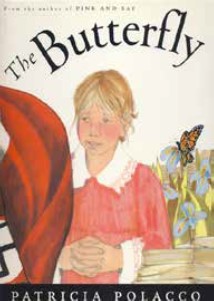
The Butterfly by Patricia Polacco
What is especially interesting is that there are also well-crafted picture books set during the war that can be appreciated by younger children. In The Butterfly by Patricia Polacco (2000), Monique, a young girl living in Nazi-occupied France, discovers that her mother, unbeknown to her, has been sheltering a little Jewish girl in their house. The eventual discovery of the Jewish girl leads to a dangerous journey at night to take her to another refuge. Polacco’s illustrations are hauntingly evocative and capture clearly the emotions of her young protagonists. The book can easily be read to a child as young as six years old
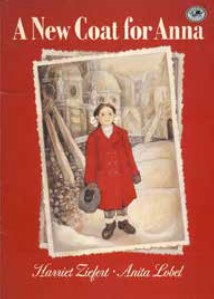
A New Coat for Anna by Harriet Ziefert; illustrated by Anita Lobel
A New Coat for Anna, written by Harriet Ziefert and illustrated by Anita Lobel (1986), would appeal to an even younger child. The story is set after the war has ended, but people still have to cope with the shortage of food and goods of any kind. As Anna needs a coat for the winter, her mother uses her ingenuity to exchange various treasured items for, first, the wool and then the workmanship necessary to bring about the coat. It is a moving story of a mother’s love and perseverance during the difficult postwar period. The first few pictures capture the bleakness of Anna’s landscape just after the war, and the mother’s somewhat anxious face is contrasted against Anna’s more carefree expression.
Apart from simply being stories poignantly told, such picture books also help younger readers gain an understanding of the impact the war had on the lives of children like themselves. Sadly, the search for books set during the war specifically in Singapore and generally in Southeast Asia indicates that this broad range is missing. There are some books suitable for teenagers, a handful suitable for children, and hardly any for young children. Almost all the books are autobiographies or biographies. Therefore, there appears to be a dearth of children’s fiction depicting the war in this part of the world.
The Historian’s Viewpoint
The lack of interest in WWII is not new to historians, who have noted that, compared with Europe, there was “a relative absence of public commemoration of the war in this region” (Lim & Wong, 2000, p. 1). Historian Wang Gungwu pointed out that the “world-wide coverage of the fiftieth anniversary of VE [Victory in Europe] Day and VJ [Victory over Japan] Day in 1995 produced little response in the region” (2000, p. 12). Unsurprisingly, then, while WWII was well documented in Europe, the situation was quite different in Asia. Wang also found that “some dramatic personal experiences did go on record, and some novels and short stories were set during periods of Japanese Occupation, but they were few” (2000, p. 11). Lim Pui Huen Patricia found that 50 years after the war, only about “50-odd volumes” of autobiographies and memoirs of the war had been written by members of the local population of Peninsular Malaysia and Singapore (1995, p. 121). While more autobiographies have surfaced in the intervening years, there has not been a significant increase.
Intended Audience
Among this relatively small number of autobiographies, few were written with the child reader in mind; they were mostly for the general public. Even though many of the writers were children at the time of the war, they wrote about their childhood memories of the war as adults looking back upon their childhood, so that the child protagonist is seen through the eyes of the adult narrator. Most writers who expressed the hope that their memoirs would enable young readers to better understand this period of Singapore’s history appear to have written for readers aged approximately 14 and above. This is seen in Diary of a Girl in Changi (1941–1945) by Sheila Allan (1994, 2004), Rosie’s War: Escape from Singapore 1942 by Rosalind Sharbanee Meyer (2007), In the Grip of a Crisis by Rudy Mosbergen (2007), A Cloistered War: Behind the Convent Walls During the Japanese Occupation by Maisie Duncan (2004), and Escape from Battambang: A Personal World War II Experience by Geoffrey Tan (2001).
While these books are certainly valuable accounts of the war years, they may not be books that the child would choose to read, simply because their intended audience is not the child reader. Who the author writes for will naturally affect the way the story is told.
Take, for example, The Upstairs Room (Reiss, 1972) and Rosie’s War: Escape from Singapore 1942 (Meyer, 2007). Both books are based on the writers’ true experiences – Jewish girls who had to flee their homes during the war – and both are first-person narratives.
Rosie’s War: Escape from Singapore 1942 by Rosalind Sharbanee Meyer
However, in Rosie’s War, the narrator is the adult recalling how she felt as a child, and her reminiscences are coloured by her adult reflections on her childhood feelings and experiences. Recalling the home in which she lived before the war, she comments: Sometimes it is better to keep the memories intact, safe, buried deep in the heart, to pull out occasionally to savour and polish. Somehow the older I get, the more I appreciate those happy times before the war, even though it was after that we became what I termed ‘well off’… .(p. 56)
This is the adult Rosie trying to make sense of her childhood experiences. In contrast, one does not sense of the intrusion of the adult self upon the child protagonist in The Upstairs Room. The writer returns to the time when she was a child, and tells the story through the voice of Annie, the child narrator, who has just begun to realise what having to be confined to a tiny room for an indefinite period of time entails:
Unhappily I looked out of the window. ‘You’re lucky you can stay in today,’ Dini said.
‘It’s awful out. I wish I could stay up here with you.’ But right after she said that she
left – to go to school. I’d even go to school and like it, if I could get out. (p. 47)
The viewpoint is from Annie the child, for whom the frustration of being cooped up overshadows the danger of discovery. It would appear that Johanna Reiss made a conscious decision to write her story for children, while Rosalind Sharbanee Meyer chose to write her story for the general reader.
The Voice of the Child
To further illustrate this point, it would be helpful to briefly look at the books of Japanese-American writer Yoshiko Uchida. During WWII, although she was an American citizen, Yoshiko Uchida was interned together with other Japanese-Americans of their Japanese ancestry. She wrote about this experience in both adult and children’s books. In her autobiography, Desert Exile: The Uprooting of a Japanese-American Family (1982), she writes as an adult looking back upon her life.
In The Invisible Thread (1991), however, she writes for children, beginning with the time when she was a six- year-old until her incarceration during WWII. Yoshiko Uchida chose to write about her experiences for two separate audiences, and tailored her stories accordingly.
Similarly, in her children’s fiction, the decision to speak through a child protagonist is clearly a conscious one. Although she was an adult when she was interned, in order to write for children about her experiences, she created the character of 11-year-old Yuki Sakane in Journey to Topaz (1971) and in the follow-up book Journey Home (1978). The stories are told through the eyes of Yuki, the child protagonist.
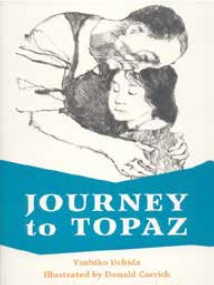
Journey to Topaz by Yoshiko Uchida
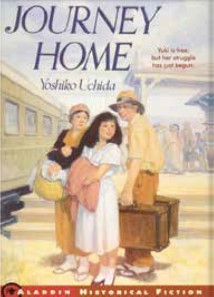
Journey Home by Yoshiko Uchida
The Child Reader as Intended Audience
There are, however, only a handful of autobiographies set in Singapore during WWII that are written specifically for children. These include Aishabee at War: A Very Frank Memoir by Aisha Akbar (1990), From Farm & Kampong by Dr Peter H. L. Wee (1989), A Young Girl’s Wartime Diary by Si Hoe Sing Leng (2007), Sunny Days of an Urchin by Edward Phua (1996) and Papa as a Little Boy Named Ah Khoon by Andrew Tan Chee Khoon (2007).
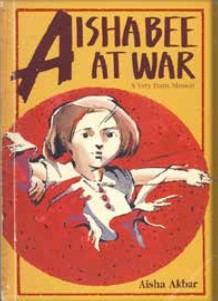
Aishabee at War: A Very Frank Memoir by Aisha Akbar
Of these, Aishabee at War is arguably the most successful. It is a lively account of the author’s life between 1935 (the war started in 1939) and 1945, filled with the details that a child growing up into a teenager would note. Thus, on the one hand, her account is of a childhood much like any other: She writes, for instance, of her struggle to establish a place for herself as the youngest member of a large family, and how she found solace in reading and music. But, on the other hand, it is also a fascinating account of a child living in unusual times. The details of history are woven into the fabric of the story, and revealed through the story, rather than through authorial intrusion.
Aisha Akbar shows an awareness of her intended child audience, stating in the book’s preface that her autobiography is “a true account, as far as I can remember, of the events before the war, and up till 1945, as seen through the eyes of a child”.
She writes about the war in a factual, unsentimental way, sometimes finding humour even in dark situations. She recalls the somewhat surrealistic response of her neighbours to the bombing of Singapore:
I hung about the fringe of the crowd, trying to determine what was going on, but
I soon realised that they knew no more than I did. That did not stop them from
voicing their opinions, and there were all sorts of speculations. The word I heard
most often was ‘war’, and it seemed strange to me that if they really did believe we
were at ‘war’ no one had thought of turning off the lights. The whole of Singapore
was lit as for a carnival, and the atmosphere was electric with excitement. (p. 74)
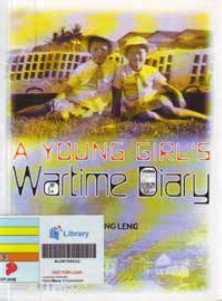
A Young Girl’s Wartime Diary by Si Hoe Sing Leng
A Young Girl’s Wartime Diary contains the diary entries of the writer from 1942 to 1945. However, as the writer chose to arrange her entries thematically rather than chronologically, her account lacks narrative strength, and the reader has to piece together the overall picture of the events unfolding in the book. There is also a rather jarring shift in perspective, from the adult authorial introduction to each section to the subsequent diary entries of the young author. Nevertheless, the book gives a genuine glimpse into the thoughts and feelings of a girl living in Singapore during the war.
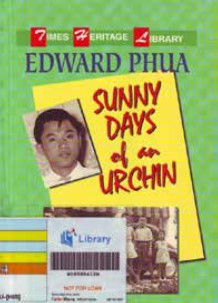
Sunny Days Of an Urchin by Edward Phua
Edward Phua’s Sunny Days of an Urchin has a stronger narrative that stretches from the start of the war to the author’s schoolboy experiences under the British Military Administration. Although the style of writing is not as elegant as Aishabee at War, the book is peppered with interesting details of the author’s childhood. His account testifies to the sheer ingenuity shown by his family members in creating ways to cope with the shortages of food and basic necessities during the war. His nanny, for example, devised a way of growing padi (Malay for “unmilled rice”) in their backyard as a means of supplementing their meagre supply of rice. Having done that, they then had to come up with equally ingenious means of keeping the birds away and harvesting the rice. There is a sense of free-spiritedness in the book which is echoed in From Farm & Kampong and Papa as a Little Boy Named Ah Khoon.
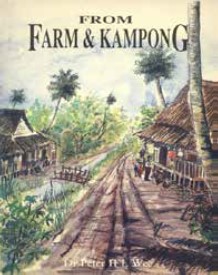
From Farm & Kampong by Dr Peter H. L. Wee
In From Farm & Kampong, Peter Wee takes the reader back to the start of the war, when he was about three years old, till his entry into the University of Malaya’s Faculty of Medicine in Bukit Timah in 1957, a span of 16 years. Like Sunny Days of an Urchin, From Farm & Kampong testifies to the resilience shown by the local population in coping with the sudden changes to their lifestyles. Wee speaks appreciatively of his father’s readiness to buckle down to farm work:
Work was hard and harsh, rest was a luxury, but Dad accepted his spartan life with
calm fortitude. Any other man from Katong would perhaps have found it impossible
to sustain such a life for any length of time, but the necessity of feeding six mouths" maintained Dad’s resolve. He did not give up. (p. 21)
For the whole family, life soon changed from the “cultured, middle-class and English-educated urban ways” to the “harsh exigencies of farm life” (p. 23). However, Wee also notes that their farm life did have its own rewards; he and his brothers soon became much more acquainted with nature: “Each discovery was precious to a child and remained with him.” (p. 25)
Wee has thoughtfully included black-and-white drawings of the two villages he lived in, – which is especially helpful, as Kampong Amber no longer exists, and the other, Chia Keng Village, has changed substantially.
Similarly, Papa as a Little Boy Named Ah Khoon by Andrew Tan Chee Khoon – a record of the author’s childhood from 1943 to 1953 – includes black-and-white illustrations that help readers bridge the gap between the Singapore of the 1940s and 1950s and the Singapore of today. Like From Farm & Kampong, the war occupies the first part of Papa as a Little Boy Named Ah Khoon.
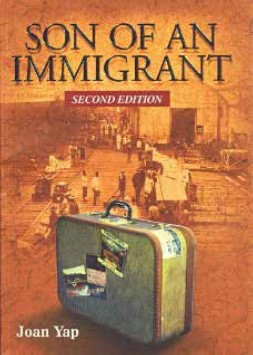
Son of an Immigrant by Joan Yap
Thus, while there are a handful of noteworthy autobiographies for children set during the war, there does not seem to be any book of fiction. The closest example would be the fictionalised biography, Son of an Immigrant, by Joan Yap, which is based on the real life story of a barrister, Lui Boon Poh. The story begins in Batu Pahat, a small town in then Malaya, where the narrator, Ah Di, was born. As the Japanese soldiers march down through Malaya, Batu Pahat is bombed and, in one fell swoop, Ah Di loses his parents and his brother-in-law. He and his elder sister then have to fend for themselves in Japanese-occupied Malaya. But they find that their relatives are unwilling to house them, leaving the 12-year-old Ah Di frustrated and angry:
I hated the murderous Japanese, the ungrateful relatives, my father for leaving us and, most of all, myself for not being able to care for my sister and her son. I was full of fear and hatred. (p. 32)
Ah Di soon discovers that war brings out the best and the worst in people: Ironically, it is the very family that Ah Di’s mother had looked down upon who come to their rescue. With Auntie Khoo’s help, Ah Di becomes a street vendor selling cigarettes on the black market “created and supported by corrupt Japanese officials and collaborating local merchants” (p. 39). Like many other people during the war, Ah Di finds himself learning to just live each day as it comes, with fear never very far away:
Each morning, I was glad to be alive and each night after my dinner, I was grateful for a safe and peaceful day. …. There were many nights when I cried myself to sleep thinking of Father and the hopelessness of my country. (p. 43)
After the war, the story shifts to Singapore as Ah Di leaves Batu Pahat to find work on the island. The war setting occupies only six of its 28 chapters; hence, the story is less centred on WWII than the tale of a young man’s courage to pursue his dream.
Malaysia
There are two books of fiction set in Malaysia: All Our Yesterdays by Stuart Buchan (1987) and Biggles in Borneo by W. E. Johns (1943, 1960). Both books can be found in the Asian Children’s Collection.
In Biggles in Borneo, Biggles is a typical action hero: a fighter pilot heading a squadron of capable pilots and navigators. He is compassionate, a good strategist, and able to keep a level head. The book is laced with witty humour, especially in the conversations between Biggles and his crewmates. The story takes place on the island of Borneo and in Peninsular Malaya, and Johns is able to create a realistic setting for both. The Japanese are the typical baddies and sometimes referred to as “yellow”, which, of course, would not be appreciated by the Chinese. That aside, the book is interesting and maintains a good pace.
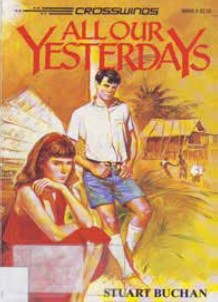
All Our Yesterdays by Stuart Buchan
All Our Yesterdays focuses more on the protagonists’ efforts to return to a normal life after the war. The story centres on 15-yearold Julie’s return to her father’s home in Kuala Lumpur, 10 years after WWII. Evacuated to England with her mother, Julie ends up in a boarding school after her mother dies. In the meantime, her father is sent to a prison camp in Singapore, where conditions are very harsh and many people die. Upon the surrender of Japan, her father is freed, and he is devastated to learn of his wife’s death and decides to leave his daughter in England for the time being. Julie ends up staying in England until she is 15.
Upon Julie’s return, she finds her father distant, and feels cut off from his and her aunt’s world, because she was not interned as they were. She longs for acceptance and tells them:
“I want you to respect my life, too. This is the only life I have. I didn’t make the war,
and now that it’s over, all any of you want to think about is the past and the war.”
(p. 132)
Her words bring her aunt, Spider, to a realisation: “We’re all locked in another prison now just as much as we were in the camp. Our memories have imprisoned us.” (p. 133)
But, for Spider, letting go of the memories is even more difficult:
“It must count for something! Do you see that? It must all count for something.
Otherwise…
Otherwise all life had no meaning, everything was just a child’s game, win or lose.”
(p. 140)
Buchan wants us to sympathise with the characters in the book. They are innocent bystanders, and each has to cope with what has happened in the war. Julie and her mother’s experiences show that those who return to England do not necessarily have a better time, having to cope with a separated family, the rationing and bombing in England. For those who survive the prison camp, forever etched in their minds are the memories of the torture, the inhumane treatment at the hands of other humans, and the memory of those who died, so much so that people like Spider, in their desire to see some meaning in the terrible events that have unfolded, cannot let go of the haunting memory.
The book shows that there may not be any easy solution for war survivors. Most people wish for the war to be over, so that they can return to normal life. But some of them find that life has changed, and coming to terms with how the war has affected them takes more than they expect. However, it is a pity that there is only one copy of this book in the Asian Children’s Collection, as it is a story that readers aged 11 and above, and especially girls, would enjoy.
Indonesia
The Way of a Boy: A Memoir of Java by Ernest Hillen (1993, 1995) and Disguised: A Wartime Memoir by Rita la Fontaine de Clercq Zubli (2001, 2007) are both about the Dutch interned in prison camps during WWII.
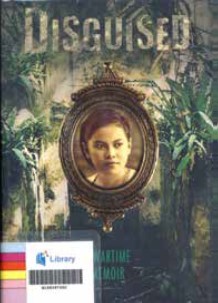
Disguised: A Wartime Memoir by Rita la Fontaine de Clercq Zubli
Disguised: A Wartime Memoir was first published in 2001 by Southfarm Press, and then republished in 2007 by Candlewick Press when the book, by then out of print, was discovered by an editor from the latter. Rita and her family are Dutch Indonesians who were interned during WWII. The memoir recounts how, fearing for Rita’s safety, her family persuaded her to disguise herself as a boy. Not only did Rita successfully carry off the disguise, but as 12-year-old Ricky, she learnt enough Japanese to be a translator for the camp commandant, enabling her to speak up for her fellow prisoners when necessary.
Disguised: A Wartime Memoir is a good example of an autobiography written for older children, as the voice of the narrator is a 12-year-old Rita. The book is readable because of its strong story line. The writer’s concern is with telling her story, and she has skilfully woven historical details into the story. At the same time, the inclusion of a map showing the Dutch Indies in 1942 compared with the Indonesia of today, and a glossary of Dutch, Japanese and Malay-Indonesian words, shows the awareness of the help that contemporary readers may need in visualising events that took place so many years ago.
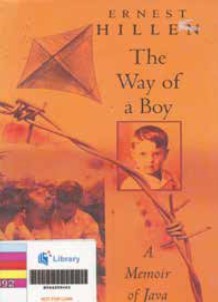
The Way of a Boy: A Memoir of Java by Ernest Hillen
The Way of a Boy: A Memoir of Java was not published as a children’s book. Yet, it could arguably be a children’s book, as throughout the story, the writer, Ernest Hillen, writes in the voice of the young Ernest. The author writes as if he were again a child reliving the experience, incorporating lively details of what he heard, smelled and observed, thus enabling the reader to picture quite clearly what the writer must have experienced as a young boy growing from childhood into early adolescence, completely surrounded by only women and other children in the camp.
Ernest Hillen also captures poignantly the fear he felt, that they “would always be prisoners” (p. 102):
The Japanese held us, I said, and they weren’t going to let us go. Otherwise, why
hadn’t they done so already? Why had they even picked up women and children?
We weren’t men, we couldn’t fight them. No, they kept us in camps because they
liked it. … We were being punished because they thought we were bad, and they
were going to keep on punishing us. They would always think we were bad; we
would never leave the camp. (p. 102).
Hillen tells his friend, Ankie, who is older than him, that he has come to the point where he begins to feel “guilty about just about everything” (p. 103). Ankie understands his confusion, telling him that “she thought that perhaps many people felt this guilt. She did sometimes. But she was sure it wasn’t right” (p. 104). Through this recollection, the writer shows us how vulnerable the prisoners of war, especially the children, were. The book is a vivid portrayal of life for a child prisoner of war.
The Philippines
Two books set in the Philippines during WWII are Barefoot in Fire: A World War II Childhood by Barbara-Ann Gamboa Lewis (2000, 2005) and Secret Mission to the Philippines: The Story of “Spyron” and the American- Filipino Guerillas of World War II by William Wise (1968).
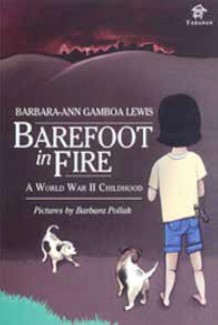
Barefoot in Fire: A World War II Childhood by Barbara-Ann Gamboa Lewis
Barefoot in Fire is a lively account of how a local family coped during the war in Manila, as seen through the eyes of 10-year-old Pooh. Although her family was unlike other families around them because her mother was a ‘white’ woman married to a Filipino, and so the children of a mixed race, this difference was not much of a factor during the war, as everyone had to struggle to survive. We also see how Pooh’s family did what they could to help the resistance fighters, and how they had to cope with homelessness and poverty during the war.
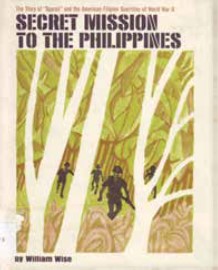
Secret Mission to the Philippines by William Wise
Secret Mission to the Philippines tells the story of how Commander Charles Parsons, an American who had worked and lived a long time in the Philippines, helped coordinate guerrilla activities in the Philippine islands through a secret organisation named “Spyron”, a portmanteau derived from the words “spy squadron” (p. 75). The book is well-written and a page-turner. The courage and determination shown by Charles is all the more remarkable, as this is a true story.
The story also shows Charles’s awareness of the humanity of the people caught in the fight for freedom, people willing to give up their lives, and even those of their family, and yet who long for simple necessities such as toilet soap (p. 136).
There is also the awareness that success is not gained without some sacrifice: Charles’s mother-in-law, Mrs Blanche W. Jurika, was executed by the Japanese for her involvement in guerrilla activities. But her only crime was that of being his mother-in-law (p. 153).
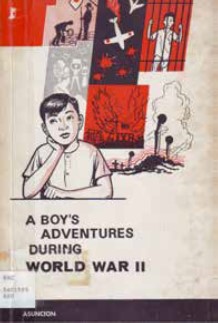
A Boy’s Adventures During World War II by Ampara R. Asuncion
Another noteworthy book is A Boy’s Adventures During World War II by Ampara R. Asuncion (1977). This book is distinct from most of the others discussed here, as it is suitable to be read to children of about six years of age. Berto, the narrator, is a 10-year-old boy living in Manila when the Japanese start bombing the city. The family decides to flee Manila, but along the way, Berto gets separated from his parents. However, he meets a couple who are fleeing to the swamps and they take him with them. Berto discovers that many people have fled to the swamps and have set up a camp there.
His description of life in the refugee camp shows how the people band together to help one another survive by living as one community. The story is told in simple sentences, as if a child is speaking aloud. Yet, the story is well told and succeeds in narrating Berto’s life over the three years of Japanese occupation.
The ending, when Berto is reunited with his parents, is quite moving. The writer tackles simply and sensitively the more difficult themes of suffering and fear. He also tactfully handles questions that Berto and his community have to grapple with, such as why God would allow such cruelty to continue. The Filipinos are depicted as a God-fearing people whose faith enables them to find strength in God. The tone throughout is not one of bitterness, but one of acceptance, that the only thing Berto can do is to try his best to look forward to a better time. The writer’s ability to deal with such complex ideas successfully demonstrates that such themes are possible in a book for children if dealt with appropriately. The dominance of the Americans in the lives of the Filipinos distinguishes these two accounts from the books set in Indonesia, in Singapore and in Malaysia. It is a reflection of how the different colonial powers played a major part in shaping these Southeast Asian nations.
Conclusion
One of the obvious conclusions that can be drawn from these books is that, while some efforts have been made to capture true experiences during WWII in autobiographies for children, little has been done in terms of creating children’s fiction set during this period. Similarly, little effort has been made to cater to the young child: apart from books such as A Boy’s Adventures During WWII, most of the other books are for children with a fairly good reading stamina. It is hoped that, with time, there will be more children’s fiction depicting this period of history, as well as other significant periods in the history of this region.
Indeed, there is a need for more interest in local children’s books as a whole. While more recognition is being given to the need to support local children’s writers with schemes such as the First-Time Writers and Illustrators Publishing Initiative – organised by the Media Development Authority of Singapore and the National Book Development Council of Singapore – it is still difficult for local children’s writers to break into the market. Not only do they have to contend with cost issues arising from the relatively smaller local market, their books also have to compete with books from the UK, America and Australia, whose books dominate the local market. Given that these countries have benefited from a much longer history of the art of publishing for children, it is little wonder that local children’s books can easily be eclipsed. However, as pointed out by Dr Sandra Williams, Singapore can take heart from the example of other “English-speaking countries with even smaller populations, such as the Republic of Ireland” that have “succeeded in developing a distinct literature for their children” (2006, p. 113).
Thus, as well-known local writers such as Lee Tzu Pheng and Edwin Thumboo have noted, there is a need for more support for local English literature. The need is not just for suitably talented Singaporeans to write literature for Singaporeans, but also for other Singaporeans to be willing to read their works, so as to bring about “a literature of our own of such quality and significance that we regard it as a substantial part of our national identity” (Lee, as cited in NLB, 2005b, p. 2). The need for a national literature was eloquently expressed by Margaret Atwood in 1972 in Survival: A Thematic Guide to Canadian Literature:
Literature is not only a mirror; it is also a map, a geography of the mind. Our literature
is one such map, if we can learn to read it as our literature, as the product of who
and where we have been. We need such a map desperately, we need to know about
here, because here is where we live. For the members of a country or a culture,
shared knowledge of their place, their here, is not a luxury but a necessity. Without
that knowledge we will not survive. (p. 19)
She also warned that if “a country of a culture lacks such mirrors, it has no way of knowing what it looks like; it must travel blind” (p. 16). We need our own literature, too – in this case, concerning WWII – so that we may navigate this significant period of history, which saw the highest death rates in the history of Singapore; so we can better understand how and why those three years “generated racial tensions, poverty, corruption, and a whole host of social evils” while at the same time helping to define the meaning of “home“ for Singapore’s migrants (Lee, 2005, p. 333). Good fiction for children set during this period will not only help fill the void in this area, but will also go some way in helping to build up the corpus of Singapore literature for children.
The author wishes to acknowledge the contributions of Dr Sandra Williams, Senior Lecturer, School of Education, University of Brighton, in reviewing the paper.
References
Aisha Akbar, Aishabee at War: A Very Frank Memoir (Singapore: Landmark Books 1990). (From National Library Singapore, call no. RSING 959.57022 AIS-[HIS])
“An Introduction” in War and Memory in Malaysia and Singapore, ed. P. Lim Pui Huen and Diana Wong (Singapore: Institute of Southeast Asian Studies, 2000), 1–8. (From National Library Singapore, call no. RSING 959.503 WAR)
Andrew Tan Chee Khoon, Papa as a Little Boy Named Ah Khoon (Singapore: Ring of Light Publishers, 2007). (From National Library call no. RSING 959.5704092 TAN-[HIS])
Anne Frank, The Diary of a Young Girl, trans. S. Massotty. (London: Penguin Books, 1997)
Barbara Gamboa Lewis, Barefoot in Fire: A World War II Childhood (Manila: Tahanan Books, 2005). (From National Library Singapore, call no. RAC 959.9035092 LEW)
Diana Wang, “Memories of War: World War II in Asia,” in War and Memory in Malaysia and Singapore, ed. P. Lim Pui Huen and Diana Wong (Singapore: Institute of Southeast Asian Studies, 2000), 11–22. (From National Library Singapore, call no. RSING 959.503 WAR)
Edward Phua, Sunny Days of an Urchin (Singapore: Federal Publications, 1996). (From National Library Singapore, call no. RSING 959.5704 PHU)
Ernest Hillen, The Way of a Boy: A Memoir of Java. (New York: Penguin Books, 1995)
Geoffrey Tan, Escape From Battambang: A Personal WWII Experience (Singapore: Armour Publishing, 2001). (From National Library call no. RSING 940.54815957 TAN)
Harriet Ziefert, A New Coat for Anna (New York: Dragonfly Books, 1986)
Ian Serraillier, The Silver Sword (London: Heinemann Educational Books, 1957)
Jacob Glatstein, Emil and Karl, trans. Jeffrey Shandler (New Milford, Connecticut: Roaring Book Press, 2006). (Original work published in Yiddish 1940)
James Riordan, Escape from War (London: Kingfisher, 2005)
Joan Yap, Son of an Immigrant (Singapore: Joan Yap, 2007). (From National Library Singapore, call no. YAP)
Joanna Reiss, The Upstairs Room (England: Puffin Books, 1979). (Original work published 1972)
Judith Kerr, When Hitler Stole Pink Rabbit. (London: Collins, 1998)
Lee Geok Boi, The Syonan Years: Singapore Under Japanese Rule 1942–1945 (Singapore: National Archives of Singapore and Epigram, 2005). (From National Library Singapore, call no. RSING q940.53957 LEE)
Lois Lowry, Number the Stars. (New York: Yearling, 1989)
Maisie Duncan, A Cloistered War: Behind the Convent Walls During the Japanese Occupation (Singapore: Times Editions, 2004). (From National Library Singapore, call no. RSING 940.5425092 DUN)
Margaret Atwood, Survival: A Thematic Guide to Canadian Literature. (Toronto: Anansi, 1972)
Michael Morpugo, Friend or Foe. (London: Egmont Books, 2001)
Michael Morpugo, Waiting for Anya. (London: Egmont Books, 2001)
P. Lim Pui Huen, “Memoirs of War in Malaya,” in Malaya and Singapore During the Japanese Occupation, ed. Paul H. Kratoska (Singapore: Journal of Southeast Asian Studies, 1995), 121–47. (From National Library Singapore, call no. RSING 940.5425 MAL)
Patricia Polacco, The Butterfly (New York: Philomel Books, 2000)
Peter H. L. Wee, From Farm & Kampong (Singapore: Graham Brash, 1989). (From National Library Singapore, call no. RSING 959.57 WEE)
Rita la Fontaine de Clercq Zubli, Disguised: A Wartime Memoir (Cambridge, Massachusetts: Candlewick Press, 2007). (From National Library Singapore, call no. RAC 940.53161 CLE)
Rosalind Sharbanee Meyer, Rosie’s War: Escape from Singapore 1942 (Darlinghurst, NSW: Sydney Jewish Museum, 2007). (From National Library Singapore, call no. RSING 959.5704092 SHA)
Rudy Mosbergen, In the Grip of a Crisis: The Experiences of a Teenager During the Japanese Occupation of Singapore, 1942–45 (Singapore: Printed by Seng City Trading, 2007). (From National Library Singapore, call no. RSING 940.54815957 MOS)
Sandra J. Williams, An Annotated Bibliography of Singapore Children’s Books (Singapore: National Book Development Council of Singapore, 2006). (From National Library Singapore, call no. RCLOS 015.5957062 WIL)
Sandra J. Williams, “The Struggle To Develop a Distinctive Children’s Literature in Singapore,” New Review of Children’s Literature and Librarianship 2, no.1 (2006): 103–15.
Sheila Allan, Diary of a Girl in Changi, 1941–45, 3rd ed. (Australia: Kangaroo Press, 2004). (From National Library Singapore, call no. RSING 940.547252092 ALL)
Si Hoe Sing Leng, A Young Girl’s Wartime Diary (Singapore: Lingzi Media, 2007). (From National Library Singapore, call no. RSING 959.5703 SIT)
Singapore. National Library Board, Asian Renaissance: The Singapore and Southeast Asian & Asian Children’s Collection Guide (Singapore: National Library Board, Publishing & Research Services, 2005). (From National Library call no. RSING 025.21095957 ASS)
Singapore. National Library Board, Singapore Children’s Literature: An Annotated Bibliography (Singapore: National Library Board, 2005). (From National Library Singapore, call no. RSING 015.5957 SIN)
Stuart Buchan, All Our Yesterdays. (New York: Crosswinds, 1987)
Yoshiko Uchida, Journey to Topaz (Berkeley, California: Heyday Books, 1971). (From National Library Singapore, call no. Y UCH)
W. E. Johns, Biggles in Borneo (Leicester: Brockhampton Press, 1960). (Original work published 1943)
Yoshiko Uchida, Journey Home (New York: Aladdin Paperbacks, 1978)
Yoshiko Uchida, Desert Exile (Seattle: University of Washington Press, 1982)
Yoshiko Uchida, The Invisible Thread (New York: Beechtree, 1991)