
Article
On the Waterfront: The Building of Singapore’s First High-rise Skyline, 1918–1928
Topics
History
1 April 2015
The 1920s in Singapore were an upbeat time, an era of optimism, energetic growth and expanding horizons, the economic recessions of the early 1920s notwithstanding.
When you come to Singapore the whole place seems so new, so very George the Fifth.
Up, overhead, seaplanes circle; opposite the wharves is a brand-new railway station; you
roll into town along a road both sides of which implore you not to be vague but to order
Haig, or to try somebody’s silk stockings or somebody else’s cigarettes; the streets are full
of motor traffic; most of the big buildings are quite new; and if you are English, you get an
impression of a kind of tropical cross between Manchester and Liverpool.
— Roland Braddell, The Lights of Singapore, 1934 —
Lee Kong Chian Fellowship
November 2009 – April 2010
Research Paper
Introduction
The genesis of my Lee Kong Chian research project dates back half a century to a book I gave my grandmother for her birthday in 1960, when I was four years old. My grandmother died in 1967, whereupon the book passed to my mother, and when she in turn died some five years ago, the book came back to me. What was this book? A slim volume, just 76 pages, entitled, Singapore – City of the Lion, written by Joanna Moore, with photographs by Kathinka Fox.1 City of the Lion was published in 1960 — the year that I gave it to my grandmother — and leafing through its pages I learned that Singapore back then was “situated at the sea and air crossroads of South-East Asia and is one of the greatest and most important junctions of ocean and air traffic in the world, … a natural port of call for ships and aircraft serving western routes from Britain, Europe, Africa and India, eastern routes from America, Japan, the Philippines and China, and southern routes from Australasia and Indonesia” (Moore & Fox 1960: 2). Then, as now, “Singapore’s raison d’être [was] trade and industry, with agriculture and fishing making only a minor contribution to its wealth” (Moore & Fox 1960: 28). “One of the greatest entrepôt ports in the world,” Singapore in 1960 was also “an important link in the international radio and submarine cable network” (Moore & Fox 1960: 8, 11). The population back then stood at 1.5 million, most of whom lived and worked within the city area, but plans were in progress to relocate part of the latter population to satellite towns outside the city where “the housing estates and flats erected by the Singapore Improvement Trust [the colonial forerunner of today’s Housing Development Board] … are among the finest examples of planning and design in the world” (Moore & Fox 1960: 8-9). In short, Singapore, fifty years ago, was “a great, prosperous modern city,” whose success was built on “trade and commerce, banking and insurance, shops and markets” (Moore & Fox 1960: vii; 11).
![Singapore – City of the Lion, Joanna Moore and Kathinka Fox (1960) [JD].](https://isomer-user-content.by.gov.sg/339/e0fdccaf-1b43-4ddc-9ff4-c0e3801b9745/Fig 1_Singapore – City of the Lion,.jpg)
Singapore – City of the Lion, Joanna Moore and Kathinka Fox (1960) [JD].
All of this sounds pretty impressive and not a little unlike the sort of thing that might be written about the Singapore of today. When it came to modern high-rise architecture, the 20-storey Asia Insurance Building (completed in 1955) down on the waterfront was the tallest building in South East Asia, while the Bank of China on Battery Road, which came in at 18 storeys, was not that far behind.2 Like today, the port was one of the busiest in the world, while the recently-opened airport at Paya Lebar (1955) was celebrated as the very best in the region and a landmark in tropical Modernist architecture. Cutting-edge skyscrapers, a premier port, an up-to-the-minute airport, modern housing estates and apartment blocks; one has to be old enough to recall the over-crowded slums of Chinatown and the fetid Singapore River, to fully appreciate just how far the city-state has progressed in the last half century.
![Asia Insurance Building, Ng Keng Siang (1954) [Skyscrapercity]](https://isomer-user-content.by.gov.sg/339/995d546f-816c-4bd9-8005-45a5d17bc614/Fig 2_Asia Insurance.jpg)
Asia Insurance Building, Ng Keng Siang (1954) [Skyscrapercity].
![Bank of China, Palmer & Turner (1954) [John Irwin]](https://isomer-user-content.by.gov.sg/339/2499fd34-465c-4655-8f94-b63d9647032b/Fig 3_Bank of China1.jpg)
Bank of China, Palmer & Turner (1954) [John Irwin].
![Singapore Improvement Trust flats, Tiong Bahru (1958) [NAS]](https://isomer-user-content.by.gov.sg/339/5847f033-cf8a-41ea-8454-b69782501b7a/Fig 4_Singapore Improvement Trust flats.jpg)
Singapore Improvement Trust flats, Tiong Bahru (1958) [NAS]
Nevertheless, the perception of Singapore as a “prosperous, modern city” back in 1960 got me thinking. Just when exactly did Singapore become ‘modern’, as opposed to merely ‘flourishing’, ‘thriving’, ‘successful’ and all the other upbeat, positivistic adjectives that have been attached to the name ‘Singapore’, almost since Raffles first stepped ashore here back in 1819? For some, of course, it is that very moment, which marks the beginning of modern Singapore: “Sir Stamford Raffles, founder of modern Singapore …” is how the man is typically presented in the history books. But since the term ‘modern Singapore’ as used in this context is evidently quite different to Moore and Fox’s “prosperous, modern city”, we clearly need to tighten up our definition of what is meant by the word ‘modern’ before proceeding any further.
Defining Modernity
The word ‘modern’ derives from the Old French moderne, and first entered the English language around the seventeenth century. Naturally, with such a long history, modern has come to acquire a multiplicity of meanings, some current, some archaic, and some plain moribund. A perusal of the academic literature on the subject is not especially helpful here in that there are literally dozens of competing definitions of what it means to be modern. Historian, sociologist, art critic, philosopher of science: each of them has defined the term modern in their own way, not uncommonly to suit a specific theoretical agenda that they wished to advance. Renaissance Italy, Copernicus and Galileo, the European Enlightenment, the Industrial Revolution, the French Revolution, Paris in the early twentieth century — the advent of the modern era can be found, it seems, in many places and across a wide arc of time.
For my part, what I am talking about here is more an idea of modernity, as opposed to something that is simply of its time. This understanding of modernity has its origins in the same basic set of historical circumstances that gave rise to the modern era in the historian’s sense of the term — the industrial revolution and an accompanying move to the city; the emergence of market- or capitalist-led economies; the creation of the modern centralised state and its attendant bureaucracies — but it is more of a cultural phenomenon, one that extends beyond these historical contingencies to embrace a set of ideas and aspirations which have to do with the betterment of mankind — in a word, progress. Like modernity, the idea of progress in the West has ancient roots, but by the late nineteenth century there was a widespread assumption that the future well-being of mankind would be contingent upon continued advances in the realm of the sciences and engineering. Social and political reforms were equally a part of this scheme of things, of course, but it was the triumphs of engineering — Crystal Palace, Victorian railway stations, Brunel’s steamships, the Flatiron Building in New York, the Firth of Forth Bridge — which particularly captured the imagination and which came to symbolise the idea of progress in the late Victorian age.
Of course, modernity involves much more than simply building railway bridges; it is an ideological stance that rejects tradition, historicism, and received ideas about the way things are, in favour of a secularised, rational engagement with the world, based on scientific principles, the ultimate aim being to liberate mankind from the slough of ignorance and superstition. As Baudrillard observes, modernity conceived thus, “is neither a sociological concept, nor political concept, nor exactly a historical concept. It is a characteristic mode of civilization” (1987: 3).
This understanding of modernity is particularly associated with the early decades of the twentieth century, when advances in industry, technology and the sciences, accompanied by rapid social change and political reforms in the West, seemed to herald the prospect of a new era of unprecedented prosperity and personal freedoms. The First World War may have introduced the West to the horrors of mechanised killing on an industrial scale, but it was to be, so President Woodrow Wilson declared, “the war to end all wars”, and there remained, even in the postwar era, an almost millenarian belief in the beneficent qualities of science and technology. Factories and power stations; ocean liners and railway locomotives; motor cars and aeroplanes; stunning feats of engineering — highways, railway bridges and hydroelectric dams — these were all key images in the collective representation of modernity. But nothing better symbolised this brave new world than the modern city, which was at once the archetypal location of modernity in a physical sense, while at the same time providing writers, artists and above all film-makers with a rich source of imagery for the portrayal of modernity as a “mode of civilisation”, an idea that we see perhaps most brilliantly captured in Fritz Lang’s 1926 movie, Metropolis.
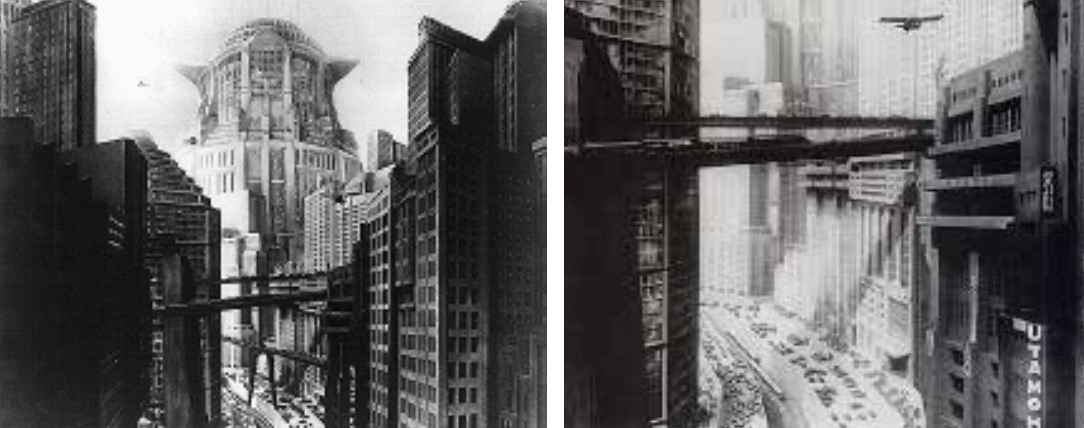
Publicity stills from Metropolis, directed by Fritz Lang, Universum Film A.G. (1926).
Singapore: The Future Made Present
As it happens, Metropolis presented a fairly bleak vision of the future, with a subterranean-dwelling proletariat, down-trodden and oppressed by a wicked oligarchy of heartless capitalists — for every Utopian vision of the future there must be, it seems, a dystopian counterpart — but generally speaking, modernity was seen in a positive light and there was little doubt in the minds of social visionaries in the 1920s and thirties — architects and engineers, politicians and policy-makers, hygienists and Futurists — that the future salvation of mankind lay in beneficent town planning and good architecture, that is to say, Modernist architecture.
![Ludwig Hilberseimer, Perspective of North-South Street, Highrise City (1924) [AIC]](https://isomer-user-content.by.gov.sg/339/e6da5467-9905-41cc-8672-0aafc521cfb3/Fig 6_ Ludwig Hilberseimer.jpg)
Ludwig Hilberseimer, Perspective of North-South Street, Highrise City (1924) [AIC].
In many respects, the Singapore of today can be seen as the realisation of those Utopian dreams, a vision of the future made real. If one looks, for example, at images of Ludwig Hilberseimer’s proposal for a Highrise City of 1924,3 or Le Corbusier’s Contemporary City from 1922, or his Radiant City, two years later, the parallels between these paper Utopias of the 1920s and the urban landscape of modern-day Singapore are striking.
Multi-storey blocks of public housing laid out on an orthogonal grid with plenty of green spaces in between; broad highways for motor cars, with elevated walkways for pedestrians; mass rapid transport systems, both beneath the street and running above it ; many a modern city has some or even all of these features, but nowhere have they been implemented to such an extent and with such systemic thoroughness as in Singapore. In today’s “Tropical City of Excellence”, inner-city slums, squatter encampments and derelict urban wastelands have been consigned to the dustbin of history; we live, as Cherian George memorably put it, in “an air-conditioned nation”, where the trains run on time, the tap water is potable and every home is wired up to the Internet, not something that was even dreamt of back in the 1920s.
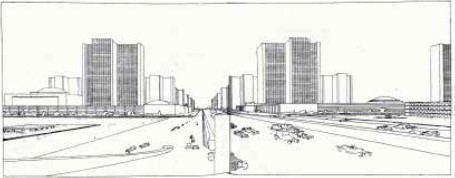
Le Corbusier, Contemporary City (1922)
And we’re not just talking about the HDB estate here. The Italian Futurist Antonio Sant’Elia, may have got no further than the drawing board with his Citta Nuova, or “New City” of 1914 — he was killed in the First World War — but it doesn’t take a great leap of the imagination to see his vision of the future fast becoming a reality in Singapore’s Central Business District and the cluster of tall buildings that are currently going up around Marina Bay.
.jpg)
Antonio Sant’Elia Citta Nuova (1914)
But how exactly did all of this come about? At what point did Singapore haul itself out of the mangrove swamps, so to speak, and get on the road to modernity? There is a popular perception that modern Singapore is almost entirely a creation of the post-independence era, and that prior to 1965, Singapore was little more than a “sleepy colonial backwater”.4 Most certainly this was not the case, as my introductory remarks have made clear, but all the same, is there a specific moment in time when one can say that Singapore became a truly modern city in the sense that Moore and Fox perceived it to be, rather than merely of its time?
Well, first we must be careful to distinguish between modernity as conceived in the West, and alternative, non-Western forms of modernity experienced elsewhere in the world. As Chua Ai Lin points out in her PhD thesis, ‘Anglophone Asians in Colonial Singapore, 1920–1940’:
In … recent years, the concept of modernity has gradually shed the Eurocentric
perspective of a homogenising, unitary trajectory. The fact that modernization
took on forms copied directly from the West is not the same as claiming that
modernity in the non-West was merely a (failed) imitation of western modernity.
What has become prominent now is the idea of ‘multiple modernities’ or ‘alternative
modernities’ based on studies of modernity outside Europe and America
(Chua 2007: 2).
Recognising this possibility of “multiple modernities” and more specifically, a distinctively Asian engagement with modernity, I return to my question, ‘When did Singapore become modern?’
One can approach this issue from a number of different angles. Chua Ai Lin, for her part, takes a look at the impact of mass media and popular culture on Singapore’s Anglophone Asian community — primarily Straits Chinese, but also English-speaking sections of the Indian and Ceylonese communities, as well as the Eurasian community — during the period between the two world wars. Motorcars and magazines, the cinema and wireless broadcasting, gramophone records and the New World, Great World and Happy World amusement parks, are the principal focus of her investigation. “In Singapore,” she writes, “it was the Anglophone Asian community that was best-poised to take up the opportunities offered by popular modernity” (Chua 2007: 238). “Their middle-class status meant they had sufficient spending power and leisure time to be active participants in consumerist modernity [while their] English-medium education gave them a strong global awareness [which] made them instinctively open to new ideas, new technologies and the wider world (even beyond the British Empire)” (Chua 2007: 238). And while “their education and multilingual upbringing gave them skills to access these diverse influences from around the world [the] new mass media offered even greater possibilities about learning new ways of doing things” (Chua 2007: 238). As a consequence, “the inter-war generation had the potential to make a more dramatic change from established practice than had previously been experienced [and it was] this openness and desire to break away from the past [that] was an important aspect of the distinctly modern identity of this group” (Chua 2007: 238).
In her thesis, Chua highlights how the cinema played an important, if not instrumental, role in introducing Singaporeans to the modern world. And certainly, there is no doubt that movies have a sensory immediacy like no other medium of communication, being capable, in this respect, of transporting their audiences through time and space to places and situations that they would ordinarily never have the privilege of experiencing. Among other things, the cinema enabled those Singaporean audiences in the 1920s and thirties to see how life was lived in London, Paris, New York, or, closer to home, Shanghai (for the average Singaporean, China’s most advanced metropolis was just as fabulous and remote as any city in West).
I specifically refer to cities here, because as I suggested earlier, it was the city, more than any other image or situation, which came to be identified with modernity as a way of life, or “mode of civilisation”. And it is for these same reasons that I have chosen to adopt an architectural perspective in the following examination of the coming of modernity in Singapore, for then, as now, it was the city’s architecture which perhaps more than anything else proclaimed Singapore’s modern status to the world.
The View From The Sea
Prior to the late 1970s when the city as we know it today began to take shape, the most dramatic single transformation of downtown Singapore, in physical terms, occurred in the years immediately following the end of the First World War. And it took place along the waterfront — the 600-yard stretch running from Collyer Quay to the mouth of the Singapore River — which was the most prestigious bit of real estate in town at that time. In just ten years following the conclusion of hostilities in Europe, this narrow strip of harbour-front properties was utterly transformed, metamorphosing from a relatively homogenous parade of low-rise nineteenth century godowns (with one or two exceptions) into a glamorous, modern skyline that architecturally speaking was situated somewhere between the London Embankment and the Shanghai Bund. It is at this point, I submit, that Singapore figuratively stepped out of the mangrove swamps and into the modern world of finance, shipping, insurance and a globalised economy, which these new buildings signified. But first, a little background to the waterfront and how it came to be.
The town of Singapore and its architecture has always attracted attention and even in the earliest days of the Settlement we find visitors regularly commenting on the fine buildings along the Esplanade, the neat and orderly streets and tree-lined thoroughfares, and the grand colonial-style residences of the European and Asian elites. The view of Singapore as one approached the town from the sea — and almost everyone did approach the town from the sea up until Qantas and Imperial Airways began their first weekly passenger flights in 1934 — was especially admired. Frank Marryat, for example, who visited Singapore as a Midshipman in the Royal Navy in the1840s, writes: “From the anchorage the town of Sincapore [sic] has a very pleasing appearance,” adding that “most of the public buildings as well as some of the principal merchants’ houses, face the sea” (Marryat 1846-1846; cited in Bastin 1994: 53). This much-painted vista was the ‘face’ of Singapore throughout the nineteenth century and continued to be a defining view of the city right up until the late 1970s when the Marina reclamation scheme filled in the Inner Harbour and put the sea at one remove from the old waterfront.
For much of the nineteenth century, the principal focus of attention lay to the north of the Singapore River mouth, the locus of Raffles’ original ‘European Town’. Mid-century, the view from the sea included old Parliament House (at that time, the courthouse), the Armenian Church, St Andrew’s Church, the Roman Catholic Cathedral of the Good Shepherd, Raffles Institution, and, on the summit of the hill behind, Government House, which stood on the site of Raffles’ former bungalow. These were the prestige buildings of their day, the beneficence of British rule projected in their elegant Classical facades and the soaring spires of the Christian places of worship, Singapore’s first high-rises.
![Beach Road in the 1840s by John Turnbull Thomson, Government Surveyor (detail), with Raffles Institution on the left and the houses of leading merchants referred to by Marryat [JHJ]](https://isomer-user-content.by.gov.sg/339/b1a267ec-0227-4242-ae4c-f98230d5996c/Fig 9_Beach Road 1840s.jpg)
Beach Road in the 1840s by John Turnbull Thomson, Government Surveyor (detail), with Raffles Institution on the left and the houses of leading merchants referred to by Marryat [JHJ]
Gradually, however, the gaze of the onlooker began to shift south of the Singapore River after work began, in 1858, on a land reclamation scheme on the seaward side of Raffles Place. The principal undertaking here was the construction of a robust seawall to a design by the eponymous Captain George Chancellor Collyer, Chief Engineer of the Straits Settlements, and when this was completed in 1864, it made possible the development of a new, commercial waterfront to the south of the Singapore River.
![Singapore from the Roads, Robert Wilson Weber (detail) (1849) [Martyn Gregory]](https://isomer-user-content.by.gov.sg/339/7ed45cc8-52f6-4cc8-bcc4-f004a5239332/Figure 10_Singapore from the Roads.jpg)
Singapore from the Roads, Robert Wilson Weber (detail) (1849) [Martyn Gregory]
The earliest buildings on Collyer Quay were fairly modest, two-storey affairs, the ground floor comprising an arcaded verandah, or five-foot way, with a cantilevered wooden balcony above. In one or two instances, a third storey was added in the form of a tower, or observatory, from the top of which a peon with an eye-glass would scan the horizon for in-coming ships; in those days, if a cargo was unassigned, then whoever managed to meet the vessel as she came into port, and befriend the captain before he dropped anchor, generally got the business.
![Collyer Quay in the 1890s; note the cantilevered balconies and look-out towers [AOTO]](https://isomer-user-content.by.gov.sg/339/aa0d432a-f16d-4d49-a5c8-5b1109db0211/Fig11_Collyer Quay 1890s.jpg)
Collyer Quay in the 1890s; note the cantilevered balconies and look-out towers [AOTO]
Two early buildings of note along this new stretch of harbour front were the General Post Office and Exchange Building, completed in 1878 and 1879 respectively. Although they fronted onto Cavenagh Bridge Road, they were designed to be seen as much from the seaward side as from the land; the Exchange Building for example, was described as a “sightly, substantial structure [which] shows out prominently from the Harbour” (Straits Times Overland Journal, 30 September 1879: 2).
![The General Post Office (left) and the Exchange Building in the 1880s [LKL]](https://isomer-user-content.by.gov.sg/339/ba887e98-a14d-4ef1-9864-542609417491/Fig12_General Post Office (left) the Exchange.jpg)
The General Post Office (left) and the Exchange Building in the 1880s [LKL]
The seaward elevations of the Exchange Building.
The seaweed elevations of the General Post Office.
In 1892, they were joined by a huge Victorian blockbuster, the Hong Kong and Shanghai Bank Building, standing at the corner of Battery Road and Collyer Quay — the same site that HSBC occupies to this day. The Bank’s 1892 premises was an architectural tour de force in terms of its polygamous marriage of disparate architectural styles — Renaissance, Baroque, Queen Anne and Gothic, with a Roman portico tacked onto the front by way of an entrance. An early work by engineer-architects, Messrs Archibald Swan and James Waddell Boyd Maclaren, it was, in the view of the Straits Times, “the most commanding building… yet erected in Singapore”, and it completed the line-up for the nineteenth century (ST 1 November 1894: 2).
![Hongkong & Shanghai Bank, Swan & Maclaren, 1892 [BCA/NAS]](https://isomer-user-content.by.gov.sg/339/617fd52b-d279-40c9-ae9d-049efa188d23/Fig 14_ Hongkong & Shanghai Bank 1892.jpg)
Hongkong & Shanghai Bank, Swan & Maclaren, 1892 [BCA/NAS].
![Hongkong & Shanghai Bank, c.1905 [NAS/NHB]](https://isomer-user-content.by.gov.sg/339/857cd1c0-2111-467b-82ae-e0bcc2230568/Fig15_ Hongkong & Shanghai Bank 1905.jpg)
Hongkong & Shanghai Bank, c.1905 [NAS/NHB].
Collyer Quay From 1900 To The End Of The First World War
Singapore at the turn of the century was a busy, bustling entrepôt, with a population standing at around a quarter of a million and growing fast. The Victorian era may have reached its zenith with the celebration of Queen Victoria’s Diamond Jubilee in 1897, but the flood tide of ‘new imperialism’ was still in full spate, and although the news of the Queen’s death in 1901 plunged the town and its inhabitants into a dark and mournful silence — Singapore was “like a city struck with plague” (E. A. Brown 1935: 17) — it doesn’t seem to have affected the commercial life of the community much. Indeed, the following year the Municipal Engineer received a bumper crop of submissions for planning permission — more than 1,000 in number, a record that would not be surpassed until the 1970s (Seow 1973: 473). Raffles Place continued to be the most sought after business address in town, but opportunities for redevelopment in ‘the Square’ didn’t come up that often. Happily, the Telok Ayer reclamation scheme had recently added Robinson Road, Cecil Street, Stanley Street and Raffles Quay to the southern end of the CBD and this was where the majority of new offices and godowns were built in the first decade of the new century. Some development did, however, continue to take place along Collyer Quay in the early years of the new century, beginning with Winchester House in 1903.
Winchester House was a redevelopment of No. 16 Collyer Quay by business tycoon Towkay Loke Yew. It was designed by Swan and Maclaren and had a colonnade of Roman Doric columns in the round at street level, with lots of rustication, quoins and other Classical detailing above, which certainly made it stand apart from its rather more perfunctory nineteenth-century neighbours. Completed in 1904, at four storeys this was Singapore’s tallest building; it was also the first to have an electric lift installed, though this was not until 1906.
![Winchester House, Swan & Maclaren (1903–1904) photograph taken c.1918 [Cheah 2006]](https://isomer-user-content.by.gov.sg/339/3f11c2ea-6541-4cbd-b56e-a5a083122b46/Fig 16 _Winchester House 1918.jpg)
Winchester House, Swan & Maclaren (1903–1904) photograph taken c.1918 [Cheah 2006].
Winchester House was followed, in 1908, by The Arcade, an extraordinary Orientalist confection “built according to Arabian and Moorish designs,” surmounted by a pair of copper onion domes (ST 30 October: 7). Designed by Scottish architect, David McLeod Craik, for the Alkaff family, The Arcade was completed in 1909 and comprised a covered walkway, or atrium, which extended from Collyer Quay all the way through to Raffles Place. Lit from above by a glass roof, with rows of shops on either side and a restaurant in the middle, plus two floors of offices above, The Arcade prefigured, on a modest scale, many of today’s shopping complexes.
![The Arcade, David McLeod Craik (1908–1909) [NAS]](https://isomer-user-content.by.gov.sg/339/ee7e8917-77fb-4230-be1b-b5ae6e63393d/Fig 17_ Arcade.jpg)
The Arcade, David McLeod Craik (1908–1909) [NAS].
![St Helen’s Court, Swan & Maclaren (1915–1916), photograph taken in the 1950s [NAS]Add your alt text here](https://isomer-user-content.by.gov.sg/339/60689a1a-a2fb-4ae5-abf2-37bfd940bdce/Fig 17_ St Helen Court.jpg)
St Helen’s Court, Swan & Maclaren (1915–1916), photograph taken in the 1950s [NAS].
In 1915, The Arcade was joined by St Helen’s Court, headquarters of the Asiatic Petroleum Company and the Straits Steamship Company, which was built right next door. This was another Swan & Maclaren building though both principals had retired by this time, and at five storeys it put both Winchester House and The Arcade in the shade. It was not, however, the tallest building in Singapore by now, that honour having been claimed by R. A. J. Bidwell’s clock tower for the Victoria Theatre and Memorial Hall in 1906.
Like The Arcade and Winchester House, St Helen’s Court was a commercial building with office space to let. Completed in 1916, it marked the end of the second phase of development of Collyer Quay. Apart from the noble edifices I have described here, the rest of the buildings on Collyer Quay at this moment in time were two-storey affairs — the odd lookout tower excepted — most of which dated back some fifty years to the completion of Collyer Quay in the late 1860s. As for the new additions, imposing though they were in their way, they were still firmly situated in the nineteenth century; the Hong Kong and Shanghai Bank building, just twenty years on from its grand opening, already seemed like an architectural dinosaur from another era.
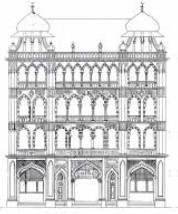
The Arcade, David McLeod Craik (1908). [BCA/NAS].
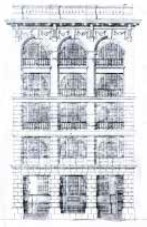
St Helen’s Court, Swan & Maclaren (1915). [BCA/NAS].
![Winchester House, Swan & Maclaren (1903) [BCA/NAS].](https://isomer-user-content.by.gov.sg/339/ed16d38d-5f9e-49ba-b1d8-987c9e7a78dc/Fig 18_ Winchester House 1903.jpg)
Winchester House, Swan & Maclaren (1903) [BCA/NAS].
This, then, was Collyer Quay at the end of the First World War, a busy waterfront scene, backed by godowns and commercial premises, overlooking a harbour packed with ships. Joseph Conrad, who put into Singapore several times in the 1880s when he was serving as a ship’s officer in the merchant marine, would have recognised the place and felt comfortably at home. Just ten years later, however, the waterfront had been completely transformed. Four major new buildings had sprung up — the Ocean Building (1922), the Union Building (1924), a new Hong Kong and Shanghai Bank Building (1924), and the General Post Office or Fullerton Building (1928)5 — all of them huge neo-Classical blockbusters, in the contemporary “English Renaissance” style, what we would call today, “Edwardian Baroque”.6 They were Singapore’s first skyscrapers,7 impossibly tall, so it seemed back then, their soaring towers and rotundas boldly silhouetted against the sky like a display of gigantic wedding cakes.
“There are few Oriental cities which can boast of a nobler and more inspiring group of buildings than that which is now seen by the citizen of Singapore as he passes over Cavenagh or Anderson Bridge,” commented the Straits Times of 27 June 1928, the day of the official opening of the new General Post Office, otherwise known as the Fullerton Building. “On a bright tropical morning,” the article continued, “with flags bright touches of colour to their pillared, galleried masses, these new buildings on Fullerton Road and Collyer Quay give [even] the most unimaginative a glimpse of the power and romance of Eastern commerce.”
![Collyer Quay, around 1928/29 [Cheah 2006].](https://isomer-user-content.by.gov.sg/339/e21b3d04-47aa-440c-8084-668e9f462276/Fig 19._Collyer Quay 1928_29.jpg1.jpg)
Collyer Quay, around 1928/29 [Cheah 2006].
A former resident, returning to Singapore in 1929, after an absence of a few years, similarly thought that “the completion of the Ocean building, the new Hong Kong [sic] Bank and the General Post Office have added immensely to the appearance of the city” (ST 16 February 1929: 7), while Robert Bruce Lockhart considered the Fullerton to be “a magnificent building”, adding that it was “stately and large enough to dominate Pall Mall if it were transferred to that centre of London clubland” (1936: 80).8
By all accounts, it was certainly an extraordinary turn around for Singapore and one that took place in a remarkably short period of time, but how did it actually come about? What were the historical circumstances that both preceded and precipitated this dramatic transformation of the waterfront? And who were the architects who designed these buildings and made it possible? These are the questions I shall be addressing in the remainder of this paper.
From Suez To Pangkor
To fully appreciate the circumstances that led to this remarkable metamorphosis of Singapore’s waterfront, one has to wind the clock back half a century to a series of catalytic events that took place between the years 1869 and 1874. Although occurring independently of one another, their cumulative effect was to transform the role traditionally played by Singapore in the commerce of Southeast Asia and the Pacific region, initiating changes or otherwise setting in motion events that would eventually lead to a very advantageous repositioning of the island in relation to the global economy of the late nineteenth and early twentieth centuries.
First up was the opening of the Suez Canal in November 1869, which more or less overnight led to the Straits of Malacca becoming the principal trade route to Australasia and the Far East.9 Singapore, at the southernmost tip of the Malacca Straits, was naturally well-positioned to enjoy the commercial benefits of this increased traffic and in the five years following the opening of the canal, Singapore’s trade figures jumped from just over £58 million in 1868 to nearly £90 million in 1873 (Turnbull 1989: 83).
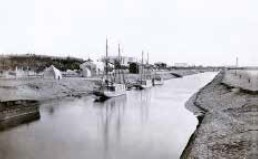
The Suez Canal, c.1860.
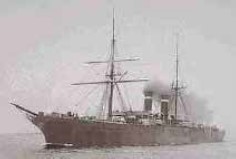
The SS Etna, c.1865 – a typical example of an ocean-going steamship in the 1860s.
The opening of Suez was doubly serendipitous in that it came at a time when significant advances were being made in the development of steam navigation, both in terms of the technology involved and the numbers of steamships plying the world’s oceans. As a consequence of this, Singapore now became one of a series of British ports and coaling stations connecting Britain with Australia and the Far East. They included Gibraltar and Malta in the Mediterranean, Aden on the on the Red Sea, Trincomalee on the east coast of Sri Lanka, Penang at the head of the Malacca Straits, Singapore itself, and then on to Hong Kong and the Treaty Ports of China, or else south to Australia and New Zealand. “As undisputed mistress of the seas,” Mary Turnbull writes, “Britain held the key ports and controlled international shipping lanes, with Singapore as one of the most vital links in the chain” (1989: 89).
The opening of Suez also occurred in the same year as the completion of America’s first transcontinental railroad linking the great cities of the Eastern Seaboard with the Pacific ports of the West Coast. With the steamship now offering speedier and more reliable services back and forth across that great ocean, after 1869 the world was a much smaller place.
Three years later, in 1872, the world seemed even smaller, when Singapore was connected up to the Eastern Telegraph Company’s rapidly expanding network of submarine telegraph cables, which made possible, literally overnight, a more or less instantaneous exchange of ideas with London and all points in between.10 Cable telegraphy not only revolutionised communications within the British Empire, but also globally, with Singapore quickly assuming a pivotal role as a communications hub in Southeast Asia.
Lastly, there was the signing of the Treaty of Pangkor in 1874, which saw the installation of a British Resident as advisor to the Sultan of the State of Perak on the West Coast of the Malay Peninsula. This marked the beginning of British intervention in Malaya, a process that would eventually lead to the formation of the Federated Malay States in 1895, with the subsequent addition of the unfederated northern Malay states in 1909, to create what became known as British Malaya.11
![Map, c.1870, showing the telegraph lines in operation, under contract, and contemplated, to complete the circuit of the globe [www.atlantic-cable.com].](https://isomer-user-content.by.gov.sg/339/e5f7b201-c332-4344-b63c-2a9598277c7f/Fig 21_Map 1870.jpg)
Map, c.1870, showing the telegraph lines in operation, under contract, and contemplated, to complete the circuit of the globe [www.atlantic-cable.com].
Prior to the Treaty of Pangkor, the Malay Peninsula had been plagued by a more or less endemic state of petty warfare, territorial feuding and general lawlessness, but under British governance, a relatively stable political environment soon emerged, the odd rebellion aside, which in turn led to a rapid opening up of the Malayan hinterland as businessmen, merchants, entrepreneurs and adventurers of every description rushed in, eager to exploit the rich natural resources and mineral wealth of the Peninsula. Again, Singapore was to benefit enormously from these developments, as indeed did Penang at the northern end of the Malacca Straits.
Singapore, of course, had long enjoyed the reputation of being the region’s principal entrepôt and a thriving port-city, but the combined effect of the opening of Suez, steam navigation, the American railroads, the advent of cable telegraphy, and British intervention in Malaya, occurring as they did almost one on top of the other, suddenly created a broad new horizon of possibilities for commercial ventures and business enterprises in the region, while encouraging the development of Singapore as a financial centre; within a few short years Singapore was well placed on the road to becoming a major player in an increasingly globalised world economy.
The Opening Up Of the Malay Peninsula
The principal argument in favour of British intervention in the Malay States had been the prospect of bringing peace to the troubled state of Perak and thereafter gaining access to the rich tin deposits of the Kinta Valley, which lay within its boundaries. It was a good move: within ten years of the signing of the treaty of Pangkor, Malaya had become the largest tin producer in the world, and by the end of the century was supplying around 55 percent of the world’s tin. Initially, tin mining operations were mainly Chinese-led, but as the British extended their rule across the Malay Peninsula, building roads and laying down a rudimentary infrastructure as they went, European investors were encouraged to get in on the act too. The Straits Trading Company, established in Singapore in 1887, was the first European firm to take advantage of the situation, introducing modern tin-smelting technologies to replace the old hand-operated charcoal blast furnaces that the Chinese pioneers had relied on. In 1890, Straits Trading built their first smelter on Singapore’s Pulau Brani, close by Keppel Harbour, or the New Harbour as it was still known in those days. This soon became the principal smelter in the region and by the turn of the century, Straits Trading was ex officio tin smelter to the world, processing ore from as far away as Australia, South Africa and Alaska, at a time when Malaya was also the world’s foremost supplier of tin.
![The Straits Trading Company’s smelter on Pulau Brani (left) [NAS]](https://isomer-user-content.by.gov.sg/339/bfbad619-442c-4b03-8935-57a177362896/Fig 22_Smelter Pulau Brani.jpg)
The Straits Trading Company’s smelter on Pulau Brani (left) [NAS].
![the ss Kaka of the Straits Steamship Company, which was used to transport tin ore from Teluk Anson, the main port for the Kinta Valley, to Pulau Brani [www.merchantnavyofficers.com]](https://isomer-user-content.by.gov.sg/339/a448184d-0422-480c-a53c-5de424895c1f/Fig 22_ ss Kaka.jpg)
The ss Kaka of the Straits Steamship Company, which was used to transport tin ore from Teluk Anson, the main port for the Kinta Valley, to Pulau Brani [www.merchantnavyofficers.com],
Coincident with the development of the Malayan tin mining industry was an opening up of the country generally. Towns were built, roads laid down, and lines of communication established. A railway line began to make its way down the West Coast of the Peninsula, albeit in rather a piecemeal fashion, and more remote areas gradually began to be put on the map. Gold was discovered in Pahang while the forests of Johor made their Maharaja rich by supplying the gutta percha that was needed to insulate thousands upon thousands of miles of submarine telegraph cables.12 At the same time, large swathes of the jungle were cleared for commercial agriculture.
Coffee was the principal plantation crop in the early days, but in the mid-1890s the bottom fell out of the coffee market due to Brazilian overproduction, while in Malaya the plants were ravaged by a particularly pernicious pestilence, the rapacious coffee-hawk moth (Cephonodes hylas).13 Down on their luck, the pioneer planters turned to rubber, which at that time was still at the experimental stage as a commercial venture, but was actively being promoted by the Director of Singapore’s Botanic Gardens, Nicholas Ridley, otherwise known as ‘Mad’ Ridley.14
The move into rubber was both the planters’ salvation and the making of British Malaya. Until the invention of the pneumatic tyre, rubber was mainly used in the manufacture of waterproof clothing and footwear; surgical appliances; hoses, seals and manifolds for steam engines, pumps and other mechanical devices; and as an insulating material for electrical gadgets. Solid rubber tyres had been used for carriages in a limited way, but then, in 1887, John Boyd Dunlop fitted air-filled rubber tubes to the wheels of his son’s tricycle and within the space of three or four years there opened up a huge new market for the stuff — bicycle tyres, tens of thousands of them! It was still the bicycle tyre which led the demand for rubber when planters in Malaya began to convert their coffee plantations into rubber estates, but around the same time, the brothers Michelin began producing the first pneumatic motorcar tyre. That was in 1895, and a decade later it was the motorcar — and in particular the burgeoning American automobile industry — which required almost more rubber than anyone could supply at that time. At the turn of the century, rubber exports from British Malaya were miniscule, but by 1921 the figure stood at over 200 million lbs, half of which was destined for the United States (Baker 2005: 94).
The Emergence of Singapore As A Financial Centre
In 1900, most of the companies that owned rubber estates and tin mines were based in the UK, either in London or, in the case of the mining industry, Cornwall (Wong 1965: 216; Baker 1999: 204). And since they had neither the personnel on the ground, nor the local expertise to the run their operations at the Straits end of the business, they turned to long-established merchant houses in Singapore, such as Guthrie & Co., Boustead’s, Paterson Simons, and Mansfield & Co.,15 and asked them to act as their agents. As well as organising the shipment of raw materials, the local agent was also responsible for providing supplies and equipment, management services, hiring labour, and preparing the accounts (Baker 1999: 204). What this meant in the long term, was that as the production of raw materials in the region increased, Singapore was not only geographically well placed to act as a regional centre for the transhipment of this produce to other parts of the world — which was of course her traditional role in the economy of the Malay Archipelago — but could also provide the professional services as well as the financial infrastructure to facilitate this growth (Baker 1999: 204).
And by this time, it was not only the British in Malaya who were investing heavily in the region, but also foreign investors from other parts of the world, including America, Germany, France, and the Netherlands. Transfers of capital to start up companies, buy machinery, expand production, improve transportation, and generally make the wheels of commerce go round, swelled the coffers of local banks — notably, the Nederlandsche Handel Maatschappij (predecessor of today’s ABN AMRO Bank), the Chartered Bank of India, Australia and China (today’s Standard Chartered), and the Hongkong and Shanghai Banking Corporation — while encouraging financial institutions from other countries — America, France, the Netherlands, and the Middle East — to open a Singapore branch (Baker 1999: 204). At the same time, the need to insure cargoes moving in and out of Singapore and other Straits Settlements ports resulted in the setting up of an insurance market in Singapore, which then became the regional centre for marine insurance in Southeast Asia (Baker 1999: 204).
All of this helped to promote Singapore’s reputation, not only as a thriving port city, but also as a financial centre, which in turn meant that Singapore was well placed to take advantage of new investment opportunities that were fast appearing in the region. China was top of the list as the Western superpowers — Britain, France, Germany, Russia and the United States — competed among themselves to grab as big a slice of the Chinese gao (cake) as they could. The French were also busily engaged in establishing a presence in Cochin-China, Tonkin and Annam, an activity that ultimately led to the creation of an Indochinese empire that was almost one-and-a-half-times as big as France by the turn of the century. Meanwhile, the Americans, who had been hovering around the Pacific since the middle of the nineteenth century, suddenly found themselves the heirs to Spain’s colonial possessions in the Philippines and Guam at the conclusion of the Spanish American War in 1898. Even independent Siam, while she may have avoided colonisation thanks to the Anglo-French accord of 1896, was nevertheless caught up in the great imperial scramble for Southeast Asia, when obliged to accept a series of treaty-port type agreements with the West (Wong 1978: 62 66). There was also an increase in trade with ports on Russia’s eastern seaboard, largely due to the completion of the Trans-Siberian railway in the 1890s, which joined up the eastern and western halves of the Russian Empire in much the same way that the transcontinental railroad had brought the East and West Coasts of the United States closer together some thirty years earlier. Finally, there was a rapidly modernising Japan, in the throes of a quick-fit industrial revolution, which again provided further opportunities for investment and trade. With the world becoming an ever-smaller place in terms of doing business, it was almost inevitable that the port of Singapore, with its attendant financial institutions and business expertise, would play an increasingly pivotal role in the commerce of East Asia at the start of the new century.
The First World War
Which brings us to the eve of the First World War. Apart from a frightening few days for the European community during the Sepoy Mutiny of 1915, Singapore was not much affected by the fighting in Europe. True, a certain amount of alarm was caused by the presence of the German light-cruiser Emden in the Indian Ocean in the early months of the war, but she never entered Singaporean waters. There was a mad spree of panic buying immediately following the declaration of war, which led to a sudden hike in food prices, but the government soon stepped in and, having banned the export of large quantities of foodstuffs to other countries, the situation returned to more or less normal. With Allied merchant shipping subject to enemy attacks, there were inevitable shortages as well as a disruption of the postal services — particularly in the opening few months of the war when the Emden took its toll on Allied shipping in the Indian Ocean — but otherwise life went on pretty much as usual.16
One area of the economy that was hard-hit by the conflict, though, was the Malayan tin mining industry, which entered into a steep recession from which it did not recover until the war was over. But if the fortunes of the tin towkays suffered a reversal during the First World War, they were usually more than adequately compensated for by their businesses interests elsewhere, principally the Malayan rubber industry, whose output more than doubled during the war years, largely on account of the further impetus that this lent to the American automobile industry (Coates 1987: 193).
At the beginning of hostilities, no one really appreciated the importance of motor vehicles in relation to the war effort; everyone was still thinking in terms of horses when it came to military transport (Coates 1987: 192). Within a very short space of time, though, the view had altered radically. It was motorised transport which saved Paris from falling to the Germans in the first month of the war as French soldiers were ferried to the front in buses, lorries, taxis and even private motorcars. Similarly, when British reinforcements arrived, they too were rushed to the frontline in lorries, sparing them forced marches. And again lorries proved their worth when trains and railway lines were destroyed by enemy bombardment and later bombing from the air. As Frank Seiberling, founder of the Goodyear Tire and Rubber Company, observed towards the end of 1914: “The automobile fits in for the direct purpose of war to an extent we have not yet discovered. More cars will be built than we ever dreamed of” (cited in Coates 1987: 192).
And they all needed tyres! This surge in demand for rubber is reflected in the production figures for Malaya during the war years which rose from 47,000 tons per annum in 1914 to 112,000 tons annually in 1918, the latter figure representing 60 percent of the total production of plantation rubber worldwide (Coates 1987: 193). Singapore, as the principal port for the export of Malayan rubber, could only benefit.
Quite apart from the added impetus the war gave to the Malayan rubber industry, it also introduced certain structural changes to the way in which the trade in rubber was conducted, and again Singapore played a pivotal role. Up until this time, Malayan rubber destined for the United States had been shipped to London via the Indian Ocean and Suez Canal, where it was auctioned in the London Commercial Salesrooms in Mincing Lane, and then sent on to the United Sates across the Atlantic. The reasons for this were largely historical: Mincing Lane was traditionally the centre of the world’s trade in tea and spices, and as the demand for rubber products grew in the latter half of the nineteenth century — chiefly as a result of the discovery of vulcanisation in 1840s — rubber was added to the portfolio. Another factor, though, was the fact that by the end of the first decade of the twentieth century, the majority of Malayan rubber estates were in the hands of London-based firms, financed by British money (Coates 1887: 119). In the early days of Malayan rubber, the majority of estates had been owned by pioneer planters — either European or Chinese — but when plantation rubber began to take off in a major way, British investors became interested and capital raised in London was used to buy them out,17 with the management of the estate then being contracted to a local agency house such as Guthrie’s, Boustead’s, or Paterson Simons. Naturally the London estate owners preferred to see the sale of rubber taking place ‘at home’, so to speak, and the brokers of Mincing Lane were more than happy to oblige.
It was for these reasons, then, that London, before the First World War, was the de facto centre of the world’s rubber trade. True, a certain amount of Malayan rubber had been sold independently in Singapore prior to 1914, and this had led to the creation of the Singapore Chamber of Commerce Rubber Association in 1911, but for the most part, no one seriously questioned or challenged London’s prerogative as the world’s marketplace for rubber.
The outbreak of war, however, changed all this. To avoid the predations of German U-boat submarines, which soon began to take a deadly toll of merchant shipping in the Atlantic, Malayan rubber bound for the States, instead of being sent for auction in London, now started to be shipped across the Pacific to West Coast ports from whence it was transported by train to Akron, Ohio, centre of the American tyre industry and self-proclaimed “Rubber Capital of the World”. And with the advent of direct shipments of rubber to the US, Singapore’s own fledgling rubber market suddenly took on a new significance in that many American buyers now found it more expedient to transact their business where the rubber was, rather than go through their brokers in London — the auctions in Singapore were speedier and there were fewer intermediaries involved when it came to delivery and shipments. Not that all the rubber exported to America via the Pacific during the First World War was purchased in Singapore — Mincing Lane still retained a considerable interest — but what was particularly significant about the new arrangement was the fact that it was the price of grade one rubber sold at weekly auction at the Singapore Exchange, which now began to determine the price of rubber both in London and elsewhere in the world (Coates 1987: 195).
Admittedly, come the end of the war, the situation was reversed when the US economy went into recession in the early 1920s, causing the price of rubber to plummet. In order to re-inflate prices, restrictions were placed on both rubber production and its sale, with the brokers of Mincing Lane assuming the role of determining how much rubber could be released onto the market and when. This temporary setback in the fortunes of the Singapore Rubber Exchange — and it was only a temporary one — did not, however, in any way diminish the significance of Singapore’s wartime record in relation to Singapore’s positioning in the global marketplace. Not only was Singapore a good place to do business in relation to the commerce of East Asia and maritime Southeast Asia, but it was also a major export centre and marketplace for two of the world’s most important raw materials, the other of course being tin, for although the Malayan tin mining industry was in recession during the war years, it was just about to make a spectacular comeback.
There were other changes which had taken place during the war years that were also very much in Singapore’s favour at this time, notably improvements to the port facilities at Keppel Harbour which had been completely upgraded during the war years and now boasted the second-largest graving dock in the world, as well as greatly extended wharfage at the huge new Empire Dock, completed in 1917. At the same time, work was just about to start on a causeway linking Singapore island with the mainland which would enable goods and passengers to travel by train all the way from the terminus at Tanjong Pagar to the town of Prai in Province Wellesley, which was the mainland train station for Penang. This in itself was a major step forward, but the ultimate aim, here, was a continuous rail link that would connect the Malay Peninsula, via Burma, with British India. Lastly, there was Singapore’s strategic importance as a communications hub. At the outbreak of war in 1914, the upsurge in communications combined with the inoperability of the Indo-European land-lines which passed through enemy territory, had led to all communications with India and the Far East being transferred to the Eastern Telegraph Company whose network of land and submarine cables covered most of Asia by this time. The Eastern Telegraph Company and its regional operator here in Singapore — the Eastern Extension Australasia and China Telegraph Company — benefited hugely from this increase in telegraphic communication, with the company’s annual receipts rising from £131,000 before the war to £950,000 in 1915 alone, more than half of which was profit. By the end of the hostilities, ‘the Eastern’ had become an indispensable part of Britain’s imperial communications network, with the Singapore cable station playing the role of regional ‘nerve centre’ in a worldwide web of telegraph lines and submarine cables that effectively constituted the central nervous system of the British Empire.
This was how the situation stood in Singapore, in November 1918, as the fighting in Europe finally came to an end after four long years. The price of Malayan rubber was high, the tin market was just about to make a brilliant recovery, property prices and the construction industry were already booming, and shipping was rapidly returning to normal. There may have been a recession looming just around the corner, but no one knew about it then.18 Rather this was a moment of optimism and celebration, with the up-coming centenary of the founding of modern-day Singapore by Sir Stamford Raffles to look forward to, his cherished dream of establishing a “great commercial emporium” in the East by now very much a reality. It is no coincidence, then, that it is precisely at this point at which we see this sudden burst of building activity down on the waterfront. And not just new buildings, but buildings of a novel kind — large corporate blockbusters, built to the latest designs, that would give Singapore its first high-rise skyline, a skyline that before the decade was out would be drawing comparisons with London, Liverpool and Shanghai.
![Singapore City (detail), showing Collyer Quay and the buildings to be discussed, highlighted in yellow [Government Survey Department, 1954] [JD].](https://isomer-user-content.by.gov.sg/339/bf1e833d-408e-4b12-973c-ef1184b85798/Fig 23_ Singapore City detail.jpg)
Singapore City (detail), showing Collyer Quay and the buildings to be discussed, highlighted in yellow [Government Survey Department, 1954] [JD].
The Ocean Building (1919–1922)
The first of the postwar behemoths to go up on Collyer Quay was the Ocean Building, the new headquarters of the Ocean Steamship Company, more popularly known as the Blue Funnel Line. Founded in 1865 by two brothers, Alfred and Philip Holt of Liverpool, the Ocean Steamship Company was established to provide a regular steamship cargo service from England to China, initially via the Cape of Good Hope and then subsequently through the Suez Canal when the latter opened in 1869. By the turn of the century, Blue Funnel was one of the most important shipping lines in the Far East.19
This commercial success was in no small way due to the effectiveness of their eastern agents — John Swire & Sons in China and Mansfield & Co. in Singapore. The latter were a local firm which started out in Singapore in 1861 as a ship chandlery business — their founder was the eponymous Captain George Mansfield — but eventually ended up as one of the most famous names in Asian shipping. As agents to the Ocean Steamship Company, Mansfield’s principal responsibilities were to arrange for the orderly delivery of cargoes from Europe and other foreign ports to their consignees, and, equally importantly,
In the case of the Blue Funnel line, the principal cargoes carried by its ships were tin and rubber from the Malay states, tobacco from the East Indies, refrigerated fruit and meat from Australia, and machinery and manufactured goods from Europe. In addition, there was a profitable sideline in passengers, especially migrant labour from China and Muslim pilgrims making the Haj to Mecca. The years immediately preceding the First World War were especially successful for the Ocean Steamship Company with record profits, and as the company prospered it added to its fleet; by 1913, the Blue Funnel list numbered 77 ships, its total tonnage having nearly tripled since 1901. And the company continued to prosper during the war years — Far Eastern trade was not badly affected by the hostilities in Europe, and relatively few ships were lost through enemy action. Indeed, a number of the Blue Funnel ships were commandeered by the British Government to carry vital supplies and transport troops, for which the company was handsomely compensated. Freight rates also rose during this period, which further added to company profits, and it was very much on the back of this wartime success that the Ocean Building was commissioned.
The design is credited to the British engineer Somers Howe Ellis (1871–1954) who was Chief Civil Engineer of the Ocean Steamship Company from 1919 until his retirement in 1939, but other parties were also involved, most notably the prestigious Liverpool architectural practice of Messrs Briggs & Thornely who prepared the working drawings.
The new building was situated at the corner of Collyer Quay and Prince Street, the site having previously been occupied by the premises of Blue Funnel’s agents, Mansfield & Co. The contrast between the new and the old could not have been greater. Five storeys in elevation, the main part of the building would be a few feet higher than St Helen’s Court, which at that moment was the tallest building on the waterfront, but then there was to be a fifty-foot tower on top, which would turn the Ocean Building into a veritable skyscraper by Singaporean standards. As the Straits Times of 30 December 1919 rightly observed, “it will be one of, if not the most striking piles in Singapore [and] a valuable addition to the line along the sea front” (ST, 30 December 1919: 10).
![The site of the Ocean Building, at the junction of Collyer Quay and Prince Street c.1900 [NAS]. The building that we see here was occupied by Mansfield & Co. who were the Singapore agents for the Ocean Steamship Company [NAS].](https://isomer-user-content.by.gov.sg/339/d2d80ad3-ee90-405b-bf91-300bb72d864c/Fig 24_ Site Ocean Building.jpg)
The site of the Ocean Building, at the junction of Collyer Quay and Prince Street c.1900 [NAS]. The building that we see here was occupied by Mansfield & Co. who were the Singapore agents for the Ocean Steamship Company [NAS].
Quite apart from the Ocean Building’s great height, it was also considerably larger, in terms of office space, than any previous commercial development in Singapore, the area of the site being approximately 17,000 square feet with 11,500 square feet of office space on each floor (ST 30 December 1919: 10). It was indicative of the state of the Singapore economy, the Straits Times correspondent noted, “that although the building will not be ready for occupation for two years … the whole of the accommodation is reported to be let already” (ST 30 December 1919: 10).20
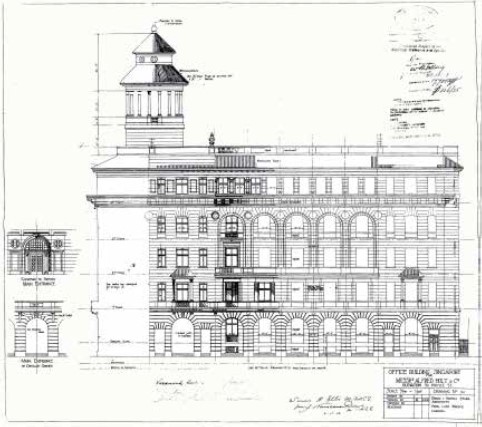
Working drawings for the Ocean Building, Prince Street elevation (BCA/NAS).
It took close on three years for the Ocean Building to be completed, but it seems the wait was worth it, with the Straits Times describing the end result as “a credit to the great British shipping firm that owns it,” as well as “concrete proof of the faith that Messrs. Alfred Holt and Company have in the future, the building in Singapore being one of many offices and godowns that the firm has erected at different ports in the East” (ST 18 December 1922: 9). Standing 160 feet from the top of its tower to the street below, this was “the tallest building in Singapore at the present time,21 while its facing of artificial stone gives giving it a striking appearance from whatever point it is seen” (ST 18 December 1922: 9). But lest it be thought that the new addition to the skyline was a trifle ostentatious, it was noted that “there is in fact a chasteness about the ornamental work that reflect much credit on Mr. R. Nolli of Bangkok, who is in charge of this part of the work in connection with the building, and whose decorative work in artificial stone and plaster, both on the interior and exterior to the structure, is a distinct feature of the Ocean Building” (ST, 18 December 1922: 9).
Mr R. Nolli was of course the famous Italian sculptor and stonemason, Cavaliere Rudolfo Nolli (1888–1963), who had come out East at the age of 19 to assist in the construction of a new pavilion for the Royal Palace in Bangkok. This was at the personal behest of King Chulalongkorn of Siam (today’s Thailand), and it was in recognition of his work on the Ananta Samakhom Throne Room that Nolli received his Italian knighthood (cavaliere). As well as being a sculptor, Nolli also specialised in architectural ornaments, special plastering techniques, pre-cast and imitation stone, and bush-hammered facing work, and it was these skills which led to him being engaged to produce the ornamental stonework for the new Ocean Building — he was appointed by the Anglo-Danish engineering firm of Swanson & Sehested, who were responsible for the engineering works.22 The success of the Ocean Building subsequently meant that Nolli found himself receiving commissions for just about every new building of any consequence thereafter erected in Singapore and the Malay Peninsula; his best-known surviving work in Singapore is probably the group of figures that fills the tympanum of the Supreme Court in Singapore.
Chaste, Nolli’s ornamental work may have been, but there were nevertheless “many outstanding features in this British designed and British owned, up-to-date building,” including the “overhanging balconies on the Collyer Quay and Prince Street frontages [and] the allowance of six instead of five feet for the footway, giving the portion on the Prince Street frontage, in particular, the appearance of a fine arcade, with a fine ceiling overhead.” Best of all was the tower, “fashioned like a lighthouse, at the apex, from which a widespread view of the island of Singapore can be obtained” (ST 18 December 1922: 9).
![The Ocean Building from Finlayson Green [NAS].](https://isomer-user-content.by.gov.sg/339/528700ab-d611-4d49-8b31-11db091cfeca/Fig 26_ Ocean Building_Finlayson Green.jpg)
The Ocean Building from Finlayson Green [NAS].
Modern Construction Techniques
Certainly, the Ocean Building was a very striking affair — especially in a Singapore context where nothing quite so large or monumental had been seen before. That it was possible to build on such a scale was entirely due to the architect and engineers taking full advantage of the latest construction techniques and building technologies then available. Easily the most significant of these was the combination of a reinforced concrete frame and artificial stone cladding, which made for a considerably lighter structure than if the building had been erected according to traditional methods. This consideration was of vital importance when building on the waterfront where the ground was not as firm as might be desired, having been reclaimed from the sea.
Firm foundations were, and indeed remain, a major concern in Singapore, as Alexander Gordon, Municipal
Architect between 1923 and 1931, was to recall:
The greatest shock that an architect receives on arrival here is the building
foundations he has to tackle. I can still remember how I had the ‘wind up’ when I
erected my first building on a swamp supported on timber bakau piles. For many
months I daily inspected it and was surprised that it did not develop cracks. This
gave me some confidence (ST 25 October 1930: 12).
In such circumstances, it was critical that a building be as light as possible and it was the advent of steel frame buildings and reinforced concrete which made it possible to erect much taller buildings for the same on-site loading than had previously been the case.23 In the case of the Ocean Building and those that followed it on the waterfront, it was decided that a reinforced concrete frame was the most suitable construction method for the site — steel frame buildings are potentially problematic in the tropics where there is a risk of corrosion.
A Question Of Attribution
Although the design of the Ocean Building is generally attributed to Alfred Holt’s Chief Civil Engineer, Somers Howe Ellis, the legend on the working drawings indicates that they were prepared by Messrs Briggs & Thornely, who as it happens were one of the leading architectural practices in the UK at that time. Ellis was an engineer by training who was something of an expert on the construction of wharves in tidal waters — he was the author of a book by that title, published in 1908, and also published several papers on the subject in engineering journals. Prior to taking up the post of Chief Engineer, he had worked on a number of commissions from Blue Funnel in the Far East, but these were principally engineering projects rather than architectural assignments, comprising wharves and godowns in Hong Kong, Shanghai and the Netherlands East Indies. In 1919, as newly-appointed Chief Civil Engineer of the Ocean Steam Ship Company, Ellis was naturally assigned the task of designing the firm’s new flagship premises in Singapore, something that was certainly within his competency engineering wise. However, given the prestigious nature of the project, Ellis, coming from an engineering background, may have felt that a little additional input from a professional architect would be advisable, which could explain how Briggs & Thornley came to be involved — Briggs & Thornley were a Liverpudlian practice and Liverpool was, of course, Blue Funnel’s homeport and headquarters of the Ocean Steamship Company, where Ellis himself was based. In 1919, Briggs & Thornely’s most famous building to date was their Mersey Docks and Harbour Board Offices (1907), down on the Liverpool waterfront, a gigantic Baroque extravaganza, designed by the senior partner, Sir Arnold Thornely (1870-1954), looking not a little unlike St Peter’s in Rome with a few extras bits thrown in for good measure. This may have been the deciding factor which encouraged Ellis to ask his Liverpudlian neighbours for some professional assistance when it came to the Classical detailing of his corporate waterfront blockbuster; although the Ocean Building is a rather more modest affair, there is a certain generic similarity.
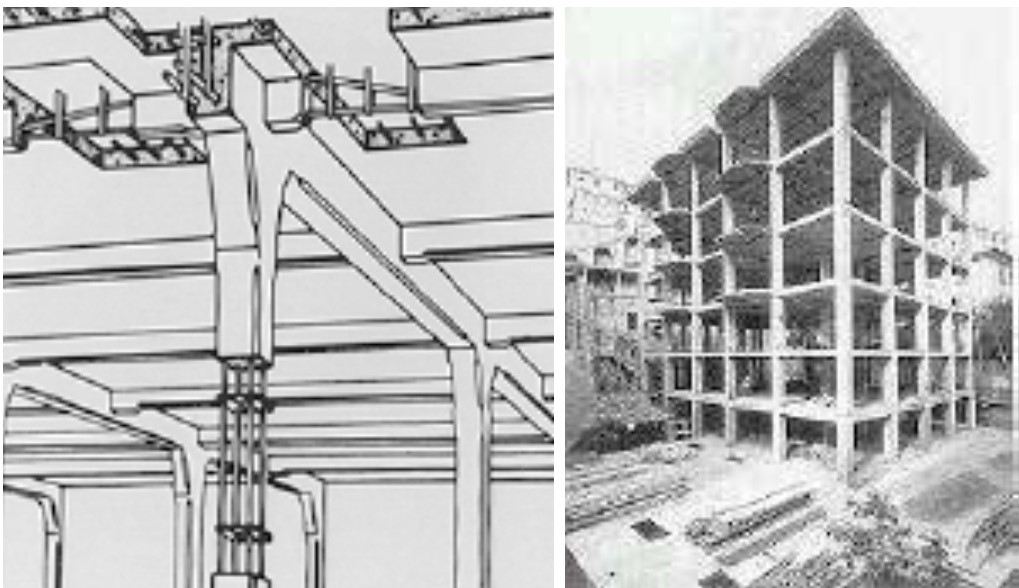
Reinforced concrete frame construction methods as pioneered by Frenchman Francois Hennebique in the late 1870s and 1880s.
![Mersey Docks and Harbour Board Offices, Pier Head, Liverpool, Briggs & Thornley (1907) [reference.findtarget.com].](https://isomer-user-content.by.gov.sg/339/9a590280-f7f0-404d-950b-39e08a5d589c/Fig 28_ Mersey Docks and Harbour Board Offices.jpg)
Mersey Docks and Harbour Board Offices, Pier Head, Liverpool, Briggs & Thornley (1907) [reference.findtarget.com].
Classical Modern: Without Modernists
Irrespective of whoever may have ultimately been responsible for the architectural styling, the Ocean Building was a resounding success. “An imposing pile,” proclaimed the Straits Times at the official opening on 24 March 1923, “that it is the handsomest building in town admits of no doubt.” But was it modern? From today’s perspective, the Ocean Building, with its arcaded elevations, rusticated façade, and rotunda- like tower, seems anything but. At the time, though, none of this was felt to be in any way anachronistic; rather, the Ocean Building was regarded as a particularly fine exemplar of what was known as ‘Modern Classical’.
Contrary to being an oxymoron, Modern Classical was very much the architecture of choice for large civic or commercial buildings in the decade following the end of the First World War. Nowadays, there is an almost intuitive tendency to think of modern architecture between the two world wars in terms of the glass and steel erections of the German Bauhaus school, or Le Corbusier’s “purist” white cubes, or Mies van der Rohe’s minimalist Barcelona Pavilion. In actual fact, the vast majority of new buildings erected during this period — certainly in the 1920s, but also the 1930s too — were conceived in the Classical manner. Indeed, as architectural historian Henry-Russell points out, “Through at least the first three decades of the twentieth century most architects of the western world would have scorned the appellation ‘modern’, or, if they accepted it, would have defined the term very differently from the way it [is] understood [today]” (Hitchcock 1958: 531). Still deeply steeped in the historicism of the nineteenth century, the term modern, to them, generally meant designing buildings in the grand Classical tradition, while making the most of the recent advances in construction techniques — steel and reinforced concrete, artificial stone, plate glass, electric lifts and services, and so on.
The continued preference for Classically-informed buildings was not because the general public was unaware of the ‘new architecture’ of the early Modernists; it was simply not well received. “Modern German dwelling houses look like the products of a cubist or futurist nightmare,” declared the editor of the Straits Times, in June 1929 (ST 10 June: 10). “Although they are obviously designed to act as sun-traps, there is no architectural merit in the utilitarian purpose. They are odd, uncouth, apparently unfinished. The average child can construct something aesthetically more pleasing with a Meccano set”.24
Classical architecture, on the other hand, had dignity and gravitas. It carried the cumulative weight of more than two thousand years of Western civilisation. It was the physical embodiment of humanist ideals, refined manners and good taste. And it was, of course, the architecture of empire — in the first instance Roman; in the second, British.
But if the Union Building, and those that joined it on the waterfront in the years that followed, were Classically inspired, this is not to say that they were ‘revivalist’ in the Victorian sense. Despite being typically referred to at the time as “English Renaissance” in style, they didn’t seek to faithfully reproduce the architecture of some earlier period in the Classical canon, be it Greek, Renaissance, Palladian, Baroque or whatever.25 No, the buildings on Collyer Quay, for all their Classical razzmatazz, were definitely modern in their conception, and would have been perceived as such at the time, not least because of their extreme size, which could only have been achieved by using the latest construction techniques.
But it wasn’t simply the fact that the Ocean Building was bigger, size-wise, it was also ‘bigger’ in terms of its proportions and this was an important part of the modern Classical aesthetic as Municipal Architect Alexander Gordon explained in an address that he gave to a lunchtime gathering of the Singapore Rotary Society, at the Raffles Hotel, in October 1930.
![The Municipal Offices, c.1930, with part of the Hotel de l’Europe visible on the left [NAS].](https://isomer-user-content.by.gov.sg/339/5b8fde96-1490-46cf-b172-948cce1e1db5/Fig 29_ Municipal Offices 1930.jpg)
The Municipal Offices, c.1930, with part of the Hotel de l’Europe visible on the left [NAS].
Gordon began by noting that since there was no tradition of permanent architecture indigenous to the region, as there was, say, in India, “the more important buildings are now being erected in the modern classic style [which] has evolved from a study of the old Greek and Roman buildings adapted to modern construction and requirements” (ST 25 October 1930: 12). “These new buildings,” he continued, “are designed on a much bigger scale than the old Renaissance or classic buildings seen here. You now design on a larger unit.” By way of example, Gordon compared the Hotel de l’Europe, on St Andrew’s Road, erected 1904–1907, with its next-door neighbour, the recently completed Municipal Offices (today’s City Hall). “There is very little difference in height or frontage,” Gordon observes, “yet the scale seems so much bigger. Whereas in the old type, an elevation would have a base with two or three colonnades one above the other, the front being divided into approximately equal divisions vertically, the new type has a massive base [and] one tall dignified colonnade with cornice and parapet in proportion” (ST 25 October 1930: 12).
![The Ocean Building photographed in the 1960s. Here we get a good impression of the new scale of architecture that this building introduced to Singapore [Chua 1989].](https://isomer-user-content.by.gov.sg/339/dbdf253b-4634-48d9-972d-c0990a9ba443/Fig 30_ Ocean Building 1960s.jpg)
The Ocean Building photographed in the 1960s. Here we get a good impression of the new scale of architecture that this building introduced to Singapore [Chua 1989].
According to Gordon, “the modern classic, aims at bigness, simple dignity and the cutting out of superfluous features and decorations” (ST 25 October 1930: 12), characteristics which were exemplified by the Municipal Building which it just so happened Gordon himself had a hand in designing. At the same time, the Ocean Building down on Collyer Quay, with its double-height arcades, pared down Classical detailing, and bold cornice, also fulfilled all these criteria admirably and it is this same super-sized Classicism which defined all the major new buildings that were erected on the waterfront in the period we are considering. Whatever one might think of the late-period Edwardian Baroque style today — and there are many who are rather disparaging about it — back in the 1920s it was considered to be “up-to-the-minute” and the “latest thing”, to use the parlance of the day.
The Hong Kong And Shanghai Bank Building (1921–1924)
The genius of the Ocean Building may have had more to do with Liverpool than Singapore, but the next corporate blockbuster to appear on Collyer Quay — the new Hongkong & Shanghai Bank Building on the corner of Collyer Quay and Battery Road — was an entirely home-grown affair, being designed by Singapore’s leading architectural practice, Messrs Swan & Maclaren, with engineering works by United Engineers, formerly Riley Hargreaves & Co. and Howarth Erskine & Co.
The earlier Hongkong & Shanghai Bank building that it replaced was the Victorian Gothic pile from 1892, which had been designed by the founding partners of Swan & Maclaren, Messrs Arthur Archibald Swan and James Waddell Boyd Maclaren. By this time, however, both these illustrious gentlemen had long since departed the scene — Swan retired around 1900 and Maclaren in 1912 — and the job of designing the new Hongkong & Shanghai Bank building in 1921 went instead to Denis Santry.
Santry was a colourful character. An Irishman, born in Cork in 1879, Santry attended the Royal College of Art in London. Upon graduating, he departed for South Africa — this was just after the end of the Boer War — and practiced there as an architect for several years. Acclaimed as a pioneer of the Arts and Crafts Movement in South Africa, Santry was probably better known to the general public as a cartoonist for the Johannesburg newspaper, the Rand Daily Mail. He also acted, directed plays and shot some of the first film footage made of South Africa. A likeable man, Santry was very well connected in South African society, counting among his friends Jan Smuts, the prominent South African statesman, military leader and philosopher, who was subsequently Prime Minister of the Union of South Africa from 1919 until 1924 and again from 1939 until 1948.
After nearly two decades in Africa, Santry decided he could do with a change of scenery and just before the end of the First World War he set sail for the US, where he earned a living as a cartoonist for a while. Evidently, the climate there did not suit him and so Santry determined to return to South Africa once more. When he landed in Singapore in 1919, it was fully with the intention of continuing his passage to Cape Town, but apparently “the air here appealed to him and he decided to stay” (ST 7 March, 1934: 2). He found employment with Swan & Maclaren and subsequently became a partner in 1924, continuing with the firm until his retirement in 1934.
“The Call of the East”, one of Santry’s most famous cartoons satirising colonial manners. Salubrious Singapore, by Santry and Claude (1920).
Apart from the Hongkong & Shanghai Bank Building, Santry was also responsible for the Union Building (see below, pp. 36-38), the Sultan Mosque, the 1914–1918 War Memorial, and several blocks of flats. As in South Africa, he was also well known for his cartoons and caricatures, which appeared regularly in local magazines and periodicals. A valedictory send-off in the Straits Times on the occasion of his final departure from Singapore in March 1934 described him as “one of the most popular men of post-war Singapore,” adding that “for fifteen years, Mr. Santry has done his best as an architect to add to the dignity and beauty of the town — and as a cartoonist he has never stopped poking fun at it!” (ST 7 March 1934: 12).
Santry may have been famous in South Africa as a pioneer of the Arts and Crafts Movement there, but his Hongkong & Shanghai Bank was anything but Arts and Crafts in style, being conceived as another Edwardian Baroque blockbuster. The new bank building was Santry’s first major undertaking in Singapore and even before work began on site in January 1922, it had already received this enthusiastic notice in the Straits Times:
Early in the new year will see the commencement of building operations which will
entirely transform that important corner in the local commercial world opposite
Johnston’s Pier. … The building is to be of reinforced concrete with a lower storey of
granite and the other storeys finished on the outside in artificial granite, this striking
a new note in local architecture (ST 16 November 1921: 9).
![Hong Kong & Shanghai Bank Building, Denis Santry (Swan & Maclaren) (1921–1924) [BCA/NAS]](https://isomer-user-content.by.gov.sg/339/80ca8513-e913-462b-bda5-f9865f4cce80/Fig 32_ Hong Kong & Shanghai Bank Building 1921.jpg)
Hong Kong & Shanghai Bank Building, Denis Santry (Swan & Maclaren) (1921–1924) [BCA/NAS].
Architecturally, the building was going to be in the “English Renaissance” style, which in this instance meant a rusticated arcade at street level surmounted by a grand colonnade of Ionic columns rising through three storeys to support an attic floor, the whole being surmounted by a rotunda and dome.26 In terms of the materials, too, this was going to be a very lavish affair. For example, there were to be four pairs of bronze entrance doors, each pair measuring eight feet wide by fourteen high, and weighing three tons; steel windows incorporating specially designed sunblinds would also be used in place of the usual wooden window fittings.
The interior was to be equally resplendent, one of the features of the new banking hall being an absence of wooden fixtures and fittings. Instead, the Strait Times informs us, the “counters as well as floors will be entirely of marble, and there will be marble columns with brass capitals.” To further add to this magnificence, the space would be lit from above by two domed lights, or lanterns, executed in stained glass, which would give “a cathedral like effect” (ST 16 November 1921: 9).
The stained glass work was to be carried out by a Mr. Leonard Walker of the Royal Academy, who “is one of the leading artists working in this medium” (ST 16 November 1921: 9). The centre of one of the lights was to feature “a female figure symbolical of ‘Commerce’ who holds a globe upon her knee,” while the other would comprise “the symbols of the Hongkong and Shanghai Bank, consisting of a ship in full rig, a Chinese junk, with a mountain in the background.” The remaining portion of the two large lights and the other windows of the main hall were to contain a series of figures representing the various peoples with whom the Bank did business: “Great Britain, China, India, Malaya, Japan, Ceylon, North and South America, Holland, Egypt, Burmah [sic], Siam, Canada, Arabia, Spain, France, South Africa, Australia, Italy and Scandinavia.” So marvellous was the whole ensemble that prior to its installation, the stained glass lights were put on display in Selfridge’s department store in London, where they were much admired (Malayan Saturday Post, 28 June 1924: 10).
This was corporate power dressing taken to new heights, the mercantile equivalent of ‘shock and awe’ tactics, intended to impress upon the Singapore public the Olympian stature of the Hongkong and Shanghai Banking Corporation in the world of Eastern finance. It was not, however, the last word in ostentation on Singapore’s waterfront in the mid-1920s. That honour went to the bank’s next-door neighbour, the Union Insurance Society of Canton.
![The Hong Kong & Shanghai Bank Building in the 1960s, by which time it had unfortunately been deprived of its tower and had a couple of extra floors added above the original attic storey [Chua 1989].](https://isomer-user-content.by.gov.sg/339/bee956dc-065d-49b5-b2f9-12aaf40c8dec/Fig 33_ Hong Kong & Shanghai Bank Building 1921.jpg)
The Hong Kong & Shanghai Bank Building in the 1960s, by which time it had unfortunately been deprived of its tower and had a couple of extra floors added above the original attic storey [Chua 1989].
The Union Building (1921–1924)
The Union Building was nothing less than “palatial”, a one-and-a-quarter-million-dollar, seven-storey extravaganza, surmounted by a 60-foot tower and dome, with a combined elevation of 173 feet. Although two storeys taller than its neighbour, the rusticated arcade on Collyer Quay matched that of the Hongkong & Shanghai Bank in scale and proportion, creating a sense of harmony at street level. The façade above was dominated by a majestic colonnade of Ionic columns, book-ended by tall panels rising through four storeys, with huge bronze medallions at the top, some 8 feet in diameter, bearing the coat of arms of the Society. A bold, dentilated cornice with a 7-foot projection — “a particularly ticklish piece of engineering work”, according to the Straits Times (23 January 1924: 12) — completed the main façade, with a stepped-back attic storey above. The crowning glory, though, was undoubtedly the central, rotunda-like tower, surmounted by a stepped dome.
![Union Insurance of Canton Building, Denis Santry (Swan & Maclaren) (1921–1924) [BCA/NAS]](https://isomer-user-content.by.gov.sg/339/8dabf9fe-f19f-41d0-92ec-4812552f01e2/Fig 34_ Union Insurance of Canton Building.jpg)
Union Insurance of Canton Building, Denis Santry (Swan & Maclaren) (1921–1924) [BCA/NAS]/
Not to be outdone by its neighbour, the entrance to the Union Building comprised a pair of massive bronze doors, measuring 15½ feet high and 8 feet wide. These opened onto a broad flight of stairs leading up to a 50-foot hall, which was lit from above by a glazed skylight. Huge doors — again cast in bronze — led to magnificent suites of offices on either side with coffered ceilings twenty feet high (SFP 17 January 1924: 17).
No expense was to be spared on the materials either. A feature article in the Singapore Free Press, written in January 1924, as the building was nearing completion, tells us that the
“… harmonious use of various coloured marbles for floors and walls on the ground
floor will provide an effect of striking richness, unequalled in the country. The floor
marbles will be Belgian black and dove, the skirting of the walls will be of Genoa
green, the mouldings round the doors will be Swiss cippolino (striped green), while
quartered panels will be of bresicated Sienna” (SFP, 17 January 1924: 17).
With a frontage of 158 feet and a depth of 145 feet, the building covered an area of 23,000 square feet, and afforded a total of 131,000 square feet of office space, which greatly exceeded that of any other existing building in Singapore at that time.27 Like the Ocean and Hongkong and Shanghai Bank buildings, once the requirements of the owners had been satisfied, it was intended that the rest of the office space be made available for commercial let, providing “spacious accommodation for very many firms who are desirous of transferring their activities to more up-to-date and commodious headquarters” (SFP 17 January 1924: 12).
In the case of the Union Building, the principal lease-holder was Boustead and Company. They had previously owned the site on which the building stood and not only shared half the ground floor with the Union Insurance Society, but also occupied the whole of the floor above (SFP 17 January 1924: 12). Like Mansfield’s in the Ocean Building, Boustead’s was one of those venerable Singapore mercantile institutions whose history stretched back to the very early days of the Settlement. Founded in 1828 by Englishman Edward Boustead, the company had a portfolio typical of the classic nineteenth-century British agency house. They had started out by trading in tea, silk, tobacco, tin, copra, Straits produce and what have you, but subsequently moved into shipping, finance,28 insurance, cargo and freight handling, tin mining, plantation management, marketing and distribution, and any other aspect of the import-export business that could be profitably engaged in.
![The Union Building and Hong Kong & Shanghai Bank in the early 1950s [Chua 1989].](https://isomer-user-content.by.gov.sg/339/8246ed3b-1292-405c-b1ef-6353e298a553/Fig 35_ Union Building and Hong Kong Shanghai Bank 1950s.jpg)
The Union Building and Hong Kong & Shanghai Bank in the early 1950s [Chua 1989].
Other occupants of the Union Building included the American Consulate, the Japanese Consulate, American Express, Muller and Phipps (a New York - based trading company), the Anglo-French Trading Co., the Mitsubishi Shoji Kaisha Sumatra Lumber Co., a couple of mining concerns, Fraser & Cumming (brickworks and a sawmill), the Australian engineering firm of Fogden Brisbane and Co., and the Singapore Architects Journal. Next door, in the Hongkong and Shanghai Bank Building, the tenants included Adamson and Gilfillan, the Singapore Turf Club, Derrick and Co. (accountants), the Dollar Steamship Co., Pirelli and Co., the Ardath Tobacco Co., Norwich Union and Phoenix Insurance, and the architectural practice, Swan and Maclaren, who of course designed the building.
Together, the owners and their tenants provide a snapshot of Singapore’s business culture in the mid-1920s — shipping, insurance, banking and financial services, tin mining and rubber, agency houses and trading companies — and when the two buildings were completed, more or less back to back, at the tail end of 1924, there followed what the Straits Times described as “a general exodus of leading Singaporean firms from their former offices” (ST 29 December 1924: 9).
The Almighty Dollar
In the space of just five years from the time that work on the Ocean Building commenced on site in early 1920, to the completion of the Union and Hong Kong & Shanghai Bank buildings at the end of 1924, Singapore’s waterfront had been completely transformed, and certainly the editor of the Straits Times, reflecting on these changes a couple of years later, was in no doubt as to the principle cause. “Commerce,” he wrote, “dominates Singapore to a degree which strikes the visitor much more sharply that the resident, who soon acquires the invaluable tropical habit of taking things for granted, and it is significant of one aspect of life in this city that our noblest pile of buildings should be given over to business” (ST 17 August 1926: 8). “With flags flying from turrets and roofs,” he continued, “and the lines and curves of modern concrete architecture clear-cut against the blue sky, the new buildings on Collyer Quay seem veritable palaces of commerce and finance, and they are a brave inspiriting sight on any breezy Singapore morning” (ST 17 August 1926: 8). There were other notable buildings in Singapore, the editor acknowledged, in particular the recently-opened Edward VII College of Medicine, but unfortunately that was “hidden away where few residents and no tourists ever see it.” The completion of the new General Post Office, then under construction, was also something that could be looked forward to. “But with one or two exceptions,” he concluded, “it must be conceded that for the dignified and beautiful architecture which has come to Singapore since the war we have to thank the merchants, shippers, and bankers, and you may search the city over and find not a worthy building which is not dedicated to the Almighty Dollar” (ST 17 August 1926: 8).
Fullerton Building (1928)
The new General Post Office referred to here was of course none other than the Fullerton Building,29 which was then in the process of being erected on the site previously occupied by the old Post Office and the Exchange Building. There had been talk about redeveloping the site ever since the end of the First World War, the colonial authorities being in urgent need of new office space, not too far removed from the existing seat of Government at Empress Place, to accommodate a burgeoning civil service.30 The situation was naturally superb — “probably no structure in the East could have a more commanding site” (ST 30 September 1920: 7) — and mindful of this, the Government decided to host an open competition to ensure that the location got the building it deserved.
The competition was won by the Shanghai practice of Keys & Dowdeswell, with the eponymous partners, Major P. H. Keys, FRIBA, and Frederick Dowdeswell, ARIBA, moving to Singapore to start work on their commission in May 1920. Sketch plans and the principal elevations were displayed in the Legislative Council Chamber for a month and approval had been given to go ahead with the working drawings, when it was suddenly decided that owing to the uncertain financial climate — this was the time of the 1920 US recession and a corresponding crash in tin and rubber prices — the building should be postponed until the economic position brightened (SFP 23 June 1928: 11). As things turned out, work did not commence on the building until the beginning of 1924, by which time Keys and Dowdeswell had been inducted into Government service and had been profitably set to work on a number of important public works projects, most notably the new Sailor’s Institute for officers and men of the merchant marine on Anson Road, which was then nearing completion, and the Norris block and staff quarters of the General Hospital (completed in 1926).
Major Keys was the principal creative force in the partnership and he soon became a prominent figure in the local architectural community, though not always for entirely admirable reasons. Arthur Coltman, who was an architect with the firm Booty & Edwards at this time, remembered Keys as an “unusual character [who] hated all opposition and did everything to crush it” (Coltman 1957). According to Coltman, Keys “had no respect for any architectural code and went to any lengths to get work.” One incident that stood out for Coltman was when Keys “asked me [Coltman] to give up Booty & Edwards and join him. Indeed he made me quite an attractive offer. Booty was away in England at the time but in any case I was not to be coerced [whereupon] Keys promised me he would see us and Swan & Maclaren in the gutter before he had finished with us.”
As it happens, it was Keys’ career which ended up in the gutter, and the Major in disgrace, for at some point in the early thirties both he and Dowdeswell were found guilty of professional misconduct and were struck off the architectural register (Coltman 1957). In 1924, however, this unpleasantness lay in the future and Keys and Dowdeswell were the toast of the town. The Post Office was their biggest project to date, indeed it would be the biggest of their career, a massive seven-storey structure, plus basement, “the largest building of the kind ever built in Singapore,” so the Straits Times of 9 January 1924 reported. And it had a budget to match — a colossal $4,098,808, which at the time was by far the largest figure ever expended on a building project in the Straits Settlements (SFP 23 June 1928: 11).
The contract for building work was awarded to the well-known London engineering firm of Messrs Perry and Co. (Bow), Ltd., who already had a branch office in Singapore, having previously been engaged on the Sailors’ Institute (ST 9 January 1924: 9). The contract period was for four years and work began on site in February 1924. The biggest problem the contractors faced came right at the beginning, namely the nature of the site and the difficulty of providing adequate foundations for such a massive building on ground that was close to the sea and not very firm in the first place. In order to overcome these difficulties, it was decided to adopt the raft method of foundations — basically a huge platform of cement which ‘floated’ on the soil beneath — rather than resort to piles. This involved digging down through a strata of boulders and clay to a point 16 feet below ground level; some 40,000 cubic yards of soil were removed from the site, while pumps worked day and night to prevent the hole from filling up with water, since it was well below the tidal level on the other side of Captain Collyer’s seawall (ST 9 January 1924: 9).
The building itself was another reinforced concrete frame structure, built to a design by Messrs. Edmond Coignet and Co., London.31 In all, around 20,500 cubic yards of reinforced concrete, 1,300 tons of steel, 3.5 million bricks and some 20,000 cubic feet of timber, went into the making of the Fullerton Building, with an additional 124,000 cubic feet of artificial granite were used for the facing (SFP 23 June 1928: 11). The responsibility for the latter work again went to Rodolfo Nolli, whose huge colonnade of Doric columns on the seaward side of the building was much admired. These were cast in half-sections, comprising eight inches of cement and granite chips over a concrete core. According to the Straits Times, the results were “pronounced by experts to be excellent, and the general effect, even to the layman, appears most satisfactory, the differing textures of the various stones giving a very natural appearance” (ST 27 June 1928: 9).
The Fullerton Building was finally completed in June 1928 to much acclaim. According to the Straits Times, “The Post Office building, with its walls towering 120 feet from the ground, its fluted Doric colonnades on their heavy base, its lofty portico over the main entrance, and the 400-foot frontage along the waterfront, adds immeasurably to the dignity and solidity of central Singapore” (ST 27 June 1928: 9). Moreover, the design of the building reflected “a happy mean between beauty and utility, lightness and mass, and ornamentation and dignity” (ST 27 June 1928: 9). In short, “the general verdict is that the architects have made the most of a great opportunity and that all who have a share in the building have enhanced their professional reputation” ST 27 June 1928: 9).
![The Fullerton Building under construction, revealing the modern concrete-frame skeleton that underpins its Classical façade [NAS].](https://isomer-user-content.by.gov.sg/339/a1a70a8a-d9d6-428f-a602-89132dd026a9/Fig 36_ Fullerton Building.jpg)
The Fullerton Building under construction, revealing the modern concrete-frame skeleton that underpins its Classical façade [NAS].
![The Fullerton Building, Keys & Dowdeswell (1924 – 1928) [NAS].](https://isomer-user-content.by.gov.sg/339/d49f1d5d-b956-405e-9ce5-ceb811bd49fc/Fig 37_ Fullerton Building.jpg)
The Fullerton Building, Keys & Dowdeswell (1924 – 1928) [NAS].
The Singapore Free Press also thought the Fullerton “a public building worthy of the city and port of Singapore,” and suggested that “for a time a visit to the new Post Office will be almost an awesome experience” (SFP 27 June 1928: 10).
Governor Sir Hugh Clifford, for his part, was in no doubt, too, that the new Post Office was “the most imposing [building] at present existing in the Colony of the Straits Settlements,” adding that it “will be for many years, one of the principal landmarks in Singapore.” Indeed, even today, despite the dramatic backdrop of glass and steel that towers behind it, the Fullerton Building still retains a kind of monumental grandeur that easily competes with its lofty, but less substantive neighbours. The enduring success of the Fullerton building in this respect lies without doubt in its majestic peristyle of Doric columns. No matter that they are one of Cavaliere Nolli’s ‘effects’ rather than the real thing, they still look pretty good, even today, imparting to the waterfront an imposing sense of gravitas as one looks across to Collyer Quay from the far side of Marina Bay.
Concluding Remarks
The Fullerton Building was officially opened on 28 June 1928 and it was the last of the four major building works undertaken on Singapore’s waterfront in the 1920s. The ensemble would subsequently be completed by Clifford Pier, but work on that did not begin until 1930 and obviously the pier did not contribute to Singapore’s changing waterfront skyline. Indeed there were no significant additions to the latter until after the Second World War, when the Bank of China and the Asia Insurance buildings were erected in the mid-1950s.
Reflecting on the physical transformation of Collyer Quay in the decade following the end of the First World War, the Straits Times, in an editorial written on the eve of the official opening of the Fullerton Building, had the following to say:
In less that ten years the face of the sea front in the centre of town has changed
entirely with the coming of such imposing structures as Union Building, Ocean
Building and the new Hong Kong Bank and now lastly the stately pile [the Fullerton
Building] of which a description appears in our columns to-day. In the course of time
no doubt the rest of the Collyer Quay offices which in style belong to a former day
will give place to something more in keeping with their companions, and, with the
coming of the long-awaited [Clifford] pier, Singapore will present a frontage to the
sea in keeping with the standing of a great port (ST 27 June 1928: 8).
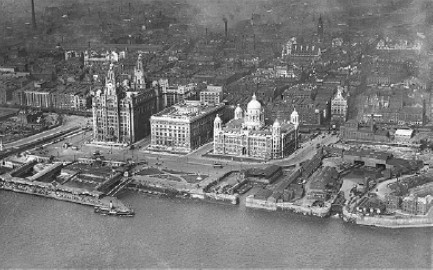
The Liverpool Waterfront some time in the 1920s. From left to right: the Liver Building, Walter Aubery Thomas (1908 – 1911); William Edward Willink and Philip Coldwell Thicknesse (1904 – 1917); Mersey Docks and Harbour Board Building, Sir Arnold Thornley (1904 – 1907).
Certainly, the changes were very much in keeping with other major harbour front developments elsewhere in the world. For example, there was more than a passing resemblance between the new Singapore waterfront and Pier Head, Liverpool, not least, perhaps, because the Liverpudlian architectural practice of Briggs & Thornley may have had a hand in the design of the Ocean Building. The parallel was important, because this was at a time when Liverpool proclaimed itself to be the “Second City of Empire”, with a port that was second only to London in size and importance.
And it was not just Liverpool that Singapore resembled, but also Shanghai; a photograph of the Singapore waterfront, which appeared in the Straits Times of 2 March 1935, was accompanied by a caption that read, ”What China Coast people call the ‘Bund’”.
![The Shanghai Bund in the 1930s [2point6billion.com].](https://isomer-user-content.by.gov.sg/339/863a0cea-bd6b-4ebf-8f5b-6de0dd687d05/Fig 39_ Shanghai Bund 1930s.jpg)
The Shanghai Bund in the 1930s [2point6billion.com].
The redevelopment of Singapore’s waterfront in the 1920s was quite self-conscious in a way that Collyer Quay in the nineteenth century was not, with the possible exception of the 1892 Hong Kong and Shanghai Bank Building, which was definitely making a statement. Whereas the architecture of Collyer Quay of the 1870s and eighties was simply of its time, the remarkable burst of corporate bodybuilding in the 1920s was intended to steal the limelight and project an image of Singapore as modern up-to-date metropolis, in much the same way that today’s corporate skyscrapers do.
I have discussed the circumstances that led to the emergence of Singapore as a major financial centre in the first two decades of the twentieth century — Malayan tin and rubber, shipping and insurance, banking and financial services. This was a coming of age that occurred in tandem with the island’s expanding economic horizons and increased importance as a regional entrepôt. But the 1920s were also a time of important advances in Singapore’s physical development as a city. A series of Municipal initiatives to relieve the overcrowded and insanitary living conditions in Chinatown, while they may not have been as rapid or as extensive as they could have been — proper funding was a major problem — at least went someway to improving the lot of Singapore’s urban poor at this time. The introduction of a waterborne sewerage system, for example, accompanied by an improved water supply for the town centre, are two such instances of Municipal advances of the 1920s, though admittedly their implementation was piecemeal and painfully slow. The creation of the Singapore Improvement Trust in 1927 was another important initiative leading as it eventually did to the Housing Development Board of the post-independence era. Initially, the remit of the SIT only extended to the improvement of existing housing stock — the building of large-scale residential estates like the one at Tiong Bahru, would come later. Nevertheless, the Trust did introduce a number of important town planning concepts, including zoning, which specified the type of housing and developments permitted in a particular area, as well as regulated building specifications. The SIT also accelerated the implementation of the existing back lanes programme in Chinatown, Kampong Glam and other inner city areas, which went some way to breaking up fetid and insanitary blocks of back-to-back housing, allowing light and fresh air to reach dark and dank interiors, and enabling improved sanitary arrangements to be effected.
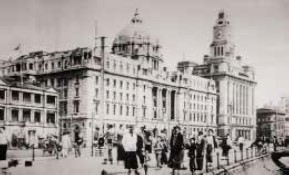
The Union Insurance Society of Canton Building.
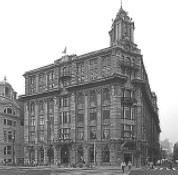
Hong Kong & Shanghai Bank Building and Customs House, Shanghai Bund.
1927 also saw the opening of the St James Power Station at Keppel Road which greatly extended the provision of electricity, especially to outlying areas — up until this time, the Municipality had relied on Shanghai Electric Construction Company to provide the town’s electricity supply. The Shanghai Electric Construction Company provided power to the Singapore Tramways Company, which had run an electric tram service from 1905. The latter was wound up in 1926 and a new company was created in its place, the Singapore Traction Company, which replaced the trams on rails with a more sophisticated trolley bus service that would continue in operation until 1962.
This forerunner of today’s MRT system — at the time, it was the largest trolley bus network in the world (Waterson 2003: 114) — augmented by the infamous mosquito bus,32 enabled the expansion of the town to more outlying areas, principally Serangoon and the East Coast. Prior to the First World War, Singapore’s East Coast was essentially one big coconut grove, but after this point we see the gradual extension of the town eastwards with each passing year: Kallang, Geylang, Tanjong Katong, Joo Chiat, Telok Kurau; in 1928, the Municipal boundaries were redrawn to include Siglap (Lee Kip Lin 1988: 119).
This expansion of the town went hand in hand with the emergence of a modestly affluent middle class and an accompanying suburban lifestyle. Entirely new neighbourhoods, comprising streets of small bungalows and residential shophouses came into being in the 1920s reflecting the new mobility of those times. This was Singapore’s commuter belt, peopled by salaried office workers, doctors, lawyers, architects and school teachers — Chua Ai Lin’s “Anglophone Asian community … poised to take up the opportunities offered by popular modernity.” And of course, this is precisely the time we do indeed see the emergence a modern popular culture revolving around the cinema, music, cabaret, fashion and other leisure-time pursuits, facilitated in part by a proliferation of mass media — newspapers, magazines and newsreels. As Chua Ai Lin has argued, the cinema in particular played a major role in broadening the cultural horizons of Singaporeans during this period — London, Paris, New York, Hollywood and, closer to home, Shanghai — were now a part of the cultural landscape in a way that they had never been before. And on a more serious note, there was also a concomitant growth in political awareness and activity at this time, with increasing interest in events abroad, particularly China, and also a growing self-awareness and understanding of Singapore’s place in the world — in short the first stirrings of nationhood and a sense of national identity.
I have mentioned the improvements to the docks, which were carried out during the First World War, and the building of a Causeway connecting Singapore island with the Malayan mainland, which was completed in 1923. Another important development in the twenties was the British Government’s decision to develop Singapore as a naval base to service a huge new battle fleet in the Far East — the so-called “Singapore Strategy”. This came about as a result of Viscount Jellicoe’s fact-finding mission to India and the Dominions in 1919, which returned home with the conclusion that the future defence of the British Empire was rested upon being able to match the major naval build-up then being initiated by the Japanese — in Jellicoe’s view, Singapore was “undoubtedly the naval key to the Far East” (Murfett et al 1999: 148). Although the proposal suffered a reversal at the hands of Ramsay MacDonald’s Labour Government of 1924, it eventually went ahead and work began at Sembawang in 1928, scheduled to last seven years, which included docks, workshops, fuel tanks and other storage facilities, as well as accommodation for some two thousand naval personnel (Murfett et al 1999: 153, 157).
And the navy was just part of the military build-up in Singapore as the island’s artillery and air defences were progressively extended as part of the overall plan to turn Singapore into a “Gibraltar of the East.” This included the construction of a Royal Air Force station at Seletar in the late twenties, which as well as serving a military purpose, was also used as an aerodrome for civil aviation. Completed in 1929, the first scheduled commercial flights to regional destinations commenced the following year, though a proper long haul passenger service from Europe did not begin until 1934 (Taylor 2002: 41; Turnbull 1989: 137).
Considered together, these developments that took place in the 1920s, indicate that Singapore at this time was very much a city on the move. The 1920s were an upbeat time, an era of optimism, energetic growth and expanding horizons, the economic recessions of the early 1920s notwithstanding. This is when we see Singapore transcend its traditional role of regional entrepôt and interlocutor between Asia and Europe, to take up a position on the international stage as a global port-city with connections reaching right around the world — to Japan, Russia, the Americas, Australia and South Africa, as well as Britain, India and Europe. It was also a time of rapid social change and political developments — not something I have been able to consider here — reflected in the lifestyles and aspirations of the people. And here I don’t mean just the privileged European and Asian elites, but also Singapore’s burgeoning middle classes who were themselves in part the agents of this transformation.
For all that, Singapore was still a city of huge disparities in the physical and material well-being of its people with an enormous gulf between rich and poor, the privileged and the deprived. As the Straits Times observed, “One thing which we who live in Singapore sometimes forget is the extraordinary contrast between the big public buildings, the Fullerton Building and the Municipal Building, and the Chinatown squalor at the back of them” (ST 7 June 1936: 2). Not that these incongruities disqualified Singapore from being considered a properly modern city — one would have been able to find much the same degree of social inequality in New York, London or Shanghai at that time.
![The Singapore waterfront in the 1950s, the skyline still dominated by the blockbusters of the 1918 – 1928 era [NAS].](https://isomer-user-content.by.gov.sg/339/98a231f4-313c-4272-b2ed-306521e54c46/Fig 41_ Singapore waterfront 1950s.jpg)
The Singapore waterfront in the 1950s, the skyline still dominated by the blockbusters of the 1918 – 1928 era [NAS].
Which brings us back to our starting point — the idea of Singapore as a modern city. Certainly, by the end of the 1920s, Singapore could properly be considered modern in every sense of the word and it was precisely this message that the buildings down on the waterfront set out to capture and convey, for then as now it was Singapore’s corporate ‘skyscraper’ architecture which more than anything else proclaimed Singapore’s status as a thoroughly modern, twentieth-century metropolis. Accordingly, I leave the last word to Robert Bruce Lockhart, returning to Singapore in 1935 after a quarter of a century’s absence. Reflecting on the changes that had taken place, he writes: “It is an international Liverpool with a Chinese Manchester and Birmingham tacked on to it. Its finest buildings are modern” (1936: 140).
Endnotes
1 Joanna Moore was the wife of the Singapore-based publisher Donald Moore, who, one need hardly say, was the publisher of the book.
2 The Bank of China remained the tallest building in the vicinity of Raffles Place until 1974 when it was overtaken by UOB Plaza Two.
3 Ludwig Karl Hilberseimer (1885 – 1967) was a German architect and urban planner best known for his ties to the Bauhaus and to Mies van der Rohe, as well as for his work in urban planning at the Illinois Institute of Technology in Chicago.
4 My quotation comes from the Rough Guide to Malaysia, Singapore and Brunei, 2006 edition, p. 605, but any number of similar descriptions can be found on the internet simply by Googling “colonial backwater Singapore”. Naturally, most of these postings are neither scholarly, nor even well-informed, but they do reveal a common misconception regarding Singapore’s standing in the world on the eve of independence. Mr Loy Hui Chien, for example, First Secretary of the Singapore Mission to the United Nations in 2009, describes the Singapore of “fifty years ago” [i.e. 1959] as “little more than a squalid colonial backwater at the tip of the Malay Peninsula” (this was in a statement regarding the assessment of the apportionment of expenses of UN peace keeping operations on 6 October of that year). Squalid much of Singapore may well have been at that time, but a backwater? Far from it.
5 The dates refer to their year of completion.
6 The term “Edwardian Baroque” refers to Baroque revival buildings dating from the very end of the Victorian era through to the beginning of the First World War (nobody minds the term being stretched out a little on either side of the actual reign of Edward VII). It is also applied, rather less accurately it must be said, to large Classically-informed civic buildings of the postwar era, which are not necessarily the same thing. Many of the latter were of course designed by architects who were practicing before the war and who were definitely Edwardian Baroque back then. By the early twenties, however, they had moved on, cutting back on the more excessive ornamentation (i.e. the Baroque bits!). This was no doubt partly a response to the austerities of the immediate postwar era and also partly due to the influence of the contemporary stripped Classical movement— a kind of simplification of Classical elements — which presaged the advent of the Modern movement.
7 They were actually described as such (“Sky Scraper Audacity,” Straits Times, 4 February, 10. (From NewspaperSG)
8 The Fullerton Building, it should be explained, as well as being the GPO, was home to the Singapore Club, an exclusive European establishment, which was modelled along the same lines as a gentleman’s club in London, hence Bruce Lockhart’s reference to Pall Mall, where a number of these institutions are to be found, residing in the most palatial accommodation.
9 Previously, ships rounding the Cape of Good Hope would head for the Sunda Strait between Sumatra and Java, if they were destined for China, or else keep to the southern latitudes of the Indian Ocean if they were Antipodean bound.
10 The results of the Oxford and Cambridge Boat Race on 14 April 1871 were telegraphed to India in four minutes (Makepeace 1921: 167).
11 Both the Federated and Unfederated Malay States had “protected state” status, that is to say, they were ostensibly to be governed by their own traditional rulers, with the British Resident simply there in an advisory capacity. In practice, however, they were administered by the British along similar lines to the Straits Settlements. The state of Johor also accepted a treaty of protection with the United Kingdom in 1885, but remained outside the Federated Malay States when the latter were constituted in 1895; a resident Advisor was subsequently accepted in 1904.
12 Gutta percha is the latex-like sap of a number of trees belonging to the Sapodilla family, which are native to the Malay Peninsula. It was the nineteenth century forerunner of rubber, its most significant application being the insulation of submarine telegraph cables, though it was also widely used as dental cement and in the manufacture of golf balls, galoshes and rubber hoses.
13 It was the caterpillar of that species, rather than the moth, which caused the damage, the former being endowed with an insatiable appetite for the leaves of young coffee plants.
14 Ridley’s madness had nothing to do with his advocacy of plantation rubber, but came about as a result of a chance remark made to a planter while out botanising in the jungles of Malaya. After a fall of rain, they found themselves plodding through mud with water almost up to their eyes, which led Ridley to observe to his companion that in South America the natives wore boots of their own manufacture, which kept their feet and legs completely dry — he was referring to indigenous gum boots made by Indians of Brazil from the sap of wild rubber trees. Evidently the planter found the idea preposterous and Ridley completely off his head and so hence forth, the distinguished botanist became known as ‘Mad Ridley’ (Coates 1987: 101)
15 Guthrie & Co. was founded by Singapore pioneer, Alexander Guthrie, in 1821; Boustead & Co. in 1828; Paterson Simons & Co. in 1859; and Mansfield & Co. in 1861.
16 There were serious food shortages immediately after the conclusion of hostilities in Europe, but this had more to do with a failure of the rice harvest in 1919, than the war itself.
17 As often as not the pioneer planters were given shares in the London firm and stayed on as shareholder-managers (Coates 1987: 116)
18 This was the 1920-1921 US recession, which led to Mincing Lane temporarily regaining control of the world rubber market when production and sales restrictions were introduced in 1922.
19 The information in this section relating to the Ocean Steamship Company is taken from the Ocean Liner Virtual Museum website (www.oceanlinermuseum.co.uk)
20 As well as providing a home for the Blue Funnel Line and their Singapore agents, Mansfield and Co., there was additional office space available for commercial lets.
21 This was incorrect: Bidwell’s Victoria Memorial Hall tower, from 1906, is a little over 175 feet in elevation.
22 Swanson & Sehested were originally based in Bangkok, but moved their head office to Singapore upon being awarded the Ocean Building contract; no doubt it was the Bangkok connection which led Swanson & Sehested to commission Rudolfo Nolli to work on the artificial stone cladding and architectural ornaments.
23 The first steel-frame high-rises were built in Chicago in the 1890s; reinforced concrete came in a little earlier with French pioneers leading the way.
24 Meccano is the brand name of a model construction kit, comprising re-usable metal strips, plates, angle-girders, axels, wheels, gears and so forth, which can be connected together using washers, nuts and bolts. Invented in 1901, Meccano is still manufactured today in France and China, but probably reached the height of its popularity between the two world wars, when it provided an invaluable introduction to the principles of mechanics and engineering for boys who were that way inclined.
25 The Victorians, taking over from the antiquarian interests of their Georgian predecessors, became almost fanatically obsessed with emulating the architecture of early periods in history: most famously Gothic and Greek, but also various vernacular styles, which they fondly described as “Old English”. Each school had its champions and its critics, and so bitter were their differences that this period in British architectural history is often described as “The Battle of the Styles”.
26 The rotunda was removed sometime in the mid-1950s.
27 It was more than double the area of office space offered by the Ocean Building.
28 Boustead & Co. was actually the first Singapore agent for the Hongkong and Shanghai Bank next door, prior to the bank opening a branch office in 1877.
29 The Fullerton Building was named after Sir Robert Fullerton (1773–1831), first Governor of the Straits Settlements, during the time of the East India Company (1826–1830).
30 As well as the Post Office, the proposed building was to house various administrative departments, including that of the Harbour Master Attendant, the Import and Exports Department, the Monopolies Department, the Chief Health Officer, the Veterinary Surgeon, the Director of Education and Inspector of Schools, the Marine Surveyor and the Government Survey Office.
31 Edmond Coignet (1856-1915) was a French engineer who in the late nineteenth century was one of the pioneers of reinforced concrete using metal inserts; by the time the Fullerton was commissioned, the firm was a wholly British concern. Keys had previously worked with Edmund Coignet and Co. on the London Western District Post Office and the General Post Office Money Order Department at Holloway, London, so the pairing was an appropriate one.
32 The mosquito bus was a local invention which took a large car chassis — the Model T Ford was a popular choice — and customised it, putting a seven-seater timber frame passenger cabin on the back, which was open at the rear to permit easy boarding and disembarking; by 1927, there were 456 on the roads (Waterson 2003: 114)
Bibliography
Baker, Jim. Crossroads: A Popular History of Malaysia and Singapore. Singapore: Times Editions, 1999. (From National Library Singapore, call no. RSING 959.5 BAK)
—. The Eagle in The Lion City: America, Americans and Singapore. Singapore: Landmark Books, 2005. (From National Library Singapore, call no. RSING 303.4825957073 BAK)
Baudrillard, Jean. “‘Modernité’.” Encyclopaedia Universalis 12 (1985): 434–26; Canadian Journal of Political and Social Theory 11, no. 3 (1987): 63–72.
Bastin, John, ed. Travellers’ Singapore: An Anthology. Oxford in Asia Paperback, 1994. (From National Library Singapore, call no. RSING 959.5705 TRA-[HIS])
Braddell, Roland. The Lights of Singapore. 3rd ed. 1982. Reprint, Kuala Lumpur: Oxford University Press, 1934. (From National Library Singapore, call no. RRARE 959.57 BRA-[JSB])
Brown, Edwin A. Indiscreet Memories. 2007, Reprint, Singapore: Monsoon Books, 1935. (From National Library Singapore, call no. RCLOS 959.51 BRO-[RFL])
Bruce Lockhart, R. H. Return to Malaya. London: Putnam, 1936. (From National Library Singapore, call no. RCLOS 959.5 LOC-[ET])
Coates, Austin. The Commerce in Rubber: The First 250 Years. Singapore: Oxford University Press, 1987. (From National Library Singapore, call no. RSING 338.1738952 COA)
Coltman, Arthur Oakley. ‘A Brief Record of Booty & Edwards, Architects’. 1957. Personal copy.
Chan, Kwok Bun and Tong Chee Kiong, eds. Past Times: A Social History of Singapore. Singapore: Times Editions, 2003. (From National Library Singapore, call no. RSING 959.57 PAS-[HIS])
Chua, Ai Lin. “‘Modernity, Popular Culture and Urban Life Anglophone Asians in Colonial Singapore, 1920–1940’.” PhD diss,, University of Cambridge, 2007.
Hitchcock, Henry-Russell. Architecture: Nineteenth and Twentieth Centuries. 4th ed. 1977. Reprint. London: Thames & Hudson, 1958. (From National Library Singapore, call no. RART 724.9 HIT)
Lee, Kip Lin. The Singapore House 1819–1942. Singapore: Times Books International, 1988. (From National Library Singapore, call no. RCLOS 728.095957 LEE)
Makepeace, Walter. “‘The Machinery of Commerce’.” In One Hundred Years of Singapore. Vol. 2, edited by Walter Makepeace, Gilbert E. Brooke and Roland St. J. Braddell. London: John Murray, 1921, 166–234. (From National Library Singapore, call no. RCLOS 959.51 MAK)
Makepeace, Walter, Gilbert E. Brooke and Roland St. J Braddell, eds. One Hundred Years of Singapore. 2 vols. London: John Murray, 1921. (From National Library Singapore, call no. RCLOS 959.51 MAK)
Moore, Joanne and Kathinka Fox. Singapore – City of the Lion. Singapore: Donald Moore, for Heinemann Asia Ltd, 1960.
Murfett, Malcolm H. “‘A Keystone of Imperial Defence or a Millstone around Britain’s Neck?” 1999.
“Singapore 1919–1941.” In Malcolm H. Murfett, John N. Miksic, Brian P. Farrell and Chiang Ming Shun. Between Two Oceans: A Military History of Singapore from the First Settlement to Final British Withdrawal. Oxford: Oxford University Press, 1999. (From National Library Singapore, call no. RSING 355.0095957 BET)
Malcolm H. Murfett, John N. Miksic, Brian P. Farrell and Chiang Ming Shun. Between Two Oceans: A Military History of Singapore from the First Settlement to Final British Withdrawal. Oxford: Oxford University Press, 1999. (From National Library Singapore, call no. RSING 355.0095957 BET)
Santry, Denis and Claude. Salubrious Singapore. Singapore: Kelly & Walsh, 1920. (From National Library Singapore, call no. RRARE 828.99 SAN)
Seow, Eu-Jin, “‘Architectural Development in Singapore’.” PhD diss., University of Melbourne, 1973.
Taylor, David. Seletar Crowning Glory: The History of the RAF in Singapore. West Sussex: Woodfield Publishing, 2002. (From National Library Singapore, call no. RSING 358.40095957 TAY)
Turnbull, C. M. A History of Singapore 1819–1988. 2nd ed. Kuala Lumpur: Oxford University Press, 1989. (From National Library Singapore, call no. RSING 959.57 TUR)
Waterson, Roxanne. “Gathering Speed: Transport and the Pace of Life’.” In Past Times: A Social History of Singapore, edited by Chan, Kwok Bun and Tong Chee Kiong Singapore: Times Editions, 2003. (From National Library Singapore, call no. RSING 959.57 PAS-[HIS])
Wong, Lin Ken. The Malayan Tin Industry to 1914 With Special Reference to the States of Perak, Selangor, Negri Sembilan and Pahang. Tucson: Published for the Association for Asian Studies by the University of Arizona Press, 1965. (From National Library Singapore, call no. RCLOS 338.27453 WON)
—. “Singapore’s Growth as an Entrepôt Port 1819–1941.” Journal of Southeast Asian Studies 9, no. 1 (March 1978): 50–85. (From JSTOR via NLB’s eResources website)