
Article
Women and Islam in Pre–19th Century Aceh
Topics
History
1 April 2015
This Chapter of Asia article examines gender relations in Aceh, which have been changed and transformed by the adoption of Islam. From the 16th to 17th centuries when Aceh emerged as an Islamic state, women had proved to be actively involved in the processes of social and political change.
By Ma. Theresa R. Milallos
Introduction
The nature and extent of Islam’s influence on women in Southeast Asia in general and contemporary Indonesia in particular have been highly debated (see, for instance, Blackburn, 2008; White, 2006; Syafiq, 2006; Othman, 2005; Bennett, 2005; Nik Noriani, 2003; Mas’Udi, 2002; Frith, 2002). Nowhere is this discourse more apparent than in Aceh, which has, since 1999, started implementing Syariah (the religious law of Islam) as part of its autonomy agreement with Jakarta, and spawned renewed debate on its implications on women (see, for example, Milallos, 2007 Noerdin, 2002; Siapno, 2002). Yet, historically, Aceh remains one of the shining examples of female ascendancy in a sultanate, a phenomenon itself riddled with controversy from the Islamic viewpoint (see, for example, Mernissi, 1993). Between 1641 and 1699, four sultanahs (queens) ascended the throne in at least 59 years of unbroken rule. In the latter part of the 17th century, the last sultanah, Kamalat Shah, was deposed following a fatwa (ruling) from Mecca forbidding female rule.
The many “inconsistencies, contradictions and paradoxes in the ideology of gender” (Peletz, 1996, p. 3; in this case, referring to Negeri Sembilan) manifest themselves in male–female relations in Aceh, which precludes the simplistic analysis that women had been subordinated to and by men. What is disturbing is that after the December 2004 tsunami, the discourse included how women were responsible for the horrendous disaster.1 This has led to the critical observation of some aspects of Syariah, the most visible and controversial of which is the enforcement of busana Muslimah (Muslim attire for women, ubiquitous of which is the jilbab, or head cover). That Aceh became a major trading entrepot and Islamic centre of learning after the fall of Malacca in 1511 and entered a golden age of economic prosperity and religiosity in the 17th century helped explain these inconsistencies, contradictions and paradoxes that persist until today. Indeed, since early modern times, gender remains at the heart of political and social change. The impact on what women can do and be vis-à-vis men is reflective of these historical processes.
This paper seeks to understand how gender relations have changed and indeed been transformed by the adoption of Islam in Aceh. Considerable research has already shown that women in Southeast Asia, including those in Aceh, enjoyed a higher level of economic autonomy and personal freedom prior to the colonisation period compared with those from West, East and South Asia (Andaya, 2006, 2000a,b; Peletz, 1996; Ong & Peletz, 1995; Errington, 1990; Reid, 1986). The objective of this paper is to investigate the ways and extent to which this “higher status” of women can be observed. Ultimately, the discussions that follow aim to contribute to a clearer picture of women’s history in Southeast Asia in general and Aceh in particular.
Transition to Islam in Aceh in the Early Modern Period
While the exact period of Islam’s entry into Aceh2 is highly contested (see, for example, Iskandar & Ahmad, 2001),3 recent discoveries of tombstones in Kuta Lubhok, Aceh Besar district, give evidence of a Muslim community as early as the 12th century (McKinnon, 2006, pp. 30–32). Nonetheless, the adoption of Islam in this area has been gradual, syncretistic and far from following a simple linear path. Pre-Islamic practices and belief systems co-existed, sometimes uneasily, with Islamic ones.4
The initial stage in this expansion and adoption process was marked by intense interaction between Islam and local belief systems. Islam provided a powerful rationale for state-building under the authority of a mortal, but god-endowed, sultan. What followed after the ruler Iskandar Muda’s death, however, was a tumultuous period of Islamic renewal and reformism. Azra (2004) emphasises that, during this time, the entire Malay-Indonesian archipelago was increasingly pulled into the global network of Islamic intellectual debate. However, the shift to a “reformist, purificationist and activist” Islam (Azra, 2004) not only reflected international intellectual trends, but, more importantly, the local politico-economic environment of the time (Reid, 2000, pp. 17–29). Aceh, by then having reached the peak of military power as a “gunpowder empire”, needed an ideology and system to “justify its expansion and infraction of long-standing habits of accommodation” (Reid, personal communication, 5 September 2008). The more legalistic and scriptural brand of Islam, obviously alien and intolerant of local influences, that had been promoted by the Gujarati mystic and scholar Nur al-Din ar-Raniri (d. 1658) who flourished in Aceh’s royal court in the 15th century did serve to present a more “modern” and innovative sultanate. It was targeted for the numerous and increasingly powerful foreign Muslim traders in Aceh (Reid, personal communication, 5 September 2008).
The culmination of this stage was the “fierce heresy-hunt” led by ar-Raniri against the wujuddiyah doctrine of the Sumatran Sufi writer Hamzah and Pasai theologian Shamsuddin, originally patronised by Iskandar Muda (Ito, 1978). With the death of Iskandar Thani and the assumption of power by his widow Safiyyat al-Din (r. 1641–75; the first of four consecutive queens), ar-Raniri’s hard-line political and economic policies – which had disastrous consequences, notably the burning of books, execution of wujuddiyah supporters and the exclusion of Chinese and Christians (Reid, personal communication, 5 September 2008) – were swiftly challenged and abolished.
The tolerant Islam advocated by the North Sumatran scholar Abd al-Rauf al-Sinkili characterised much of
the subsequent decades under the four queens. This period is marked by “syncretism and inclusiveness”, with adat (customary and traditional laws) gaining more ground in the countryside (Reid, personal communication, 5 September 2008; Reid, 2007, p. 8; Azra, 2004). Aceh’s power was obviously waning, and the sultanate was shrinking following the loss of many of its territories and the decline of trade in its port. By 1675, with the death of Safiyyat al-Din, Aceh was confined to only north Sumatra (Djajadiningrat, 1979, p. 62).
Subsequent decades marked the shifting of traditional power away from the sultan and into the hands of the orang kaya, the emerging elite class with increasing political powers, who had effectively put four queens on the throne from 1641 to 1699 (Reid, 2005, pp. 94–111; Azra, 2004; Hurgronje, 1906).5 In the next 239 years, one leadership crisis after another unfolded, evidenced by “eleven inconsequential Sultans, including three Arabs (1699–1726), two Malays (both in 1726) and six Bugis (1727–1838)” (Riddell, 2006, p. 42).
Indeed, these “waves” of Islamic adoption, reformism and renewal had had profound consequences on gender relations. Andaya (2000) succinctly explains the interlinked roles of Islam and the state (in Aceh, comprising the sultan, local aristocrats, or uleebalang, and religious scholars, or ulamas) in understanding gender issues since the spread of Islam in island Southeast Asia in the 13th century:
First, as the Shadow of God on earth, the ruler had a special responsibility to ensure
that the law of God was enforced, in sexual conduct as much as in other matters
…. Second, since Islam was so closely linked to royal sponsorship, demonstration
of piety became closely associated with elite practices…. Third, political Islam was
consistently concerned that the presence of women in the public sphere could
lead to social disruption because of their own passions as well as the emotions they
aroused in men (Andaya, 2000, p. 242).
Given these considerations, several questions may be raised regarding a discourse on gender in pre-19th century Aceh. First, to what extent had Islam become entrenched in the Aceh sultanate in the early modern period, and to what degree was Islamic law actually observed? Second, who in the population had been squarely within the ambit of Islamic piety and practice during this time? The answers to these questions will hopefully clarify what it means for women during this period to enjoy “high status”.
Patterns in the adoption of Islam and their Consequences to Gender Relations
Following the patterns of intensification and weakening in the adoption and interpretation of Islam, it is not surprising to find observations such as the following from François Martin, who wrote in 1602:
The [upper-class] women are covered in a cotton cloth from the waist to the knees,
and another covering them from the breast to the waist. The others have the [upper]
body naked except for a scarf wound over one shoulder and covering parts of the
breast. Their heads are bare except for hair pins…. They go bareheaded, their hair
simply tied back. Some have their heads shaved and are fairly difficult to distinguish
from men except for their breasts. (Reid, 1995, pp. 57–58).
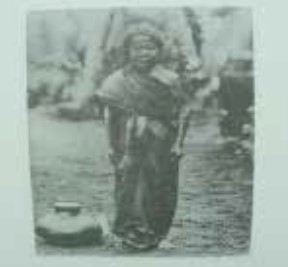
Note the attire in late 19th century reminiscent of François Martin’s observations in 1602. Photo reproduced from C.Snouck Hurgronje. 1997. Aceh: Rakyat dan Adat Istiadat. All rights reserved, Lee Kong Chian Reference Library Collection, 2008.
He further stated that there was a local custom of observing physical distance with women, so that “[w]e who did not know of this custom saw no objection to coming up to speak to them. On seeing this they would abuse us and as a sign of their contempt would spit on the ground” (Reid, 1995, p. 58). Yet, these women could bare part of their breasts without embarrassment, adorn their ears, leave their heads uncovered, and go bathing in the river naked without being accosted (Reid, 1995, p. 59).
Curiously, according to Martin, adultery already received a high penalty: “In the case of adulterous men, their private parts are cut off; for women the nose, or the eyes are cut out” (Reid, 1995, p. 60). By 1621, Augustin de Beaulieu noted that, in addition to execution and the cutting off of body parts, caning – a ubiquitous Islamic practice – was a popular way to administer punishment (Reid, 1995, pp. 66–67).
These waves or patterns have resulted in “inconsistencies, contradictions and paradoxes in gender” (Peletz, 1996, p. 3), thereby contributing to ambiguity in societal expectations, observable until today, of women. Most notable are conceptions of female chastity and the importance ascribed to concealment. In 1602, for instance, chastity generally appeared not to have been a prized commodity, according to Martin’s observation:
When strangers come to this place, they buy women for
as much time as they want to stay there, without the
women being shocked by this…. Before getting married
the girls do no scruple to prostitute themselves to anyone
they consider suitable, which in no way prevents them
from marrying (Reid, 1995, p. 58).
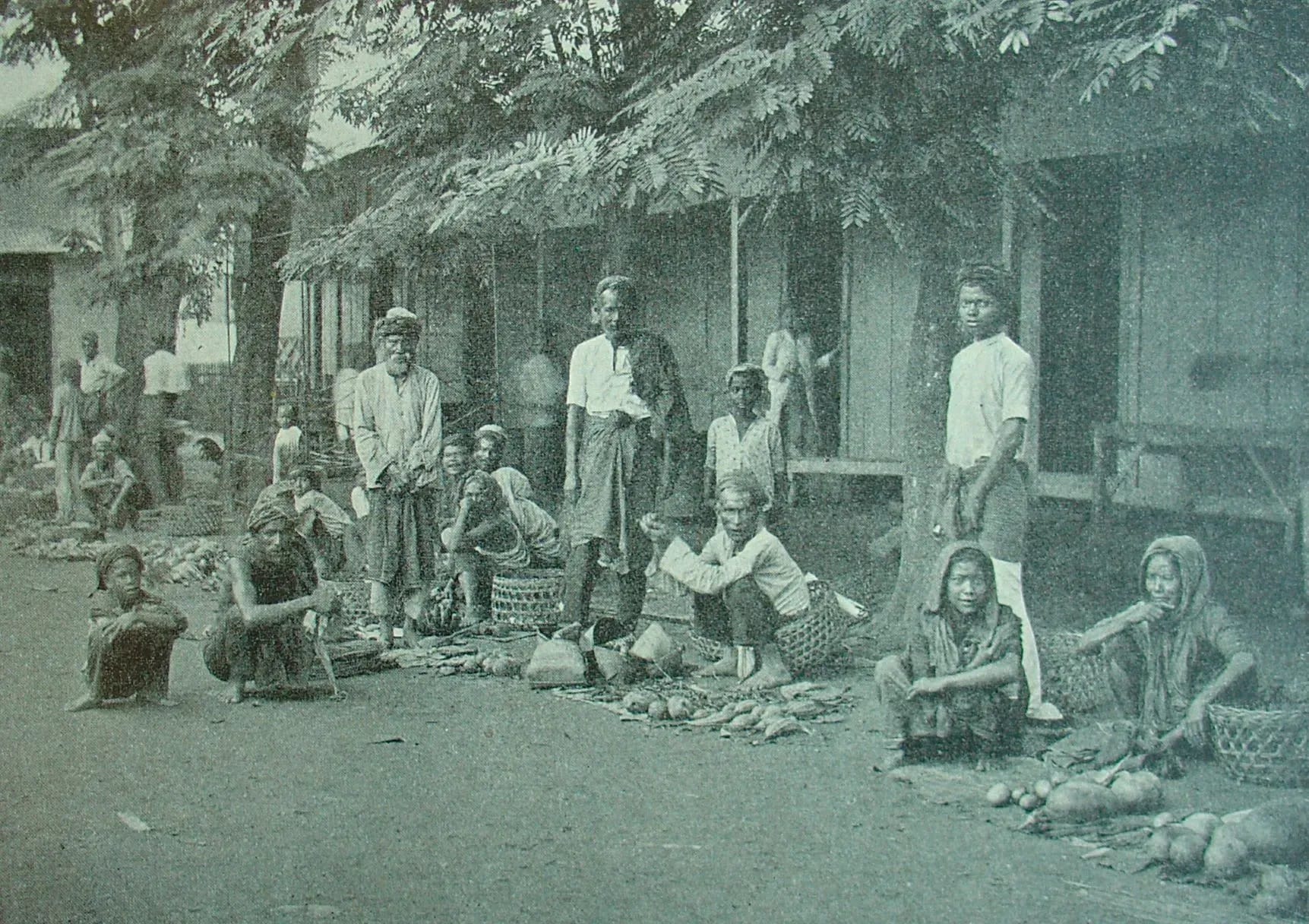
Note the relative ease of gender intermixing in this late-19th-century photo. Photo reproduced from C. Snouck Hurgronje. 1906. The Atjehnese. All rights reserved, Leyden: E.J. Brill, 1906.
About four decades later, Jan Janszoon Struys wrote about the incident of an Acehnese woman left alone on an Acehnese junk captured by some Italians. Raped by these Italians, she was finally able to escape ashore, only to be “krissed” by her husband until she died (Reid, 1995, pp. 50–51). Why she was on board the junk in the first place is unknown. The “krissing” is also not difficult to understand, given the
strong abhorrence of the Acehnese to foreigners (Hurgronje, 1906, p. 296). However, notions of chastity appeared to have been generally unchanged, and this was most apparent among non-palace womenfolk. In 1323, for example, Fra Odorigi de Perdonne, who visited Lamri, observed that polyandry6 was a common practice and that “all women be in common” (Coedes, 1968, p. 213). By the 19th century, Hurgronje – while stressing the virginity of the bride before marriage, especially in relation to the paying of bride-wealth and the involvement of a wali (guardian) – also noted that there existed “comparative freedom of intercourse between the sexes in Aceh” (1906, pp. 328–346). Thus, it was easy for a woman to “get the man to sit down by her for a moment” (Hurgronje, 1906, pp. 113–114). If such liaisons produced a child, abortion was recommended by the uleebalang (territorial aristocrats) or the rakan (“follower of the uleebalang”) (Hurgronje, 1906, pp. 113–114), contrary to the stricter contemporary view under Syariah that absolutely forbids gender mixing, much less illicit intercourse.
The early to mid-17th century was characterised by behaviour that would not have been acceptable to a more legalistic and scriptural interpretation of Islam. Prevailing societal expectations presented a relatively permissive environment in which “hermaphrodites” abounded, the keeping of more than 300 concubines by the king of Aceh explicitly acceptable, prostitution tolerated, and the freedom with which women could go out into the masculine “outside” recognised (Reid, 1995, pp. 55–63). It is unlikely that these kinds of behaviour would be condoned among the elite classes, however, where notions of morality would certainly be much higher.
In relation to the issue of female concealment, contemporary debate is rife on whether it is a traditional, therefore “indigenous”, practice (see, for instance, Noerdin, 2002). Evidence shows that indeed it had been practised since pre-colonial times. In many areas in Southeast Asia from the 16th century onwards, the evolution of the state and the economic gains from trade had produced increasingly stratified social structures. In 1602, for instance, the orang kaya in Aceh began to sport long fingernails on the thumb and little finger, a sign that they did not need to do work by hand (Martin, as cited in Lombard, 1991, p. 58). Their women, in turn, were freed up from labour, thereby removing them from the “sexually dangerous and aggressively masculine ‘outside’” and concealing them from the public gaze (Andaya, 2000, p. 241).
In Aceh, female concealment acquired a mystical quality during the era of the four queens (1641–99). Starting from Safiyyat al-Din’s reign, the following became laws:
1. That the queen should never marry or know the use of man.
2. That no man in the kingdom should presume to have a sight of her after being chosen as queen.
3. That the lords and justices should cause no act or law (already established) to be violated, or any other law or act to be made without the queen’s consent.
4. That her attendants should not be fewer than 500 women and eunuchs (Bowrey & Temple, 1905, 298–299).
As Iskandar Thani’s widow, Safiyyat al-Din was not allowed to remarry, though the reason was certainly not based on Islamic principles. The offer of marriage by the Sultan of Johor via a delegate was turned down, because it was feared that Johor would take the opportunity to subjugate Aceh. Bowrey went on to say:
Not one man, Woman or Childe is admitted to get a sight of her save the Women
and Eunuchs that are her attendants, and some Eunuchs her chiefe Councellours,
but when businesse with her doth present, the great Oronkay or Some of the Others
doe come into the Pallace and declare theire businesse to some of her Councell who
informs her thereof. (Bowrey & Temple, 1905, pp. 299–300).
Indeed, while Aceh is not unique in having placed four queens on the throne (see Mernissi, 1993, who counted at least 18 who had exercised considerable political authority over their kingdoms), it appears to be the only one that has actively promoted such a strict requirement for a queen to be “a maiden, advanced in years, and connected by royal blood with the ancient royal line” (Marsden, 1986, pp. 453–454). The sultanah’s throne is raised on a dais and protected by a thin curtain so that, as Bowrey ingenuously observed, a man making an act of salutation by raising the hands to the face does so to the queen’s windows. “She all the while looketh upon us, although wee cannot See her” (Bowrey & Temple, 1905, p. 307).
Although the seclusion of the queens as a practice is not new, having been the practice for the sultans’ wives, concubines and daughters in the past, what is new is the insistence on the myth of the “virgin queen”. Unlike Hindu Java in the early 16th century, which, Tome Pires observed, had numerous unmarried women (1944, p. 177), Aceh certainly did not have a comparable traditional regard for maidens deciding not to marry (Hurgronje, 1906, pp. 295, 343). Yet, the law demanding that the queen be a “virgin”, secluded and protected by curtains when receiving an audience (see Bukhari, 1966, for the relevance of the curtains) may be understood as having been cultivated to emphasise the incorruptibility of the female monarch. In Aceh, as in many Muslim societies, the notion of “outside” (keluar) versus “inside” (dalam) to delineate masculine and feminine spheres of activity appears to have been influenced to a large degree by the principles of Islam. Mernissi argued, for instance, that, “Islam is crystal clear about principles. So if one acknowledges a priori that women effectively have no power, then one cannot directly transmit any divine mission to them” (1993, p. 34). In this interpretation, Islam forecloses to women the possibility of political rule.
The virtual stripping of sexuality and consequently the threat of social disruption brought about by the female presence in the public sphere has certainly helped rationalise female ascendancy. Andaya argued that the higher the social class of a woman and her family, the higher the societal constraint placed on her to withdraw from the “outside” (2000b, pp. 231–253). As monarchs, however, the queens straddled both the “outside” world of politics traditionally occupied by men, and the “inside” world of mysticism and the home allotted to the female. While women could never be caliphs (the Prophet’s deputies as the Messengers of God) by virtue of being the “wrong” sex (Mernissi, 1993), conditions of emergency might warrant their political ascendancy. Seclusion, therefore, acts to balance the already dangerous situation of crisis, which precipitated female ascendancy in the first place. Indeed, this “asexualisation”, or the process by which one is rendered virtually sexless, is heightened by the insistence on a queen being an “old maid”, the life stage when a woman is generally considered the least desirable.
Having passed the childbearing stage, she is also considered to be wiser and, according to Andaya (2000, p. 236), “gender neutral”.7 At the same time, because royal power is held as highly masculine, these queens maintained large harems, like their male counterparts (Andaya, 2000, p. 244). For a male monarch, the possession of a large harem was obviously a symbol of prestige and potency.8 A sexless and undesirable female monarch, therefore, assumed mystical power by the display of a large retinue of women under her protection.
Andaya (2000b) argued that although women of high birth were secluded, this does not mean they were completely cut off from the socio-political and economic lives of the sultanate. They often kept men in their employ to trade in the market on their behalf and generally act as go-between with the “outside” world. To what extent this is true in pre-19th century Aceh is as yet unknown. De Beaulieu, however, noted in 1621 that the palace residents – composed of al-Mukammil’s wives and family, concubines, female guards and slaves both male and female – were virtually sealed within (Reid, 1995, p. 69). Inside the palace, the presence of a market, where only palace residents could trade among themselves without ever having to go outside its walls, had effectively brought the “outside” into the “inside”.
Hadi (2004, p. 86) noted that in Aceh at least two major works have been written which explicitly acknowledges female rule in times of crisis. The first, the Taj us-Salatin (The Crown of the Rulers) – compiled in 1603 by Bukhari al-Jauhari (Iskandar & Ahmad, 2001, p. xl; Winstedt, 1958, pp. 95–97; Bukhari, 1966) – prescribes that a female could be crowned only under times of great uncertainty, such as when there were no available and appropriate male royal candidates. In this case, the crowning of a woman would be in accordance with the people’s desire to avoid fitnah (corruption) in the country (Hadi, 2004, p. 81; Bukhari, 1966).
The second, the Safinat al-Hukkam (The Boat of the Judges), written by Jalal al-Din al-Turasani during the reign of Ala al-Din Ahmad Syah (r. 1727–35) and Ala al-Din Johan Syah (r. 1735–60), specifically states: “It is permitted to crown a woman and a fasiq (wicked) as a ruler in a condition of darurah (necessity) in order for God’s religion to be implemented” (Hadi, 2004, p. 86, fn 223). Ar-Raniri, who wrote the Bustanu’s-salatin, allegedly defended female rule within religious circles, particularly his benefactress Safiyyat al-Din. This explicit religious defence led one scholar to argue that “[i]t is possible that only al-Raniri’s powerful support and influence had legitimised the appointment of his benefactor’s widow as Sultanah” (Hadi, 2004, pp. 83-84).9 Al-Sinkili subsequently expressed moderate views not only regarding the acceptability of female rule, but also the eligibility of women for the post of hakim (judge) (Hadi, 2004, p. 85). Mernissi (1993) showed that this element of crisis as a precondition for female ascendancy is supported by historical evidence in many of the cases of Muslim kingdoms that had put women on the throne.
The deposition of Kamalat Syah at the end of the 17th century due to a fatwa from the Chief Qadi of Mecca was very much reflective of the waves of Islamic reformism and renewal as well as the religious turmoil sweeping across Aceh at this time. Starting in 1683 when Zakiyyat al-Din (r. 1678-88) received a delegation from Sharif Barakat of Mecca, the fate of female ascendancy was sealed. In the spirit of Islamic intellectualism prevalent during this period, some Acehnese raised the long-standing issue of whether it was permissible according to Islamic law for a woman to be a ruler (Azra, 2004, pp. 78–79). Both al-Sinkili and the Meccan delegation apparently failed to give explicit opinions, so that the dilemma was taken to Mecca where the Haramayn ulama, through the chief mufti, finally declared an irrevocable opinion that such a rule ran counter to the Syariah (Azra, 2004, p. 79). This decision was brought back and enforced in Aceh during the reign of Kamalat Syah (r. 1688-99). She was replaced, quickly and quietly. Nothing was heard about her again, except that she died soon after. Female political leadership after 59 years became virtually nonexistent overnight, and would remain so for another century, until Tjoet Njak Dien emerged as a political figure against Dutch colonisation (see Zainuddin, 1966, pp. 56–69).
One other ambiguity with implication to gender is the issue of inheritance, which exemplifies the tension between Islam and adat. De Beaulieu, in 1621, noted: “The king is heir to all his subjects if they have no male children” (Reid, 1995, p. 70). Thus, among the aristocracy, having a son appears to have been critical to ensure that wealth does not revert to the sultan upon the family patriarch’s death, as a “father cannot bequeath any inheritance to his daughter” (Reid, 1995, p. 70). While such an observation may have been applicable only during particular reigns of despotic rulers such as al-Mukammil and Iskandar Muda, it is still markedly different from the adat custom characteristic of Aceh wherein parents, like the Minangkabau of western Sumatra and Negeri Sembilan, pass on houses and rice lands to daughters. In the late 19th century, Hurgronje (1906) observed that the pattern of inheritance regarding immovable property was through daughters. The provision of a house or an inside room (juree) was a responsibility highly regarded of parents to a daughter upon her marriage (Hurgronje, 1906, p. 35). The perpetuation of this practice was affirmed in the 1960s when Siegel (1969) undertook ethnographic research in Aceh. He noted: “No men owned houses” (1969, p. 142, fn 2), and that “[e]very married woman owned her own house and the land on which it stood, provided she had been geumeukleh [literally separated] from her parents” (Siegel, 1969, pp. 141–142).
On the matter of polygamy as sanctioned by Islam, it was commonly the upper classes, notably the aristocracy, royalty and state officials, who practised numerous marriages, while the common man, following traditional customs, married a second wife only when he had been divorced or if the first wife had died (Hoesin, 1970, 56–57). When polygamy did occur, the man must give some of his property as inheritance to the new (and usually younger) wife in order to convince her parents of the second (or third) union (Lombard, 1991, p. 70).
The debate on adat and Islam has focused on the harmony and tension between the two, the alleged misogyny of Islam, and the bilaterality purportedly inherent in adat (see, for instance, Hurgronje, 1906, pp. 10–16; Wazir, 1992; Peletz, 1996; Rahman, 2006; Lugina, 2008). While 17th-century Aceh did not yet have a tradition of codified laws as sophisticated as those that existed in 15th-century Malacca (Hadi, 2004, p. 217; see Liaw, 1976, for Malacca laws), adat has been observed to govern the system of landholding and inheritance. However, unlike the development of adat in other areas of maritime Southeast Asia, adat in Aceh was imposed by the rulers rather than originating from the people themselves (Riddell, 2006). Both the village head (keucik) and the hereditary district chief (uleebalang) adjudicated using adat, while the ulama administered Islamic law when appropriate (Reid, 2006a, p. 9).
Adat and Islam in Aceh are thus exogamous structures divorced from the processes of negotiation through which communities are able to define social expectations. Consequently, the tension between the two will not just be theoretical or ideological in nature; rather, it strikes deeply at the core of their rationale. Such a consideration has implications on what “indigenous” practices and laws mean vis-à-vis what are alien and, more importantly, how to define “Acehneseness” (Reid, 2006a, p. 9).
As to their impact on women, Wazir (1992) believed that the major difference between adat and Islam is that generally the former provides the basis for women’s power and autonomy, while the latter supports male power. The “overall pervasive norm of ‘bilaterality’” (Wazir, 1992, p. 5) endowed in adat is most obvious in matters relating to land, economics, kinship and marriage, all of which reduce hierarchical differences based on gender. Thus, young unmarried women may be marginalised just as much as young unmarried men because of age, marital status and class, rather than simply on the basis of biology or sex (Wazir, 1992, p. 10).10 In pre-19th century Aceh, there was a need to delineate between urban and rural, as the influence of Islam and adat was undoubtedly geographically and class-based, as shown below.
Female Roles in Pre-19th Century Aceh
Female roles in pre-19th century Aceh reflect the diversity and relatively active participation women enjoyed to varying degrees. Andaya (2006, p. 48) emphasised the role of legitimate wives and even concubines not only in perpetuating royal bloodlines, but also in legitimating rule and brokering peace through intermarriages. The Hikayat Aceh (Iskandar & Ahmad, 2001) itself starts with the myth of Raja Syah Muhammad’s marriage to a fairy (budadari or baludari) named Tuan Puteri Dewi Indera (or Puteri Betung), who came from a bamboo. His brother, Raja Syah Mahmud, was also joined in marriage to another fairy, Puteri Bungsu. Lamri and Aceh’s unification and the subsequent creation of the sultanate in the early 15th century also occurs with the marriage of Putri Setia Indera, Aceh Sultan Inayat Syah’s daughter, to Ali Mughayat Syah, Lamri Sultan Shams Syah’s son (Hadi, 2004, p. 13). In 1599, Aladin11 proclaimed himself king by emphasising the right of his wife, the previous sultan’s kinswoman, and after murdering the rightful child-heir (Davis, 1970, p. 148). The interlinking of kingdoms – in this case Malacca, Aceh and Perak – was also achieved through strategic marriages. Andaya (2006, pp. 63–64) highlighted a Perak source that mentions a widowed queen who was taken back to Aceh with her children. The Aceh queen later took her eldest son as husband. This adopted prince, descended from the Malacca line, succeeded to the throne of Aceh in four years and sent his brother back to Perak to be installed as ruler (Andaya, 2006, pp. 63–64). Siapno (2002, 55–59) also referred to Paduka Syah Alam (Ruler of the World), mother to Sultan Salah ad-Din, who chose and appointed an Agha (Turkish title) named Kasdin (who later adopted the title Raja Bungsu) to rule the sultanate in lieu of her son who was deemed useless.
Unlike in Malacca, however, where the wives of sultans are clearly supplied by the bendaraha (chief minister) line (Wazir, 1992, pp. 38–43), there is no clear indication as to the origins of royal wives and even concubines in Aceh.12 Nonetheless, while Hadi (2004) argued that the possession of a pure-blood pedigree is not necessarily a requirement, the political legitimacy provided by a “right” birth can forestall contestation from others interested in assuming royal power. Zakiyyat al-Din’s (r. 1678–88) royal credentials were put in doubt when she became Aceh’s third queen; worse, there had been rumours that she was in reality a man masquerading as a woman (Marsden, 1986, pp. 449–450; Djajadiningrat, 1979, p. 63 contradicted this notion). Again, on Ala ad-Din Mahmud Syah Juhan’s succession to the throne in 1781, there was vocal opposition by partisans supporting another son from the previous sultan’s favourite wife. In addition, women’s involvement in palace intrigues, rebellions and conspiracies had been numerous.13
The queens themselves were far from being mere figureheads. When William Dampier arrived in Aceh in 1688 during the transition between Zakiyyat al-Din and Kamalat Shah (r. 1688-–99), the general sociopolitical atmosphere was one of tolerance and diplomacy (see Reid, 1995). Careri, in the 18th century, noted: “The Queen of Achin shows herself friendly towards Malacca as is evident from her letter to the governor” (1934, p. 123). The Franciscan priest Jeronymo dos Reis, who arrived in Aceh in 1688, lamented: “After the death of the Queen, our Religious in that mission (Achin) suffered great tribulations and persecutions…” (in Reid, 1995, p. 52). Another Franciscan priest, Carlos do Porto Seguro, reiterated in 1732 the inability of the Christian missionary outposts in Aceh to regain their tolerable position under the queens, further noting that “the missionaries are not allowed to preach the Faith publicly” (Reid, 1995, pp. 52–53). Safiyyat al-Din’s reign is known as one of the longest, most prosperous and peaceful in Aceh’s history.14 Indeed, the individual longevity of the reigns of the three queens (Safiyyat al-Din ruled for 35 years, and both Zakiyyat al-Din and Kamalat Syah for 11 years each), with the exception of Nakiat ad-Din (r. 1676–8), is comparable to the long reigns of earlier Acehnese sultans (see Adat Aceh, 1981).
Like other kings in Southeast Asia, notably Sultan Agung of Mataram and the kings of Angkor, the sultans of Aceh had followed the practice of surrounding themselves with many women (Reid, 1988, p. 637). These women played the roles of royal entertainers, who were “not usually seene of any but such as the king will greatly honour” (Foster, 1940, pp. 93, 131), “ambassadors of goodwill”15 and guards (Reid, 1995, pp. 51–53, 64–80). Women guards and attendants certainly enjoyed a reputation of being more loyal and trustworthy than men, and less likely to conspire against the throne.16 Peter Mundy’s accounts from 1637, a few months after the death of Iskandar Muda and the beginning of Iskandar Thani’s reign, are rich with observations regarding female guards, equipped with bows and arrows (Reid, 1995, p. 88), who accompanied Iskandar Thani abroad:
These [referring to the female guards] sate Neare and aboutt him [referring to the
king] while the pastyme lasted, all uncovered and shorne, having cutt off their haire
att the old kings death, as most of the weomen in towne else: a Custome used of old
[emphasis added]. (Reid, 1995, p. 90)17
Female palace slaves, particularly those who attended directly to the sultan, are often described as having extraordinary beauty. Indeed, according to Bowrey, they were “very comely and much whiter then the Common Sort of Natives are’ (1905, p. 310). It is probable that these slaves, as well as castrated boys,18 acting as their guards and the sultan’s councillors, might have come from Nias, where the people were known to be more physically attractive than the common Acehnese (see Hurgronje, 1906, pp. 19–20). Safiyyat al-Din herself had about 100 eunuchs and 1,000 “of the comliest women the Countrey or Citty affordeth” (Bowrey & Temple, 1905, pp. 300, 310). Some sultans observed the practice of giving these women as “partners” to their favourite allies (see Reid, 1995, p. 70).
Among the sources of income for women, some came from their work as money-changers and funeral “criers”. From François Martin, we learn that some women were hired to weep and grieve at funerals: “They utter dreadful cries and to see them looking so miserable you would think they were suffering deeply, but every so often they stop and laugh together and are cheerful” (Reid, 1995, p. 61). In addition, similar to those documented in other places – such as early Pasai, Cambodia, Siam, Cochin China, the Moluccas and Malacca – Acehnese women in the urban areas of pre-19th-century Aceh ruled the markets (Reid, 1988, p. 634; 1993, p. 93). Although there is a dearth in materials that talk directly about the role of women in the context of the early modern market, observations made by William Dampier in 1688 to 1689 give anecdotal evidence of their involvement in the economic life of the sultanate. Along the streets of Aceh, women “money changers” sat and hawked cash (Lombard, 1991, p. 67). As money changers, they would have been in control of cash flow, implying control also of valuable information regarding how much money was floating around each day, how much was being required daily by both foreigners and locals alike, exchange rate patterns, even the changing trends in the supply and demand of commodities. Nonetheless, though directly in contact with money, it was not their own, as most of them were slaves (Reid, 1995, p. 114).
In 17th century Aceh, slaves comprised those too poor to have slaves working for them and so must offer their own labour (Lombard, 1991, p. 77), and those taken back to Aceh as war booties. Being slaves, however, did not mean total bondage to their owners: “Yet tho’ all these are slaves, they have habitations or houses to themselves in several parts of the City, far from their Masters Houses, as if they were free People” (Reid, 1995, p. 114). One of the more important implications of being a slave is that once he died, and he had been unable to redeem his bondage, whatever he owned reverted to his master, a situation reminiscent of the plight of those close to the sultan. Thus, of note is that a slave could theoretically pay off his bondage; what is unclear is whether a woman could be bonded for labour and redeem her freedom in the same way as a man could. The Undang-Undang Melaka (see Liaw, 1976), enforced in Malacca, is clear: The debtor could only be a man, and his onerous debt responsibilities did not extend to his wife and children if he died. Adat Aceh demanded that children borne of female slaves had the same rights as those of free women (Hoesin, 1970, pp. 51–52). Hurgronje (1906, p. 22) noted that in the early 19th century the incidence of such unions between the Acehnese and his female slave(s) was low, because other methods were first sought to ensure that such pregnancies were nullified. In contrast to Islamic law, which considers the children of slaves as slaves themselves following descent on the mother’s side, adat Aceh treats them as free. However, their names bear their origins, which are then dropped after a generation or two later (Hurgronje, 1906, p. 22).
The “High-Status” of Women
Women’s biological capacities for reproduction and regeneration have traditionally endowed them with magical and mystical powers. In many Southeast Asian societies, this has allowed women to play important roles in ritual and political activities. The advance of Islam, and other major religions such as Christianity and Buddhism, brought with it greater social constraints, because none “provide any textual basis for female participation in religious rituals at the highest levels” (Peletz, 1996, p. 59).
In Aceh, like in other societies in Southeast Asia, it is very clear that high-born women did enjoy higher status than lower-ranked men, both in terms of material wealth and social prestige (see also Errington, 1990, p. 7). At least in the pre-19th century, it was difficult to view women as one group, with their collectively articulated interests, vis-à-vis men. The waves of Islamic adoption, interpretation and implementation as well as the historical processes occurring during specific periods resulted in a continuous process of clarifying social expectations, behaviour and even aspirations among different groups of women bound together within particular social classes. It is also not surprising that those who had been directly affected by socio-political changes in state-building prior to the 19th century were female urban-dwellers.
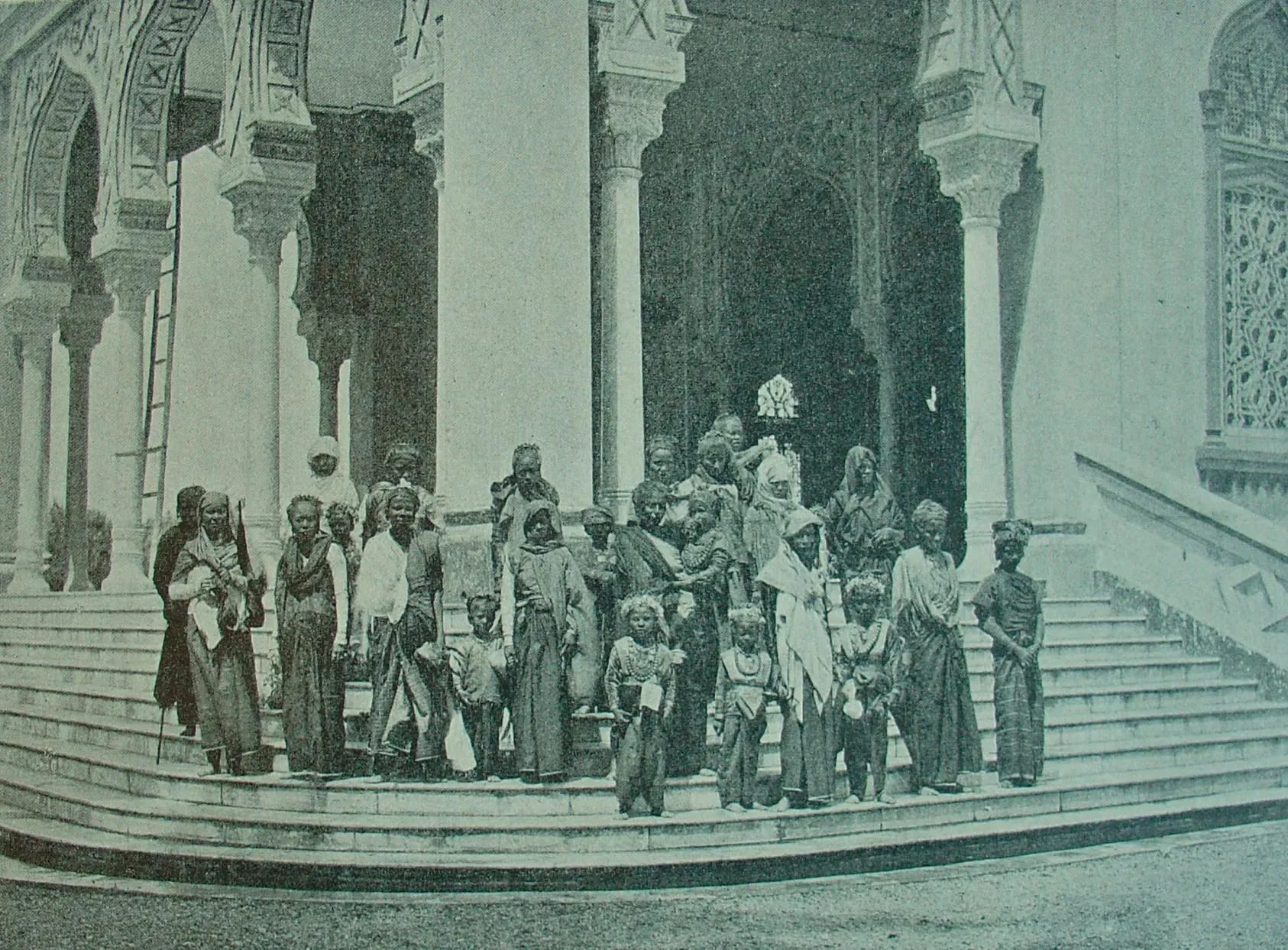
Women and young girls in late-19th-century Aceh. Photo reproduced from C. Snouck Hurgronje. 1906. The Atjehnese. All rights reserved, Leyden: E.J. Brill, 1906.
Reid (1993b, pp. 71–72, 74) estimated the city population in 17th century Aceh to be at least 100,000, with the urban area approximately measuring 12km2. If we consider this number conservatively, given that the sultan’s palace itself housed at least 3,000 women (certainly during Sultan Iskandar Muda’s reign), we could suppose that the direct impact of Islam would be highest on those who lived in the palace or the walled area, next among those residing within the general urban areas, and weakest in the rural or marginalised areas. This conception would follow Johns’s conclusion that coastal city-states in the early modern era were:
… centres for the diffusion of Islamic ideas to the peasant interior by means of
kinship systems similar to those which had served to diffuse elements of Indic
culture, adding a further colouring to the corpus of adat (a continually evolving
code) already tinctured with Hindu-Buddhist beliefs (1976, p. 310).
What is clear regarding gender relations in pre-19th century Aceh is that the advance of urbanisation and modernisation brought with it concomitant social changes. That women actively participated in these changes is unquestionable. Bound within the expectations, constraints and opportunities accruing from their particular social classes, women are shown to have contributed fully to and gained from the perpetuation of prevailing social conditions.
Conclusion
Pre-19th century women in the Islamic sultanate of Aceh were certainly products of their specific time periods and circumstances. Although they did not necessarily experience either complete equality or inequality with men, they did enjoy relative economic leverage and self-autonomy that enabled them to live fairly independent lives from men. Of course, this statement has to be tempered by the fact that as the sultanate was progressing to become a highly stratified urban area, women from different classes enjoyed varying degrees of “high status”. In addition, it is true that as varying waves or patterns occurred in the interpretation and adoption of Islam, social expectations changed as a consequence to reflect prevailing notions. These waves in large part contributed to the ambiguity inherent in Acehnese gender relations, which manifests until today.
Women’s control of residential and rice lands, often inherited from parents and in turn given to daughters when they marry, describes a society that ensures female economic independence. Provisions in adat in terms of inheritance rights, marriage and divorce emphasise bilaterality, which provides avenues for equitable lives regardless of gender. Indeed, while gender may not necessarily be unimportant, it is certainly not the sole basis of personal power in pre-19th century Aceh. At the level of royalty and nobility, women played strategic roles, albeit often unrecorded, in the perpetuation of royal bloodlines and the sultanate.
The predominant picture of women in Aceh during this period is that of supporting and preserving the status quo. The reigns of the four queens are notable for keeping the sultanate together in harmony, which had earlier been jeopardised by the quest for pan-Islamism, rather than the more syncretic and inclusive Islam. The relative ease with which female seclusion was accepted among the elite female population also points to the fact that it was a practice that did not necessarily seem abhorrent to these women.
Islam is shown to have flourished in Aceh’s urban areas. Thus, it is not surprising even then that the most “devout” were found not in rural areas, but in urban areas where historical processes involving key figures emerged first, with consequences that reverberated to the rest of society. If history has supported such an assumption, it is still true in contemporary Aceh, where the use of the jilbab is ubiquitous in the cities, notably in Banda Aceh, rather than in the more remote interior. In relation to the delineation between masculine and feminine roles, this would not necessarily have been a problem in areas where the need for labour was critical, regardless of gender.19 In urban areas, where social status and class freed some segments of the population from manual labour, gender differentiation became more stringent.
Lastly, the blaming of women in the 2004 tsunami generally came from community members and religious leaders around urban areas (see Cuevas, 2006, who presented data from focus-group discussions in Banda Aceh), which is not surprising. After all, urban areas are fertile ground for both devotion and decadence, and the processes that start in the centres lose their intensity as soon as they spread outward.
Women themselves have been shown to actively support these discourses and ensure that social norms are followed. From the 16th to 17th centuries when Aceh emerged as an Islamic state, women had proved to be actively involved in the processes of social and political change. Far from being mere pawns in the life of the state, they had contributed to the perpetuation and development of social expectations between men and themselves.
The author wishes to thank Professor Anthony Reid of the National University of Singapore for his valuable comments. However, the views, opinions and errors that may occur in this paper are entirely the author’s responsibility.
Endnotes
1 Based on my informal discussions with Acehnese women and encounters with the Wilayat’ul Hisbah (the vice and morals squad) in 2006, this had often been used to force compliance of Syariah laws. Also see Cuevas, writing in post-tsunami Aceh, who noted, “Within traditional Acehnese culture there is a tendency to blame women for any social wrongs, a factor which significantly contributes to the communities [sic] denial of gender-based violence” (Cuevas, 2006, 17). The dichotomisation of the female’s role as “keeper of Islam” and “source of social fitna [corruption]” (Saktanber, 2002, p. 31) is often at the heart of dominant discourses such as this.
2 Iskandar argues that the name “Aceh” must be used only to refer to what is currently the province of Aceh and cannot mean the area in the early modern era. To use it in a narrower sense, one must refer to Aceh Besar, which is directly under the power of the sultan (Iskandar & Ahmad, 2001, lvi).
3 According to Iskandar, the Sulalat al-Salatin - one of the most important Malay literary sources about the kings of Malacca - boasts that Islam had entered Lamri (Aceh’s precursor) earlier than Pasai, second only to Sumatera (or Samudra) (Iskandar & Ahmad, 2001, liv–lv). However, whether or not Lamri is indeed the precursor of Aceh is contested (Iskandar & Ahmad, 2001, lvi–lviii). Iskandar further states that by approximately the mid 14th century, Islam was already spreading in Lamri (Iskandar & Ahmad, 2001, xvi–xvii). Admiral Cheng Ho’s chronicler between 1413 and 1433, Ma Huan, noted then that the entire population in Lamri was already Muslim, as was its king (Ma, 1970, 123).4 See, for instance, (Reid, 1993) regarding the assimilation of pre-Islamic spirits to Islamic jinn (spirits). Regarding the popularity of water feasts, see (Hurgronje, 1906), (Lombard, 1991, 198–99), (Reid, 2005, 129–34) and (Bowrey & Temple, 1905, 325, fn 2). Regarding the sacrifice of large numbers of water buffaloes, see (Lombard 1991, 199).
5 Siapno vigorously argued against the implicitly masculine schematic formula commonly used by scholars reading ancient texts, which contend that the four successive reigns of queens in Aceh signified the decline of the sultanate (Siapno, 2002, 55). She noted that these analyses “do not pay critical attention to the production of gender and power in these texts”. Her objection to (Reid’s, 1988) interpretation, for instance, that the four Acehnese queens had been “placed” on the throne, thereby foreclosing any form of political agency from the women themselves (Siapno, 2002, 55), is notable.
6 Polyandry refers to the union of one woman with two or more men. However, as Fra Odorigi de Perdonne does not elaborate, it is difficult to make conclusions.
7 (Andaya, 2000) noted that in some languages the terms for old men and old women are blurred.
8 See The Ship of Sulaiman: “The idea that they [sultans] have so many slave girls and servants merely encourages them to think of themselves as all the more important” (The Ship of Sulaiman, 1972, 178)
9 Reid contradicts this claim regarding ar-Raniri’s support for female ascendancy: “The Aceh elite had earlier spurned Raniri’s advice by putting a woman on the throne and were so pleased with the results that they enthroned three subsequent women” (Reid, 2007, 8–9)
10 Lugina (Lugina, 2008), however, protested against such oversimplification of the issue. Islam is not the only contributor to women’s marginality in the Malay community. From a more contemporary case study in Riau, she concluded that “it is the interplay between adat, Islam and the state ideology of womanhood that has affected women’s position” (Lugina, 2008, 80)
11 Davis here talked about a sultan who, in the beginning of his life, was a fisherman and later admiral of the sultan’s navy (Davis, 1970, 147–48). This story has often been attributed to Sultan Ala al-Din Ri’ayat Syah (r. 1586–89) (see, for instance, Zainuddin, 1968, 9–11). However, some attribute it to Ali Mughayat Syah al-Mukammil.
12 De Beaulieu, however, noted that among the numerous wives and concubines of the reigning sultan (al-Mukammil), about 20 were the “legitimate daughters of kings he has pillaged” (1995, 64–80). In addition, de Beaulieu noted that when a man who is a subject of the sultan dies and leaves behind unmarried daughters, the sultan takes them and puts them in his palace.
13 One of the wives of Sultan Ibrahim (Marsden, 1986, 427) or Ala ad-Din Ri’ayat Syah from Daya (Iskandar & Ahmad, 2001, xvi) poisoned him to avenge a brother who had suffered under him. As well, Iskandar Muda’s mother and Iskandar Thani’s sister-in-law had both been accused of conspiring against each of them, an act of treason punishable by death; as a consequence, both were tortured and executed.
14 Zainuddin (Zainuddin, 1966) added that Safiyyat al-Din was a patron of literature, and very fond of syairs (poems), having as teachers Hamzah Fansuri for rhyme and Nur al-Din ar-Raniri for the science of fikh [Islamic jurisprudence]. She was also a war commander skilled in horseback riding and pistolshooting. Her contribution to legislation allegedly includes introducing some changes to the Majelis Mahkamah Rakyat, the sultanate’s legislative body, when she appointed an unprecedented 16 female representatives to the 73 parliament seats normally occupied by men (Zainuddin, 1966, 43–44). As an able diplomat and astute negotiator, she was able to guide her sultanate through trade negotiations with the English (see Bowrey & Temple, 1905, 318–21, fn 3) the so-called Dutch subversion of 1645, Johor’s independence from Aceh in 1646, and the revolt of Sumatra Barat in 1652 (Zainuddin, 1966, 45–54).
15 See, for instance, William Dampier’s account (in Bowrey & Temple, 1905, 308–9, fn 4): “[S]he [referring to Taju al-Alum, also referred to as Safiyyat al-Din] sent also two Dancing Girls to shew him [a Captain Thwait] some pastime there”. François Martin (Reid, 1995, 56–57) writes: “They [referring to the French delegation] were very well received by the King [of Pedir, son of the King of Aceh]…. He asked if they wanted women.”
16 Zainuddin (Zainuddin, 1966, 8–15) referred to a Laksamana Malahajati, who was able to attain a high status in the court of Sultan Ala ad-Din Ri’ayat Syah. Her achievements were allegedly impressive: head of the royal palace secret guards (Geheimraad), protocol commander of the government, and political expert. Her sound analysis and diplomacy at that time, in particular urging the sultan to exercise good diplomatic relations with the English to counter the Portuguese threat, determined how the English was welcomed and treated when a ship arrived in 1602 under the command of Sir James Lancaster.
17 Mundy further remarked in relation to the “old custom” that there are some who are strangled to accompany and attend to the dead king in the other world (Reid, 1995, 90)
18 (Hurgronje, 1906, 21) also talked about the tractability, zeal, obedience and trustworthiness of Niasese slaves. “The women are more highly prized for their beauty than those of the dominant race, and many of the boys who are sadati (dancers) or otherwise are made to minister to the unnatural lusts of the Achehnese, are of Niasese origin.” François Martin added that these boys, who were entrusted with “all [the men’s] goods and living with their wives as guards”, had their penis and testicles cut off “leaving nothing at all” (Reid, 1995, p. 58). Further, he referred to “hermaphrodites” in Pedir, although unfortunately he makes no other clarifying statement (see Reid, 1995, 56–57).
19 (Hall, 1992, 183–72) pointed to the existence of abundant land and demand for additional labour regardless of sex as possible reasons. Religious and socio-cultural customs, traditions and practices must have mirrored prevailing social realities, and vice versa. Nonetheless, while women may have actively participated in agriculture, home, market, trade, diplomacy, warfare, entertainment, literature, and even statecraft (surely including those in early Lamri/Aceh), epigraphic records of female roles in early times are limited (Hall, 1992, 190).
References
Adat Aceh: Dari Satu Manuskrip India Office Library (Switzerland: Inter Document Company, 1981). (microform)
Adat Atjèh, Reproduced in Facsimile From a Manuscript in the India Office Library (‘S-Gravenhage, Martinus Nijhoff, 1958)
A. H. Johns, “Islam in Southeast Asia: Problems of perspective,” in Southeast Asian History and Historiography: Essays Presented to D.G.E. Hall, ed. C. D. Cowan and O. W. Wolters (Ithaca, N.Y.: Cornell University Press, 1976), 304–20. (From National Library Singapore, call no. RSEA 959 SOU)
Amirul Hadi, Islam and State in Sumatra: A Study of Seventeenth-Century Aceh (Boston: Brill, 2004). (From National Library Singapore, call no. RSEA 322.1095981 HAD)
Anthony Reid, “Introduction,” in Islamic Legitimacy in a Plural Asia, ed. Anthony Reid and Michael Gilsenan (London: Routledge, 2007), 1–13. (From National Library Singapore, call no. RSEA 297.272095 ISL)
Anthony Reid, “Introduction,” in Verandah of Violence: The Background to the Aceh Problem, ed, Anthony Reid (Singapore: Singapore University Press in association with University of Washington Press, Seattle, 2006), 1–21. (From National Library Singapore, call no. RSING 959.81 VER)
Anthony Reid, “The Pre-Modern Sultanate’s View of Its Place in the World,” in Verandah of Violence: The Background to the Aceh Problem, ed, Anthony Reid (Singapore: Singapore University Press in association with University of Washington Press, Seattle, 2006), 52–71. (From National Library Singapore, call no. RSING 959.81 VER)
Anthony Reid, An Indonesian Frontier: Acehnese and Other Histories of Sumatra (Singapore: Singapore University Press, 2005). (From National Library Singapore, call no. RSEA 959.81 REI)
Anthony Reid, Charting the Shape of Modern Southeast Asia (Singapore: Institute of Southeast Asian Studies, 2000). (From National Library Singapore, call no. RSEA 959 REI)
Anthony Reid, Witnesses to Sumatra: A Travellers’ Anthology (Kuala Lumpur, Malaysia: Oxford University Press, 1995). (From National Library Singapore call no. RSEA 915.998104 WIT-[TRA])
Anthony Reid, “Islamization and Christianization in Southeast Asia: The Critical Phase, 1550–1650,” in Southeast Asia in the Early Modern Era: Trade, Power, and Belief (London: Cornell University Press, 1993), 151–179. (From National Library Singapore, call no. RSING 959 SOU)
Anthony Reid, Southeast Asia in the Age of Commerce 1450–1680, vol. 2: Expansion and Crisis (New Haven: Yale University Press, 1993). (From National Library Singapore, call no. RSEA 959 REI)
Anthony Reid, “Female Roles in Pre-Colonial Southeast Asia,” Modern Asian Studies 22, no. 3 (1988): 629–45. Cambridge University Press. (From JSTOR via NLB’s eResources website)
Ayse Saktanber, Living Islam: Women, Religion and the Politicization of Culture in Turkey (London: IB Tauris Publishers, 2002)
Azyumardi Azra, The Origins of Islamic Reformism in Southeast Asia: Networks of Malay-Indonesian and Middle Eastern ‘Ulama’ in the Seventeenth and Eighteenth Centuries (Leiden: Asian Studies Association of Australia, in association with KITLV Press, 2004). (From National Library Singapore, call no. 297.60959 AZR)
Barbara Watson Andaya, The Flaming Womb: Repositioning Women in Early Modern Southeast Asia (Honolulu: University of Hawai’i Press, 2006). (From National Library Singapore, call no. RSEA 305.409590903 AND)
Barbara Watson Andaya, “Delineating Female Space: Seclusion and the State in Pre-Modern Island Southeast Asia,” in Other Pasts: Women, Gender and History in Early Modern Southeast Asia, ed. Barbara Watson Andaya (Honolulu: Center for Southeast Asian Studies, 2000), 231–53. (From National Library Singapore, call no. RUR 305.420959 OTH)
C. Snouck Hurgronje, Aceh: Rakyat Dan Adat Istiadatnya, Jilid II, Seri INIS 28 (II) (Jakarta: Indonesia-Netherlands Cooperation in Islamic Studies (INIS), 1997)
C. Snouck Hurgronje, The Achehnese, vol. 1, trans. A.W.S. O'Sullivan (Leyden: late E.J. Brill, 1906). (From National Library Singapore, call no. RRARE 959.81 SNO-[JSB])
Denys Lombard, Kerajaan Aceh: Jaman Sultan Iskandar Muda (1607–1636), trans. Winarsih Arifin (Jakarta: Balai Pustaka, 1991). (From National Library Singapore, call no. RSEA 958.8021 LOM)
E. Noerdin, “Customary Institutions, Syariah Law and the Marginalization of Indonesian Women,” in Women in Indonesia: Gender, Equity and Development, ed. Kathryn Robinson and Sharon Bessell (Singapore: Institute of Southeast Asian Studies, 2002), 179–86. (From National Library Singapore, call no. RSING 305.4209598 WOM)
Edmund Edwards McKinnon, “Indian and Indonesian Elements in Early North Sumatra,” in Verandah of Violence: The Background to the Aceh Problem, ed, Anthony Reid (Singapore: Singapore University Press in association with University of Washington Press, Seattle, 2006), 22–37. (From National Library Singapore, call no. RSING 959.81 VER)
Fatima Mernissi, The Forgotten Queens of Islam, trans. Mary Jo Lakeland (Cambridge: Polity Press, 1993). (From National Library Singapore, call no. RUR 920.00917671 MER)
G. Coedes, The Indianized States of Southeast Asia, trans. Susan Brown Cowing (Honolulu: East-West Center Press, 1968). (From National Library Singapore, call no. RSEA 959 COE)
H. M. Zainuddin, Srikandi Atjeh (Medan: Pustaka Iskandar Muda, 1966)
“Introduction,” in Bewitching Women, Pious Men: Gender and Body Politics in Southeast Asia, ed. Aihwa Ong and Michael G. Peletz (Berkeley, Calif.: University of California Press, 1995), 1–18. (From National Library, call no. RSING 305.30959 BEW)
Jacqueline Aquino Siapno, Gender, Islam, Nationalism and the State in Aceh: The Paradox of Power, Co-optation and Resistance. (London: RoutledgeCurzon, 2002). (From National Library Singapore, call no. RUR 305.40958 SIA)
James T. Siegel, The Rope of God (Berkeley: University of California Press, 1969). (From National Library Singapore, call no. RUR 301.2095981 SIE)
John Davis, The Voyages and Works of John Davis, the Navigator (New York: Burt Franklin, 1970). (From National Library Singapore, call no. R 910.45 DAV)
John Francis Gemelli Careri, “A Voyage Round the World,” Journal of the Malayan Branch of the Royal Asiatic Society 12, no. 2 (1934): 94-107. (Microfilm NL1578)
K. Hall, “Economic History of Early Southeast Asia,” in The Cambridge History of Southeast Asia, vol 1: From Early Times to c. 1800, ed. Nicholas Tarling (Cambridge, UK: Cambridge University Press, 1992), 183–272. (From National Library Singapore, call no. RCLOS 959 CAM)
Kamala Chandrakirana and Yuniyanti Chuzaifah, “The Battle Over a “New” Indonesia: Religious Extremism, Democratization and Women’s Agency in a Plural Society,” in Muslim Women and the Challenge of Islamic Extremism, ed. Norani Othman (Petaling Jaya, Selangor, Malaysia: Sisters in Islam, 2005), 49–77. (From National Library Singapore, call no. RSING 305.48697 MUS)
Khalid Hussain, Taj us-Salatin (Kuala Lumpur: Dewan Bahasa dan Pustaka, 1966). (From National Library Singapore, call no. RCLOS Malay 899.2302 TAJ)
Liaw Yock Fang, Undang-Undang Melaka [The Laws of Melaka] (The Hague: M. Nijhoff, 1976). (From National Library Singapore, call no. RCLOS 340.09595141 LIA-[JSB])
Linda Rae Bennett, Women, Islam and Modernity: Single Women, Sexuality and Reproductive Health in Contemporary Indonesia (London: Routledge Curzon, 2005). (From National Library Singapore, call no. RSEA 305.4869709598 BEN)
Ma Huan, The Overall Survey of the Ocean’s Shores [1433], trans. Feng Chʻeng-Chün (Cambridge: Published for the Hakluyt Society at the University Press, 1970). (From National Library Singapore, call no. RCLOS 910.8 HAK)
Ma Theresa Milallos, “Muslim Veil As Politics: Political Autonomy, Women and Syariah Islam in Aceh,” Contemporary Islam 1, no. 3 (December 2007)
Masdar F. Masʼudi, Islam and Women’s Reproductive Rights (Kuala Lumpur, Malaysia: Sisters in Islam, 2002). (From National Library Singapore, call no. RSEA 305.48697 MAS)
Michael G. Peletz, Reason and Passion: Representations of Gender in a Malay Society (Berkeley: University of California Press, 1996). (From National Library Singapore, call no. RSEA 305.3095951 PEL)
Moehammad Hoesin, Adat Atjeh ([Banda Atjeh]: Dinas Pendidikan dan Kebudajaan Propinsi Daerah Istimewa Atjeh, 1970). (From National Library Singapore, call no. RUR 390.095981 HOE)
Nik Noriani Nik Badlishah, ed., Islamic Family Law and Justice for Muslim Women (Kuala Lumpur, Malaysia: Sisters in Islam, 2003). (From National Library Singapore, call no. RSEA 346.0150917671 ISL)
Noor Aisha Abdul Rahman, Colonial Image of Malay Adat Laws: A Critical Appraisal of Studies on Adat Laws in the Malay Peninsula during the Colonial Era and Some Continuities (Leiden: Brill, 2006). (From National Library Singapore, call no. RSEA 340.52595 NOO)
Norani Othman, Muslim Women and the Challenge of Islamic Extremism, ed. Norani Othman (Petaling Jaya, Selangor, Malaysia: Sisters in Islam, 2005. (From National Library Singapore, call no. RSING 305.48697 MUS)
P.A. Leupe, The Siege and Capture of Malacca from the Portuguese in 1640-1641: Extracts from the Archives of the Dutch East India Company, trans. Mac Hacobian (Singapore: Printers Limited, 1936), 128–429. (From National Library Singapore, call no. RCLOS 959.5118 LEU-[RFL])
Patricio Cuevas, Still Standing Tall: Addressing Gender Issues in Banda Aceh (Banda Aceh: World Vision Indonesia Tsunami Response, 2006). (From National Library Singapore, call no. RSING 305.42095981 CUE)
Peter Riddell, “Aceh in the Sixteenth and Seventeenth Centuries: ’Serambi Mekkah” and Identity,” in Verandah of Violence: The Background to the Aceh Problem, ed, Anthony Reid (Singapore: Singapore University Press in association with University of Washington Press, Seattle, 2006), 38–51. (From National Library Singapore, call no. RSING 959.81 VER)
Raden Hoesein Djajadiningrat, Kesultanan Aceh: (Suatu Pembahasan Atas Bahan-Bahan Yang Tertera Dalam Karya Melayu Tentang Sejarah Kesultanan Aceh) (Banda Aceh: Projek Rehabilitasi dan Perluasan Museum Daerah Istimewa Aceh, 1979). (From National Library Singapore, call no. RUR 959.801 DJA)
Richard Carnac Temple, ed., A Geographical Account of Countries Round the Bay of Bengal, 1669 to 1679 (London: Printed for the Hakluyt Society, 1905). (From National Library Singapore, call no. RCLOS 910.8 HAK–[GBH])
Richard Olof Winstedt, A History of Classical Malay Literature ([Kuala Lumpur]: Malayan Branch of the Royal Asiatic Society, 1958). (M. B. R. A. S. reprint no. 12)
S. Lugina, “Adat, Islam and Womanhood in the Reconstruction of Riau Malay Identity,” in Indonesian Islam in A New Era: How Women Negotiate Their Muslim Identities, ed. Susan Blackburn, Bianca J. Smith and Siti Syamsiyatun (Clayton: Monash University Press, 2008), 69–93. (From National Library Singapore, call no. RSEA 305.4869709598 IN)
S. White, “Gender and the Family,” in Voices of Islam in Southeast Asia: A Contemporary Sourcebook, ed. Greg Fealy and Virginia Hooker (Singapore: Institute of Southeast Asian Studies, 2006), 273–74. (From National Library Singapore, call no. RSING 297.0959 VOI)
Shelly Errington, “Recasting Sex, Gender and Power: A Theoretical and Regional Overview,” in Power and Difference: Gender in Island Southeast Asia, ed. Jane Monnig Atkinson and Shelly Errington (Stanford, Calif.: Stanford University Press, 1990), 1–58. (From National Library Singapore, call no. RSING 305.30959 POW)
Susan Blackburn, “Introduction,” in Indonesian Islam in a New Era: How Women Negotiate their Muslim Identities (Clayton: Monash Asia Institute Pr. 2008), 1–21. (From National Library Singapore, call no. RSEA 305.4869709598 IND)
Syafiq Hasyim, Understanding Women in Islam: An Indonesian Perspective (Jakarta: Solastic, 2006). (From National Library Singapore, call no. RSEA 305.409598 HAS)
T. Iskandar, ed., Bustanu’s-Salatin, Bab II, Fasal 13 (Kuala Lumpur: Dewan Bahasa dan Pustaka, Kementerian Pelajaran Malaysia, 1966). (From National Library Singapore, call no. RSEA Malay 992.1 NUR)
Tabitha Frith, “Constructing Malay Muslim womanhood in Malaysia” (Working Paper, no. 117, Monash University, 2002)
Takeshi Ito, “Why Did Nuruddin Ar-Raniri Leave Aceh in 1054 A. H.?” Bijdragen tot de-Taal-, Land-en Volkenkunde 134, no. 4 (1978): 489–91. (From JSTOR via NLB’s eResources website)
Teuku Iskandar and Hassan Ahmad, ed., Hikayat Aceh (Kuala Lumpur: Yayasan Karyawan, 2001). (From National Library Singapore, call no. R 959.81 ISK)
The Ship of Sulaiman, trans. John O'Kane (Persian Heritage Series No. 11). (London: Routledge and Kegan Paul, 1972). (From National Library Singapore, call no. RSEA 959.302 SHI)
Tome Pires, “The Suma Oriental of Tome Pires and the Book of Francisco Rodrigues, Rutter of a Voyage in the Red Sea, Nautical Rules, Almanack and Maps, Written and Drawn in the East Before 1515,” in The Bibliothèque de la Chambre Des Députés, ed, Antonio Cortesao, (London: Hakluyt Society, 1944). 2 vols. (Microfilms NL14208, NL26012)
Wazir Jahan Karim, Women and Culture: Between Malay Adat and Islam (Boulder, Colo.: Westview Press, 1992) (From National Library Singapore, call no. RSEA 305.309595 WAZ)
William Foster, The Voyages of Sir James Lancaster to Brazil and the East Indies, 1591–1603 (London: Printed for the Hakluyt Society, 1940). (From National Library Singapore, call no. RCLOS 910.8 HAK–[RFL])