
Article
An “Oriental Phase of Crime”: Representations of Amok in Singapore’s English Newspapers (1880s–1940s)
Topics
History
17 April 2026
This article seeks to explore how Singapore’s English-language newspapers represented amok in the colony from the 1880s to 1940s. In doing so, it reveals how British colonials may have perceived and contended with amok in this era.
By Jialin Christina Wu
On the morning of 3 October 1908, Ali, a Malay man from Terengganu, killed his Javanese wife and dangerously wounded two other women near Thomson Road in Singapore. According to the local newspaper Straits Echo, Ali’s wife had refused to return to him until he had paid $50 for her maintenance (spousal support). The three victims had then “‘nagged’ the man” about his inability to pay “until he became desperate and attacked them savagely”.1 Pursued by a crowd of vigilante Malays, Chinese and Javanese armed with sticks, Ali met his end when he fell into a well and drowned while evading capture. “None of the Police were in the vicinity at the time, and it is believed that the Malay was done to death by the crowd! It is now many years since we had a real amok in Singapore”,2 reported the Straits Echo.
These comments on Ali’s “amok” raise a simple, yet challenging question. What is a “real amok”? How is amok distinguished from other comparable acts of violence? An answer to these questions may be found in the writings of Sir Hugh Clifford. A prominent British colonial administrator and influential man of letters, Clifford had written the novel Saleh: A Sequel, published in the same year as Ali’s assault. In Saleh, the titular character, a Malay prince, “salvages his honour in Malay style by running amok”,3 prompting one reviewer to describe it as a “bestiality of inherited tendencies” unique to Malays.4 To Clifford, amok was a reaction to dishonour or insult. It typically resulted in the murder of a spouse or people closest to the amok-runner, who would subsequently attack anyone in his passage.5 These views echo contemporaneous descriptions of amok in Singapore’s newspapers, which noted that “victims are often women and children”, and that the amok-runner’s “family are his favourite victims.”6 Speculating that amok might be considered a form of insanity unique to “the more excited races” in Malaya, the Singapore Free Press later declared in 1911: “The East is remarkable for certain forms of crime which hardly find any parallel in other parts of the world”.7
Given that amok has persistently served as a trope in the Western imagination as “the defining characteristic of Malays”,8 it has generated a substantial body of literature, including literary sources, medical treatises, legal reports and other forms of scholarly work. Many of them date to the colonial era in Malaya’s history (i.e. 19th and 20th centuries), where a peak in scholarly interest in amok appears to have occurred.9 However, as Eduardo Ugarte has argued, “a pall of confusion still hangs” over amok, and extant literature has “frequently proven to be as racist and fantastic as the 19th century sources on which they were based.”10 Indeed, the only book-length work on amok has been criticised as an apology for British rule in Malaya as it credits the “civilising” impact or “modernising forces of late 19th century colonialist imperialism” with having eliminated amok.11 This uncritical assumption of the fruits of British colonialism is highly problematic,12 and fails to account for the fact that amok cases continued to be reported into the post-colonial era.
In this light, this article seeks to explore how Singapore’s English-language newspapers represented amok in the colony from the 1880s to 1940s. In doing so, it reveals how British colonials may have perceived and contended with amok in this era. Although this paper draws data from a longer period (beginning in 1819), it focuses on 1880–1942. This is partially partly due to the availability of sources. More critically, this approach also stems from the opportunity to cross-reference and study this corpus of sources with other primary sources (such as police reports). Additionally, in focusing on newspapers and the data available on actual cases on amok, this essay seeks to offer an empirically-based approach to this topic. As such, it seeks to complement existing studies on this topic, which have focused on the viewpoints of colonial administrators or writers on amok, instead of actual reported amok cases.13 Moreover, no study exists at present on the representation of amok in newspapers in Singapore (or Malaya at large).14
Furthermore, the information gleaned from these newspapers reveal two insights. First, contrary to colonial opinions, amok did not decline over time (see figure 1). Second, amok-runners (i.e. those identified as having run amok) did not belong exclusively to any particular ethnic group (see figure 2). Newspapers reported that half of all amok cases began in a private space, usually in the home. Furthermore, while it is commonly presented by colonial writers such as Hugh Clifford that amok cases had no motive, about one quarter of all cases in Singapore (24) were motivated by issues such as domestic disputes, loss of employment, or quarrels over money. For instance, our opening anecdote on Ali’s amok in 1908 was motivated by a domestic (and financial dispute).15 No motive was noted for 20 cases, and the remaining 56 cases did not offer information on this issue. How, then, can we account for these discrepancies between press reports, and what was frequently presented as amok in other textual sources of the era, such as colonial fiction?
In answering this question, this essay demonstrates that “amok” came to encompass a greater meaning beyond a facile definition of an unmotivated assault committed by any one ethnic group in colonial Singapore. By studying how newspapers reported on amok cases in Singapore, this essay argues that amok came to represent a category of an “Oriental phase of crime” in the British imagination,16 one which encompassed any violent act committed by colonised peoples. This was particularly the case when the motive seemed insignificant, or when the violence of the amok seemed disproportionate to the motive Additionally, while British colonials cited the occurrence of amok as justification for colonial tutelage, this essay suggests that the fascination (or obsession) of British colonials with amok instead reveals their fears or unease over their authority in Malaya, as they persistently sought to quell (or control) amok through draconian measures over the duration of their rule.
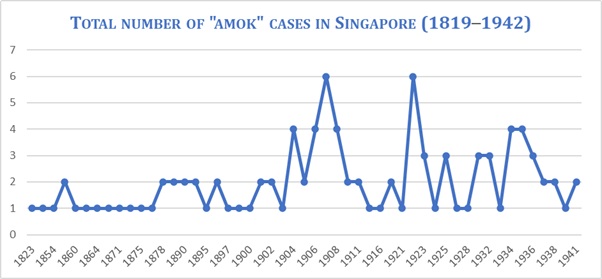
Figure 1: Total number of “amok” cases reported in Singapore. Sources: Various English newspapers held by NLB, 1819–1942.
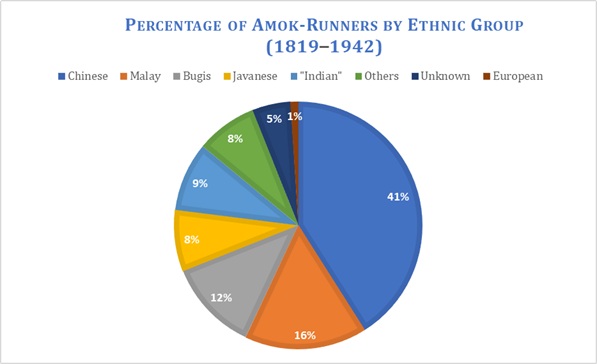
Figure 2: Percentage of Amok Runners (or Amokers) by ethnic group. Note: “Others” include 1 Filipino, 1 Boyanese, 1 Siamese, 2 West Indians, 1 Dayak, 1 Panthan, 1 individual from Somaliland. Sources: Various English newspapers held by NLB, 1819–1942.
Amok in the Midday Sun: From Malay Stereotype to “Oriental Phase of Crime”
Race and ClimateNewspapers of the era help us understand how Westerners saw amok in Malaya. In newspapers, amok came to encompass a wider meaning than that of a racial stereotype and was used as shorthand for violent crime in colonial Singapore and Malaya. As a case in point, the Straits Times published an article describing the relation between Malays and amok in 1874:
The nature of the Malays of our island is not unlike their clime. Beneath their civil and apparently gentle surface fierce passions smoulder, which require but a spark to kindle into a devastating flame. Maddened by jealousy, or some real or fancied wrong, the ordinarily mild Malay becomes a demon. Then his eyes glare like those of a wild beast, out leaps his kris or parang, and he rushes on the amok...17
Such descriptions of the stereotype of the “violent Malay” were not uncommon in the colonial era. Yet, what is intriguing here is the association between Malay “nature” and the climate as a possible explanation for amok. In retrospect, the claims made here about the impact of the sultry Malayan climate on Malay “nature” are reminiscent of other racial stereotypes, such as that of the “myth of the lazy native”.18 Writing in 1908, B.O. Stoney, author of The Malays of British Malaya, had for instance noted: “Malays are too indolent by nature […] their doom is sealed, that as time progresses they must go to the wall […] they will survive only as objects of scientific interest to the ethnologist and the historian”.19 Much like amok, “Malay indolence”, according to Stoney, could be attributed to the climate as “the Malay has been here so long that the climate has by this time done its worst for him”.20 By extension, the impact of the Malayan climate on one’s “nerves” would thus have a nefarious influence – irrespective of one’s race. As one reporter of the Straits Echo claimed in 1909, “Amok or self-murder, the killing lust is probably partly traceable to climatic effects.”21 Arguing that the climate provoked some Malays to amok and Europeans to commit suicide, he added: “Climate has been blamed for it, and the enervating influence of tropical or semi-tropical climates cannot wholly be ignored”.22
Even though amok has mostly been imagined as a racial stereotype unique to Malays, as newspaper sources reveal, the climate played a determining role in how British colonials understood amok. For instance, John H. Whitaker, a sub-editor of the Malaya Tribune, declared in a 1929 article: “The habit of running amuck (in Malay amok) is a characteristic of all people of the Malay race living near the equator but is unknown among the same peoples far from the equator. [Amok] is certainly a characteristic superinduced by the rays of the torrid sun”.23 Citing his extensive experience of “[h]aving lived for nineteen years in the tropics, in Singapore and in different parts of the Philippine Islands”, Whitaker added: “The same rays have sent many a white man crazy [...] Every white man who lives at sea-level near the equator learns that he has to wear a specially constructed hat to protect his grey matter from turning black”. Before concluding that “the ordinary white man deteriorates here mentally, physically and morally”, Whitaker warned of the “inevitable deterioration of the white man in the tropics”, citing as evidence that his descendants, “when he has mingled his blood with any of the native races, will become more or less degenerate (if they remain in the tropics)”.24
As this article illustrates, British colonials such as Whitaker believed that it was the climate, rather than race per se, that resulted in amok or the “mental deterioration” of an individual. This, in turn, explains why British colonials and colonial newspapers used amok to describe cases of violent crime committed by non-Malays. For instance, when Sandwell, a British drummer, murdered Corporals Hurly and Newall at the Tanglin Barracks in 1907, the case was considered a “European amok”, as Sandwell was reported to have recalled nothing other than “a touch of the sun”.25
Insanity and Substance Abuse
Apart from climatic explanations, newspaper sources suggest that British colonials understood “crime” in Malaya differently, particularly as they sought to contend and make sense of local conditions. For instance, some British colonial doctors considered amok a form of “insanity”,26 or mental condition peculiar to Malays. Such was the opinion of Dr. Gilmore Ellis. In his annual medical report of the lunatic asylum in Singapore published in the Singapore Free Press in 1892, Ellis argued that crimes committed in a state of amok should be considered as a separate category since they came “under the definition of insanity, as held by lawyers”.27 Arguing that amok-runners were “unable to refrain from obeying that impulse”, Ellis added that they “should not be held responsible for any action they may commit during their paroxysm of mania”.28
One 1918 case exemplifies the role that such medical opinion played in British understandings of amok. In November, Tan Seng, a Chinese, killed Ang Tua Tow, a 17-year-old Hokkien youth, and wounded six others in an amok at Selegie Road near Kandang Kerbau market. Dr. Gibbs of the Lunatic Asylum observed Tan, surmising that “the accused could not have been in his sense at the time he committed the offence”. Concurring with the doctor, the jury unanimously found Tan to have been mentally unfit during his assault, concluding that Tan “could not have been responsible for his actions at the time that he ran amok”.29 With his plea of insanity accepted, Tan was eventually acquitted of murder. A similar fate awaited Aboo bin Awang in 1922, when he killed his wife and 4-year-old son in a back room at 26-I Delta Road because his wife wanted to leave him for another man. Finding him to be “temporarily insane” and thus not guilty, the presiding judge, Justice Barrett-Lennard, publicly expressed that “it might be probable that the accused suffered from a form of mania, known as running amok, which was not uncommon in the East”.30 These examples are by no means exceptional or rare. From the data collected in the newspapers, about 20 out of 100 cases of amok (where the data is available) in Singapore involved an amok-runner who had been deemed insane.
However, pleas of insanity were not systematically accepted in all amok cases. Take the case of Tang Yow Khoon, who, in 1931, had run amok and killed Tee Tek Cheng at North Bridge Road, and had his insanity plea rejected.31 Another example is that of Haji Ali bin Haji Hassan, who ran amok at 126 Minto Road after his wife refused to allow him to pawn her bangle in 1900. Although his defence attorney, A.R. Lowell, tried to “set up a plea for insanity quoting Clifford’s Court and Kampong and other books bearing on amok”, Haji Ali was sentenced to death when his plea was rejected.32 Similarly, just as Clifford’s works and other books on amok were used as evidence in court, it is noteworthy that scientific articles were also cited in court where amok was concerned. Such was the case when Mohamed Isa bin Leman ran amok in 1938 in Pahang, Malaysia. After killing a woman and injuring a small girl, his counsel, R. Rajasooria, pleaded that the accused had run amok “while of unsound mind”.33 By referring to a “mental expert”, Dr. Murdoch, and a scientific article of Dr. Galloway’s on running amok as a form of insanity, Rajasooria had argued that Mohamed Isa “must have been suffering from some sort of mental disease at the time he committed this offence” as he had just lost his child and “was in a state of mental anguish”.34 No information on the conclusion of the court is available, but reports in the Pinang Gazette and Straits Chronicle reveal that Deputy Public Prosecutor R.M. Cluer had dismissed Rajasooria’s argument by arguing that there was no proof that Mohamed Isa had been insane during his amok. Moreover, Cluer had challenged, “if amok had been classified as a form of mental disease, it would have been included in the treatises on the subject.”35
Indeed, some British colonials had been wary of accepting the opinion that amok was simply a form of insanity peculiar to Malays. As early as 1896, H. L. Hulbert, the District Magistrate of Kuala Kangsar, had voiced his suspicion about such an interpretation in the Straits Maritime Journal and General News. “I have heard it more than once stated by Malays that in these cases of amok, the man often is not really mad”,36 declared Hulbert. Drawing from the statements of his informants, he added that one would then commit an amok as he knew “that he could not suffer a greater penalty than death even if he killed half a dozen people [...] on the off chance that he would be brought in as insane, and simply detained”.37 Echoing these views, a writer of the Singapore Free Press warned, “Running amok is a not infrequent occurrence among the highly strung natives of the Malay States”, and “[a] native would feign madness and murder his employer, knowing that the crime would be put down as the work of a madman”.38 Arguing that an amok-runner “knows that he will not hang, as ‘amoks’, who are not shot, are sent to a mental home until they are sufficiently recovered to be let out again”,39 this contributor sought to cast doubt on the wisdom of judging amok in the same light as insanity. Furthermore, opined the writer, “[as] a rule only deep thinkers are affected by homicidal mania, so that it is surprising that natives will go crazy in this way.”40
In similar vein, Antoine Cabaton, a Professor of Malay at Paris’ École des Langues Orientales, alleged that Malays ran amok due to substance abuse. “The Malays are very much addicted to the smoking of hashish”, reasoned Cabaton, and this practice “renders the habitue subject to sudden crises of maniacal fury known as ‘running amok’ during which he rushes through the streets. armed with his kreese [kris], slashing and killing all whom he meets”.41 The amok of one John Nathan, a West Indian sailor in 1904, appears to correspond with Cabaton’s interpretation of this phenomenon. In September, a drunk Nathan injured nine people around Anson Street and Bernam Road at Tanjong Pagar. Declared insane and delusional, Nathan, who was confined at the asylum, had all charges dropped against him.42
In retrospect, these discussions on the claim that amok was a form of insanity, the peculiarity of the phenomenon, as well as the possible impact of Malaya’s climate underline how British colonials and other Europeans considered amok as a unique form of violence in a thoroughly “exotic” context. Their presence and knowledge of being in an “exotic” context framed their perspective of amok as a “fearful species of crime” unique to the “Oriental” setting in Malaya.43 Indeed, a 1925 case of amok onboard the S.S. Klang sheds light on such a perspective. Described as “the worst case of amok in the history of Malaya”, this case involved a Malay man from Bandjarmasin on board the steamer S.S. Klang that had just departed Singapore for Penang. The man was presumably provoked to run amok as he had no sleeping accommodations, and two Malays (a pair of siblings) had refused to share their bunks with him. Provoked, the man killed eight individuals, including the S.S. Klang’s Captain McDonald, and injured 13 people, before being shot dead during his amok. Positing that “the man must have been in an abnormal mental condition to be so angered by a trifle”, a contributor to the Straits Echo added that the cause of the amok would have arisen from “the ordinary tendency to ‘see red’, intensified by a passionate and volatile Eastern temperament”.44 Reflecting on the differences between Eastern and British temperaments, he noted that “outbursts of homicidal frenzy occur among Chinese and Indians” – not just Malays, and that “even the Anglo-Saxon experiences a violent desire to ‘see red’ occasionally, and nothing but centuries of social and moral inhibitions prevent him from letting off steam in this sanguinary Oriental manner”.45 “There does seem to be something in these uncontrollable Oriental outbreaks, which is outside our Western experience and understanding”, concluded the writer.46 As this writer suggests, amok came to be perceived as an “Oriental” crime unique to Malaya. Indeed, as we shall see in the following section, discussions on the punishments of amok-runners also reinforced its “exotic” aspect as an “Oriental” crime.
Crime and Punishment: Controlling Amok
Amok as Crime
At the eve of his retirement after 40 years of service in Malaya, John White was interviewed by the Malaya Tribune on his experiences in the colony. Commenting on the decline of amok in Malaya over the years, White shared an anecdote on how this came to pass. In Ipoh, he came across the case of a Malay who had run amok and killed seven people. When “the usual plea of madness was put in”, recounted White, a doctor “who classed himself as an expert in mental diseases” sought vainly to convince the court that the accused had been mad.47 Compelled to see “the futility of his argument”, the doctor had his word dismissed. The accused was subsequently found guilty and executed. “Cases of running amok, which hitherto had been so frequent, seemed to die off immediately”, concluded White, noting with satisfaction that “the Malay no longer was able to follow the old custom of wholesale murder just because his forebears had practiced it with impunity”.48
White’s account on the necessity of treating amok as crime (as opposed to a mental condition), and the effectiveness of punishing amok-runners to eliminate amok was echoed by several European and British colonials in Malaya. In the early 1900s, Westerners in Malaya, such as Cabaton, the Professor of Malay mentioned earlier, had already cast doubt on the argument that amok could be considered in the same light as insanity. Pointing out that Malays were “not altogether without guile”, he described how the “vice of ‘running amok’ became so prevalent at one time that sentences of death were passed on all natives captured in that condition”.49 In his opinion, the use of harsh punishment was justified as “the singular diminution of cases of amok which followed [would lead] one to believe that many acts of public or private vengeance were performed under the disguise of this peculiar form of mania”.50
This perspective to judge (or punish) amok cases in a more severe light became more widespread in time. Similarly, the arguments put forth in favour of dealing more leniently with amok were less accepted with time. For instance, in England in 1931, when two murderers put forth the defence of “complete oblivion” (in the same line as amok), the Lord Chief Justice Gordon Hewart dismissed both appeals and bemoaned its frequency, as he “remember[ed] a similar defence being put forward in a number of cases of ‘amok’ in Malaya”.51
Public Punishments and Shaming
Concurrently, the “exotic” nature of amok also led British colonials to imagine inventive and harsh methods to curtail it. Such was the case for the first reported amok in Singapore, when Syed Yasin stabbed William Farquhar in 1823. According to Munshi Abdullah, Raffles ordered that Syed Yasin’s mutilated corpse “be brought and put in a buffalo cart, which was thereupon sent round the town to the beat of the gong, informing all the Europeans and native gentlemen to look at this man […] then they carried the corpse to Tanjong Maling, at the Point of Tullo Ayer, where they erected a mast on which they hung it, in an iron basket (i.e. a barred box) […] and there it remained for ten or fifteen days, till the bones only remained”.52 This punishment was meted out with full knowledge that swift burials were the norm for Muslims, and where such public spectacles of punishment were a “terrifying tool of repression”.53 Indeed, as Abdullah explained, “[w]hen people were hanged in public […] some cried from fright, others shook to their very bones at the sight; many also took caution to themselves; not forgetting it for their lifetime”.54
In retrospect, British colonials appear to have been convinced of the utility of such public spectacles in curtailing amok. When James Birch, the first British Resident of Perak, was murdered in an apparent amok in 1875, the Straits Times reminded readers of Syed Yasin, along with a note of approval that “his remains hung afterwards in terrorem at Tanjong Mallang”. Reflecting that “the barbarous heritage of the Middle Ages is to be found in the early annals of this city”, the Straits Budget similarly underlined in 1937: “When men were hung in public in Singapore their deaths really had a deterrent effect [...] since people have been hung several times in Malacca and Singapore, amoks, murders and piracies have lessened”.55
Apart from public hangings, one particular suggestion about the punishment of amok-runners frequently resurfaces throughout the period studied. At the turn of the 20th century, some British colonials suggested that the corpses of amok-runners should be buried with a pig carcass as a form of punishment. Indeed, this punishment was raised in 1901 as a reaction to an amok committed in June by a Malay man, Ibrahim, at Little Cross Street and Arab Street. Commenting on the necessity for “the severest and most disgraceful punishment the law could inflict”,56 the editor of the Singapore Press argued in 1901: “With Oriental phases of crime we must apply Oriental remedies. The pig is our ace of trumps in this case. It will deter from amok, if the man who meditates it has to face the certainty that there is no paradise but rather Jehannam [Hell] for him, and that his grave companion is to be the unclean beast”.57 Convinced that such a punishment “would probably smash amok forever”, the editor urged: “Let us have ‘the pig, the pig, and nothing but the pig,’ as the real bogey for would-be-amokers”.58
There is little evidence that this punishment was carried out, but a 1903 article in the Pinang Gazette and Straits Chronicle, quoting the Singapore Free Press, underlined that the “suggestion that in future in all notorious cases of amok the body of the murderer should be buried in contact with a pig, is now widely accepted amongst the natives as a decision to be carried out without fail”.59 Going one step further, it suggested that such burials should be made public to render the punishment more effective. Another mention of such “pig burials” can be found in 1908 in the Straits Echo, when a writer commented on the amok case of Hadji Ibrahim, a Bugis man of Jalan Sultan, who had killed and injured several people on Arab Street in 1887. “It was not till the report got about that the Government intended burying the body of every amok-runner with that of a pig – that most unclean beast to the Mohammedan – that amok-running abated”,60 noted the writer. Echoing this view, the Singapore Free Press commented in 1911 on Hadji Ibrahim’s amok, noting with approval that: “It was recommended that the amoker, if alive and condemned to death and executed, would be buried with the carcass of a pig. It is said that this threat had such a terrifying effect that cases of amok at once became less frequent.”61
The peculiarity of using “pig burials” as a probable deterrence against amok merits greater attention. How did this suggestion come about in the first place? An 1899 article of the Singapore Free Press offers some insights to this question. According to the article, “a certain famous Rajah” was responsible for this idea. “He is said to have enacted that the body of the man who ran amok should be buried with the carcass of a pig, thus securing eternal damnation for his immortal soul”, claimed the newspaper. Declaring that the “charm worked like magic”, the Singapore Free Press noted that the unidentified Rajah “effectually crushed amok in his dominions by a grave-desecrating and grave-defiling policy which would make the British dervishes aforesaid begin howling afresh if they knew it”.62 Criticising the notion that Singapore courts, “under the pressure of silly sentimentalism”, were “compelled in this enlightened colony to treat amok as a form of homicidal mania, and treat the criminal [...] as a mere lunatic”, the newspaper insisted that a punitive approach to amok was more appropriate for such “Oriental” crimes. In hindsight, one wonders if such a punishment had indeed been meted out by a Muslim Rajah, it would have been gravely offensive not only to himself, but also to Malay society at large. Nonetheless, the proposal of “pig burials”, public hangings and public spectacles of such punishment are insightful as they reveal British perspectives of what amok signified. While the suggestion of “pig burials” remind us that British colonials commonly imagined amok-runners to be Malay, the discussions over the public spectacle of punishment reveal the degree to which amok was an “exotic” phenomenon that necessitated a unique punitive measure in Malaya.
At the same time, the extent to which British colonials obsessed over the eradication of amok suggests their unease over this foreign “Oriental” practice, over which they had little mastery. One 1874 case of amok in Java is instructive in this regard. Having learnt that a European had died in an amok because he had been violent with a native, the Straits Times warned: “At the present juncture, when the Malay peninsula is being judiciously opened to European surveillance and direction, [...] this terrible event evinces that it is highly improper and also dangerous to resort to violence or strike natives in this quarter of the world”. Cautioning its readers that “[t]he native character is, however, naturally revengeful, and, perhaps after being pent up for years, manifests itself in an amok, or mata glap [dark eyes] as they term it”. The newspaper also emphasised: “There can be no doubt that great caution should be exercised in dealing with these tribes, especially the Bugis, who are far more vindicative than others”.63
In justifying their use of harsh punishment for amok-runners, it bears reminding that British colonials frequently referred to the purportedly violent and repressive environment which pre-existed in Malaya. As a case in point, R.J. Farrer, President of the Municipal Commissioners, recounted in 1930 to the Straits Times the story of how the grandfather of the Sultan of Kelantan had received a small injury from an Arab who had run amok in 1915. Recalling that “[n]ot only was that man executed but the whole of his family and everybody in whom ran the same strain of blood”, Farrer mused that the story “could be borne in mind when they heard people running down the imperialistic authority of British rule”.64 A similar opinion was raised in W. Linehan’s The History of Pahang (1936), which informed readers: “Death by the creese [kris] was one of the most humane forms of execution. An amok (a person who ran amuck) was treated as a wild beast; he could lawfully be killed by anybody. His fate was di-tikam tandang: to be stabbed by the hurling of javelins”.65 Similarly, newspaper reports reveal how a particular instrument (see Figures 3 and 4), a fork, was used to apprehend amok-runners. Admitting that this was a “relic of less humane times” and a “mediaeval instrument”, the Straits Times described it as “U-shaped iron prongs with [a] serrated inner edge which, when mounted on a long handle, were used – theoretically at least – to catch persons who had run amok and pin them by the neck to the nearest wall”.66 Noting that these weapons were used at least since the 1880s, the Singapore Free Press explained that pirates and “plenty of ‘amok’ cases” were caught by way of these forks.67
In retrospect, the use of such specific tools in amok cases served to reinforce the belief that Malaya was an innately violent space, and that its inhabitants were correspondingly violent. This was indeed the impression that a writer to the Singapore Free Press seemed to have in 1901 at the occasion of the amok at Little Cross Street mentioned previously. Arguing that “the Bugis people who migrate here carry, as a rule, weapons such as krises (presumably to sustain their reputation among the Malays as great warriors)”, this writer cautioned that “in the event of a quarrel the means for amok-running is obviously made easy!”68 Thus, suggested the writer, the government ought to control the possession and sale of weapons other than firearms to curtail further cases of amok. As the following section will demonstrate, British colonials subsequently created a narrative on the eradication of amok due to the “enlightening” fruits of British rule. As Frank Swettenham, the influential and respected colonial administrator argued, colonial intervention had eliminated amok “in a society where might was right” where “no fountain of justice or appeal existed”.69
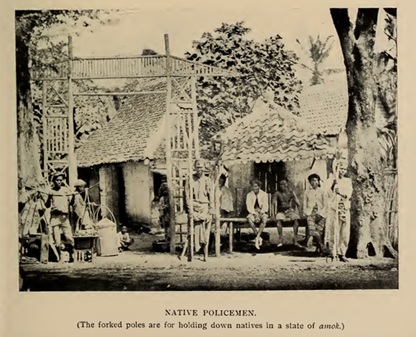
Figure 3: The man in the centre is holding up a Y-shaped instrument, which Cabaton indicates was used to hold down amok-runners. Antoine Cabaton, “Java, Sumatra, and the Other Islands of the Dutch East Indies”, trans. Bernard Miall (Charles Scribner's Sons, 1914), unnumbered. Public domain.
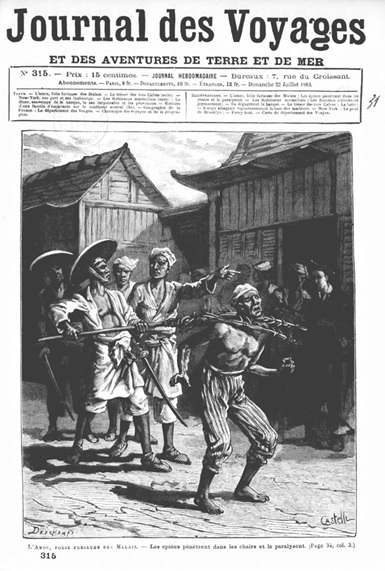
Figure 4: An illustration captioned “Amok, the furious madness of the Malays. The thorns penetrate the flesh and paralyse him.” (Translation mine). “Journal des Voyages et des aventures de terre et de mer”, 22 July 1883, Paris. Public domain.
“British Guidance” and the End of Amok?
Although amok cases continued to be reported in Singapore and Malaya throughout the period studied, British colonials continually claimed that amok declined and ended due to colonial rule. For instance, as early as in 1898, the Straits Budget published an interview with Swettenham, who had proudly reflected that:
[A]s a matter of fact, during the last five-and-twenty years we have completely revolutionised the social life of the people. Remember, before we went there, Malaya was so little known that even the East itself was almost ignorant of its existence. In each State, the Rajah, Sultan, chief, or whatever he was, was supreme and absolute. His word was law, and oppression and cruelty of the most hideous description were the result. As a consequence the people, oppressed beyond endurance, had resort to that supreme cry of the hopelessly injured [...] which is popularly known as “running Amok.” Now all that is practically at an end, and you have the spectacle of a happy and contented people endeavouring under British guidance to get all the good they can out of one of the richest countries on God’s earth.70
Swettenham’s comments are noteworthy in illustrating how amok could be woven into a larger narrative corroborating the argument that “British guidance” was a force for good in Malaya. By underscoring the remoteness and primitive nature of a land in which its people, “oppressed beyond endurance”, had no choice but to resort to amok, Swettenham was legitimising British intervention in Malaya. Furthermore, in claiming that British rule “completely revolutionised” Malayans in a mere 25 years, Swettenham was praising the efficiency of British colonialism in Malaya. Finally, his emphasis on how Malays stopped running amok in exchange for happiness and “British guidance to get all the good they [could] out of one of the richest countries on God’s earth” corresponds perfectly with colonial discourse on the “benefits” of British colonial rule.
In short, “British guidance” and “civilisation” – in contrast to Malaya and its amok – were put forth as solutions for Malaya’s “progress”. Echoing this view, the Straits Echo declared in 1908 that these changes were due to the merits of British colonial “moral power” as: “The marvel is that these wild Oriental communities have been lifted thus far along the path of Western civilisation, not by armed force, but by the moral power of the English gift for administration of men who mean what they say, are always straightforward, and are not to be corrupted by bribes.”71
Concurrently, these colonial narratives on the way the “wild Oriental communities” of Malaya had been “civilised” not by military coercion, but by the moral superiority of British colonialism, also reveal how amok was a separate category of “Oriental” crime in the eyes of British colonials. Indeed, these discourses emphasise how amok had been a common practice in Malaya because the “law of the land” (or lack thereof) allowed amok to proliferate. For instance, a Straits Echo article described Malaya before British rule as a land in which “heavily armed bravos skulked about where they pleased”, and whose “recognised habit of promiscuous murder, known as running amok, produced universal terror and insecurity”.72 In contrast, noted the Straits Echo, British law had so thoroughly “transformed” Malaya that now a “[w]holesome regard for law and order has been created, human life is safe, and native industry is able to raise its head and flourish”.73 Colonial discourse on the “lawlessness” of Malaya went hand-in-hand with the notion that the inhabitants of Malaya were heavily armed and relied on their weapons instead of laws.
As early as 1849, the Journal of the Indian Archipelago and Eastern Asia had posited that “amoks result from an idiosyncrasy or peculiar temperament common amongst Malays”, who in turn, had been “compelled from boy-hood to trust to his kris for the protection of his person and his honour”.74 In similar vein, Swettenham underlined in The Real Malay that “no Malay man was ever seen unarmed”, as “men usually carried from three to eight weapons, and boys of a few years old two or three”.75 Echoing such views, Clifford, in Court & Kampong, made the association between amok and the carrying of weapons explicit: “in independent Malay States everybody goes around armed […] As a consequence, madmen often run âmok [sic].”76 As alluded to previously, the extent to which British colonials highlighted the “martial” aspect of Malays suggests colonial unease. Following suit, colonial endeavours to disarm and limit the carrying of weapons likewise indicate their fears of “martial natives”.
In retrospect, colonial unease on amok was at times embedded within colonial discourses extolling the benefits of colonial rule. This is discernible, for instance, in Singapore colonial police reports, some of which were reproduced in newspapers. For instance, in his annual report on Singapore’s prisons for 1912, C.F. Green, the Acting Inspector, had warned: “The Malay has been suddenly taken from a semi-patriarchal social state and plunged into the bustle and complexity of modern civilisation”.77 According to Green, this process of “levelling up to European standards of minds which exhibit such anomalous phases as those described by the Malay words ‘latah’ and ‘amok’ will almost of necessity, be accompanied by serious individual lapses”.78 In other words, while “modern civilisation” brought forth by British colonialism was capable of eliminating amok, it could likewise be responsible for producing “serious individual lapses” for those who were caught in the process of “levelling up to European standards”. This paradox, however, seems to have been lost on Green. What is evident from his writing though, is his unease – both in a situation where the uprooting of Malays from their “semi-patriarchal” state could produce “serious individual lapses”, and a situation in which this uprooting does not occur. As newspapers of the era reveal, this constant unease stemmed from the belief that a fundamental “gulf separating the Orient from the Occident is still remarkably wide”, as “national characteristics” of Malays, evident in the phenomenon of amok, remain “hopelessly beyond the comprehension of the white man”.79
Concurrently, Green’s comment on the fact that Malays had seemingly been “plunged” into the “complexity of modern civilisation” and/or uprooted from their original “state” is intriguing.80 As several other observers have noted, such changes, which resulted in “a chewing of the cud of grievance by the Asiatic races, ends in their running amok”.81 Although most colonial officials did not go further in explaining which aspects of the “complexity of modern civilisation” could have had an impact leading to an eventual amok or other “serious individual lapses”, evidence suggests that the irruption of colonial capitalism over the 19th and 20th centuries had fundamentally destabilised Malay society and economy.82 As some of the cases discussed above reveal, some of the motives of men who committed amok involved the loss of employment, quarrels over money, or domestic disputes (of which the chief reason was linked to financial issues). While it is not the argument of this essay, the motives cited in these cases point to the possibility that amok could have been linked to the pauperisation of some men brought on by colonial capitalism in Malaya over two centuries. This, in part, might help explain why amok cases did not decline with time – despite colonial discourses pointing to the contrary.
In sum, this essay has sought to illustrate how amok came to represent a version of “Oriental” crime in the British imagination. While it was mostly used to describe a sudden rampage or violent act by Malays throughout the period studied, amok also gained currency and came to represent an “Oriental phase of crime” writ-large. As this essay has suggested, British unease at the phenomenon of amok also signified their unease over their authority in Malaya. This was perhaps most apparent in the manner they sought to punish and eliminate amok, particularly when British administrators (e.g. William Farquhar in 1823 and James Birch in 1875) were attacked or killed by amok-runners. In these many ways, rather than simply representing a peculiar phenomenon or unhelpful stereotype purportedly pertaining to Malays, amok itself might be read or used as an interpretative lens to understand the workings of colonial society and colonial perspectives over two centuries of British rule in Malaya.
About the Author
Jialin Christina Wu is a Fung Global Fellow (2024–2025) at Princeton University and a Lecturer in Asian History at the University of Paris I Pantheon-Sorbonne. A 2024 Lee Kong Chian Research Fellow, Christina is presently working on a genealogy of the phenomenon, “running amok”.
Endnotes
1 “Singapore Notes. A Terrible ‘Amok’,” Straits Echo, 9 October 1908, 5. (From NewspaperSG)
2 “Singapore Notes. A Terrible ‘Amok’.”
3 Victor Savage and Lily Kong, “Hugh Clifford and Frank Swettenham: Environmental Cognition and the Malayan Colonial Progress,” in The Writer as Historical Witness: Studies in Commonwealth Literature, ed. Edwin Thumboo and Thiru Kandiah (Singapore: UniPress, 1995), 409–25 (From National Library Singapore, call no. RSING 820.99171241120 WRI); Hugh Charles Clifford, Saleh: A Sequel (Edinburgh: W. Blackwood, 1908). (From National Library Singapore, call no. RCLOSE 823.91 CLI -[RFL])
4 “Some Problems of Asiatic Rule,” Straits Budget, 26 November 1908, 12. (From NewspaperSG)
5 Hugh Charles Clifford, The Further Side of Silence (New York: Double Day), 326. (From National Library Singapore, call no. RCLOS 823.91 CLI)
6 “Running Amok,” Straits Times, 22 July 1911, 12. (From NewspaperSG)
7 “Running Amok.”
8 Philip Holden, Modern Subjects/Colonial Texts (Greensboro, NC: ELT Press, 2000), 103. (From National Library Singapore, call no. RSING 823.8 HOL)
9 Eduardo Ugarte, “Running Amok: The ‘Demoniacal Impulse,” Asian Studies Review 16, no. 1 (1992): 182.
10 Ugarte, “Running Amok: The ‘Demoniacal Impulse,” 182.
11 John Clarke Spores, Running Amok: An Historical Inquiry (Athens, Ohio: Ohio University Press, 1988), 121. (From National Library Singapore, call no. RSING 362.2 SPO)
12 Jialin Christina Wu, “Disciplining Native Masculinities. Colonial Violence in Malaya, Land of the Pirate and the Amok,” in Violence, Colonialism and Empire in the Modern World, ed. Philip Dwyer and Amanda Nettleback (Cham, Switzerland: Palgrave Macmillan, 2018), 182–83.
13 See, for instance, the work of Ee Heok Kua “Amok as Viewed by British Administrators in Colonial Malaya”, The British Journal of Psychiatry, 200, no. 3 (2012): 244.
14 One notable exception would be the work of Zhi Qing Denise Lim, “Europeans in the Press: A Comparative Reading of the Representation of 'Deviant' Behaviour in English- and Chinese-language Newspapers in Singapore (1923-41)”, in Chapters on Asia. Selected Papers from the Lee Kong Chian Research Fellowship (2021) (Singapore: National Library Board, 2022), 39.
15 Ali’s 1908 “amok” also contains other discrepancies when compared with contemporaneous definitions of amok. Apart from having a motive, Ali’s assault had also begun in a private setting (one of the victim’s home). He had also used a common table knife, not a kris, as reported in the press. The kris, a distinctive dagger used in Indonesia and Malaysia, is also considered to contain much spiritual and ritual meaning in island Southeast Asia.
16 “Correspondence: Amok,” Singapore Free Press and Mercantile Advertiser, 7 June 1901, 2. (From NewspaperSG)
17 B.A.C., “Jottings From a Tropical Island,” Straits Times, 30 May 1874, 2. (From NewspaperSG)
18 Syed Hussein Alatas, The Myth of the Lazy Native (London: Frank Cass, 1977). (From National Library Singapore, call no. RSING 301.4510959 ALA)
19 B.O. Stoney, “The Malays of British Malaya,” in Twentieth Century Impressions of British Malaya: Its History, People, Commerce, Industries and Resources, ed. H. Cartwright and Arnold Wright (Lloyd’s Greater Britain Publishing Company Ltd, 1908), 227–8. (From National Library Singapore, call no. RCLOS 959.51033 TWE)
20 Stoney, “The Malays of British Malaya,” 227–8.
21 “Suicide,” Straits Echo, 7 May 1909, 4. (From NewspaperSG)
22 “Suicide.”
23 “Effects of Tropics. Is This a Proper Home for the White Man?” Malacca Guardian, 7 October 1929, 5. (From NewspaperSG)
24 “Effects of Tropics. Is This a Proper Home for the White Man?”
25 “The Tanglin Barracks Tragedy. Accused Tells of Attacks of the Sun. The Medical Evidence,” Singapore Free Press and Mercantile Advertiser, 18 July 1907, 8. (From NewspaperSG)
26 “Dr. Ellis on ‘Amok’,’’ Straits Times Weekly Issue, 22 August 1893, 2. (From NewspaperSG)
27 “Lunacy in the Straits,” Singapore Free Press and Mercantile Advertiser, 31 May 1892, 3. (From NewspaperSG)
28 “Lunacy in the Straits.”
29 “Singapore Assizes. An Exciting Chase After the Accused”, Straits Budget, 31 January 1919, 19. (From NewspaperSG)
30 “The Fifth Assizes,” Straits Times, 19 September 1922, 9. (From NewspaperSG)
31 Sentenced to Death”, Straits Times, 22 May 1931, Page 12. (From NewspapersSG)
32 “Local and General,” Pinang Gazette and Straits Chronicle, 17 September 1900, 2. (From NewspaperSG)
33 “F.M.S. Court of Appeal,” Pinang Gazette and Straits Chronicle, 29 March 1938, 8. (From NewspaperSG)
34 “F.M.S. Court of Appeal.”
35 “F.M.S. Court of Appeal.”
36 “Longshore and Nautical Chat,” Straits Maritime Journal and General News, 3 June 1896, 3. (From NewspaperSG)
37 “Longshore and Nautical Chat.”
38 “When a Malay or Chinese Runs Amok,” Singapore Free Press and Mercantile Advertiser, 27 September 1932, 3. (From NewspaperSG)
39 “When a Malay or Chinese Runs Amok.”
40 “When a Malay or Chinese Runs Amok.”
41 “Customs From the East,” Singapore Free Press and Mercantile Advertiser, 10 November 1911, 3. (From NewspaperSG). For more information about Cabaton, see Denys Lombard, “Un grand précurseur: Antoine Cabaton (1863–1942),” Archipel 26 (1983): 17–24. (From National Library Singapore, call no. RSING 959.005 A)
42 “The Amok Runner. Defendant Declared Insane,” Straits Budget, 19 October 1904, 7. (From NewspaperSG)
43 “Correspondence: Amok.”
44 “Amok and the Law,” Straits Echo, 29 January 1927, 76. (From NewspaperSG)
45 “Amok and the Law.”
46 “Amok and the Law.”
47 “Malayan Reminiscences,” Malaya Tribune, 21 April 1931, 9. (From NewspaperSG)
48 “Malayan Reminiscences.”
49 “Customs From the East.”
50 “Customs From the East.”
51 “Our London Letter,” Straits Times, 22 August 1931, 17. (From NewspaperSG)
52 Munshi Abdullah, Hakayit Abdulla: Translations from the Hakayit Abdulla (bin Abdulkadar), trans. J.T. Thomson (London: Henry S. King & Co, 1874), 132. (From National Library Online). The body was finally displayed for only 3 days, for “Malay people became upset with Raffles’ humiliating public display of Syed Yasin’s body”. See Maziar Mozaffari Falarti, Malay Kingship in Kedah: Religion, Trade, and Society (Lanham, Md.: Lexington Books, 2013), 80. (From National Library Singapore, call no. RSEA 959.51 FAL)
53 Wu, “Disciplining Native Masculinities,” 182.
54 Munshi Abdullah, Hakayit Abdulla: Translations from the Hakayit Abdulla (bin Abdulkadar), 233
55 “The First Hangings,” Straits Budget, 28 January 1937, 5. (From NewspaperSG)
56 W.W.B., “Amok,” Singapore Free Press and Mercantile Advertiser, 10 June 1901, 3. (From NewspaperSG)
57 Editor’s reply to “Amok-Running,” Singapore Free Press and Mercantile Advertiser, 13 June 1901, 5. (From NewspaperSG)
58 “Amok-Running.”
59 “The Week,” Pinang Gazette and Straits Chronicle, 12 May 1903, 4. (From NewspaperSG)
60 “Twenty-Five Years of Straits History,” Straits Echo, 28 April 1908, 5. (From NewspaperSG)
61 “Burial of Suicides,” Singapore Free Press and Mercantile Advertiser, 4 August 1911, 7. (From NewspaperSG)
62 “Topics of the Week,” Singapore Free Press and Mercantile Advertiser, 6 April 1899, 6. (From NewspaperSG)
63 “Items From the Java Press,” Straits Times, 19 December 1874, 1. (From NewspaperSG)
64 “Reminiscences of Mr. R.J. Farrer. Malayan Anecdotes. Comedy and Drama of Early Days,” Straits Times, 20 September 1930, 12. (From NewspaperSG)
65 ‘When the Drum Sounded in Pekan,” Straits Times, 15 July 1936, 10. (From NewspaperSG)
66 “Notes of the Day,” Straits Times, 18 September 1931,10. (From NewspaperSG)
67 “The Singapore Free Press and the Men Who Have Made It,” Singapore Free Press and Mercantile Advertiser, 8 October 1935, 1. (From NewspaperSG)
68 Amok-Running.”
69 Frank A. Swettenham, The Real Malay: Pen Pictures (London: John Lane, 1900), 259–61. (From National Library Singapore, call no. RCLOS 959.5 SWE)
70 “Sir Frank Swettenham: Interviewed in London,” Straits Budget, 4 January 1898, 5. (From NewspaperSG)
71 “The Transformation of the Malay States”, Straits Echo, 22 February 1908, 5. (From NewspaperSG)
72 “The Transformation of the Malay States.”
73 “The Transformation of the Malay States.”
74 “Malay Amoks and Piracies. What Can We Do To Abolish Them?” Journal of the Indian Archipelago and Eastern Asia 3, no. 7 (July 1849): 463–64. (From National Library Online)
75 Swettenham, The Real Malay: Pen Pictures, 25.
76 Hugh Clifford, In Court & Kampong: Being Tales & Sketches of Native Life in the Malay Peninsula (London: G. Richards, 1897), 79. (From National Library Online)
77 “Prisons of the Colony. Reflections on Schemes of Reformation. Banishment of the Morphia Fiend,” Straits Budget, 27 November 1913, 8. (From NewspaperSG)
78 “Prisons of the Colony.”
79 “On Running ‘Amuck’,” Pinang Gazette and Straits Chronicle, 19 March 1929, 7. (From NewspaperSG)
80 “Prisons of the Colony.”
81 Mayo, “Random Reflections on ‘Being Fed-Up’,” Singapore Free Press and Mercantile Advertiser, 9 March 1911, 4. (From NewspaperSG)
82 See Syed Hussein Alatas, The Myth of the Lazy Native. A Study of the image of the Malays, Filipinos and Javanese from the 16th to the 20th century and its function in the ideology of colonial capitalism, (London: Frank Cass, 1977) (From National Library Singapore, call no. RSING 301.4510959 ALA)