
Article
Music in Syonan in Memory and Experience: The Case of the Forgotten Corporal and the Memory of a Period of Nightmare
Topics
History
16 April 2026
This paper seeks to answer two fundamental questions: What did music-making mean for those who were involved in its practice and performance within the context of a military occupation? Why did these local musicians perform for the occupying forces, and what were their motivations?
By Phan Ming Yen
Music for Everybody
Over four consecutive days in August 1943, the front page of Syonan Sinbun1 – the English daily newspaper published during the Japanese Occupation of Singapore (1942–45) – ran reports of a series of three concerts that were held from 15 to 17 August.2 According to Syonan Sinbun, the three concerts were attended by an estimated 6,000 people.3 The last concert, which attracted an audience of about 1,500, was held outdoors,4 whereas the first two performances were held at the Dai Tao Gekijo (the former Cathay Cinema), where the Syonan Hoso Kyoku (“Light of the South” Broadcasting Corporation) was also based.
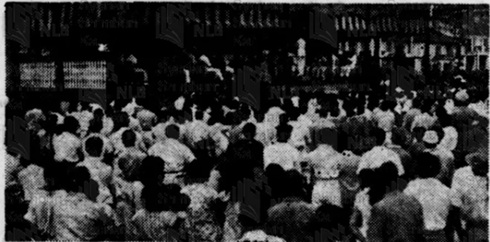
The crowd at the outdoor concert, from “Open Air Musical Concert,” from Syonan Sinbun, 19 August 1943. Unseen in the photo is the former YMCA building, almost directly across on Stamford Road, facing the Ladies’ Lawn Tennis Club House. The building served as the East District Branch as well as headquarters for the Kempeitai, the Japanese military police (“Young Men’s Christian Association,” Singapore Infopedia. From National Library Singapore. Article published 2017). Despite the cheerful atmosphere in the photo, the YMCA building was one that most tried to avoid. Hedwing Anuar (1928–), former director of the National Library of Singapore (1965–98), too, avoided the building where she could: “We would either walk along Stamford Road and then turn into Waterloo Street and get to [St Joseph’s Church on Victoria Street] or we could go by Bras Basah Road and get in. So, we preferred to go by Bras Basah Road. But you could see people being brought in chains to YMCA and we could hear cries and screams when [we] went by. It was a really scary place at that time and there were always sentries at the door and so on and by the Cathay because the Japanese propaganda people were at the Cathay building.” (Hedwig Anuar, oral history interview by Jesley Chua Chee Huan, 26 July 1998, transcript and MP3 audio, Reel/Disc 6 of 44, National Archives of Singapore (accession no. 002036), 73.)
The three concerts were performed by local musicians who had attended a 10-day course on Japanese music conducted by Watanabe Makoto, who was described as needing “no introduction to the people of Syonan who [had] already seen him wield the baton at various recitals”.5 The course was attended by 130 musicians from “cabarets, cafes and restaurants”, from which 50 were subsequently selected to form an orchestra for public performances. The course, which the concerts were a result of, was seen as the “latest move” by the Tokubetushi (the Syonan Special Municipality) with the driving principle of “Music for Everybody”.6 Both came “under the auspices” of the Gunsendenhan (Propaganda Department) of the Gunseikan-bu (Military Administration).7 Despite the impact Watanabe must have had on local musicians back then, virtually no research has been conducted on him. I have yet to encounter any in-depth work done on Watanabe among Japanese sources.8
Through the three August 1943 concerts and Watanabe’s career in Syonan, this paper seeks to answer two fundamental questions: What did music-making mean for those who were involved in its practice and performance within the context of a military occupation? Why did these local musicians perform for the occupying forces, and what were their motivations?
For the purposes of focus and scope of research, this paper will only examine these questions through the experiences of selected individuals and selected musical activities within the majority of the civilian population who were not interned. Music within the civilian internment and prisoner-of-war camps is fodder for another paper. In the absence of official documents about musical activities or operations of the Gunsendenhan,9 which I have yet to come across, and in light of Syonan Sinbun serving as a propaganda tool for the military administration, an assumption can be made that the newspaper’s account was a reflection of the administration’s intent.
Sylvian Surroundings for Inspiring Nippon Melodies
The course ended with a “simple ceremony” comprising a performance by “seven orchestras” and a speech by Hirokuni Dazai, who was variously head of the municipal education department, chief secretariat and a representative of the Syonan Hoso Kyoku. In his address to the musicians, Dazai stated that music played a “vital part in the daily life of men” and “exhorted” the musicians present to “give their utmost co-operation to the authorities under current wartime conditions to encourage the musical side of Nippon culture among the people of Syonan”.10
Music indeed played an important role in Japanese war efforts, whether as cultural propaganda, morale booster or entertainment.11 As a musician, Watanabe emerged from a social-cultural milieu where, at the onset of the Pacific War, the Japanese government pushed for the wartime role of music. According to newspapers in Japan, music could appeal “to the feeling of the people and has the characteristics of not being restricted by language or knowledge”, “fine music that [would] stimulate the patriotic sentiment of the people and join the firing front and the home front in manifesting the Empire’s glory...”, and music “not only [enhanced] the fighting spirit of the people and their appreciation for beauty but [was] also an indispensable medium by which [Japan could be introduced] to the Southern Regions and to other foreign countries”.12
It was deemed important enough that the Japanese government’s Board of Information formed a Musical Instrument Distribution Committee to ensure the “smooth distribution of materials for the manufacturers of musical instruments” in Japan.13 Pianist Monotari Iguchi (1908–83) saw it as Japan’s role “with her superior musical cultures, to help and lead the other peoples in Greater East Asia to create their own national music.”14
Musical performance of any form can be seen as an exercise of power, as French economic and social theorist Jacques Attali once wrote. He said that any theory of power must include a “theory of the localization of noise and its endowment with form”. Music, or any organisation of sounds, is a “tool for the creation or consolidation of a community” and it is what links a “power center to its subjects .., and an attribute of power in all its forms”.15 Within such a framework and within the context of a military occupation, the description of the outdoor concert of 17 August 1943 by the Syonan Shimbun reporter is thus instructive of an exercise of power and a process of the transformation of place.
The programme for the concerts comprised 16 items – Japanese military songs, wartime songs and folk songs – arranged by Watanabe for an ensemble of 50 instrumentalists and four vocalists. Watanabe – as one of his former wartime local staff, E. Leong, recalled – was head of music at the Gunsendenhan and had “supreme authority over singers … and all musicians, ranging from pianists to flute players on a Chinese stage” with “even gong-beaters were under his control” and “made laws to suit his own whims and fancies.”16
The concert featured well-known Japanese works such as Harusame (春雨, Spring Rain), a traditional Japanese melody; Aikoku no hana (愛国の花, Flowers of Patriotism); and Sakura Variations (most likely a set of variations of the popular Japanese folk tune さくら さくら Sakura, Sakura).17 These works were rich in cultural symbolism and allusion. In her article about the construction of home in popular wartime Japanese songs, Sabiene Strasser noted that some song lyrics referencing nature were not necessarily about nature but rather used “nature’s manifestations as a pool of metaphors”.18
For Strasser, excepting the cherry blossom, all other flowers in wartimes songs represent women, citing Aikoku no hana as an example. This song, a 1938 hit made popular by singer Hamako Watanabe (1910–99), was often recalled in song by wartime survivors in their oral history interviews with the National Archives of Singapore.19 As for the cherry blossom of the Sakura Variations, which the Syonan Sinbun reviewer noted as the “most popularly appreciated, to judge by the ovation accorded to it”,20 it symbolised brave manhood.21 The cherry blossom would later become associated with kamikaze pilots.22
The newspaper claimed that the outdoor concert was “even better” than the previous two held indoors “due to the sylvian surroundings which formed an ideal background for the inspiring Nippon melodies that had themselves [sprung] from the characteristic love for nature expressed in so many of the songs.”23 In this instance, the natural environment of an occupied territory was more than just a backdrop for the music of the occupier. Being the “ideal” backdrop, the land of the occupied becomes associated with the natural environment of the home country of the occupier (Japan in this case) through music: that is, the nature found in the occupied territory is in sync with the music inspired by the nature of the homeland of the occupier. Here, identification of the land of the occupied with the homeland of the occupier becomes complete through music.
Yet, after the end of the Occupation, the memory of these concerts and Watanabe seem to have lapsed into obscurity. In the immediate post war years, Leong wrote in the same article that Watanabe had been “soon forgotten”.24 How was this so?
A Medium Through Which We Can Study Occupation
Who was Watanabe? Who were the local musicians who participated in the concerts? If indeed the drive for those 10 days was about “music for everybody”, then the music for the population of Syonan was Japanese music. Did the local musicians then feel they were active participants in Japanese propaganda efforts?
As educator and musician Christopher Small argues, an understanding of persons/personhood “taking part in a musical performance are in effect saying to themselves, to one another, and to anyone who may be watching or listening”,25 if “this is who we are” and that “there is a sense in which all musicking can be thought of as a process of storytelling, in which we tell ourselves a story about our relationship”,26 then a study of musical activity could explore the possibility of opening alternative understandings and dialogues about this “dark”27 period of the Japanese Occupation in Singapore’s history.
As Sophia Geng observed in her study, “Music and Sound in Weihsien Internment Camp in Japanese-occupied China”, music matters in understanding the history of occupation for music “provides a medium through which we can study occupation as it was taking place, rather than examining it retrospectively” as well as capturing “the makers, performers, listeners and non-participants in their diverse social roles as captors, prisoners, collaborators and bystanders.”28 Music, as Geng argues, was “an expression of identity, as well as a common language that could bridge and enlarge sociocultural, political and economic gaps.”29
The Sound of Irony
The two common responses I heard from generations born after 1945 at the mention of music in wartime Singapore were either that the soundscape of Syonan was devoid of musical activities, or that musical activities during that period had largely remained a little known aspect of Singapore’s history.30 It was as if for an entire post-war and post-independence generation, the co-existence of the arts and accounts of “cries and screams” from within the former YMCA building was an impossibility or even an incongruity.
Such a perception could also have been compounded by observations such as those made by Mamoru Shinozaki who was known for his work as a liaison between the Japanese administration and the local population of Syonan, especially when he served as head of the Kōseika, or Welfare Promotion Section, within the Welfare Bureau of the Syonan Municipality. In Shinozaki’s memoir, Syonan – My Story: The Japanese Occupation of Singapore, which was widely lauded when it was first published in the mid-1970s,31 he recalled: “Not that there was much drinking among the people during the occupation. There was very little entertainment of any kind, no enjoyment. All the main theatres were reserved exclusively for Japanese soldiers. Unnecessarily, Singapore people were shut out of most luxurious bars and restaurants. Had they even been open to them, few could have afforded to have gone inside: they did not have the money”.32
While most luxurious bars and restaurants may have not been affordable for the local population, that did not mean there was “little entertainment of any kind” and “no enjoyment”.33 It would seem that Shinozaki had forgotten that when he was Chief Officer of Education in the early months of the Occupation, he had signed off on a notice that appeared on 14 May 1942 in the Syonan Times announcing four forthcoming concerts by the Syonan Symphony Orchestra (or Syonan Orchestra as it was called by the press) that were to take place on the 16th and 17th of that month at the Syonan Gekyizo (former Victoria Theatre). These concerts were open to three categories of audiences: two concerts for civilians only, one concert for both civilians and officials and one solely for Japanese soldiers.34
Contemporaneous reports also reflect an active post-war music scene. The 1946 Annual Report in Singapore noted that “with regard to cultural interests, the interruption of the normal life of the city caused by the Japanese occupation did less damage than might have been expected”.35 The report observed that while there was public entertainment and film screenings, the considerable amount of propaganda in most of them led the public to shun them, coupled with fears about being out after dark, the “arts had to be cultivated in the home or not at all”.36 The result of which was that “during these years many acquired their first experience of and love for classical music, Chinese calligraphy, and the monuments of Asiatic or Western literature”.37 Such circumstances in turn led to a “burst of musical and dramatic activity” when “peace came, and conditions permitted”.38
Indeed, in November 1945, just barely two months after the end of the Japanese Occupation on 12 September, and within a week or so of one another, there were notices in the English press for the formation of a symphony orchestra by the enterprising Gordon Van Hien39 – an amateur musician who, from the time of his arrival in Singapore in 1938 until the outbreak of the war, was active both as a performer and music organiser. He had spent his internment in Changi and Sime Road camps conducting choirs and organising concerts, as did Scottish composer, conductor pianist and organiser Erik Chisholm (1904–65), who had then just been appointed music director of ENSA (Entertainments National Service Association) for the Southeast Asia Command.40
By December 1945, concerts by the ENSA Symphony Orchestra were being held at the Victoria Memorial Hall.41 Then, a year later in December 1946, Van Hien conducted the first symphony concert of the Singapore Musical Society at the Victoria Memorial Hall since the Occupation. According to the Malaya Tribune, the audience “filled the auditorium, crowded on to the benches behind the concert platform and overflowed into the verandahs of the Hall”.42
Within the Chinese music scene, much has been written about the rise of what is now known as getai (literally “song stage”) in the form of the “singing café” during the Occupation. Contemporaneous reports in the English press in the immediate post-war years for instance, made much of the “night cafes” or “singing cafes” that originated during the Occupation as “‘beer gardens’ offering vocal entertainment by attractive but not always talented girl singers”.43
This legacy continued to fascinate the English press even close to a decade after end of the war. In a 1953 report headlined “Pretty Girls, Songs, Dance and Comedy”, the Singapore Free Press noted that this was as a “well-tried formulate that never fail[ed] to draw an attentive audience” across the three amusement parks (New World, Great World and Happy World) of Singapore then. Such cafes, the report claimed were “peculiarly a Malayan Chinse invention originating from the Japanese Occupation” that were not found in China or elsewhere in Southeast Asia.44
A year later in 1954, an article in the Straits Times called the singing café (described also as “those colourful , open-air theatres where Malayan Chinese relax after the day’s work, soothed by the songs of pretty girls”) as one of the “most remarkable developments in the night life of Singapore since the war”. With the few cinemas screening “uninviting Japanese propaganda films” and with “little public amusement then”, the public “flocked to the cafes to see and hear Chinese girls, then crooning tunes mainly acceptable to the Japanese”.45
When viewed in retrospect, for those who lived through the period and who participated in musical activities, whether as performers or audience, there seemed no explaining the paradoxical milieu in which they survived.
As prominent conductor, educator and administrator who helped shaped the post-war Singapore classical music scene, Paul Abisheganaden (1914 – 2011)46 wrote in his memoir, Notes Across the Years : Anecdotes from a Musical Life, “However, ironical as it may sound, and in spite of the tremendous hardships and privations, music and dance re-surfaced in the lives of many people. It could be said that in some ways, music and dance actually flourished… The irony was due to the fact that the enemy, in spite of their many atrocities, had come from a country which was extremely advanced in both the performance and appreciation of the arts”.47
Abisheganaden had served as an inspector for music at schools during the Occupation, where his duty was to assist music teachers “in every way possible” in the teaching and promotion of Japanese songs in the classroom. He also performed with the Syonan Symphony Orchestra.48
The Forgotten Corporal
Despite the well-attended concerts August 1943,their conductor, Makoto Watanabe seemed to have been largely forgotten. His work is not mentioned in most readily available English language accounts of the Occupation.49 As Leong mentioned, by 1951, Watanabe “was soon forgotten” except when “the open air cafes and singers” would sometimes bring back to many “the memory of a period of nightmare under this strange un-musical, yet, music loving Jap”.50 Yet, this was the same man, whom Leong said “ruled Singapore music”51 during the Occupation.
Two of the most extensive recollections of Watanabe in English-language print to date are those by Leong in his 1951 article for the Singapore Free Press and in Abisheganaden’s 2005 memoir. Watanabe was also recalled – with few exceptions – often in passing, by some oral history interviewees for the NAS.
Yet, within what is available, there remains a shroud of confusion over Watanabe. Details such as his date of arrival in Syonan and of his assumption of duties and how much of what was attributed to him was a result of individual initiative or as an agent of Japanese administrative policies are not always clear.
Also, several variants of his name can be found within both English and Japanese texts. In the Syonan Times/Syonan Sinbun/Syonan Shimbun, he has been referred to as “S. Watanabe”,52 “M. Watanabe”, “T. Watanabe”53 and “Makoto Watanabe”, while after the war, in the Singapore Free Press, as “Mokoto Watanabe”.54 In one wartime Japanese text, he was referred to simply as “W”.
As such, before any study of how Watanabe influenced and impacted the music scene and the lives of local musicians in Syonan, a summary of his career and role as understood by the local community – through the Syonan Times/Syonan Shinbum, Leong (who worked with him) and Abisheganaden (who was aware of Watanabe, although from his accounts their relationship is unclear) — becomes problematic because of differing accounts of other sources such as contemporaneous accounts of his activities in the Japanese media, accounts by writer Hiroshi Terasaki (寺崎浩) in his essay 馬来の音楽 (Music of Malaya) in 大東亜戰争陸軍報道班員手 (Memoirs of an Army War Correspondent in the Greater East Asia War)55 and film producer Hideo Koide (小出英男) in his collection of essays in 南方演藝記 (Record of Performances in the South56 or Nanpō Engeiki) and reports in the Malay Mail New Order.
An Iron Hand
Watanabe was head of music of the Gunsendenhan, and his work included both new initiatives and routine duties. The first public mention of him in Syonan was in the 13 October 1942 issue of the Syonan Times, on the occasion of the establishment of an ensemble, the Sing Sing Gakudang, by the entertainment section of the Gunsendenhan, which was to debut on 15 October at the Dhoby Ghaut playground.57
Prior to that, the Malay Mail New Order had reported the arrival of Watanabe from Kuala Lumpur from Japan, probably sometime in mid-June of 1942, in preparation of a series of six concerts that was held from 23 to 25 June at the city’s Pavilion Theatre.58 He was assisted by Akira Takaya (高屋朗), a well-known performer with the famed Kinryukan Theatre at Asakusa59 who had arrived with him. This was also likely Watanabe’s first appearance as a musician in the “Southern regions” (referring to countries in present-day Southeast Asia).
Watanabe was introduced to the Kuala Lumpur public as “one of the most famous conductors of popular music in Nippon”. The concerts were sponsored by the Gunsendenhan, with full support from the Heitan Shireibu (Military Headquarters of the Commissaria60 and the Kempeitai (Military Police). The concerts were arranged by the Gunsendenhan61 after it had noted the popularity of Japanese songs following the fall of Kuala Lumpur.62
The press reports of the preparations for the Kuala Lumpur concerts are reminiscent of the August 1943 concerts of the “Music for Everybody” drive.
The programme for the concerts comprised primarily Japanese songs that ranged “from folk songs to modern swing numbers” of which some were arranged and composed by Watanabe. The ensemble that accompanied A. Tayaka and other the singers (who also included seven local female vocalists) were “recruited from local talent.” Comprising two tenor saxophonists, four alto saxophonists, three trumpeters, two trombonists, four violinists, one bass player, one drummer and two pianists (one listed as a soloist),63 the ensemble underwent “vigourous daily training for several days to provide the treat”.64
The performances were covered extensively by the Malay Mail New Order with particular attention on Watanabe. The headlines of the reviews speak for themselves: for the first day, it was “Two Hours of Excellent Entertainment” met with “thunderous applause”; for the third, it was “Grand Concert in Short Sleeves: Nippon Soldier-Singer & Nippon Soldier-Conductor: Lively Orchestra Under Expert Direction” where singers were accompanied by an orchestra dressed in shirt sleeves under the leadership of a conductor “in khaki pants and shirt” kept “a packed audience of several thousand thrilled for nearly three hours”.65
The 15 July 1942 issue of Asahi Shimbun headlined its report on the concerts as “Malaya’s Enthusiasm for Japanese Music is Thriving”.66 Watanabe’s efforts as a band leader were highlighted to its Japanese readers who were told that the musicians, gathered from various bars and cafes in Kuala Lumpur in mid-June, had rapidly become a “splendid”67 ensemble under the enthusiastic direction of Watanabe.
It is from these reports that Watanabe’s name can be ascertained. His name was given as “渡邉眞”, which could be read as either “Watanabe Makoto” or “Watanabe Shin”. This explains the reference to him as “S. Watanabe” in the October issue of Syonan Times.68 It can be safely assumed that given the context (i.e music performances and music related matters) in which the name appears in the press, he was generally known as “Makoto Watanabe”. “T. Watanabe” and “Mokoto Watanabe” are likely typographical errors. In Terasaki’s article “Music of Malaya”, an account of his musical encounters in Penang, Kuala Lumpur and Singapore in 1942, he refers to a “W” whom he heard in Kuala Lumpur conducting a jazz band, who was later training a “local orchestra” in Syonan. Terasaki’s observations of “W” when verified against other accounts, confirms that “W” refers to Makoto Watanabe.69 Terasaki was one of the hundreds of Japanese intellectuals (including novelists, painters, poets, filmmakers and others) drafted for propaganda service and assigned to the 25th Army of Lt General Yamashita Tomiyuki in his Malayan campaign.70
Watanabe’s pre-war reputation comes to fore in Japanese sources that reference him as an “up and coming”71 band conductor and arranger with the record company Columbia.
Koide wrote that following the concerts, Watanabe and Akira Tayaka took the ensemble to perform for Japanese troops outside of Kuala Lumpur. He recounted how when the ensemble was to be disbanded, both the local musicians and two men were in tears. He also reported that Watanabe and Tayaka later moved to Syonan and worked with the Gunsendenhan for performances, which included putting together a musical ensemble that was larger than the one in Kuala Lumpur and was to be active in providing public as well as broadcast performances.72
Terasaki held a different opinion of Watanabe. Terasaki noted that while Watanabe carried out interesting research into keroncong (a popular musical form originating from Java), Watanabe, however, had his shortcomings as a composer. In fact, Terasaki was critical of Watanabe’s compositional skills, noting a lack of harmony, boring use of musical instruments and a sense of “emptiness” in his music. Terasaki cites an example of Watanabe scoring a melody for three saxophones playing in unison followed by trumpets carrying the same melody while other instruments remained silent. Terasaki found little musicality or nuance in such instrumentation.73
Sometime between June and October, Watanabe travelled to Syonan – most likely his final and intended destination – and in October he was introduced to the locals via the press as a “musician by profession” who was “conducting his own orchestra in Tokyo before he joined the Army and came to Malaya”.74 Upon his arrival in Syonan, Watanabe ruled “those under him with an iron hand”, according to Leong.75
No One was Allowed to Play or Sing Unless…
Leong had noted that the social milieu in Syonan at the time of Watanabe’s arrival was one when “business was practically at a standstill” but the “amusement and entertainment industries were lucrative” and “singers and musicians were in great demand” and “cafes with music and songs sprang up overnight”.76
The importance of providing musical entertainment at food and lifestyle establishments was the norm then: music if anything, was seen as a draw for patrons and restaurants. When restaurants and cafes resumed operations after the fall of Singapore, promises such as “high class music”77 or “enchanting music by a first-class orchestra”78 or “melodious music during meal hours”79 were made in advertisements. Everyone, it seemed, wanted life to resume or assume some pre-Occupation normalcy.
Bands that were popular prior to the war also began to re-appear with the re-opening of restaurants and cafes. The opening of Nan-Mei Soo restaurant in September 1942 – touted as one of Syonan’s largest and most “up to date” restaurants at that time – for instance, saw the press discussing the quality of music provided before commenting on the food offered.80
It was within this context then, that Watanabe, at least in Leong’s eyes, began his attempt to assert his (or the Japanese military administration’s) authority over the music scene. Watanabe’s first form of control was the registration of all musicians and singers and that “no one was allowed to play or sing unless he or she possessed a pass issued by his department.” The second form of control was his decision to “ban all Western music and songs and censor all Chinese songs and their lyrics”.81
It was also around this time, according to Leong, that Watanabe launched an initiative that would impact Singapore till present day: the “singing cafes” which would come to be known as getai. As Leong recalled, “Young, pretty, attractively-dressed Chinese girls crooning away to the accompaniment of an orchestra before a microphone and under dazzling lights [were] common sights in open air cafes at Singapore amusement parks… This entertainment, unknown before the last war, [was] now becoming quite popular with the Chinese, particularly the non-English speaking Chinese. The idea was originated during the Japanese Occupation by a Japanese army corporal, Mokoto [sic] Watanabe”.82
In addition to the above, Abisheganaden also mentioned in his oral history interviews (1993–95) and memoir (2005) that Watanabe was brought in to conduct the Syonan Symphony Orchestra. Abisheganaden said, “the Japanese established an orchestra to give performances at the Victoria Theatre… The Japanese managed to commandeer the services of several musicians in Singapore. These were Europeans who came from countries not at war with Japan… And they brought a man called Watanabe from Japan who was an orchestra or band conductor… And they found out how many local musicians they could get and they established an orchestra which gave two performances every Sunday at the Victoria Theatre”.83
In his memoir, Abisheganaden elaborated how the orchestra was managed by a Hungarian musician called “Paul Gerentzer” (sic) who was engaged by the Syonan Kokkaido (Victoria Theatre) as manager of the orchestra. Gerentser in turn ‘roped in other foreign musicians and together with all available local musicians… played under the direction of Watanabe’”.84
The veracity of these claims, however, warrants a closer examination, especially when Abisheganaden’s memoir has been considered “a definitive history of Western classical music in Singapore”.85
The Epitome of Live Entertainment: The Syonan Symphony Orchestra
I have documented elsewhere the convoluted accounts of the origins of the Syonan Symphony Orchestra and its impact on local musicians who performed in it, ascertaining that it was more an initiative of Paul (or “Gaza” with its variant spelling of “Geza”) Gerentser than that of the Japanese military administration.86 What was not accounted for then was conclusive evidence that Watanabe could not have in any way been involved in its founding (no mention of Watanabe does not necessarily mean that he was not present or involved) or why and how Paul Abisheganaden could have been mistaken in his recollections.
The report of the Syonan Symphony Orchestra’s first concert appeared in the 10 April 1942 issue of the Syonan Shimbun.87 It was a review of a close to three-hour concert by an eight-piece member orchestra led by Gerentser for wounded and sick soldiers at the Syonan General Hospital (Singapore General Hospital today). By May, the orchestra was giving two concerts a week conducted by another Hungarian musician, Francis Steven Krempl (or “Feri” or “Ferenc” as he was also called)88 at the Syonan Kokaido. Both Gerentser and Krempl were musicians with the former Reller’s Band that had played at Adelphi and Sea View hotels in the pre-war years. Performances by the orchestra throughout the Occupation were so well received that Abisheganaden would remember them as “the epitome of live entertainment during those war years”.89
However, when the Syonan Symphony Orchestra was performing on the weekends of 13 and 14, 20 and 21, and 27 and 28 June 1942,90 Watanabe, as mentioned earlier, had only arrived in Malaya and even then, was in Kuala Lumpur preparing for the concerts on 23 to 25 June. Watanabe was thus not involved in any way in the founding of the Syonan Symphony Orchestra. In fact, up until 1943, it would appear that the Syonan Symphony Orchestra and Watanabe were appearing in concerts independent of one another. For instance, the Syonan Shimbun reported on 11 September 1943 of two concerts: one on 10 September in Penang where Watanabe conducted an ensemble of 30 musicians in a programme of his own compositions; and the Syonan Symphony Orchestra’s forthcoming concert on 12 September.91
One reason Abisheganaden could have remembered otherwise was that he recalled an exception rather than the rule. There was indeed one occasion in 1944 when Watanabe did conduct the Syonan Symphony Orchestra. On 1 July 1944, a “Grand Concert to Help Syonan Public More Defence Minded” sponsored by the Malay newspaper Berita Malai and the Japanese newspaper Singapore Nippo was held at the Dai Toa Gekijo featuring musicians of the then newly formed Syonan Music Association. The concert was conducted by Watanabe and featured the Syonan Orchestra. It was broadcast “live” over radio and advertised as “special musical entertainment by the Syonan Orchestra conducted by M Watanabe relayed from the Dai Toa Gekijo...”.92
Under Dazzling Lights: Getai
The case for the getai (歌台) having been borne from the Occupation has been argued for in Wong Chin Soon’s (王振春) 新加坡歌台史话 (Xin Jia Po Ge Tai Shi Hua, Singapore’s Getai Historical Stories) and by Chan Kwok-bun and Yung Sai-shing in their essay “Chinese Entertainment: Ethnicity and Pleasure” in Chinese Entertainment.93
The violinist Wang Jin Tong who performed in the singing cafes during the Occupation made no mention of Watanabe in his memories of the origins of the singing café in the amusement parks nor do Chan and Yung refer to Watanabe’s role in their article. Rather, Wang claimed that he had first proposed the idea of a “song stage” when he was approached by an entrepreneur for advice on how to revitalise a café at the New World amusement park.94
While there is only Leong’s assertion that the idea of “singing cafes” originated from Watanabe, it was surely no coincidence that the announcement of the reopening of New World and Great World amusement parks appeared in the Syonan Times on 15 October, two days after Watanabe first appeared in the English press and on the same day Sing Sing Gakudang made its debut. New World re-opened on 19th November.95
Whether or not Watanabe was directly responsible for the concept of the “singing café”, it can be safely conjectured that he had some role in this initiative, given his role as head of music within the Gunsendenhan and his background in popular music. More significantly, it would have been obvious to the Japanese military administration that the re-opening of these amusement parks would mean more food and beverage establishments that would require musicians and singers.
How then could the Japanese military administration benefit from a control of the musicians who would be performing in these places? How could such control be leveraged for the Gunsendenhan’s purposes, and what did this in turn mean for local musicians?
Co-opting Local Musicians: “It Is Compulsory Otherwise…”
The orchestras formed and led by Watanabe primarily comprised local musicians or musicians already in Singapore before the Occupation. The Sing Sing Gakudang ensemble at the onset, for instance, consisted of “instrumentalists of Malay, Filipino, Chinese and Indian musicians” with five vocalists, “four young women, Filipinos and Eurasians” and a male singer, Philip Vaz, who by that time, had already “made a number of public appearances”.96 Vaz, for one, had arrived in Singapore in 1936 from Rangoon, Burma to join AM de Silva’s band.97 The orchestra assembled from the “Music for Everybody” drive comprised musicians from cafes, restaurants and cabarets.
One challenge Watanabe faced must have been how to induce (if not coerce) local musicians to perform for Japanese propaganda (as well as entertainment) purposes. Of equal importance, how did local performers under Watanabe feel about performing the music of occupying forces? What motivated them to participate, what was the transactional relationship and of what dynamic and dimension?
This research proposes the possibility that Watanabe imposed the compulsory registration of musicians and vocalists as way of compelling them to perform with the ensembles he had formed for the dual purposes of propaganda and entertainment.
First, musicians had to be registered with the Gunsendenhan to obtain a permit to perform at any type of establishment; part of the requirements of registration was to perform for the Gunsendenhan when called upon. In other words, for a musician to perform at lifestyle places where it was financially lucrative, they had to register with the Gunsendahan and registration entailed performing for the Gunsendahan as well.
Prominent Singapore violinist Tan Julai (c.1925–2019), who performed under Watanabe, attested to this in his oral history interview. He was the recipient of the 2010 Lifetime Achievement Award of the Composers and Authors Society of Singapore (Compass) Awards.98 When the war broke out, Tan was in his mid-teens and still a music student with the then well-known Far Eastern Music School. Both necessity and opportunity found Tan playing in an orchestra formed by the Gunsendenhan under Watanabe as well as in restaurants during the Occupation.
In his interview, Tan did not state the year he performed with the ensemble, hence, it is unclear if he had joined the Sing Sing Gakudang of 1942, the 50-man orchestra formed for the “Music for Everybody” initiative of 1943, or an orchestra organised after the formation of the short-lived Syonan’s Musicians Association in 1944. What is clear, however, from Tan’s account, is a causal connection between having to play for the Gunsendenhan, performing for propaganda purposes and the opportunity to perform at cafes and restaurants. Tan thought that opportunities to perform at food and beverage establishments were “fixed by the propaganda department”.99
Thus, in order to perform such places, one had to enroll with the department. Tan recalled that some musicians from the Malay, Eurasian and European communities had mentioned that the Gunsendenhan were trying to “get hold of musicians together” and help look for work for them at restaurants and cafes. “When I saw restaurants being opened up, cafes, then I realised that this was it. I had to enroll myself”,100 said Tan. To Tan, registering with the Gunsendenhan seemed mandatory in order for musicians to perform in food and beverage outlets – “It [was] compulsory otherwise they [could not] get any jobs”.101
Tan recalled that Watanabe’s first course of action was to enroll and grade the musicians. He then organised a “big concert” at Dai Toa Gekijo.102 The orchestra that Tan performed in was “quite a big orchestra” that had “about 40 to 50 musicians” with “a lot of strings, blowing as well as percussion”.103
The orchestra performed once or twice a month, while rehearsals were held once or twice a week. The orchestra also had a Japanese name, which Tan did not state. Musicians had to pay for their own attire as well as upkeep of their own instruments and were remunerated only with food supplies.104 Monetary income instead came from performing at restaurants and cafes, work obtained through the assistance of the Gunsendenhan.
According to Tan, earnings from playing at various restaurants – including the Nansei at Seah Street and another café at Orchard Road – were “quite sufficient to live” on, and he affirmed that the Occupation was significant in his life because it “more or less” provided him the opportunities to pursues a living with his music.105 Tan said he did not “mind playing for free” because the Gunsendenhan would “help to get the jobs... We had to, no other choice”.106
Impression of Watanabe: “… it was military law…“
Watanabe left the same deep impression on Tan as a stern taskmaster he did on Leong or possibly just almost anyone who encountered him. Leong recalled Watanabe as being “hard hearted and eccentric” who dispensed “rough and ready justice” with no favourites in his arbitrations between employers and musicians. Watanabe was given to long “tedious practices for military concerts”, which often deprived musicians of their “tiffin and dinners and even interfering with their work at the cafes”. Musicians “dreaded” these rehearsals.107 Leong also felt that Watanabe “knew little about music, much less about conducting”.108
From the musicians’ perspective, Watanabe was, to Tan, every bit the exacting taskmaster – “He was very strict, of course,… He was very, very stern. No joking around, very, very stern. And everybody has got to be present on time”.109 Latecomers were chastised with a slap.
Whether it was experience tempered by the passage of time of time (Tan was 71 and had been interviewed slightly more than 50 years after the Occupation; Leong was writing just six years after the Occupation) or individual temperament, Tan seemed to have viewed Watanabe’s behaviour as more of a result of his circumstances rather individual character traits – “He was very strict, of course. Couldn’t blame him. At that time, it was the military administration. So, they had to be very strict about everything”. As for the physical abuse, Tan said, “Well, it was military law so he would slap”.110
For Tan though there was no doubting the role music played in his life during the Occupation and the subsequent impact of the Occupation on his musical career. He said, “Well, as a musician I think I was lucky. If I had not been in the [sic] music I would have suffered more, definitely”.111
“What Could We Do… Japanese Time”: Surviving in a War Bigger Than They Were
Tan and other musicians’ tolerance of the likes of Watanabe and the circumstances as they strove to survive the Occupation bear out the observation that “even when the occupied people are treated well, an occupation is usually highly burdensome to them nonetheless, as it greatly diminishes their capacity for self-determination, both individual and collective.”112
This is also evident in the experience of Victoria Krempl nee Mowe (1916 –2010), who was a dancer with the Syonan Symphony Orchestra from 1942 to 1945. The orchestra had, within a few months of its founding, included dance items to add variety to its programmes. The group, comprising female dancers, was subsequently known as Syonan Orchestra Girls. In her oral history interview, Krempl, who later became a kindergarten teacher113 in Singapore, was asked if she had found her work “degrading”. (Paul Abisheganaden had asked her this question, presumably because it could have been a form of collaboration.) She had replied, “What else could we do? Japanese time…”.114
The ethical dilemma and the consequences that arose for an individual under such circumstances were particularly noted by Oswald Gilmour who was part of the Malayan Planning Unit involved in the post-war reconstruction of Singapore. This was more so when during the Japanese regime, “all sorts of malpractices had grown up, some voluntarily, some involuntarily” resulting in “respectable people” having to “do things in order to live, previously which they would never have contemplated”.115
Gilmour, who arrived in Singapore at the end of the Occupation and was in Singapore in the weeks that followed, had found himself in a Malaya where it was often impossible to “draw a line between collaboration and non-collaboration”. He noted “small percentages” from each communal group having collaborated with the Japanese to “varying degrees”, while others tried to make the Japanese “believe they were collaborating, while in fact they were feathering their own nests” and the majority, especially those who were affluent before the war, “spent much of their time and energies” remaining “as inconspicuous as possible”.116
The conflict faced by those who refused to collaborate or who were not given the opportunity, were observed by Gilmour to have “found living by honest means almost or entirely impossible” and in order to exist, resorted to “dishonest or questionable practices, with an ever-increasing moral deterioration”.117
Musicians were certainly not immune to such dilemmas in their struggle for survival during an Occupation where one’s capacity for self-determination was diminished. One such musician who faced an unwelcomed fate in the immediate postwar period was the singer Fedela Tagarino, who was popularly known as Miss Fadillah. Born around 1919 to a father who had come to Malaya from the Philippines and a mother who was local of Portuguese-descent, Miss Fadillah was billed variously as New Columbia’s “Microphone Queen”118 and “the singing sensation of Penang”119 in the pre-war years.
In 1940, she was involved in the war effort, performing in fundraising events. Perhaps her major contribution in this area was her recording of the song Kebuasan Hitler (The Cruelty of Hitler), which was also released in 1940. Publicity for the song, together with another song Karangan Hitler (Hitler’s Composition) recorded by another popular singer of that time, Miss Julie, only came out in January 1941. As the Straits Times reported: “Malay opera artists are helping with anti-Nazi propaganda”.120
After the Fall of Singapore, Miss Fadillah was detained briefly by the Japanese military,121 but otherwise, throughout the Occupation, she performed with the Syonan Hoso Kyoku as a vocalist alongside Philip Vaz and both were often accompanied by the pianist S. Gomez. The trio made such an impact with their talent that they gave a “model concert of Nippon songs”, sponsored by the Hoso Kyoku on the second anniversary of the beginning of the Pacific War at the Great World amusement park.122
After the war Miss Fadillah’s son Bernadine Wong stated in the documentary Finding Miss Fadillah that “she was either detained or interrogated because of being a collaborator of the Japanese”.123 “My mother was a very simple lady. The only thing she really knew how to do and do well was sing, you know,” recalled. “So, if she had to sing Japanese songs, she sang Japanese songs. If she had to sing English songs, she [would] sing English songs. If she had to sing Bahasa she would sing Bahasa songs or Filipino folk songs. She was just trying like many, many other people to make ends meet, just struggling to survive in a war that was a lot bigger than they were… ”.124
A Space to Engage: “I Mean, We Just Don’t Understand…”
Being a musician performing in cafes, bars or restaurants allowed those among the local population to encounter another facet of the occupier and here, music served as another space for the occupied to engage with the occupier. Tan recalled from his experience of performing in night spots frequented by Japanese soldiers, “I noticed they loved music. They could be any rank from officer to ordinary soldier, they seemed to like music … and usually when they request, in appreciation they would give the musicians cigarettes or drinks or tips...”125
Yet, these were possibly the same soldiers who would, the very next morning, go into battle or commit acts of brutality within the context of wartime. As head of the Gunsendenhan in wartime Kuala Lumpur, Lt. Kimura, said of Watanabe and Takaya, “these two gentlemen were not merely soldiers but excellent musicians who, at a moment’s notice, [would] forget their talent and become strong soldiers.”126
The human capacity to appreciate the arts at one moment and yet engage in acts of barbarism at another was noted by renowned literary critic George Steiner – whose work for much of his life “has concerned itself, directly or indirectly, with trying to understand, to articulate, causal and teleological aspects of the Holocaust”.127 At his talk, A Festival Overture, for the University Festival Lecture of the 50th Edinburgh Festival in 1996, Steiner said, “As the inhuman tenor of this century comes to condition our feelings, the terrible impotence of literature and the arts somewhat stand naked… It is that we now know of the neutrality of the arts and of their performance in the company of barbarism, of the enigmatic capacity of human beings to appreciate music or writer verse and then proceed to bestiality the next morning”.128
In his oral history interview with the National Archives of Singapore, civil servant Robert Iau (1935–2005) recalled that during the Occupation, the Japanese established a farm and a military camp near his home. Iau remembered that a Japanese soldier from the camp used to visit them regularly as his family had a piano. The soldier would come to play the piano and cry as he played. Iau’s family learnt that the soldier was “a major or something like that in the Salvation Army” who had been “sucked into the war”129 and herein lay what Iau found difficult to reconcile years later: the incongruity between music-making and acts of physical violence by the same individual. Iau described the man as “a very strange soldier… he would spend hours picking out the tunes on the keyboard. And he would be picking out tunes of hymns and he would weep and cry as he played the tune of the hymns… But the strange thing [was] he was also one of the most brutal of guards in the farm behind us and I [had] seen him beating up guys mercilessly. And yet, he could come to the house and pick out tunes on hymns and start to cry. I mean, we just [didn’t] understand.”
Even 80 years after the end of the Pacific War, perhaps there is still much more that is left to be understood.
The writer would like to thank Dr Eugene Dairianathan for his feedback on the paper and discussions on various aspects of music and performance; Dr Kevin Blackburn for his sharing of the primary source material from Malay Mail New Order and insights into the social aspect of the Japanese Occupation; Associate Professor Matsuoka Masakazu for the sharing of his paper and other aspects of his research; Dr Kentaro Sakai for various source material; Dr Eriko Ogihara-Schuck; Dr Clay Eton for advice; Sum Wai Ying and Ko Tim-Keung for help with translations for the Japanese sources; Kong Leng Foong and other librarians of the National Library of Singapore during his Lee Kong Chian Research Fellowship tenure; librarians of the Japan Foundation Library and National Diet Library in Tokyo, Japan.
About the Author
Independent researcher, writer, and editor Phan Ming Yen has been involved in Singapore’s art scene variously as a music critic, journalist, writer, and arts manager for over 30 years. His writing has been published by Ethos Books, online in Quarterly Literary Review Singapore, and also in BiblioAsia. In his latest publication, he worked with ballet pioneer Goh Soo Khim in her memoir Love Connects. Phan’s primary area of research is music during the Japanese Occupation of Singapore. He was a recipient of the National Library Board’s Lee Kong Chian Research Fellowship in 2024.
Endnotes
1 The main English language paper, regarded as the “premier newspaper” by Paul Kratoska in The Japanese Occupation of Malaya and Singapore, 1941–1945: A Social and Economic History (Singapore: NUS Press, 2019) (From National Library Singapore, call no. RSING 959.5103 KRA) was published under various mastheads: Shonan Times on 20 February 2602, Syonan Times on 21 February 2602, Syonan Sinbun on 8 December 2602 and Syonan Shimbun on 8 December 2603. See Kratoska, The Japanese Occupation, 2019, 8. This paper will follow the names of the newspaper accordingly.
2 See the following in Syonan Sinbun of 2603: “Syonan Grand Concert Draws Record Gathering: ‘Music for Everybody’ Drive,” Syonan Shimbun, 16 August 1943, 1; “Nippon Melodies Please Record Audience,” Syonan Shimbun, 17 August 1943, 1; “Open Air Musical Attracts Another Huge Crowd,” Syonan Shimbun, 18 August 1943, 1; “Open Air Musical Concert,” Syonan Shimbun, 19 August 1943, 1. (From NewspaperSG)
3 “Open Air Musical Attracts Another Huge Crowd.”
4 “Syonan Grand Concert Draws Record Gathering.” Where possible, this article uses the romanised Japanese names of the institutions or venues during the period of 1942 to 1945 first. Some of the romanised terms or names will be as they appeared in documents of the period.
5 “130 Musicians Being Instructed by Conductor Watanabe,” Syonan Shimbun, 4 August 1943. (From NewspaperSG)
6 “130 Musicians Being Instructed by Conductor Watanabe.”
7 Syonan Sinbun, 4 August 2603 and “Public Performances of Nippon Music Arranged in Syonan,” Syonan Shimbun, 13 August 1943, 1. (From NewspaperSG)
8 Much of the recollections of Watanabe are anecdotal which veracity, based on evidence, remains to be examined in further depth. Perhaps a further mining of archival material in both Singapore and Japanese sources may reveal in greater depth and accuracy of what actually transpired during the Occupation, especially from the viewpoint of the occupier which, in turn, would provide a greater understanding of the experiences of the occupied. The experiences and real-life stories of local musicians such as Phillip Vaz, Miss Fadillah, Tan Julai and Victoria Krempel nee Mowe, but to name a few, for whom the practice of music (and the arts in general) offered both a refuge for survival and an opportunity to thrive also deserve more detailed examination.
9 One of the challenges highlighted by Japanese historian and researcher Matsuoka Masakazu is a lack of historical sources on musical activities, such as those of the Japanese military administration’s operations in Syonan. See: Goraku ka nihonka kyouiku ka?: Nihon senryō ka shingapōru ni okeru ongaku ゴラク カ ニホンカ キョウイク カ? : ニホン センリョウ カ シンガポール ニ オケル オンガク [Entertainment or Japanization Education?: Music in Japanese-occupied Singapore]. In Shokuminchi kyōiku-shi kenkyū nenpō植民地教育史研究年報 [Annual report on the study of colonial educational history], no. 17 (2014).
10 “Public Performances of Nippon Music Arranged in Syonan.”
11 One of the most recent studies on this subject matter is Matsuoka’s “ゴラク カ ニホンカ キョウイク カ? : ニホン センリョウ カ シンガポール ニ オケル オンガク” [Entertainment or Japanization Education? Music in Japanese-occupied Singapore], which has yet to be translated into English. Matsuoka argues that whether it had been the intent of Japanese military policy to establish Japan as a cultural leader in its envisioned Greater East Asia Co-prosperity Sphere and whether music was overtly used as a tool for cultural indoctrination or primarily as a means of entertainment but with a secondary intent of subliminal inculcation. Based on available reports, Matsuoka concluded that musical activities during the Occupation revealed the limitations of Japanese military cultural and propaganda policy.
12 “Navy Man Stresses War Role of Music,” Japan Times and Advertiser, 6 January 1942.
13 “Music Plays Vital Role: Government Organs Plan to Make More Musical Instruments,” Nippon Times, 16 March 1943.
14 “Iguchi Outlines Vital Role of Japan in Musical World: Japanese Music Is Spreading to the Southern Regions and It Is Nippon’s Duty to Lead the Peoples There to Find and Create Their Own National Music,” Nippon Times, 14 July 1943.
15 Jacques Attali, Noise: The Political Economy of Music (London: University of Minnesota Press, 1999), 6.
16 E. Leong, “The Jap Corporal Who Called The Tune,” Singapore Free Press, 20 March 1951, 4 (From NewspaperSG). This research thus far has revealed little on the identity of E. Leong, who is likely to be Eddie Leong. His wife, Mrs E. Leong, was involved in theatre performances, mainly a staging of Lady Precious Stream in 1946. See “Lady Precious Stream Plans,” Straits Times, 10 November 1946, 5 and “Lady Precious Stream Plans,” Straits Times, 13 December 1946, 5; “Lady Precious Stream Plans,” Straits Budget, 19 December 1946, 11, where she is identified as a “Mrs E. Leong”. In another staging of the same play in December1951 where she is identified as Mrs Eddie Leong, see “Old Boys To Stage Play for School,” Straits Times, 14 December 1951, 7. (From NewspaperSG)
17 See “Syonan Grand Concert Draws Record Gathering.”
18 Sabiene Straser, “Home, Militarism and Nostalgia in Japanese Popular Song from 1937 to 1945),” in Vienna Graduate Journal of East Asian Studies 2, ed. Rudiger Frank et al., (Vienna: Prasesns Verlag, 2011), 137.
19 See oral history interviews of Nona Asiah, oral history interview by Julianti Parani, 17 April 2004, transcript and MP3 audio, Reel/Disc 1–4, National Archives of Singapore (accession no. 002840); Taman Bin Haji Sanusi, oral history interview by Chua Ser Koon, 22 June 1982, transcript and MP3 audio, Reel/Disc 1–6, National Archives of Singapore (accession no. 000195); 506, National Archives of Singapore.
20 “Syonan Grand Concert Draws Record Gathering.”
21 Straser, “Home, Militarism and Nostalgia in Japanese Popular Song from 1937 to 1945,” 139.
22 See Emiko Ohnuki-Tierney. Kamikaze, Cherry Blossoms, Nationalisms: The Militarisation of Aesthetics in Japanese History (Chicago: University of Chiago Press, 2002) on how the cherry blossom was transformed into a symbol variously used by the military.
23 “Open Air Musical Attracts Another Huge Crowd.”
24 Leong, “The Jap Corporal Who Called the Tune.”
25 Christopher Small, Musicking: The Meanings of Performing and Listening (Hanover, New Hampshire: University Press of New England, 1998), 134.
26 Small, Musicking: The Meanings of Performing and Listening, 134.
27 Iskandar Mydin, “Reflections on War Memory: 80 Years Since the Fall,” Muse SG 15, no. 1 (2022): 9. (From PublicationSG)
28 Sophia Geng, “Music and Sound in Weishin Internment Camp in Japanese-Occupied China,” Sonic Histories of Occupation: Experiencing Sound and Empire in Global Context ed. Russell Skelchy and Jeremy E. Taylor (Ireland: Bloomsbury Academic, 2023), 75.
29 Geng, “Music and Sound in Weishin Internment Camp in Japanese-Occupied China,” 76.
30 This observation is gathered from audience response from a talk “Better Than a Gun or Revolver: Music as Protection and Collaboration in Wartime Singapore,” [10 May 2022, video, 48:27. (From National Archives of Singapore accession no. 2024004180)], given by Phan Ming Yen on 10 May 2022 for the National Archives of Singapore.
31 See Tan Tai Siong, “Japanese Official Saved Many from Wartime Pogrom,” Straits Times, 27 June 1997, 9 (From NewspaperSG), for the memory of Shinozaki’s legacy among Singaporeans.
32 Mamoru Shinozaki, Syonan – My Story: The Japanese Occupation of Singapore (Singapore: Times Book International, 1992), 58. (From National Library Singapore, call no. RSING 959.57023 SHI-[HIS])
33 Shinozaki, Syonan – My Story: The Japanese Occupation of Singapore, 58.
34 “Page 3 Advertisements Column 1: Syonan Gekyizo,” Syonan Times, 14 May 1942, 3. (From NewspaperSG)
35 P.A.B. McKerron, Annual Report on Singapore for 1st April–31st December 1946 (Singapore: Government Printing Office, 1947), 97. (From National Archives of Singapore, call no. RDLKL 959.57 MAC)
36 “Page 3 Advertisements Column 1: Syonan Gekyizo.”
37 McKerron, Annual Report on Singapore for 1st April–31st December 1946, 97.
38 McKerron, Annual Report on Singapore for 1st April–31st December 1946, 97.
39 “Symphony Orchestra To Be Formed,” Straits Times 11 November 1945, 3. (From NewspaperSG)
40 Cecil Street, “Singapore Diary,” Straits Times 17 November 1945, 2. (From NewspaperSG)
41 “Page 4/1 Advertisements Column 1: First Appearance of the ENSA Symphony,” Malaya Tribune 26 November 1945, 4/1. (From NewspaperSG)
42 “First Symphony Concert Since Liberation Impresses,” Malaya Tribune, 9 December 1946, 6. (From NewspaperSG)
43 Hsuan Tsung, “The Chinese Stage and Screen”, Straits Times, 21 September 1952, 14. (From NewspaperSG)
44 Fu Hsi, “Pretty Girls, Songs, Dance and Comedy,” Singapore Free Press, 26 February 1953, 8. (From NewspaperSG)
45 Fu Shi, “Café Singers,” Straits Times Annual 1 January 1954, 70–71. (From NewspaperSG)
46 To date, Paul Abisheganaden’s memoir possibly provides one of the more extensive and penetrating glimpses into musical life as experienced by a music practitioner during the Occupation. Abisheganaden was recipient of the Cultural Medallion, Singapore’s highest award for services to the arts and culture scene, in 1986. His memoir Note Across the Years has been called a “definitive history of Western classical music in Singapore.” See Chang Tou Liang, “Paul Abisheganaden,” Singapore Infopedia, published January 2019.
47 Paul Abisheganaden, Notes Across the Years: Anecdotes from a Musical Life (Singapore: Centre for the Arts, 2005), 95. (From National Library Singapore, call no. RSEA 398.4 SKE)
48 See Paul Abisheganaden, oral history interview by Jesley Chua Chee Huan, 23 February 1994, transcript and MP3 audio, Reel/Disc 13 of 48, National Archives of Singapore (accession no. 001415), 170 and also Abisheganaden, Notes Across the Years, 96–97.
49 A search in the Japan Times have also yielded no mention of Watanabe.
50 Leong, “The Jap Corporal Who Called The Tune.”
51 Leong, “The Jap Corporal Who Called The Tune.”
52 “Gun Senden-Han Forms Own First Class Orchestra,” Syonan Times 13 October 1942, 4. (From NewspaperSG)
53 “130 Musicians Being Instructed by Conductor Watanabe.”
54 Leong, “The Jap Corporal Who Called The Tune.”
55 Hiroshi Terasaki’s essay 馬来の音楽 (Music of Malaya) has not been translated into English nor have the six volumes of 大東亜戰争陸軍報道班員手 (Memoirs of an Army War Correspondent in the Greater East Asia War) in which his essay appears in Volume 4. Translation from ChatGPT. This writer has chosen to use the “Memoirs” rather than “Notes”.
56 Hideo Koide’s book has not been translated into English. This title is the writer’s own translation based on a version from ChatGPT.
57 To date, this research has yielded no history of the Sing Sing Gakudang in other sources beyond newspapers. Based on 1942 reports in the Syonan Times, its history is not entirely clear. On 15 October 1942, the supposed debut date of Sing Sing Gakudang, a reminder for a performance by a “Daitoa Orchestra Band” (or Dai Tao Orchestra) in the same vicinity appeared in the newspapers. Thereafter, the month of October 1942 saw performances by the Dai Tao Orchestra and in November by Sing Sing Gakudang. Both entities were described as ensembles of the Gunsendenhan. This writer believes that both ensembles were the same entity, the difference being that the name “Dai Toa Orchestra” was used when singers were not performing with the ensemble.
58 “Nippon Concert to Be Staged at Local Theatre: Famous Conductor in Charge Nippon," Malay Mail New Order, 22 June 1942.
59 See https://jp.tingroom.com/yuedu/rymjmp/zuopinheji/58402.html
60 This could also be translated as “logistics headquarters”.
61 “Nippon Concert to be Staged at Local Theatre.”
62 “Nippon Concert to be Staged at Local Theatre.”
63 “Nippon Concert to Be Staged at Local Theatre.”
64 “Grand Concert in Shirt Sleeves: Nippon Soldier-Singer & Nippon Soldier-Conductor: Lively Orchestra Under Expert Direction,” Malay Mail New Order 26 June 1942.
65 “Grand Concert in Shirt Sleeves.”
66 “Malaya’s Enthusiasm for Japanese Music Is Thriving,” Asahi Shimbun 15 July 1942.
67 “Malaya’s Enthusiasm for Japanese Music Is Thriving.”
68 “Gun Senden-Han Forms Own First Class Orchestra.”
69 Hiroshi Terasaki, 寺崎浩. “Maki no ongaku” 馬来の音楽 [Music of Malaya]. In Ō Tōa zhàn zhēng Rikugun Hōdō Han In Te 大東亜戰争陸軍報道班員手 [Memoirs of an army war correspondent in the Greater East Asia War]. Vol. 4. Edited by Bunka Hōkōkai. 大日本雄弁会講談社, 昭和17–18, 147.
70 Yoji Akashi, “Japanese Cultural Policy in Malaya and Singapore, 1942–1945,” in Japanese Cultural Policies in Asia during World War 2, ed. Grant Goodman (New York: St Martin’s Press, 1991), 119.
71 Hideo Koide, 小出英男, “Kakuchi no ongaku Dan to kashu-tach” 各地の音楽團と歌手達 [Musical groups and singers from various regions], in Nanfang Yanyi ji南方演藝記 Southern Performing Arts. (東京: 大空社, 2000), 280.
72 Koide, “Kakuchi no ongaku Dan to kashu-tach,” 280.
73 Terasaki, “Maki no ongaku,” 147.
74 “Gun Senden-Han Forms Own First Class Orchestra.”
75 Leong, “The Jap Corporal Who Called the Tune.”
76 Leong, “The Jap Corporal Who Called the Tune.”
77 “Page 2 Advertisements Column 1: The Rising Sun Restaurant,” Syonan Times 20 June 1942, 2. (From NewspaperSG)
78 “Page 3 Advertisements Column 5: Great Eastern Restaurant,” Syonan Times 30 August 1942, 3. (From NewspaperSG)
79 “Page 3 Advertisements Column 4: Nanmei-soo,” in Syonan Times 9 September 1942, 3. (From NewspaperSG)
80 “New Restaurant Opened at Former Dutch Club,” Syonan Times 12 September 1942, 4. (From NewspaperSG)
81 Leong, “The Jap Corporal Who Called The Tune.” This act of banning Western music by Watanabe, as recalled by Leong, is of interest. It is not clear what is meant by “Western music”. The banning of the performances, in public and in private of about 1,000 American and British musical compositions, which included “mostly jazz numbers, as inappropriate to the times”, did not take place until 14 January 1943 (see “Enemy Musical Compositions Put on Black List,” Syonan Sinbun 15 January 1943, 1 (From NewspaperSG)). At the outbreak of the Pacific War, in January 1942, Tokyo’s Board of Information had decided that “any kind of American and British music, no matter whether it is genuine or light music, should not be played under any circumstance”
81 No Japanese musician was “permitted to sing or play and kind of music of Japan’s enemy countries, the United States and the British Empire.” See “Anglo-US Music Banned,” Japan Times & Advertiser, 2 January 1942. Perhaps Leong was referring to American and British music but not music of other Western countries. The Syonan Symphony Orchestra and the Shonan Police Band, after all, continued to perform music by Western composers.
82 Leong, “The Jap Corporal Who Called The Tune.”
83 See Abisheganaden, interview, 23 February 1994, Reel/Disc 13 of 48, 170.
84 Abisheganaden, Notes Across the Years, 96–97.
85 See Chang, “Paul Abisheganaden.”
86 See Phan Ming Yen, “The Syonan Symphony Orchestra: A Case for Musical Collaboration in Wartime Singapore,” Cultural Connections 6 (2021) (From National Library Singapore call no. RSING 700.95957 CC). Variants of the name of the orchestra have included Syonan Kokaido Orchestra and Syonan Orchestra. On the orchestra’s house programme however, the ensemble refers to itself as “Syonan Symphony Orchestra”.
87 “Rapturous Musical Treat Enthrals Troops,” Syonan Times,10 April 1942, 4. (From NewspaperSG)
88 “Programme for To-day’s Concert,” Syonan Times, 16 May 1942, 3; “Syonan Gekizyo Concert by The Syonan Orchestra” Syonan Times, 22 May 1942, 4. (From NewspaperSG)
89 Abisheganaden, Notes Across the Years, 97.
90 “Orchestral Concerts at Syonan Gekizyo,” Syonan Times, 10 June 1942, 4; “Page 3 Miscellaneous Column 1: The Gekizyo,” Syonan Times, 19 June 1942, 3; “Page 3 Advertisements Column 3: The Gekizyo,” Syonan Times, 26 June 1942, 3. (From NewspaperSG)
91 “Nippon Musical Concert in Penang Big Success,” Syonan Sinbun, 11 September 1943, 2; and “Popular Concert”, Syonan Sinbun,11 September 1943, 2. (From NewspaperSG)
92 “Grand Concert To Help Make Syonan Public More Defence-Minded,” Syonan Shimbun, 29 June 1944, 2 and “Today’s Syonan Radio,” Syonan Shimbun 1 July 1944, 2. (From NewspaperSG)
93 Wong Chin Soon 王振春, Xinjiapo ge tai shi hua新加坡歌台史话 [Singapore’s Getai Historical Stories] (新加坡 : 新加坡青年书局, 2006). (From National Library Singapore, call no. RSING 792.7095957 WZC) has not been translated into English. Comprising interviews and profiles of performers, it discusses the origins of getai. Wong had also written about getai for the Chinese press in Singapore. See also Chan Kwok-bun and Yung Sai-Shing “Chinese Entertainment. Ethnicity and Pleasure,” in Chinese Entertainment: Enjoyment or Struggle (New York: Routledge, 2012), 24–26. (From National Library Singapore, call no. R 306.48120951 CHI). There is an unanimity that getai and the concept of the singing cafes began during the Occupation at the amusement parks. But there are varying accounts and differing memories as to who exactly started this trend.
94 Wong, Xinjiapo ge tai shi hua, 1–7.
95 “Former Capitol and New World Park Open to Big Crowds,” Syonan Times, 21 November 1942, 4. (From NewspaperSG)
96 “Gun Senden-Han Forms Own First Class Orchestra.”
97 Felix, “Philip Vaz To Sing at the Capitol,” Singapore Free Press 5 September 1951, 4 (From NewspaperSG). Vaz was a popular jazz musician and bandleader from the time of his arrival in Singapore until his death in Kuala Lumpur, Malaysia in 1976. He had moved to Kuala Lumpur in 1962. He was a singer with the Hoso Kyokuduring the Occupation and was noted by Koide as being an “Indian” who played the piano and sang bass. There is much mention of him in performances in the press throughout the Occupation.
98 Versatile in jazz, Western classical, Malay and Chinese music as well as being adept on the violin, viola and the piano, Tan became a professional musician in the immediate post-war years. He was also known for the Julai Tan Quintet and the Julai Tan Trioin the 1980s. At time of his death, he was regarded by a younger generation of musicians as being “legendary” and credited for having built “the foundations for the music scene we have today.”
98 See “Singapore’s Oldest Jazz Musician, Julai Tan, Dies at Age 94,” Straits Times, 7 August 2019, https://www.straitstimes.com/lifestyle/entertainment/singapores-oldest-jazz-musician-julai-tan-dies-at-age-94.
99 See Julai Tan, oral history interview by Ruzita Zaki, 11 January 1996, transcript and MP3 audio, Reel/Disc 2 of 10, National Archives of Singapore (accession no. 001726), 2.
100 Julai Tan, oral history interview by Ruzita Zaki, 11 January 1996, transcript and MP3 audio, Reel/Disc 1 of 10, National Archives of Singapore (accession no. 001726), 13.
101 Julai Tan, oral history interview by Ruzita Zaki, 19 January 1996, transcript and MP3 audio, Reel/Disc 5 of 10, National Archives of Singapore (accession no. 001726), 1. The veracity of Tan’s recollection about compulsory registration and that of E. Leong’s account of Watanabe having all musicians registered is of particular interest. I have not come across any mention of compulsory registration of musicians by the Gunsendenhan (even in other oral history interviews) until April 1944. Even then, this registration was because of the military administration’s intention to form a Syonan Musicians’ Association with the intent of providing a “suitable form of amusement” for the people, promoting enthusiasm for music and improving standards of local musicians. See “Association To Be Formed of All Musicians” Syonan Shimbun 8 May 1944, 2 (From NewspaperSG). This was also related to the intent to “wipe out enemy music.” In August 1942, however, a new department (or section) called the Kōseika, or Welfare Promotion Section, was created within the Welfare Bureau of the Syonan Municipality with one of its main objects being to “find work for the educated but unemployed people”. A notice was subsequently issued requesting those who were unemployed, including “bankers, clerks, specialists, teachers, salesmen” to register themselves at various centres throughout the city. See “Syonan Tokubetu-si Notice No. 107: Registration of Educated Uemployed,” Syonan Times, 25 August 1942, 3 (From NewspaperSG). It could be possible that there were those who did not register and continued to find work on their own.
102 Tan, interview, 11 January 1996, Reel/Disc 2 of 10, 6–7. Here it is not clear which ensemble Tan joined. From his account it appears to be that of the “Music for Everybody” drive given his description of enrollment, grading and the size of the ensemble. While I have yet to come across reports of the ensemble continuing to give concerts, it would seem from Tan’s account that some form of it continued to exist. Moreover, one challenge faced in working with Tan’s interview is that the interviewee did not interview Tan continuously on the topic of the Gunsenndenhan orchestra, but proceeded to ask Tan about his music education before returning to the subject matter two reels later.
103 Tan, interview, 11 January 1996, Reel/Disc 2 of 10, 6–7.
104 Julai Tan, oral history interview by Ruzita Zaki, 11 January 1996, transcript and MP3 audio, Reel/Disc 4 of 10, National Archives of Singapore (accession no. 001726), 4–6.
105 Tan, interview, 19 January 1996, Reel/Disc 5 of 10, 10–11.
106 Tan, interview, 11 January 1996, Reel/Disc 4 of 10, 6.
107 Leong, “The Jap Corporal Who Called The Tune.”
108 Leong, “The Jap Corporal Who Called The Tune.”
109 Tan, interview, 11 January 1996, Reel/Disc 4 of 10, 3–4.
110 Tan, interview, 11 January 1996, Reel/Disc 4 of 10, 3–4.
111 Tan, interview, 19 January 1996, Reel/Disc 5 of 10, 9.
112 Jeff McMahan, The Morality of Military Occupation, 31 Loy. L.A. Int'l & Comp. L. Rev. 7 (2009),
https://digitalcommons.lmu.edu/ilr/vol31/iss1/2
113 See Irene Pates, “Devoted to Teaching and Manners,” Straits Times 20 February 1984, 2. (From NewspaperSG)
114 Victoria Krempl, oral history interview by Lai Ah Eng, 7 October 1996, transcript and MP3 audio, Reel/Disc 3 of 9, National Archives of Singapore (accession no. 001783)
115 Oswald W. Gilmour, With Freedom to Singapore (London: Ernest Benn Limited, 1950), 100. (From National Library Singapore, call no. RSING 959.57023 GIL-[HIS])
116 Gilmour, With Freedom to Singapore, 100.
117 Gilmour, With Freedom to Singapore, 100.
118 “Amusements,” Straits Times, 24 August 1939, 12. (From NewspaperSG)
119 “Page 5 Advertisements Column 2: Wembley Park,” Pinang Gazette and Straits Chronicle, 20 May 1940, 5. (From NewspaperSG)
120 “Karangan Hitler,” Straits Times, 30 January 1940, 12. (From NewspaperSG)
121 Miss Fadillah’s detention is briefly mentioned in the oral history interview of Isa Ibrahim who worked at the Syonan Hoso Kyoku. This incident arose only when Isa was asked for an example of the power of the Kempeitai. Here Isa recounts of how a Japanese Intelligence Officer called Mr Hando was “very, very close” with Miss Fadillah. The Kempeitai arrested Miss Fadillah when he went on holiday, but released her upon his return, for reasons not known to Isa. In a television documentary on Ms Fadillah, “Into the Vault: Episode : Finding Miss Fadillah,” https://www.mewatch.sg/watch/Into-the-Vault-E1-Finding-Miss-Fadillah-64394, producer and sound designer Safuan Johari investigated the incident further with her son Berandine Wong, who mentions in the documentary that she was arrested on account of the recording of Kebuasan Hitler. The Japanese military administration wanted to know the composer of the song. Wong recalled that Miss Fadillah had mentioned to him that it was the first prime minister of Malaysia, Tunku Abul Rahman. Attempts by this writer to contact Bernadine Wong was met with no response.
122 “Hoso Kan Sponsoring Song Contest,” Syonan Sinbun 5 December 1943. 2. (From NewspaperSG)
123 “Finding Miss Fadillah.”
124 “Finding Miss Fadillah.”
125 Tan, interview, 11 January 1996, Reel/Disc 4 of 10, 10.
126 “Grand Concert in Shirt Sleeves: Nippon Soldier-Singer & Nippon Soldier-Conductor: Lively Orchestra Under Expert Direction,” Malay Mail New Order 26 June 1942.
127 Eric Homberger, “George Steiner Obituary,” Guardian, 5 February 2020, https://www.theguardian.com/books/2020/feb/05/george-steiner-obituary.
128 George Steiner, “A Festival Overture,” Informational Public Relations Services, University of Edinburgh, 11 August 1996.
129 Robert Iau’s interview is cited at length in the subsection “The Japanese Up Close” in the chapter “Life in the Greater East Asia Co-Prosperity Sphere,” in Lee Geok Boi’s The Syonan Years: Singapore Under Japanese Rule: 1942–1945 (Singapore: National Archives of Singapore and Epigram, 2005), 200–01 (From National Library Singapore, RSING q940.53957 LEE-[WAR]). Lee, however, only cites what Lau mentions in the context of an instance when after the Japanese soldiers and civilians had settled over the island, “the local people had more than ample opportunities to see what the Japanese were like”. This writer worked for Robert Iau in the late 1990s at the then Singapore Arts Centre and recalled Lau mentioning an instance of the violence of Japanese soldiers towards civilians.