Article
A Deep Dive into the Northern Lions of Singapore’s Chin Woo Athletic Association
Topics
Culture
9 April 2026
Martial arts training, acrobatic skills, and warm, stuffy costumes – it’s not easy to be a Chin Woo Northern Lion dancer.
By Angela Sim
Most people in Singapore are familiar with the Lion Dance, which is a common sight especially during the Chinese New Year period. This is the time when lion dance troupes around the island perform in front of shops (and homes) to usher in good fortune.
What is less well known is that most of the time, these lion dances are performed by groups that use the southern lion. Less common are troupes that use the northern lion. The latter is usually larger and more vibrantly coloured, with a long, flowing mane. Its head features large eyes and multiple bumps on the back of their heads. Its southern counterpart, on the other hand, has a prominent horn on its head and is typically smaller.
One of the few groups to use the northern lion is the Golden Lion Dance Troupe, which is part of the Chin Woo Athletic Association (精武体育会). The first batch of Northern lions (北狮) were brought to Singapore in 1934 by Chin Woo pioneering martial arts instructor Wei Yuan Feng (1906–84).1
The early lion heads were made from dense yellow clay and paired with a cape made of green hemp. Weighing about 10 kg each, these heavy lions were cumbersome to manoeuvre.
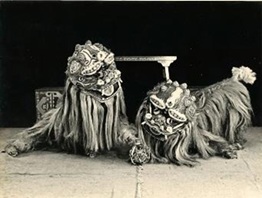
The early Northern lions were heavy and difficult to dance with, 1930s. Courtesy of Singapore Chin Woo (Athletic) Association.
Together with Fang You Chang (1904–72), another Chin Woo martial arts instructor, they remade the lions, using lightweight rattan (instead of mud and sand) for the lions’ heads and layered it with paper. These refinements saw the weight of the lion’s head reduced to just 3 to 3.5 kg, with the cape weighing 2 to 3 kg. This significant improvement allowed the dancers to move with the agility and deftness that the lions are now known for.
A New Look
Once “sport[ing] different colours like pink and yellow”,2 the lion heads are now more appealing, layered with gold paper, with details painted on by hand. The cape, made from Luzon hemp (from the Philippines) is dyed golden yellow. The distinctive colour of the lions was customised by the Chin Woo Association and even has its “very own colour codes” to ensure consistency. Dyed merino wool is also used for the “eyebrows, ears, head details and even nostril hair” of the lions. “DIY is key” to the creation of the lions – “from combing out the abacus cape, to painting and drawing the details, to constructing the sausage-like backbone, even the spring on the tail”, the lions are painstakingly “handmade by the association” and cannot be purchased commercially.3
The lions had a fiercer look in the 1960s, but by the 1970s, their look had softened. Their heads were now also adorned with “‘pom-pom balls’…adopted from the traditional design in China” – green ones representing female lions and red ones male.4 These pom-pom balls are thought to be a nod to Hai Lung (海龍), Empress Tzu Hsi's (慈禧太后, b.1835–d.1908) most treasured Pekingese (dog). Hai Lung always wore two fluffy silk pom-poms – one red and one green – behind his ears. Northern lions bear a striking resemblance to Pekingese dogs, which are known as Fulins (福临) or Foo (Fu) dogs, and are named after Fulin, a town in Changsha County, northeast Hunan Province in China, where they are from.5
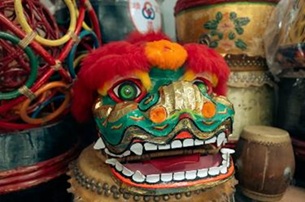
Today, the lions’ heads are made of rattan and layered with gold paper, 2024. Courtesy of Edmund Lau.
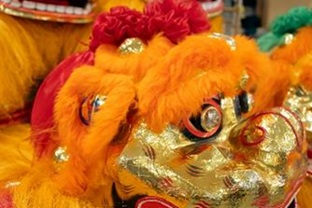
Close-up of a lion’s head. A characteristic of Northern lions are multiple bumps on its head, 2024. Courtesy of Edmund Lau.
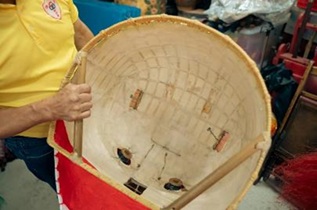
Interior of the lion’s head, 2024. Courtesy of Edmund Lau.
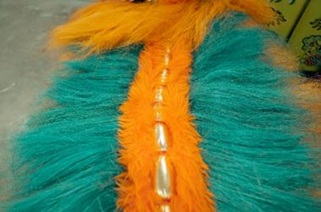
Sausage-like backbone of the Chin Woo lions, 2024. Courtesy of Edmund Lau.
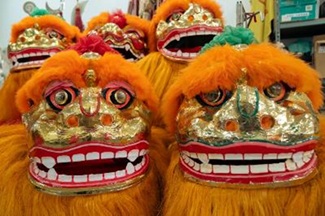
Lions with red and green pom-poms on their heads are thought to be a nod to Empress Tzu Hsi’s beloved Pekingese dogs, also known as Fulin, 2024. Courtesy of Edmund Lau.
Becoming a Lion
Prior to their very first performance, Golden Lions must be “awakened” in a ceremony called kaiguang yishi (开光仪式). A prayer ritual is carried out and blessed ceremonial brushes are used to dot the lions’ heads, tails, four paws, ears, nose and eyes with red cinnabar (mercury sulphide). Stroke by stroke, the lions are anointed and come to life, roused by accompanying percussions. The lions then pay their respects to the local deities and give thanks.
Training to be a Golden Lion dancer is not for the faint of heart. It starts with basic martial arts training which can take at least two to three years. The dancer must master essential moves such as tan tui (弹腿), or “springing legs”, and ma bu (馬步), or “horse stance”. These stances “strengthen the core” and build up the fitness of the dancers. The dancers must have strong backs to pull off the strenuous routines – for instance, the dancer holding the lion head must “stand on the thighs of his partner who is acting as the back and tail of the lion”. Interestingly, as boys in Singapore are now taller than in the past this now “poses a challenge for the Golden Lion dance moves”.6 The head of the lion is usually taken on by a shorter dancer. For a taller dancer to be the head of the lion means that they “must maintain a rather low stance, squatting even, which adds pressure to the thighs”.7
Besides the physical demands of the routines, “the challenge also lies in the costume of the Golden Lions”. The tail end of the costume is like a jumpsuit that the dancer at the back wears for the duration of the dance. Each lion has two dancers – the one in front controls the head and front legs, while the one at the back manages the hind legs and acts as the lion’s spine. The capes of Southern lions are loose, meaning that dancers can be switched out if needed. However, Northern lion costumes are connected via the top cape of the lion’s body, so dancers cannot be replaced mid-performance. Hence, the heat and humidity inside the costume can be quite unbearable.8
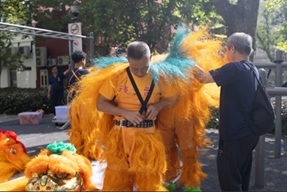
The dancer in the front attaching the cape – the cape is connected to the dancer at the back, 2024. Courtesy of Jue Ming Low.
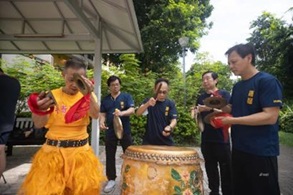
Each lion dance performance is accompanied by gongs, drums and, on special occasions, the suona. Courtesy of Jue Ming Low.
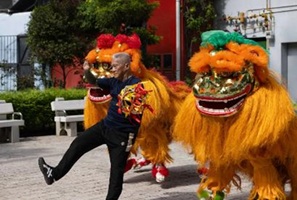
The warrior with a xiu qiu adds an exciting element to the lion dance. Courtesy of Jue Ming Low.
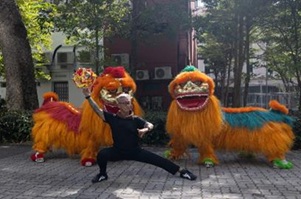
The interaction between the lions, warrior and xiu qiu is dynamic and engaging. Courtesy of Jue Ming Low.
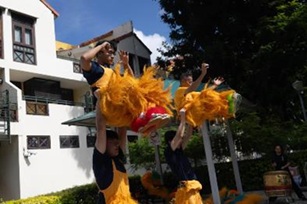
Strong cores and backs are essential for the dancers to carry out their moves. Courtesy of Jue Ming Low.
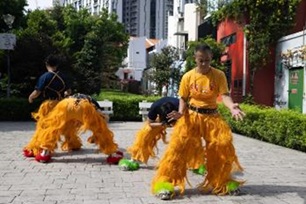
Lion dancers practising their moves. Courtesy of Jue Ming Low.
Future of the Golden Lion Dance
Today the Golden Lion Dance troupe has about 20 to 25 members. Maintaining a troupe of such status and size comes with its own set of challenges. The lion dance taught in schools as a co-curricular activity is often the Southern dance and “it’s tough to get young members to come onboard”.9 The Chin Woo Golden Lions are “doing [their] best to garner the awareness of the younger generation”.10
The Golden Lions have performed at various public events such as Singapore’s first National Day Parade at the Padang in 1966, Esplanade’s Huayi Festival 2023, Chinatown heritage festivals, Qixi Festival 2024 and the Singapore Chinese Cultural Centre’s 2025 Lunar New Year Family Fun Day. These showcases are a good way to introduce young children to lion dance, the Golden Lions, and the Singapore Chin Woo (Athletic) Association. The Chin Woo Athletic Association also uses social media to promote the Golden Lion Dance.
Over the years, public attitudes toward lion dance in Singapore have shifted significantly. In the 1960s, both the Northern and Southern styles of lion dance were often viewed with suspicion due to their association with secret societies. Despite this, some youths have found a creative outlet in lion dance.
To breathe new life into the tradition, lion dance troupes began reimagining the art form. They introduced competitions that highlighted the athleticism and martial arts aspects of the dance, aiming to attract younger participants and distance the practice from its troubled reputation. One of the most significant milestones in this transformation was the launch of the Ngee Ann City National Lion Dance Championships on Orchard Road in 1995. This annual event, featuring dramatic performances and breathtaking acrobatics, turned lion dance into a celebrated display of cultural and athletic excellence, restoring its place as a source of pride for Singaporeans. (The Ngee Ann City National Lion Dance Championships, held annually on Orchard Road since 1995, became a major milestone in the reinvention of the art form. The public event, which usually features the southern lion dance, combining dramatic performances and impressive acrobatics, helped to make lion dance a source of athletic and cultural pride).
Lion dance troupes have become communities where individuals from diverse backgrounds come together. The discipline required to master the dance offers structure and focus, particularly for youths with challenging circumstances. These troupes are positive influences, instilling their members with a sense of purpose, camaraderie, belonging and an opportunity to develop new skills and self-discipline. Today, lion dance is a thriving cultural tradition in Singapore, celebrated both as a time-honoured practice and a dynamic, contemporary art form.
The author would like to thank Jack Tan, Secretary-General of the Singapore Chin Woo (Athletic) Association, for his time and help with this article.
To learn more about the Singapore Chin Woo (Athletic) Association, read this article by Senior Librarian Seow Peck Ngiam.
See some historical photos of the Golden Lions in this article.
About the Author
Angela Sim is a researcher of Asian heritage and culture. She uses her platform as a media content creator to explore areas such as folk religion, Peranakan culture, and sunset industries including Chinese woodblock printing, effigy restoration, and lantern making. Angela is a Singapore native and promotes the nation as a cultural destination. She has a Bachelor of Arts majoring in Japanese Art History and currently resides in Brisbane, Australia. Her work can be found on YouTube under the handle Hakka Moi.
Endnotes
1. “Northern Lion.” Singapore Chin Woo (Athletic) Association, published 2021, https://sgchinwoo.com/northern-lions/.
2. Jack Tan, interview with Angela Sim, August 2024.
3. Tan, interview.
4. Tan, interview.
5. Derling Princess and Thomas E Millard, Two Years in the Forbidden City. (1924, London: Fisher). (From National Library Singapore, call no. 951.035 DER)
6. Interview with Jack Tan.
7. Tan, interview.
8. Tan, interview.
9. Tan, interview.
10. Tan, interview.