Article
Salvation for the Forgotten: The Kiew Lee Tong Temple’s Ritual for the Souls of the Dead
6 October 2026
Topics
Culture
History
The Kiew Lee Tong Temple conducts a special ritual for the dead once every decade.
By Angela Sim
The arrival of the seventh lunar month in Singapore is unmistakable. There will be a pervasive smell of smoke and grass patches in public housing estates will bear scorch marks as people burn paper effigies and “hell notes” as offerings to dead ancestors. Also known as the Hungry Ghost Month, this is the period when Chinese Taoists and Buddhists believe that the souls of the dead return to the land of the living.
For most adherents, all this burning is an annual ritual. However, one temple in Bishan does it differently. At the Kiew Lee Tong Temple (九鲤洞; Jiu li dong, meaning “nine carp cave”), a particular ritual is conducted every 10 years to remember both deceased ancestors as well as forgotten souls during the seventh month. The ceremony appears to trace its origins in Singapore to the massacre of civilians during the Japanese Occupation of Singapore.
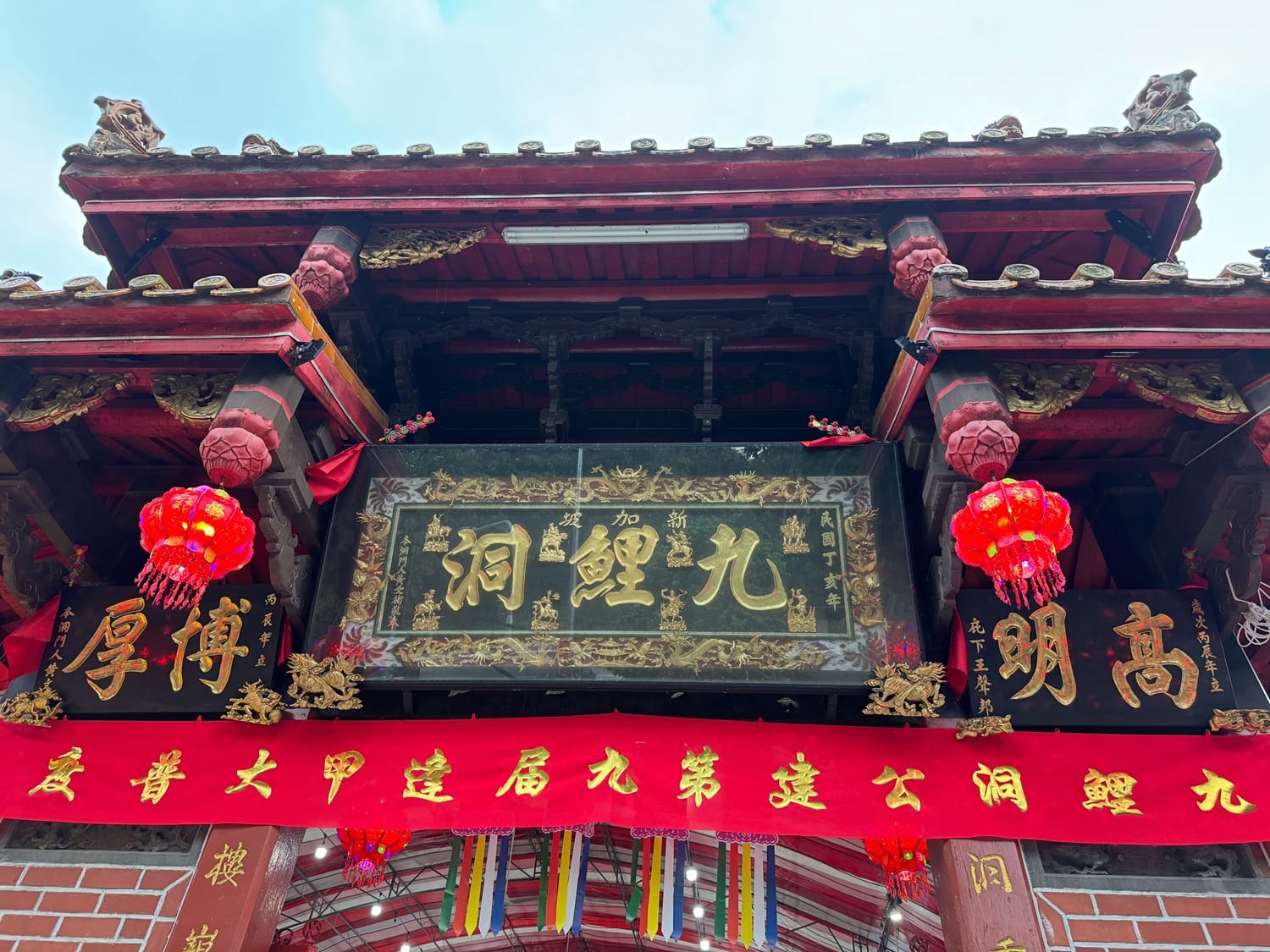
The Kiew Lee Tong Temple at 5 Jalan Tambur. Courtesy of Angela Sim.
First Ceremony
Held over three days, the Decennial Universal Soul Salvation (逢甲大普度; Feng jia da pudu) ritual was last conducted at the temple in August 2024 (decennial means every 10 years). The ritual is practised by the Henghwa community (originally from Putian, Fujian province), and the first recorded ceremony was conducted by the temple in 1944 in response to the atrocities of the Sook Ching massacre.1 (After Singapore fell to the Japanese on 15 February 1942, Chinese males between the ages of 18 and 50 were ordered to report at mass screening centres, and those suspected of being anti-Japanese were executed.)
The ritual served to appease the restless spirits of the unjustly slain and bring them peace. Today, it has evolved into a comprehensive spiritual undertaking that continues to reflect the Henghwa community’s values of remembrance and redemption. All the rites in this ritual are rooted in the community’s care for the suffering of the unseen and their empathy towards wandering souls and neglected spirits, in keeping with the ritual’s overarching aim of spiritual salvation.
Summoning the Invisible
Preparations begin weeks in advance through fuji (扶乩), or planchette spirit writing, invoking the spirit of the Immortal Chen Zhangzhe (持教善德陈长者; Chijiao Shande Chen Zhangzhe), a Henghwa banxian banfo (半仙半佛), a Henghwa religious concept describing a spiritually exalted being who embodies qualities associated with both Daoist immortals and Buddhist enlightenment. They are part of the Qiongyao Fajiao de Si Da Zhenxiin (琼瑶法教的四大真仙), or patron deities of this temple, to assume the role of a spiritual overseer for the ritual proceedings.2
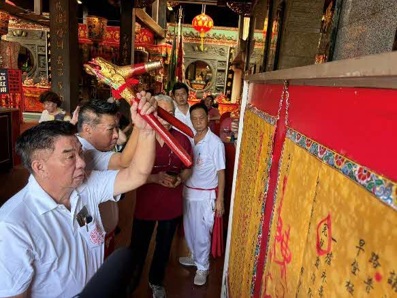
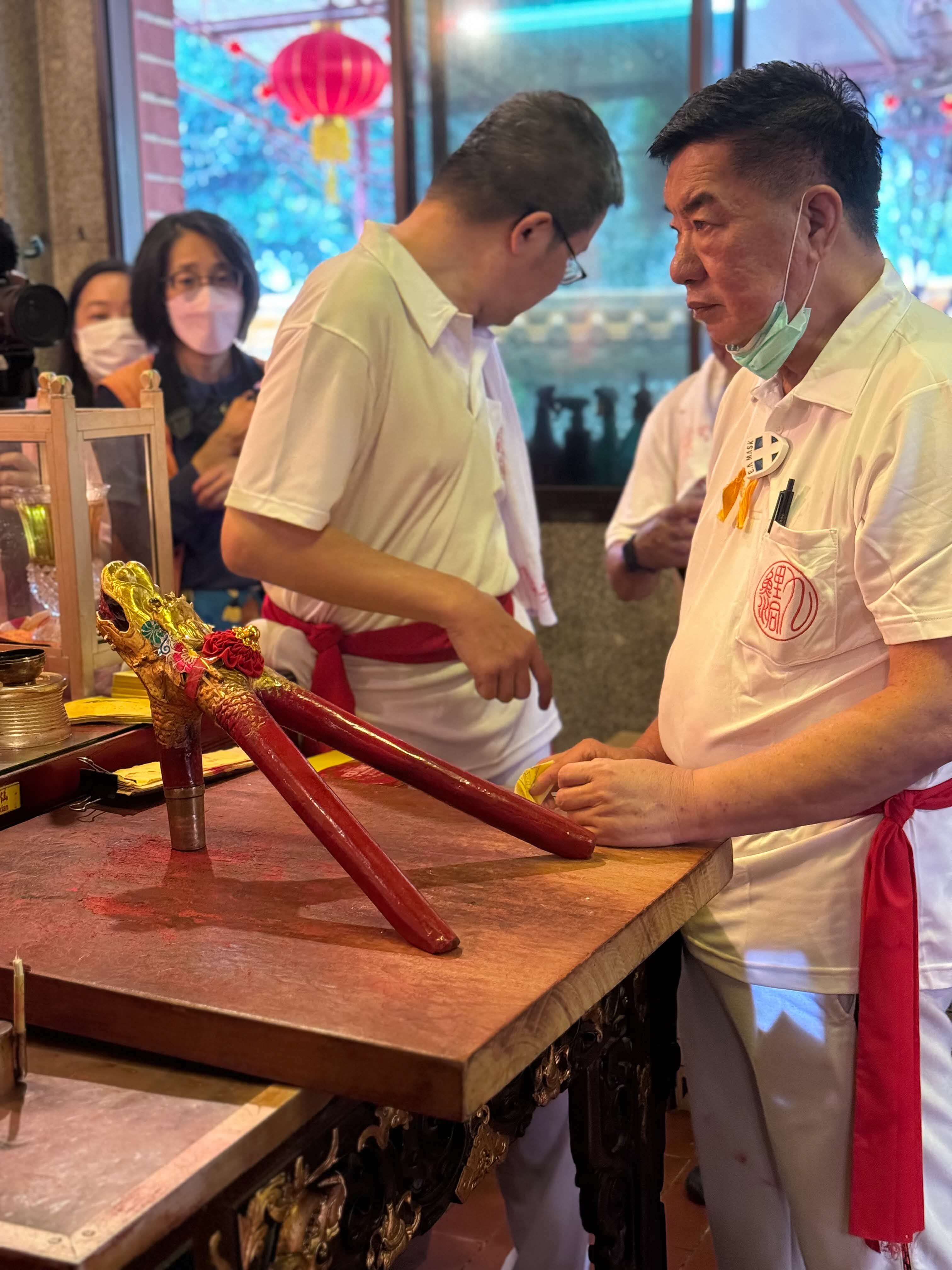
Spirit writing is seen in Chinese religious and divinatory practices, particularly within Taoist folk religion and temple-based ritual traditions. It involves the use of a stylus – typically a Y-shaped or T-shaped wooden or metal implement – held by two individuals known as jishou (扶手) who act as mediums. The stylus is suspended over a surface coated with fine sand, ashes, or occasionally paper, and it is guided to inscribe Chinese characters through the coordinated movements of the individuals.
The message is believed to come from deities (shen; 神), immortals (xian; 仙), or ancestral spirits, whose presence is ritually invoked prior to the session. The resulting characters – often cryptic or stylised – are interpreted by temple scribes and sometimes compiled into jishu (乩書; spirit texts), the poems and books produced during a spirit-writing session.3
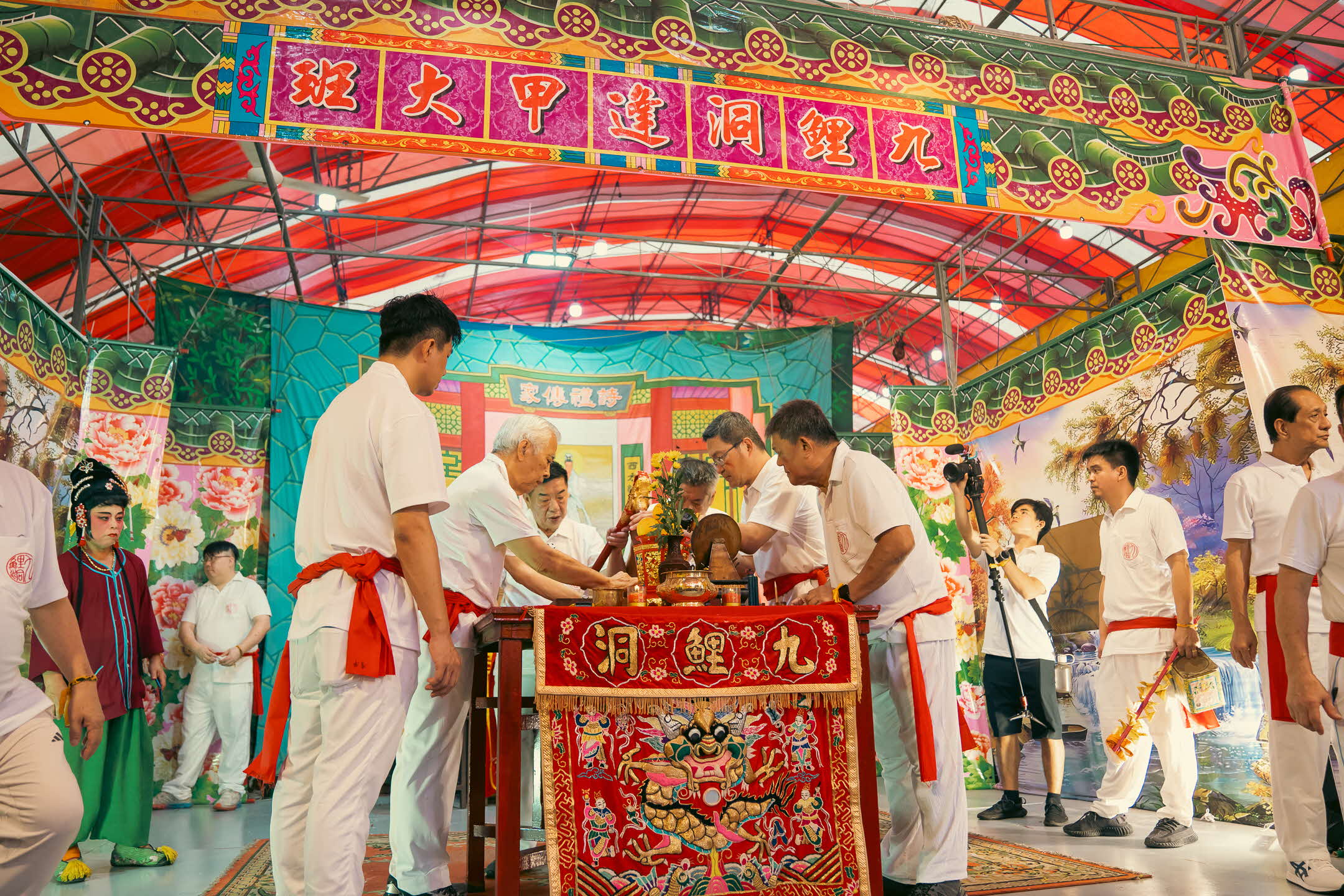
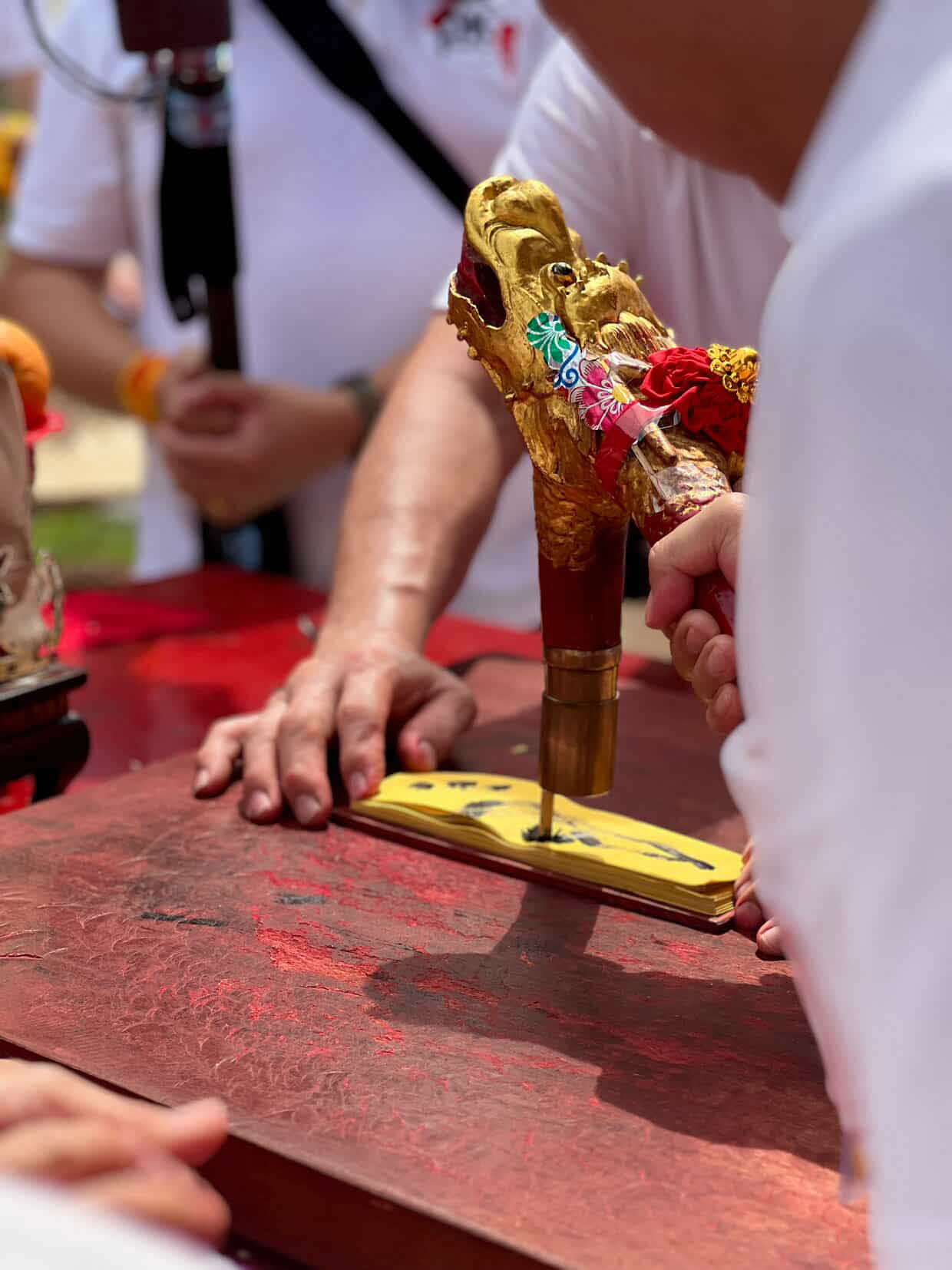
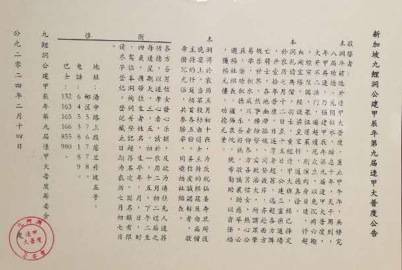
Under Immortal Chen Zhangzhe’s guidance, the li fan (立幡; ritual banner), measuring about 1.2 x 1 m in length, is raised with reverence. He also sanctifies the sacred implements and talismans with ink and consecrated cinnabar to prepare the ritual space in anticipation of the spirits’ arrival.4
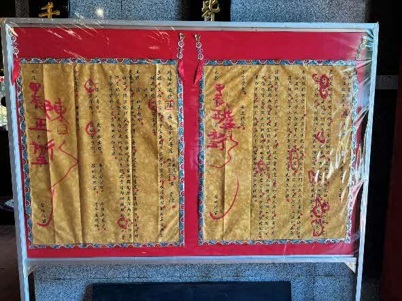
Banner with dates for the ritual, 2024. Courtesy of Kiew Lee Tong Temple.
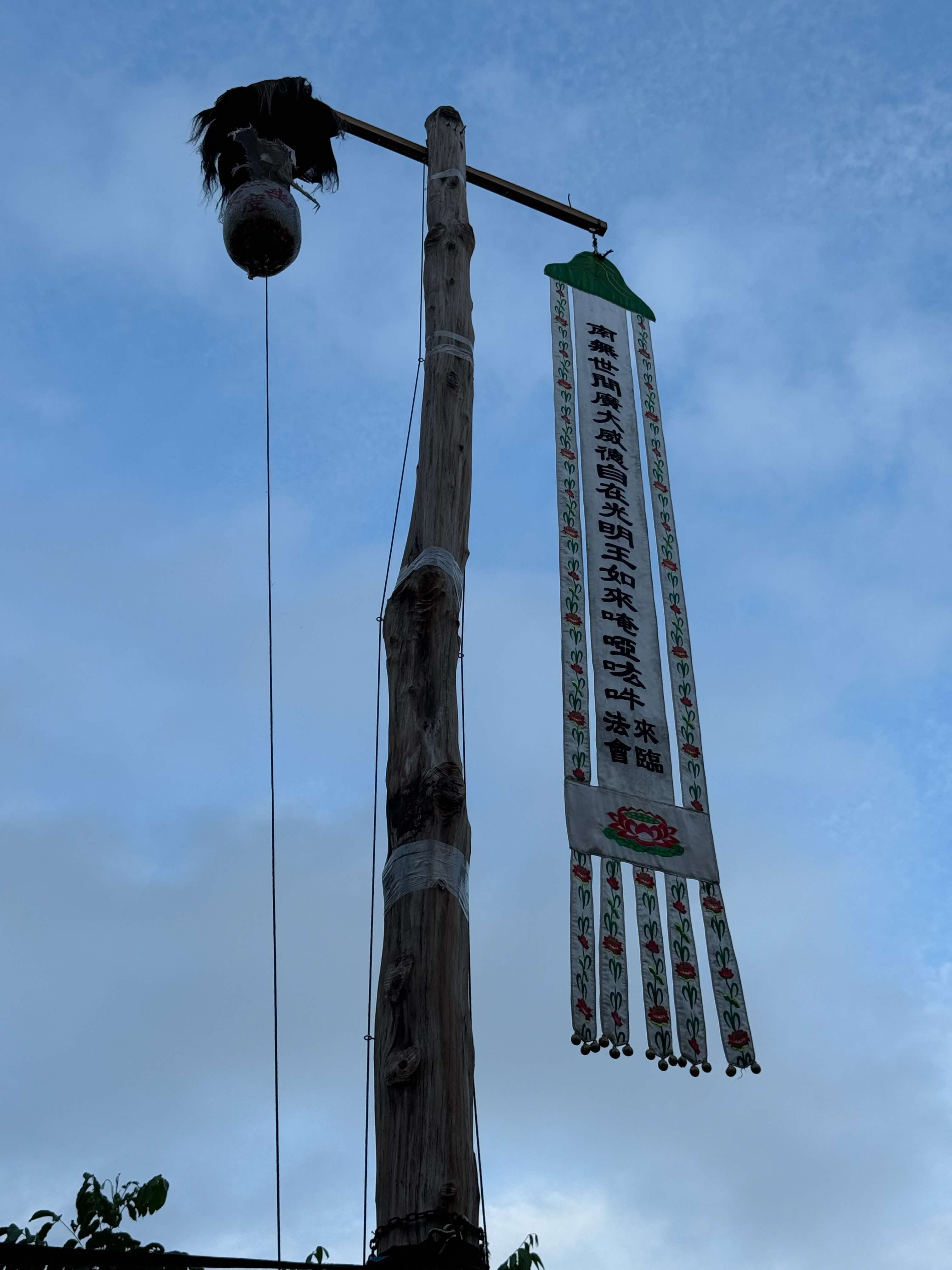
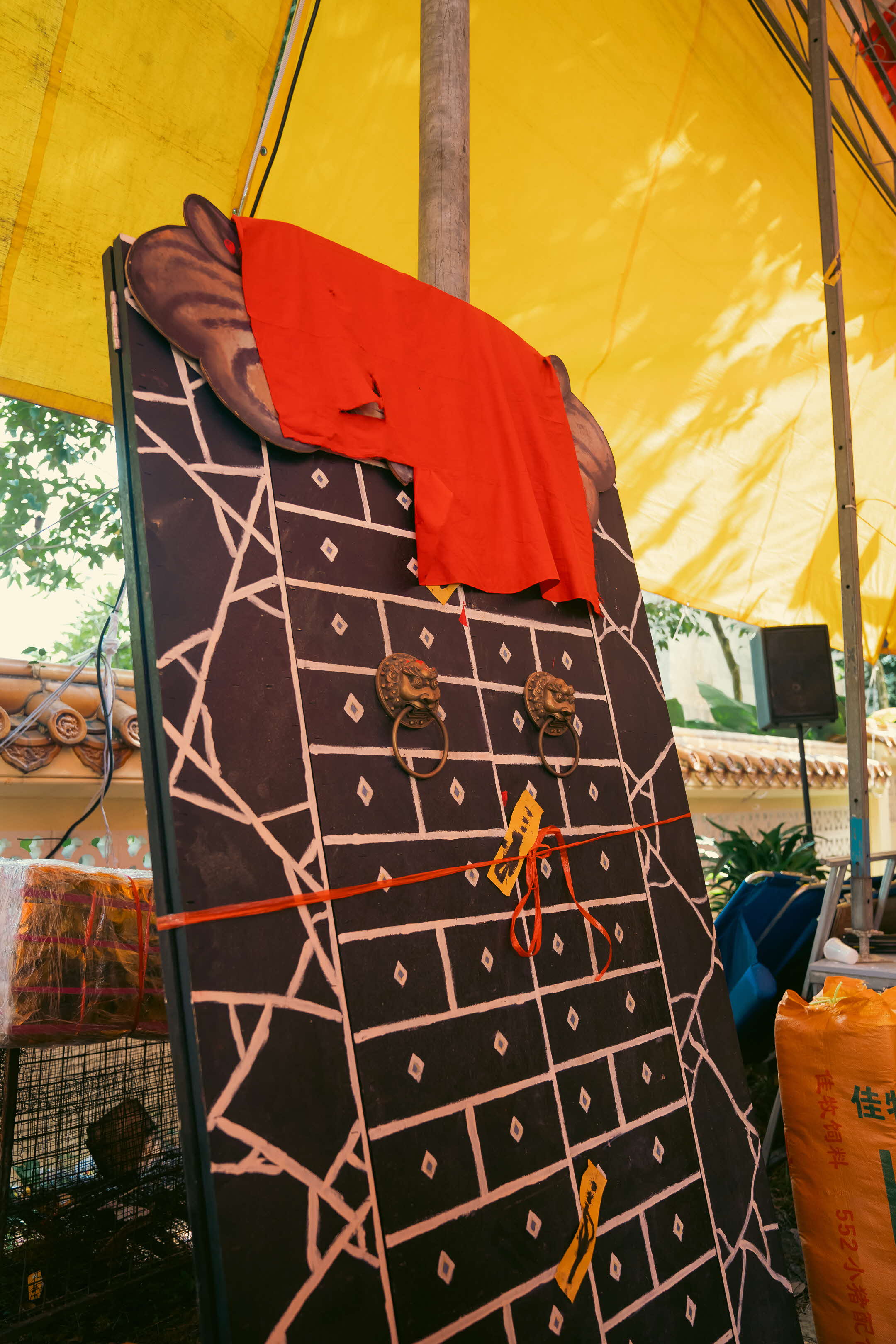
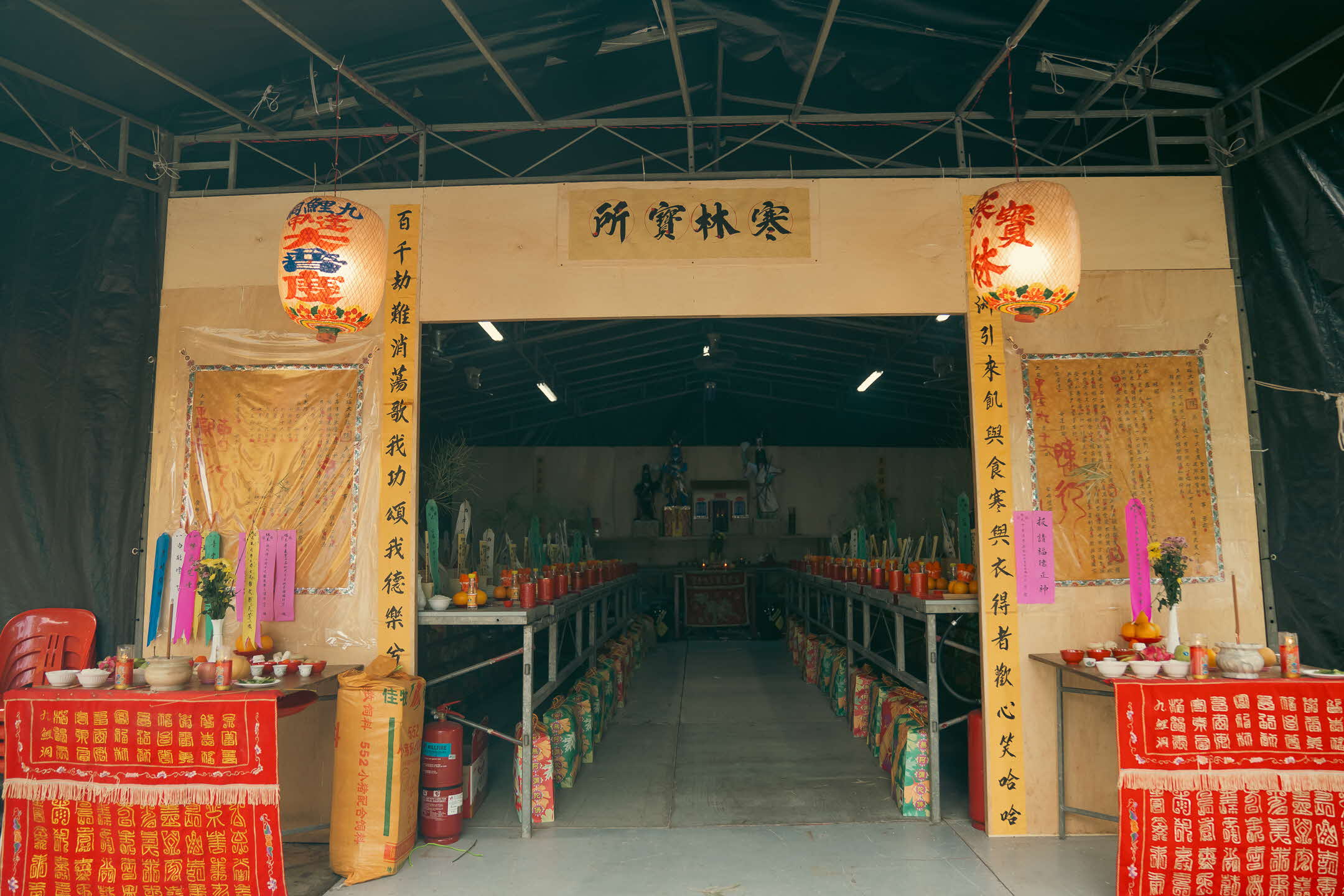
A 36-foot-tall flagstaff (11 m) is erected outside the temple, and adorned with a lantern, streamer and symbolic paper crane. The hoisting of the flagstaff marks the most critical stage of the ritual. Its precise 36-foot measurement is symbolically significant, with designated proportions extending both above and below ground. This vertical span is believed to connect multiple layers of heaven above and penetrate the earth below, thereby informing the three realms – Heaven, Earth and the Underworld – of the impending salvation ritual. The flagstaff also serves as a spiritual beacon, defining the ritual’s effective radius and summoning all wandering souls within its reach.5
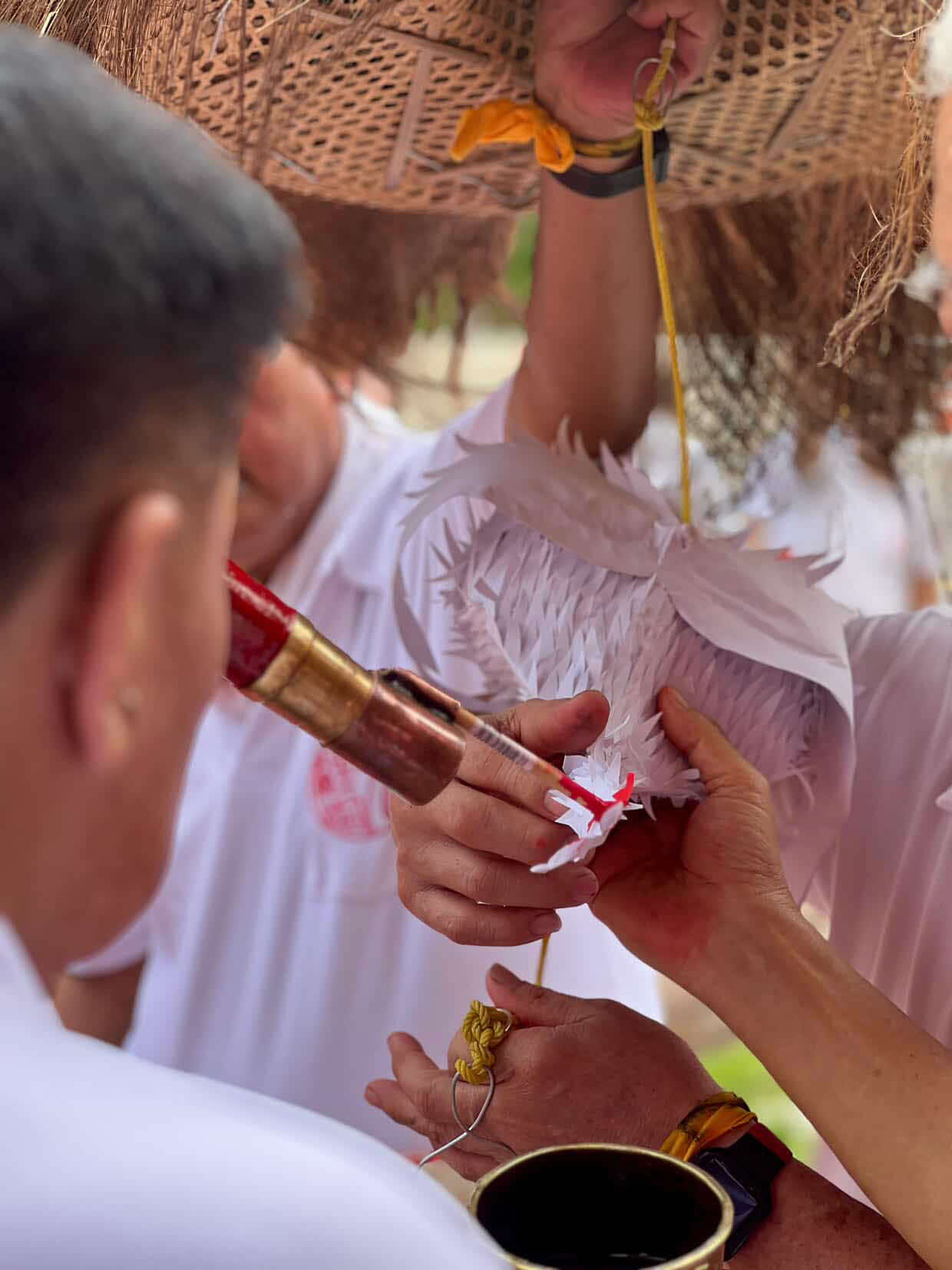
Paths lined with lanterns called guiludeng (鬼路灯; literally “ghost streetlight”) – each shaded by traditional bamboo yuli (雨笠; rain hats) – symbolically light the way for spirits of the six realms of existence – gods (天), humans (人), asuras (阿修罗) or demigods, animals (畜生), hungry ghosts (饿鬼) and hell beings (地狱) – serving as a conduit between heaven and earth.
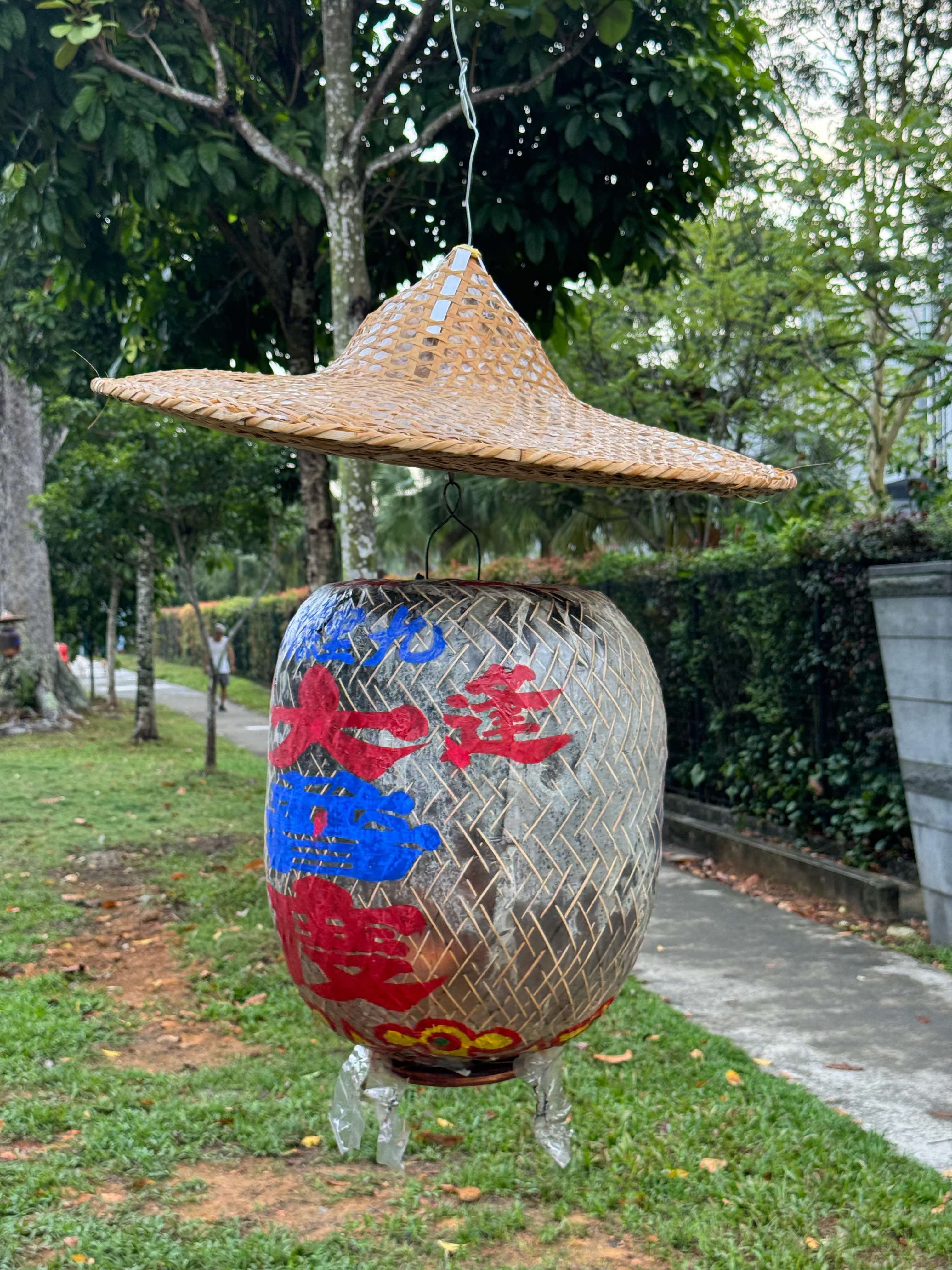
A guiludeng (鬼路灯shaded by a traditional bamboo rain hat. Courtesy of Angela Sim.
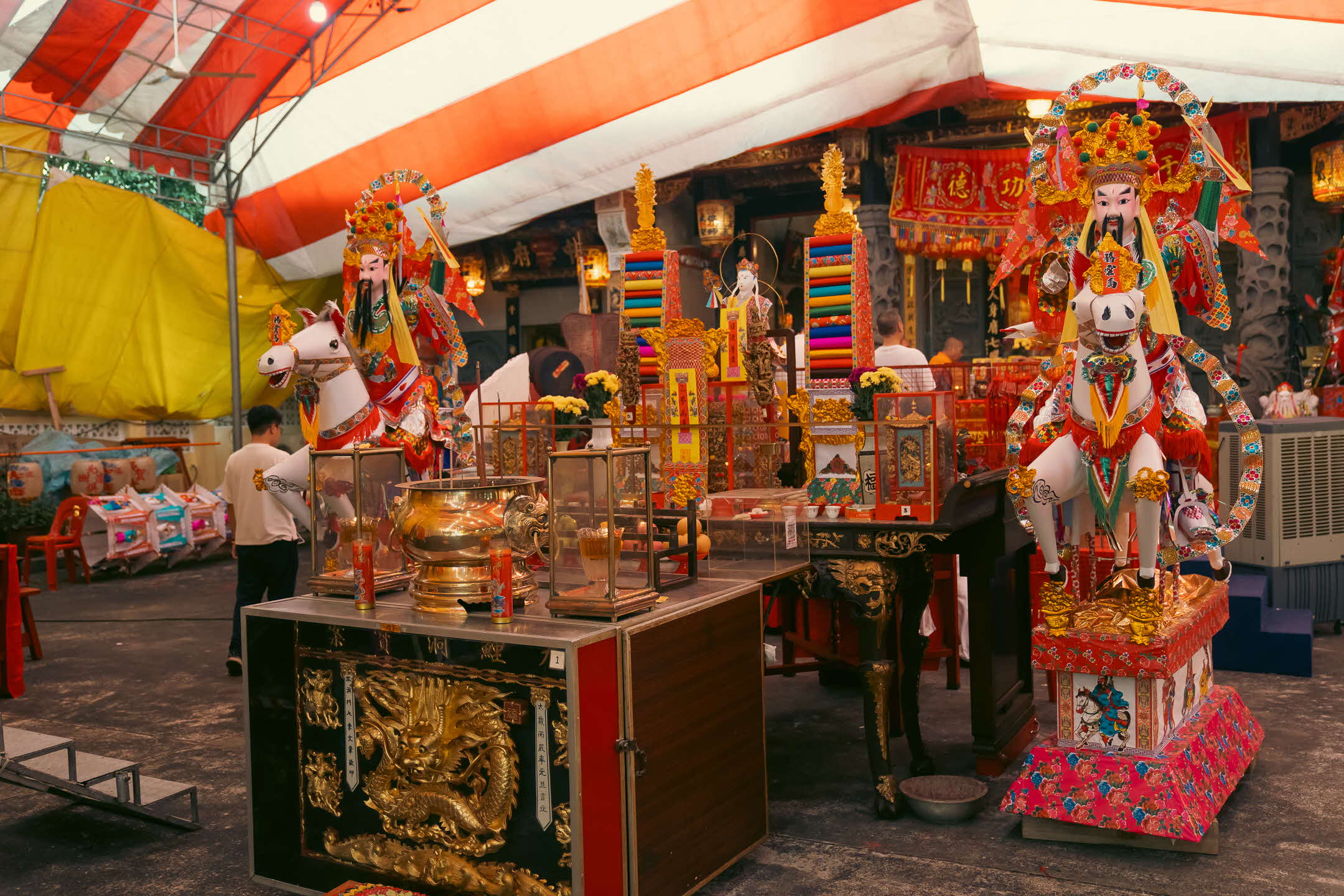
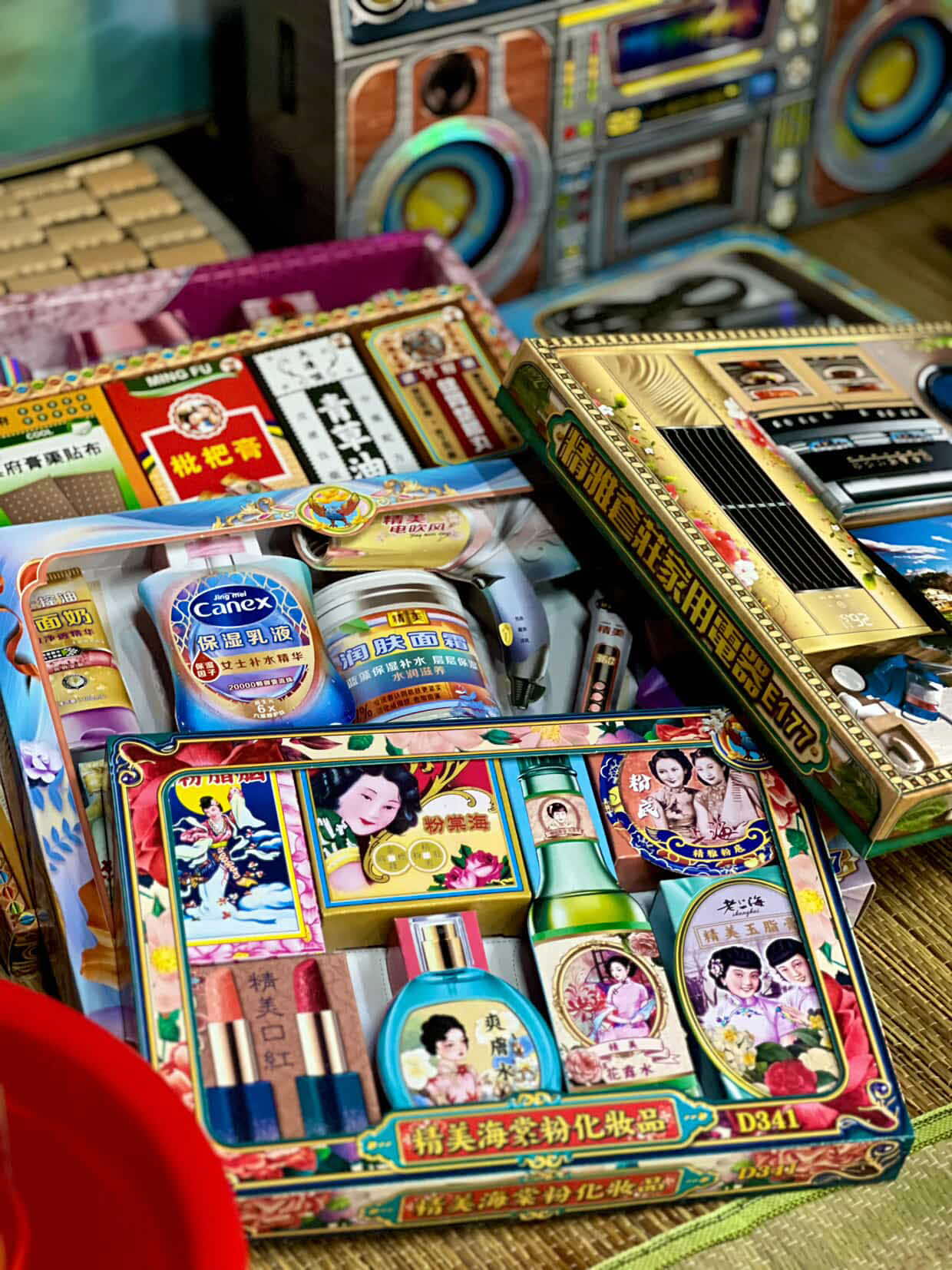
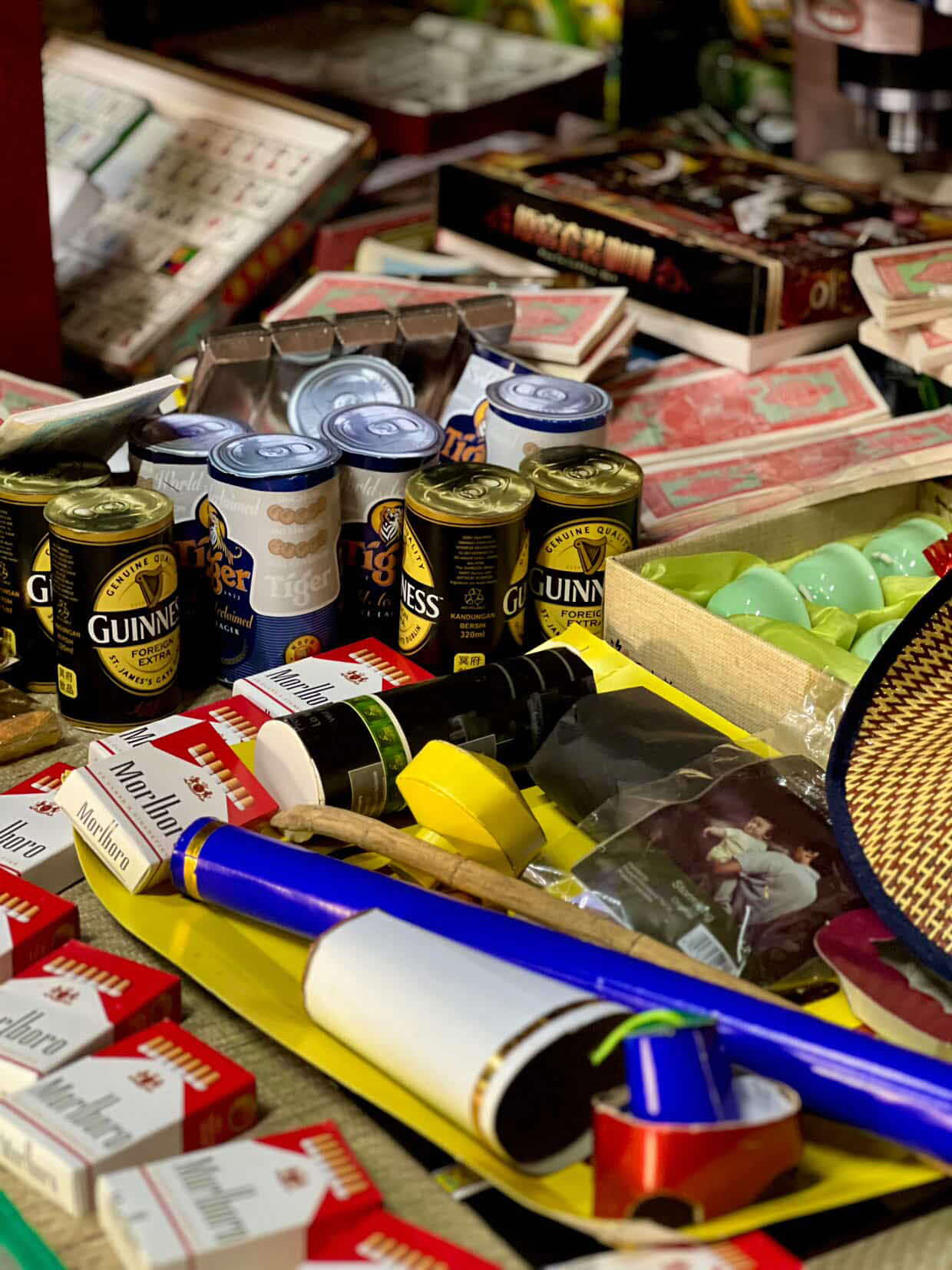
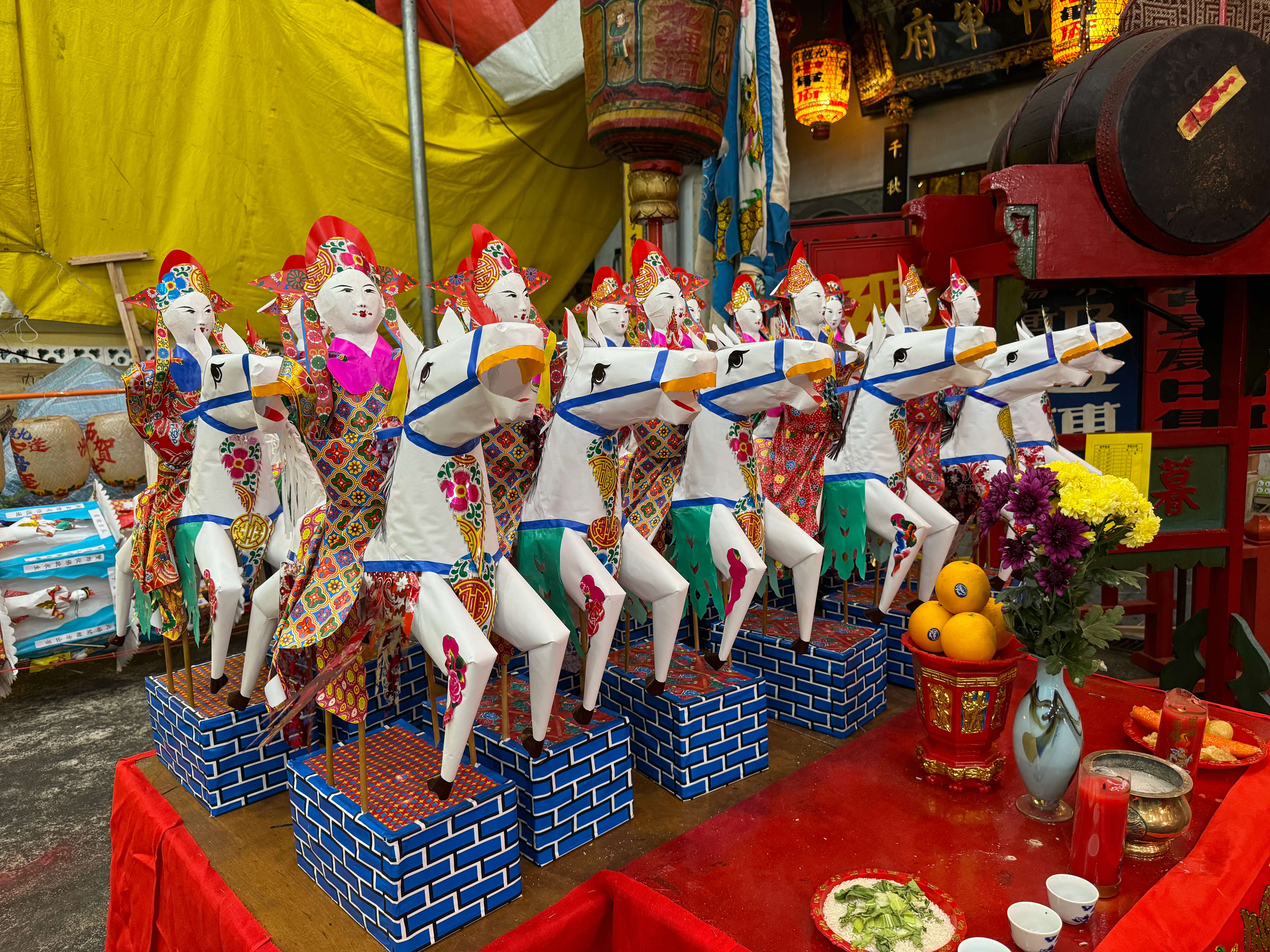
Paper effigies of guards, servants and deities, as well as children’s toys and various offerings transform the temple grounds into a sanctuary for souls with no descendants to honour them.6

Unique Offerings
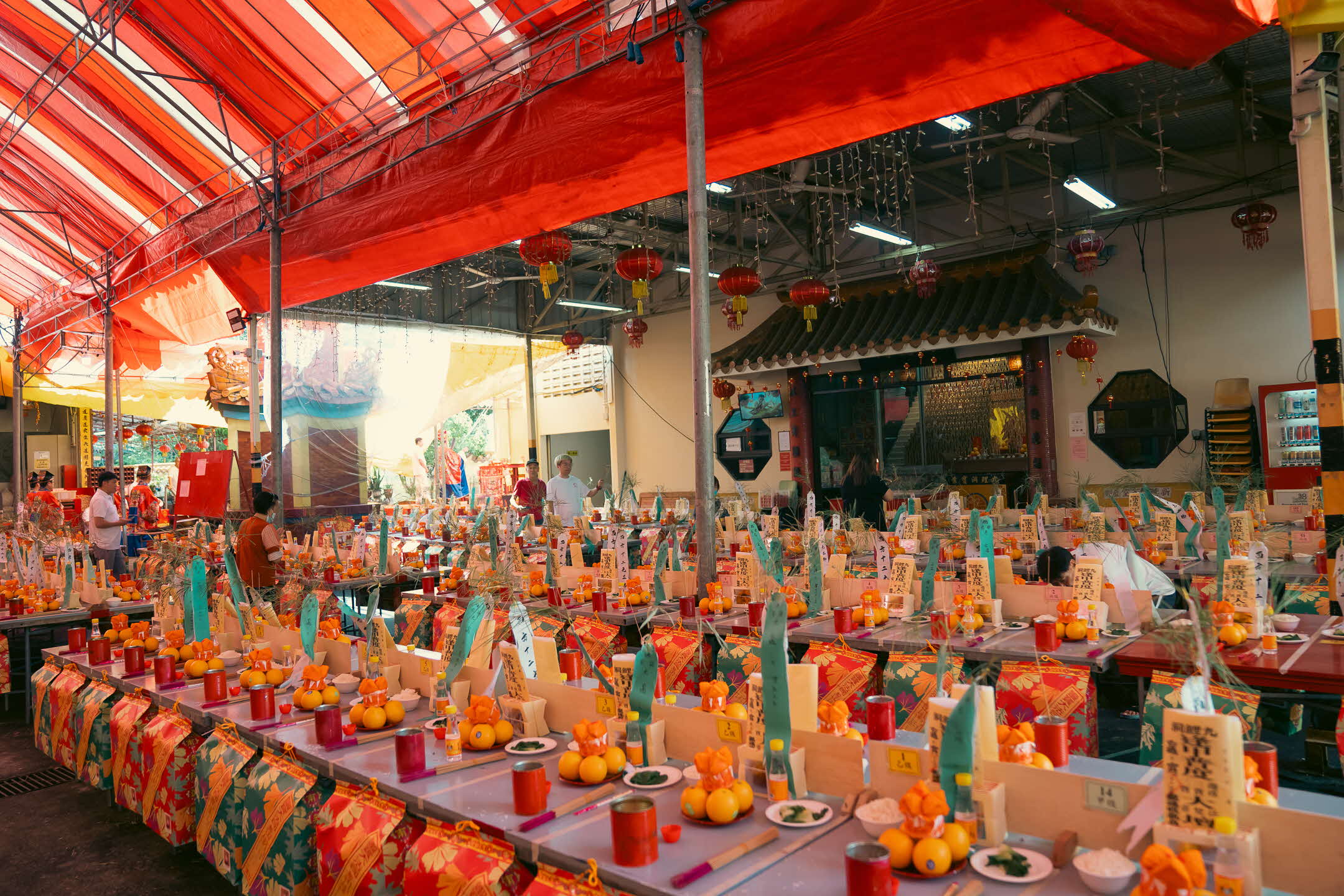
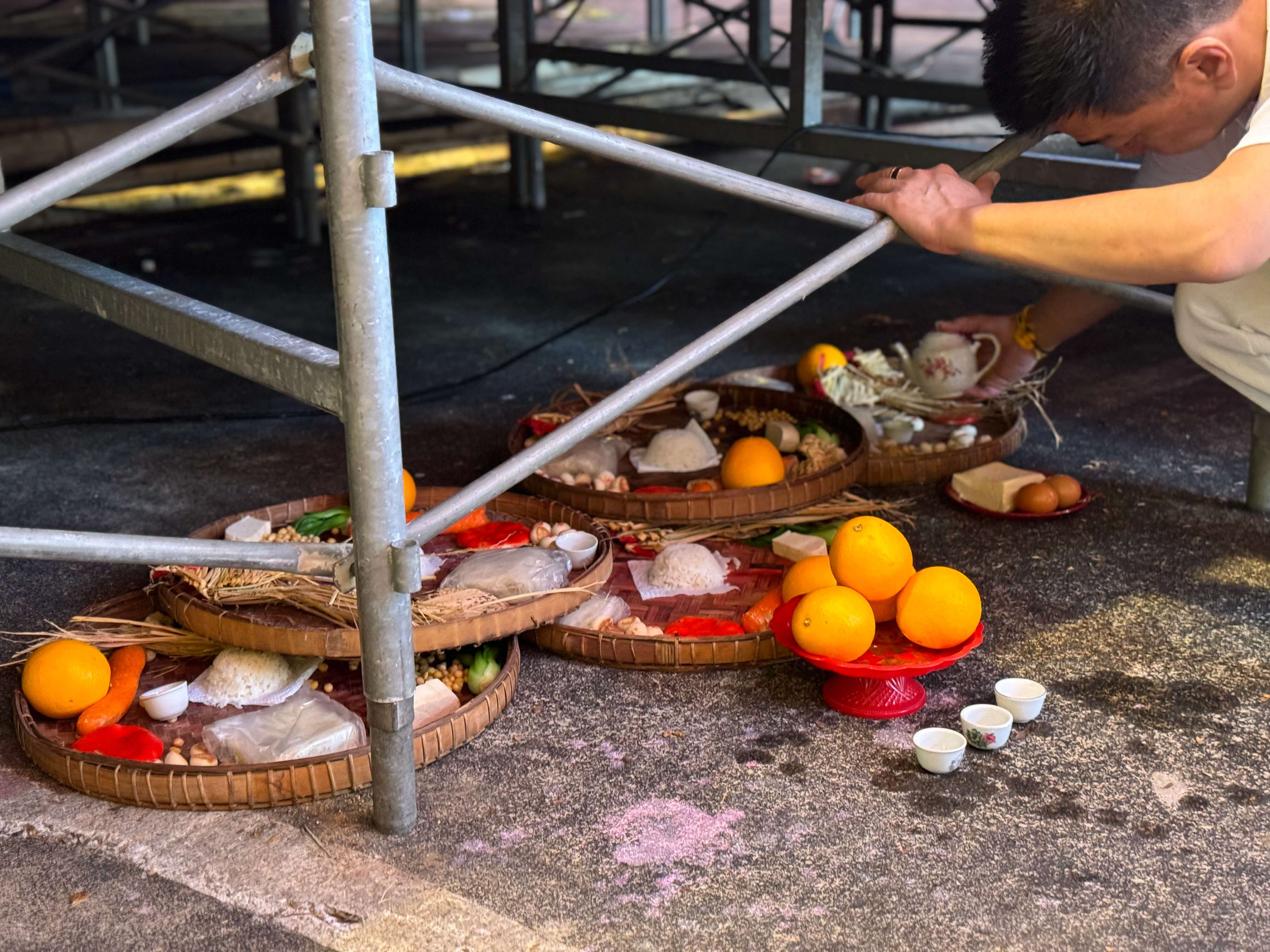
A distinctive feature of the ritual is the unique arrangement of offerings, known as “orphan plate”, or gupan (孤盘). Unlike standard ancestral offerings, which are often arranged in sets for known ancestors, gupan is specially prepared for wandering, unclaimed, or forgotten souls, i.e. those without descendants to make offerings on their behalf.
The items on the gupan are carefully assembled with a sense of dignity and completeness, symbolising care and respect for the deceased as though they are family. Placed in circular trays and scattered throughout the ritual space, gupan offerings serve not only as sustenance but also as an invitation – drawing lonely spirits to the site of the ritual and allowing them to partake in the collective salvation rites.
On each gupan is a handwoven pouch filled with rice and preserved radish (菜脯饭; koli puay), straw sandals (草鞋; cao-a) and a rain hat (斗笠; ho-li) – simple yet symbolically rich items that reflect care for the souls’ journey to the Western Paradise (西方极乐世界; a perfect, joyous realm where practitioners seek rebirth to attain enlightenment).
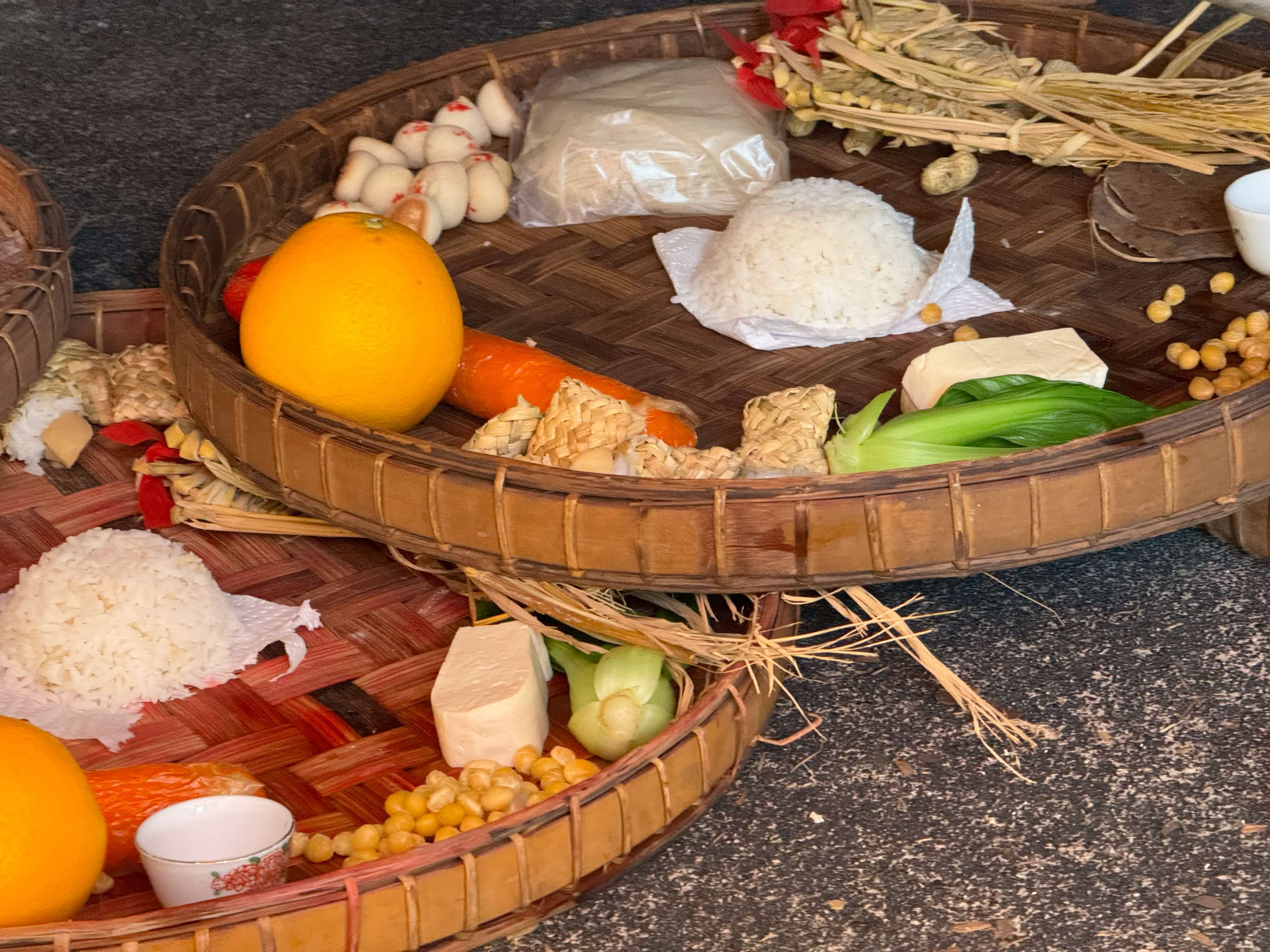
Gupan (孤盘) offerings for neglected spirits. Courtesy of Angela Sim.
Also on each gupan are two unusual but deeply symbolic items. One is a starch paste, made by mixing dried starch powder with cold water into a smooth, glue-like consistency. This is offered as a kind of spiritual salve to help wandering souls “heal” themselves, especially those who may have suffered violent or accidental deaths resulting in broken limbs or bodily trauma. “If they passed in pain, we want to help soothe them,” explained a temple volunteer. “Even if we can’t see them, we imagine what they might need.”
The other item is known in the Henghwa dialect as cha hon, or cha fen in Mandarin (擦粉), a soft, porridge-like preparation made from mee sua (面线), or wheat noodles, cooked until it reaches a thick, starchy consistency. It resembles a kind of viscous soup and is believed to be especially helpful for souls who have difficulty swallowing solid food. “These are not ordinary dishes,” another temple volunteer explained. “They are made for those who are forgotten, or who cannot speak for themselves. We imagine their pain, and we try to feed and comfort them.”7
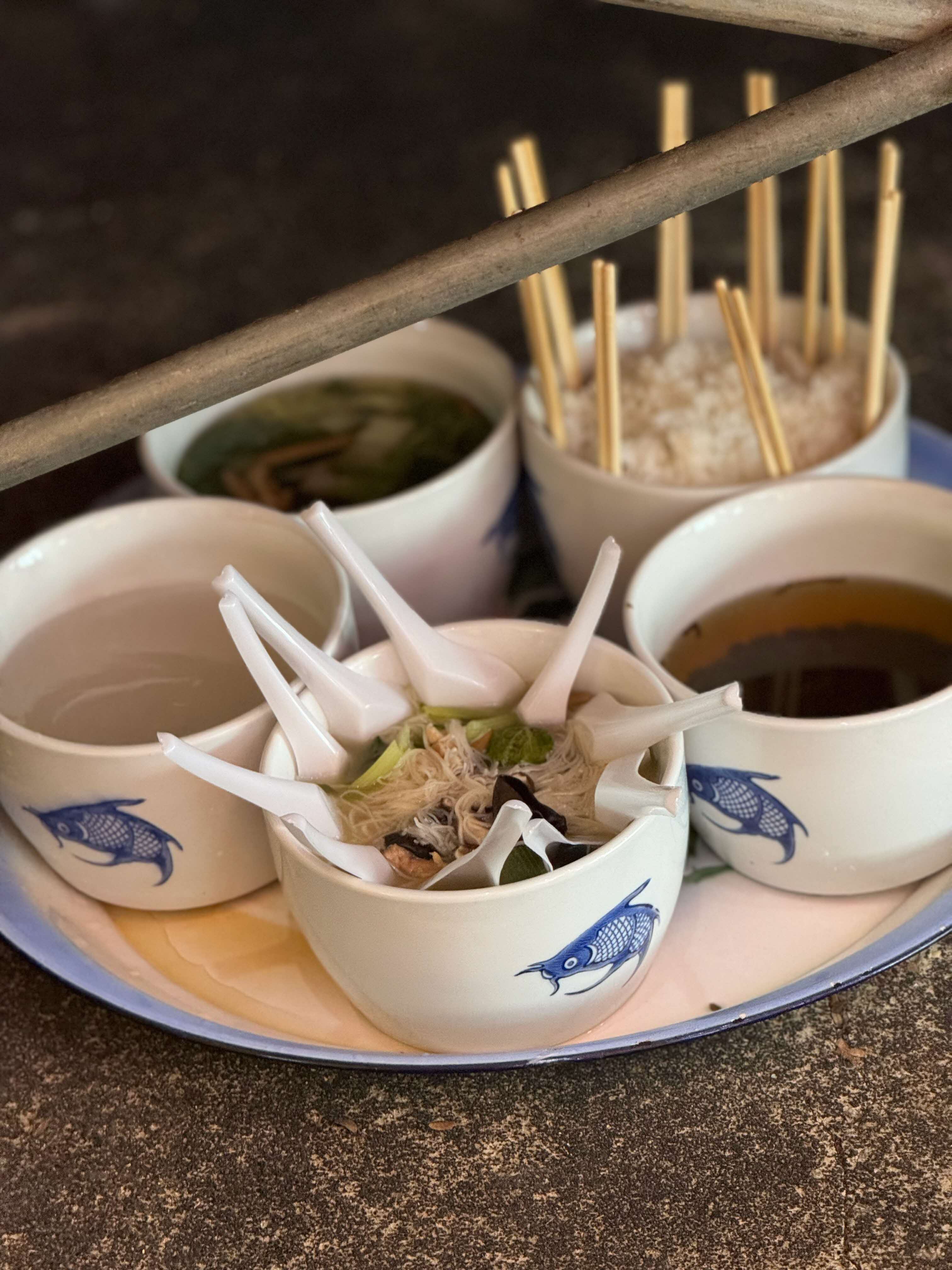
Soup, starch and other soft food for the spirits. Courtesy of Angela Sim.
Theatre as Sacred Ritual
The highlight of the three-day Decennial event is the ritual theatre performance of Mulian Jiu Mu (目连救母), or “Mulian Rescues His Mother”, performed in the Henghwa dialect. This play recounts the tale of Mulian (目连), originally named Fu Luobu (傅罗卜), who rescues his mother from hell after she is condemned for her sins.
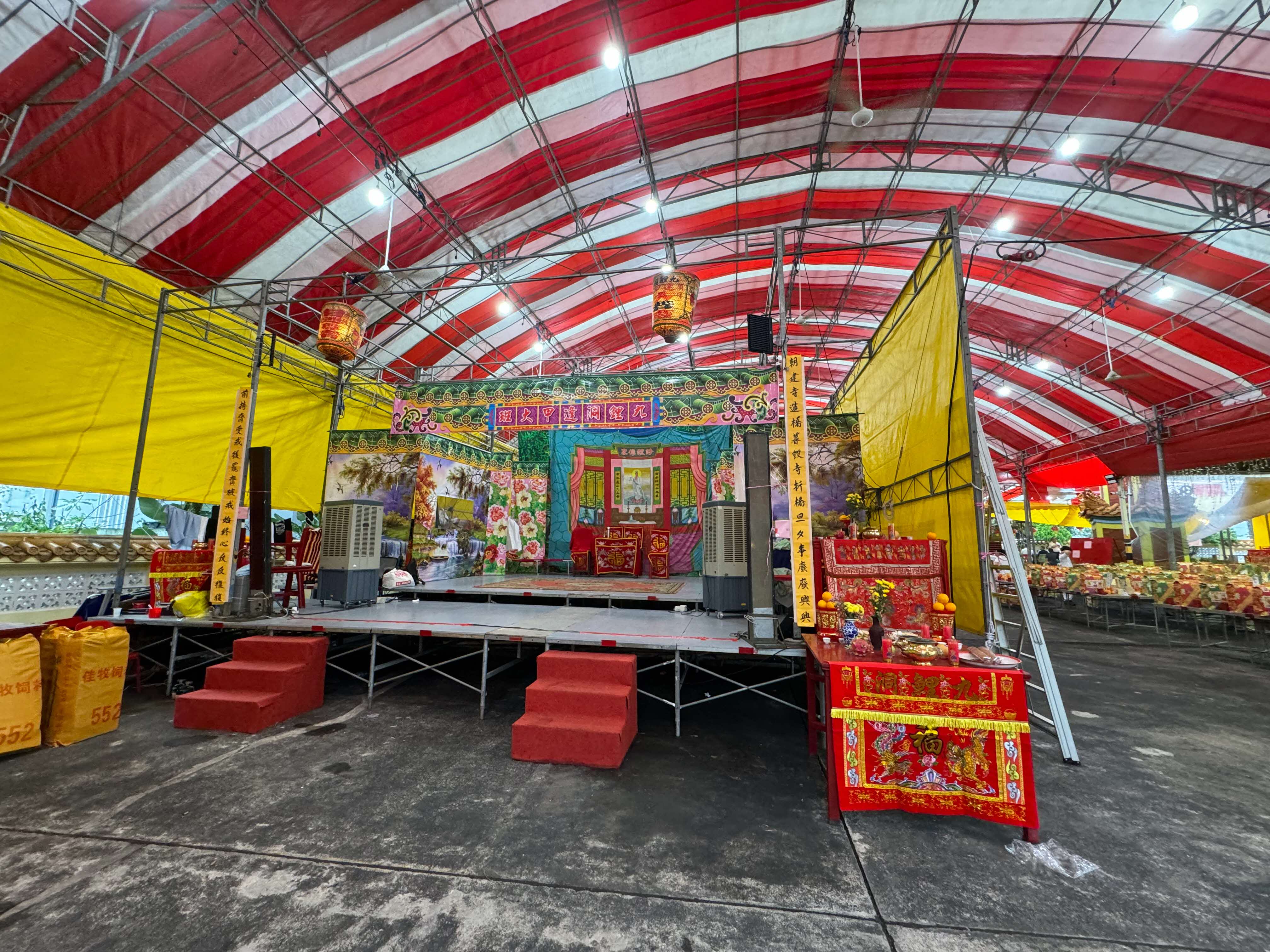
During a period of absence while Mulian was away on business, his mother ordered the destruction of bridges and temples and instructed her servant to offer dog meat buns to monks. Because of her transgressions, she was condemned to an untimely death and cast into the deepest and most torturous level of hell. With the help of sacred tools, such as the xizhang (锡杖), or monk’s staff, granted by Buddha and merit-making acts like charitable offerings, Mulian ultimately secures his mother’s rebirth into the Western Paradise.8
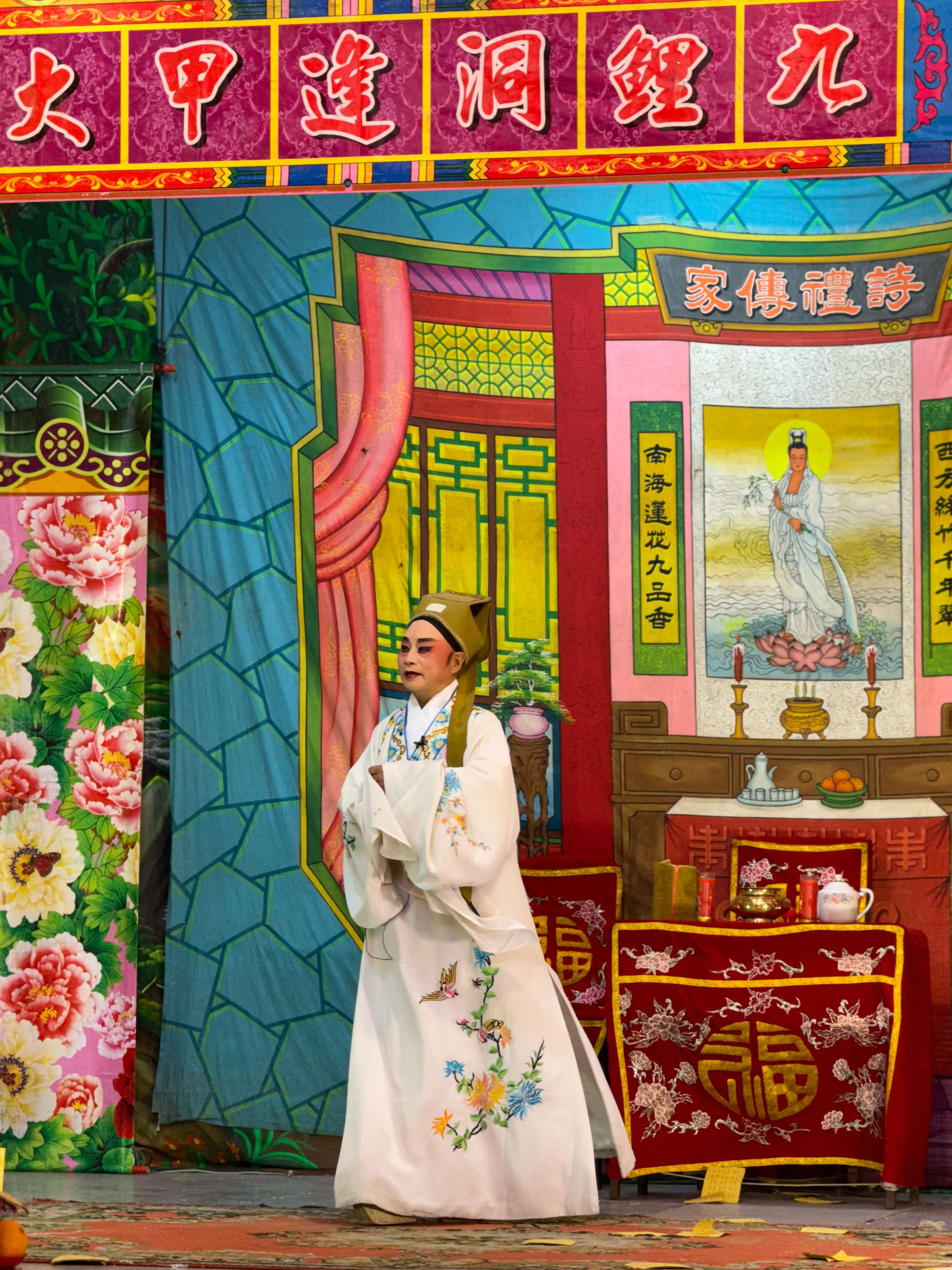
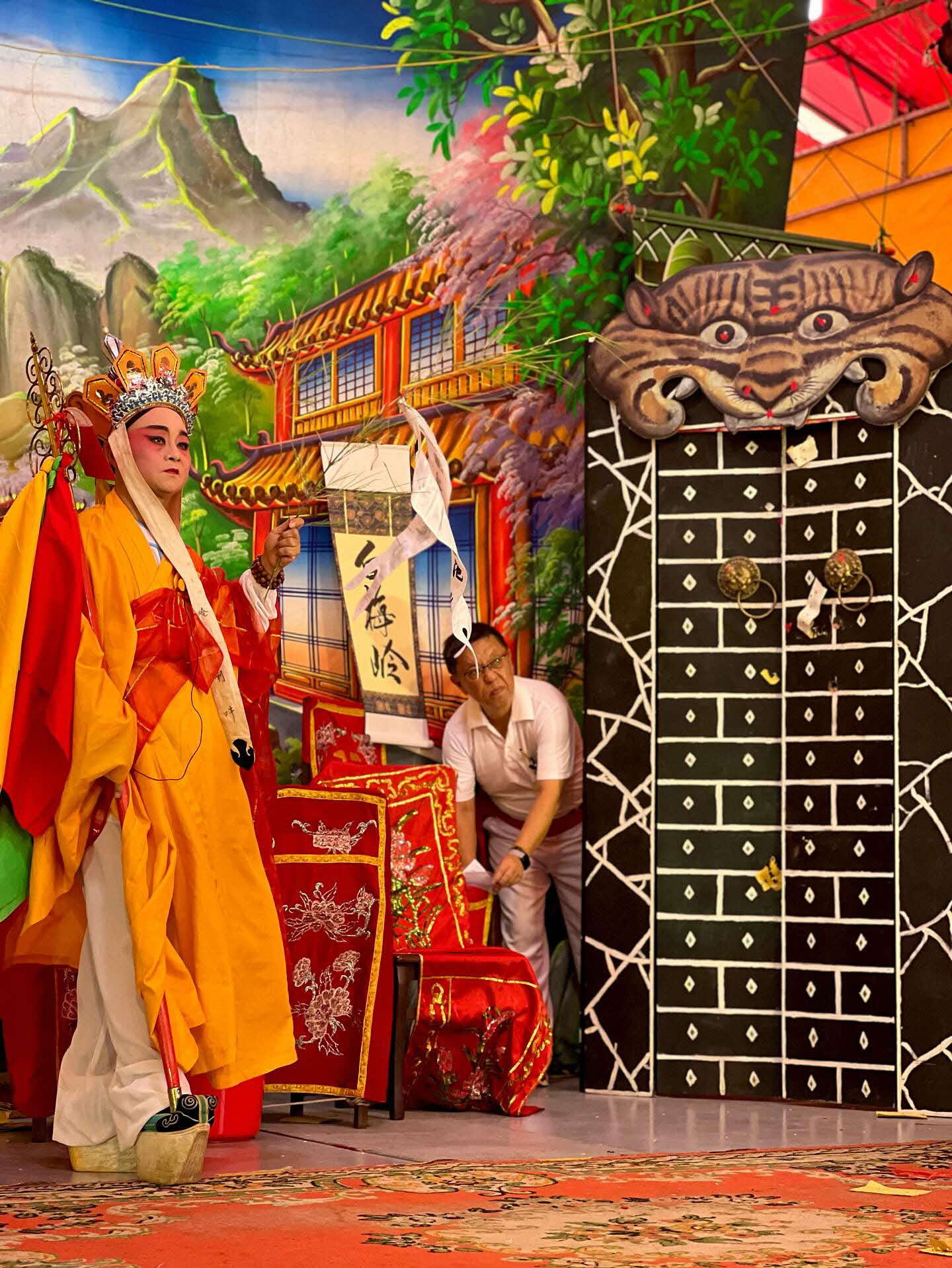
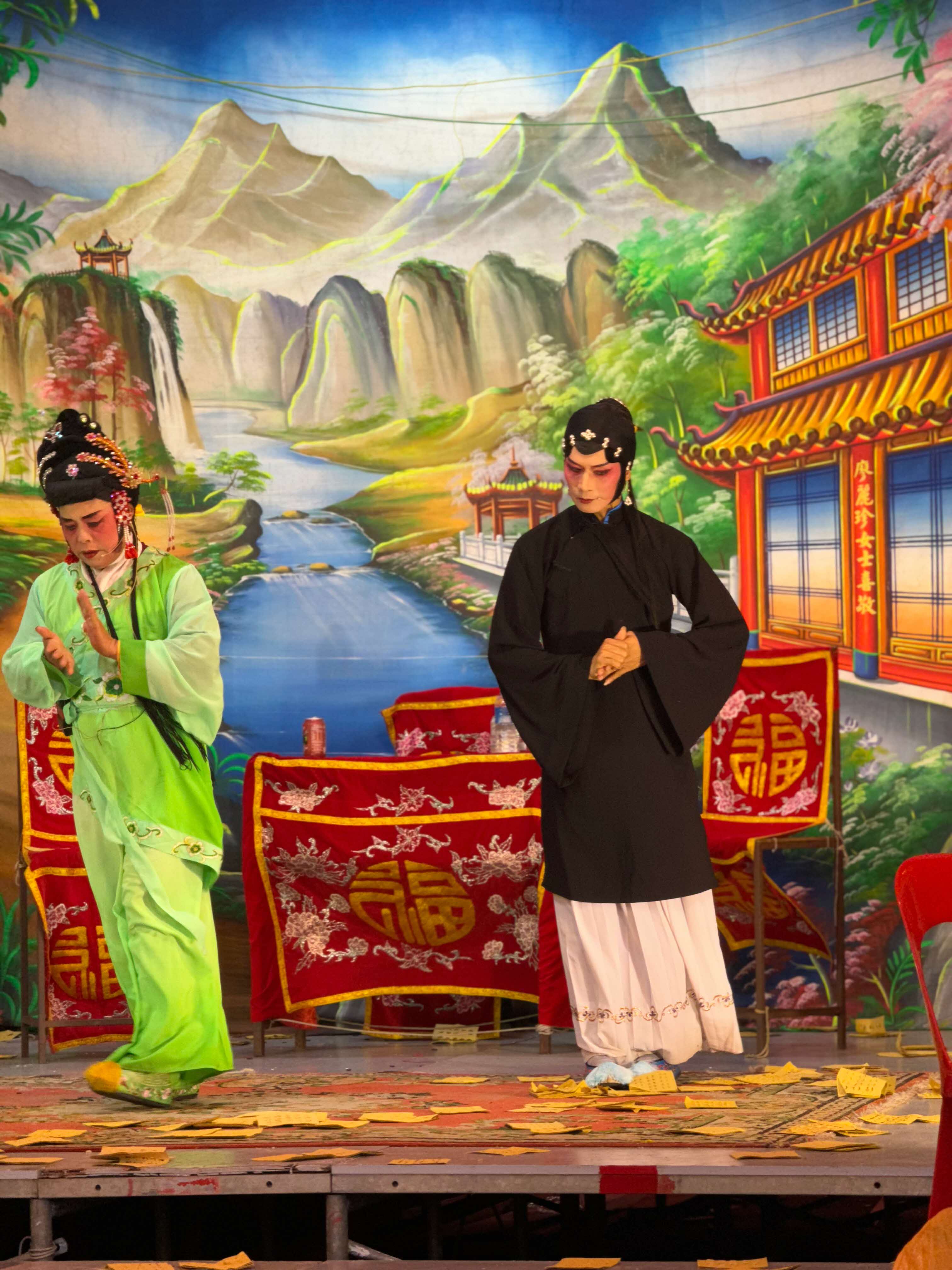
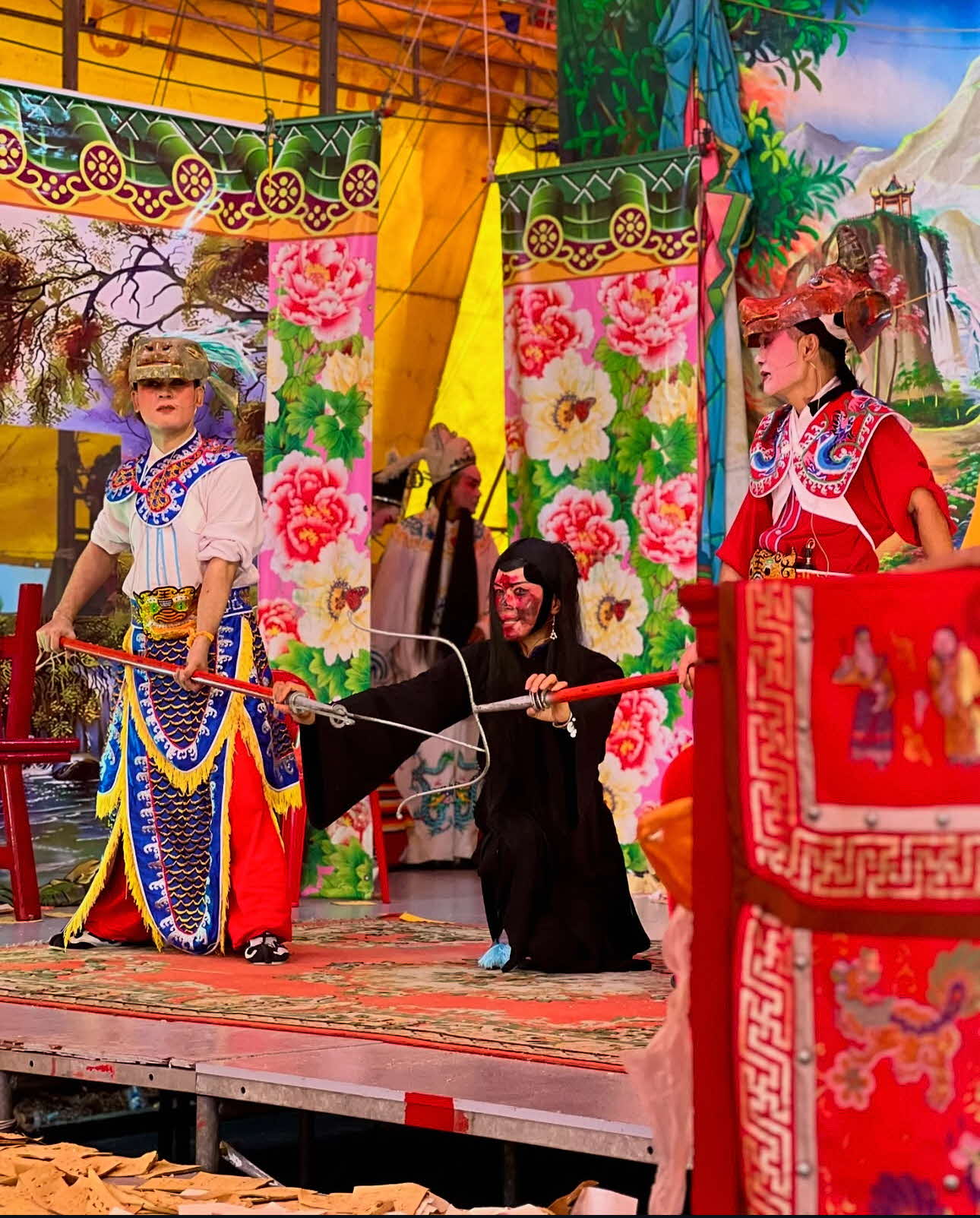
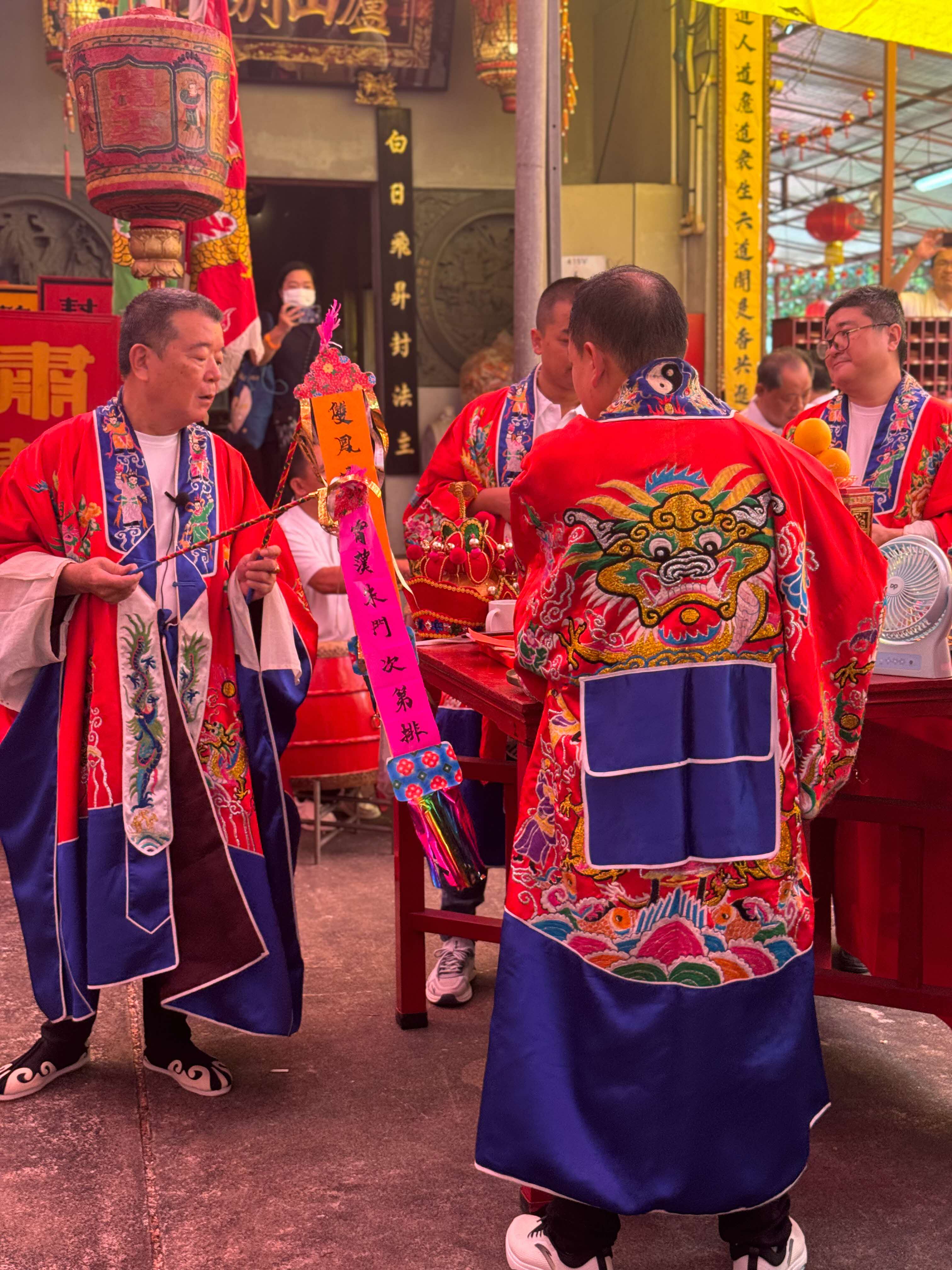
This Mulian performance, unlike conventional opera, functions as a religious ritual. Gestures and props are consecrated, and each actor is ritually prepared. Portraying Mulian on stage is a role of great spiritual significance. The actor must learn and master the mantras integral to the universal salvation rites. The props associated with Mulian are treated with the utmost reverence, undergoing consecration through planchette writing, the application of talismans and chanting led by Buddhist monks.
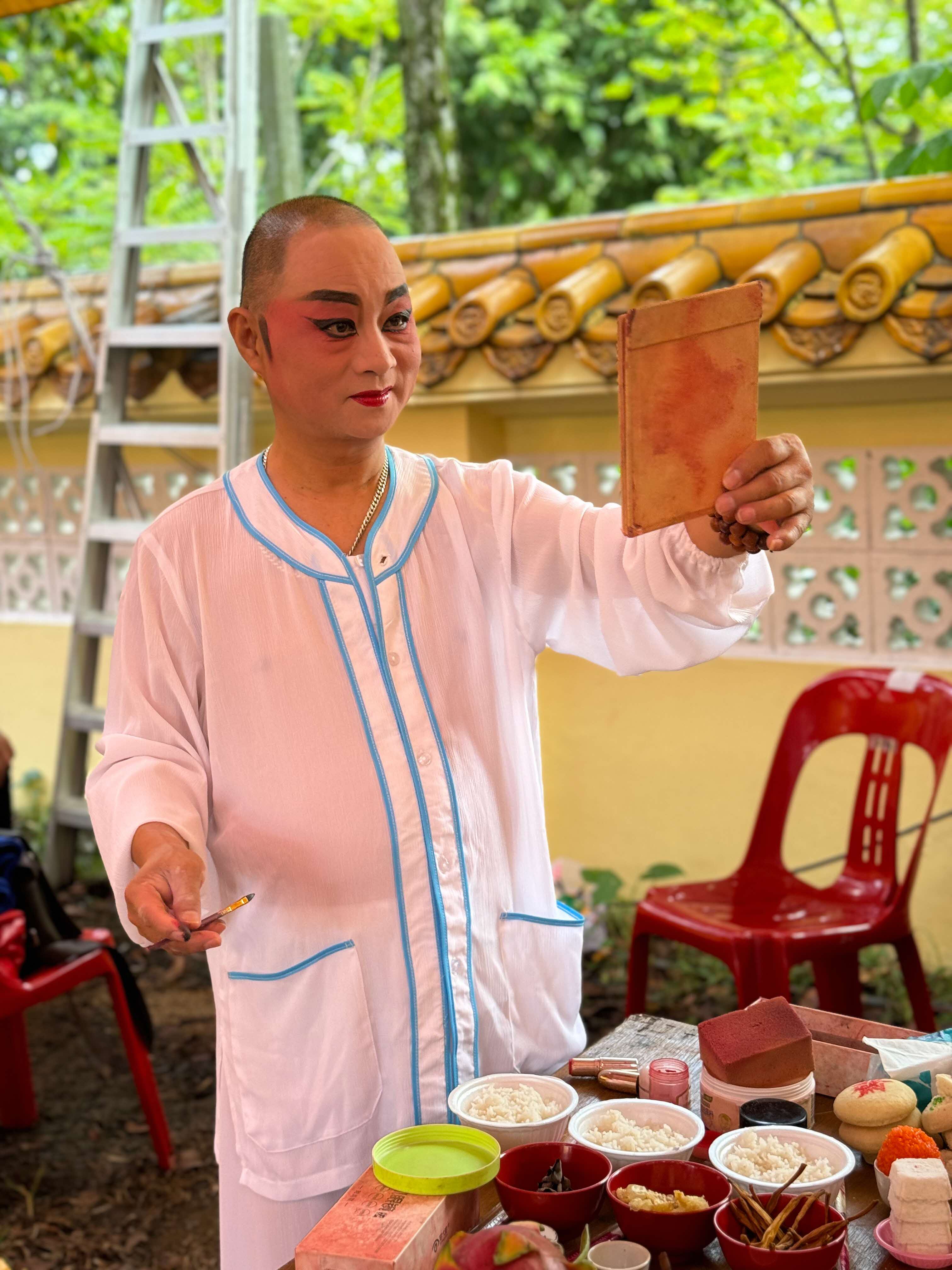
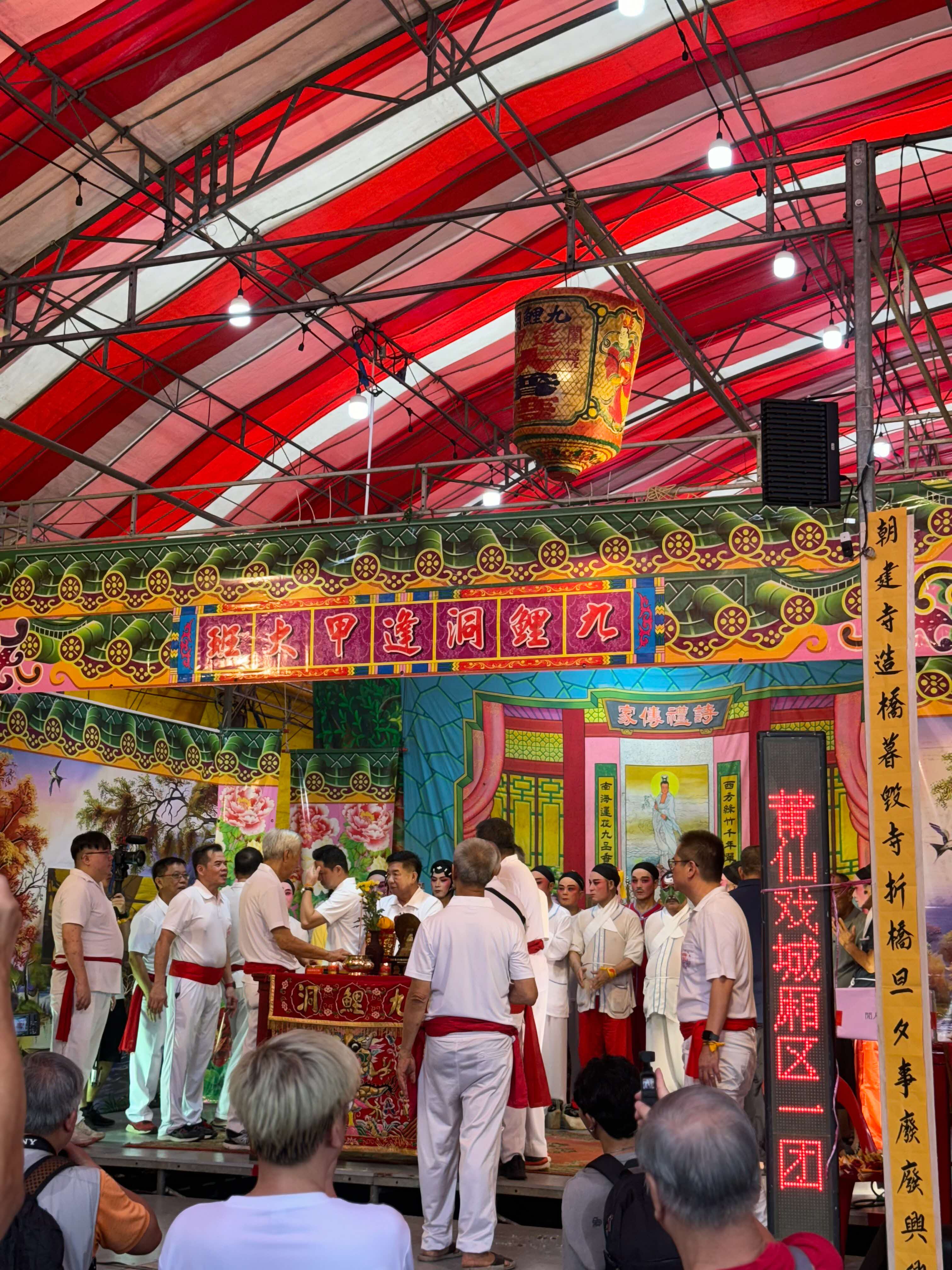
Mulian is depicted wielding a six-ring staff called Jiuxi lianhuan zhang (九锡連環杖), with the six rings symbolising the beings across the six realms of existence. Crucially, the staff is considered a sacred ritual tool and not merely a theatrical prop. Prayers and blessings are bestowed upon all the actors as well as the director of the play. The members of the strictly male performance troupe “calls upon the Gods” to preside over them, and special talismans are given to all actors who keep these inside their wigs or on other parts of their body.
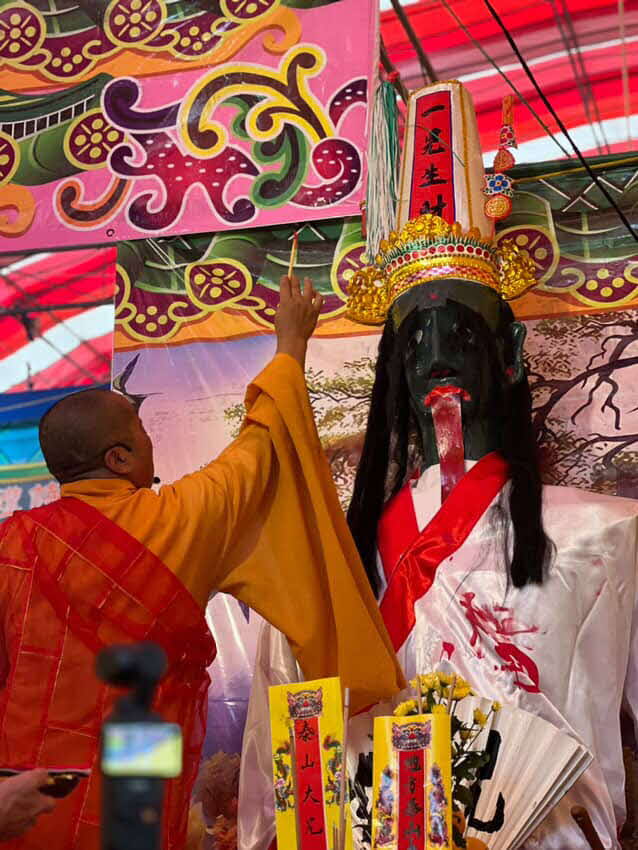
The third day of the event begins with Mulian’s transformation called mulian tuohua (目連脱化). At the central Buddhist altar, the actor who plays Mulian first appears in the role of a sheng (a traditional male character in Chinese opera). In a carefully choreographed sequence, he solemnly removes his headgear and costume, marking a transition from theatrical performer to ritual medium. The transformation of the character from layman to saint is marked by a striking visual shift – symbolised by the ritual shaving of his “three thousand strands of hair” and the donning of monastic robes.
The ritual theatre is also supported by both Taoist priests and Buddhist monks who perform prayers, chants and spirit offerings throughout.
A Dramatic Closure
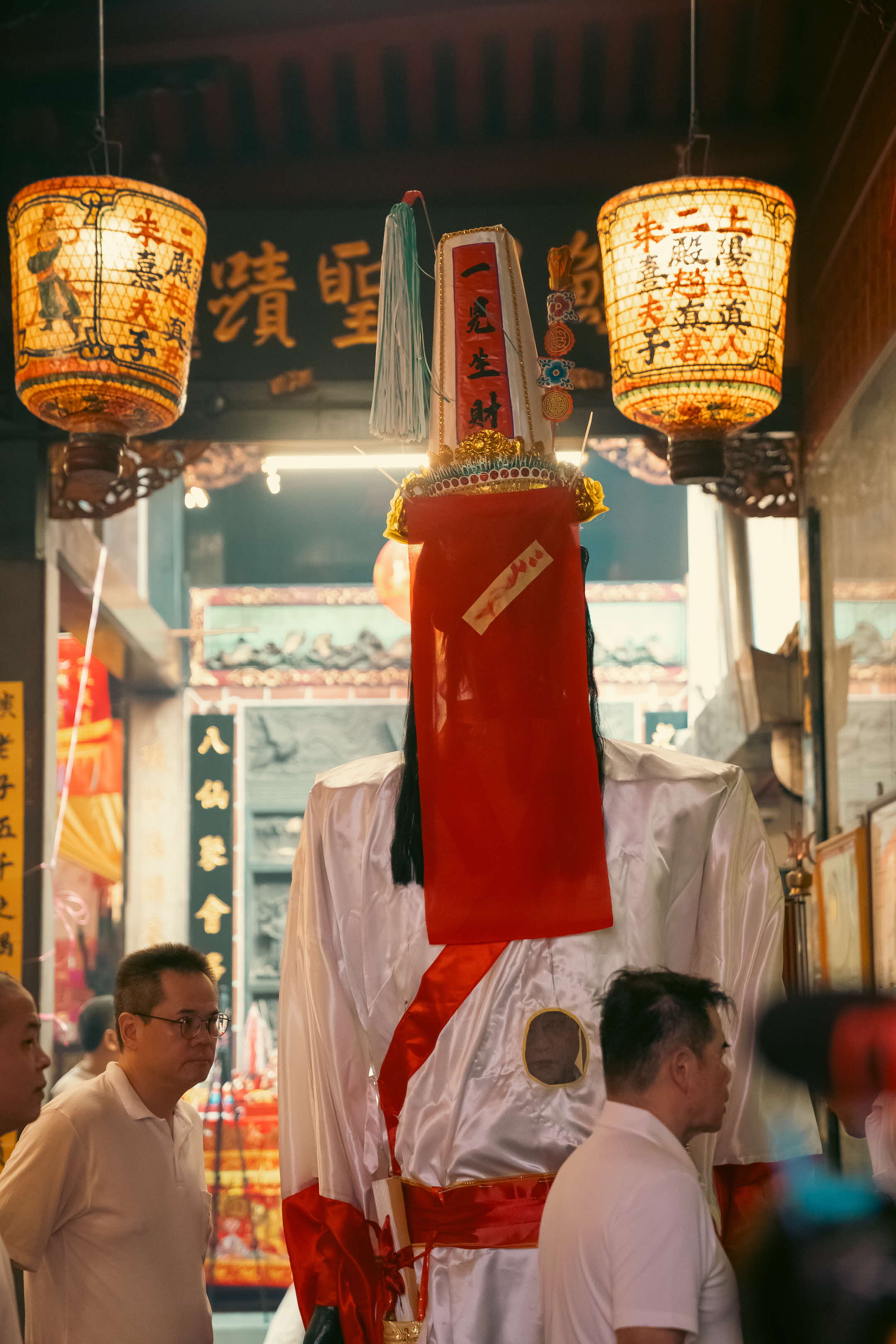
In the play’s most climactic moment, the underworld deity Dua Ya Pek (大爷伯; Da Ye Bo) bursts through the temple gates, flanked by hell guards diyu guishi (地獄鬼使) and niu tou ma mian (牛头马面), who are elaborately costumed to embody the fierce enforcers of the underworld.
The guards’ exaggerated, frenzied movements stand in stark contrast to the solemnity of the rites that follow. In traditional Chinese belief, these guards serve as the disciplinary functionaries of the netherworld, responsible for escorting the souls of the dead to judgment, enforcing karmic consequences and maintaining order across the various hell realms. Often portrayed as fearsome and relentless, they act under the authority of the Ten Kings of Hell (十殿阎罗; Shi Dian Yanluo), ensuring that no spirit – no matter how lost, misbehaved, neglected or outside the ritual perimeter – escapes judgment or wanders indefinitely.
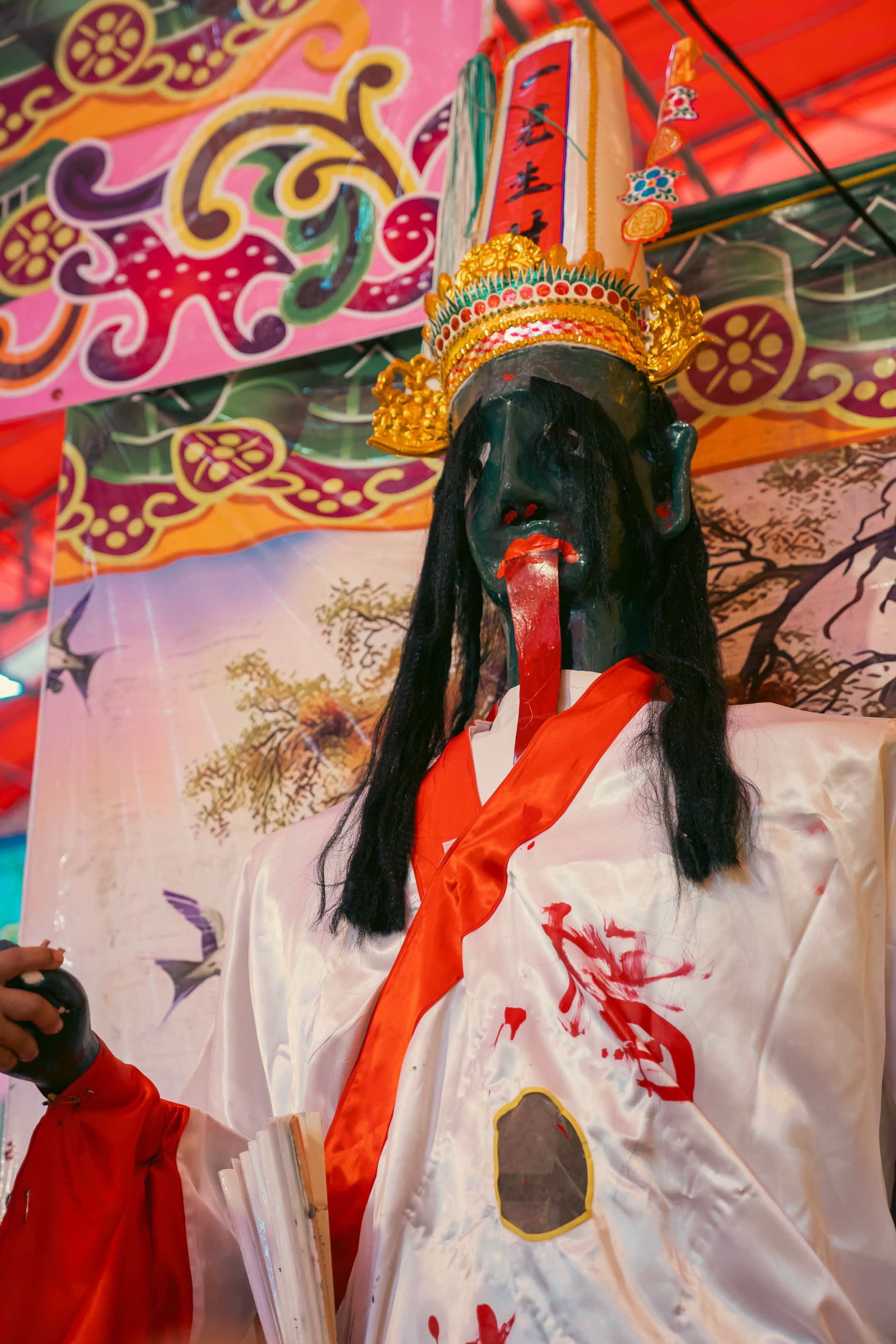
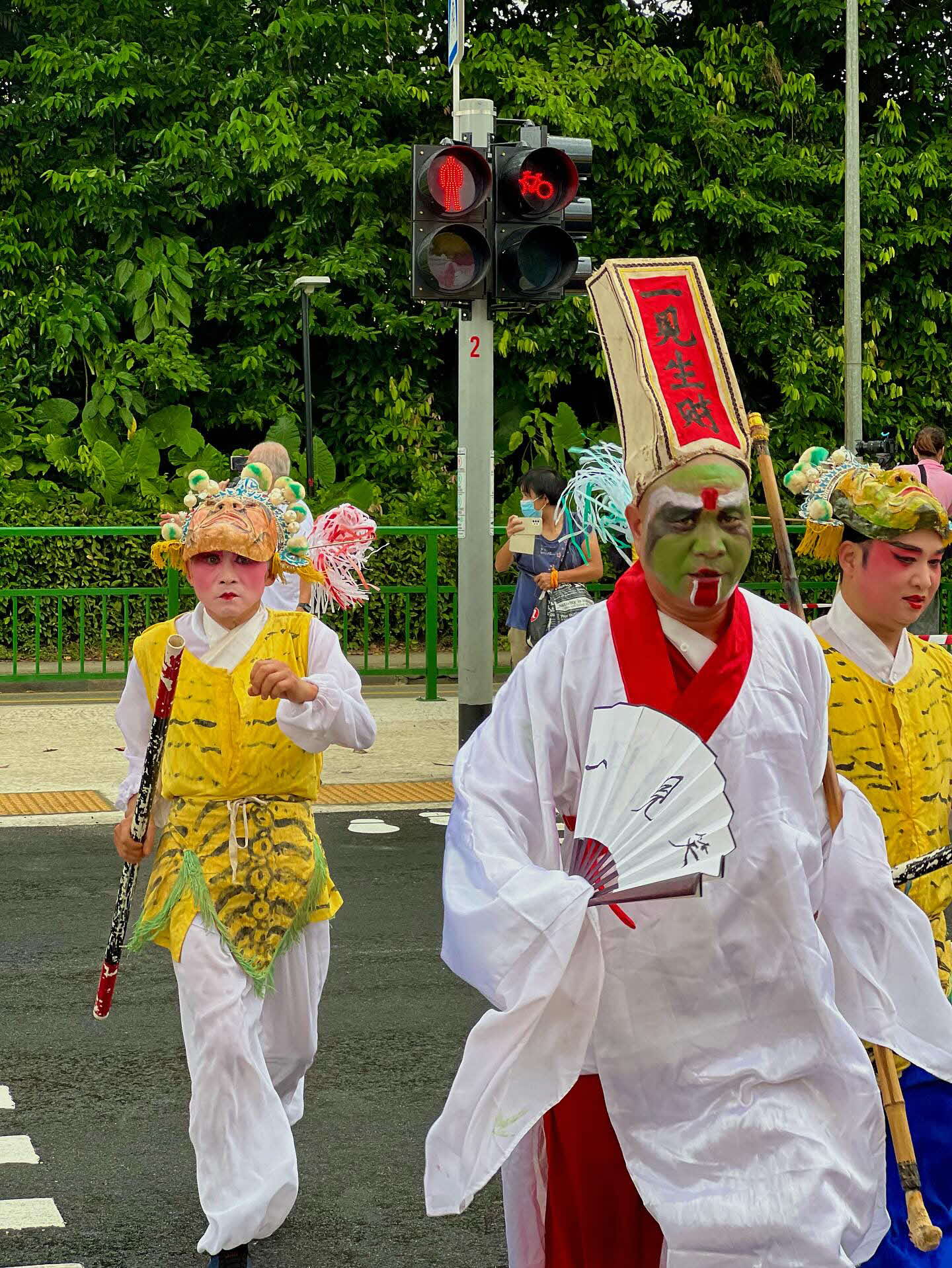
This pivotal scene signifies both a ritual and narrative transition – from the chaos and unrest of the spirit realm to the onset of divine intervention and spiritual order. This final sweep gathers all remaining souls so that they, too, may receive offerings and be guided towards peace and eventual release.
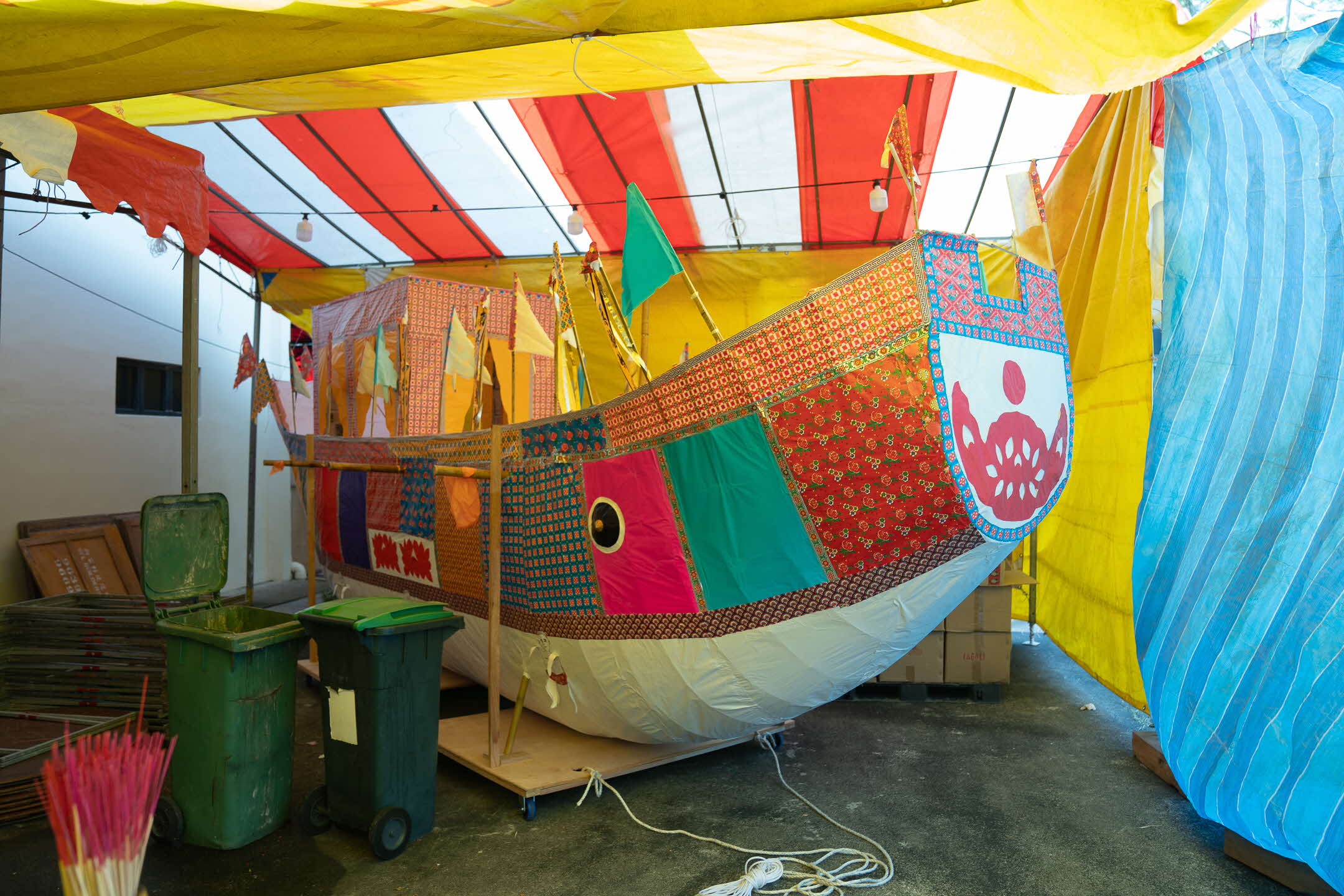
The ritual closes with song ling (送灵; literally “sending spirit”), a crucial act symbolically enacted through the burning of a large, intricately crafted paper boat often adorned with inscriptions of ancestral names and paper offerings. The boat serves as a spiritual vehicle, guiding the souls to their destined places – be it the Western Paradise, a return to their ancestral domain, or a more favourable rebirth – so they may depart n peace and order.
Preserving a Sacred Legacy
For the Henghwa community, the Decennial Universal Soul Salvation event is an act of collective healing and cultural continuity. As ritual theatre, the performance serves as a vital medium for the transmission of intangible cultural heritage, encompassing narrative, gesture, music and ritual knowledge passed down through generations.
Beyond performance, the ritual functions as a communal act of moral and spiritual reciprocity, reaffirming the interdependence of the living and the dead. By offering care to forgotten souls, the community reasserts its collective identity and ethical obligations.9
About the Author
Angela Sim is a researcher of Asian heritage and culture. She uses her platform as a media content creator to explore areas such as folk religion, Peranakan culture and sunset industries, including Chinese woodblock printing, effigy restoration and lantern making. Angela is a Singapore native and promotes the nation as a cultural destination. She has a Bachelor of Arts majoring in Japanese Art History and currently resides in Brisbane, Australia. Her work can be found on YouTube under the handle Hakka Moi.
Endnotes
1 Yu Shujuan 余淑娟, “Fengjia dapudu: Xinjiapo jiulidong de zhongyuan jidian” 逢甲大普度:新加坡九鯉洞的中元祭典, [The Decennial Universal Soul Ritual at Kiew Lee Tong Temple in Singapore: A Hungry Ghost Festival Ceremony], Xiamen University Center for Research on Local Historical Documents, 7 October 2024, https://crlhd.xmu.edu.cn/info/1037/4180.htm (opens in new tab); Li Yiyun 李亦筠, “Fengjia dapudu: Shi nian yi ‘du’ shijian zainan” 逢甲大普度 十年一‘度’世间灾难 [The Decennial Universal Soul Ritual: Once every 10 years to deliver the world from calamities], Lianhe Zaobao 联合早报, 21 July 2024, https://www.zaobao.com.sg/lifestyle/history-heritage/story20240721-4258970 (opens in new tab).
2 Ng Keng Guan, interview by author, Singapore, 1 September 2024. He is a devotee of the Kiew Lee Tong Temple.
3 Bernard Formoso, “Spirit-writing and Mediumship in the Chinese New Religious Movement Dejiao in Southeastern Asia,” Anthropos: International Review of Anthropology and linguistics 109, no. 2 (June 2014): 539–50, ResearchGate, https://www.researchgate.net/publication/279106120_Spirit-Writing_and_Mediumship_in_the_Chinese_New_Religious_Movement_Dejiao_in_Southeastern_Asia (opens in new tab); Matthias Schumann and Elena Valussi.eds., Communicating with the Gods: Spirit-Writing in Chinese History and Society (Leiden: Brill, 2023), 43–44, https://www.degruyterbrill.com/document/isbn/9789004677906/html (opens in new tab).
4 Ng Keng Guan, interview by author, Singapore, 6 June 2025.
5 Ng Keng Guan, interview by author, Singapore, 6 June 2025.
6 Ng Keng Guan, interview by author, Singapore, 6 June 2025.
7 Explanation on list of offerings, names and usage. Alex Tay, interview by author, Singapore, 22 July 2024. Alex Tay serves on the committee of Kiew Lee Tong Temple; Ng Keng Guan, interview by author, Singapore, 1 September 2024.
8 On the 3rd day of the Dicennial event, the actor playing Mulian will be presented with the stake and robes at the Buddhist altar of the temple. The ritual takes place in the morning before the Mulian theatre begins. Alex Tay, interview by author, Singapore, 25 June 2024.
9 Ng Keng Guan, interview by author, Singapore, 1 September 2024.