
Article
The Different Faces of Sang Kancil
14 April 2026
Topics
Culture
More than just a folktale, the adventures of Sang Kancil and its many variations are a glimpse into multicultural influences and values of the past.
By Theresa Fuller
I grew up listening to the stories my Kun Kun – grandfather – told me. As the Penglipur Lara (soother, carer, or storyteller) of the family, he often regaled me, his first-born Chu chu (grandchild), with folktales. Sadly, Kun Kun passed when I was seven and I miss him to this day.
Kun Kun nourished my love of folktales and often told me of a legendary creature who lived in the depths of hutan rimba, the deep dark jungle of Nusantara.1 The creature would cross rivers on the backs of crocodiles, escape perilous pits and outwit the mightiest animals in the rainforest – the tiger (harimau) and crocodile (buaya). So great were the exploits of this extraordinary creature that his legends were told across Southeast Asia and beyond.
This wonderful hero was the mousedeer, Sang Kancil.
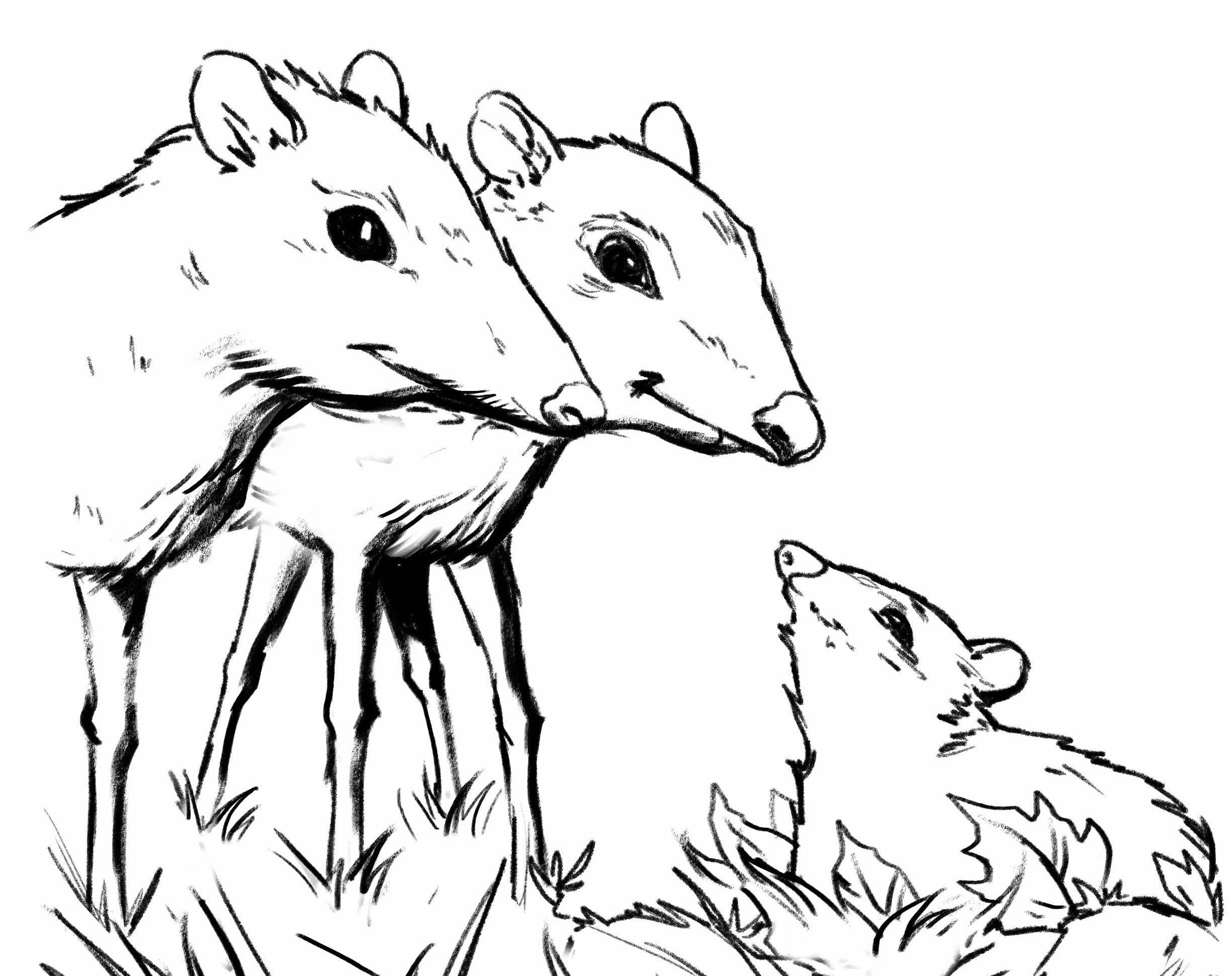
The mousedeer with his family. In “Kantjil to the Rescue”, the mousedeer is the kind king of the jungle, who works tirelessly for days to protect newly hatched ground-owls from humans. Courtesy of Theresa Fuller.
The mousedeer (or chevrotain) holds a very special place in my heart. At bedtime, Kun Kun would tell of enormous rocs (mythical giant birds of prey) carrying off Sinbad, of Chinese dragons bringing rain, and of a cheeky chevrotain dancing on the head of the Gergasi (giant). I didn’t understand the eclectic mix of stories at the time but later it all became clear.
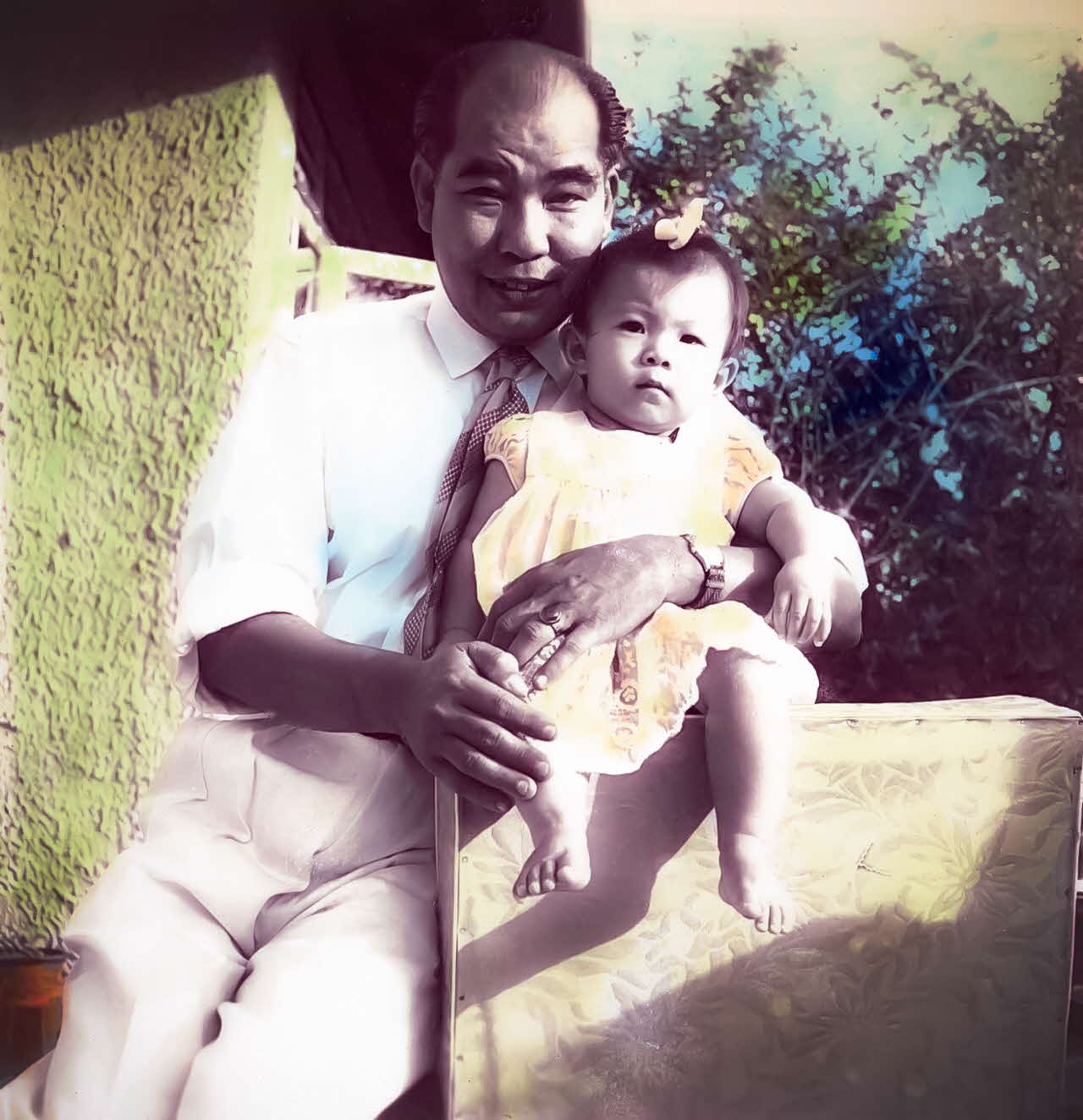
The writer, Theresa Fuller, with her beloved Kun Kun. Courtesy of Theresa Fuller.
Trading Stories
Traders from Southern China, recorded as early as the late 1300s,2 sailed to Southeast Asia, or Nanyang, to seek their fortunes. Some of them wound up in Melaka, married local women and started families.3 These families were eventually known as Peranakan, and my family is one of them.4
But the Chinese weren’t the only ones trying to get to Southeast Asia. The whole world was in a race to get to Southeast Asia. Why? They were all in search for the land where treasure grew on trees.
This nursery rhyme provides a hint of what they were after:
I had a little nut tree
Nothing would it bear,
But a silver nutmeg
And a golden pear.
Spices. The whole world, or at least those who could afford them, craved spices: pepper, aniseed, nutmeg, cloves from the Spice Islands of Indonesia.
But the Chinese were not the first to Southeast Asia. The Arabs and Indians had arrived, too. This is probably why my bedtime stories also included ones from The Thousand and One Nights, a collection of folktales, which include the adventures of Sinbad. It also makes sense, then, in my search for the stories my Kun Kun told me, that Sang Kancil, the mousedeer hero as I first knew him to be, went by many names in different languages. He was Sang Kancil in Malay (Sang means “revered”); Kanchel in Baba Malay; Mīminnī5 in Ceylonese or Sri Lankan; Akal Pelanduk in Borneo, Malay and Bahasa Indonesia (akal for “timeless” and pelanduk means “mousedeer” or “horn”); and Pilandok in Tagalog. Europeans have also spelt his name variously as P’landok, Pelandok,6 or Kanchil,7 Kantchil,8 or Kantjil.9
The monsoon winds also linked the Malay Peninsula to the two great markets of India and China. From India came textiles while the Malay Archipelago provided exotic marine and jungle produce.10 And from China were goods like tea, silk, porcelain, pearls, fans and ornamental works with pepper, camphor, Arabian opium and Indian brought back to China.11 But goods were not the only things exchanged, as can be seen from my bedtime stories, which hailed from as far away as the Philippines and Sri Lanka.
River Crossing
Most of Sang Kancil’s adventures take place in the jungles of Nusantara, which refers to the Indonesian archipelago and the broader Malay world.
The most well-known of all Sang Kancil’s adventures is the one where he crosses the river on the backs of crocodiles. However, modern versions of Sang Kancil’s stories present a version of the mousedeer devoid of all the nuances and shades that I know. They emphasise his lack of stature, his defencelessness and how factors such as hunger drove him to do the impossible. This was not the hero I knew. My mousedeer would deliberately trot down to the riverbank to chat with Sang Buaya (the crocodile) and challenge him to a tug-of war!12
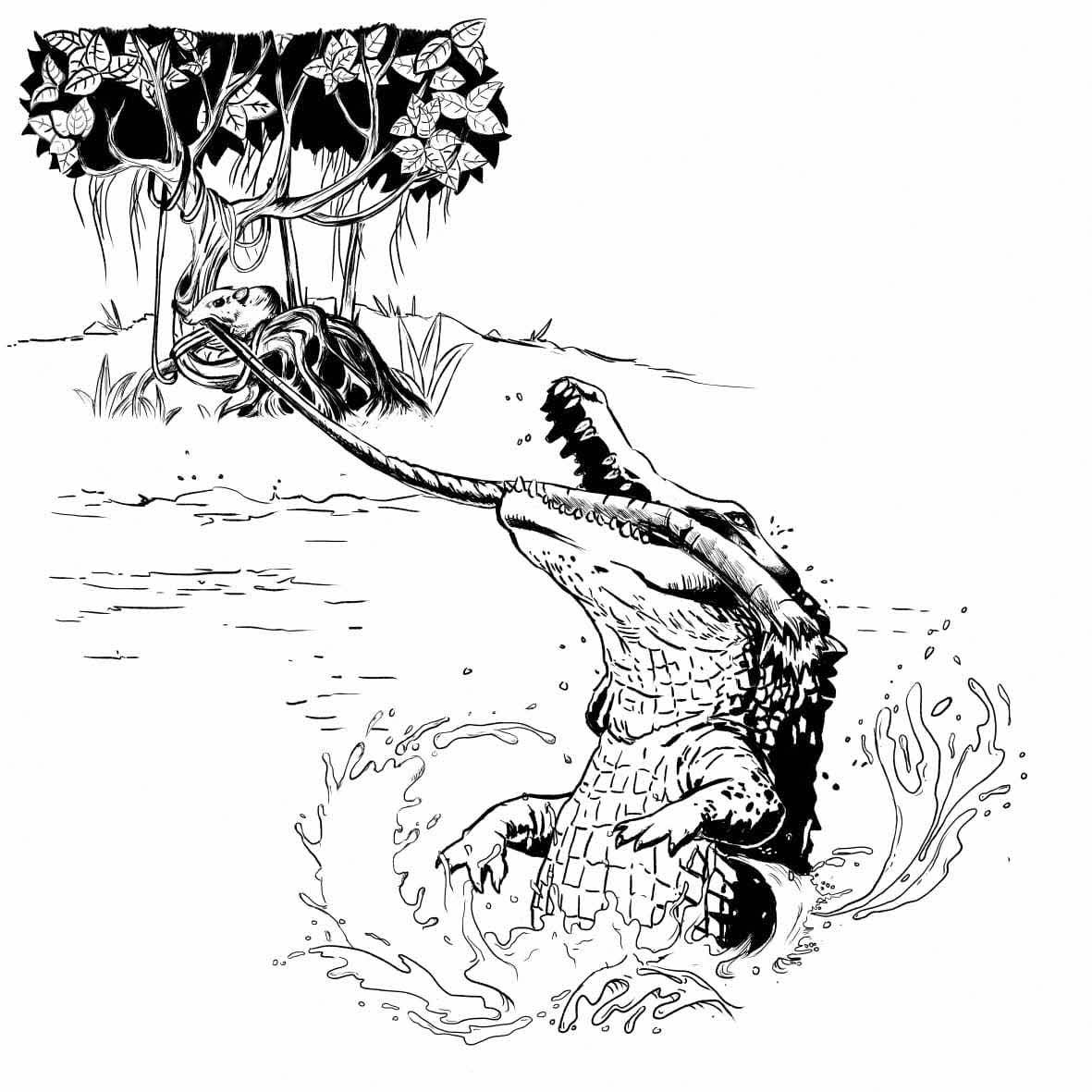
Sang Kancil engaged in a tug-of-war with Sang Buaya (the crocodile). Courtesy of Theresa Fuller.
All the stories I came across in my search for Sang Kancil crossing the river were of him counting the crocodiles. But Kun Kun had told me a version where Sang Kancil not only counted them but measured the length of the crocodiles from the tip of their jaws to the tips of their tails. This reveals Sang Kancil’s great courage for he was not simply bouncing from buaya back to buaya back, but instead deliberately taking the time to gauge each crocodile’s length, coming into extremely close contact with the lethal jaws of each hungry crocodile.

Sang Kancil leading monkeys across the river via the backs of hungry crocodiles in the tale “The Monkeys and the Crocodiles”(see Eating the Liver of the Earth, p. 38). Courtesy of Theresa Fuller.
In each tale, Sang Kancil has a different motivation for crossing the crocodile infested waters: he is hungry and wants to eat delicious jambu air (water apples) growing on the other side of the river; he is being chased by enemies; he wants to assert his authority as the new king of the jungle. He does so by outwitting the crocodiles to get to the other side. In one story, Sang Kancil tells the crocodiles that he is a messenger of Nabi Sleyman (Prophet Solomon) and it is his will that the mousedeer counts all his slaves (the crocodiles). So, the crocodiles float on the river while the mousedeer jumps on their backs, counting them one by one. After Sang Kancil reaches the other side, he simply states that he has reckoned correctly and that the crocodiles may now sink back into the water. In another story, as told by the Mokens (formerly sea dwellers, today’s sea nomads of the Southwest coast of Thailand and Myanmar), Sang Kancil is being hunted relentlessly by several predators, and he calls upon the crocodile who just happens to be his good friend to carry him across the river.13
A different version shows Sang Kancil’s kind heart – he doesn’t need to cross the river but does so out of concern for a crocodile who was hurt after a fight with a tiger. (Of course, the fight had been instigated by Sang Kancil).14 Another tale sees Kancil’s leg grabbed by a crocodile as he drinks water by the river’s edge. Sang Kancil then pretends to be a stick of wood, and the gullible crocodile lets go and Sang Kancil escapes. Another version has the crocodile pretending to be a log – Sang Kancil cheekily says “logs float upstream!” and the silly crocodile immediately starts to float upstream.
Beyond these, I knew there were many more stories of Sang Kancil. I trawled the Internet Archive, rare books, Project Gutenburg, journals, blogs, websites and, of course, my own memory to find them. Eventually, I collected all these stories in my book Eating the Liver of the Earth: Mousedeer Tales (opens in new tab) (2024, Bare Bear Media).
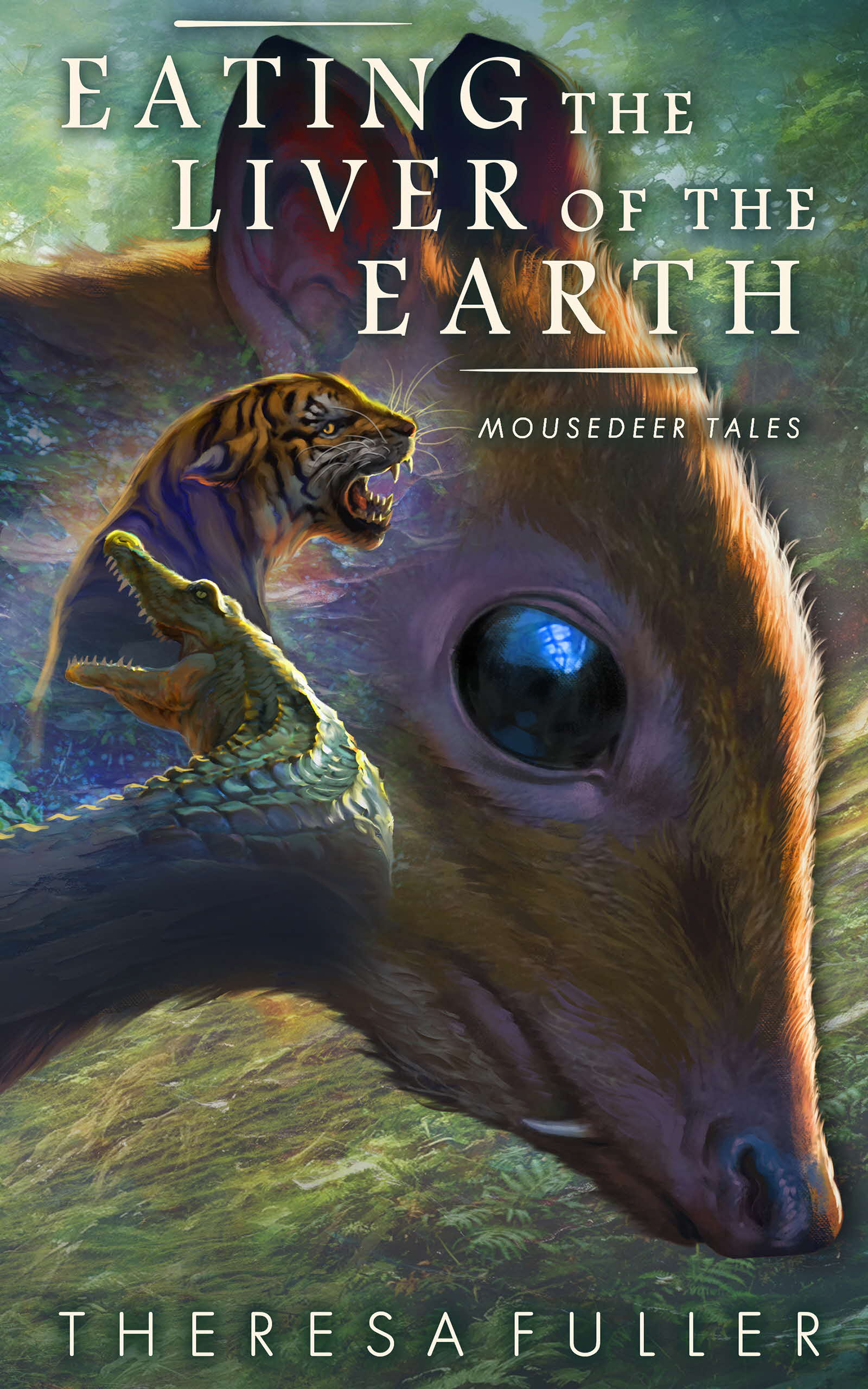
Eating the Liver of the Earth is a compilation of Sang Kancil stories researched and found by Theresa Fuller.
The Many Facets of Sang Kancil
Gathering all the stories about Sang Kancil I could, I found that they could fit into four main categories.
The first is Sang Kancil the trickster. Trickster stories are ubiquitous and, in these versions, Sang Kancil is often portrayed as weak and small but intelligent. It is only through his wit that he survives all the dangers of the jungle. I had heard many of these stories – such as Sang Kancil and the Farmer; Sang Kancil and the Buffalo; Sang Kancil and the Monkey; and The Resident’s Compound. These simple but delightful tales show that brains matter more than size.
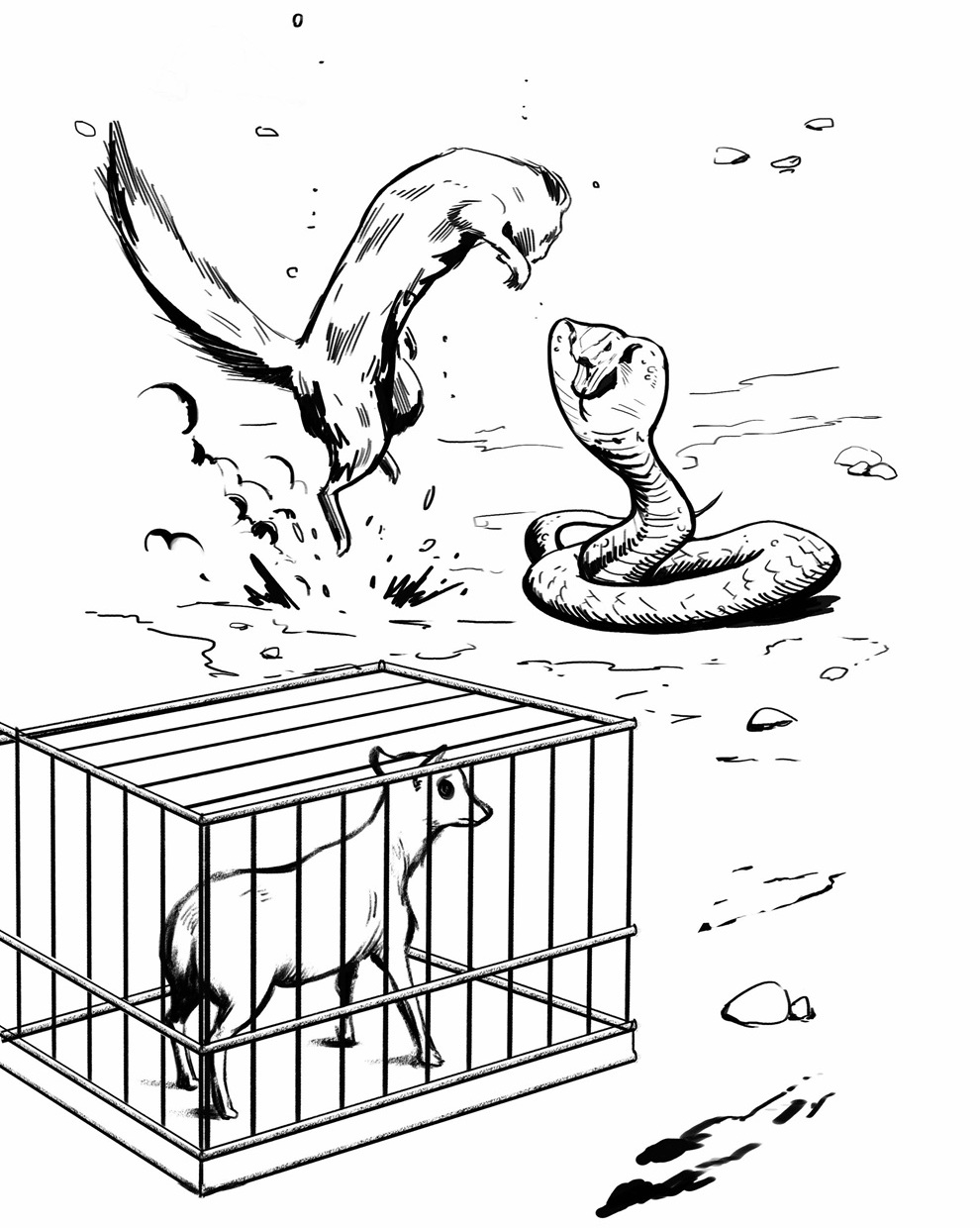
Sang Kancil (in the cage) observes a ferocious fight between the mongoose and cobra in the story “The Resident’s Compound” (see Eating the Liver of the Earth, p.68). Courtesy of Theresa Fuller.
The second category is where Sang Kancil has authority and rank – pangkat. In these stories Sang Kancil is in the service of King Solomon, holding positions like a judge or chief magistrate (Salaam di Rimba or Judge of the Jungle). His job is to bring peace. These stories often include a horned creature (Pelanduk) who played jokes (Jenaka) and was able to become a leader, a king and more. These tales, which have been collected in my book, include “Sang Kancil the Judge”,15 and “Two Men and an Axe”,16 and see Sang Kancil wisely resolving disagreements between various parties.
In the tale of “Sang Kancil the Judge”, a drought causes one friend to request a loan from another. When the time comes to repay the loan, however, the borrower refuses to do so, using the argument that he would only repay when there are two moons. And as there was only one moon in the sky, he was not obligated to repay the loan. The lender goes to Sang Kancil, who at once calls the two friends to the foot of the hill at night. When the two friends arrive, the mousedeer asks them to look into the well. When the borrower sees the moon and its reflection at the bottom of the well, he realises that his ploy can no longer work and repays his debt.
In “Two Men and an Axe”, Kancil shows his wisdom to be greater than King Solomon’s. Two men approach the king with a complaint. The first man reported that when he asked his neighbour to return an axe he had borrowed, he was told that it had been eaten by caterpillars. As King Solomon puzzled over how metal could be devoured, he ordered his judge, Sang Kancil to settle the matter. After listening to the case, the mousedeer asks to be excused. When he returns to court, he is filthy. Sang Kancil explains to the irate king that after he left the court he had gone to the river to bathe, but when he arrived at the river, it was ablaze. To put the fire out, he rolled in the river, hence the reason for his appearance. The king declared the mousedeer’s tale as nonsense, prompting Sang Kancil to ask the king why he had believed the story spun by the borrower, but Sang Kancil’s. The king realised his error, demanded the borrower replace the axe, and thanked Sang Kancil for his wisdom.
The third category are stories where Sang Kancil is portrayed as a king and judge. He is a good ruler but does not hesitate to punish those who disobey. Many of these stories can be found in Hikayat Pelanduk Jenaka (Humorous Tales of the Mousedeer).17 These stories, which can be found in my book, include ones like “The Tiger Makes Peace with the Goat”;18 “The Joker Deceives the Giant”;19 “Kantjil to the Rescue”,20 and “Shaikh ‘Alam Quarrels with the Elephant King”.21

The mousedeer sleeping with one eye open in “The Mock Funeral of the Great Commander Harimau” (see Eating the Liver of the Earth, p. 198). Courtesy of Theresa Fuller.
The last category presents a Sang Kancil known as Akal Pelanduk, who is more vicious and unsavoury in character. In one story, Sang Kancil’s wife, a tiger, was pregnant and in need of some medicine. Sang Kancil brings her not only the wrong leaves, but ones with maggots. Using what Sang Kancil had brought her, the maggots entered her womb and she died.22
Not Just Stories
I felt justified in my endeavours when I came across the work of the late Ian Proudfoot, who, in A “Chinese” Mousedeer Goes to Paris, described the little-known book Hikayat Pelanduk Jenaka.23 This text goes as far back as Malay literature can be traced, with the oldest known version (found in Batavia in 1682 in a well-worn state) held at the Bibliotheque Nationale (National Library) in Paris.24
According to him, “Most mousedeer stories are simple trickster tales, told singly or bundled into anthologies. The Hikayat version, however, mimics the form of an epic. It deploys a cohesive set of tales to convey how its hero acquires authority through pretending to perform ascetism, orchestrates a truce between the clans of tigers and goats, kills an ogre who has been terrifying the forest creatures, then through a series of tricks subdues the elephant, the bear, and the crocodile, and finally routs an army of monkeys”.25 In the end, the unassuming mousedeer eventually becomes king of the jungle.

Sang Kancil dances upon the head of Gergasi the giant, who had been terrorising the animals of the jungle (in “Grandmaster and the Gergasi”, also known as “The Joker Deceives the Giant”). Courtesy of Theresa Fuller.
Few know of these series of stories. Proudfoot opines that the mousedeer epic (from Hikayat Pelanduk Jenaka) was “lumped together with other mousedeer tales drawn from oral sources”. The oral stories were “trickster stories, and simpler in conception than the mousedeer epic” and later watered down26 and “put into writing to provide reading texts for the new vernacular schools”.27 These stories were also made into children’s books with cute illustrations and this “fitted [in] with the prejudice of the literate, for whom these rustic ‘oral’ folk tales were, at best, charmingly unsophisticated and naïve”.28
But no one who reads the Hikayat Pelanduk Jenaka would have found the mousedeer epic unsophisticated or naïve. Its text is hilarious and witty. In fact, in its time it would have been considered “subversive” and “its strong political satire is an uncomfortable reminder that there have always been political and ideological struggles in the Malay world, and that the common folk of by-gone days were not always credulously in awe of their rulers.” In fact, “the Hikayat Pelanduk Jenaka makes a truly radical political statement…”29 in that “royal power rests on false consciousness… and how a gullible public can be made to think they need an authority figure through a combination of religious fraud and false security fears…”30. However, the Hikayat Pelanduk Jenaka is overlooked and seen to have “little to offer those today who look to the past as a golden age”.31
I hope these precious folktales will never be forgotten, as they are a part of my heritage, indeed for everyone who has grown up in Southeast Asia.
About the Author
Theresa Fuller is an independent researcher, analyst/programmer, and educator with a deep passion for the folktales of Southeast Asia. Her work includes the acclaimed publications The Girl Who Became a Goddess, The Girl Sudan Painted Like a Gold Ring, and Eating the Liver of the Earth–Mousedeer Tales. Currently, she is dedicated to safeguarding Baba Malay, ensuring its survival for future generations.
Endnotes
1 Georges Voisset, Tales from the Deep Forest – The Very Curious Adventures of Kancil the Mousedeer (opens in new tab) (Kuala Lumpur: Institut Terjemahan & Buku Malaysia, 2015), 3. (From National Library Singapore, call no. R 398.2 VOI)
2 Khoo Joo Ee, The Straits Chinese – A Cultural History (opens in new tab) (Amsterdam: The Pepin Press, 1996), 18. (From National Library Singapore, call no. RSING 305.895105951 KHO)
3 Felix Chia, The Babas (opens in new tab) (Singapore: Times Books International, 1980), 1, 5. (From National Library Singapore, call no. RSING 301.45195105957 CHI)
4 Khoo, The Straits Chinese – A Cultural History (opens in new tab), 25.
5 Henry Parker, Village Folktales of Ceylon (Project Gutenberg, 1910), no. 31.
6 Dunstan Entingi, Iban Animal Stories (Kuching: Borneo Literature Bureau), 9. (From National Library Singapore, call no. RUR 398.2 ENT)
7 Stuart Dickens McHugh, Kanchil the Wily One (opens in new tab) (Gloucester: Thornhill Press, 1977), 9. (From National Library Singapore, call no. RCLOS 398.209595 MAC-[ACL])
8 Harold Courlander, Kantchil’s Lime Pit, and Other Stories From Indonesia (Harcourt, Brace and Company Inc, 1950), 7. (From National Library Singapore, call no. RUR 398.2 COU-[FOL])
9 Magueritte Harmon Bro, How the Mouse Deer Became King (Garden City, N.Y.: Double Day & Company, Inc, 1970), 13. (From National Library Singapore, call no. RUR 398.209595 BRO-[FOL])
10 Khoo, The Straits Chinese – A Cultural History (opens in new tab), 17, 18, 19.
11 The Certificate History of Malaya 1400-1965 by M. Muthulingam & Tan Phing Choo, Peony by Preston Press 1993, page 5
12 Borneo Literature Bureau, Mousedeer and the Crocodile (opens in new tab) ([Kuching]: Borneo Literature Bureau, 1968), 1–5. (From National Library Singapore, call no. RCLOS 398.209595 BOR-[ACL])
13 Jacques Ivanoff, Rings of Coral (opens in new tab) (Thailand: White Lotus, 2001), 279. (From National Library Singapore, call no. RSEA 398.209591 IVA)
14 Borneo Literature Bureau, Clever Mouse-deer (opens in new tab) (Kuching: Borneo Literature Bureau, 1964), 35–41. (From National Library Singapore, call no, RCLOS 398.209595 BOR-[ACL])
15 Theresa Fuller, Eating the Liver of the Earth: Mousedeer Tales (opens in new tab) (New South Wales: Bare Bear Media, 2024), 206–7. (From National Library Singapore, call no. RSEA 828.99343 FUL)
16 Fuller, Eating the Liver of the Earth (opens in new tab), 208–9.
17 Voisset, Tales from the Deep Forest (opens in new tab), 130–215.
18 Fuller, Eating the Liver of the Earth (opens in new tab), 220–5.
19 Fuller, Eating the Liver of the Earth (opens in new tab), 231–5.
20 Fuller, Eating the Liver of the Earth (opens in new tab), 277–80.
21 Fuller, Eating the Liver of the Earth (opens in new tab), 241–47.
22 Fuller, Eating the Liver of the Earth (opens in new tab), 291.
23 Described most recently by Siti Mariani Omar, Katalog Manuskrip Melayu diPerancis (opens in new tab) [Catalogue of malay mansucripts in France] (Kuala Lumpur: Perpustakaan Negara Malaysia, 1991), 66 (From National Library Singapore, call no. R q016.091089992 KAT-[LIB]); P. Voorhoeve, “Les Manuscrits Malais de la Bibliothèque Nationale De Paris” Archipel (opens in new tab) no.6 (1973): 42–80. (From National Library Singapore, call no. RSING 959.005 A)
24 In the 17th century, a group made a copy of Hikayat Pelanduk Jenaka. The manuscript was in Batavia in 1682 and was in a well-worn state: see Ian Proudfoot, “A ‘Chinese’ Mousedeer Goes to Paris” Archipel (opens in new tab) no. 61 (2001): 69–97. (From National Library Singapore, call no. RSING 959.005 A)
25 This plot is broadly common to the Paris text and to the texts published by H.C. Klinkert, De Pelandoek Djinaka: Of Het Guitige Dwerghert: Naar Een Ander Maleisch Handschrift Voor De Pers Bewerkt (Leiden: Brill, 1893) (India Office MS 3049) (From National Library Singapore, call no. RUR 398.2 PEL); H.C. Klinkert, Hikajat Pelandoek Djinaka, of De Reinaert De Vos Der Maleiers (Leiden: Brill, 1885) (Leiden Cod.Or. 1932). (From National Library Singapore, call no. RRARE 899.2302 HIK). Both the latter derive from nineteenth-century manuscripts.
26 Amin Sweeney, A Full Hearing: Orality and Literacy in the Malay World (opens in new tab) (Berkeley: University of California Press, 1987), 89, n.27. (From National Library Singapore, call no. RSEA 899.2809 SWE)
27 Ormonde Theodore Dussek, ed., Hikayat Pelandok; Ia-Itu Hikayat Sang Kanchil, Cherita Pelandok Dengan Anak Memerang, Hikayat Pelandok Jenaka [Hiyakat Pelandok; It's the tale of the kanchil, the pelandok story with the beaver child, the pelandok joke story], Malay Literature Series, no. 13 (Singapore: Methodist Publishing House, 1915) (From National Library Singapore, call no. RRARE 899.2300881 HIK). The same series of oft-reprinted Romanised school texts also includes a collection of farcical tales Richard Olaf Winstedt and A.J. Sturrock, ed., Cherita Jenaka Iaitu Pak Kadok, Pak Pandir, Lebai Malang, Pak Belalang, Si Lunchai, Malay Literature Series, no. 6 (Singapore: Methodist Publishing House, 1906)
28 Proudfoot, A ‘Chinese’ Mousedeer Goes to Paris (opens in new tab),” 2001, 69–97.
29 Proudfoot, A ‘Chinese’ Mousedeer Goes to Paris (opens in new tab),” 2001, 70.
30 Proudfoot, A ‘Chinese’ Mousedeer Goes to Paris (opens in new tab),” 2001, 71.
31 Proudfoot, A ‘Chinese’ Mousedeer Goes to Paris (opens in new tab),” 2001, 69–97