
Video
Kaya: More Than a Spread on Toast
19 August 2026
Topics
Food
The sweet custard known as kaya actually belongs to a family of egg-based coconut milk confections called serikaya in Malay.

Commonly eaten on toast in Singapore, kaya is familiar to many as a sweet, fragrant coconut jam. But according to food historian and author Khir Johari, kaya is part of serikaya, a broader category of egg-based coconut milk confections with Malay roots. This versatile custard made using three main ingredients: egg, coconut milk and a sweetener forms the base of many dishes such as kueh puteri salat, serikaya tulang and agar-agar serikaya. Find out how these different expressions of serikaya are made, the traditional tools used to make them, and the occasions when they are served.
This episode is part of From Book to Cook, a cooking show on Singapore’s food history. Other episodes can be found here (opens in new tab).
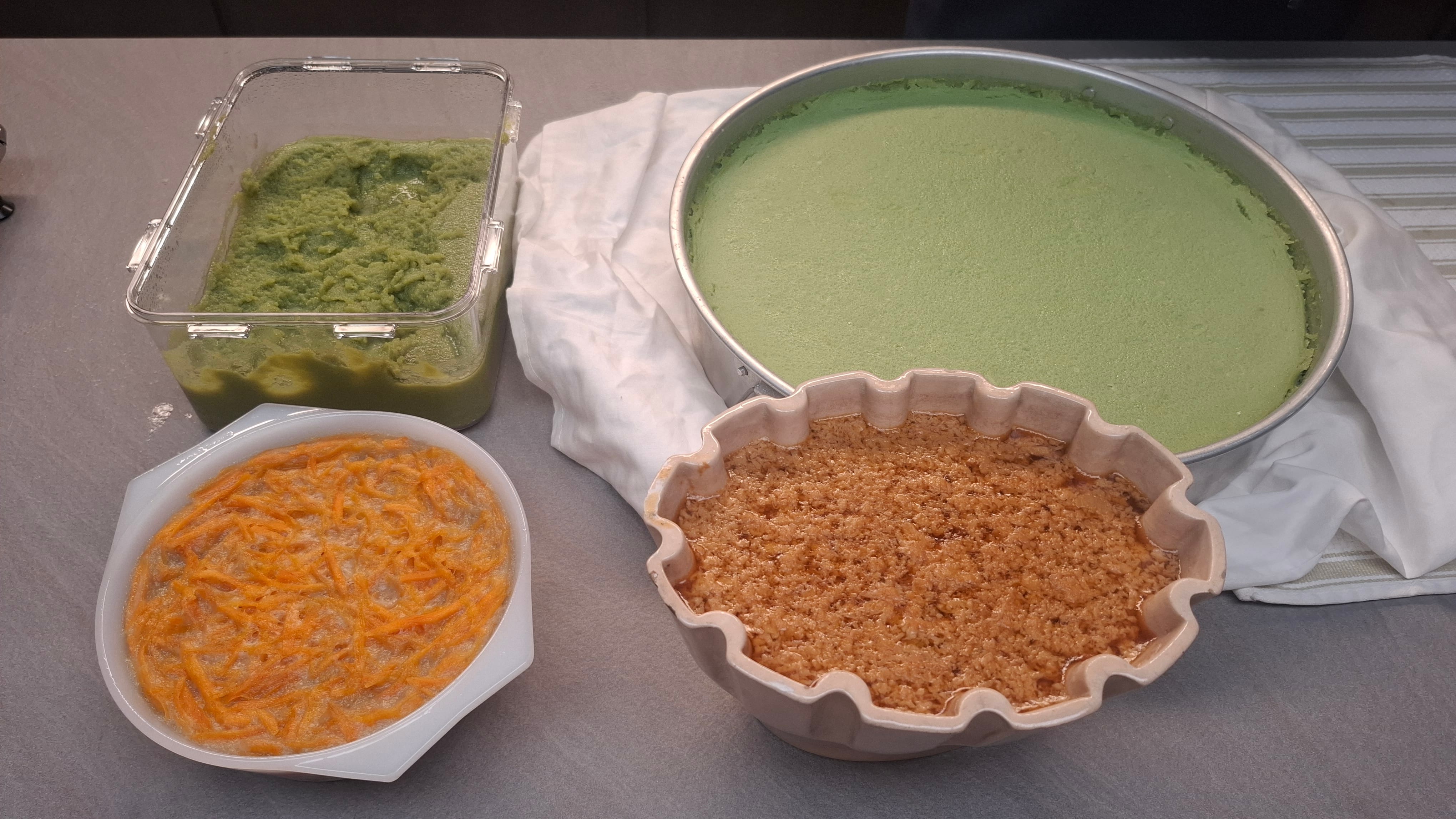
Clockwise from top left: spreadable kaya, kueh puteri salat, agar-agar serikaya and serikaya tulang.
Recipes
Khir’s ingredients and instructions
Spreadable serikaya
12 large eggs
1 L first-pressed fresh coconut milk
600 g caster sugar
1 tsp. salt
1/2 tsp. vanillin
120 g pandan leaves
310 ml water
1. In a food processor, grind prewashed pandan leaves with water. With a strainer, extract the pandan juice. Set aside.
2. In a mixing bowl, stir sugar with eggs until sugar is partially dissolved. Add in the coconut milk and stir well until the sugar completely dissolves. Scent the mixture with vanillin and add the salt to bring out additional creaminess. Add into the custard mixture about 7 tbsp. of pandan extract and mix well.
3. Strain into the top saucepan of a double boiler. Stir constantly and uniformly in a double boiler with a simmering bottom pan for 1 hour and 15 minutes. Remove from heat and continue stirring, preferably over a cold water bath.
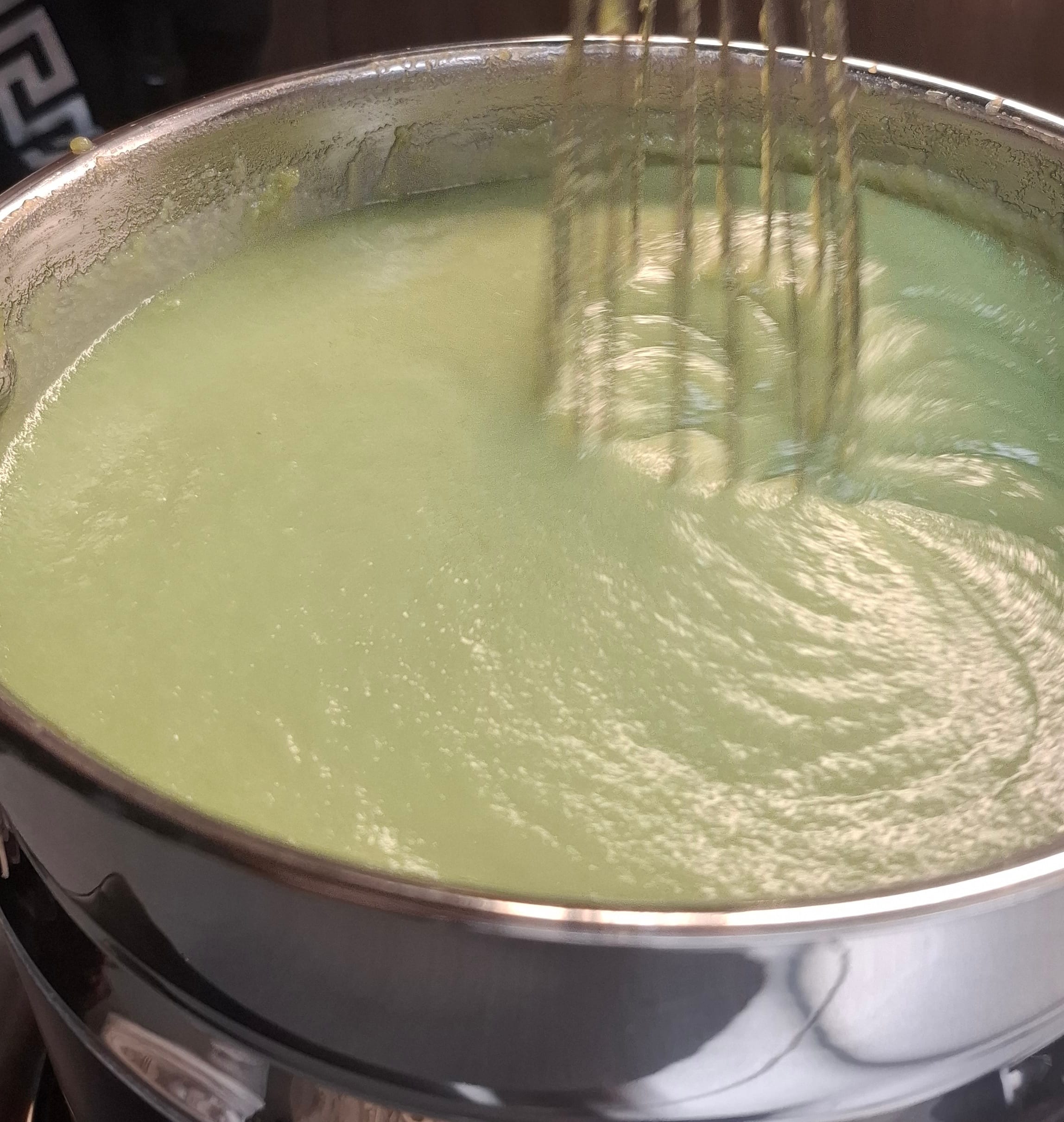
Spreadable kaya being constantly stirred in a circular motion in a double boiler. It curdles and thickens over a period of about 1 hour and 10 minutes. In the past, commercially made kaya was sold in cans, although they are more commonly found in jars today.
Serikaya tulang
5 large eggs
430 ml first-pressed fresh coconut milk
200 g caster sugar
2 tbsp. flour
1 tsp. salt
1 tsp. vanilla essence
sweet potato (orange), julienned
1. Peel and wash the sweet potatoes. With a grater, julienne it. Set aside.
2. In a mixing bowl, stir sugar with eggs until sugar is partially dissolved. Add in the coconut milk and stir well until the sugar completely dissolves. Salt and scent the custard mixture with vanilla essence. Fold the flour into the mixture.
3. Strain the mixture over another mixing bowl. Then gently mix in the julienned sweet potato.
4. Pour the textured custard mixture into heat resistant moulds that have been lightly buttered.
5. Steam the custard for approximately 45 minutes. Let cool and serve with baguette or bread of choice.
Agar-agar serikaya
5 eggs
260 ml coconut milk
560 g palm sugar (gula melaka), chopped
37 g dried agar-agar strips
1 tsp. salt
a pinch of vanillin
4 blades of pandan leaves, tied into bundles
2,100 ml water
1. Soak the agar-agar strips for about 20 to 30 minutes. Rinse and place in a medium-sized pot with 2,100 ml of water. Boil the agar-agar with pandan leaves, stirring from time to time until the strips have completely dissolved.
2. While the agar-agar is dissolving, in a mixing bowl, mix well the eggs, coconut milk, salt and vanillin. Set aside.
3. After the agar-agar has dissolved, add in the palm sugar. Boil gently until all the sugar has dissolved. Strain and put the agar-agar solution back onto the stove, then lower the heat.
4. Gently pour the egg and coconut mixture into the hot agar-agar solution. Do not stir. Bring up the heat and allow large curds to form in the agar-agar solution. Using a whisk, gently push and pull the curds. Turn off the heat.
5. Pour or scoop the agar-agar mixture with the floating curds into moulds. The less dense curds will float to the top as it cools. Allow it to set at room temperature, then chill in the fridge before serving.
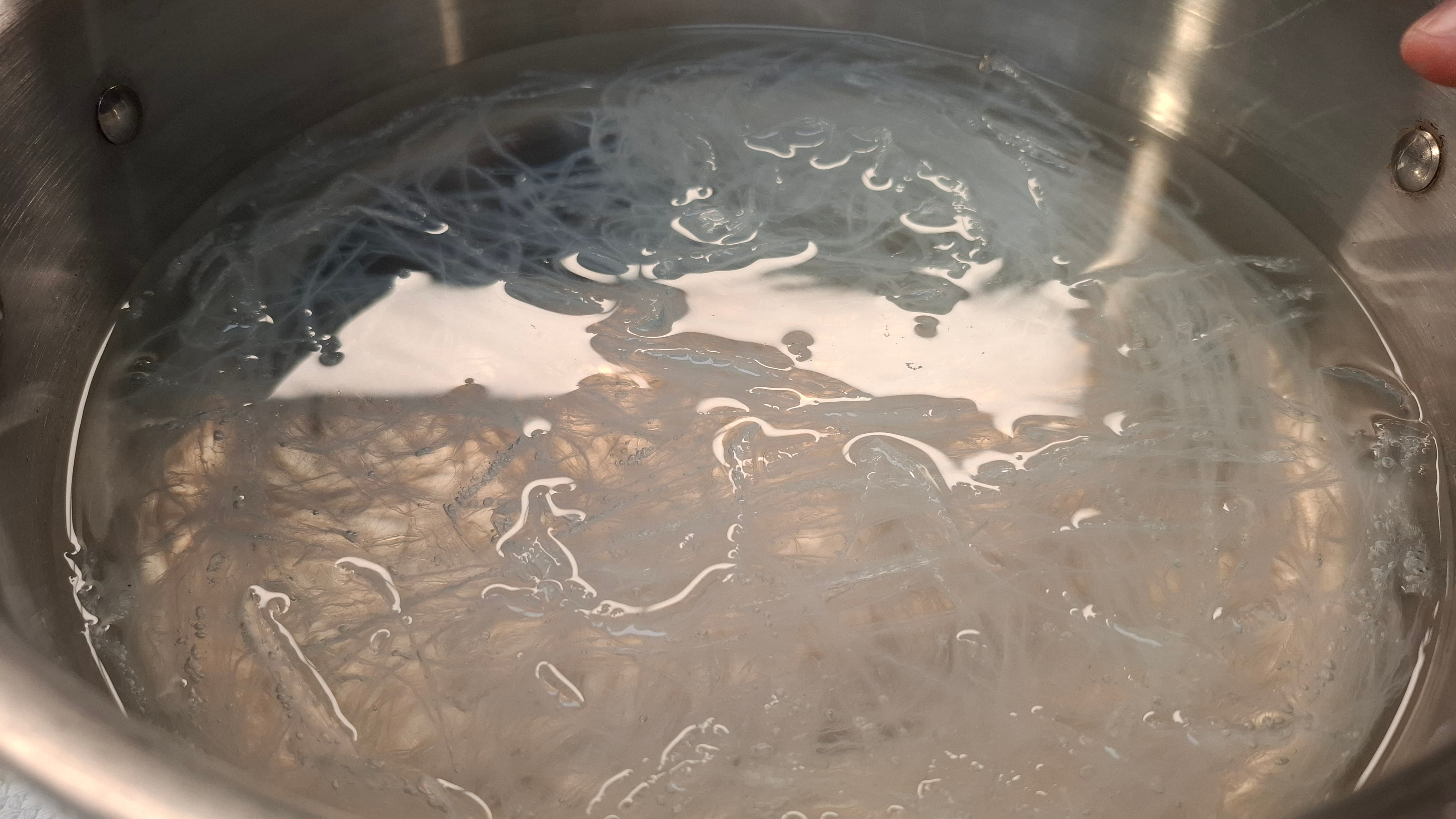
Agar-agar is derived from red seaweed. Here, it has been processed into translucent strips.
Related Podcast
Serikaya: Family of Kaya-based confections (opens in new tab)
What is commonly referred to as kaya belongs to a wider Malay repertoire of egg-based coconut confections known as serikaya. Award-winning writer and food historian Khir Johari tells the origins and meaning of serikaya, its common misconceptions and the different food he can concoct from the classic combination of eggs, sugar and coconut milk.
Related Articles
Kaya (opens in new tab)
Kaya is the colloquial term for serikaya in Singapore. It is a sweet, creamy spread or custard made with coconut cream, eggs, sugar and pandan leaves. It is commonly eaten in Singapore as a spread on toasted bread with butter, in a dish known as kaya toast. Variations of kaya can be found in other parts of Southeast Asia. (Infopedia)
The Role of Foraging in Malay Cuisine
From forests to coastlines, the Malay community has foraged for food for centuries. Khir Johari examines this way of life before land reclamation, when food was largely seasonal and indigenous communities had intimate knowledge of their natural world. (BiblioAsia)
A Day in the Life of Kopitiam Workers (opens in new tab)
For many Singaporeans, the most important meal of the day is enjoyed at a kopitiam and includes coffee, kaya toast and soft-boiled eggs. Senior Librarian Joanna Tan finds out more about the kopitiam and the work that goes into producing our favourite breakfast items. (National Library Blog)
Ya Kun (opens in new tab)
Ya Kun is a chain of cafes that is best known for its coffee and kaya toast. It started as a coffee stall at Telok Ayer Basin before World War II and was formally registered as a business under the proprietorship of Loi Ah Koon in 1944. Ya Kun now has franchise operations in Singapore, South Korea, Japan, Indonesia, the Philippines and China. (Infopedia)
Related Books
Khir Johari, The Food of Singapore Malays: Gastronomic Travels Through the Archipelago (opens in new tab) (Singapore: Marshall Cavendish Editions, 2021).
R. J. Wilkinson, A Malay-English Dictionary (Romanised) (opens in new tab) (Mytilene: Printed by Salavopoulos and Kinderlis, 1932).
Meriam Ismail, Authentic Malay Cooking (opens in new tab) (Tuttle Publishing, 2013).