
Video
Kueh Pie Tee’s Peculiar Past
Topics
Food
29 April 2024
Join award-winning cookbook author Christopher Tan as he investigates the mysterious origins of kueh pie tee and its connection to American cuisine, while making the snack from a recipe in Susie Hing’s 1956 cookbook, In a Malayan Kitchen. Using both local moulds and American “patty irons” dating back to the 1950s–70s, Christopher shows us the different shell shapes that can be made, and how the fillings have changed over time – from cream or milk-based sauces in the Western version to those ins
How did kueh pie tee get its name? Why is it considered a Peranakan dish? Cookbook author Christopher Tan dives into the mystery of this crispy snack as he makes them using vintage moulds.

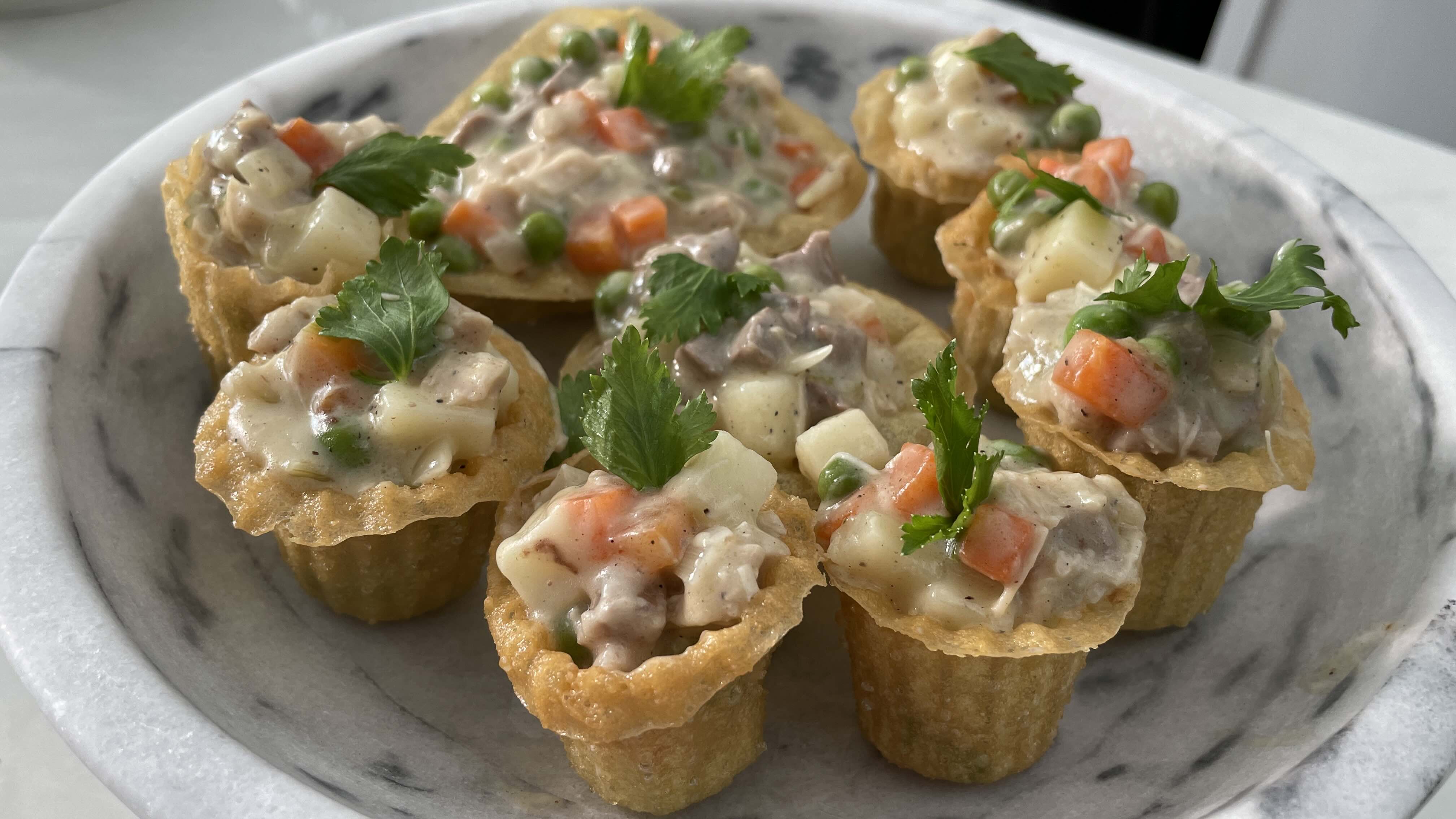
Kueh pie tee shells with rims, also called “top hats”. Commercially made shells do not typically come with rims as they break easily during the packing process.
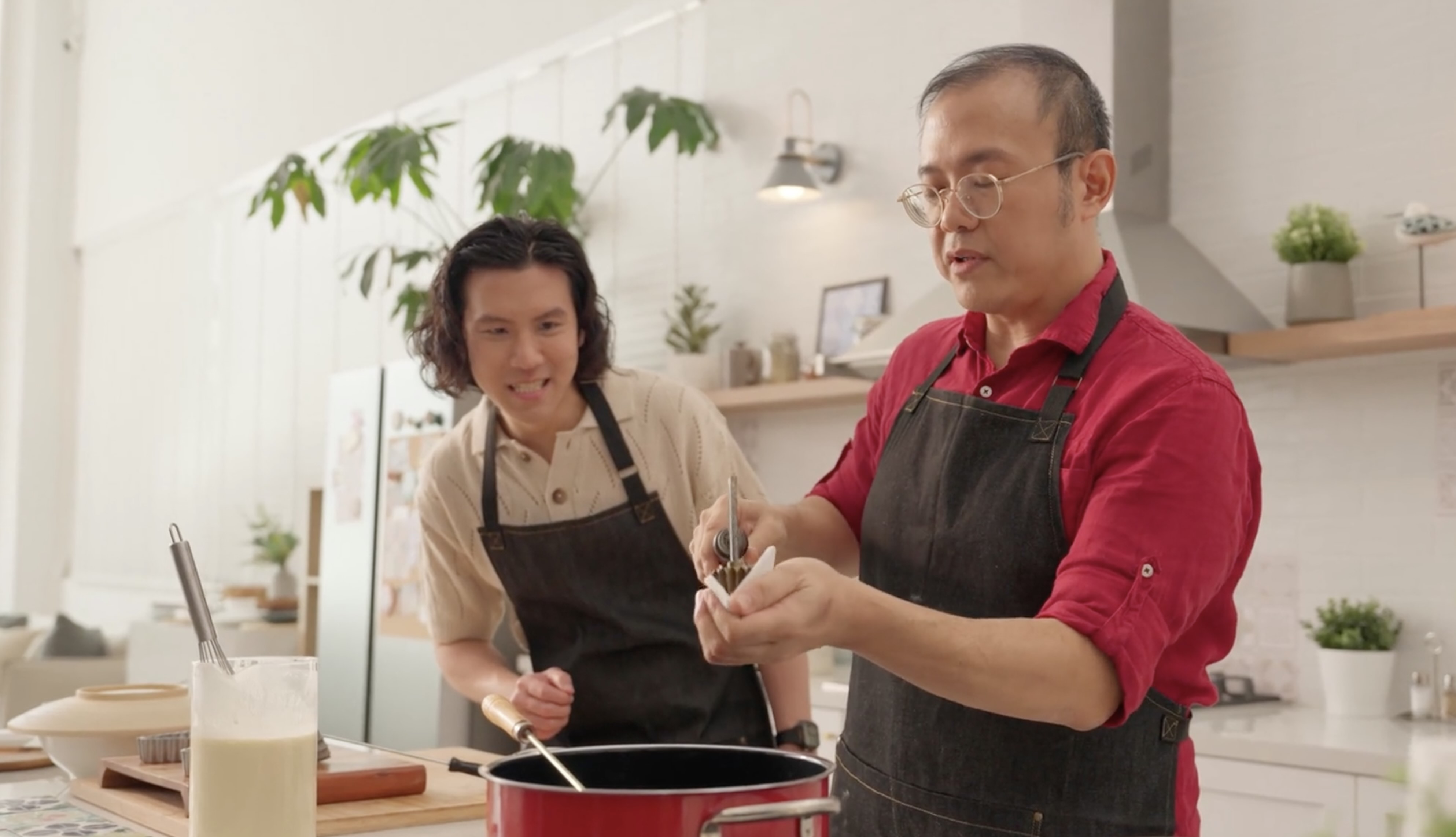
Host Paddy (left) watching nervously as Christopher blots excess hot oil from one of the moulds before it is dipped into the batter and returned to the hot oil for frying.
Recipe
Susie Hing’s recipe is for “Kroket Tjanker (Java Kwei Patti)”, but according to Christopher, there aren’t any Javanese recipes with the same name. One can only speculate that she got the name “kroket” from “croquette”, a deep-fried roll made of a creamy filling wrapped in mashed potato, egg and breadcrumbs. Perhaps she was inspired by the filling of the Dutch-Indonesian croquette, which is almost identical to the filling for her kwei patti.
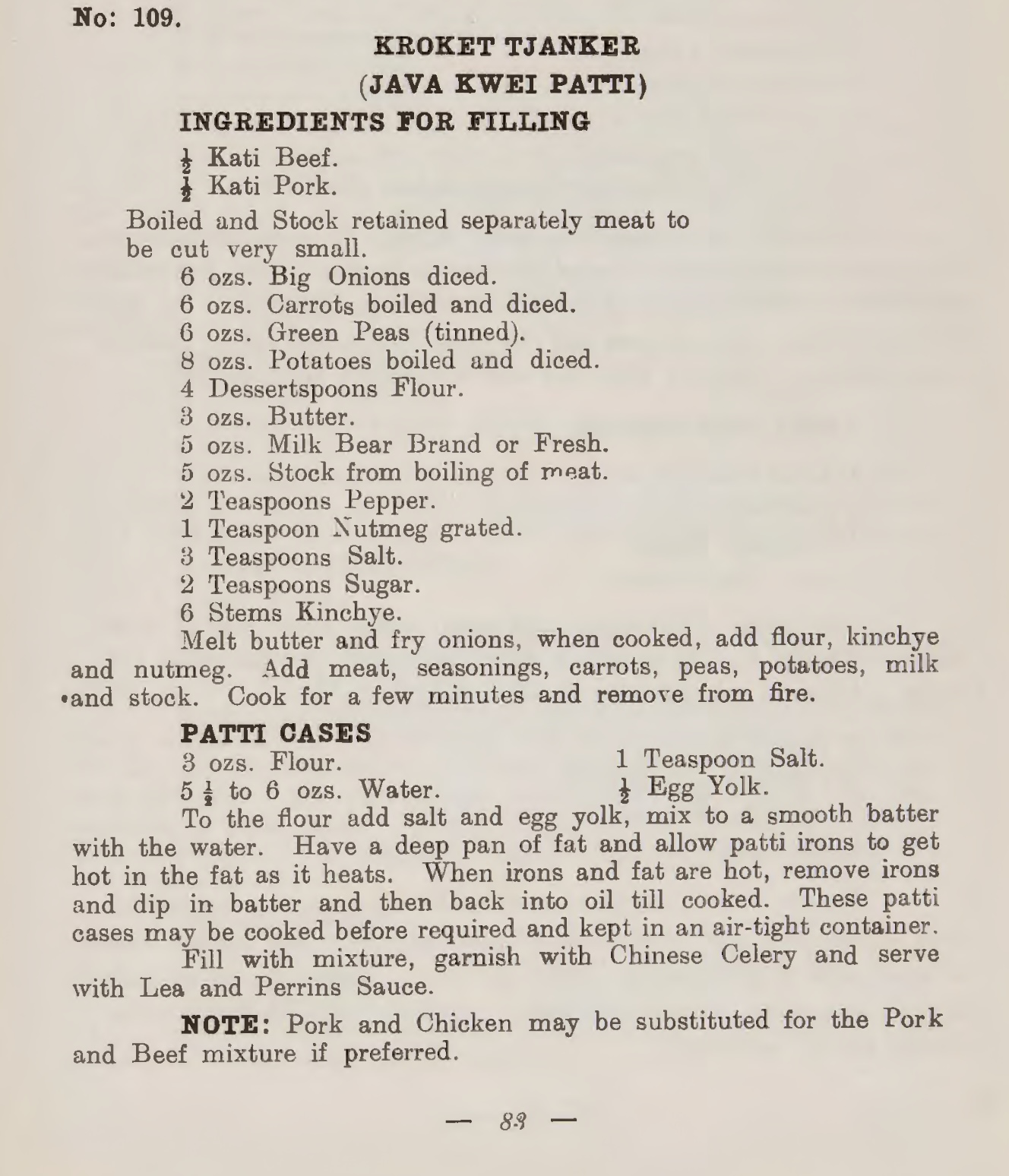
Recipe for kwei patti, showing measurements in ounces and kati. These imperial and local measurements were dropped after the metric system was adopted in Singapore in 1971.
Christopher used different moulds to make the pie tee shells, including local modern and vintage pie tee moulds, and American moulds.
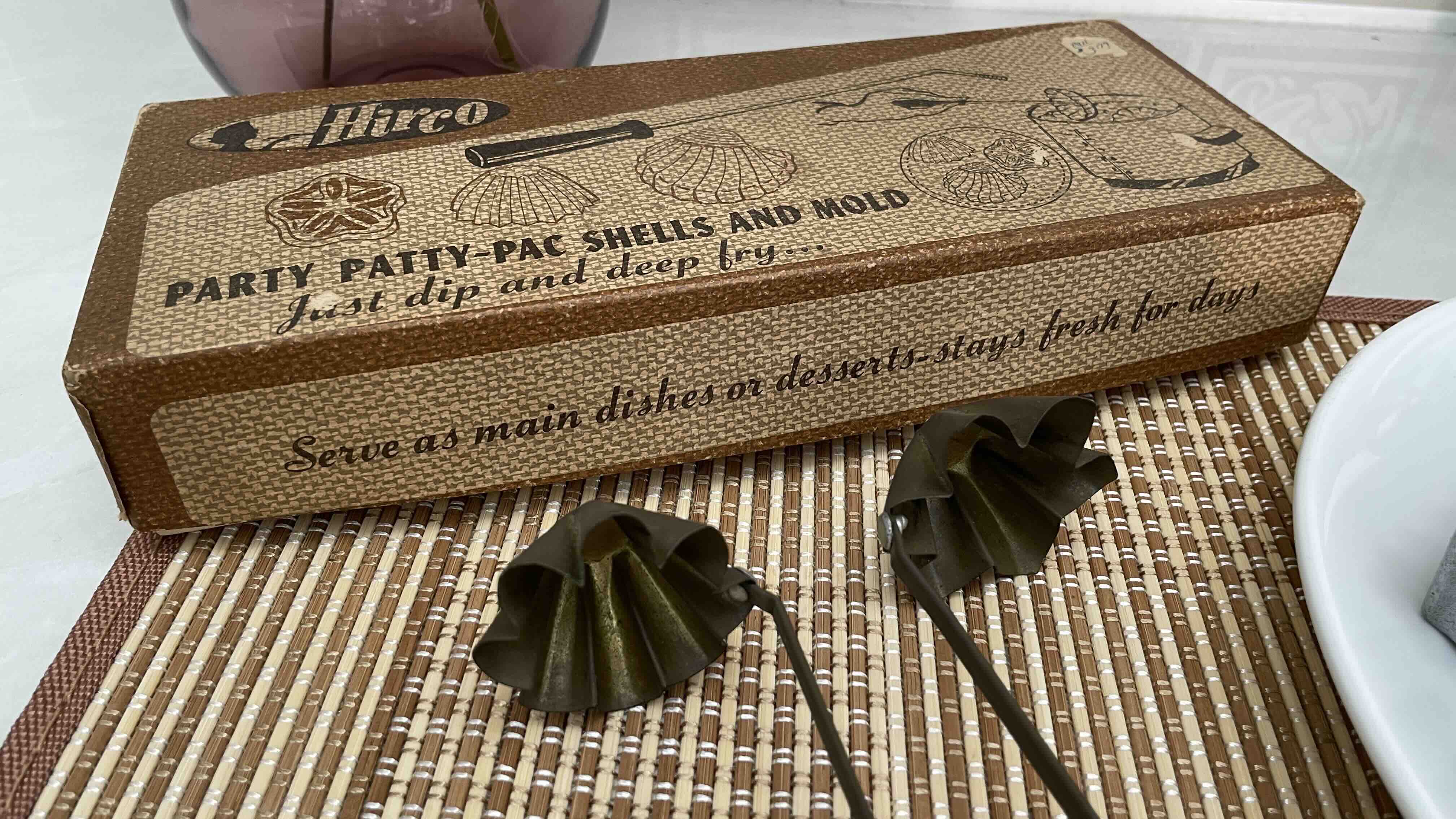
The American moulds made by Hirco, perhaps sometime during the 1950s–70s.
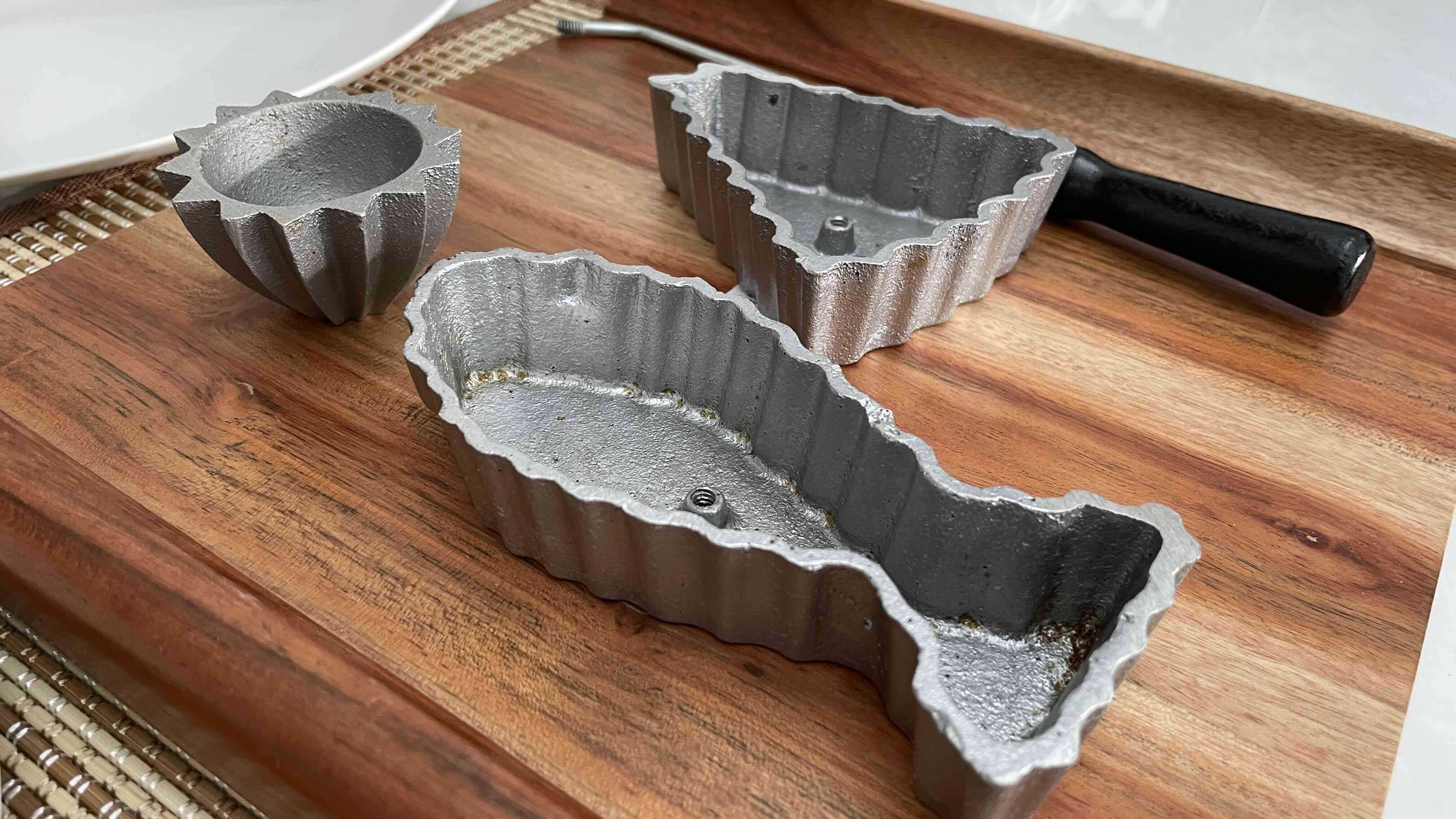
The American moulds by Hirco came in a set of many different shapes and could be unscrewed from the handle.
Related Podcast
Kueh Pie Tee: A Detective Story
Kueh pie tee is not a pie that goes with tea. So where did the name (and dish) come from? Award-winning cookbook author Christopher Tan combs through old newspapers and cookbooks, in search of the origins of the dish.
Related Articles
Peranakan (Straits Chinese) Community
In Singapore today, the term “Peranakan” generally refers to a person of mixed Chinese and Malay/Indonesian heritage. Many Singapore Peranakans trace their origins to 15th-century Melaka, where their ancestors were thought to be Chinese traders who married local women.
Babas and Nonyas: The Peranakan Chinese in Singapore
The local Baba community has a social history that is as fascinating as their material culture is colourful. Known as Peranakan (or Peranakan Cina), the Babas are an acculturated community of Southern Chinese domiciled in the Straits Settlements since they first settled in Melaka in the 16th century.
Love Is a Many-Layered Thing
What lies in this vale of tiers? Christopher Tan delves into lapis legit, the cake as famous for its exacting recipe as for the unparalleled flavour of its buttery layers.
The Evolution of Straits-born Cuisine
Lee Geok Boi looks at what makes Peranakan cuisine unique and delves into old cookbooks to see how Straits-born cuisine came to be.
“Mrs Beeton” in Malaya: Women, Cookbooks and the Makings of the Housewife
Beyond their literal content, cookbooks offer interesting insights into the domestic space of British Malaya, shedding light on how women saw themselves and how feminine ideals from the West were propagated in the colonial era.
Milestones to the Metric System
Prior to the 1970s, Singapore used three different systems of weights and measures. Shereen Tay traces how we transitioned to the metric system.
Related Books
Hing, Susie. In a Malayan Kitchen. Singapore: Mun Seong Press, 1956. (From National Library, Singapore, call no. RCLOS 641.59595 HIN-[RFL])
Lee, Chin Koon. Mrs. Lee's Cookbook: Nonya Recipes and Other Favourite Recipes. Singapore: The Author, 1974. (From National Library, Singapore, call no. RSING 641.595957 LEE)
Wee, Sharon. Growing Up In a Nonya Kitchen: Singapore Recipes From My Mother. Singapore: Marshall Cavendish Cuisine, 2012. (From National Library, Singapore, call no. RSING 641.595957 WEE)