
Article
Bugis Street: From Sleazy to Sanitised
Topics
Places and Buildings
10 October 2015
The spruced up Bugis Street of today is a far cry from the days when it was a bump-and-grind fleshpot. Lee Meiyu chronicles its chequered history.
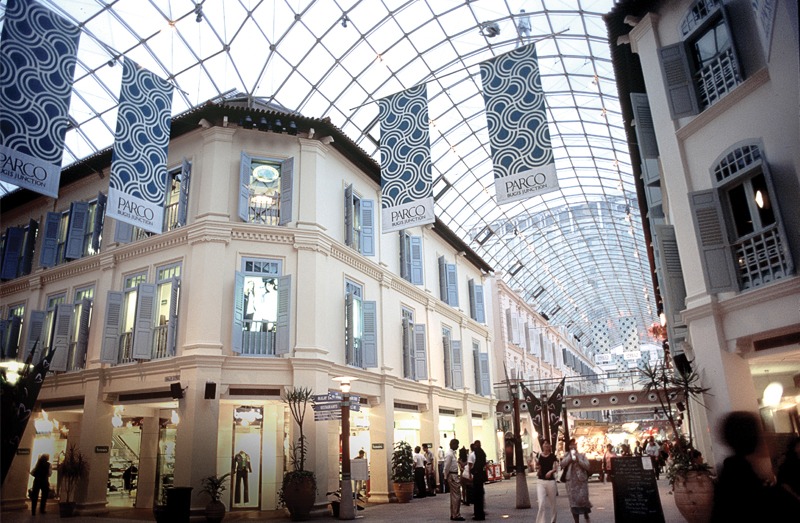
Bugis Junction with its covered glass and air-conditioned walkways. This photo was taken in 1995 when the shopping mall first opened. G. P. Reichelt Collection, courtesy of National Archives of Singapore.
In 1960, the Dutch writer Francis Downes Ommanney described Bugis Street as “one of the most beautiful streets in the world” and endowed with an “irrepressible vitality”. From the 1950s to the early 80s until it was bulldozed in the name of redevelopment in 1985, Bugis Street was a notoriously seedy area that put Singapore on the map for all the wrong reasons. Even back in 1960, Ommanney knew the days of Bugis Street were numbered. The fact that the street existed for another 25 years after his account was written speaks volumes of its resilience.
The Early Years
To most young Singaporeans, Bugis Street is known for its affordable and quirky fashion goods. Its heady days of wild partying have largely been forgotten by the crowds that throng the places that bear its name today – Bugis Junction and Bugis+ shopping malls and the “new” and sanitised Bugis Street with its maze of small shops and street carts. Yet, for decades after its disappearance, Bugis Street continued to fascinate novelists, playwrights and filmmakers who reference in their works its raucous streetside dining and boozing along with its other more tawdry offerings.
Perhaps one of the most controversial films ever made about Bugis Street is Saint Jack by the American director Peter Bogdanovich in 1979. Banned by the authorities for depicting Singapore as a “haven for pimps and whores”, the film became infamous when Bogdanovich later admitted to duping the authorities in order to secure permission to shoot his film.
BUGIS STREET IN LITERARY WORKS AND FILMS
1955: Bugis Street Blues: A Sentimental Guide to Singapore by Barrington Kaye (poem)
1964: Pretty Polly Barlow by Noel Coward (novel)
1965: Pretty Polly by Guy Green (film)
1973: Saint Jack by Paul Theroux (novel)
1979: Saint Jack by Peter Bogdanovich (film)
1992: Lest the Demons Get to Me by Russell Heng (play)
1992: Private Parts by Michael Chiang and Dick Lee (play)
1994: Bugis Street by Raymond and Edmund Ooi, lyrics by Tan Hwee Hua and Mock Pak Lum (musical)
1994: Bugis Street: The Novel by Koh Buck Song and Tan Hwee Hua (novel)
1995: Bugis Street by Yonfan (film)
(This list is not meant to be exhaustive.)
Despite its infamy as a seedy place crawling with drunks, pimps and prostitutes, Bugis Street has a long history that predates its unsavoury past. Migrant communities used to live and work in this area during the time of Singapore’s founding. In the 1822 Raffles Town Plan drawn by surveyor Philip Jackson, the area was designated as the European town with an Arab kampong (village), the sultan’s compound and a Bugis kampong located further east along the shoreline. Old land records show that the site of the former Bugis Street was first leased to a J. de Almeida by the British East India Company in 1829. Although Jackson’s town plan never fully materialised, the first topological survey conducted by George D. Coleman in 1829 showed that the area was well developed, with a “Jalan Bugus” appearing for the first time on a map of Singapore. However, Jalan Bugus was not located in the present vicinity of Bugis Street, but further east along the west bank of the Rochor River.
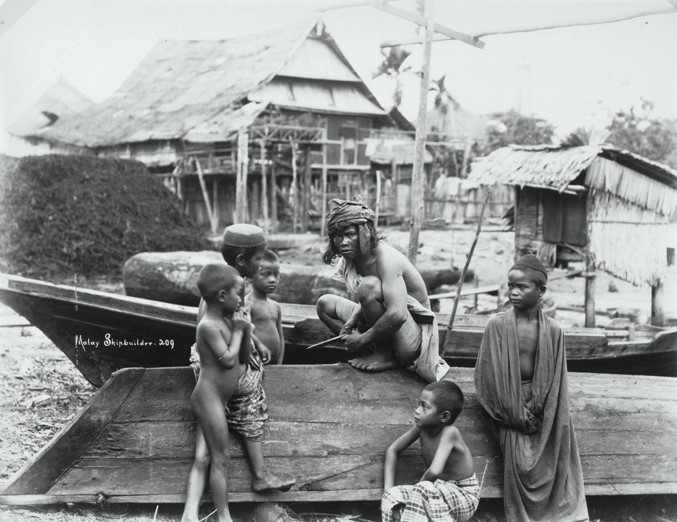
A boat builder and his family in Kampong Bugis, c. 1880s. Courtesy of the National Museum of Singapore, National Heritage Board.
WHO ARE THE BUGIS?
Bugis Street serves as a reminder of the long history and connection between the Bugis community and Singapore. Sketched on the earliest landward map of Singapore drawn between 1819 and 1820 was a “Buggugs Town extending to Eastern Bay” (“Buggugs” is the older spelling of “Bugis”) near the sultan’s palace. The town’s location is the present-day Kampong Glam district.
The Bugis, originally from Celebes (now known as Sulawesi) in Indonesia, migrated to various parts of Southeast Asia and rose to become prominent members of the Riau-Johor ruling family through armed action, strategic marriages and an extensive trading network between the 17th and early 20th centuries.
In February 1820, around 500 Riau-Bugis people fled to Singapore after armed clashes with the Dutch. The first Resident of Singapore, William Farquhar, welcomed them, knowing full well that they would attract the lucrative Bugis trade to the fledgling Singapore port.
The Europeans, however, never moved into the Bugis Street area, preferring the north bank of the Singapore River and what is now the downtown core of Singapore. Instead, overcrowding at nearby Chinatown caused a spillover of the Chinese population into the Bugis area. In particular, the Hainanese community became so entrenched in the area that they had a street adjacent to Bugis Street named after them – Hylam Street (“Hylam” is the older spelling for “Hainan”).
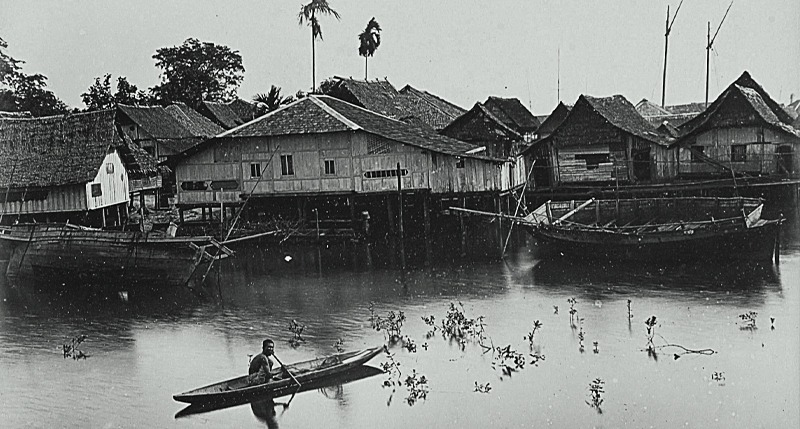
In the 1820s, Kampong Bugis was located between Rochor and Kallang rivers on the eastern side of Singapore. Photographed by G. R Lambert & Company. Courtesy of the National Museum of Singapore, National Heritage Board.
In former times, Bugis Street was known in Hokkien as “Peh Sua Pu” (白沙浮), or “white wash”. It is not known why the street was so named, but it could be attributed to the fact that houses there were once given an extra coat of whitewash. Older residents in the area believe the name comes from the fine layer of white sand that settled in the area, likely blown in from the sea just beyond Beach Road before land reclamation in subsequent decades pushed the shoreline out. Interestingly, the Cantonese called the street “Hak Kaai” (黑街) or “black street”, probably because there were no street lights in the early days and it was pitch-dark during nightfall.
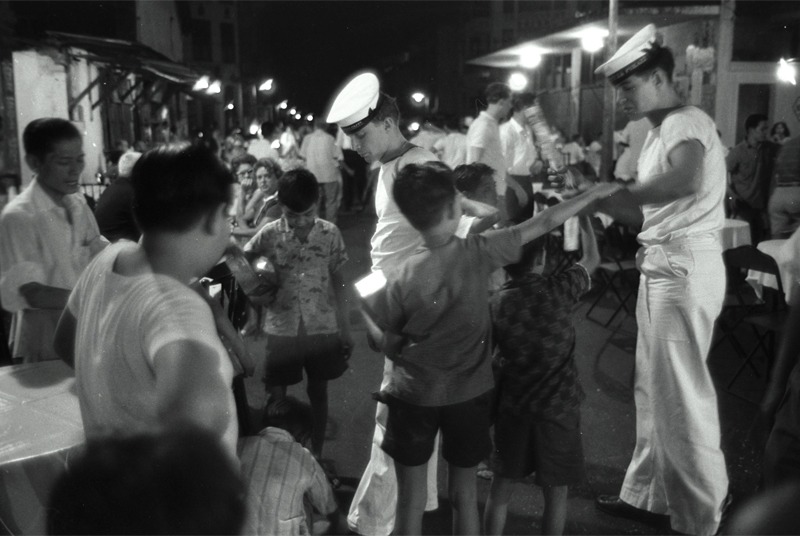
Western seamen on shore leave at Bugis Street in 1962. Courtesy of National Archives of Singapore.
Bugis Street was also part of what was known as “Little Japan”, an area that stretched from Sophia Road in the north to Beach Road in the south, and Rochor Road in the east to High Street in the west. The pre-war Japanese community in Singapore congregated in Little Japan, and the vicinity of Bugis Street was notorious for its Japanese brothels in the late 19th and early 20th centuries. The colonial government viewed prostitution as a necessary evil as the serious imbalance in the male and female populations in almost all the new migrant communities forced single males to seek out the company of prostitutes. As a result, two locations near Bugis Street were designated as red-light districts as early as the 1860s: the area surrounding Malay Street, including Bugis Street, and further west around North Canal Road. Prostitution was further legalised under the 1870 Contagious Diseases Ordinance, which recognised government-registered brothels.
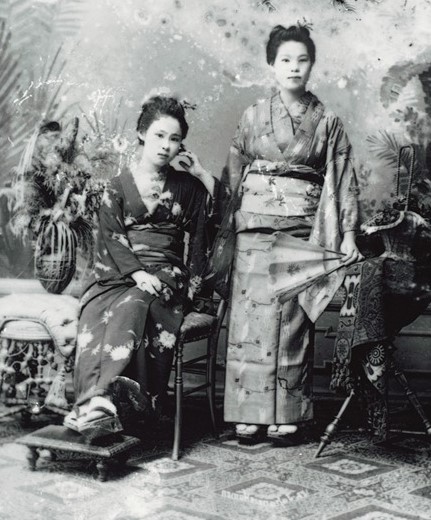
Portrait of two karayuki-san in Singapore taken by G. R. Lambert & Company in 1890. Literally “Ms Gone Overseas”, karayuki-san were Japanese women who travelled to East and Southeast Asia to work as prostitutes. Courtesy of the National Museum of Singapore, National Heritage Board.
The Vice Trade and Other Shenanigans
Prior to the arrival of the Japanese prostitutes, European prostitutes were already occupying the area in such large numbers that a campaign was called for their removal in June 1864. The prostitutes were described in The Straits Times as plying their trade from the doorways of the brothels or roaming the streets, and were painted as “florid, blowsy type, foul-mouthed harridans” and “not a night… passed without brawls and police raids and the crash of bottles thrown from open windows”.
After the European prostitutes were evicted, the Japanese moved in and set up two brothels on Malay Street around 1877, gradually replacing the brazen European girls with the more delicate karayuki-san, the term used for Japanese prostitutes. By the turn of the century, Singapore’s red-light district was clearly defined within the confines of Malay Street, Bugis Street, Hylam Street, Malabar Street, Fraser Street and Tan Quee Lan Street, with the first four streets described as “public thoroughfares”. A traveller visiting the place once described the colourful scenery:
“Every brothel had a table and a few chairs in front of it, as well as benches along the wall. These were placed there for the karayuki girls to sit and wait for customers… and the girls… who all have chalk-white faces like winter melons, which look even more pale under the glow of the lamp… are calling out to any stranger….”1
The Japanese flesh trade reached a peak between 1904 and 1905 – with an astounding 130 brothels operating in the area – until licensed Japanese prostitution was abolished in 1920. As Japanese prostitutes followed the fate of their European predecessors, the Bugis Street area continued to prosper as a Japanese shopping district and a popular dining location for locals.
So Where Exactly was Bugis Street?
Bounded by Victoria Street to the north, North Bridge Road to the south, Middle Road to the west, and Rochor Road to the east, Bugis Street first appeared as Charles Street on an 1857 map entitled “A General Plan of the Town and Environs of Singapore” by S. Narayanen. Malay Street was drawn parallel to it. By 1878, Charles Street was depicted as Buggis Street in J. F. A. McNair’s “Map of the Town and Environs of Singapore”. Malabar Street and Hylam Street also appeared on a map for the first time, and they were drawn adjacent to Bugis Street and linking it to Malay Street. The layout of the streets in the area remained more or less intact from 1931 onwards, with Albert Street extended to link up with Bugis Street and Tan Quee Lan Street. In 1991, the four streets – Malay Street, Hylam Street, Malabar Street and Bugis Street – were expunged when construction of Bugis Junction began.
So where is the old Bugis Street today? Its location is likely what is now called Bugis Square – although few people know its name as such – tucked between the buildings that make up Bugis Junction. More precisely, this is the empty, cobblestoned space in front of the entrance leading into BHG department store and Starbucks cafe.
The entire Bugis Junction complex, which includes the InterContinental Singapore hotel and an office block, was developed on the site where the four expunged streets used to be. The glass-covered air-conditioned walkways of Bugis Junction on the ground floor were previously occupied by Malay Street, Malabar Street and Hylam Street. Tell-tale signs include the faux old-style shophouses built along both sides of the main walkway and the 11 inconspicuous information boards on the history of the place. Look out also for the indoor “street” signs that carry these old street names.
The Montmartre of Singapore
Looking at the crowds milling around the Bugis Junction area today, it is difficult to associate it with Bugis Street’s notoriety as a haven for transsexuals and drag queens. In November 1957, The Singapore Free Press described the street as the Montmartre of Singapore:
“Wherever you go, all over the world, people will ask you, “Is Bugis Street still going strong?” It is, in its own particular way, one of Singapore’s windows and is as much a part of our city as Montmartre is to Paris. How Bugis Street became popular no one knows, but popular it is and popular it will remain, enjoying the reputation of being the Apache Quarter of Singapore.”2
For about three decades from the 1950s to the early 1980s, Bugis Street functioned as a nightspot for both locals and tourists, offering street dining under the open sky. Wild partying, accompanied by street brawls, was a frequent occurrence as the evening progressed. The thoroughfare came alive during the early evenings and the revelry often lasted until the wee hours of the morning.
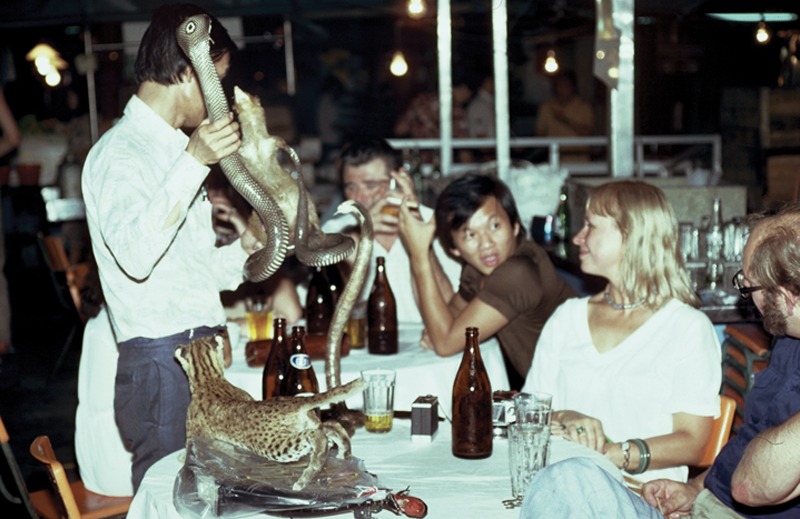
Bugis Street vendors selling stuffed animals to tourists, 1979. Ronni Pinsler Collection, courtesy of National Archives of Singapore.
The street connected two busy main roads, Victoria Street and North Bridge Road, and was lined with hawker stalls along both sides. Waiters clad in white singlets and shorts ran between the tables, shouting orders over their customers’ heads, nimbly avoiding beggars holding out tins for contributions. As the witching hour drew closer, the street became more raucous with Chinese singing girls, shoe-shine boys, peddlers, prostitutes and pimps, reaching an apex when the famous drag queens made their much-awaited appearance. The locals who visited in the evenings with their families for the food would be replaced by gawking tourists as well as British servicemen and European sailors looking for beer and pleasures of the flesh.
For many tourists, the main highlight of the night would be the drag queens and transsexuals, derisively called ah quah (in Hokkien) or bapok (in Malay), the Singaporean equivalent of the famous Thai ladyboys. Scantily clad in women’s clothes, with make-up expertly applied and blonde wigs to finish the look, these women were a sight to behold. Onlookers were astonished by their femininity and beauty. The drag queens would sashay down the street, flaunting their bodies and stopping occasionally to flirt. Photos of these transsexual women clothed, semi-nude or even nude, could be purchased and for a fee, they could be persuaded to sit on customers’ laps and take a photo together as a souvenir.
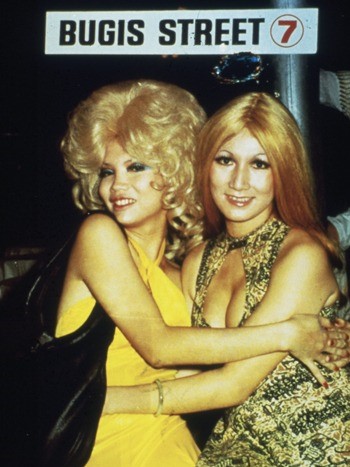
Dolled-up transsexuals at Bugis Street in the 1980s. Singapore Tourist Promotion Board Collection, courtesy of National Archives of Singapore.
The prostitutes, both straight and transsexual, operated similarly, weaving among the tables looking for prospective customers or standing in the alleyways waiting. Once a deal was struck, the prostitute and the customer would leave the scene in one of the taxis or trishaws waiting for business or adjourn to a grubby cubicle in the nearby red-light district of Albert Street and Tan Quee Lan Street. Sailors and GIs who stayed throughout the night became so inebriated with alcohol that they would sing without abandon. Some would climb onto the nearby public toilet roof and perform an impromptu lewd dance, much to the delight of the crowds and the chagrin of the police.
Secret societies and street brawls were a perennial problem, and prostitution promised handsome profits to those who controlled the business. Gangs marked out their territories and skirmishes occurred when boundaries were encroached. Gangsters often demanded “protection money” from the small-time businesses that operated in the area, and when owners refused to comply, their shops would be smashed. Families who were familiar with the sleazy reputation of Bugis Street after midnight generally avoided the place. It was a source of constant headache for the police, and daily patrols were carried out to ensure the safety of visitors in the area.
The Transformation of Bugis Street
Bugis Street survived the British withdrawal of military troops from Singapore in the early 1970s by attracting tourists and locals, as well as military men from the ANZUK forces (formed by Australia, New Zealand and the United Kingdom), who replaced the British troops. However, its fate was sealed in 1984 when the government expressed intention to redevelop the prime land it occupied. Vociferous public pleas for its conservation appeared in local newspapers shortly after the announcement, which led to a joint study by the Ministry of National Development and the Singapore Tourist Promotion Board (now Singapore Tourism Board, STB).
To the disappointment of the street hawkers, shopkeepers and fans of Bugis Street, the study concluded that the street would not be preserved, citing development needs, the construction of the Mass Rapid Transit station at Victoria Street as well as potential health risks from lack of sewers in the area as reasons. Bulldozers were sent in to demolish the shophouses on Bugis Street in October 1985, marking the end of an era that spanned more than a century. The hawkers and shopkeepers were relocated, while the transsexuals and prostitutes moved their business elsewhere.
There were attempts by the STB after the demolition to recreate a sanitised version of the Bugis Street of yesteryear, but these efforts failed to take off. A decade later, Bugis Junction, which officially opened on 8 September 1995, was built on the site of the former Bugis, Malay, Hylam and Malabar streets. It is a mixed-use development housing a shopping mall, an office tower and the InterContinental Singapore hotel. The “new” Bugis Street opposite Bugis Junction on Victoria Street is now a squeaky-clean pedestrianised shopping street that the authorities recreated when they hived off part of Albert Street.
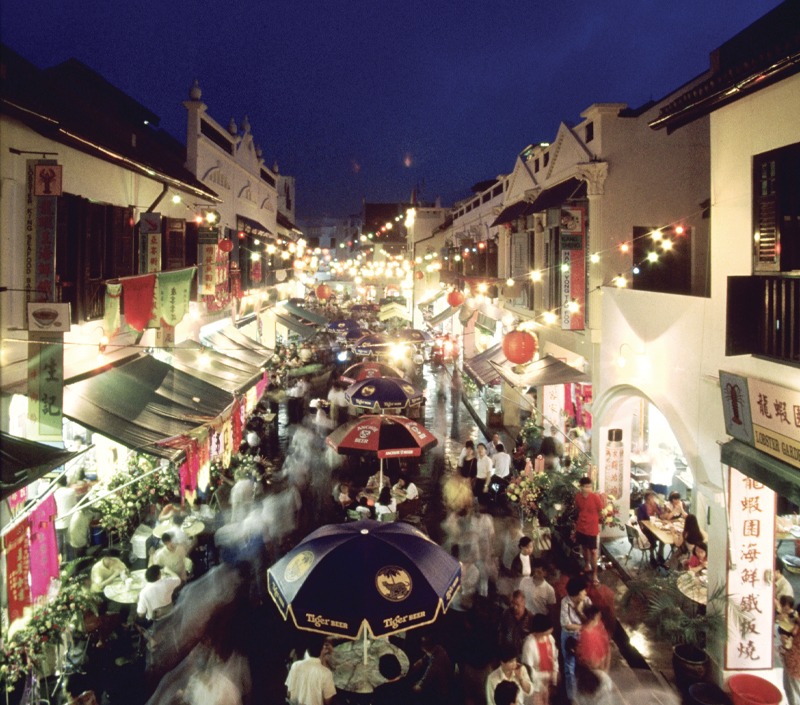
Attempts were made to revitalise Bugis Street after the original was demolished in 1985 but these eventually fizzled out. Singapore Tourist Promotion Board Collection, courtesy of National Archives of Singapore.
Today, there are occasional attempts to revive Bugis Street in novels, plays and films, as well as in accounts of tourists and locals who remember the area. They reminisce about the sights, sounds and smells, and the larger than life personalities that defined the spectacle known as Bugis Street – the street that never slept.
About the Author
Lee Meiyu is a Librarian with the National Library of Singapore. She is co-writer of publications such as Money by Mail to China: Dreams and Struggles of Early Migrants and Roots: Tracing Family Histories – A Resource Guide.
Endnotes
1 Warren, J.F. (2003). Ah Ku and karayuki-san: Prostitution in Singapore, 1870–1940 (p. 51). Singapore: Singapore University Press. (Call no.: RSING 306.74095957 WAR)
2 Opinion Montmartre of S’pore. (1957, November 29). The Singapore Free Press, p. 4. Retrieved from NewspaperSG.
References
Aleshire, I. (1985, February 6). Study on Bugis Street gives hawkers reprieve. The Straits Times, p. 44. Retrieved from NewspaperSG.
Aleshire, I. (1985, July 13). Bugis Street stalls must go – it's final. The Straits Times, p. 9. Retrieved from NewspaperSG.
Bastin, J., & Lim, C.S. (2012). The founding of Singapore 1819: Based on the private letters of Sir Stamford Raffles to the Governor-General and Commander-in-Chief in India, the Marguess of Hastings, preserved in the Bute Collection at Mount Stuart, Isle of Bute, Scotland, together with a description of the earliest landward map of Singapore preserved in the Bute Collection at Mount Stuart, Isle of Bute, Scotland. Singapore: National Library Board. (Call no.: RSING 959.5703 BAS)
Bugis area streets to be roofed and air-conditioned. (1992, January 25). The Straits Times, p. 23. Retrieved from NewspaperSG.
Bugis St buildings torn down. (1985, October 15). The Straits Times, p. 38. Retrieved from NewspaperSG.
Chan, S.K. (1964). A study of a street – Bugis Street: A street of no night (unpublished dissertation). Singapore: National University of Singapore. (Not available in NLB holdings)
Codelli, L. (Ed.) (2014). World film locations. Singapore. Bristol: Intellect Books. (Call no.: RSING 791.43025095957 WOR)
Firmstone, H.W. (1905, February). Chinese names of streets and places in Singapore and the Malay Peninsula. Journal of the Straits Branch of the Royal Asiatic Society, 42, 53–208, p. 70. Retrieved from JSTOR via NLB’s eResources website.
Goh, C., & Woo, Y.Y. (Eds.). (2009). The Coxford Singlish dictionary. Singapore: Angsana Books. (Call no.: RSING 427.95957 COX)
Lim, S.W. (Ed.). (2002). Postmodern Singapore. Singapore: Select Pub. (Call no.: RSING 959.57 POS)
McKie, R.C.H. (1972). Singapore. Sydney: Angus and Robertson. (Call no.: RSING 959.57 MAC)
National Archives of Singapore. (1857). A General Plan of the Town and Environs of Singapore [Survey Map]. Retrieved from National Archives of Singapore website.
Ommanney, F.D. (1960). Eastern windows. Longmans, Green. (Call no.: RSING 959.51 OMM)
Opinion Montmartre of S’pore. (1957, November 29). The Singapore Free Press, p. 4. Retrieved from NewspaperSG.
Pearson, H.F. (1969, July). Lt. Jackson’s plan of Singapore. Journal of the Malaysian Branch of the Royal Asiatic Society, 42 (1) (215), 161–165, pp. 162, 165. Retrieved from JSTOR via NLB’s eResources website.
Pelras, C. (1996). The Bugis. Cambridge, Mass.: Blackwell Publishers. (Call no.: RSING 959.84 PEL)
Salma Khalik. (1986, December 11). New site for rebirth of Bugis Street. The Straits Times, p. 15. Retrieved from NewspaperSG.
Seah, J. (1992, February 27). Ah Pin, where are you? The Straits Times, p. 5. Retrieved from NewspaperSG.
Shimizu, H., & Hirakawa, H. (1999). Japan and Singapore in the world economy: Japan’s economic advance into Singapore, 1870–1965. London: New York: Routledge. (Call no.: RSING 337.5205957 SHI)
Shingaporu Nihonjinkai. (2004). Prewar Japanese community in Singapore: Picture and record. Singapore: Japanese Association. (Call no.: RSING 305.895605957 PRE)
Survey Department, Singapore. (1979). Singapore: Town Sub-Division Number XI-1, XII-1, XII-2, XII-3, XII-4, XIII-2, XIII-3, XIII-4 [Survey Map]. Retrieved from National Archives of Singapore website. (Map was originally produced in 1931, additional markings in pencil and red ink were added on in later years and the last amendments were in 1979)
Singapore. Urban Redevelopment Authority. (1878). Map of the Town and Environs of Singapore. [Survey Map]. Retrieved from National Archives of Singapore website.
Slater, B. (2006). Kinda hot: The making of Saint Jack in Singapore. Singapore: Marshall Cavendish Editions. (Call no.: RSING 791.430232 SLA)
Survey Department, Singapore. (1828). Plan of the Town of Singapore by Lieut Jackson. [Survey Map]. Retrieved from National Archives of Singapore website.
Survey Department, Singapore. (1836). Map of the Town and Environs of Singapore. [Survey Map]. Retrieved from National Archives of Singapore website.
Swinstead, G., & Haddon, G. (1981). Singapore stopover. Singapore: Time Books International. (Call no.: RSING 959.57 SWI)
The social evil. (1864, June 18). The Straits Times, p. 1. Retrieved from NewspaperSG.
Uhde, J., & Uhde, Y.N. (2010). Latent images: Film in Singapore. Singapore: Ridge Books. (Call no.: RSING 384.8095957 UHD)
Warren, J.F. (2003). Ah Ku and karayuki-san: Prostitution in Singapore, 1870–1940. Singapore: Singapore University Press. (Call no.: RSING 306.74095957 WAR)
We don’t want sympathy, we just want understanding. (1985, October 11). The Straits Times, p. 16. Retrieved from NewspaperSG.
Wing On to take $11m stake in Bugis complex. (1992, March 10). The Straits Times, p. 39. Retrieved from NewspaperSG.