
Article
Convict Labour in Colonial Singapore
Topics
History
10 October 2015
Singapore was once a penal colony for convicts shipped in from overseas. Bonny Tan documents how their humble service raised some of its famous buildings.
![Indian labourers, most likely former convicts, repairing a road in front of the since demolished Chartered Bank Building along Battery Road, circa 1900. Image reproduced from Liu, G. (1999). Singapore: A Pictorial History 1819–2000. Singapore: Archipelago Press in association with the National Heritage Board. (Call no.: RSING 959.57 LIU-[HIS]).](https://isomer-user-content.by.gov.sg/339/815a055e-0e7b-4df6-adcf-40a0b5233ecd/Indian labourers.jpg)
Indian labourers, most likely former convicts, repairing a road in front of the since demolished Chartered Bank Building along Battery Road, circa 1900. Image reproduced from Liu, G. (1999). Singapore: A Pictorial History 1819–2000. Singapore: Archipelago Press in association with the National Heritage Board. (Call no.: RSING 959.57 LIU-[HIS]).
“Erring souls of a bygone day, men of another clime sojourning here against their will, those Indian convicts have left an indelible mark on Singapore.”1
– The Singapore Free Press and Mercantile Advertiser, 8 October 1935.
On 25 April 1825, the looming hulk of the brig Horatio pulled ashore into Singapore, carrying with it an ignominious cargo of some 80 convicts. Fortunately, this first shipment of men (and one lone woman) did not suffer the long, arduous and often fatal sea journey that subsequent batches of felons would experience. Originally from Madras (now Chennai), India, these convicts2 had been sent here from the nearby Indonesian port city of Bencoolen, in Sumatra.
Sojourning Against Their Will
In 1787, around the same time that Australia became a penal colony for British felons, Bencoolen (Bengkulu today) became the first penal colony for Indian convicts. Soon after, Penang and Malacca joined its ranks, receiving shiploads of convict labour in 1796 and 1805 respectively.
Penal transportation had proven effective in clearing the overflowing prisons in India as well as feeding the demand for cheap labour to build infrastructure and key buildings in the colonies of the growing British Empire. To the Indians, however, traversing the vast unchartered oceans or kala pani (literally “black water”) was a terrible thing, not only physically but spiritually as well. The Hindus would lose their varna, or caste status, as a result of crossing the seas, while the Muslims would find living and sharing their food and latrines with non-Muslims an abomination to their religion.
The first shipment of Indian prisoners to Singapore in 1825 was an outcome of the Anglo-Dutch treaty of 1824 that ceded Bencoolen to the Dutch in exchange for Malacca to the British. Within a week of the Horatio dropping anchor, the next shipment of 122 convicts arrived, also via Bencoolen, quickly establishing Singapore as the next penal colony in the region. By the 1830s, Singapore, along with Penang and Malacca, had been infamously designated as the “Sydney of the East” for Indian convicts, with Singapore alone accounting for more than 2,000 convicts, making up at least half of the total number in the Straits Settlements.
The British were of the view that shipping the convicts out to faraway lands for use as forced labour was more effective in deterring crime compared to other, more punitive measures. But so harsh was the journey that many convicts, even on safe arrival, died from depression and homesickness.
“The love of their native country is very great with them, and the idea of never again seeing their homes, their old and sacred places… and loss of caste, act powerfully both on mind and body…some obstinately refuse to eat at all.”3
In 1819, Singapore’s founder, Stamford Raffles had mapped out, in broad strokes, his plans for this new settlement. Unfortunately, local labour, whether Malay or Chinese, proved ineffective, expensive or insufficient, threatening to throw Raffles’ grand plans into disarray when he left the island for good in 1824. Although Raffles was adamant against using slave labour, he had learnt, through his stint as governor in Bencoolen, the benefits of using convict labour. In fact, it was Raffles who laid the foundation for an enlightened system of managing convicts during his service in Bencoolen. He improved their miserable conditions there and encouraged them to become “useful labourers and happy members of society”.
The Assistant Resident George Bonham, who had worked with Raffles in Bencoolen, was entrusted with realising Raffles’ plans in Singapore. Stretched beyond measure at a time when the British East India Company was tightening its belt and reducing personnel, Bonham received the first convicts who stepped off the Horatio with open arms. He found them generally well behaved and manageable, trained as they were under Raffles’ liberal convict system. Before long, Bonham terminated the services of the paid wardens and replaced them with convicts on much lower salaries. This in turn motivated the other convicts to strive for similar good behaviour so that they too could aspire to be promoted and escape the drudgery of hard labour.
Thus began the experiment of appointing prisoners as their own warders, which is described in John Frederick Adolphus McNair’s landmark publication, Prisoners Their Own Warders (1899). This successful exercise, unique to the Straits Settlements, was the outcome of the work of several successive, liberal-minded colonial architect-surveyors and military engineers who had been tasked to build the township using imported convicts.4
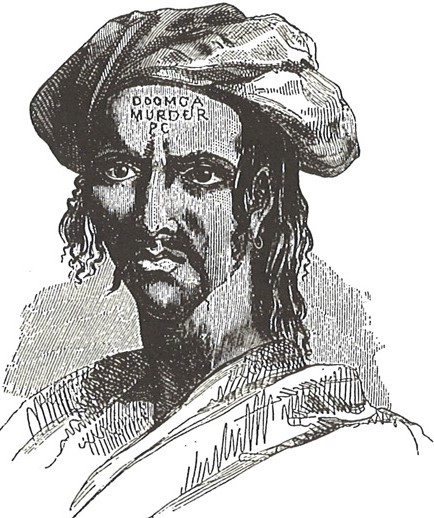
Convicts who had committed murder in India were branded on the forehead with “Doomga” which means murderer in Hindustani. Image reproduced from Marryat, F. (1848). Borneo and the Indian Archipelago: With Drawings of Costume and Scenery (p. 215). London: Longman, Brown, Green and Longmans. Retrieved from BookSG. Collection of the National Library Singapore (Accession no.: B03013523F).
An Indelible Mark
Coming mainly from India, but also from Hong Kong and Burma, one of the convicts’ early tasks included transporting soil from Pearl’s Hill and Bras Basah as landfill for the marshy area that would become the commercial hub of Singapore. As Commercial Square (present-day Raffles Place) took root, the convicts started constructing the gridline of roads that linked the town centre to the jungle interiors and coastal areas.
Beginning in 1833, under the management of architect and surveyor George D. Coleman, who was then the superintendent of convicts, several key roads were laid by convict labour: Beach Road cut along the shoreline, connecting the Malay enclave to the Chinese community; Thomson and Serangoon roads penetrated the heart of the jungles; Budoo (Bedok) provided access to the east coast of Singapore, while Bukit Timah Road acted as an artery for the transportation of goods from the Malay Peninsula to Singapore town, doing away with the need for boats. The “beautiful straight country roads” stretching between Geylang and Changi, and Newton and Kranji, were also built by the skilled hands of these convicts. Additionally, they were instrumental in developing infrastructure such as drains and sea walls.
To deal with the tiger menace in preparation for clearing the jungles, the Shikari hunting guides among the Indian convicts, armed with “muskets and ball ammunition”, were dispatched in teams to Bukit Timah, Serangoon, Changi and Chua Chu Kang. Other Indians proved adept at catching venomous snakes such as cobras and kraits, especially during the construction of Fort Canning.
“They… would stealthily follow them to their burrows, then grasp the tail, and by a rapid movement of the other hand…. grip the snake firmly at the neck and allow it to coil round their arm… They were then destroyed, the convicts… always asking pardon of the snake for so betraying it to their masters.”5
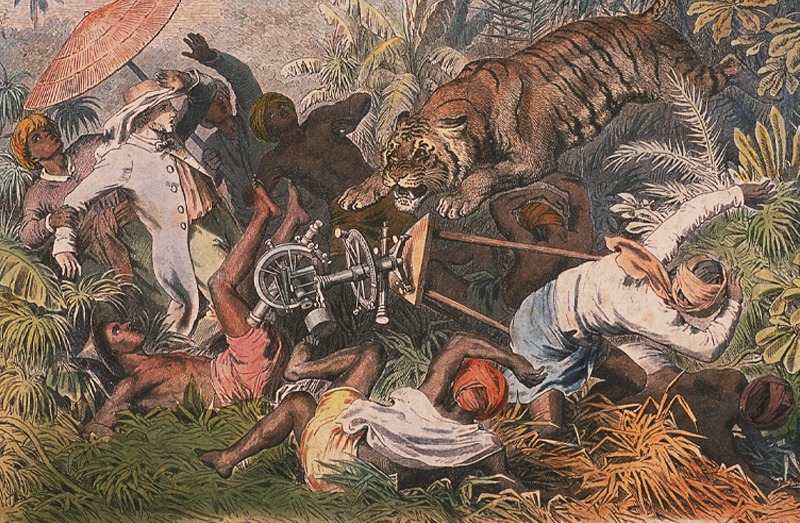
This wood engraving depicts an actual incident during which G.D. Coleman and a group of Indian convict labourers were attacked by a tiger while constructing a new road through the jungle in 1835. Fortunately, the tiger crashed into Coleman's surveying equipment and ran away, leaving everyone unscathed. Courtesy of the National Museum of Singapore, National Heritage Board.
With the roads criss-crossing the town and beyond, John Turnbull Thomson, then government surveyor and the next superintendent of convicts, engaged the convicts in a systematic survey of the island’s developed land in 1842 so that proper land leases could be issued. The men used simple tools such as a chain made of rattan, a long rod and an ordinary compass, but were accurate in charting their results.
Besides major land work, the convicts were also engaged in regular duties around town. Select groups were sent to sweep the streets daily, clear rubbish three times a day and tend the town’s parks and gardens. They were also given unenviable duties such as “[culling] stray dogs on the first three days of every month and [removing] dead bodies from public highways”. Convicts were not confined to menial tasks but also held important positions in the community, such as announcing the town’s official time by signalling when the noonday gun was to be fired from Fort Canning, serving as firefighters and police peons, or working as domestic staff in the homes of the ruling European elite.
An Open Village in a Closed Cage
Although convict labour had been used for public works since 1833, limited funding and resources inhibited most building activity until the late 1850s, when a surge in construction resulted in the proliferation of some of Singapore’s iconic 19th-century structures that still stand today. One of the earliest and most massive efforts was the building of their own prison grounds, which eventually doubled up as a factory for construction works. Construction of the prison at Bras Basah began in the 1840s, but took some 20 years to complete. It was “the largest building complex in the settlement” at the time, extending from Victoria Street to Bencoolen Street, and bounded by Stamford Road and Bras Basah Road, except the site occupied by the Cathedral of the Good Shepherd.
Henry Man, who oversaw the convicts from 1845, led the initial construction projects and highlighted to the government the vast savings accrued from using skilled convict labour. He is credited with training the convicts in mastering artisan skills such as carpentry, brick making and laying, blacksmithing, lime extraction from coral, stone quarrying and tree felling as well as dressing the timber for roofs, and door and window frames.
The convicts were organised in teams according to ethnic groups and provenance, leveraging the distinctive skill set of each group. The Madras convicts for instance handled stones and bricks, while those from Bombay served as carpenters and painters. The convicts from Hong Kong were considered as skilled stonemasons and carpenters, and the Burmese proved better at working with local thatching materials such as attap and rattan. The prison space soon evolved into a thriving village, with functional rooms designed for work rather than punitive confinement. “There were shops for tailors, weavers, rattan workers, coir and rope makers, flag makers, a printing press, and a photographic studio, and a few draughtsmen for executing plans and working drawings.”
Over time, the primitive and native ways of working were replaced by more advanced Western tools and methods, especially with the arrival of J. F. A. McNair, who served as executive engineer and superintendent of convicts from the end of 1857. He set up a large brick field along the river bank off Serangoon Road where there were deposits of good clay. Here, the convicts were taught by a skilled European brick maker to mould bricks. So superb was their craftsmanship in both making and laying bricks that their work was awarded a silver medal at the Agra Exhibition held in India in 1867. The convicts’ creativity was also seen in the rattan chaise lounge they designed and which soon became widely used throughout the Far East.
When the Bras Basah prison compound was completed in 1860, the convicts realised, not without some irony, that their own hands had transformed the informal open area of huts into a proper prison with a walled compound; the inside joke among them was that “an open campong [sic], or village, had become a closed cage”.
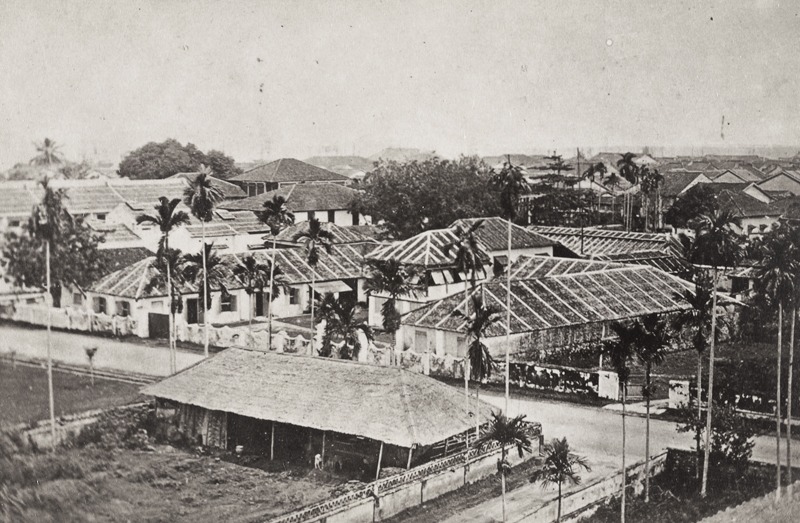
When the first Indian convicts arrived in Singapore in 1825, they were put up in convict houses located between Bras Basah and Stamford roads. Ironically, the convicts were made to build their own prison complex; work began on the Bras Basah convict jail in the 1840s and it would take some 20 years to complete. Courtesy of the National Museum of Singapore, National Heritage Board.
Raising the Civic Centre
Under McNair’s charge, the convict labour force became thoroughly organised and skilled, and the civic centre began to take shape with the construction of several key buildings. McNair’s first undertaking was to complete St Andrew’s Church (St Andrew's Cathedral from 1870), designed by architect Ronald MacPherson and consecrated in 1862 (the original edifice by G. D. Coleman had been struck by lighting and demolished in 1855).
As the original church had a steeple that was too heavy for its foundations, the new church was built with a smaller steeple. To add the finishing touch, boy convicts, who weighed much lighter than adult males, were specially trained to climb up the new steeple and place imported slates on it. The internal furnishings, including the pulpit, reading desks and fittings, were also crafted by the convicts.
.jpg)
St Andrew's Church (1862) is another key building that was built by Indian convict labour. In 1870, it was renamed St Andrew's Cathedral. Courtesy of the National Museum of Singapore, National Heritage Board.
Of special interest are the church walls and columns, which were burnished to a sheen using “Madras chunam”, a plaster comprising lime (derived from sea shells) beaten together with egg whites and coarse sugar, or “jaggery”, until a paste was formed. Then water steeped in coconut husks was added to the concoction. Once the plaster had dried, it was “rubbed with rock crystal or rounded stone until [it] took a beautiful polish”. Till today these surfaces have weathered well under the tropical sun and rain.
Work on St Andrew’s Church ended in 1862 and the convicts embarked on building the rest of the civic centre. Significant constructions include the Town Hall (1861; today’s Victoria Theatre); the battlements of Fort Canning (some of which are still standing; the courts and post office converted from the old courthouse (1864) – which today is the Arts House (formerly Old Parliament House); the master attendant’s quarters (no longer extant); a new court house (1865), which later became the office for the government secretariat – parts of which are now the Asian Civilisation Museum; as well as Cavenagh Bridge (1867) linking the civic centre to the commercial centre. “These monolithic institutions built with convict labo[u]r established the colony’s autonomy and strengthened its appeal for separation from India in 1867.”
In April 1867, the Straits Settlements finally ended its ties with Bengal, India, and came directly under the jurisdiction of the Crown in London. The conversion of the Straits Settlements into a crown colony also marked the end of Singapore as a penal colony. Officially, the transportation of Indian convicts to the island ceased, although convict labour continued to be used extensively on the island until 1873.
The newly appointed governor, Harry St George Ord, considered the rented home he was given in Singapore as well as McNair’s initial plans of a $100,000 replacement bungalow as beneath his stature. Instead, 106 acres (0.4 sq km) of land belonging to Charles Prinsep’s nutmeg estate was purchased in 1867, and McNair was tasked to build his new residence, the palatial Government House, in time for the Duke of Edinburgh’s visit in 1869, just two years away.
The convicts were taught to make special bricks for the architectural mouldings, copings, architraves and capitals that were specially manufactured in the prison kilns. They also did most of the plastering and laid the flooring for the house. Models for the Corinthian pillars and styled capitals were made on site for the convicts to copy and replicate. Besides constructing the main buildings, the grounds and gardens were also laid out by convicts.
Although endless changes to the building on the orders of Ord led to ballooning costs and severe criticisms, when Government House was finally completed, it was hailed for its symmetrical beauty and for triumphantly marrying the sensibilities of a Malay palace with a stately English mansion. Today, Government House is known as the Istana, and serves as the official residence of Singapore’s president. It is a testament to the skills of the convicts as well as their superintendent, McNair.
Souls of a Bygone Era
The outstanding structures built by the convicts were merely an outward manifestation of the unique management of the convicts. So superior was the organisation of Singapore’s convict prison that Captain (later Major-General) James George Forlong, executive engineer and surveyor in an Indian province was sent by the British government to ”prepare a code of rules based on those in force in the Singapore jail”. Having visited prison systems both in India and England, Forlong was convinced that Singapore’s was “not inferior to those of England and quite unequalled by any… seen in India”.
Between 1845 and 1846, guidelines for the management of the convicts were formalised by William J. Butterworth, then governor of the Straits Settlements. Known familiarly as the “Butterworth Rules”, they were culled from Raffles’ earliest principles and the experiences of subsequent superintendents in the management of convicts. The rules were revolutionary in “the total abolition of free warders… and the substitution entirely of petty officers, raised from amongst the convicts themselves”.6
The convicts were divided into six classes that defined their duties and responsibilities, with increasing levels of liberty and culminating in the “First Class” convict who was given a trusted position and allowed to move freely on a ticket of leave. Even so, “First Class” convicts had to attend a muster parade once a month and the ticket of leave could be revoked anytime if they misbehaved. Convicts were assigned a class upon arrival, often based on the length of their sentence. However, during their probationary period, convicts could move down a class, on account of bad behaviour, or up a class, if they were deemed reliable and manageable.
CONVICT CLASSES
Convicts were divided into six classes:
• First Class consisted of trustworthy convicts allowed to move freely on a ticket of leave.
• Second Class comprised convict petty officers, and those employed in hospitals and public offices.
• Third Class convicts were employed in roads and public works, having passed their probationary course.
• Fourth Class comprised newly arrived convicts as well as those downgraded from the higher classes or promoted from the fifth class. They worked in light irons.
• Fifth Class comprised convicts downgraded from the higher classes and required more than ordinary vigilance to prevent escape, or regarding whom special instructions had been received from India. They worked in heavy irons.
• Sixth Class were invalids and superannuated convicts. Youths were transferred to a special category within this class for “boys”. Female convicts were assigned to this class too. “They were confined in a separate ward under a convict matron, and no prison male warder was allowed therein on pain of degradation.”
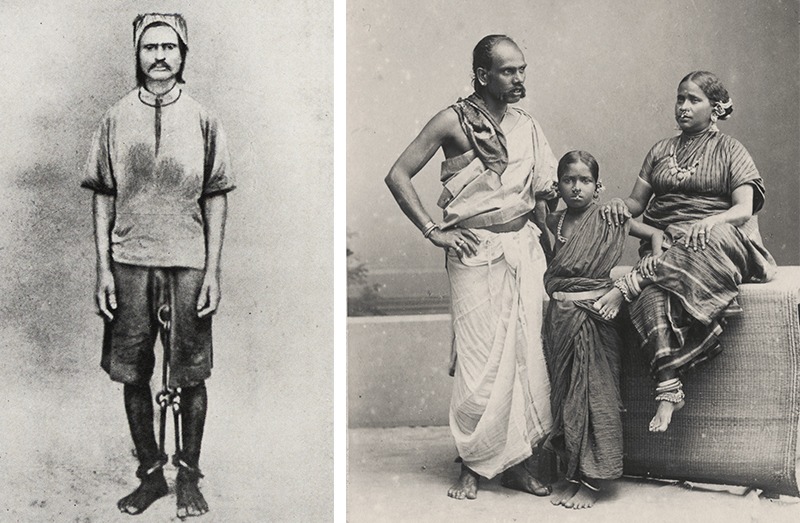
(Left) A convict of the “Fifth Class”. Image reproduced from McNair, J.F.A. (1899). Prisoners Their Own Warders. Westminster: A. Constable. (Microfilm no.: NL 12115). (Right) In May 1873, the last Indian convicts were sent to the Andaman Islands while others returned to India. “First Class” convicts who remained in Singapore married and had families. Photoalbum Singapur by G. R. Lambert & Company (1890). Image reproduced from Fotoalbum Singapur (1890). Collection of the National Library, Singapore (Accession no.: B18975148J).
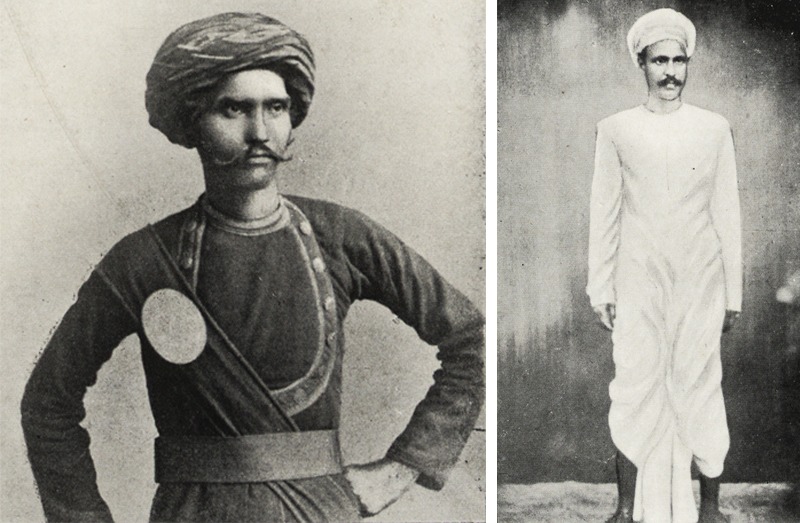
(Left) Duffadar Ram Singh, senior petty officer of the Bras Basah convict jail. (Right) A convict of the second class and munshi (clerk). Images reproduced from McNair, J.F.A. (1899). Prisoners Their Own Warders. Westminster: A. Constable. (Microfilm no.: NL 12115).
The success of Singapore’s penal system was not merely due to the way it was organised but also in the superintendent’s benign influence over the convicts. For one, the enlightened McNair, who was fluent in Hindi, was well known for his ability to guide the convicts by his mere presence and personality. In fact, he had only one European assistant, while the rest of his peons were convicts.
Although there were walls encircling the prison compound, it was generally a fluid space with Europeans entering the confinement area and convicts working and living beyond the prison walls. For example, Europeans often entered the prison grounds to provide professional training to the convicts, such as the Portuguese foreman who trained the convicts in printing, which then led to the establishment of a prison printing press.
McNair also set up a photographic studio around the 1860s and taught the convicts this new skill. The studio was popular with Europeans who were keen to have their portraits taken. In fact, the prison compound became a tourist attraction for Europeans visiting from India, who shopped for various goods in the prison shops, ranging from rattan chairs to waste paper baskets. The more trusted convicts who were employed by Europeans were even given permission to build their own huts beyond the prison confines, marry and have families. Often, convicts travelled to various parts of the town for municipal and construction work, many staying for weeks out of the prison walls in the outskirts of the township where the worksites were located.
Ticket to Freedom
On 8 May 1873, the ship Paknam conveyed the last Indian convicts to the Andaman islands and returned others to India. In Singapore, First Class convicts who had a “ticket of leave” were freed and allowed to remain in Singapore. While the magnificent civic structures built by the convicts are a testament to their contribution to society, their individual stories remain hidden in the annals of history.7
The National Library of Singapore and the National Archives hold both primary and secondary resources that can encourage further research in this field. Besides newspaper articles directly accessible from NewspaperSG, much of this article is based on two publications, namely McNair’s Prisoners Their Own Warders (1899) and Pieris’ Hidden Hands and Divided Landscapes (2009), both of which are available in the library.
CONVICTS WHO MADE GOOD
Many convicts who were involved in land survey work continued as government survey assistants. One such convict, Hammapah, set up a land brokerage, buying large plots of land in the east. His son Somapah continued the business, submitting building plans in 1884 and 1897 for what is today known as Somapah Village in Upper Serangoon Road, a legacy of his family’s successful establishment.
Another convict, Babajee or Bawajee Rajaram from Bombay, became the first native draughtsman in Singapore, having been head of the team working on the plans and drawings for many key public works, including St Andrew’s Church, the General Hospital and Government House. Upon his release, Babajee continued to produce municipal drawings between 1889 and 1897, and was even engaged in private architectural design; he drafted the design, for example, for Louis Alfred’s bungalow on Devonshire Road in 1890.
Others went into trade related to cattle, either as herdsmen, milk suppliers or cart drivers.
The author would like to thank Associate Professor Anoma Pieris at the University of Melbourne, School of Design, for reviewing this article.
About the Author
Bonny Tan is a Senior Reference Librarian with the National Library of Singapore. Her interest in architecture began during a year spent at the National University of Singapore’s Architecture Department, which led to her interest in the people behind some of Singapore’s iconic buildings.
Endnotes
1 Untitled. (1935, October 8). The Singapore Free Press and Mercantile Advertiser, p. 6. Retrieved from NewspaperSG. 2 Not all were criminals. Some were wealthy, educated and/or religious leaders, but were incarcerated for political reasons. One example is Tikiri Banda Dunuwille, otherwise known as Guru Maharaj Singh. He led rebellions against the British in Ceylon and died while incarcerated in Singapore. His remains are enshrined and venerated at the Silat Road Sikh temple. See Pieris, A. (2011, Winter). The ‘other’ side of labour reform: Accounts of incarceration and resistance in the Straits Settlements Penal System, 1825–1873. Journal of Social History, 45 (2), 453–479. Retrieved from JSTOR via NLB’s eResources website.
3 Rai, R. (2014). Indians in Singapore, 1819–1945: Diaspora in the colonial port city (p. 17). New Delhi: Oxford University Press. (Call no.: RSING 909.049141105957 RAI); Rose, J. (1988). Report on the jails and jail hospitals of the Straits Settlements, for the official year 1857–58. In R.L. Jarman (Ed.). (1998), Annual reports of the Straits Settlements, 1855–1941 (Vol 1). [Slough, UK]: Archive Editions. (Call no.: RSING 959.51 STR)
4 Because they were headed by colonial engineers, the running of penal institutions in the Straits Settlements differed from those in colonial South Asia which were led by military or medical officers. See Pieris, 2011, p. 456.
5 McNair, J.F.A. (1899). Prisoners their own warders: A record of the convict prison at Singapore in the Straits Settlements, established 1825, discontinued 1873, together with a cursory history of the convict establishments at Bencoolen, Penang and Malacca from the Year 1797 (p. 53). Westminster: A. Constable. (Call no.: RRARE 365.95957 MAC; Microfilm no.: NL12115) (A 2013 reprint is available on the open shelf of the Lee Kong Chian Reference Library.)
6 Pieris noted that “There were several subsequent efforts at penal reform related to improving hygiene and reinforcing the labour regime throughout the 19th century in tandem with developments in Europe and other colonies.”
7 Anoma Pieris stands at the forefront in piecing together the histories of individual prisoners through primary sources, ephemera and genealogical research.
References
Anderson, C. (2012). Subaltern lives: Biographies of colonialism in the Indian Ocean world, 1790–1920. Cambridge: Cambridge University Press. (Call no.: RSEA 365.34 AND)
Boon, R. (2010, August 17). McNair Street. Retrieved from Penang, Penang lang lah…… website.
Convict labour. (1935, October 8). The Singapore Free Press and Mercantile Advertiser (1884–1942), p. 6. Retrieved from NewspaperSG.
Davies, D. (1955, April 10). The prisoners built themselves in. The Straits Times, p. 12. Retrieved from NewspaperSG.
Groom, P. (1958, March 31). S’pore has a lot to thank the convicts for. The Singapore Free Press, p. 10. Retrieved from NewspaperSG.
Jarman, R.L. (Ed.). (1998). Annual reports of the Straits Settlements, 1855–1941 (Vol 1). [Slough, UK]: Archive Editions. (Call no.: RSING 959.51 STR)
Kernial, S.S. (1966). Tamil and other Indian convicts in the Straits Settlements, A. D., 1790–1873. Proceedings of the First International Conference Seminar of Tamil Studies, Kuala Lumpur, Malaysia, April, 1966. Kuala Lumpur: International Association of Tamil Research. (Call no.: RSING 494.811 INT)
Koh, T., et. al. (Eds.). (2006). Singapore: The encyclopedia. Singapore: Editions. Didier Millet in association with the National Heritage Board. (Call no.: RSING 959.57003 SIN-[HIS])
Makepeace, W., Brooke, G.E., & Braddell, R.St.J. (Eds.) (1991). One hundred years of Singapore. (Vol. 1). Singapore: Oxford University Press. (Call no.: RSING 959. 57 ONE-[HIS])
McNair, J.F.A. (1899). Prisoners their own warders: A record of the convict prison at Singapore in the Straits Settlements, established 1825, discontinued 1873, together with a cursory history of the convict establishments at Bencoolen, Penang and Malacca from the Year 1797. Westminster: A. Constable. (Call no.: RRARE 365.95957 MAC; Microfilm no.: NL12115) (A 2013 reprint is available on the open shelf of the Lee Kong Chian Reference Library.)
Phoenix. (1914, October 3). Early days – The Indian convicts in the Straits. The Straits Times, p. 2. Retrieved from NewspaperSG.
Pieris, A. (2009). Hidden hands and divided landscapes: A penal history of Singapore’s plural society. Honolulu: University of Hawaii Press. (Call no.: RSING 365.95957 PIE)
Pieris, A. (2011, Winter). The ‘other’ side of labour reform: Accounts of incarceration and resistance in the Straits Settlements Penal System, 1825–1873. Journal of Social History, 45 (2), 453–479. Retrieved from JSTOR via NLB’s eResources website.
Rai, R. (2014). Indians in Singapore, 1819–1945: Diaspora in the colonial port city. New Delhi: Oxford University Press. (Call no.: RSING 909 049141105957 RAI)
Rose, J. (1988). Report on the jails and jail hospitals of the Straits Settlements, for the official year 1857–58. In R.L. Jarman (Ed.). (1998), Annual reports of the Straits Settlements, 1855–1941 (Vol 1). [Slough, UK]: Archive Editions. (Call no.: RSING 959.51 STR)
Untitled. (1873, May 3). Straits Times Overland Journal, p. 8. Retrieved from NewspaperSG.
Verrons, N. (1846, April 25). Convicts – and convict labour. The Straits Times, p. 2. Retrieved from NewspaperSG.