
Article
Men in Blue: A History of the Singapore Police Force
Topics
Organisations
10 October 2015
The Singapore Police Force has made great strides – along with several changes in uniform – since its inception in 1819. Ang Seow Leng traces its history.
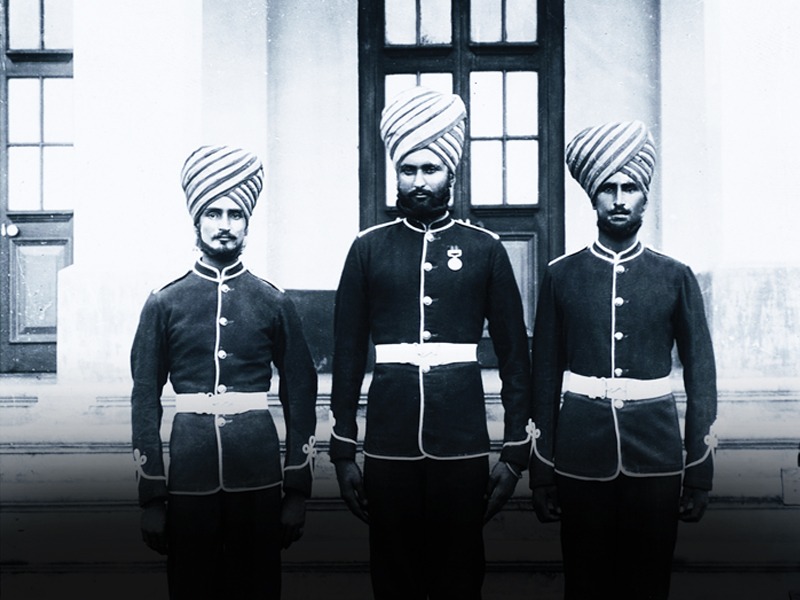
Sikhs from Punjab, India, were recruited to boost the strength of the police force. By August 1881, there were about 100 Sikh policemen in Singapore. Courtesy of the National Museum of Singapore, National Heritage Board.
Singapore’s first police force was officially established soon after the British East India Company (EIC) set up a trading post on the island in February 1819. William Farquhar, Singapore’s first Resident, appointed his son-in-law Frances James Bernard as the chief of the police department, staffed with a skeletal team of just “one constable, one jailer, one writer, one tindal and eight peons1”. The main task of the police was to take charge of the European quarter and to ensure that the mercantile community was not “disillusioned” by rising crime.
The Malay scholar and teacher Abdullah bin Abdul Kadir (better known as Munsyi Abdullah), who arrived in Singapore from Malacca sometime after June 1819, noted that the first police station in Singapore was a stone house where criminals would be charged. Before that, an attap (thatched) hut was used as a charge room in the temenggung’s2 district.
Humble Beginnings: 1819 to 1830s
Before the arrival of Raffles, Singapore’s minuscule population of barely 150 was ruled by the temenggung, a subordinate of the sultan of Johor. Just four months after Singapore’s establishment as a trading post of the EIC, foreigners, the Chinese in particular, heard about the booming town and rushed to Singapore in droves, driving the population to well over 5,000.
Three years later in July 1822, Raffles observed that Singapore had become a large and prosperous town, with at least 10,000 inhabitants from various countries actively involved in trade and commerce. The influx of migrants continued unabated and a census taken in 1911 indicated that the heterogeneous population comprised 48 different races altogether – the Chinese and Indians were counted as one race each – with no fewer than 54 different languages recorded as being spoken in the settlement.
Maintaining law and order was a challenge in the newly colonised Singapore. The increasing crime rate, especially after night fall, led a group of prominent merchants to start a Night Watch Fund in March 1821 to finance what is considered as Singapore’s first auxiliary police force comprising one jemadar3 and nine peons for night patrols.
The Treaty of Friendship and Alliance signed on 2 August 1824 between the EIC, Sultan Husain Shah, the eldest son of Sultan Mahmud Shah, the last ruler of the Johor Sultanate, and Temenggung Abdul Rahman, Hussein’s representative in Singapore, officially ceded Singapore and the adjacent islands and waters within 10 geographical miles in perpetuity to the EIC.
As Singapore flourished, the police force became seriously understaffed; in 1831, it only had 18 men. It was only 10 years later that the force was considerably enlarged with the sitting magistrate as superintendent, three European constables, an assistant constable, 14 officers and 110 policemen.
Dawn of a New Era: 1840s to 1880s
With a large influx of immigrants arriving in Singapore, among them hardcore criminals whom the Chinese and Dutch governments wanted to be rid of, the 1830s and 1840s experienced a further deterioration in the crime situation. The colonial government appealed to the residents of Singapore to attend a meeting in February 1843 to “take into consideration the present state of the local police and other matters connected therewith… as the subject is one of much importance as regards the security of the Community both in their lives and persons.”
In October 1843, Thomas Dunman was appointed to the office of the Deputy Magistrate and Superintendent of Police. He was then a commercial assistant with Martin Dyce & Company and was described as someone with an “intimate acquaintance with the manners and habits of the Natives”. Among the pressing issues that Dunman tried to resolve when he took office included frequent robberies and murders as well as violent clashes between rival Chinese secret societies.
The few British administrators on the island were stretched thin and held multiple official positions. Dunman, who was also a deputy magistrate, was unable to devote his time fully to improve the police force. Fortunately, when the Police Act of 1856 was passed in 1857, the position of Commissioner of Police was separated from that of the Resident Councillor. Dunman continued with his full-time service as commissioner until his retirement in 1871, spending 28 years of his life improving the image, morale and efficiency of the force. In appreciation of his services in quelling the 1854 Hokkien-Teochew riots, Dunman received the commendation of the Governor-General-in-Council and was presented with a sword of honour from Governor William J. Butterworth.
Between 1857 and 1871, the police force was placed under the purview of the Police Act of 1856. The Police Force Ordinance of 1871, which was passed with minor amendments in 1872, officially defined the duties of the police for the first time in Malaya, and was enforced until the Japanese Occupation (1942–45).
In 1856, the Deputy Superintendent of Police George Wahad highlighted the issues facing the police force. First, there was a language barrier as none of the Bengalese, Indian and Malay officers understood Chinese. To add to the problem, the record books were written in the respective languages of the policemen, which the European officers could not understand. Second, there were frequent changes in manpower because the Bengalese and Indian policemen went home for good after completing two or three years of service. To make matters worse, the pay was unattractive and it was difficult to retain or hire suitable candidates.
Although there was a large Chinese community residing in Singapore in the early 19th century, they were not considered as ideal candidates for the police force for various reasons, one of which was that they were repeatedly bought off by the secret societies. When the prospect of introducing Chinese police officers was debated in the Legislative Council in 1872, Hoo Ah Kay (better known as Whampoa), was of the view that Chinese men from different dialect groups be recruited to prevent dominance by any one group in the police force. However, the problem of attracting good candidates due to the low wages remained unresolved.
In 1877, the British established the Chinese Protectorate to administer all matters relating to the Chinese community in the Straits Settlements, namely the regulation of Chinese immigration to prevent abuse of the coolie (menial labour) trade, trafficking of women and girls for prostitution, and the suppression of Chinese secret societies.
William A. Pickering was appointed the first Protector of Chinese in Singapore on 3 May 1877. Pickering executed his duties with distinction: during his 10 years in office, he worked closely with the police, and made an invaluable contribution to law and order. Pickering was conversant in Mandarin and a number of Chinese dialects, and took a personal interest in the problems faced by new immigrants. He successfully broke the stranglehold of the secret societies over the Chinese community, and closed down brothels that forced young girls into prostitution.
In 1881, Sikhs and Europeans were recruited to address the manpower shortage in the police force. But this did not create a huge impact; in 1884, Inspector-General S. Dunlop reported that police officers were overworked, and often received less than three-and-a-half hours of rest in between duty. Although the situation improved in subsequent years, in 1908, there were calls to reform the police force as there were only 1,024 police officers handling a population of around 200,000. The lack of policing made some of the districts and islands around Singapore unsafe, and the police force continued to struggle to find the right people to recruit.
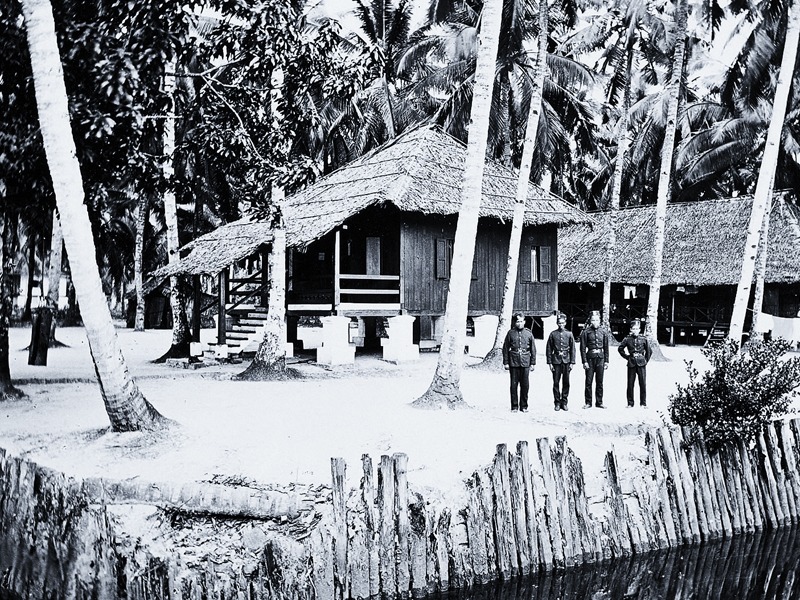
A late 19th-century police post at Grove Estate, which was formerly a coconut planation located in the Tanjong Katong area. Photographed by G. R. Lambert & Company. Courtesy of the National Museum of Singapore, National Heritage Board.
Inadequacies and Improvements: 1920s to 1950s
The arrival of Chinese refugees fleeing the political chaos in China for Malaya and other Southeast Asian countries led to an increase in secret society activity in the mid-1920s. Some migrants brought with them firearms, which were believed to have been stolen or bought cheaply from stocks that had been smuggled into China from France, Belgium and Germany. As a result, faction fighting, robberies and murders increased, and the use of firearms became so rampant that Singapore soon earned the ignominious nickname of “Chicago of the East”.4 In 1927 alone, there were about 30 murders linked to secret societies. Unfortunately, the police were ill-equipped to handle the situation. The inadequacy of the police force was highlighted in a cheeky article that was published in The Straits Times on 14 June 1929:
“Mr Low Pow Song said: “Not so very long I was in a car in Lavender Street. We were behind another car, and pulled up as the car in front was stopped by the police – a European inspector and four natives, constituting an armed patrol. Shots were fired from the car. The police disappeared. I saw them go behind the pillars on the pavement. The men in the car jumped out and ran away. The native policemen reappeared, the European inspector behind them. He was shouting, “Fire, why don't you fire?” One of the policemen replied ‘Tada biji Tuan’ [meaning “no bullets” in Malay].”
By 1923, a temporary training establishment had been set up in the vicinity of Shenton Way to train policemen. A permanent training school was eventually built on Thomson Road in 1929. For 76 years, the facility was known by various names: Police Depot, Police Training School and Police Academy, Training Command (TRACOM), among others. The school prepared the recruits for every aspect of police work, including investigation techniques and enhanced operational capabilities.
The 1930s saw a number of police buildings constructed. The Singapore Detective Branch and Chief Police Officer had their headquarters on Robinson Road, which was built at a cost of over half a million dollars in 1931. Several old police stations were also gradually upgraded into new concrete structures, like the Paya Lebar police station that used to be an old wooden hut. In 1934, the iconic Hill Street police station was completed. The six-storey neo-classical building was designed by the colonial architect Frank Dorrington Ward. It was one of the tallest buildings in Singapore at the time, and conveniently housed living quarters for policemen and their families.
During the immediate post-war years, the police suffered from the stigma of having worked under the Japanese and it was not until around 1950 that the police force managed to regain public trust. In the 1950s, senior officers of the police force were mainly British gazetted police officers who were appointed as cadet assistant superintendents of police until they passed the required examinations in police law, Malay language and government regulations in order to be promoted to assistant superintendents.
In October 1945, the Volunteer Special Constabulary (VSC) was formed to complement the police force, starting with 150 full-time officers who were paid a monthly salary. On 1 March 1949, Commissioner of Police R. E. Foulger recruited the first batch of female police officers – considered a major milestone in the history of the police force. Before this, the untrained wives of police constables were employed to “help check women accused” and were paid a dollar per search. The newly recruited women police officers were trained to handle female offenders, record the statements of victims of sexual offences, and counsel women and juveniles who were on the verge of turning to crime.
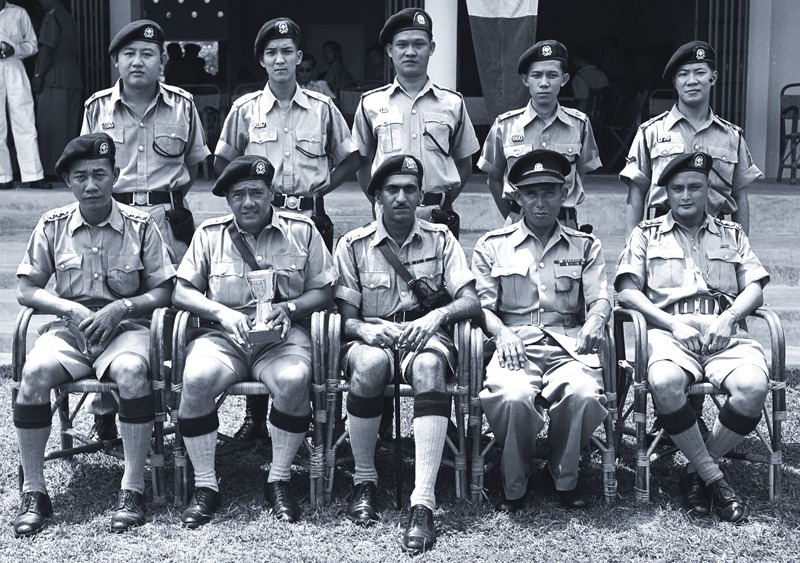
Members of the Volunteer Special Constabulary at the Police Training School, 1953. Ministry of Information and the Arts Collection, courtesy of National Archives of Singapore.
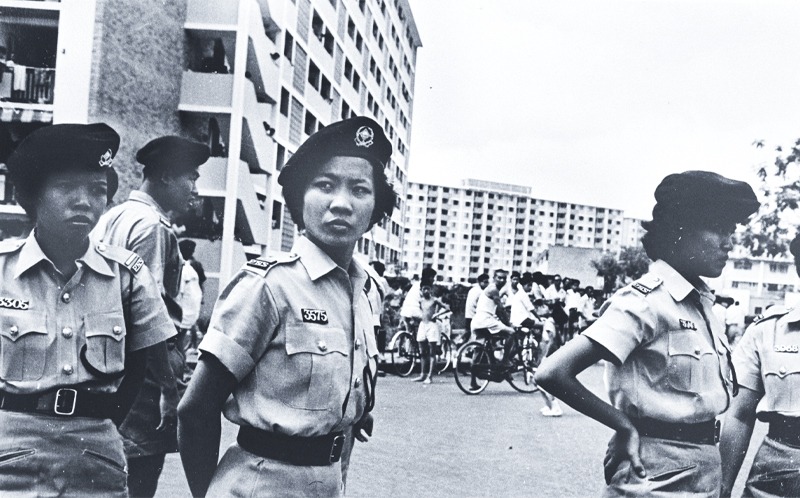
Police women guarding the demolition of unauthorised hawker stalls in St Michael’s Estate, 1962. Ministry of Information and the Arts Collection, courtesy of National Archives of Singapore.
The European, Sikh and Gurkha Contingents
The first two inspectors and 21 trained European constables arrived in Singapore on 25 March 1881, and the following day, an assistant superintendent and 54 Sikhs arrived from Punjab, India. More Sikhs continued to arrive and by August 1881, there were 100 Sikh policemen in Singapore.
Unfortunately, the European contingent did not adjust well to local conditions and was eventually disbanded in 1906. As a result, subsequent Europeans were only recruited as inspectors or gazetted officers. The Sikh contingent, however, gained a good reputation in the police force and became the favoured choice for other types of policing. Some were hired by the Tanjong Pagar Dock Company as “dock police”, while others guarded the Straits Trading Company Limited’s tin smelting works, Shell Company’s oil storage tanks at Pulau Samboe and the granite quarries at Bukit Timah Hill.
However, the situation changed dramatically after the Japanese Occupation. The Sikh contingent was disbanded due to the high attrition rate. Many Sikhs left the police force when they became demoralised due to divided loyalties experienced during the Japanese Occupation. In addition, with India and Pakistan gaining independence, recruitment opportunities became scarce.
Seeing the need for a paramilitary unit of the armed police force that was of “a completely foreign element of independent character, unaffected by the racial prejudices of Malaya”, Commissioner Foulger initiated negotiations to start a Gurkha contingent in Singapore. The fiercely loyal Gurkhas from Nepal, well known for their bravery and military prowess, were specially recruited to maintain law and order during civil disturbances, guard vital establishments, provide personal protection for important people and act as ceremonial guards of honour. The first batch of Gurkhas arrived in March 1949, followed by three more batches in April and May, totalling 150 men.
The Gurkha forces were called to the frontlines during several major civil disturbances in the 1950s, namely the Maria Hertogh riots in 1950, the Hock Lee Bus riots in 1955 and the Chinese Middle School riots in 1956. They were also deployed during Konfrontasi (Confrontation)5 from 1963 to 1966 and the 1964 race riots. During the Gulf War in the early 1990s, the Gurkhas were called upon to protect Singapore’s offshore islands of Pulau Bukom, Pulau Sebarok and Pulau Brani and their oil refineries. More recently in 2009, they were deployed for duty at the Asia-Pacific Economic Cooperation summit and in 2013, worked with police officers to quell the unrest in Little India.
Men in White
The management of traffic on the roads developed in tandem with improvements in Singapore’s transport system. Within the first two years of Singapore’s founding in 1819, some 13 miles of roads were built to serve the harbour as well as the commercial and residential areas. The increased traffic led to the planning of the first road network in 1826 and over time, the mode of transportation evolved from bullock carts, horse-drawn carriages, jinrikishas, trishaws and steam trams to electric trams, motorbikes, cars and buses.
Since 1937, traffic policemen have been recognisable by their white uniforms and gloves that provide them with greater visibility on the roads. Information on the history of the traffic police force is limited but it gained prominence when its first mobile squad was dispatched in 1939 – comprising 11 motorcycles and two high-powered cars – to five rural and four town districts to reach out and educate the people on road safety.
Until traffic lights were installed in 1948, traffic policemen were a common sight on the roads, directing traffic and ensuring the road safety of users. Today, the traffic police continue to play the same role with the help of new technologies like dashboard-mounted speed detectors, surveillance cameras, breath evidential analysers, laser speed detection systems and mobile communications systems.
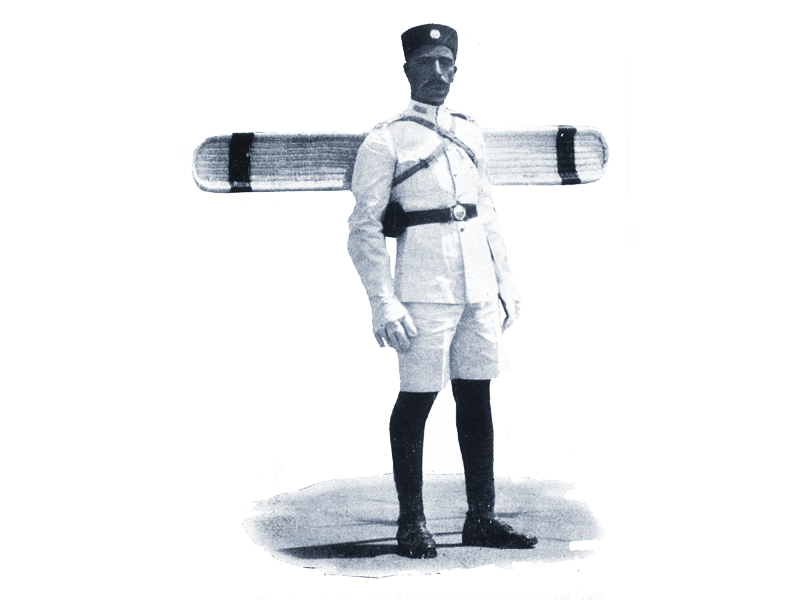
From 1926 to just before World War II, traffic police officers on duty had rattan “wings” strapped onto their backs. The wings helped reduce arm fatigue as the policeman would merely turn on his feet and the wings would indicate the direction the traffic should flow. There are two wing models – the “tilt wing” model that enabled the traffic policeman to lower the wing to signal traffic on that side to move, and the “fixed wing” model. Lee Kip Lin Collection, courtesy of National Archives of Singapore.
Post-independence Developments
After Singapore gained independence in 1965, the government launched a police recruitment programme. As a result, for the first time since the founding of Singapore, the majority of the new police recruits were Chinese.
As early as 1959, the Police Cadet Corps Organisation was introduced in secondary schools to encourage interest in the police force among school children. The organisation was renamed the National Police Cadet Corps (NPCC) in July 1971; Prime Minister Lee Kuan Yew explained the need for the NPCC: “When the PAP first took office in June 1959, people had little trust in the police force. The policeman was then seen as an instrument of suppression, used by the British colonial government to fend off popular demands for independence. When we became the government, we needed the people to identify themselves with the police, to see them as their friends and custodians of law and order. One way to bring this about was to get their sons and daughters to join the NPCC.”
Over the years, several efforts were made to reduce crime rates. Beginning with the first Crime Prevention Week held from 15 to 21 March 1954, followed by subsequent crime prevention campaigns, these community outreach programmes aimed to educate the public on crime prevention measures and help foster better relations between the police and the people.
Further improvements to the police force took place in 1972 when the Lee Soo Ann Report was implemented. The report recommended a pay revision and changes to the entry qualification of new recruits. The Lee Soo Ann committee had been formed to tackle the high turnover rate in the police force; many who left cited low pay and poor working conditions as the main reasons for their departure.
In 1975, full-time police national service was introduced to provide additional manpower to patrol and guard important installations as well as supplement the work of regular officers. By 1982, the police force had more than 12,000 of such national servicemen.
EVOLVING UNIFORMS
One of the earliest mentions of a police uniform was after the first set of rules and regulations for the Singapore police force was established in October 1846. “The day uniform for Indian policemen was made up of a red turban, blue frock coat, white trousers, police belt and staff. The day uniform for Malay policemen was made up of dark batik headkerchief, blue jacket, dark-blue sarong worn short over white trousers, police belt and staff. At night they wore black jackets and trousers with a lascar’s cap.”
Over time, Malay policemen started donning the traditional songkok headgear, complete with a pompon, to go with the sky-blue flannel shirt, starched khaki shorts and dark blue puttees – strips of cloth wrapped around the lower leg up to the knees – and were armed with a wooden truncheon. By the time Singapore started recruiting the Gurkha contingent in 1949, the songkok had been replaced with the beret. When Singapore was briefly part of Malaysia, a peaked cap was issued instead of a beret.
In 1969, on the 150th anniversary of the founding of Singapore, the police adopted a completely new look. On 1 June that year, the 6,000-strong police force changed its colonial uniform of grey flannel tunic and khaki shorts to the now familiar navy blue shirt and pants ensemble that is modelled after the American-style police uniform. By 1974, the blue-and-white lanyard, traditionally worn round the left shoulder and looped to the pocket with an attached whistle, was replaced by a new short cord worn from the shirt button to the left-hand pocket to hold the whistle. This trivia is worth noting as this is the last item of the colonial policeman’s outfit that was replaced.
Neighbourhood police posts were introduced in June 1983 to promote community policing, emphasising the shared responsibility of combating crime by the community and the police force. In 1997, neighbourhood police posts were restructured into neighbourhood police centres offering a wider suite of services. In May 2012, a new community policing system – with the formation of the Crime Strike Force units and the Community Policing Unit – was introduced to enhance the neighbourhood police centres. The new system engaged the community in fighting crime as well as empowering the people with crime-fighting capabilities.
In 2000, the Singapore Police Force moved to its new headquarters at New Phoenix Park on Irrawaddy Road, sharing premises with the Ministry of Home Affairs and the Internal Security Department. Located within the headquarters building is the Police Heritage Centre which opened in 2002. The centre showcases 180 years of police history and is open to the public.
In September 2006, the $276-million Home Team Academy officially opened in Choa Chu Kang to provide training to police, prisons and immigration officers. This marked a new chapter in the training and development of a new generation of law enforcement officers.
In the words of Assistant Superintendent Ryan Koh, the poster boy for the island-wide “stop crime” campaign, “true police work is not as action-packed and glamorous as it is on screen, and it involves a lot of hard work….” Today, the Singapore Police Force has evolved into a large and complex organisation, and it continues to maintain law and order, protect life and property, detect and prevent crime, and prosecute offenders. It has indeed come a long way since its first incarnation in 1819 under Francis James Bernard as its chief.
About the Author
Ang Seow Leng is a Senior Librarian with the National Library of Singapore. Her responsibilities include managing the National Library’s collections, developing content as well as providing reference and research services.
Endnotes
1 A tindal is a native petty officer, while a peon is a low-ranking police officer.
2 A temenggong is the local Malay chieftain responsible for maintaining law and order.
3 A jemadar is a native junior officer with a rank corresponding to that of a lieutenant. Originating from the Urdu language, it was used to denote a rank in the British Indian Army until 1965.
4 Chicago in the 1920s had about 1,000 gangs and the highest violent crime rates among cities in the United States. See A brief outline of Chicago's gang history. Retrieved from University of Illinois website.
5 Konfrontasi was Indonesia’s hostile and militant response to the formation of the British-backed Federation of Malaysia. See National Library Board. (2014). Indonesia announces Konfrontasi (Confrontation). Retrieved from National Library Online.
References
60 years ago. (1994, January 21). The Straits Times, p. 22. Retrieved from NewspaperSG.
A brief outline of Chicago’s gang history. Retrieved from University of Ilinois website
A look at history of police force. (2002, August 23). The Straits Times, p. 3. Retrieved from NewspaperSG.
Abdullah Abdul Kadir Munshi. (2009). The Hikayat Abdullah. Kuala Lumpur, Malaysia: The Malaysian Branch of the Royal Asiatic Society. (Call no.: RSEA 959.5 ABD)
Abul Fazil. (1969, January 27). US style blue look for S’pore police. The Straits Times, p. 8. Retrieved from NewspaperSG.
Academy to cross-train officers. (2005, June 2). The Straits Times, p. 5. Retrieved from NewspaperSG.
Chan, K.S. (2001, June 11). When cops wore pompons and puttees. The Straits Times, p. 8. Retrieved from NewspaperSG.
Cheung, S.W., et al. (Eds.). (2009). A place to remember, 1929–2005: Police Depot, Police Training School, Sekolah Latehan Pulis, Advanced Training School, Police Training School, Police Academy, Training Command. Singapore: Singapore Police Force. (Call no.: RSING 363.2095957 PLA)
Chong, Z.L., & Zakaria Zainal. (2014). The invisible force: Singapore Gurkhas. Singapore: Ethos Books. (Call no.: RSING 355.359095957 CHO)
Comber, L. (2008). Malaya's secret police 1945–60: The role of the special branch in the Malayan Emergency. Singapore: Institute of Southeast Asian Studies; Australia: Monash Asia Institute. (Call no.: RSING 363.283095951 COM)
Davies, D. (1955, February 13). Many died in Hokkien-Teochew riots. The Straits Times, p. 14. Retrieved from NewspaperSG.
Foulger gives evidence. (1951, February 27). The Straits Times, p. 5. Retrieved from NewspaperSG.
Hippoclydes. (1931, June 3). Chinese secret societies. The Singapore Free Press and Mercantile Advertiser (1884–1942), p. 1. Retrieved from NewspaperSG.
Ho, G.L. (1974, January). History of the women police in the Singapore Police Force. Singapore Police Journal, 5 (1), 48. (Call no.: RSING 354.59570074 SPJ)
Home Affairs Ministry to get $442m new home in 2000. (1997, January 11). The Straits Times, p. 27. Retrieved from NewspaperSG.
Kaur, A. (2009). Sikhs in the policing of British Malaya and Straits Settlements (1874–1957). Saarbrücken: VDM Verlag Dr. Müller. (Call no: RSING 363.2095951 KAU)
Koh, N. (1983, June 2). Mr Smile is here. The Straits Times, p. 8. Retrieved from NewspaperSG.
Leathart, S. (1996). With the Gurkhas: India, Burma, Singapore, Malaya, Indonesia, 1940–1959. Edinburgh; Cambridge: Pentland Press. (Call no.: RSING 356.113092 LEA)
Legislative Council. (1872, July 6). The Straits Times, p. 2. Retrieved from NewspaperSG.
Makepeace, W., Brooke, G.E., & Braddell, R.St.J. (Eds.). (1991). One hundred years of Singapore. (Vol. 2). Singapore: Oxford University Press. (Call no.: RSING 959.57 ONE)
Mesenas, C. (1971, June 19). Police pay report is ready. The Straits Times, p. 3. Retrieved from NewspaperSG.
Mobile police patrolmen in Singapore streets. (1939, December 20). The Straits Times, p. 11. Retrieved from NewspaperSG.
Morrah, P. (1963). The History of the Malayan Police. Journal of the Malayan Branch of the Royal Asiatic SocietyJournal of the Malayan Branch of the Royal Asiatic Society, 36 (2), (202), 1–172, p. 34. Retrieved from JSTOR via NLB’s eResources website.
National Heritage Board. (2015, December 7). Former Hill Street Police Station. Retrieved from National Heritage Board website.
National Library Board. (2014). Chinese Protectorate is established. Retrieved from National Library Online.
National Library Board. (2014, May 12). First Crime Prevention Week written by Lim, Tin Seng. Retrieved from Singapore Infopedia website.
National Library Board. (2014). Indonesia announces Konfrontasi (Confrontation). Retrieved from National Library Online.
New cord will replace police lanyard. (1974, January 11). New Nation, p. 3. Retrieved from NewspaperSG.
Peer M. Akbur. (2002). Policing Singapore in the 19th & 20th centuries. Singapore: Singapore Police Force. (Call no.: RSING 363.2095957 PEE)
Rodriguez, D. (2015, March–April). Singapore’s most famous cop. Hey! The NTU Magazine, 21, 21. (Call no.: RSING 378.5957 H)
Singapore. Ministry of the Interior and Defence. Manpower Division. (1969). Our security, 1819–1969: Nation-building through service in the armed forces and the police. Singapore: Printed by the Govt. Print. Off. (Call no.: RSING 355.22 SIN)
Singapore. Traffic Police Dept. (2004). Traffic police heritage book. Singapore: Traffic Police Department. (Call no.: RSING q363.2332095957 SIN)
Singapore Police Force. (2013). Annual report. Retrieved from Singapore Police Force website.
Singapore traffic “cops” now “angels” in white. (1937, August 2). The Straits Times, p. 12. Retrieved from NewspaperSG.
Singapore’s police. (1908, August 24). The Straits Times, p. 7. Retrieved from NewspaperSG.
Singh, K. (2009). The Sikh police contingent: Custodians of the empire. Singapore: Karam Singh. (Call no.: RSING 363.2095957 KAR)
Straits Settlements. Straits Settlements Government Gazette. (1877, May 4). Government Notification No. 98. Singapore: [s. n.]. (Call no.: RRARE 959.51 SCG; Microfilm no.: NL1006)
Straits Settlements. (1890). Indian acts passed during the period extending from the 22nd day of April 1834 to the 31st day of March 1867 both days inclusive and now in force in the colony of the Straits Settlements, as determined by the commissioners appointed by his excellency the Governor of the Straits Settlements under the provisions of "The Statute Law Revision Ordinance 1889" (No. VIII of 1889). An Act for regulating the Police of the Settlements of Prince of Wales’ Island, Singapore and Malacca (Act No. XIII of 1856). Singapore: Government Printing Office. (Call no.: RCLOS 348.5957022 STR-[HWE])
Teh, J. L. (2006, August 19). Academy gives realistic edge to security training. The Straits Times, p. 1. Retrieved from NewspaperSG.
Teow, M.B.K., & Wijeysingha, E. (2000). National Police Cadet Corps: Its origin, growth and development. Singapore: National Police Cadet Corps. (Call no.: RSING q369.4095957 TEO)
“The Chicago of the East”. (1929, June 14). The Straits Times, p. 7. Retrieved from NewspaperSG.
The Free Press. (1843, February 9). The Singapore Free Press and Mercantile Advertiser (1835–1869), p. 3. Retrieved from NewspaperSG.
The Free Press. (1843, October 5). The Singapore Free Press and Mercantile Advertiser (1835–1869), p. 3. Retrieved from NewspaperSG.
The Singapore Police Force – A Brief History. (1982, May/June). Police Life, 6 (4), 11. (Call no.: RSING q363.2095957 PL)
Turnbull, C.M. (2009). A history of modern Singapore, 1819–2005. Singapore: NUS Press. (Call no.: RSING 959.57 TUR)
Wahab, G. (1856, March 11). Singapore Municipal Committee. The Straits Times, p. 5. Retrieved from NewspaperSG.
Wake, C.H. (1975). Raffles and the rajas: The founding of Singapore in Malayan and British colonial history. Journal of the Malaysian Branch of the Royal Asiatic Society, 48 (1), 47–73, pp. 58–61. Retrieved from JSTOR via NLB’s eResources website.
Wan, M.H., & Lau, J. (2009). Heritage places of Singapore. Singapore: Marshall Cavendish Editions. (Call no.: RSING 959.57 WAN)
Zakaria Zainal. (2012). Our Gurkhas: Singapore through their eyes. Singapore: Wee Editions. (Call no.: RSING 355.35095957 ZAK)