Article
Cartoons of Terror
Topics
Collection Highlights
1 January 2016
Four volumes of illustrations by the artist Liu Kang offer a rare insight into how people in Singapore were persecuted and tortured by the Japanese during the Occupation years.
Title: Chop Suey (opens in new tab) (杂碎画集) (opens in new tab)
Illustrator: Liu Kang (刘抗) (1911-2004) with English text by Zheng Zhenen (郑珍恩) and Chinese text by Zheng Shouzhuo (郑守拙)
Year published: 1946
Publisher: Eastern Art Co. (东方艺术公司) (Singapore)
Language: English (3 volumes) and Chinese (1 volume)
Type: Book
Call no.: RRARE 959.5106 CHO
Accession nos.: B02901745F (v.1); B02901746G (v.2); B02901747H (v.3); B02756777H (Chinese)
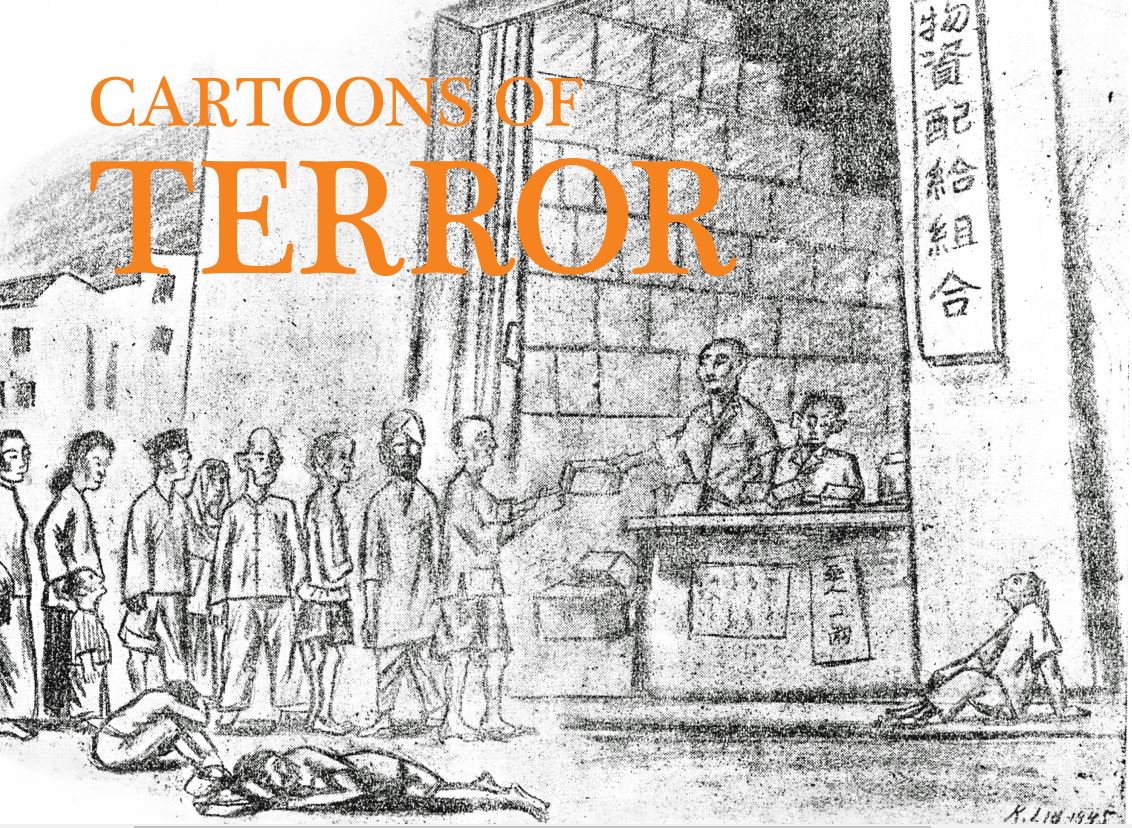
During the Occupation years, Japanese companies controlled the wealth in Singapore and Malaya. The Japanese claimed that this would bring about co-prosperity by ensuring an even distribution of goods among the population regardless of race. All rights reserved, Liu, K. (1946). Chop Suey (Vol. I). Singapore: Eastern Art Co.
The horrors of the Japanese Occupation (1942–45) in Singapore can be read in any number of history books. But few are likely to be as visceral as a series of cartoon books published after World War II in 1946. Titled Chop Suey, the four volumes of illustrations by the artist Liu Kang offer a rare insight into how people in Singapore were persecuted and tortured by the Japanese during the Occupation years.
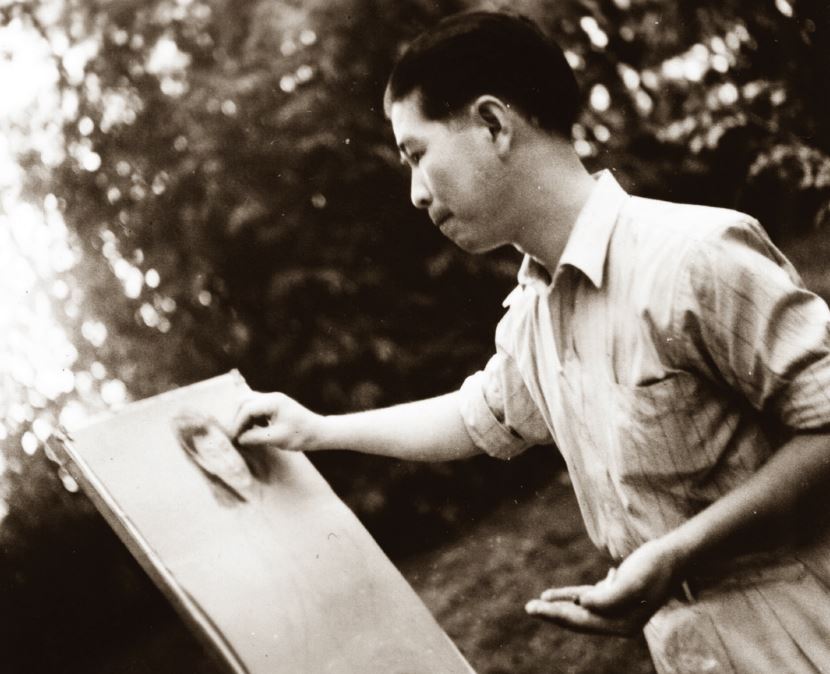
Liu Kang at work, circa late 1940s. Courtesy of Liu Thai Ker.
When Singapore fell to Japan on 15 February 1942, the Chinese community suffered the greatest backlash when Chinese males aged between 18 and 59 were singled out for mass executions by the Japanese military. Operation Sook Ching (the Chinese term means “purge through cleansing”) was an opportunity for the Japanese to rid Singapore of its anti-Japanese elements and seek vengeance on local Chinese who had supported the boycott of Japanese goods and provided financial support to the Chinese government during the bitter second Sino-Japanese War in 1937.1
The Japanese Occupation was a significant period in Singapore’s history. One result of these common experiences was a heightened awareness of nationalism in Southeast Asia, which played a role in making the idea of independence attractive to many people after the war. Beyond the surface value of Liu Kang’s work, what it represents as a poignant record of wartime memories had far reaching consequences on post-war bilateral relations between Singapore and Japan.2
The cartoon books – three in English, and one in Chinese – were quickly forgotten in the post-war years, but later gained prominence in the 1980s after they were re-discovered and publicly exhibited by the National Archives and the National Library. The sketches were used in 1984 as part of Singapore’s national education programme.3 Subsequently, in 1986, two of the Chop Suey volumes were displayed at the National Library as part of its Heritage Week event.4
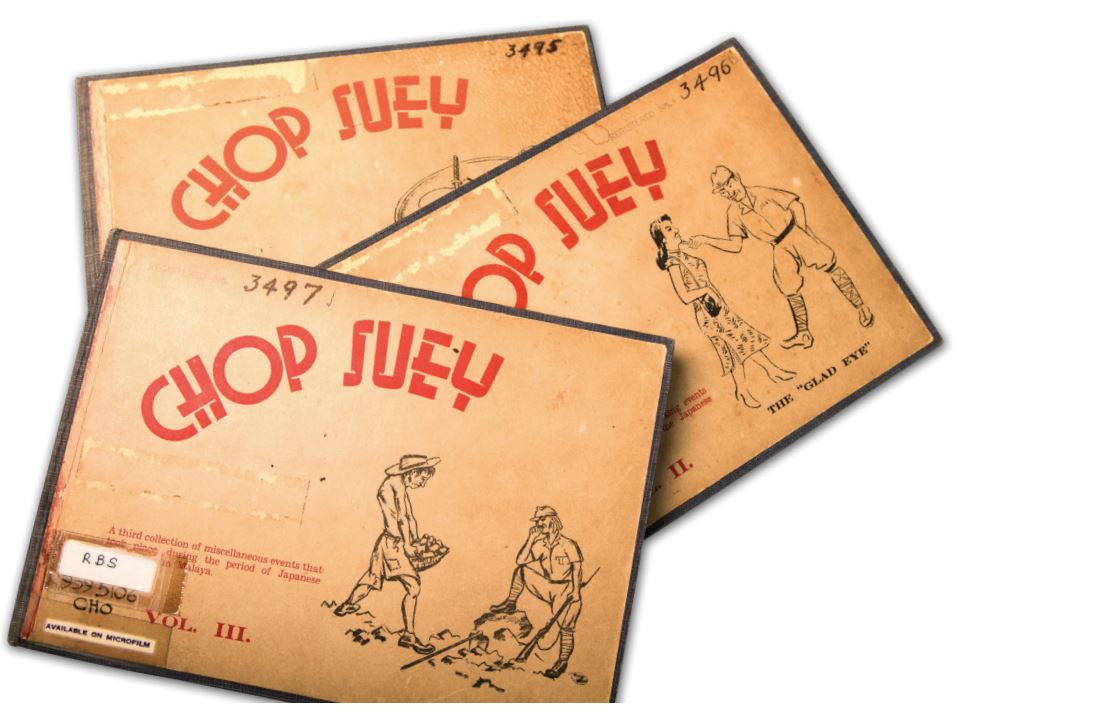
These three volumes of Chop Suey by the artist Liu Kang offer a rare insight into how people in Singapore were persecuted and tortured by the Japanese during the Occupation years. The fourth volume held by the National Library is a photocopy of the Chinese edition. Image source: National Library Board, Singapore.
In Japan, the full set was translated and published by Waseda University’s Dr Michiko Nakahara, a Japanese researcher in women’s studies, human rights and Southeast Asian history. She had found a copy in a Dutch bookshop in 1988 and tracked down Liu Kang for permission to translate and publish it in Japanese.5 Following that, Global Arts & Crafts Pte Ltd – an imprint of World Scientific Publishing – republished the four books as a single volume in 1991 due to public requests for the books. In 2014, the book was republished once again by World Scientific under its imprint, Global Publishing Company.6
According to a 1986 interview in The Straits Times, the series was the idea of the artist’s friend and insurance agent, Zheng Zhenen (郑珍恩).7 The two men went about collecting stories of people who suffered during the Occupation. The 36 illustrations, spread across the three English volumes, depict painfully graphic scenes of people being tortured at the hands of the Japanese military, including bayoneting babies in mid-air, hanging prisoners upside down and ripping off fingernails with a clipper.
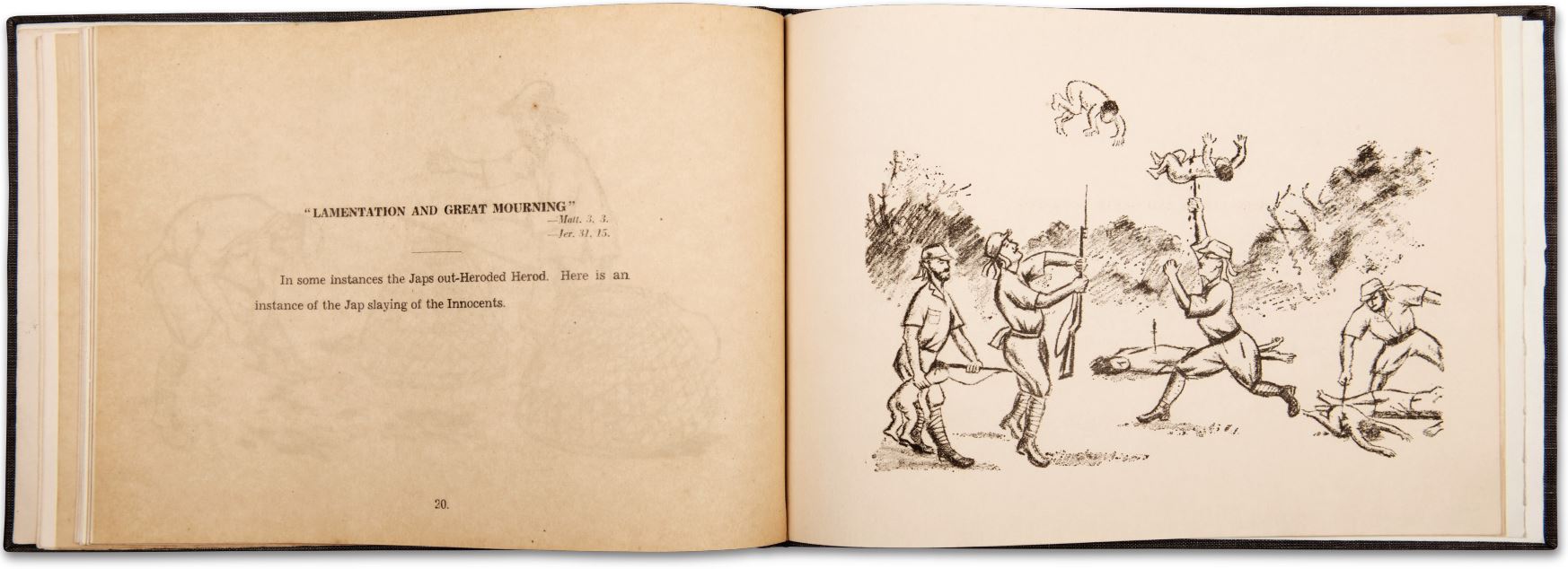
The 36 illustrations in the series depict graphic scenes of people being tortured at the hands of the Japanese Military, including babies being bayoneted in mid-air. Image source: National Library Board, Singapore
After the war, Liu Kang became widely known as one of the Nanyang artists, a famous pioneering group of modernist Singapore artists who painted idyllic rural scenes and people in oils or Chinese ink.8 In Chop Suey, however, Liu Kang did charcoal sketches and caricatures, methods not characteristic of his signature works. This led art critics to interpret Liu Kang’s work in Chop Suey as representative of the experience of the community rather than a significant phase in his development as an artist. In fact, Liu Kang himself appeared to have had forgotten about the illustrations; he was reportedly surprised when the National Archives presented him with a rebound copy of the Chinese volume in 1982.9
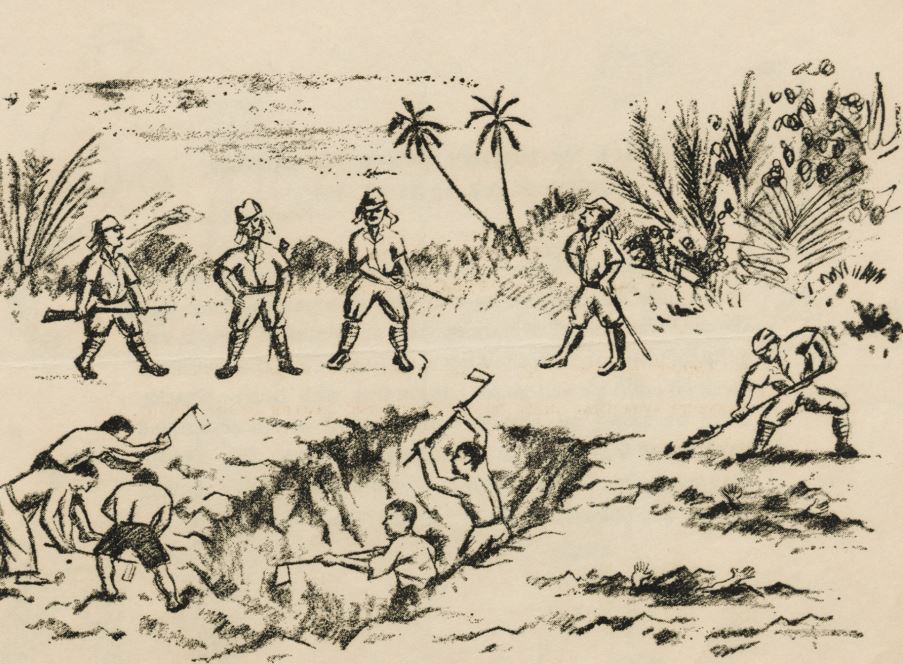
Those chosen to be massacred were often made to dig their own graves before they were killed by the Japanese soldiers. Image source: National Library Board, Singapore.
Liu Kang enlisted the help of Zheng Zhenen to write the captions in English.10 A Zheng Shouzhuo (郑守拙) wrote the captions for the fourth Chinese-language volume, which mostly documents the experiences of prisoner-of-war (POW) internees and contains illustrations from the first two English-language volumes. Only the sketches in the first volume were signed by Liu Kang.Unfortunately, the National Library has only a photocopy of the Chinese edition and not an original.
– Written by Timothy Pwee
Endnotes
1 Henry P. Frei, Guns of February: Ordinary Japanese Soldiers’ Views of the Malayan Campaign and the Fall of Singapore, 1941–42 (opens in new tab) (Singapore: Singapore University Press, 2004), 148 (From National Library Singapore, call no. RSING 940.5425 FRE-[WAR]; Ernest Koh, Diaspora at War: The Chinese of Singapore Between Empire and Nation, 1937–1945 (opens in new tab) (Leiden: Brill, 2013). (From National Library Singapore, call no. RSING 305.89510595709044 KOH)
2 Cheah Boon Kheng, “Memory as History and Moral Judgement: Oral and Written Accounts of the Japanese Occupation of Malaya,” in War and Memory in Malaysia and Singapore (opens in new tab), ed. Patricia Lim Pui Huen and Diana Wong (Singapore: Institute of Southeast Asian Studies, 2000), 23–41. (From National Library Singapore, call no. RSING 959.503 WAR)
3 Lim Cheng Tju, “Chop Suey – Cartoons About the Japanese Occupation and National Education in Singapore,” International Journal of Comic Art (opens in new tab) 6, no. 2 (Fall 2004): 415–30; Hedwig Alfred, “History Simple and Relevant (opens in new tab),” Straits Times, 24 December 1983, 1. (From NewspaperSG)
4 Chong Wing Hong, “Cartoons on a Reign of Terror (opens in new tab),” Straits Times, 23 September 1986, 3. (From NewspaperSG)
5 Michiko Nakahara, Chopusui: Shingapōru no nipponhei-tachi チョプスイ: シンガポールの日本兵たち (opens in new tab) [Chop Suey: Japanese Soldiers in Singapore] (東京: めこん, 1990) (From National Library Singapore, call no. RSING 940.53595 CHO); “Asian Treasure (opens in new tab),” Straits Times, 6 April 1991, 9. (From NewspaperSG)
6 Liu Kang 刘抗, Za sui hua ji 杂碎画集 (opens in new tab) [Chop suey] (新加坡: 八方文化创作室, 1991) (From National Library Singapore, call no. Chinese RSING 940.53595 LK-[WAR]); Liu Kang 刘抗, Za sui hua ji 杂碎画集 (opens in new tab) [Chop suey] (新加坡: 八方文化创作室, 2014) (From National Library Singapore, call no. Chinese RSING 940.53595 LK-[WAR])
7 Chong, “Cartoons on a Reign of Terror (opens in new tab)”; Huang Yuyun 黄玉云, “Mànhuà suōxiě sān nián bā gè yu” “漫画缩写三年八个月 (opens in new tab)” [Manga: Three years and eight months], 联合早报 Lianhe Zaobao, 19 September 1986, 5. (From NewspaperSG)
8 Yeo Wei Wei, ed., Liu Kang: Colourful Modernist (opens in new tab) (Singapore: The National Art Gallery, 2011), 8. (From National Library Singapore, call no. RSING 759.95957 LIU)
9 Chong, “Cartoons on a Reign of Terror (opens in new tab).”
10 Li Yongle 李永乐, “Huì chū rǎn xuè de lìsh” “绘出染血的历史 (opens in new tab)” [Depicting a blood-stained history], 联合晚报 Lianhe Wanbao, 16 February 1987, 12. (From NewspaperSG