
Article
Stories of Abdullah
Topics
Collection Highlights
1 January 2016
The book is one of the most important records of the socio-political landscape in Singapore, Melaka and the southern Malay kingdoms of Johor and Riau-Lingga at the turn of the 19th century.
By Ang Seow Leng
Title: Hikayat Abdullah (opens in new tab) [Stories of Abdullah]
Author: Abdullah bin Abdul Kadir (Munsyi Abdullah) (1797–1854)
Year published: 1849
Publisher: Mission Press (Singapore)
Language: Jawi
Type: Book; 443 pages
Call no.: RRARE Malay 959.503 ABD
Accession no.: B03014389F
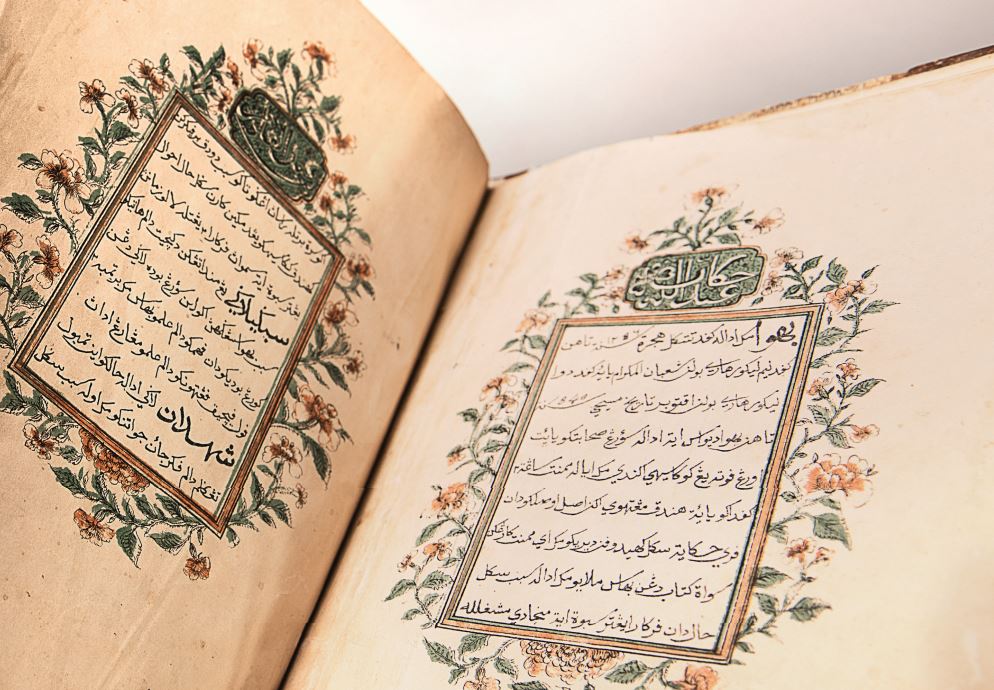
The fine calligraphy and beautifully coloured double frontispiece of the Hikayat Abdullah made it among the most impressive Malay works ever printed in the Straits Settlements. Image source: National Library Board, Singapore.
Quite ironically, the most detailed account of Stamford Raffles’ momentous arrival in Singapore was captured by a man who was not even there. Abdullah bin Abdul Kadir, better known as Munsyi Abdullah, gathered reports from those present to piece together a version of the events that occurred during Raffles’ first arrival to Singapore on 29 January 1819.1 This landmark narrative is included in his autobiography Hikayat Abdullah, or Stories of Abdullah, one of the most important records of the socio-political landscape in Singapore, Melaka and the southern Malay kingdoms of Johor and Riau-Lingga at the turn of the 19th century.
Written in Jawi – modified Arabic script used to write the Malay language – between 1840 and 1843 and published in 1849, the book is considered compulsory reading among scholars of Malay literature and culture and is the most renowned of Abdullah’s works.2 Until the 1970s, it was used as a textbook in every Malay school in Singapore.3
Born in Melaka in 1797, young Abdullah studied under the best Malay scholars in his hometown and read all the Malay manuscripts he could find. By the time he was 11, the child prodigy was already making money from writing Qur’anic texts and teaching religion to Indian soldiers stationed in Melaka. The soldiers called him “munsyi”, which means “teacher of language” – a title he would carry for the rest of his life. By 14, Abdullah had become an accomplished Malay scholar.4 He went on to teach Malay to some of the most eminent administrators, scholars and missionaries in the Straits of Melaka, including Raffles.5
As a scribe and interpreter for Raffles, and a Malay teacher to several English personages, Abdullah had a front-row seat to the political and cultural developments of the time. His perceptive insights, combined with a penchant for vivid descriptions, would give future readers of his book a rich picture of 19th-century life and personalities in Singapore and the region.6
Among other things, the Hikayat chronicles the three changes of the European guard in Melaka, the establishment of the British settlement in Singapore in 1819, Sultan Husain Shah’s brief rule during the early days of the settlement, and the eventual ceding of the island by the sultan and temenggung of Johor to the East India Company. The autobiography captures the breathless pace of Singapore’s development as a trading port under the British Empire, recounting the construction of new infrastructure, the boom in commerce, and the influx of immigrants that led to the island’s multi-racial population.7
Departing from the courtly tradition of Malay texts, Abdullah adopted a journalistic tenor that suited his forthright views. His passages are realistic and lively, incorporating many Malay idioms and proverbs.8 The unusually conversational tone was inspired by the Sejarah Melayu (Malay Annals), a book about the history of the Melaka Sultanate in the 15th and early 16th centuries. Abdullah had edited a version of Sejarah Melayu while working for Reverend Benjamin Keasberry, a Protestant missionary and noted leader in Malay education and in printing.9
It was another missionary and printer, Alfred North, who encouraged Abdullah to write an account of the Malay people – including traditional Malay stories, customs, prejudices and superstitions – that would interest the Europeans.10 In this effort, Hikayat Abdullah succeeded splendidly – it became the best-known Malay literary work among Europeans.11
Abdullah was the first local to have his works published in Malay, earning him the reputation of the “father of modern Malay literature”.12 In recent times, however, Abdullah has also been called a stooge of the British for his pro-British views.13 Regardless, he certainly earned the epithet “father of Malay printing.” He and Reverend Claudius Henry Thomsen introduced printing to Singapore when they arrived from Melaka in 1822. Abdullah’s works would have been beautiful editions even then – Hikayat’s fine calligraphy and beautifully coloured double frontispiece made it among the most impressive Malay works ever printed in the Straits Settlements.14
This copy of the Hikayat Abdullah, which carries a dedication in English to William J. Butterworth, governor of the Straits Settlements from 1843–55, was one of two artefacts the National Library submitted to the “Treasures from the World’s Great Libraries” exhibition held from 2001–02 at the National Library of Australia in Canberra.15
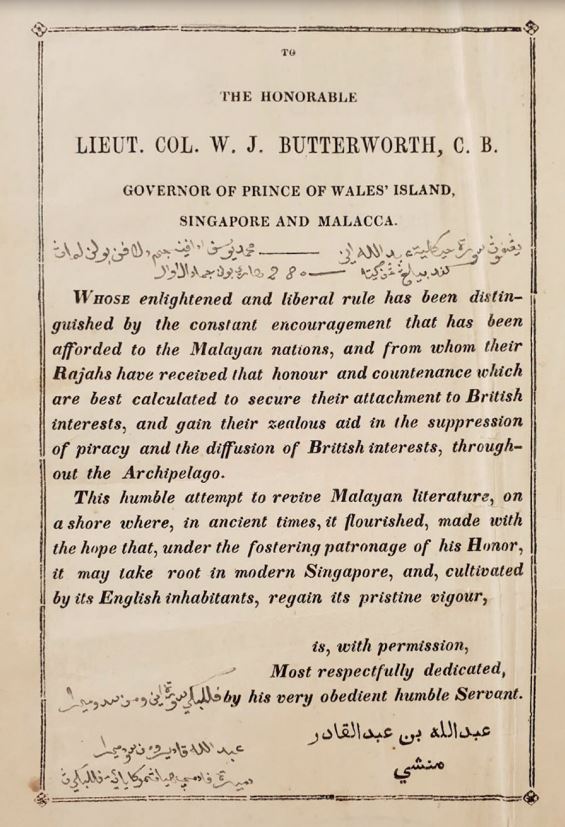
A special edition of Hikayat Abdullah was printed with Abdullah’s dedication to Colonel Butterworth, the British Governor for the Straits Settlements from 1843 to 1855. Image source: National Library Board, Singapore.
Munsyi Abdullah died in Mecca in 1854 while on pilgrimage.16 But his legacy is assured: Hikayat Abdullah is a lasting milestone in modern Malay literature.
Endnotes
1 National Library of Australia, Treasures from the World’s Great Libraries (opens in new tab) (Canberra: National Library of Australia, 2001), 108. (From National Library Singapore, call no. R q025.1 TRE-[LIB])
2 George Murray Reith, Handbook to Singapore, With Map and a Plan of the Botanical Gardens (opens in new tab) (Singapore: Straits Print. Office, 1892), 132–33 (From National Library Online; Singapore, call no. RRARE 959.57 REI (opens in new tab); microfilm NL 7522)
3 Allington Kennard, “Some Brilliant Reporting on Our History (opens in new tab),” Straits Times, 28 September 1970, 20. (From NewspaperSG)
4 Abdullah Abdul Kadir Munshi, The Hikayat Abdullah; An Annotated Translation by A. H. Hill; With Foreword by Cheah Boon Keng (opens in new tab) (Kuala Lumpur, Malaysia: The Malaysian Branch of the Royal Asiatic Society, 2009), 8–9. (From National Library Singapore, call no. RSEA 959.5 ABD)
5 Annabel Teh Gallop, “Early Malay Printing: An Introduction to the British Library Collections,” Journal of the Malaysian Branch of the Royal Asiatic Society 63, no. 1 (258): 98. (From JSTOR via NLB’s eResources (opens in new tab) website)
6 Anuar Othman, “Historical Malay Works in Chinese (opens in new tab),” Straits Times, 4 January 1993, 8. (From NewspaperSG)
7 Abdullah Abdul Kadir Munshi, The Hikayat Abdullah (opens in new tab), v.
8 H. F. O'B. Trail, “An Indian Protagonist of the Malay Language: Abdullah “Munshi”, His Race and His Mother-Tongue,” Journal of the Malaysian Branch of the Royal Asiatic Society 52, no. 2 (1979): 81 (From JSTOR via NLB’s eResources (opens in new tab)website); Azizah Sidek abd Mazelan Anuar, “Hidayat Abdullah (opens in new tab),” BiblioAsia 3, no. 4 (January 2008): 35–36.
9 Abdullah Abdul Kadir Munshi, The Hikayat Abdullah (opens in new tab), v, 22; Gracie Lee, “Benjamin Keasberry (opens in new tab),” Singapore Infopedia. Article published 2016; “Sejarah Melayu (The Malay Annals),” UNESCO Memory of the World, n.d.
10 Raimy Che-Ross, “Malay Manuscripts in New Zealand: The ‘Lost’ Manuscript of the ‘Hikayat Abdullah’ and Other Malay Manuscripts in the Thomson Collection,” Journal of the Malaysian Branch of the Royal Asiatic Society 75, no. 2 (2002): 18. (From JSTOR via NLB’s eResources (opens in new tab) website)
11 Reith, Handbook to Singapore, With Map and a Plan of the Botanical Gardens (opens in new tab), 132.
12 Vernon Cornelius-Takahama, “Munshi Abdullah (opens in new tab),” Singapore Infopedia. Article published 2019.
13 Amin Sweeney, “Abdullah bin Abdul Kadir Munsyi: A Man of Bananas and Thorns,” Indonesia and the Malay Word 34, no. 100 (November 2006): 223–45. Retrieved from Taylor & Francis Online.
14 Gallop, “Early Malay Printing: An Introduction to the British Library Collections,” 96–97.
15 Singapore. National Library Board, Annual Report (opens in new tab) (Singapore: National Library Board, 2002)), 24. (From National Library Online)
16 Raimy Che-Ross, “Munshi Abdullah’s Voyage to Mecca: A Preliminary Introduction and Annotated Translation.” Indonesia and the Malay World 28, no. 81 (July 2000): 182. Retrieved from Taylor & Francis Online.