
Article
A Dictionary That Bridged Two Races
Topics
Collection Highlights
1 January 2016
One of the earliest Chinese-Malay dictionary published in Singapore was the Hua yi tong yu (华夷通语), published in 1883. It contains more than 2,800 entries in 25 categories.
By Lee Meiyu
Title: Hua yi tong yu 华夷通语 (opens in new tab) [Comprehensive glossary of chinese and foreign languages]
Author: Lin Hengnan 林衡南 (also known as Lim Kong Chuan 林光铨)
Year published: 1883
Publisher: Koh Yew Hean Press 古友轩(Singapore)
Language: Chinese (Southern Min dialect)
Type: Book; 252 pages
Call no.: RRARE Chinese 499.23824151 LHN
Accession no.: B03018482D
Donated by: Tan Yeok Seong
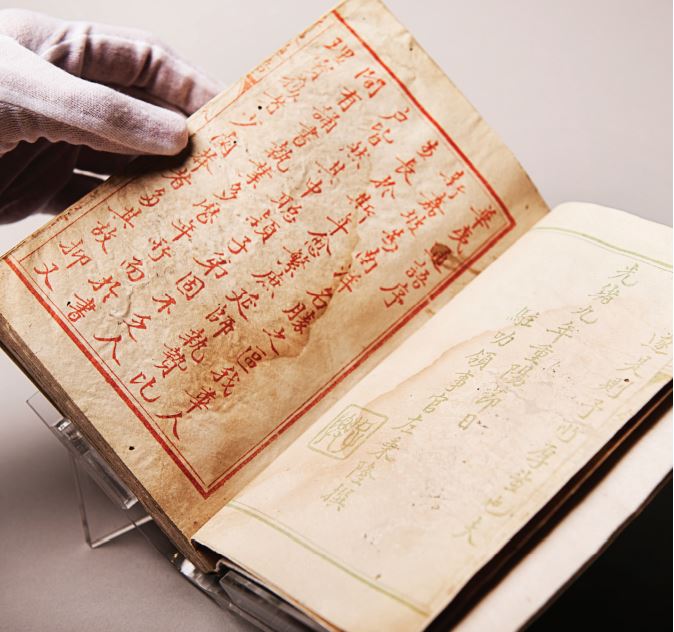
Left-hand page: The editor, Li Qinghui, explains in the preface why he and the author, Lin Hengnan, conceived the idea of compiling Hua yi tong yu.Right-hand page: Zuo Binglong (左秉隆), the first Chinese Consul to Singapore appointed by the Qing Imperial Court in China, signed off the foreword, which was written during the Double Ninth Festival in 1883. Image source: National Library Board, Singapore.
Soon after Singapore gained independence in 1965, the government announced that English would be the lingua franca that would unite the linguistically diverse population. But attempts to forge a common language in Singapore had begun as early as the 19th century, when Chinese migrants to Singapore – the majority of whom spoke Southern Min dialects (闽南语) such as Hokkien1 – tried to communicate with the Malay-speaking indigenous population. Several Chinese-Malay dictionaries – listing Malay words with their equivalent terms in Chinese – were produced in the 19th century.2 One of the earliest was Hua yi tong yu (华夷通语), published in 1883.
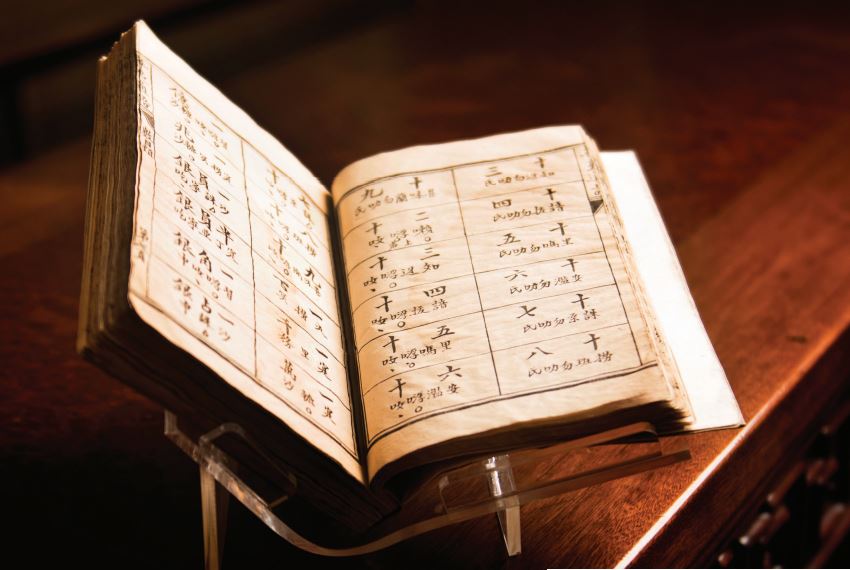
These pages in Hua yi tong yu provide the pronunciation for various numerals and silver currencies. Photographed against an antique teakwood table, donated to the National Library Board by George L. Hicks. Image source: National Library Board, Singapore.
This earliest known Singapore-published Chinese-Malay dictionary in the National Library’s collection contains more than 2,800 entries in 25 categories. The entries include terms used in disciplines such as cosmology and geography to mathematics as well as common business terms. The second section categorises the entries according to the number of Chinese characters contained in each term, while the third and final section lists verbs and adjectives that could not be categorised in the preceding two sections.3
In the preface penned by Zuo Binglong (左秉隆), the first Chinese Consul to Singapore appointed by the Qing Imperial Court, the writer explains that the dictionary was necessary because large numbers of Chinese migrants had settled in Nanyang (南洋 or the “South Seas”) to trade with the Malays in the region. Since the migrants – mainly from the Zhangzhou and Quanzhou regions of Fujian province and Chaozhou in Guangdong province – could not conduct their business effectively due to their inability to speak Malay, a dictionary was needed.
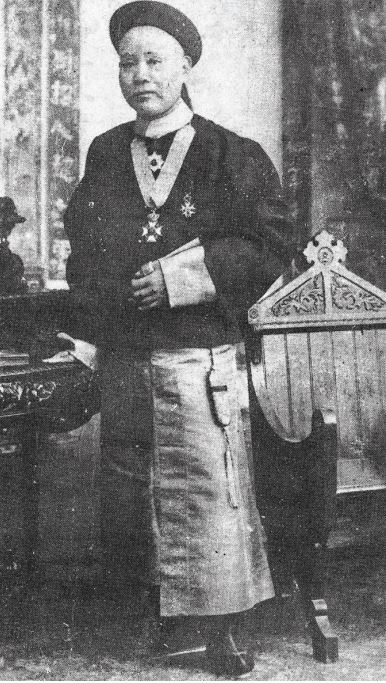
Zuo Binglong (左秉隆), the first Chinese Consul to Singapore appointed by the Qing Imperial Court in China, penned the foreword of Hua yi tong yu. All rights reserved, 左秉 隆.(1959). 勤勉堂诗钞. 新加坡:南洋历史研究会.
The author, Lin Hengnan (林衡南), came up with an ingenious solution by devising a system that uses native Southern Min dialects to phoneticise Malay words. The dictionary teaches users how to pronounce Malay words by using Chinese characters that sound similar when said in the Southern Min dialects.4 For example, to learn the Malay word satu, which means “one”, Lin used the Chinese characters “沙诛” – pronounced sha zhu in Mandarin but sa tu in Hokkien. Tiga, or “three”, is “知迓” – pronounced zhi ya in Mandarin but ti ga in Hokkien.5
To render the phoneticisation more accurate, Lin indicated the tone of the Chinese character to be used when pronounced using Southern Min dialects. He also switched between the tones of the Zhangzhou, Quanzhou and Chaozhou dialects as needed to ensure that the words were pronounced correctly in Malay.6
The first edition of the dictionary was published as Tong yi xin yu (通夷新语) in 18777 (unfortunately the National Library does not own a copy of this). Lin wrote in his introduction that he had originally compiled the dictionary for his newly arrived fellow countrymen in Singapore. It was only through the encouragement of a friend, Chen Fengren (陈凤人) from Chaozhou, that he decided to publish the dictionary.8 For modern-day readers, Hua yi tong yu serves as a historical record of words in the Southern Min dialects that are either obsolete or rarely used today.
An in-depth study of the text reveals that many expressions and sentence constructions – a mix of written vernacular Chinese (bai hua;白话), classical Chinese (wen yan;文言), Mandarin (guan hua;官话) and dialect (tu hua;土话) – that were unique to that era – are no longer commonly used today. Linguists who have studied Hua yi tong yu agree that the dictionary helps to track the evolution of borrowed Malay words in the Southern Min dialects and vice versa, a phenomena spurred by prolonged interactions between the migrants and locals.9
Linguistic insights aside, the dictionary also provides an anthropological snapshot of the lives of these new Chinese residents. The entries include shipping terms and the names of different parts of a ship and the tools used onboard – reflecting the importance of trade in their lives – as well as the names of various types of food and fruits, illnesses, herbs and household items.10
The dictionary was edited by Li Qinghui (李清辉) and published by Lin’s own publishing house, Gu You Xuan (古友轩), also known as Koh Yew Hean Press, established in the 1860s on Telok Ayer Street.11
Lin wrote other books, and in 1890, founded the Chinese newspaper called Xing bao (星报).12 After Lin died, the newspaper was taken over by his son who eventually sold it to Lim Boon Keng. The latter renamed it Ri xin bao (日新报) in 1899.13
Endnotes
1 Straits Settlements Department of Statistics, Blue Book (opens in new tab) (Singapore: Government Printing Office, 1883), p6. (From National Library Singapore, call no. RRARE 315.957 SSBB; microfilm NL30780)
2 Zhang Jiaxing 张嘉星, “Yìnní, xīn, mǎ mǐnnán fāngyán wénxiàn shù yào” “印尼、新、马闽南方言文献述要” [A brief survey of Minnan dialect literature in Indonesia, Singapore, and Malaysia], 漳州师范学院学报(哲学社会科学版) Journal of Zhangzhou Teachers College (Philosophy and Social Sciences Edition) 3 (2002): 73–74. Retrieved from CNKI.
3 Li Rulong 李如龙, “Huá yí tōng yǔ yánjiū” “华夷通语研究” [A study of ‘Huayi Tongyu’], 方言 2 (1998): 105–06. Retrieved from CNKI.
4 Lim, Kong Chuan 林衡南, Hua yi tong yu 华夷通语 (opens in new tab) [Comprehensive glossary of chinese and foreign languages] (新加坡: 古月轩, 1883). (From National Library Online)
5 Li, “Huá yí tōng yǔ yánjiū,” 106, 108–22.
6 Li, “Huá yí tōng yǔ yánjiū,” 106, 108–22.
7 Lim, Hua yi tong yu, (opens in new tab)
8 Lim, Hua yi tong yu, (opens in new tab)
9 Li, “Huá yí tōng yǔ yánjiū,” 106, 108–22.
10 Li, “Huá yí tōng yǔ yánjiū,” 105–06.
11 Lim, Hua yi tong yu (opens in new tab); Zheng Wenhui 郑文辉, Xinjiapo Hua wen bao ye shi: 1881–1972 新加坡华文报业史: 1881–1972 (opens in new tab) [History of the Chinese-Language Press in Singapore: 1881–1972] (新加坡: 新马出版印刷公司, 1973), 25–26. (From National Library Singapore, call no. Chinese RCLOS 079.5957 CWH-[AKS])
12 Ye Guan Shi 叶观仕, Ma xin bao ren lu (1806–2000) 马新华人录 (1806 –2000) (opens in new tab) [Who's who in the press, Malaysia & Singapore (1806–2000)] (吉隆坡: 名人出版社, 1999), 27–28. (From National Library Singapore, call no. Chinese RSING q070.922595 WHO)
13 Zheng, Xinjiapo Hua wen bao ye shi (opens in new tab), 29.