Article
Logan’s Journal
Topics
Collection Highlights
1 January 2016
The Journal of the Indian Archipelago and Eastern Asia is known for its single-minded focus on the thriving scientific and literary activity within the Straits Settlements.
By Ang Seow Leng
Title: The Journal of the Indian Archipelago and Eastern Asia (opens in new tab)
Editor and contributor: James Richardson Logan (1819–69)
Year published: 1847–55 (9 volumes); 1856–59 (new series; 3 volumes)
Publisher: Same as editor / contributor (Singapore)
Language: English
Type: Serial (12 volumes)
Call no.: RRARE 950.05 JOU
Accession nos.: B03014448B (v.1); B03014449C (v.2); B03014450F (v.3); B03014451G (v.4); B03014452H (v.5); B03043596H (v.6); B03014453I (v.7); B03014454J (v.8); B03014455K (v.9); B03013644J (new series, v.1); B03013645K (new series, v.2); B03013649D (new series, v.3)
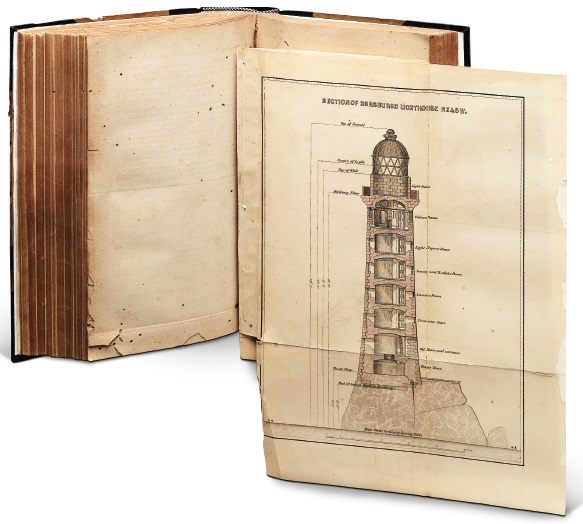
A pull-out page showing the cross-section of the Horsburgh Lighthouse. All rights reserved, National Library Board, Singapore.
In the pre-Wikipedia era, scientific and literary knowledge was mainly documented in the form of periodicals and journals. In the early 19th century, most of such publications in circulation in the region comprised missionary-related magazines and Dutch-produced scientific journals of Java.1 But one local publication stood out for its single-minded focus on the thriving scientific and literary activity within the Straits Settlements.2 The Journal of the Indian Archipelago and Eastern Asia marked a pioneering attempt to produce a scholarly journal in the British settlements of the Far East,3 showcasing the intellectual prowess of writers from professions as diverse as priests, lawyers, doctors, soldiers, merchants and planters.4
The journal’s main purpose was to introduce its readers to all the available sources of information on the Indian Archipelago, and to treat every subject in a scientific manner. It covered a comprehensive sweep of topics, including history, language, literature, ethnography, natural history, physical science, topography, agriculture and economics.5
Most of the articles printed in the periodical were first-hand observations of the peoples living in the region. In particular, the journal was the first to publish descriptions of certain tribes, such as the Kayans of Borneo, the Do Donga of Bima, and the Binua, Mintira, Besisi, Jakuns and Sabimba peoples of the Malay Peninsula.6 It also reproduced some early official documents, including letters by Stamford Raffles and John Crawfurd written during the early years of Singapore’s founding in 1819.
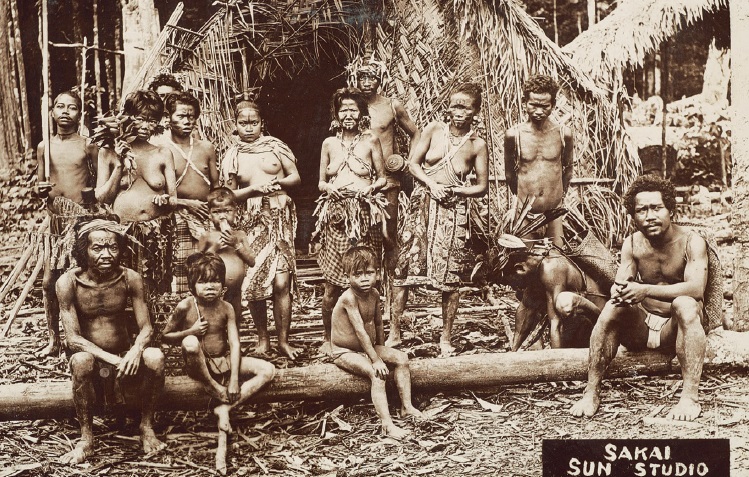
A group of Orang Asli, the indigenous people of the Malay Peninsula. Logan’s Journal was the first to document descriptions of various tribes of the Malay Peninsula. Courtesy of the National Museum of Singapore, National Heritage Board.
Among its pages were translations, compilations and notices from Dutch writings; observations from English and American residents living in various parts of the Indian Archipelago, including Java, Bali, Borneo, the Philippines and Siam (Thailand); as well as articles translated from Dutch and Spanish sources relating to the region. Most of the original contributions featured in the journals mainly focused on the Malay Peninsula, Siam (Thailand), Borneo and Cochin China (South Vietnam). Selected Malayan prose and poems were also included, accompanied by translations and explanatory and critical notes.7
The journal’s creator, James Richardson Logan, was born in Scotland in 1819.8 He studied law in Edinburgh, moved to Bengal as an indigo planter, and then became a law agent in Penang. As a lawyer, he was known for supporting the rights of natives, such as Indian sireh (betel nut) planters and Chinese clan associations.9
In 1843, Logan relocated to Singapore, where he worked in partnership with his brother before returning to Penang in 1853.10 He then took over the Penang Gazette, transforming it into an influential newspaper. As a member of the Asiatic Society of Bengal, and corresponding member of the Ethnological Society of London, and the Batavian Society of Arts and Sciences,11 Logan had a wide range of interests spanning geological enquiry, geographical exploration and philological studies.12 His personal collection of philological books was purchased in 1878 by the Singapore Library.13 Logan died in Penang in 1869 at the age of 51 from malaria, and a public statue was erected in Penang in his honour.14
Logan started the journal in 1847 while living in Singapore and edited its articles until 1862.15 He displayed such dedication to his work that the journal became synonymous with his name: “Logan’s Journal” was how many referred to it. Logan personally contributed numerous articles to the journal, including “The Present Condition of the Indian Archipelago” (Vol. 1, 1847, pp. 1–21), an essay on his observations of Indonesia’s history, and considered as one of the more important papers published in the journal.16
For his efforts, Logan was praised by George F. Hose, the President of the Straits Branch of the Royal Asiatic Society, who noted in his inaugural speech that Logan’s bold endeavour had attracted notable writers from all classes and diverse nationalities: French, German, Dutch, Swiss and even Chinese.17 The sole Chinese contributor was Seah Eu Chin, a prominent merchant and leader in the Chinese community in Singapore, whose essay was titled “The Chinese in Singapore: General Sketch of the Numbers, Tribes and Advocations of the Chinese in Singapore” (Vol. 2, 1848, pp. 283–289).
All nine volumes of the journal dating from 1847 to 1855, along with three additional volumes that were part of a new series published between 1856 and 1859, are bound in their original state and part of the National Library’s collection. The first few volumes bear the stamp “Syonan Tosyokan” on the title page, indicating that they were part of the collection of the Syonan Library during the Japanese Occupation.
Endnotes
1 Joshua Chia Yeong Jia and Bonny Tan, “James Richardson Logan (opens in new tab),” Singapore Infopedia. Article published October 2020.
2 J. Turnbull Thomson, “A Sketch of the Career of the Late James Richardson Logan, of Penang and Singapore,” Journal of the Straits Branch of the Royal Asiatic Society no. 7 (June 1881): 78. (From JSTOR via NLB’s eResources (opens in new tab) website)
3 “The Free Press: Journal of the Indian Archipelago and Eastern Asia (opens in new tab),” Singapore Free Press, 29 July 1847, 2. (From NewspaperSG)
4 G.F. Hose, “Inaugural Address by the President, the Venerable Archdeacon Hose, M. A. Delivered on the 28th February 1878,” Journal of the Straits Branch of the Royal Asiatic Society (opens in new tab) 1 (July 1878): 3.
5 James Richardson Logan, Prospectus of the Journal of the Indian Archipelago and Eastern Asia (opens in new tab) (Singapore: [s.n.]., 1847), iv–vii. (From National Library Online; call no. RRARE 959.802 PRO-[JSB]; microfilm NL15069)
6 “The Journal of the Indian Archipelago and Eastern Asia (opens in new tab),” Singapore Free Press, 16 November 1849, 1. (From NewspaperSG)
7 Logan, Prospectus of the Journal of the Indian Archipelago and Eastern Asia (opens in new tab), iv–vii.
8 Christopher Bastin and John Bastin, “Some Old Penang Tombstones,” Journal of the Malaysian Branch of the Royal Asiatic Society 37, no. 1 (205) (July 1964): 146. (From JSTOR via NLB’s eResources (opens in new tab) website)
9 Chia and Tan, “James Richardson Logan (opens in new tab).”
10 C.M. Turnbull, “The European Mercantile Community in Singapore, 1819–1867,” Journal of Southeast Asian History 10, no. 1 (March 1969): 17. (From JSTOR via NLB’s eResources (opens in new tab) website)
11 James Richard Logan, The Journal of the Indian Archipelago and Eastern Asia (opens in new tab), V (January 1851): title page. (From National Library Online; call no. RRARE 950.05 JOU (opens in new tab); microfilm NL25793)
12 Thomson, “A Sketch of the Career of the Late James Richardson Logan, of Penang and Singapore,” 78.
13 Chia and Tan, “James Richardson Logan (opens in new tab).”
14 Turnbull, “The European Mercantile Community in Singapore, 1819–1867,” 17–18.
15 Hose, “Inaugural Address by the President, the Venerable Archdeacon Hose, M. A. Delivered on the 28th February 1878 (opens in new tab),” 2.
16 John Bastin, “English Sources for the Modern Period of Indonesian History,” in An Introduction to Indonesian Historiography (opens in new tab), ed. Soedjatmoko (Jakarta: Equinox Pub, 2007), 266–67. (From National Library Singapore, call no. RSEA 959.8 INT)
17 Hose, “Inaugural Address by the President, the Venerable Archdeacon Hose, M. A. Delivered on the 28th February 1878 (opens in new tab),” 3.