
Article
The Story of Singapore Radio (1924–41)
Topics
Arts
4 April 2016
The advent of wireless broadcasting created the same ripples that the Internet unleashed in more recent times. Chua Ai Lin traces its development in colonial Singapore.
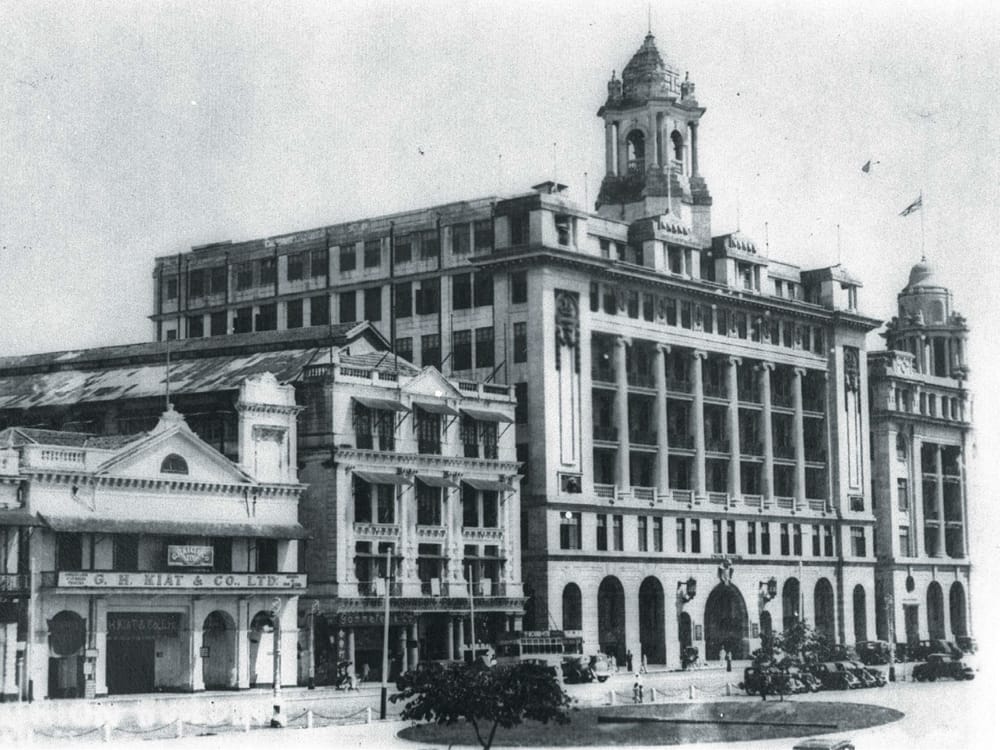
The studio of the Amateur Wireless Society of Malaya (AWSM) began operations in the Union Building at Collyer Quay at the end of 1924, using an aeroplane transmitter. Roland Craske Collection, courtesy of National Archives of Singapore.
Although 1935 marks the year the first official broadcasting company in Singapore – the British Malaya Broadcasting Corporation (BMBC) – was granted a monopoly licence, the origins of radio broadcasting can be traced to more than a decade earlier in 1924, when the Amateur Wireless Society of Malaya was established. But even before the BMBC was launched, people in Singapore were already listening to hortwave broadcasts from around the world, including the Empire Service of the British Broadcasting Corporation (now known as BBC World Service).
The Nascent Days of Broadcasting
As in Britain, radio broadcasting in Singapore was started by amateur enthusiasts and supported by commercial enterprises dealing in radio equipment. They were responsible for setting up amateur radio stations, lobbying the government for better broadcasting policies, promoting radio through various means, and educating the public on the technical aspects of wireless reception.
In 1924, a group of like-minded radio enthusiasts from the expatriate community, Fred Keller and “Messrs. Sutherland, Howard, Taylor and Robinson”, founded the Amateur Wireless Society of Malaya (AWSM) in Singapore; it was the first of its kind in the Straits Settlements and Federated Malay States. The founders were representatives of companies with a vested interest in wireless, namely General Electric, Marconi’s Wireless Telegraph Company, and Standard Telephone.1 It was only after much lobbying on the part of the AWSM that the Straits government finally issued the society with a temporary transmitting licence, and at the same time, receiving licences to private listeners.2
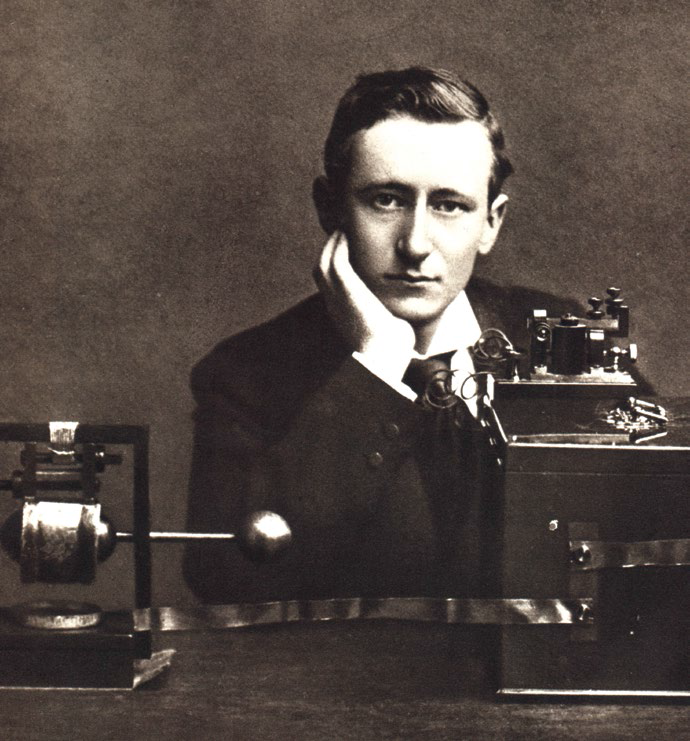
Guglielmo Marconi (1874–1937), Nobel Prize winner and inventor of the radio. He is seen here with his early radio apparatus – the transmitter (left) and the receiver (right). In 1897, Marconi established the Wireless Telegraph & Signal Company Limited (renamed Marconi’s Wireless Telegraph Company in 1900). Creator/photographer unknown. Courtesy of Wikimedia Commons.
The fledgling AWSM studio began life in the Union Building at Collyer Quay at the end of 1924, using an aeroplane transmitter on loan from Marconi Company, with the help of United Engineers. A technical committee was cobbled together, and working with a concert committee, soon put up twice-weekly broadcasts. These featured mostly well-known amateur performers from the European expatriate community, namely Mme. Fecilia Dietz, Mrs Ida Kinloch and Mrs Druddell, as well as non-Europeans like the Eurasian violinist Mr Eber, and “various bands, notably that of Mr Roy Minjoot and his ‘Scamps’”. The venture also had the support of local businesses: S. Moutrie & Company loaned new HMV gramophone releases, while Robinson Piano Company provided musical instruments and records from the American record label, Columbia.
However, the AWSM soon ran into financial difficulties as well as technical. However, the AWSM soon ran into financial difficulties as well as technical problems. Using a mediumwave transmitter that was only effective over short distances, reception became impossible at distances over one mile (1.6 km) away, and made worse because of increasing interference. At the same time, shortwave radio stations from other parts of the world began to compete for listeners in Singapore. All this sounded the death knell for the society, and on 28 January 1928, the AWSM made its final transmission.3
It took two years for the AWSM to recover, and in November 1930, the society launched its official monthly magazine Omba Pende – a contraction of the Malay words for “short” (pendek) and “wave” (ombak).4 The climate seemed favourable for the association to become active again, as reported by the magazine in July 1931:
“There is a revival of interest here in radio, in fact a more widespread interest than we have ever known. The evidences of it are the rebirth of the Amateur Wireless Society of Malaya, a definite increase (reported in several directions) in the purchase of radio apparatus, more space given to radio in the local press, the renewed and intensified demand for broadcasting of British programmes locally and from Home, and the promising replies of the authorities concerned to that demand.”5
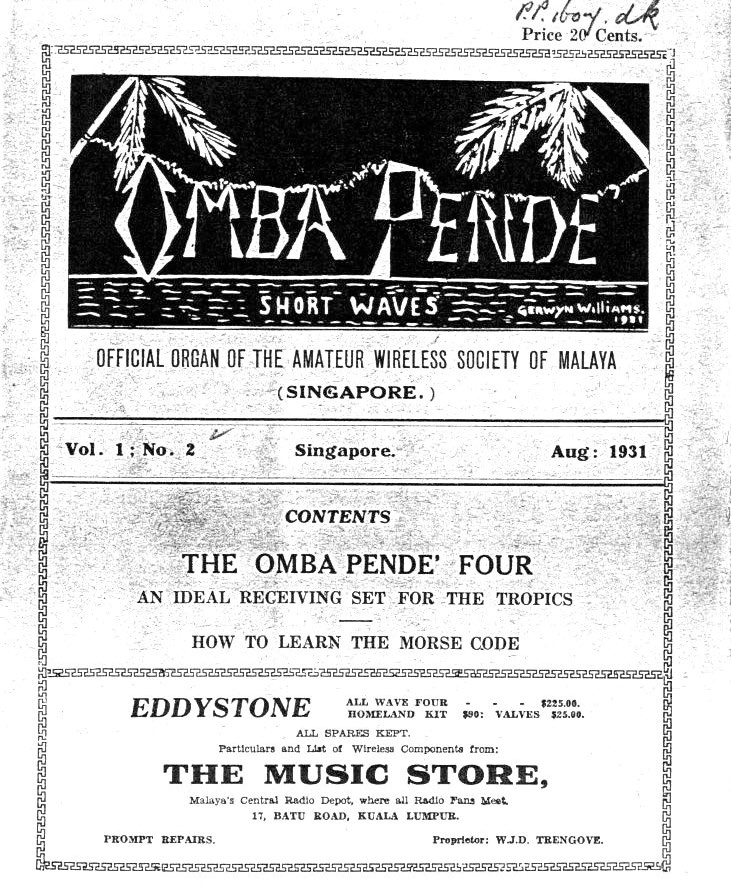
Cover of Omba Pende (Vol 1. No. 2, August 1931), the first radio magazine in Malaya and the official voice of the Amateur Wireless Society of Malaya.
However, the main impetus for the renewed vigour of the society was a new regulation – which took effect in 1931 – by the Posts and Telegraphs Departments of the Straits Settlements and Federated Malay States. The authorities mandated that “all radio receiving sets must incorporate at least one stage of screen-grid H.F. amplification”, which would increase the capability of the receiver set. The AWSM felt this was unnecessary and a “tall order” as there was no such regulation even in Britain.6 The society, therefore, became an organised voice for citizens to express their objections.
Active promotion by the major English-language newspapers in Singapore, coupled with the AWSM’s close relationship with pressmen who shared the society’s concerns and ideals, contributed to the surge in interest in radio. For instance, the Malaya Tribune – which had a wide readership among the Asian community as the “krani’s paper” (clerk’s paper), and a history of lobbying the government on various issues from municipal matters to political rights for Asians – was the key mover behind the revival of the AWSM in 1930.
Starting out with sporadic articles in the late 1920s, the Tribune moved on to running a weekly Friday column on wireless radio. The writer of the radio articles and column used the moniker “Radiofan”, whose true identity was almost certainly C. H. Stanley Jones, the Malaya Tribune’s assistant editor. He became a committee member in the revived AWSM and took on the role of editor of the Omba Pende. The magazine was even printed at the Malaya Tribune Press.7
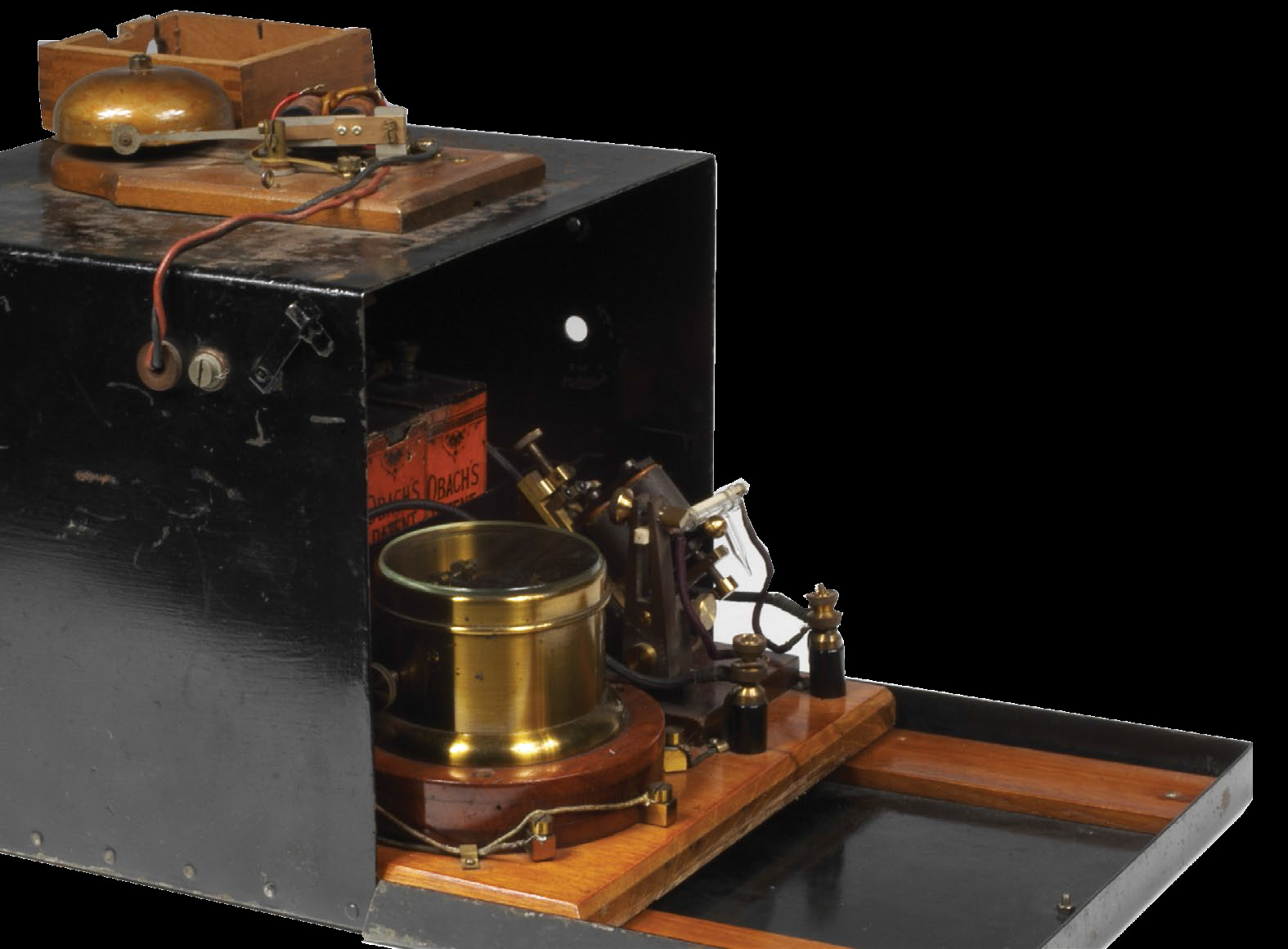
One of the first wireless receivers created by Guglielmo Marconi in 1896. It was used in his public demonstration of wireless communication at Toynbee Hall, London, in 1896. © Museum of the History of Science, University of Oxford.
Other newspapers also caught the enthusiasm for radio – first The Singapore Free Press, followed by The Straits Times – which began giving more coverage to radio news. In 1930, the radio correspondent of The Singapore Free Press joined Jones as one of the convenors of the AWSM.8 By November 1932, all three English-language daily broadsheets had become firm supporters of radio broadcasting.
Local and Foreign Broadcasting Services
In September 1926, the Straits Settlements and Federated Malay States governments accepted the recommendations of the Malayan Wireless Committee, one of which was to issue an exclusive broadcasting licence – to be awarded by competitive application – for a five-year period. In addition, there would be an accompanying fee increase for receiving licences, from $5 to $20 each, with $18 going to the broadcaster. It is not clear why these recommendations were not implemented subsequently.
With the cessation of the AWSM’s transmissions in 1928, enthusiastic individuals soon dominated the broadcasting scene. In 1931, the society’s long-standing vice-president, R. E. Earle, of the Singapore Harbour Board’s electrical department, and his wife set up their own independent shortwave station, VS1AB, at their home in Tanjong Pagar, and transmitted gramophone record music every Wednesday and Saturday night for two hours starting from 9.30 pm. Listeners in Malaya, China and Australia, and even from as far away as America and England, could tune in.
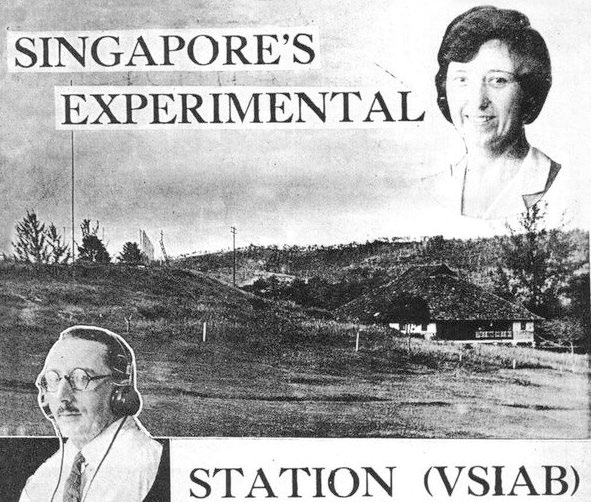
R. E. Earle, vice-president of the Amateur Wireless Society of Malaya, and his wife set up their own independent shortwave station, VS1AB, at their home in Tanjong Pagar, and transmitted gramophone record music every Wednesday and Saturday night. All rights reserved, Malayan Radio Review, 20 June 1932, pp. 3, 5.
Around the same time, another active AWSM member, E. C. Yates, who worked in Capitol Theatre overseeing the electrical equipment,9 obtained a transmission licence as well as some equipment from the Radio Service Company of Malaya to build a transmitter. Station VS1AD was thus born, broadcasting musical programmes from Capitol Building. It was no coincidence that both Earle and Yates dealt with electrical equipment as a profession, with Yates specialising in the latest technology in sound equipment for “talkies” (sound films) at the brand new Capitol cinema. At the time, anyone keen on working with wireless radio was required to possess a certain amount of technical aptitude, and even more so for those attempting radio transmission. Then AWSM president, A. B. Sewell, also had a transmission licence, but his station, VS1AF, was mostly inactive, reflecting the dismal state of affairs in amateur broadcasting during that period.10
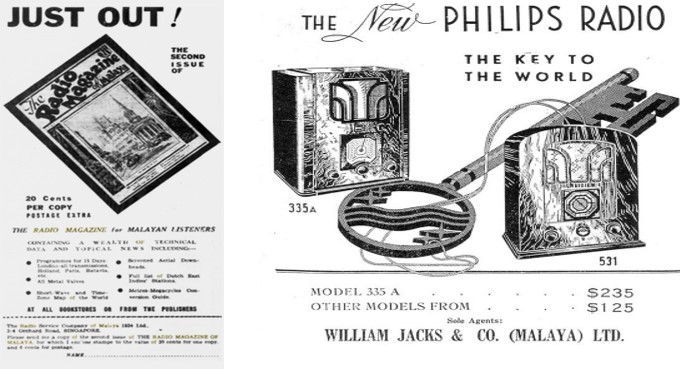
(Left) An advertisement publicising the second issue of The Radio Magazine of Malaya in the 19 February 1936 copy of The Straits Times. The magazine was published by the Radio Service Company of Malaya, which operated its retail and service outlet and radio station on Orchard Road. ©The Straits Times. (Right) An advertisement for Philips radio receivers sold by William Jacks & Co. (Malaya) Ltd. This appeared on the front cover of the Malayan Radio Times magazine dated 24 May 1936. The wavy lines and star spangles depicted in the logo of the Philips company, which was founded in Eindhoven (Netherlands) in 1891, are said to represent radio waves.
The pressure for a more organised broadcasting station in Singapore became more intense after the Kuala Lumpur Amateur Wireless Society (KLAWS) officially began its regular transmission service on 5 April 1930. It was far more successful than the AWSM in Singapore. The Kuala Lumpur society had access to better equipment with a transmitting range of up to approximately 60 miles (97 km). KLAWS also managed to attract many listeners with a high-profile broadcast of the opening speech made by Sir Cecil Clementi, Governor of the Straits Settlements and High Commissioner of the Federated Malay States, at the Kuala Lumpur Agri-Horticultural Exhibition on 19 April, just two weeks after the station’s opening. The effect was not vastly dissimilar to the excitement created when the renowned opera soprano, Dame Nellie Melba, was first heard in test broadcasts in Britain in 1920.
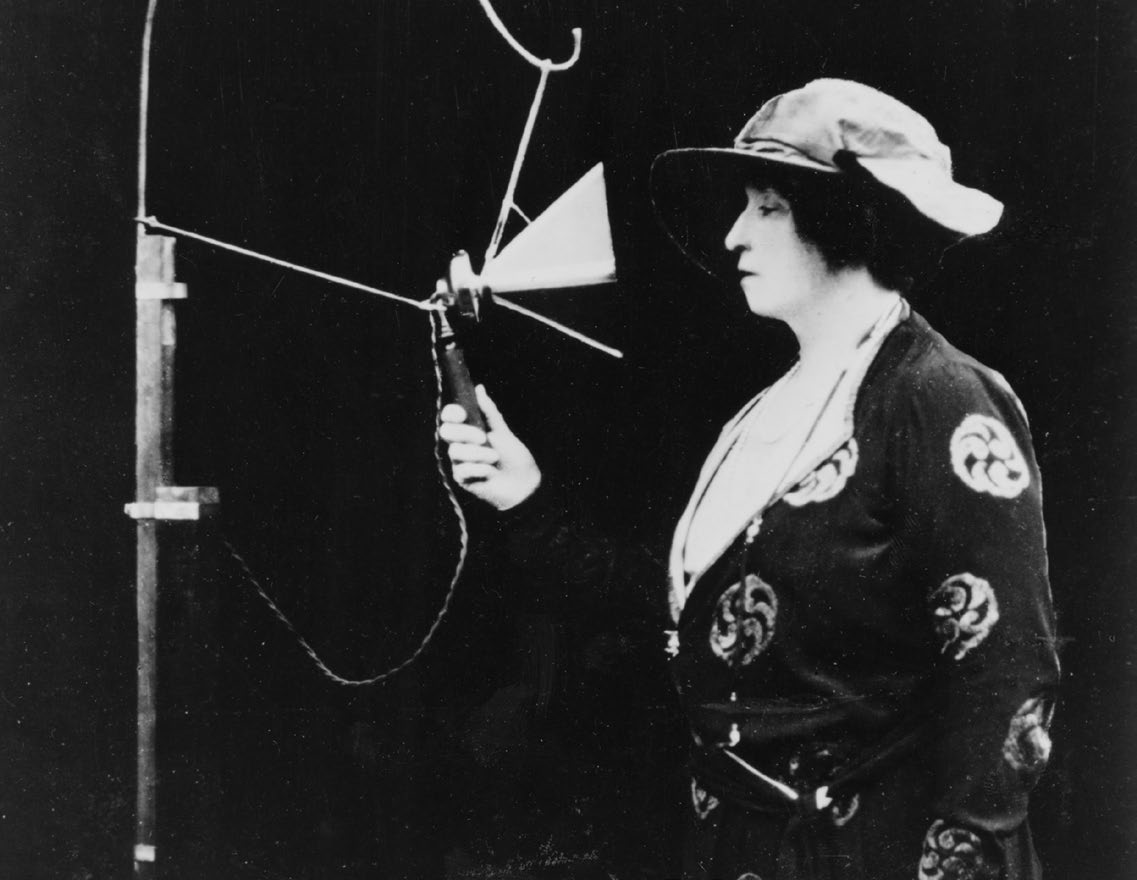
Renowned opera soprano, Dame Nellie Melba, making her famous broadcast in Britain in 1920. © Museum of the History of Science, University of Oxford.
Perhaps the most significant reason for the success of the Kuala Lumpur station was the large degree of non-European involvement in the society. About half of its 75 members were Asians, with the Chinese, including its vice-president, making up 80 percent. This aligned the society’s needs and interests with that of the wider public at large compared with the European-dominated AWSM in Singapore. Programmes in Chinese dialects, Malay and Tamil were produced, including a Tamil drama titled Kovlan in 1934. Weekday transmissions on Tuesdays and Fridays would begin with 30 minutes of “Asian music”. In 1931, the renamed Kuala Lumpur Amateur Radio Society acquired its own shortwave transmitter, which was capable of sending signals across the length of the Malay Peninsula, as well as parts of the Netherlands East Indies and Borneo.11
Having witnessed the significant developments in radio broadcasting in Kuala Lumpur, the AWSM began to lobby hard for the Straits government to set up an official Singapore broadcasting station, or at the very least, allow the society access to the expensive transmission equipment required to broadcast their programmes. The AWSM argued that “… there is a strong demand, that broadcasting is not a luxury but a necessity to a civilised country. It has been proved for years by Singapore amateurs VS1AA, VS1AB and VS1AF, and more recently by the Kuala Lumpur Radio Society, that broadcasting of speech and music on short and medium waves, is a practical possibility here”.12
With the Straits Settlements Association (Singapore) and the Rotary Club having already discussed the matter, the AWSM called on other organisations in Singapore to back up their demands for an official broadcasting station in the colony. The society also lodged a protest with the Colonial Office and the BBC over its transmissions from its shortwave station at Chelmsford in England, which were too weak to be received in Singapore. Omba Pende carried strongly worded editorials and satirical cartoons on the matter. The society’s main grouse was the lack of reliable transmission, whether Malayan or British, and to make matters worse, listeners were asked to pay $5 for a receiving licence.13
Apart from the lack of good programming and clear reception, listening to the radio in early 1930s Malaya was an exercise in frustration, especially if one did not have the patience and expertise to solve frequent technical issues and breakdowns. The government, in the meantime, was unconvinced of the need to invest in broadcasting when there were so few listeners. It was assumed that there was a correlation between the number of receiver licences issued and the spread of radio in Malaya, when in fact this was probably a gross underestimation of the actual figures – most people from several households would usually come together to listen to broadcasts, thus dispensing with the need to apply for their own radio licences.
Turning Point of Radio
The turning point of radio in Singapore took place on 19 December 1932, when the new Empire Service of the BBC was launched. By mid-June 1933, Malayan listeners could tune into Empire programmes for seven-and-a-half hours each day.14 The programming comprised Big Ben time signals, news bulletins, music (both live and gramophone recordings), religious services, talks and sports reports. Correspondingly, a reliable radio schedule titled “Empire Radio To-Night” was published in the daily press, a vast improvement over the days when the Malaya Tribune depended on its readers to submit reception reports and schedules of “likely transmissions”. No longer did local listeners have to depend on Radio Saigon – the most reliable daily service available in Singapore at the time – or try their luck with the erratic reception of foreign stations for their regular dose of entertainment. With the launch of the Empire Service, one of AWSM’s key objectives was finally fulfilled. The Malayan Radio Review and Gramophone Gazette declared in its inaugural editorial in June 1933 that Malaya had finally caught up with other British colonies in terms of radio development.15
The second major boost for Singapore broadcasting was the establishment of the first professional broadcasting station, Radio ZHI, which started test transmissions on 3 May 1933. The private radio station was owned by the Radio Service Company of Malaya, which boasted “the most varied and comprehensive radio stocks in Malaya”, specialising in wholesale and retail wireless receivers and equipment with its retail and service outlet at No. 4 Orchard Road. The radio station was located next door, on the upper floor of the shophouse, known as Broadcast House (since demolished), at No. 2 Orchard Road.16
The company’s foray into broadcasting had begun sometime earlier when E. C. Yates, who ran the amateur station VS1AD, left his job at Capitol Theatre to join the Radio Service Company of Malaya, where he rebuilt and improved on his transmitter. The company seized the opportunity to fill a gap in local broadcasting as well as increase its sales revenue – the theory being that more radio programming would attract potential buyers of receiver sets and raise the profile of the company through its association with the broadcasting station.
Transmissions were four times a week: on Mondays, Wednesdays and Thursdays from 6 to 8.30 pm, and Sundays from 11 am to 1.30 pm, providing listeners in Singapore with locally produced content. Besides gramophone record music, there were daily 15-minute news bulletins compiled from The Straits Times; Monday concerts arranged by Fecilia Dietz (who had performed a similar role in the early broadcasting efforts of the AWSM in 1924); Wednesday stock market reports from Fraser and Co., the exchange and share brokers in Collyer Quay; and Sunday morning religious services relayed by means of a land line from the “Presbyterian Church” (presumably the Orchard Road Presbyterian Church across the road from the station). The church’s Tomlinson Hall was also leased to the station for broadcasting live musical performances. Later, a land line was laid to the bandstand on Waterloo Street, where the Straits Settlements Police Band usually performed, and also to the Raffles Hotel, for transmitting dance music.
The Radio Service Company of Malaya soon found these arrangements to be more expensive than originally anticipated. An Advisory Committee for Broadcasting Programmes was formed and voluntary subscriptions collected, with the aim of improving programming standards. By 1935, part of these funds had been used to improve the station’s facilities, including a new dedicated studio at its retail and service outlet at No. 4 Orchard Road.17 By broadcasting on mediumwave, Radio ZHI was able to attract and retain a strong following of listeners in Singapore, especially those who could only afford mediumwave radios that received local transmissions, as opposed to the more expensive shortwave sets.18
The Rise (and Fall) of the BMBC
In 1934, the colonial government finally decided to issue an exclusive broadcasting licence for Malaya, eight years after it was first proposed by the AWSM in 1926. This might have been precipitated by the popularity of Radio ZHI, which proved that local broadcasting was a viable endeavour.
In addition, as a result of recommendations made by the Telegraphs and Telephone Communications Committee in 1931, the Posts and Telegraphs Department of the Straits Settlements and Federated Malay States, as well as that of the Unfederated Malay States, came under a new Malaya-wide board that was better equipped to deal with the new challenges.19
Whatever the case, on 21 July 1935, the broadcasting licence was awarded to the British Malaya Broadcasting Corporation (BMBC), a Singapore-based company established by a “small band of wireless enthusiasts”. The cost of running the station came from receiver-set licence fees, which were increased from $5 to $12 each per annum, of which 90 percent was channelled to the BMBC. The government reserved the right to censor all broadcasts.
The BMBC built a new station on Caldecott Hill, which was chosen for its elevated location and considerable distance away from electrical interferences in the built-up town area.20 Initially, a mediumwave transmitter was used to serve Singaporeand southern Johor. The station decided against the use of shortwave receivers as these had fewer users, were more expensive and technically more complex. The BMBC’s normal service was officially launched on 1 March 1937, and in July the following year, the station began shortwave transmissions to serve the entire Malay Peninsula. With the BMBC designated as Malaya’s exclusive broadcaster, the authorities unwisely terminated the broadcasting licence of Radio ZHI at the end of 1936, while the station of the Kuala Lumpur Amateur Radio Society ceased operations in November 1938.21
However, the BMBC was not a sustainable set-up, and internal and external reasons soon led to its demise. The company was unable to raise the funds required by selling shares, it had been incurring losses since operations began, and the revenue derived from receiver-set licence fees was insufficient to cover the costs of running the station. A government subsidy was earlier disbursed to keep the station afloat.22
The Threat of World War II
The outbreak of World War II in Europe and the looming threat of Japanese aggression in Asia introduced a new set of circumstances. The British Ministry of Information set up the Far Eastern Bureau in Singapore to counter enemy propaganda in Asia. Seeing the urgent need to disseminate propaganda information the government’s initial tepid interest in broadcasting took an about-turn, and for the first time, substantial resources and planning were devoted to enhancing the broadcasting service in Malaya.
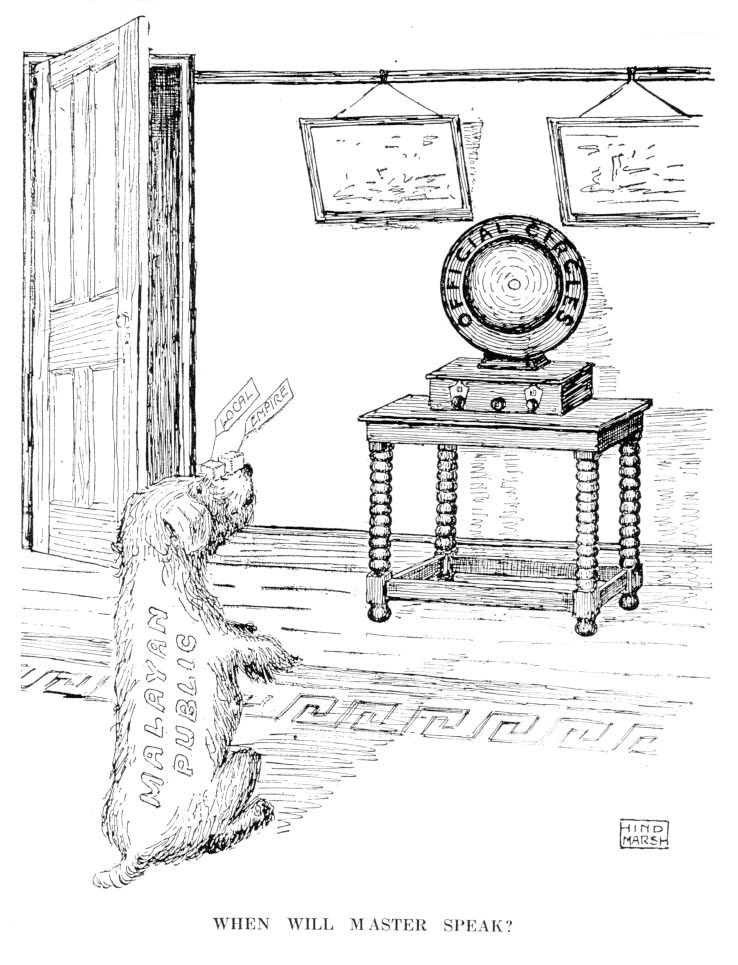
A cartoon lampooning His Master’s Voice (HMV) gramaphone label to express the Malayan public’s frustration at having to wait for the government to start its local and Empire-wide broadcasting. All rights reserved, Omba Pende, September 1931, p. 17.
In March 1940, the Straits government acquired the BMBC and reorganised it as the Malayan Broadcasting Corporation (MBC). The government appointed Eric Davis, a British educational broadcaster, as Director-General of Broadcasting, Straits Settlements, and Chairman of the MBC, with plans for the MBC to be the most impressive station outside of Europe.23 However, these grand plans were forestalled by the Japanese invasion of Singapore in February 1942. Nonetheless, by this time, the MBC had achieved considerable progress: broadcasting was taking place on four simultaneous shortwave and mediumwave transmissions in 13 languages, including Malay, Hindustani, French, Arabic and Dutch; new equipment had been acquired; and 290 staff, mostly Asians, had been recruited and trained locally.24 The last move was a strategic one as these staff went on to form the backbone of broadcasting in the post-war years.
Future of Broadcasting
The growth of radio broadcasting in Singapore and Malaya is the result of the enterprise and perseverance of a group of stalwart pioneers and private entities, as well as the introduction of shortwave radio. But reliable and creative radio broadcasting needed the financial investment and infrastructure of state-run efforts, and it was only after much lobbying that the British colonial government began to reach out to the people through its shortwave Empire Service, and at the end of the 1930s, responded to the threat of war with the establishment of the Malayan Broadcasting Corporation in Singapore.
Radio broadcasting in Singapore has come a long way – from its shaky start in 1924 to 13 FM stations operated by Mediacorp today. Broadcasting has much to celebrate in 2016 as Mediacorp gets ready to move from Caldecott Broadcast Centre to its brand new premises at Mediapolis@one-north in the Buona Vista area.
About the Author
Dr Chua Ai Lin is the president of the Singapore Heritage Society and a member of the National Library Advisory Committee. She holds a PhD in History from the University of Cambridge. Her papers on Singapore’s social and cultural history have been published in journals such as Modern Asian Studies and Inter-Asia Cultural Studies.
Endnotes
1 Keller, F. (1931, September). Work of the pioneers in Malaya. Omba Pende, p. 2.
2 ‘Bancam. (1931, August). Work of the pioneers in Malaya. I – History of the A.W.S.M. Omba Pende, pp. 16–17; McDaniel, D.O. (1994). Broadcasting in the Malay world: Radio, television, and video in Brunei, Indonesia, Malaysia, and Singapore (p. 24). Norwood, N.J: Ablex Publishing. (Call no.: RSING 302.2340959 MAC)
3 Omba Pende, Aug 1931, pp. 16–17.
4 Radiofan. (1930, October 24). Radio in Malaya; Join the Singapore Society. The Malaya Tribune, p. 10; Radiofan. (1930, November 7). Radio in Malaya: First meeting of Society. The Malaya Tribune, p. 10; Radiofan. (1930, November 10). Radio society revived. The Malaya Tribune, p. 9. Retrieved from NewspaperSG.
5 Five dollars for nothing. (1931, July). Omba Pende, p. 1.
6 Omba Pende, Jul 1931, p. 3.
7 Omba Pende, Jul 1931, p. 1, back cover and November 1931, p. 1.
8 The Malaya Tribune, 7 Nov 1930, p. 10; Pro Bono Publico, The Press and Wireless. (1932, November 20). Malayan Radio Review, p. 9.
9 Ng, P.T.P. (1996). History of radio broadcasting in Singapore: Its formative years. Singapore: National University of Singapore. (Call no.: RSING 791.44013095957 NG)
10 What’s on the ether? (1931, July). Omba Pende, p. 16; Singapore’s experimental station. (1932, June 20). Malayan Radio Review, pp. 3–4; Z.H.I. Singapore calling. (1936, February 1). The radio magazine of Malaya, pp. 9–11.
11 McDaniel, 1994, pp. 28–30.
12 Omba Pende, Jul 1931, p. 3.
13 Omba Pende, Jul 1931, p. 3; Malayan Radio Review, 20 Nov 1932, p. 9.
14 Further extension of Empire radio programmes. (1933, June 10). The Malaya Tribune, p. 15. Retrieved from NewspaperSG.
15 The dawn. (1933, June). Malayan Radio Review and Gramophone Gazette, p. 1.
16 Radio Service Co. of Malaya (advertisement). (1931, August). Omba Pende, p. 17; The Singapore and Malayan Directory. (1936). Singapore: Fraser & Neave. (Call no. RCLOS 382.09595 STR); Abisheganaden, P. (2005). Notes across the years: Anecdotes from a musical life (p. 77). Singapore: Unipress. (Call no.: RSING 784.2092 ABI); The radio magazine of Malaya, 1 Feb 1936, p. 2.
17 The radio magazine of Malaya, 1 Feb 1936, pp. 2, 9–11; Broadcast Station Z.H.I. Singapore. (1935, November 24). Malayan Radio Times, pp. 8–9; McDaniel, 1994, pp. 34–35.
18 Ng, 1996, p. 9.
19 Problems of communications. (1931, September 1). The Straits Times, p. 17. Retrieved from NewspaperSG.
20 Abisheganaden, 2005, p. 79.
21 McDaniel, 1994, pp. 35–38.
22 McDaniel, 1994, pp. 44–45; Broadcasting station in Singapore. (1935, April 12). The Straits Times, p. 11; B.M.B.C. finances cause “grave concern”. (1937, August 31). The Singapore Free Press and Mercantile Advertiser (1884–1942), p. 9. Retrieved from NewspaperSG.
23 McDaniel, 1994, p. 45.
24 Playfair, G. (1943). Singapore goes off the air (p. 143). New York, Books: E.P. Dutton & company, inc. (Call no.: RCLOS 940.548142 PLA)