
Article
Chinese Puppet Theatre: Rekindling a Glorious Past
Topics
Culture
4 April 2017
Chinese puppetry is a tradition that is slowly losing ground in Singapore. Caroline Chia tells us why this art form should be preserved.
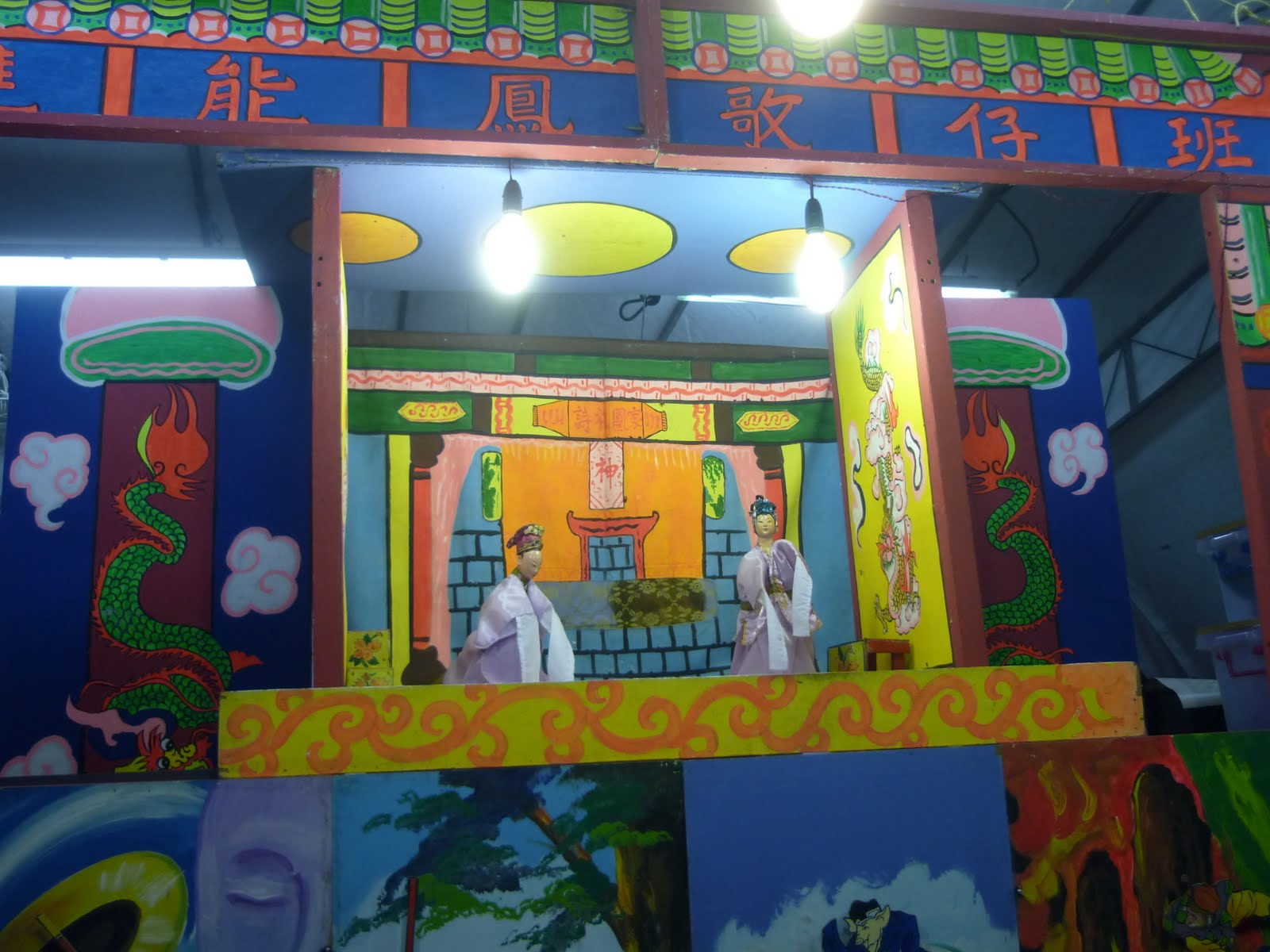
A Hokkien glove puppet performance by Shuang Neng Feng troupe at Jiu Xuan Temple on 30 March 2010. Photo by Caroline Chia.
Tossing a puppet into the air to perform a somersault, the puppeteer sings at the top of his melodious voice, accompanied by the high-pitched clapping of cymbals and the resounding striking of drums backstage. Unfortunately, the response to this unusual street-side performance at a temple in the heartlands of Singapore is met with either furrowed eyebrows or blank looks, or young people hurrying past an unwelcome obstruction, their eyes averted or glued to their mobile phones. Such a scene would have been unthinkable half a century ago when Chinese puppet theatre in Singapore was a popular form of street entertainment for children and the working class.
The Search Begins
I have always been interested in the forgotten and unknown, and thus my exploration of Chinese puppetry in Singapore began in 2007 – the same year I first encountered these puppets. While travelling on a bus in Tampines one day, I spied through the window a small makeshift stage with what looked like moving bundles of colourful cloth. When the bus stopped at the traffic junction, I realised that the bundles were actually miniature puppets garbed in traditional Chinese opera costumes.
From a young age, I have been exposed to Chaozhou, or Teochew opera (Chaoju, 潮剧), as performances were often staged in the Jalan Besar neighbourhood where I grew up. My maternal grandmother, who hailed from Swatow (now Shantou), a city in the Chinese province of Guangdong, was an avid fan of Teochew opera and often regaled her grandchildren with stories from the operas she used to watch as a young girl.
The cloth puppets left an indelible impression on me and I began to search for information on Chinese puppetry. There was very little material to go by but thankfully, I was able to embark on my initial study by using oral history interviews from the National Archives of Singapore. Its Oral History Centre had interviewed a number of puppet masters from the different regional (or dialect) groups in the 1980s. The rest of my research material was collected through painstaking fieldwork and personal interviews with puppeteers since then.
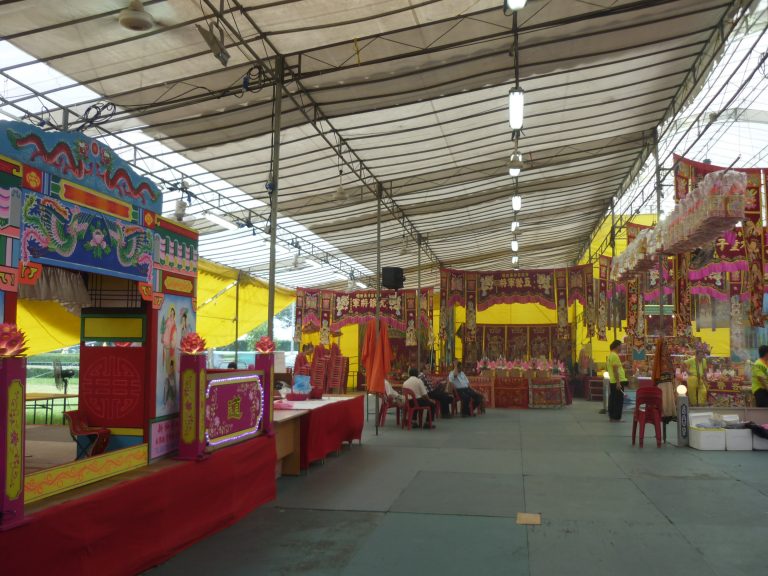
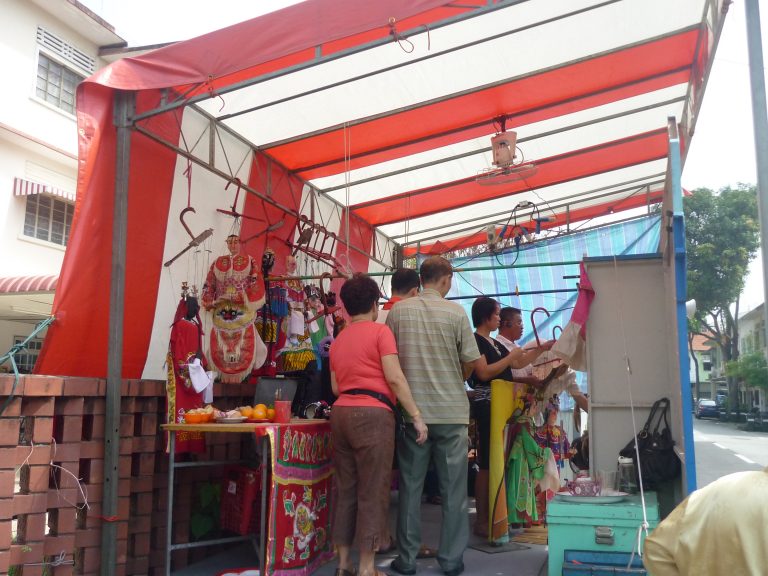
A puppet stage (left) erected in a temporary canopy housing the sintua at Geylang Bahru on 21 May 2010. Photo by Caroline Chia.
Finding the puppeteers, establishing contact, meeting up with them and getting them to disclose closely guarded secrets of the trade was a mammoth task. To my surprise, I discovered a wide variety of puppetry art forms in Singapore, all originating from different parts of southern China.
Types of Chinese Puppetry
Traditional puppet art forms include Hainanese rod puppetry (zhangtou mu’ou, 杖头木偶) from Hainan island, Hokkien glove puppetry (budaixi, 布袋戏) and string puppetry (tixian mu’ou, 提线木偶) from southern Fujian, Henghua string puppetry from Putian and Xianyou in eastern Fujian, Teochew iron-stick puppetry from Chaozhou, and Waijiang string puppetry performed by the Hakka community.1
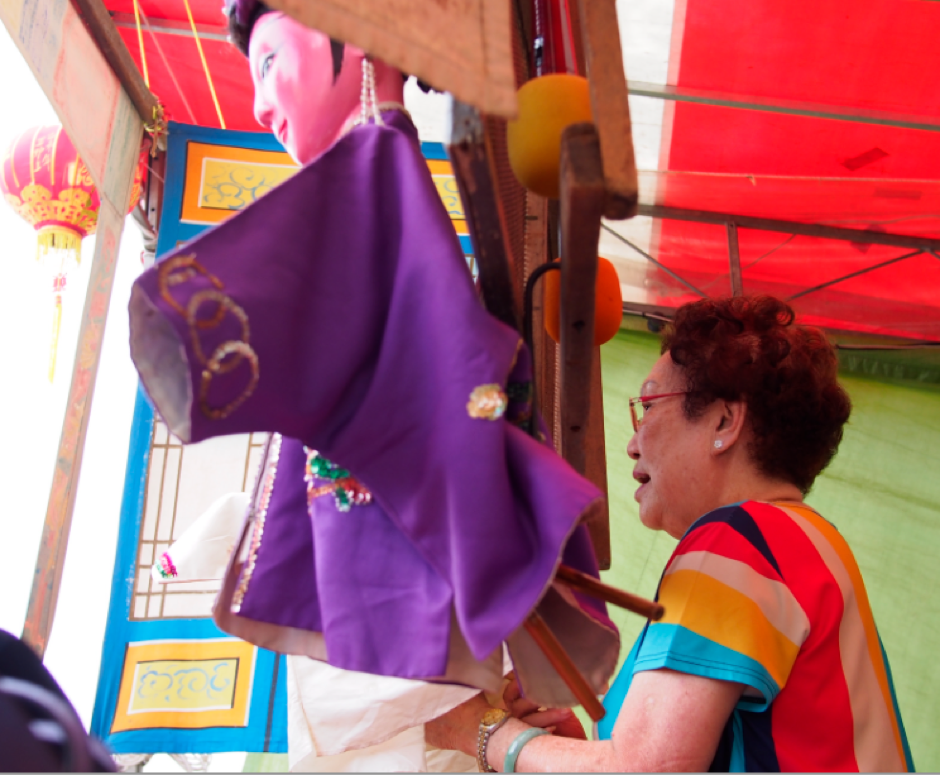
Hainanese rod puppet troupe San Chun Long’s performance at the Yan Kit Village Chinese Temple in November 2015. The rods are partially obscured from view by the puppet’s costume. Photo by Jace Tan, National Heritage Board Puppetry Documentation Project 2015/2016.
The opera performances are staged in regional languages (or dialects), which unfortunately make it difficult for the average Singaporean youth to understand and appreciate. Due to the success of the Speak Mandarin Campaign launched by the government in 1979, the majority of young Chinese people schooled in modern Singapore have become unfamiliar with dialects, which critics say has brought along with it an erosion of indigenous Chinese cultures and traditions.2
Appreciating Chinese puppet theatre was also a challenge for me but I was fortunate enough to have learnt Teochew and Hokkien from my parents and grandparents. I also picked up some basic Henghua during my 10-week stay in Putian, China, in 2013.
Manipulating a Marionette
The art of manipulating a puppet takes years to master but I will briefly explain how the different types of puppets are controlled. A Hainanese rod puppet measures between 60 and 70 cm and weighs approximately 2 to 3 kg. Each puppet comprises a centralised rod connected to the head and two thinner rods at the base for the puppeteer to manipulate.
The height of the Henghua string puppet varies between 80 cm and 1 m. The puppeteer, whilst in a standing position, manipulates the puppet using the 12 strings attached to it. Additional strings can be added to create more intricate and complex movements. Its southern counterpart, the Hokkien string puppet, ranges from 60 to 90 cm in height, and has an average of 12 strings. According to veteran puppeteers in Singapore, the Hokkien string puppet can have up to 19 strings, depending on the needs and type of performance.
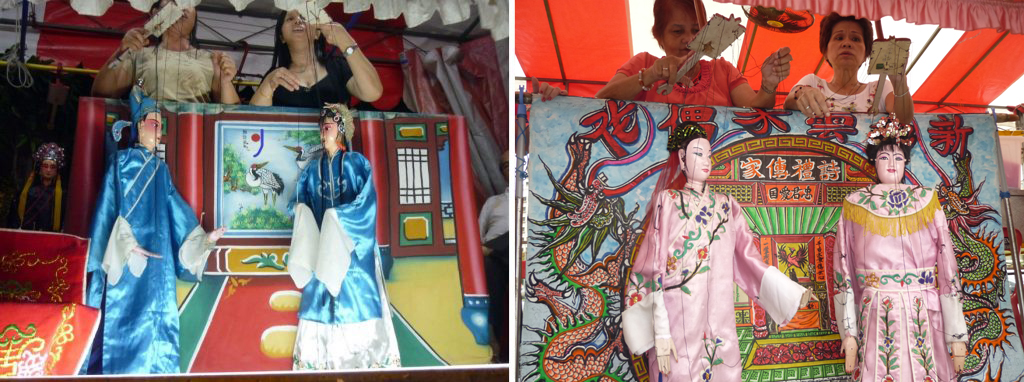
(Left) A Hokkien string puppet performance by Xin Cai Yun (now disbanded) at Serangoon North on 10 April 2010.(Right) A Henghua string puppet performance by Sin Hoe Ping at Li Jiang Temple on 30 June 2010. Photos by Caroline Chia.
The Hokkien community also has another puppet type known as glove puppet (potehi in Hokkien). The glove puppet, as the term suggests, is controlled by inserting the hand into the interior of the puppet, with the index finger embedded in the head compartment and the rest of the fingers below the head to control the puppet’s movements. The puppeteer is hidden behind the stage set and manipulates the puppet on the stage with only his or her arms exposed. Older glove puppets tend to be smaller, ranging from 25 to 35 cm in length. Newer puppets can go up to 40 cm.
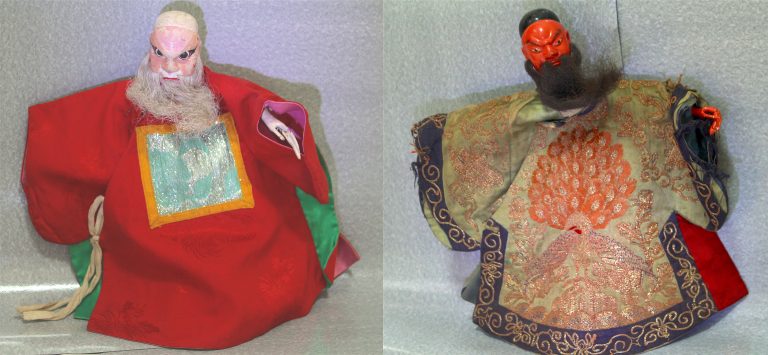
(Left ) A white-faced villain (白奸) glove puppet, c.1950s. The colour white usually represents a villainous or crafty personality.(Right) A Guan Gong (关公) glove puppet, c.1950s. Guan Gong, also known as Guan Yu, is a historical Chinese character from the Three Kingdoms Period in the third century CE. He was later portrayed as a fictional character in the Chinese classic Romance of the Three Kingdoms. The colour red on Guan Gong’s face represents loyalty. Both photos by Caroline Chia.
Originating from Chaozhou, the average height of the Teochew iron-stick puppet is approximately 35 cm whereas older ones were shorter at about 25 cm. The puppet head is made of clay or papier-mâché. There are three iron sticks attached to the puppet: one to support it and the other two with wooden handles for manipulation. The puppeteer sits on a low stool and controls the puppet from above.
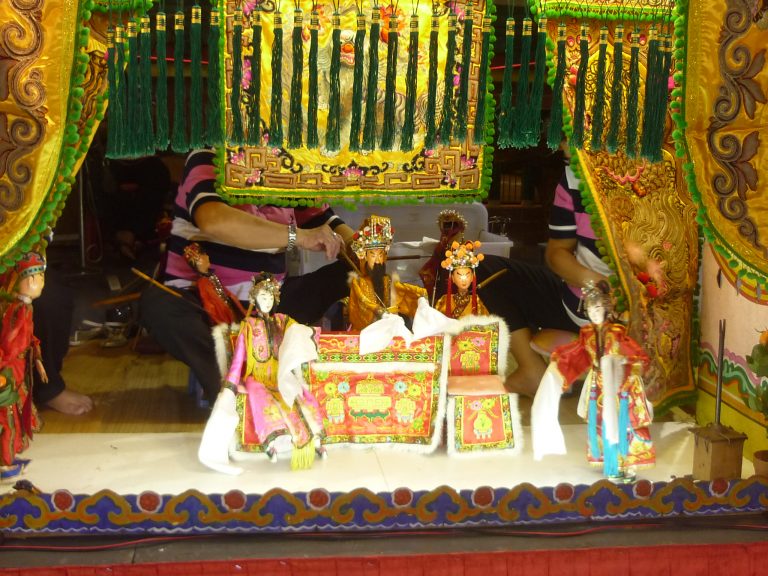
A Teochew iron-stick puppet performance by Lao Sai Bao Feng (disbanded) at Chee Chung Huay temple on 7 February 2011. Photo by Caroline Chia.
Although puppet theatre has its roots in different parts of China and there are variations of the form distinct to each region, it is surprising how these various types have been able to coexist and complement one another in a small geographical space like Singapore. Each puppet type is unique to a specific community who share a common language and cultural kinship. This means that one would not usually expect audiences from one dialect group, for example the Teochews, to watch a Hainanese puppet show because of the language barrier. As migrant races, differences in language and cultural practices as well as feudal ties to ancestral villages in China were barriers to social interaction in the Chinese community in the early days of Singapore’s founding.
PUPPET TALES
Regardless of regional differences, the storylines of most Chinese puppet shows in Singapore are based on Chinese classics set in imperial China, such as A Family of Three Scholars (一门三进士) for the Hokkien and Teochew communities, Scholar Zhang Wenxiu (张文秀) for the Hainanese, and Scholar Wang Zhaorong (王兆荣) for the Henghua.
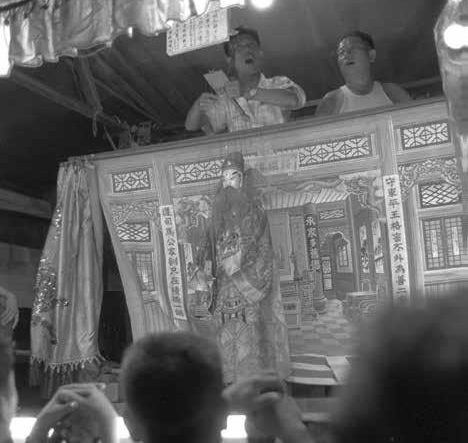
A string puppet show in Chinatown, 1963. The script is placed in such a way that the puppeteer can read it while manipulating the puppet. Courtesy of National Archives of Singapore.
The show is always preceded by a ritual during which the puppets, which represent celestial beings such as the Eight Immortals, express thanksgivings to the deity whose feast day is being celebrated.
This ritual is important because it allows the sponsors to convey thanksgiving to the deity and in return, seek the deity’s blessings. After the prelude, the performance takes place. Many stories revolve around the theme of a scholar – a highly respected figure in imperial China – and the various challenges he encounters before excelling in the imperial examinations. There are also stories that depict fictional characters from Journey to the West (西游记) and Records of the Strange (聊斋志异), or martial arts characters from Romance of the Three Kingdoms (三国演义) but most have a happy ending, often marked by a reunion of family members and/or lovers, that befits the feast day celebrations.
The Transmission of Puppet Theatre
The various puppet types discussed in this article belong to what is known as “traditional temple theatre”, or more simply, “a play offering thanksgiving to the deities” (choushenxi, 酬神戏). This suggests that puppet performances are usually staged in temples to celebrate the feast days of deities. Puppet theatre is closely associated with temples, and invariably, the few troupes that exist today rely on these religious institutions for survival. Apart from temple venues, puppet shows in the past were occasionally held in the homes of wealthy businessmen, specially commissioned to perform for an elder’s birthday or during occasions such as weddings and anniversaries.
In colonial Singapore, temples served as social institutions that provided both longtime Chinese settlers and new migrants with a sense of spiritual consolation when they were far removed from their hometowns in China. Regardless of whether they were settlers or migrants, many Chinese immigrants regarded China as the motherland to which they would return as soon as they had earned enough.
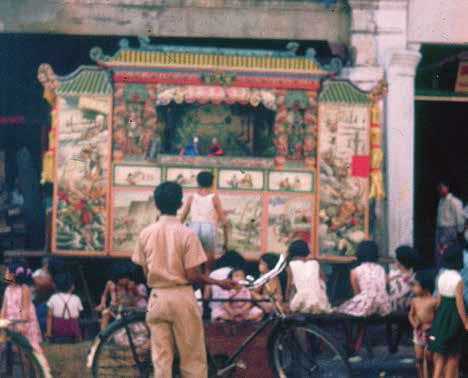
Children enjoying a Chinese street puppet show, c. late 1960s. John C Young Collection, courtesy of National Archives of Singapore.
In the 19th century, travelling by sea was a risky venture, with many dying of pestilence or illness during the perilous sea journey before they could arrive at their destination. Those who survived the ordeal would express their thanksgiving to the deities, including Mazu, popularly known as Goddess of the Sea. The veneration of Mazu led to the construction of some early temples by different dialect groups. For example, the Hokkiens established Thian Hock Keng temple at Telok Ayer Street in 1840, while the Teochew community erected the Wak Hai Cheng temple in 1826. On the feast day of Mazu, puppet performances would be staged in these temples, a tradition that continues to this day.
Compatriot ties were essential for the Chinese sojourner, many of whom were penniless men who arrived in Singapore in the second half of the 19th century to work as indentured labour, among whom were adventurous spirits looking to make their fortune overseas. As it was unimaginable for a person to venture overseas without first establishing a social network, these young men often obtained assistance from their fellow villagers, whether it was to borrow money or to seek an introduction to relatives living overseas.
The transmission of puppet theatre likewise depended on such compatriot ties between China and Singapore as well as other parts of Southeast Asia. Established puppet masters who had settled in Singapore for instance, could take on a son, younger brother, nephew, or a neighbour from the same hometown in China, or at least those who spoke the same regional language, as apprentices, or introduce them to others in the same trade. Temples and clan associations, or huiguan (会馆), established in various parts of Southeast Asia also invited puppeteers from the same hometown or region in China, and assisted them in the process of emigration.
According to oral history records, the earliest Hokkien glove puppet troupe in Singapore was Xin Quan Sheng (新泉胜), which was established in 1895. However, little is known about the troupe except that its name was associated with a box used to store puppets, which was purchased by a carver named Huang Renshui (黄壬水). A native of Jinmen with his ancestral village in Nan’an, southern Fujian, Huang travelled with a glove puppet troupe to Siam (Thailand) in 1890. Not long after, he married a local woman there. When Huang’s eldest brother Bingchen passed away in 1907, Huang relocated to Singapore to take over his shop, Say Tian Kok (西天国), which specialised in making deity effigies. Occasionally, Huang also performed as a puppeteer.3
Another example of how the puppet trade took root in Southeast Asia was the Hainanese rod puppet troupe, San Chun Long (三春隆). In 1921, a Hainanese puppeteer by the name of Xie Yinlin (谢殷林) was believed to be the first to bring rod puppets from Wenchang, Hainan, to Southeast Asia. The rod puppets, possibly carved by Xie himself, were first brought from Wenchang to Siam, and eventually ended up in Singapore in 1939. It was only in 1947 that Foo Tiang Soon (符祥春, 1904–1994?), a renowned musician and co-proprietor of San Chun Long, bought the puppets and established the troupe. From these examples, we can see that traditional Chinese puppetry relied heavily on compatriot and kinship ties, and that Singapore was an important nexus in the transmission of these regional traditions.
Travelling Theatre
The spread of traditional Chinese puppetry from China to Southeast Asia in the late 19th and early 20th centuries was partly due to the high demand for puppet performances in the region. Puppet troupes, whether already established back in China or just set up in Singapore, proved very popular with overseas Chinese communities in Malaya, Indonesia, Siam (Thailand) and Burma (Myanmar). When no local puppet performers were available, a troupe from China or Singapore would travel to these countries to perform, where they would stay for weeks or even months at a time. These performances were mostly sponsored by wealthy Chinese businessmen who yearned for the familiar entertainment of their hometowns. Puppet troupes would also hold performances at temples during the feast days of deities.
Foo Tiang Soon, the co-founder of Hainanese puppet troupe San Chun Long, recalled that his troupe was frequently invited to perform in Malaya, including at an amusement park established by the Shaw Brothers in Kuala Lumpur. According to puppeteer Long Hian Keng (龙兴京), a ticketed performance took place in Kuala Lumpur during the 1950s that was very popular with children. As there was no Hainanese puppet troupe in Malaysia in the 1970s, San Chun Long was often invited to stage shows in Hainanese temples and clan associations in Ipoh, Penang and Sabah.
The Teochew puppet troupe, Lao Sai Bao Feng (老赛宝丰), too, was popular, especially among Teochew communities in parts of Southeast Asia. In 1976, its leader Tay Lee Huat (郑利发) travelled with his troupe to Tawau, in Sabah, for a performance that was well-received by the local Teochew community. Tay claimed that Lao Sai Bao Feng was the first Teochew puppet troupe to have performed in Tawau and Sandakan.
In Singapore, local puppet troupes have also received praise from their respective communities. Lee Chye Ee (李载饴, 1919–1991), the troupe leader of the Hokkien troupe Jit Guat Sin (日月星), recalled the occasional douxi (斗戏), or “competitive show”, between his troupe and Lao Chuan Ann (老泉安), another well-known Hokkien troupe back then. On one memorable occasion, the two troupes were invited to pit their skills to prove who were the more accomplished puppeteers. Both troupes gave their best, which included singing, complex manipulation techniques and story presentation. Lao Chuan Ann performed Li Shiming Roaming the Underworld (李世民游地府), and to make the performance more realistic, the troupe used various props to portray the 18 levels of hell. Jit Guat Sin performed Huang Feihu Retaliating Against the Five Hurdles (黄飞虎反五关) with a splendid display of acrobatic skills that showcased the puppeteers’ consummate control of the marionettes. Such competitive shows were common in the 1950s.
Although the Henghua community was a minority group, its dominance of the Chinese puppetry art scene in Singapore in the mid-20th century was evidenced by the large numbers of puppet troupes that emerged during its peak. Some of the troupes included De Yue Lou (得月楼), Shuang Sai Le (双赛乐), Feng Huang Ting (凤凰亭), Xin De Yue (新得月), and He Ping (和平). The He Ping troupe was the predecessor of Sin Hoe Ping (新和平), currently the last existing Henghua puppet troupe in Singapore.
Cross-cultural Influences
Although Chinese puppetry originated from China, the different regional forms have adapted in various ways so that we can now proudly claim a puppetry tradition that is uniquely multicultural and Singaporean, tempered with mutual respect for each dialect group’s culture and traditions. Although the various puppet theatre forms still cater mainly to their own communities and temples, some significant changes have taken place.
In November 2015, for instance, San Chun Long was invited to perform at the Yan Kit Village Chinese Temple in celebration of Shui Wei Sheng Niang’s (水尾圣娘, literally translated as “Goddess of the Lower Stream”) feast day. Founded by the Hainanese community in 1939, the temple was originally located in a Hainanese enclave known as Yan Kit village across the road from its current location. Today, the temple is visited by devotees from other dialect groups. The chairman of the temple, Koh Chee Gong, is not a Hainanese, but a Cantonese. To ensure their continued survival, temples have welcomed devotees from other dialect communities.
Another aspect that is distinct to Singapore is the proliferation of sintua (or shentan, 神坛, translated as “household shrine”) and spirit mediums known as tangki (or jitong, 乩童), with the latter sometimes involving devotees from different dialect groups as well as some non-Chinese. When a spirit medium goes into a trance, the deity is believed to have possessed the medium, endowing the latter with powers to heal the sick. The devotees usually consult the spirit mediums on matters relating to health, finance or spirituality, and occasionally the future. These spirit mediums sometimes hand out sweets, red-dyed eggs and other “auspicious” food items that are believed to bestow blessings on whomever receives them. Despite the advances made by modern medicine, this form of alternative healing is still sought after by some Singaporeans.
In a way, the existence of spirit mediums and sintua have partly contributed to the survival of puppet theatre. Puppet troupes are often invited to perform during the feast days of deities worshipped at these sintua, and during such celebrations, tents with a makeshift puppet stage are usually erected. These instances demonstrate how religious institutions have made adjustments to ensure the survival of puppet theatre.
Rediscovering Our Heritage
There have also been efforts by local puppet masters to conserve and preserve the puppetry art form in Singapore. I pored through a number of Henghua opera scripts and discovered that they are generally longer and more complete, compared with the more condensed scripts found in China. For example, Beidouxi (北斗戏), the Northern Dipper Play, a form which expresses thanksgiving to the gods for protecting the children of the sponsors, is performed for two hours in Singapore but the one I watched in Putian lasted for only 20 minutes using a more simplified script. The Sin Hoe Ping troupe still performs the Northern Dipper Play upon request.
The Northern Dipper Play staged by the Henghua Sin Hoe Ping troupe on 6 November 2010. The performance was held to express thanksgiving by the sponsors whose son was sickly at a young age but has now grown up to be a healthy man. The performance took place before his wedding day. Note the participation of the sponsors on stage. The son had to cross the “Hundred Flowers Bridge” as part of the ritual and would then return “safely” to his parents’ side. Photo by Caroline Chia.
Singapore’s warm and humid climate is not conducive for the conservation of puppet artefacts and paraphernalia, especially since there is a lack of know-how in protecting these items. Although many precious artefacts have been damaged due to poor conservation practices, some have remained in good shape as a result of careful safeguarding by the puppet troupes. When I visited San Chun Long troupe in late 2015, I noticed that the brightly painted faces of the rod puppets appeared more vibrant compared with the ones I saw in some photos in 2012. On further probing, I discovered that the puppets had been repainted in China in 2014.
When these puppets were sent to Hainan for a new coat of paint, Lin Hongwu (林鸿吾), 92, a native of Hainan, was reported to be very surprised when he saw them. To the elderly man, it was a joyous “reunion” of sorts. Lin remembered seeing similar puppets in Hainan when he was younger. Unfortunately, those puppets were destroyed during the Cultural Revolution years between 1966 and 1976.4 With possibly the only known collection of old rod puppets in Hainan destroyed, this last surviving collection of traditional rod puppets in Singapore has become all the more valuable. These nearly century-old puppets could very well be the oldest examples around.
The conservation efforts by members of San Chun Long, particularly the current troupe leader, 49-year-old Zhou Jingwen (周经文), who is passionate about preserving the puppets and the traditions his elders left him, is highly commendable. Despite the sharp decline in the number of performances and ageing puppeteers, Zhou is adamant about safeguarding this heritage for as long as he can.
Today, traditional Chinese puppet theatre is in danger of being obliterated from the cultural landscape. The inability of young Singaporeans to speak dialects and the lack of interest in an archaic form of theatre are some of the biggest challenges that face existing puppet troupes. Many puppet masters despair over the decline of this once-glorious trade and the rapidly shrinking audiences who appreciate such entertainment. There is little motivation for troupes to innovate and keep up with the times.
Through my continued contact with the puppeteers, many have expressed their interest in performing outside the confines of the temple and to educate the public on this traditional art form. There have been opportunities for puppet troupes to perform at new platforms but the scope is limited.5 More support, monetary or otherwise, is needed to keep puppet theatre going in modern-day Singapore, but unless young Singaporeans can be convinced that traditional Chinese puppet theatre is not “uncool” and old-fashioned, there is imminent danger of losing yet another part of our rich heritage.
About the Author
Caroline Chia researches on the theatrical forms of the Chinese diaspora in Singapore, China, Taiwan and Australia. She is the author of Development of Cantonese Opera in Singapore (2013) and co-author of Potehi: Glove Puppet Theatre in Southeast Asia and Taiwan (2015). She has worked with the National Heritage Board to document puppetry art forms in Singapore, and organised the first traditional glove puppetry workshop in November 2016. Visit her blog at: http://marionettetheatre.blogspot.sg.
References
Books
Kraus, R.C. (2012). The cultural revolution: A very short introduction. New York: Oxford University Press. (Call no.: 951.056 KRA)
《华人、华语、华文》[Mandarin: The Chinese connection]. (2000). 新加坡: 推广华语理事会. (Call no.: Chinese RSING 306.4495957 MAN)
Book chapter
Chia, C. (2015). Potehi in Singapore, survival and change. In K. Fushiki & R. Ruizendaal (Eds.), Potehi: Glove puppet theatre in Southeast Asia and Taiwan. Taiwan: Taiyuan Publishing. (Call no.: RSEA 791.530951249 POT)
Journal article
Ruizendaal, R. (1990). A discovery in Fujian province: Iron-stick puppet theatre. CHIME: Newsletter of the European Foundation for Chinese Music Research, 2, 28-42. (Not available in NLB holdings.)
Unpublished Theses
Teh, S.H. (2004). 《新加坡海南杖头木偶-三春隆木偶班个案研究》 [Hainanese rod puppet in Singapore – A case study of San Chun Long puppet troupe]. Honours thesis, National University of Singapore.
Chia, C. (2016). The interaction of oral and literate practices in Singaporean Chinese temple theatre. Doctoral thesis, University of Melbourne.
Oral history interviews
Chiang, C. (Interviewer). (1982, February). Oral history interview with Ng Yew Kian [Transcript of MP3 recording no. 000158/10/04, p. 43]. Retrieved from National Archives of Singapore website.
Chua, C.H. (Interviewer). (1988, January 19). Oral history interview with Ng Yew Kian [Transcript of MP3 recording No. 000874/04/01, pp. 3–8]. Retrieved from National Archives of Singapore website.
Chua, C.H. (Interviewer). (1988, May 28). Oral history interview with Tay Lee Huat [Transcript of MP3 recording no. 000893/09/01, pp. 5–6]. Retrieved from National Archives of Singapore website.
Chua, S.B. (Interviewer). (1988, June 6). Oral history interview with Lee Chye Ee [Transcript of MP3 recording no. 000936/10/02, pp. 24–26]. Retrieved from National Archives of Singapore website.
Wang, Z.C. (Interviewer). (1988, January 16). Oral history interview with Foo Tiang Soon [Transcript of MP3 recording no. 000875/03/01, pp. 23–24, 27]. Retrieved from National Archives of Singapore website.
Wang, Z.C. (Interviewer). (1987, December 15). Oral history interview with Long Hian Keng [Transcript of MP3 recording no. 000859/06/02, p. 18]. Retrieved from National Archives of Singapore website.
Personal interviews
Chia, C. (Interviewer). (2015, November 26). Personal interview with Zhou Jingwen.
Chia, C. (Interviewer). (2015, November 28). Personal interview with Zhou Jingwen.
Chia, C. (Interviewer). (2016, April 29). Personal interview with Tan Siew Keow.
Chia, C. (Interviewer). (2016, November 27). Personal interview with Tina Quek Tina.
Li, Z. (Interviewer). (2015, June 8). Personal interview with Goh Swee Theng.
Endnotes
1 The term “Henghua” is a transliteration of “Xinghua” as Putian city and Xianyou county were previously administered under the Xinghua area.
2 The Speak Mandarin Campaign was launched by then Prime Minister Lee Kuan Yew on 7 September 1979 with the objective of improving communication and understanding among Chinese Singaporeans, and to create a Mandarin-speaking environment conducive to the successful implementation of the bilingual education programme.
3 It is not possible to ascertain if Huang Renshui performed as a puppeteer with the Xin Quan Sheng troupe or with another troupe.
4 The Cultural Revolution in China – also known as the Great Proletarian Cultural Revolution – launched by Mao Zedong, then chairman of the Communist Party, began in May 1966 and lasted until his death in 1976. This revolution mainly targeted the arts and popular beliefs. See Kraus, R.C. (2012). The cultural revolution: A very short introduction. New York: Oxford University Press. (Call no.: 951.056 KRA)
5 In 2014, for instance, I recommended Pang Tong Teng from the Tien Heng Kang troupe (新兴港琼南剧社) to Artsolute, a social group that works with youths to participate in community development and cultural exchange programmes through the arts. At the time, Artsolute was looking for a puppeteer in traditional Chinese puppetry for a cultural exchange trip to Brunei. In 2016, I introduced the Teochew puppet and opera troupe Sin Ee Lye Heng to Lepark, organiser of “Getai Soul 2016”, Singapore’s first soul music festival. The two-day event was held at Pearl’s Hill.