
Article
Heaven, Earth and Brotherhood
Topics
Culture
7 July 2017
Secret societies arrived on the back of mass migrations of Chinese to Asia in the colonial era. Makeswary Periasamy highlights the National Library’s collection of early books on Chinese triads.
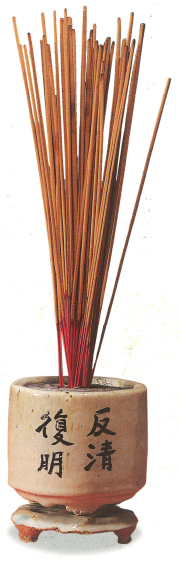
A censer of joss sticks − bearing the Chinese characters 反清复明(fanqing fuming) − placed on the initiation altars of secret societies. The phrase means “Destroy the Qing, restore the Ming”. The porcelain censer rests on a three-legged stand, a distinguishing feature of Hung censers. The tripod symbolises the unity of heaven, earth and man. All rights reserved, Lim, I. (1999). Secret Societies in Singapore: Featuring the William Stirling Collection (p.49). Singapore: National Heritage Board, Singapore History Museum. (Call no.: RSING 366.095957 LIM).
The National Library’s Rare Materials Collection – which comprises a valuable collection of books and printed items from as early as the 15th century − has a number of works on secret societies and their activities in colonial outposts such as Riau, Batavia, Penang, Singapore and Hong Kong.
These works were mostly written by Western colonial officials working in the region, such as William A. Pickering, Gustave Schlegel, William Stanton, William G. Stirling and J.S.M. Ward. Most of these writers were proficient in the Chinese language and gathered information on secret societies from interviews with detained members, from perusing seized documents, and in the case of William A. Pickering, by observing the initiation ceremonies of secret society members.1
The works of these colonial writers focused mainly on the Chinese secret society Tiandihui (天地会) − the “society of the three united, Heaven, Earth and Man” − which originated in China’s Fujian province in the mid-1700s.2 The society was originally formed in China for the purpose of overthrowing the Manchu-led Qing dynasty (1644–1912) and restoring the Ming dynasty (1368–1644) of ethnic Han Chinese.3 Secret societies, which started off in various parts of Asia ostensibly to provide financial aid and social support to newly arrived Chinese immigrants, trace their roots primarily to the Tiandihui in China.
Besides comparing the secret societies to the Freemason4 order of medieval England, the authors also describe the origins and governance of secret societies, initiation ceremonies for new members, secret society paraphernalia, the oaths and rites that bind the brotherhood through fictive kinship, as well as symbols and code words recognisable only to members.
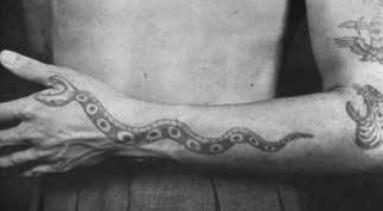
A snake tattoo on the forearm of a secret society member. Courtesy of National Archives of Singapore.
Works from the 1800s
One of the earliest works on Chinese secret societies in the Rare Materials Collection is a study in German − Geschichte der brüderschaft des himmels und der erden: Der communistischen propaganda China’s (1852) − by the Dutch missionary E.H. Röttger. He translated the term “Tiandihui” into German as “Himmel, Erde, Bruderschaft”, which means “Heaven, Earth, Brotherhood”.5
Between 1832 and 1842, Röttger worked as a missionary in Riau island in Indonesia, interacting with the 5,000-strong Chinese population there and learning the ways of the Tiandihui. Due to ill health, he left for Europe to recuperate but returned for a second stint between 1844 and 1845.
A comprehensive 19th-century study on the Tiandihui is Thian Ti Hwui: The Hung-League or Heaven-Earth-League, a Secret Society with the Chinese in China and India (1866) by Gustave Schlegel, an interpreter with the Dutch colonial government in Indonesia (or Dutch Indies as it was known then).6
After spending several years in China, Schlegel arrived in Batavia (now Jakarta) as a Chinese interpreter in 1862. Through his work, he was able to gather much information on secret societies. One year into his posting, Schlegel was asked to translate documents found in the home of a secret society member who had been arrested. He also had access to secret society materials seized by the Dutch colonial government, as well as two Chinese manuscripts detailing secret society rites and oaths. In 1866, Schlegel published his landmark study on the Tiandihui.
The National Library also has a set of unbound manuscripts and documents – in English and Chinese – pertaining to various secret societies that were influential in Penang in the mid-1800s. Known as the Chinese Secret Societies: A Collection of Manuscripts and Documents Relating to Secret Societies in Penang,7 it likely came from the office of the Chinese Protectorate in Penang, which was set up to manage the affairs of Chinese migrants, including the supervision of secret societies (similar offices were also set up in Malacca and Singapore). Of particular importance is a document containing parts of the 1868 Penang Riots Commission Report.8
The Penang Riots of 1867 involved four secret societies: Ghee Hin Society (also known as Kian Tek), Toh Peh Kong Society, White Flag Society and Red Flag Society. The riots started on 3 August 1867 over a “trifling quarrel” that subsequently escalated and lasted for 10 days. A commission of enquiry was subsequently set up to investigate the cause of the riots.9
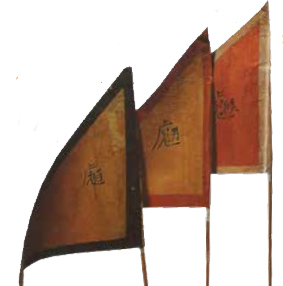
Three out of the five flags of ranks representing the five principal lodges of the Hung Society. Pictured here (from left to right) are the flags for Earl (伯), Baron (男) and Marquis (候). The other two ranks are Viscount (子) and Duke (公). All rights reserved, Lim, I. (1999). Secret Societies in Singapore: Featuring the William Stirling Collection (p. 46). Singapore: National Heritage Board, Singapore History Museum. (Call no.: RSING 366.095957 LIM).
The Penang collection also includes William A. Pickering’s article on “Chinese Secret Societies” (1879), which describes a Tiandihui initiation ceremony he witnessed in Singapore. Pickering became the first Protector of the Chinese in Singapore in 1877, and he himself joined the Tiandihui. This was at a time when the Tiandihui was a registered de facto society in Singapore.10 Pickering’s fluency in Mandarin and Chinese dialects had helped him earn the trust of the Chinese.
Works from the 1900s
William G. Stirling was the Assistant Protector of the Chinese in Singapore between 1921 and 1931 when he co-authored the three-volume work, The Hung Society or the Society of Heaven and Earth (1925–26), with J.S.M. Ward, who had previously written on the subject of Freemasonry.11 In this publication, the authors attempted to prove that the Freemasons and Tiandihui shared common origins.12
Stirling, a Freemason himself and married to a Chinese, used Schlegel’s work as a basis to understand the secret societies he was dealing with. Stirling penned the first volume on the history of the Tiandihui, and explained in detail its initiation ceremonies and rituals. Ward wrote the other two volumes, comparing the Tiandihui’s ceremonies with those from other ancient cultures.
In Singapore, the Tiandihui took on the name Ghee Hin Kongsi (meaning “Rise of the Righteousness”), and became the first secret society to be formed here in 1820. In 1972, it further entrenched itself as a legitimate society with the purchase of a temple at No. 4 China Street.13 Although members paid annual and initiation fees, Stirling observed that revenue was also collected via illegal means such as gambling, opium sales and prostitution.
In 1890, when secret societies were declared illegal in Singapore following the enactment of the 1889 Societies Ordinance, most of the documents and paraphernalia belonging to the society were destroyed by the colonial authorities. Fortunately, a number of seals and certificates were salvaged and surrendered to the office of the Protector of the Chinese. These items are now part of the William Stirling Collection at the National Museum of Singapore.
The Triad Society: Or, Heaven and Earth Association (1900) was originally written by William J. Stanton in the late 1890s as a series of journal articles. Stanton, a British police officer in Hong Kong, could speak Chinese dialects and was instrumental in surpressing the activities of the secret societies.14
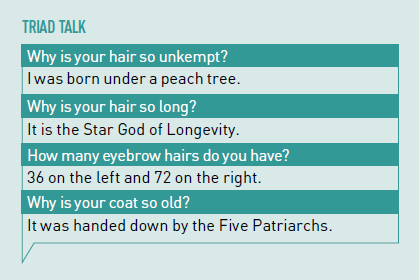
The publication provides a comprehensive overview of Hong Kong’s Triad Society – the Tien Ti Hin or the Heaven and Earth Association. Stanton reproduced in his book the membership certificates of 10 secret societies that he had collected all over Southeast Asia.15 In addition to translating and explaining the various seals used by the Triad Society, Stanton also described the methods used to verify the identity of a member. These included hand signs, code words, asking specific test questions (see here) as well as knowledge of certain arrangements of objects such as teacups.
The Rare Materials Collection’s most recent work on the Tiandihui is Triad and Tabut: A Survey of the Origin and Diffusion of Chinese and Mohamedan Secret Societies in the Malay Peninsula A.D. 1800–1935 (1941).16 Printed for internal distribution and intended for use by government authorities only, it is based on an unfinished manuscript by Mervyn Llewelyn Wynne, a senior police officer in Penang.
Wynne reviewed the history and development of the Chinese and Malay secret societies in Malaya by collating all the earlier works. He completed the first part of his research in December 1936 but was unable to finish the work as he was killed at the start of the Japanese Occupation in 1942.
Although incomplete, Wynne’s work provides a comprehensive overview of secret societies in 19th-century Malaya and makes reference to many documents that are no longer available.17 The National Library holds a copy of the rare 1941 imprint as well as three copies of the 1957 re-issued version with a foreword by Wilfred L. Blythe, the former Colonial Secretary of Singapore.
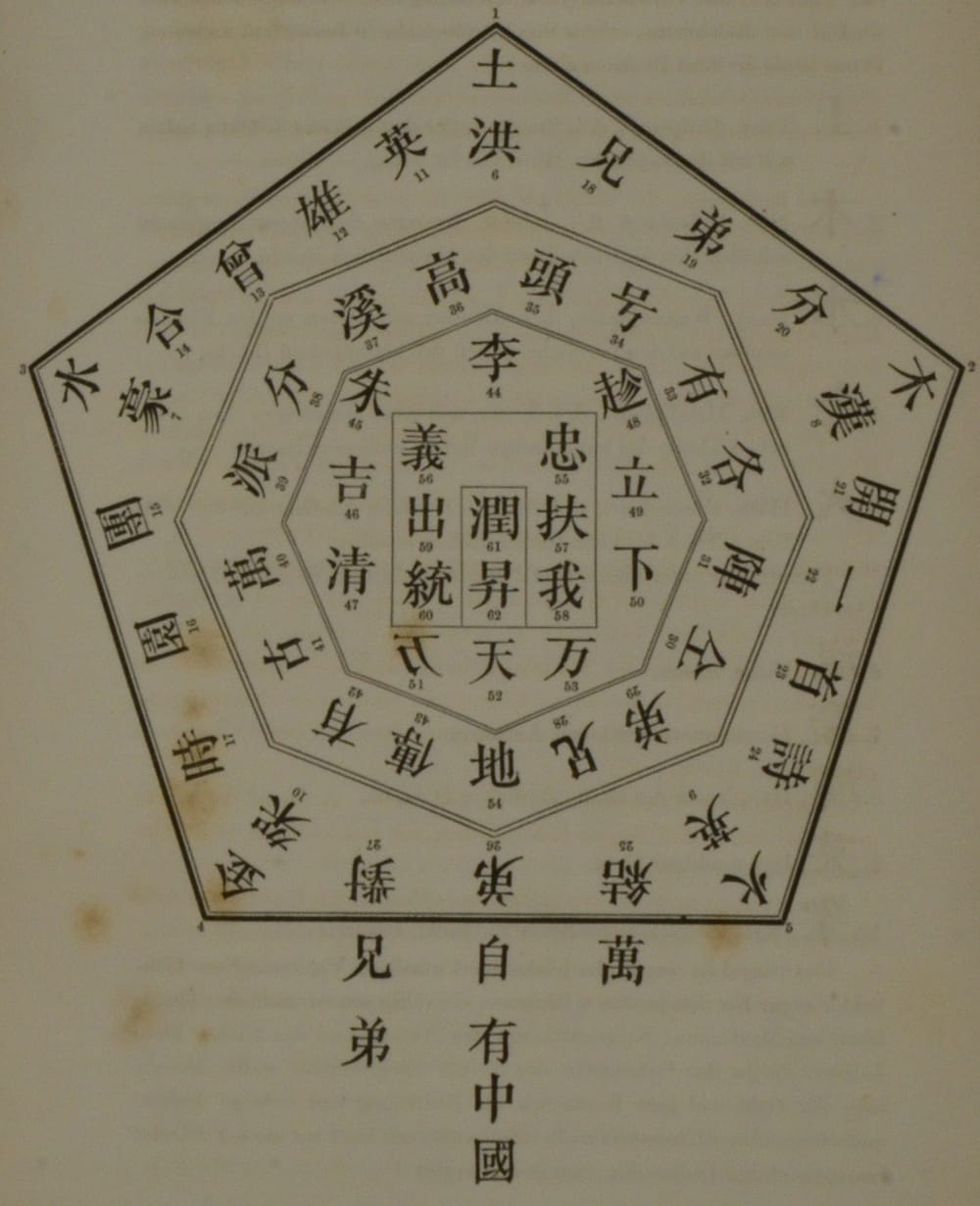
In this 1852 German-language book on Chinese secret societies in Riau, Indonesia, Dutch missionary E. H. Röttger discusses the history, structure and initiation rituals of triads using information gleaned from interviews with society members and the local Chinese community. The pentagon-shaped seal of the Chinese secret society Tiandihui on page 11 of the book shows the five Chinese characters – 土 (earth), 木 (wood), 水 (water), 金 (metal) and 火 (fire) . These represent the five elements in Chinese philosophy. All rights reserved, Röttger, E.H. (1852). Geschichte der brüderschaft des himmels und der erden: Der communistischen propaganda China’s Berlin: In Commission bel Wilhlelm Hertz. Collection of the National Library, Singapore, Accession no.: B20032051B.
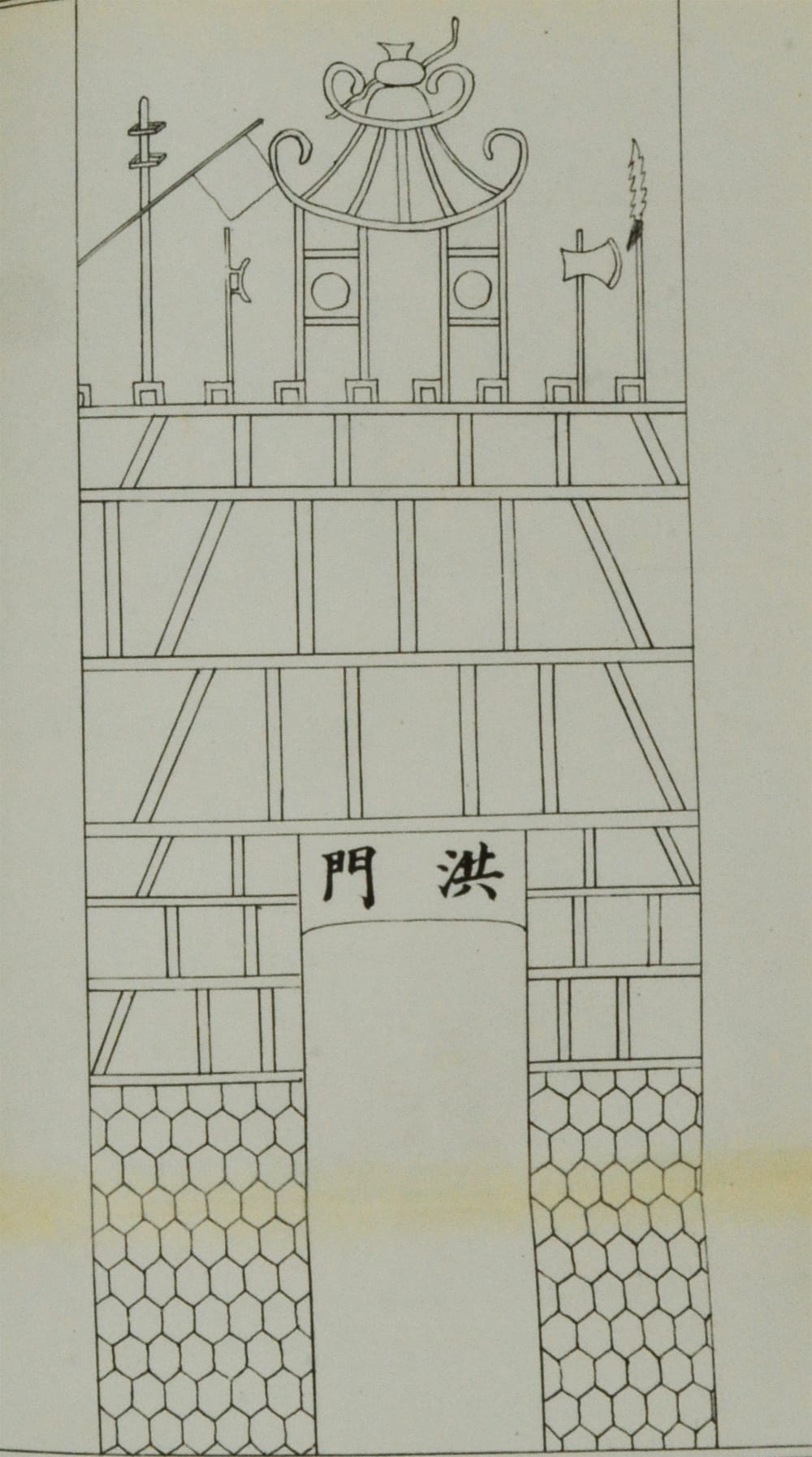
This illustration is taken from another seminal 19th-century work on secret societies in Indonesia. In his book written in English and published in 1866, Gustave Schlegel, an interpreter with the Dutch colonial government in Batavia, drew similarities between the Freemasons of Europe and the Chinese secret society Tiandihui through the use of their symbols and rituals. In this diagram from Tab. IV of the book, the Hung Gate (洪门; Hongmen) is the first of three symbolic gates that the initiate must pass through during the member initiation ceremony, in which initiates are introduced to the origins of the Tiandihui, its leaders and members as well as its rules and oaths. All rights reserved, Schlegel, G. (1866). Thian Ti Hwui: The Hung-League or Heaven-Earth-League, a Secret Society with the Chinese in China and India. Batavia: Lange & Co. Collection of the National Library, Singapore, Accession no.: B29259841G.
![William G. Stirling, Assistant Protector of the Chinese in Singapore between 1921 and 1931, and J.S.M. Ward co-authored this important three volume work on secret societies in Singapore. The Hung Society or the Society of Heaven and Earth was published between 1925 and 1926. Pictured here is the title page of Volume 1 with the colourful frontispiece titled “A Triad Plan of the Mystic Journey as Portrayed in the Arrangement of the Lodge”. On page 132 of the book is the “grand membership certificate” of the Ghee Hin Society. This impression was taken from the original “chop” that was seized when the society was declared illegal in 1890. Ghee Hin (“Rise of the Righteousness”) was regarded as the first secret society in Singapore and was formally registered in 1820. All rights reserved, Ward, J. S. M., & Stirling, W. G. (1925–1926). The Hung Society or the Society of Heaven and Earth. London: The Baskerville Press. Collection of the National Library, Singapore, Accession nos.: B02924365I [v. 1], B02924366J [v. 2], B02924367K [v. 3].](https://isomer-user-content.by.gov.sg/339/d2cfed8b-143e-4635-bced-dca54a22f3e6/07b_heavenearth.jpg)
William G. Stirling, Assistant Protector of the Chinese in Singapore between 1921 and 1931, and J.S.M. Ward co-authored this important three volume work on secret societies in Singapore. The Hung Society or the Society of Heaven and Earth was published between 1925 and 1926. Pictured here is the title page of Volume 1 with the colourful frontispiece titled “A Triad Plan of the Mystic Journey as Portrayed in the Arrangement of the Lodge”. On page 132 of the book is the “grand membership certificate” of the Ghee Hin Society. This impression was taken from the original “chop” that was seized when the society was declared illegal in 1890. Ghee Hin (“Rise of the Righteousness”) was regarded as the first secret society in Singapore and was formally registered in 1820. All rights reserved, Ward, J. S. M., & Stirling, W. G. (1925–1926). The Hung Society or the Society of Heaven and Earth. London: The Baskerville Press. Collection of the National Library, Singapore, Accession nos.: B02924365I [v. 1], B02924366J [v. 2], B02924367K [v. 3].
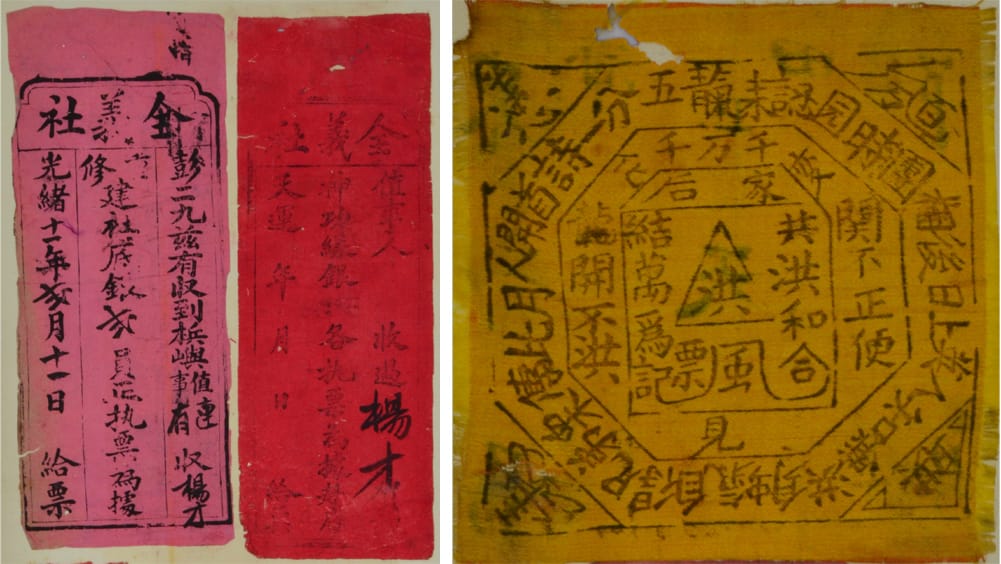
Also in the collection of the National Library is a set of unbound documents – in English and Chinese – pertaining to various secret societies in Penang in the mid- 1800s. The provenance of these documents is unclear; they were likely seized from various sources and kept at the office of the Chinese Protectorate in Penang. Shown here are membership certificates, notices, forms and receipts which were printed on white, yellow or red cloth. To make the documents unintelligible to non-members and confound the authorities, secret societies would rearrange the Chinese characters, create abbreviations or use ideograms. All rights reserved, Chinese Secret Societies: A Collection of Manuscripts and Documents Relating to Secret Societies in Penang. (1867). Collection of the National Library, Singapore, Accession no.: B02461230G.
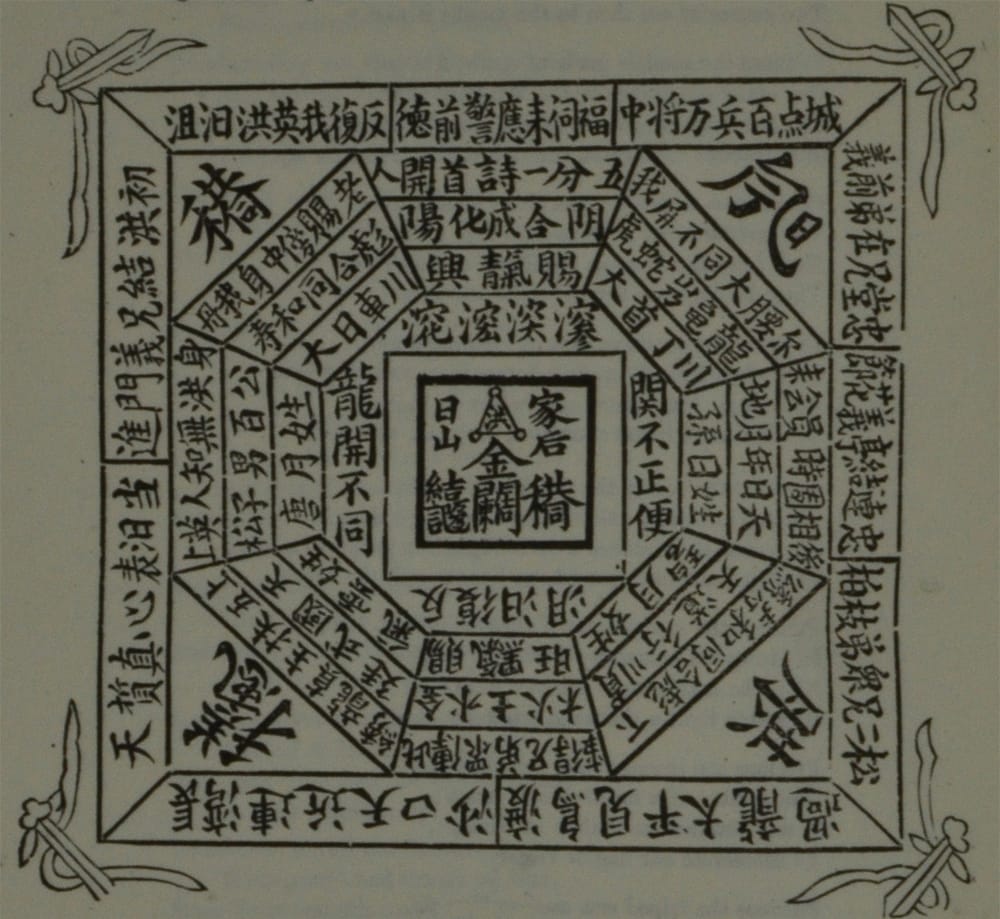
Published in 1900, The Triad Society: Or, Heaven and Earth Association was written by William J. Stanton, a British police officer in Hong Kong. The book contains reprints of articles originally written for The China Review in the late 1890s. Stanton was a Chinese speaker and was able to interact with triad members in Hong Kong when gathering information for his book. The cover design of the book represents the ritual flags placed in a peck, or wooden tub, of rice on the altar during the initiation ceremony. These flags represent the five lodges of the Hung Society. On page 72 of the book (pictured here) is a membership certificate of the Triad Society, which comprises a square enclosing an octagon. Printed within the latter is the verse composed by its five founders. The verse has been handed down and “used as a memorial and sign of membership”. Members had to carry the certificate with them at all times. All rights reserved, Stanton, W. J. (1900). The Triad Society: Or, Heaven and Earth Association. Hong Kong: Printed by Kelly & Walsh. Collection of the National Library, Singapore, Accession no.: B18990109D.
About the Author
Makeswary Periasamy is a Senior Librarian with the National Library, Singapore. She selects and acquires rare materials for the National Library, and also oversees the map collections of the library.
Endnotes
1 Murray, D.H., & Qin, B. (1994). The origins of the Tiandihui: The Chinese triads in legend and history (p. 89). Stanford, Calif.: Stanford University Press. (Call no.: R 951 MUR)
2 Lim, I. (1999). Secret societies in Singapore: Featuring the William Stirling collection (p. 10). Singapore: National Heritage Board, Singapore History Museum. (Call no.: RSING 366.095957 LIM)
3 Vaughan, J.D. (1974). The manners and customs of the Chinese of the Straits Settlements (p. 92). Singapore: Oxford University Press. (Call no.: RSING 390.0951 VAU)
4 Freemasonry is a secular fraternal order, traditionally encompassing male members only and which traces its origins to ancient times. Members are taught the society’s principles through rituals and symbols, and although it is not a religious order, members are expected to follow certain rules of morality and spirituality.
5 Röttger, E.H. (1852). Geschichte der brüderschaft des himmels und der erden: Der communistischen propaganda China’s. Berlin: In Commission bel Wilhlelm Hertz. (Call no.: RRARE 366.0951; Microfilm no.: NL24374)
6 The Thian Ti Hwui was originally published as second of three studies by Gustave Schlegel in a single volume with the general title, Verhandelingen van het Bataviassch Genootschap van Kunsten en Wetenschappen, Deel XXXII. The other two works by Schlegel in this volume include the original editions of the Hoa Tsien Ki, of, Geschiedenis van het Gebloemde Briefpapier: Chinesche Roman (Dutch Translation of a Chinese Literary Work) and the Lets over De Prostitutie in China (Schlegel’s Study of Prostitution in China). The National Library’s copy of Thian Ti Hwui is also bound together with these two works.
7 [Chinese secret societies: A collection of manuscripts and documents relating to secret societies in Penang]. (1867). (Call no.: RRARE 364.10609595113 CHI; Microfilm no.: NL18296)
8 The full report, including testimonies from the 71 witnesses interviewed, was presented at the Straits Settlements Legislative Council in 1868.
9 Comber, L. (1959). Chinese secret societies in Malaya: A survey of the Triad Society from 1800−1900 (pp. 110−112). New York: Published for the Association for Asian Studies by J.J. Augustin. (Call no.: RDTYS 366.09595 COM); Straits Settlements. (1868). Report of the Commissioners appointed under act XXI of 1867, to enquire into the Penang riots; Together with proceedings of the committee, minutes of evidence and appendix (p. vi). Penang: Colonial Government of the Straits Settlements. Penang: Colonial Government of the Straits Settlements. (Call no.: RRARE 366.0951 STA; Microfilm no.: NL1100)
10 Murray & Qin, 1994, p. 97.
11 Ward, J.S M., & Stirling, W.G. (1925–1926). The Hung Society or the Society of Heaven and Earth. London: The Baskerville Press. (Call no.: RRARE 366.09595 WAR; Microfilm no.: NL25414)
12 Murray & Qin, 1994, p. 100.
13 Lim, 1999, p. 15.
14 Stanton, W.J. (1900). The Triad Society: Or, Heaven and Earth Association. Hong Kong: Printed by Kelly & Walsh. (Call no.: RRARE 366.0951 STA; Microfilm no.: NL25923)
15 Murray & Qin, 1994, p. 100.
16 Wynne, M.L. (1941). Triad and tabut: A survey of the origin and diffusion of Chinese and Mohamedan secret societies in the Malay Peninsula A.D 1800–1935. Singapore: Government Printing Office. (Call no.: RRARE 366.09595 WYN; Microfilm nos.: NL9715, NL6705)
17 Wong, L.K., & Wong, C.S. (1960, March). Secret Societies in Malaya. Journal of Southeast Asian history, 1 (1), 97–114, pp. 97–98. Retrieved from JSTOR via NLB’s eResources website.