
Article
The Way We Were: Fashion Through the Decades
Topics
Culture
10 October 2017
Singapore has emerged as a leading Asian fashion capital in recent years. Zoe Yeo tracks its evolution through fashion publications from the Legal Deposit Collection.
Among other things, Singapore’s multicultural and multi-ethnic society is reflected in the clothing we wear. The first ever official census conducted in 1824 recorded 10,683 residents, comprising 74 Europeans, 15 Arabs, 4,580 Malays, 3,317 Chinese, 756 Indian natives and 1,925 Bugis.1 When the intrepid 19th-century travel writer Isabella Bird first stepped foot in Singapore in 1879, she was amazed at how the city was “ablaze with colors and motley with costume” and how the attire worn by locals made up “an irresistibly fascinating medley”.2
The fashion scene in Singapore today is starkly different from what Bird witnessed in the 19th century but one thing hasn’t changed: the Singaporean woman’s penchant for dressing well and keeping up with the latest fashion. Looking through the National Library’s Legal Deposit Collection of fashion magazines and books published in Singapore over the past several decades, one is able to study changing trends not only in dress, but also hair and makeup.
Traditional Costumes
Up until the 1950s, traditional attire was a common sight on the streets of Singapore. Wearing Western-style clothes was the preserve of those who had studied or travelled overseas, or who were wealthy enough to buy imported fashions sold at a handful of high-end boutiques.3
With comfort as a priority, Malays preferred loose clothing to combat the humid weather – the baju kurong (or kurung) being the traditional attire of choice for both men and women.4 Men wear the baju kurong ensemble of loose-fitting shirt and pants with a sampin or sarong-like wrap around the waist, while women pair their knee-length top with a matching skirt in the same material. The women’s version is intricately embroidered with motifs such as those seen in Baju Kurong Sulam Modern (1952), a pattern book of popular embroidery designs inspired by flowers and birds. According to the author, C. Mahat, it is crucial to pick the right colour palette for the embroidery so that the colours do not clash.
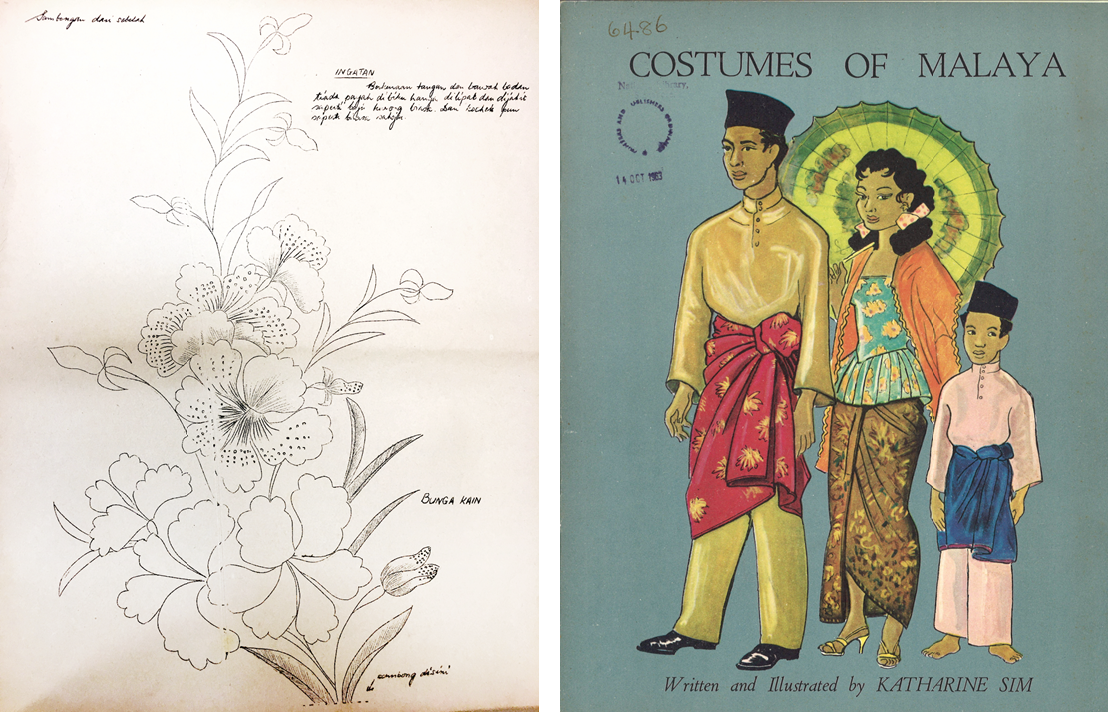
(Left) Baju Kurong Sulam Modern is a pattern book of popular embroidery designs inspired by flowers and birds. All rights reserved, Mahat. C. (1952). Baju Kurong Sulam Modern. Singapore: M. Salleh.(Right) This illustrated book provides vivid descriptions of the fashion scene and traditional attire worn by the different racial groups in post-war Singapore. All rights reserved, Sim, K. (1963). Costumes of Malaya. Singapore: Published by Donald Moore for Eastern Universities Press Ltd.
In the eyes of author Katherine Sim, the sari (or saree) worn by women of the Indian subcontinent was the most graceful of costumes, with its flowing lines and sculptured look. The cheongsam worn by Chinese women, on the other hand, was the most provocative, as it “shows off a woman’s figure to the highest degree possible… short of a bikini”. Sim’s illustrated book, Costumes of Malaya (1963), provides vivid descriptions of the fashion scene and traditional attire worn by different racial groups in post-war Singapore.
Women’s Fashion Magazines
Following World War II, women’s roles in society changed drastically. In 1948, women were given the right to vote and, in 1961, the Women’s Charter was passed to improve and protect the rights of females in Singapore.5 As more women found employment in the workforce and their spending power increased, fashion choices broadened to include work attire, which in turn encouraged foreign brands to enter the local retail market.
Although cinemas had been around in Singapore since the early 1900s, it was the advent of television in 1963 that inspired local women to follow the latest trends seen in the media, most of which were influenced by Western movies and celebrities. Women’s fashion magazines started appearing in Singapore to cater to the increasing appetite for fashion news and trends.6
Fashion was the title of the first Malay weekly fashion magazine published in Malaya. The kebaya designs featured in the magazine had a more defined silhouette accentuated with interesting necklines and elements borrowed from Western-style dresses. The fashion-forward kebaya designs also borrowed from other ethnic costumes, such as the body-hugging cheongsam with Chinese frog buttons.
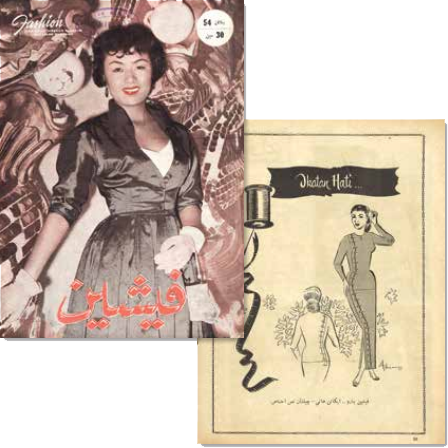
This is the cover of the 20 February 1955 edition of Fashion, the first Malay weekly fashion magazine published in Malaya. On page 18 of this issue is a cheongsam-inspired body-hugging kebaya with Chinese frog buttons. All rights reserved, C. Mahat. (1955, February 20). Fashion. Singapore: R. M. Yusoff Ahmad: Harmy.
Fashion Mirror was one of the pioneering publications that featured content on local fashion. First published in 1958, it was one of the most popular magazines among women in Singapore with articles specially written for Malayan readers. The magazine showcased clothing that was influenced by Western culture and infused with a dash of local flavour. One such outfit was the Chinese samfu, a blouse-and-trouser pairing using modern fabrics enhanced with “border” designs to create a “novel and striking effect”, as seen in the May–June 1959 issue.
Her World, launched in July 1960 and one of Singapore’s longest-running women’s magazines, was touted as being “packed with features on beauty, babies, things to make for your home, exercises for your figure, exciting new recipes, cheongsams, sarong kebayas”. The inaugural issue informed readers that the Western dress was the preferred attire among young ladies in university – as opposed to traditional costumes – as it was less restrictive and more comfortable to wear. The October 1961 edition featured a sarong kebaya that had been given a sartorial twist with Spanish-influenced “wide billowy bishop sleeves caught in cuffs at the wrist”.
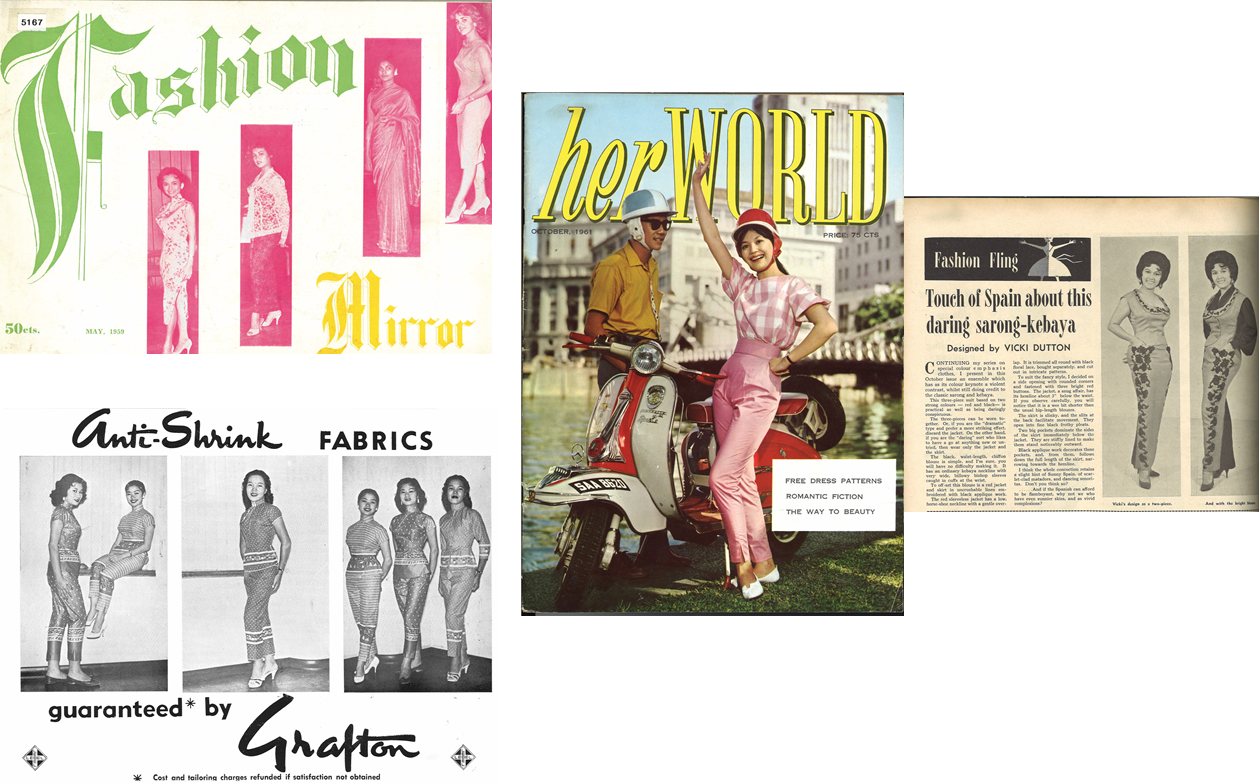
(Left) Fashion Mirror was one of the most popular magazines in Singapore during its time with its emphasis on local fashion trends. Featured on page 16 of the May–June 1959 issue is a modern version of the traditional Chinese samfu using a special anti-shrink fabric. All rights reserved, Princess Enterprises. (1959, May–June). Fashion Mirror. Singapore: Princess Enterprises.(Right) Her World, first launched in July 1960, is one of Singapore’s longest-running women’s magazines. The October 1961 edition – with Margaret Mok on the cover – featured on page 10 a sarong kebaya with Spanish-influenced “wide billowy bishop sleeves caught in cuffs at the wrist”. All rights reserved, Straits Times Press. (1961, October). Her World (p. 10). Singapore: Straits Times Press (Malaya) Ltd.
Made-to-Measure
As Western culture made greater inroads into the local fashion scene, tailors who could replicate designs seen on television and film, and in fashion magazines were highly sought after by both women and men.7 The first public fashion showcase for men was held in 1961 by the Singapore Merchant Tailors Association. The aim was to introduce the latest trends in bespoke suits to local consumers, “to show off” the high standard of tailoring in Singapore, and to improve dress sense among men. The publication, produced in conjunction with the event, featured on its cover a Western-style evening jacket that had been given an ethnic spin with batik material.
The popularity of made-to-measure clothing also led to a demand for sewing and tailoring classes. Mui Goi Ladies Dress-Making & Embroidering Institution was one of the pioneers offering dressmaking lessons in the 1950s and 1960s. To celebrate its ninth anniversary in 1962, a special exhibition of students’ works was held in the school. These works were subsequently featured in a commemorative publication.
To cater to the increasing interest in fashion, dress design and dressmaking classes were introduced by the Adult Education Board in 1963. A total of 1,508 students were enrolled in the first and second batches of the six-month course. Their works were showcased in a souvenir magazine published in 1965.
Budding fashionistas also turned to dress pattern publications such as Lucky Fashion Magazine (幸福时装杂志) and Shee Zee Fashion (旭日 时装) for inspiration. The inaugural issue of Lucky Fashion Magazine published in June 1965 proved so popular that it sold out within a few weeks, and went into three reprints before the second issue was published a year later. Home economics teachers also used the magazine as reference material for their sewing and handicraft lessons in school. Shee Zee Fashion, a publication of Shee Zee Institute of Tailoring, featured outfits designed for tropical weather such as the miniskirt, the 1960s runaway best-seller by British fashion icon Mary Quant.8
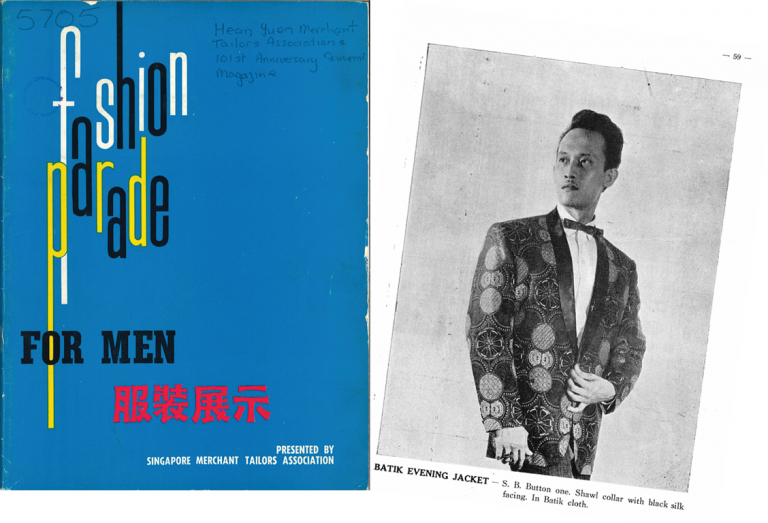
The Western-style evening jacket featured in Fashion Parade for Men had been given an ethnic spin with batik material. All rights reserved, Singapore Merchant Tailors Association. (1961). Fashion Parade for Men: Presented by Singapore Merchant Tailors Association (p. 59). Singapore: Singapore Merchant Tailors Association.
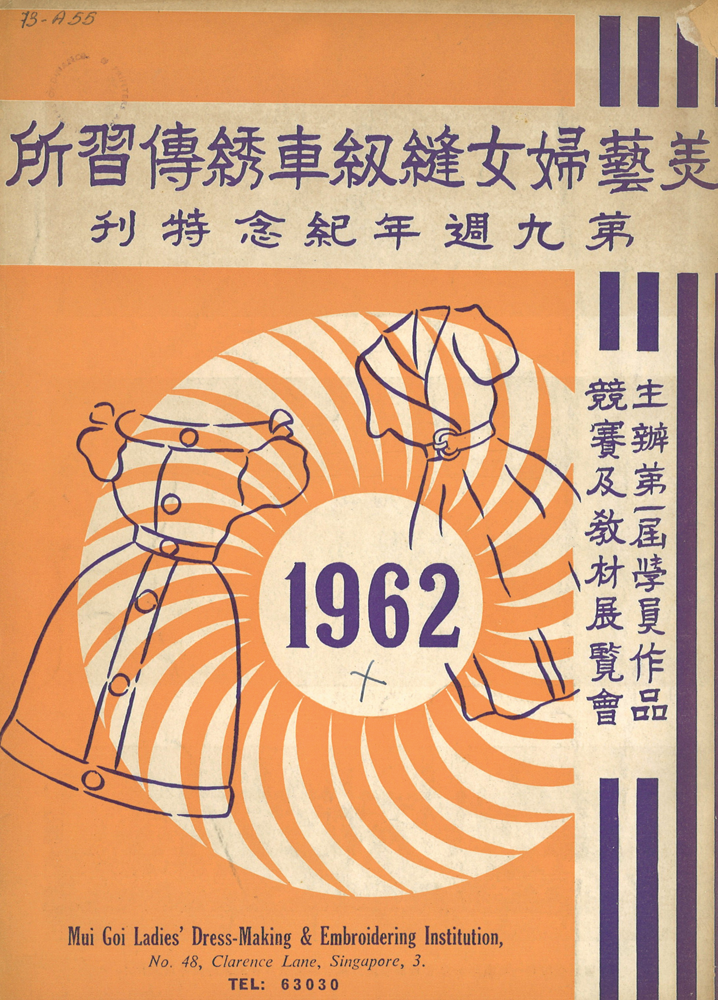
A special exhibition of students’ works was held to commemorate the ninth anniversary of Mui Goi Ladies Dress-Making & Embroidering Institution. All rights reserved, Mui Goi Ladies’ Dress-Making & Embroidering Institution. (1962). 美艺妇女缝纫车绣传习所第九周年纪念 特刊: 主办第一届学员作品竞赛及教材展览会. Singapore: Mui Goi Ladies’ Dress-Making & Embroidering Institution.
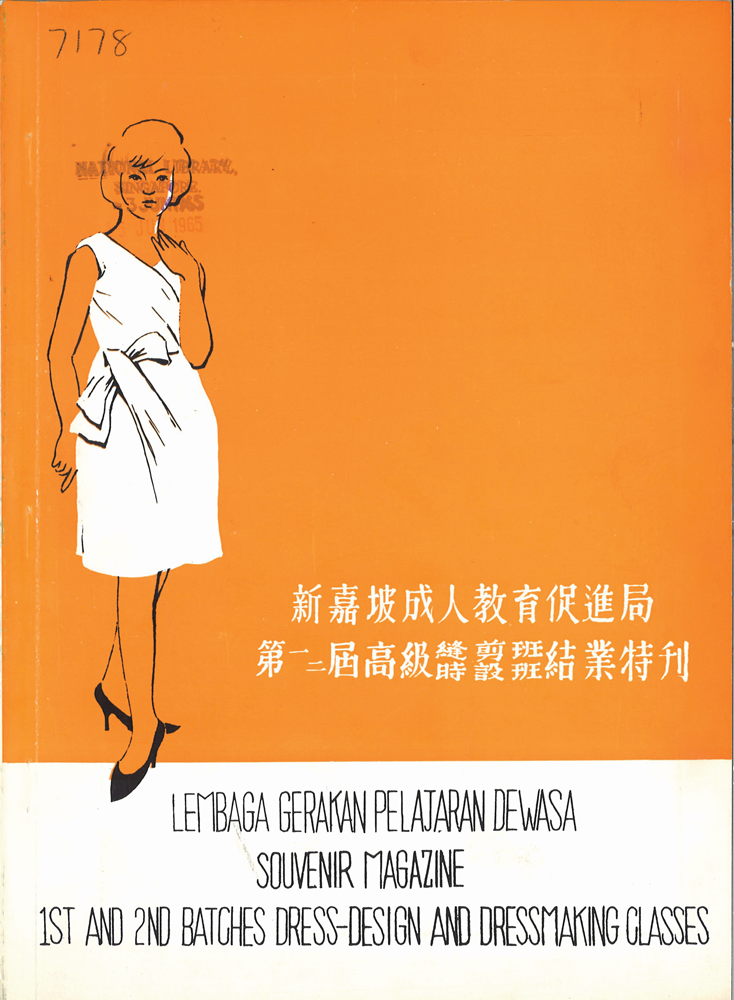
Dress design and dressmaking classes were introduced by the Adult Education Board in 1963. The students’ works are showcased in this souvenir magazine. All rights reserved, Adult Education Board. (1965). Souvenir Magazine 1st and 2nd Batches Dress-Design and Dressmaking Classes (新嘉坡成人教育促进局第一, 二届高级缝剪班时设班结业特 刊, Lembaga Gerakan Pelajaran Dewasa). Singapore: 1st and 2nd Batches Dress-Design and Dressmaking Classes.
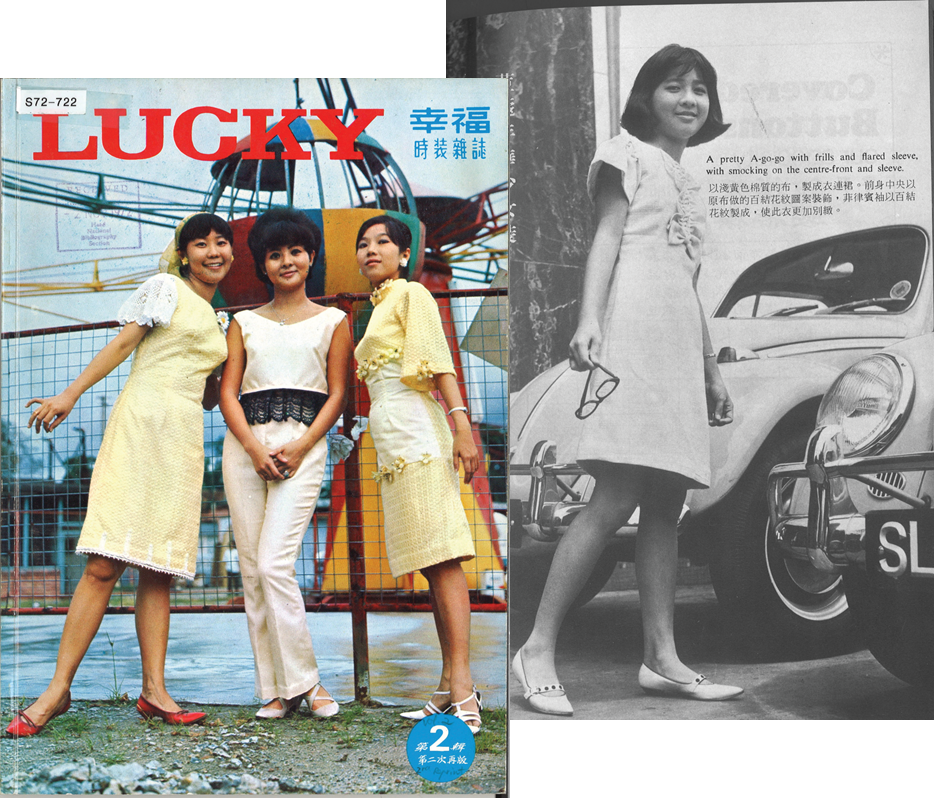
The dress patterns in Lucky Fashion Magazine provided the inspiration for many budding fashionistas to sew their own clothes. It was also used by school teachers as reference material for their sewing and handicraft lessons. Outfits showcasing the popular “A-go-go” style of the early 1970s are featured in this second issue of the magazine. This dress on page 31 is described as “a pretty a-go-go with frills and flared sleeves, with smocking on the centre-front and sleeve”. All rights reserved, Far Eastern Culture Co. Ltd. (1965). Lucky Magazine of Fashion and Multi-Knotted Decorative Designs (幸福时装杂志) (p. 31). Singapore: Far Eastern Culture Co. Ltd.
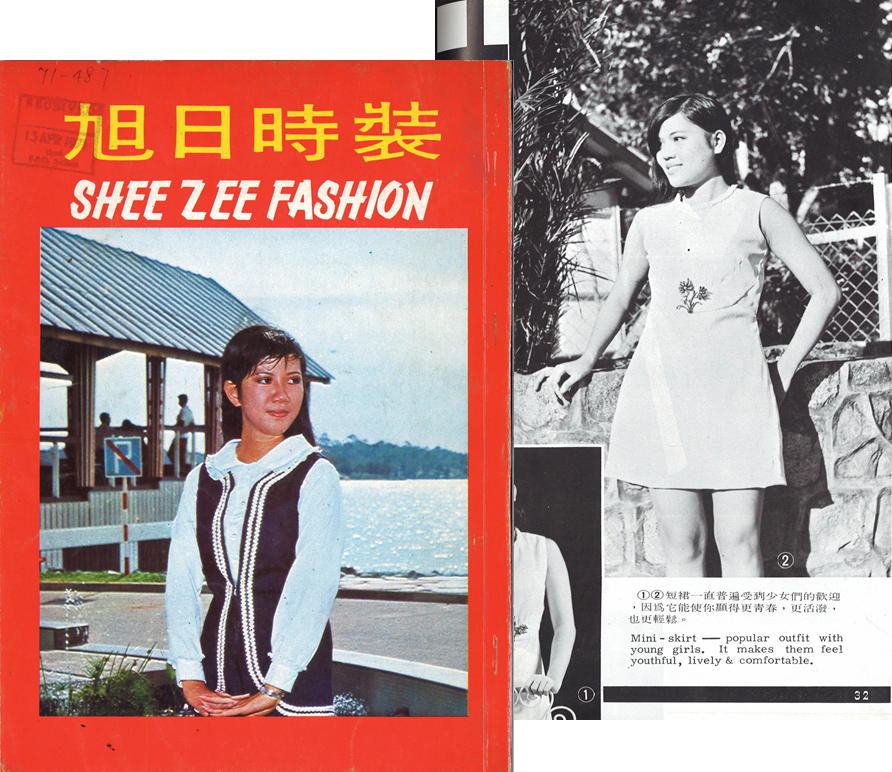
Shee Zee Fashion, a publication of Shee Zee Institute of Tailoring, featured outfits designed for our tropical weather, such as the miniskirt. The trendy outfit was popular with young girls as it portrayed “youthfulness and liveliness”, and was comfortable to wear. All rights reserved, Shee Zee Institute of Tailoring. (1971). Shee Zee Fashion (旭日时装) (p. 33). Singapore: Shee Zee Institute of Tailoring.
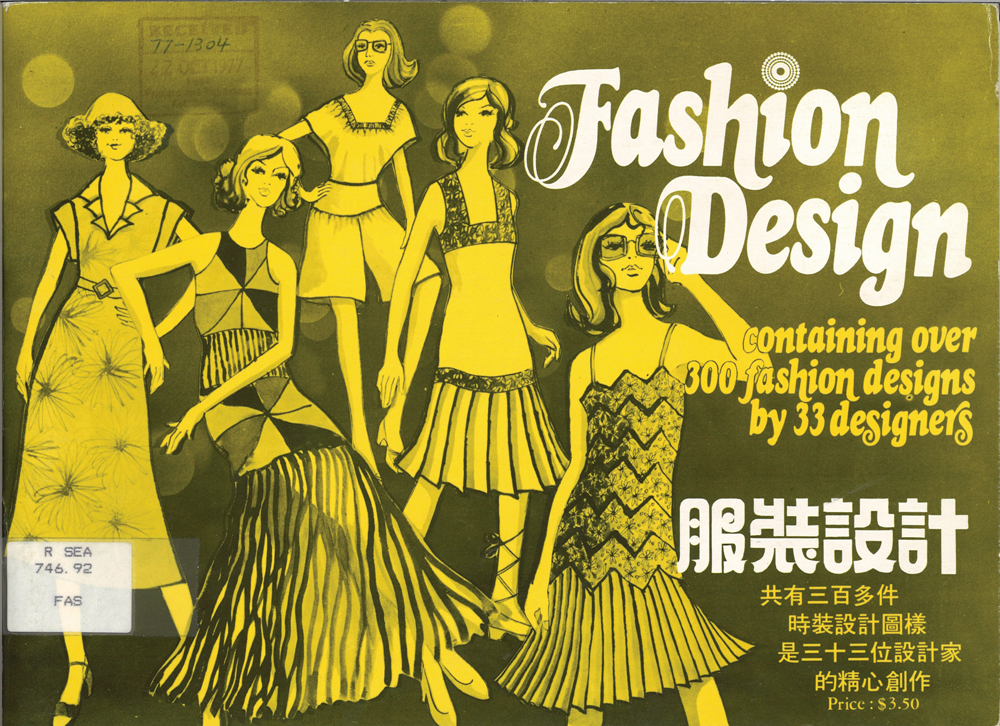
This 1977 publication showcases the creations by 33 local designers. All rights reserved, Koh, W.W.L. (1977). Fashion Design: Containing Over 300 Fashion Designs by 33 Designers (服装设计). Singapore: Circle One Design Centre.
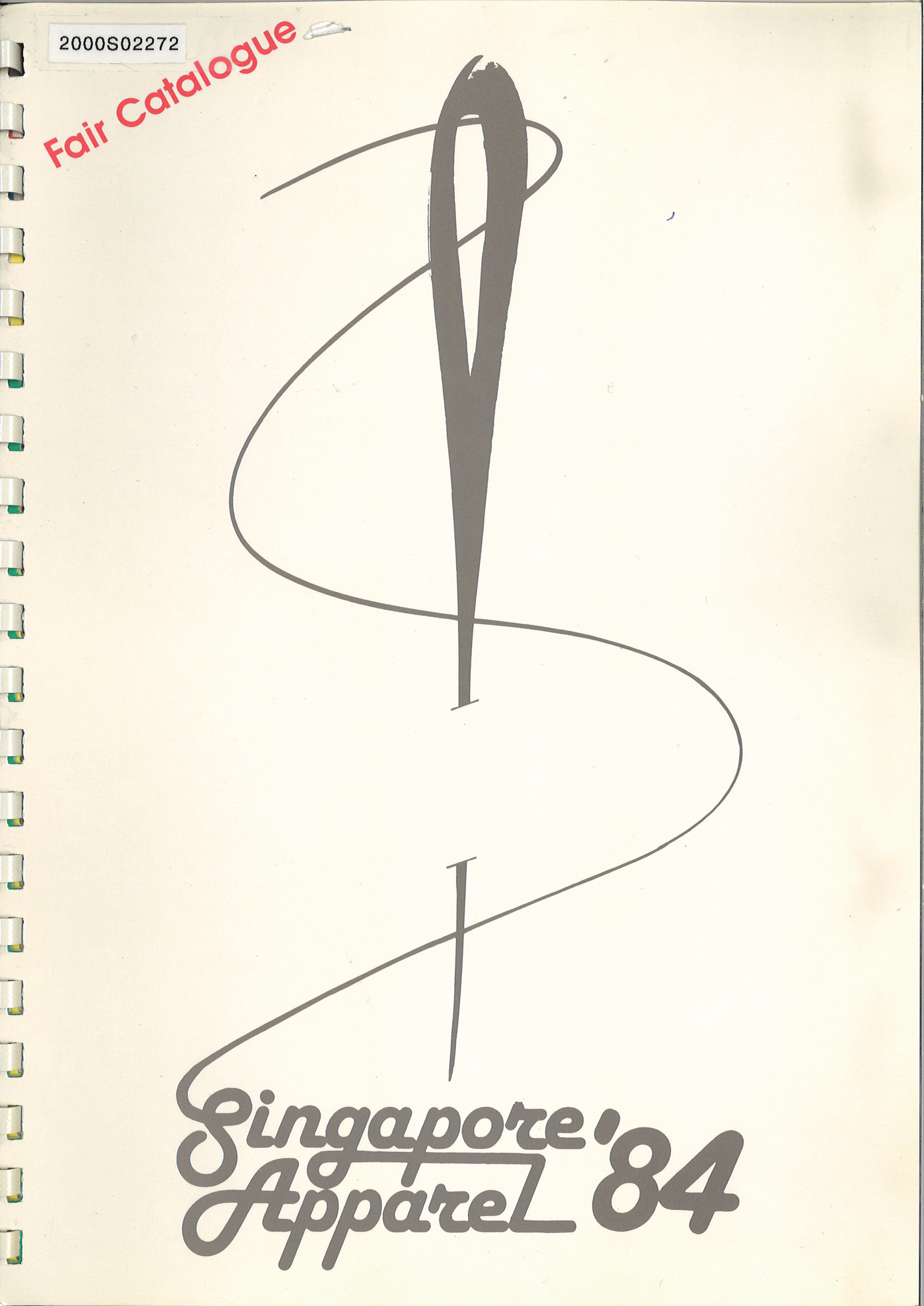
The second instalment of the Singapore Apparel exhibition was held in November 1984 after a successful inaugural launch in 1983. The 1984 event was said to be a testimony of the “enthusiasm, creativity and talents of people in the trade” and aimed to establish the “Made-in-Singapore” hallmark of quality and reliability. All rights reserved, Singapore Apparel: Fair Catalogue. (1983). Singapore: Singapore Textile and Garment Manufacturers’ Association.
Singapore on the World Fashion Map
The local fashion industry received another boost in the 1970s when the manufacturing sector took off in Singapore. The opening of Japanese departmental stores, such as Yaohan, Isetan and Sogo, also enlivened the local shopping scene. Ready-to-wear outfits were sold in department stores and shopping centres that sprang up all over the island.9
In 1977, a group of 33 local designers collaborated to produce a book showcasing their works. Titled Fashion Design: Containing Over 300 Fashion Designs by 33 Designers, it was the first of its kind in Singapore. As opposed to the “fanciful dresses from foreign countries [that] are not acceptable to the great majority of people here,” the creations featured in the publication were appropriate for the local climate and tailored to fit the petite Asian silhouette.
As homegrown labels grew in tandem with fashion imports, efforts were made to put Apparel ’83, the city’s first industry-wide garment trade show promoting local labels and designers, was hailed as a resounding success.10
In October 1983, The Straits Times reported that Singapore-made apparel had led to a $20-million increase in exports for the first eight months of the year, raking in more than $1.1 billion worth of sales for the year.11 Local designers were cultivating a global audience and putting Singapore on the world fashion stage.12
Singapore has since set its sights on becoming the fashion capital of Asia.13 The Singapore Fashion Festival was launched by the Singapore Tourism Board in 2001 to help achieve that goal. The festival was held annually until 2009, when it took a one-year hiatus, and was rebranded as the Asian Fashion Exchange (AFX) in 2010.
In 2015, Singapore Fashion Week became the core event of AFX,14 garnering worldwide attention and participation by renowned international labels. In the 2016 edition, 13 homegrown designers shared the spotlight with other top Asian designers – the highest number yet at Singapore Fashion Week.15
The efforts seem to have paid off. In 2011, Singapore was ranked number eight in the list of Top 50 Fashion Capitals in the World by the US-based Global Language Monitor. Although the city dropped to number 14 (out 56 fashion capitals) in 2015, it was the third highest-ranked Asian city, after Tokyo (number 10) and Hong Kong (number 12)16 – a lofty status it aims to maintain or better in years to come.
What is the Legal Deposit?
One of the statutory functions of the National Library Board Act is Legal Deposit. Under the act, all publishers, commercial or otherwise, are required by law to deposit two copies of every work published in Singapore with the National Library within four weeks of its publication. The Legal Deposit function ensures that Singapore’s published heritage is preserved for future generations. Legal Deposit also acts as a repository for published materials, providing exposure via the online catalogue, PublicationSG: catalogue.nlb.gov.sg/publicationsg. For more information, please visit www.nlb.gov.sg/Deposit.
About the Author
Zoe Yeo is an Associate Librarian with the National Library, Singapore. Her responsibilities include developing the National Library’s collections as well as providing content and reference services on topics relating to Singapore and Southeast Asia.
Endnotes
1 Buckley, C.B. (1984). An anecdotal history of old times in Singapore: 1819–1867 (p. 154). Singapore: Oxford University Press. (Call no.: RSING 959.57 BUC)
2 Bird, I.L. (2000). The Golden Chersonese (p. 119). Köln: Könemann. (Call no.: RSING 915.951 BIR)
3 Souza, J D., Ong, C., & Rao, T. (2016). Fashion most wanted: Singapore’s top insider secrets from the past five decades (p. 14). Singapore: Straits Times Press Pte Ltd. (Call no.: RSING 746.92095957 DES)
4 National Heritage Board & Fashion Designers Society. (1993). Costumes through time: Singapore (p. 115). Singapore: National Heritage Board and Fashion Designers Society. (Call no.: RSING q391.0095957 COS)
5 National Heritage Board & Fashion Designers Society, 1993, p. 7.
6 National Heritage Board & Fashion Designers Society, 1993, p. 7; Souza, Ong & Rao, 2016, p. 16; Jessie Yak and Sundari Balasubramaniam, “In Vogue,” BiblioAsia 10, no. 3 (October–December 2014); Chandramohan, G. (2017, February 24). Singapore chic. Retrieved from Roots.sg. website.
7 Souza, Ong & Rao, 2016, pp. 14–15.
8 Yak and Balasubramaniam, “In Vogue.”
9 Souza, Ong & Rao, 2016, p. 34; Yak and Balasubramaniam, “In Vogue.”
10 Lee, Y.M. (1982, May 15). Campaign to promote S’pore high fashion abroad. The Business Times, p. 1; Apparel ’83 – a sign of progressive enterprise. (1982, October 3). The Straits Times, p. 13. Retrieved from NewspaperSG.
11 The Singapore cut ropes in $20m more. (1983, October 22). The Straits Times, p. 15. Retrieved from NewspaperSG.
12 Goh, L.K. (1982, January 18). Big plans for place on the fashion map. The Straits Times, p. 22. Retrieved from NewspaperSG.
13 Souza, Ong & Rao, 2016, pp. 151.
14 National Library Board. (2016). Singapore Fashion Festival written by Nureza Ahmad. Retrieved from Singapore Infopedia website.
15 Woo, A. (2016, October 26). Singapore Fashion Week 2016 opens with a bang. The Straits Times. Retrieved from Factiva via NLB’s eResources website.
16 Reyes, K. (2012, November 15). Singapore: A global fashion capital on the rise. Retrieved from styleXstyle website; The Global Language Monitor. (2016). Paris towers over world of fashion – as top global fashion capital. Retrieved from The Global Language Monitor website.