
Article
Stamping History
Topics
Arts
1 January 2018
Postage stamps are more than little squares of paper to be stuck on envelopes. Justin Zhuang discovers how stamps have helped forge Singapore’s identity over the past five decades.
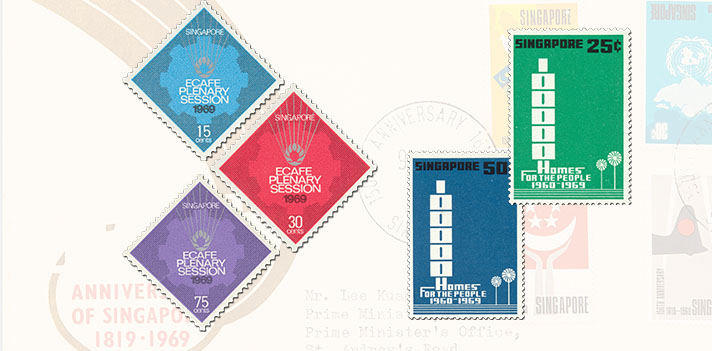
Two stamp series issued in 1969 under a “new liberal policy”, following the formation of the Stamp Advisory Committee in 1968: “25th Plenary Session of ECAFE” by graphic artist Eng Siak Loy (left) and “10,000 Homes for the People” by Tay Siew Chiah (right). Courtesy of Singapore Philatelic Museum.
There was precious little to celebrate when the Singapore Stamp Club commemorated 100 years of postage stamps in 1967. The accompanying exhibition booklet was very blunt in describing the dismal state of Singapore’s philatelic scene:
“Against the increasing tendency of practically every other country in the world to issue more and more commemorative stamps each year, the conservative policy of Singapore must be almost without an equal.”1
Between self-government in 1959 and merger with Malaysia in 1963, and independence in 1965, Singapore issued only eight commemorative stamp series to mark these historic occasions. Unlike definitive stamps that are meant for everyday use, commemorative stamps are issued to record national milestones and showcase Singapore’s culture, customs and identity to the world. This was a lost opportunity according to the booklet: “What other country can claim to have issued a total of only 21 commemorative stamps in the past 8 years!”2
The paucity of such stamps was not the only issue plaguing the Singapore stamp scene at the time. Almost a year after the exhibition at the National Library at Stamford Road, then Minister for Communications Yong Nyuk Lin noted that local stamps were generally “dull” and suffered from “disappointingly low” sales.
To fix the situation, the government set up the Stamp Advisory Committee (SAC) in 1968. “This situation certainly calls for immediate remedial action and in line with present Government policy of increasing productivity and to raise additional revenue, wherever possible,” said Minister Yong at the inaugural meeting of the SAC, adding, “… there is no reason why we cannot use more imagination and drive in the creation of attractive designs for our postage stamps….”3
This “new liberal policy”4 marked a turning point in the history of Singapore stamps. Over the next 50 years, stamps evolved from being mere accessories of a young state to a revenue-generating platform that spoke of the achievements of the nation to its people and the world.
Raising Standards and Revenue
As one of SAC’s primary tasks was to attract more people to buy local stamps, it became less concerned with artistic considerations than the previous committee, which had been set up after Singapore became self-governing in 1959.5 Reflecting the state’s greater interest in stamps and a market-oriented outlook, the nine-man SAC was staffed with five civil servants from the ministries for culture and communications, three philatelists and one arts lecturer.6 The committee advised the minister for communications on philatelic policy, including stamp themes, designs and ways to increase sales locally and abroad. The committee also proposed ways to grow interest in philately, particularly among young Singaporeans.
One of SAC’s earliest initiatives was to triple Singapore’s commemorative stamp issues. From an average of just one a year, the country issued three stamp series in 1969: to mark the 25th Plenary Session of Economic Commission for Asia and the Far East (ECAFE) held in Singapore; the completion of 100,000 homes by the Housing and Development Board; and the 150th anniversary of the founding of Singapore. These stamps scored several firsts for local postal history.
The ECAFE issue of three stamps designed by local graphic artist Eng Siak Loy were the first square-shaped ones, each depicting the organisation’s emblem in red, blue and purple backgrounds respectively to denote different face values.
The 150th anniversary of the founding of Singapore series in 1969 was the first time that stamps were issued in 12-by-12 centimetre miniature sheets, and featured different designs for each of the six values. To commemorate the milestones in Singapore’s modern history, Eng and Han Kuan Cheng, who were colleagues at Radio Television Singapura, used a semi-abstract graphic style to depict the country’s industrialisation (15 cents), entry into the United Nations (30 cents), merger with Malaysia (75 cents), self-government in 1959 ($1), the Japanese Occupation ($5) and the landing of Sir Stamford Raffles ($10).
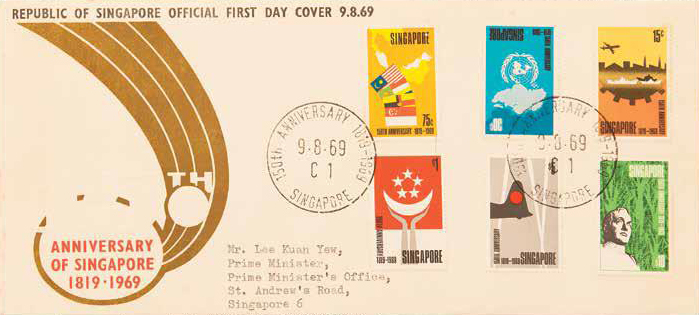
First-day cover of “150th Anniversary Founding of Singapore” addressed to then Prime Minister Lee Kuan Yew dated 9 August 1969. The stamps were designed by Eng Siak Loy and Han Kuan Cheng. Courtesy of Singapore Philatelic Museum.
Despite the stamps’ high face value – a total of $17.20 compared with just under a dollar for previous issues − these first-day covers were reportedly sold out within the first two hours.7 By the 1980s, a first-day cover8 of this series was worth around $700. Today, the price for a mint condition cover and accompanying miniature sheet is $900, according to the Singapore Postage Stamp Catalogue.9
The successful sales of the 1969 commemorative stamps led the SAC to increase the number of new issues the following year to five, a figure that has steadily increased over the decades along with sales. Only four years after the policy shift, revenue from Singapore stamp sales jumped by tenfold to a million dollars.10
Realising the lucrative income to be reaped from sales of commemorative stamps, the government issued an average of six stamp series a year in the mid-1970s, then increased it to eight by the mid-90s. Today, some 10 to 12 stamp issues are released a year.11
How Stamps Tell a Story
As Singapore liberalised the issue of commemorative stamps, the production process too became less arbitrary under the SAC. In the past, public competitions were organised to determine stamp designs, but the outcomes were not always desirable. For instance, while some 115 submissions were received in the 1962 National Day competition for commemorative stamps – eventually won by Kuala Lumpur resident Loo Shen Yuen – a dearth of entries almost held up the earlier competition in 1959 to design stamps marking Singapore’s attainment of self-governance.12 Eventually, the situation was resolved by Raffles Museum director (and Stamp Design Committee member) Dr Carl Alexander Gibson-Hill, who suggested using the “Singha”, the gold lion symbol of Singapore’s first settlement in the 13th century.13
Within the SAC, all decisions regarding stamp themes and designs were made by a group of individuals selected by the government. The committee was guided by an annual circular sent to various ministries to solicit for ideas. A selection of themes would then be put forward to the minister for communications to approve, after which two to three graphic artists would be invited to submit proposals for the competition.
This rigorous process reflected the increasing importance of stamps as a means of representing the nation on the global stage. As the first SAC chairman, Phua Bah Lee, noted in 1978:
“In a world where communications play an important role in forging links between nations…, the postage stamp as a medium of communication has assumed increasing importance today. From a humble origin as a means of enabling the postal services to collect postage, stamps have become a powerful means of communicating an idea or of projecting a country’s national image overseas.”14
And the image that Singapore wanted to project to the world during the early nation-building decades was its effort to industrialise the economy, modernise the city and mould its people.
Thus, stamps were issued to mark the anniversaries of government agencies such as the People’s Association (1970) and the Economic and Development Board (1986) as well as the 10th anniversary of the national shipping company, Neptune Orient Lines (1978), and the completion of Changi Airport (1981). There were also stamp issues that coincided with national campaigns to raise quality in industrial production (1973), convert from the imperial to the metric system (1979) and increase productivity (1982).
One series that reflected the progressive spirit of the times was the 1975 “Science and Industry” set of three stamps by art lecturer and graphic artist Sim Tong Khern. Sim departed from the traditional hand-illustrated stamps of the time by manipulating photographs of an oil refinery, a medical surgery and the two satellite earth stations in Sentosa to create a technicolour depiction of Singapore’s industrialisation efforts.
Besides such nationalistic stamps, there were also designs that spoke of Singapore’s place in the world. The 1971 stamp series commemorating the launch of Singapore’s first satellite earth station made a grand statement of how the country could now communicate with two-thirds of the world. Graphic designer William Lee superimposed a drawing of a satellite dish over a block of four conjoined 30-cent stamps, creating Singapore’s first se-tenant series. Much less dramatic in design were stamps commemorating international and regional events such as International Women’s Year (1975), the 75th anniversary of the world scout movement (1982) and the 20th anniversary of ASEAN (1987).
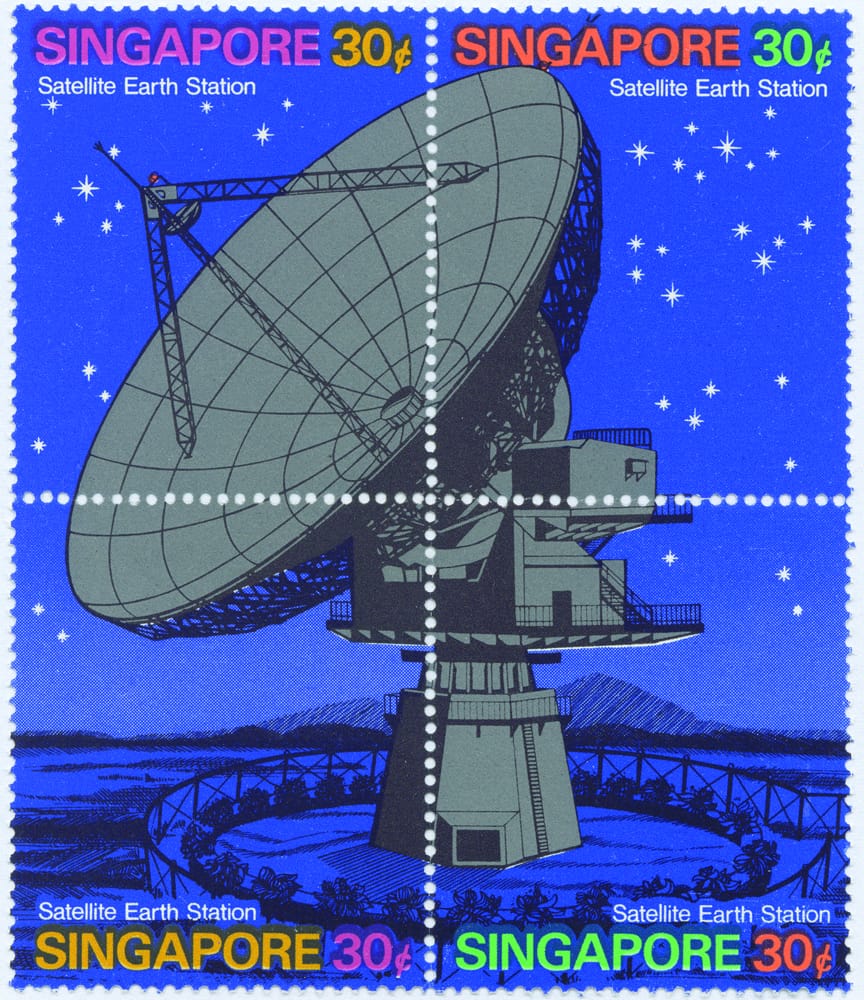
“Satellite Earth Station” (1971) stamps by graphic designer William Lee to commemorate the launch of Singapore’s first satellite earth station. Lee superimposed a drawing of a satellite dish over a block of four conjoined 30-cent stamps, creating Singapore’s first se-tenant series. Courtesy of Singapore Philatelic Museum.
In the 1990s, stamp issues kept pace with an increasingly outward-looking Singapore. This took the form of more tourist-centric issues, first seen in the 1990 “Tourism” definitive stamps designed by graphic designers Ng Keng Seng and Lim Ching San. Their stamps depicting Singapore landmarks and its four ethnic groups were followed by other series on national monuments, costumes, art, architectural heritage and museums as well as stamps featuring local flora and fauna such as birds, butterflies, marine life, corals, and orchids, including the national flower Vanda Miss Joaquim.
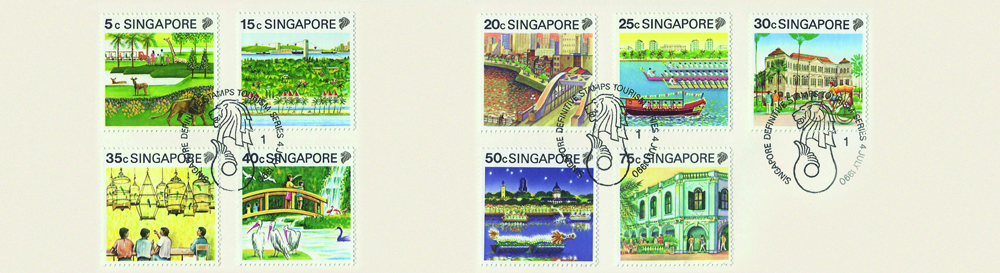
“Tourism Low Value Definitives” (1990) by graphic designer Ng Keng Seng. The stamps reflect an increasingly outward-looking Singpore. Courtesy of Singapore Philatelic Museum.
This new and softer image of Singapore replaced the practice of trumpeting the achievements of the nation. Stamp issues became less overt. For instance, the 2010 “Anniversary” series bundled together the milestones of the Housing and Development Board, People’s Association, Singapore Customs and Singapore Scout Association.
One exception, however, is the military, which has consistently had a series or two in every decade, starting with the 1970 “National Servicemen” series designed by art lecturer Choy Weng Yang. His stamps depicting various silhouettes of soldiers defending Singapore in strikingly aggressive poses have evolved over the years to showcase the country’s latest military weapons and technology – sending a message perhaps that Singapore, although small, is not to be messed with.
The receding of the state in stamp imagery also mirrored the softening of top-down rule. Newly installed Prime Minister Goh Chok Tong mapped out a vision of the government serving as facilitator and giving the private sector more room to shape the country. This is best summed up in the “Singapore, A Global City” three-part series released between 2002 and 2004, which commemorated Singapore’s hosting of the World Stamp Championship and the 150th anniversary since stamps were first used here. Created by local design studio Design Objectives, the series showcased industrial products and landmarks, and were released as miniature sheets complete with images of 15 global companies such as Creative Technology, McDonald’s and Shell.
A Canvas for Singapore Designers
Beyond showcasing Singapore to the world, stamps also provided a canvas for the creative output of Singaporean artists and designers. Although this was not explicitly stated as a goal, Singapore’s most prolific stamp designer Eng Siak Loy remembers how SAC committee member Choy created this opportunity.
“In the past, stamps were not designed by artists but advertising agencies. But the standards were not great, so Choy suggested stamps should be designed by local artists and recommended me,” he recalled.15 Eng submitted his very first stamp designs for the ECAFE theme, and has since designed over 50 stamps − roughly 14 per cent of Singapore’s philatelic output − all the while working as a graphic artist at Radio Television Singapura, Housing and Development Board and National Parks Board, before retiring in 2010.16
Today, Eng continues to be a prolific designer of stamps, adding to the output of his closest competitors, Chua Ban Har and Leo Teck Chong, both of whom started designing stamps in the 1980s. Stamp design has even become a family tradition with Eng’s son, Tze Ngan (also known as Weng Ziyan), designing several series, including the 2015 “Singapore: 50 Years of Independence (1965–2015)” set.17
Another graphic designer who made his name with stamps is William Lee. He rose to fame when his 1971 “Commonwealth Heads of Government Meeting” stamps − only the second series he had ever worked on then – was included in the world’s leading philatelic publication, Gibbons Stamp Monthly.18 Lee used his stamps as a springboard to grow his creative agency Central Design. He went on to design 15 more stamp sets until 1986, and built a reputation as Singapore’s leading graphic designer. He has designed logos for government agencies and local corporations, including Post Office Savings Bank, Singapore Armed Forces Reservists’ Association (SAFRA), Shangri-La Hotel and the Citizen Consultative Committee − all of which still remain in use.19
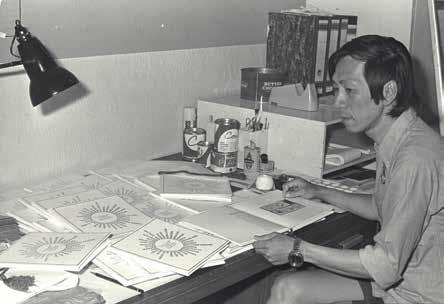
Graphic and stamp designer William Lee at work at his River Valley flat-cum-studio in 1971. Source: The Straits Times © Singapore Press Holdings Limited. Permission required for reproduction.
Stamps That Bridge Two Countries
The 1990s also saw Singapore releasing stamps together with other countries, known in philatelic circles as joint issues. The earliest recorded was with China in 1996, when a stamp by graphic designer Sylvia Tan depicting Singapore’s waterfront was released together with Chinese artist Jiang Zhi Nan’s depiction of Suzhou’s iconic Panmen (Pan Gate). Over the last two decades, other joint issues have been released with regional neighbours (Malaysia, Vietnam, the Philippines and Indonesia), Australia, South Korea and Japan, European countries (Belgium, Sweden, France and Liechtenstein) and even Egypt and the Vatican.
Commemorative to Commercial
Despite the changing face of Singapore stamps over the last five decades, SAC’s criteria for themes and designs has largely remained the same since it was first drawn up in 1968. Today, a theme qualifies to be issued if it fits any one of six criteria identified by the committee.20 This includes the commemoration of a national achievement, a local pioneer, and the 25th, 75th, 100th, 150th or 200th anniversary of a public organisation; depiction of unique lifestyles and values; recognition of regional and global events of importance to Singapore; and stamp themes that spark interest among children. Apart from this, SAC also considers if stamp themes and designs are sensitive to Singapore’s multicultural society and appeals to stamp collectors and the public.
This set of criteria has held up well except on two occasions. The 1971 “Singapore Festivals” series of four stamps by William Lee, each depicting children celebrating Chinese New Year, Hari Raya Puasa, Deepavali and Christmas respectively, was roundly criticised for the racist undertones and inaccurate portrayal of ethnic cultures. A Chinese newspaper pointed out that the Chinese child’s traditional costume was already obsolete in Singapore, while a Malay cultural organisation took issue with the illustration of Malays flying a kite on Hari Raya Puasa, a deeply religious event. According to a New Nation editorial, Malays were depicted as “a happy-go-lucky community” compared with the other racial groups.21 In its defence, the SAC said the designs had expressly avoided religious imagery because of perceived sensitivities.
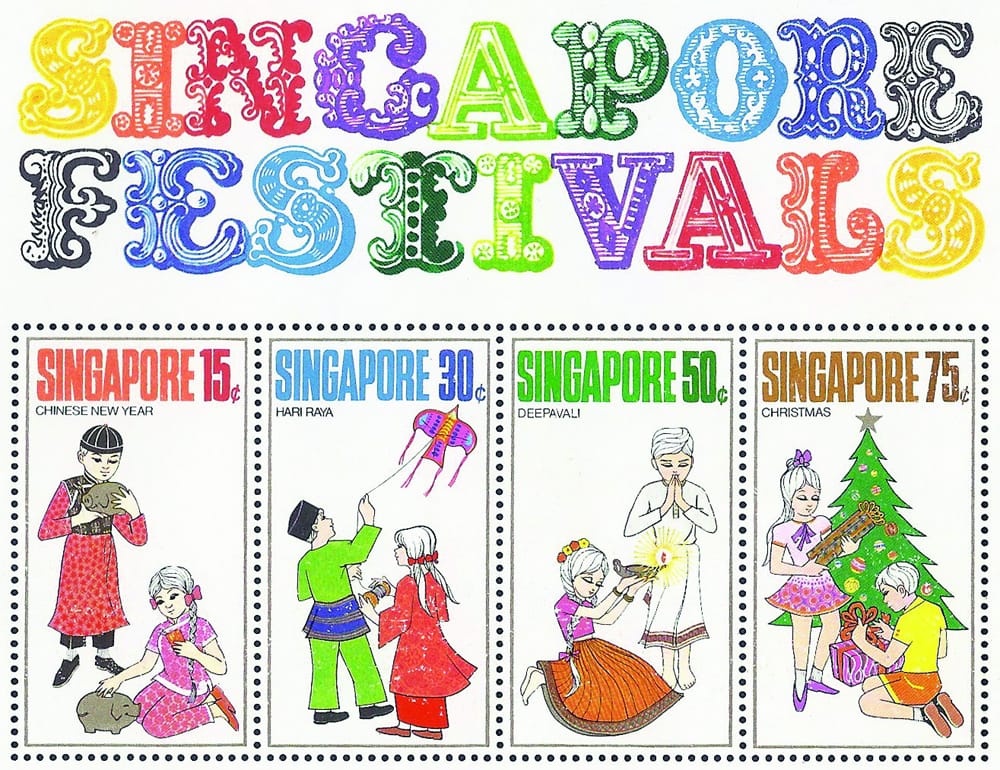
“Singapore Festivals” (1971) by graphic designer William Lee. The stamps, which depicted children celebrating Chinese New Year, Hari Raya Puasa, Deepavali and Christmas, were criticised for their racist undertones and inaccurate portrayal of ethnic cultures. Courtesy of Singapore Philatelic Museum.
More recently, in 2010, a group of philatelists led by Lim Chong Teck criticised Singapore stamp issues as becoming “commercialised at the expense of marking significant national occasions”. Lim wrote in a letter to The Straits Times complaining that local stamps were becoming devalued because of the “frivolous, irrelevant or poorly designed” stamp issues in recent times, including the ones on toys, playgrounds and local food. “[F]ar too many stamps are issued, cementing Singapore’s growing and unwelcome reputation of abusing stamp issues for commercial gain in the philatelic arena,” he added.22
Then SAC chairman, Professor Lily Kong, refuted Lim’s remarks, citing a list of awards Singapore stamps had won over the years. Eng’s 2002 “Heritage Trees” series was rated the second most beautiful stamps in the world by Timbropresse Group, the Paris-based publisher of philatelic magazine Timbres, while Design Objective’s series for the 2004 Olympic games was named the most original stamp by the International Olympic Committee. While Lim disagreed with recent stamp themes, Professor Kong said they were issued “to provide variety and to sustain the public interest”.23
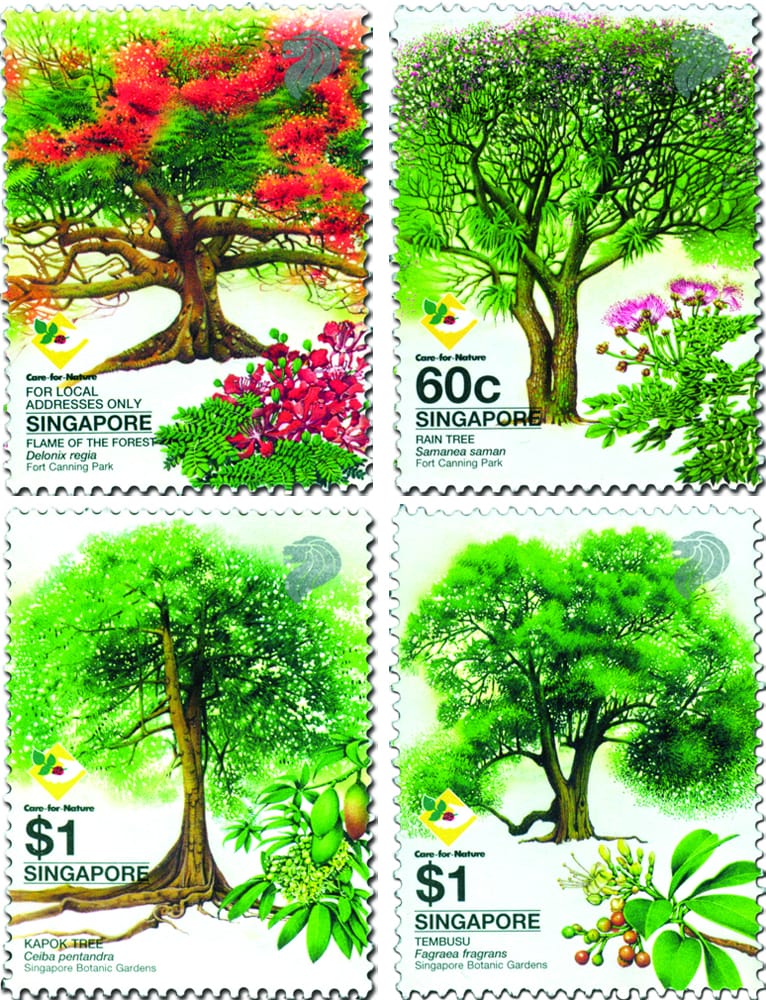
Issued on 26 September 2002, graphic artist Eng Siak Loy’s “Heritage Trees” series was rated the second most beautiful stamps in the world in 2003 by Paris-based Timbropresse Group, the publisher of philatelic magazine Timbres. The trees featured were Flame of The Forest (22 cents), Rain Tree (60 cents), Kapok ($1) and Tembusu ($1). Courtesy of Singapore Philatelic Museum.
This tension between commemoration and commercial gain has been inherent in the issuing of stamps since the SAC was founded in 1968. As Minister Yong said in 1972, SAC had to be careful with what it issued lest it affected the value and reputation of Singapore stamps. “We shall not indulge in gimmicks nor issue philatelic frivolities,” he said.24 Lim’s criticism that stamps had veered away from nationalistic imagery had some truth.
The Future of Stamps
While early Singapore stamps captured a young nation’s transition into a global city, the themes have since shifted towards more popular subjects both from within Singapore and inspired from abroad. Since 1996, an annual Chinese zodiac calendar series commemorating the Lunar New Year has been issued − first designed by freelance illustrator Nicodemus Loh, and more recently, Leo Chong Teck. In 2005, a stamp was issued to commemorate the 200th anniversary of the birth of Danish fairytale author Hans Christian Andersen. Even when Singapore is the theme, such stamps have depicted typically Singaporean subjects, including vanishing trades, old cinemas and, of course, local food.
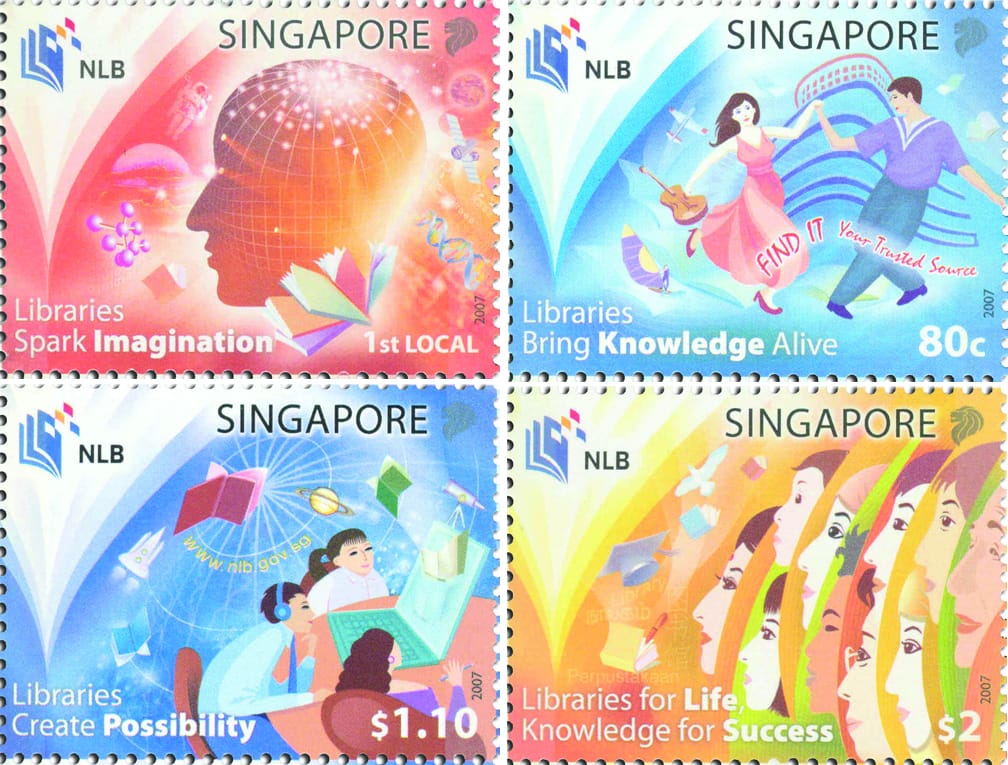
Issued on 12 November 2007, this set of four stamps commemorates the new knowledge framework proposed by the National Library Board’s vision and strategy: to ensure that Singapore’s “published heritage is preserved” and “knowledge remains readily accessible to all Singaporeans for their lifelong learning”. Courtesy of Singapore Philatelic Museum.
Ironically, this turn towards the everyday and the popular comes at a time when the rise of electronic mail has rendered stamps becoming less relevant in our daily lives. This is especially pertinent since postal services became corporatised in 1992. Today, stamps are issued by the government agency turned corporation, SingPost. The latter has been granted a license by the Infocomm Media Development Authority (which in turn continues to be advised on philately matters by the SAC).
Facing a decline in postal volume, SingPost’s head of postal services recently acknowledged that stamps have become more an object for the serious collector than for everyday use.25 This declining mass appeal has diminished the value of stamps as a platform for showcasing the achievements of the nation and as a revenue stream.
Ironically, postage stamps have today come full circle to when they were first created in the middle of the 19th century by Englishman Sir Rowland Hill: simply as proof of advance payment for delivery.
About the Author
Justin Zhuang is a writer and researcher with an interest in design, cities, culture, history and media. The co-founder of writing studio In Plain Words contributes to various architecture and design magazines, including Design Observer and American Institute of Graphic Art’s Eye on Design. He is the author of Independence: The History of Graphic Design in Singapore Since the 1960s (2012), Mosaic Memories: Remembering the Playgrounds Singapore Grew Up In (2014) and the catalogue for the exhibition Fifty Years of Singapore Design (2016). For more information, see http://justinzhuang,com.
Endnotes
1 Singapore Stamp Club. (1967). Singapore Independence stamps. In 1867–1967 Centennial Stamp Exhibition commemorating one hundred years of postage stamps in Singapore… at the National Library: [Souvenir programme] (p. 2). Singapore: Singapore Stamp Club. (Call no.: RCLOS 769.5695957 SIN)
2 Singapore Stamp Club, 1967, p. 2.
3 Ministry of Culture. (1968, August 27). Speech of Mr Yong Nyuk Lin, Minister for Communications at the inaugural meeting of the Stamp Advisory Committee held at the conference room of the Malayan Rubber Export Registration Board, 3rd Floor, Fullerton Building on Tuesday, 27th August, 1968 at 1500 Hours. Retrieved from National Archives of Singapore website.
4 5 stamp issues for next year. (1969, August 8). The Straits Times, p. 6. Retrieved from NewspaperSG.
5 Loh, P.Y. (2013–2014). Stamp up for Singapore: Commemoration in National Day Stamps, 1960–1984 (p. 15) (Unpublished thesis). Retrieved from Academia website.
6 The inaugural Stamp Advisory Committee was chaired by Phua Bah Lee, (Parliamentary Secretary, Ministry of Communications) and comprised M. Bala Subramanion (Postmaster General), Roy Daniel (Head, Publicity Division, Ministry of Culture), Koh Seow Chuan (Ag. President, Singapore Stamp Club), Choy Weng Yang (Lecturer, Arts & Crafts, Teachers’ Training College), Lian Hock Lian (Assistant Secretary, Ministry of Communications), W. Maxwell (Philatelist), Eric Khoo Cheng Lock (Philatelist) and Patrick Lee Boon Guan (Assistant Controller of Posts).
7 ‘150’ stamps a big hit. (1969, September 10). The Straits Times, p. 4. Retrieved from NewspaperSG.
8 A first-day cover consists of the stamp on a cover, post card or envelope, and postmarked with the date that the stamp is first authorised for use.
9 Lim, T. (1986, November 10). Stamps can bring big returns over time. The Straits Times, p. 20. Retrieved from NewspaperSG.
10 Chia, P. (1972, December 18). $1million S’pore stamps sold in a year. The Straits Times, p. 9. Retrieved from NewspaperSG.
11 Ang, B. (2016, October 30). Stamp of passion. The Straits Times, p. 3. Retrieved from NewspaperSG.
12 Federation man wins Singapore contest. (1961, November 20). The Straits Times, p. 5; Lack of interest may hold up stamps. (1958, August 21). The Straits Times, p. 10. Retrieved from NewspaperSG.
13 Chance put gold lion on new stamp. (1959, May 20). The Singapore Free Press, p. 7. Retrieved from NewspaperSG.
14 Stamp collecting within the means of many. (1978, August 20). The Straits Times, p. 7. Retrieved from NewspaperSG.
15 Teo, K.G. (Interviewer). (2012, September 27). Oral history interview with Loy Eng Siak [Cassette recording no. 003762/7/2]. (Note: A written request to the National Archives of Singapore is required to access this interview.).
16 Tay, E. (2013, March 17). Three months to design stamp set. The Straits Times, p. 2. Retrieved from NewspaperSG.
17 The Straits Times, 30 Oct 2016, p. 3.
18 An issue is born: Commonwealth Heads of Government Meeting 1971 Singapore (1971, March). Gibbons Stamp Monthly, pp. 262–263. United Kingdom: Stanley Gibbons.
19 Tan, C. (1986, November 15). Designer makes yet another mark. The Straits Times, p.13. Retrieved from NewspaperSG.
20 Infocomm Media Development Authority. (n.d.). Criteria and guidelines for selection of stamp themes. Retrieved from Infocomm Media Development Authority website.
21 The cultural divide in stamp image. (1971, July 14). New Nation, p. 8. Retrieved from NewspaperSG.
22 Lim, C.T. (2009, November 27). Stamps: Irrelevant themes, poor designs. The Straits Times, p. 31; Lim, C.T., et al. (2010, March 30). Revive role of stamps in marking Singapore history. The Straits Times, p. 20. Retrieved from NewspaperSG.
23 Kong, L., & Ng, S.F. (2010, April 2). S’pore’s history and heritage captured in stamps. The Straits Times, p. 41. Retrieved from NewspaperSG.
24 The Straits Times, 18 Dec 1972, p. 9.
25 Wee, C.F. (2015, August 3). Stamping his mark on a changing postal landscape. The Straits Times, p. 3. Retrieved from NewspaperSG.