
Article
Warm Tidings in a Cold War
Topics
History
1 January 2018
Remittance letters between Singapore and China during the height of the Cold War from the 1950s–70s recount both the joy and angst of relationships across the miles. Dong Hui Ying delves deeper.
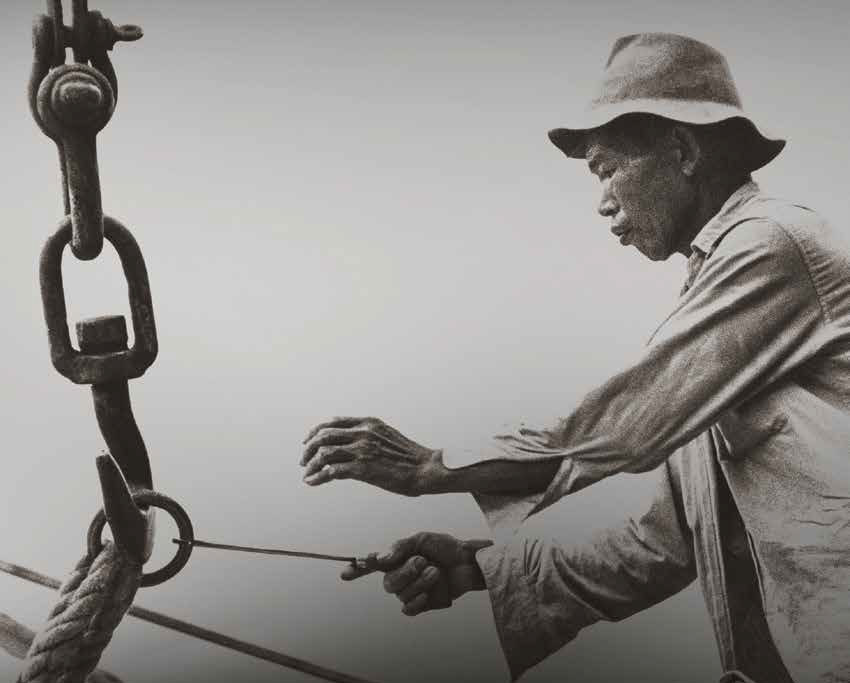
A Chinese worker in Singapore hoisting bales of rubber, late 1960s. The majority of such men who left China to find employment in Singapore between the 1820s and 1950s were engaged in manual labour. Letters were the only means of communication with their families back in China. George W. Porter Collection, courtesy of National Archives of Singapore.
The establishment of the People’s Republic of China (PRC) in 1949, the onset of the Cold War,1 and revolution, decolonisation and war in Southeast Asia between the 1940s and 1970s ushered a period of uncertainty in Chinese and Southeast Asian interactions. The Cold War did not bring migration and communication between China and Southeast Asia to a grinding halt as expected, and the movement of people, goods and, not least, remittances and letters, continued at a steady pace.
The last was due, in no small part, to attempts by the PRC government to protect a major source of foreign exchange. In 1955, it issued decrees declaring the protection of remittances to China from abroad, guaranteeing remittances as the “legitimate income”2 of the families of overseas Chinese (华侨) living in China.
To encourage the flow of remittances from abroad, such families were given preferential treatment from the late 1950s to the mid-1960s. This took the form of extra allotments of grain as well as permission to use remittances for the upkeep of ancestral graves and to continue with geomancy and other feudal superstitious practices. These incentives in turn encouraged the Chinese diasporic community in Southeast Asia to send money home.
The Value of Remittance Letters
Letters accompanying these remittances, namely qiaopi (侨批), continued to actively circulate between Southeast Asia and China during the Cold War. According to Liu Haiming, letter writing served several functions in traditional Chinese families: “as an important communication channel, a vehicle of moral education… and… as a composition writing exercise for children”.3
Remittance letters are important primary sources in the study of Chinese migrant experiences during this important period in Asian and global history as they provide a glimpse into the experiences, world views, values and expectations of migrants. Important matters were discussed and settled in the letters, from ancestor worship, marriage and child-bearing to health education and migration.
In this context, the remittance letters in the National Library’s Koh Seow Chuan Collection take on special importance. These letters were written mainly by male emigrants to Singapore from the Chaozhou (Teochew) area in China between the 1950s and the 1970s (with letters from the 1960s largely absent). Most were written by a few men, with a small number penned by women who were, presumably, wives or relatives of the letter writers.
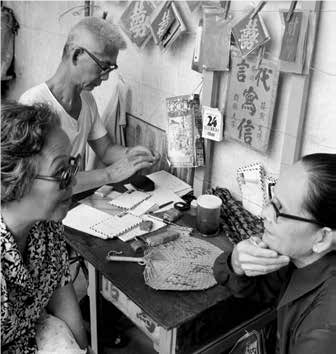
A Cantonese letter writer-calligrapher with his customers in this photo taken on 24 October 1979. As most Chinese migrants in Singapore were illiterate, they engaged professional letter writers to pen remittance notes to their families back home in China. Often, these writers were also asked to read letters aloud to the recipients. All rights reserved, Kouo Shang-Wei Collection, National Library Board, Singapore.
A major challenge facing any historian using these letters is their fragmented nature, both chronologically, and in terms of the individuals and families involved. To overcome this, remittance letters compiled in the Chaoshan Qiaopi Jicheng (《潮汕侨批集成》) were examined to supplement those in the Koh Seow Chuan Collection.
In addition, articles on overseas Chinese in the newspaper People’s Daily ( 《人民日报》) were studied to examine how official policies of the PRC and the rise of nation-states during the Cold War affected migrants and their families between the 1950s and 1970s.
The core themes that emerge, as explored in this essay, are family and kinship ties, socio-religious practices, customs, health, education, migrational processes, material aspects of migration and socioeconomic concerns.
Religious Practices
Besides food, clothing and shelter, religious practices constituted a large part of household expenditure, according to Chen Da’s study, Emigrant Communities in South China.4 The Chaozhou people placed great importance on the worship of ancestors and deities. Deities like Shen and Tien were worshipped in temples or shrines for the safety, health and prosperity of the migrants in Southeast Asia, as well as those of the supplicants, on the first and 15th day of each lunar month.
Remittances were regularly sent back with instructions to put aside the money for religious observances such as sacrifices and prayer (祭祀之需). Some migrants even returned to China to worship their ancestors personally. The more affluent migrants – as a display of having achieved worldly success abroad – would send money to help construct ancestral halls that housed the patrilineal group’s ancestral tablets.
In his letter in 1949, Xu Mingqin pledged to “add grandparents’ and granduncles’ and grandaunts’ tablets in the ancestral hall”.5 Such contributions allowed migrants to be active participants in family affairs back in China and also strengthened family ties across the miles.
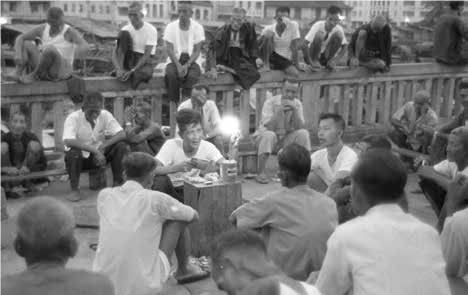
Chinese men gathered around a storyteller along Singapore River, c. 1960s. With barely enough to make ends meet after sending money home to China, entertainment for most migrants took on very simple forms. Courtesy of National Archives of Singapore.
Marital Unions
Marriage was an important union in which kinship ties were forged and maintained. In an emigrant family of middle or lower economic status, a portion of the remittances received was put aside for the sender’s marriage expenses. The migrant would return home to marry when sufficient money had been saved and a suitable girl found.
Sometimes, additional contributions were called for. In Yang Ruixiong’s case, he explained that he was hard-pressed to contribute towards his younger brother’s marriage expenses:
“I have received the letter about my brother Ruihan’s marriage. I am supposed to help with all the marriage expenses. However, I am earning very little and cannot help. Please notify me three months before the day of marriage. If I can, I will try to send more, at least 100 RMB to help.”6
Many migrants whose sons were also in Southeast Asia asked their wives or mothers back home to look for suitable brides for their sons. Wu Juanzhuan, for example, sent several letters asking his wife to find a worthy match for their son, Xilie.7 Another migrant, Xu Mingqin, asked his mother to find an ideal girl for his son Huizhuan.8 Daughters’ marriages were similarly arranged long-distance. Xu Mingqin and his wife (who had moved to Singapore to be with her husband) sought a good husband for their daughter Huizhuang, with Xu’s mother’s help.9
In arranging marriages, parents generally wanted to know the background of the prospective in-laws. Ideally, they wanted their sons to marry a submissive girl from their own area who held the same traditional values. In Zeng Hequan’s letter to his wife, he asked about the background of his prospective daughter-in-law and the occupation of her parents.10
The same concern applied to prospective sons-in-law, as seen from Yaliu’s letter to her mother-in-law in China on her daughter Meixiang’s marriage. Yaliu was perturbed that no one could ascertain which village her future son-in-law came from or what his family circumstances were like.11
Chinese migrants in Southeast Asia, although young and exposed to foreign influences, generally accepted arranged marriages in an effort to remain filial to their parents. By accepting arranged marriages, migrant sons would have a wife in their hometowns to fulfil traditional responsibilities, such as serving their parents and maintaining the family shrine when they went abroad again for work after the wedding.
Parent-Son Relationships
For migrant sons and their families, remittance letters served as a vital channel of communication. In particular, parent-son relationships were traditionally “central to family life and superior to other family relations, including conjugal ties”.12 Migrant sons were expected to “send money to their rural homes, leave their wives and children with their old folks, and regard their sojourn in the city as temporary, even when they spend their entire lives there”. Success was typically defined by the “onset of remittances”.13
In times of financial difficulty, when no remittance could be enclosed, a letter of reassurance about the migrant’s health and safety (平安信) was still expected. Most letters usually consisted of one to two lines in addition to the usual greetings and mention of remittances sent back. However, on special occasions, they could stretch into hundreds of words. The emotional dimension of these correspondences is often neglected in the study of remittance letters.
The expression of concern and longing was evident in Liu Shizhao’s note to his mother, who had been injured during a flood in his hometown:
“I am extremely pained to hear about your injury. I wish from afar that you recover quickly after seeing a doctor and taking medication. I am well overseas. Please do not worry about me.”14
Husband-Wife Relationships
Remittance letters between migrant couples hold “powerful cultural and emotional value”.15 Under normal circumstances, even when their husbands sent back remittances or returned home regularly, the women had to bear greater family responsibilities during their husbands’ absence.
The situation worsened during the Cold War when migration regulations made return trips difficult and rare, and remittance letters indicated a sharp decrease in movement between China and Singapore.16 Thus, such letters were immensely reassuring and key to maintaining husband-wife relationships across the seas. In a letter to his wife in 1965 (Fig. 1), Yang Ruixiong wrote:
“You sent two letters in a row to quarrel with me, it really amuses me. I was just being hot-tempered and as a result, said a few words that crossed the line. Do you have to be this angry? I will apologise to you now. Sorry, sorry, for my bad manners. Is this satisfactory? We are already an old married couple, does it have to be like this?”17
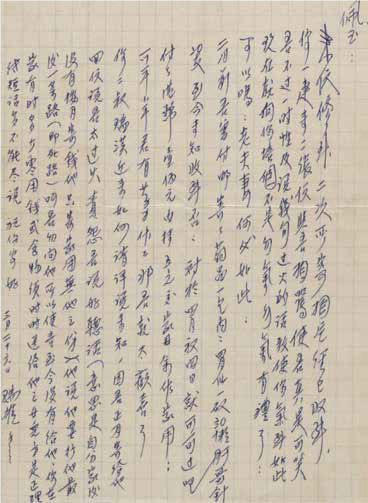
Figure 1: Letter from Yang Ruixiong to his wife Xu Peiyu, 26 March 1965. All rights reserved, Koh Seow Chuan Collection, National Library Board, Singapore.
Migrant-Child Relationships
Migrants also expressed concern towards their children at home. In a letter to his mother in 1956, Liu Yongyu referred to the news that Lianxiang, his daughter back home in China, was feeling neglected by her mother, who had moved to Singapore with Lianxiang’s younger sisters. He explained that the younger girls were living very ordinary lives in Singapore and there was no reason for Lianxiang to feel disadvantaged.18
Zheng Youchu was another concerned parent. In 1952, he wrote expressing worry about his daughter Xianqing’s complaints of frequent abdominal pains after childbirth and suggested that she consult a physician immediately.19 In 1954, he was concerned that Xianqing was becoming too thin and advised her to avoid sour foods.20
Sibling Relationships
Care and concern were also extended to younger siblings at home. For example, Liu Shizhao’s letter in August 1955 expressed sympathy for his younger sister Bixia and offered to help her:
“After learning about your plight in the letter, I sympathise with your situation. If Mother comes to Singapore in the future, and you have decided not to marry, and will work to support yourself, I will let you look after all my housing and other properties in China. You can also work on the fields in Liu Hu Tou Shan. I will send you allowance each month.”21
Not all sibling relationships were amicable, however. A letter from Yang Ruixiong to his wife in 1965 points to the souring of the relationship between him and his younger brother because the former had not sent the latter a monthly allowance since the family property was divided up. As a result, the younger brother threatened to commit suicide.22
Reiteration of Values
The remittance letters in the Koh Seow Chuan Collection reflect how value systems relating to education, gender roles and modern lifestyles were reiterated, negotiated and challenged in migrant families during the Cold War.
The education of their sons back home was a frequent concern for migrants in Southeast Asia. Yang Ruixiong asked how his son was doing in school and requested that the latter write a few characters to show him.23 Lin Zhaolie similarly advised that his son should continue with his studies.24
As for female family members, attitudes were mixed. Xu Mingqin advised his daughter not to go to school, and complained bitterly when she did not heed his advice.25 In contrast, Zheng Buchang was insistent on his sister having an education, as seen in his heartfelt letter in 1950:
“You should not be wasting your time while you are young. You won’t have time for your studies later. Don’t let our parents down. If you have time, write me some letters. You must work hard so you are not left out of society. Please bear this in mind. I am not educated enough, so I have always been oppressed by society, and there’s nothing I can do about it.”26
Emphasis on education and filial piety is similarly evident in Lin Zhaolie’s letter, asking his son to be filial to his grandmother, on top of concentrating on his studies.27 In a letter dated 1954, Xu Mingqin was pleased that his son Huisong showed filial piety by devoting himself to taking care of the family business.28
Migrants continued with the practice of forming kinship-based clans overseas. Yang Ruixiong, who came to Singapore from Shantou, was a founder and volunteer staff at Xian Le Tong Xiang Hui. The association of some 200 members assisted people from the same clan in matters such as marriages and funerals.
Writing home in 1957, Yang emphasised the importance of family harmony: “My younger brother and wife, please work together for the good of the family, and try not to quarrel so much.” Reflecting an attitude typical of male migrants, who put great emphasis on family reputation, Yang also stressed the need for the preservation of “face”, as he now had a new position and status among the association members.29
On a subsequent occasion, Yang wrote to his wife and reminded her to be independent:
“I am in Singapore and have only depended on myself. I have dignity as a man and have not asked for anything from relatives. We are husband and wife, you can ask me for anything. However, if you ask other people, you will lose face. I am teaching you how to conduct yourself, not criticising you, please understand.”30
Negotiation of Values
The Immigration Ordinance No. 5 of 1952, implemented in Singapore on 1 August 1953, allowed overseas family members of local residents to travel to Singapore.31 This move challenged the entrenched Confucian tenet of a “male handling affairs outside of the home, females handling those inside it”. A wife was expected to live in her husband’s home and fulfil her duties as a mother and daughter-in-law while the husband provided economic support, seeking opportunities abroad, if necessary. Hence, “wives could not be expected to accompany their husbands overseas if the latter had aged parents left behind”.32
Thus, even though the new residents were no longer constrained by migration restrictions, they were met with considerable resistance from families back home when asking for their wives to join them in Singapore. The frustration in seeking parental approval was expressed in Liu Shizhao’s remittance letter (Fig. 2):
“Mother, you did not allow my wife to come to Singapore. Ever since I married 10-plus years ago, I have had no children. My wife unfortunately died. I married another woman, but a few months later I had to return to Singapore. My wife is supposed to serve you, and should not come to Singapore. But I am already 30-plus, yet I have no children, I feel really ashamed. Last month, my wife sent me a photograph, and I have applied for an entry number and intend for her to come to Singapore to live with me. I hope, Mother, that you will allow it. One, two years later, we will return home together. It is impossible to return to China right now.”33
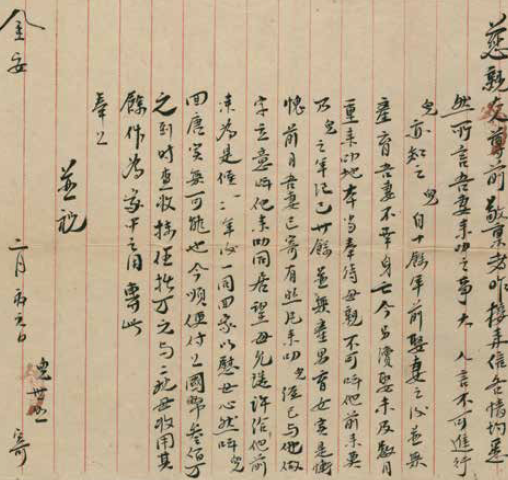
Figure 2: Letter from Liu Shizhao to his mother, date and year unknown. All rights reserved, Koh Seow Chuan Collection, National Library Board, Singapore.
Liu Shizhao’s experience mirrors the plight of many migrants who toiled in Southeast Asia, torn between being a filial but lonely son and a loving but guilt-ridden husband – a dilemma brought into painfully sharp focus by the new migration policy.
Challenging Traditional Values
Living overseas and being exposed to new cultural practices caused some migrants to challenge certain practices back home. Previously confined to the customs and mores of their kinsmen and their home community, the migrants now interacted with people from other regions in China and even foreigners of other races in Singapore, each with their own cultural practices, traditions, beliefs and values.
In a letter to his wife in 1965, Yang Ruixiong rebuked her for wanting to give up their son for adoption (likely to a childless relative):
“Singapore has not had such practices for a long time. Please do not think of such things again. The Chinese Communist Party has brainwashed the people in China these 10-plus years.”34
This cultural practice, called guofang (过房), entailed “the adoption of sons in homeland conditions, embodying the classical notion of a boy being passed from one agnatic line to another within the same lineage”.35
Material Circulation
Remittance letters also recorded the movement of goods between China and Southeast Asia. There was some transfer of luxury goods such as woollen sweaters, fountain pens, watches, jewellery and jade, but most of the items were daily necessities such as textiles, oils and medicine.
For example, migrants sent medicines and supplements back home, such as medicated oils like Tiger Balm ointment (万金油) and Axe Brand Universal Oil (驱风油). On one occasion in 1965, Yang Ruixiong sent his wife a bag of medication containing a bottle of Weisen-U pills (胃仙一罐).36 Weisen-U, a popular gastrointestinal remedy, was not available in China at the time.
When Liu Shizhao’s wife in Singapore was about to give birth in 1955, he asked his mother to buy three to four boxes of Daniangjin (大娘巾), a pharmacy brand with 300 years of heritage in Chaozhou and famous for its gynaecological pills. In the same letter, he asked his mother to purchase two many-banded kraits, and gave directions for soaking the dried snakes in wine and medicine to prepare a remedy that would dispel wind, among other beneficial health effects.37
A man’s virility was also a matter of great concern, as siring heirs and continuing the family line were held in high regard. Xu Mingqin’s letter in 1954 asked his mother if his friend Zhaochao had produced an heir (世子) and how many grandsons he had.38 On separate occasions, two male migrants requested for the dried penis of a black dog (乌狗性), believed to be efficacious in boosting male sexual potency.39
The circulation of goods reflecting the cultural beliefs of migrants was also evident in Lin Xiquan’s request to Xu Mingqin to bring him an Eight Immortals altar cloth (八仙床裙), an indication of Daoist belief. Lu Mutang also sent back a funeral shroud (福寿衣) for his mother.40
The goods that crossed borders also reflected the political, economic and social transformations of the migrants and their family members back in China. For example, a state procurement programme (统购统销) implemented by the Chinese government in 1953 resulted in the shortage of everyday supplies such as cotton, shoes, pots and oil.41 Overseas Chinese who returned to China reportedly complained about not having enough cotton for clothes.42 As a result, migrants frequently sent home old clothes and textiles, one example being Lu Mutang, who sent back three pieces of cloth in 1953 and some coarse cloth (粗纹布) in 1954.43 Some of the goods circulated were a reflection of China’s Great Leap Forward, the economic and social campaign that the government launched between 1958 and 1962. For example, the national “iron and steel” movement of 1958 saw items such as cooking pots, pans and farming tools being melted in backyard steel furnaces to increase steel production. According to Frank Dikötter, in the summer of 1961, reportedly “140,000 tonnes of farming tools had been thrown into the fires in the model province of Henan” alone.44
Writing in January 1959 in response to his mother’s request for a sewing machine, Xiaosheng expressed exasperation:
“If I buy you a sewing machine, and it is later offered up to be melted down for steel, wouldn’t that be doing injustice to my hard-earned money? This so-called socialism – the Chinese people in Nanyang are all unhappy with it.”45
One letter dated 4 July 1961 (Fig. 3) records a migrant, Liu Saibi (one of the few letters written by women migrants in the collection), sending back 1,000 grams of fertiliser to Hong Kong.46 This fertiliser was to be transferred to the local commune and exchanged for food, which would be collected by Liu’s mother.
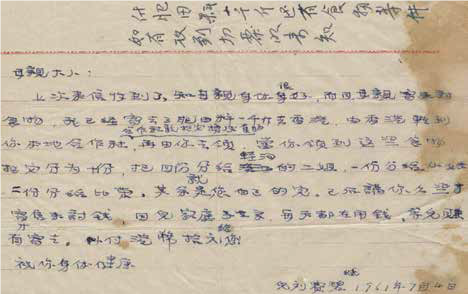
Figure 3: Letter from Liu Saibi to her mother, 4 July 1961. All rights reserved, Koh Seow Chuan Collection, National Library Board, Singapore.
The remittance letters in the Koh Seow Chuan Collection demonstrate how family relations were kept alive across long distances. The money sent home was put to use for the family’s benefit, while the accompanying letters reinforced the primacy of familial bonds and responsibilities. Through correspondence over matters such as marriage, child-rearing and religious practices, and through expressions of longing and concern in the letters, relationships between the migrants in Southeast Asia and family members back home were strengthened. Despite the physical divide, these letters helped to keep a sense of culture and tradition alive for migrant sons and daughters in faraway lands.
This is an abridged version of Warm Tidings in a Cold War: Remittance Letters and Family Ties in the Chinese Diaspora, 1950s−1970s, taken from the recently published book Singapore’s Social & Business History Through Paper Ephemera in the Koh Seow Chuan Collection. Published by the National Library Singapore,the book is available for reference and loan at the Lee Kong Chian Reference Library and selected public libraries (Call nos.: RSING 338.7095957 SIN and SING 338.7095957 SIN)
About the Author
Dong Hui Ying is a final-year student at Nanyang Technological University, Singapore, and will graduate with a Bachelor of Arts in History in 2018. She is one of the co-authors of the recently published book Singapore’s Social & Business History Through Paper Ephemera in the Koh Seow Chuan Collection.
Endnotes
1 The Cold War, which took place approximately between 1945 and 1990, refers to the period of geopolitical tension between the capitalist US and the communist Soviet Union, and their respective allies.
2 Zhou, E. (1955, March 3). Guanyu guanche baohu qiaohui zhengce de mingling (关于贯彻保护侨汇政策的命令). Renmin Ribao. (Not avilable in NLB holdings.)
3 Liu, H. (2005). The transnational history of a Chinese family: Immigrant letters, family business, and reverse migration (p. 135). New Brunswick, NJ: Rutgers University Press, 2005. (Call no.: R 304.8730510922 LIU)
4 Chen, D. (1940). Emigrant communities in South China: A study of overseas migration and its influence on standards of living and social change (p. 155). New York: Institute of Pacific Relations. (Call no.: RCLOS 309.151 CHE-[RFL])
5 Letter 2558, Xu Mingqin to his mother and aunt-in-law, May 20 (旧历四月廿叁日), 1949, Koh Seow Chuan Collection, National Library Board, Singapore. (Call no.: RRARE C816.3 KOH)
6 Letter 2199, Yang Ruixiong to his mother and wife Peiyu, November 14, 1956, Koh Seow Chuan Collection, National Library Board, Singapore. (Call no.: RRARE C816.3 KOH)
7 Letter 2168, Wu Juanzhuan to his wife, date unknown (丁弎月初九日), year unknown, Koh Seow Chuan Collection, National Library Board, Singapore. (Call no.: RRARE C816.3 KOH); Letter 2205, Wu Juanzhuan to his wife, date unknown (弍月初伍日), year unknown, Koh Seow Chuan Collection, National Library Board, Singapore. (Call no.: RRARE C816.3 KOH)
8 Letter 2876, Xu Mingqin to his mother, January 5 (十二月初一日), 1954, Koh Seow Chuan Collection, National Library Board, Singapore. (Call no.: RRARE C816.3 KOH)
9 Letter 2552, Xu Mingqin and his wife to their daughter Huizhuang, January 9 (元月九日即完月初九日), 1957, Koh Seow Chuan Collection, National Library Board, Singapore. (Call no.: RRARE C816.3 KOH)
10 Letter 2710, Zeng Hequan to his wife, November 30, 1952, Koh Seow Chuan Collection, National Library Board, Singapore. (Call no.: RRARE C816.3 KOH)
11 Letter 2600, Yaliu to her mother-in-law, date unknown (元月初十), year unknown, Koh Seow Chuan Collection, National Library Board, Singapore. (Call no.: RRARE C816.3 KOH)
12 Qi, X. (2015, March). Filial obligation in contemporary China: Evolution of the culture-system. Journal for the Theory of Social Behaviour, 45 (1), 141–161, p. 149. Retrieved from Wiley Online Library website.
13 Freedman, M. (Ed.). (1970). Family and kinship in Chinese society (pp. 26, 33). Stanford: Stanford University Press. (Call no.: RCLOS 301.42 FRE)
14 Letter 2194, Liu Shizhao to his mother, November 3 (十月初五日), 1970, Koh Seow Chuan Collection, National Library Board, Singapore. (Call no.: RRARE C816.3 KOH)
15 Shen, H. (2012). China’s left-behind wives: Families of migrants from Fujian to Southeast Asia, 1930s–1950s (p. 93). Singapore: NUS Press. (Call no.: RSEA 306.87230951245 SHE)
16 Barnett, A.D. (1955). Self-rule and unrest: Overseas Chinese in Singapore: Disturbing trends in an overseas Chinese city which is moving from colonialism toward self-rule (p. 9). Southeast Asia series, III. (Call no.: RCLOS 959 AUFSR)
17 Letter 2214, Yang Ruixiong to his wife Xu Peiyu, March 26, 1965, Koh Seow Chuan Collection, National Library Board, Singapore. (Call no.: RRARE C816.3 KOH)
18 Letter 2153, Liu Yongyu to his mother, December 11, 1956, Koh Seow Chuan Collection, National Library Board, Singapore. (Call no.: RRARE C816.3 KOH)
19 Letter 2633, Zheng Youchu and his wife to their daughter Xianqing and son-in-law Zhuoren, November 20, 1952, Koh Seow Chuan Collection, National Library Board, Singapore. (Call no.: RRARE C816.3 KOH)
20 Letter 2906, Zheng Youchu and his wife to their daughter Xianqing and son-in-law Zhuoren, January 12 (农历腊月初八日), 1954, Koh Seow Chuan Collection, National Library Board, Singapore. (Call no.: RRARE C816.3 KOH)
21 Letter 2594, Liu Shizhao to his mother and sister Bixia, August 24 (旧历七月初七日), 1955, Koh Seow Chuan Collection, National Library Board, Singapore. (Call no.: RRARE C816.3 KOH)
22 Letter 2214, Yang Ruixiong to his wife Xu Peiyu, March 26, 1965, Koh Seow Chuan Collection, National Library Board, Singapore. (Call no.: RRARE C816.3 KOH)
23 Letter 2210, Yang Ruixiong to his mother, September 7, 1955, Koh Seow Chuan Collection, National Library Board, Singapore. (Call no.: RRARE C816.3 KOH)
24 Letter 2863, Lin Zhaolie to his mother, December 4 (十一月初十日), 1954, Koh Seow Chuan Collection, National Library Board, Singapore. (Call no.: RRARE C816.3 KOH)
25 Letter 2558, Xu Mingqin to his mother and aunt, May 20 (旧历四月廿叁日), 1949, Koh Seow Chuan Collection, National Library Board, Singapore. (Call no.: RRARE C816.3 KOH)
26 Letter 2639, Zheng Buchang to his sister, February 27, 1950, Koh Seow Chuan Collection, National Library Board, Singapore. (Call no.: RRARE C816.3 KOH)
27 Letter 2863, Lin Zhaolie to his mother, December 4 (十 一月初十日), 1954, Koh Seow Chuan Collection, National Library Board, Singapore. (Call no.: RRARE C816.3 KOH)
28 Letter 2553, Xu Mingqin to his mother, June 11 (阴历五 月十一日), 1954, Koh Seow Chuan Collection, National Library Board, Singapore. (Call no.: RRARE C816.3 KOH)
29 Letter 2179, Yang Ruixiong to his mother, second brother and wife Peiyu, February 28 (正月廿九日), 1957, Koh Seow Chuan Collection, National Library Board, Singapore. (Call no.: RRARE C816.3 KOH)
30 Letter 2211, Yang Ruixiong to his wife Xu Peiyu, April 7, 1965, Koh Seow Chuan Collection, National Library Board, Singapore. (Call no.: RRARE C816.3 KOH)
31 Saw, S.H. (2012). The population of Singapore (p. 31). Singapore: Institute of Southeast Asian Studies. (Call no.: RSING 304.6095957 SAW)
32 Shen, 2012, p. 34.
33 Letter 2232, Liu Shizhao to his mother, date unknown (二月初六), year unknown, Koh Seow Chuan Collection, National Library Board, Singapore. (Call no.: RRARE C816.3 KOH)
34 Letter 2211, Yang Ruixiong to his wife Xu Peiyu, April 7, 1965, Koh Seow Chuan Collection, National Library Board, Singapore. (Call no.: RRARE C816.3 KOH)
35 Freedman, M. (1957). Chinese family and marriage in Singapore (p. 67). London: H.M. Stationery Off. (Call no.: RSING 301.42 FRE)
36 Letter 2214, Yang Ruixiong to his wife Xu Peiyu, March 26, 1965, Koh Seow Chuan Collection, National Library Board, Singapore (Call no.: RRARE C816.3 KOH).
37 Letter 2596, Liu Shizhao to his mother, November 16 (十月初三日), 1955, Koh Seow Chuan Collection, National Library Board, Singapore. (Call no.: RRARE C816.3 KOH)
38 Letter 2543, Xu Mingqin to his mother, May 5 (四月初三 日), 1954, Koh Seow Chuan Collection, National Library Board, Singapore. (Call no.: RRARE C816.3 KOH)
39 Letter 2564, Xu Mingqin to his mother, May 4, 1955, Koh Seow Chuan Collection, National Library Board, Singapore. (Call no.: RRARE C816.3 KOH); Letter 2589, Liu Shizhao to his wife Ding Shuduan, October 13, 1954, Koh Seow Chuan Collection, National Library Board, Singapore. (Call no.: RRARE C816.3 KOH)
40 Letter 2236, Lu Mutang to his mother, date unknown (丁柒月初一日), year unknown, Koh Seow Chuan Collection, National Library Board, Singapore. (Call no.: RRARE C816.3 KOH)
41 Zhao, G. (1959–60). Economic planning and organization in mainland China: A documentary study, 1949–1957 (p. 44). Cambridge, Mass.: Center for East Asian Studies. (Call no.: RCLOS 338.951 CHA)
42 Xi, R. (1954, September 20). Jinjiang county to the responses and requests of guiqiao and qiaojuan of tonggou tongxiao (晋江专区归侨、侨眷对棉布统销的反 映和要求). Renmin Ribao
43 Letter 2275, Lu Mutang to his mother, October 6 (九月初十日), 1954, Koh Seow Chuan Collection, National Library Board, Singapore. (Call no.: RRARE C816.3 KOH)
44 Dikötter, F. (2010). ). Mao’s great famine: The history of China’s most devastating catastrophe, 1958–1962 (p. 144). New York: Walker & Co. (Call no.: R 951.055 DIK)
45 “如果缝衣车买过手便要献去炼成钢铁,不是冤枉我之血 汗钱耶。所谓今社制度,南洋侨眾,均不滿意”. Chaoshan Lishi Wenhua Yanjiu Zhongxin (Ed). (2007). Chaoshan qiaopi jicheng (潮汕侨批集成), di yi ji, 12 (p. 267). Guilin: Guangxi shifan daxue chubanshe. (Call no.: Chinese RSEA 383.495127 CSQ)
46 Letter 2149, Liu Saibi to her mother, July 4, 1961, Koh Seow Chuan Collection, National Library Board, Singapore. (Call no.: RRARE C816.3 KOH)