
Article
Four Taps: The Story of Singapore Water
Topics
History
4 April 2019
From a hole in the ground to running water at the turn of the tap. Lim Tin Seng tells us how far Singapore has come in its search for water.
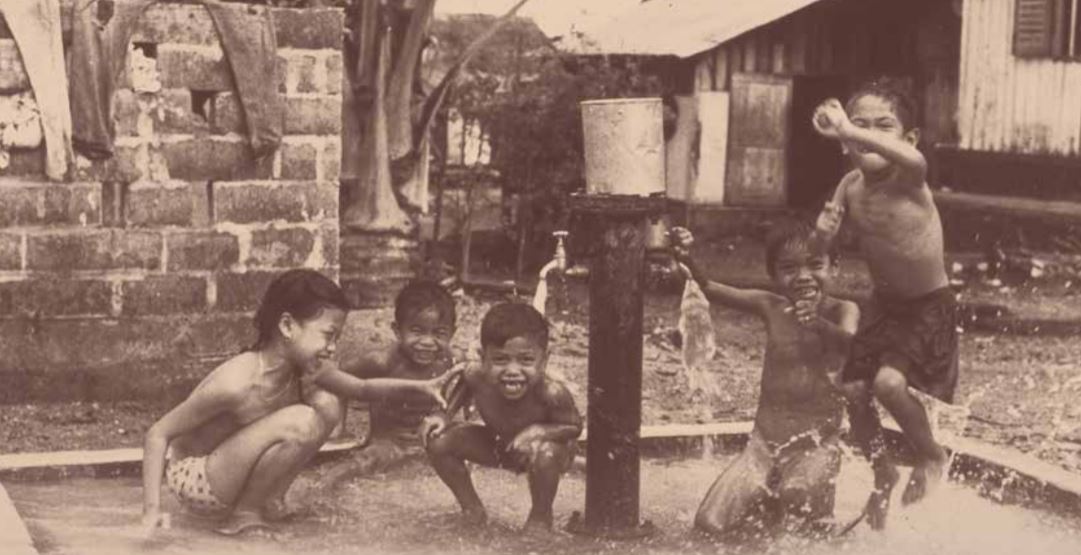
Children splashing themselves with water at a standpipe in a village in Geylang Serai, 1960s. The government installed standpipes to provide water to residents who had no taps in their homes. Courtesy of National Archives of Singapore.
Water has and will always be a precious resource in Singapore. In 2015, the Washington-based World Resources Institute identified the city-state as one of 33 out of 167 countries most likely to face extremely high water stress by 2040.1 To help overcome the absence of natural water bodies, the government has come up with innovative ways to expand and diversify Singapore’s water resources.
Over the decades, PUB, Singapore’s national water agency, has created a sustainable supply from four sources: water from local catchment, imported water, high-grade reclaimed water (known as NEWater) and desalinated water.2 Together, these four sources, termed the “Four National Taps”, have come a long way in helping Singapore meet its water needs.
Early Water Supplies
Securing a sustainable water supply is key to Singapore’s development, a fact recognised by the British since the time of Stamford Raffles. One of the reasons why the British chose Singapore as a trading post was its access to fresh water. In fact, digging a well for drinking water was among the first tasks ordered by Raffles when he landed in Singapore on 28 January 1819.3
Eight months later, the British completed building a reservoir near the foot of Bukit Larangan (now Fort Canning Hill). Despite being rudimentary, the reservoir had an aqueduct that carried water to a plaster-lined tank sited at the edge of the Singapore River.4 The tank had a spout so that skiffs (small boats) dispatched by the larger ships anchored in the harbour could pull up beneath the spout to collect water.5
The reservoir remained as the island’s main water supply until the 1830s when demand exceeded its capacity. It was subsequently replaced by a system of wells that were dug around the hill.
As demand for water continued to grow in tandem with Singapore’s development as a trading port, the British realised that using wells to supply water to visiting vessels was unsustainable as the low water rate – at a piddling four gallons per minute – was too slow. This meant that ships had to wait for several hours before they could fully replenish their water supply. Those whose patience wore thin resorted to obtaining contaminated water from the Kallang River.6
The First Reservoirs
In 1823, the British Resident John Crawfurd proposed spending 1,000 Spanish dollars to build a new reservoir, but this did not materialise. In 1852, the Government Surveyor and Engineer John Turnbull Thomson suggested drawing water from the “Singapore Creek” – an early reference to the Singapore River. The lack of government support and public interest, however, scotched this plan. Five years later, in 1857, the idea of having a proper reservoir resurfaced again when Tan Kim Seng, a wealthy Straits Chinese merchant, donated 13,000 Straits dollars to the local government to improve the town’s water supply.7
Tan’s offer could not have come at a better time: the population had grown eightfold from 10,683 in 1824 to 81,734 in 1860, and in their desperation, people turned to contaminated wells and streams for their water needs.8 With Tan’s donation, the government began making plans in January 1858 for a new reservoir and waterworks. But when cost estimates ballooned to 100,000 Straits dollars, the Bengal Presidency in Calcutta, which administered the British colonies in the Far East, refused to sanction the project. The reservoir and waterworks were put on hold until 1862 when the Bengal government agreed to fund half the project.9 The remaining half was raised through a loan in 1864.
The new Impounding Reservoir (renamed Thomson Road Reservoir in 1907 and thereafter as MacRitchie Reservoir in 1922) began operations in 1877, exactly 20 years after Tan Kim Seng’s philanthropic gesture. Located off Thomson Road, the reservoir comprised a catchment area of about 1,890 acres and a conduit made of masonry that could transport water to within 200 feet of the Singapore River.10
Managed by the Municipal Council, the reservoir used gravity rather than pumps to distribute the water. As a result, the municipality had to construct a number of service reservoirs on high ground such as hilltops. Water from the Impounding Reservoir would flow to a pumping station at the foot of the hill before being sent up to the service reservoir and distributed to households. The first of such service reservoirs was built on Mount Emily in 1878, followed by Pearl’s Hill in 1898 and Fort Canning in 1928.11
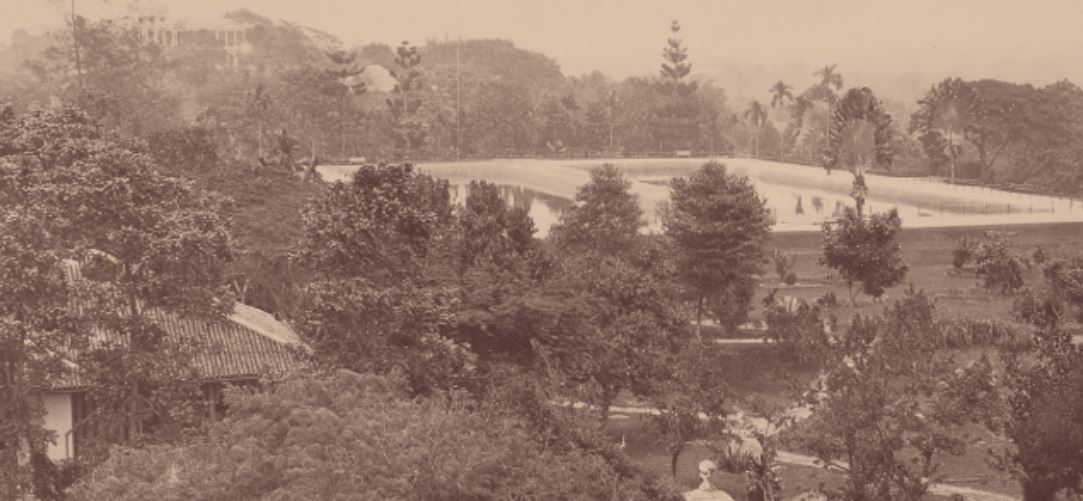
The service reservoir on Mount Emily as photographed by G.R. Lambert & Co., c.1880s. It was built in 1878 to receive water from the Impounding Reservoir in Thomson Road and distribute it to households. Courtesy of National Museum of Singapore, National Heritage Board.
By the end of the 1900s, Singapore’s daily water consumption had surged to 4.5 million gallons. This was due to the booming population as well as the growth of New Harbour (now Keppel Harbour). Municipal Engineer James MacRitchie decided that the best course of action was to enlarge the Impounding Reservoir. Carried out between 1891 and 1894 and at a cost of 32,000 Straits dollars, the expansion works increased the capacity of the reservoir.12
However, the enlarged reservoir could barely meet with the increased demand during prolonged periods of dry weather. To relieve the pressure, the municipality had to curtail water supply to as few as two hours per day. It also resorted to supplementing the water supply with well water despite its inferior quality.13
In 1905, the Impounding Reservoir’s embankment was raised to further increase its capacity. To obtain the additional water, a tunnel was dug to connect the reservoir to Kallang River. While the construction of the tunnel was still underway, Municipal Engineer Robert Peirce proposed constructing an embankment across the valley of Kallang River to create a second reservoir in 1902.14
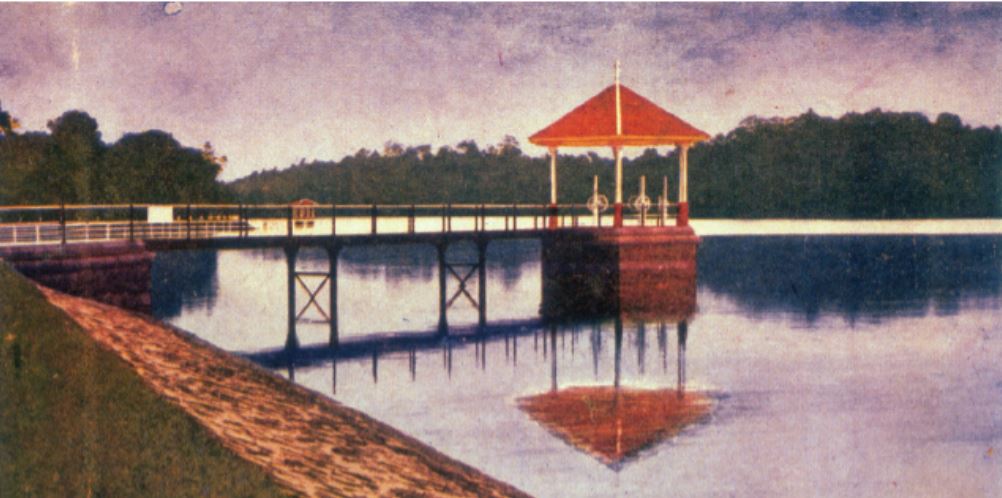
Thomson Road Reservoir c.1910. Known as the Impounding Reservoir when it began operations in 1877, it was renamed Thomson Road Reservoir in 1907 and MacRitchie Reservoir in 1922. Lim Kheng Chye Collection, courtesy of National Archives of Singapore.
Kallang Reservoir – renamed Peirce Reservoir in 1922 and Lower Peirce Reservoir in 1975 – was officially opened in 1911 at a cost of around one million Straits dollars. Capable of producing at least 3.5 million gallons of water each day, the new reservoir together with the enlarged Thomson Road Reservoir (known as Impounding Reservoir, until 1907), supplied the town of Singapore with 9 million gallons of water daily.15
While the two reservoirs provided enough water in the first decade of the 1900s, there were concerns whether this was sustainable, especially since the population had swelled from 300,000 in 1910 to almost 420,000 in 1920. During the same period, the average daily consumption of water had risen to over 10 million gallons, beyond the capacity of the two reservoirs.16
Peirce warned that the water situation would end in “disaster” unless “large and bold measures [were] taken to improve the water supply without delay”. The Municipal Council’s initial solution was to construct a third reservoir at Seletar (renamed Upper Seletar Reservoir in 1992), which was envisaged to have a capacity of 700 million gallons.17 But the project was subsequently scaled down to a smaller reservoir that supplied only 2 million gallons of water a day in favour of something far more ambitious – the Johor water scheme.18
Water from Across the Border
The Municipal Council had explored the idea of importing water from Johor from as early as 1904 after Peirce predicted that Singapore would continue to face chronic water shortages even if it were to develop all its potential water resources on the island. Over the next decades, Scudai River, Linggiu River (a tributary of Johor River) and Pelapah River in the state of Johor were identified as potential water sources for Singapore (see text box below).19
Finally, in 1923, the Municipal Council concluded that the best solution was to obtain water from Gunong Pulai in Johor due to its height. Located some 32 miles from Singapore and standing at 770 feet, Gunong Pulai allowed water to be delivered to the island by gravity, which was the most economical means.20
Development of the Gunong Pulai scheme, which cost 22 million Straits dollars, involved the construction of a series of dams to create a 1.2 billion-gallon impounding reservoir at the mountain’s ridge in 1927 and a second 3.2 billion-gallon reservoir located some 5 miles away in Pontian Kechil in 1931. As the latter reservoir was situated on lower ground, the water had to be pumped to Gunong Pulai’s waterworks for treatment and then piped across the Causeway.21
With water supply boosted by the Johor reservoirs, it was initially thought that Singapore had met its water requirements for at least 20 years. However, the introduction of a waterborne sewage system and an increase in British troops in Singapore led to an unexpected surge in water consumption to 25 million gallons a day by 1940. In response, the Municipal Council embarked on a plan in 1939 to turn Seletar into a permanent reservoir with a daily yield of at least 4 million gallons. The project, which cost 5.6 million Straits dollars, also involved the construction of a second Pontian Kechil-Gunong Pulai water pipe to increase capacity. With these improvements, Singapore’s daily water supply increased to over 31 million gallons.22
The continued rise in population – from 570,000 in 1940 to nearly a million in 1947 – again cast a spotlight on Singapore’s water woes.23 Since the daily water supply stayed relatively unchanged during the Japanese Occupation and the immediate post-war period, the increase in consumption meant that Singapore was once again facing the crisis situation it experienced during the early 1900s.24 To address this issue, the Municipal Council curtailed water supply and launched a Save Water campaign in 1950 to reduce consumption.25
In urgent need of more water, the Municipal Council – renamed the City Council in 1951 – looked for a new water source in Johor and decided on Tebrau River.26
Completed in 1953, the Tebrau waterworks alleviated the water situation in Singapore by adding at least 20 million gallons of water to the colony’s daily supply. This brought the daily total supply to at least 56 million gallons, surpassing the daily consumption of 52 million gallons. Initially, the City Council wanted to expand the Tebrau waterworks, but the winding down of the Communist-related Emergency from the late 1950s allowed the Johor River scheme to be revived in 1958 and finalised in 1961.27
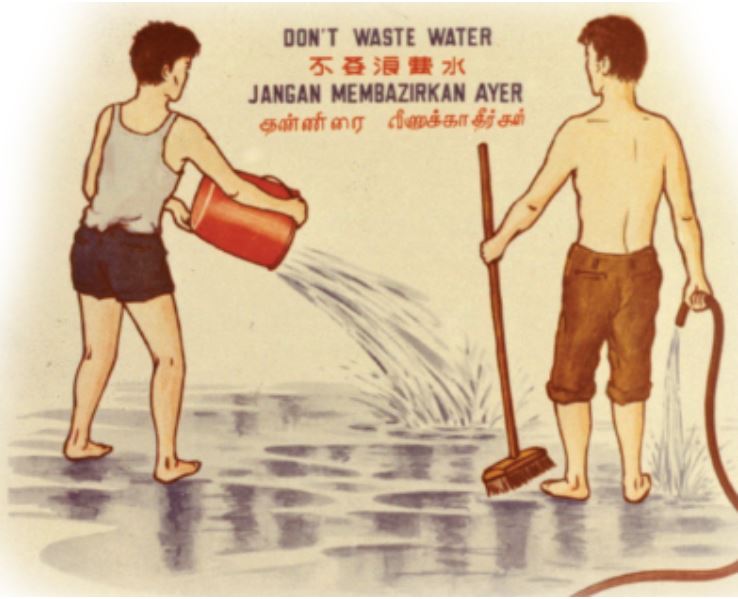
In an age when people had to collect water from standpipes, public education was vital in water conservation. Courtesy of PUB, Singapore’s national water agency.
When the new waterworks at Johor River began operations in 1968, at least 30 million gallons of water were delivered daily to Singapore. While the authorities were planning the Johor River scheme, they also built another waterworks at Scudai River in 1965.
Known as Sultan Ismail Waterworks, it provided Singapore with another 30 million gallons of water each day. The additional water supply from the Johor River and Scudai schemes was timely for Singapore as the island’s daily water consumption had more than doubled by this time, from 52 million gallons in 1955 to 110 million in 1970. This was largely due to a population boom in the 1960s as well as the growth of the shipping, services and industrial sectors.28
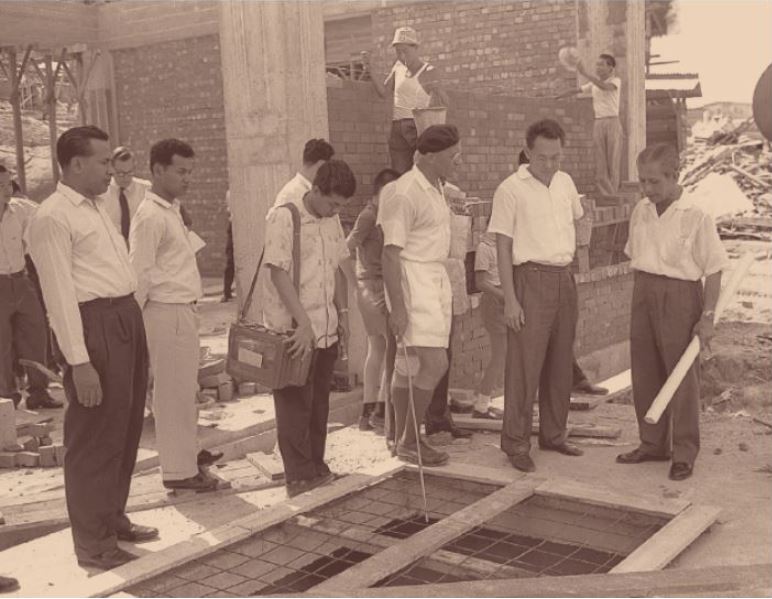
Then Prime Minister Lee Kuan Yew visiting the Sultan Ismail Waterworks construction site at Scudai River in May 1964. Completed in 1965, the waterwoks provided Singapore with another 30 million gallons of water each day. Ministry of Information and the Arts Collection, courtesy of National Archives of Singapore.
Securing Domestic Water Resources
Although the water supply from Johor helped to relieve the water crisis in the 1950s and 60s, the government had already recognised its heavy dependence on Johor for water. This was evident during the Malayan Campaign when the water supply from Johor was abruptly cut in January 1942 after the British, in a bid to slow down the advancing Japanese forces, blew up the Causeway and with it the main water pipe system from Gunong Pulai.29
In 1963 when both the Johor River and Scudai schemes were still under construction, coupled with the prolonged dry weather, Singapore’s water supply fell to critically low levels, thereby forcing the PUB – formed in 1963 to take over the utilities departments from the City Council – to impose a 10-month-long water rationing exercise between April 1963 and February 1964.30
In 1950, the Municipal Council had commissioned a study to investigate the availability of new water sources in Singapore. Led by the engineering firm Sir Bruce White, Wolfe Barry and Partners, the consultants recommended three methods of drawing water from the rivers: either damming or transferring the water to a larger central reservoir, tapping on groundwater in the eastern part of the island, and constructing wells and harvesting rainwater. However, in light of the revival of the Johor River scheme, the City Council did not implement the recommendations except to create a groundwater system in Bedok in 1959. Costing M$2 million, the project was a disappointment as it yielded less than one million gallons of water a day instead of the expected 5 to 10 million gallons.31
After Singapore gained independence in 1965, one of the first post-independence water projects carried out by the PUB was the enlargement of Seletar Reservoir in April 1967. Upon its completion in February 1969, the S$27-million project increased the reservoir’s capacity by more than 30-fold.32
In 1972, PUB embarked on the construction of a new S$55-million reservoir located upstream of Lower Peirce Reservoir. Upper Peirce Reservoir was completed in 1975 and officially opened in February 1977 with a water storage capacity seven times that of Lower Peirce Reservoir.33
Unprotected Catchments
MacRitchie, Upper Peirce and Lower Peirce reservoirs are located in the Central Catchment Nature Reserve. As it is not possible to build new reservoirs within this gazetted nature reserve, the PUB has had to look elsewhere for water. In 1972, the agency released the first Water Master Plan, which charted the long-term development of water resources in Singapore.34
One innovative method adopted by PUB was the creation of a string of unprotected catchments across the island. Unlike protected reservoirs, such catchments are located in urban areas, yielding water that is of lower quality and with higher organic matter. To improve water quality, a number of measures were taken, such as using stronger disinfectants, improving filtration methods, enforcing stricter anti-pollution controls, implementing a more efficient waste management system, and launching the Keep Singapore Clean campaign.35
The Kranji and Pandan reservoirs were the first two estuarine reservoirs built in unprotected catchment areas in 1975. The S$75-million Kranji-Pandan water scheme was formed by damming the Kranji and Pandan rivers. The two reservoirs served mainly the north-western part of Singapore, including Jurong Industrial Estate and housing estates in the area.36
In 1981, dykes were built across the mouths of the Murai, Poyan, Sarimbun and Tengah rivers to transform them into reservoirs under the Western Catchment Scheme. These reservoirs supply water to the western part of the island, including Queenstown, Bukit Merah, Telok Blangah, Pasir Panjang and Alexandra.37
In 1983, PUB initiated the Sungei Seletar-Bedok Water project to meet the increasing demand for fresh water in the eastern part of Singapore. Unlike the earlier two estuarine reservoir schemes, the main water source for this urbanised catchment was storm water run-off. Storm water collected from nine ponds in Bedok, Tampines and Yan Kit was channelled to Bedok Reservoir, which was created from a former sand quarry.
A second reservoir, Sungei Seletar Reservoir (renamed Lower Seletar Reservoir in 1992), was formed by damming Seletar River. The river water was also used to fill Bedok Reservoir (see text box overleaf).38
Marina Reservoir, located in the heart of the city, is another urban reservoir. It officially opened in 2008 and was created by building a dam – Marina Barrage – across Marina Channel. Envisioned by Singapore’s first Prime Minister Lee Kuan Yew in 1987, the barrage is unique in the sense that it stores water, alleviates flooding and supports recreational activities. The flood control function is enabled by a mechanism that serves as a tidal barrier to prevent rising waters from advancing inland and flooding low-lying areas. The barrage also keeps the reservoir’s water level constant, making it suitable for water activities such as sailing, windsurfing and canoeing.39
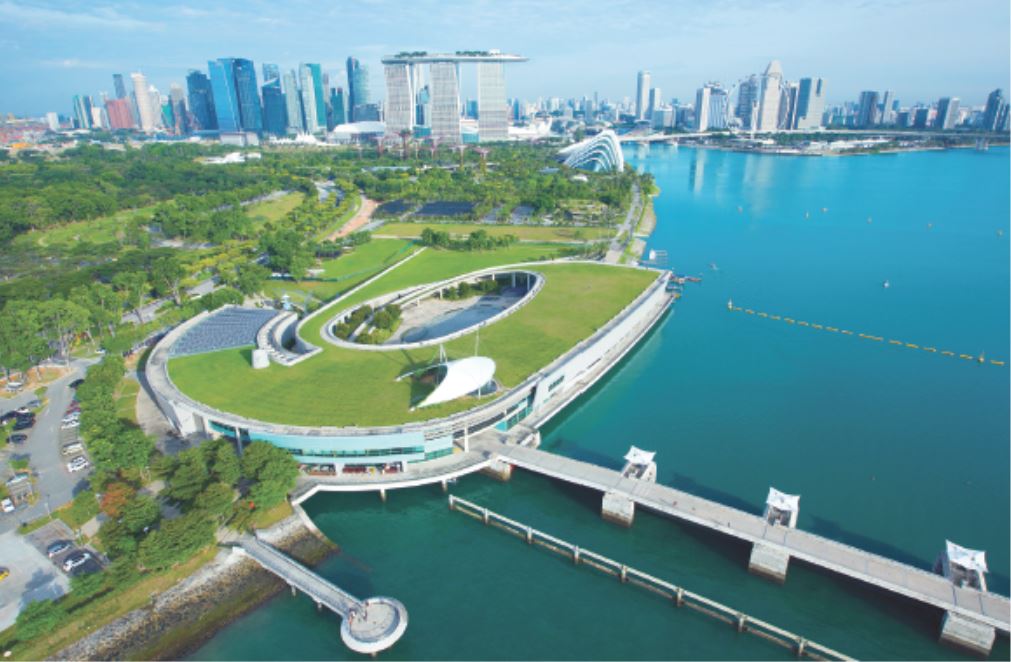
Built across Marina Channel, Marina Barrage created Singapore’s 15th reservoir, the first located in the city. The barrage serves three purposes: it stores water, alleviates flooding and supports recreational activities. Courtesy of PUB, Singapore’s national water agency.
NEWater and Desalinated Water
Another recommendation of the 1972 Water Master Plan was the use of reclaimed water, in other words, water that has been purified to a high degree. This was, however, not an entirely new concept. Industrial water was first introduced in 1966 with the construction of Jurong Industrial Water Works by the Economic Development Board to supply non-potable water for industries. The objective was to help conserve potable water by reclaiming the effluent from Ulu Pandan Water Reclamation Plant.40
In 1974, Singapore’s Sewerage Department opened an experimental plant in Jurong that attempted to produce potable reclaimed water by using advanced membrane technologies, including reverse osmosis, to purify waste water. However, the plant was decommissioned a year later as the purification technologies available then were unreliable and expensive.41
It would take another 25 years before technological advances made it possible for PUB to revisit the idea of producing potable reclaimed water. The Singapore Water Reclamation Study (NEWater Study) conducted in 1998 revealed that water reclamation was a growing trend globally and that membrane-based purification technologies had become more reliable and cost efficient. This led to the opening of the prototype NEWater demonstration plant at Bedok Water Reclamation Plant in 2000.42
A comprehensive study of NEWater was carried out between 2000 and 2002. Although the study concluded that NEWater was safe for potable use, it recommended blending NEWater with raw reservoir water and then subjecting the resulting mix to the same water treatment process as raw reservoir water. This would re-introduce trace minerals removed during the production of NEWater and make the idea of consuming treated and purified waste water more palatable to the public.43
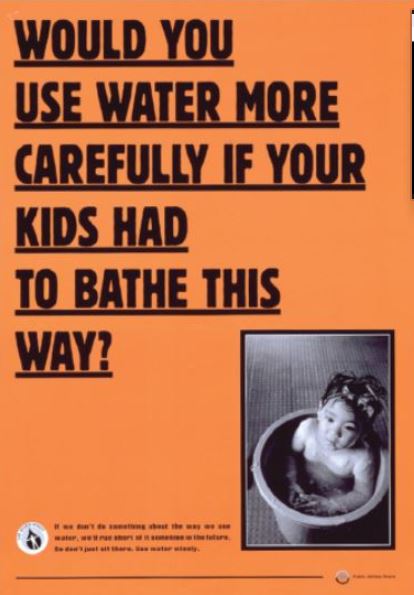
A 2001 poster by the Public Utilities Board exhorting people to save water. PUB Collection, courtesy of National Archives of Singapore.
Following the successful conclusion of the NEWater study, PUB’s Bedok NEWater Plant came into operation in 2002, marking the launch of NEWater as the Third National Tap.44 Since then, NEWater plants have been built in Kranji (2003), Seletar (2004 but decommissioned in 2011), Ulu Pandan (2007) and Changi (2010 and 2017).45 These plants are expected to meet up to 55 percent of Singapore’s future water needs by 2060.46
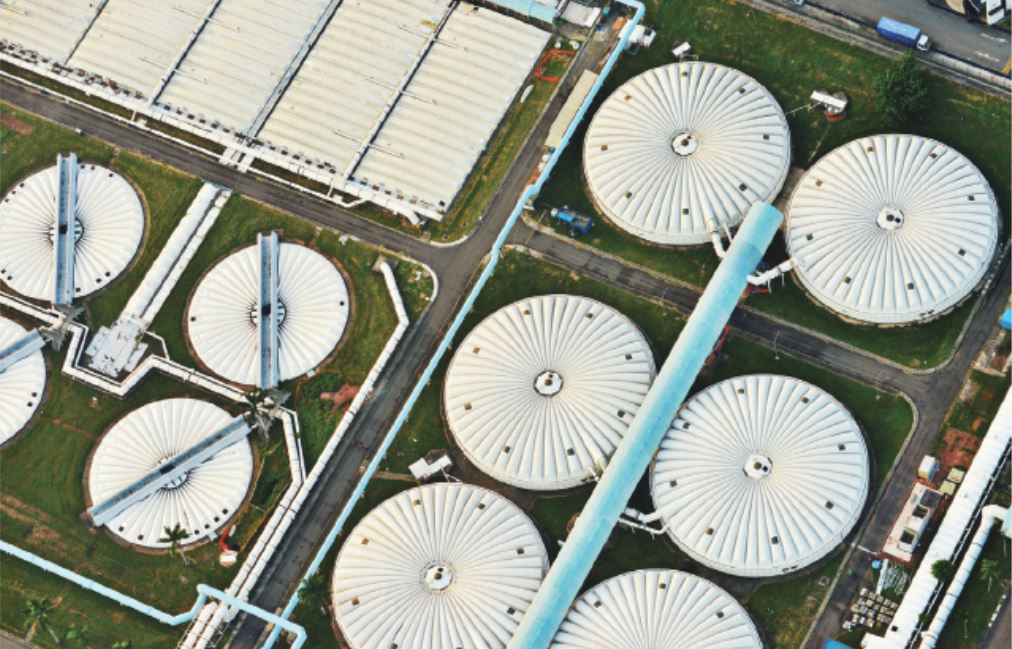
Waste water is treated at the Ulu Pandan NEWater Plant, which opened in 2007. Reclaimed water is today one of Singapore’s Four National Taps. Photo by Richard W.J. Koh.
The 1972 Water Master Plan also recommended tapping seawater as another source of water supply. However, minerals and salts have to be removed from seawater first in a process known as desalination. Unfortunately, as the desalination technology available at the time was energy intensive and costly, the PUB decided not to adopt this method. As more energy efficient water purification methods, particularly reverse osmosis, became available in the 1990s, PUB began to relook the idea of desalinating seawater.
In 2005, desalinated water officially became the Fourth National Tap with the opening of the first desalination plant in Tuas. Hyflux’s wholly owned subsidiary, SingSpring Pte Ltd, won a bid with to construct a desalination plant under PUB’s Design, Build, Own and Operate (DBOO) model. This plant, which has a daily capacity of up to 30 million gallons, supplies PUB with desalinated water over a 20-year period.
In 2013, Hyflux won a second bid to construct the second desalination plant under the DBOO model to supply PUB with desalinated water over a 25-year period.47 By 2020, Singapore is expected to commission three more desalination plants in Tuas, Marina East and Jurong Island.48 By 2060, Singapore’s total water demand could almost double, with the non-domestic sector accounting for about 70 percent. By then, NEWater and desalination would meet up to 85 percent of Singapore’s future water needs.
Other Water Strategies
Conceptualised in the 1990s as a solution for Singapore’s used water needs, Phase 1 of the Deep Tunnel Sewerage System (DTSS) comprises a 48 km-long deep sewer tunnel running from Kranji to Changi, a centralised water reclamation plant at Changi, two deep sea outfall pipes and 60 km of link sewers.
The heart of DTSS Phase 1, the Changi Water Reclamation Plant, is capable of treating 900,000 cubic metres (202 million gallons) of used water per day. The used water is treated to meet international standards before it is channelled to a NEWater factory for further purification or discharged into sea. At a NEWater plant, the treated used water goes through a rigorous 3-step treatment process to produce high-grade reclaimed water.49 Projected to complete by 2025, DTSS Phase 2 can collect used water from the western and southern parts of Singapore for treatment at the proposed Tuas Water Reclamation Plant.
To overcome the limited capacity of existing reservoirs, PUB implemented the Reservoir Integration Scheme in 2007. This scheme uses a system of pipelines and pumps to connect reservoirs so that excess water can be transferred from one reservoir to another, thereby optimising their capacity.50 In 2011, the total number of reservoirs in Singapore increased to 17 when two more were created when dykes were built across the mouth of Punggol and Serangoon rivers.
PUB is also making strides in water technologies by partnering overseas firms. One recent example is the trial of a new desalination method in 2015 with American company, Evoqua Water Technologies. Known as electro-deionisation, this method uses an electric field to extract dissolved salts from seawater, leaving behind fresh water. Compared with the current desalination method, electro- deionisation is significantly more efficient in terms of energy usage and cost.51
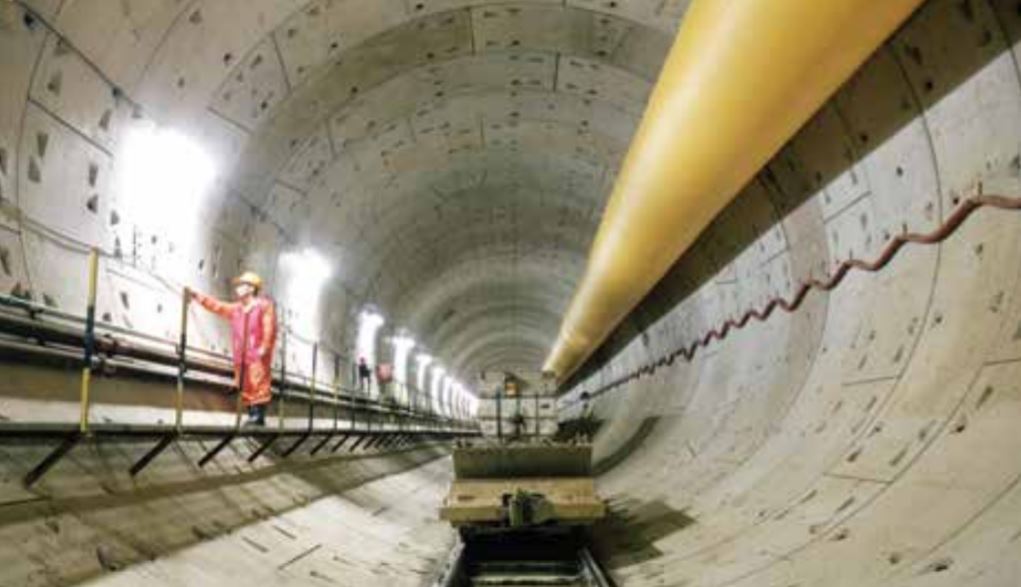
Conceptualised in the 1990s as a solution for Singapore’s waste water needs, the Deep Tunnel Sewerage System uses a network of deep tunnels to convey waste water by gravity to NEWater reclamation plants in Kranji, Changi and Tuas. Courtesy of PUB, Singapore’s national water agency.
From the first well dug by the British in 1819 to a constant supply of clean drinking water flowing from taps, Singapore’s water journey – at times bumpy and perilous – has come a long way since the time of Raffles. Through persistence, foresight and innovation, our water pioneers have been able to overcome massive obstacles and challenges to develop and diversify Singapore’s water sources.
At the current rate of 148 litres per person per day, Singapore uses more water than many other developed cities. It is crucial that Singapore continues to find innovative ways to secure and sustain a robust and affordable water supply for future generations. Water rationing and lining up in snaking queues to collect water from public standpipes is a scene from the 1960s that we should not revisit.
Active, Beautiful, Clean Waters
Other than being one of the first urban water catchments, Bedok Reservoir was also one of three demonstration projects under the Active, Beautiful, Clean Waters (ABC Waters) Programme. Launched in 2006 the programme aimed to turn waterways and reservoirs into recreational sites for public use by enhancing them with amenities.52
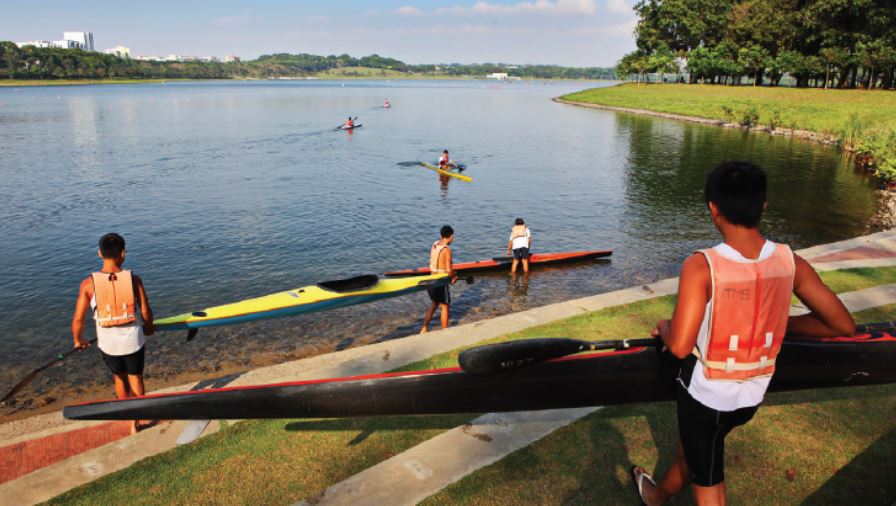
Kayakers at Bedok Reservoir, 2011. This was one of three demonstration projects under the Active, Beautiful, Clean Waters (ABC Waters) Programme launched in 2006. Reservoirs were beautified with pathways, trees and street lights, and some were even opened for recreational purposes. Photo by Richard W. J. Koh.
Prior to this, the public held the view that reservoirs were out of bounds and strictly used for the collection of water. As Prime Minister Lee Hsien Loong quipped, “Our old attitude was, the water is for the reservoir, don’t go near it, keep far away, keep it clean, no canoeing, don’t walk near it, if possible, don’t even look at it”.53
However, the ABC Waters Programme became a game changer. Selected reservoirs and waterways in Singapore received extensive makeovers. Street lamps were installed, trees were planted and proper pedestrian access was provided. In some cases, even fishing decks and pontoons for boats and kayaks were added.54
Water Agreements With Malaysia
Singapore and Malaysia have signed four water agreements regarding the supply of water from across the Causeway.
5 December 1927: This agreement allowed Singapore to lease 2,100 acres of land in Gunong Pulai at an annual fee of 30 sen per acre for the purpose of supplying raw water to the island. Singapore was not charged for the water.
2 October 1961 (Tebrau and Scudai Rivers Water Agreement): Replaced the 1927 agreement and allowed Singapore to draw water from Gunong Pulai, Tebrau River and Scudai River for a period of 50 years. Singapore paid an annual rent of RM5 per acre and 3 sen for every 1,000 gallons of raw water it drew. After the agreement expired in 2011, Singapore handed over to the Johor State government the Gunong Pulai and Scudai waterworks as well as the pump houses at Pontian and Tebrau without any charges and in good working order.
29 September 1962 (Johor River Water Agreement): This agreement is still in effect today and allows Singapore to draw 250 million gallons of water per day from the Johor River for a period of 99 years until 2061. Singapore pays rent for the land it uses “at the standard rate applicable to the use made of such lands and in particular building lots on town land”. It also pays for the water it draws at the rate of 3 sen per 1,000 gallons.
24 November 1990: This agreement supplements the 1962 water agreement and is still valid today. The agreement allows Singapore to purchase treated water from Johor in excess of the entitlement of 250 million gallons per day of untreated water under the 1962 agreement. Singapore bore the cost of constructing a dam across Linggiu River and maintaining it. Singapore also paid a one-time upfront payment of RM320 million as compensation for the loss of land use, a premium of RM18,000 per hectare and rentals for the remaining tenure of the agreement calculated at an annual rent of RM30 per 1,000 square feet (0.02 acre). The 1990 agreement will expire in 2061, along with the 1962 agreement.
References
Government of Singapore. (2018). Water. Retrieved from Ministry of Foreign Affairs website.
Water agreements. (2006). In T. Koh, et al. (Eds.). [Singapore: The encyclopedia] (p. 585). Singapore: Editions Didier Millet; National Heritage Board. (Call no.: RSING 959.57003 SIN-[HIS])
About the Author
Lim Tin Seng is a Librarian with the National Library, Singapore. He is the co-editor of Roots: Tracing Family Histories – A Resource Guide (2013); Harmony and Development: ASEAN-China Relations (2009) and China’s New Social Policy: Initiatives for a Harmonious Society (2010). He is also a regular contributor to BiblioAsia.
Endnotes
1 S’pore “most at risk of facing high water stress”. (2015, August 29). The Straits Times, p. 37. Retrieved from NewspaperSG.
2 The Straits Times, 29 Aug 2015, p. 37.
3 Tarling, N. (1992). Singapore and the Singaporeans since 1819 (p. 27). Auckland: Centre for Asian Studies, University of Auckland. (Call no.: RSING 959.57 SIN-[HIS]).
4 National Archives of Singapore. (2008). 10 years that shaped a nation: An exhibition catalogue (p. 38). Singapore: National Archives of Singapore. (Call no.: RSING 959.5705 TEN-[HIS]); Hon, J. (1990). Tidal fortunes: A story of change: The Singapore River and Kallang Basin (pp. 8, 29–30). Singapore: Landmark Books. (Call no.: RSING 959.57 HON-[HIS]); Makepeace, W., Brooke, G.E., & Braddell, R.S.J. (Eds.). (1991). One hundred years of Singapore (p. 326). Singapore: Oxford University Press. (Call no.: RSING 959.57 ONE-[HIS]).
5 Dobbs, S. (2003). The Singapore River: A social history, 1819–2002 (pp. 33–34). Singapore: Singapore University Press. (Call no.: RSING 959.57 DOB-[HIS]).
6 Dobbs, 2003, p. 34.
7 Makepeace, Brooke & Braddell, 1991, p. 326; Yeoh, B.S.A. (2003). Contesting space in colonial Singapore: Power relations and the urban built environment (pp. 177–178). Singapore: Singapore University Press. (Call no.: RSING 307.76095957 YEO).
8 Saw S.H. (2012). The population of Singapore (p. 9). Singapore: Institute of Southeast Asian Studies. (Call no.: RSING 304.6095957 SAW); Makepeace, Brooke & Braddell, 1991, p. 327.
9 Ng, P.K.L., Corlett, R.T., & Tan, H.T.W. (Eds.). (2011). Singapore biodiversity: An encyclopedia of the natural environment and sustainable development (p. 59). Singapore: Editions Didier Millet. (Call no.: RSING 333.95095957 SIN); Yeoh, 2003, p. 178; National Archives of Singapore, 2008, p. 38.
10 Ng, Corlett & Tan, 2011, p. 59; Yeoh, 2003, p. 178.
11 Makepeace, Brooke & Braddell, 1991, p.327.
12 Our water supply. (1912, March 28). The Singapore Free Press and Mercantile Advertiser (Weekly), p. 14. Retrieved from NewspaperSG; Ng, Corlett & Tan, 2011, p. 59; Yeoh, 2003, p. 179.
13 Yeoh, 2003, p. 179; The Singapore Free Press and Mercantile Advertiser (Weekly), 28 Mar 1912, p. 14.
14 Yeoh, 2003, p. 179; Official scheme. (1902, December 8). The Straits Times, p. 5; Singapore water supply. (1912, March 20). The Singapore Free Press and Mercantile Advertiser, p. 12. Retrieved from NewspaperSG.
15 The Singapore Free Press and Mercantile Advertiser, 20 Mar 1912, p. 12; Colonial government. (1911). Administration report of the Singapore Municipality for the year (p. 23). Singapore: Fraser & Neave. (Call no.: RRARE 352.05951 SIN; Microfilm no.: NL3408); Singapore. Public Utilities Board. (1985). Yesterday & today: The story of public electricity, water and gas supplies in Singapore (p. 13). Singapore: Times Books International. (Call no.: RSING 363.6095957 YES); Our water supply in 1906. (1907, July 20). Eastern Daily Mail and Straits Morning Advertiser, p. 2; Our water supply. (1912, March 27). The Singapore Free Press and Mercantile Advertiser, p. 12; Campbell, B. (1972, December 5). Coping with the ever increasing demand for water. The Straits Times, p. 14. Retrieved from NewspaperSG.
16 The municipality in 1919. (1920, August 27). The Singapore Free Press and Mercantile Advertiser, p. 7; Singapore’s water supply. (1922, November 3). The Malaya Tribune, p. 6. Retrieved from NewspaperSg.
17 Yeoh, 2003, p. 179; The water supply. (1907, November 19). The Straits Times, p. 7. Retrieved from NewspaperSG.
18 Singapore water supply. (1924, October 17). The Straits Times, p. 11; Farrer, R.J. (1935, October 8). The municipality in my time. The Singapore Free Press and Mercantile Advertiser, p. 16; $500,000 reservoir project nears completion. (1940, May 18). The Malaya Tribune, p. 3. Retrieved from NewspaperSG.
19 Our water scheme: Its history: Part I. (1924, March 26). The Singapore Free Press and Mercantile Advertiser (Weekly), p. 10; Water supply: Expert approves Gunong Pulai scheme. (1922, October 12). The Straits Times, p. 9. Retrieved from NewspaperSG.
20 Singapore water supply: Gunong Pulai scheme finally adopted. (1923, December 17). The Straits Times, p. 9; Singapore water: Official report on proposed scheme. (1924, January 4). The Straits Times, p. 9. Retrieved from NewspaperSG; The Singapore Free Press and Mercantile Advertiser (Weekly), 26 Mar 1924, p. 10.
21 The Singapore Free Press and Mercantile Advertiser (Weekly), 26 Mar 1924, p. 13; Singapore water supply. (1927, April 25). The Singapore Free Press and Mercantile Advertiser, p. 7; Visit to Pontian Kechil: A sad coincidence. (1932, March 7). The Malaya Tribune, p. 8; Singapore water supply: Pontian reservoir completed. (1932, March 7). The Straits Times, p. 12. Retrieved from NewspaperSG; The Singapore Free Press and Mercantile Advertiser (Weekly), 26 Mar 1924, p.10.
22 The Straits Times, 7 Mar 1932, p. 12; The Malaya Tribune, 18 May 1940, p. 3; Extension of town supply ahead of schedule. (1940, May 21). The Singapore Free Press and Mercantile Advertiser, p. 5; Singapore’s $5,500,000 water scheme: Pipe-Line in Johor being doubled. (1939, April 2). The Straits Times, p. 17. Retrieved from NewspaperSG.
23 War conditions hold up taking of census. (1941, June 17). The Malaya Tribune, p. 2. Retrieved from NewspaperSG; Saw, 2012, p. 14.
24 ‘Save water’ call to S’pore. (1950, February 14). The Singapore Free Press, p. 6. Retrieved from NewspaperSG.
25 Water famine: Hits Singapore. (1950, February 14). The Malaya Tribune, p. 2. Retrieved from NewspaperSG; The Singapore Free Press, 14 Feb 1950, p. 6.
26 Tortajada, C., Joshi, Y., & Biswas, A, K. (2013). The Singapore water story: Sustainable development in an urban city-state (p. 13). New York: Routledge. (Call no.: RSING 363.61095957 TOR).
27 Colony has no fear of water shortage. (1955, June 7). Singapore Standard, p. 5; The Straits Times, 3 Sep 1961, p. 1; Water supply: Council to reconsider plan. (1958, May 23). Singapore Standard, p. 4. Retrieved from NewspaperSG.
28 Lee, G. (1968, April 20). Sultan opens $30m waterworks. The Straits Times, p. 11; Sultan opens $21m. project. (1965, April 3). The Straits Times, p. 15. Retrieved from NewspaperSG; Singapore Standard, 7 Jun 1955, p. 5; Chia, P. (1971, June 28). Divining water needs for the future. The Straits Times, p. 12. Retrieved from NewspaperSG.
29 National Archives of Singapore, 2008, p. 39.
30 Tan, Y.S. et. al. (2009). Clean, green and blue: Singapore’s journey towards environmental and water sustainability (pp. 125–126). Singapore: ISEAS Pub. (Call no.: RSING 363.70095957 TAN).
31 White, B. (1950). Report on the water resources of Singapore island, excluding those within the present protected catchment area (p. 40). London: Wolfe Barry & Partners. (Call no.: RCLOS 627.095957 BRU); $2m extra water plan goes on. (1958, April 28). The Singapore Free Press, p. 7. Retrieved from NewspaperSG; Tortajada, Joshi & Biswas, 2013, p. 13.
32 Singapore. Public Utilities Board. (1969). Souvenir brochure to commemorate the inauguration of Seletar Reservoir, Public Utilities Board (Foreword, pp, 2, 4, 9). Singapore: The Board. (Call no.: RCLOS 628.13095957 PUB); Over 100 million gallons of water supplied to S’pore daily. (1969, August 10). The Straits Times, p. 32. Retrieved from NewspaperSG.
33 Singapore. Public Utilities Board. (1977). Souvenir brochure to commemorate the official opening of the Upper Peirce Reservoir (Introduction). Singapore: The Board. (Call no.: RCLOS 628.13095957 PUB); Mr Lee to open S’pore’s largest impounding reservoir. (1977, February 27). The Straits Times, p. 18. Retrieved from NewspaperSG.
34 Tan, 2009, pp. 128–129
35 Tan, 2009, p. 131.
36 ‘Yes’ for Kranji-Pandan reservoir project. (1972, March 9). The Straits Times, p. 4; $132m water supply projects to be ready this year. (1975, February 9). The Straits Times, p. 6. Retrieved from NewspaperSG.
37 Water from western catchment for these areas. (1982, May 5). The Straits Times, p. 10. Retrieved from NewspaperSG.
38 Tan, 2009, p. 132; Singapore. Public Utilities Board. (1997). Singapore’s water supply (p. 5). Singapore: Public Utilities Board. (Call no.: RSING 628.1095957 SIN); Two proposed reservoirs to be linked. (1980, August 18). The Straits Times, p. 9. Retrieved from NewspaperSG.
39 Public Utilities Board. (2016, November 16). Marina Barrage. Retrieved from Public Utilities Board website; Liaw, W.C. (2008, November 1). First city reservoir opens. The Straits Times, p. 1. Retrieved from NewspaperSG; Ministry of Information, Communications and the Arts. (2005, March 22). Speech by Minister Mentor Lee Kuan Yew at the Marina Barrage commencement ceremony on 22 March 2005, 6.00pm. Retrieved from National Archives of Singapore website.
40 Tan, 2009, pp. 140–141.
41 Peh, S.H. (2007, April 7). Liquid asset. The Straits Times, p. 50. Retrieved from NewspaperSG; Tan, 2009, p. 142.
42 United Water Technologies. (2002, June). Singapore water reclamation study: Expert panel review and findings (pp. AB-1, AB-2). Retrieved from United Water Technologies website; Tan, 2009, p. 142; Teo, L. (2001, January 13). Recycling to meet 15% of water needs by 2010. The Straits Times, p. 1. Retrieved from NewspaperSG.
43 United Water Technologies, Jun 2002, pp. AB-7, AB-11–AB-24; Tan, 2009, pp. 143–144.
44 Hyflux Ltd. (2002). Annual report 2001 (p. 1). Retrieved from Hyflux website; Ministry of Information, Communications and the Arts. (2003, February 21). Speech by Prime Minister Goh Chok Tong at the Official Launch of Newater on Friday, 21st February 2003 at 7.00pm. Retrieved from National Archives of Singapore website.
45 Tang, W.F. (2004, June 19). Third Newater plant on stream as water sector opens up. The Business Times, p. 8. Retrieved from NewspaperSG; Public Utilities Board. (2012). Annual report 2010/2011 (p. 15). Retrieved from Public Utilities Board website; Lee, U-W. (2007, March 16). Let’s drink to another Newater success: PM. Today, p. 3. Retrieved from NewspaperSG; Public Utilities Board. (2017, January 18). Singapore’s fifth NEWater plant opens. Retrieved from Public Utilities Board website; Boh, S. (2017, January 19). $170m fifth Newater plant launched. The Straits Times, p. 3. Retrieved from NewspaperSG.
46 Public Utilities Board. (2017, September 21). NEWater. Retrieved from Public Utilities Board website.
47 Ong, M.A. (2005). Towards environmental sustainability: State of the environment 2005 report (p. 21). Singapore: Ministry of the Environment and Water Resources. (Call no.: RSING 363.72095957 ONG); Public Utilities Board. (2017, October 3). Desalinated water. Retrieved from Public Utilities Board website.
48 Chua, G. (2013, September 18). Another milestone as second desalination plant opens. The Straits Times, pp. 2–3. Retrieved from NewspaperSG; Public Utilities Board, 3 Oct 2017.
49 Public Utilities Board. (2016). Our water, our future (p. 20). Singapore: Public Utilities Board. (Call no.: RSING 333.910095957 OUR).
50 Public Utilities Board, 2012, p. 14; Tan, 2009, p. 135.
51 Public Utilities Board, 2016, p. 20.
52 Bedok reservoir first to be upgraded. (December 2005/January 2006). Waternet, p. 8. (Call no.: RSING q363.61095957 W); $23m river, reservoir upgrade. (2006, May 30). The New Paper, p. 16. Retrieved from NewspaperSG.
53 Koh, L. (2005, November 6). $1m makeover at Bedok Reservoir. The Straits Times, p. 8. Retrieved from NewspaperSG.
54 Public Utilities Board. (2008). Explore Bedok Reservoir; Public Utilities Board. (2008). Explore MacRitchie Reservoir. Retrieved from Public Utilities Board website.