
Article
Makan Places and Coffee Socks
Topics
Food
10 October 2018
Barbara Quek highlights publications that showcase Singapore’s unique hawker fare from the National Library’s Legal Deposit Collection.
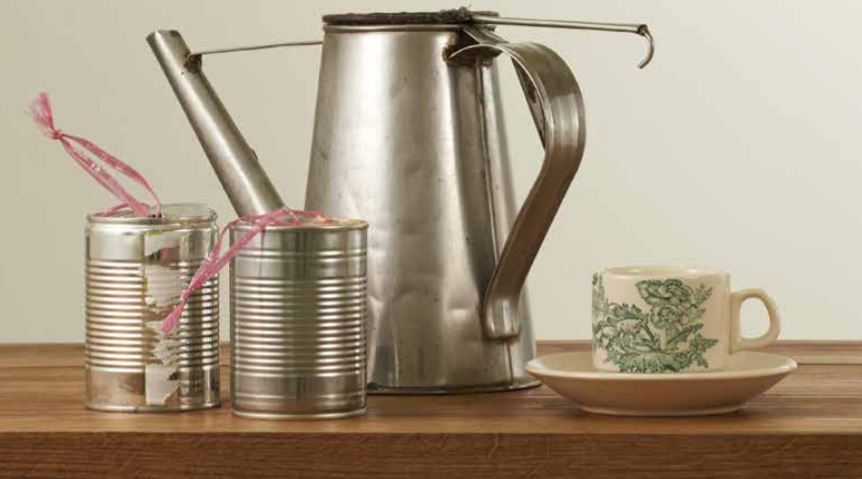
Singaporeans are perennially eating or else talking about their next meal – such is their obsession with food. The city’s gastronomic scene is renowned, with makan (“eat” in Malay) places offering everything from hawker fare to haute cuisine. The inclusion of hawker stalls in the Michelin Guide Singapore (the third edition was launched recently1) is testimony of the heights that hawker fare with its humble street food origins has risen to.
Hawker Tales
Hawker centres are quintessentially Singaporean institutions. First-time visitors – usually tourists – are often amazed at the rich and affordable array of freshly cooked food conveniently housed under one roof.
The “irony of the hawker centre” in Singapore, notes social scientist and geographer Lily Kong, is that the hawker no longer goes around selling goods.2 Singapore’s hawker culture can be traced to itinerant hawkers from the 19th to mid-20th centuries who literally moved from one place to another calling out to customers and peddling food, drinks and household wares. In order to eradicate problems arising from contamination, improper refuse disposal and traffic congestion caused by makeshift stalls, the government resettled street hawkers within purpose-built standalone hawker centres from the 1970s onwards.
Over the years, street hawker food has made its way to hawker centres, coffeeshops, food courts and even the menus of fancy restaurants.3 The iconic Satay Club at the Esplanade and Glutton’s Square on Orchard Road are long gone, but more traditional hawker centres such as Newton Food Centre, Maxwell Food Centre and Chomp Chomp Food Centre still pack in the crowds despite competition from fast food outlets, air conditioned food courts and new-fangled cafes.4
Kopitiam and Coffee Socks
The ubiquitous kopitiam (literally “coffeeshop”; kopi meaning “coffee” in Malay and tiam for “shop” in Hokkien) is found in almost every neighbourhood in Singapore, with many open 24/7 for people who need their coffee (or supper) fix. Coffeeshops have been around for as long as people remember them and have come to symbolise our forefathers’ entrepreneurial spirit.
The coffeeshop is patronised by Singaporeans from all walks of life. It is a place where one can enjoy good local food and catch up on gossip over a freshly brewed cup of kopi or teh (“tea”) paired with toast slathered with kaya (coconut jam) and half-boiled eggs drizzled with dark soy sauce.
There are no baristas at these coffeeshops, just “uncles” and “aunties” who have mastered the art of making that perfect cup of coffee. Doctor and food blogger Leslie Tay remembers the “uncle in pajama pants making kopi” and reminisces that “stepping into Heap Seng Leong [along North Bridge Road] is like stepping into a time portal.”5
Here is a sampling of publications featuring hawker stalls and coffeeshops from the National Library’s Legal Deposit Collection.
Around Lau Pa Sat: A “What’s On” Guide to Singapore’s First and Only Festival Market
(Sep/Oct 1993)
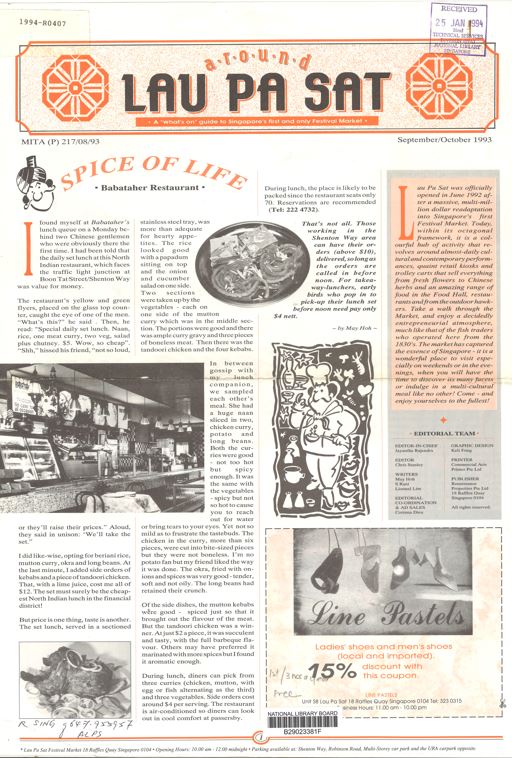
Opened in 1894, Lau Pa Sat (meaning “old market”) – also known as Telok Ayer Market – in the Central Business District – is known as the “grande dame of markets”. The market was converted into a hawker centre in 1972. The Sep/Oct 1993 edition of the newsletter features budget meals and recommends dishes such as kueh pie tee, vegetables and rice, and soup from the various stalls.
Not for Sale: Singapore’s Remaining Heritage Street Food Vendors
(2013)
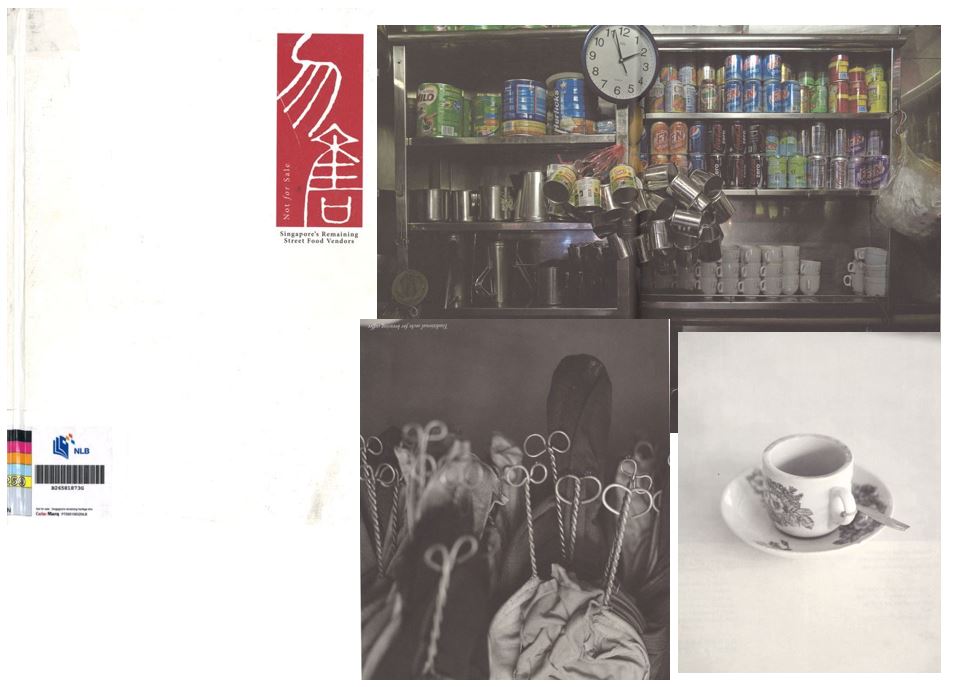
This commemorative book pays tribute to 300 hawker and street food stalls who have had a long history in Singapore. The editorial team visited various hawker centres in Singapore over a two-year period to locate, interview and document the trials and tribulations of our heritage hawkers. As highlighted in the introduction, each has a unique story to tell, with its “own set of challenges, circumstances and accomplishments”.6
The Business Times & Knight Frank CEOs’ Hawker Guide
(2010)
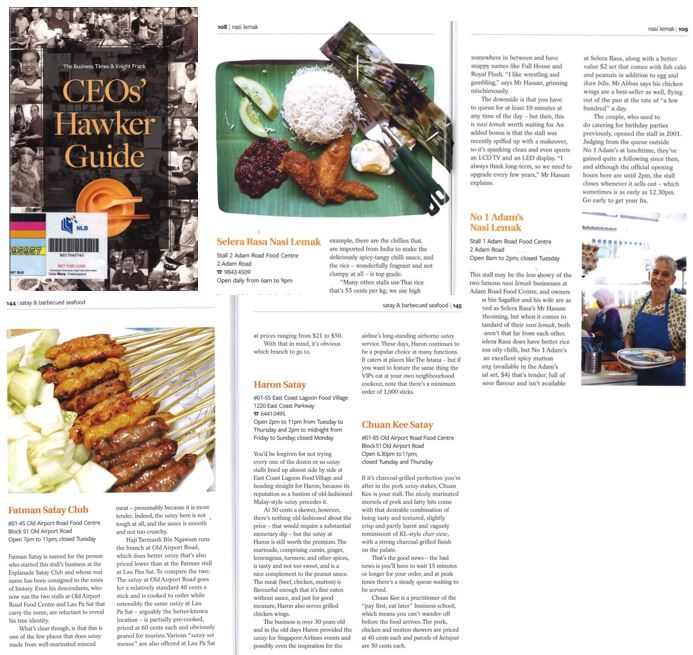
Published by The Business Times and Knight Frank in 2010 to raise funds to preserve Singapore’s hawker heritage, this book presents the personal food stories of some of Singapore’s prominent business leaders. In all, 134 stalls in 26 local food categories are featured, ranging from bak kut teh and nasi padang to roti prata. Obviously, CEOs are just as comfortable eating out at hawker centres as they do at fine-dining restaurants.7
I-S Magazine
(2008)
![The writers claim that it is “no secret that food factors largely in the psyche of the average Singaporean… [and] nothing comes remotely close to the colourful experience of eating in a hawker centre… from the most sinful char kway teow, or luak (fried oyster), Hokkien noodles, chicken rice and carrot cake…”.8 They stake out four popular hawker centres – People’s Park, Maxwell, Newton and Bedok Interchange – to find out what goes on in a day in the life of the average hawker.](https://isomer-user-content.by.gov.sg/339/06ff0f7c-aef2-498f-a18c-095a7b1b07cb/CoffeeSocks5.JPG)
The writers claim that it is “no secret that food factors largely in the psyche of the average Singaporean… [and] nothing comes remotely close to the colourful experience of eating in a hawker centre… from the most sinful char kway teow, or luak (fried oyster), Hokkien noodles, chicken rice and carrot cake…”.8 They stake out four popular hawker centres – People’s Park, Maxwell, Newton and Bedok Interchange – to find out what goes on in a day in the life of the average hawker.
Eat East: Food Guide of the Marine Parade District
(2001)
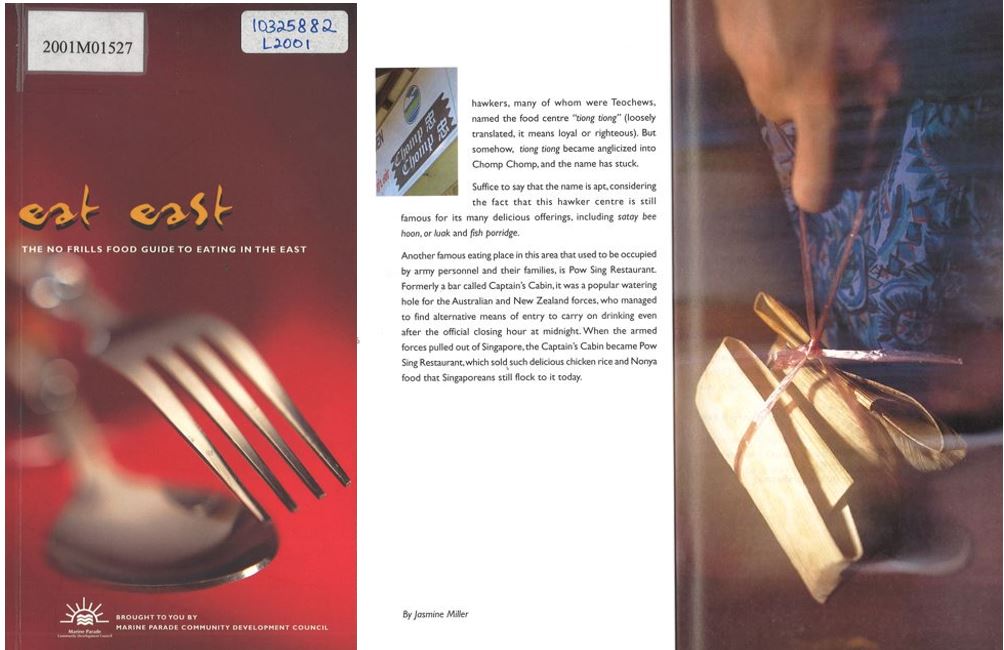
This food guide was published for residents of Marine Parade housing estate. It features some of Singapore’s best-loved multiracial makan places.
Community Bedok: Celebrating 10 Years of the Constituency
(1987)
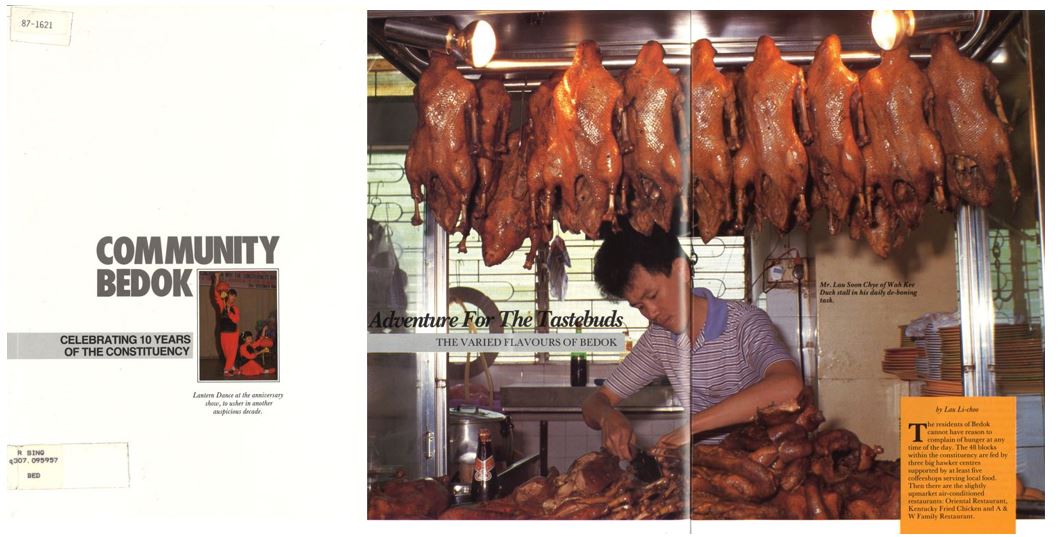
In “Adventure for the Tastebuds: The Varied Flavours of Bedok”, writer Lau Li-choo claims that residents living in Bedok have no reason to complain of hunger. The constituency is served by many hawker centres and coffeeshops selling good food. Pictured here is Lau Soon Chye of Wah Kee Duck stall, located across the road from the former Bedok and Changi cinemas, deboning ducks for his customers. Unfortunately, the stall has since closed.
Singapore Hawker Centres: People, Places, Food
(2007)
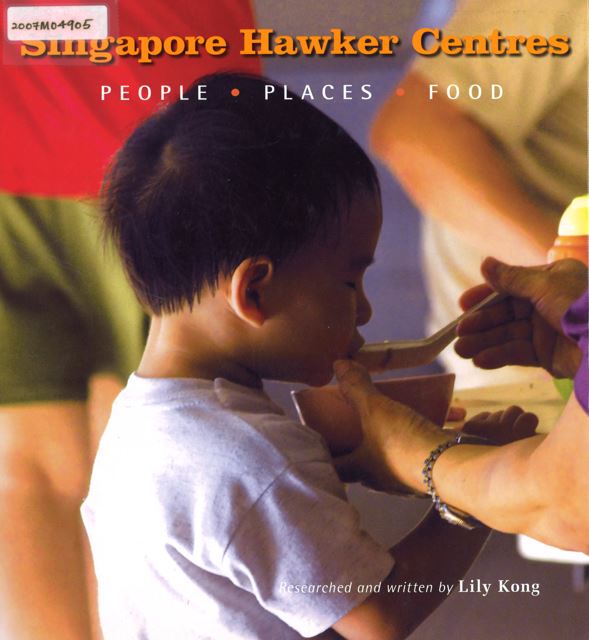
Commissioned by the National Environment Agency, this coffee table book by Lily Kong looks at the changing face of hawking in Singapore, and features different types of local food. The book also includes case studies and interviews with enterprising hawkers, and is illustrated with photos.
旧机场路小贩中心百货商店二周年纪念特刊 (Old Airport Road Hawkers’ Centre & Emporium 2nd Anniversary Souvenir Magazine)
(1975)
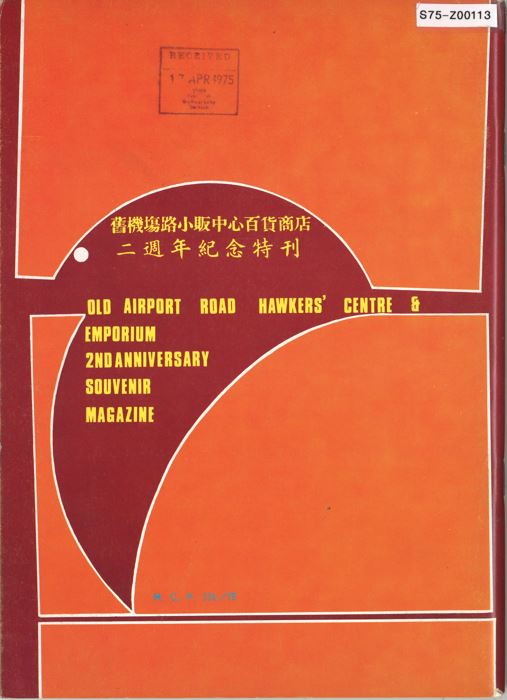
The Old Airport Road Hawkers’ Centre & Emporium opened in 1973 with 192 food stalls on the first floor and 120 shops selling sundries on the second floor. It was so popular that people from all over Singapore came here to shop and eat. Kallang Airport was located nearby between 1937 and 1955, hence its name. Known as Old Airport Road Food Centre today, it still continues to draw the crowds as foodies say that some of Singapore’s best hawker fare is found here.
WHAT'S YOUR BREW?
Nothing rouses the senses more than the aroma of freshly roasted kopi brewed in traditional “coffee socks”, which are reusable filter bags made of muslin. To enjoy a proper Singapore-style coffee, you need to order as locals do. For example, if you just say “kopi” when placing your order, it means that you want coffee with condensed milk and sugar, and when you say “kopi c”, you’ll be given coffee with evaporated milk and sugar. If you like your coffee thick, say “kopi gao” and if you don’t want sugar, remember to say “kosong”.
Foreign residents in Singapore have also learned to appreciate local coffee, and taken to using these local lexicons with gusto. According to food editor Tan Hsueh Yun, the ultimate treat is “kopi gu yew”, or coffee with butter, which contains just enough butter and “condensed milk to sweeten the drink without obscuring the nuances of the coffee”.
Reference
Tan, H.Y. (2014, September 26). [Food picks]. The Straits Times, p. 6. Retrieved from NewspaperSG.
About the Author
Barbara Quek is a Senior Librarian with the National Library, Singapore. She is currently with the Advocacy & Statutory Function group that oversees the compliance of Legal Deposit in Singapore.
Endnotes
1 Michelin Guide. (2018). Michelin Guide experiences: Restaurants, lifestyle in Singapore. Retrieved from Michelin Guide website.
2 Kong, L. (2007). Singapore hawker centres: People, places, food (p. 31). Singapore: National Environment Agency. (Call no.: RSING 381.18095957 KON).
3 Pang, J. (2013). Not for sale: Singapore’s remaining heritage street food vendors (Foreword). Singapore: GoodFood Syndicate LLP. (Call no.: RSING 647.9509225957 PAN).
4 Kong, 2007, p. 15.
5 Tay, L. (2013, November 26). Heap Seng Leong coffeeshop: And time stood still. Retrieved from ieatishootipost.sg website.
6 Pang, 2013, p. 12.
7 Phoon, A., & Cheah, U-H. (2010). The Business Times & Knight Frank CEOs’ hawker guide. Singapore: Business Times. (Call no.: RSING 647.95095957 BUS)
8 Wan, B., & Yong, Y.S. (2008, January 18). The great hawker crackdown. I-S magazine (pp. 8, 10, 12). Singapore: Asia City Pub. (Call no.: RSING 052 ISM)