
Article
Navaratri Golu: The Hindu Festival of Dolls
Topics
Culture
10 October 2019
Celebrated by Hindus of South Indian origins, the Golu festival is a lively melange of colourful dolls, womenhood and spirituality. Anasuya Soundararajan shares with us its origins.
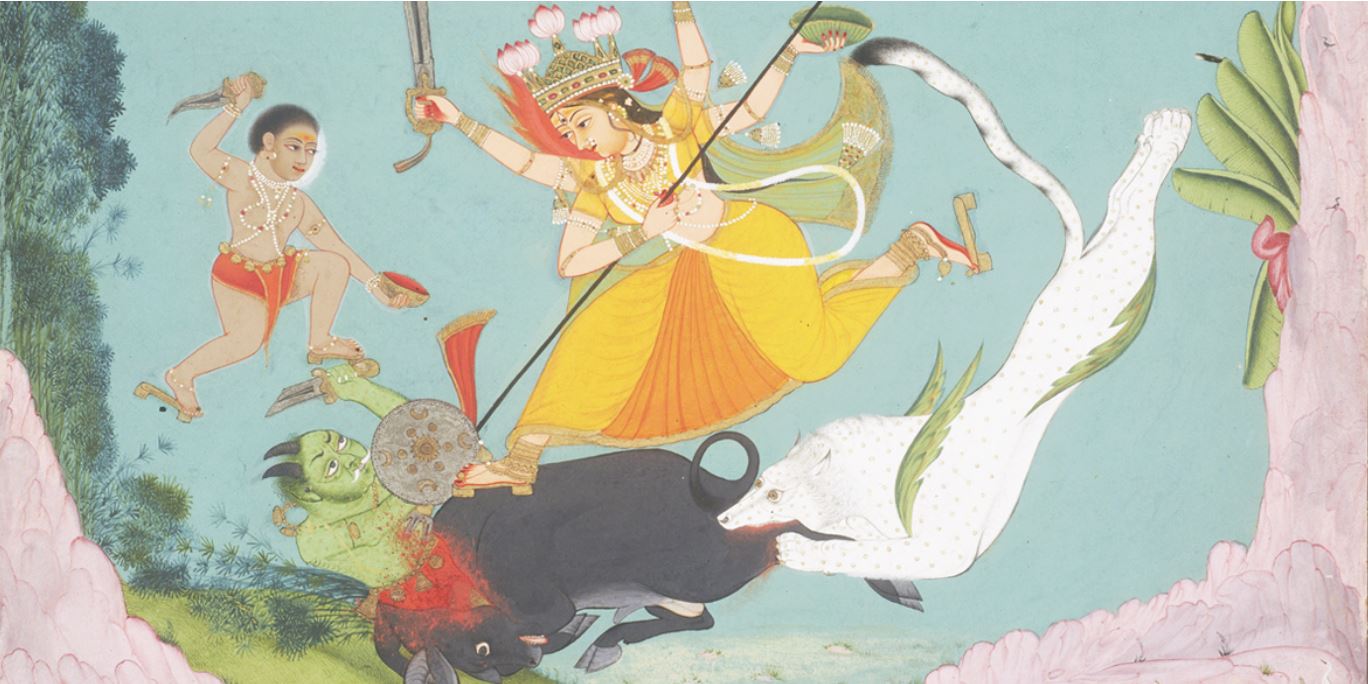
A painting of Goddess Durga fighting the buffalo demon Mahishasura. She holds the divine weapons (trident, spear and conch, among other things) given to her by the gods to empower her to slay the demon. Artist unknown, Kota, Rajasthan, c. 1750. Stella Kramrisch Collection, 1994, Philadelphia Museum of Art. Retrieved from Wikimedia Commons.
Every year, dolls in various forms and sizes take centre stage in many Hindu households for nine nights and 10 days. Known as Bommai Golu in Tamil (meaning “Court of Dolls”), this celebration is an integral part of the Navaratri festival. Navaratri, meaning “nine nights” (nava is “nine” and ratri is “nights”), honours the Hindu goddess Shakti in all her different manifestations.
Navaratri Golu is believed to have been celebrated since the existence of the Vijayanagar kingdom in 14th-century India, and was especially popular with the royal families of Thanjavur and Pudukkottai in the state of Tamil Nadu.1 Today, Golu is mainly observed by South Indians from the states of Tamil Nadu, Andhra Pradesh, Telangana and Karnataka.
Interviews with older Singaporeans reveal that this quaint custom of displaying dolls in the home has been a tradition for a number of Indian families in Singapore since the 1940s, or perhaps even before that.2 Over the years, there seems to be more families and even younger Singaporeans embracing the practice. Besides the homes, Golu is also observed in Hindu temples in Singapore.
The Legend of Navaratri
Golu is celebrated annually as part of the Navaratri festival. The festival begins on the day of a new moon, between September and October, in the Hindu month of Purattasi.
Shakti, one of the goddesses in the Hindu pantheon, takes many forms and names.3 Her most important manifestation is Durga, the warrior goddess who vanquished the evil buffalo demon Mahishasura.4
According to the legend of Navaratri, Mahishasura waged war in heaven, imprisoned all the gods and wreaked havoc on earth. In retaliation, Brahma, Vishnu and Shiva, the three gods making up the Hindu Trimurti, enlisted the help of their respective consorts, the goddesses Saraswati, Lakshmi and Parvati.5 From the combined strength of the goddesses emerged Goddess Durga – full of voracious strength and power, and riding a tiger with a trident in her hand.6 In the ensuing battle between Durga and Mahishasura, all the other gods and goddesses spiritually imbued Durga with their divine powers and weapons.
At midnight, on the 10th and final day of the ferocious battle, Durga finally managed to pierce her trident into the buffalo demon’s chest and behead him. However, the gods and goddesses, whose powers were completely spent after aiding Durga, were turned into statues. Devotees honour and remember the selfless acts of these gods and goddesses, which are symbolised by the dolls displayed during Golu. Navaratri ultimately commemorates the victory of Durga over Mahishasura – the triumph of good over evil.7
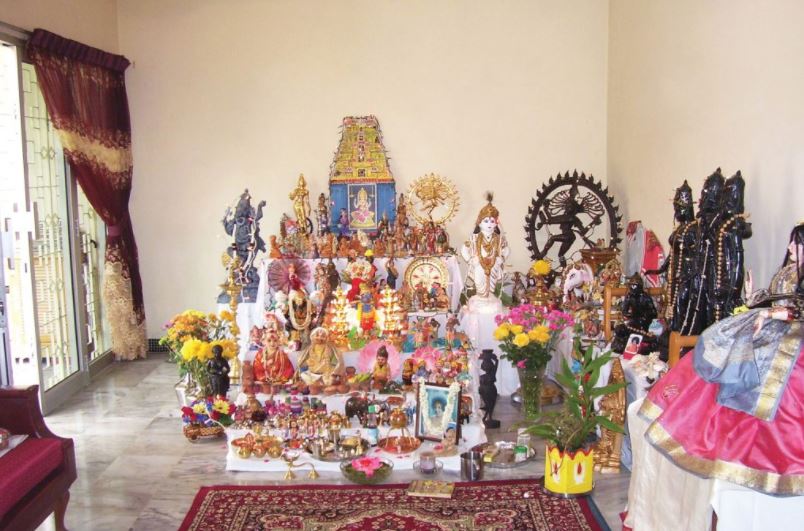
A Golu display at the author’s home in 2006. The topmost two steps feature dolls representing Hindu deities. The kalasam(silver or brass pot) is placed on the second tier. Behind the kalasam is the pair of marapachi dolls. On the right-hand corner of the third step is a village scene in India. On the second step from the bottom is a pair of grandfather and grandmother dolls in the traditional Thanjavur bobble-head style. In front of them are traditional cookery toys made of wood. Courtesy of Anasuya Soundararajan.
Celebrating Golu
Mrs Lalitha Vaidyanathan, a musician and retired teacher, remembers her family’s Golu celebrations in their home from the early 1940s. Neighbours and friends would visit their home at 16 Kirk Terrace during the festival, which she describes as a happy gathering of people who came to worship and enjoy the festive spirit as well as indulge in her mother’s delectable home-cooked vegetarian meals. Mrs Vaidyanathan has since continued the tradition in her own home after she married in 1980.8
The Navaratri Golu was an integral part of the yearly festivities at my home when I was growing up. Every year during the Navaratri period, my mother would arrange the dolls and figurines on a platform, and perform a nightly puja (prayer). Relatives and friends would be invited to partake in the festivities, resulting in a lively confluence of colourful dolls, animated guests, devotional songs and delicious food during the nine nights. As little children, my brother and I eagerly looked forward to this celebration each year. My mother, who is 80 this year, has been putting up Golu displays since 1972 and continues to do so until today.
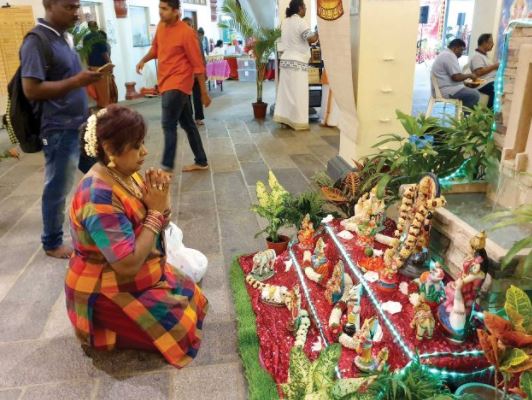
A devotee praying in front of the Golu display at the Sri Mariamman Temple during the Navaratri festival, 2019. Courtesy of Kesavan Rajinikanth.
Families would first clear their furniture to create space in the living room for the makeshift steps, which are erected a few days before Navaratri. The dolls are exhibited on odd-numbered steps – three, five, seven or nine – as odd numbers are considered auspicious in Hindu custom and tradition. The steps are then covered with a white piece of cloth, usually a cotton veshti.9
Traditionally, families would create the steps from whatever furniture is found in the home, such as low tables, shelves, benches, stools, metal trunks or even empty boxes.10 The number of steps varies in each home, depending on the available space and the number of dolls to be displayed.
The very first Golu display in our home in 1972 was a simple three-step contraption fashioned out of a coffee table and stools of varying heights. The following year, my father constructed a more elaborate nine-step platform by using metal brackets fastened with nuts and bolts and custom-made wooden planks. These days, it is much easier to set up a display as ready-made Golu steps can be bought in stores in India and Singapore. These lightweight and foldable steps are made of plastic and come in sets of three, five, seven or nine.11
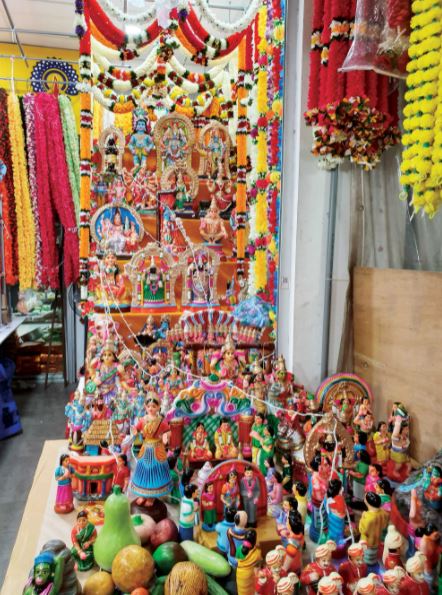
Jothi Flower Shop in Little India, Singapore, selling Golu dolls during Navaratri, 2019. On display are dolls of deities and Hindu mythological characters, as well as dolls from a wedding scene and village temple procession. Courtesy of Kesavan Rajinikanth.
As Golu dolls represent a divine presence in the home, great care goes into their upkeep and storage when not in use. A few days before the start of the festival, my mother would retrieve the dolls from the storeroom and begin arranging them on the steps. This is a task traditionally performed by women.
While most of the dolls represent gods and goddesses, some are based on popular saints in Hindusm while others reflect scenes from everyday life. The dolls can also depict characters in Hindu mythology, royal processions and weddings. In addition to the wide assortment of dolls, miniature kitchenware, little trinkets and anything ornamental and colourful can be part of the Golu display.12
Golu dolls are traditionally handed down from one generation to the next; some families may even possess dolls that are more than a hundred years old.13 In addition, people may buy new dolls every year, thus adding to their collection over the years and passing these on to their descendants. Mrs Vaidyanathan proudly tells me that most of the dolls featured in her Golu display were given to her by her late mother. These are family heirlooms that hold precious memories for her and reflect the rich history of the Golu tradition. She has also been buying new dolls over the years, and now has an impressive collection.14
There is no hard and fast rule for arranging the dolls. Those that depict deities are usually placed on the topmost tiers: dolls representing Rama, Lakshmana, Sita, Krishna, Radha, Siva, Vishnu, Durga, Lakshmi and Saraswati occupy this favoured position. The middle steps are dedicated to saints and religious figures, while dolls in the lower steps portray vignettes such as a wedding scene, a religious procession or scenes of village life. Toys and miniature kitchenware are displayed on the lowest steps. These include Thanjavur dolls, which are traditional bobble-head dolls made of paper and clay or plaster of Paris.15
Traditionally, only dolls of Hindu deities and saints, and scenes depicting everyday life in India were featured during Golu. However, in many modern homes today, dolls from all over the world – Thailand, the Philippines and also from Britain and Europe – are sometimes included in the Golu display.
The inclusion of non-traditional dolls and themes make Golu even more interesting today. Families showcase their creativity and artistry in the display and try to come up with special themes each year.16 Some homes prefer to stick to tradition, while others present the dolls in more elaborate and extravagant settings. Stories from Indian epics, such as the Ramayana and Mahabharata, come alive on the steps, while more creative families may recreate a miniature park or zoo complete with trees, plants and animals.17 The displays are often decorated with twinkling fairy lights to create a festive atmosphere.
The dolls are usually made of clay, stone or wood and mainly produced in the villages of southern Indian states such as Tamil Nadu, Karnataka, Telangana and Andhra Pradesh. A smaller number of such dolls are made in the northern state of Rajasthan and the eastern state of Kolkata.18 My parents bought our dolls during their travels to India in the 1970s and ’80s, as it was difficult to find Golu dolls in Singapore at the time. Today, one can find a wide assortment of dolls in shops in Little India during the Navaratri season, with prices ranging from $20 for the simpler ones to $150 for the more elaborate creations.
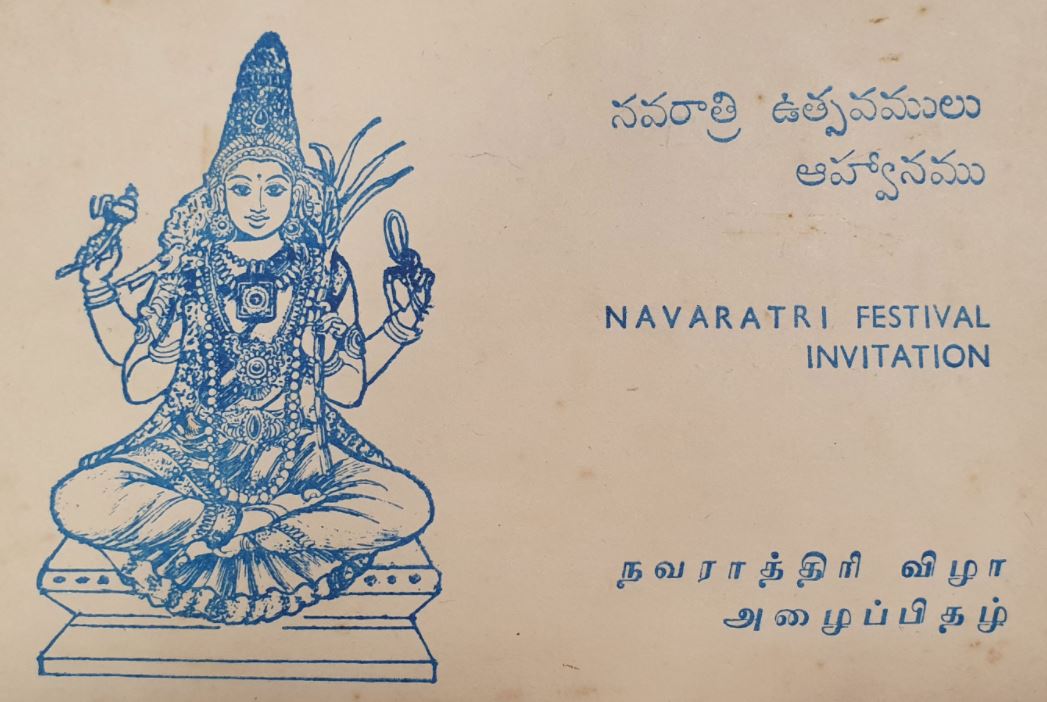
A Navaratri Golu invitation card welcoming relatives and friends to the author’s home in 1976. Courtesy of Anasuya Soundararajan.
Rituals and Customs
Besides commemorating the victory of good over evil, Navaratri is also a celebration of womanhood where feminity is elevated to a highly auspicious state.19 Three forms of the Goddess Shakti are worshipped during the festival. The first three nights of Navaratri are devoted to Goddess Durga when devotees pray for the eradication of evil in thought and deed, and for the strength to overcome this struggle; the next three nights honour Lakshmi, the goddess of wealth, fortune and prosperity; and the last three nights celebrate Saraswati, the goddess of knowledge, wisdom and the arts.20 Families observing Navaratri seek the divine grace of the three goddesses, invoking their blessings for good health, happiness and prosperity.
On the new moon day of the month of Purattasi, a kalasam (silver or brass pot) is placed on the middle step of the tiered platform. The pot of water, which represents Goddess Shakti, has mango leaves covering its opening and is topped with a coconut and ringed by a garland of rose and jasmine blooms. Worshippers invoke Goddess Shakti with prayer offerings of flowers, oil lamps, camphor and incense.21
The first set of dolls to adorn the display is a pair of wooden ones symbolising a man and a woman, known as the marapachi dolls. Usually placed on the upper steps of the display, these dolls represent Venkateshwara, an avatar of Lord Vishnu, and his consort Mahalakshmi. Dressed in the traditional silk veshti and saree,22 they also depict the union of a husband and wife, and symbolise prosperity and fertility.23 If there is a girl in the family, it is customary for the mother to gift a new set of marapachi dolls to her daughter when she gets married so that she can start her own Golu tradition.24
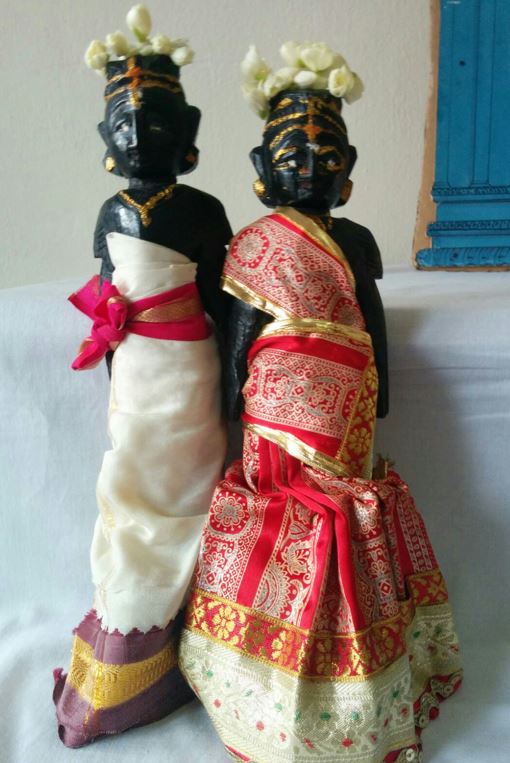
A pair of marapachi dolls, representing Venkateshwara (an avatar of Lord Vishnu) and his consort, Mahalakshmi. The dolls are dressed in the traditional silk veshti and saree. Courtesy of Anasuya Soundararajan.
All the dolls are ritually worshipped during the celebrations.25 In the evenings, a lamp is lit in front of the display, and bhajans (devotional songs) are sung in praise of Goddess Shakti. Golu is also a social event where relatives and friends are invited to view the doll display and participate in the prayers and celebrations. Visitors are then served light refreshments and prasadam (offerings of food).
When the guests leave, each woman is presented with a thamboolam – a tray containing auspicious items like kungumam (red powder), turmeric, betel leaves, flowers, fruits, sweets and other gifts. The belief is that whatever you give will be returned to you by the goddesses – as represented by the dolls – that are residing in your home for the nine nights.26 In some homes, a kanya puja27 (young girls’ prayer) is performed on any chosen night of Navaratri. During the prayer, nine prepubescent girls are revered and offered gifts such as clothing, fruits and sweets.28
On the 10th and final day, or Vijayadasami, the marapachi dolls are made to lie down and symbolically put to sleep, to mark the end of the year’s Navaratri Golu.29 All the dolls are then removed from the display, carefully wrapped in cloth and stored in boxes, ready to be taken out again for the following year’s Golu.
Mrs Vijayam Balakrishna Sharma, a renowned Carnatic musician who has celebrated the festival for many years, recalls in her oral history interview with the National Archives that a special drink made of yogurt and spices is offered to Goddess Durga on the last day to quench the deity’s thirst and revive her after the tiring battle with the buffalo demon.30
TEMPLE FESTIVITIES DURING NAVARATRI
Navaratri is one of many festivals observed at Hindu temples in Singapore. Devotees visit temples to get the darshan (blessed vision) of Goddess Shakti and participate in special prayers. Many temples – including Sri Mariamman, Sri Veeramakaliamman, Sri Vadapathrakaliamman, Sri Vairavimada Kaliamman, Sri Thendayuthapani and Sri Senpaga Vinayagar – put up a Golu display, albeit on a much larger and grander scale compared with those found in homes.
Music and dance programmes held in the evenings are also an integral component of the temple festivities. Temples organise classical dance performances as well as vocal and instrumental devotional music recitals to honour the deities.
It is believed that once you have begun the tradition of celebrating Golu, you cannot arbitrarily stop celebrating it. Unless there is an event such as a death in the family, the display must continue every year uninterrupted. Even then, the tradition cannot come to a complete stop, but takes place on a smaller scale, perhaps with just a few dolls and only a single step.31
References
Mangala, “Navarathri,” Straits Times, 16 October 1981, 4. (From NewspaperSG)
Prabhavathi Nair, “Nine Nights of Excitement Honour the Goddess Devi,” Straits Times, 3 October 1997, 17. (From NewspaperSG)
A. P. Raman and S. V. Krishnan, “Festival in Honour of Goddess-Shakti,” Straits Times, 7 October 1983, 4. (From NewspaperSG)
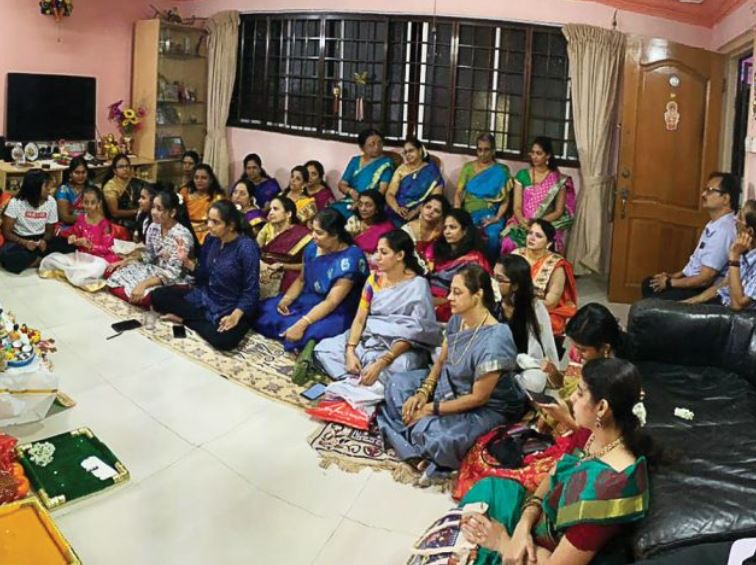
Relatives and friends of Usha Mohan viewing the Golu display in her home and singing devotional songs, 2019. Courtesy of Usha Mohan.
Keeping the Tradition Alive
Mrs Lalitha Vaidyanathan and my mother, Mrs Komalavalee Soundararajan, who was interviewed by the National Archives in 1991, believe that the doll display, daily prayers and gathering of people usher a divine presence into the home and bring with them a sense of fulfilment and happiness. Having practised the tradition for decades in Singapore, they hope to see women of the younger generation celebrate this festival in their own homes.32
Darshna Mahadevan, who is in her late 20s, has been putting up a Golu display in her home since she married two years ago. She is determined to continue the tradition started by her mother and grandmother, and wishes that more young people would celebrate Golu in Singapore.33
Golu not only showcases the rich culture and customs of Hindus, but it is also a way for young people to be introduced to the various deities and their significance in Hinduism.34 Navaratri is also an occasion to seek divine blessings and spiritual fulfilment. On a social level, Golu provides the chance to meet and engage in community fellowship, offering an opportunity for everyone to discover more about Hindu mythology and religious practices.35
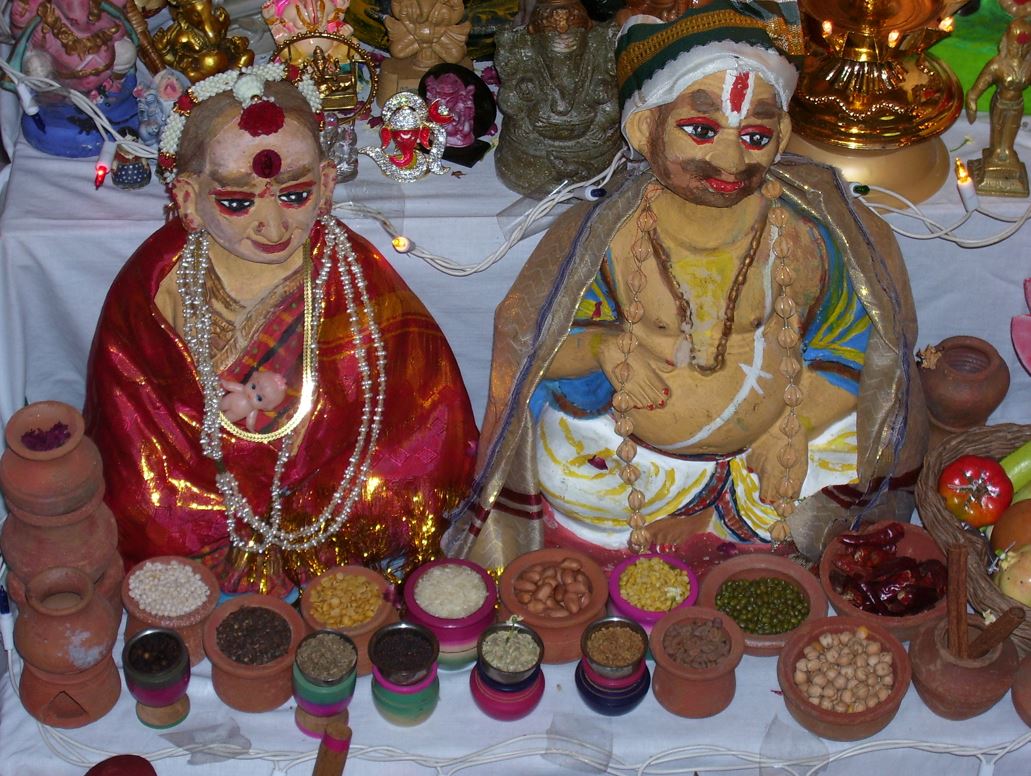
Traditional Thanjavur dolls – representing a grandmother and a grandfather – are bobble-head dolls made of paper and clay or plaster of Paris. Courtesy of Anasuya Soundararajan.
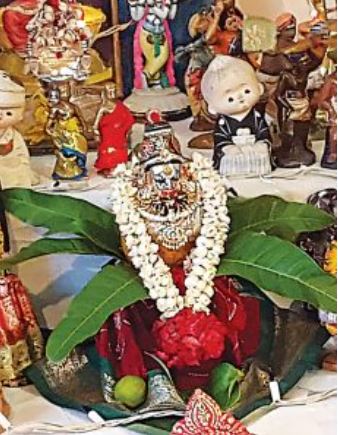
The kalasam is a silver or brass pot containing water, and decorated with a jasmine and rose garland. Its opening is covered with mango leaves and topped with a coconut. Courtesy of Anasuya Soundararajan.
HINAMATSURI: JAPAN'S DOLL FESTIVAL
Interestingly, the Hindu Golu festival mirrors a tradition in Japanese society that also centres on dolls. Hinamatsuri, also known as “Dolls Day” or “Girls Day”, is celebrated annually in Japan on 3 March when families pray for the happiness and wellbeing of their young daughters (usually up to age 10).
Hinamatsuri originates from an ancient custom called hina nagashi, in which hina dolls made of straw are placed in a boat and sent down a river that eventually empties into the sea. This act has become a symbolic gesture for warding off bad luck.
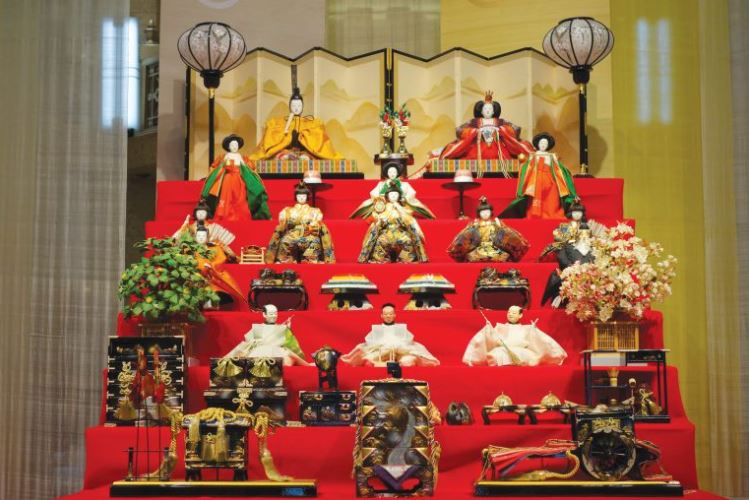
A seven-tiered Hinamatsuri doll display, 2014. Placed right at the top are the emperor and the empress dolls. On the second tier are three court ladies, and on the third, five male musicians. The fourth tier features two ministers, while the fifth holds three samurais to protect the emperor and the empress. A variety of miniature furniture, utensils and carriages is displayed on the sixth and seventh tiers. Retrieved from Wikimedia Commons.
During the festival, the figurines of royal personages are arranged on as many as seven hinadan, or platforms, in Japanese households. Covered with red fabric, each step displays a set of decorative dolls called hina ningyo, representing members of the imperial court. The size of the dolls and the number of tiers vary, but usually there are five to seven tiers.
The topmost tier features dolls representing the two most important members of the Japanese imperial family – the emperor and the empress. The second tier carries three court ladies and the third supports five male musicians. The fourth tier features two ministers, while the fifth holds three samurais who serve as protectors of the emperor and the empress. On the sixth and seventh tiers are displayed a variety of miniature furniture, utensils and carriages.
The hina ningyo dolls are made of wood and decorated in traditional court dress of the Heian period (794–1185). Similar to the Hindu Golu practice, these Japanese dolls are handed down from one generation to the next, or bought by a girl’s parents or grandparents for her first Hinamatsuri.
On the day of the festival, girls wake up early and put on their best kimono, eat hishimochi (diamond-shaped rice cakes) and drink shirozake, a type of sake made from fermented rice. The emphasis on girls during Hinamatsuri is similar to the Navaratri Golu’s focus on women and womenhood.
Japanese families start preparing for this festival around mid-February, and put away the dolls on the day after Hinamatsuri. There is a superstitious belief that families who delay keeping away the dolls will have trouble marrying off their daughters when the time comes.
References
Jayashree Krishnan, “A Cultural Connection: Japanese Hina Matsuri and Navratri Kolu,” India America Today, 4 October 2016.
Prabhavathi Nair, “Nine Nights of Excitement Honour the Goddess Devi,” Straits Times, 3 October 1997, 17. (From NewspaperSG)
About the Author
Anasuya Soundararajan is a researcher at the National Library, Singapore, where she provides information services to government agencies. Her research areas include culture, communications and education.
Endnotes
1 Rotti, J. (2017, September 25). Dasara doll festival – significance and history. Retrieved from Karnataka website; Subramanian, A. (2017, September 22). Steps of wonder. The Hindu. Retrieved from The Hindu website.
2 Author’s interviews with Mrs Lalitha Vaidyanathan and Mrs Komalavalee Soundararajan and oral history interviews of Mrs Vijayam Balakrishna Sharma and Mrs Komalavalee Soundararajan.
3 Shakti is a divine cosmic energy that represents feminine energy and the dynamic forces that flow through the universe. Shakti takes many forms and names, including mother goddess, fierce warrior and the dark goddess of destruction. She is also known as Parvati, Durga and Kali.
4 Flood, G. (1996). An introduction to Hinduism (pp. 174–175, 177–178). New York: Cambridge University Press. (Call no.: R 294.5 FLO).
5 Brahma, who is traditionally depicted with four faces and four arms, is the creator god. Vishnu upholds and preserves creation; he is usually depicted as having blue skin and four arms. Shiva is the destroyer god as he removes all evil from the world. Their consorts are Saraswati, Lakshmi and Parvati respectively. Saraswati is the goddess of knowledge, music, art, wisdom and learning. Lakshmi is the goddess of wealth, fortune and prosperity. Parvati is the goddess of fertility, love, beauty, marriage, children, devotion, divine strength and power.
6 Goddess Durga is sometimes described as riding on a lion.
7 Jagannathan, M. (2005). South Indian Hindu festivals and traditions (p. 111). New Delhi: Abhinav Publications. (Call no.: R 294.536 MAI); The different ways of celebrating Navarathri. (1989, September 29). The Straits Times, p. 4. Retrieved from NewspaperSG.
8 Author’s interview with Mrs Lalitha Vaidyanathan, 1 July 2019.
9 Veshti is the traditional attire of South Indian men, consisting of a floor-length piece of long white cloth wrapped around the waist. See Chacko, B. (2017, September 28). It’s Navaratri, time to bring Golu dolls home. The Indian Express. Retrieved from Indian Express website.
10 Chacko, 28 Sep 2017.
11 Chacko, 28 Sep 2017.
12 Srinivasan, M. (2011, September 26). Doll them up. The Hindu. Retrieved from The Hindu website; Subramanian, 22 Sep 2017.
13 Nadadhur, S. (2018, October 18). Bommala Koluvu: A treasure trove of stories, traditions and memories. Times of India. Retrieved from Times of India website; Rotti, 25 Sep 2017.
14 Author’s interview with Mrs Lalitha Vaidyanathan, 1 July 2019.
15 Rotti, 25 Sep 2017; Krishnan, J. (2016, October 4). A cultural connection: Japanese Hina Matsuri and Navratri Kolu. India America Today. Retrieved from India America Today website; Subramanian, 22 Sep 2017.
16 Devalla, R. (2015, October 21). Blend of tradition and creativity. The Hindu. Retrieved from The Hindu website.
17 Rotti, 25 Sep 2017; Author’s interview with Darshna Mahadevan, 30 June 2019.
18 Srinivasan, 26 Sep 2011.
19 Rodrigues, H. (2005). Women in the worship of the Great Goddess. In A. Sharma (Ed.), (2005). Goddesses and women in the Indic religious tradition (p. 72). Leiden, The Netherlands: Brill. (Call no.: R 294.082 GOD).
20 Mangala. (1981, October 16). Navarathri. The Straits Times, p. 4. Retrieved from NewspaperSG.
21 Jagannathan, M. (2005). South Indian Hindu festivals and traditions (p. 112). New Delhi: Abhinav Publications. (Call no.: R 294.536 MAI); The Straits Times, 29 September 1989, p. 4; Supramaniam, R. (Interviewer). (1991, October 17). Oral history interview with Komalavalee Soundara Rajan (Mrs) [Recording no. 001319/4/1]. Retrieved from National Archives of Singapore website.
22 The saree or sari is a traditional attire for women of South Asian descent. It is a long piece of fabric draped around the body, which is worn together with a short fitted blouse called a choli and a long petticoat.
23 Srinivasan, 26 Sep 2011.
24 Rotti, 25 Sep 2017.
25 Rotti, 25 Sep 2017.
26 Nair, P. (1997, October 3). Nine nights of excitement honour the Goddess Devi. The Straits Times, p. 17. Retrieved from NewspaperSG; Bari, P. (2017, September 25). Pune’s South Indian darbar of dolls in creative assembly for Navratri. The Hindustan Times. Retrieved from The Hindustan Times website.
27 Also known as kumari puja.
28 The Straits Times, 3 Oct 1997, p. 17.
29 Subramanian, 22 Sep 2017; Naaidu, P. (Interviewer). (2018, March 21). Oral history interview with Vijayam Balakrishna Sharma [Accession no.: 004262/3/1]. Retrieved from National Archives of Singapore website.
30 Oral history interview with Vijayam Balakrishna Sharma, 21 March 2018.
31 Bari, 25 Sep 2017.
32 Author’s interview with Mrs Lalitha Vaidyanathan, 1 July 2019; Oral history interview with Komalavalee Soundara Rajan (Mrs), 17 Oct 1991.
33 Author’s interview with Darshna Mahadevan, 30 June 2019.
34 Rotti, 25 Sep 2017.
35 S. V. Krishnan. (1988, October 21). Nine days in honour of a brave goddess. The Straits Times, p. 9. Retrieved from NewspaperSG.