
Article
Deforestation in 19th-century Singapore
Topics
Nature
4 April 2021
Manmade climate change is usually seen as a modern phenomenon. In fact, rising temperatures as a result of rampant deforestation were already evident in Singapore two centuries ago, says Chia Jie Lin.
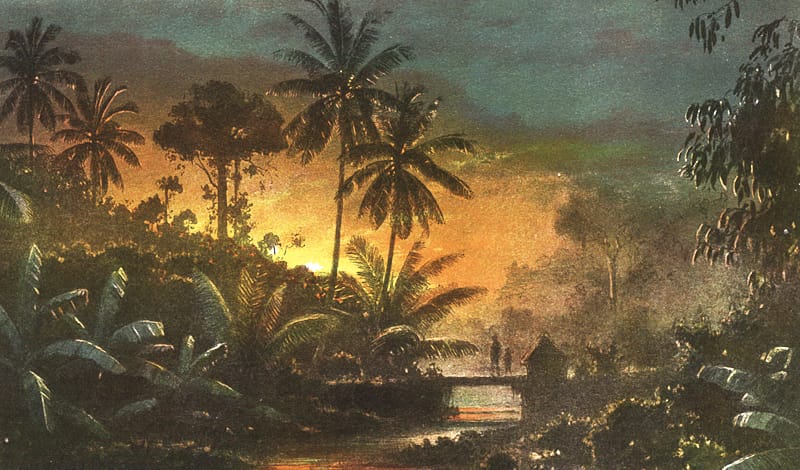
This print titled “Jungle Fire Near Bukit Timah” (1876) by Austrian diplomat and naturalist Eugen von Ransonnet-Villez was published in his Skizzen aus Singapur and Djohor (Sketches: Singapore and Johor) in 1876. The burning of vast swathes of primary forest to clear the land for crop cultivation was a familiar sight in 19th-century Singapore. Image reproduced from Ransonnet-Villez, E. (1876). Skizzen aus Singapur and Djohor. Braunschweig: Druck und Verlag von George Westermann. Retrieved from BookSG. Collection of the National Library, Singapore. (Call no.: RRARE 959.51 RAN; Accession no.: B03013662J).
The year was 1873 and Singapore’s wells had almost run dry. The Impounding Reservoir (present-day MacRitchie Reservoir) on Thomson Road, a major source of potable water and completed six years earlier, failed to carry water to the town because water levels had dropped to extremely low levels.1 Water was so scarce that the poor resorted to drinking filthy canal water, exacerbating the cholera epidemic that killed at least 448 people that year.2
How did this situation come to be? In the decades following the arrival of the British in 1819, vast swathes of primary forest were cleared for the planting of cash crops such as gambier and pepper, leading to the mass displacement and extinction of native flora and fauna. The rampant deforestation brought about unprecedented ecological effects – including water scarcity.
Cultivating the Colony
The dissolution of the Dutch East India Company at the turn of the 19th century created new opportunities for the British to challenge the commercial dominance of the Dutch in the East Indies (present-day Indonesia). Men like Stamford Raffles and William Farquhar arrived in search of new colonies. The tropical climate of Malaya was seen as conducive for the cultivation of spice plantations, which the British sought to fashion after the Dutch-controlled Moluccas (Maluku).3
“The rain falling here in showers throughout the year, and not confined to one season, gives a perpetual verdure to vegetation, cools the surface of the earth,” wrote surgeon Robert Little in an essay published in The Journal of the Indian Archipelago and Eastern Asia in 1848.4 Raffles and Farquhar had envisioned Singapore as a spice island and were keen to develop commercial plantations of spices and other crops for trade and profit.
In 1822, Raffles and Nathaniel Wallich, a Danish surgeon and naturalist who had previously been Superintendent of the Royal Gardens in Calcutta, India, established a botanical garden on Government Hill (now Fort Canning Hill) for the “experimental cultivation of the indigenous plants of Singapore” such as nutmeg and cloves.5 The island’s European and Chinese residents followed suit, and attempted to grow nutmeg until an infestation in the 1850s and 60s decimated the nutmeg plantations.6
It was pepper and gambier plantations, however, that were the main drivers behind the large-scale clearing of inland primary forests on the island. The cultivation of these two crops had begun in late 18th-century Singapore with the arrival of Teochew planters. After fleeing Chinese clan wars on the Riau islands, they settled in remote river estuaries across Singapore and began planting gambier and pepper alongside Malay planters.
In his correspondences with Raffles’ Acting Secretary L. Nelson Hull in 1822, Resident and Commandant of Singapore William Farquhar wrote that Temenggong Abdul Rahman had granted “various Malays and Chinese” permission to clear the ground for plantations. Farquhar further reported that some 20 plantations were already present in Singapore when he first arrived with Raffles in 1819.7
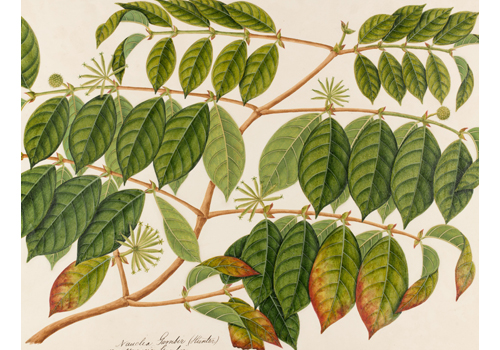
A painting of the gambier plant from the William Farquhar Collection of Natural History Drawings, 1803–18. Gift of G.K. Goh. Courtesy of the National Museum of Singapore, National Heritage Board.
The founding of a free port on the island transformed the regional market for gambier, causing the centre of trade to shift from Riau to Singapore. Fuelled by their displeasure with rising Dutch taxes in Riau, Chinese planters also began migrating en masse from Riau to Singapore to trade and cultivate gambier.8
These planters brought with them their practice of shifting cultivation, in which primary forest was cleared to cultivate crops. When the soil became exhausted of nutrients, usually by the 15th year of production, and timber and firewood supplies nearby became scarce, these farmers moved onto new virgin land.9 Joseph Balestier, the first American Consul to Singapore, compared the pepper and gambier planter to a “locust”, leaving “a tract of desolation behind him”.10
From 1835 to the 1890s, Singapore was a major production centre for gambier, the cultivation of which afforded employment opportunities for Chinese immigrants – either as plantation owners who became kangchu (港主; headman or literally “lord of the river”) or labourers. Most of the immigrants ended up in the latter category.
In the 1830s, the relocation of the gambier market from Riau to Singapore, as well as the lifting of trade tariffs on gambier, encouraged extensive cultivation.11 As a result, by the late 1840s, large expanses of primary forest in Singapore had been indiscriminately cleared and there were some 400 pepper and gambier plantations across the island. The highest recorded land area for cultivated gambier was 24,220 acres in the 1850s, while that for cultivated pepper amounted to 2,614 acres in the same decade.12 By 1855, Singapore was home to an estimated 12.5 million gambier trees and 1.5 million pepper vines in over 540 documented plantations – 27 times more than the estimated 20 plantations that existed on the island a little over three decades ago.13
These plantations were not merely land-intensive, but also timber-intensive. Trees were felled for timber, fuel and charcoal in gambier-producing factories, resulting in the widespread disappearance of dipterocarp primary forests (lowland rainforest on dry land) and freshwater swamp forests.
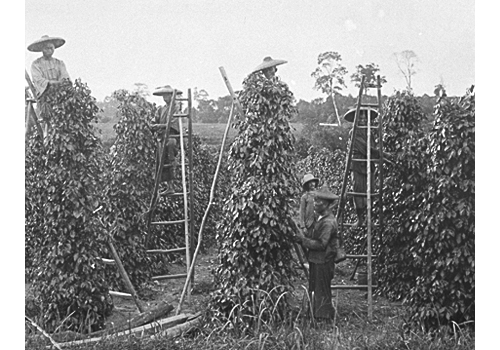
Workers in a pepper plantation in Malaya, 1890s. Pepper was planted alongside gambier as the cultivation of either crop alone was not economically viable. Plantation workers used the waste produced from the boiling of gambier leaves as fertiliser for pepper vines. The latter also entwine themselves around the gambier plants for support as they grow. Gretchen Liu Collection, courtesy of National Archives of Singapore.
In his 1883 Report on the Forests of the Straits Settlements that led to the demarcation of Singapore’s first forest reserves and the creation of a Forest Department,14 Nathaniel Cantley, then Superintendent of the Singapore Botanic Gardens, wrote that small areas of cultivated land known as bangsal (Malay for a “shed” or “lean-to shelter”) typically used up approximately 2,500 pounds of timber per day for pepper kilns and boiling gambier. These bangsal served as dwellings for the labourers and a place where they could prepare gambier. Over time, the area of land deforested for firewood for a plantation would have been equivalent to the size of the corresponding plantation itself.15
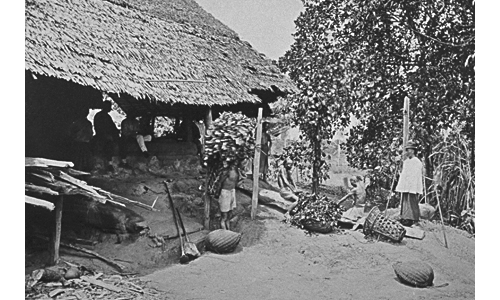
Gambier production, 1890s. Small areas of cultivated land known as bangsal (Malay for a “shed” or “lean-to shelter”) typically used up approximately 2,500 pounds of timber per day for pepper kilns and boiling gambier. These bangsal served as dwellings for the labourers and a place where they could prepare gambier. Gretchen Liu Collection, courtesy of National Archives of Singapore.
Environmentalism Takes Root
Environmental studies by British colonial officials first emerged out of efforts to better understand and govern their colonies in Southeast Asia to maximise commercial agricultural output.16 Such studies focused on areas such as native plant and animal species, tropical diseases and meteorological observations; the latter involved measurements of rainfall, atmospheric pressure, and air and earth temperatures.
In the 19th century, meteorological explorations served many functions within the British Empire. The British Association for the Advancement of Science and the Royal Society sought to advance “the science of terrestrial magnetism”, which was of great importance to the empire’s maritime interests. Meanwhile, medical officers in the colonies recorded temperatures and air pressures to study the relationship between tropical climates and the incidence of diseases.17
However, scientific concerns regarding the environmental impact of deforestation can be traced to 17th-century European academic circles. In 1664, landscape architect John Evelyn, known as one of Britain’s first environmentalists, published Sylva, or A Discourse of Forest-Trees, and the Propagation of Timber18 under the newly established Royal Society. Evelyn argued that the extensive growth of glassworks, iron industries and shipbuilding – all of which were heavy in timber usage – threatened the forests of Britain. Such concerns, coupled with the environmental costs of deforestation, continued into the next century and, by the early 1800s, had become an established domain for scientific study.
Scientists working in Europe and America linked extensive forest clearance for agriculture to climatic issues such as lower rainfall and higher water evaporation rates, the latter due to the lack of tree cover. The Prussian polymath and naturalist Alexander von Humboldt, who investigated the relationship between deforestation and climatic change in the New World and Central Asia, warned in 1849 that “by felling trees which cover the tops and sides of mountains, men in every climate prepare at once two calamities for future generations – the want of fuel and the scarcity of water”.19
Adverse climatic effects were similarly felt in the wake of mass deforestation across British colonies in Southeast Asia. By the mid-19th century, colonial officials and foresters in the Straits Settlements began to attribute these environmental changes to widespread deforestation.20
In an 1848 essay on the “probable effects” of unchecked land clearance on Penang’s climate published in The Journal of the Indian Archipelago and Eastern Asia, James Richardson Logan, the editor of the journal, wrote: “Nature when left to herself provides a compensatory influence in the dense leafy forests, but if these are consigned to destruction, every successive drought will prove more baneful than the preceding.” In the same report, Logan observed that Singapore’s governor had forbidden “the further destruction of forest on the summit of hills”, likely to ameliorate destructive effects like erosion, siltation and even flood-induced famines.21
Among the earliest observers of this “destruction of forest” on Singapore’s hilltops was naturalist Alfred Russel Wallace, renowned for his discovery of the theory of evolution. Wallace first arrived in Singapore on 20 April 1854 to collect bird and insect specimens and Bukit Timah soon became a favourite hunting ground.
In a letter dated 9 May 1854, Wallace wrote: “Here portions of the forest, which originally covered the whole island, and which is rapidly disappearing, still exists, and it is in them that I find my only good hunting-grounds.” He further remarked that Bukit Timah offered a “good view” of the island’s rapidly proliferating pepper and gambier plantations and “it is apparent that but few years can elapse before the whole island will be denuded of its indigenous vegetation, when its climate will no doubt be materially altered (probably for the worse), and countless tribes of interesting insects become extinct”.22
Wallace’s predictions were realised. By the turn of the 20th century, some 90 percent of Singapore’s primary forest cover had been lost. Timber resources had become so scarce that planters struggled to find even simple wooden stakes to support gambier and pepper vines. Hundreds of square kilometres of abandoned pepper and gambier plantations had become secondary forest (belukar), invaded by lalang and brushwood that were dry and easily flammable. Forest fires broke out so frequently, especially during prolonged dry weather, that the Forest Department began experimenting with planting new species like the Syzygium grande (sea apple) and Gluta rengas trees along the forest edges to act as fire breaks.23
Another consequence was that the temperature in the town centre began to increase. In his study of temperature readings of Singapore made by officers of the East India Company, John Turnbull Thomson, Government Surveyor of the Straits Settlements, observed that the temperature of Singapore town and its surrounding areas had increased by 2.48 °F (1.38 °C) in just two decades from the early 1820s to 40s.
Thomson suggested that the temperature increase was caused by “the country within 3 miles of the town being now clear of jungle and cultivated, which formerly was covered with primeval forest”.24 Europeans settlers in Singapore’s urban core sought respite from the heat of the town by retreating to the jungle, coastal or hillside bungalows, which afforded breezy and cooler surroundings.
“By resorting to the neighbourhood of the jungle a degree at least of reduction in the temperature may be secured. In such places as Selita [Seletar]… lying well in the interior, and with the primeval forest all around them, the additional coolness is palpable, and cannot be less than two or three degrees,” wrote John Cameron in Our Tropical Possessions in Malayan India.25
Such observations and accounts illustrate what we know today as the urban heat island effect – a phenomenon where cities with little greenery have warmer temperatures than rural, forested areas, due to their dense concentration of pavements and buildings that absorb heat.26
Dry Wells and Droughts
One key casualty of deforestation was Singapore’s rapidly diminishing water supply. The destruction of much of the island’s mangroves, freshwater swamps and streams, and other natural water bodies meant the loss of crucial water sources for consumption, plantation agriculture, sanitation and other municipal needs.27
In 1879, Colonial Engineer and Surveyor-General John Frederick Adolphus McNair was tasked by Colonial Secretary Cecil Clementi Smith to investigate the state of natural forests in the Straits Settlements, partly to seek “conclusions… as to the climatic influence of forests or the effect of their clearances on the rainfall”. Although the island had been “greatly denuded of trees”, McNair found that there was “no marked diminution” in the volume of rainfall in Singapore.28
However, in his 1883 report on deforestation, Cantley wrote that a decrease in forested areas “economises the water supply” – an indirect reference to a cyclic relationship between rainfall and forest density.29 He also noted that experiments conducted outside Singapore had revealed that greater tree cover and shade led to higher rainfall, as “accounted for by the fact that when a cloud containing vapour comes in contact with the cool air over the forest or woodland, contraction takes place, the aqueous particles are forced together and fall in the shape of rain”.30 The same experiments found that bare, deforested land was not conducive to cloud formation, thus bringing no rain.
Such environmental effects continued to be hotly debated in European academic circles. Colonial Treasurer Allan Skinner remarked that while some believed that the loss of timber had “diminished the supply of rain”, this theory was dismissed by others who cited continued rainfall patterns and the difficulties of ascertaining localised climate effects.31 While widespread global deforestation would certainly have a knock-on effect on the climate around the world, colonial administrators and writers believed that it was unlikely that, given Singapore’s diminutive size, deforestation here would have an immediate impact on rainfall patterns in the region.
That said, Singapore was struck by droughts several times – in 1842, 1849, 1855 and 1864 – typically due to the dry season lasting from February to March each year.32 These took on an increased intensity in the latter years of the 19th century. “Singapore was suffering badly from want of water, the season was unusually dry,” wrote medical assistant J.J.L. Wheatley in 1885 in the Journal of the Straits Branch of the Royal Asiatic Society regarding the abject conditions of the 1873 drought. “Nearly all the wells such as they were – many being mere pits a few feet deep without any protective wall – had almost run dry.”33
Another prolonged drought hit the island in 1877, causing fruit and rice harvests to fail and the loss of plant species under cultivation in the Singapore Botanic Gardens.34 We now know that this drought was brought about by the global El Niño Southern Oscillation, which is the unusual warming of ocean surfaces in the eastern tropical Pacific Ocean.35 Although the phenomenon was unknown then, such periodic El Niño (“the little boy” in Spanish) events resulted in lower rainfall in Southeast Asia and other parts of the world in the mid 1800s.
The poor water provisions in Singapore exacerbated the effects of both global and local climatic changes on the local population. The poor were hardest hit by droughts, and intermittent cholera outbreaks continued to devastate the population throughout the 1870s. A Straits Times article dated 5 May 1877 reported that people living in villages “are dying off like flies”, due to the lack of a reliable potable water supply.36
These deadly droughts underscored the poor provision of waterworks by municipal authorities, and the increasing pressure on limited water resources as the population expanded and urban sprawl increased. Demand for water soared from new industries such as “the Docks and Wharves at Telok Blanga[h] and New Harbour and from suburban districts like Mount Elizabeth and Orchard Road and Chinese streets like Havelock Road, Chin Swee Road and Kelang [Kallang] Road”.37
A municipal notice dated 26 March 1885 declared limits on the supply of water to town due to “the protracted drought and increasing scarcity of water”.38 In the meteorological report for 1885, Thomas Irvine Rowell, Principal Civil Medical Officer of the Straits Settlements, reported a “long drought” in March, a “somewhat dry” August and an “unusually dry” October. He wrote that there was “little doubt” that “forest desiccation” – an archaic expression for “destruction” – influenced rainfall, but like Skinner found it difficult to ascertain the exact effects of extensive forest clearing on rainfall in Singapore.39
Within a mere eight decades, the deforestation of Singapore’s primary forests for agricultural purposes and commercial profit had brought about unprecedented ecological destruction. An island once described as being “covered with the mighty forest trees” had been degraded into a lalang wasteland, beset by water shortages and forest fires.40 Such developments were catastrophic not only for flora and fauna, but also imperilled the humans living on the island, especially the impoverished who had limited access to clean water.
By the end of the 19th century, colonial administrators sought to ameliorate the environmental devastation and combat climatic changes in the Straits Settlements. To this end, they established forestry programmes in the 1880s and 90s to encourage the sustainable consumption of nature. In Singapore, these included gazetting the interior reserves of Sembawang, Mandai, Chan Chu Kang (later renamed Nee Soon Village) , Bukit Panjang and Ang Mo Kio, with the goal of protecting streams and water supplies like the Impounding Reservoir.
Despite this, Singapore’s water precarity continued into the early years of the 20th century. Increasing water pressures became so severe that the municipal authorities limited the daily supply of water to the town to a mere three hours per day in 1895 and two hours per day in 1902.41 By 1900, the average supply of water per day had swelled to four million gallons, with the number estimated to rise to 6.5 million gallons by 1910.42
Environmental discourse from the 17th to 19th centuries contains early theories on the phenomenon we now know today as disruptions to the global water cycles (or movement of water in the atmosphere), most likely exacerbated by human destruction of the environment and climate change. With the progress of science, scientists can now attribute droughts to mass deforestation, with some postulating that severe droughts across the world will soon be inevitable, should mass deforestation of areas like the Amazon continue.43
The relationship between forests and the climate is complex. A look at the environmental history of Singapore can offer a window into how nature in the 19th century was an object of consumption, and how this unhindered exploitation of natural resources devastated the environment and those who lived within it. These are lessons that remain relevant today.
About the Author
Chia Jie Lin is an Assistant Curator with Programmes & Exhibitions at the National Library, Singapore. She is co-curator of the “Human x Nature: Environmental Histories of Singapore” exhibition.
Endnotes
1 Wheatley, J.J.L. (1885, June). Further notes on the rainfall of Singapore. Journal of the Straits Branch of the Royal Asiatic Society, (15), 61–67, p. 62. Retrieved from JSTOR via NLB’s eResources website.
2 Tan, B. (2020, July–September). Cholera in 19th-century Singapore. BiblioAsia, 16 (2), 10–15, p. 11. Retrieved from BiblioAsia website.
3 Williamson, F. (2015, September). Weathering the empire: Meteorological research in the early British Straits Settlements. The British Journal for the History of Science, 48 (3), 475–492, p. 475. Retrieved from JSTOR via NLB’s eResources website.
4 Little, R. (1848, August). An essay on coral reefs as the cause of Blakan mati fever, and of the fevers in various parts of the East. The Journal of the Indian Archipelago and Eastern Asia, Vol. II, 449–497, p. 458. Retrieved from BookSG. (Call no.: RRARE 950.05 JOU; Accession no.: B03014449C)
5 Hanitsch, R. (1913, December). Letters of Nathaniel Wallich relating to the establishment of Botanical Gardens in Singapore. Journal of the Straits Branch of the Royal Asiatic Society, (65), 39–48, p. 45; Bastin, J. (1981). The letters of Sir Stamford Raffles to Nathaniel Wallich 1819–1824. Journal of the Malaysian Branch of the Royal Asiatic Society, 54 (2), 1–73, p.13. Retrieved from JSTOR via NLB’s eResources website.
6 O’Dempsey, T. (2014). Singapore’s changing landscape since c. 1800 (p. 20). In T.P. Barnard (Ed.), Nature contained: Environmental histories of Singapore (pp. 17–48). Singapore: NUS Press. (Call no.: RSING 304.2095957 NAT)
7 National Archives of Singapore The Citizen Archivist Project. (1822, December 23). L6: Singapore: Letters to Bencoolen. (Media no.: SSR/L006_0178). Retrieved from National Archives of Singapore website.
8 Trocki, C.A. (1976). The origins of the kangchu system 1740–1860. Journal of the Malaysian Branch of the Royal Asiatic Society, 49 (2) (230), 132–155, p. 139. Retrieved from JSTOR via NLB’s eResources website.
9 Jackson, J.C. (1965, July). Chinese agricultural pioneering in Singapore and Johore 1800–1917. Journal of the Malaysian Branch of the Royal Asiatic Society 38 (1) (207), 77–105, p. 80. Retrieved from JSTOR via NLB’s eResources website.
10 Balestier, J. (1848). Views of the state of agriculture in the British possessions in the Straits of Malacca (p. 146). [n.p.]. (Call no.: RRARE 630.95951 BAL; Accession no.: B29029409B)
11 Trocki, 1976, p. 140.
12 Jackson, Jul 1965, pp. 78–79.
13 Untitled. (1855, May 15). The Straits Times, p. 5. Retrieved from NewspaperSG.
14 Cantley, N. (1883). Report on the forests of the Straits Settlements. In Proceedings of the Legislative Council of the Straits Settlements for the year 1883. Singapore: Government Printing Office. (Call no.: RRARE 328.5957 SSLCPL; Accession no.: B20048240I). [Note: Cantley’s report can also be retrieved from the Annual report on the Botanic Gardens, Singapore, for the year 1879–1890 at the Biodiversity Heritage Library website.]
15 O’Dempsey, 2014, p. 23.
16 Williamson, Sep 2015, p. 476.
17 Williamson, Sep 2015, p. 489.
18 Evelyn, J. (1664). Sylva, or a discourse of forest-trees, and the propagation of timber. London: Printed by J. Martyn and J. Allestry. Retrieved from Biodoversity Heritage Library website.
19 Rajan, S.R. (2006). A contract with nature (pp. 21–54). In Modernizing nature: Forestry and imperial eco-development 1800–1950. Clarendon: Oxford University Press. (Not available in NLB holdings)
20 Logan, J.R. (1848). The probable effects on the climate of Pinang of the continued destruction of its hill jungles. The Journal of the Indian Archipelago and Eastern Asia, Vol. II, 534–536, p. 535. Retrieved from BookSG. (Call no.: RRARE 950.05 JOU; Accession no.: B03014449C)
21 Logan, 1848, p. 534; Powell, M.A. (2016, August). People in peril, environments at risk: Coolies, tigers, and colonial Singapore’s ecology of poverty. Environment and History, 22 (3), 445–482, p. 466. Retrieved from ResearchGate website.
22 Wallace, A.R. (1854). [Letter dated 9 May 1854, Singapore]. Zoologist 12 (142), 4395–4397. Retrieved from Wallace Online website.
23 O’Dempsey, 2014, p. 37.
24 Thomson, J.T. (1849). General report on the residency of Singapore. The Journal of the Indian Archipelago and Eastern Asia, Vol. III, 618–628, 744–755, p. 627. Retrieved from BookSG. (Call no.: RRARE 950.05 JOU; Accession no.: B03013629B)
25 Cameron, J. (1865). Our tropical possessions in Malayan India: Being a descriptive account of Singapore, Penang, Province Wellesley, and Malacca (p. 158). London: Smith, Elder and Co. Retrieved from BookSG. (Call no.: RRARE 959.9 CAM-[JSB]; Accession no.: B29032445G); Williamson, F. (2020, June 15). The science of stifling heat: Recognising urban climate change in the Straits Settlements. Historical Climatology. Retrieved from Historical Climatology website.
26 Williamson, 15 Jun 2020.
27 O’Dempsey, T., & Ping, T.C. (2011, October 16). The freshwater swamp forests of Sungei Seletar Catchment: A status report (pp. 121–166). In Proceedings of Nature Society, Singapore’s Conference on “Nature Conservation for a Sustainable Singapore”. Retrieved from Nature Society (Singapore) website.
28 McNair, J.F.A. (1879, June 21). Report by the colonial engineer on the timber forests in the Malayan Peninsula (p. E10). In Annual report on the Botanic Gardens, Singapore, for the year 1879–1890. Retrieved from Biodiversity Heritage Library website.
29 Cantley, 1883, p. 6.
30 Cantley, 1883, p. 7.
31 Skinner, A.M. (1883, December). Straits meteorology. Journal of the Straits Branch of the Royal Asiatic Society, 12 (3), 245–259, p. 250. Retrieved from JSTOR via NLB’s eResources website.
32 Williamson, F. (2020, September). Responding to extremes: Managing urban water scarcity in the late nineteenth-century Straits Settlements. Water History, 12 (3), 251–263, p. 253. Retrieved from Springer Link website.
33 Wheatley, Jun 1885, p. 62.
34 Williamson, Sep 2020, p. 254.
35 Williamson, Sep 2020, p. 251.
36 Tuesday, 1st May. (1877, May 5). The Straits Times, p. 3. Retrieved from NewspaperSG; Williamson, 2020, p. 254.
37 Yeoh, B.S.A. (1993, September). Urban sanitation, health and water supply in late nineteenth and early twentieth century colonial Singapore. South East Asia Research, 1 (2), 143–172, p. 148. Retrieved from JSTOR via NLB’s eResources website.
38 Presgrave, D.G. (1885, April 28). Page 4 Advertisements Column 6: Municipal notice. The Straits Times, p. 4. Retrieved from NewspaperSG.
39 Rowell, T. I. (1885, December). Meteorological report, for the year 1885. Journal of the Straits Branch of the Royal Asiatic Society, (16), 385–411, p. 390. Retrieved from JSTOR via NLB’s eResources website. [Note: From 1870 to 1885, the mean annual rainfall of Singapore fell by over 52 percent, from 123.24 to 58.37 inches, while the mean annual number of rainy days fell by 43 percent, from 209 to 119 days.]
40 Thomson, J.T. (1865). Some glimpses into life in the Far East (p. 15). London: Richardson & Company. Retrieved from BookSG. (Call no.: RRARE 959.51 THO-[LKL]; Accession no.: B20048166E)
41 Untitled. (1895, May 22). The Straits Times, p. 3; A water famine. (1902, September 4). The Singapore Free Press and Mercantile Advertiser, p. 145. Retrieved from NewspaperSG.
42 Yeoh, Sep 1993, p. 148.
43 Pearce, F. (2018, July 24). Rivers in the sky: How deforestation is affecting global water cycles. Retreived from Yale Environment 360 website; MacDonald, J. (2015, November 11). Does deforestation lead to drought? Are we at the point of no return? Retrieved from JSTOR Daily website.