
Article
How Changi Airport Came To Be
Topics
Places and Buildings
10 October 2021
As Singapore’s Changi Airport marks its 40th anniversary in 2021, Rebecca Tan uncovers fascinating facts behind the decision to build the airport and how it eventually took shape.
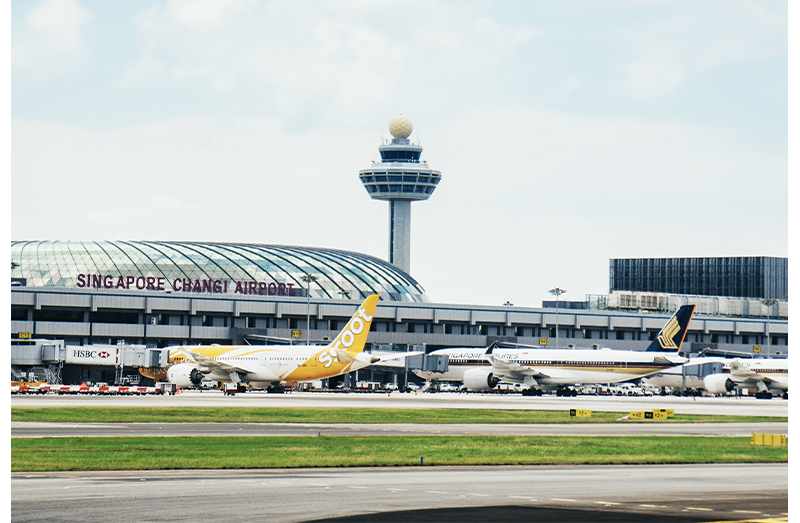
Singapore Airlines and Scoot planes at Changi Airport. In the background is the iconic control tower. Photo by Shawn Ang, 16 March 2020. Retrieved from Unsplash.
On 1 July 1981 at 7.10 am, SQ 101 made history when it became the first commercial flight to land at the newly opened Changi Airport. The plane arrived from Kuala Lumpur’s Subang Airport and carried 140 passengers, some of whom had especially travelled to the Malaysian capital just so that they could be on this flight.
To mark the occasion, all passengers received certificates and were treated to a lion dance and a pipe band performance upon arrival. Less than an hour later, SQ 192 headed for Penang, becoming the first flight to depart from Changi.1
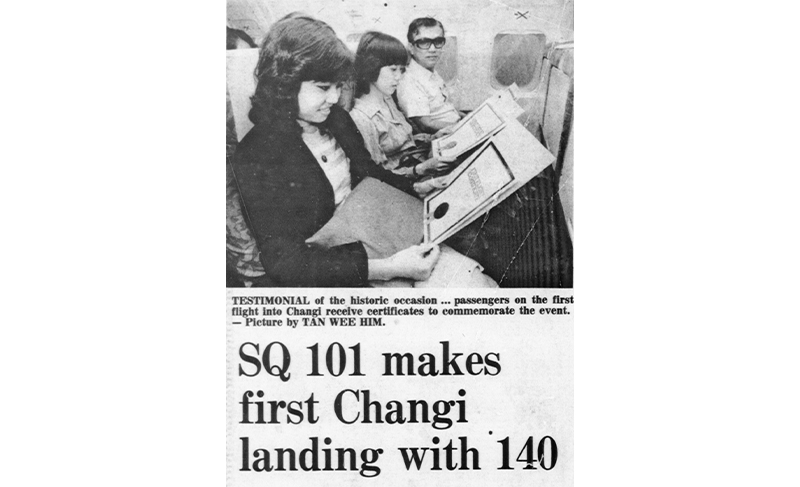
Passengers on board Singapore Airlines flight SQ 101 from Kuala Lumpur to Singapore on 1 July 1981. It carried 140 passengers, some of whom had especially travelled to the Malaysian capital to board the flight. Image reproduced from The Straits Times, 2 July 1981, 8. (From NewspaperSG).
In the four decades since, Changi Airport has grown from strength to strength; it is regularly voted one of the top airports in the world and has helped turn Singapore into a major aviation hub and international gateway. Today, it is hard to imagine Singapore without Changi Airport and its iconic control tower. However, what many people do not know is the particular set of circumstances that led to its existence.
Changi Versus Paya Lebar
Before Changi Airport opened in 1981, commercial flights landed in Paya Lebar Airport, which had begun operations in 1955. However, within two decades, Paya Lebar’s shortcomings became obvious.
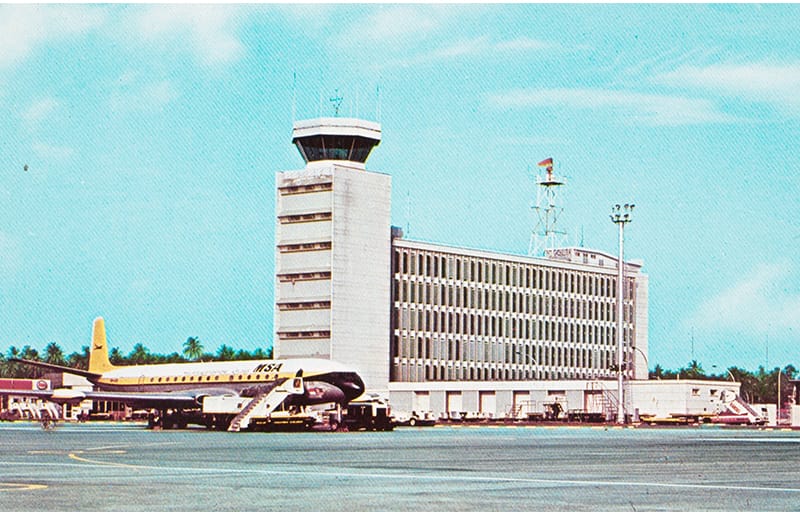
Paya Lebar Airport, 1960s. The airport only had a single runway. Seen on the tarmac is a plane belonging to the Malaysia-Singapore Airlines which existed from 1966 to 1972. The predecessor of Singapore Airlines. Courtesy of National Museum of Singapore, National Heritage Board.
“By mid 1970s, it was clear that Paya Lebar Airport would not be able to cope with the growing traffic for much longer,” said Minister Mentor Lee Kuan Yew in 2006 at Changi Airport’s 25th anniversary dinner. “We needed a bigger airport, with at least two runways. The proposal put to me was to expand Paya Lebar and construct a second runway.”2
External consultants recommended expanding Paya Lebar’s terminals and building a second runway by filling up the nearby Serangoon river. “This would be a difficult engineering task because of the soft clay of the river bed, so it would need special compaction equipment,” he noted.3
But Lee was not keen on expanding Paya Lebar Airport. “I felt then that Paya Lebar had inherent disadvantages. It was located near the city centre. Expansion would be limited. Worse, noise and air pollution would become worse because the flight path footprint was already over our city centre.”4
The alternative was to build a new airport in Changi, taking over the former Royal Air Force base there. Such an airport would be located away from the city centre and flights into and out of Changi would be over water. In addition, there was the possibility of future expansion by reclaiming land.
Lee revealed that the consultants initially had not recommended Changi because of “the cost of relocating to Changi plus the loss of $800 million in investments already made on Paya Lebar”. He recalled that the Cabinet had reluctantly agreed to the decision to build the airport at Changi.5
Before the plan could be implemented, however, the world was gripped by the oil crisis that began in 1973. The price of oil had quadrupled leading to a reduction in air traffic. Also, with the larger-capacity Boeing 747s taking to the skies and carrying more passengers, there were fewer smaller planes landing at Paya Lebar. All these meant that the pressure on the airport was reduced and the need for a second runway became less pressing.
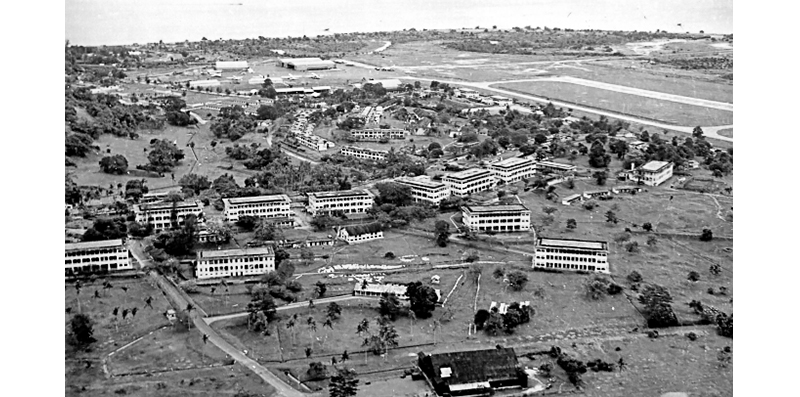
Aerial photograph of the Royal Air Force base in Changi, 1950s. In 1975, parts of the air base were acquired to build Changi Airport. RAFSA Collection, courtesy of National Archives of Singapore.
“I appointed Howe Yoon Choong, then chairman of the Port of Singapore Authority, to head a team to study if we could move to Changi in time before a second runway was necessary,” Lee recalled. “The team concluded that Changi was possible and could be ready by 1981.”6
In the early days, when Changi was still being considered, Pek Hock Thiam, director of the Ministry of Communications, organised helicopter and Skyvan trips for airport development committee members and ministers, including Lee, to view the Changi site. He recalled their excitement mixed with the fear of the unknown. As Pek noted: “There was nothing there. Worse, we knew that half the land for the airport would have to come from the sea. Who would believe we could create so much land in 2½ years?”7
The final decision to build the new airport at Changi came quickly. “Although [the] cost of relocating the airport to Changi was high, some $1.5 billion”, Lee believed that this would be the better option in the long term. When Lee was in Washington in April 1975, Goh Keng Swee, as acting prime minister, sent him an urgent message to say that a quick decision had to be made if Changi Airport was to be built by 1981.8 Lee cabled back and told Goh to proceed.
Like what you're reading? Subscribe to BiblioAsia's online newsletter for the latest stories.
Building Changi
To coordinate and lead the development of the airport, Sim Kee Boon, permanent secretary at the Ministry of Communications, was appointed chairman of the Executive Committee for Airport Development (ECAD). Howe Yoon Chong, who chaired the airport steering committee, was responsible for updating Lee on Changi’s progress.
Changi Airport was planned to be at least five times bigger than Paya Lebar Airport. To accommodate the new airport, existing land had to be cleared and new land reclaimed.
Site preparations began in June 1975, which eventually involved demolishing 558 buildings, exhuming 4,096 graves and clearing nearly 200 acres (80 hectares) of swampland.9
The land reclamation was a mammoth undertaking as 870 hectares of land had to be reclaimed. While some 200 hectares came from cutting down hills on existing land, the rest was reclaimed from the sea. This called for the use of five giant cutter suction dredgers, each costing $50 million. Operating some 3 kilometres from the shore, the five machines began dredging up 50,000 cubic metres of earth each day. And this was just at the start of the project; running at full capacity, these machines were expected to double the output. Some 41 million cubic metres of earth were sucked out by pumps and conveyed by 10 kilometres of metal pipeline to the filling site.10
Other infrastructural projects included reconstructing and extending the existing military runway to double its length from 2,000 to 4,000 metres. A 40-aircraft parking apron, taxiways, earthworks and drainage were also constructed. Apart from the infrastructure of the airport, there was also the design and building of the airport terminal as well.
Although the passenger terminal building was based on an initial plan submitted for the expansion of Paya Lebar, the final design for Changi deviated significantly from this. Sim noted that the original design gave “very little consideration to aesthetics”. “We finally decided that the airport should be an extension of our garden city,” he said. “This is because the first point of contact for the tourist visiting Singapore, apart from your Singapore Airlines girl in the plane, is the airport. So we took great care to combine the aesthetics with the functional aspects.”11
One key change that occurred was the location of the now-iconic control tower. Built at a cost of $8.5 million, it was originally meant to be situated on top of an administration building. However, that would leave the airport without a focal point. “Finally, we decided to have the control tower as the focal point and to put the administration block over the finger piers,” said Sim.12 In all, the air traffic control tower’s design underwent more than 20 changes before the final design was approved.
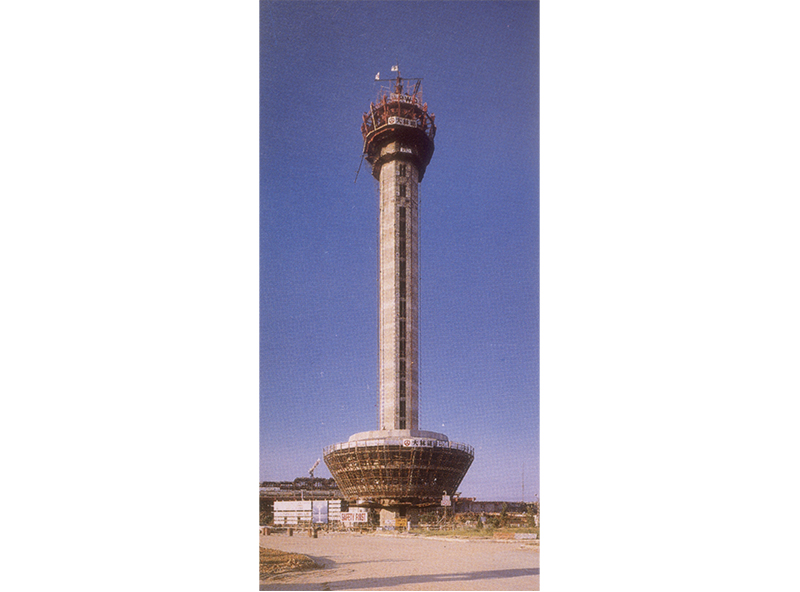
The iconic control tower of Changi Airport under construction, 1980. The three-storey bowl-like structure was built on the ground then pulled upwards with four jacks and eight cables at the rate of six metres a day. Civil Aviation Authority of Singapore Collection, courtesy of National Archives of Singapore.
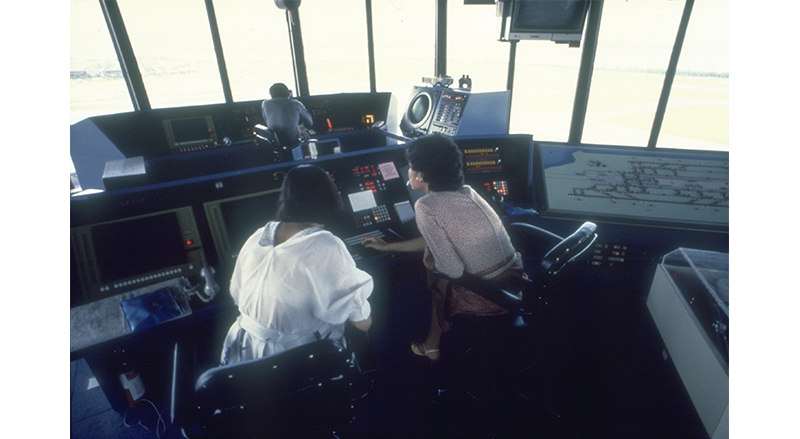
Air traffic controllers at work in the control tower of Changi Airport, 1985. Civil Aviation Authority of Singapore Collection, courtesy of National Archives of Singapore.
Given the scale of the Changi Airport project, the construction process inevitably encountered numerous challenges. Takao Kitamura, the director in charge of international operations at Takenaka Komuten, the main contractor for the airport’s passenger terminal building, recalled that after the company began work on the project, the price of sand rose by about 300 percent, and labour costs rose by 50 percent.
Extremely detailed plans were also necessary. “We even had to plan where to deliver the materials,” he said. “If you deliver them at one end of the building, it could be a one-kilometre walk to the other end.”13
Even something as mundane as the weather could throw a spanner in the works. Every time it rained, workers would not show up for work. In fact, on one occasion in 1978, a flood turned a basement into a veritable swimming pool and ruined the expensive machinery there, holding up work for a month. The challenges extended even to landscaping. Pek Hock Thiam recalled: “I had to argue, beg and cajole the Parks and Recreation Department to give us big trees instead of small trees.”14
The Changi project had a very tight deadline because Paya Lebar was approaching saturation, which is why an arrival hall had to be built there as a temporary measure. To ensure that Changi would not be delayed, Sim said that there had to be a mindset shift in the Public Works Department, which was in charge of building the airport.
“The traditional method of operation is that the [Public Works Department] engineers supervise the contractor who does the work. After that, if the contractor has a problem, the engineers will say it is not their problem. So if the contractor goes bankrupt, too bad. Employ another one. If the project is delayed, never mind, because the time factor is usually not critical. But for us, it was.
“So very early on, we impressed on all the officers that the contractors problems were their problems, and in the end, my problems, because I’m in charge.”15
Preparing for the Big Day
As with any big event, there were a number of dry runs before actual operations commenced on 1 July 1981. The first test flight, a Boeing 747, touched down at 7.25 pm on 13 May – two weeks before the big day.16
The first flight with paying passengers, SQ 100, landed on 31 May at 9.50 am. It was a chartered flight with 246 passengers, comprising mainly families with children. Organised by a travel agent, the flight had taken off from Paya Lebar Airport and flown up the east coast of peninsular Malaysia to Mersing before turning back and touching down at Changi.17
Lee Kee Foon, a housewife who flew first class with her family, said: “We wanted to see Changi Airport before it is open to the public.” After the flight, passengers were each presented with a souvenir medallion and flight certificate.18
Switching over from one airport to another was no easy task. As Bernard Chen, assistant secretary at the Ministry of Finance, noted: “Very few people appreciate this – we moved from Paya Lebar to Changi in one night without any disruption in [air transport] service… Everything was ready. We didn’t have to bus anybody back.”19
In addition to careful planning and dry runs, the authorities also went abroad to learn from the experience of other airports.
“The Civil Aviation Authority sent officers to observe moving operations in Taiwan when they switched operation from the old airport to Chiang Kai-shek Airport at Taoyuan,” said Ong Teng Cheong, who was minister for communications between 1978 and 1983. “They also went to Tokyo to see the [move] from Haneda to Narita… So it’s a question of observing the experience of others and planning carefully for our own switching-over operation.”20
The last plane to land at Paya Lebar – SQ 11 from Los Angeles and Tokyo – did so at 10.50 pm on 30 June 1981, while the last commercial flight, SQ 28 to Abu Dhabi and Frankfurt, left shortly after at 11 pm. That same night, personnel from the Republic of Singapore Air Force arrived with all the equipment necessary to facilitate Paya Lebar Airport’s conversion into a military air base.21
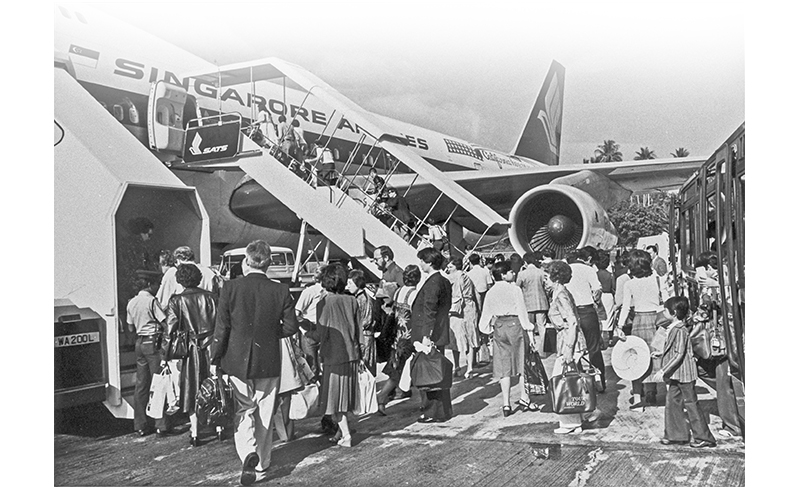
Passengers boarding a Singapore Airlines flight at Changi Airport, 1981. Civil Aviation Authority of Singapore Collection, courtesy of National Archives of Singapore.
Expanding Changi
Changi Airport began operations on 1 July 1981 with just one terminal and one runway. Work on the second runway was completed in 1983 and commissioned the following year. To cope with increased passenger traffic, Terminal 2 was opened in November 1990, while Terminal 3 began operations on 1 January 2007.
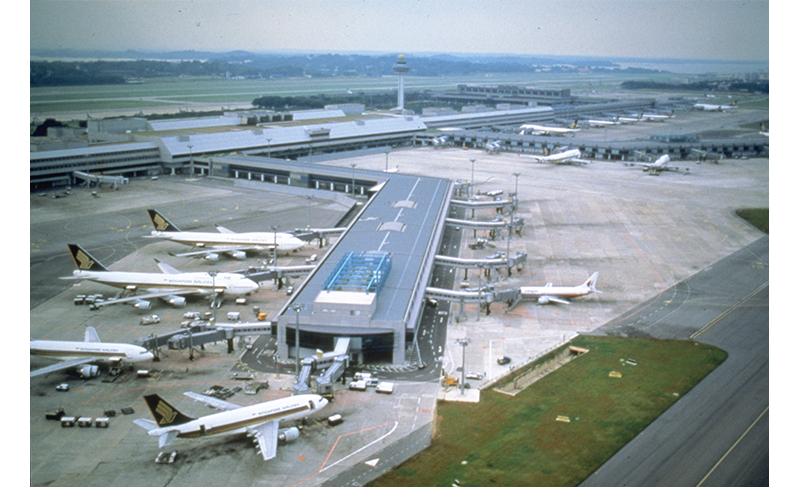
The finger pier at Changi Airport Terminal 2, 1996. Civil Aviation Authority of Singapore Collection, courtesy of National Archives of Singapore.
In 2006, the Budget Terminal commenced operations. This was built in response to the increasing trend of low-cost travel in the region, but it closed in 2012 to make way for the construction of Terminal 4, which opened in 2017.22
Over the years, Changi also improved on its connectivity with the city centre. In 2001, the Changi Airport Mass Rapid Transit (MRT) station on the East-West Line was opened. Such a link had not been viable back in the 1980s when most of the land around the airport was relatively undeveloped.23 In future, the airport will be accessible from the city via the Thomson-East Coast Line as well.24
In 2008, Changi Airport Group was formed as a result of the corporatisation of Changi Airport.25 One of the key projects it subsequently embarked on was building Jewel Changi Airport, a large shopping and entertainment complex that opened on 17 April 2019. A joint venture between Changi Airport Group and CapitaMalls Asia, the project took three years to gain the approval of Singapore’s Cabinet.26
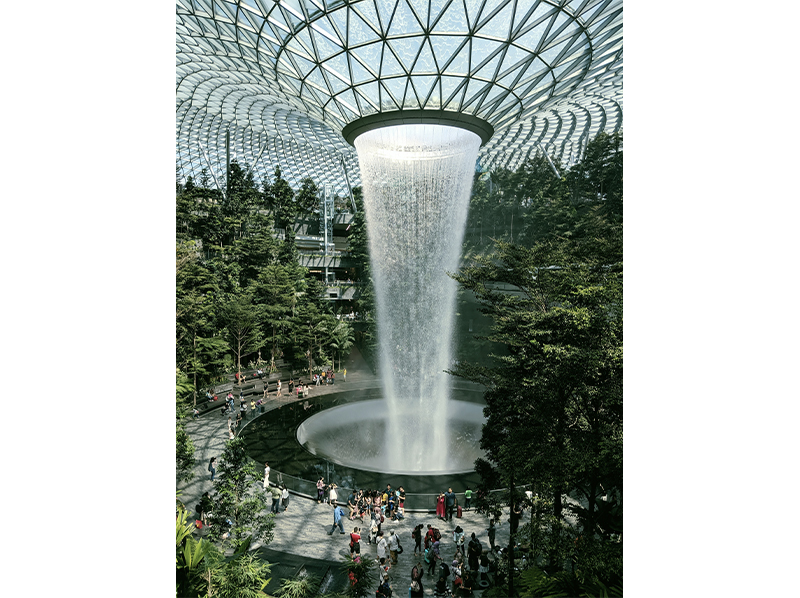
The Rain Vortex at Jewel Changi Airport. With water cascading down 40 metres, it is the world’s tallest indoor waterfall. Photo by Jansen Yang, 8 October 2019. Retrieved from Unsplash.
Awards, Accolades and the Future
Over the years, Changi has developed an international reputation. In 1988, just seven years after it opened, Business Traveller UK magazine rated Changi Airport as the world’s best airport; it had been number two in the previous four years.27 The following year, airport officials from 16 countries visited Changi Airport to attend a seven-week airport management course, learning from Changi’s experiences.28
Changi has since gone on to win many other such awards: it clinched the “Best Airport in the World” award from Business Traveller US a total of 27 times between 1991 and 2020.29
Changi Airport turned 40 in 2021 in what is a very challenging time for the air travel industry. The Covid-19 pandemic has upended business and leisure travel globally, leading to a reduction in passenger air traffic everywhere. As a result of the pandemic, Changi’s own passenger traffic levels dropped by over 80 percent between 2019 and 2020.30 Changi Airport Group lost a significant revenue stream, while shops and restaurants in the terminals continued to suffer.
Speaking in Parliament in October 2020, then Transport Minister Ong Ye Kung said that the government would support Changi Airport Group and other companies in the aviation sector, “[b]ut the most meaningful support we can give to our aviation companies is to restore passenger traffic and revive our air hub, in a safe, in a controlled manner”.31
As vaccination rates rise in Singapore and the country moves towards dealing with Covid-19 as an endemic disease, air traffic through Changi Airport will hopefully increase. With the same foresight, fortitude and perseverance that led to its genesis, the fortunes of Changi will undoubtedly rise again.
More resources on Changi Airport’s early years are available here.
About the Author
Rebecca Tan is an Associate Librarian with the National Library, Singapore. She is part of the digital heritage team and works on curating and promoting access to the library’s digital collections.
Endnotes
1 “SQ 101 Makes First Changi Landing with 140,” Straits Times, 2 July 1981, 8; “All Poised for the Big Take-off,” Straits Times, 1 June 1981, 12; “Changi Arrives,” Straits Times, 1 July 1981, 1. (From NewspaperSG)
2 Lee Kuan Yew, “Speech by Mr Lee Kuan Yew, Minister Mentor, at Changi Airport 25th Anniversary Dinner, 1 July 2006, 8.00 pm at the Raffles Ballroom, Swissotel the Stamford,” Raffles Ballroom, Swissotel the Stamford, 1 July 2006, transcript. (From National Archives of Singapore, Document no. 20060701991)
3 Lee, “Speech by Mr Lee Kuan Yew, Minister Mentor, at Changi Airport 25th Anniversary Dinner.”
4 Lee, “Speech by Mr Lee Kuan Yew, Minister Mentor, at Changi Airport 25th Anniversary Dinner.”
5 Lee, “Speech by Mr Lee Kuan Yew, Minister Mentor, at Changi Airport 25th Anniversary Dinner.”
6 Lee, “Speech by Mr Lee Kuan Yew, Minister Mentor, at Changi Airport 25th Anniversary Dinner.”
7 Judith Hale, “Billion Dollar Dream Comes True,” New Nation, 27 June 1981, 25. (From NewspaperSG)
8 Lee, “Speech by Mr Lee Kuan Yew, Minister Mentor, at Changi Airport 25th Anniversary Dinner.”
9 Peter Hutton, Wings Over Singapore: The Story of Singapore Changi Airport (Singapore: MPH Magazines, 1981), 41. (From National Library, Singapore, Call no. RSING 387.736095957 HUT)
10 “Dredges Get to Work to Reclaim Land for Changi Airport,” Straits Times, 11 July 1976, 7. (From NewspaperSG)
11 Judith Hale, “Getting There On Time,” New Nation, 27 June 1981, 26–27. (From NewspaperSG)
12 Hale, “Getting There On Time.”
13 Hale, “Billion Dollar Dream Comes True.”
14 Hale, “Billion Dollar Dream Comes True.”
15 Hale, “Getting There On Time.”
16 Tan Wee Him, “A Landing that Made History,” Straits Times, 13 May 1981, 10. (From NewspaperSG)
17 Wendy Yang, “246 in Historic Landing at Changi Airport,” Straits Times, 1 June 1981, 8. (From NewspaperSG)
18 Yang, “246 in Historic Landing at Changi Airport.”
19 Wu Wei Neng, Integrating the Planning of Airports and the City: The Singapore Story, ed. Cheong Kay Teck (Singapore: Centre for Liveable Cities, 2019), 18. (From National Library, Singapore, Call no.: RSING 387.7362095957 CHE)
20 Ong Teng Cheong, oral history interview by Lee Ee Boon, 19 June 1987, transcript and MP3 audio, Reel/Disc 3 of 5. (From National Archives of Singapore, Accession no. 000794)
21 “Goodbye Paya Lebar, Here We Come Changi,” Straits Times, 1 June1981, 12. (From NewspaperSG).
22 “Major Milestones,” Changi Airport Group, accessed 20 June 2021, https://www.changiairport.com/content/dam/cacorp/documents/changiairportgroup/CAG%20Major%20Milestones%20Jul%202014.pdf.
23 “MRT Line Won’t Go to Changi Airport,” Straits Times, 14 March 1987, 14. (From NewspaperSG)
24 “Land Transport Master Plan 2040,” Land Transport Authority, accessed 30 June 2021, https://www.lta.gov.sg/content/dam/ltagov/who_we_are/our_work/land_transport_master_plan_2040/pdf/LTA%20LTMP%202040%20eReport.pdf.
25 Ministry of Information, Communications and the Arts, “Corporatisation of Changi Airport and Restructuring of Civil Aviation Authority of Singapore (CAAS),” 7 October 2008, transcript. (From National Archives of Singapore, Document no. 20081007996)
26 Feng Zengkun, Jewel Changi Airport: Through the Eye of the Builder (Singapore: Woh Hup-Obayashi Joint Venture [Project Jewel]: Straits Times Press, 2019), 22. (From National Library, Singapore, Call no. RSING 725.39095957 FEN)
27 Lois Ng, “Changi the Champ,” New Paper, 30 July 1988, 5. (From NewspaperSG)
28 “Airport Officials from 16 Countries Here to Learn from Changi,” Straits Times, 20 October 1989, 26. (From NewspaperSG)
29 “Awards and Accolades,” Changi Airport Group, accessed 20 June 2021, https://www.changiairport.com/corporate/about-us/awards-and-accolades.html.
30 Ng Wei Kai, “Passenger Traffic at Changi Airport Fell 82.8% Last Year,” Straits Times, 1 June 2021, https://www.straitstimes.com/singapore/passenger-traffic-in-changi-airport-fell-828-per-cent-last-year-from-683m-in-2019-to-118m.
31 Ong Ye Kung, “Parliamentary Ministerial Statement by Minister for Transport, Mr Ong Ye Kung, on Recovery of Aviation Sector,” 6 October 2020, Ministry of Transport, https://www.mot.gov.sg/news-centre/news/detail/parliamentary-ministerial-statement-by-minister-for-transport-mr-ong-ye-kung-on-recovery-of-aviation-sector.