
Article
The Role of Foraging in Malay Cuisine
Topics
Food
10 October 2021
Foraging for food in the hills, the forests and the coastline has been carried out by the Malays for centuries, as Khir Johari tells us.
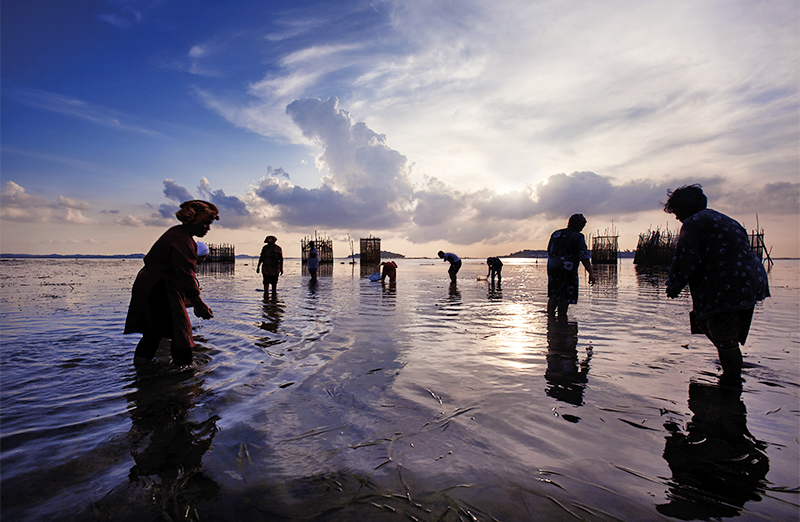
Foraging at low tide. Photograph by Law Soo Phye, courtesy of Khir Johari.
The Sulalat al-Salatin1 (Genealogy of Kings), better known as Sejarah Melayu or Malay Annals, tells us that when Sang Nila Utama – the Sumatran prince of Palembang who sired the Malay kings of old Singapura – landed on the island of Temasek around 1299,2 the shores were at a dry low tide (ayer tohor). We know this because the tale reports that the first thing his men did after landing was to forage along the beach. Here Sang Nila Utama is referred to by his title Sri Tri Buana, which means “Lord of Three Worlds” (the upper realm of the gods, the world of humans and the underworld):
“And when [the men] reached the shore, the ship was brought close in and Sri Tri Buana went ashore with all the ship’s company and they amused themselves with collecting all manner of shellfish and seaweeds.”3
This gives us an idea of just how embedded the practice of foraging for food was for coastal Malays. In fact, man has been foraging for food since time immemorial.
Foraging, requiring little to no specialised tools and demanding less physical exertion than agriculture and hunting, is likely the oldest means of acquiring sustenance. But gathering food from wild sources has not been abandoned entirely today. Certainly not in the Malay world, where foraging – or meramu (to collect all sorts of materials) – has survived well into modern times. The verb meramu is a prefixed form of the root ramu. The Malay word for ingredients – as in those needed in a recipe – is ramuan: things which have been gathered.
The Gems Around Us
The Malays foraged in multiple ecological domains and habitats. This emerged from their well-oriented understanding of local geography, which was made legible by the use of specific nomenclature. They identified different types of terrestrial features: there were padang (plains), cangkat (knolls), bukit (hills), lembah (valleys) and gunung (mountains). But even flat land itself was differentiated based on elevation, with darat (upland) distinguished from baruh (lowland). Forests, or hutan, were classified as either rimba (virgin forest) or belukar (secondary forest). Rivers were divided into hulu (upstream) and hilir (downstream). Freshwater swamps, or paya, were different from mangrove swamps, or bakau. Formations on the coast were also differentiated into telok (bays and coves) and tanjong (capes). At sea, the Malays identified terumbu or beting (patch reefs), karang (coral reefs) and busung (mudflats).
On land, the Malays foraged in the spacious yards around their rural homes, in the belukar near their villages as well as along trails that connected them. Much could be made of the leaves, shoots, stems and roots found therein. In the dish known as botok-botok, fish steak is marinated with spices and infused with flavourful foliage and herbs before being wrapped in banana leaves and steamed. Flowers could also be gathered for consumption. The flowers of the durian tree – prior to their fruiting – were often collected and enjoyed as ulam (a dish of raw vegetables eaten with rice).
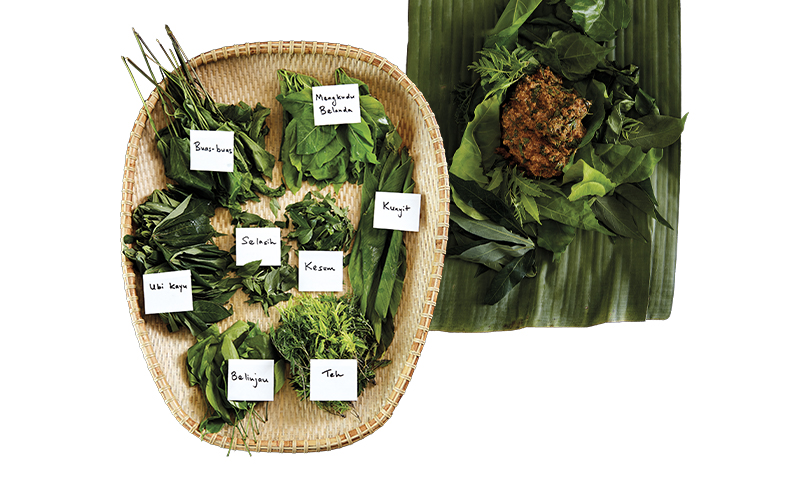
(Left) Foraged leaves and herbs to make botok-botok. Photograph by Law Soo Phye, courtesy of Khir Johari. (Right) To prepare botok-botok, fish slices are marinated with spices and infused with flavourful foliage and herbs, before being wrapped in banana leaves and steamed. Photograph by Law Soo Phye, courtesy of Khir Johari.
Besides foliage, flowers, shoots, roots, stems and tubers, the forests also occasionally turned up rare extravagances, like wild honey. A person skilled in the dangerous task of extracting honey (manisan lebah, literally “bee’s sweets”; also known as ayer madu or simply madu) from a hive was the pawang lebah (beekeeper).
There was also much to obtain from the swamps, both freshwater and mangrove, which were a rich source of edible flora and fauna. Beremi, a native watercress (Herpestes monniera), was once abundant in freshwater swamps in the Malay world but is now no longer widely available due to habitat loss.
At One with the Sea
Of course the sea was no stranger. Gathering shellfish, seaweed and other intertidal products (berkarang or mengambil karang-karangan) was an important pastime for the Malays, many of whom lived near or by the sea. Among specimens commonly collected for consumption were gonggong (dog conch; genus Strombus), ranga (spider conch; Lambis lambis; alternatively rangar; range in the Johor-Riau dialect), siput kilah (noble volute), jani (sea urchin), gamat (sea cucumber), latoh (sea grape), sangu or agar-agar (jelly seaweed), kupang (mussel), remis (surf clam), kepah (Venus clam) and kerang (cockle).
Cockles were once abundant along the entire west coast of the Malay Peninsula and on the sandy shores of Singapore. Collected in bucketfuls and carefully rinsed, these shellfish are “a favourite article of diet” of the Malays,4 who cooked them into sambal, or simply boiled them, stir-fried with vegetables, or skewered into sate kerang.
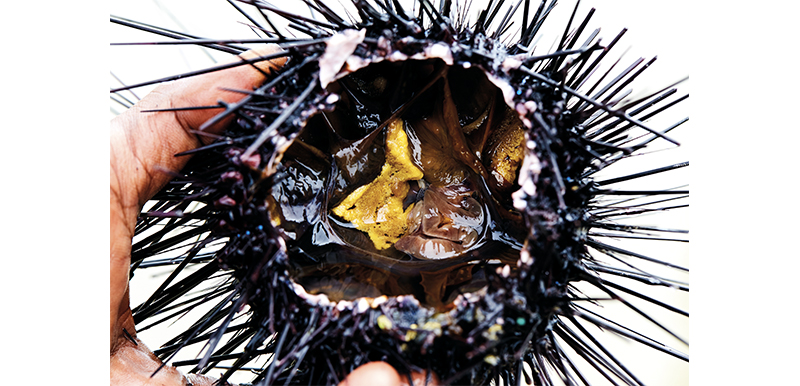
Sea urchin consumption was once common among coastal Malays. In many parts of the world today, sea urchin is considered a delicacy. Photograph by Law Soo Phye, courtesy of Khir Johari.
In the days before Singapore’s southern islands were reclaimed and their inhabitants relocated to the mainland, the islands were home to various Malay communities who had an intimate relationship with the marine ecology around them. Juria Toramae, an independent researcher, artist and marine conservationist, has written about how the residents of outlying islands like Pulau Sudong lived off collecting corals and seaweed, in a place where land was too scarce to put under the plough. She notes how “corals and seaweeds were popular amongst Singapore’s mainlanders for home decoration and jelly-making”.5
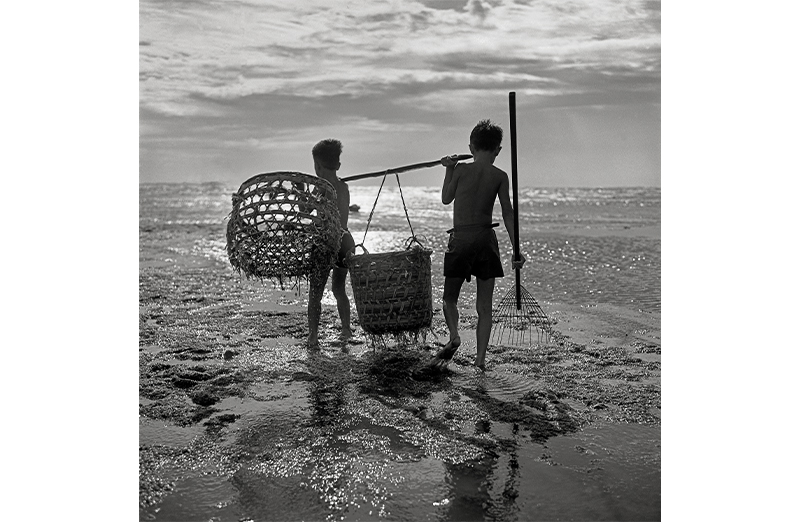
Raking seaweeds on Singapore’s shores. Photograph by and courtesy of Lim Kwong Ling.
In a paper published in 1982, Chew Soo Beng gives a rich account of the lives of the Pulau Sudong islanders before they were resettled into high-rise public housing on the mainland in the late 1970s:
“Groups of women row their kolek [small wooden boat] to different parts of the exposed portions of the reef to gather sea produce. This activity was performed with considerable gaiety, seeming to be an enjoyable activity. Everyone carried a basket and unmarried girls wore bunga raya (hibiscus) in their hair. In teams of threes or fours, usually to form a line, they combed the reef for agar-agar (an edible seaweed), gulong, the trepang and a variety of beche-de-mer. When both the tide and sun were low, the gathered chatter of the women at work could drift into the village where the men, excluded from the offshore merriment, conversed beneath their favourite pondok.”6
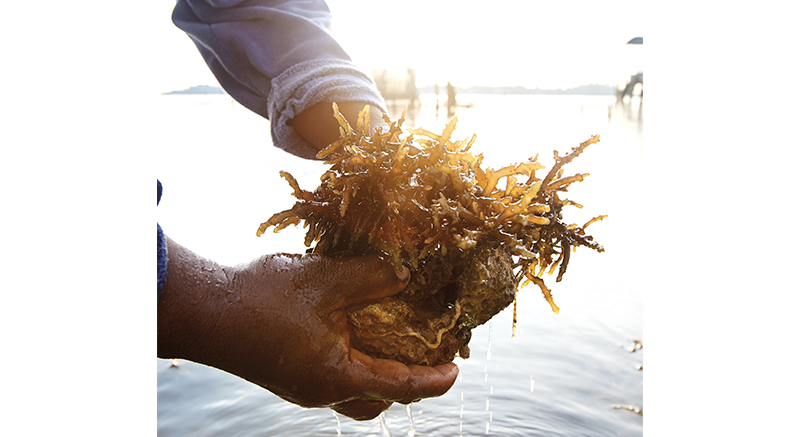
Picking the seasonal agar-agar, which is boiled down and its gelatinous by-product made into dessert throughout the Malay world. Photograph by Law Soo Phye, courtesy of Khir Johari.
Remnants of this lost way of life can be seen today only in those parts of the Riau Islands in Indonesia where such time-tested rhythms have not been swept away by the modern economy’s relentless forces. The fishing and gathering expeditions of Singapore’s southern islanders often brought them to Riau. The islands on both sides of the Singapore-Indonesia border together formed a contiguous maritime neighbourhood.
Bound by ties of kinship, these island communities transcended the artificial international borders that divide the waters between Singapore and Indonesia, first drawn up by the British and Dutch colonial powers in the Anglo-Dutch Treaty of 1824.7 Prior to the 1997 Asian Financial Crisis, the Singapore dollar was a widely accepted currency in Riau. Even when Riau islanders got married, dowry exchange was made in the Singapore dollar as well. This affinity with Singapore was made possible by geographical proximity.
Islanders on Pulau Pemping (on the Riau side of the border), for example, can see the Singapore skyline from their homes overlooking the sea. They adhered to the Singapore Standard Time for their daily prayers and watched Singaporean television. Movement across the border used to be more porous. Mak Imah, who lived on Pulau Semakau (on the Singapore side of the border), simply dismantled her home, crossed over to Pulau Pemping and reassembled it. This took place when she and her neighbours were ordered to resettle on the mainland. Singapore’s authorities then amalgamated Pulau Semakau with Pulau Seking to form Semakau Landfill, which began operations on 1 April 1999.
Of course, mainland Singapore itself is an island, and Malays residing in its coastal settlements lived much the same way. Those living in seaside villages such as Tanjong Irau, Telok Mata Ikan, Padang Terbakar, Kampong Wak Hassan and Pasir Panjang, for example, also engaged in foraging for seafood on beaches, intertidal zones, estuaries and rivers. This spontaneous relationship with one’s ecological surroundings is at odds with post-independence Singapore’s micromanagement of nature. In the manicured city-state, fishing is allowed only at designated waterways, and picking of any fallen fruit, vegetable or mineral from the wild is either banned or subject to approval by a state-issued permit.
In 2009, the Berita Harian newspaper reported that two women – Che’ Kamsiah and Che’ Saemah – were seen picking cockles and shellfish from Sungai Ketapang, a tributary of the Bedok River (Sungai Bedok).8 That an activity once so commonplace is now considered newsworthy attests to the radical transformation in the way of life of Malays in Singapore. Sungai Ketapang has since been canalised in concrete and courses by the Laguna National Golf and Country Club before flowing into the Bedok River.
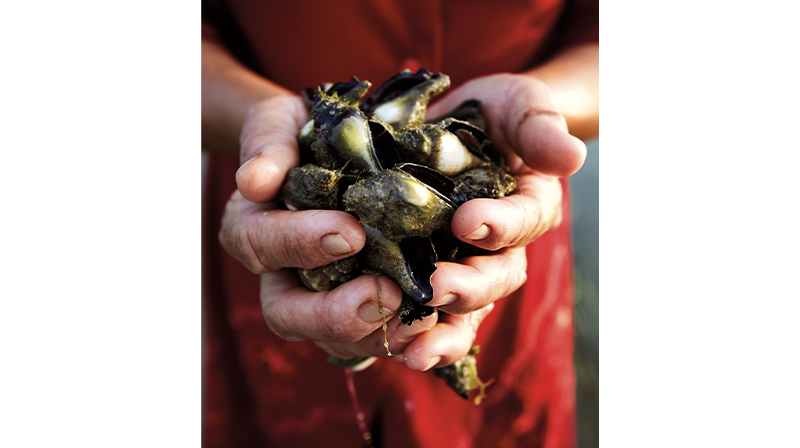
Male gonggong (sea snails) collected from mudflats. Photograph by Law Soo Phye, courtesy of Khir Johari.
Conscious Consumption
Prior to reclamation and more recent development, one can imagine how Sungai Ketapang was perhaps one among many natural cornucopias for Malay settlements in old Tanah Merah. More importantly, this episode suggests the profoundly intimate knowledge that indigenous communities have of their natural world, one that has even withstood – in its own little way – the displacement brought about by urbanisation.
This knowledge extends to understanding what can be acquired at which times of the day and year, as well as the natural processes of an ecological system that make such foraging practices sustainable. For Malays living in pre-industrial times, where natural resources were readily shared with the community, the principle of conscious consumption was largely upheld.
For instance, it was never in the long-term interest of a kampong community to harvest all the fish in a water body at once, even if one had the means. Some foraging practices could even help in the propagation of certain plants, such as turi (Sesbania grandiflora) and ubi kayu (cassava; Manihot esculenta), where a broken-off stem regenerates into two or more new ones. Even when flowers were picked, it was important not to strip the entire plant bare, but to leave some flowers behind to ensure that there was no decline in the fruit crop.
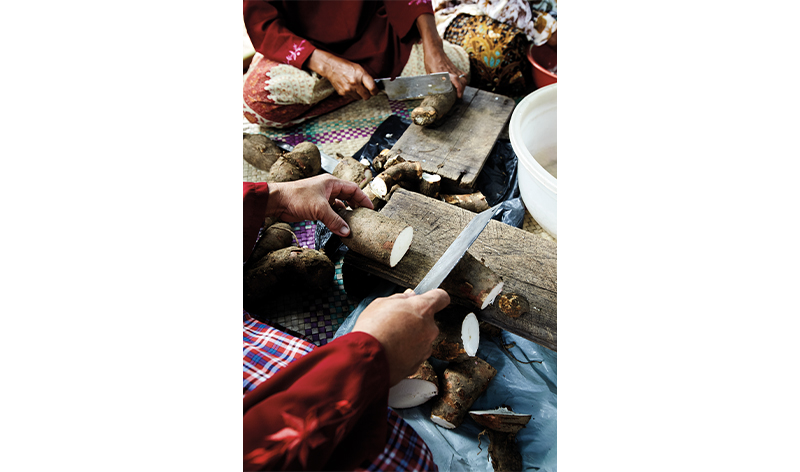
The ubi kayu (cassava), whose root and young leaves are commonly foraged. Photograph by Law Soo Phye, courtesy of Khir Johari.
If an entire tree had to be killed, no part went to waste. This was the case when the umbut – the prized heart of a palm – was acquired. Once the umbut was removed, the palm ceased to live. For coconut palms, the leaves were gathered for weaving into ketupat (rice cakes) cases or for wrapping otak-otak (fish mousse mixed with spices, wrapped in banana or coconut leaves and then grilled). The spines of the fronds, lidi, had multiple uses too: they were mainly used as skewers for sate (satay), and could also be bundled together to form an egg-beater or even a broom if longer fronds were used. The trunk was often used as a beam in construction, while dried coconut husks were used as cooking fuel.
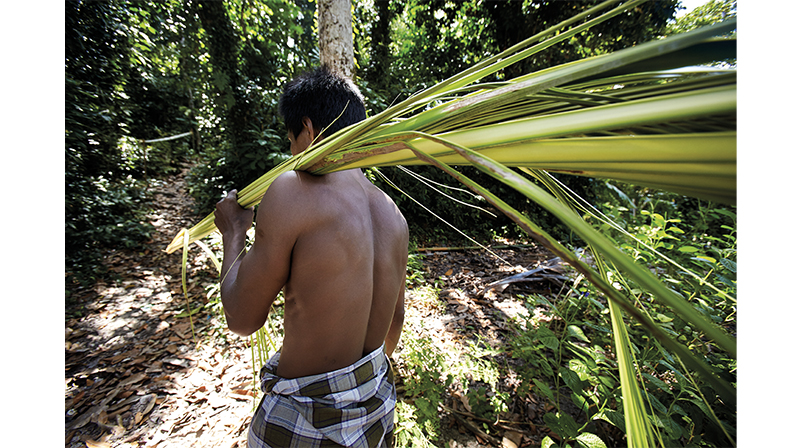
Janur (tender young coconut fronds), destined for transformation into ketupat casing. Photograph by Law Soo Phye, courtesy of Khir Johari.
Modern-day exploitation of natural resources and industrial capitalism, however, challenged the viability of foraging as a way of life. Just as the last of the Malay villages in Singapore were being torn down in the 1970s and 80s, growing awareness was afoot in the West about this fast-disappearing mode of consumption.
In 1971, Alice Waters, one of the key pioneers of the organic food movement in the United States, opened her restaurant Chez Panisse (which is still in operation today) in Berkeley, California. The restaurant emphasises using only locally grown ingredients from sustainable sources, and the menu changes according to the seasons, serving only what is available at that time of the year.
This sensitivity to seasonal constraints was also a crucial characteristic of foraging by the Malays. They only plucked the leaves of the puchok pakis (fiddlehead fern; Diplazium esculentum) while these were tightly furled. While binjai (Mangifera caesia) can be consumed even before it ripens, as some find it appealing in its sour stages, one rarely plucked the tree bare before the fruits reached their prime. As for the keranji (Dialium indum), the fruits emerge only once every five years, making it a waste to chop the tree down in its “unproductive” years in between.
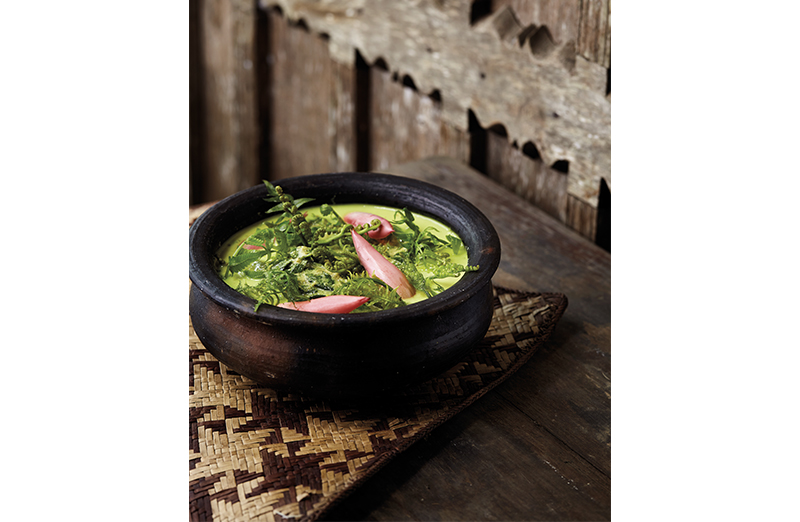
A Malay gulai (curry) of young fern fronds. Photograph by Law Soo Phye, courtesy of Khir Johari.
Industrialised food production has overcome constraints like these. One can now enjoy durian at any time of the year, despite it being a seasonal fruit. This has allowed the human consumer to transcend their position within the food chain, no longer subject to its natural processes or the constraints of seasonality. There is a danger, perhaps, in this growing distance between us and the natural processes that give rise to our food. The more removed we are from the natural domains where our ingredients were once traditionally harnessed, the less control and discernment we have in determining what food we should be consuming.
A DURIAN BY ANY OTHER NAME
Unlike the coconut and the pineapple, the durian does not seem to have been cultivated as a commercial crop by the Malays in the past. Durian trees were either encountered in the wild, or one might have the trees in one’s dusun (orchard or private fruit grove). The Malay expression durian runtuh (like a fallen durian) – used to convey unexpected bounty or good fortune – best illustrates the serendipity with which the durian fruit is found on the ground.
There were once dozens of durian varieties that are now mostly lost, eradicated by modern monoculture. Due to aggressive commercial cultivation, durian consumption is now woefully limited to the same set of popular cultivars, such as Mao Shan Wang (Musang King) and the blandly named D24. Gone are the heirloom varieties known to Malays of old.
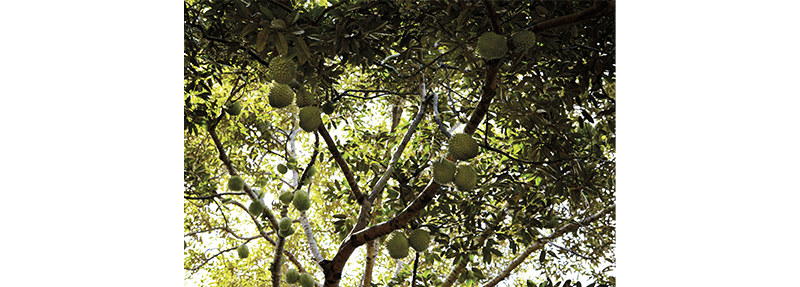
A durian tree with its thorny fruit. Photograph by Law Soo Phye, courtesy of Khir Johari.
The evocative names of these heirloom durians lyrically describe their shape and form, such as Kuching Tidur (Sleeping Cat). Kachapuri referred to durians whose only edible pulp was found right in the centre (hence kachapuri, the central chamber of a palace). Varieties whose names were inspired by the shape of their pulp include Durian Kepala Gajah (Elephant’s Head), Kepala Rusa (Deer’s Head), Telor (Egg), Daun (Leaf), Kembar Dua (Pair of Twins), Gempa Bumi (Earthquake), Raja Asmara (King of Passion), Juring Panjang (Long Slice), Jantong (Heart), Gelok (Water Vessel), Mata Ketam (Crab’s Eye) and Sultan Bersandar (Reclining Sultan). Durian Bantal (Durian Pillow) probably had a “pillowy” texture. Some names referred to the colour of the fruit, such as Durian Nasi Kunyit (Turmeric Rice), Mentega (Butter), Emas (Gold), Batil Suasa (Rose Gold Bowl), Tembaga (Brass), Gading (Ivory), Susu (Milk) and Otak Udang (Prawns’ Brains).
There is also a vocabulary associated with the anatomy of the durian: a single whole durian fruit is sebutir or sebiji durian; a single segment of its interior is sepangsa durian, while a single seed with its edible flesh adjoining is seulas durian, meaning one unit.
The following are terms related to the stages in a durian’s growth:
Mata ketam Very small
Mendamak When thorns first appear
Kepala kera Larger but dry
Mentimun ayer Beginning to be juicy
Meliat Getting consistency
Mendaging ayam Sweet and rich
Menchempur Fruit first falling
Membuang burok Fruit first falling
Gugur rahat Falling plentifully
In Singapore, a contemporary movement is advocating for a revival of organic food production. Social enterprises run foraging trips and are trying to build an urban farming industry. This has been attributed to a “global food trend” of picking and eating plants growing in the wild, drawing inspiration from the likes of Michelin-star Danish restaurant Noma, started by chef René Redzepi in 2003.9 While this movement may in fact draw on a recent global turn towards sustainable practices in light of growing concerns about climate change, we have observed how foraging for food by our forebears in Singapore is nothing new, but in fact was once also the norm.
Journalist and food writer Michael Pollan argues that the modern food industry has taken over the role that culture and living in nature once played in mediating our relationship with food.10 “The human omnivore,” he writes, “has the incalculable advantage of a culture, which stores the experience and accumulated wisdom of countless human tasters before him.”11 Whereas an ecologically conscious existence once informed our choices about what and how much we could eat and when, these decisions today have been largely taken over by a highly organised global food industry.
Cultural knowledge on consumption – providing a system of ethics, taboos, and other do’s-and-don’ts with regard to nutrition – has also become increasingly less relevant as advancements in nutrition science offer more systematic guidelines. While the latter ought to be celebrated, we cannot help but mourn, however little, the loss of inherited wisdom from earlier generations that understood food within an ecological context, and one in which the human consumer was embedded. As global food security becomes an increasing concern, it is perhaps timely to remind ourselves that not so long ago, it was still in fact possible for people in Singapore and the region to – at least in part – feed themselves by directly harnessing nature’s gifts.

This is an edited chapter from The Food of Singapore Malays: Gastronomic Travels Through the Archipelago by Khir Johari, published by Marshall Cavendish Editions (2021). The book explores in detail the history and culture of Malay food in Singapore and raises questions such as: How did Malay cuisine evolve to its modern-day form? How has geography influenced the way Malays eat? What cultural beliefs shape the rituals of Malay gastronomy? What does food tell us about the Malay worldview?
This book is scheduled to be published in October 2021. Thereafter, it will be available for reference at the Lee Kong Chian Reference Library and for loan at selected public libraries. It will also retail at major bookshops in Singapore.
About the Author
Khir Johari is a researcher of Malay history and culture, and former vice-president of the Singapore Heritage Society. He has a Bachelor of Science degree in mathematics from Santa Clara University and a Masters in education from Stanford University. The Food of Singapore Malays (2021) is his first book.
Endnotes
1 Sulalat al-Salatin (Genealogy of Kings) is one of the most important works in Malay literature. The current form was compiled in the 17th century based on older prototypes by Bendahara Tun Seri Lanang, the most senior minister of the Johor Sultanate.
2 Sang Nila Utama subsequently founded the city of Singapura on Temasek. His descendants ruled the city until the fifth and last ruler, Parameswara, fled to Melaka after an attack by the Javanese, establishing the Melaka Sultanate in around 1400.
3 Sejarah Melayu = The Malay Annals. Compiled by Cheah Boon Keng and transcribed by Abdul Rahman Haji Ismail. (Kuala Lumpur: Malaysian Branch of the Royal Asiatic Society, 1998), 91. (From National Library, Singapore, Call no. Malay R 959.5 SEJ)
4 John Frederick Adolphus McNair, Perak and the Malays: “Sarong and Kris” (London: Tinsley Brothers, 1878), 90 (From BookSG, Call no. RRARE 959.5131 MAC; Accession no. B03013449B)
5 Juria Toramae, “Notes on Some Outlying Reefs and Islands in Singapore,” Mynah, no. 1 (October 2016): 130, Academia, https://www.academia.edu/35691230/Notes_On_Some_Outlying_Reefs_and_Islands_of_Singapore.
6 Chew Soo Beng, “Fishermen in Flats,” Monash Papers on Southeast Asia, no. 9 ([Clayton, Vic.]: Centre of Southeast Asian Studies, Monash University, 1982). (From National Library, Singapore, Call no. RSING 301.4443095957 CHE)
7 The signing of the Anglo-Dutch Treaty by Great Britain and the Netherlands in London on 17 March 1824 resolved outstanding bilateral issues. This redefined the spheres of influence of these two colonial powers in the region, leading to the formation of British Malaya and the Dutch East Indies.
8 “Nak lala? Pergi ke Sungei Ketapang,” Berita Harian, 6 April 2009, 3. (From NewspaperSG)
9 “Foraging in Singapore: Field to Table,” Straits Times, 28 February 2015, 6–7. (From NewspaperSG)
10 Michael Pollan, The Omnivore’s Dilemma: A Natural History of Four Meals (New York: Penguin Press, 2006), 7. (From National Library, Singapore, Call no. 394.12 POL)
11 Pollan, The Omnivore’s Dilemma, 4.