
Article
Portugal's Linguistic Legacy in Southeast Asia
Topics
Culture
1 April 2023
While Portugal may not have had a large presence in this region, remnants of the Portuguese language continue to linger on, in some places more than others.
By João Oliveira
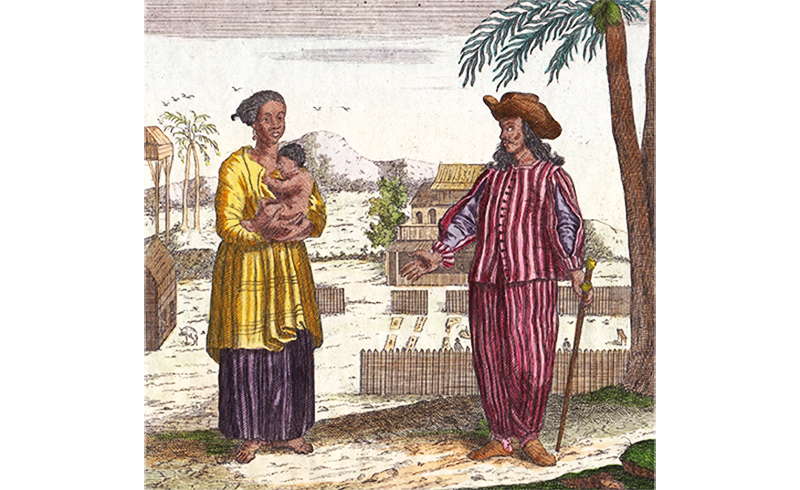
A Mardijker couple in Batavia. Mardijkers were the descendants of freed slaves of the Portuguese in India, Africa and the Malay Peninsula. They spoke a Portuguese-based creole. Courtesy of Ian Burnet.
Learning a new language opens your mind to new experiences. Sometimes, though, it can open your mind to old ones as well. I began learning Bahasa Indonesia a few years ago, first on my own, and then later under a teacher. Along the way, I kept encountering Indonesian words that sounded a lot like Portuguese words, mainly because those Portuguese words had entered the Indonesian language.
An Indonesian person wakes up in the morning when the sun comes through the jendela (from the Portuguese janela, or “window”). He gets out of bed, and after completing his morning routine, he takes his business kemeja (camisa; “shirt”) out of his almari (armário; “closet”) and gets changed for work.
He goes to the kitchen, sits down at the meja (mesa; “table”) and has bread with mentega (manteiga; “butter”) or maybe some keju (queijo; “cheese”) for breakfast. Later, he puts on his sepatu-sepatu (sapato; “shoes”) and goes to work in his kereta (from the archaic carreta; “car”). On his way to the office, he sends his daughter, who is holding a boneka (boneca; “doll”) in her hands, to sekolah (escola; “school”). On the weekend, that is, on sabtu (sábado; “Saturday”) and minggu (domingo; “Sunday”), he goes to a pesta (festa; “party”) with his friends.
I have since taught Portuguese to Indonesians, and I always begin with those words that are common between the two languages. I believe that this is a great way to break the ice and get acquainted with one another.
The presence of Portuguese loanwords in Bahasa Indonesia and other Southeast Asian languages is a legacy of Portugal’s presence in this region. Southeast Asia has been a major commercial and cultural hub for many centuries and, as a result, it attracted people from neighbouring regions and further afield. Among them have been the people from Portugal, my country.
Portugal has always been a small and relatively powerless state, except for a period in the 15th and 16th centuries when the Portuguese became the first European power to explore the Atlantic, Indian and Pacific oceans. Despite the relatively short time that they were in Southeast Asia, they left behind linguistic and cultural footprints that are still visible (or audible) today.
The extent of Portugal’s linguistic and cultural legacy in this region can be seen from different angles. Portuguese loanwords have entered local languages and become part of the local lexicon, as we see in the case of Bahasa Indonesia. Where the level of cultural intermingling has been deeper, it resulted in the creation of contact languages (also known as creole languages) such as Papia Kristang in Melaka, as well as new cultures that reflect the hybridisation. There also exists the seemingly unique situation of Timor Leste (formerly East Timor), where Portuguese (rather than a creole) continues to be used as a working language.
Portuguese Loanwords
We often hear of purists who insist on keeping the traditions of their languages and do not want them “contaminated” by other languages. Nevertheless, as human cultures do not exist in a bubble, languages have always integrated borrowings (also called loanwords) from neighbouring as well as distant languages. In 1913, Sebastião Rodolfo Dalgado unearthed Portuguese loanwords in more than 50 Asian languages in his book, Influência do Vocabulário Português em Línguas Asiáticas.1 A skilled and encyclopaedic missionary and linguist from Goa, Dalgado used his skills to recreate an imagined Portuguese empire and to inflate the influence of the Portuguese language and culture in Asia, as he felt that the linguistic and religious legacy of the Portuguese in Asia was evidence of the superiority of Portuguese civilisation.2
Mainly relying on dictionaries, Dalgado identified Portuguese loanwords in Southeast Asian languages such as Burmese (seven), Khmer (25), Thai (35), southern Vietnamese (15), northern Vietnamese (eight), Malay (431), Acehnese (51), Batak (29), Sundanese (100), Betawi (10), Javanese (104), Madurese (48), Balinese (21), Dayak (41), Makassarese (101), Buginese (122), Ambon Malay (16), Nicobarese (27), Tetum (774) and Galoli (429). (Dalgado did not know Malay/Indonesian and the extent of the influence of Portuguese on these two languages has been updated since Dalgado’s book, as scholars have published more recent papers and books on the subject.3)
Dalgado also recorded Portuguese loanwords in Asian dialects of European languages: Anglo-Indian (173),4 Indian French (62) and Chinese Pidgin English (15). (The last was used in the ports of South China.5)
Contact Languages, Syncretic Cultures
A more interesting phenomenon is the creation of contact languages. As its name suggests, a contact language emerges when two or more different languages come into contact with one another and get lexically and structurally intertwined, forming what is called creoles. In the colonial context, such languages often consist of the vocabulary from the language of the coloniser (superstrate) and some lexical and grammatical influence from the language(s) of the colonised (substrate). Portuguese-based creoles are creoles whose main vocabulary consists of Portuguese words.
Portuguese-based contact languages in Asia arose when Portuguese men, such as traders and venturers (casados; literally “married”), married local women or took them as concubines. The offspring of these liaisons came to be known as Eurasian, who developed specific linguistic and cultural traits.6
There have been Portuguese-based creoles in Southeast Asia: Papia Kristang in Melaka; Batavia and Tugu creole in Java; Flores creole in the Flores and Solor islands; the Moluccas creole; Burma creole in Myanmar and Siam creole in Thailand.7 With the exception of Papia Kristang, most of the other creoles have become extinct, or are now very close to it.
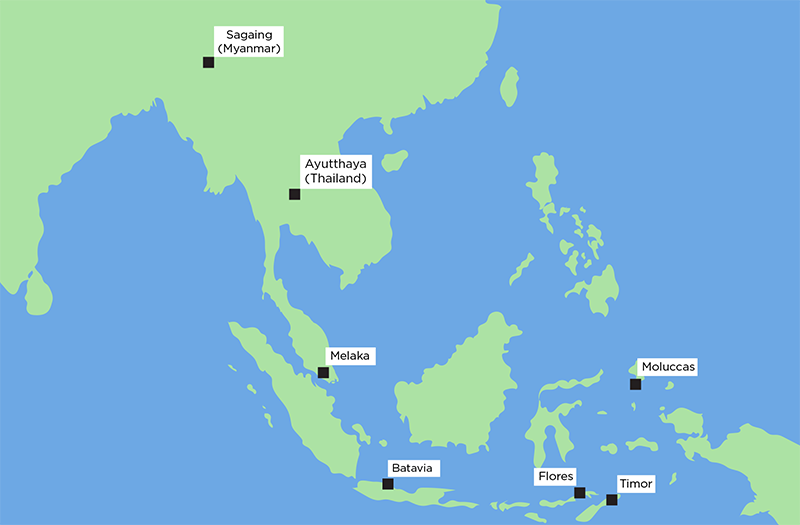
There have been Portuguese-based creoles in Southeast Asia: Papia Kristang in Melaka; Batavia and Tugu creole in Java; Flores creole in the Flores and Solor islands; the Moluccas creole; Burma creole in Myanmar and Siam creole in Thailand.
Papia Kristang
The first Portuguese contacts with Melaka began in 1509 and intensified after Afonso de Albuquerque conquered Melaka two years later. The most common name of the Portuguese-based creole of Melaka, Papia Kristang (“Christian speech”), and the local Portuguese settlement, Padri Sa-chang (“land of the priest”), show the deep connection between language, religion, territory and identity.
Today, Papia Kristang is considered an important identity marker but with little social prestige.8 The people remaining in the Portuguese Settlement (in Malay, Kampung Portugis) in Melaka consists of a small group of poor fishermen who are an anthropological curiosity and a tourist attraction. As Papia Kristang is the only surviving Portuguese-based creole in Southeast Asia, it has attracted interest from both Kristang scholars9 and other academics.10
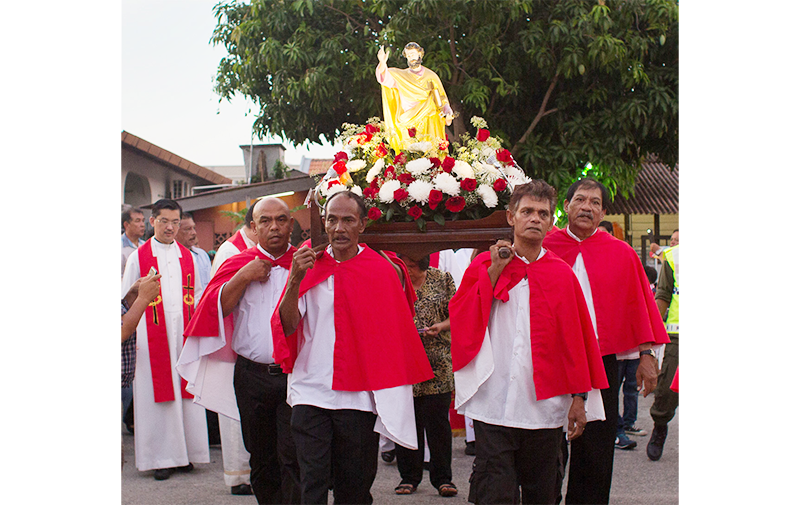
Religious festivals are a part of life in the predominantly Catholic Eurasian community of Melaka’s Portuguese Settlement. Pictured here is the celebration of Festa San Pedro, or Saint Peter’s Festival. Saint Peter is the patron saint of fishermen. Photo by Desmond Lui. Courtesy of Melissa De Silva.
Over time, Papia Kristang spread geographically as groups of Portuguese Eurasians moved around the region. Following the capture of Portuguese Melaka by the Dutch in 1641, some Eurasians fled to other places in the region such as Makassar. Subsequently, when the Dutch attacked Makassar in 1660, it led to an exodus of the Eurasians to Larantuka on Flores island. These migratory patterns spread Kristang to other areas outside of Melaka.
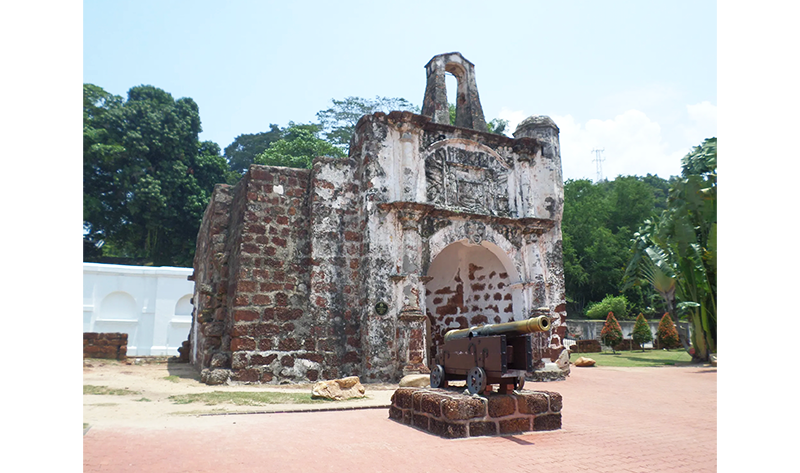
The surviving gateway of A Famosa, the Portuguese fort in Melaka, 2015. The fort was built by the Portuguese after they conquered the city in 1511. Today, the only parts of the fort remaining are the Porta de Santiago gateway and the restored Middelburg Bastion, which was added on by the Dutch in 1660. Photo by Chongkian. Retrieved from Wikimedia Commons (Creative Commons Attribution-ShareAlike 4.0 International; CC BY-SA 4.0).
While the Dutch conquered Melaka from the Portuguese in 1641, and subsequently ruled it until 1825, they could not dethrone the Portuguese-based creole in Melaka. Many Dutch men ended up marrying Creole-speaking Eurasians and had Creole-speaking slaves of Portuguese descent.11 Despite being unrelated to the Portuguese, these slaves were known as Black Portuguese (Zwarte Portugueesen) and later Mardijkers (from Malay merdeka, which means “free men”, as they were “free” from taxes. The word merdeka is in turn derived from marhardika, Sanskrit for “freedom”).12
Many Mardijkers hailed from places in Southeast Asia where Portuguese-based creoles were spoken. The Dutch also recruited native Christian soldiers from the Indian coast who spoke a Portuguese-based creole, which further cemented the creole as a lingua franca. As a result, the presence of Portuguese-based creole solidified in Melaka during more than 180 years of Dutch rule.
The arrival of the British into the region was the impetus for more migratory waves of Portuguese Eurasians out of Melaka. Many settled in Penang after the British colonised it in 1786. The Portuguese Eurasians were also among the first to settle in Singapore after a trading port was set up here in 1819. In the colonial race hierarchy, Eurasians occupied the social stratum below Europeans but above Asians. As a result, being Eurasian became desirable, though more for political power than for cultural reasons.
Linguistically, the British were more successful than the Dutch as British colonial rule in the Straits Settlements (comprising Singapore, Melaka and Penang) led to the dominance of English in these territories, eventually displacing Kristang for the Portuguese Eurasians. As evidence, consider the fact that after the Second World War, Portuguese Eurasians who migrated out of Southeast Asia chose to settle down in English-speaking countries. Those who moved to Portugal were mainly from East Timor.
Among those who remained, Kristang continued to decline in the face of other languages like Malay (in Malaysia). In Singapore, Kristang has been supplanted by English, Malay, Tamil and Chinese, although there have been efforts to keep the language and culture alive. The Portuguese-Eurasian community has been promoting pedagogical and cultural activities to revitalise the Kristang language.13
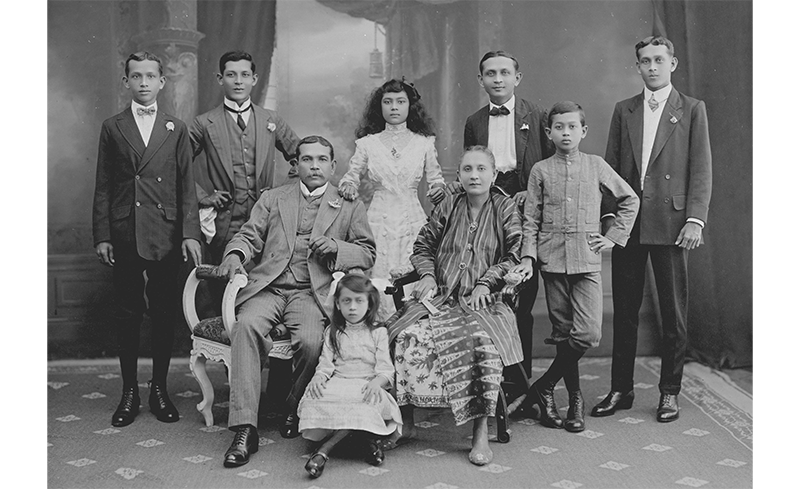
Studio photograph of a Eurasian family in Singapore, 1910–25. Lee Brothers Studio Collection, courtesy of National Archives of Singapore.
In 2004, Valerie Scully and Catherine Zuzarte published a Kristang dictionary in Singapore because they wanted to “to help all those interested in this fascinating language learn more about it, and thereby remember our roots”. Interestingly, in their acknowledgements, they noted that, as children, they had been “discouraged from using Kristang for fear that we would not be able to master the English language that was taught in schools”.14
To give a flavour of the language, the dictionary contains poems, songs and prayers. The Lord’s Prayer in Kristang goes:
Nos sa Pai ki teng na seu,
Santah fikadu bos sa nomi,
Bos sa reinu beng
Bos sa bontadi kumpridu,
Na terra asi kema na seu,
Dah nos sa pang di kada dia.
Peduah nos sa pekadu,
Asi nos peduah nos sa inimigu.
Nang desah nos teng mal intentasang,
Mas librah kon nos di tudu mal, Amen.15
A comparison with the prayer in modern Portuguese shows distinct similarities:
Pai nosso, que estais no céu,
Santificado seja o Vosso nome.
Venha a nós o Vosso reino.
Seja feita a Vossa vontade,
Assim na terra como no céu.
O pão nosso de cada dia nos dai hoje.
Perdoai-nos as nossas ofensas
Assim como nós perdoamos a quem nos tem ofendido.
Não nos deixeis cair em tentação,
Mas livrai-nos do mal, Amén.
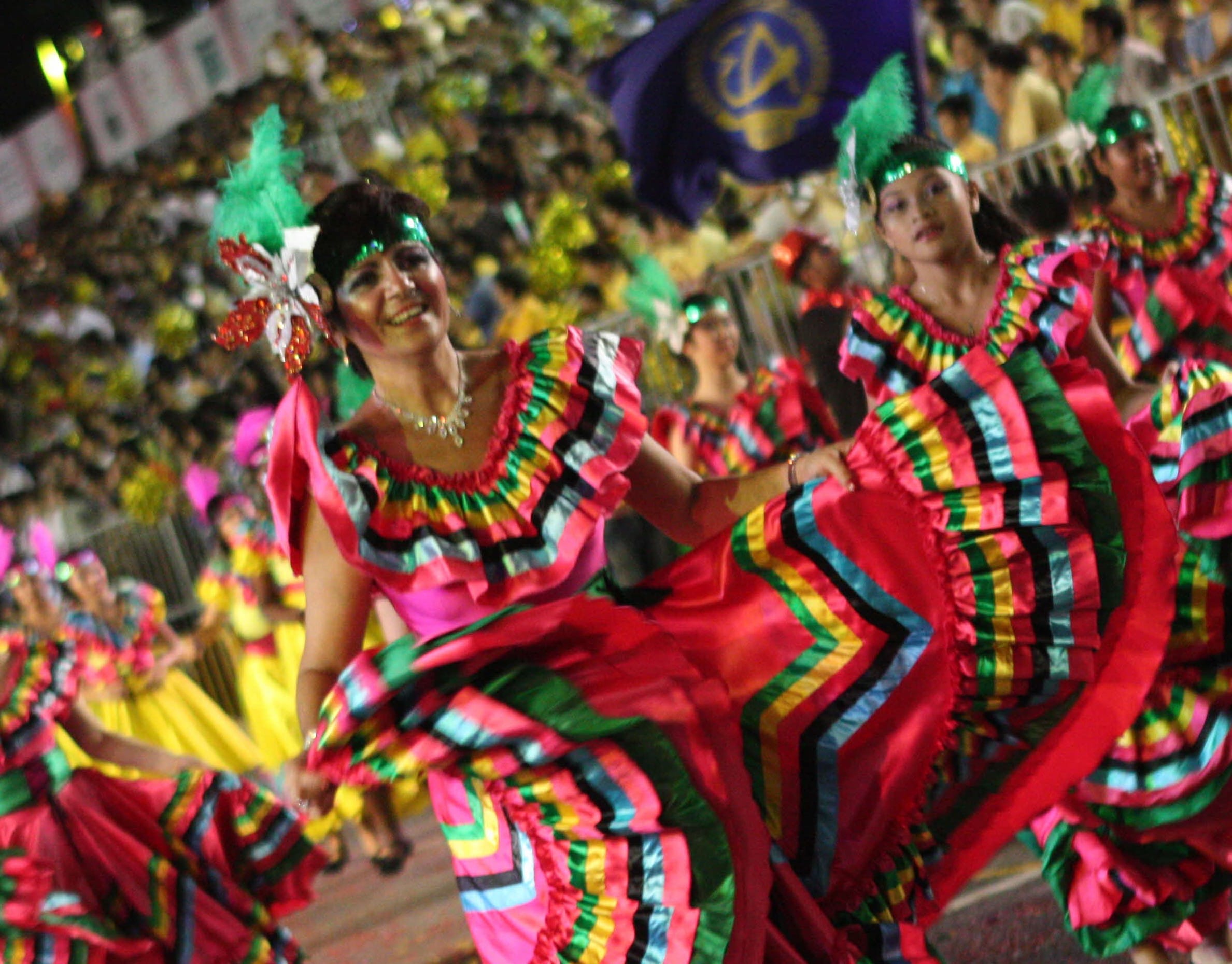
The Eurasian Association contingent at the Chingay parade, 2010. Courtesy of the Eurasian Association, Singapore.
Batavia and Tugu Creole
Between the 17th and 20th centuries, Batavia (now Jakarta) was the centre of Dutch power in Asia. Batavia came under Dutch control in 1619, but had never been ruled by the Portuguese. However, many people who had lived under Portuguese influence (soldiers, slaves and Eurasian families from South India, Ceylon, Melaka and various Southeast Asian islands) converged there. For that reason, a Portuguese creole came to be used as a means of communication between European and Asian groups.
As in Singapore, the Eurasians in Batavia were just below the Dutch in the social hierarchy, which conferred them political advantages. However, with the passage of time, as the influence of the Portuguese waned and was replaced by more powerful groups, the same happened with their linguistic and cultural influences.
In Tugu, a village near Batavia, the Portuguese language (via a Portuguese creole) was spoken. Unlike most other Eurasian communities, the people in this village converted to Calvinism. The Tugu community began to decline during the Japanese Occupation when the “Portuguese” were perceived as colonialists. Jacob Quiko, the mayor of Tugu who died in 1978, was one of the last creole speakers who actively promoted the language. His grandson Guido Quiko continues his legacy today, as he and his community still organise events celebrating their Eurasian heritage.16
Moluccas Creole
Another creole arose after the Portuguese founded Kota Ambon in 1521 in the Spice Islands (known today as the Moluccas or the Maluku Islands), and the building of Fort Kastela in Ternate in 1522. As in Melaka, Portuguese men married local women and their descendants were also called Eurasians and spoke a creole. When the Ternatans successfully seized the fortress in 1575, Eurasian families fled to Ambon.
In Maluku, the creole later shifted to Ambonese Malay, a local variety of Malay that still retains several Portuguese words. Subsequently, when the Spanish established a garrison in the Maluku Islands in the 17th century, Eurasian families migrated to the Philippines where they founded a town called Ternate in Luzon. There, the creole was relexified as a Spanish-based creole. Today, the language – known as Ternate Chabacano – is no longer recognised by the local Eurasian community as having Portuguese origins. It is only through linguistic and historical research that its Portuguese roots have been identified.17
Flores Creole
In the 16th century, Portuguese merchants and missionaries began settling in the islands of Flores, Adonara and Solor. The merchant community later split from the missionary community and relocated to Larantuka in Flores. However, these two groups subsequently reunited after Dutch attacks on Solor.
Later, the two communities also settled in Wureh and Konga, both also in Flores. Their descendants, the local Eurasians, which also included deserters from the Dutch East India Company, became known as Larantuqueiros, or “people from Larantuka”.18
In 1702, as they tried to flee from Dutch influence, the Portuguese community in Flores resettled in Lifau, Timor. Nonetheless, Portuguese linguistic and cultural elements remained in Larantuka. In Larantuka, Portuguese was used liturgically, in the same way Latin continued to be used in European churches long after vernacular languages had replaced Latin as a language of daily communication. The linguistic influence of Portuguese in Christian liturgy in Larantuka remains to this day.
The Portuguese subsequently settled in Dili, on Timor, in 1769. To ensure their safety, in 1859, the Portuguese sold their nominal rights over their other settlements in Flores and Solor in exchange for the Dutch recognition of East Timor as belonging to Portugal. This agreement led to a new wave of migration. Moradores (inhabitants) from Flores settled in Sikka while those from Solor moved to Bidau, in the suburbs of Dili. Each spoke its own variant of Portuguese creole, although only the latter is documented. As these creoles came into contact with local languages such as Tetum or with more normative versions of Portuguese, they were gradually phased out. The Solor variant was similar to Papia Kristang and Macanese creole (the creole that developed in Macau), which suggests that it was either derived from one of them or from a common ancestor.19
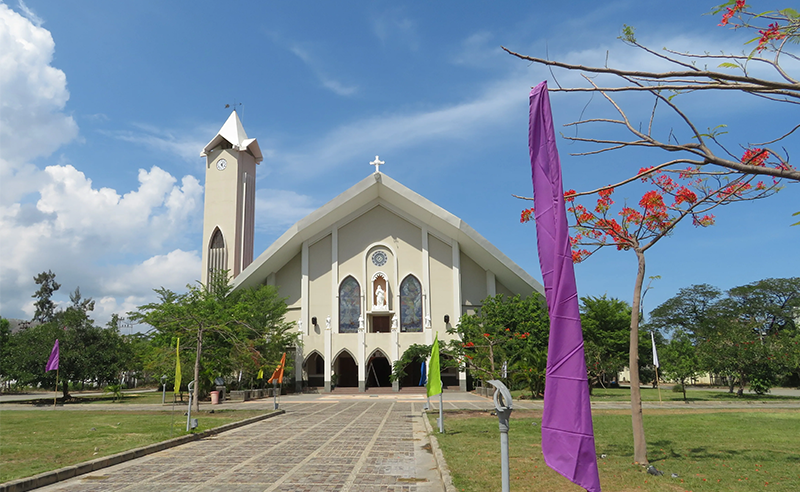
The Immaculate Conception Metropolitan Cathedral in Dili is the main church of the Roman Catholic Archdiocese of Dili, Timor Leste. Photo by Torbenbrinker. Retrieved from Wikimedia Commons (Creative Commons Attribution-ShareAlike 4.0 International; CC BY-SA 4.0).
Burma and Siam Creoles
Little is known about the Burma creole in Myanmar and the Siam creole in Thailand. There are no surviving examples of the two creoles, only European accounts that these existed.
In Burma (now Myanmar), the Eurasian community lived in the southern region of Tanintharyi.They were called the Bayingyi, a derivation of the Arabic Feringi (anglicised as “Frank”), which means “foreigner”. Their descendants, who now mainly reside in the Sagaing region in northern Myanmar, are culturally Burmese and are only distinguished by their religion– Catholicism.
In Thailand, the creole is supposed to have emerged in Ayutthaya and, after its fall in 1767, in present-day Bangkok. As in Burma, the people of Portuguese descent became integrated into Thai society.20
Timor Leste
The linguistic situation in Timor Leste today is complex and understudied. The territory has 31 ethno-linguistic groups and 46 “kingdoms”.21 Timor Leste represents an exception to the decline of Portuguese influence in Southeast Asia. Here, the Portuguese language (not a creole), as well as Catholicism, was used by educated elites to resist the annexation by Indonesia in 1974. After Timor Leste gained independence in 2002, both the Portuguese language and Catholicism were used as a means for fostering national unity among the many loose and decentralised ethnic groups and languages.
Besides Portuguese, the other official language of East Timor is Tetum. Tetum is not usually considered to be a creole; like Malay, it is categorised as an Austronesian language. It has, however, been largely influenced by the Portuguese lexicon and grammar, although Tetum itself has great internal variation.22 For historical reasons, Tetum Prasa (“Tetum of the City”), the variety spoken in Díli, is heavily influenced by Portuguese, both lexically and structurally. The written version of Tetum Prasa, used in newspapers, is known as Tetunguês (a portmanteau of “Tetum” and “Portuguese”).
As this brief survey demonstrates, while Portugal’s legacy in Southeast Asia most clearly manifests in language, there are also other vestiges. The development of different Eurasian groups and the situation in Timor Leste show that Portugal’s social and cultural legacy, which transcends language and involves other important identity traits, sometimes matters even more.23
Like all other European colonial conquests, the Portuguese venture into Southeast Asia was often a violent and unethical one. The legacies of colonialism, imperialism, euro-centrism and the “universal” values of Enlightenment have been interrogated in postcolonial studies. However, we cannot change history; we can only learn from past mistakes and work towards a better and more ethical present and future. In a world that is becoming increasingly globalised, culturally homogeneous and, at the same time, politically polarised, it is important that we celebrate diversity and do not let the past die out.
About the Author
Dr João Oliveira is a linguist and an academic in the field of cultural studies, focusing on Asian languages, narratives and religions.
Endnotes
1 Sebastião Rodolfo Dalgado, Influência do Vocabulário Português em Línguas Asiáticas (Abrangendo Cerca de Cinquenta Idiomas) (Coimbra: Imprensa da Universidade, 1913), Hathi Trust Digital Library, https://catalog.hathitrust.org/Record/001054188.
2 Rosa Ribeiro Fernando, “Revisiting Creoles and Other Languages in the Lusophone Indian Ocean,” in The Portuguese in the Creole Indian Ocean: Essays in Historical Cosmopolitanism (Basingstoke: Palgrave Macmillan, 2015). (From National Library, Singapore, call no. RSEA 305.80091712469091824 ROS)
3 Manuel Teixeira, “The Influence of Portuguese on the Malay Language,” Journal of the Malayan Branch of the Royal Asiatic Society 35, no. 1 (1962): 95–107. (From JSTOR via NLB’s eResources website); Russell Jones, Carstairs Douglas and Thomas Barclay, eds., Loan-words in Indonesian and Malay (Leiden: KITLV, 2007). (From National Library, Singapore, call no. RSEA 499.22124 LOA)
4 Henry Yule and A.C. Burnell, Hobson-Jobson: The Anglo-Indian Dictionary (Ware: Wordsworth Reference, 1996). (From National Library, Singapore, call no. RDET 427.95403 YUL)
5 Robert A. Hall, Jr., “Chinese Pidgin English Grammar and Texts,” Journal of the American Oriental Society 64, no. 3 (July–September 1944): 95–113. (From JSTOR via NLB’s eResources website); Umberto Ansaldo Stephen Matthews and Geoff Smith, “China Coast Pidgin: Texts and Contexts,” Journal of Pidgin and Creole Languages 25, no. 1 (March 2010): 63–94, https://www.researchgate.net/publication/233595288_China_Coast_Pidgin_Texts_and_contexts.
6 Ronald Daus, Portuguese Eurasian Communities in Southeast Asia (Singapore: Institute of Southeast Asian Studies, 1989). (From National Library, Singapore, call no. RSING 305.869059 DAU); John Byrne, “The Luso-Asians and Other Eurasians: Their Domestic and Diasporic Identities,” in Portuguese and Luso-Asian Legacies in Southeast Asia, 1511–2011, Vol. 1, The Making of the Luso-Asian World: Intricacies of Engagement, ed. Laura Jarnagin (Singapore: Institute of Southeast Asian Studies, 2011). (From National Library, Singapore, call no. RSING 305.869105 POR)
7 Hugo Cardoso, “O Português em Contacto na Ásia e no Pacífico,” in Manual de Linguística Portuguesa, ed. Ana Maria Martins and Ernestina Carrilho (Berlin: De Gruyter, 2016), https://library.oapen.org/handle/20.500.12657/23870; Hugo Cardoso, “Contact and Portuguese-Lexified Creoles,” in The Handbook of Language Contact, 2nd ed., ed. Raymond Hickey (Hoboken: John Wiley & Sons, 2020), https://www.wiley.com/en-sg/The+Handbook+of+Language+Contact%2C+ 2nd+Edition-p-9781119485056.
8 Stefanie Pillai, Wen-Yi Soh and Angela S. Kajita, “Family Language Policy and Heritage Language Maintenance of Malacca Portuguese Creole,” Language & Communication 37 (July 2014): 75–87, ScienceDirect, https://doi.org/10.1016/j.langcom.2013.12.003.
9 Margaret Sarkissian, D’Alburquerque’s Children: Performing Tradition in Malaysia’s Portuguese Settlement (Chicago: The University of Chicago Press, 2000), https://press.uchicago.edu/ucp/books/book/chicago/D/bo3623368.html.
10 Alan N. Baxter, A Grammar of Kristang (Malacca Creole Portuguese) (Camberra: The Australian National University, 1988), Hathi Trust Digital Library, https://catalog.hathitrust.org/Record/007130472; Alan N. Baxter and Patrick de Silva, A Dictionary of Kristang (Malacca Creole Portuguese): With an English-Kristang Finderlist (Canberra: Pacific Linguistics, 2004). (From National Library, Singapore, call no. RSEA 469.79321 BAX)
11 Dennis De Witt, “Enemies, Friends, and Relations: Portuguese Eurasians During Malacca’s Dutch Era and Beyond,” in Portuguese and Luso-Asian Legacies in Southeast Asia, 1511–2011, Vol. 2, Culture and Identity in the Luso-Asian World: Tenacities & Plasticities, ed. Laura Jarnagin (Singapore: Institute of Southeast Asian Studies, 2012). (From National Library, Singapore, call no. RSING 305.869105 POR)
12 Ian Burnet, Archipelago: A Journey Across Indonesia (Kenthurst, NSW: Rosenberg Publishing Pty Ltd, 2015), 29–30. (From National Library, Singapore, call no. RSEA 959.804 BUR)
13 Kevin Martens Wong, “Kodrah Kristang: The Initiative to Revitalize the Kristang Language in Singapore,” Language Documentation & Conservation Special Publication, no. 19 (December 2019): 35–121, https://scholarspace.manoa.hawaii.edu/bitstream/10125/24906/1/ldc-sp19-wong.pdf. See also Kodrah Kristang facebook, accessed 5 December 2022, https://www.facebook.com/kodrahkristang/; Keep Kristang Alive facebook, accessed 5 December 2022, https://www.facebook.com/KristangKL/; and Yo Falah Linggu Kristang, accessed 5 December 2022, https://www.facebook.com/yofalah.linggukristang.
14 Valerie Scully and Catherine Zuzarte, The Most Comprehensive Eurasian Heritage Dictionary: Kristang-English, English-Kristang (Singapore: SNP International, 2004). (From National Library, Singapore, call no. RSING 306.0890403 SCU)
15 Valerie Scully and Catherine Zuzarte, The Eurasian Heritage Dictionary: Kristang-English, English-Kristang, 2nd ed. (Singapore: Straits Times Press, 2017), 34. (From National Library, Singapore, call no. RSING 306.0890403 SCU)
16 Philippe Maurer, The Former Portuguese Creole of Batavia and Tugu (Indonesia) (London: Battlebridge Publications, 2011). (From National Library, Singapore, call no. RSEA 469.79968 MAU); Raan-Hann Tan, Por-Tugu-Ese?: The Protestant Tugu Community of Jakarta, Indonesia (PhD diss., Instituto Universitário de Lisboa, 2016).
17 Barbara Dix Grimes, “The Development and Use of Ambonese Malay,” in Papers in Austronesian Linguistics, vol. 1 (Canberra: Australian National University, 1991), https://www.sil.org/resources/archives/37426; Eeva Sippola, Una gramática descriptiva del chabacano de Ternate (Helsinki: University of Helsinki, 2011), https://helda.helsinki.fi/handle/10138/28255.
18 Maria Alice Marques Viola, Presença Histórica “Portuguesa” em Larantuka (Séculos XVI e XVII) e Suas Implicações na Contemporaneidade (PhD diss., Faculdade de Ciências Sociais e Humanas da Universidade Nova de Lisboa, 2013); Alice M. Viola, “Presenças Históricas Portuguesas em Larantuka (Indonésia Oriental)” in As Lições de Jill Dias: Antropologia, História, África e Academia, ed. Maria Cardeira and Clara Saraiva (Lisboa: Etnográfica Press, 2013), https://www.academia.edu/8821423/Presenças_históricas_portuguesas_em_Larantuka.
19 Alan N. Baxter, “Notes on the Creole Portuguese of Bidau, East Timor,” Journal of Pidgins and Creole Languages 5, no. 1 (1990): 1–38, John Benjamins e-Platform, https://doi.org/10.1075/jpcl.5.1.02bax.
20 Rita Bernardes de Carvalho, “A ‘Snapshot’ of a Portuguese Community in Southeast Asia: The Bandel of Siam, 1684–86,” in Portuguese and Luso-Asian Legacies in Southeast Asia, 1511–2011, Vol. 2, Culture and Identity in the Luso-Asian World: Tenacities & Plasticities, ed. Laura Jarnagin (Singapore: Institute of Southeast Asian Studies, 2012). (From National Library, Singapore, call no. RSING 305.869105 POR)
21 Vicente Paulino, “Remembering the Portuguese Presence in Timor and Its Contribution to the Making of Timor’s National and Cultural Identity,” in Portuguese and Luso-Asian Legacies in Southeast Asia, 1511–2011, Vol. 2, Culture and Identity in the Luso-Asian World: Tenacities & Plasticities, ed. Laura Jarnagin (Singapore: Institute of Southeast Asian Studies, 2012). (From National Library, Singapore, call no. RSING 305.869105 POR)
22 Zuzana Greksásová, Tetun in Timor-Leste: The Role of Language Contact in Its Development (PhD diss., Universidade de Coimbra, 2018).
23 Michel Cahen, Dejanirah Couto, Peter Ronald Dsouza, Louis Marrou and Alito Siqueira, “Issues of Asian Portuguese-Speaking Spaces and Lusotopias,” Lusotopie 7 (2000): 148–157, https://www.persee.fr/doc/luso_1257-0273_2000_num_7_1_1366.