
Article
One Hundred Years of Martial Arts: A History of the Singapore Chin Woo (Athletic) Association
1 April 2024
The Singapore Chin Woo (Athletic) Association donated its collection of photographs and materials to the National Library, Singapore, in 2023. Find out more about the history of one of Singapore’s oldest martial arts associations.
By Seow Peck Ngiam
Fans of Bruce Lee (李小龙) will remember the 1972 movie Fist of Fury (精武门) with Lee starring as Chen Zhen (陈真), whose skills as a martial artist helps restore Chinese self-respect and honour. Set in Shanghai during the early 20th century, the movie depicts Lee as a student of a great martial arts master, Huo Yuanjia (霍元甲).1
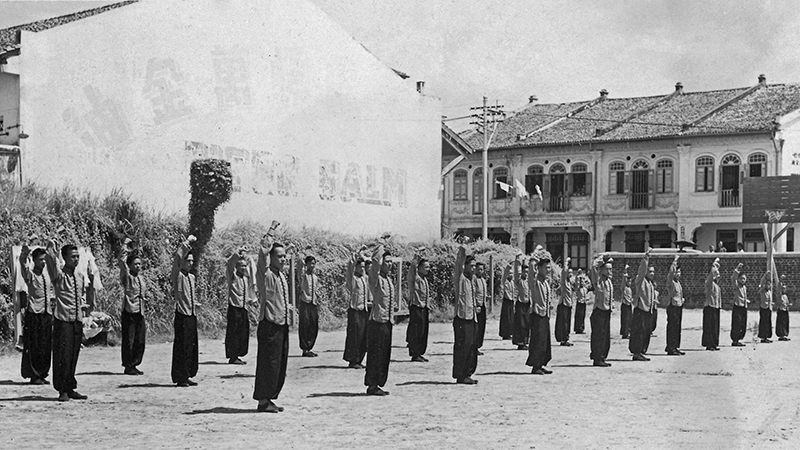
Chin Woo members during a mass martial arts workout at the association’s athletic field in Tanjong Pagar (Duxton Plain Park today) in the 1950s. Donated by Singapore Chin Woo (Athletic) Association. Collection of the National Library, Singapore.
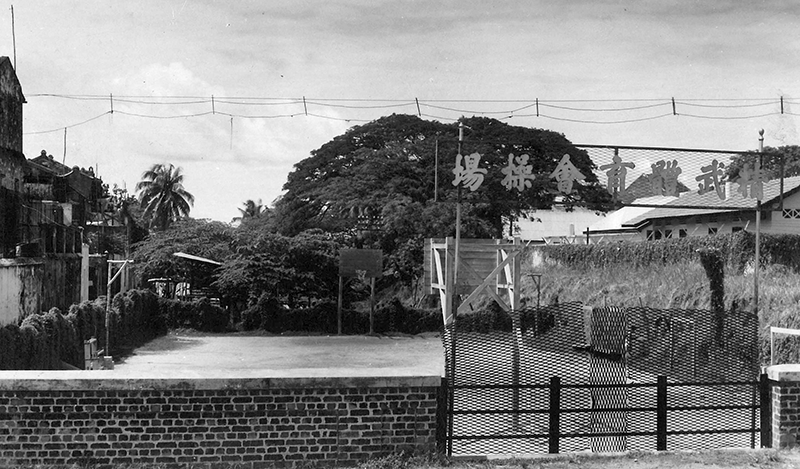
A view of the completed Chin Woo athletic field in Tanjong Pagar. A steel sign that reads “Chin Woo (Athletic) Association Athletic Field” in Chinese is visible at the entrance, c. 1940s. Donated by Singapore Chin Woo (Athletic) Association. Collection of the National Library, Singapore.
While Chen Zhen only existed in the movie, Huo was a real person. He is associated with the founding of the Shanghai Chin Woo (Athletic) Federation (上海 中央精武体育总会), one of the early public martial arts institutions in China, and which still exists today.2
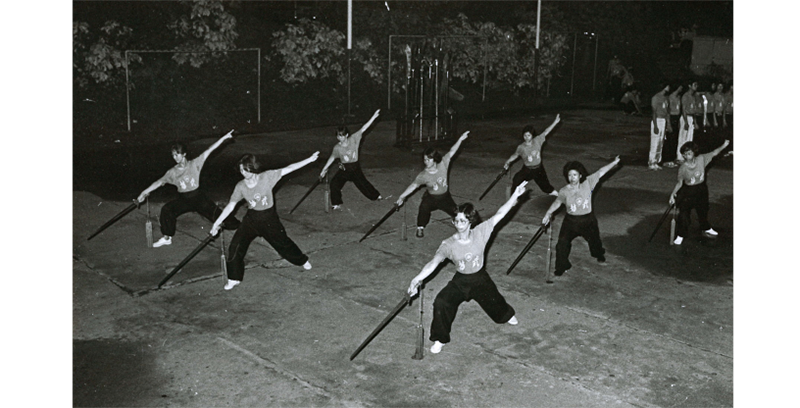
Female Chin Woo members training with swords (女子集体剑) at the association’s athletic field in the 1970s. Donated by Chin Woo (Athletic) Association. Collection of the National Library, Singapore.
Branching Out to Singapore
After its founding in Shanghai in the early 20th century, the federation expanded, setting up branches around China. In 1920, representatives from the federation travelled to Southeast Asia to encourage the overseas Chinese to set up martial arts schools in their own communities. In Singapore, the delegation was warmly welcomed by prominent Chinese leaders such as Lim Boon Keng, Eu Tong Sen and Lim Nee Soon. Martial arts performances and documentary screenings were held, which were well received by the Chinese community.3
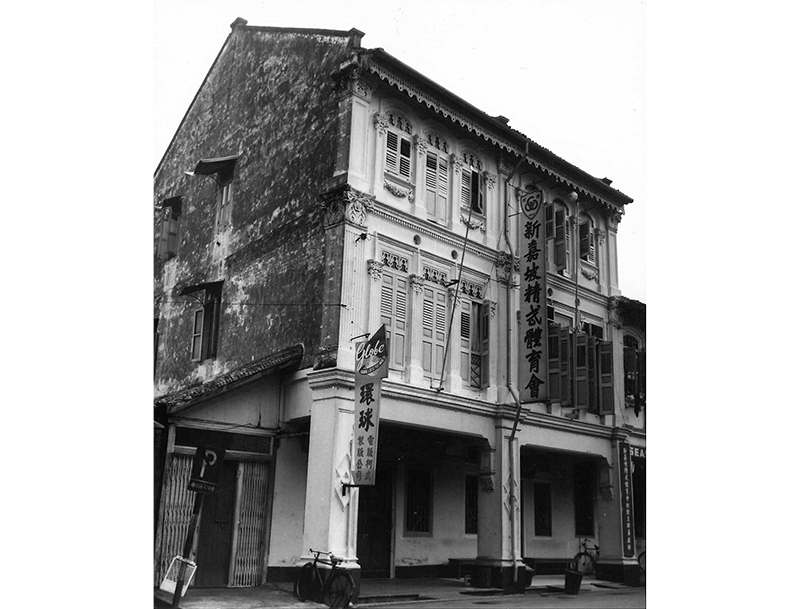
Since its founding in 1921, the Chin Woo Association had moved a few times before relocating to its current premises at 90 Neil Road in 1940, where it remains to this present day. Donated by Singapore Chin Woo (Athletic) Association. Collection of the National Library, Singapore.
Inspired by the visit, Cai Jinglin (蔡景麟), a Singapore-based martial arts instructor with links to Shanghai Chin Woo, teamed up with Yang Zhaozhen (杨兆桢) and led a founding committee that included businessmen like Lim Nee Soon. The Singapore branch of the federation was established in 1921.4
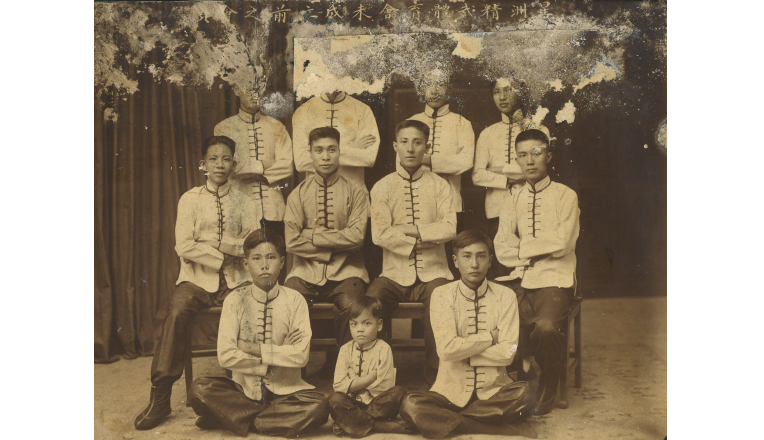
Early members of Chin Woo, 1920. Donated by Singapore Chin Woo (Athletic) Association. Collection of the National Library, Singapore.
About a year later, on 9 August 1922, it was officially registered by the colonial government as the Chinese Chin Wu (Athletic) Association (星洲中国精武体育会).5 (In 1960, the organisation assumed its current name, the Singapore Chin Woo [Athletic] Association.6) The association’s objectives are to impart martial arts, strengthen the body and mind, and instil “wisdom, benevolence, courage” (“智、仁、勇”) in its members, as embodied in its emblem of a shield with five pointed edges.7
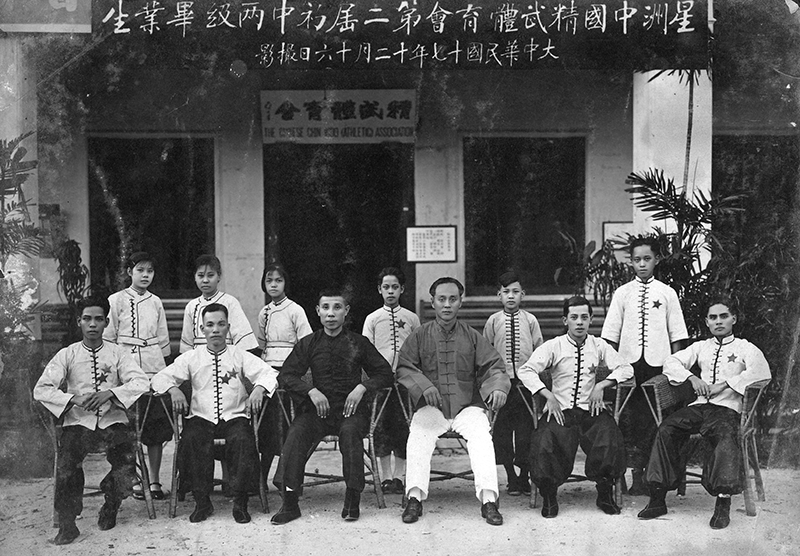
The second batch of graduating students with the instructors, Zhao Liancheng (赵连城) (third from left) and Liu Qinggui (刘清溎) (fourth from left), who were sent to Singapore by the Shanghai Chin Woo (Athletic) Federation, 1928. Donated by Singapore Chin Woo (Athletic) Association. Collection of the National Library, Singapore.
In 1953, the association mooted the establishment of a federation comprising the various Chin Woo athletic associations in Malaya (南洋中国精武会总会). The purpose was to “unite Chin Woo associations in Singapore and all over Malaya, encourage each other, jointly promote Chin Woo, improve the level of martial arts, enhance the efficiency of administration, contribute to the economy, and sponsor charitable and public welfare undertakings”.8 The Chinese name of the federation was changed to 马来亚精武体育会总会 (Malaya Chin Woo Athletic Association Federation) when it was registered in 1954.9 (The federation has also been referred to as 南洋马来亚精武体育会总会 [Nanyang Malaya Chin Woo Athletic Association Federation].10)
Martial Arts and Lion Dancing
Singapore Chin Woo teaches a variety of traditional Chinese martial arts, originating mainly from the Yellow River, Yangtze River and Pearl River regions of China. Its core curriculum revolves around 10 basic sets of martial arts forms (基本十套拳), namely Tai Tui (潭腿), Gong Li Quan (功力拳), Da Zhan Quan (大战拳), Jie Quan (节拳), Qun Yang Gun (群羊棍), Ba Gua Dao (八卦刀), Wu Hu Qiang (五虎枪), Jie Tan Tui (接潭腿), Tao Quan (套拳), Dan Dao Chuan Qiang (单刀串枪), as well as various forms of Tai Ji (太极).11
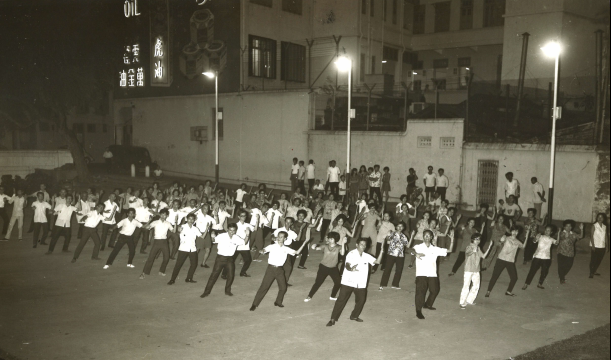
A mass training of Taiji Quan (太极拳) at the Chin Woo association’s athletic field in the 1960s. Donated by Singapore Chin Woo (Athletic) Association. Collection of the National Library, Singapore.
The association also became particularly well known for its lion dance troupe in Singapore. The troupe was founded in 1934 after a pair of northern lions were brought to Singapore by Wei Yuan Feng (魏元峰), a pioneer martial arts instructor who was formerly with Chin Woo in Shanghai.12
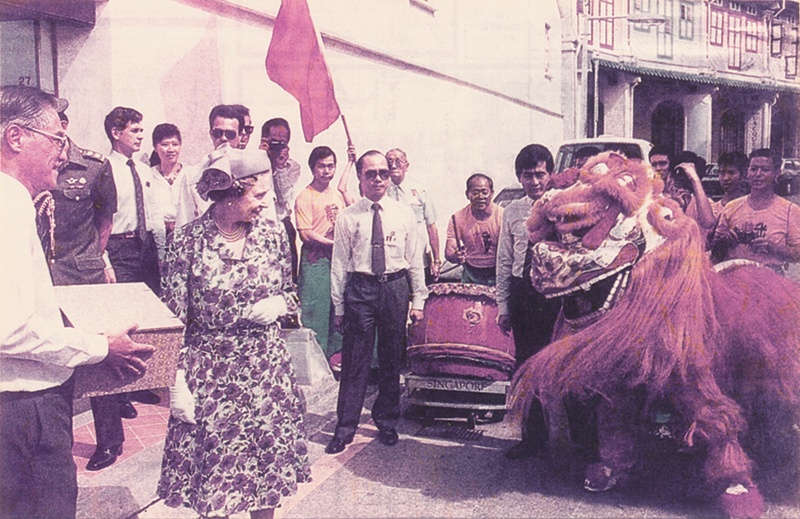
Queen Elizabeth II being greeted by a Golden Lion Dance performance by the Chin Woo lion dance troupe during her visit to Tanjong Pagar Conservation Area, 1989. Donated by Singapore Chin Woo (Athletic) Association. Collection of the National Library, Singapore.
The heads of the lions, however, were heavy and uncomfortable and so Wei, together with another instructor Fang You Chang (方又昌), decided to remake them. Instead of mud and sand, they used bamboo for the lion’s head, which was decorated with golden paper and golden yellow wool. They also made a cape for the lion’s body using golden yellow Manila hemp, a strong fibrous material from the Philippines.13 Thus was born the association’s distinctive golden lion.
The period between the 1960s and the 1980s was the peak of the lion dance troupe. In 1976, the image of the association’s lion was printed on Singapore’s $10 note. Today, the Golden Lion dance is a signature of the association and integrates gongs, drums and the suona (唢呐), a Chinese wind instrument.14
The troupe eventually also began performing the Southern Lion dance after He Shun (何顺), a famous Southern Lion Dance practitioner joined the association in 1953. Through his efforts, as well as those of other teachers, the troupe won the Southern Lion Excellence Award at the 7th National Pugilistic Competition in 1984.15
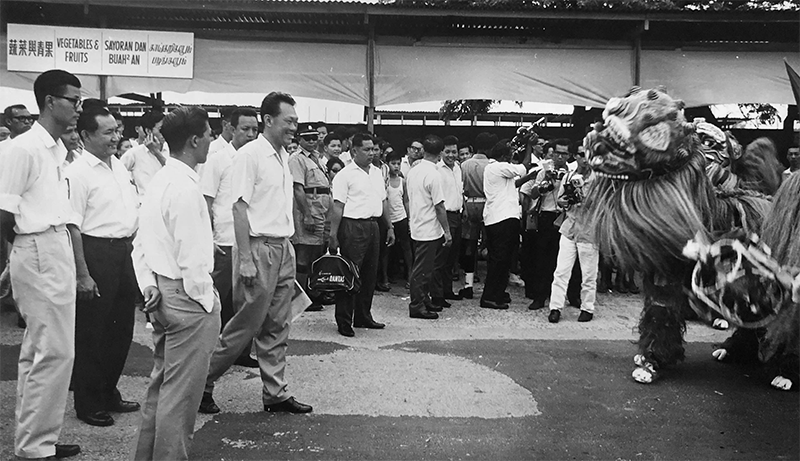
Chin Woo’s award-winning lion dance troupe was often invited for performances. This lion dance was performed at the opening ceremony of the Primary Production Department’s exhibition booth at an agricultural show in Kallang Park in September 1965. Prime Minister Lee Kuan Yew was the guest of honour. Donated by Singapore Chin Woo (Athletic) Association. Collection of the National Library, Singapore.
Chin Woo’s Donation of Materials to the National Library
In 2023, the association donated 150 items to the National Library. The donated materials comprise both physical and digital photographs as well as records and publications produced by Chin Woo, including a digital copy of their 100th anniversary publication.
One interesting record dates back to 1946 and documents the association’s plans for expanding its athletic field which was used for regular training sessions. Chin Woo had leased a 4,880 sq ft (453 sq m) space from the government and money was needed to fund its refurbishment, rent and other miscellaneous expenses.
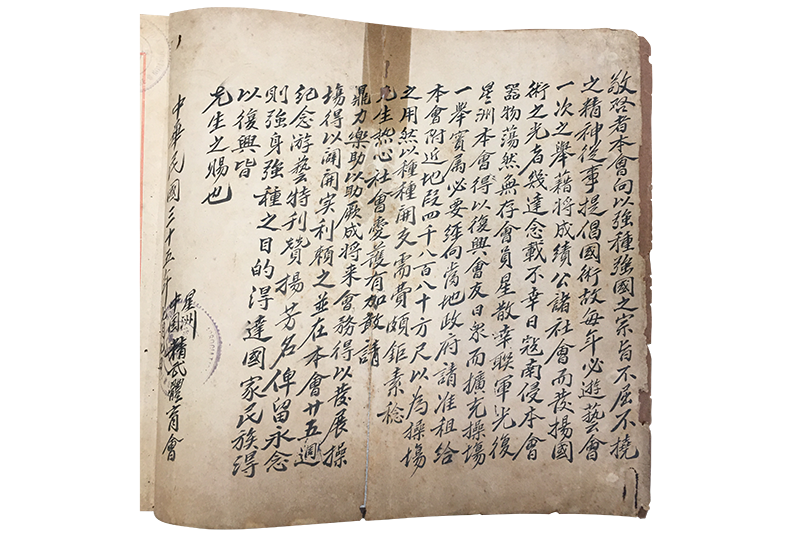
Chin Woo’s membership increased as Singapore rebuilt its society and economy after the Japanese Occupation (1942–45). This record, dating back to 1946, documents the association’s plans for expanding its athletic field in Tanjong Pagar. It also lists all donations sought for the expansion of the training ground and for expenses such as rent for the land and other miscellaneous purposes. Donated by Singapore Chin Woo (Athletic) Association. Collection of the National Library, Singapore.
The association managed to raise more than a thousand dollars, and this document records all the donations. The largest single donation was $700 and came from Nanyang Hwa Pek Thung Hsiang Hoey (南洋华北同乡会), a clan made up of members from provinces in northern China. It had been founded by Wei, the martial arts instructor with Chin Woo.
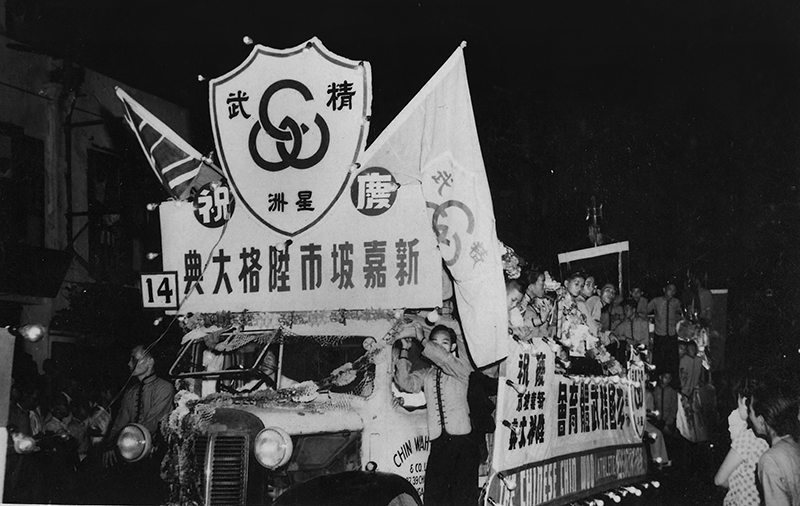
When Singapore was proclaimed a City of the British Commonwealth by a royal charter on 22 September 1951, Chin Woo was part of the procession from Lau Pat Sat to Shenton Way to celebrate the event. Donated by Singapore Chin Woo (Athletic) Association. Collection of the National Library, Singapore.
Today, the Singapore Chin Woo (Athletic) Association is one of the oldest Chinese martial arts associations in Singapore.16 In addition to martial arts, lion dance and flag dancing, Chin Woo conducts Chinese language classes and bookkeeping classes. They also have a choir and a Peking opera troupe, and offer recreational and fitness activities such as football, basketball, wrestling, dance and yoga.17
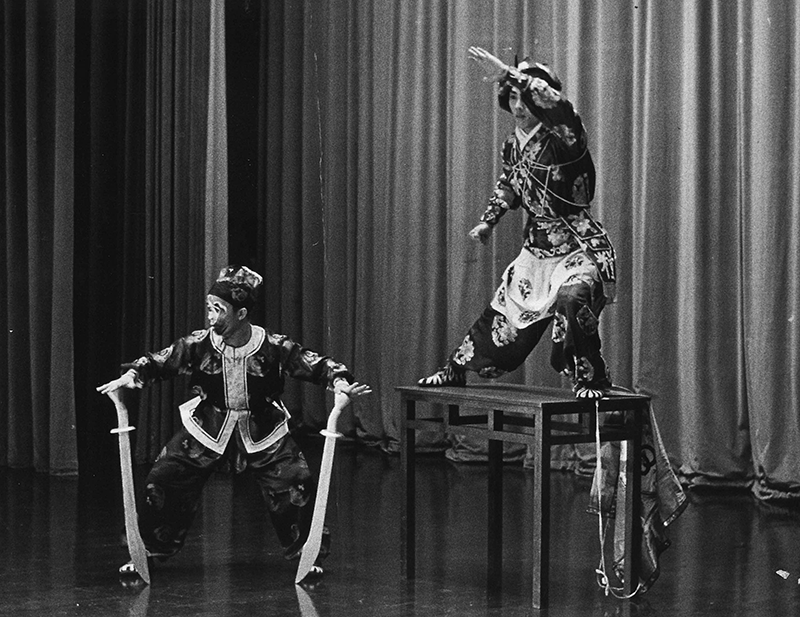
Chin Woo’s Peking opera troupe was established in 1959 and performed notable martial arts-related works such as Xin Tie Gong Ji (新铁公鸡) and San Cha Kou (三岔口). Shown here is a stage scene of San Cha Kou in the 1960s. Donated by Singapore Chin Woo (Athletic) Association. Collection of the National Library, Singapore.
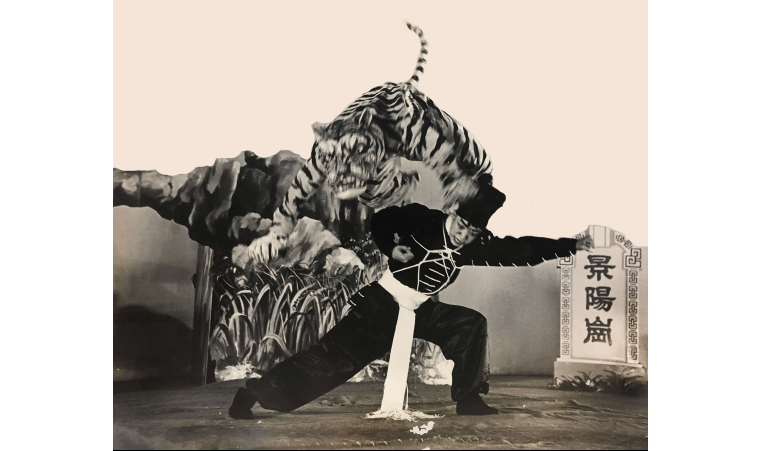
A performance of Peking opera, Wu Song Da Hu (武松打虎), c. 1960s. Donated by Singapore Chin Woo (Athletic) Association. Collection of the National Library, Singapore. The Singapore Chin Woo (Athletic) Association collection will be made available at the National Library and online in due course. Find more materials in the collection from our (catalogue) and (website).
About the Author
Seow Peck Ngiam is a Senior Librarian with the National Library, Singapore. Her responsibilities include selection, evaluation and management of materials for the Chinese and donor collections. She also conducts research and writes on collection highlights for the library.
Endnotes
1 Dwayne Wong (Omowale), “‘No Dogs and No Chinese Allowed’: The Historical Significance of Bruce Lee’s ‘Fist of Fury’,” HuffPost, 15 March 2016, https://www.huffpost.com/entry/no-dogs-and-no-chinese-al_b_9455424; “Enthusiasts Mark Martial Arts Master Huo Yuanjia’s 150th Birthday in Shanghai,” CGTN, 23 January 2019, https://news.cgtn.com/news/3d3d514f314d544d32457a6333566d54/index.html.
2 Lee Xiu 李秀, “Bai nian jingwu ti yu zai malaixiya de fa zhan ji ying xiang yan jiu” 百年精武体育在马来西亚的发展及影响研究 [The study of the development and influence of century-old Chin Woo in Malaysia], Journal of Huangshan University 13, no. 5 (October 2011): 96. (From JSTOR via NLB’s eResources website)
3 Singapore Chin Woo (Athletic) Association, 新加坡精武体育会四十五周年会庆纪念刊 1921–1966 = Singapore Chin Woo (Athletic) Association, 45th Anniversary Celebration Souvenir (Singapore: Singapore Chin Woo [Athletic] Association, 1966), 189. (From National Library, Singapore, call no. RCLOS Chinese 796.8159 SIN)
4 Singapore Chin Woo (Athletic) Association, 新加坡精武体育会四十五周年会庆纪念刊, 80.
5 “Our History,” Singapore Chin Woo (Athletic) Association, last accessed 8 January 2024, https://sgchinwoo.com/our-history; Untitled, Singapore Free Press and Mercantile Advertiser (1884-1942), 12 August 1922, 6. (From NewspaperSG)
6 “Our History.”
7 Lee, “Bai nian jingwu ti yu zai malaixiya de fa zhan ji ying xiang yan jiu,” 96–100; “Our Emblem and Flag,” Singapore Chin Woo (Athletic) Association, last accesses 8 January 2024, https://sgchinwoo.com/our-emblem-and-flag/.
8 Gong Pengcheng 龚鹏程, “Jing wu tiyu hui zai nanyang de fa zhan,” 精武体育会在南洋的发展 (The development of the Chin Woo Athletic Association in Southeast Asia), 少林与太极 (Shaolin and Taiji), no. 6 (2021), 52–55, https://m.fx361.com/news/2021/1012/8937357.html; “Ge de Jingwuhui dai biao ji yi shang jue zu lianhe jigou ding ming wei Nanyang zhongguo jingwuhui zonghui tong guo zhang cheng xu chu chang wu wei yuan ji ge bu zhi yuan” 各地精武会代表集怡商决组联合机构定名为南洋中国精武会总会通过章程选出常务委员及各部职员 (Representatives of Chinese martial arts associations from various states met in Ipoh and decided on the formation of Nanyang Zhongguo Jingwuhui Zonghui), 南洋商报 Nanyang Siang Pau, 6 May 1953, 9. (From NewspaperSG)
9 “Ma jingwu zonghui yi huo zhun zhu ce” 马精武总会 已获准注册 (Registration of Chin Woo federation of Malaya has been approved), 星洲日报 Sin Chew Jit Poh, 19 February 1954, 8. (From NewspaperSG)
10 Singapore Chin Woo (Athletic) Association, 新加坡精武体育会五十周年会庆纪念刊 1921–1971 = Singapore Chin Woo (Athletic) Association, 50th Anniversary Celebration Souvenir (Singapore: Singapore Chin Woo [Athletic] Association, 1971), 240. (From National Library, Singapore, call no. RCLOS Chinese 796.8155095957 SIN)
11 “Martial Arts,” Singapore Chin Woo (Athletic) Association, last accessed 8 January 2024, https://sgchinwoo.com/martial-arts/.
12 Singapore Chin Woo (Athletic) Association, 新加坡精武体育会四十五周年会庆纪念刊, 80.
13 “Oriental Papermaking Fibres,” Centre for Cultural Materials Conservation, last accessed 8 January 2024, https://cultural-conservation.unimelb.edu.au/manilahempabaca.html.
14 Singapore Chin Woo (Athletic) Association, 新加坡精武体育会一百周年纪念刊 = Singapore Chin Woo (Athletic) Association 100 Anniversary (Singapore: Singapore Chin Woo [Athletic] Association, 2021), 66–67. (From National Library, Singapore, call no. RSING Chinese 796.8155095957 SIN)
15 Singapore Chin Woo (Athletic) Association, 新加坡精武体育会一百周年纪念刊, 66–67.
16 “Our History.”
17 Singapore Chin Woo (Athletic) Association, 新加坡精武体育会一百周年纪念刊, 34.