
Article
A Century of Singapore’s Cinemas
Topics
Arts
1 January 2026
Once central to Singapore’s social and cultural life, cinemas went from being majestic, memorable landmarks to more utilitarian and prosaic halls housed in shopping malls.
By Alvin Tan
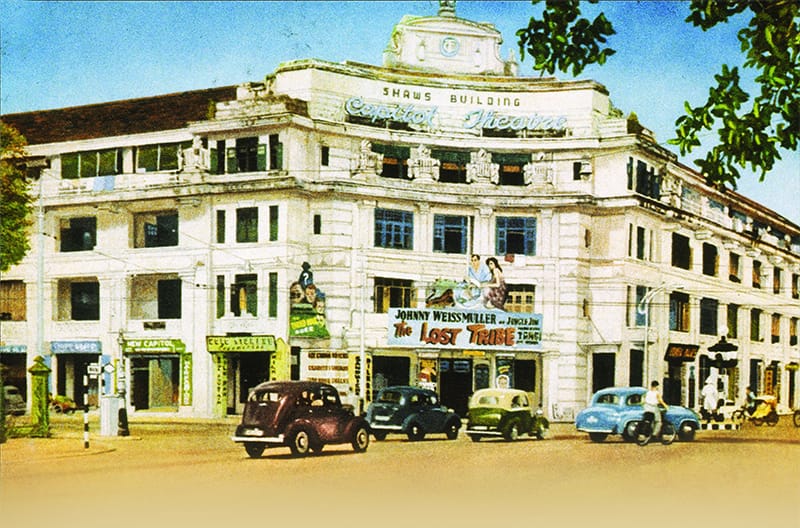
Capitol Theatre and the adjoining Namazie Mansions at the junction of Stamford Road and North Bridge Road, c.1950. Courtesy of National Archives of Singapore (Media - Image no. 19980005110 - 0043).
For film aficionados in Singapore, Tuesday, 19 August 2025, was a black day. That was when The Projector – Singapore’s only independent cinema – announced that it would cease all operations immediately, with all screenings and events cancelled. Citing “rising operational costs, shifting audience habits and the global decline in cinema attendance”, The Projector would go into liquidation with debts totalling $1.2 million.1 This was followed by an announcement a few weeks later that Cathay Cineplexes would be wound up and go into voluntary liquidation.2 Is this curtains for the cinema industry in Singapore?
Cinemas were once institutions that served important social, cultural, educational and economic functions. In the pre-television era, these landmark buildings provided the people with communal experiences. Today, for most people, watching a movie has gone from being a shared experience to a siloed and personalised act of private, if not solitary, consumption, on a glass screen slightly wider than one’s palm. Or if one makes the effort to go to the cinema, it means traversing the many floors in a shopping mall before locating it on the uppermost floor, one option among the many offerings and services available.
Little but a Novelty?
Singapore’s first enclosed cinema – the Paris Cinematograph – opened in 1904, in a section of the Malay Theatre on Victoria Street. Before this, film screenings took place in tents or in existing theatres and music halls. For the locals, the cinema added another option to the rich repertoire of street entertainment available at the time, such as Chinese opera, Javanese wayang kulit (shadow puppetry) and bangsawan (Malay opera).
As “talkies” (films with sound) came on the scene, bangsawan failed to compete and former bangsawan venues were converted into movie theatres. In February 1935, Theatre Royal on North Bridge Road – ostensibly the first permanent bangsawan venue – was modernised, renamed Royal Theatre and eventually screened Tamil “talkies” in place of bangsawan performances.3
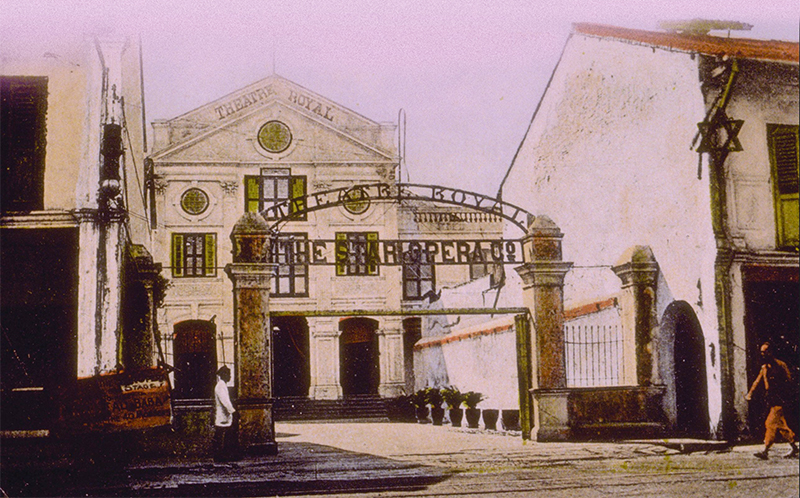
Theatre Royal on North Bridge Road, c. 1910. It was the first permanent venue for bangsawan (Malay opera) performances. Courtesy of National Archives of Singapore (Media - Image no. 19980007360 - 0033).
Meanwhile, with their moving images (and eventually sound), cinemas in Singapore grew in popularity. New venues appeared, some of which became household names and geographical landmarks. In 1909, Tan Cheng Kee – the eldest son of the Melaka-born Peranakan entrepreneur Tan Keong Saik (Keong Saik Road in Singapore was named after him) – bought the Marlborough and the adjacent Alhambra theatres on Beach Road. He rebuilt the Alhambra in 1914 per the design of Eurasian architect J.B. Westerhout and reopened it to great fanfare in 1916.4
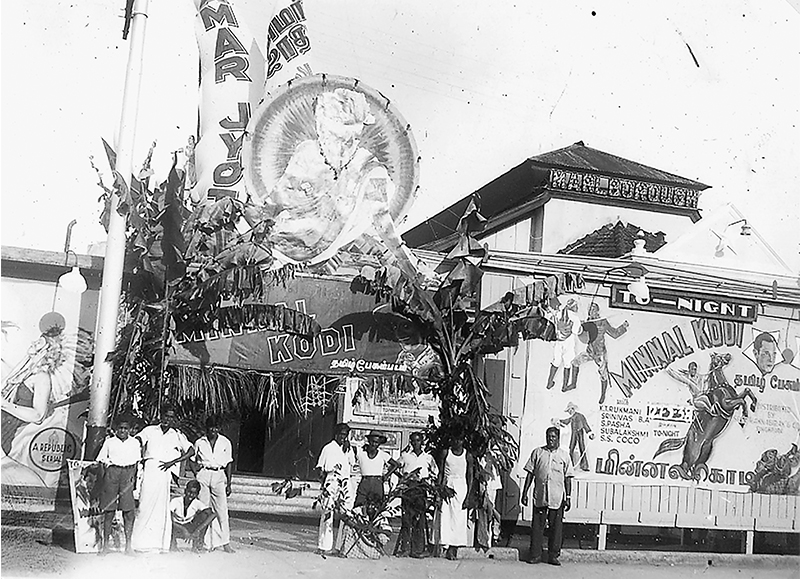
The Marlborough on Beach Road, 1938–39. Along with the Alhambra, it was demolished in the 1970s to make way for the Shaw Towers complex. RAFSA Collection, courtesy of National Archives of Singapore Media - Image no. 20170000052 - 0172).
The cinema was nicknamed “Hai Kee”, meaning “edge of the sea” in Hokkien because of its beachfront location. The Alhambra could seat 3,500 patrons who could take in the sea view from its tea garden, which came with a live orchestra to boot.5 These marked Tan’s first forays into Singapore’s cinema business. His pioneering moves predated the better-known Shaw Brothers and Cathay Organisation by more than a decade.
Tan went on to acquire the Palladium on Orchard Road in 1918 for $25,000 – way below its $60,000 construction cost. Tan remodelled this erstwhile rival of the Alhambra, renaming it the Pavilion in 1925.6 At the same time, he rebuilt his first acquisition – the Marlborough – and equipped it with electric fans and lighting to make for a more comfortable viewer experience.
A shrewd businessman, Tan was an inveterate upgrader who willingly invested to make his cinemas relevant and appealing. In 1930, he shelled out $100,000 to update and improve the Alhambra which, together with the screening rights he obtained from major film producers Metro-Goldwyn-Mayer, United Artists, Fox Film Corporation and Warner Brothers, ensured that the crowds kept coming.7
The late 1920s onwards saw a boom in the movie theatre industry. In 1929, Jubilee Theatre on North Bridge Road opened. It was among the first cinemas to be installed with equipment to support “talkies”. In the 1950s, it was the premier theatre for Cantonese films, with bookings having to be made one week in advance.
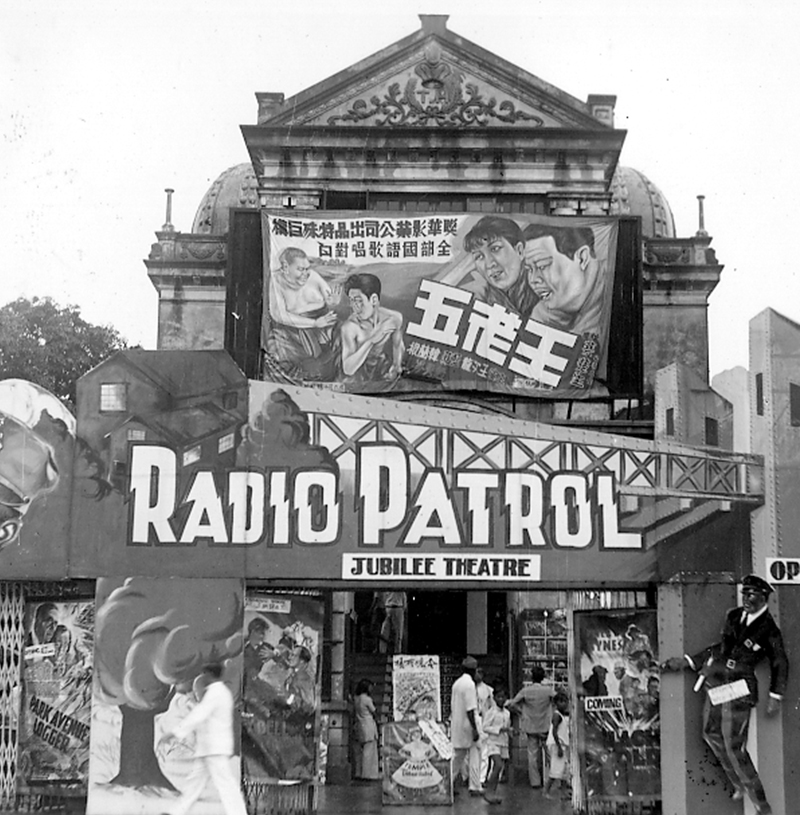
Jubilee Theatre on North Bridge Road, 1937–38. It was demolished in the 1990s to make way for an annex to the Raffles Hotel, and today comprises shops, restaurants and Jubilee Hall. RAFSA Collection, courtesy of National Archives of Singapore (Media - Image no. 20170000052 - 0152).
A year later, Capitol Theatre, owned by the Namazie brothers, opened on 22 May 1930. Located at the junction of Stamford Road and North Bridge Road, it was not just another cinema. It was a high-end destination that exuded a touch of upmarket class that none of the other cinemas quite managed to replicate.8
Inspired by the Roxy Theatre in New York, Capitol’s British architects, P.H. Keys and F. Dowdeswell, designed a building that remains an architectural landmark to this day. Capitol was in many ways a cinema of superlatives. It was the largest theatre in the Far East with its 1,600-seating capacity. It housed what was then the largest projection room in the world, built with reinforced concrete, the latest construction material. It screened its films with the world’s latest Simplex deluxe projectors.
Its ventilation system, novel and innovative for its time, pumped in cooled air for the comfort of its patrons, who were decked out in their best. Most importantly, it was built and equipped specifically for “talkies”, with special attention paid to its acoustic design and performance.9
The others were not to be outdone though. On 3 October 1939, Singapore’s first skyscraper, the 16-storey Cathay Building opened at the foot of Mount Sophia. Housing a hotel, a restaurant and Singapore’s first air-conditioned cinema with 1,321 seats, it was owned by the film magnate Loke Wan Tho, who established Cathay Organisation in 1935.10
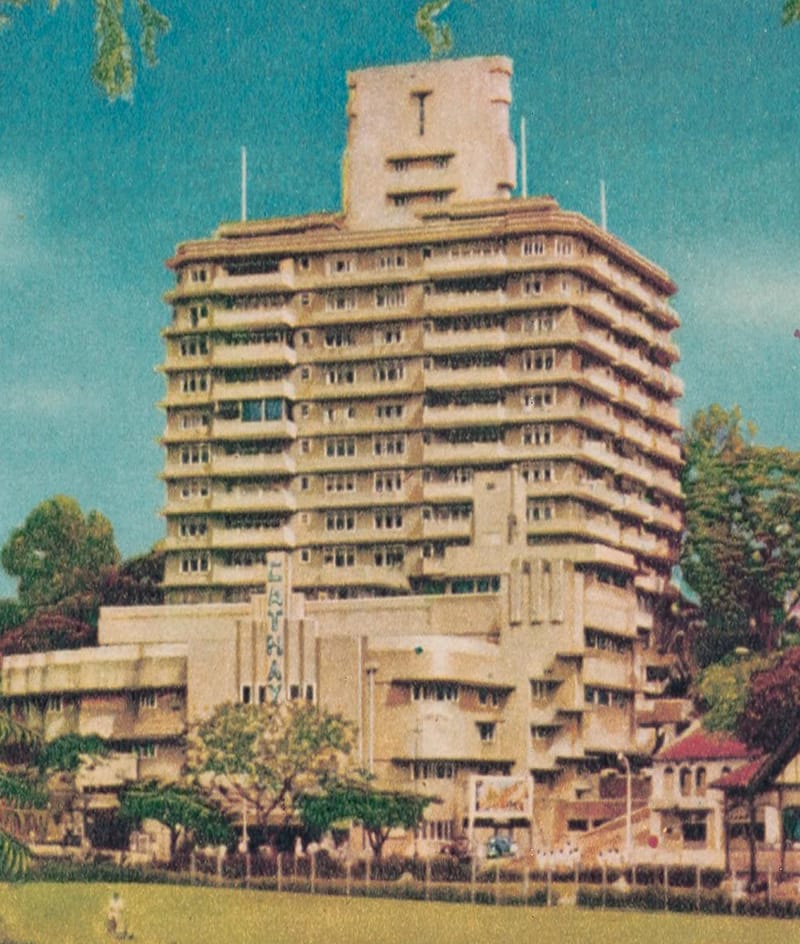
The 16-storey Cathay Building was Singapore’s first skyscraper, c. 1970. It was appropriated by the Japanese during the Japanese Occupation. Collection of the National Museum of Singapore, National Heritage Board.
On 15 February 1942, the British surrendered Singapore to the Japanese after a bruising 70-day campaign that saw them retreat down the length of the Malay Peninsula. Cathay Building, which was hit by enemy gunfire, was appropriated by the Japanese during the occupation years and renamed Dai Toa Gekijo (Greater Eastern Asian Theatre). It was used as the base for Radio Syonan, and as the headquarters of the propaganda department and the military information bureau.
Postwar Recovery and Growth (1946–65)
After the war, the cinema industry underwent a period of consolidation and growth. In 1946, Shaw Brothers – founded by Shanghainese brothers Runme Shaw and Run Run Shaw in 1928, who were originally from Ningbo, China – acquired Capitol Theatre.11 Tan Cheng Kee’s cinema empire, which had divested the Alhambra and the Marlborough in the late 1930s to Shaw Brothers, exited the scene.12
Shaw Brothers, which became the holding company Shaw Organisation in 1988, built Shaw House at the junction of Orchard Road and Scotts Road. The 10-storey building officially opened in November 1958, and was constructed using Italian marble, specially hammered plaster and Venetian glass mosaic tiles. Lido Cinema, described as the “most luxurious theatre in Singapore” by the Straits Times, opened beside Shaw House in February 1959.13
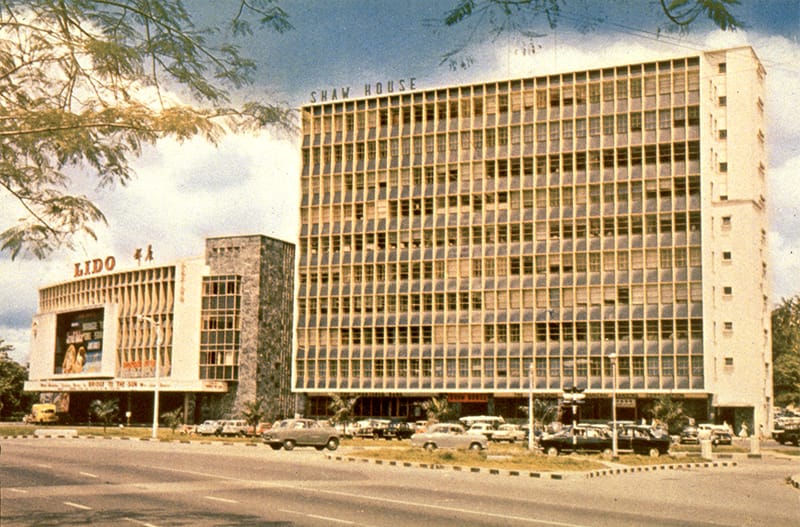
Lido Theatre and Shaw House at the junction of Orchard Road and Scotts Road, 1960s. Both buildings were demolished in 1990 to make way for the present-day Shaw House which houses Lido cineplex, Isetan Department Store and retail shops. Courtesy of National Archives of Singapore (Media - Image no. 19980002919 - 0084).
Cathay Organisation also began expanding its cinema chain.14 In January 1951, Cathay, after renovating and renaming the Alhambra as the New Alhambra, reopened a year later with a screening of the Western film, Broken Arrow.15
A new player also entered the market. In 1945, Goh Eng Wah, originally from Muar, Johor, partnered a friend to open and screen films in Victory Theatre at Happy World (later renamed Gay World) amusement park.16 He subsequently acquired stakes in Happy Theatre and Silver World, both at the same location. The eponymously named Eng Wah Organisation, founded in 1946, grew to become a major player in cinemas in Housing and Development Board (HDB) estates across Singapore in the 1970s.17 Eng Wah, together with Shaw and Cathay, eventually dominated the postwar movie theatre business.
New Towns, New Lifestyles, New Cinemas (1965–97)
Singapore’s independence and subsequent urban redevelopment marked the next stage of expansion for cinemas. In late 1965, two cinemas – Venus Theatre and Golden City Theatre – opened in Queenstown, Singapore’s first satellite town by the Singapore Improvement Trust.18 Located on Margaret Drive, these were followed by the dual-screen Queenstown Cinema and Bowling Centre in 1977.19
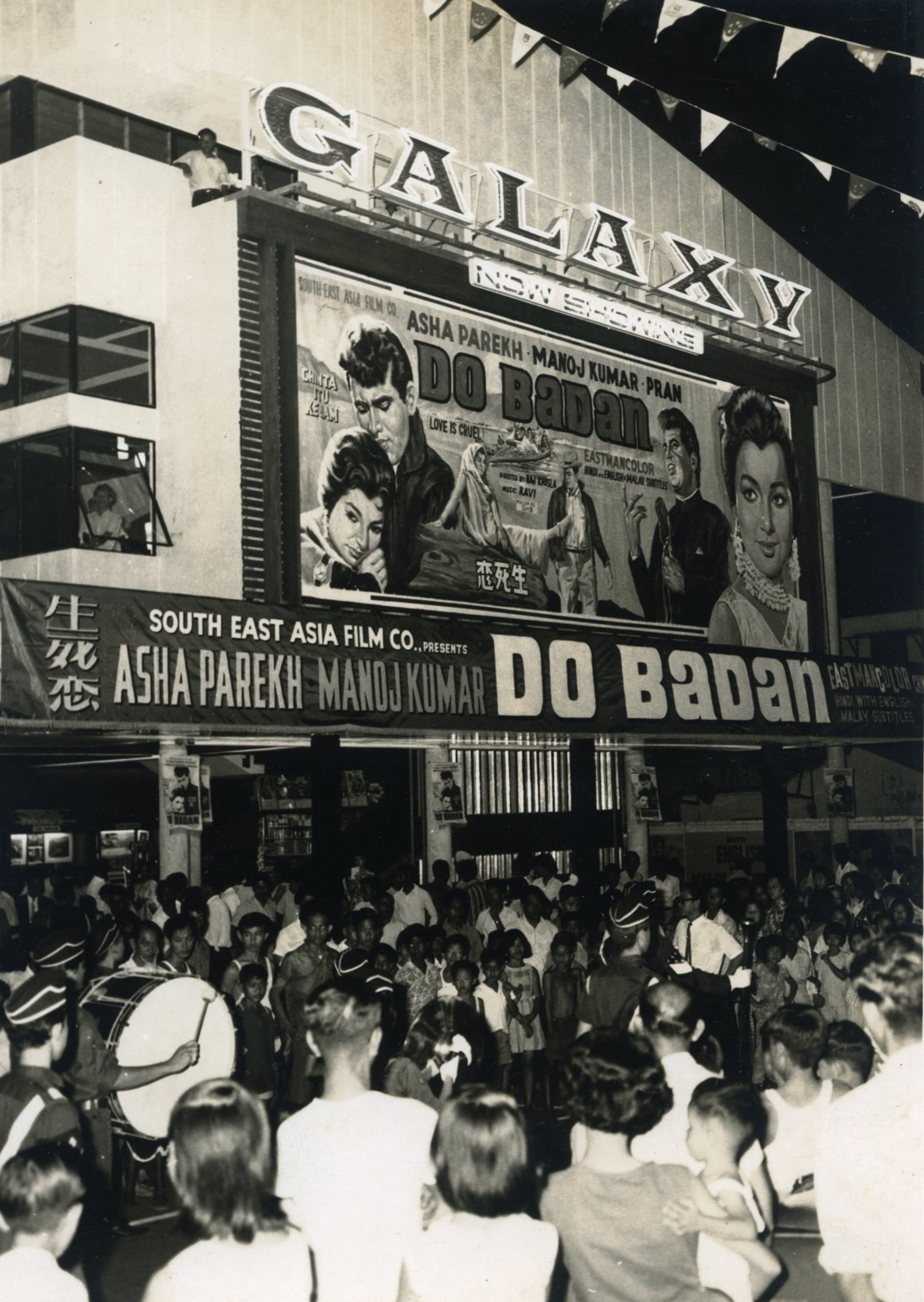
Opening of Galaxy Cinema in Geylang on 15 October 1965. It was owned by Lim Nee Soon, rubber tycoon and prominent community leader, and known as Apollo Theatre in the 1930s. Upon his death in 1936, his son Lim Chong Pang took charge of the cinema and renamed it Garrick Theatre. In 1965, Chong Pang’s son, Herbie Lim Eng Kwan, rebranded it as Galaxy Cinema. The building is today home to the Muslim Converts' Association of Singapore. Courtesy of Peter Lee.
This reflected the ethos of HDB’s town planning, that is each satellite or new town would be self-contained with a range of amenities and services that residents could access conveniently. In 1972, Toa Payoh Cinema and Kong Chian Cinema (later renamed Central Cinema) opened, bringing the cinematic experience to HDB’s first new town. Other names soon appeared: Savoy in Boon Lay in 1978, Broadway in Ang Mo Kio in 1979, Empress in Clementi in 1980, Bedok Cinema in 1980, Jubilee in Ang Mo Kio in 1981, and Princess and Raja in Bedok in 1983.20
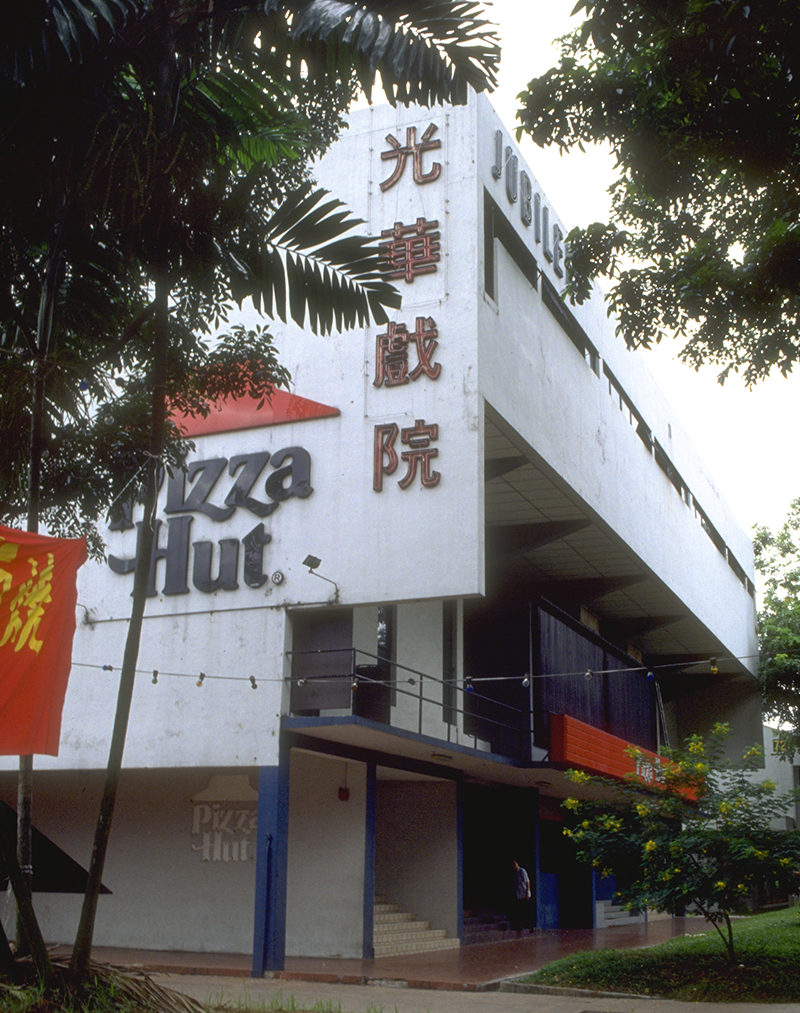
Jubilee Theatre in Ang Mo Kio Town Centre, 1994. Courtesy of National Archives of Singapore (Media - Image no. 19980007383 - 0107).
Over in Jurong, Cathay developed the Jurong Drive-In Cinema, which opened on 14 July 1971. The drive-in combined the privilege of car ownership and the fun of film viewing. It afforded cinemagoers a modicum of privacy and the atmosphere of a carnival, under the night sky.
Located on Yuan Ching Road, it occupied 5.6 ha of land for 900 cars, which required 259,939 cc of infill, and had a massive 14.3 m by 33.5 m screen, hanging 7.6 m from the ground. To add to the atmosphere, vendors sold ice cream and cold drinks to customers in their cars, which were hooked up with speakers. Even its location in far-flung Jurong was a draw. Hotel executive Lilian Gan recalled: “My husband and I used to go there once or twice a week. We’d go on long drives on weekends and end up there.”21
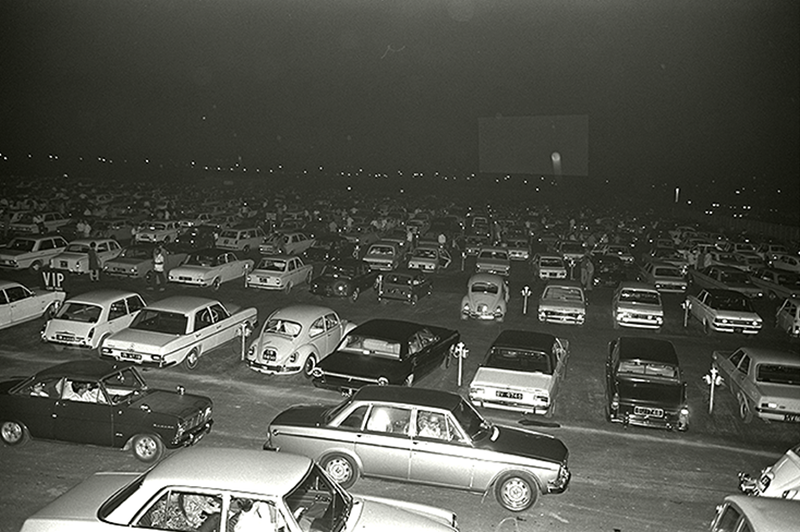
Vehicles at the Jurong Drive-in Cinema on opening night, 14 July 1971, Ministry of Information and the Arts Collection, courtesy of National Archives of Singapore Media - Image No. 19980007001 - 0003).
Although many cinemas were opening in the suburbs, there were signs from the late 1970s that the movie theatre was losing its draw. Jubilee Theatre on North Bridge Road closed in 1978 due to the lack of modern facilities and declining business. Then in September 1985, Jurong Drive-In closed for good after a short 15-year existence.22 Both the iconic Lido and the original Shaw House were demolished in 1990 to make way for the present-day Shaw House, with the theatre being integrated into the building as opposed to a standalone structure.
Standalone cinemas became an endangered species after Yishun 10, Singapore’s first multi-hall cinema complex, or cineplex, showed the way. The cineplex opened on 27 May 1992 in Yishun, then the last stop on the North-South Line of the Mass Rapid Transit system. Clad in metal and red and adorned with science-fiction motifs, the building, designed by architect Geoffrey Malone, was intended to look like “a rocket ship which had landed in Yishun from outer space”.23
Yishun 10 had scale. It spanned 3,635 sq m of floor space, with 2,552 seats across 10 movie halls. It housed popular and affordable dining options – Burger King, Milan Pizza and Long John Silver’s – serving as a one-stop destination for the moviegoer. It even offered 10 movies for the price of nine through a stored-value card, allowing cashless payment. This combination of novelty, high-tech cool and convenience proved to be a hit for Golden Village Entertainment – it drew more than three million visitors by the end of 1993.24
Soon, other cineplexes followed suit. In September 1993, Shaw Organisation opened a four-screen cineplex in Jurong Entertainment Centre, which also housed an amusement arcade, a bowling alley and Fuji Ice Palace, an ice skating rink. And in 1997, Cathay’s youth-centric Cineleisure Orchard opened at the site of the former Orchard Cinema, offering multiple screens, retail floors and dining options.25
The cineplex was a model that existing single-hall cinemas – whose attendance numbers fell in the 1990s – found difficult to beat. By the early 2000s, many household names had ceased operations altogether.
From Big Screen to Small Screen (1995–2025)
While the cineplexes continued to draw crowds, the industry was facing incipient challenges from sociocultural and technological shifts that slowly but surely shaped and changed – perhaps irreversibly – the way people entertained themselves. In 1995, Singapore Cable Vision, on the back of robust financial and infrastructure support by a consortium, launched its first subscription cable television service in Tampines.26
Priced at $29.95 a month, cable TV promised a world of entertainment at your fingertips and in the comfort of your own home.27 In 1996, 57,580 subscribers signed up, which tripled to 255,000 over the next five years.28 Along with the easy availability of video cassette recorders and rampant video piracy, cinema attendance started to fall.29
Older cinemas began closing despite attempts at reconfiguring themselves as cineplexes. Some, such as Ang Mo Kio’s Jubilee Theatre, were demolished but others were repurposed, while still others were given conservation status.30
In 1986, Fairfield Methodist Church acquired and refurbished the Metropole Theatre in Tanjong Pagar. The cinema, with its distinctive Modernist curves and wall-to-wall window facade, was designed by local architect Wong Foo Nam and completed in 1958.31
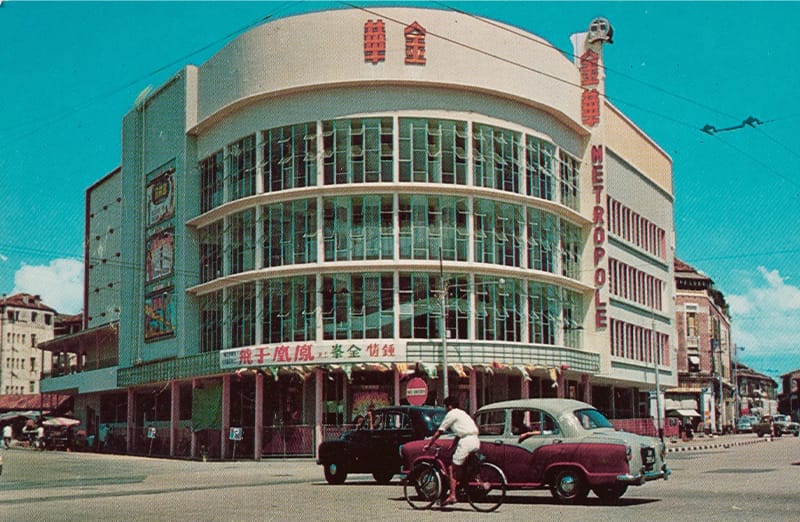
Metropole Theatre at the junction of Tanjong Pagar Road and Maxwell Road, late 1960s. The building, which has a curved facade with floor-to-ceiling windows, presently serves as the Fairfield Methodist Church. Collection of the National Museum of Singapore, National Heritage Board.
Toa Payoh’s eponymously named cinema, which opened in 1972, changed hands twice and is now ERA Asia-Pacific’s new headquarters. Majestic Theatre on Eu Tong Sen Street in Chinatown, a Swan & Maclaren design, was granted conservation status in 1989. It currently houses the Majestic Smart Seniors Applied Learning Centre.32
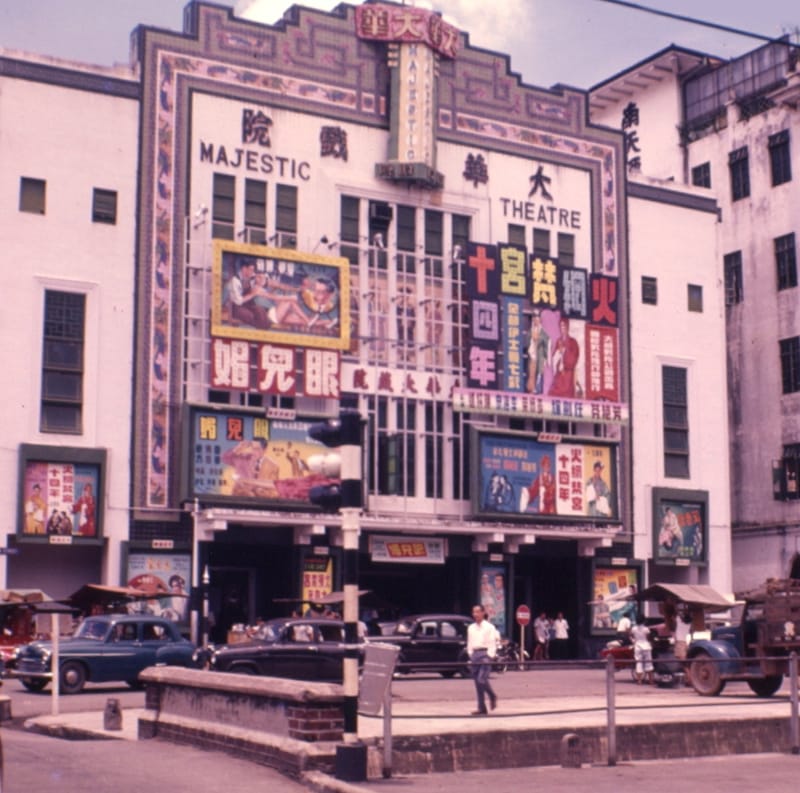
Majestic Theatre on Eu Tong Sen Street in Chinatown, 1960s. It was designed by Swan & Maclaren in a mix of Western and Chinese architectural styles. The building today houses the Smart Seniors Applied Learning Centre by RSVP Singapore. RAFSA Collection, courtesy of National Archives of Singapore (Media - Image no. 20220000214 - 1262).
By the 2000s, standalone cinemas were well on their way to becoming extinct. Recognising this, the state decided to designate Cathay Building’s Art Deco facade as a national monument in 2003, while the building itself was demolished and replaced by a modern steel-and-glass construction. In 2007, the same conservation status was granted to Capitol Theatre.33
Disruption finally and truly arrived in June 2007 when the Apple iPhone was launched. Within a decade, Singapore would be inundated by a wave of converging technological developments – mobile broadband, social media, fibre broadband and nationwide 4G coverage – enabling mobile computing that would radically transform how entertainment is consumed.34
Both cinemas and cable TV operators worldwide faced the prospect of freefalling viewership as content creation became increasingly social, personal and personalised. Now, you can watch a movie in the comfort of your home, watch whatever whenever you want as many times as you wish, and rewatching whatever you've watched earlier. You can also create your own content and put it online, and wait or hope for it to go viral.
Cinema attendance fell from a peak of 22 million in 2013 to 10 million in 2023. Despite an increase in the number of cinema screens from 218 to 277 in the same period, seating capacity held steady at about 39,000 between 2013 and 2023.35
The numbers have only gotten worse since the Covid-19 pandemic. According to the Singapore Film Commission, cinema attendance plunged from 18.46 million in 2019 to just 8.4 million in 2024, a drop of 54.5 percent.36
The dominoes began falling on 11 January 2022 when Filmgarde Cineplexes announced it was shutting down its cinemas in Century Square and Bugis+. In June 2022, Cathay Cineplex at the landmark Cathay Building shuttered. This was followed by closures in Ang Mo Kio Hub, Parkway Parade, Cineleisure Orchard and West Mall over the next three years.37
In October 2024, Eng Wah sold its cinema operations to mm2 Asia, marking its exit from the industry after 79 years. In March 2025, Filmgarde announced on Instagram that its last remaining screen in Leisure Park Kallang would close, after 18 years in the industry.38 These were undoubtedly business decisions driven by falling cinema attendance, tight margins, rental and cost pressures and other related factors, in particular, the economic fallout from the
Covid-19 years.
The Future of Cinema
Are present developments merely a market shakeout allowing the fittest to survive or do they portend the end of cinemagoing? Shaw Organisation is certainly not throwing in the towel just yet. In fact, Shaw has announced that it is upgrading Lido with laser projectors and new screens. Full renovation works will only be completed at the end of 2025.39
Shaw has also taken over the cinema space in Jurong’s Jem mall after the landlord terminated its lease with Cathay Cineplexes and repossessed the cinema space in March 2025. Mark Shaw, director of the Shaw Organisation Group of Companies, told the Straits Times that Shaw Theatres at Jem would open in stages from November 2025.40
While Hollywood blockbusters and big-name directors might still pull in crowds on occasion, cinema operators will have to address the larger societal and economic shifts that have eroded the spatial, visual and aural advantages that their big halls, big screens and big sound systems have traditionally enjoyed. With the shift in consumption patterns and the current preference for solitary, private viewing over communal experiences, cinemas certainly must reinvent themselves if they hope to continue avoiding the fate of the bangsawan theatres that they replaced a century ago.
About the Author
Alvin Tan is an independent researcher and writer focusing on Singapore history, heritage and society. He is the author of Singapore: A Very Short History – From Temasek to Tomorrow (Talisman Publishing, 2nd edition, 2022) and the editor of Singapore at Random: Magic, Myths and Milestones (Talisman Publishing, 2021).
Endnotes
1 Angelica Ang, “Singapore Indie Cinema the Projector Ceases Operations from Aug 19 After over a Decade,” Straits Times, 19 August 2025, https://www.straitstimes.com/life/local-indie-theatre-the-projector-to-cease-operations-on-aug-19-after-a-decade; Sharanya Pillai, Tessa Oh and Paige Lim, “The Projector Owes S$1.2 Million to Creditors; Golden Mile Cinema Put Up for Rent,” Business Times, 19 August 2025, https://www.businesstimes.com.sg/companies-markets/projector-owes-s1-2-million-creditors-golden-mile-cinema-put-rent.
2 Therese Soh, “Cathay Cineplexes Ceases Operations As Talks With Creditors Fall Through,” Business Times, 1 September 2025, https://www.businesstimes.com.sg/companies-markets/cathay-cineplexes-ceases-operations-talks-creditors-fall-through.
3 Tan Chui Hua, “The Theatres of Bangsawan,” BiblioAsia 15, no. 4 (January–March 2020): 8–13.
4 Bonny Tan, “From Tents to Picture Palaces: Early Singapore Cinema,” BiblioAsia 11, no. 1 (April–June 2015): 6–11; Barbara Quek, “Cinema Pioneer Tan Cheng Kee,” BiblioAsia 18, no. 1 (April–June 2022): 54–57.
5 Quek, “Cinema Pioneer Tan Cheng Kee.”
6 Tan, “From Tents to Picture Palaces: Early Singapore Cinema”; Quek, “Cinema Pioneer Tan Cheng Kee.”
7 Quek, “Cinema Pioneer Tan Cheng Kee.”
8 Bonny Tan, “Living It Up at the Capitol,” BiblioAsia 13, no. 4 (January–March 2018): 16–21.
9 Tan, “Living It Up at the Capitol.”
10 Soh Gek Han, “Key Milestones in the History of Cathay Cinema,” BiblioAsia (2022).
11 Vernon Cornelius-Takahama and Ong Eng Chuan, “Cathay Building,” Singapore Infopedia. Article published September 2020.
12 “Shaw Cinemas, Pre War,” Shaw Organisation, accessed 3 October 2025, https://shaw.sg/prewar; Quek, “Cinema Pioneer Tan Cheng Kee.”
13 “The Rise of the House of Shaw,” Straits Times, 22 November 1958, 1; “Scott Will Open New Theatre,” Straits Times, 6 February 1959, 11. (From NewspaperSG)
14 Bonny Tan, “Loke Wan Tho: The Man Who Built Cathay,” BiblioAsia 18, no. 3 (October–December 2022): 60–68; Alvin Chua, “Cathay Organisation,” Singapore Infopedia. Article published 2011.
15 “Alhambra to Be Renovated,” Straits Times, 13 January 1951, 5; “Face Lift for Singapore Cinema,” Straits Times, 14 January 1951, 11. (From NewspaperSG)
16 Boon Chan, “Goh Eng Wah, Pioneer of Local Cinema Industry, Dies at 92 of Congestive Cardiac Failure,” Straits Times, 7 September 2015, https://www.straitstimes.com/lifestyle/entertainment/goh-eng-wah-pioneer-of-local-cinema-industry-dies-at-92-of-congestive.
17 Heirwin Mohd Nasir, “Goh Eng Wah,” Singapore Infopedia. Article published 2015.
18 “Development of Queenstown, Singapore’s First Satellite Town,” Singapore Infopedia. Article published 2014; National Heritage Board, “Former Venus and Golden City Cinemas,” Roots, last updated 2 November 2021, https://www.roots.gov.sg/places/places-landing/Places/landmarks/my-queenstown-heritage-trail/former-venus-golden-city-theatres.
19 “Queenstown/Queensway Cinema,” Remember Singapore, accessed 3 October 2025, https://remembersingapore.org/queenway-cinema/; Tan Chun Wei, “Queenstown Cinema and Bowling Centre,” 14 January 2010, photograph. (From National Library Online)
20 Alvin Tan, Singapore: A Very Short History – From Temasek to Tomorrow, 2nd edition (Singapore: Talisman Press, 2022), 157–58. (From National Library Singapore, call no. RSING 959.57 TAN); National Heritage Board, “ERA APAC Centre (Former Toa Payoh Cinema),” Roots, last updated 11 August 2021, https://www.roots.gov.sg/places/places-landing/Places/surveyed-sites/ERA-APAC-Centre-Former-Toa-Payoh-Cinema; National Heritage Board, “600@Toa Payoh (Former Kong Chian Cinema,” Roots, last updated 17 January 2022, https://www.roots.gov.sg/places/places-landing/Places/surveyed-sites/600-at-Toa-Payoh-Former-Kong-Chian-Cinema; Singapore Film Society, “Part 5: Savoy Cinema,” Facebook, 3 July 2016, https://www.facebook.com/singaporefilmsociety/photos/to-the-residents-living-in-boon-lay-and-jurong-west-during-the-1970s-and-1980s-t/10154309751113594/; National Heritage Board, “Broadway Plaza (Former Broadway Cinema),” Roots, last updated 17 January 2022, https://www.roots.gov.sg/places/places-landing/Places/surveyed-sites/Broadway-Plaza-Former-Broadway-Cinema; John Lui, “Eng Wah’s 80-Year Legacy Ends As Historic Singapore Cinema Operator Exits Industry,” Straits Times, 23 October 2024, https://www.straitstimes.com/life/entertainment/eng-wah-s-80-year-legacy-ends-as-we-cinemas-in-clementi-changes-hands; “Memories of Bedok’s Princess,” Remember Singapore, 16 July 2018, https://remembersingapore.org/2018/07/16/bedok-princess-cinema-memories/.
21 Sharon Teng, “Movies Beneath a Starry, Starry Night,” BiblioAsia 17, no. 4 (January–March 2022): 19–23; Lito Gutierrez, “It’s Curtains for Jurong Drive-In Tomorrow,” Straits Times, 29 September 1985, 10 (From NewspaperSG)
22 National Library Board, “Cinemas in Bras Basah,” Curiocity, last updated 27 August 2025, https://curiocity.nlb.gov.sg/digital-stories/bras-basah/bb-cinemas/; Teo Lian Huay, “Curtains to Come Down on Another Theatre,” New Nation, 29 September 1978, 2. (From NewspaperSG); Teng, “Movies Beneath a Starry, Starry Night.”
23 Justin Zhuang, “Yishun 10,” DocomomoSG, accessed 3 October 2025, https://www.docomomo.sg/modernist-100/yishun-10. It was not until 1996 that the North-South Line was extended to Woodlands and beyond. Ratnala Thulaja Naidu, “Woodlands MRT Line,” Singapore Infopedia. Article published September 2019.
24 Zhuang, “Yishun 10”; “Crowds Pack Movieplex on Opening Day,” Straits Times, 29 May 1992, 33; “Yishun Cinema Offers Cards to Buy Film Tickets,” Straits Times, 9 May 1992, 25. (From NewspaperSG)
25 National Library Board, “Urban Oasis,” Curiocity, last updated 27 August 2025, https://curiocity.nlb.gov.sg/digital-stories/jurong/new-town/; Richard H., “JCube: A Pictorial Memorial,” Urban Red Dot, 7 August 2023, https://urbanreddot.substack.com/p/jcube-a-pictorial-memorial; “Corporate History,” Cathay Organisation, accessed 3 October 2025, https://cathay.com.sg/about-us/corporate-history/.
26 Genevieve Cua, “Group to Set Up $500 M S’pore-Wide Cable Network,” Business Times, 18 July 1994, 1. (From NewspaperSG)
27 Catherine Ong, “SCV Sets Rates at $29.95 a Month for Basic Package,” Business Times, 8 June 1995, 2. (From NewspaperSG)
28 “Pay TV Subscribers (End of Period), Annual,” Singapore Department of Statistics, accessed 3 October 2025, https://data.gov.sg/datasets/d_940152f94433823108acfd8b19fb0834/view?columnLegendPage=1.
29 “S’pore Still on Piracy Watch List,” Straits Times, 2 April 2000, 35. (From NewspaperSG)
30 Claire Leow, “Eng Wah to Demolish Jubilee Theatre,” Business Times, 30 November 1994, 19. (From NewspaperSG)
31 National Heritage Board, “Fairfield Methodist Church (Former Metropole Cinema),” Roots, last updated 28 October 2021, https://www.roots.gov.sg/places/places-landing/Places/surveyed-sites/fairfield-methodist-church.
32 National Heritage Board, “ERA APAC Centre (Former Toa Payoh Cinema)”; Heirwin Md Nasir and Gladys Low, “Majestic Theatre,” Singapore Infopedia. Article published July 2024; “Majestic Smart Seniors Applied Learning Centre,” RSVP Singapore, accessed 3 October 2025, https://rsvp.org.sg/mssalc/.
33 Cornelius-Takahama and Ong, “Cathay Building”; National Heritage Board, “Former Cathay Building (Now The Cathay),” Roots, last updated 1 July 2022, https://www.roots.gov.sg/places/places-landing/Places/national-monuments/former-cathay-building-now-the-cathay; “Capitol Theatre, Capitol Building and Stamford House,” Urban Redevelopment Authority, accessed 3 October 2025, https://www.ura.gov.sg/Conservation-Portal/Explore/History.aspx?bldgid=SRNBR.
34 “History of Internet in Singapore: From Niche Toy to Must Have Essential,” GovTech Singapore, 12 August 2021, https://www.tech.gov.sg/media/technews/history-of-the-internet/.
35 “Cinema, Seating Capacity And Attendances, Annual,” Singapore Department of Statistics, accessed 3 October 2025, {% raw %}https://data.gov.sg/datasets/d_db2db28d64339467a1d44f4026f0dd7a/view?columnLegendPage=1&dataExplorerSort={%7b%222022%22:%22DESC%22%}{% endraw %}.
36 John Lui, “JB Cinemas Are Getting More Popular with S’poreans. How are Local Operators Upping Their Game?,” Straits Times, 1 October 2025, https://www.straitstimes.com/life/entertainment/jb-cinemas-are-getting-more-popular-with-sporeans-how-are-local-operators-upping-their-game.
37 Jan Lee, “Filmgarde Cineplexes Shuts Down Last Outlet at Kallang, Exits Industry,” Straits Times, 25 March 2025, https://www.straitstimes.com/life/entertainment/filmgarde-cineplexes-shuts-down-last-kallang-outlet-exits-industry; Lakeisha Leo, “The Cathay Cineplex in Handy Road to Close on Jun 26, Independent Cinema the Projector to Enter as Pop-Up,” CNA, 17 June 2022, https://www.channelnewsasia.com/singapore/cathay-cineplex-handy-road-close-jun-26-projector-cathay-building-2753516; Yasmin Begum, “Cathay Cineplex at Parkway Parade to Close on Aug 27,” CNA, 21 August 2023, https://www.channelnewsasia.com/singapore/cathay-cineplex-cinema-parkway-parkway-close-shut-aug-27-3712996; Renee Quek, “Cathay Cineplexes at AMK Hub to Close After Jun 30,” CNA, 20 June 2024, https://www.channelnewsasia.com/singapore/cathay-cineplexes-amk-hub-close-jun-30-cinema-close-jun-30-4421641; Hazeeq Sukri, “Golden Village X the Projector at Cineleisure Launching in December, Will Feature Blockbusters, Indie Films, Live Music,” CNA, 13 June 2023, https://cnalifestyle.channelnewsasia.com/entertainment/golden-village-projector-cineleisure-orchard-december-2023-361196.
38 Lui, “Eng Wah’s 80-Year Legacy Ends as Historic Singapore Cinema Operator Exits Industry”; Lee, “Filmgarde Cineplexes Shuts Down Last Outlet at Kallang, Exits Industry.”
39 Lui, “JB Cinemas Are Getting More Popular with S’poreans.”
40 Lui, “JB Cinemas Are Getting More Popular with S’poreans.”