
Article
Singapore’s Early Japanese Community on a Rare Map
Topics
History
25 March 2026
A rare Japanese-English street map of Singapore tells the forgotten stories of the early Japanese community who left their mark here in the early 20th century.
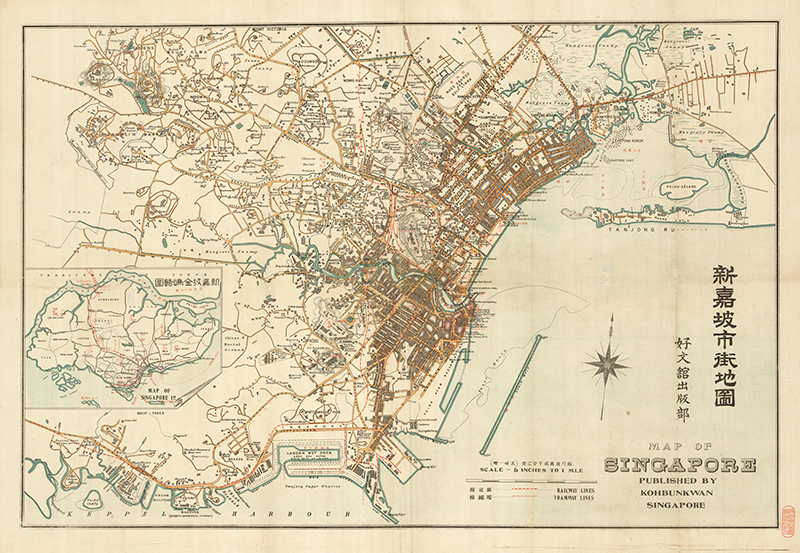
Map of Singapore = 新嘉坡市街地圖 (Shingapōru Shigai Chizu), likely published in 1920. It is one of the earliest Japanese street maps of Singapore. (From National Library Singapore, call no. RRARE 912.5957 MAP).
Within the National Library’s Rare Materials Collection lies a cartographic treasure that opens a window into Singapore’s multicultural past. The map titled Map of Singapore = 新嘉坡市街地圖 (Shingapōru Shigai Chizu) tells a story of the thriving Japanese diaspora that once called this bustling port city home.1
The undated work, measuring 54 cm by 79 cm, was likely published in 1920, making it one of the earliest Japanese street maps of Singapore. Drawn to a scale of 1:5 miles, the map presents a detailed layout of Singapore town, accompanied by an inset map of the island of Singapore. The map appears to be an adaptation of Fraser and Neave’s 1913 Map of Singapore Showing the Principal Residences and Places of Interest,2 with four significant additions: the inset map, Japanese place names as well as railway and tramway lines.
While many place names are simply transliterations of their English names, what makes this Japanese map fascinating are the place names and locations that the map creator had carefully marked out for their special importance to the early Japanese community.
The map had originally been published in January 1919 to commemorate Singapore’s centenary. This first edition featured a distinctive cartouche (a decorative emblem on a map that contains the title, author, general description, legend, scale bar, etc.) and advertisements from local Japanese businesses printed on the reverse.3 The library’s copy, however, appears to be from a later 1920 printing as it lacks these visual elements.4
Kobunkan: Bookstore and Publisher
The publisher’s name, Kobunkan, appears on the map in both Japanese and English as 好文舘出版部 (Kōbunkan Shuppanbu; Kobunkan Publishing Department) and Kohbunkwan Singapore.5 Kobunkan was one of Singapore’s pioneering Japanese bookstores and publishers,6 with a long-established presence at 167 Middle Road.7
![Kobunkan bookstore (2nd shophouse from the right) and Iroha Motor Cars & Co. (extreme right) at 167 and 168 Middle Road respectively, c. 1910s. The handwritten caption behind the photograph reads 英領新架坡 好文館 いろは自動車 山﨑·竹井経営 [泰来當質店] (Eiryō Shingapōru Kōbunkan Iroha Jidōsha Yamasaki·Takei keiei [Tài Lái Dāng Zhìdiàn], which translates as “British-governed Singapore / Kobunkan and Iroha Motor Cars / Managed by Yamsaki & Takei / Chop Thai Loy Pawn Shop”. Courtesy of Tanabe Tsukasa.](https://isomer-user-content.by.gov.sg/339/60397c4b-3c6f-4bd1-bf64-9b01e37cffd7/japanese_kobunkan2.png)
Kobunkan bookstore (2nd shophouse from the right) and Iroha Motor Cars & Co. (extreme right) at 167 and 168 Middle Road respectively, c. 1910s. The handwritten caption behind the photograph reads 英領新架坡 好文館 いろは自動車 山﨑·竹井経営 [泰来當質店] (Eiryō Shingapōru Kōbunkan Iroha Jidōsha Yamasaki·Takei keiei [Tài Lái Dāng Zhìdiàn], which translates as “British-governed Singapore / Kobunkan and Iroha Motor Cars / Managed by Yamsaki & Takei / Chop Thai Loy Pawn Shop”. Courtesy of Tanabe Tsukasa.
The bookstore offered an extensive array of Japanese products ranging from newspapers, magazines, books and maps to stationery and picture postcards. Its customers included the employees of leading Japanese firms in the commercial district of Raffles Place and Collyer Quay as well as small Japanese businesses clustered around Middle Road and North Bridge Road. The latter comprised medical and dental clinics, retail shops, grocery stores, photo studios, barbershops, tailors, hotels, inns and restaurants.
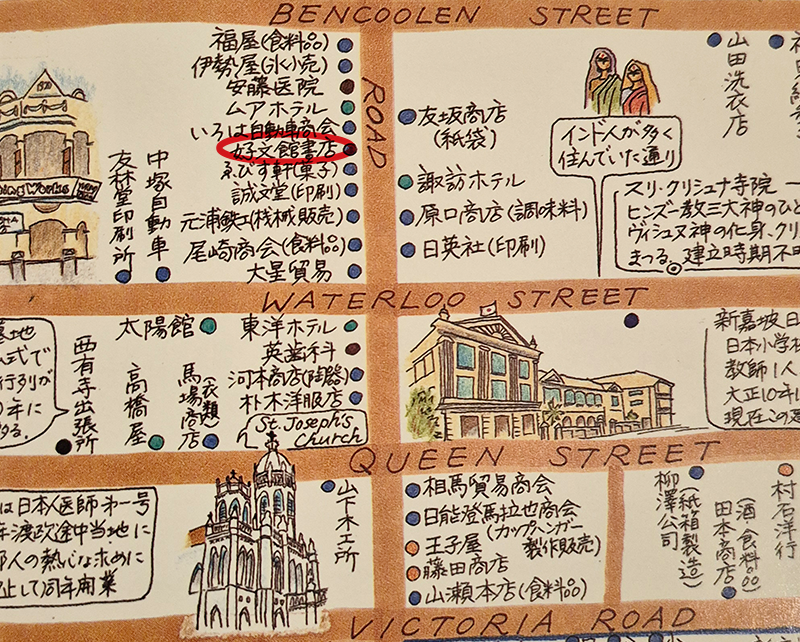
Location of Kobunkan bookstore (circled in red) on Middle Road. Image reproduced from 戦前シンガポールの日本人社会: 写真と記錄 = Prewar Japanese Community in Singapore: Photographs and Records (Senzen Shingapōru no Nihonjin Shakai: Shashin to Kiroku). シンガポール: シンガポール日本人会 (Shingapōru: Shingapōru Nihonjinkai), 2004, 30–31. (From National Library Singapore, call no. RSING 305.895605957 PRE). Courtesy of The Japanese Association Singapore.
![A set of 10 Singapore postcards published by Kobunkan. Images reproduced from 風景繪はがき : 新嘉坡 (Fūkei e Hagaki : Shingapōru ). (From National Library Singapore, call no. RRARE 305.89928 LIM-[LSB]. Donated by Mr Lim Shao Bin).](https://isomer-user-content.by.gov.sg/339/a2fe183e-2c43-452f-82e8-53354f7a0be5/japanese_postcards.png)
A set of 10 Singapore postcards published by Kobunkan. Images reproduced from 風景繪はがき: 新嘉坡 (Fūkei e Hagaki: Shingapōru ). (From National Library Singapore, call no. RRARE 305.89928 LIM-[LSB]. Donated by Mr Lim Shao Bin).
Kobunkan’s bestsellers revealed the community’s continued links with Japan. Major newspapers such as Asahi Shimbun (朝日新聞), Osaka Mainichi (大阪毎日) and Tokyo Nichi Nichi (東京日日) provided vital news from home. Literary and general interest magazines such as The Sun (太陽; Taiyō), The Central Review (中央公論; Chūō Kōron), Reform (改造; Kaizō), and Japan and the Japanese (日本及日本人; Nihon oyobi Nihonjin) attracted a steady readership among white-collar workers like employees of trading companies and banks.
![Kobunkan bookstore on the left and Iroha Motor Cars & Co. on the right at 167 and 168 Middle Road respectively, c. 1910s. The handwritten caption behind the photograph reads 「英領新架坡中央街 山﨑・竹井経営 日本人初の自動車営業 日本人初の書籍新聞販売店 西宇和郡(現西予市)三瓶町出身竹井庫敬(くらよし=向かって左の和服の男性)ほか馬来人、車掌、ボーイ」[Eiryō Shingapōru Chūō-gai Yamazaki・Takei keiei Nihonjin hatsu no jidōsha eigyō Nihonjin hatsu no shoseki shinbun hanbaiten Nishiuwa-gun (gen Seiyo-shi) Mikame-chō shusshin Takei Kurayoshi (Kurayoshi = mukatte hidari no wafuku no dansei) hoka maraijin, shashō, bōi], which translates as “British-governed Singapore, Middle Road. Managed by Yamazaki & Takei. First Japanese automobile business. First Japanese bookstore and newspaper store. Born in Mikame Town, Nishiuwa District (current day Seiyo City), Takei Kurayoshi (Kurayoshi = the man in Japanese clothing on the left) alongside Malay, driver and boy”. Courtesy of Tanabe Tsukasa.](https://isomer-user-content.by.gov.sg/339/fc78f85d-ef48-486f-b87a-adbfceefed38/Kobunkan bookstore.png)
Kobunkan bookstore on the left and Iroha Motor Cars & Co. on the right at 167 and 168 Middle Road respectively, c. 1910s. The handwritten caption behind the photograph reads 「英領新架坡中央街 山﨑・竹井経営 日本人初の自動車営業 日本人初の書籍新聞販売店 西宇和郡(現西予市)三瓶町出身竹井庫敬(くらよし=向かって左の和服の男性)ほか馬来人、車掌、ボーイ」[Eiryō Shingapōru Chūō-gai Yamazaki・Takei keiei Nihonjin hatsu no jidōsha eigyō Nihonjin hatsu no shoseki shinbun hanbaiten Nishiuwa-gun (gen Seiyo-shi) Mikame-chō shusshin Takei Kurayoshi (Kurayoshi = mukatte hidari no wafuku no dansei) hoka maraijin, shashō, bōi], which translates as “British-governed Singapore, Middle Road. Managed by Yamazaki & Takei. First Japanese automobile business. First Japanese bookstore and newspaper store. Born in Mikame Town, Nishiuwa District (current day Seiyo City), Takei Kurayoshi (Kurayoshi = the man in Japanese clothing on the left) alongside Malay, driver and boy”. Courtesy of Tanabe Tsukasa.
But perhaps more unusual was Kobunkan’s largest customer base – the karayuki-san.8 Sold into prostitution, these Japanese women lived and worked in Japanese brothels located in and around Malay Street, which was within walking distance to the bookstore. They typically favoured lifestyle and women’s magazines such as Kodan World (講談世界; Kōdan Sekai), Women’s World (婦人世界; Fujin Sekai) and Friend of the Housewife (主婦の友; Shufu no Tomo).9
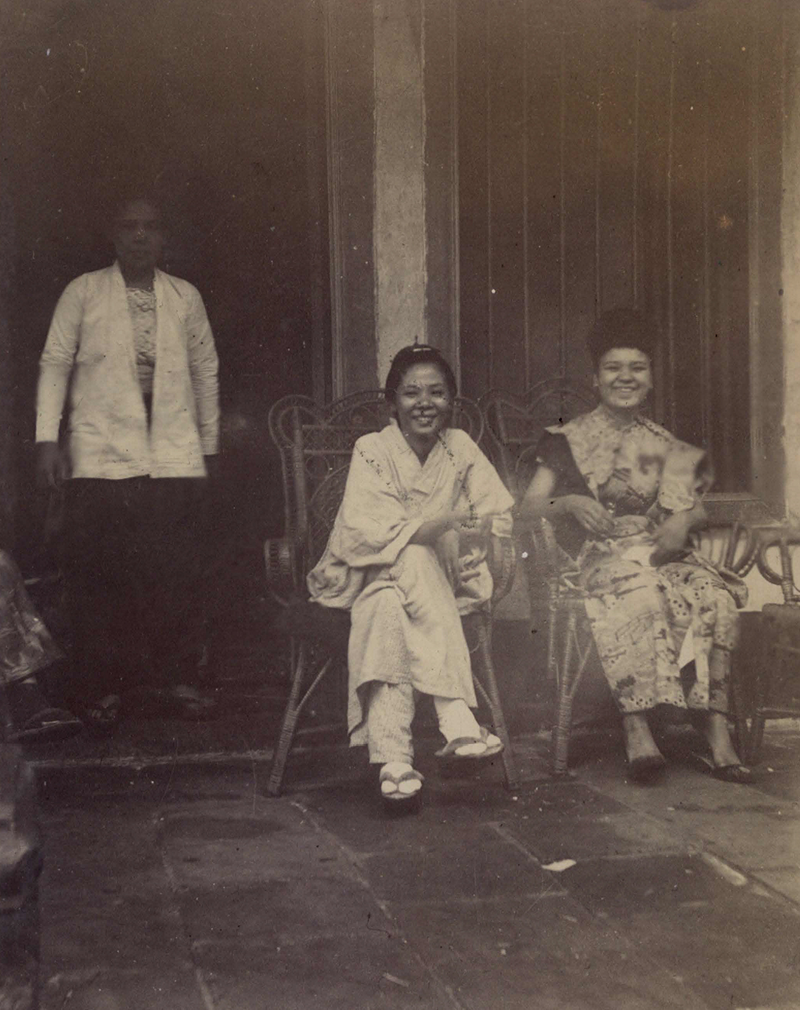
Two karayuki-san seated along a five-footway, c. 1870s–1910s. Image reproduced from Sammlung von 19 originalphotographien aus Singapur (n.p.: n.p., 1880–1900). (From National Library Singapore, call no.RRARE 779.99595703 SAM).
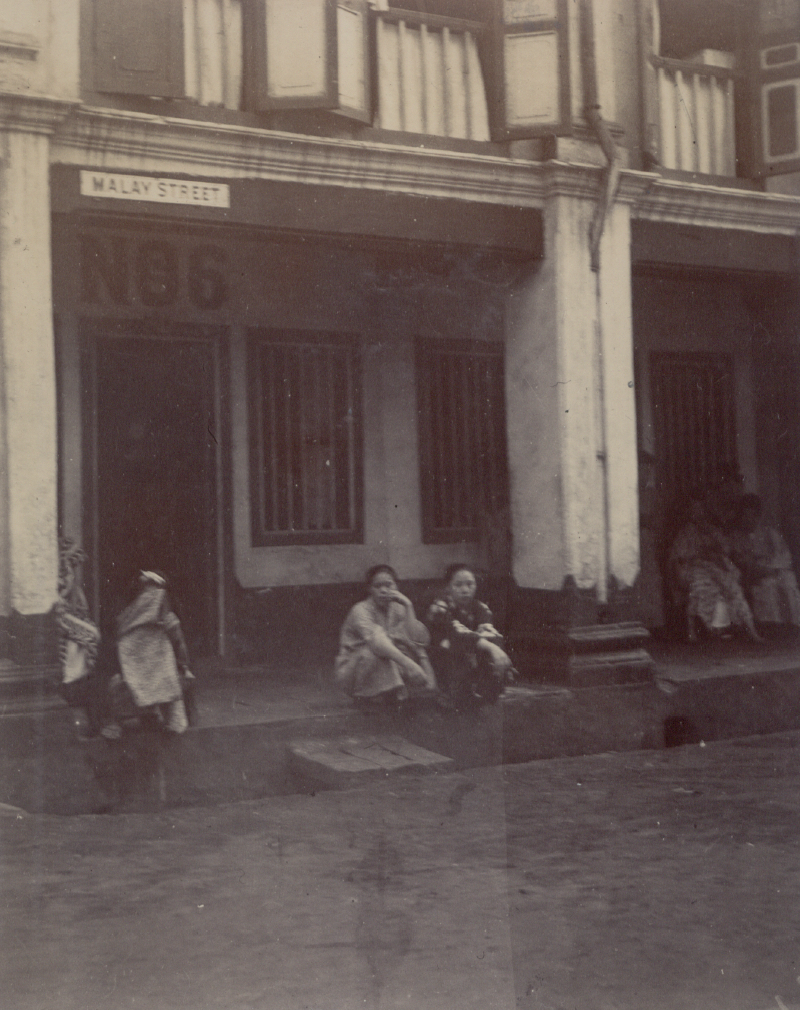
Two karayuki-san seen outside No. 6 Malay Street. Image reproduced from Sammlung von 19 originalphotographien aus Singapur (n.p.: n.p., 1880–1900). (From National Library Singapore, call no. RRARE 779.99595703 SAM).
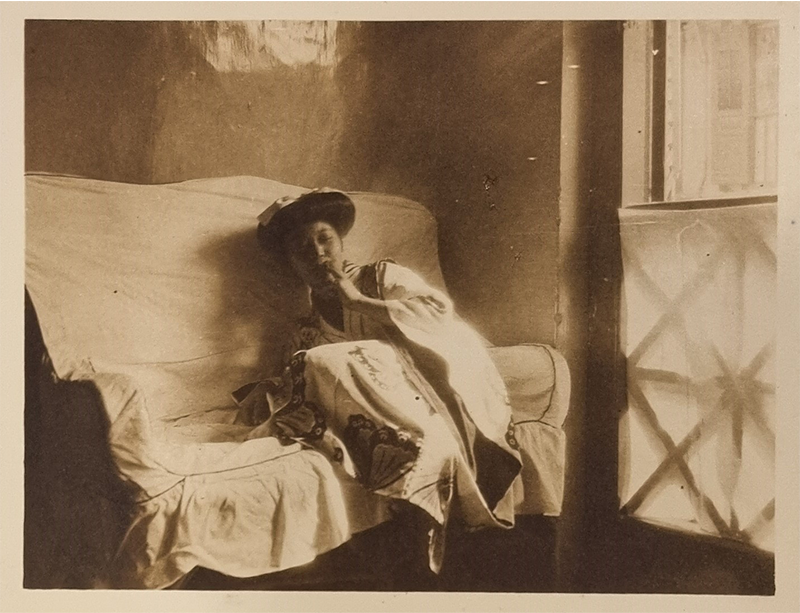
A Japanese woman in her quarters. Based on her attire and the handwritten caption, “A Oriental Star in Singapore”, she was most likely a karayuki-san or an entertainer. Image reproduced from Singapore: Photographs, Early 20th Century (n.p.: n.p., 1900 and 1930?). (From National Library Singapore, call no. RRARE 959.5703 SIN. Donated by Kelvin Ang Kah Eng).
Kobunkan’s reach also extended beyond Singapore’s borders, serving Japanese plantation workers in Johor and expatriate communities across British Malaya, the Dutch East Indies and British North Borneo.10 The bookstore was also the local distributor for Sakura Beer and the Kangaroo brand of canned Japanese fishcakes – chikuwa and kamaboko.11
From Pearl Diver to Entrepreneur
This curious connection between Japanese fishcakes, kangaroos and Singapore becomes clear when we examine the life of Kobunkan’s founder Yamasaki Eijirō (山崎 榮治郎),12 whose remarkable journey took him from Japan to Singapore and Australia.13

A postcard of Yamasaki Eijirō and his general store in Broome, Western Australia, c. 1909. Photo by Aussie~mobs. From flickr (https://www.flickr.com/photos/70994841@N07/23180596783).
Born in 1871 in Ehime Prefecture, Japan, Yamasaki first arrived in Singapore as a crew member aboard a British ship bound for India. Through a local broker in Singapore, Yamasaki secured work as a pearl diver in Broome, Western Australia, where the global demand for pearl buttons had created a booming industry that attracted many Japanese settlers.14 Yamasaki’s entrepreneurial drive soon led him to general trading, importing Japanese goods to Broome via shipping agents in Singapore and establishing the commercial network that would later pave his move to Singapore.
Also, while in Australia, Yamasaki made a foray into Malayan rubber. His 300-acre Ehime Rubber Estate (愛媛ゴム園; Ehime Gomu-en), established between 1909 and 1910, was one of the earliest rubber plantation developments along the Johor River.15
![Ehime Rubber Plantation in Johor. Image reproduced from 馬來に於ける邦人活動の現況 (Marai ni okeru Hōjin Katsudō no Genkyō). 新嘉坡: 南洋及日本 人社 (Shingapōru Nan’yō oyobi Nihonjinsha), 60. (From National Library Singapore, call no. RRARE 305.89560595 TSU-[LSB]. Donated by Lim Shao Bin).](https://isomer-user-content.by.gov.sg/339/c7e39304-052f-4694-8256-e3f586fd6c4b/Ehime Rubber Plantation in Johor.png)
Ehime Rubber Plantation in Johor. Image reproduced from 馬來に於ける邦人活動の現況 (Marai ni okeru Hōjin Katsudō no Genkyō). 新嘉坡: 南洋及日本 人社 (Shingapōru Nan’yō oyobi Nihonjinsha), 60. (From National Library Singapore, call no. RRARE 305.89560595 TSU-[LSB]. Donated by Lim Shao Bin).
The Move to Singapore
When Yamasaki relocated to Singapore in 1912,16 the knowledge and experience that he had gained from his Australian ventures stood him in good stead. He initially established his wholesale trading business from Nippon Hotel (日本ホテル; Nippon Hoteru) on Beach Road, selling Australian beef and Kangaroo brand canned food manufactured by his own Sanyu Trading Company Canning Factory (三友商會鑵詰製造所; Sanyū Shōkai Kanzume Seizōsho) back in Ehime Prefecture.17
Recognising the growing demand for Japanese reading materials among Singapore’s expanding Japanese community, he started Yamasaki Bookstore Section (山崎書林部; Yamasaki Shorinbu) in 1912.18 Yamasaki’s business quickly outgrew the hotel premises, which struggled to accommodate his three business arms: the book retail department, the merchandise department (山崎商品部; Yamasaki Shōhinbu) and the Sanyu Trading Company operations.
In May 1913, Yamasaki relocated his operations to the more spacious 167 Middle Road.19 The bookstore was renamed Kobunkan (好文舘) in 1914 and, by 1915, had undergone significant expansion with the establishment of a publishing division helmed by Kōno Kōhei (河野公平), a seasoned newspaper editor from Ehime.20
Yamasaki’s entrepreneurial ambitions were not confined to general trade and books alone. In 1913, he established Iroha Motor Cars & Co. (いろは自動車商会; Iroha Jidōsha Shōkai),21 which employed Malay drivers to provide transportation services tailored specifically to the Japanese community’s needs. These included trips to and from the Japanese cemetery for funerals, visits to the entertainment and red-light districts,22 recreational drives for karayuki-san and passenger transfers for European vessels docked at the Singapore harbour. The growth in the business led to its expansion and he leased the adjacent shophouse unit at 168 Middle Road.
The End of an Era
In 1920, Yamasaki and his wife left Singapore, presumably to return permanently to Japan. The local Japanese newspaper carried a farewell notice where he expressed his gratitude to the community for their send-off. His departure marked the beginning of a decline of his businesses. Entrusted to co-manager Takei Kurayoshi (竹井庫敬) and others, these businesses struggled against the economic headwinds of the early 1920s – a slump in rubber prices and the 1920 ban on Japanese prostitution – before finally closing in 1923.23
Mapping a Community: Main Map
The Japanese Association (日本人; Nihonjin-kai) and the Japanese Elementary School (日本人小學校; Nihonjin Shōgakkō)
Location on map: Short Street
The Japanese Association, established in 1915, and the Japanese School, founded in 1912, were both situated on Short Street. The association operated from Short Street between 1918 and 1920, while the school remained there until 1921. The school was first located on Middle Road before moving to Bencoolen Street, Wilkie Road and then Short Street.24
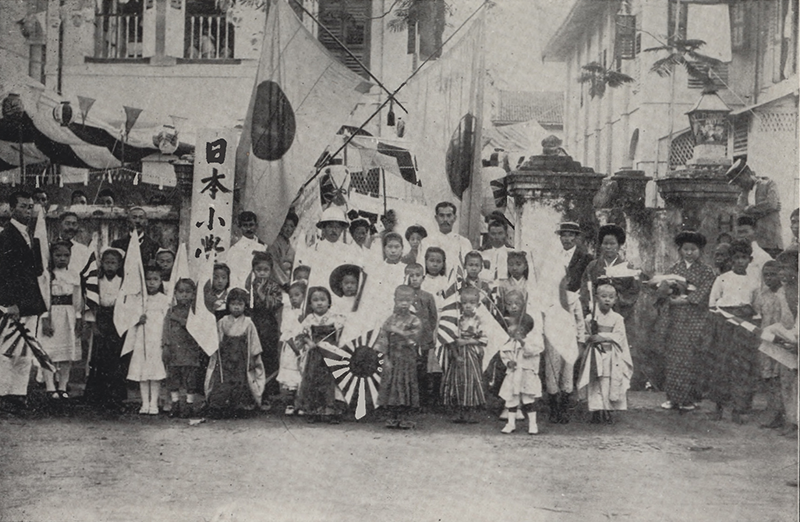
Japanese Elementary School, 1910s. Image reproduced from 伊藤友治郎 (Itō Tomojirō), 南洋群嶋写真画帖: 附南洋事情 = Picture Book of the South Sea Islands (Nan’yō Guntō Shashin Gachō: Fu Nan’yō Jijō). 英領ペナン市: 南洋調査会 (Eiryō Penan-shi: Nan’yō Chōsakai), 1914, 6. (From National Library Singapore, call no. RRARE 959 ITO).
A cornerstone of the Japanese community, the association managed the Japanese School, maintained the Japanese cemetery from 1917 onward and established the Japanese Club in 1922. The association played a pivotal role in fostering the social and cultural life of the Japanese community in Singapore. The association is located on Adam Road today, while the school has three campuses in Clementi, Changi and West Coast.
Japanese Commercial Museum (日本商品陳列舘; Nihon Shōhin Chinretsu-kan)
Location on map: 77 Bras Basah Road
The Japanese Commercial Museum was established in 1918 by the South Seas Association (南洋協会; Nan’yō Kyōkai) to further Japan’s commercial and trade expansion into the South Seas.25 Despite its name, the institution was not a museum in the conventional sense, but rather a showcase for Japanese-made merchandise.26
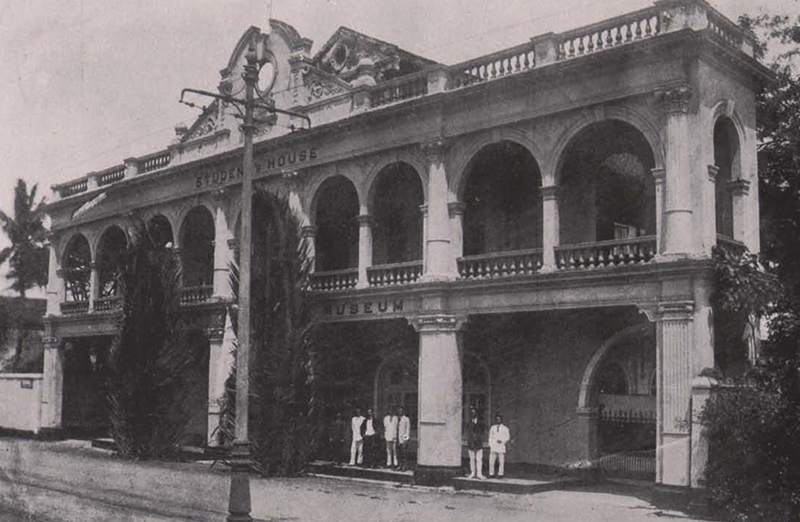
Japanese Commercial Museum. Image reproduced from 南洋之産業. 壹之卷 = Tropical Industry (Nan’yō no Sangyō. Ichi no Ken). 新嘉坡: 新嘉坡商品陳列館 (Shingapōru: Shingapōru Shōhin Chinretsukan), 1920, 7. (From National Library Singapore, call no. RRARE 338.0595 NAN).
Route to Japanese Cemetery (日本人墓地行; Nihonjin Bochi-yuki)
Location on map: Serangoon Road
Serangoon Road is marked on the map as 日本人墓地行 (Route to the Japanese Cemetery), highlighting its importance as the main thoroughfare connecting Middle Road to the cemetery. The road served as the principal route for cemetery visitors and funeral processions travelling from Middle Road – where most of the early Japanese community lived and worked – to the cemetery in Yio Chu Kang. Notably, the cemetery, where many of Singapore’s long-term Japanese residents were buried, was featured as a destination in Japanese guidebooks of the early 20th century.27 The cemetery stopped taking burials in 1973 and became the Japanese Cemetery Park in 1987.28
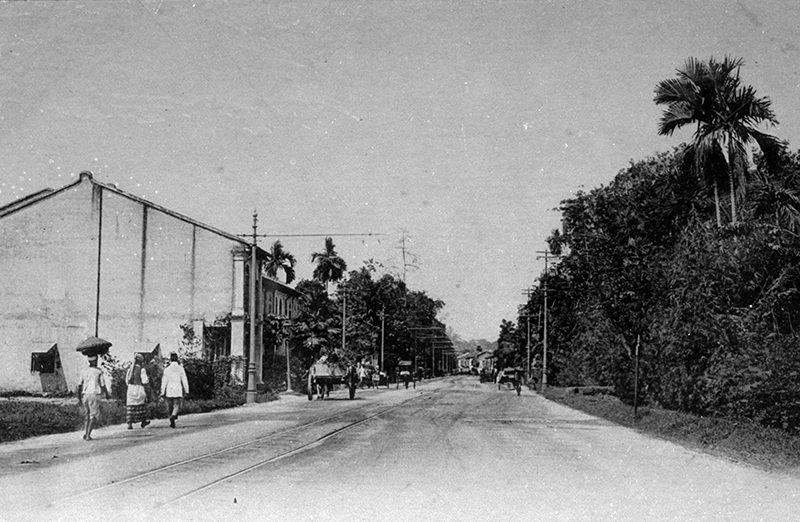
Serangoon Road, the route to the Japanese Cemetery, c. 1911. Arshak C. Galstaun Collection, courtesy of National Archives of Singapore (Media - Image no. 19980005502 - 0033).
Japanese Consulate (領事舘; Ryōjikan)
Location on map: Raffles Chambers, Raffles Place
The Japanese Consulate established its office in Raffles Chambers in 1917, one of several locations it would occupy since its founding in 1879. The consulate’s first premises was on North Bridge Road where Hoo Ah Kay (popularly known as Whampoa) served as the first honorary Japanese Consul. Following Hoo’s death in 1880, the position was left vacant until Nakagawa Tsunejirō (中川恒次郎) was appointed as the first acting consul in 1889, with his office situated on Sophia Road.29
Mitsubishi Branch Office (三菱出張所; Mitsubishi Shutchōjo)
Location on map: Raffles Chambers, Raffles Place
Trading company Mitsubishi established a representative office in Singapore in 1917 after identifying Singapore as its strategic base for expansion into British Malaya, the Dutch East Indies and India. This move was part of a broader trend of Japanese trading companies and merchants setting up operations in Raffles Place and High Street during the late 1910s to capitalise on the growing demand for Japanese goods during and after the First World War (1914–18). Reduced trade between Singapore and Europe during the war had created an opportunity for Japan to increase its commercial presence in Southeast Asia.30
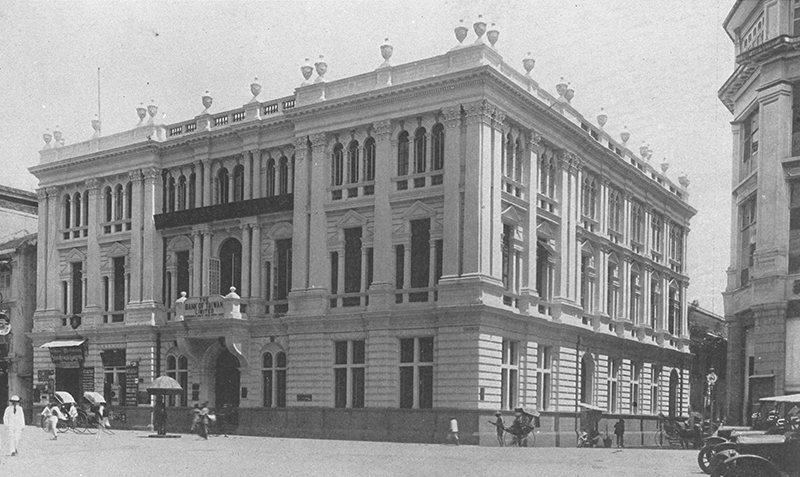
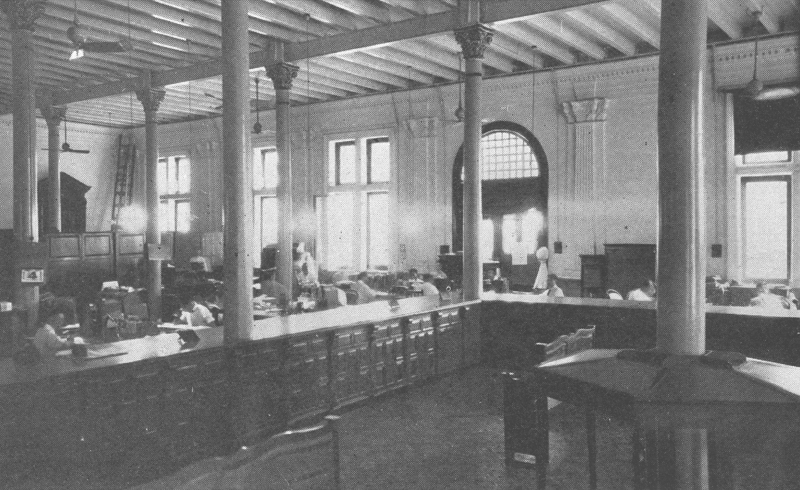
Bank of Taiwan Branch (台銀支店; Taigin Shiten)
Location on map: 1 Battery Road
The Bank of Taiwan, operating under the Japanese colonial administration in Taiwan, became the first Japanese bank to establish operations in Singapore in 1912.31 The bank first opened at 100 Robinson Road before moving to Battery Road in 1916 where it was co-located with Mitsui Bussan Kaisha (三井物産会碇), the first Japanese trading company in Singapore.32 The Bank of Taiwan was formed in 1899 to serve as the central bank and development bank of Taiwan. It aimed to expand internationally to support Japan’s economic expansion into South China and the South Seas.33 The Singapore branch primarily handled foreign exchange transactions and loans to Japanese rubber planters and businessmen.34
Bank of Taiwan Company House No. 1 (台銀第一碇宅; Taigin Daiichi Shataku)
Location on map: Osborne House, 11 Upper Wilkie Road
Known today as Mount Emily Villa, Osborne House served as the residence of the manager of the Bank of Taiwan during the late 1910s and then as the home of Singapore-based Japanese dentist Ikeda Jūkichi (池田重吉) in 1935. It later housed the Japanese Consulate-General between 1939 and 1941. After the Japanese Occupation, the building was used by the Ministry of Social Affairs’ Social Welfare Department. In 1969, Mount Emily Girls’ Home occupied the space followed by Wilkie Road Children’s Home in the 1980s.35 Today, the premises are occupied by The Private Museum.
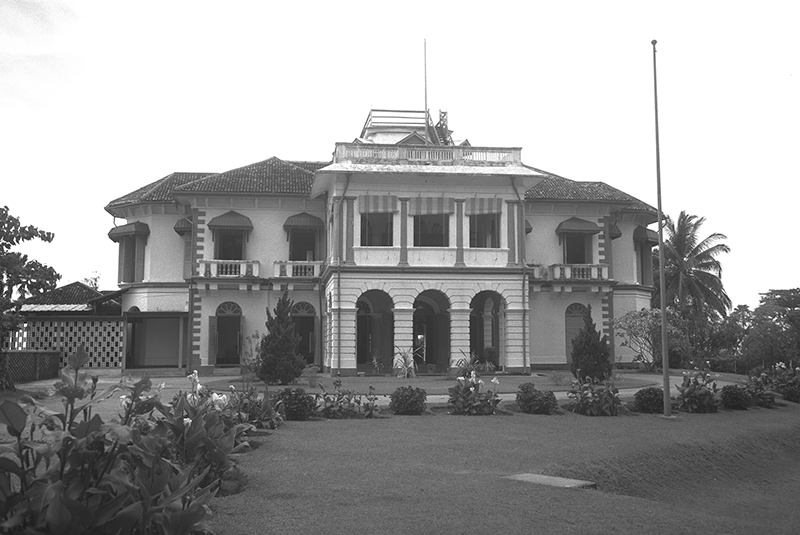
The Girls’ Home at 11 Upper Wilkie Road managed by the Social Welfare Department of the Ministry of Social Affairs, 1959. Ministry of Information and the Arts Collection, courtesy of National Archives of Singapore (Media - Image no. 19980001968 - 0017).
Japanese Ship Wharf (日本舩ワーフ; Nihon Fune Wāfu)
Location on map: Tanjong Pagar Wharves
This appears to be the berthing area for arriving Japanese ships.
Kuhara Branch Office (久原出張所; Kuhara Shutchōjo)
Location on map: 6 Scotts Road
The Singapore branch of the Kuhara Mining Company (久原鑛業株式會碇; Kuhara Kōgyō Kabushiki Kaisha) was established in 1916. The company was founded in Japan in 1905 by Kuhara Fusanosuke (久原房之助), a prominent businessman and founder of several prominent Japanese companies, including Hitachi. As part of its overseas expansion plans, the company began conducting various explorations for oil and other mineral resources in the Dutch East Indies and Malaya. By 1920, its Singapore operations had grown to include the Kuhara Trading Company (久原商事株式會碇; Kuhara Shōji Kabushiki Kaisha).36
Osaka Shosen Branch (大阪商船支店; Ōsaka Shōsen Shiten)
Location on map: 2 De Souza Street
Osaka Shosen Kaisha was one of Japan’s major shipping companies that operated alongside the Nippon Yusen Kaisha (日本郵船会碇) in Singapore. In 1918, the company established its Singapore branch office at 2 De Souza Street,37 increasing its commercial shipping presence in the region. Prior to this expansion, local agent Guthrie and Co. had managed the company’s shipping routes.38
![A postcard showing the shipping routes of Osaka Shosen Kaisha. Singapore appears as point no. 18 on the map. (From National Library Singapore, call no. RRARE 952.03 LSB-[LSB]. Donated by Lim Shao Bin).](https://isomer-user-content.by.gov.sg/339/bb13e854-7e1e-481f-b532-6fa28ee4a3fa/A postcard showing the shipping routes.png)
A postcard showing the shipping routes of Osaka Shosen Kaisha. Singapore appears as point no. 18 on the map. (From National Library Singapore, call no. RRARE 952.03 LSB-[LSB]. Donated by Lim Shao Bin).
Mitsui Company House No. 1 (三井第一碇宅; Mitsui Daiichi Shataku)
Location on map: Draycot, Stevens Road
Draycot was once the residence of the manager of Mitsui Bussan Kaisha (三井物産会碇). The property was more than a residential space; it was also a venue for hosting distinguished guests and business networking. Notable visitors included Dr Lim Boon Keng, a leader of the Chinese community in Singapore, and Marquis Saionji, a prominent Japanese statesman who stayed at Draycot while travelling to the 1919 Paris Peace Conference after the First World War.39
As Singapore’s first Japanese trading company, Mitsui Bussan Kaisha began with a modest representative office at 8 Battery Road in 1891, occupying the upper floors of the Dispensary Building. Its initial aim was to secure contracts with European steamship companies to supply coal from Japan’s largest coal mine, the Miike Mine. As business grew, Mitsui diversified into shipping, accounting, communications, insurance brokerage, and the import-export of various goods, including rice, electrical supplies, metals and metallic ores, marine products and textiles. The company’s growing influence in Singapore’s colonial business society earned it a place in the Singapore Chamber of Commerce in 1911.40
Consular Residence (領事官舍; Ryōji-kansha)
Location on map: Kinloss, Lady Hill, Orange Grove
Kinloss was constructed in 1903 as the private residence of Lieutenant-Colonel Alexander Murray, the colonial engineer and surveyor-general of the Straits Settlements.41 Following Murray’s departure from Singapore in 1906, the house became the residence of the Japanese Consul from 1909 to the 1920s.42 During this period, Kinloss hosted several significant diplomatic events, including local celebrations of the Japanese Emperor’s birthday and the coronation of Emperor Taishō in 1915. The residence also welcomed prominent guests, notably Prince Asaka Yasuhiko (朝香宮鳩彦王; Asaka-no-miya Yasuhiko-ō) during his stopover in Singapore in 1922 while en route to France for military studies.43
Beyond the Urban Core: Inset Map
Japanese Cemetery, Saiyūji Temple (日本人墓地; Nihonjin Bochi, 西有寺; Saiyūji)
Location on map: 22 Chuan Hoe Avenue
The Japanese Cemetery was established in 1891 when Futaki Tagajirō (二木多賀治郎) and two others obtained government approval to convert a plot of land in the Yio Chu Kang area into a communal cemetery for the Japanese community. The initiative was led by Futaki, the owner of a brothel, rubber plantation and grocery store.
The cemetery comprised six acres from Futaki’s rubber plantation and two acres of adjacent public land. Before its official establishment as a public cemetery, the site was already used as a burial ground for early Japanese immigrants.
The cemetery was managed by volunteers of the Mutual Aid Association. While it was initially created to serve as a burial ground for the significant number of Japanese prostitutes in Singapore, it eventually became the final resting place for many long-term Japanese residents. In 1911, Priest Baisen (楳仙和尚; Baisen Oshō) built Saiyūji, a Buddhist temple of the Sōtō sect, on the cemetery grounds to serve as the main provider of funeral services.44 The cemetery was closed to burials in 1973 and became the Japanese Cemetery Park in 1987.45
![The Japanese Cemetery (top) and Chief Priest Chisen Otsuka of Saiyūji Temple (bottom), 1910s. Images reproduced from 佃光治 (Tsukuda Mitsuharu), 馬來に於ける邦人活動の現況 (Marai ni okeru Hōjin Katsudō no Genkyō). 新嘉坡: 南洋及日本人社 (Shingapōru Nan’yō oyobi Nihonjinsha), 1917. (From National Library Singapore, call no. RRARE 305.89560595 TSU-[LSB]).](https://isomer-user-content.by.gov.sg/339/1c2cea43-be89-4970-a71c-0216111a3966/japanese_cemetary2 (1).png)
The Japanese Cemetery (top) and Chief Priest Chisen Otsuka of Saiyūji Temple (bottom), 1910s. Images reproduced from 佃光治 (Tsukuda Mitsuharu), 馬來に於ける邦人活動の現況 (Marai ni okeru Hōjin Katsudō no Genkyō). 新嘉坡: 南洋及日本人社 (Shingapōru Nan’yō oyobi Nihonjinsha), 1917. (From National Library Singapore, call no. RRARE 305.89560595 TSU-[LSB] Donated by Lim Shao Bin).
Nisshin Rubber Estate (日新ゴム園; Nisshin Gomu-en)
Location on map: Yio Chu Kang Road
A 1917 survey documented four Japanese rubber plantation estates operating in Singapore: Nisshin Rubber Estate (日新護謨園), Rising Sun Plantation (ライジンサング園; Raijin Sangu-en), Endo Rubber Estate (遠藤護謨園; Endō Gomu-en)46 and Chitose Rubber Estate (千歳護謨園; Chitose Gomu-en). These estates served not only as commercial ventures but were also popular destinations for day trips among Japanese residents and tourists in Singapore.
Nisshin Rubber Estate (Nisshin meaning Japan-Singapore)47 was established sometime between 1911 and 1913 through the consolidation of various agricultural plots that had been under cultivation since 1905. By 1917, the estate covered 1,042 acres and employed 21 Japanese staff alongside 275 Chinese, 84 Malay and 40 Indian coolies.48
As Singapore’s largest Japanese rubber plantation, it drew visits from various Japanese missions and dignitaries, including Crown Prince Hirohito (later Emperor Showa) who toured the estate during his stopover in Singapore in 1921 while en route to Europe.49
Chitose Rubber Estate (千歳ゴム園; Chitose Gomu-en)
Location on map: Lim Chu Kang
Official records indicate that the 180-acre Chitose Rubber Estate was established in January 1908 by a dentist, Henry Tsutada. Japanese sources, however, recorded that the estate was founded a year earlier by a consortium of four shareholders (千歳護謨栽培組合; Chitose Gomu Saibai Kumiai): Choya and Co. (潮谷商會; Chōya Shōkai), Tsutada Kenri (蔦田顯理; also known as Henry Tsutada), U. Ueda (上田泰正; Ueda Yasumasa) and Madam Tokio (東境セイ子; Tōkyō Seiko). The plantation employed five Chinese and 21 Javanese labourers. Given Tsutada’s fluency in English and Malay, he was likely designated to handle the registration process and correspondence with colonial authorities, which could explain why he was listed as the sole registered owner in official records.50
![Madam Tokio, a shareholder of Chitose Rubber Estate, undated. Image reproduced from 佃光治 (Tsukuda Mitsuharu), 馬來に於ける邦人活動の現況 (Marai ni okeru Hōjin Katsudō no Genkyō). 新嘉坡: 南洋及日本人社 (Shingapōru Nan’yō oyobi Nihonjinsha), 1917. (From National Library Singapore, call no. RRARE 305.89560595 TSU-[LSB]).](https://isomer-user-content.by.gov.sg/339/928ea684-0505-44d3-b93c-ee45496534fc/Madam Tokio.png)
Madam Tokio, a shareholder of Chitose Rubber Estate, undated. Image reproduced from 佃光治 (Tsukuda Mitsuharu), 馬來に於ける邦人活動の現況 (Marai ni okeru Hōjin Katsudō no Genkyō). 新嘉坡: 南洋及日本人社 (Shingapōru Nan’yō oyobi Nihonjinsha), 1917. (From National Library Singapore, call no. RRARE 305.89560595 TSU-[LSB] Donated by Lim Shao Bin).
Beyond his rubber plantation interests, Tsutada operated a dental practice from his clinic on Bras Basah Road, offering consultations in English and Malay. His linguistic abilities, which served him well in multicultural Singapore, were likely developed during his education at the Anglo-Chinese School. Outside his professional pursuits, Tsutada was a devout Christian who worshipped at the Japanese Methodist Church and raised his nine children in the faith. His second son, David Tsugio Tsutada (蔦田二雄; Tsutada Tsugio), became a prominent preacher in Japan, and many Tsutada family members continue to serve as pastors and missionaries today.51
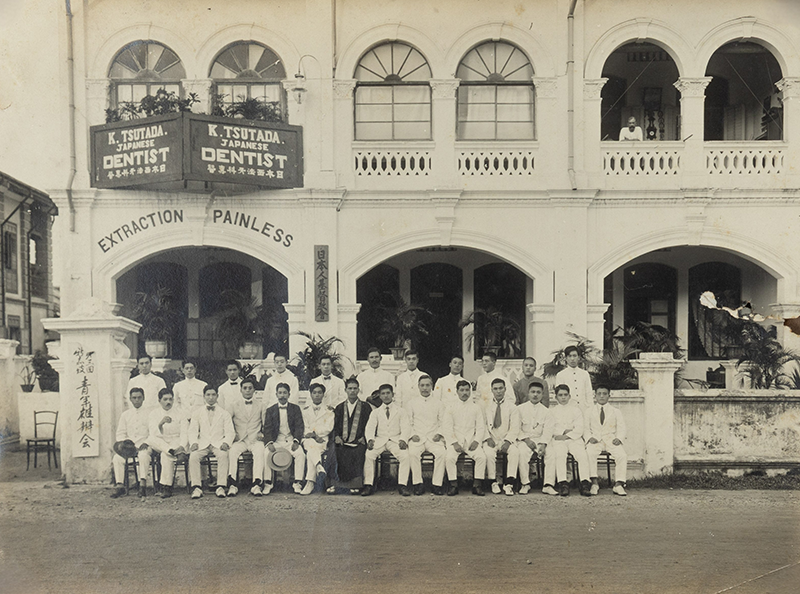
Tsutada Kenri’s dental clinic on Bras Basah Road, c. 1910s. Collection of the National Library Singapore (Accession no. B35800783A).
Discover more about the prewar Japanese community in and around Middle Road from Curiocity, and explore Japanese street maps of Singapore in the collections of the National Library Singapore and National Archives of Singapore.
The author thanks Tanabe Tsukasa, the great-grandson of Yamasaki Eijiro, for sharing information about his family; Takako Iino from Friends of the Museum in Singapore; and Senior Librarians Goh Yu Mei and Janice Loo from the National Library Singapore for their assistance in translating and highlighting relevant Japanese and pictorial sources.
About the Author
Gracie Lee is a Senior Librarian with the National Library Singapore, where she works with the Rare Collection. She enjoys uncovering and sharing the stories behind Singapore’s print heritage.
Endnotes
新嘉坡市街地圖 = Map of Singapore (Shingapōru Shigai Chizu). 新嘉坡: 好文舘出版部 (Shingapōru: Kōbunkan Shuppanbu, 1920). (From National Library Singapore, call no. RRARE 912.5957 MAP).
Fraser and Neave Limited, Map of Singapore Showing the Principal Residences and Places of Interests, 1913, map. (From National Archives of Singapore, accession no. SP006064)
The cartouche reads: 開港百周年記念出版 (Kaikō Hyakushūnen Kinen Shuppan) [Port Centenary Commemorative Publication], 1 January 1919, map. Printed on the back of the map are advertisements from local Japanese businesses such as Miyako Hotel (都ホテル; Miyako Hoteru) and Hakuai Pharmacy (博愛藥房; Hakuai Yakubō) under the header 新嘉坡開港百周年記念合廣告 (Shingapōru Kaikō Hyakushūnen Kinen Gōkōkoku) [Singapore Port Centenary Commemorative Joint Advertisement]. See 文生書院(Bunsei Shoin Booksellers, Co., Ltd.)文生書院目録 2018 年:中国・満州・朝鮮・台湾・樺太・南洋(Bunsei Shoin Mokuroku 2018–nen: Chūgoku・Manshū・Chōsen・Taiwan・Karafuto・Nan’yō), 77, https://www.bunsei.co.jp/old-book/moku/moku201809/.
南洋日日新聞 (Nan’yō Nichinichi Shinbun), 16 November 1920, 2, Hoover Institution Library & Archives, https://hojishinbun.hoover.org/en/newspapers/nos19201116-01.1.2.
The English name was spelt according to the Japanese romanisation conventions of that period.
河野公平.好文館出版部 (Kōno Kōhei and Kōbunkan Shuppanbu), 南洋總覽 (Nan’yō Sōran). シンガポ-ル: 好文館 (Shingapōru: Kōbunkan, 1920), 172–74, NUS Libraries, https://digitalgems.nus.edu.sg/view/347109. A 1916 survey of Japanese residents and their occupations recorded two bookstores operating in Singapore. In 1920, Kobunkan’s own publication, 南洋總覽 (Nan’yō Sōran), recorded just two book retailers although the printing industry had grown to 11 by that time.
This address corresponds to the site presently occupied by the Nanyang Academy of Fine Arts Campus 1 and the headquarters of the Singapore Council of Women’s Organisations.
Karayuki-san (唐行きさん), meaning “those who have gone to China”, was a euphemism used to refer to Japanese sex workers.
松本博之. 鎌田真弓. 村上雄一 (Matsumoto Hiroyuki, Kamata Mayumi and Murakami Yūichi), eds., ブルームにおける日本人商店主のライフストーリー山本亀太郎·三瀬豊三郎を中心に (Burūmu ni okeru Nihonjin Shōten-shu no Raifu-sutōrī Yamamoto Kametarō, Mise Toyosaburō o Chūshin ni), 48–59, Nagoya University of Commerce & Business, https://www.nucba.ac.jp/archives/189/202504/NUCB-K-25101.pdf; 南洋新報 (Nan’yō Shinpō), 30 October 1912, 10, Hoover Institution Library & Archives, https://hojishinbun.hoover.org/en/newspapers/nao19121030-01.1.10; 南洋日日新聞 (Nan’yō Nichinichi Shinbun), 14 January 1922, Hoover Institution Library & Archives, https://hojishinbun.hoover.org/en/newspapers/nos19220114-01.1.2.
Matsumoto, Kamata and Murakami, Burūmu ni okeru Nihonjin Shōten-shu no Raifu-sutōrī Yamamoto Kametarō, Mise Toyosaburō o Chūshin ni, 48–59.
Kōno and Kōbunkan Shuppanbu, Nan’yō Sōran, 605.
Yamasaki’s name appears as 山崎 榮次郞 in historical Japanese sources and as 山崎 栄治郎 in modern Japanese sources. In English-language publications of the time, his name was often romanised as Yejiro Yamasaki.
Matsumoto, Kamata and Murakami, Burūmu ni okeru Nihonjin Shōten-shu no Raifu-sutōrī Yamamoto Kametarō, Mise Toyosaburō o Chūshin ni, 48–59; 田部司 (Tanabe Tsukasa), 南洋を駆け抜けた夢~山崎栄治郎 (Nan’yō o Kakenuketa Yume ~ Yamasaki Eijirō), 27 January 2014, https://tanabeshouwa.wordpress.com/2014/01/27.
“Pearling Time,” Western Australian Museum, accessed 21 December 2025, https://museum.wa.gov.au/explore/lustre-online-text-panels/pearling-timeline.
“Japanese Rubber Estates in Malaya and Sarawak,” Malaya Tribune, 16 May 1914, 4; Far Eastern Geographical Establishment, The New Atlas and Commercial Gazetteer of the Straits Settlements and Federated Malay States (Singapore: Kelly & Walsh, 1917), 78. (From National Library Singapore, call no. RRARE 330.95951 SHA-[JSB]); Kōno and Kōbunkan Shuppanbu, Nan’yō Sōran, 99; 佃光治 (Tsukuda Mitsuharu), 馬來に於ける邦人活動の現況 (Marai ni okeru Hōjin Katsudō no Genkyō). 新嘉坡: 南洋及日本人碇 (Shingapōru Nan’yō oyobi Nihonjinsha), 1917, appendix, 6. (From National Library Singapore, call no. RRARE 305.89560595 TSU-[LSB]); Yuen Choy Leng, “Japanese Rubber and Iron Investments in Malaya, 1900–1941,” Journal of Southeast Asian Studies 5, no. 1 (March 1974): 35. (From JSTOR via NLB’s eResources website); “General News: A Japanese Send-Off,” Broome Chronicle and Nor’West Advertiser, 4 February 1911, 2, Trove, http://nla.gov.au/nla.news-article260021507.
“For Sale – A Bargain,” Nor-West Echo, 30 November 1912, 3, Trove, http://nla.gov.au/nla.news-article257628059; “The Licensing Act, 1911 (Eighth Schedule): Notice of Application to Remove License to Other Premises,” Nor-West Echo, 13 December 1913, 3, Trove, http://nla.gov.au/nla.news-article257687982; 南洋新報 (Nan’yō Shinpō), 22 June 1912, 7, Hoover Institution Library & Archives, https://hojishinbun.hoover.org/en/newspapers/nao19120622-01.1.7.
南洋新報 (Nan’yō Shinpō), 22 June 1912; 南洋新報 (Nan’yō Shinpō), 29 June 1912, 5, Hoover Institution Library & Archives, https://hojishinbun.hoover.org/en/newspapers/nao19120629-01.1.5.
南洋新報 (Nan’yō Shinpō), 30 October 1912, 10, Hoover Institution Library & Archives, https://hojishinbun.hoover.org/en/newspapers/nao19121030-01.1.10; 伊藤友治郎 (Itō Tomojirō), ed., 南洋年鑑 (Nan’yō Nenkan), vol. 4. 東京: 日南公司南洋調査部 (Tōkyō: Nichinan Kōshi Nan’yō Chōsabu), 1920, 98, National Diet Library Digital Collections, https://dl.ndl.go.jp/en/pid/950490/1/66.
南洋新報 (Nan’yō Shinpō), 14 May 1913, 10, Hoover Institution Library & Archives, https://hojishinbun.hoover.org/en/newspapers/nao19130514-01.1.10.
南洋新報 (Nan’yō Shinpō), 1 April 1914, 3, Hoover Institution Library & Archives, https://hojishinbun.hoover.org/en/newspapers/nao19140401-01.1.3; Ehime Prefectural Lifelong Learning Center, データベース『えひめの記憶』(Dētabēsu “Ehime no Kioku”), https://www.i-manabi.jp/system/regionals/regionals/ecode:2/57/view/7503; Kōno and Kōbunkan Shuppanbu, Nan’yō Sōran, 868.
Itō, Nan’yō Nenkan, vol. 4, 98; 南洋新報 (Nan’yō Shinpō), 21 May 1913, 10, Hoover Institution Library & Archives, https://hojishinbun.hoover.org/en/newspapers/nao19130521-01.1.10.
From the 1870s to 1920s, Japanese brothels were primarily concentrated around Malay Street, Malabar Street and Hylam Street – an area that now forms part of Bugis Junction shopping mall.
南洋日日新聞 (Nan’yō Nichinichi Shinbun), 24 April 1920, 3, Hoover Institution Library & Archives, https://hojishinbun.hoover.org/en/newspapers/nos19200424-01.1.3; 伊藤友治郎 (Itō Tomojirō), ed., 南洋年鑑 (Nan’yō Nenkan), vol. 3. 東京: 日南公司南洋調査部 (Tōkyō: Nichinan Kōshi Nan’yō Chōsabu), 1919, 168, National Diet Library Digital Collections, https://dl.ndl.go.jp/en/pid/950490/1/66; 南洋日日新聞 (Nan’yō Nichinichi Shinbun), 3 November 1920, 2, Hoover Institution Library & Archives, https://hojishinbun.hoover.org/en/newspapers/nos19201103-01.1.2; 南洋日日新聞 (Nan’yō Nichinichi Shinbun), 11 December 1923, 3, Hoover Institution Library & Archives, https://hojishinbun.hoover.org/en/newspapers/nos19231211-01.1.3.
“About Us,” The Japanese Association, Singapore, accessed 22 January 2026, https://www.jas.org.sg/en/pages/aboutus; “About Us,” The Japanese School Singapore, accessed 22 January 2026, https://www.sjs.edu.sg/en/about/.
“South Seas” or 南洋 (Nan’yō ) refers to Southeast Asia and the South Pacific under Japan’s Southern Expansion Doctrine.
“Nan-Yo-Kyokai,” Malaya Tribune, 18 November 1918, 7; “Japanese Commerce,” Straits Times, 16 November 1918, 10. (From NewspaperSG)
新嘉坡槪要 (Shingapōru Gaiyō). 新嘉坡: 新嘉坡日本人會 (Shingapōru: Shingapōru Nihonjinkai), 1923. (From National Library Singapore, call no. RRARE 959.57 SHI-[LSB]); Regina Hong, Ling Xi Min and Shimazu Naoko, Postcard Impressions of Early 20th-century Singapore: Perspective from the Japanese Community (Singapore: National Library Board: Marshall Cavendish Editions, 2020), 72. (From National Library Singapore, call no. RSING 959.57 HON-[HIS])
“Japanese Cemetery Closed to Burials,” Straits Times, 9 May 1973, 21. (From NewspaperSG); Gracie Lee, “Japanese Cemetery Park,” Singapore Infopedia. Article published 2016.
“Passengers,” Singapore Daily Times, 8 December 1879, 2. (From NewspaperSG); “Passengers,” Singapore Daily Times, 8 December 1879, 2. (From NewspaperSG); “A Social History of the Japanese in Singapore to 1945,” in Japan and Singapore: A Multidisciplinary Approach, ed. Tsu Yun Hui (Singapore: McGraw-Hill Education [Asia], 2006), 28. (From National Library Singapore, call no. RSING 303.4825205957 JAP)
Shimizu Hiroshi, Japan and Singapore in the World Economy: Japan’s Economic Advance Into Singapore, 1870–1965 (London: Routledge, 1999), 68–69. (From National Library Singapore, call no. RSING 337.5205957 SHI)
戦前シンガポールの日本人社会: 写真と記錄 = Prewar Japanese Community in Singapore: Photographs and Records (Senzen Shingapōru no Nihonjin Shakai: Shashin to Kiroku). シンガポール: シンガポール日本人会 (Shingapōru: Shingapōru Nihonjinkai), 2004, 30–31. (From National Library Singapore, call no. RSING 305.895605957 PRE); “The Bank of Taiwan Ltd. Notice,” Weekly Sun, 29 September 1912, 8. (From NewspaperSG)
“The Bank of Taiwan Ltd,” Singapore Free Press, 5 June 1916, 7; “Notice of Removal,” Malaya Tribune, 5 June 1916, 7; “[The Old Premises…],” Singapore Free Press, 7 June 1916, 7. (From NewspaperSG)
Hisasue Ryoichi, “The Establishment of the China and Southern Bank and the Southern Warehouse Company: In Relation to the Bank of Taiwan’s Southward Strategy with Overseas Chinese from the 1910s to the 1920s,” Institute of Developing Economies Discussion Paper No. 68, February 2018, IDE-JETRO, https://ir.ide.go.jp/record/50167/files/IDP000688_001.pdf.
Senzen Shingapōru no Nihonjin Shakai: Shashin to Kiroku, 228; Eric Robertson, The Japanese File: Pre-war Japanese Penetration in Southeast Asia (Singapore: Heinemann Asia, 1986), 16–17. (From National Library Singapore, call no. RSING 301.295209595 ROB)
“Crime in Malaya,” Straits Echo, 8 October 1919, 1618. (From NewspaperSG); National Heritage Board, “Mount Emily Villa,” “Roots, last updated 15 October 2020, https://www.roots.gov.sg/places/places-landing/Places/surveyed-sites/mount-emily-villa; Melody Zaccheus, “Mystery Behind Origins of Century-Old Mount Emily Villa Solved,” Straits Times, 21 March 2016, https://www.straitstimes.com/singapore/mystery-behind-origins-of-century-old-mount-emily-villa-solved.
Shimomoto Yutaka, Japanese Immigrants and Investments in North Borneo (Kota Kinabalu, Sabah: The Sabah Society, 2010), 56–66. (From National Library Singapore, call no. RSEA 305.8956095953 SHI); 南洋及日本人社 (Nan’yō oyobi Nihonjin sha), 南洋の五十年: シンガポ一ルを中心に同胞活跃 (Nan’yō no Gojūnen: Shingapōru o Chūshin ni Dōhō Katsuyaku) (n.p.: n.p., 2000), 528. (From National Library Singapore, call no. RSING 959.004956 NAN); Nagura Bunji, “The Prewar Japanese Steel Industry and Iron Ore Resources in Southeast Asia: The Development of Malaysian Iron Ore by the Ishihara Sangyo Company,” 1981, IDE-JETRO, https://d-arch.ide.go.jp/je_archive/english/society/wp_je_unu33.html.
“The Osaka Shosen Kaisha,” Straits Budget, 7 June 1918, 16. (From NewspaperSG)
“O.S.K.,” Malaya Tribune, 29 May 1918, 1. (From NewspaperSG)
“Social and Personal,” Pinang Gazette and Straits Chronicle, 5 February 1918, 5; “Japanese Peace Delegates,” Pinang Gazette and Straits Chronicle, 3 February 1919, 2. (From NewspaperSG)
Mitsui & Co. (Asia Pacific) Pte. Ltd., Heritage: The Story of Singapore’s Most Experienced Japanese “Sogo-Shosha” (Singapore: Mitsui & Co. [Asia Pacific] Pte. Ltd., 2011), 6–34. (From National Library Singapore, call no. RSING 382.06552 HER-[LSB])
“1903. The Year Reviewed,” Straits Budget, 7 January 1904, 2; “House and Land Property: The Year 1904,” Straits Budget, 5 January 1905, 10; “Tanglin Auction Sale of Excellent Teak Furniture,” Singapore Free Press, 30 June 1909, 3. (From NewspaperSG); Arnold Wright and H.A. Cartwright, Twentieth Century Impressions of British Malaya: Its History, People, Commerce, Industries, and Resources (London: Lloyd’s Greater Britain Publishing Company, Limited, 1908), 317. (From National Library Singapore, call no. RCLOS 959.51033 TWE)
“Japanese Consulate,” Pinang Gazette and Straits Chronicle, 23 October 1908, 5; “Consul for Japan,” Singapore Free Press, 31 October 1908, 1; “Notice: In Honour of H. I. J. Majesty’s Birthday,” Singapore Free Press, 30 October 1909, 2 “Victoria, &c.,” Straits Times, 13 December 1906, 12; “Japanese Consulate,” Pinang Gazette and Straits Chronicle, 23 October 1908, 5; “Notices,” Singapore Free Press, 30 October 1909, 2. (From NewspaperSG)
“Japanese Celebrations,” Singapore Free Press, 4 November 1910, 5; “Japanese Coronation,” Straits Budget, 19 November 1915, 6; “Prince Asaka in Singapore,” Singapore Free Press, 16 November 1922, 10; “About the Prince Asa Ka Family,” Tokyo Metropolitan Teien Art Museum, accessed 22 January 2026, https://www.teien-art-museum.ne.jp/archive/museum/e_asaka.html.
Senzen Shingapōru no Nihonjin Shakai: Shashin to Kiroku, 162; 安川一夫 (Yasukawa Kazuo), ed., シンガポール日本人墓地: 写真 と 記録 (Shingapōru Nihonjin Bochi: Shashin to Kiroku). シンガポール: シンガポール日本人会 (Shingapōru: Shingapōru Nihonjinkai), 1993, 8. (From National Library Singapore, call no. RSING 305.895605957 SHI); Tsu Yun Hui, “Post-Mortem Identity and Burial Obligation: On Blood Relations, Place Relations, and Associational Relations in the Japanese Community in Singapore,” Senri Ethnological Studies 62 (28 April 2002): 96–97, https://minpaku.repo.nii.ac.jp/record/2768/files/SES62_009.pdf; Kevin Blackburn, “Heritage Site, War Memorial, and Tourist Stop: The Japanese Cemetery of Singapore, 1891–2005,” Journal of the Malaysian Branch of the Royal Asiatic Society 80, no. 1 (June 2007): 21. (From JSTOR via NLB’s eResources website)
“Japanese Cemetery Closed to Burials,” Straits Times, 9 May 1973, 21. (From NewspaperSG); Lee, “Japanese Cemetery Park.”
Tsukuda, Marai ni okeru Hōjin Katsudō no Genkyō, appendix, 2–3.
“Red Cross Society,” Malaya Tribune, 9 March 2016, 9. (From NewspaperSG)
“Japanese Rubber Estates in Malaya and Sarawak,” Malaya Tribune, 16 May 1914, 4. (From NewspaperSG); Far Eastern Geographical Establishment, The New Atlas and Commercial Gazetteer of the Straits Settlements and Federated Malay States, 78; Kōno and Kōbunkan Shuppanbu, Nan’yō Sōran, 97–99; Tsukuda, Marai ni okeru Hōjin Katsudō no Genkyō, appendix, 2–3; Yuen, “Japanese Rubber and Iron Investments in Malaya, 1900–1941,” 35; Shimizu, Japan and Singapore in the World Economy, 39.
Futara Yoshinori and Sawada Setsuzō, The Crown Prince’s European Tour (Osaka: The Osaka Mainichi Publishing Co., Ltd.,1926), 26, HathiTrust, accessed 22 January 2026, https://catalog.hathitrust.org/Record/006574633 ↩
“Japanese Rubber Estates in Malaya and Sarawak”; Far Eastern Geographical Establishment, The New Atlas and Commercial Gazetteer of the Straits Settlements and Federated Malay States, 78; Kōno and Kōbunkan Shuppanbu, Nan’yō Sōran, 99; Tsukuda Mitsuharu, Marai ni okeru Hōjin Katsudō no Genkyō, appendix, 2–3; シンガポール日本人社会百年史: 星月夜の耀 = 100 Year History of Japanese Community in Singapore (1915–2015) (Shingapōru Nihonjin Shakai Hyakunenshi: Hoshizukiyo no Kagayaki). シンガポール: シンガポール日本人会 (Shingapōru: Shingapōru Nihonjinkai), 2016, 39. (From National Library Singapore, call no. RSING 305.895605957 ONE); Yuen, “Japanese Rubber and Iron Investments in Malaya, 1900–1941,” 34.
“The House of Tsutada,” The Methodist Church in Singapore, 19 June 2004, https://www.methodist.org.sg/methodist-message/the-house-of-tsutada; “Advertisement. Japanese Dentist,” Straits Times, 7 December 1909, 8; “Japanese Dentist,” Straits Times, 5 September 1910, 1. (From NewspaperSG)