
Article
An Ancient Chinese City in Jurong
22 April 2026
Topics
History
Places and Buildings
Flying swordsmen, terracotta warriors and famous TV stars once captivated visitors at the former Tang Dynasty City.
By Lim Tin Seng
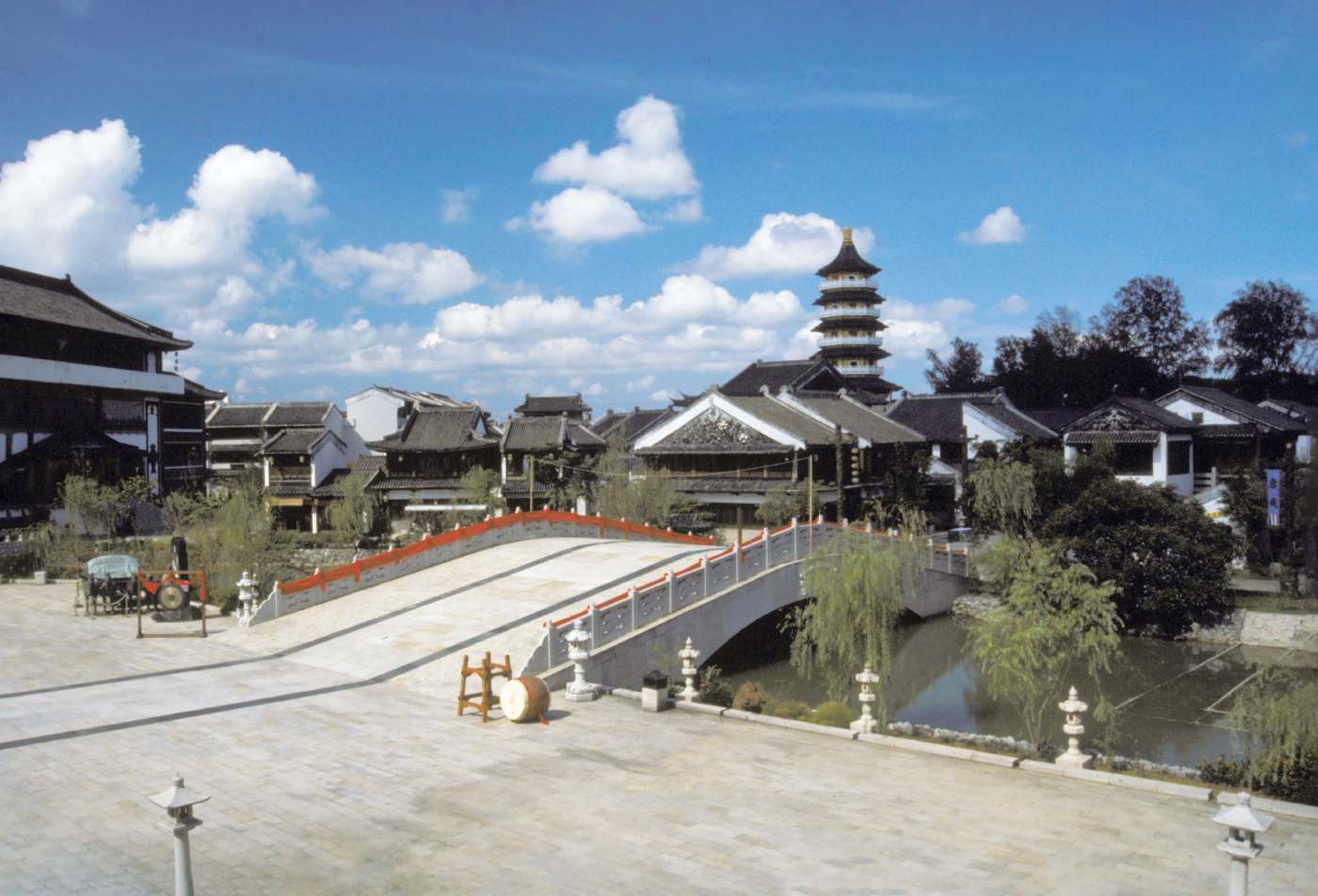
Replicas such as the Wild Goose Pagoda and Zhao Zhou Bridge were central to the park’s efforts to recreate the aesthetic of Chang’an, 1994. Ministry of Information and the Arts Collection, courtesy of National Archives of Singapore (Media - Image no. 19990001380 - 0059).
On a sweltering afternoon on 12 January 1992, thousands of visitors flocked to the western end of Singapore to watch swashbuckling heroes rescue fair maidens from danger. There, adjacent to the serene Jurong Lake on the former site of Jurong Drive-In Cinema stood the massive, grey-brick ramparts of Tang Dynasty Village, a 12-hectare project that aimed to replicate the ancient imperial city of Chang’an (modern day Xi’an) in Singapore. (Chang’an was the capital city of the Tang dynasty, 618–907.)1
Dubbed “Singapore’s own Disneyland” by the Straits Times, the theme park-cum-movie studio – which was the size of 17 football fields – greeted eager visitors with replicas of landmarks from the old Chinese capital. These included the Daming Palace (the former home of 17 emperors), the Zhao Zhou Bridge (an arch bridge spanning the Jiao River in Heibei) and the Wild Goose Pagoda (a Buddhist pagoda to house sutras and figurines).2
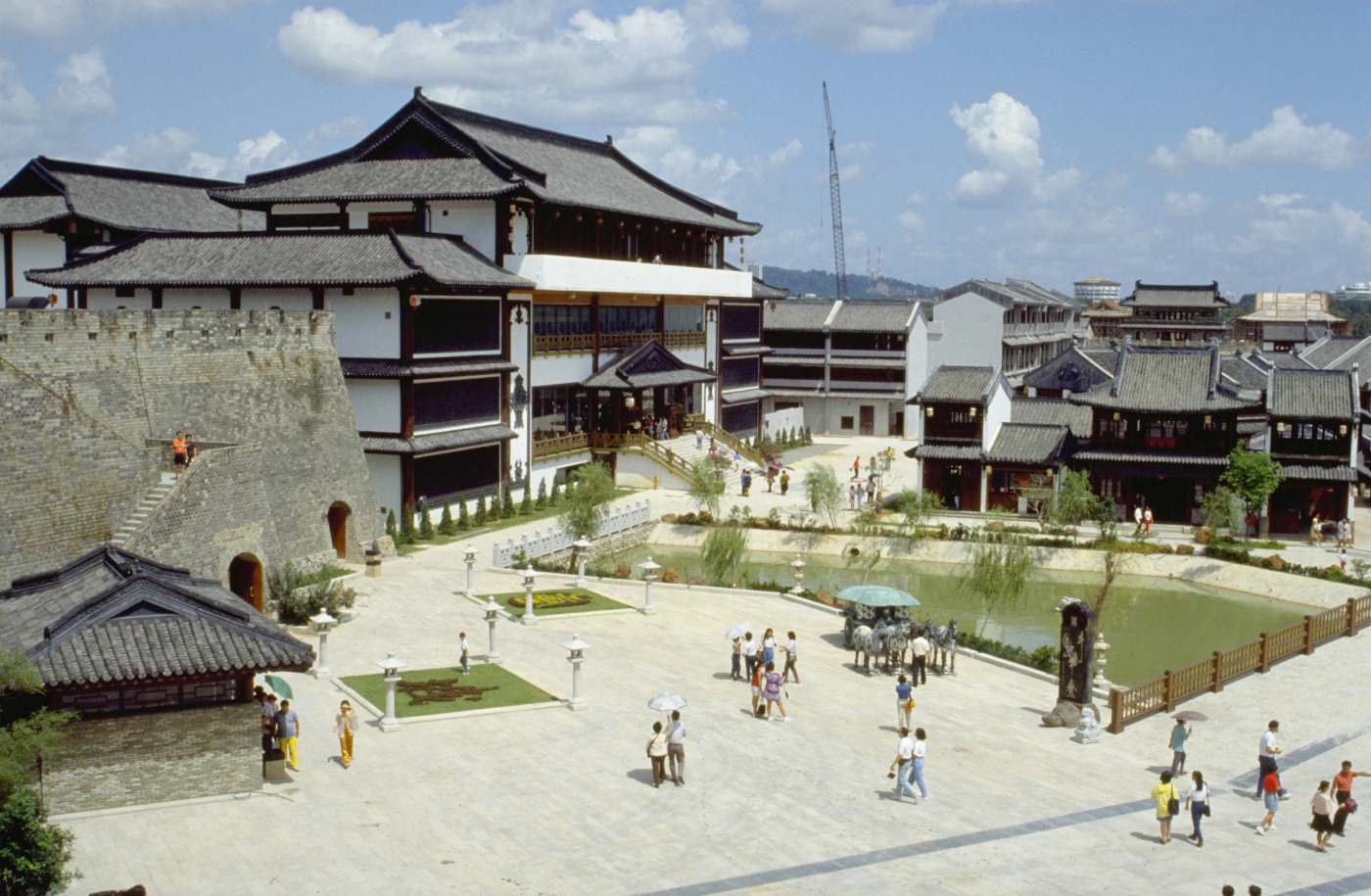
At the entrance was a three-storey complex housing duty-free shops and restaurants, designed to entice visitors to spend, 1992. Ministry of Information and the Arts Collection, courtesy of National Archives of Singapore (Media - Image no. 19990001378 - 0029).
Singapore’s “Hollywood” Ambitions
Tang Dynasty Village was the brainchild of Hong Kong tycoon Deacon Chiu Te-ken, chairman of Asia Television (ATV) and founder of investment firm Far East Consortium. His vision came at a time when major players like Shaw Brothers and Cathay Organisation had moved away from film production to focus on other aspects such as cinema distribution and broadcasting.3
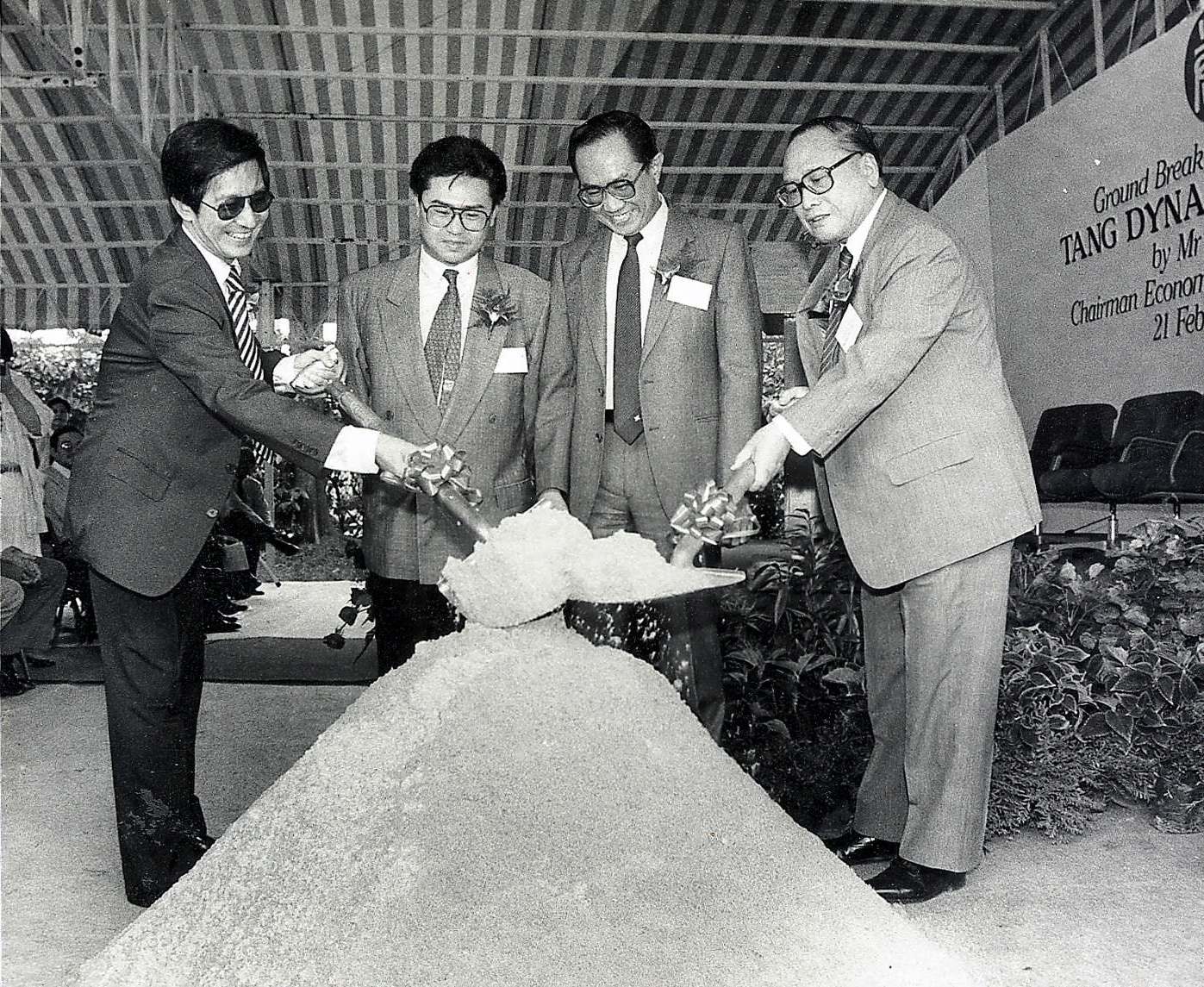
The groundbreaking ceremony for Tang Dynasty Village led by Philip Yeo, chairman of the Economic Development Board (extreme left), on 21 February 1989. Deacon Chiu, chairman of Asia Television and founder of Far East Consortium, is on the extreme right. Source: Lianhe Zaobao © SPH Media Limited. Permission required for reproduction.
Chiu envisioned establishing not just one but three movie studios within the theme park, with the intention of jointly producing Chinese serials with the then Singapore Broadcasting Corporation (SBC). He was confident that Singapore would have the necessary talent to support a Chinese movie industry like Hong Kong. “You have got to begin somewhere. Of course there are risks, like when I first started a cinema in the New Territories [in Hong Kong] and they all said nobody will go, but gradually people did,” he told the Straits Times. The movie studio concept was a primary factor that helped him secure the 1988 tender by the Jurong Town Corporation to develop the site.4
According to Philip Yeo, chairman of the Economic Development Board, the joint venture between SBC and ATV would “set the stage for the growth of [Singapore’s] indigenous movie industry”. The goal was to acquire both physical infrastructure and technical expertise in related specialised fields. “For the successful development of a movie industry, support industries such as film-processing labs, sound studios and post-production houses would have to be set up,” he said.5
At the time, in the 1980s, Singapore had “no local film industry to speak of” except for several small production houses that worked mainly on advertising commercials and commissioned documentaries. There was also a severe shortage of technical expertise as “only a handful of Singaporeans [were] equipped to stand behind a movie camera or direct a film”. “Becoming a film centre,” the Business Times noted, “would mean rare jobs and training opportunities, a certain amount of technology transfer and potentially more business for the hotel and tourist industries.”6
Chiu was fully aware of the financial risks of his investment in Jurong. His strategy was to integrate entertainment and the movie studios into a sprawling theme park.7
An Architectural Grandeur
Chiu spared no expense to recreate the city of Chang’an. “Details are very important,” he said. “I want the Tang Dynasty Village to be the best Chinese theme park in the world, so everything must be perfect.”8
Construction was a massive undertaking that relied heavily on traditional Chinese craftsmanship and genuine building materials. The project required shipping millions of items from China, including granite slabs, slates, glazed roof tiles and jade-coloured eaves to ensure that the buildings looked “as authentic as possible”.9
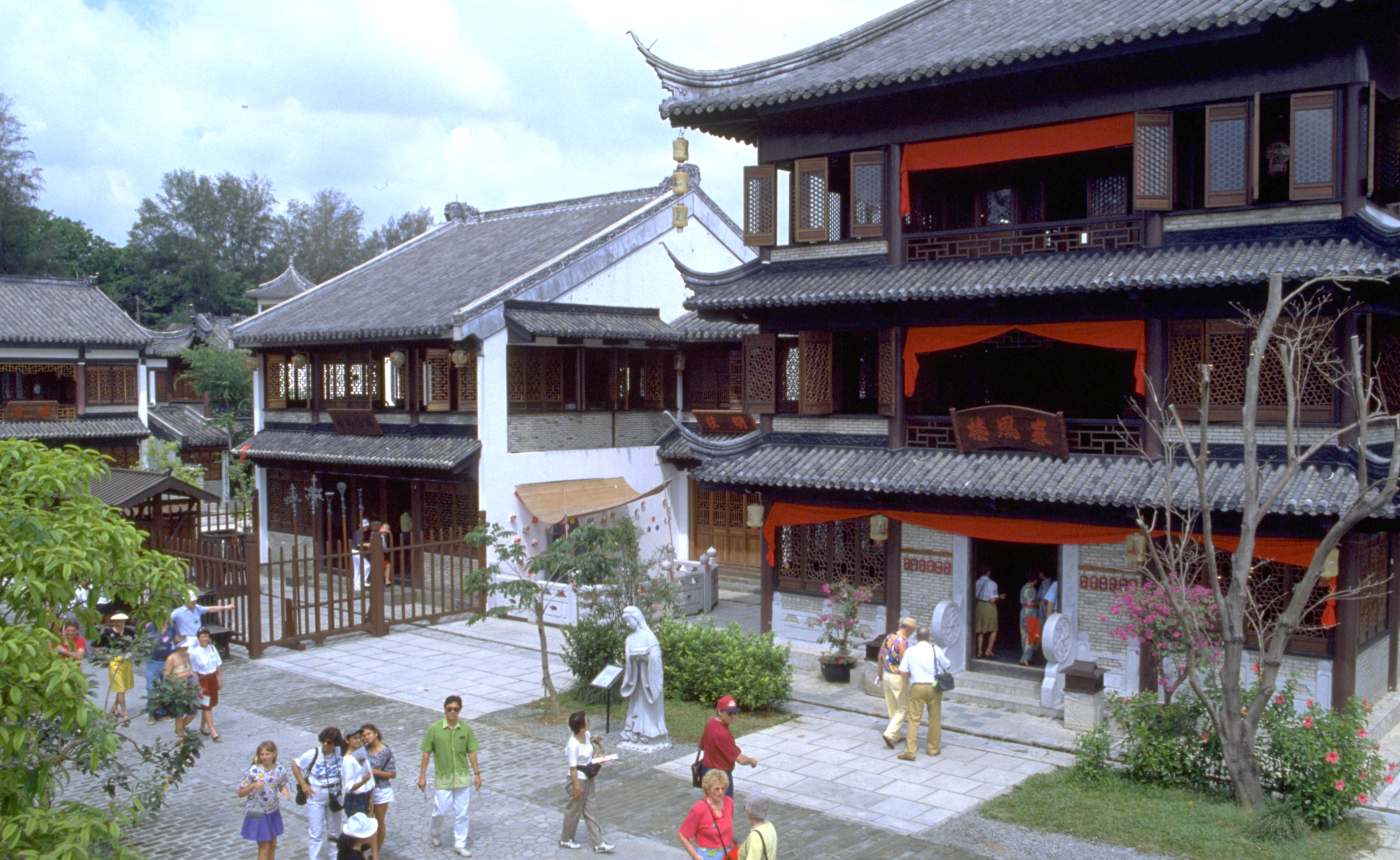
Replicas of traditional Chinese houses, 1993. Ministry of Information and the Arts Collection, courtesy of National Archives of Singapore (Media - Image no. 19990001379 - 0101).
The quest for realism even extended to the landscape, with flora native to China such as willow trees being transplanted here to mimic the scenery of a typical Tang-era village. To create the famous underground tomb of Emperor Qin Shi Huang’s terracotta army, replica life-size figures of chariots, horses and foot soldiers were imported.10
Given the meticulous attention to detail and the logistical strain of acquiring specialised materials from overseas, the project’s budget ballooned from $50 million to $70 million by 1989 before reaching a staggering $90 million by the time its gates opened in 1992.11
Marketing Blitz
As early as August 1989, a representative of the park joined a trade mission to the United States led by the Singapore Tourist Promotion Board (today’s Singapore Tourism Board). By the end of 1991, the park was marketing itself in travel fairs in Europe, Japan, Hong Kong, Taiwan and Southeast Asian countries. Chiu had high expectations for the theme park. He aimed to recoup his investment within seven years as well as attract at least one million visitors annually, increasing by 5 percent each year.12
To entice visitors to spend more than a day in the park, Chiu revealed in December 1989 that he was planning to add a 250-room hotel within the theme park, though this did not materialise in the end.13 And what would a theme park be without retail shops? In 1991, department store Metro announced that it would be setting up an 8,000 sq ft shop in the park to sell high-end items such as porcelain, paintings, silk wear, and wood and bronze carvings, which opened in January 1992.14
To promote the filmmaking facilities, Chiu set up Tang Dynasty Village Motion Pictures in June 1989 and announced his intention to make at least three movies a year “depending on the type of scripts we receive”. Filmmakers were approached, with Eric Tsang, a well-known Hong Kong actor and director, among the first to respond. “Singapore is the next best place to start a movie industry. There is a Chinese community here, so no problems getting extras. Films made here can be marketed to both China and Taiwan. And there is practically no competition here because we would be the pioneers,” he said.15
In July 1989, SBC announced that it would film its new sword-fighting serial, Legend of a Beauty, in Tang Dynasty Village. Starring Hong Kong actress Michelle Yim alongside local stars such as Chen Liping and Chen Tianwen, the production was a milestone as it was one of the first local serials to cast a prominent foreign artiste in a lead role.16
Off to a Flying Start
Tang Dynasty Village opened to much fanfare on 12 January 1992 with 5,000 visitors, beating the record of 4,000 held by Haw Par Villa in 1991.17 (Tang Dynasty Village was renamed Tang Dynasty City the following month.18)
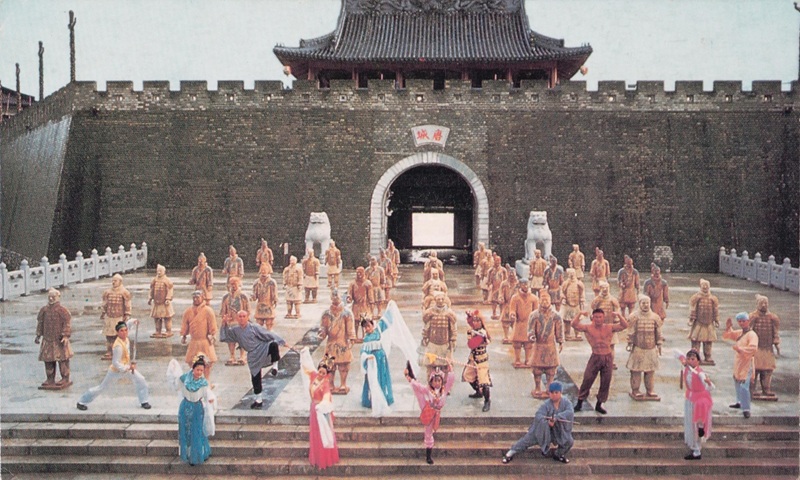
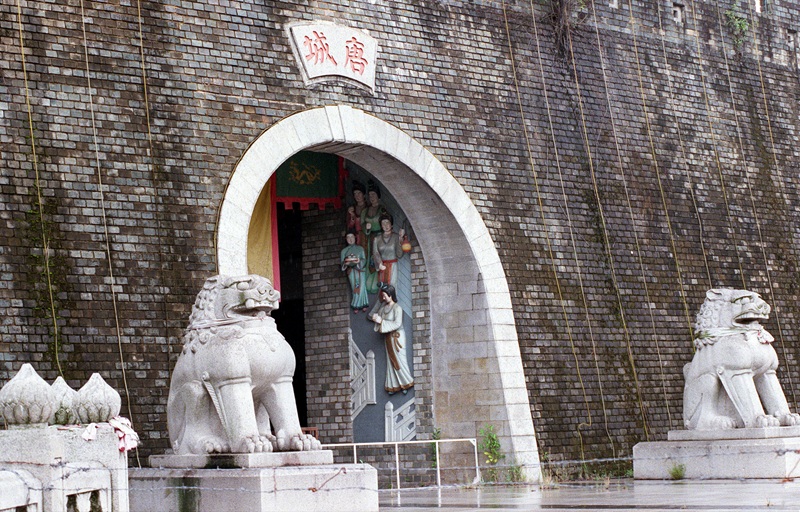
Visitors were entertained by stunt and dance troupes from China, artisans demonstrating the making of Chinese pottery, ceramics and woodcarvings, and reenactments depicting both imperial court life and the everyday struggles of people in the Tang dynasty. These included a mock trial where an offender was beaten by court officials as well as the scene of an emperor welcoming the return of a victorious general.19
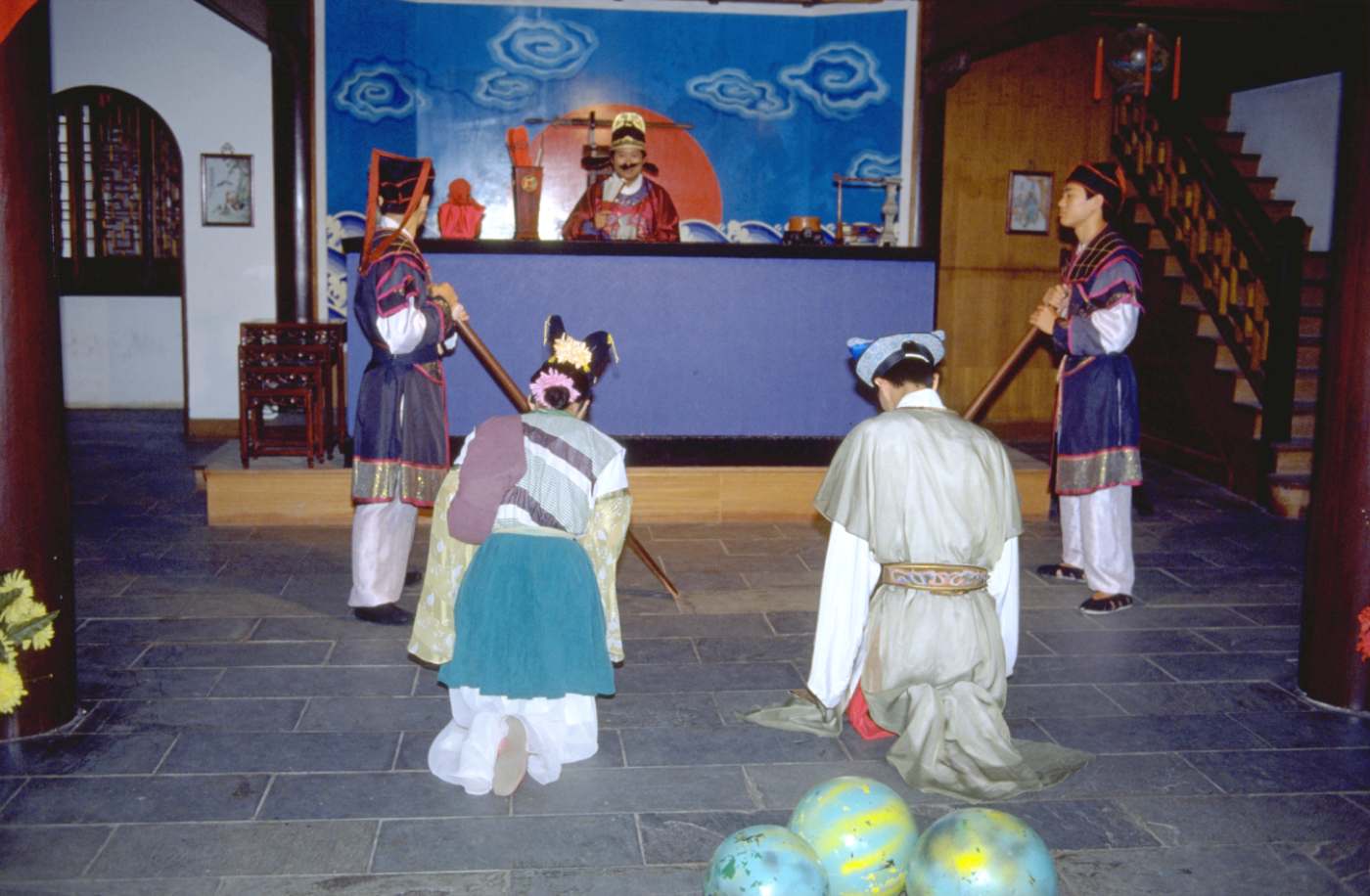
A reenactment of a court trial in ancient China, 1993. Ministry of Information and the Arts Collection, courtesy of National Archives of Singapore (Media - Image no. 19990001379 - 0118).
These daily performances won praises from visitors who paid a $15 entrance fee for adults and $10 for children, which many found “steep” since some attractions were not yet opened. For most, the highlight was the “flying” swordsmen stunt show. Crowds gasped as heroes battled in midair, skimming the surface of the river effortlessly and gliding through the sky, suspended by cable. “It’s better than a gongfu movie, and there are no nets below, too,” said insurance agent John Joseph.20
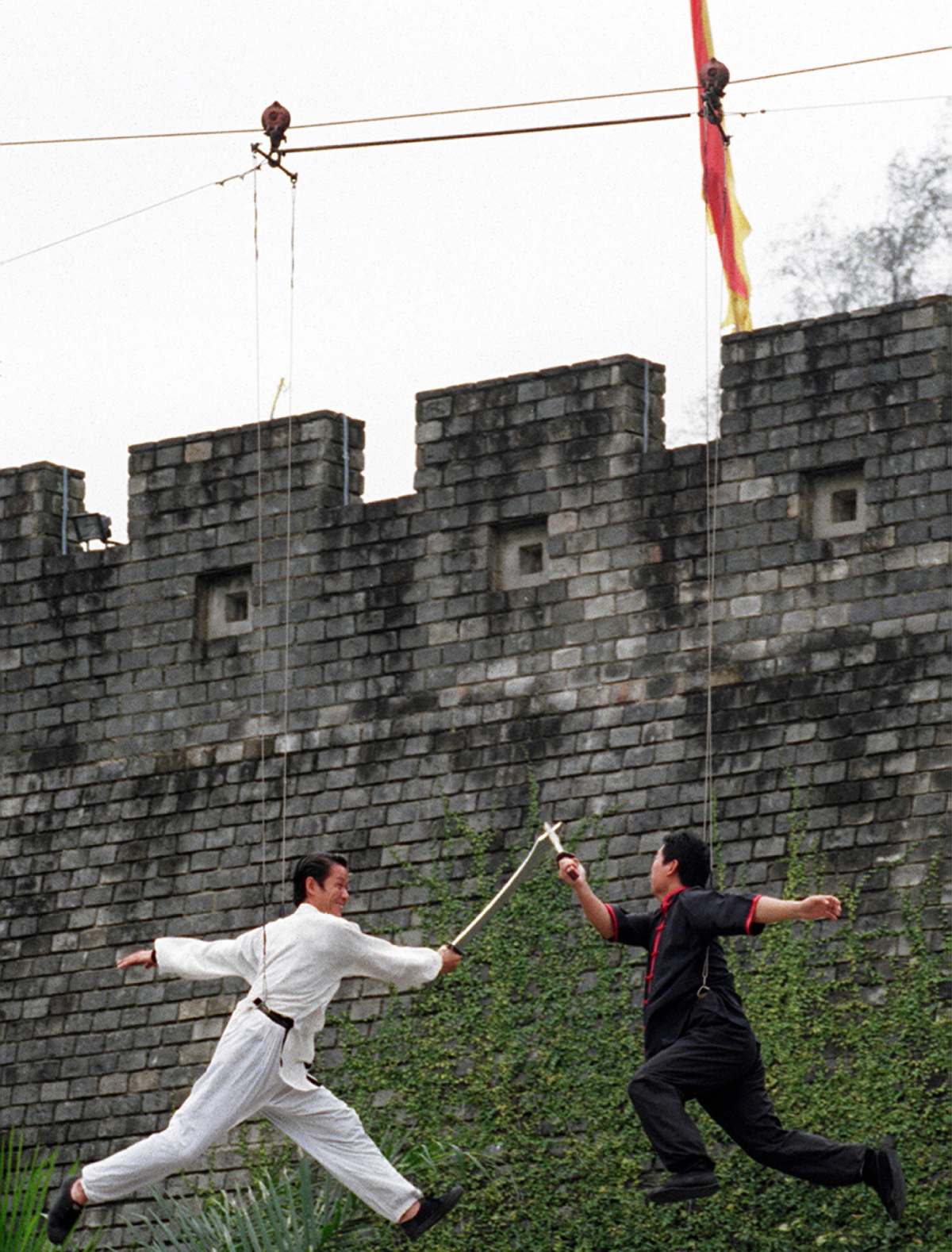
The “flying” swordsmen stunt show was a crowd favourite, 1999. Source: The Straits Times © SPH Media Limited. Permission required for reproduction.
“The costumes, loud gongs and drums make me feel as if I’ve stepped back in time,” said teacher C. Goh. For housewife Alita Abdullah, “It’s like being in ancient China!” Even guest of honour Lim Boon Heng, Senior Minister of State for Trade and Industry, joined in the festivities. Picking up a pole used in the mock trial, he quipped: “I’m sure Professor Jayakumar [Minister for Law and Home Affairs] would be interested in taking a look at this!” Jokes aside, Lim said that the “village testified to the effectiveness of the Hong Kong-Singapore twinning concept”. “It is the result of the merger of the best talent from both cities.”21
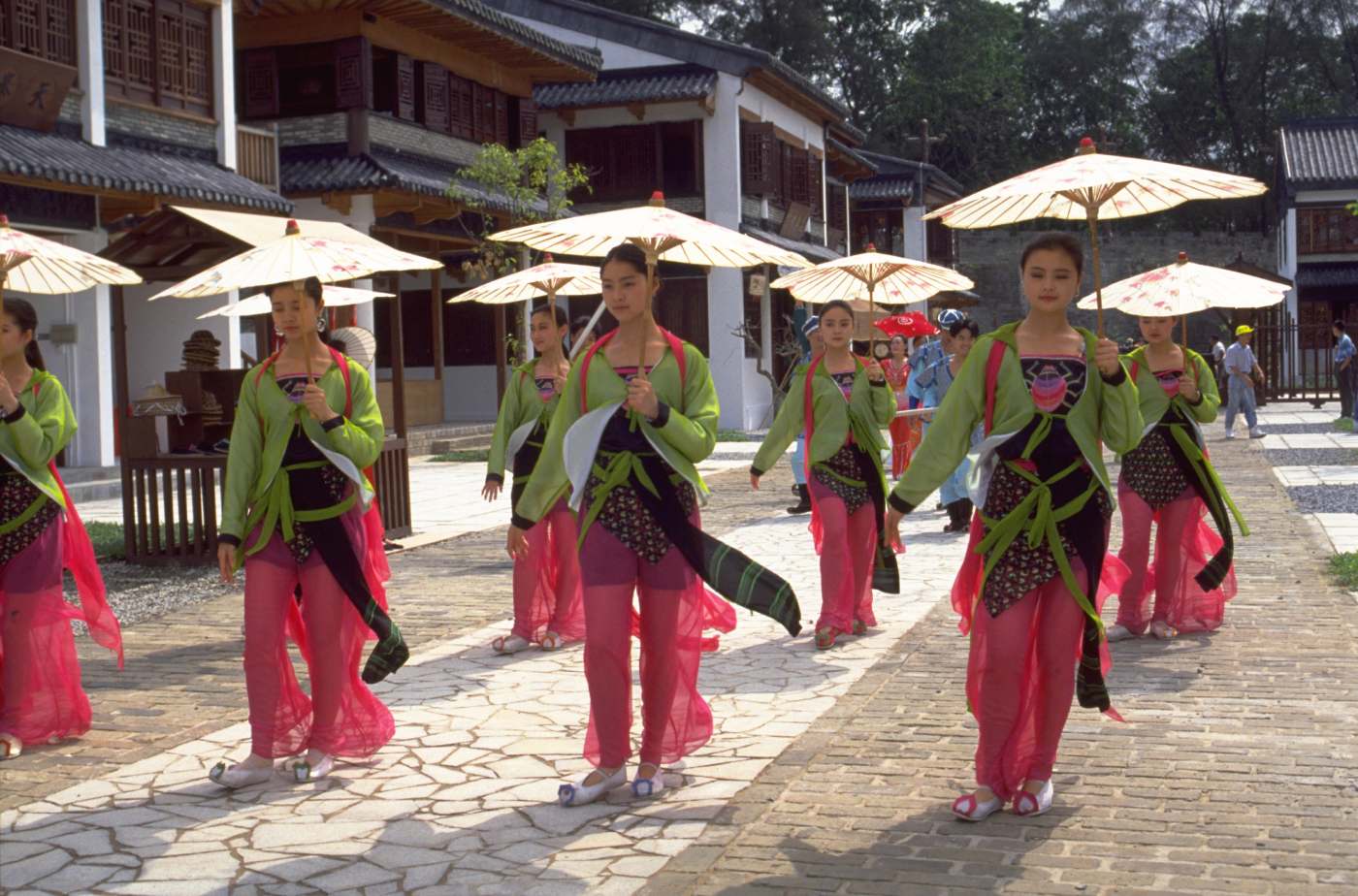
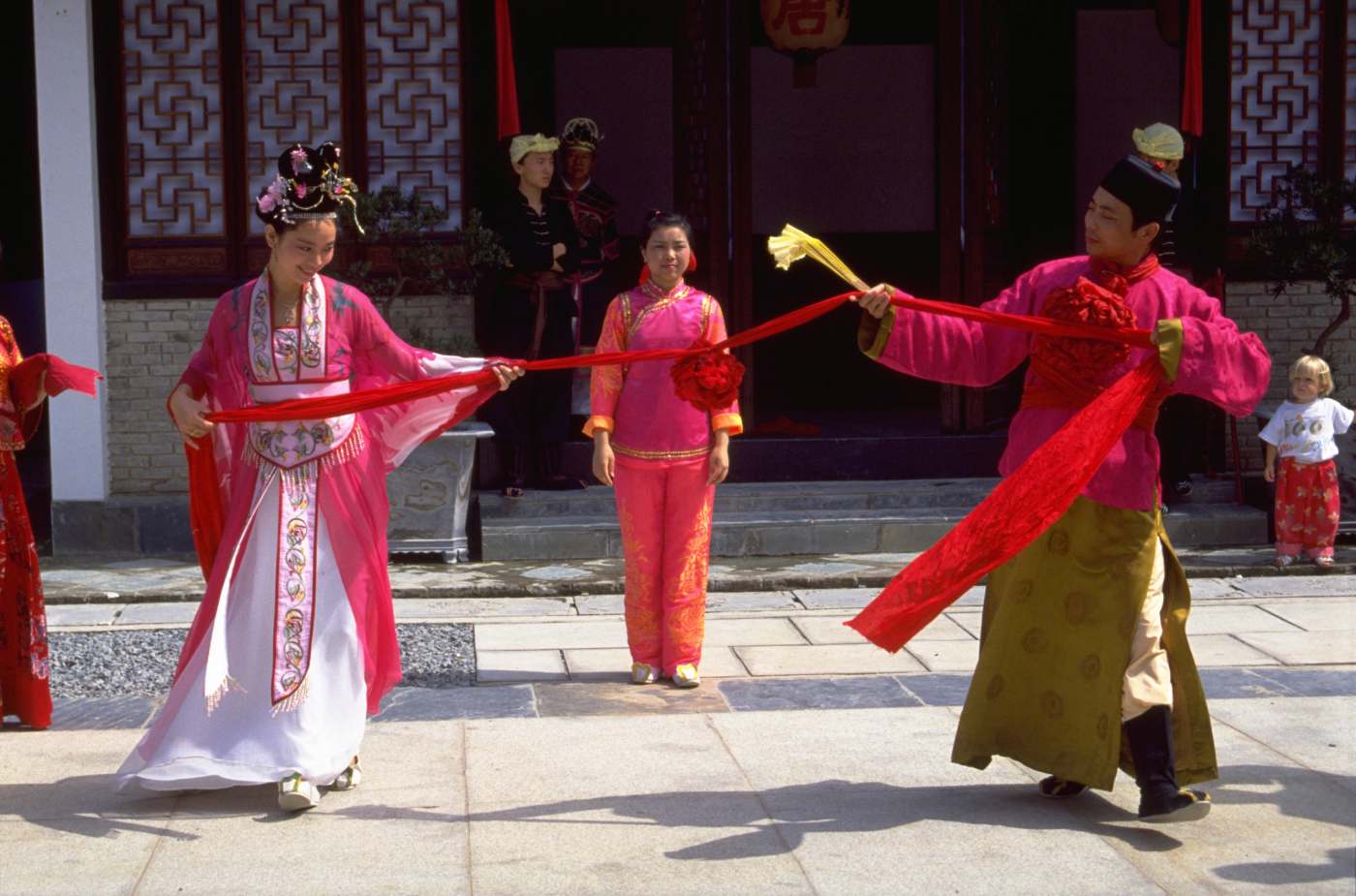
In September 1992, the well-known Hong Kong filmmaker and actor Raymond Wong revealed that he would be filming one of his upcoming movies at the theme park in November. Titled Hua Tian Xi Shi (All’s Well, Ends Well Too), the comedy flick starred some of the biggest Hong Kong artistes at the time such as Sam Hui, Ricky Hui, Leslie Cheung and Rosamund Kwan.22
After this movie, Wong filmed another in 1993: a spoof of the Chinese classic Water Margin titled Shui Hu Xiao Zhuan (Laughter of the Water Margins). Apart from Sam Hui and Ricky Hui from the first movie, the second also featured big names like Teresa Mo and Lydia Sum.23
But It Did Not End Well
While the high-profile movies and grand opening generated significant media buzz and publicity, these failed to translate into a steady stream of visitors. In its first year, Tang Dynasty City attracted only 800,000 visitors, falling short of its one-million annual target. From there, the numbers entered a steep year-on-year decline, plummeting to just 400,000 visitors by 1995, three years after opening. This was a far cry from other more popular attractions in Singapore at the time, such as the Singapore Zoo, Sentosa’s Underwater World and the Jurong Bird Park, which were all drawing over one million visitors annually.24
By October 1993, the Business Times reported that the park had already registered a $2 million loss during its opening year, prompting the paper to question if the park could remain sustainable since it appeared to have “more concrete than charm”. “Everything looked good on paper but when they materialised, the parks were a disappointment most of the time,” said tour operator Matthew Pillay. “They had various activities when they started which later fizzled out. The parks eventually became run-of-the-mill.”25
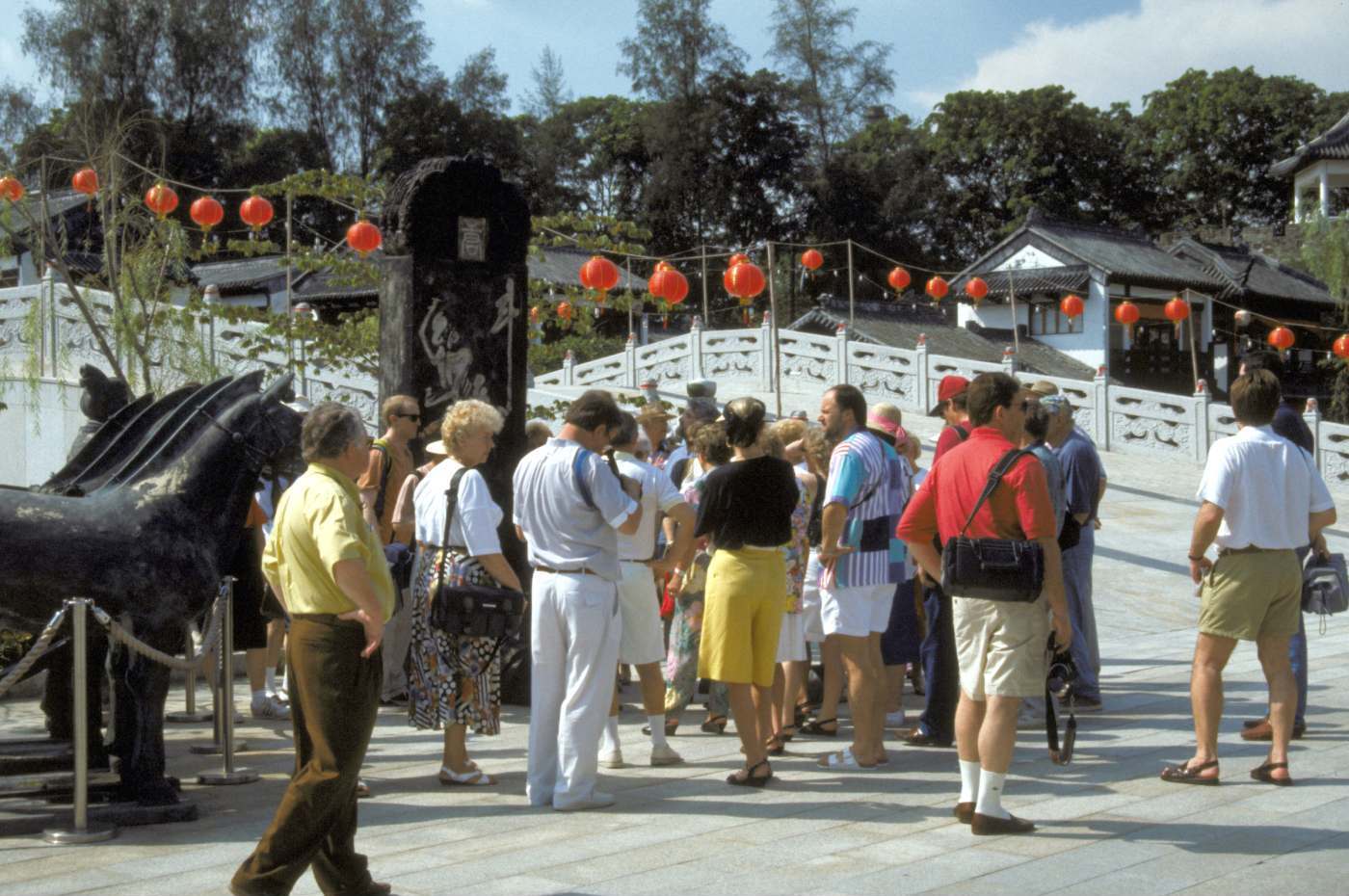
Visitors to the theme park in its early days, 1993. Ministry of Information and the Arts Collection, courtesy of National Archives of Singapore (Media - Image no. 19990001380 - 0002).
Clarence Cheung, general manager of Tang Dynasty City, believed that the dismal visitor numbers stemmed from Singaporeans’ preference for shopping and eating instead of Chinese theme parks. “We didn’t get as many locals in the first year as we had hoped for,” he said. Cheung surmised that Singaporeans have little knowledge of China and are less appreciative of things Chinese, and hoped to change this mindset through educational public talks. He added that the entrance fees were lower than those charged by theme parks in other countries. “It’s not the $15 that matters to Singaporeans but what they get out of the $15,” he said. “So we have to make sure they get value for their money.”26
This struggle also extended to the park’s aspiration to become the “Hollywood” of Singapore. Following Raymond Wong’s films, major productions at the site became increasingly rare although SBC did utilise the park to promote the serial, The Great Conspiracy, in 1993. The site was also reportedly shortlisted in 1996 as a filming location for the Malayalam film, Varnappakittu, and was eventually used for House of Harmony in 2004, a joint Singapore-Germany production starring Hong Kong actress Maggie Q and local actress Fann Wong.27
Tang Dynasty City also served as one of the filming locations for a local science-fiction film titled Avatar (2004). The screenplay was by Christopher Hatton who has also written for the American television series, Star Trek: The Next Generation. Directed by Kuo Jian Hong, the film featured an international cast such as Joan Chen, Wang Luoyang, Genevieve O'Reilly and David Warner, and local actors like Lim Kay Siu, Kumar and Gerald Chew.28
A primary factor that impeded the city’s success as a film studio was its architectural inflexibility. The Chang’an-style buildings were too historically specific, offering a narrow aesthetic that was suitable only for movies set within that singular era. Furthermore, the site lacked the comprehensive ecosystem required by major filmmakers. It could not provide essential production and broadcast infrastructure such as film-processing labs, sound stages, or even onsite accommodation for cast and crew. Without these integrated facilities, the park remained nothing but a picturesque backdrop rather than a functional, self-sustaining movie studio.29
Even the park owners recognised that its concept was not working. Dennis Chiu, the son of Deacon Chiu and the park’s managing director, admitted that it was “not doing well” and required urgent diversification. He pinpointed that the problem could be the fact that the park was too “faithful to the original and became a one-track theme park”. Although the reception was initially “overwhelming”, it quickly became irrelevant when China opened its doors to the world shortly after. “Since people could go to China to see the real thing, they did not feel the urge to see Tang Dynasty City, which was just a replica,” he said.30
In 1995, to breathe new life into the park, admission fees were waived during the evening and new offerings were introduced to transform the experience. These included food pushcarts, restaurants, a bar, a karaoke lounge, a Cantopop discotheque and a 1920s Shanghai-style cinema that screened classical Chinese movies. The park’s shows were also revamped to encourage audience participation, while exhibits were redesigned to include special effects.31
In 1996, when the Underground Palace featuring 2,000 terracotta warriors opened, it featured a film show about the life of Qin Shi Huang, a laser game where visitors could shoot down life-size monsters and demons, and even earthquake effects.32
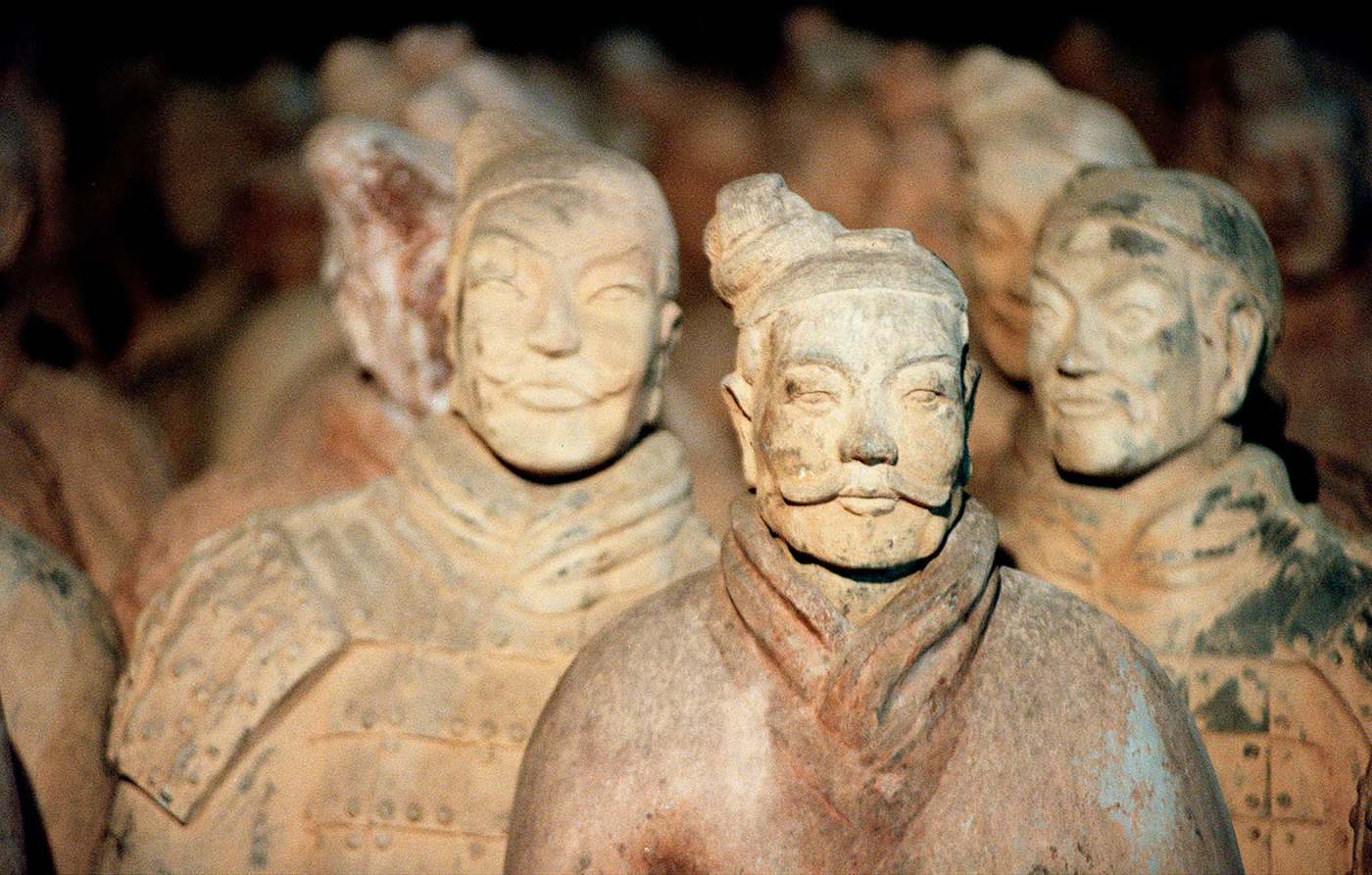
Replicas of Emperor Qin Shi Huang’s terracotta warriors were highlights of the theme park. Photo was taken in 2000, a year after its closure, when they were put up for auction. Source: The Straits Times © SPH Media Limited. Permission required for reproduction.
However, these attempts could not turn the tide. By December 1996, Admiralty Investment Holdings had acquired a 65 percent stake in the park for $47 million. The new owners planned to enhance the Chinese theme of the park by building a Chinese-style hotel; organising more cultural events, street shows and martial arts performances; bringing in exotic foods from different parts of China; and holding classes in traditional Chinese arts and crafts. “Visitors must feel that they are whisked 1,300 years back into an ancient Chinese city with people in period costumes and activities of that time,” said Bernard Kwek, chief executive of Admiralty Investment Holdings. To attract more Singaporeans and incentivise them to make repeat visits, admission fees for locals were reduced from $15 to $12. There were even plans to make the hotel a “one-stop traditional Chinese wedding centre” where couples could wed in a traditional Chinese ceremony.33
These efforts did little to improve the woes of the park. The situation was exacerbated by the onset of the 1997 Asian Financial Crisis, which caused major disruptions to the economy and a sharp drop in tourism. In August 1999, Admiralty was forced into judicial management with $62 million in debt. A month later, on 22 September, the shutters came down permanently on Tang Dynasty City: it barely lasted eight years.34
Becoming an Urban Memory
For nearly a decade thereafter, the 12-hectare site sat in a state of disrepair and was described as “an eyesore” and “a waste of space and money”. Discussions to revive the site, which included a Shaolin-themed resort, did not materialise. Eventually, the theme park was demolished in 2009.35
Today, the site of the former Tang Dynasty City is entering a new chapter. As part of the Jurong Lake District, it is being developed into a housing estate by the Housing and Development Board. While the grey bricks and terracotta warriors are no more, the legacy of Tang Dynasty City is preserved in the ephemera and photograph collections of the National Library (https://www.nlb.gov.sg/main/nlonline (opens in new tab)) and National Archives of Singapore (https://www.nas.gov.sg/archivesonline/ (opens in new tab)) as well as in the collective memory of a generation of Singaporeans who once visited the theme park.
About the Author
Lim Tin Seng is a Senior Librarian with the National Library Singapore. He is the co-editor of Roots: Tracing Family Histories – A Resource Guide (2013), Harmony and Development: ASEAN-China Relations (2009) and China’s New Social Policy: Initiatives for a Harmonious Society (2010). He writes regularly for BiblioAsia.
Endnotes
1 Lee Han Shih, “Movie Glitz and Glamour Making Its Way to Jurong (opens in new tab),” Business Times, 22 February 1989, 22; Judith Tan, “Tang Village Set to Be Fun ‘City (opens in new tab)’,” Straits Times, 24 February 1989, 15; “Consorts and Camels Beckon As Tang Village Opens (opens in new tab),” Straits Times, 12 January 1992, 19; “Tang Village Opening Draws Thousands (opens in new tab),” Straits Times, 13 January 1992, 24; “Tang Dynasty Village to Be a City (opens in new tab),” Straits Times, 25 January 1992, 23. (From NewspaperSG)
2 “Hollywood Singapore 2261 (opens in new tab),” New Paper, 22 February 1989, 16; “Singapore’s Own Disneyland (opens in new tab),” Straits Times, 10 January 1992, 2 (From NewspaperSG); Tan, “Tang Village Set to Be Fun ‘City (opens in new tab)’.”
3 Boey Kit Yin, “Hongkong Tycoon Eyes Major Property Deals (opens in new tab),” Business Times, 24 March 1988, 1; Lee Swee Hon, “My Son the Movie Maker? (opens in new tab)” Straits Times, 26 June 1988, 21; Jean Chia, “Tang Dynasty Village Owner Expects to Recoup Investment Within 7 Years (opens in new tab),” Straits Times, 21 June 1991, 48; “HK TV Tycoon Dies (opens in new tab),” Straits Times, 19 March 2015, 9. (From NewspaperSG)
4 Boey, “Hongkong Tycoon Eyes Major Property Deals (opens in new tab)”; Doreen Siow, “‘Movie Town’ and Tang Village for Jurong (opens in new tab),” Straits Times, 19 May 1988, 32. (From NewspaperSG)
5 “‘Movie Town’ and Tang Village for Jurong (opens in new tab)”; Lee, “My Son the Movie Maker? (opens in new tab)”
6 “Coming Soon – Film-making (opens in new tab),” Business Times, 23 March 1989, 12. (From NewspaperSG)
7 Siow, “‘Movie Town’ and Tang Village for Jurong (opens in new tab)”; Lee, “My Son the Movie Maker? (opens in new tab)”
8 Tang Wai Tin, “Must Be Perfect: Tang Village Boss (opens in new tab),” New Paper, 25 January 1992, 8. (From NewspaperSG)
9 “Craftsmen from China to Put Finishing Touches to Tang Village (opens in new tab),” Straits Times, 9 December 1989, 21. (From NewspaperSG)
10 “Craftsmen from China to Put Finishing Touches to Tang Village (opens in new tab).”
11 Tang, “Must Be Perfect: Tang Village Boss (opens in new tab)”; Lee “Movie Glitz and Glamour Making Its Way to Jurong (opens in new tab)”; Chan Sue Meng, “Tang Village Opening Next Week, More Projects in the Pipeline (opens in new tab),” Straits Times, 31 December 1991, 24; Doreen Siow, “Construction Costs for Tang Dynasty Village Rise $20M to $70M, (opens in new tab)” Straits Times, 11 October 1989, 40. (From NewspaperSG)
12 Sylvia Wong, “Tang Dynasty Village Expects Payback in Seven Years (opens in new tab),” Business Times, 21 June 1991, 2; Caroline Chan, “Tang Village to Be Promoted in US (opens in new tab),” Straits Times, 18 August 1989, 40; Lo Tien Yin, “Tang Village to Open in November (opens in new tab),” New Paper, 13 June 1991, 5. (From NewspaperSG)
13 Khaw, “Deacon Chiu Plans to Build Hotel at Tang Dynasty Village (opens in new tab)”; Wong, “Tang Dynasty Village Expects Payback in Seven Years (opens in new tab)”; Chan, “Tang Village Opening Next Week, More Projects in the Pipeline. (opens in new tab)”
14 Sylvia Wong, “Metro to Set Up Arts and Crafts Shop at Tang Dynasty Village (opens in new tab),” Business Times, 13 July 1991, 2; “Metro Group Plans to Expand Quickly into Gift Retailing (opens in new tab),” Straits Times, 13 January 1992, 39. (From NewspaperSG)
15 Siow, “Construction Costs for Tang Dynasty Village Rise $20m to $70m (opens in new tab)”; Chan, “Tang Village Opening Next Week, More Projects in the Pipeline (opens in new tab)”; Koh Siew Tin, “Tsang Sees Singapore As Next Tinsel Town (opens in new tab),” Straits Times, 13 March 1989, 6. (From NewspaperSG)
16 Loh Tien Yin, “Dynasty Delight (opens in new tab),” New Paper, 28 December 1991, 3; Lo Tien Yin, “Village Drama (opens in new tab),” New Paper, 13 June 1991, 20; Lee San Chouy, “Working Girl (opens in new tab),” Straits Times, 23 May 1991, 7. (From NewspaperSG)
17 “Tang Village Opening Draws Thousands (opens in new tab).”
18 “Tang Dynasty Village to Be a City (opens in new tab).”
19 “Consorts and Camels Beckon As Tang Village Opens (opens in new tab)”; “Tang Village Opening Draws Thousands (opens in new tab)”; Angeline Song, “Ouch! Ouch! This Hurts! (opens in new tab),” New Paper, 28 January 1992, 3. (From NewspaperSG)
20 Irene Hoe, “Hurray for Our Very Own Hollywood (opens in new tab),” New Paper, 22 February 1989, 14 (From NewspaperSG); “Consorts and Camels Beckon As Tang Village Opens (opens in new tab)”; “Hollywood Singapore 2261 (opens in new tab)”; “Tang Village Opening Draws Thousands (opens in new tab)”; Song, “Ouch! Ouch! This Hurts! (opens in new tab)”
21 “Consorts and Camels Beckon As Tang Village Opens (opens in new tab)”; “Tang Village Opening Draws Thousands (opens in new tab).”
22 Norman Yam, “HK Stars Coming (opens in new tab),” Straits Times, 28 September 1992, 6. (From NewspaperSG); “All’s Well, Ends Well Too,” IMDb, accessed 9 April 2026, https://www.imdb.com/title/tt0107159 (opens in new tab).
23 “Funny Way to Spend $6m (opens in new tab),” New Paper, 30 April 1993, 39; “Page 12 Advertisements Column 1, (opens in new tab)” Straits Times, 10 August 1993, 12. (From NewspaperSG); “Laughter of the Water Margins,” IMDb, accessed 9 April 2026, https://www.imdb.com/title/tt0108127/ (opens in new tab).
24 Rav Dhaliwal, “Tang Dynasty City to Build 250-room Chinese-style Inn to Draw More Visitors (opens in new tab),” Straits Times, 18 February 1996, 13; Rav Dhaliwal, “Tang Dynasty City Out to Woo Singaporeans (opens in new tab),” Straits Times, 14 December 1996, 51; “Fall in Number of Visitors to S’pore’s Leisure Spots: Survey (opens in new tab),” Straits Times, 25 July 1995, 15. (From NewspaperSG)
25 Jenny Lam, “Seeking a Unique Identity (opens in new tab),” Business Times, 9 October 1993, 17. (From NewspaperSG)
26 Lam, “Seeking a Unique Identity. (opens in new tab)”
27 Prabhavathi Nair, “Million-dollar Movie to Be Shot Here (opens in new tab),” Straits Times, 19 April 1996, 13; Sandra Leong, “Location! Location! Location! (opens in new tab),” Straits Times, 15 May 2005, 9; “Drama at Tang Dynasty City, (opens in new tab)” Straits Times, 14 June 1993, 49; Jeannie Tan, “East West (opens in new tab),” Today, 23 July 2004, 34. (From NewspaperSG)
28 Christopher Hatton, email to author, 13 July 2026; David Ngiau, “Star-studded Local Sci-fi Film (opens in new tab),” Today, 9 April 2001, 5; Sherwin Loh, “S'pore Film Reaches Out to the World (opens in new tab),” Straits Times, 26 August 2004, 66. (From NewspaperSG)
29 John Lui, “Dream Bigger with Mediapolis (opens in new tab),” Straits Times, 31 December 2008, 38. (From NewspaperSG)
30 Rav Dhaliwal, “Tang Dynasty City to Have Cantopop, Karaoke, Food (opens in new tab),” Straits Times, 27 August 1995, 20. (From NewspaperSG)
31 Dhaliwal, “Tang Dynasty City to Have Cantopop, Karaoke, Food (opens in new tab)”; Rav Dhaliwal, “Theme Parks Adding New Attractions, (opens in new tab)” Straits Times, 31 July 1995, 17. (From NewspaperSG)
32 Dawn Tan, “S’pore Attractions to Step Up Marketing Overseas (opens in new tab),” Straits Times, 8 January 1996, 26; Dawn Tan, “Million-$ Game of Battling Monsters and Demons (opens in new tab),” Straits Times, 7 June 1996, 41. (From NewspaperSG)
33 Dhaliwal, “Tang Dynasty City to Build 250-room Chinese-style Inn to Draw More Visitors (opens in new tab)”; Tan, “Million-$ Game of Battling Monsters and Demons (opens in new tab)”; Rav Dhaliwal, “Theme Parks Advised to Refresh Their Images Often (opens in new tab),” Straits Times, 23 June 1996, 33; “Admiralty Club Owner to Take 65% of Tang Dynasty, (opens in new tab)” Business Times, 9 December 1996, 2; Dhaliwal, “Tang Dynasty City Out to Woo Singaporeans (opens in new tab),” Straits Times, 14 December 1996, 51. (From NewspaperSG)
34 Kalpana Rashiwala, “Tang Dynasty Owner Takes Cover (opens in new tab),” Straits Times, 21 August 1999, 68; Kalpana Rashiwala, “Court Allows JTC to Repossess Tang Dynasty City Site (opens in new tab),” Business Times, 19 August 2000, 7; “City Closes (opens in new tab),” New Paper, 22 September 1999, 7. (From NewspaperSG)
35 Krist Boo, “No Plans Yet for Tang Dynasty Site (opens in new tab),” Straits Times, 3 February 2001, 6; Loh Chee Kong, “Forgotten $100M Tang Dynasty City (opens in new tab),” Today, 19 February 2004, 6; Tracy Quek, “Tang Dynasty City Could Be Turned into Shaolin-themed Resort (opens in new tab),” Straits Times, 27 April 2007, Page 3; Leong Wee Keat, “The End of the Tang Dynasty? (opens in new tab),” Today, 14 September 2007, 3; Lee Siew Hua, “Remaking Jurong: From Ulu Town to Romantic Lake District (opens in new tab),” Straits Times, 10 May 2008, 74. (From NewspaperSG)