
Article
Musical Evenings in Changi Internment Camp
29 April 2026
Topics
Arts
Places and Buildings
In the early months of the Japanese Occupation, a music-loving Japanese camp commander played a supporting role in musical activities that became a source of comfort and solace for the civilian internees.
By Phan Ming Yen
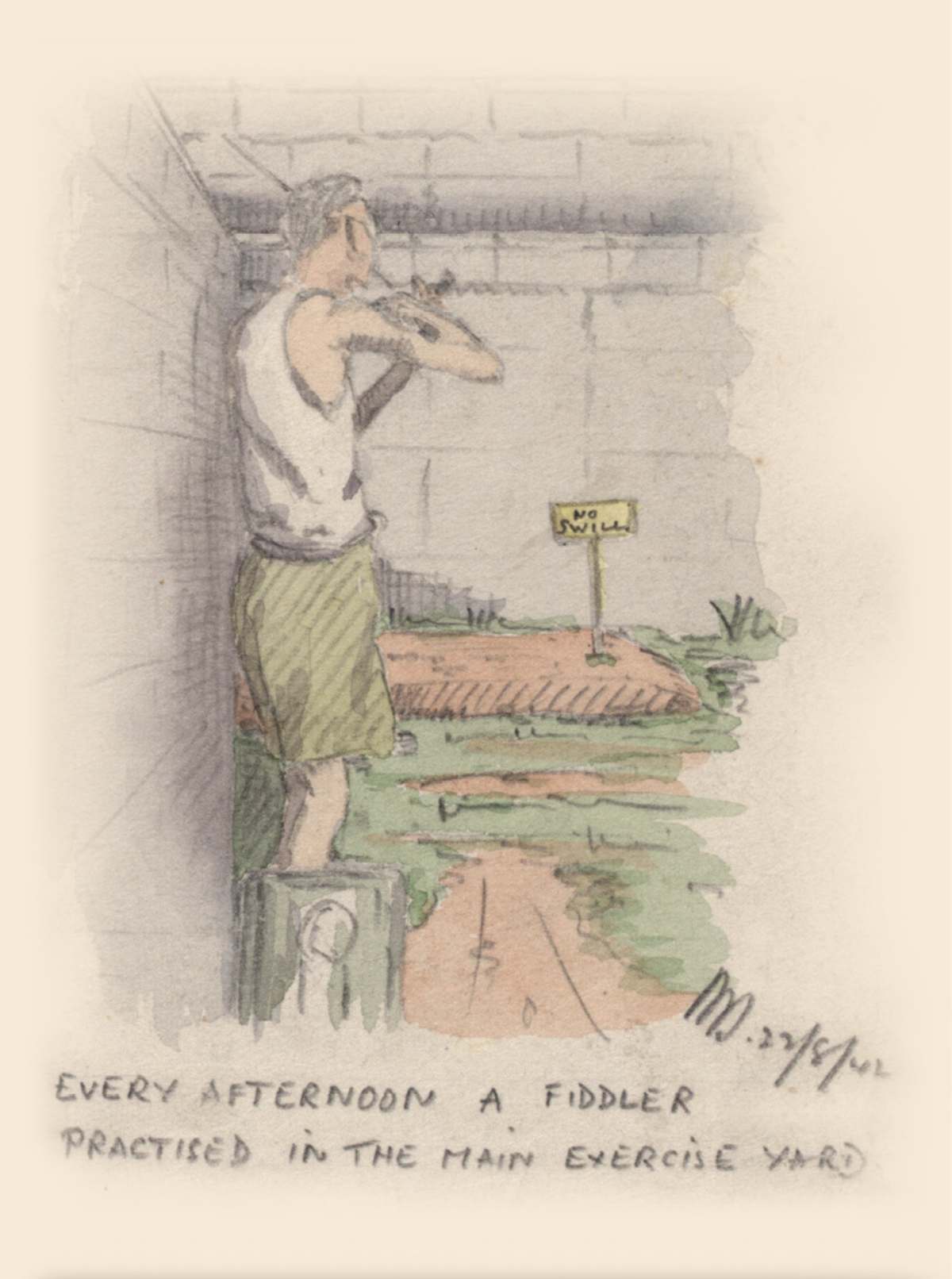
Sketch of a fiddler who practises every afternoon in the main exercise yard by William Haxworth, 1942. Haxworth was the Chief Investigator of the War Risks Insurance Department of the Singapore Treasury when war broke out. He was interned first in Changi Prison and then in Sime Road Internment Camp. W.R.M. Haxworth Collection, courtesy of National Archives of Singapore (Media - Image No. 20060000330 - 0019).
On the evening of 22 May 1942, after listening for half an hour to a trio performance at the Changi civilian men’s internment camp, the Japanese camp commander made a song request.1
Lieutenant Okasaki,2 who oversaw Changi camp from March to September 1942, had asked for the Scottish folk song “Auld Lang Syne” – traditionally sung at the stroke of midnight on New Year’s Eve to bid farewell to the old year, or played at funerals and graduations. Following the trio’s performance, Okasaki congratulated the musicians.
Given that Japan was at war with Britain, the internees might have thought that a Japanese camp commander requesting a song from an enemy country to be unusual. A report of the concert made it to the camp’s newspaper, the Changi Guardian,3 under its “Do You Know…” column the following day. The account of the concert focused more on Okasaki’s request than on the concert itself.
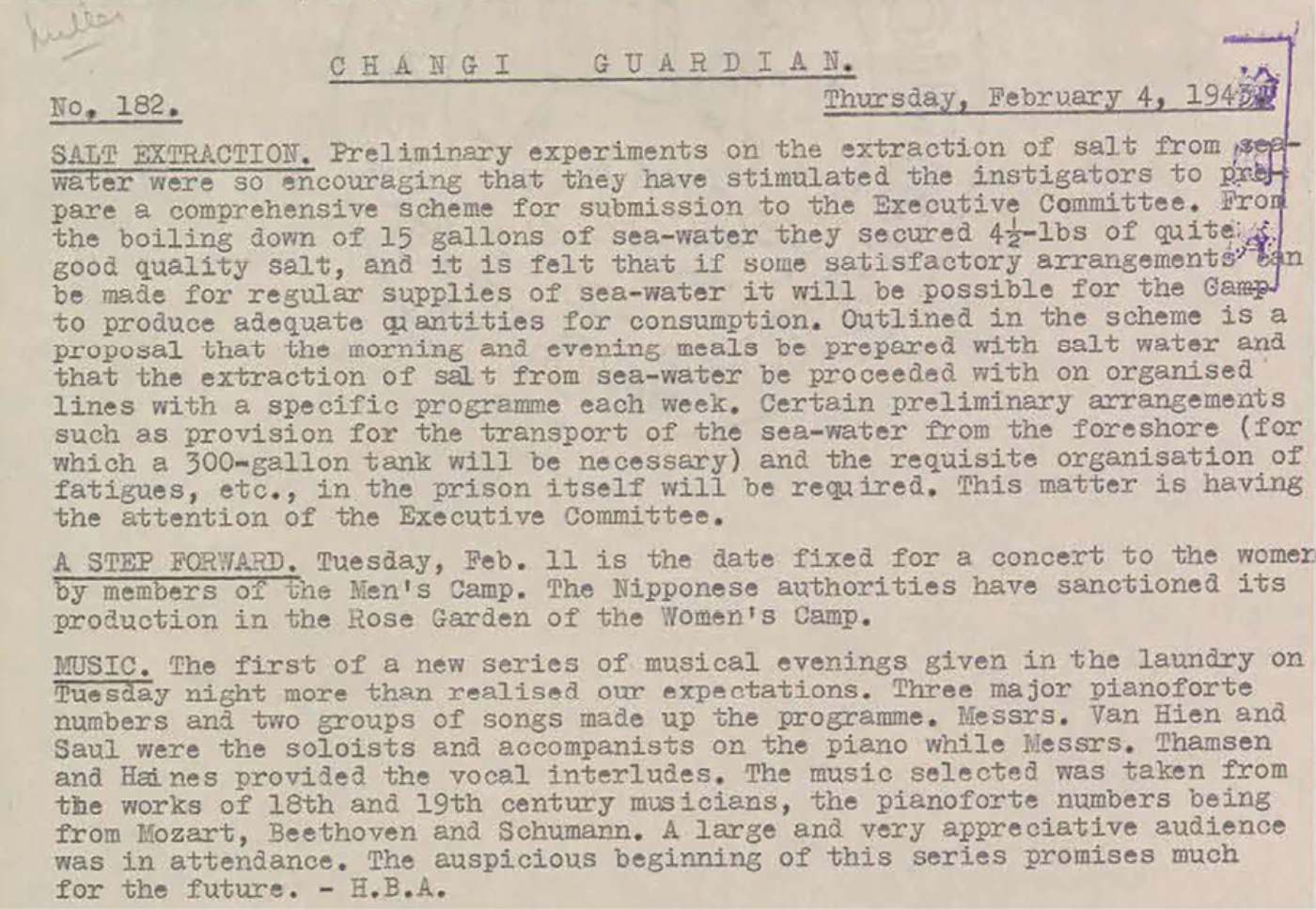
First report of “Musical Evenings” by the Changi Guadian on 4 February 1943. Reproduced by kind permission of the Syndics of Cambridge University Library (RCMS 103/12/29).
Four days later, on 26 May, in a performance given by the men for women internees,4 the same trio of musicians included “Auld Lang Syne” in their repertoire. Okasaki was also at the concert and was reported to have taken a “close interest in the programme”. With reference to “Auld Lang Syne”, the Changi Guardian noted that Okasaki “graciously acknowledged the compliment extended by the Melody Trio” in playing his favourite song. Before he left the event, Okasaki gave the gathering “carte blanche to sing the National Anthem as ‘loud as you like’”.5
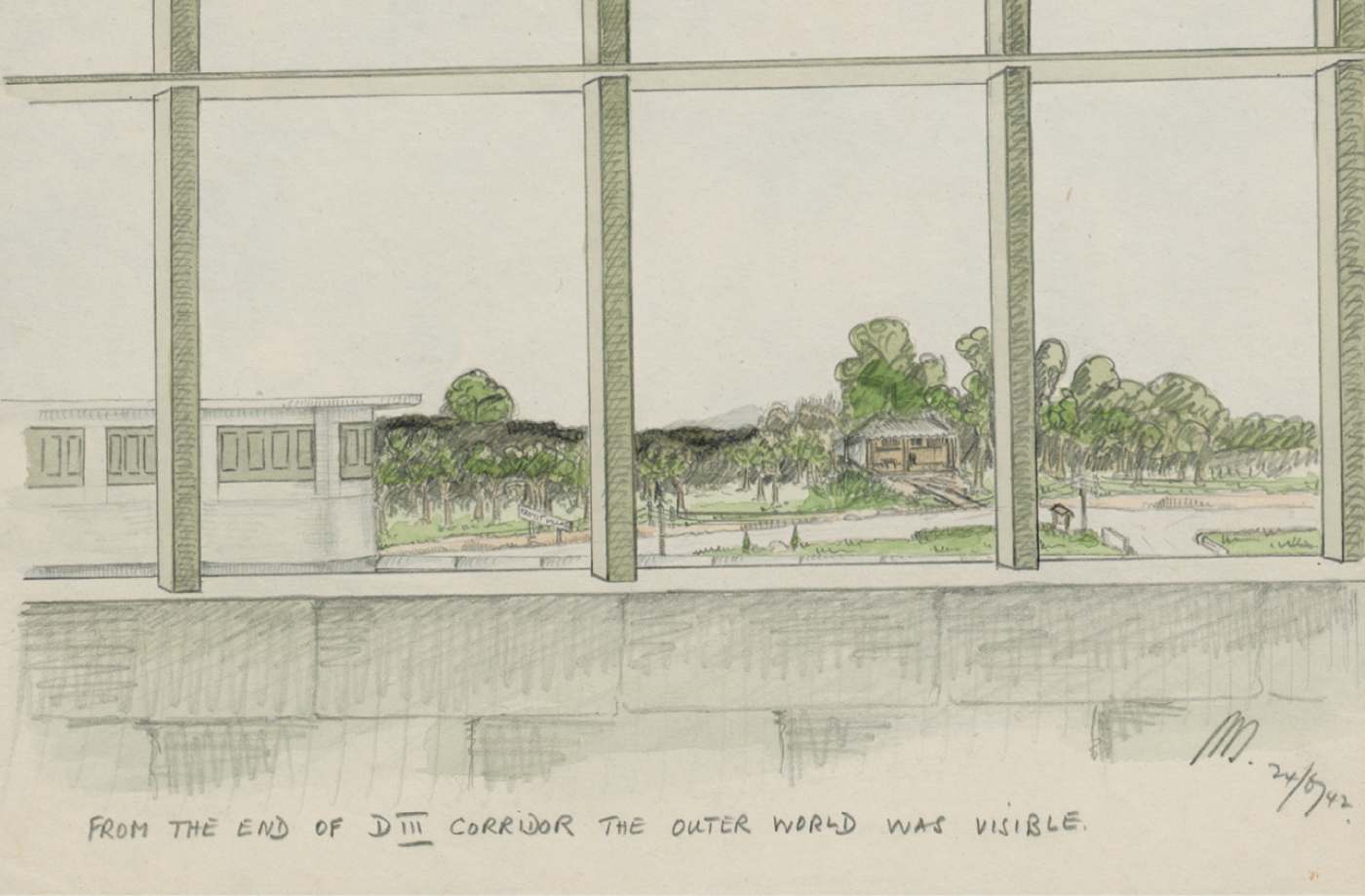
Sketch of Changi Prison titled “From the End of DIII Corridor the Outer World Was Visible” by William Haxworth, 1942. Haxworth was the Chief Investigator of the War Risks Insurance Department of the Singapore Treasury when war broke out. He was interned first in Changi Prison and then in Sime Road Internment Camp. W.R.M. Haxworth Collection, courtesy of National Archives of Singapore (Media - Image No. 20060000330 - 0094).
An Unusual Request
There are many questions arising from Okasaki’s request for “Auld Lang Syne”. How was his request communicated to the musicians at the concert on 22 May? Did he sing or hum the melody to the musicians, or did he mention the song by name? More importantly, why did he request this song, and how did he come to know of this song?
Until the mid-2000s, academic research on the experiences of Western civilians interned in Southeast Asia was few and far between. In her 2004 work, The Internment of Western Civilians Under the Japanese 1941–1945, historian Bernice Archer attributed this to Eurocentrism and how “war memories privileged masculine and battle experiences”. Archer further noted that a Eurocentric view of World War II had resulted in the marginalisation of the experiences of these Western civilians.6
In a 2023 online article for Southeast Asia Library Group, writer Gautam Hazarika noted that former Changi prisoners-of-war (POWs) had published their memoirs in the mainstream press while only a “handful” of civilian internees did – and even then, many were through non-mainstream press with most being out of print. Hazarika concluded that “very little is known about the civilians”.7
This lack of research is evident. While studies such as Sears Eldredge’s Captive Audiences/Captive Performers: Music and Theatre as Strategies for Survival on the Thailand-Burma Railway and the chapter “On with the Motley: The Changi Concert Party” in The Changi Book provide insights into the function of entertainment for POWs, no similar works exist for civilian internees, whether within the men’s or women’s internment camps in Singapore.8
As such, a closer study of these and other concerts potentially reveals how the occupier-occupied (or captor-captive) dynamic is more nuanced and multifaceted beyond the “good” and “bad” stereotypes. It also offers an opportunity to investigate how music functioned in an internment camp for both captor and captive.
Glow of the Fireflies
While there is no record in the Changi Guardian of whether “Auld Lang Syne” was sung or performed in an instrumental arrangement, the evidence suggests the latter. The musicians who formed the Melody Trio were British internees and all instrumentalists: Leo J. Farrell,9 a musician from Kuala Lumpur, played the clarinet and saxophone; George J. Merrifield,10 a prison officer, played the piano-accordion; and Sydney Alexander B. Ross,11 a planter from Melaka, played the violin. No record thus far has been found of these musicians doubling up as vocalists in their performances.
It can also be conjectured that the Melody Trio’s rendition of the song evoked different cultural experiences and memories for Okasaki than for the internees who were from “enemy countries” of Japan. Okasaki was likely listening to a song he had probably first come to know as “Hotaru no Hikari” (蛍の光; Glow of the Fireflies) when he was a student, sung to the tune of “Auld Lang Syne”. The performance likely pleased Okasaki and he congratulated the musicians when it ended. He was not listening to “Auld Lang Syne” but “Hotaru no Hikari”. If the trio had given a vocal performance of the work in its original language, English, Okasaki might have been taken by surprise and reacted differently.
“Hotaru no Hikari” – with lyrics by the poet and educator Chikai Inagaki – was often sung in Japan at school graduation ceremonies and commonly played at the end of the business day in department stores. It was introduced in 1881 in «小学唱歌集 初編», the first elementary song book for schools.12 At the time, music education – starting with singing – was deemed beneficial for society, and a singing education was considered to be a “means for moral education”.13
This “Japanised” version encouraged students, who had successfully graduated after toiling in the night by the glow of fireflies, to serve the nation. This exhortation is found in the third and fourth stanzas of the song, which were often omitted from performances in the aftermath of World War II.14 One of its lines goes: “Let no distance come between your hearts, but devote yourselves wholly to the country as one.”15
Thus, on the evening of 22 May 1942, two different sets of lyrics – conveying separate meanings but sung to the same tune – were going through the minds of the audiences. For a moment, music that was familiar to both sides bound the occupier (Okasaki) and the occupied (the internees) in a shared physical space, albeit evoking distinct and disparate cultural memories on either side.
Pianos and a Musical Ensemble
Based on events after the two concerts, it appeared that these performances of “Auld Lang Syne” had indirect and far-reaching consequences in Changi camp for the next two years.
Given the lack of musical instruments at the time,16 musical entertainment primarily comprised vocal performances, some exceptions possibly being those by the Melody Trio. When the internees were initially held at the Karikal Mahal mansion in Katong,17 a committee had been set up to look at musical and entertainment activities given the number of pianists and singers among them. However, musical instruments were necessary for the proposals put forth and, as such, it was felt that “variety and singing are the only possibilities” until “equipment” was acquired.18
After the internees were moved to Changi, the highlight of such activities was a choir formed in late March 1942 and led by Gordon Garth Van Hien (or more commonly known as Gordon Van Hien). The Changi Guardian described the choir’s debut on 18 April “an event in Changi history and is, without doubt, the outstanding cultural achievement so far”.19
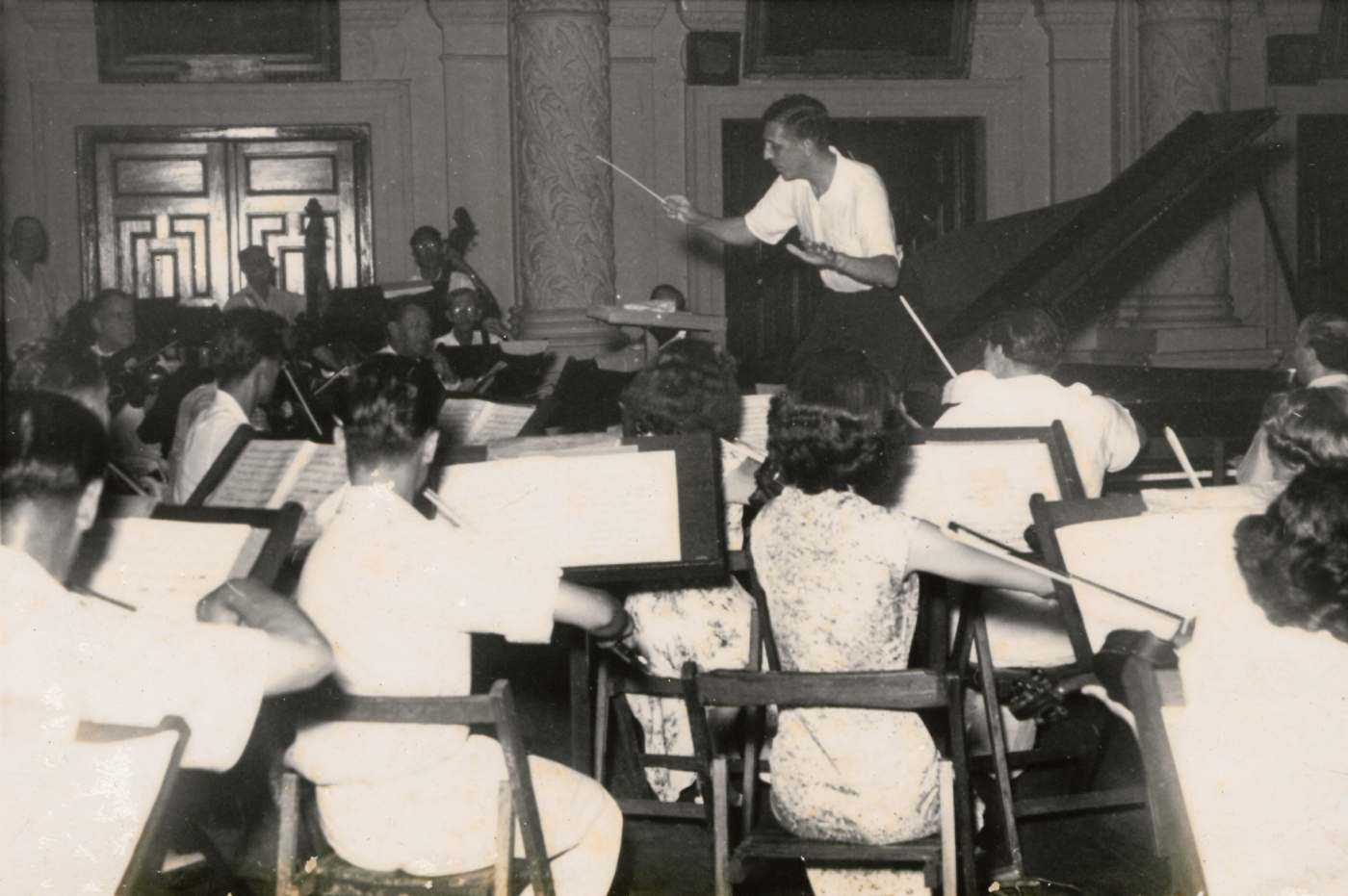
Gordon Van Hien conducting the Singapore Musical Society Orchestra, c. 1953. Goh Soon Tioe Collection, courtesy of National Archives of Singapore (Media - Image No. 20140000160 - 0210).
Van Hien had arrived in Singapore in 1938 as a chartered accountant with prior musical training in both the violin and piano while a student in Britain. He joined the Singapore Musical Society in 1940, quickly becoming its treasurer. Van Hien was scheduled to conduct the society’s orchestra on 14 December 1941, but war with Japan broke out on 8 December.20 In early March, while still at Karikal Mahal, he had already been tasked to organise musical activities.21
On 28 May, two days after the concert for women internees, the Changi Guardian was hopeful that the camp would soon have its own orchestra. The “Nipponese authorities” had allowed Farrell to venture out of the camp to collect musical instruments belonging to the internees that had been left behind in their homes. On 30 May, the Changi Guardian reported that Farrell was “scampering up and down before descending on Singapore in a half3/4ton [sic] lorry to collect any musical instruments he can lay his hands on to form a 10-piece (?) orchestra”.22
It was also around the same time that pianos began to arrive at both the men’s and women’s camps. As George Lamb Peet, acting editor of the Straits Times and Director of Information in the Straits Settlements government before 1942 recalled, the Japanese had allowed them to “bring in three good pianos”.23
On 19 May, the Changi Guardian reported that pianos had been presented to the men’s and women’s camps by “Nipponese authorities”.24 Another piano was presented by the Bishop of Singapore, John Leonard Wilson, to the camp. This piano was originally from the Mental Hospital (renamed Miyako Byoin during the Occupation) in Yio Chu Kang. The internees had sought permission from the camp authorities to transport the piano to Changi in an ambulance, which arrived on 22 May.25
On 30 May, the Changi Guardian jested that the three pianists in the camp – Van Hien, Robert Eisinger26 and Dennis B. Soul27 who formed the “Piano Sub-committee” – had the unenviable task of deciding who among the “several hundred pianists” would be deemed “competent” to give performances.28 Whether or not the “several hundred pianists” was an exaggeration, it was certainly an indication of the number of musically inclined internees who sought some relief in musical activity.
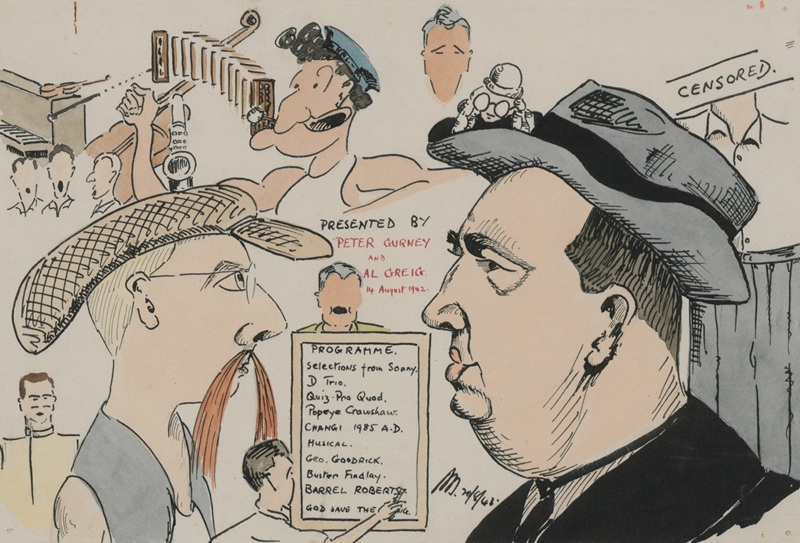
William Haxworth’s sketch of internees preparing programme posters and putting up a musical, 1942. W.R.M. Haxworth Collection, courtesy of National Archives of Singapore (Media - Image No. 20060000331 - 0025).
Van Hien possibly gave the camp’s first “piano recital” on 23 June 1942 when he presented a programme comprising works by Bach, Mozart and Chopin. This was music which the Changi Guardian felt was worthy of the Victoria Memorial Hall. Many were hopeful that this recital would be followed by more with “fortnightly recitals in the laundry”, which would be “eagerly looked forward to”.29
More importantly, however, the presence of a piano had uplifted the spirits of the internees, as noted by the Changi Guardian: “The advent of the pianoforte has made such an addition to the amenities of our prison life that at once the musical thermometer had risen. We are greatly indebted to those who have given themselves on our behalf in order that through their talents musically we should benefit aesthetically and spiritually.”30
By 18 June, Farrell had made two trips out with Okasaki, collecting also any “stray” instruments to form an orchestra. Farrell returned with an accordion, two violins, two ukuleles and two mouth organs.31 He had hoped to bring back a bass violin, a saxophone and another accordion.
The Camp Commander
Who was Okasaki, the camp commander who made time to accompany Farrell in securing musical instruments and also helped procure a cello for the musicians, expanding the Melody Trio into a quartet? [The new fourth member was Bob Kauff.]32
While little documentation on Okasaki in English-language sources has been found by this author to date, his memory fares well in the memoirs of both male and female internees.
Okasaki reminded Sheila Allan – who turned 18 six months into her internment – of a peacock when he “struts up and down on inspection days”, and she noted that his liking children was something “in his favour”. Upon his departure from the camp, Allan felt that his replacement would not be as “kindly disposed” towards the internees as he had been.33
A report by the Japanese authorities after the war described Okasaki’s management of the camp as “negative administration” in which “the internees were left to work out their own organisation” and there were no roll calls or routine inspection. The period was marked by insufficient supplies of food to “balance the diet” and the camp was on the verge of an outbreak of beri-beri until permission was granted to buy rice polishings. Furthermore, nothing was done to relieve congestion or improve living conditions, which worsened as more internees arrived. However, in the light of “later experiences”, the report noted that the internees soon realised that the restraint shown by Okasaki and his deputy, Second Lieutenant Tokuda, was “a matter of surprise and gratitude”.34
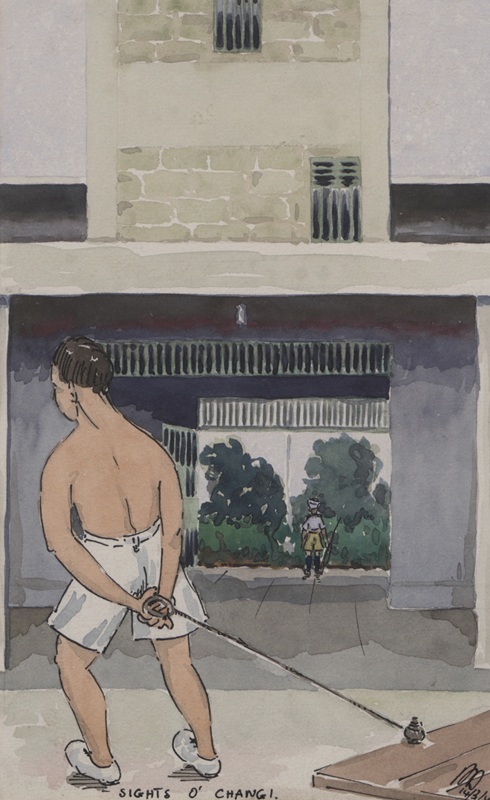
Sketch titled “Sights O’ Changi” by William Haxworth, 1943. W.R.M. Haxworth Collection, courtesy of National Archives of Singapore (Media - Image No. 20060000330 - 0014).
For American missionary Reverend Tyler Thompson, the formation of the camp orchestra was the most “surprising musical development”, and it would not have been possible “without some Japanese initiative in the matter”. He recalled Okasaki as the “most friendly of our various commanding officers”.35
According to Thompson, when Okasaki had learnt that among the internees were a “number of professional dance band musicians”, he had proposed to them: if he could use his influence to help obtain instruments, would the internees organise an orchestra and play “occasionally for him and his friends?” This was borne out by a report in the Changi Guardian that on 27 June 1942, the Melody Quartette comprising Farrell, Merrifield, Ross and Kauff, with Eisinger as pianist, had been “summoned out” to “play at the Nipponese Officers’ Mess a little way down the road”.36
Thompson’s account is corroborated by Peet, who recalled that the internees were “fortunate in the quality and resources of music in the camp”. Peet noted that Okasaki had taken a “personal interest in the creation of a camp orchestra” and had given the internees “facilities for getting instruments and music from town, so that we had a good camp orchestra”.37
The Changi Guardian, though, provides a slightly different account regarding the genesis of the orchestra. It claimed that it was Farrell who “enlisted the interest of Lt Okasaki and thus progressively secured the instruments which made the band possible, building up from a duo to a trio then to quartette and finally to the full 12-man band”. In any case, by early July 1942, Farrell and Merrifield were reported to be “deep in the throes of rehearsing their first production”.38
The camp orchestra made its debut in a production titled the “Changi Bandwagon” on 14 July in front of the women’s camp with an audience that included Okasaki.39 The programme comprised a variety of vocal and instrumental works – both popular and classical. It featured music from cultures around the world. The concert began by “leaving home” with “Auld Lang Syne” before embarking on a “world tour” with works such as “The Blue Danube” (Austria), the popular “Terang Bulan” (Bright Moon; Malaya)40 and “Waltzing Matilda” (Australia).
The irony was not lost when the Changi Guardian wrote that Japan was represented by the “Nipponese love song” titled “Koa Koshin Kyoku”. The song was most likely 興亜行進曲, or “March of the Revival of Asia”, a Japanese patriotic song.41
For Thompson, the piano recitals, various instrumental ensembles and the camp orchestra “could not have been born save in that one brief period” and such musical activities continued “to play an important part in camp life up to the Double Tenth”. This was a reference to the Double Tenth incident on 10 October 1943 when the Kempeitai (Japanese Military Police) raided the cells in Changi following Operation Jaywick, in which men from Special Operations Australia sank or damaged seven Japanese shipping vessels in Singapore waters. The Japanese suspected that the internees played a role in the incident, and later arrested, interrogated and tortured 57 civilian internees, 15 of whom died. After this, privileges such as concerts, plays and lectures were banned, and food rations cut.42
Musical Evenings
In 1943, amidst choral and orchestral concerts, Van Hien would take further advantage of the instruments that were available in organising a series of concerts which the Changi Guardian called “Musical Evenings”. Launched in February that year, these concerts were held monthly and sometimes twice a month except in the months of March and April (for reasons unknown), and were well covered by the newspaper. That it devoted such space to the series was a testament to the significance of music in the daily lives of the internees.
From a glance at the programmes of individual concerts as derived from the reviews, it appeared that the piano was at the centre of this series, notwithstanding works which also featured the voice or other instruments such as the flute or violin. There were also concerts featuring works for two pianos.
A great diversity of music was performed, from classics by Bach, Mozart, Beethoven, Schubert, Chopin and Liszt to works by contemporary composers of the time, reflecting a sophisticated musical taste among musicians and audiences.
On two occasions, well-known works by the Russian composer Rachmaninoff were featured in July and September concerts,43 the composer having only died months earlier in March. At the last of the “Musical Evenings”, before the Double Tenth incident, Eisinger’s performance of Anton Rubinstein’s “Staccato Etude”, a difficult work marked by relentlessly repeated chords, was delivered with such “arresting brilliance” that it reached “superlative heights in the camp’s musical entertainment”, the newspaper wrote.44
A Great Elevation to Troubled Spirits
Within the confines of Changi camp, the social structure and hierarchy of colonial society that existed in prewar Singapore were overturned.
Here were close to 2,800 internees in a prison complex meant for between 600 and 800 prisoners. The internees were from more than 20 countries deemed as “enemies” of Japan, and they ranged from civil servants, government servants to musicians and even a horse trainer.45
The Westerners, who were once accustomed to a life of comfort and distinction, now lived in overcrowded (three or even four persons were cramped in a cell 3 m long and 1.8 m wide) and unsanitary conditions, suffering from imbalanced diet, malnutrition, exposure to disease, and the fear of unpredictable behaviour from their captors, which at times resulted in physical violence and sometimes even death.
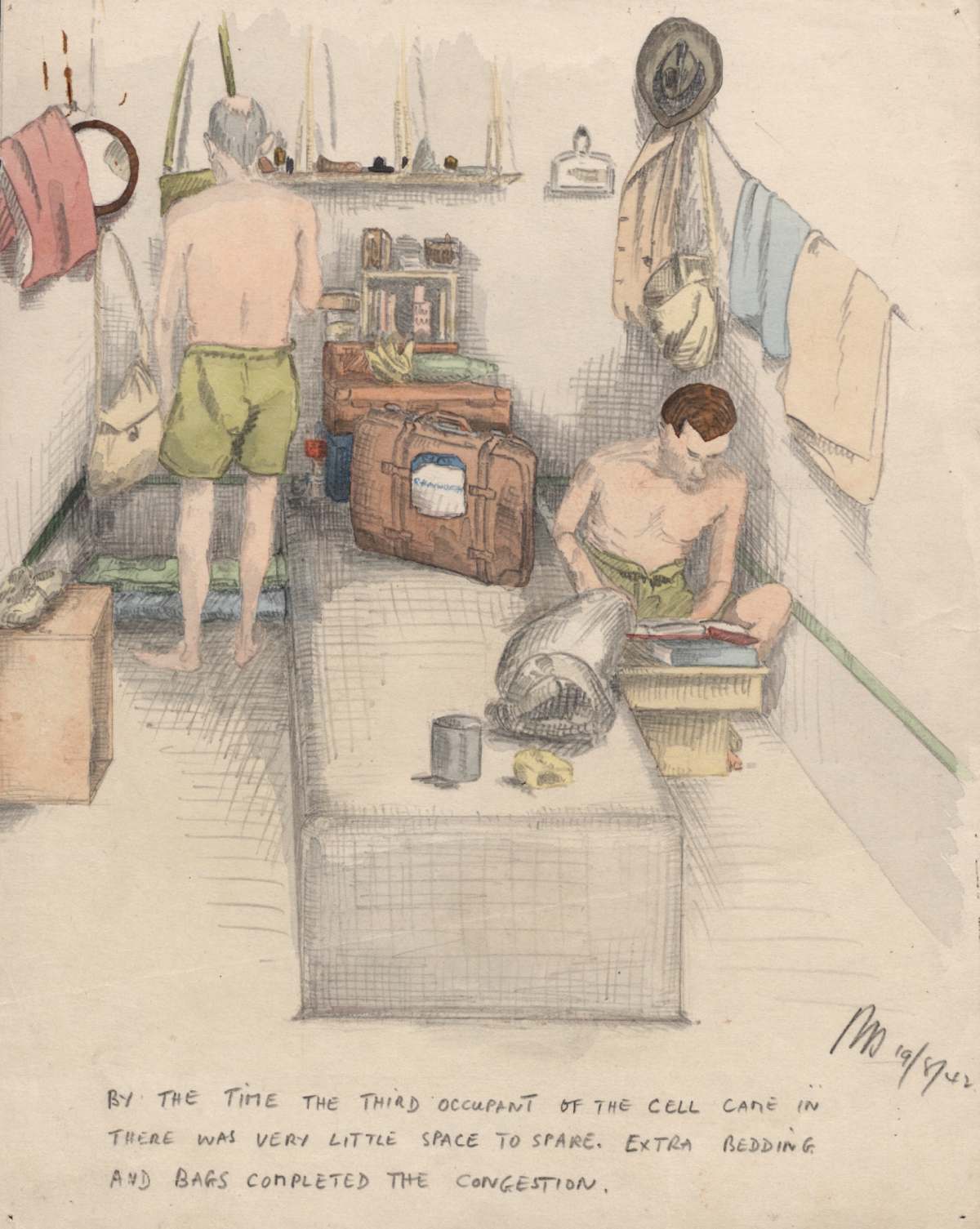
Sketch of a cell in Changi Prison by William Haxworth, 1942. Three or sometimes four men occupied a cell meant for one. Haxworth was the Chief Investigator of the War Risks Insurance Department of the Singapore Treasury when war broke out. He was interned first in Changi Prison and then in Sime Road Internment Camp. W.R.M. Haxworth Collection, courtesy of National Archives of Singapore (Media - Image No. 20060000331 - 0042).
Musical activity – or any other form of entertainment – thus played an important role in camp life. Beyond providing distraction or momentary relief from the trauma of internment, entertainments were “opportunities for individual internees to explore and develop their perhaps latent… talent”. Activities such as contributing to the newspapers, religious services, sporting events and entertainment “perpetuated Western culture and created a sense of continuity”. It was a continuity that “served to underline the survival of Western culture which they used to negate, deny or suppress the difficult and radical changes that had taken place in their lives”.46
It is perhaps no wonder, then, that the professional and amateur musicians in the camp took musical activities, especially those who performed at the “Musical Evenings”, very seriously. Beyond just a provider of entertainment or positive distraction, music making helped an individual preserve his (or her) dignity, professionalism and civility in times of distress and oppressive circumstances when the proverbial centre could no longer hold.
Music indeed brought “a great elevation to troubled spirits” of the Changi internees, where, as Peet said, “life was so hard and empty and unsatisfying in many ways”.47
The author wishes to thank Keith Aldrich and Gautam Hazarika for the insights shared. Some parts of this article originated from a lecture-performance titled “1943: Musical Evenings at Changi”, conceptualised, produced and written by the author. The work was presented by the author with Aaron Lee as narrator and co-dramaturg, and Natalie Ng as pianist and music-dramaturg, on 27 September 2025 at the National Library Building.
About the Author
Phan Ming Yen is an independent writer, researcher and producer. His current areas of research are music in wartime and cultural histories of diaspora. Phan has been published by Ethos Books, World Scientific Press, Quarterly Literary Review Singapore and BiblioAsia. He was a recipient of the National Library’s Lee Kong Chian Research Fellowship in 2024.
Endnotes
1 “Do You Know… ,” Changi Guardian No. 64, 23 May 1942, University of Cambridge Digital Library, https://cudl.lib.cam.ac.uk/view/MS-RCMS-00103-00012-00029/112 (opens in new tab).
2 The Japanese camp commander from 25 March to September 1942 was primarily identified by his last name Okazaki (sometimes spelt Okasaki in memoirs and in the Changi Guardian) in a report titled “The Internment of Civilians in Singapore by the Nipponese Authorities, February 1942 to August 1945,” University of Cambridge Digital Library, https://cudl.lib.cam.ac.uk/view/MS-RCMS-00103-00012-00011/1 (opens in new tab).
3 The Changi Guardian was a newspaper produced by the civilian male internees in Changi during the Japanese Occupation of Singapore. The editors of the newspaper were Harry Miller, a chief reporter with the Straits Times before the Occupation, and Gus Harold Wade, an entomologist with the Medical Auxiliary Service.
4 Men were segregated from women and children in Changi camp. See Nakahara Michiko, “The Civilian Women’s Internment Camp in Singapore: The World of POW WOW,” in New Perspectives on the Japanese Occupation in Malaya and Singapore, 1941–1945 (opens in new tab), ed. Akashi Yoji and Yoshimura Mako (Singapore: NUS Press, 2008), 196. (From National Library Singapore, call no. RSING 940.5337 NEW-[WAR])
5 “Women Entertained,” Changi Guardian No. 68, 28 May 1942, University of Cambridge Digital Library, https://cudl.lib.cam.ac.uk/view/MS-RCMS-00103-00012-00029/119 (opens in new tab).
6 Bernice Archer, The Internment of Western Civilians Under the Japanese 1941–1945: A Patchwork of Internment (Hong Kong: Hong Kong University Press, 2008), 105–06. [NLB has the 2004 edition published by RoutledgeCurzon, call no. R 940.53170952 ARC-[WAR] (opens in new tab).]
7 Gautam Hazarika, “‘We Published in Prison’ – Unique Material on Newspapers Published by Male Civilian Internees in Wartime Singapore,” Southeast Asia Library Group, 20 April 2023, https://southeastasianlibrarygroup.wordpress.com/2023/04/20/we-published-in-prison-unique-material-on-newspapers-published-by-male-civilian-internees-in-wartime-singapore/ (opens in new tab).
8 Sears A. Eldredge, “Captive Audiences/Captive Performers: Music and Theatre as Strategies for Survival on the Thailand-Burma Railway 1942–1945,” Digital Commons @ Macalester, 2014, https://digitalcommons.macalester.edu/captiveaudiences/ (opens in new tab); “On with the Motley: The Changi Concert Party,” in The Changi Book (opens in new tab), ed. Lachlan Grant (Sydney, Australia: NewSouth, 2015), 134–55. (From National Library Singapore, call no. RSING 940.547252 CHA-[WAR])
9 Farrell was referred to as “Len Farrell” in all Changi Guardian reports and also in the press. See “Musicians on a Tower, (opens in new tab)” Straits Budget, 5 September 1946, 12. (From NewspaperSG). His name is recorded as “Farrell, Leo J.” in “Changi and Sime Road Civilian Internment Camps: Nominal Rolls of Internees,” University of Cambridge Digital Library, https://cudl.lib.cam.ac.uk/view/MS-RCMS-00103-00012-00022/249 (opens in new tab). See also “Accordeonist [sic],” Changi Guardian No. 6, 14 May 1942, University of Cambridge Digital Library, https://cudl.lib.cam.ac.uk/view/MS-RCMS-00103-00012-00029/20 (opens in new tab). The Changi Guardian reports that Farrell had with him a piano-accordion in Changi.
10 George J. Merrifield was a prison officer who was part of the Malayan Magic Circle. He also played the piano. See “Entertainment at Gunners’ Camp (opens in new tab),” Singapore Free Press, 25 May 1940; Mary Heathcoutt, “‘Dancing Through the Ages’ a Big Success (opens in new tab),” Singapore Free Press, 18 December 1940. (From NewspaperSG), and “Changi and Sime Road Civilian Internment Camps: Nominal Rolls of Internees,” University of Cambridge Digital Library, https://cudl.lib.cam.ac.uk/view/MS-RCMS-00103-00012-00022/278 (opens in new tab).
11 Sydney A.B. Ross was a planter from Melaka. See “Changi and Sime Road Civilian Internment Camps: Nominal Rolls of Internees,” University of Cambridge Digital Library, https://cudl.lib.cam.ac.uk/view/MS-RCMS-00103-00012-00022/291 (opens in new tab).
12 A background on the “Japanisation” of “Auld Lang Syne” can be found in, “A Song Abroad,” in M.J. Grant, Auld Lang Syne: A Song and Its Culture (Cambridge, UK: Open Book Publishers, 2021), https://doi.org/10.11647/OBP.0231 (opens in new tab); https://books.openbookpublishers.com/10.11647/obp.0231/ch10.xhtml#_idTextAnchor164 (opens in new tab). Refer also to Sato Fujiwara’s blog “「蝶々」「蛍の光」を作ったのは?〜日本近代音楽教育の黎明−私たちの教育のルーツをたどる” [“Who composed ‘Cho Cho’ and ‘Hotaru no Hikari – the Dawn of Modern Music Education in Japan – Tracing the Roots of Our Education”] (blog), 4 November 2021, https://kotaenonai.org/blog/satolog/9455/ (opens in new tab); and the blog of Yokout, “魯迅と日暮里(17)帝国のフロンティアの拡大(3)蛍の光が歌えない” [“Lu Xun and Nippori (17) Expanding the Frontiers of Empire (3) I can’t sing ‘Hotaru no Hikari’”], 日暮里富士見坂を守る会 [Nippori Fujimizaka Preservation Society], https://fujimizaka.wordpress.com/2015/08/17/luxun-17/ (opens in new tab). The score can be found at the National Diet Library in Japan at https://ndlsearch.ndl.go.jp/en/books/R100000002-I000010788281 (opens in new tab). The 2 January 1942 issue of The Japan Times and Advertiser in Tokyo announced that the Board of Information of Japan had banned “any kind of American and British music”. But exceptions were made for “Japanised songs like ʻHotaru-no-Hikari’ based on ʻAuld Lang Syne’.”
13 Margaret Mehl, Music and the Making of Modern Japan: Joining the Global Concert (Cambridge, UK: Open Book Publishers, 2024), 154, https://www.openbookpublishers.com/books/10.11647/obp.0374 (opens in new tab).
14 Yokout, “魯迅と日暮里(17)帝国のフロンティアの拡大(3)蛍の光が歌えない.”
15 This translation is by Mark Jewel. Copyright (c) 2018 by The Liberal Arts Research Center, School of Political Science and Economics, Waseda University cited in Grant, Auld Lang Syne: A Song and Its Culture.
16 One possibility for the lack of musical instruments in Changi up till that point was that the internees carried only what they could with them. See Iskander Mydin and Rachel Eng, Changi Chapel and Museum: Remembering the Internees and Legacies of Changi (opens in new tab)(Singapore: National Museum of Singapore, 2021), 70. (From National Library Singapore, call no. RSING 940.547252 ISK); and George L. Peet, Within Changi’s Walls: A Record of Civilian Internment in World War II (opens in new tab)(Singapore: Marshall Cavendish Editions, 2011), 10. (From National Library Online)
17 William L. Gibson, “Karikal Mahal: The Lost Palace of a Fallen Cattle King (opens in new tab),” BiblioAsia 16, no. 3 (October–December 2020): 48–53.
18 “Entertainment,” Karikal Chronicle No. 12, 4 March 1942, University of Cambridge Digital Library, https://cudl.lib.cam.ac.uk/view/MS-RCMS-00103-00012-00029/13 (opens in new tab).
19 “Choristers Debut,” Changi Guardian No. 9, 20 March 1942, University of Cambridge Digital Library, https://cudl.lib.cam.ac.uk/view/MS-RCMS-00103-00012-00029/25 (opens in new tab); “Songbirds,” Changi Guardian No. 38, 23 April 1942, University of Cambridge Digital Library, https://cudl.lib.cam.ac.uk/view/MS-RCMS-00103-00012-00029/68 (opens in new tab).
20 “Gordon Van Hien: Lessons a Bore (opens in new tab),” Straits Times 14 November 1952. (From NewspaperSG). Gordon Van Hien played an important role in the music scene of postwar Singapore, becoming chairman of the Singapore Musical Society and in 1955 received an MBE (Member of the Order of the British Empire) for his musical activities during his internment.
21 “Entertainments”, Karikal Chronicle No. 10, 2 March 1942, University of Cambridge Digital Library, https://cudl.lib.cam.ac.uk/view/MS-RCMS-00103-00012-00029/11 (opens in new tab).
22 “We Hear,” Changi Guardian No. 69, 30 May 1942, University of Cambridge Digital Library, https://cudl.lib.cam.ac.uk/view/MS-RCMS-00103-00012-00029/121 (opens in new tab).
23 Peet, Within Changi’s Walls (opens in new tab), 94.
24 “Official Gazette,” Changi Guardian No. 60, 19 May 1942, University of Cambridge Digital Library, https://cudl.lib.cam.ac.uk/view/MS-RCMS-00103-00012-00029/104 (opens in new tab).
25 Leader article in Changi Guardian, No. 56, 14 May 1942, University of Cambridge Digital Library, https://cudl.lib.cam.ac.uk/view/MS-RCMS-00103-00012-00029/96 (opens in new tab); Joshua Chia Yeong Jia, “Institute of Mental Health (opens in new tab),” Singapore Infopedia. National Library Singapore. Article published 2008; “Do You Know…,” Changi Guardian No. 64, 23 May 1942.
26 Robert Eisinger arrived in Singapore on 19 September 1938. See “Musicians Who Fled from Nazis (opens in new tab),” Singapore Free Press and Mercantile Advertiser, 26 September 1938. (From NewspaperSG). Eisinger’s nationality was stated as “Pole” in “Changi and Sime Road Civilian Internment Camps: Nominal Rolls of Internees,” University of Cambridge Digital Library, https://cudl.lib.cam.ac.uk/view/MS-RCMS-00103-00012-00022/63 (opens in new tab).
27 Dennis B. Soul was a banker, an amateur organist and choir conductor.
28 “We Hear.”
29 “Music in Camp,” Changi Guardian No. 83, 25 June 1942, University of Cambridge Digital Library, https://cudl.lib.cam.ac.uk/view/MS-RCMS-00103-00012-00029/142 (opens in new tab).
30 “Music in Camp.”
31 “Musical Notes,” Changi Guardian, No. 80, 18 June 1942, National Archives of Singapore.
32 “It’s a Quartette Now!” Changi Guardian No. 84, 27 June 1942, University of Cambridge Digital Library, https://cudl.lib.cam.ac.uk/view/MS-RCMS-00103-00012-00029/144 (opens in new tab). Bob Kauff was a musician with the Dan Hopkins’ Band at Raffles Hotel before the war. See “Musicians Who Will Join ‘The Circus Comes to Town (opens in new tab)’,” Singapore Free Press and Mercantile Advertiser, 11 July 1939, 5. (From NewspaperSG)
33 Sheila Allan, Diary of a Girl in Changi, 1941–1945 (opens in new tab)(Pymble, N.S.W.: Kangaroo Press, 2004), 48. (From National Library Singapore, call no. RSING 940.547252092 ALL-[WAR])
34 “The Internment of Civilians in Singapore by the Nipponese Authorities, February 1942 to August 1945.”
35 Tyler Thompson, Freedom in Internment: Under Japanese Rule in Singapore, 1942–1945 (opens in new tab) (Singapore: Kefford Press, 1990),119. (From National Library Singapore, call no. RSING 940.547252092 THO-[WAR])
36 Thompson, Freedom in Internment (opens in new tab), 119; “Do You Know…?” Changi Guardian No. 85, 30 June 1942, University of Cambridge Digital Library, https://cudl.lib.cam.ac.uk/view/MS-RCMS-00103-00012-00029/145 (opens in new tab).
37 Peet, Within Changi’s Walls (opens in new tab), 93–94.
38 “Orchestral Affairs,” Changi Guardian No. 100, 1 August 1942, University of Cambridge Digital Library, https://cudl.lib.cam.ac.uk/view/MS-RCMS-00103-00012-00029/171 (opens in new tab); “Do You Know…?” Changi Guardian No. 87, 4 July 1942, University of Cambridge Digital Library, https://cudl.lib.cam.ac.uk/view/MS-RCMS-00103-00012-00029/148 (opens in new tab).
39 “Changi Bandwagon,” Changi Guardian No. 92, 16 July 1942, University of Cambridge Digital Library, https://cudl.lib.cam.ac.uk/view/MS-RCMS-00103-00012-00029/157 (opens in new tab).
40 See Saidah Rastam, Rosalie and Other Love Songs (opens in new tab) (Petaling Jaya, Malaysia: Strategic Information and Research Development Centre, 2017), 5–33. (From National Library Singapore, call no. RSING 782.42095951 SAI-[ART]) for origins of the melody of “Terang Bulan”.
41 “Changi Bandwagon.”
42 Thompson, Freedom in Internment (opens in new tab), 119; Wong Heng, “Double Tenth Incident (opens in new tab),” Singapore Infopedia. National Library Singapore. Article published January 2021; “Double Tenth,” University of Cambridge Digital Library, https://cudl.lib.cam.ac.uk/view/MS-RCMS-00103-00015-00006/1 (opens in new tab).
43 See “Flute and Piano,” Changi Guardian No. 233, 2 July 1943, University of Cambridge Digital Library, https://cudl.lib.cam.ac.uk/view/MS-RCMS-00103-00012-00029/385 (opens in new tab); and “Musical Recital,” Changi Guardian No. 257, 24 September 1943, University of Cambridge Digital Library, https://cudl.lib.cam.ac.uk/view/MS-RCMS-00103-00012-00029/421 (opens in new tab). Based upon preceding programmes of “Musical Evenings” organised by Gordon Van Hien, this author conjectures that concerts reported under headings such as “Flute and Piano” or similar ones such as “Musical Concert”, were part of the “Musical Evenings” series.
44 “Musical Evenings,” Changi Guardian No. 261, 6 October 1943, University of Cambridge Digital Library, https://cudl.lib.cam.ac.uk/view/MS-RCMS-00103-00012-00029/426 (opens in new tab).
45 Iskandar Mydin and Eng, Changi Chapel and Museum (opens in new tab), 70.
46 Archer, The Internment of Western Civilians Under the Japanese 1941–1945, 107.
47 Peet, Within Changi’s Walls (opens in new tab), 94.