
Article
The Lions of the Lion City: How Heraldry Shaped Singapore’s Identity
18 May 2026
Topics
History
In Singapore, a creature that never lived on the island became one of its most recognisable symbols – moving from legend and empire into national identity. This paradox opens a complex symbolic history in which heraldry is not mere ornament, but a visual archive of power.
By Adriana Patricia Manea (Ghemes)
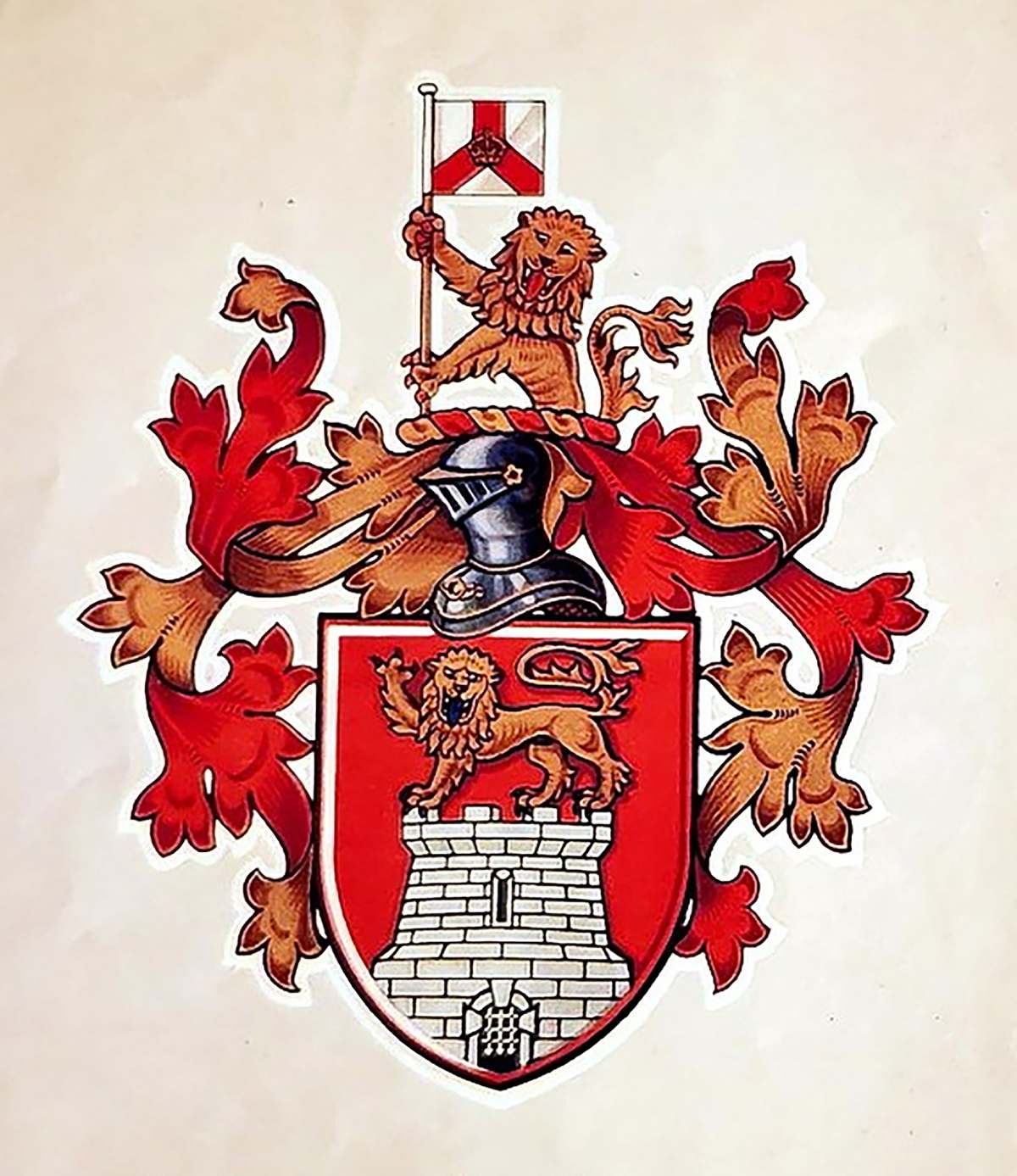
The coat of arms of the Colony of Singapore in the Colony of Singapore Annual Report 1952. Image reproduced from "Flags and Coats of Arms of Singapore" (n.p.: n.p., 1933–65). Collection of the National Library Singapore (Accession no. B34448861E; call no. RRARE 959.5703 BLA).
In Singapore, where there have never been real lions, but where their image has spanned centuries, empires and even political regimes, this apparent contradiction reveals how heraldry works.1 The Singapore lion is not a zoological representation. It is a conventional, codified sign, a form of visual authority. Heraldry does not reproduce the world as it is; it orders it, transforms it into a symbol and makes it memorable.
In the case of Singapore, this transformation has been particularly profound. Over the last centuries, the Singapore identity has been transmitted not only through language, institutions or historical memory, but also through symbols. And heraldry was one of the channels through which this continuity took shape.
The Secret Language of Heraldry
To truly understand this narrative, we must first understand the “language” of heraldry.2 Today it may seem like a niche discipline, perhaps even outdated, but for centuries heraldry was considered part of a “refined education”.3 It was, in essence, a system of identification and authority.
The coat of arms functioned as a visual identity card for individuals, families, territories and, later, entire empires. As European powers expanded, this language travelled with them. Colonial administrations exported not only institutions and trade networks but also forms of representation, including heraldic traditions overseen by institutions such as the College of Arms in London – the institution responsible for granting, registering and verifying official coats of arms.4
In the colonies, heraldry was not simply copied from the European model – it was adapted. And Singapore is one of the most interesting examples precisely because its heraldic imagery brought together two traditions: the Southeast Asian legend of the “Lion City” and the British imperial vocabulary.
A Lion Born of Legend
In Singapore’s official heraldry, the lion draws its power from two major sources: the legend of Sang Nila Utama5 and the British legacy. The legend endowed the lion with a founding aura. It linked it to the idea of a privileged beginning, the promise of a destiny and a symbolic genealogy that transcended the island’s mere geography. The name Siṃhapura (सिंहपुर) – “City of the Lion” – as well as forms such as Siṃhanagara (सिंहनगर) and Siṃhadvīpa (सिंहद्वीप), “Fortress of the Lion” and “Island of the Lion” respectively, functioned not merely as names, but as concentrated narratives of origin, legitimacy and rank.
Of course, the animal described in the Malay chronicles should not necessarily be confused with a real lion. In the European heraldic imagination, it might have corresponded more to a heraldic “tiger”.6 Heraldic power relies on symbolic legibility over naturalism. Singapore’s lion transitioned from legend to shields, enduring not as a “zoological error”, but as a versatile symbol adopted by British heraldry while retaining local significance.
In Southeast Asia, the lion signalled prestige and royal authority. City names like Singburi in Thailand and Simhapura in Vietnam prove the symbol’s regional circulation as a sign of power, even where lions never existed.
The British Brought the Lions
Although legend gave Singapore the lion, the British imperial era provided the heraldic framework through which this symbol could be formalised, whether we are referring to land lions or sea lions (also known as merlions).7
The first heraldic image of a “lion” associated, in a broad sense, with Singapore was the coat of arms of the Old East India Company.8 There, the supporters of its coat of arms9 – the sea lions, or merlions – can be seen as distant precursors of the symbol that would, much later, become the modern Merlion of Singapore.
In 1826, seven years after Stamford Raffles (representing the new East India Company) established a trading post on Singapore, the island joined Penang and Melaka in forming the Straits Settlements under the authority of the EIC. Its administration would change several times until 1 April 1867 when it became a crown colony, administered directly by the Colonial Office in London.10
Such a change also called for an appropriate heraldic representation. On 13 November 1867, the Secretary of State for the Colonies issued the first official seal of the Straits Settlements. It featured the British Royal Coat of Arms, flanked by three smaller shields representing the three territories. But this coat of arms did not yet have full heraldic status.11
Consequently, the tower with the passant guardant lion for Singapore,12 the betel palm for Penang and the kruing branch for Melaka could not be officially used on buildings, coins or other symbols of authority. Recognition only came about 44 years later, on 25 March 1911, when the College of Arms granted by Royal Warrant13 the coat of arms of the Straits Settlements: a quartered shield and a simple crest, without supporters or a motto.14 This was in use until the dissolution of the Straits Settlements on 1 April 1946.
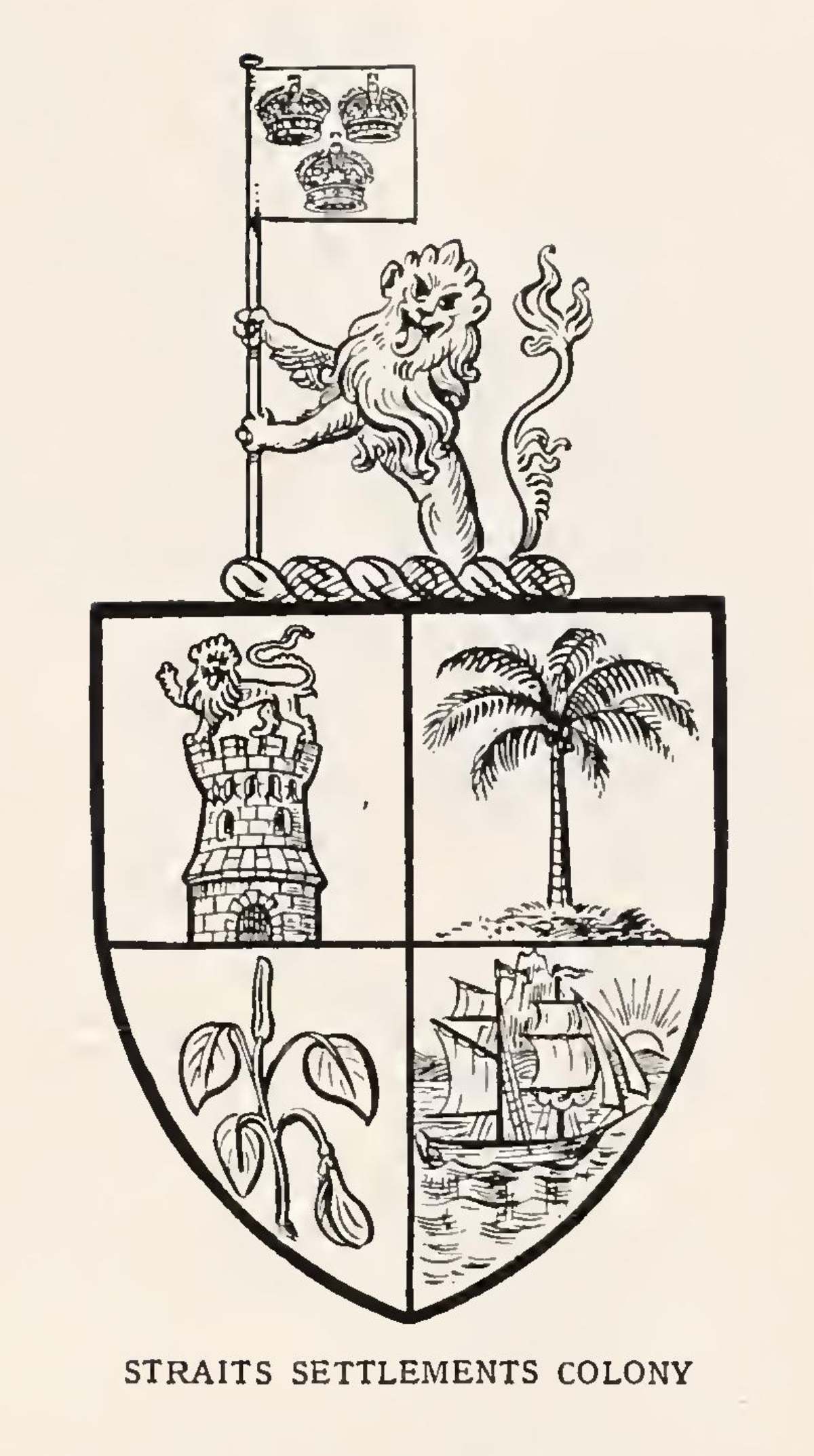
The coat of arms of the Straits Settlements, 1911. Singapore, with the lion and tower, was represented by the upper left quadrant in the shield. Image reproduced from Arthur Charles Fox-Davies, "The Book of Public Arms: A Complete Encyclopaedia of All Royal, Territorial, Municipal, Corporate, Official, and Impersonal Arms" (London: T.C. & E.C. Jack, 1915), p. 757.
For Singapore, the design was already of the “armes parlantes” type: the tower suggested the fortress or the city, while the lion referred both to the place name and to the imagery of British power. An important detail is the half-lion in the crest. In British heraldic tradition, such a design often signified a derived status, a visual dependence on imperial sovereignty.
Heraldry in Everyday Life
An official coat of arms does not remain on paper. For the Straits Settlements, heraldry became a form of “inscribing authority in space”. The coat of arms was not mere decoration, but a tangible and visual representation of power.
This is clearly evident in the case of the old Tanjong Pagar Railway Station, inaugurated on 2 May 1932 by Governor Cecil Clementi, and Clifford Pier, inaugurated by the same governor on 3 June 1933, where the coat of arms was prominently displayed. Both were strategic hubs of the imperial infrastructure, connecting points between land and sea, and between Singapore and the wider network of the British Empire in Southeast Asia.
At the railway station, the official emblem highlighted the station’s role as the southern terminus of a network – a symbolic link between the “southern tip of Asia” and London. At Clifford Pier, once the main landing point for sea passengers to Singapore, the coat of arms marked the entrance to a space under the authority of the British Crown.
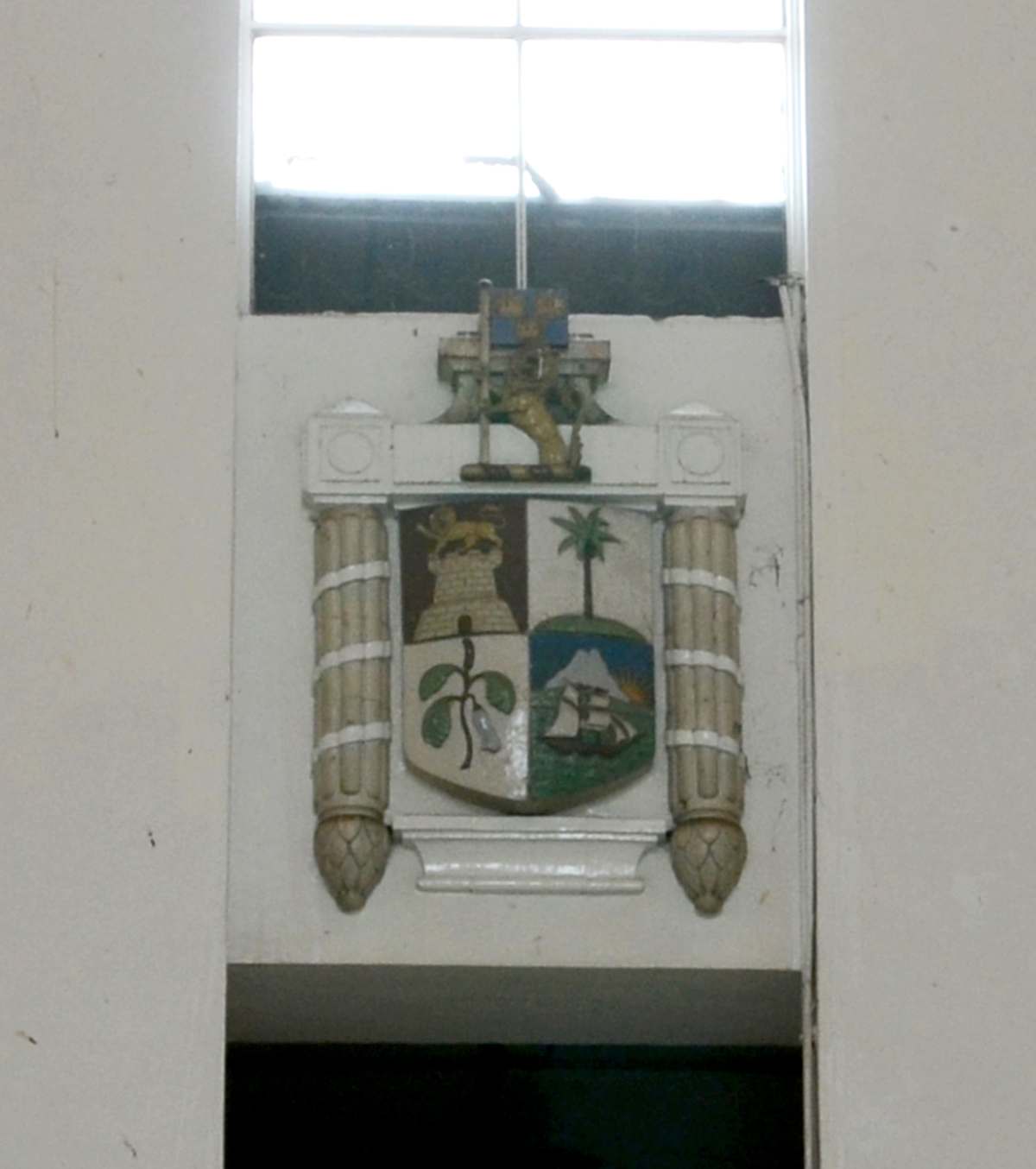
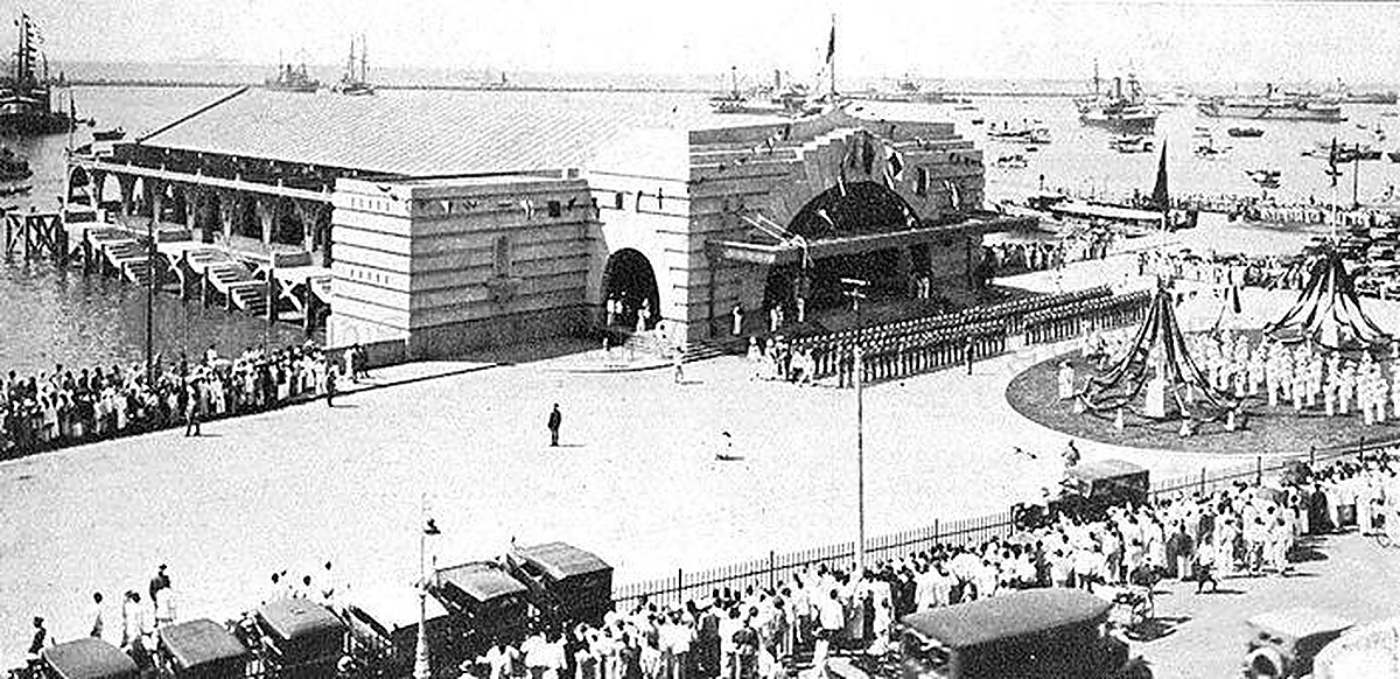
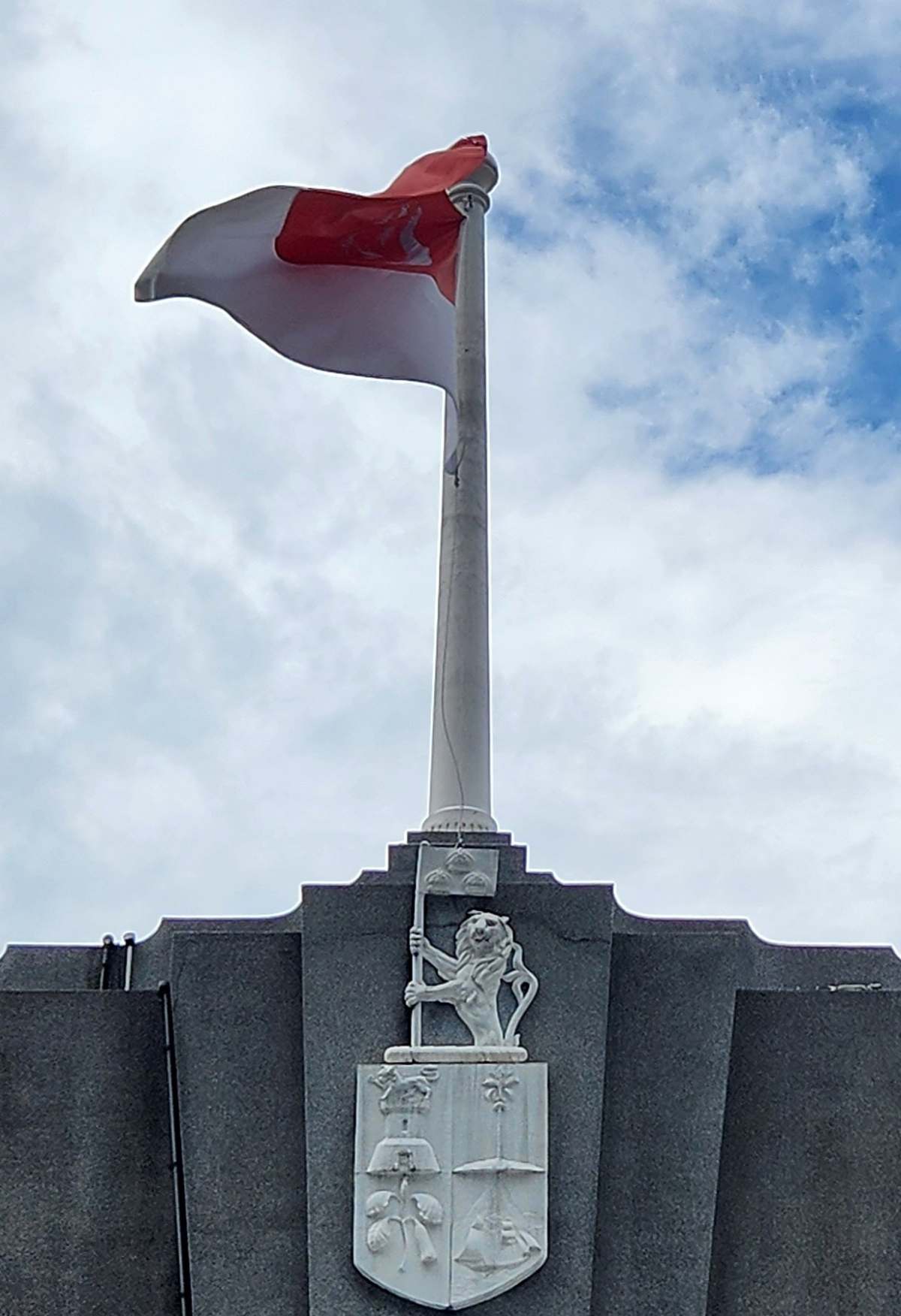
In a “city of lions” without lions, one of the most surprising questions is in fact how many lions there really are – and, above all, whether they carry their tails properly. There is, however, a detail that is almost an enigma for the heraldic eye: the lions on the coats of arms on these buildings have their tails curled inward. This may indicate either that the craftsmen did not strictly follow the specifications of the 1911 Royal Warrant, or that they did not have a sufficiently precise grasp of heraldic conventions.
During the interwar period, heraldry moved beyond the solemnity of public buildings and entered the material culture of the urban elite. Besides buildings, the Straits Settlements coat of arms was also featured on Christmas cards,15 and engraved on silver jewellery boxes16 and silver teaspoons.17 The coat of arms was not an abstract entity, but had become a part of everyday colonial social life.
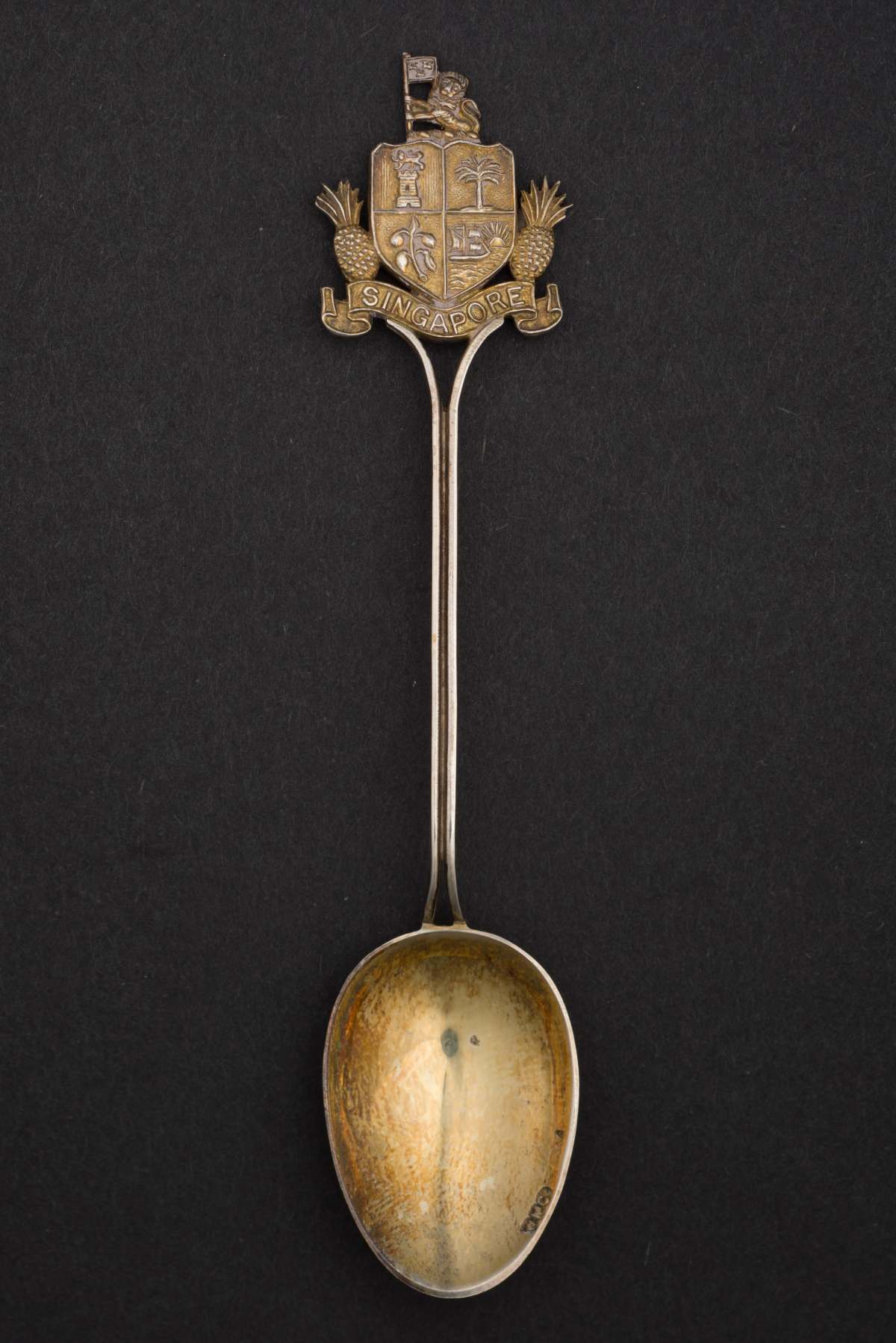
A silver spoon engraved with the coat of arms of the Straits Settlements, early–mid 20th century. Collection of the National Museum of Singapore, National Heritage Board.
The Heraldic Redesign of the Colony of Singapore (1946–48)
The dissolution of the Straits Settlements on 1 April 1946 and Singapore’s transformation into a separate crown colony brought about a major constitutional and heraldic change, resulting in a new coat of arms, but still continuing British heraldic practice.
The creation of this new arms was a rigorous process, documented in correspondence between the government of the Colony of Singapore, the Colonial Office and the College of Arms in London.18 By February 1947, the Colonial Office was already recommending that Singapore’s quadrant in the old coat of arms of the Straits Settlements become the new coat of arms of the separate colony. The proposal was accepted locally and then discussed in London where Sir Algar Howard, Garter King of Arms, gave his support.
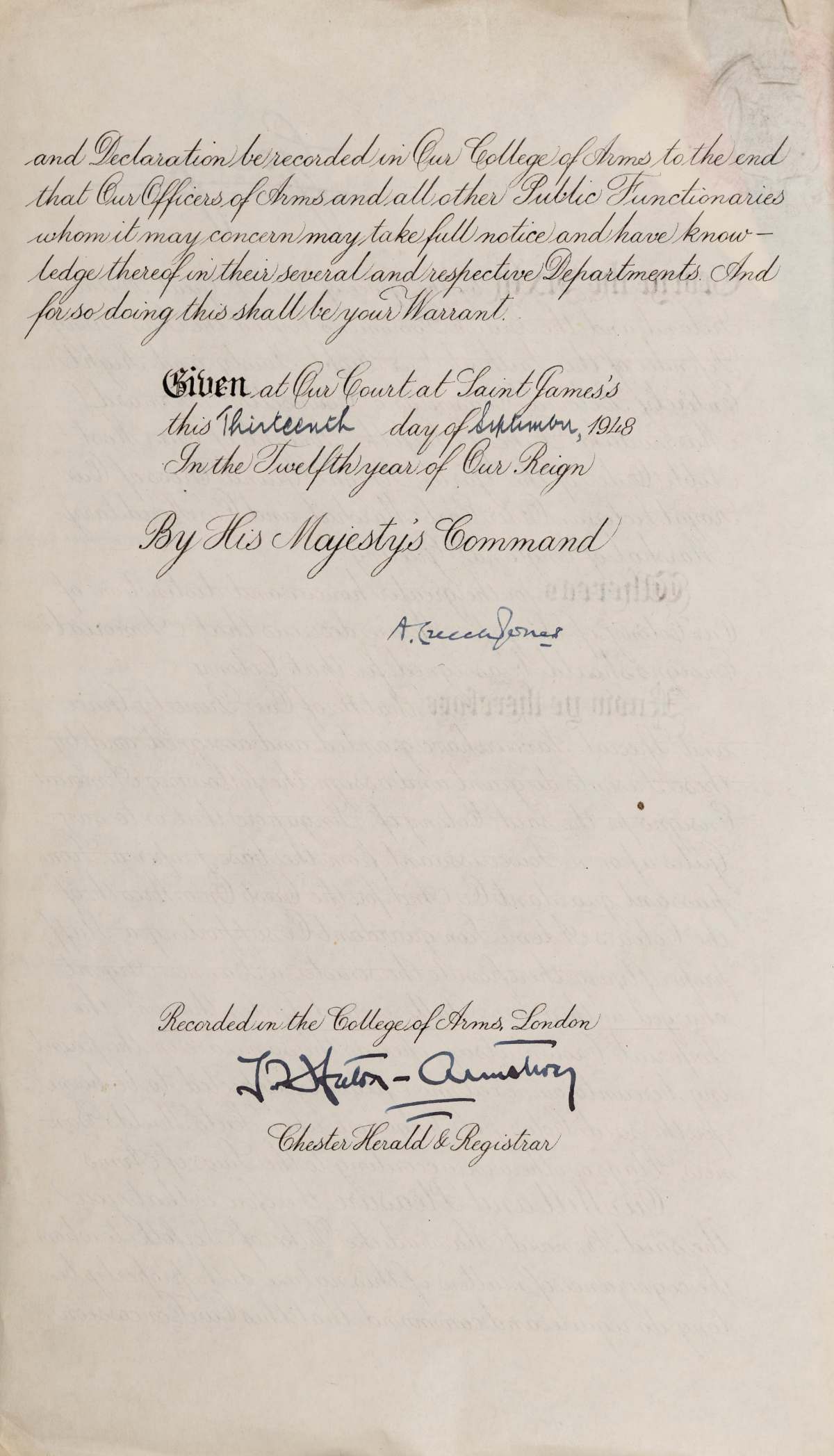
Discussions continued into 1948. Finally, on 13 September 1948, Singapore received its own coat of arms by Royal Warrant,19 signed by King George VI.20 But even after the signing of the Royal Warrant on 13 September 1948, there was a delay between the legal enactment and the actual arrival of the documents in the colony, as noted by the Straits Times in November 1948.21
There is often confusion between this Royal Warrant of the Coat of Arms of the Colony of Singapore22 and the Letter Patent23 by which arms were granted to the municipality of Singapore. The distinction is important. Royal Warrants were issued directly by the monarch and signed by him, whereas Letters Patent were issued and signed by the Kings of Arms (heads of the heralds).
Research at the College of Arms reveals that Singapore’s new coat of arms followed a rigorous British process of symbolic reconfiguration. Rather than creating a new identity from scratch, the Singapore elements from the old Straits Settlements’ arms – the tower and lion – were isolated and amplified. This maintained imperial continuity while still reflecting the colony’s new autonomous constitutional status within the British Empire.
In Singapore’s new coat of arms, the gold lion passant guardant, perched on the tower, no longer occupied just a section of a quartered shield; it now filled the entire shield. The crest maintained continuity with the old composition, but in an individualised form. Heraldically and politically, the new colony asserted its administrative autonomy without severing its visual connection to the previous regime.
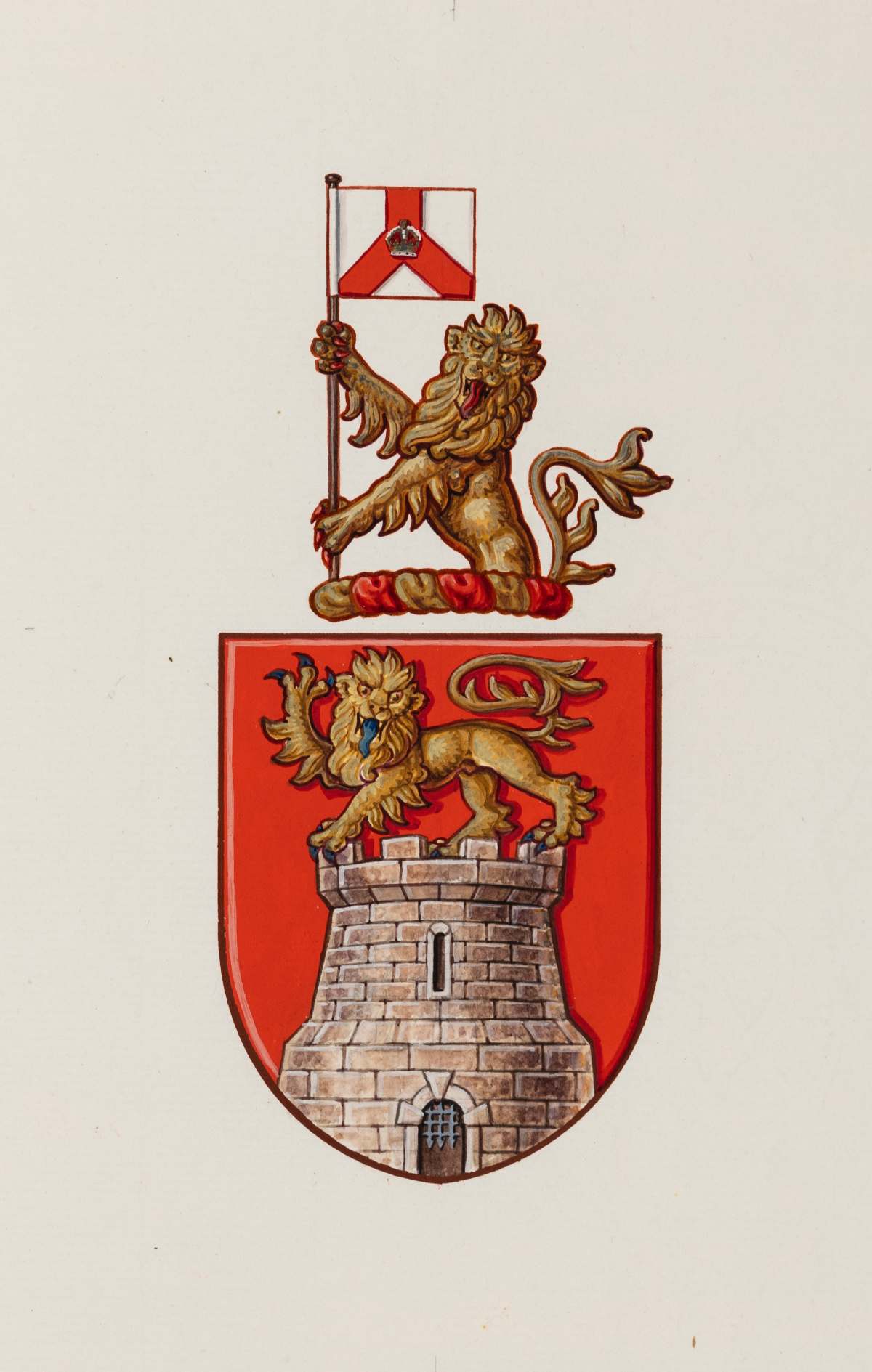
The coat of arms of the Colony of Singapore as depicted in the Royal Warrant signed by King George VI on 13 September 1948. The registered copy is held at the College of Arms in London. Image reproduced from College of Arms, MS Garter House, D/C/3, Royal Warrant of Arms for Singapore, 13 September 1948, I. 81, pp. 224–25.
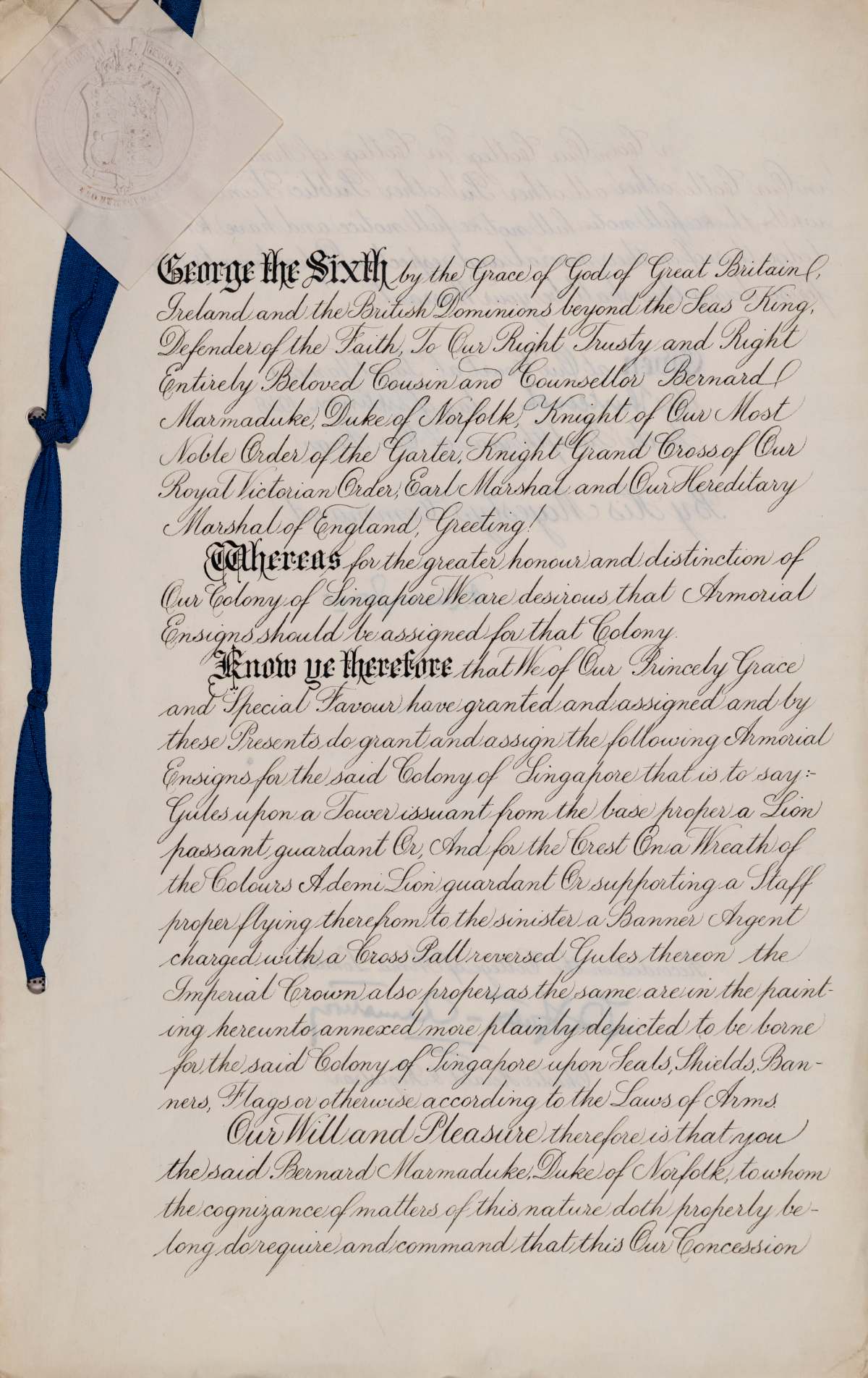
The text of the Royal Warrant established that “Armorial Ensigns” were to be granted for “the greater honour and distinction” of the Colony of Singapore. A subtle technical detail is also significant: although the text did not explicitly mention the colour of the lions’ tongue and claws, heraldic conventions dictate that the lion on the shield has claws and a blue tongue, while the one on the crest has a red tongue.
We are pleased to present, for the first time, the full text of the Royal Warrant of Arms, and the image and depiction of the coat of arms for the Colony of Singapore.
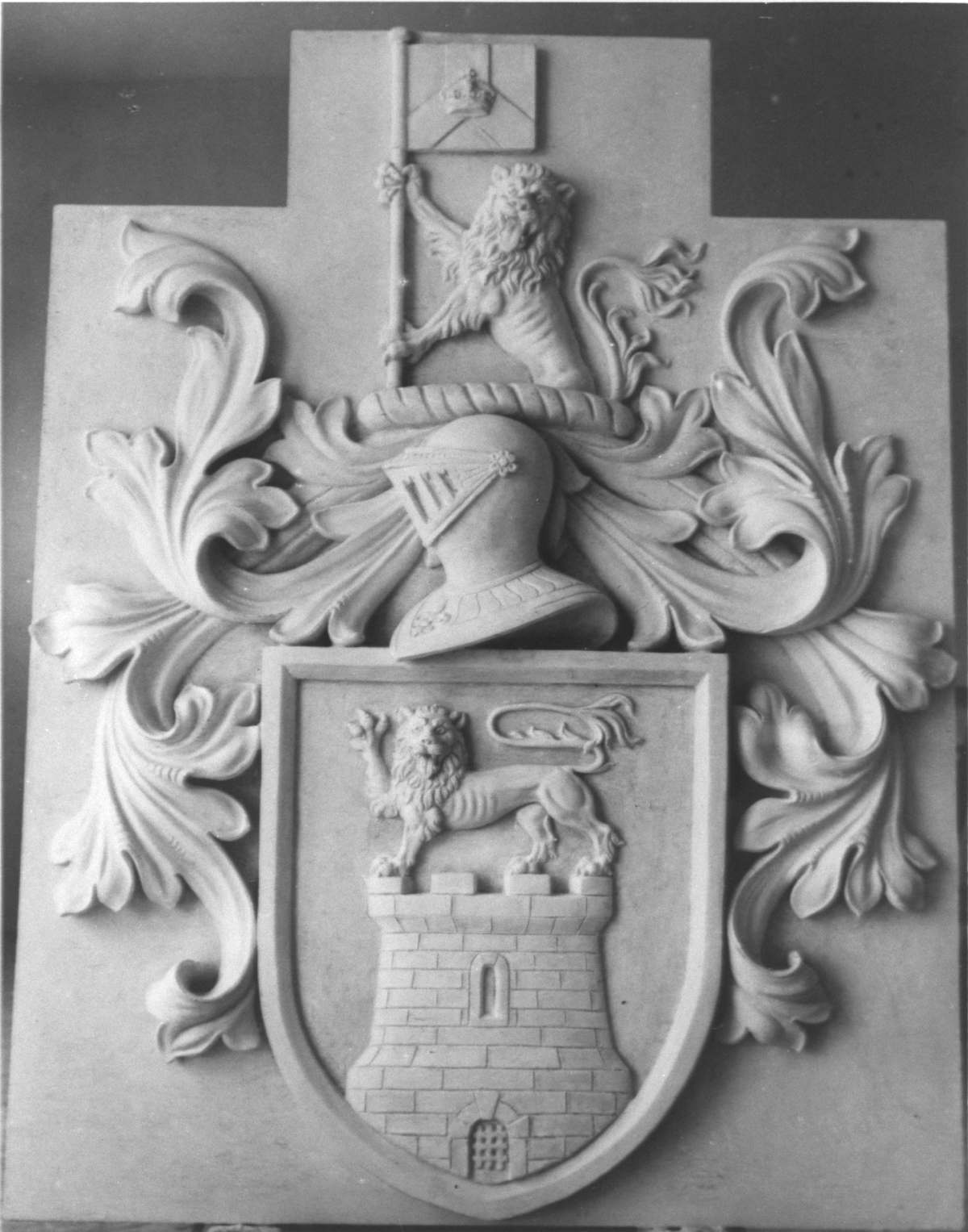
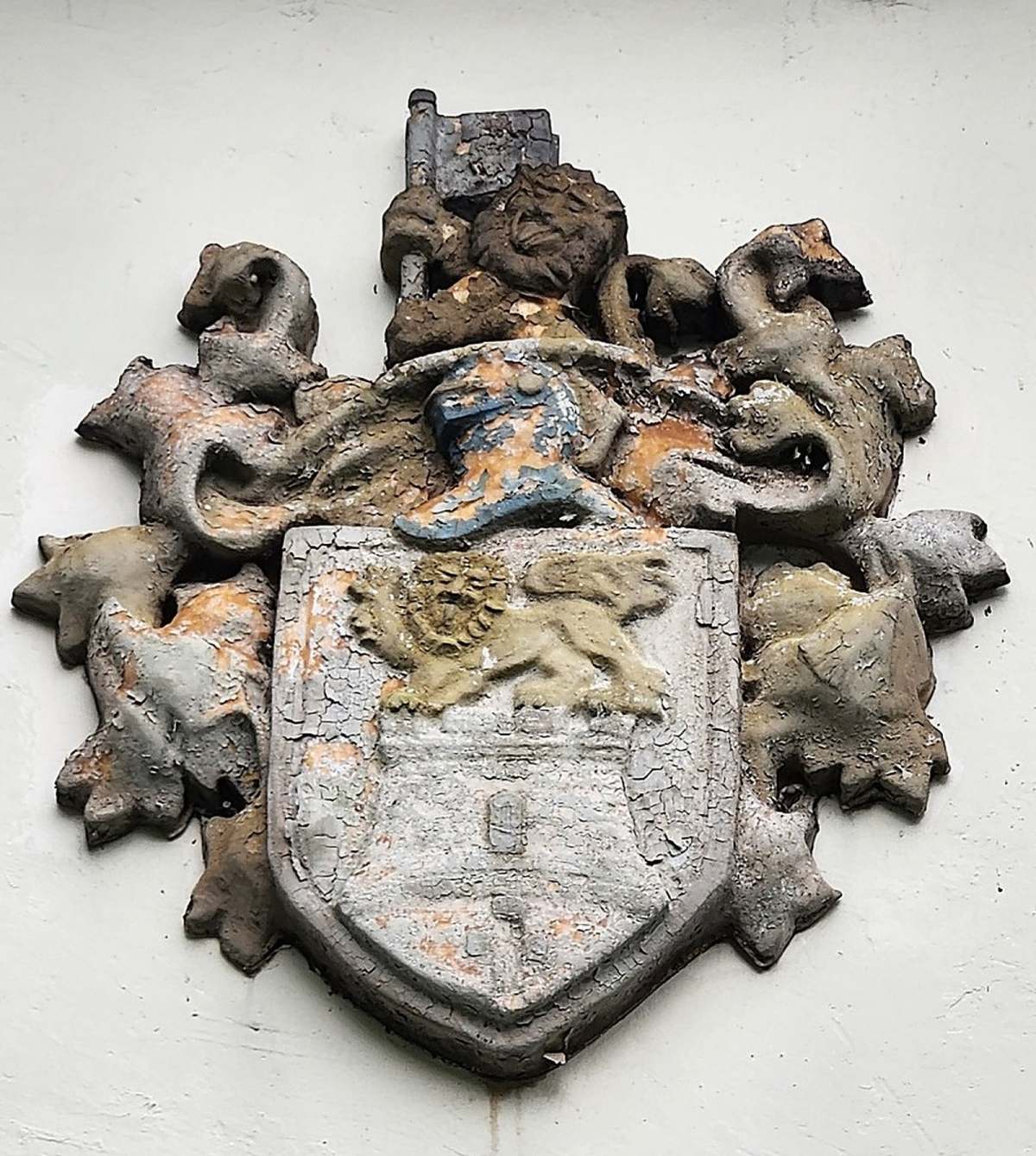
At present, physical traces of the Singapore Colony coat of arms are scarce. The documents in the Rare Materials Collection of the National Library of Singapore include only a few examples of official stationery (printed in the Singapore Annual Report, 1949 and 1952) illustrating stylistic variations of the same composition, most likely created by two different artists (but outside the College of Arms, either in the United Kingdom or in Singapore), as the lion and the tower are stylised quite differently.24
On buildings, there was once the relief sculpture created by the Italian sculptor Rodolfo Nolli titled “Coat of Arms of the Colony of Singapore”, which no longer exists today.25 The one on the facade of the former Bukit Timah Fire Station on Upper Bukit Timah Road has been preserved.26
Self-government and State Coat of Arms (1959)
The year 1959 was not merely a time of constitutional reorganisation. It was also a time of careful recalibration of the visual language of authority. With Singapore’s attainment of internal self-government on 3 June 1959, heraldry ceased to be an appendage of the colonial order and became a direct expression of local authority.
The decisive moment came on 11 November 1959 when the Legislative Assembly passed the Singapore State Arms and Flag and National Anthem Bill.27 During the debates, the new coat of arms was presented as a synthesis of heraldic tradition and local identity. “I think we have a great deal to rejoice over in having struck a simple, striking symbol which has, with the blessings which all parties have given it today, every reason to endure as the emblems of state which will evoke unity and loyalty in our people,” said then Prime Minister Lee Kuan Yew.28
On 3 December 1959, on the occasion of Yusof Ishak’s inauguration as the first Malayan-born Yang di-Pertuan Negara (Head of State), the new emblems were officially unveiled at City Hall.29 The new coat of arms of Singapore, or state crest, was no longer designed by the College of Arms; along with the state flag, it was designed by a committee headed by then Deputy Prime Minister Toh Chin Chye.30
The official description of the coat of arms of Singapore reads:
“The State Arms of Singapore shall consist of a shield on which is emblazoned a white crescent moon and five white stars on a red background. Supporting the shield shall be a lion on the left and a tiger on the right. Below the shield shall be a banner with the words ‘Majulah Singapura’ written on it. The colour red symbolises universal brotherhood and equality of man, and the colour white signifies pervading and everlasting purity and virtue. The crescent represents a young country on the rise in its ideals of establishing democracy, peace, progress, justice and equality, as indicated by the five stars. The lion represents Singapore and the tiger this island’s links with the Federation of Malaya.”31
The motto “Majulah Singapura” (“Onward Singapore”) is, in turn, essential because it is also the title of Singapore’s national anthem.32 In colonial heraldry, mottos often invoked legitimacy through the Crown or providence. Here, however, the motto mobilises and acts as a rallying call. The fact that it is in Malay, not in Latin or English, speaks volumes about the symbol’s new focal point.
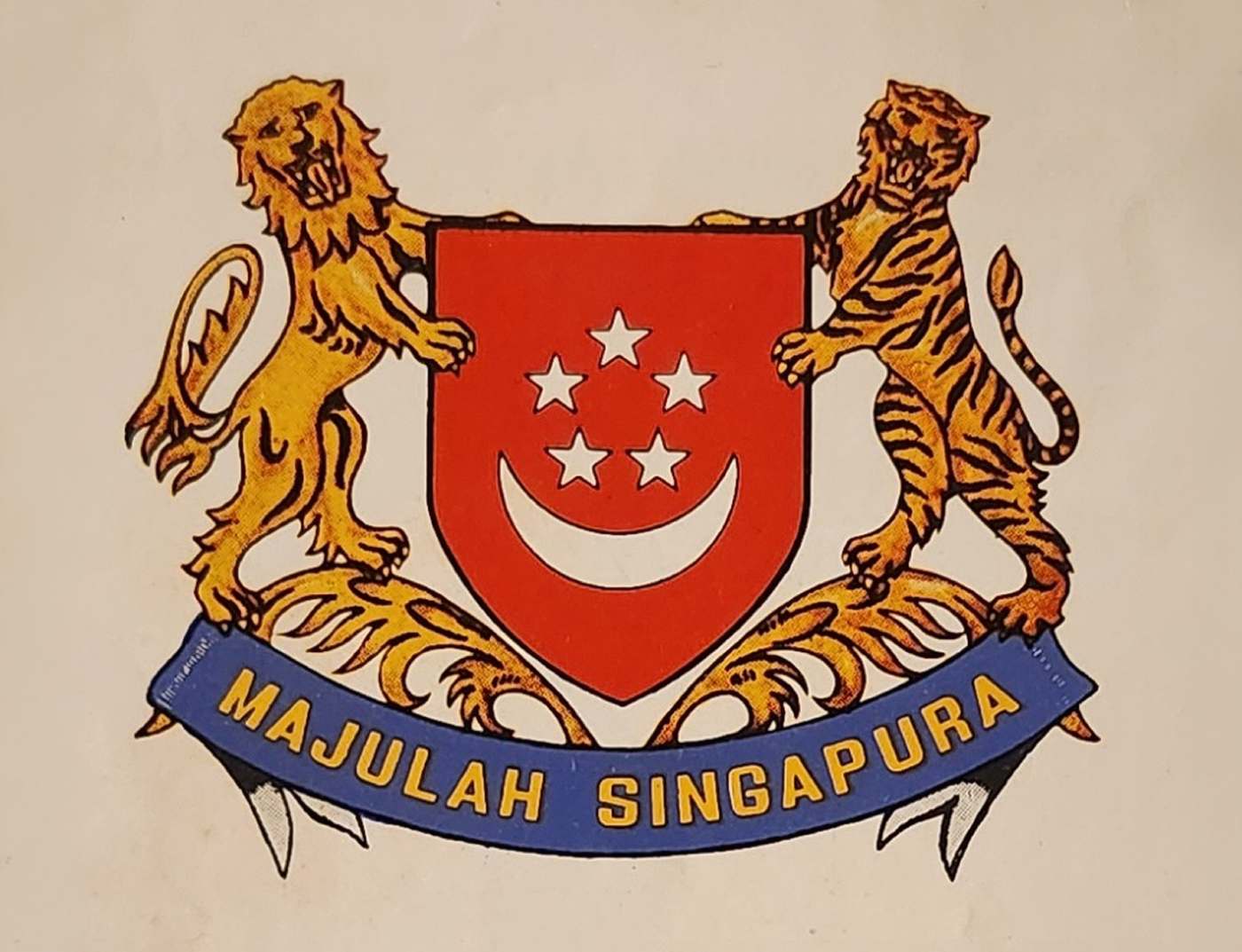
The coat of arms of the Republic of Singapore. Image reproduced from "Flags and Coats of Arms of Singapore" (n.p.: n.p., 1933–65). Collection of the National Library Singapore (Accession no. B34448861E; call no. RRARE 959.5703 BLA).
The red shield shifts the focus from colonial memory to a new identity. The colour red is symbolic of universal brotherhood and equality of man, while white signifies pervading and everlasting purity and virtue. The crescent represents a young country on the ascent in its ideals of establishing democracy, peace, progress, justice and equality as indicated by the five stars. The supporters are among the most inspired iconographic solutions in the entire heraldic history of Singapore. The lion continues the mythological lineage of the Lion City and the tiger introduces a geopolitical dimension, evoking historical ties with Malaya. The relationship between the two animals is not one of hierarchy, but of balance.
And yet, the formal structure of the new arms remains deeply rooted in Western heraldry. The shield organises the whole, the supporters lend it stability and prestige, and the motto frames it in an internationally recognisable form. The change was not in the heraldic language itself, but in the political meaning that this language carried.
An Enduring Symbol
Viewed as a whole, Singapore’s heraldic history is not merely a succession of arms. It is a visual genealogy of authority. The separate Colony of Singapore gave it a more independent form. And the self-governing state, and later the sovereign nation, transformed this legacy into one of independence and sovereignty.
What remains constant, of course, is the lion. But not the same lion. Its role has changed each time. It was first part of a composite colonial entity. It then became the emblem of a distinct colony. Finally, it established itself as a marker of identity for an independent nation. In fact, the question – how many lions are there in Singapore’s heraldry? – has a more nuanced answer than it seems: there are as many lions as there have been regimes of meaning that the island has undergone.
Singapore’s heraldry essentially functions as a visual archive of its history. The lion, absent from reality, has become ubiquitous in representation precisely because it has successfully embodied and expressed the various political changes. An animal absent from the landscape, yet extraordinarily present in memory, in architecture, in the language of the state and in the way the city presents itself to the world. Singapore did not simply inherit the lion. It reinterpreted it ceaselessly – until it made it its own.
There is no doubt that the lion will remain a symbol of Singapore for a long time to come.
This research has benefited from the direct support of highly prestigious institutions and specialists in the fields of heraldry and documentary heritage, whose contributions have been essential to the conduct and in-depth analysis of this study.
First and foremost, special thanks are due to Dr Dominic C.D. Ingram, Chester Herald of Arms, and Dr James Lloyd, Archivist of the College of Arms in London, for their generosity and constant support in facilitating access to fundamental heraldic sources, as well as for the expert guidance they so generously provided throughout the research. Thanks to the direct support of the College of Arms, it was possible to identify and study a unique collection of documents of remarkable value, which have contributed substantially to filling in an important part of Singapore’s history.
My gratitude also goes to Gladys Low, Deputy Director, Singapore and Southeast Asia Collections at the National Library Singapore, and Heirwin Mohd Nasir, Head Library Officer at the Lee Kong Chian Reference Library, for the support provided over many years in identifying and consulting relevant archival materials in Singapore.
About the Author
Dr Adriana Patricia Manea (Ghemes) is a historian, heraldist and expert in heritage diplomacy. She holds a PhD in History (summa cum laude), and specialises in global and comparative approaches to elite cultures, heraldry and informal diplomacy, with a particular interest in transnational secret societies and aristocratic networks. Based in Singapore since 2022, she provides specialist expertise to Singapore institutions in heraldry, genealogy and symbolic representation.
Endnotes
1 Heraldry may be defined as an auxiliary science of history and, at the same time, as a normative system that regulates the design, description, grant, use and visual representation of coats of arms, including studying their origin, evolution, composition and interpretation.
2 When experts describe a coat of arms and the main part called the “shield”, they use specific rules to ensure that every symbol or figure on the shield, as well as every colour and enamel, is properly identified. Accuracy is so vital that even a tiny mistake can change the entire meaning of a symbol and the description of the coat of arms. For example, a lion depicted without a tail is technically termed “diffamed”. In the harsh world of medieval honour, a diffamed lion was a sign of disgrace, or “heraldic shame” – literally a lion that had lost its dignity on the shield. See James Parker, A Glossary of Terms Used in Heraldry (Oxford and London: James Parker, 1894), XXVI, Internet Archive, https://archive.org/details/aglossarytermsu08parkgoog/page/n5/mode/2up (opens in new tab).
3 Frederick Curtis, Heraldry Simplified: A Popular Treatise on the Subject of Heraldry Together with a Glossary of Technical Terms, and Nearly Two Hundred Drawings (New York: Dodge Publishing Company, 1899), 11.
4 The College of Arms in London is the traditional heraldic authority of England. Within the context of the British Empire, the coats of arms of the colonies were not merely decorative designs, but official emblems that had to be approved in accordance with British heraldic rules, after which a Royal Warrant was issued for that coat of arms.
5 For more details, see Derek Heng, “Sang Nila Utama: Separating Myth from Reality (opens in new tab),” BiblioAsia 16, no. 2 (July–September 2020): 58–64.
6 Classifying a large feline as a heraldic “tiger” rather than a “lion” was used to represent exotic animals unknown to Europeans, as their resemblance was relatively close; medieval heralds often invented features for animals “from the East”, just as Temasek/Singapore was perceived.
7 Sea lions, or merlions, are hybrid creatures, with the upper body of a lion and the tail of a fish. These figures were not mere decorative whims. They articulated, in heraldic language, the identity of a maritime and imperial empire: the lion represented British political might, while the fish tail signified control of the sea lanes, overseas expansion and the projection of power across the oceans. In this sense, the sea lion became a symbol of British commercial dominance and naval vocation.
8 This refers to the heraldic composition of the Old British East India Company’s coat of arms. We will detail the heraldry of the imperial period in the second part of this article. The Old East India Company was incorporated by Queen Elizabeth on 31 December 1600 as the Governor and Company of Merchants of London Trading into the East Indies. A rival enterprise, the English Company Trading to the East Indies, was established by King William III on 5 September 1698 to compete against the original company. In 1708–1709, the two were merged to form one single entity called the United Company of Merchants of England Trading to the East Indies, more commonly known as the Honourable East India Company or the British East India Company.
9 The supporters of the coat of arms (in heraldic terminology) are the figures placed on either side of the shield (the central part of the coat of arms or blazon), as if they were supporting or guarding it. Supporters can be real or fantastical animals, characters or other symbolic beings, and their role is to enhance the meaning and prestige of the coat of arms.
10 Jaime Koh, “Straits Settlements (opens in new tab),” Singapore Infopedia. National Library Singapore. Article published 29 July 2014.
11 Walter Makepeace, Gilbert E. Brooke and Roland St. John Braddell, One Hundred Years of Singapore: Being Some Account of the Capital of the Straits Settlements from Its Foundation by Sir Stamford Raffles on February 6, 1819, to February 6, 1919 (opens in new tab) (London: John Murray, 1921), 571. (From National Library Singapore, call no. RCLOS 959.51 MAK-[RFL])
12 A lion passant guardant is a lion shown walking towards dexter, in the heraldic sense, with its body in profile, supported on three limbs and with the right forepaw raised; its head is guardant, meaning turned to face the observer and looking directly at the viewer.
13 The original Royal Warrant conferring the Coat of Arms of the Straits Settlements in that year is preserved at the College of Arms, Garter House, G. 12, pp. 189–92. Royal Warrants of Arms are registered with the College, which (sometimes) also preserves the original (as is the case with Singapore).
14 Arthur Charles Fox-Davies, The Book of Public Arms: A Complete Encyclopaedia of All Royal, Territorial, Municipal, Corporate, Official, and Impersonal Arms (London: T. C. & E. C. Jack, 1915), 757, Internet Archive, https://archive.org/details/bookofpublicarms00foxd/page/n7/mode/2up (opens in new tab).
15 The Christmas cards were sold by John Little and Co., Ltd. in its stores in Singapore, Penang, Kuala Lumpur and Ipoh. See for instance “Page 8 Advertisements Column 1 (opens in new tab),” Singapore Free Press and Mercantile Advertiser, 29 November 1928, 8; and “Page 10 Advertisements Column 1 (opens in new tab),” Singapore Free Press and Mercantile Advertiser, 25 October 1930, 10. (From NewspaperSG)
16 The jewellery box, described as a casket in the advertisement, was on display for sale at K.M. Oli Mohamed’s store at 3 High Street. Besides the coat of arms, it was also decorated with images of St Andrew’s Cathedral and Victoria Memorial Hall. See “Page 12 Advertisements Column 1 (opens in new tab),” Malaya Tribune,
14 February 1930, 12. (From NewspaperSG)
17 National Heritage Board, “Decorative Silver Spoon with Straits Settlements Coat of Arms,” Roots, last updated 15 October 2020, https://www.roots.gov.sg/Collection-Landing/listing/1271026 (opens in new tab).
18 College of Arms, Garter House, D/C/3, Singapore file, correspondence between the Colonial Office, the Government of the Colony of Singapore and the College of Arms, 18 February 1947– 13 September 1948.
19 The monarch grants coats of arms directly by Royal Warrant to other members of the royal family and to his or her own territories. Royal Warrants of Arms are registered with the College of Arms in London, which (sometimes) also retains the original, as in the case of this new coat of arms. The original Royal Warrant (Garter House, D/C/3, Royal Warrant granting the coat of arms to the Colony of Singapore, September 13, 1948) by which the Coat of Arms of the Colony of Singapore was conferred is kept in London, in a file containing all related correspondence, identified following research conducted with the support of the College of Arms in London. The registered copy of the document is in the College of Arms (under archive reference I. 81, pp. 224–25).
20 The images of the Royal Warrant that we are publishing here for the first time comply with the conditions imposed by the King of Arms of the Garter, who requested the removal of King George VI’s signature from the image, specifying that this measure was taken as a precaution.
21 “Singapore Waits for New Arms (opens in new tab),” Straits Times, 21 November 1948, 3. (From NewspaperSG)
22 Royal Warrant (Garter House, D/C/3, Royal Warrant granting the coat of arms to the Colony of Singapore, 13 September 1948) by which the Coat of Arms of the Colony of Singapore was conferred.
23 The original Letter Patent/Grant of Arms for the City of Singapore (the basis on which arms were granted to the municipality of Singapore) is in the collection of the National Museum of Singapore. A digitised copy of this Letter Patent is found in the records of the National Archives of Singapore where it is listed as “Royal Warrant Assigning Armorial Ensigns for the City of Singapore (opens in new tab),” 9 April 1948, document. (From National Archives of Singapore, media - image No. 20200000135 – 0001). Letter Patents are registered with the College of Arms, but the originals are sent to the recipients as in the case of the municipality of Singapore.
24 Flags and Coats of Arms of Singapore (n.p.: n.p., 1933–1965). (From National Library Singapore, call no. RRARE 959.5703 BLA)
25 The National Archives of Singapore has a photo of the sculpture. See “Coat of Arms of the Colony of Singapore, Sculpted by Italian Sculptor Rodolfo Nolli (opens in new tab),” 1948–1955, photograph. (From Lina Brunner Collection, National Archives of Singapore, media - image no. 19980001358 - 0067)
26 This writer Dr Adriana Patricia Manea (Ghemes) took a picture of the coat of arms on 26 December 2023.
27 “Singapore Gets Its ‘Symbols of Self-respect (opens in new tab)’,” Straits Times, 12 November 1959, 11. (From NewspaperSG)
28 Singapore Legislative Assembly, “Singapore State Arms and Flag and National Anthem Bill (opens in new tab),” vol. 11 of Debates: Official Report, 11 November 1959, cols. 740–41. (Singapore: Legislative Assembly, 1959–1965). (From National Library Singapore, call no. RCLOS 328.5957 SIN-[HWE]
29 “Singapore Rejoices (opens in new tab),” Straits Times, 4 December 1959, 1. (From NewspaperSG)
30 “No Conflict, Clear-cut Symbol of Unity (opens in new tab),” Straits Times, 9 August 1981, 13. (From NewspaperSG); “National Coat of Arms,” National Heritage Board, last updated 14 March 2025, https://www.nhb.gov.sg/what-we-do/our-work/community-engagement/education/resources/national-symbols/national-coat-of-arms (opens in new tab).
31 Flags and Coats of Arms of Singapore.
32 Republic of Singapore, “National Symbols Act 2022,” No. 29 of 2022, Government Gazette Acts Supplement, 7 October 2022, Singapore Statutes Online, https://sso.agc.gov.sg/Act/NSA2022?WholeDoc=1 (opens in new tab).