Article
From “Pok Jui” to Jui Residences: The Story of the National Aerated Water Company
24 July 2026
Topics
History
Places and Buildings
In the 1950s, the National Aerated Water Company produced over 40,000 bottles of Sinalco a day. All that remains today is the shell of the company’s factory on Serangoon Road.
By Alvin Tan
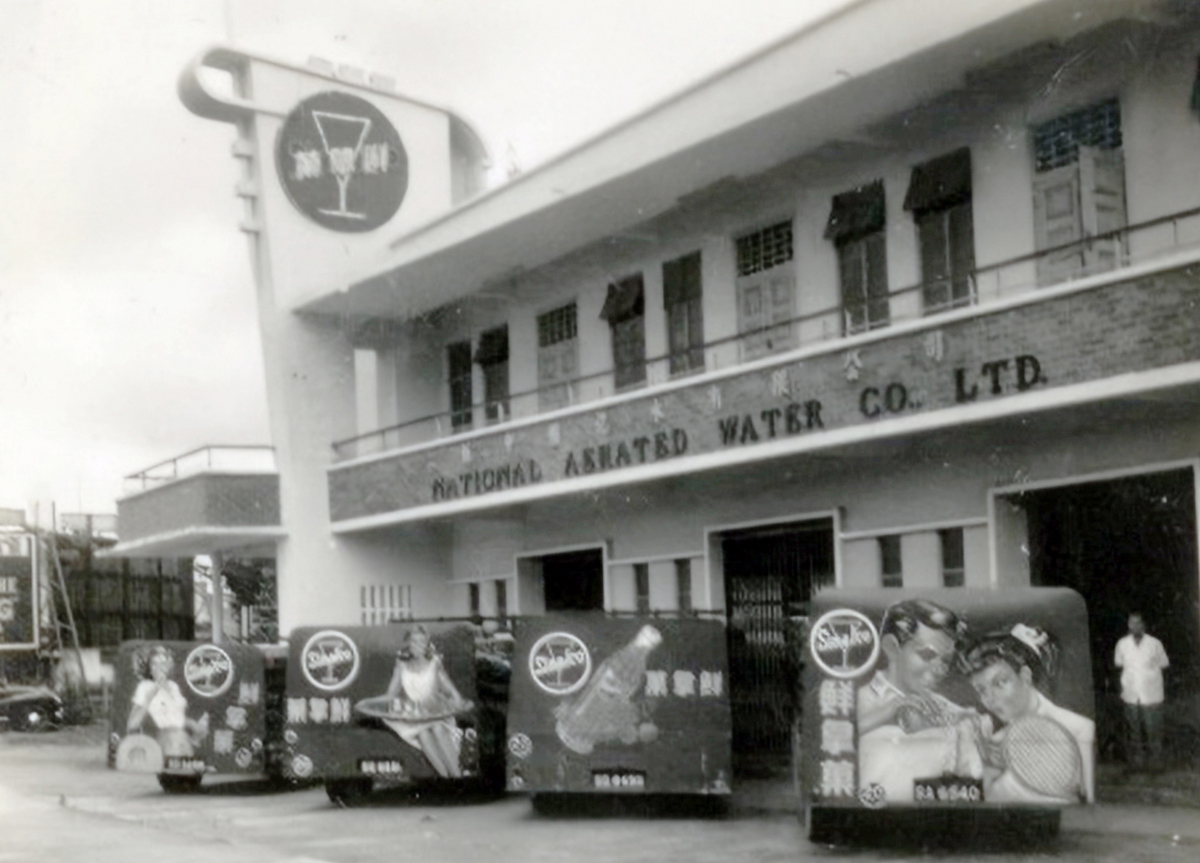
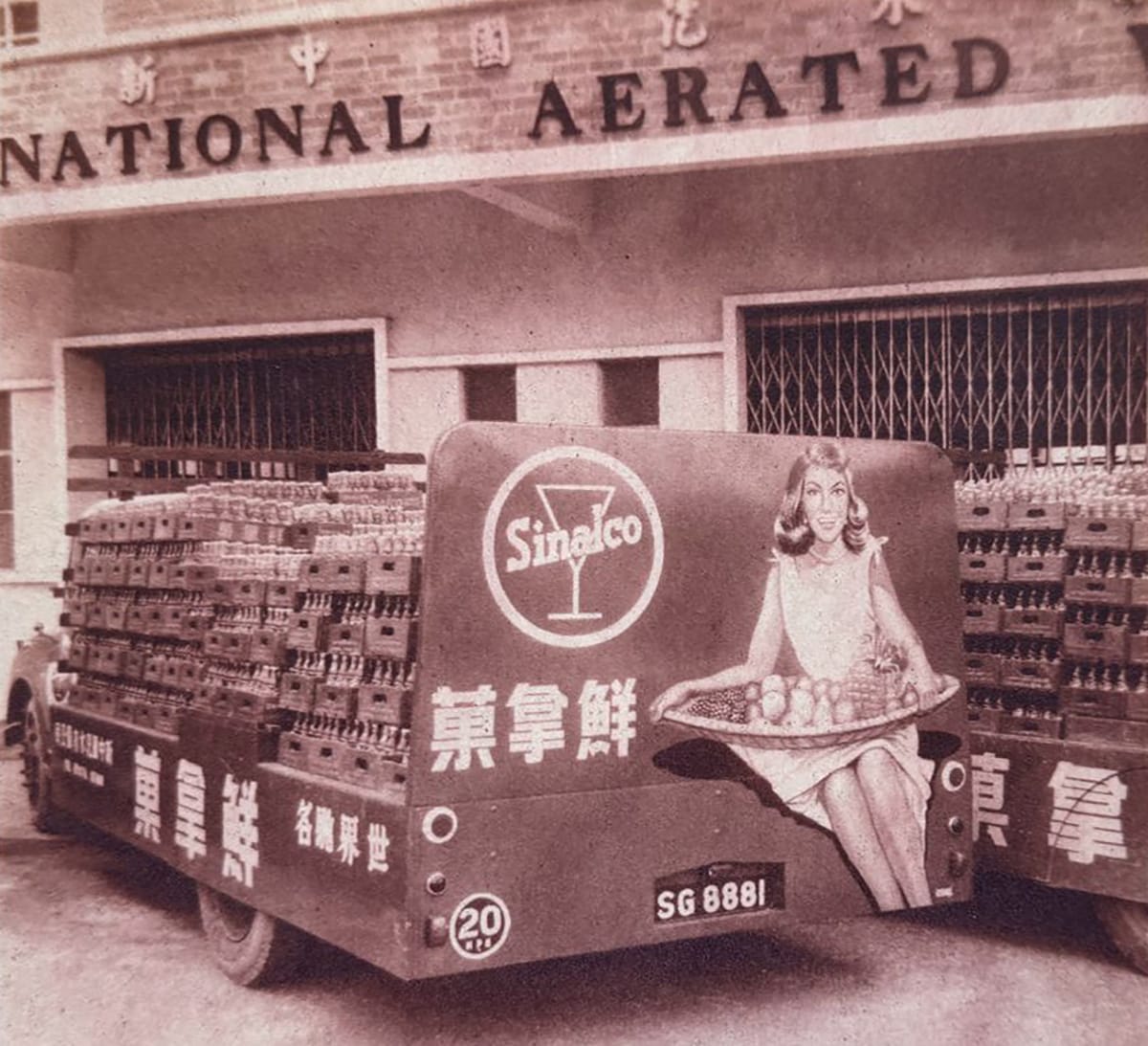
The factory of the National Aerated Water Company on Serangoon Road, c. 1950s. Parked in front of the building are Sinalco distribution trucks. Courtesy of URA Collection.
Jui Residences, an 18-storey glass-and-concrete condominium, is situated on Serangoon Road, near what was once the 3rd milestone. Standing on a 31,705-square-foot (2,946 sqm) site, it towers over a nearby two-storey Art Deco-style building that is part of the site. This comparatively ordinary-looking and diminutive building, however, is a remnant of Singapore’s industrial history. For the entire site once housed the state-of-the-art factory of the National Aerated Water Company, which operated in Singapore for 70 years, from 1929 to 1999.
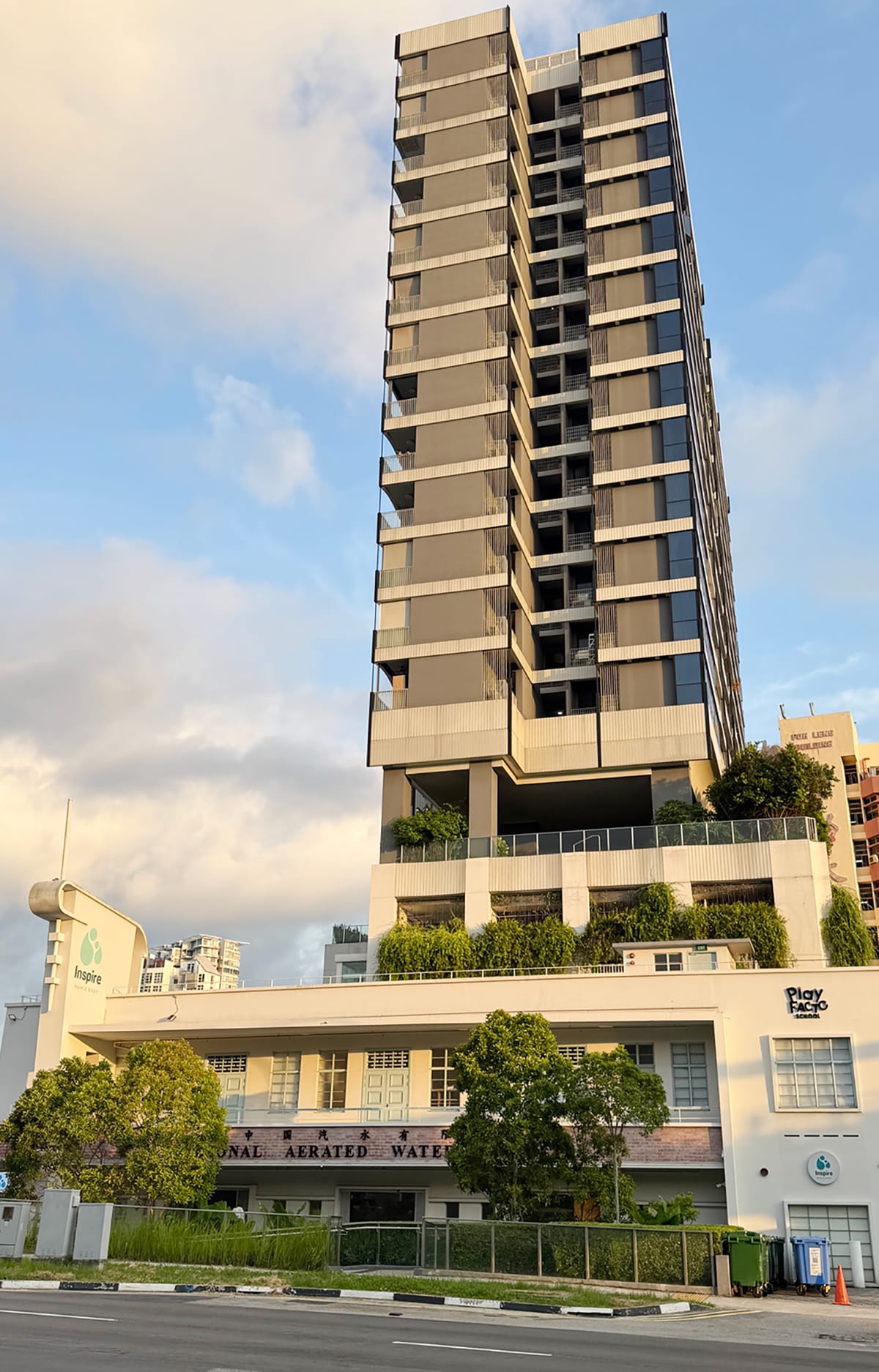
Jui Residences on Serangoon Road with the factory of the former National Aerated Water Company factory integrated into its development, 2026. Photo by Jimmy Yap.
With its iconic signage tower and prominent Sinalco logo, the building was more than a production line; it was a tangible and visual promise of speed, technology and a nation’s thirst for progress. Here, a soft drink craze was ignited – one that swept through the 1950s and 1960s by pairing a secret German formula with clever marketing, transforming the humble pok jui (Hokkien for “soft drinks”) into a sophisticated product and a household name.
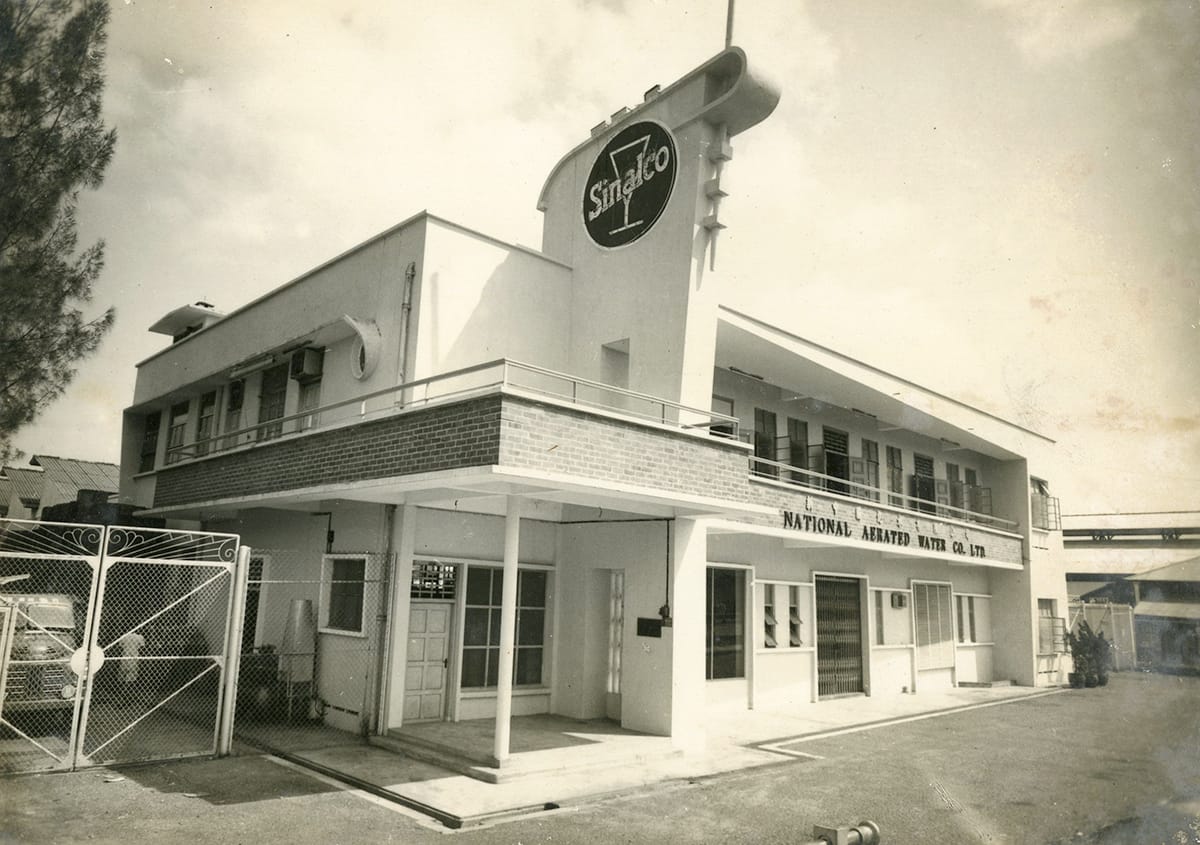
The factory of the National Aerated Water Company on Serangoon Road showing key architectural features of its Art Deco design, c. 1950s. Courtesy of URA Collection.
Soft drinks, or carbonated drinks, first made their appearance in Singapore as early as 1832. A nondescript advertisement in the Singapore Chronicle announced the arrival of “a few dozens of fresh soda water” on the ship Elizabeth.1 In 1883, John Fraser and David Chalmers Neave set up the Singapore and Straits Aerated Water Company – better known today as Fraser & Neave (F&N).2 Other manufacturers included Framroz and Co. (1904), Phoenix Aerated Water Company (1925), Amoy Canning (1951) and Yeo Hiap Seng (1953).3 Most were local agents and bottlers for foreign soft drink brands, such as Green Spot. Framroz, however, became well known for its own concoction – Orange Smash.4
In an era where imported goods had an aura of luxury, sophistication and prestige, soft drinks were marketed as objects of conspicuous consumption and cleverly positioned as the perfect thirst-quencher for the enervating tropical climate.
Bottling Aspirations
In 1929, a three-man partnership comprising Yap Shing Nin, Cheng Sze Boo and Tan Kah Woo put up $1 million in capital to set up the National Aerated Water Company on Hamilton Road, in the Jalan Besar area. It employed about 20 workers at its factory, which produced 300 bottles of soft drinks every hour.5
During the Japanese Occupation, the company continued producing soft drinks using its stockpile of flavours and sugar rations. By 1950, the company – which changed its status to private limited in 1948 – was known as “the largest Chinese manufacturer of aerated water products in Singapore” with a product line comprising orange juice, pineapple juice and sarsaparilla.6
Although it made a few different types of drinks, the company’s best-known product was a beverage known as Sinalco. The company secured the licence to distribute the drink in 1952. Interestingly, the company was not the first to introduce Sinalco to Singapore. As early as November 1934, the Malayan Tribune carried a small, nondescript advertisement which went: “A new non-alcoholic beverage called Sinalco has been introduced into the local market by Mr. E.H. Schirmer of 2 Finlayson Green. The drink is excellently prepared and should find a ready sale in Malaya.”7
Other advertisements by Schirmer touted Sinalco as “Invigorating, Strengthening and Refreshing”, “the Queen of all Non-Alcoholic Beverages” and “When mixed with Beer, it’s second to none”.8 However, the National Aerated Water Company went beyond run-of-the-mill print ads. It promoted, marketed and sold Sinalco in a manner and with a scale that eluded Schirmer. The company launched Sinalco on 1 August 1952, which soon became wildly popular in Singapore.9
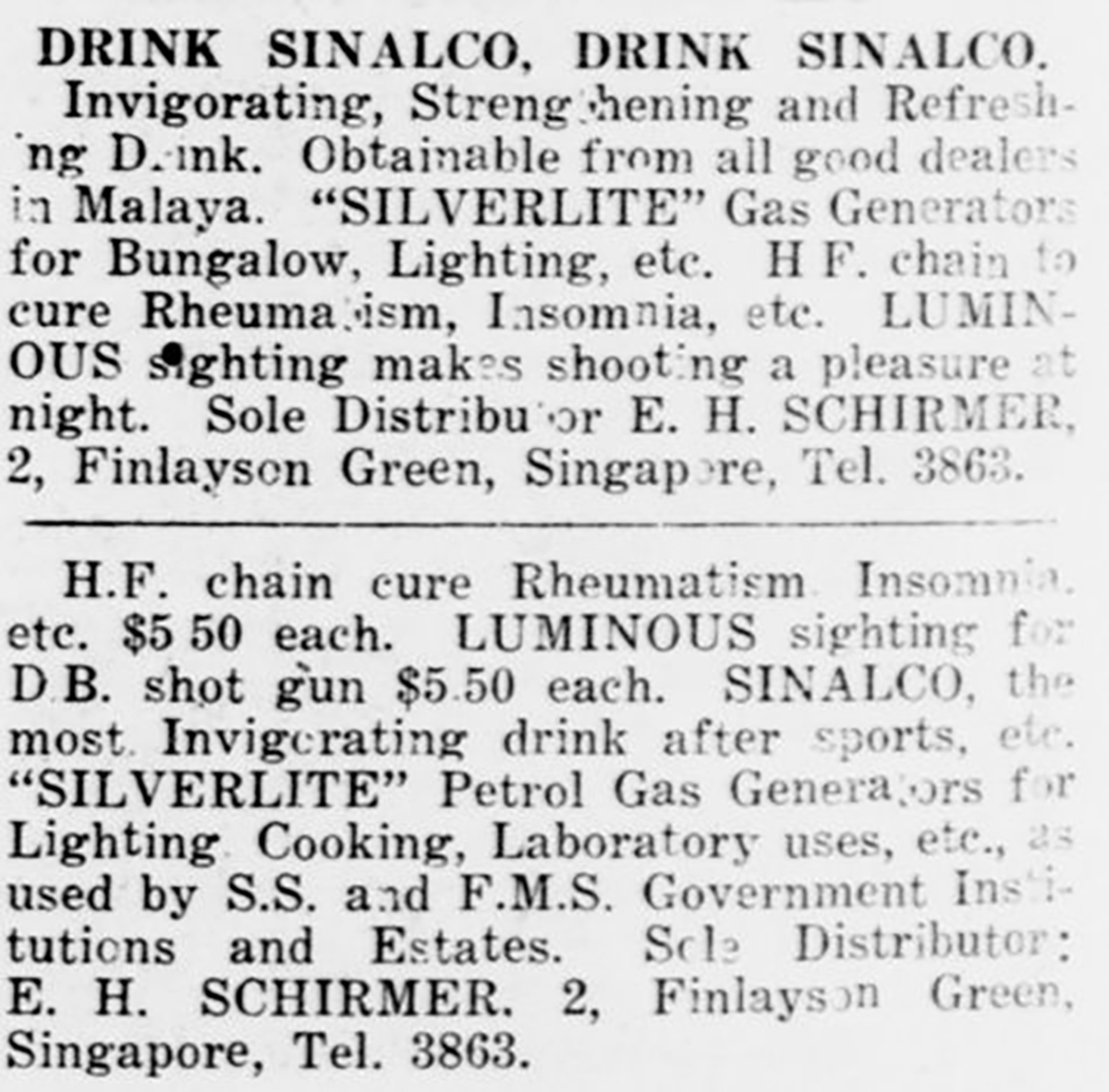
Before the National Aerated Water Company, the distributor for Sinalco was an E.H. Schirmer whose office was at 2 Finlayson Green. The advertisement described the soft drink as “Invigorating, Strengthening and Refreshing”. Image reproduced from The Malaya Tribune, 2 November 1934, 8. (From NewspaperSG).
The drink actually dates back to the beginning of the 20th century. First concocted in Detmold, Germany, in 1902, the name Sinalco was a portmanteau formed from the Latin word sine (“without”) and alco, a truncation of “alcohol”.10 Its formula was a closely guarded secret, but its ingredients included a blend of orange, lemon, strawberry, blackberry, raspberry, pineapple and other fruit juices, giving it a unique citrusy flavour. And because of the added fruit acids and mineral salts, the drink was supposedly endowed with tonic qualities.11
By September 1952, within a month of its public release, the company had sold 216,000 bottles of Sinalco. The company’s 75 employees were pulling 12-hour shifts to satisfy Singapore’s demand for the drink. One of its managing directors, Yap Shing Nin, announced that a new factory would be built to meet the demand.12
In 1954, the National Aerated Water Company celebrated its 25th anniversary by inaugurating its new premises on Serangoon Road in October that year. Built at a cost of $350,000, it was equipped with $150,000 worth of the most modern machinery – washers, fillers, conveyors, syrupers and carbonators – from the United Kingdom. “Despite keen competition in the soft drink trade, we believe there is room for all as demand continues to increase rapidly,” Yap told the Straits Times.13
Within a year, the new factory – which had a rated production capacity of 48,000 bottles a day – was producing 43,200 bottles daily. It consumed 1.5 tons of sugar each day and produced one million bottles of soft drinks every month. Eighty percent of the company’s total output was sold in Singapore, with the rest going to the Federation and Indonesia.14
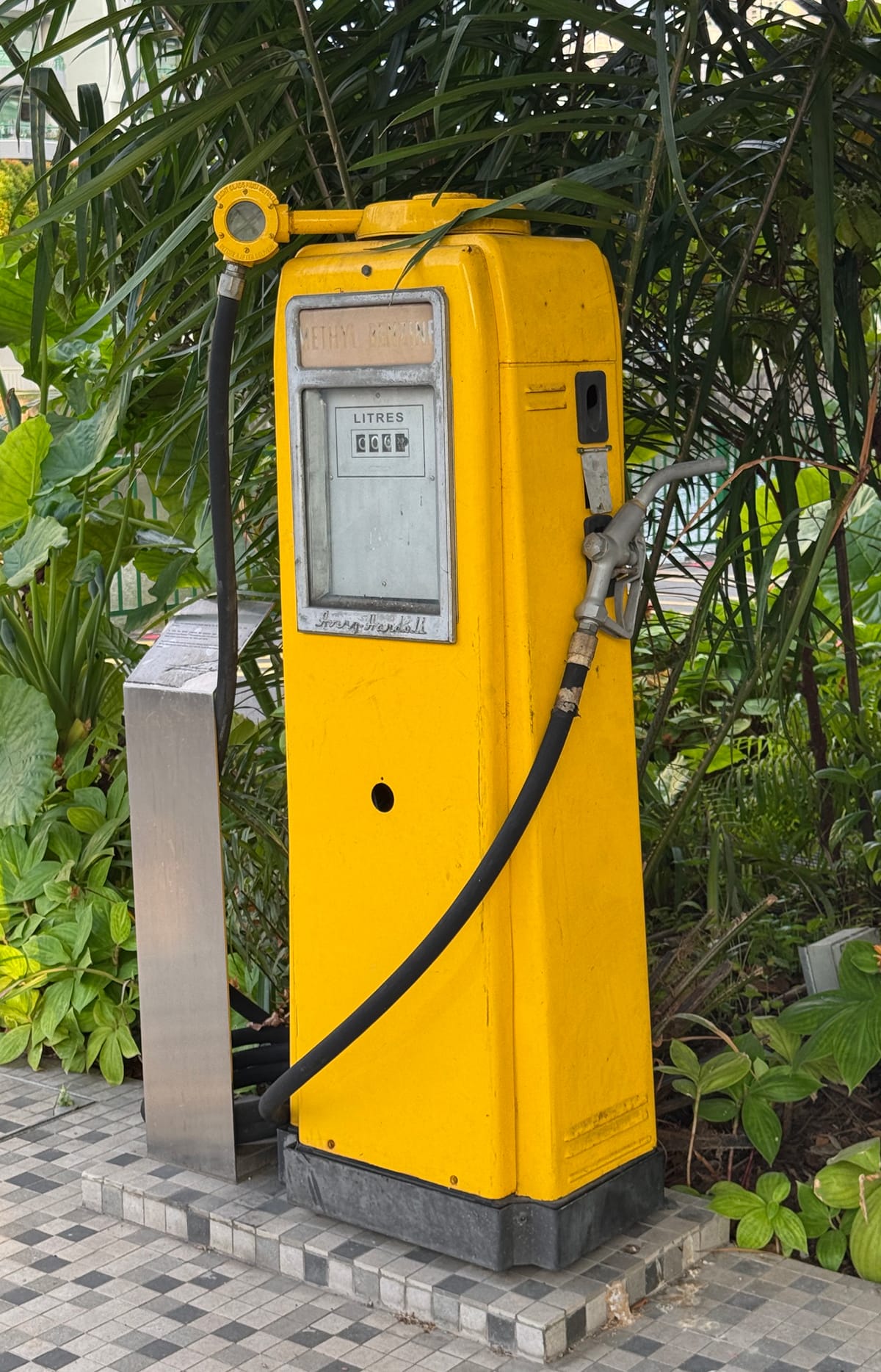
The factory even had its own fuel pump to service its “fleet of vans and lorries to carry its drinks to all parts of the Federation”. In 1958, the company announced a factory upgrade with a new $100,000 machine capable of filling 6,000 bottles of soft drinks an hour. “Business in this line is growing in Singapore and our new equipment will enable us to cope with the increasing demand,” said Cheng Sze Boo, another managing director.15
Building a Landmark
Like several other industrial buildings in Singapore from the 1940s onwards, the National Aerated Water Company building incorporated Art Deco-inspired stylistic elements. Notable examples would be the Ford Motor Factory on Upper Bukit Timah Road (1941) and Khong Guan Factory on MacTaggart Road (1952).16
With its L-shaped, two-storey red-and-cream building, the factory was designed to reflect technological progress and modernity. Deliberate efforts were made to balance the aesthetic form with its utilitarian manufacturing functions.
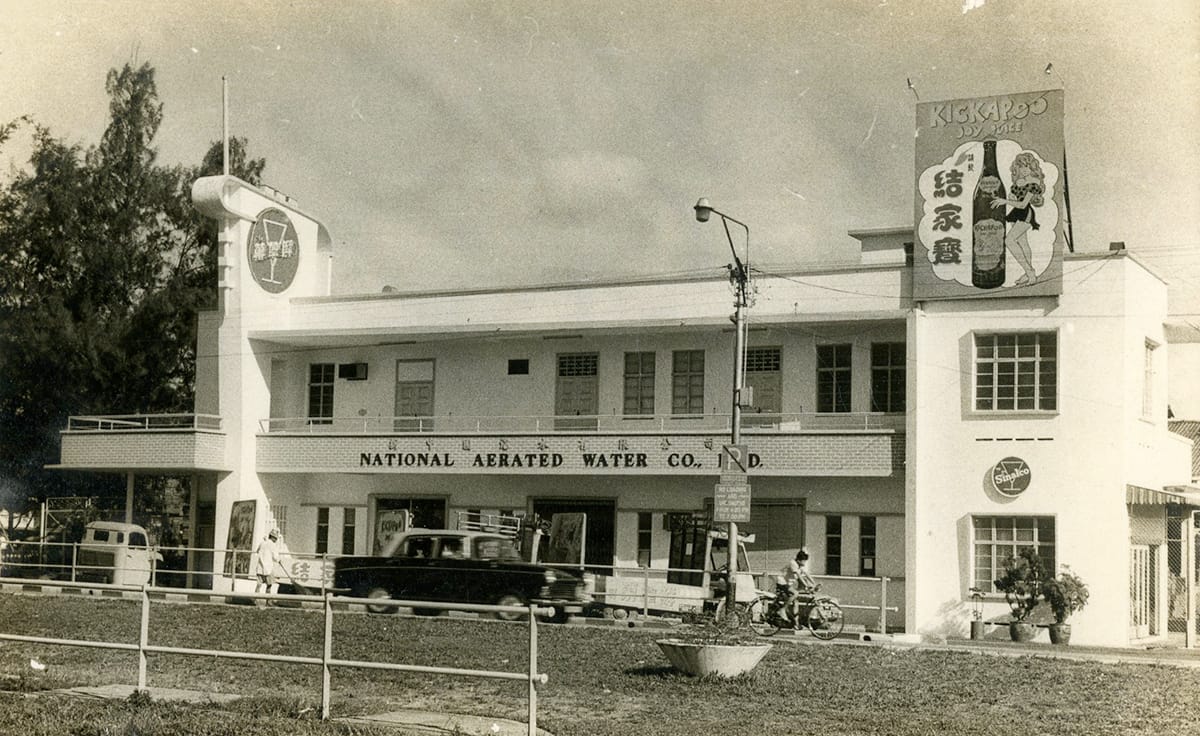
The factory of the National Aerated Water Company on Serangoon Road, undated. Courtesy of URA Collection.
The building’s facade, dominated by long horizontal lines, has a vertical signage tower (reminiscent of an aeroplane’s tail fin) rising from it, breaking the visual monotony imposed by the linear design. Offset from the building centre, the tower’s curved elements soften the otherwise hard edges and geometric shapes that form the building’s leitmotif. Emblazoned with the Sinalco logo, the tower became a prominent visual marker for the area.
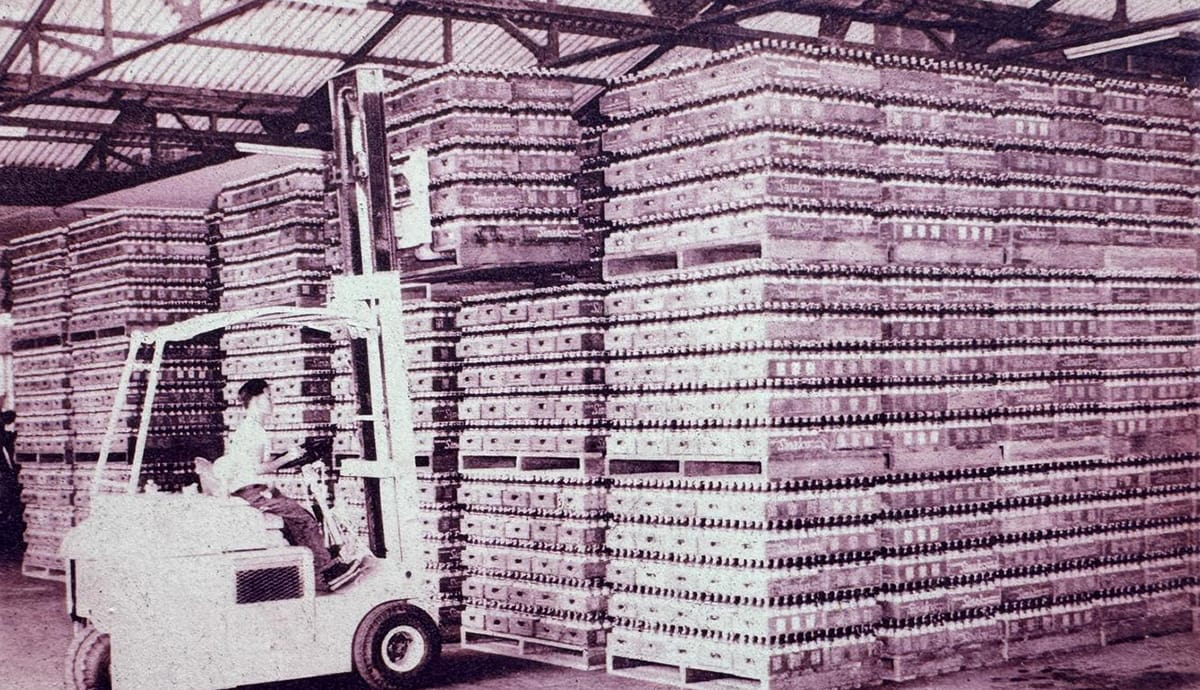
Crates of Sinalco stored in the warehouse within the factory of the National Aerated Water Company on Serangoon Road, c. 1950s. Courtesy of URA Collection.
To the tower’s left, a projecting concrete canopy marked the factory’s main entrance. And on its right, three large, rectangular collapsible grille gates facilitated loading and unloading. Similarly, the fair-faced brick parapet of the balcony, timber doors and transoms (decorative or functional panels located above the door) provided visual relief from the extensive concrete finishing and metal grid windows. The side of the building facing the Kallang River features a small circular metal grid window that serves as an effective counterpoint to the square and rectangular shapes dominating the structure.17 Together, these visual elements alluded strongly to the hallmarks of mass production – speed, efficiency and technology.
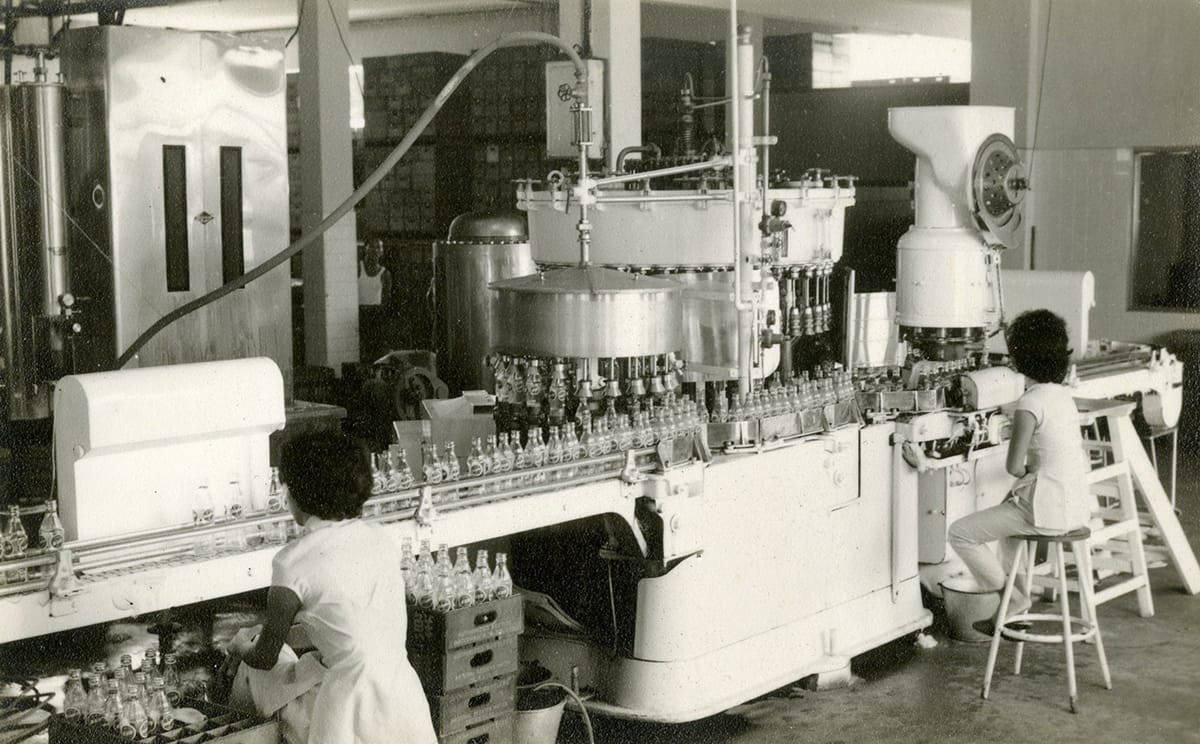
Workers bottling Sinalco at the factory of the National Aerated Water Company on Serangoon Road, c. 1950s. Courtesy of URA Collection.
Sinalco – The Trending Soft Drink of the 1950s
Sinalco was a big hit. Much of this success can be attributed to the company’s marketing savvy that, in a pre-television era, relied heavily on physical outreach and engagement. It heightened brand visibility through trade fairs (or “expos”), which were an effective means of reaching a mass audience at a time when advertising was limited to either print or radio. The company invested time and money into the decoration of its stall at these trade fairs. Allowing potential customers to have a taste of Sinalco at these events also helped to introduce it to the general public.18
Press coverage helped to build visibility. In February 1953, the Singapore Standard newspaper recommended it as a last-minute festive purchase for Chinese New Year.19 Serving Sinalco, a soft drink with European origins, to your guests in those days was considered a status symbol.
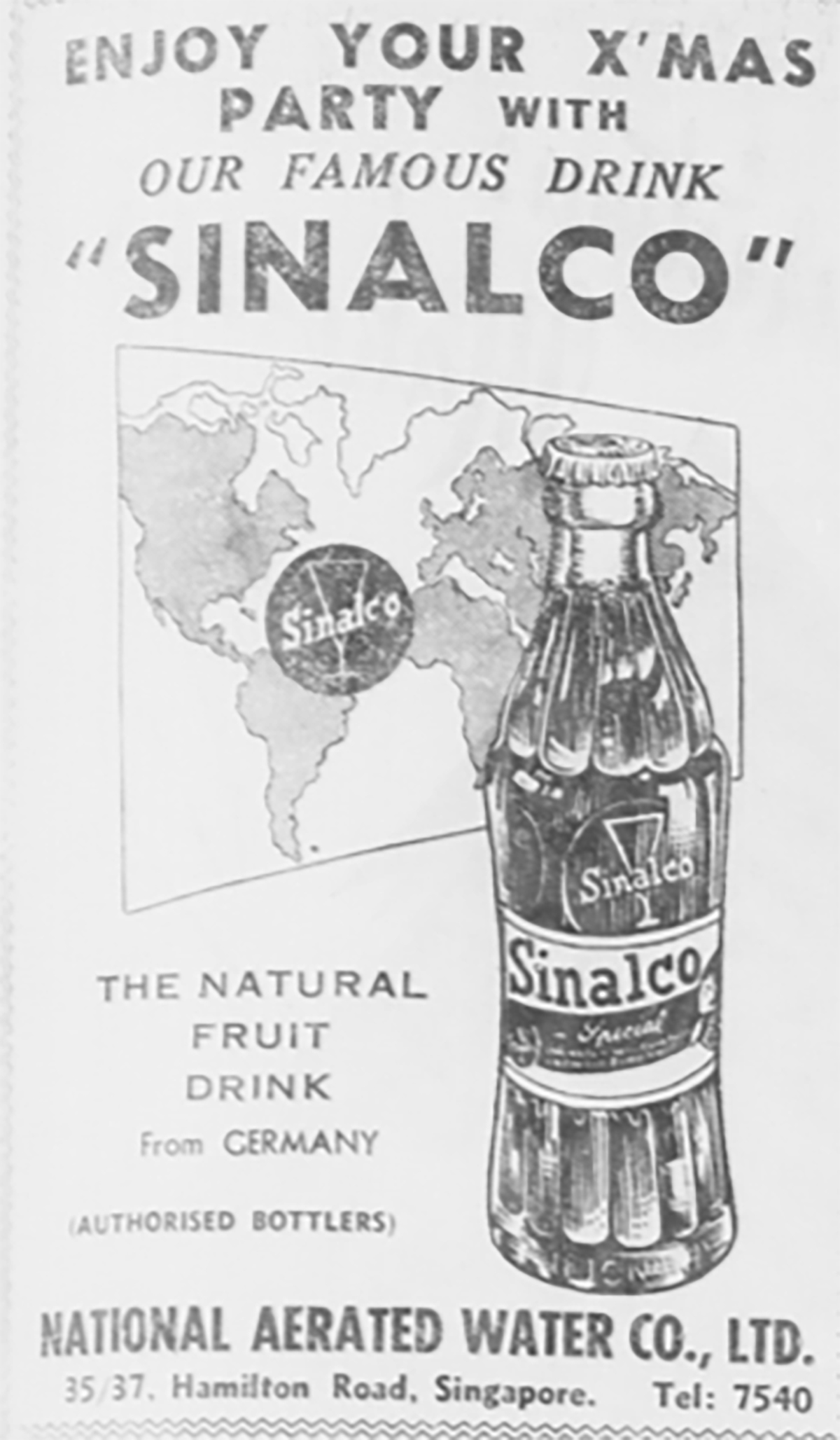
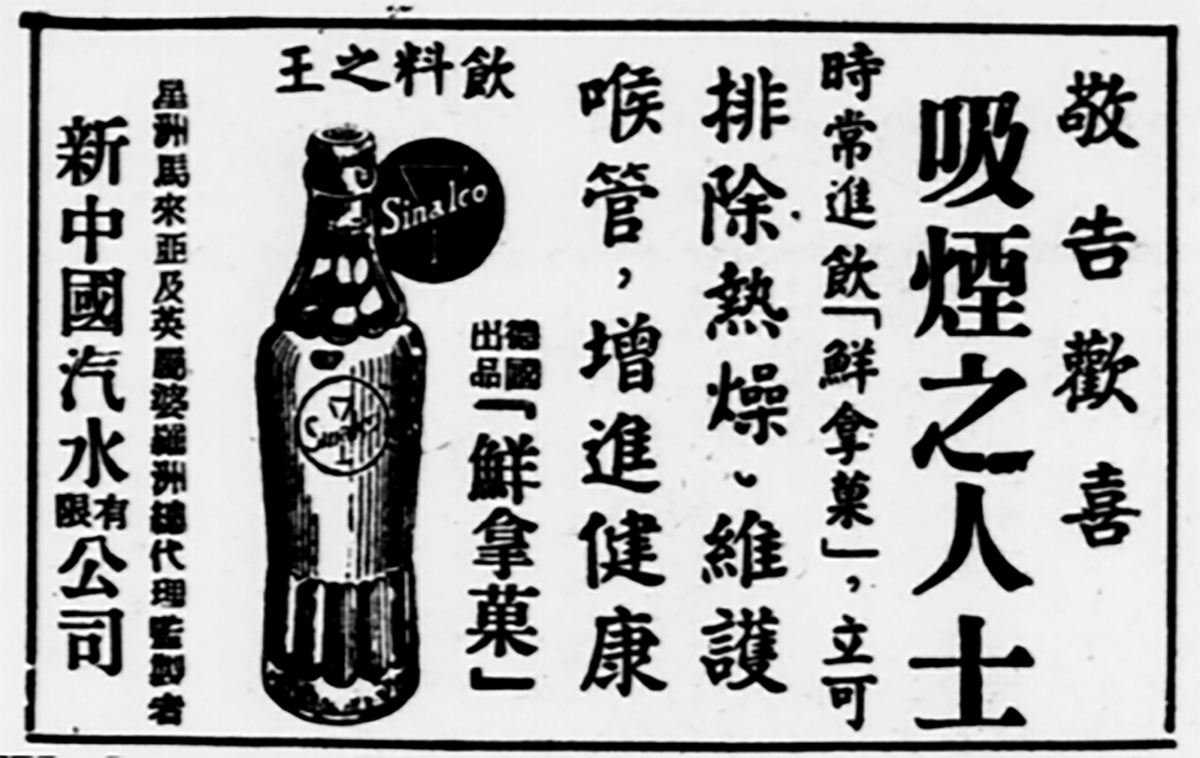
Sinalco was also associated with fun. At the Great Eastern Trade Fair in January 1953, the company promised prizes of up to “20 dozen bottles of Sinalco” if visitors could, for example, guess the number of bottle caps in a bottle or kick a ball into a hole from a distance of 12 feet. At the trade fair at Happy World in October 1955, Sinalco was sold at half price, or 10 cents a bottle. To reward customers – loyal or prospective ones – the company gave away pencils, pocket mirrors and balloons at its stall.20
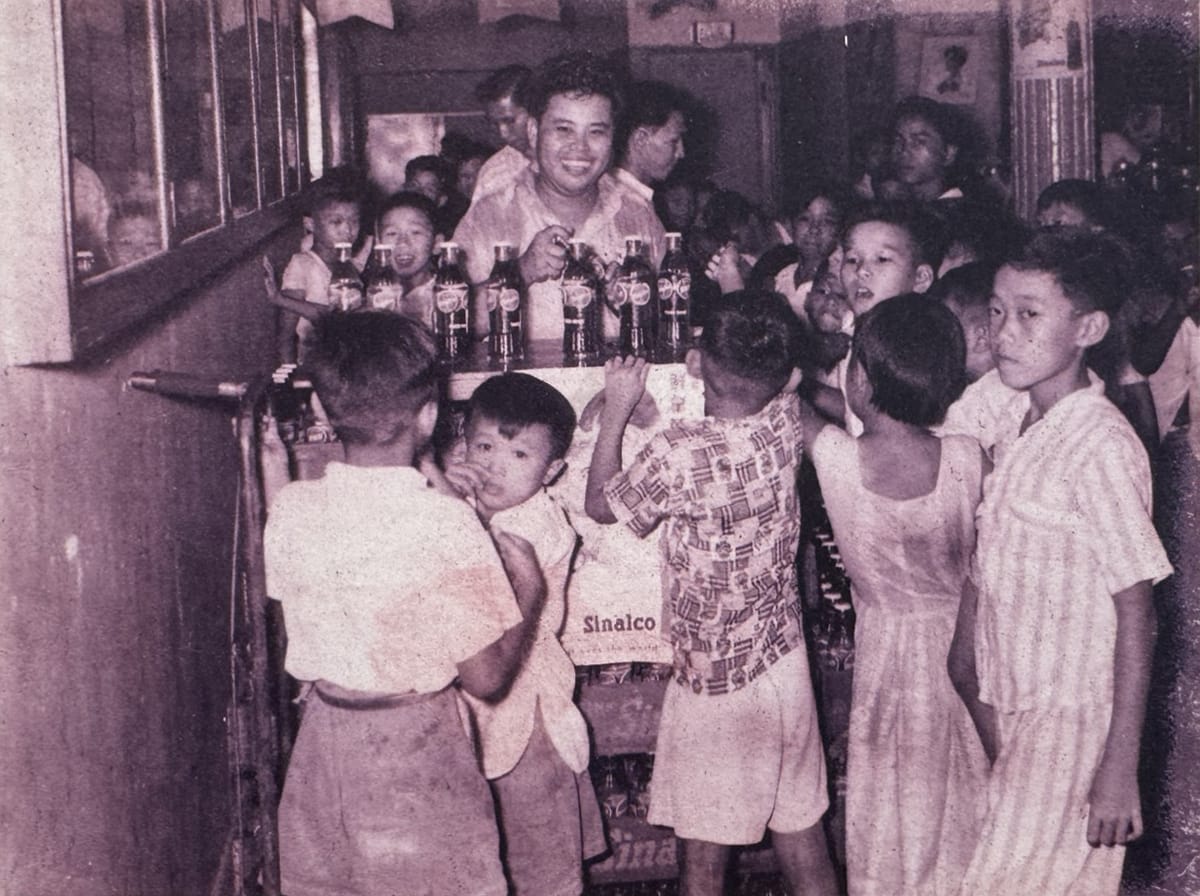
Children enjoying Sinalco, c. 1950s. Courtesy of URA Collection.
In August 1958, at the Great World Trade Fair, free bottles of Sinalco were given out nightly. At the time, these small tokens were little luxuries to most people, who were getting by with very little. “Every night it will be crowded with people, young and old, awaiting their turn for a bottle of Sinalco, politely served by smart sales girls,” the Singapore Free Press reported.21
Such activities attracted media attention, created brand awareness and generated buzz about Sinalco – it kept people wanting it and wanting more.
On 14 September 1958, the company put on what would be called a product placement drive today – Sinalco Night. Held at the Great World Trade Fair, the entertainment show featured more than 20 performers, including Chen Meiguang and Chen Meiyu, who were among that era’s leading artistes. Audiences stood a chance to win lucky draw prizes.22 The first prize comprised 10 cases of Sinalco soft drinks, one handheld travel bag, three plates, three ashtrays, 12 mirrors and 36 pencils. It can be surmised that these items were emblazoned with the Sinalco logo. Winning numbers were published in the two main Chinese broadsheets the following day.23
Later, in October 1958, the company tied up with Yong Chun Song and Dance Troupe for its 40th anniversary entertainment gala at New World. Branded as another “Sinalco Night”, the show featured the same lucky draw but guests received a special treat – a bottle of Sinalco which they deemed to be “a premium beverage”. In March 1959, the company amped up its brand campaign by holding a “Sinalco Lucky Numbers” lottery at the Constitution Exposition.24
In response to the Bukit Ho Swee Fire in May 1961, the company donated three days’ worth of sales proceeds from the Great World Trade Fair to aid the unfortunate fire victims.25 Even a charitable act was an opportunity to sell itself to potential customers.
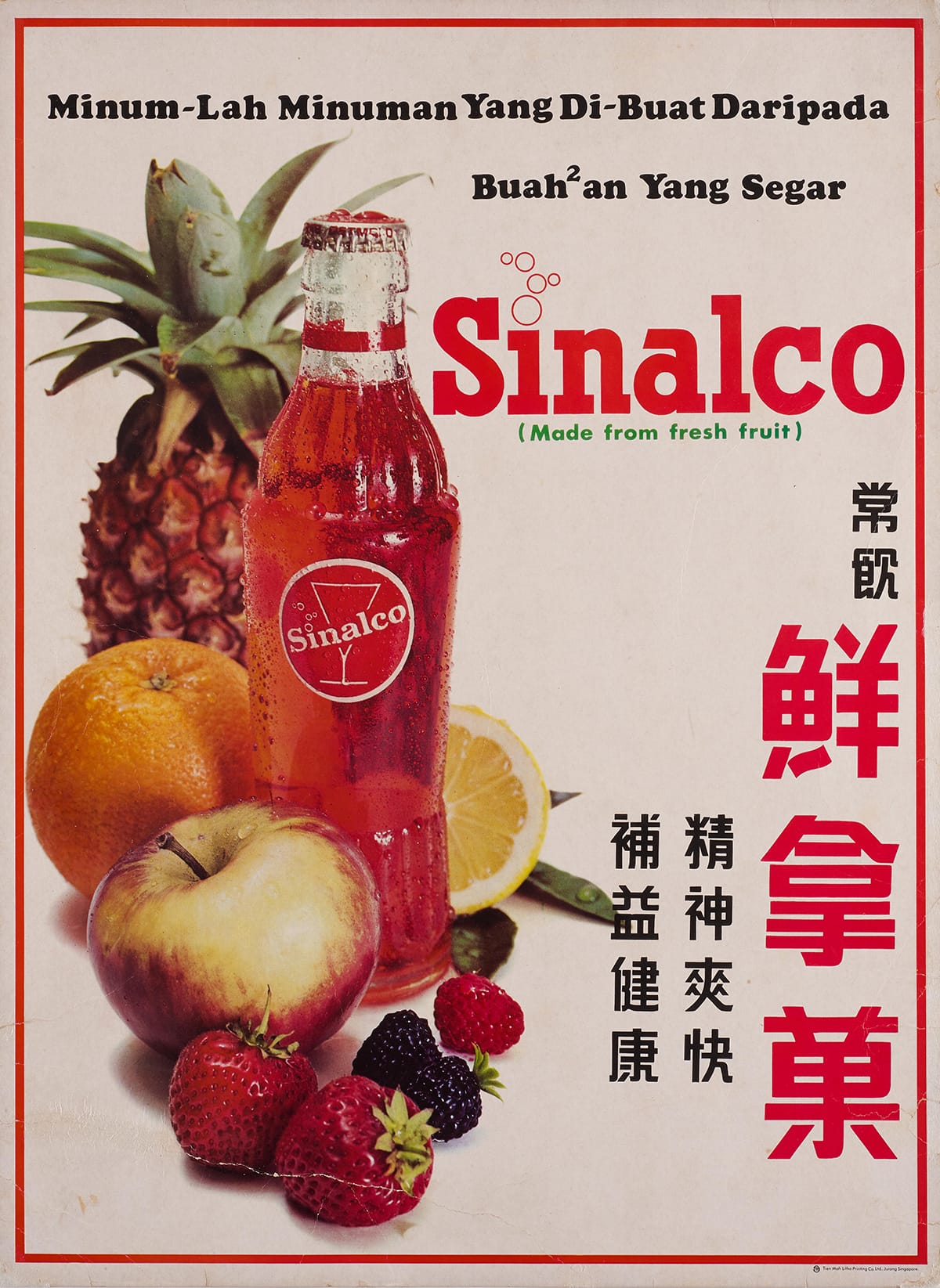
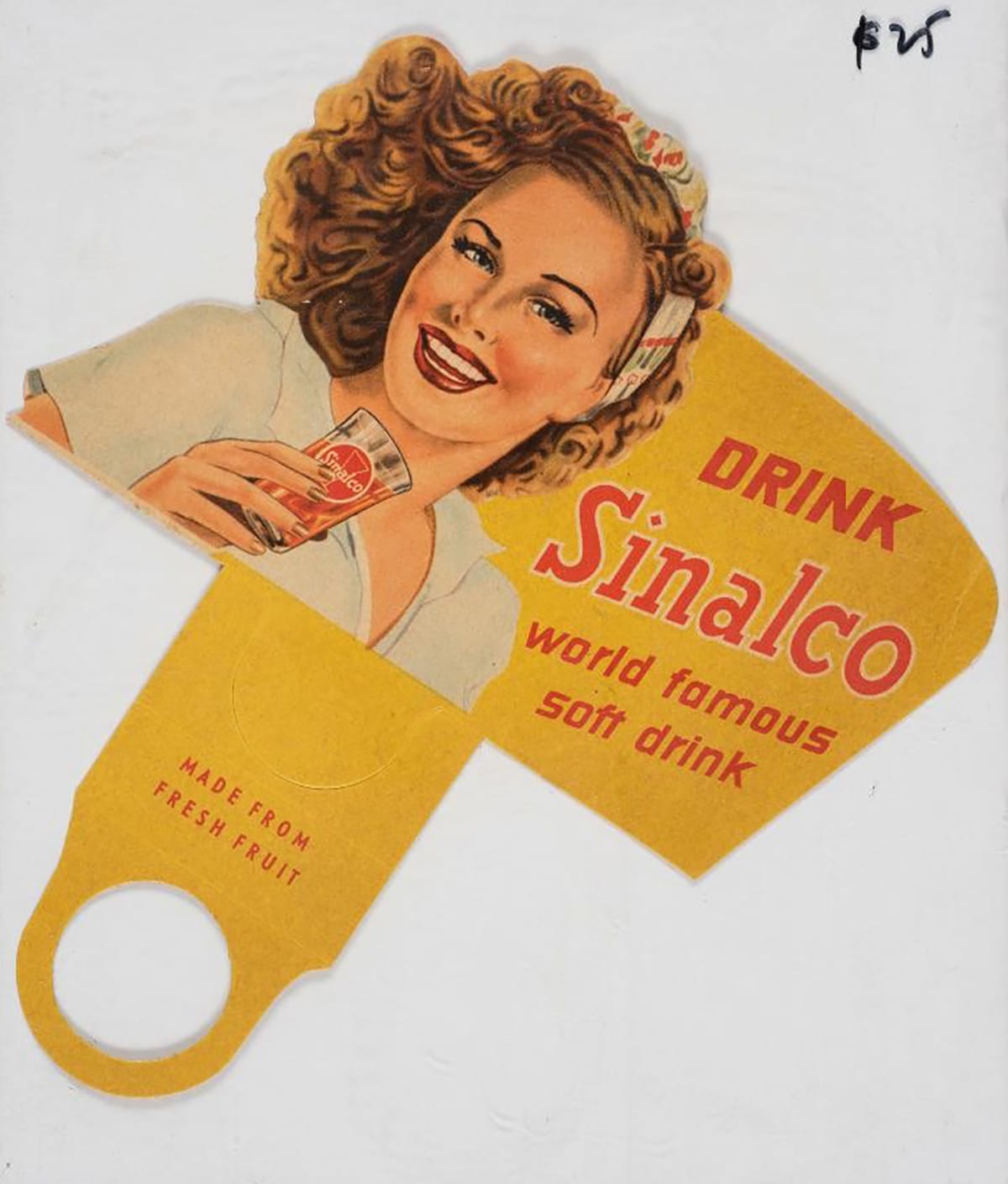
Press reports and advertisements were also used strategically to position the drink. Sinalco’s German and European pedigree, together with its unique taste and aroma, formed a brand image and language that exuded sophistication and taste. Giving out freebies such as glasses inscribed with the Sinalco logo, or supplying free drinks for school events, left more than a palpable impression in the public consciousness.26 In 1959 alone, more than 11.5 million bottles of Sinalco were sold across Singapore, Malaya and Borneo.27
Growing Capability (1960s)
In 1961, the company announced plans to build a new factory in Petaling Jaya, outside Kuala Lumpur, to better serve the Malayan market. To fit out the new factory, Ching Kwong Yew, managing director, and Yap Neng Juan, a director, visited West Germany, Japan, the United Kingdom and the United States to acquire insights into the latest know-how and technology in soft drink production.28
Built at a cost of $350,000 and equipped with fully automated machinery procured from the United States amounting to more than $200,000, the new factory’s initial production level was rated at 400 dozen bottles per hour. Employing 40 workers initially, the plant was opened in July 1964 by Lim Swee Aun, Malaysian Minister for Commerce and Industry. This added production capacity was needed urgently. Malaysians reportedly consumed 1.3 million bottles of Sinalco in 1963 alone.29
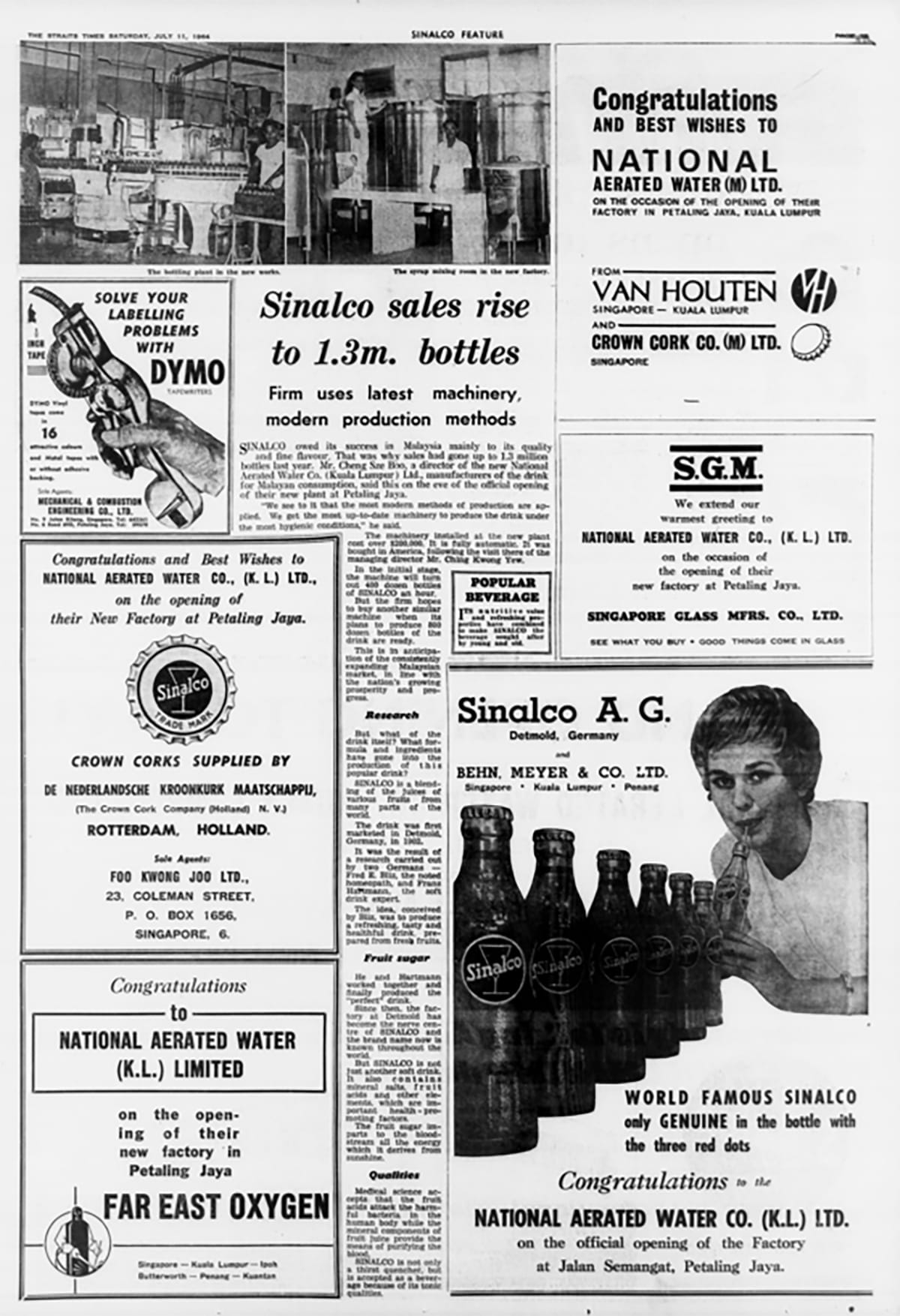
A special feature on the new factory of the National Aerated Water Company in Petaling Jaya, Malaysia, which opened in July 1964. Source: The Straits Times, 11 July 1964, 3 © SPH Media Limited. Permission required for reproduction.
In 1972, the company began producing Royal Crown Cola under franchise from Royal Crown Cola Co. International, then the third largest American soft drink producer. With this, the company hoped to secure up to 10 percent of the cola market in Singapore, which was estimated at nine million cases a year. In anticipation, the company sank $2 million into new machinery that could bottle up to 500 bottles a minute, or 27,000 bottles an hour. It also revealed plans for further plant expansions: a new factory in Singapore and in Johor Bahru.30
Fizzling Out (1970s–1990s)
For all its plans, the 1970s were challenging and troubled times for the company despite its market share and reach. The 1973 global oil crisis affected Singapore badly, leading to rising fuel costs and inflation, which peaked at 22.37 percent in 1977.31 Consequently, all soft drink makers in Singapore had to grapple with a wave of price increases between 1973 and 1977, which ate into their profitability.32
1976 proved to be particularly difficult. In October, a fire broke out at its factory caused by an errantly discarded cigarette butt, resulting in $10,000 worth of damages.33 The company also saw its market share shrink considerably when it lost its Sinalco distribution rights – which it had held for 30 years – in Sabah, Sarawak and Brunei. To add to its woes, its Malaysian subsidiary, National Aerated Water Co. (Kuala Lumpur), was the subject of a winding up petition in the Malaysian High Court in 1977.34
The company’s troubles extended into the legal sphere. In July 1976, the Industrial Arbitration Court ordered the company to provide its workers with uniforms and benefits. Subsequently, in 1979, the company was embroiled in an industrial dispute over the dismissal of six employees. The Industrial Arbitration Court eventually ruled that they had been unfairly dismissed due to their trade union ties. The company complied with the court ruling and reinstated the workers.35
By the 1980s, its most popular product was no longer Sinalco but Kickapoo Joy Juice, a lemon-flavoured concoction. The 1985 recession in Singapore also caused it to scale back production, resulting in a further loss of market share to other soft drinks.36 Its most prominent products – Sinalco, Kickapoo and RC Cola – were eclipsed by Coca Cola, Pepsi, Sprite and 7-Up, which were bottled by market leaders F&N and Yeo Hiap Seng.
In comparison, the National Aerated Water Company’s signature products were neither prominently marketed nor visible. Their marketing playbook, written for the era before television and supermarkets, was out of step with the times. What were once considered cool products now looked like staid relics and holdovers from Singapore’s early industrial past.
In 1999, the Monarch Beverage Company, the American licensor of Kickapoo Joy Juice, initiated a decisive legal action against the National Aerated Water Company for breach of contract and trademark infringement. The conflict began after the company started manufacturing a beverage branded as Kick for a third party. This prompted Monarch to cancel their franchise agreement. Despite this, the company refused to stop producing Kick so in response, Monarch filed a suit that was ultimately upheld by both the High Court and the Court of Appeal. The fallout hit quickly. The company wound up its factory operations in the same year, and its iconic Sinalco and Kickapoo drinks were no more.37 (Kickapoo subsequently returned to the Singapore market some years later, brought in by a different company.) Its once-modern factory building became neglected, marring the landscape along Upper Serangoon Road.
The Fizz Lives On
After being in a state of disrepair and disuse for several years, the building and freehold site were eventually sold for $47 million to Malaysian-listed property developers Selangor Dredging Berhad in 2016.38 The following year, the Urban Redevelopment Authority gazetted it for conservation – with full support from the developer – given its “heritage value, its role as a landmark in the area and the social memories it holds for the community”.39
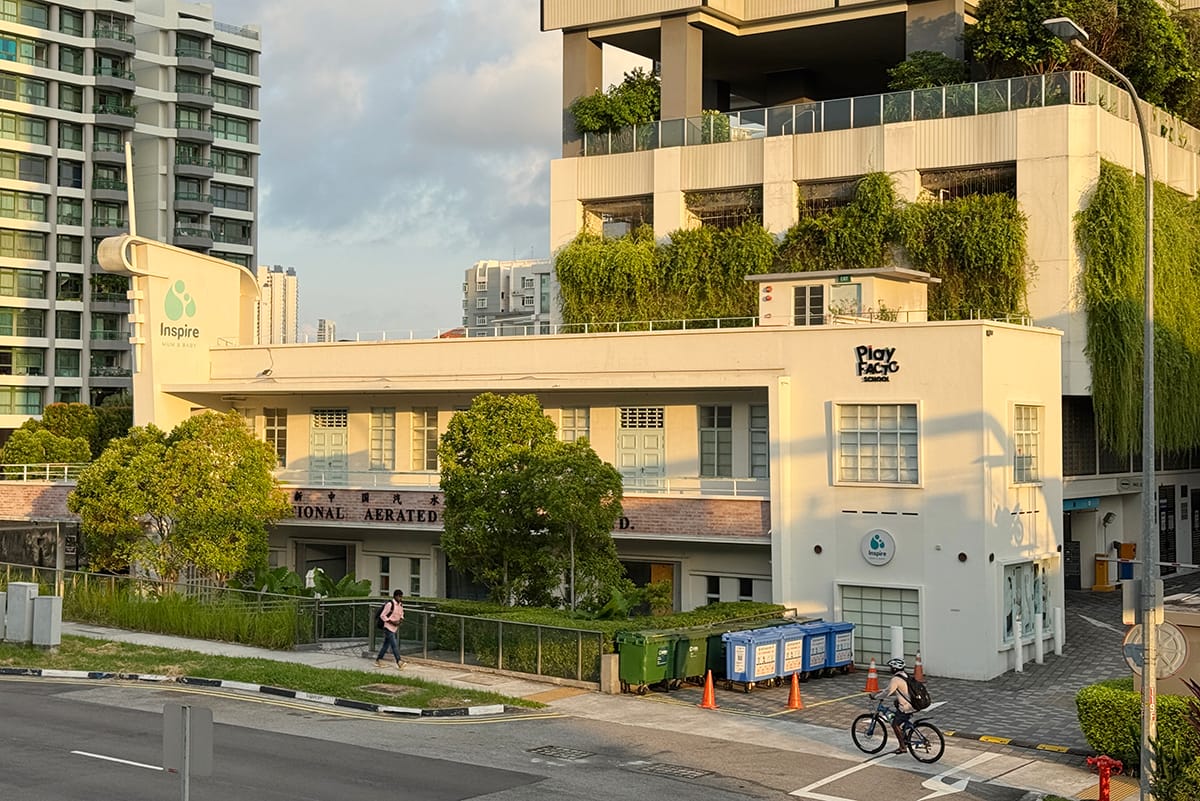
The former National Aerated Water Company factory on Serangoon Road, 2026. Photo by Jimmy Yap.
Today, the former factory building is integrated into Jui Residences condominium – its ground floor is approved for restaurant use and its second floor designated for office use. To those old enough to remember, it is a reminder that a pok jui was once so much more than just a fizzy thirst quencher. And for future generations, the building will remain a tangible reminder of a time when the fizz of a Sinalco soft drink was the flavour of economic and technological progress in Singapore’s industrial history.
About the Author
Alvin Tan is an independent researcher and writer focusing on Singapore history, heritage and society, and a regular contributor to BiblioAsia. He is the author of Singapore: A Very Short History – From Temasek to Tomorrow (Talisman Publishing, 2nd edition, 2022) and the editor of Singapore at Random: Magic, Myths and Milestones (Talisman Publishing, 2021).
Endnotes
1 “Page 1 Advertisements Column 3 (opens in new tab),” Singapore Chronicle and the Commercial Register, 8 November 1832, 1. (From NewspaperSG)
2 “Our Heritage,” F&N, accessed 13 July 2026, https://www.fnnfoods.com/our-history/ (opens in new tab).
3 “Our Aerated Water Trade (opens in new tab),” Singapore Free Press and Mercantile Advertiser, 2 January 1932, 23; “Framroz Golden Jubilee (opens in new tab),” Indian Daily Mail, 10 January 1954, 4; “Phoenix Party (opens in new tab),” Malaya Tribune, 2 July 1950, 3. (From NewspaperSG); “Our History,” Amoy Canning, accessed 13 July 2026, https://www.amoycanning.com.my/oc-history.htm (opens in new tab); “Our Milestones,” Yeo’s, accessed 14 July 2026, https://yeos.com.my/our-milestones/ (opens in new tab).
4 “Advertisement Card of Amoy Canning Corporation,” Roots, 1960s, https://www.roots.gov.sg/collection-landing/listing/1046784 (opens in new tab); “Page 3 Advertisements Column 1 (opens in new tab),” Singapore Free Press and Mercantile Advertiser, 28 April 1931, 3. (From NewspaperSG)
5 Gabriel Lee, “Sinalco: Soft Drinks Plant Opens in PJ (opens in new tab),” Straits Times, 11 July 1964, 2. (From NewspaperSG)
6 “Largest Chinese Aerated Water Manufacturers (opens in new tab),” Singapore Standard, 1 August 1950, 4; ““New $500,000 Soft Drinks Factory Opens in Oct (opens in new tab),” Straits Times, 23 July 1954, 12. (From NewspaperSG)
7 “A New Beverage (opens in new tab),” Malaya Tribune, 9 November 1934, 11. (From NewspaperSG)
8 “Page 8 Advertisements Column 3 (opens in new tab),” Malaya Tribune, 2 November 1934, 8; “Page 2 Advertisements Column 1 (opens in new tab),” Malaya Tribune, 29 December 1934, 2. (From NewspaperSG)
9 “‘Xian na guo’ jinri shangshi” “鮮拿菓”今日上市 (opens in new tab) [“Sinalco” is available today], Nanyang Shangbao 南洋商报, 1 August 1952, 4; “Xin zhongguo qishui chang jianzhì xian na guo jinri shangshi” 新中國汽水廠監製 鮮拿菓今日上市 (opens in new tab) [Sinalco produced by the National Aerated Water Company is launched today], Xingzhou Ribao 星洲日报, 1 August 1952, 5. (From NewspaperSG)
10 “A Drink for All (opens in new tab),” Singapore Free Press, 3 June 1960, 10. (From NewspaperSG)
11 “Sinalco Sales Rise to 1.3 m. Bottles (opens in new tab),” Straits Times, 11 July 1964, 13; “Soft Drink Firm to Build New Factory in Federation (opens in new tab),” Singapore Free Press, 11 August 1961, 12. (From NewspaperSG)
12 “‘Sinalco’ Factory for S’pore Planned (opens in new tab),” Sunday Standard, 14 September 1952, 3. (From NewspaperSG)
13 “Largest Chinese Aerated Water Manufacturers (opens in new tab)”; “New $500,000 Soft Drinks Factory Opens in Oct (opens in new tab).”
14 “New $500,000 Soft Drinks Factory Opens in Oct (opens in new tab)”; “Soft Drinks in Big Demand (opens in new tab),” Straits Times, 2 September 1955, 12; “$100,000 Filler for Drink Factory (opens in new tab),” Straits Times, 7 October 1958, 12. (From NewspaperSG)
15 “$100,000 Filler for Drink Factory (opens in new tab)”; “Soft Drink Firm to Build New Factory in Federation (opens in new tab).”
16 “About Former Ford Factory,” Archives Online, last updated 17 June 2026, https://corporate.nas.gov.sg/former-ford-factory/overview/ (opens in new tab); Bryna Singh, “No Cookie-cutter Look for Khong Guan Factory (opens in new tab),” Straits Times, 5 March 2016, 2–3. (From NewspaperSG)
17 Melody Zaccheus, “Old National Aerated Water Co Building in Serangoon Will Be Conserved, Says URA,” Straits Times, 15 December 2017, https://www.straitstimes.com/singapore/old-bottling-factory-in-serangoon-will-be-conserved-says-ura (opens in new tab).
18 “A New Soft Drink (opens in new tab),” Singapore Standard, 24 January 1953, 8; “Free Soft Drinks for Everyone at This Trade Fair Stall (opens in new tab),” Singapore Free Press, 22 August 1958, 12. (From NewspaperSG)
19 Joy Jones, “Suggestions for Chinese New Year Purchases (opens in new tab),” Singapore Standard, 11 February 1953, 7. (From NewspaperSG)
20 “A New Soft Drink (opens in new tab)”; “Free Gifts at Stall (opens in new tab),” Singapore Standard, 15 October 1955, 10. (From NewspaperSG)
21 “Free Soft Drinks for Everyone at This Trade Fair Stall (opens in new tab).”
22 “Xian na guo zhi ye shisan wan juxing” 鮮拿菓之夜 十三晚舉行 (opens in new tab) [Sinalco night held on the 13th], Xingzhou Ribao 星洲日报, 10 September 1958, 15; “Xin zhongguo qishui youxian gongsi juxing xian na guo zhi ye jiang you fengfu zhi gewu jie” 新中國汽水有限公舉行拿菓之夜 將有豐富之歌舞節 (opens in new tab) [National Aerated Water Company Ltd. is hosting Sinalco night featuring a variety of song and dance performances], Xingzhou Ribao 星洲日报, 14 September 1958, 14. (From NewspaperSG)
23 “Xin zhongguo qishui youxian gongsi juxing xian na guo zhi ye paiyan geju ji juxíng choujiang” 新中國汽水有限公司 舉行鮮拿菓之夜 排演歌劇及舉行抽獎 (opens in new tab) [National Aerated Water Company held a Sinalco night featuring opera performances and a lucky draw], Xingzhou Ribao 星洲日报, 16 September 1958, 13; “Xian na guo zhi ye xingyun jiang jiexiao” 鮮拿菓之夜幸運獎揭曉 (opens in new tab) [Sinalco night lucky draw winners announced], Nanyang Shangbao 南洋商报,
16 September 1958, 8. (From NewspaperSG)
24 “Xian na guo qishui qiwei fenfang xiao re zhi ke” 鮮拿菓汽水 氣味芬芳消熱止渴 (opens in new tab) [Sinalco has a fragrant aroma and can quench thirst and relieve heat], Xingzhou Ribao 星洲日报, 12 October 1958, 12; “Sinalco Lucky Numbers (opens in new tab),” Singapore Standard, 12 March 1959, 7. (From NewspaperSG)
25 “Xin zhongguo qishuǐichang chupin xian na guo qishui, liu yue yi ri qi yilian san tian jia da shijie zhanlan hui juxing yimai, quanshu zeng gei zhong ba lu huozai zaimin, tu wei gi chang tanwei canguan” 新中國汽水廠出品「鮮拿菓」汽水,六月 一日起一連三天假大世覽會舉行義賣,全 數贈給中峇魯火災災民,圖為該廠攤位參觀 (opens in new tab) [National Aerated Water Company’s “Sinalco” soft drink will be sold at the Great World Exhibition for three days starting June 1st, with all proceeds donated to victims of the Tiong Bahru fire. The photo shows visitors to the factory’s booth], Xing Zhou Ri Bao 星洲日报, 3 June 1961, 18. (From NewspaperSG)
26 “Gou xian na guo huo zeng boli bei” 購鮮拿菓獲贈玻璃杯 (opens in new tab) [Buy Sinalco and get a free glass], Nanyang Shangbao 南洋商报, 17 January 1959, 8; “Nanhua nǚ zhong xinsheng jiexiao” 南華女中新生揭曉 (opens in new tab) [Nanhua Girls’ High School new students announced], Nanyang Shangbao 南洋商报, 15 December 1959, 7. (From NewspaperSG)
27 “A Drink for All (opens in new tab).”
28 “Soft Drink Firm to Build New Factory in Federation (opens in new tab)”; “World Tour to Buy Soft Drink Plant World (opens in new tab),” Straits Times, 29 June 1962, 12. (From NewspaperSG)
29 Lee, “Sinalco: Soft Drinks Plant Opens in PJ (opens in new tab)”; “Sinalco Sales Rise to 1.3 m. Bottles (opens in new tab).”
30 “Page 28 Advertisements Column 2: Another Choice for Cola Fanciers (opens in new tab),” Straits Times, 20 October 1972, 28; “Page 6 Advertisements Column 1 (opens in new tab),” Straits Times, 13 October 1972, 6; “Move to Expand Bottling Factory in Singapore (opens in new tab),” Eastern Sun, 26 October 1968, 9. (From NewspaperSG)
31 “Inflation, Consumer Prices (Annual %) – Singapore,” World Bank Group, accessed 26 May 2026, https://data.worldbank.org/indicator/FP.CPI.TOTL.ZG?locations=SG (opens in new tab).
32 “Soft Drinks to Go Up by 5 Cents a Bottle Today (opens in new tab),” Straits Times, 10 February 1973, 8; Douglas Chan and Teresa Ooi, “Dearer Soft Drinks (opens in new tab),” New Nation, 5 November 1974, 1; Ngiam Tong Hai, “Soft Drinks Prices to Go Up Again (opens in new tab),” Straits Times, 16 September 1977, 1; Ngiam Tong Hai, “Confirmed: Soft Drinks Up 5c (opens in new tab),” Straits Times, 26 February 1979, 1. (From NewspaperSG)
33 “Xin zhongguo qishui zhanfang shihuo fenhui shu wan xin kong ping sunshi guji yue wan yuan” 新中國汽水棧房失火焚毀数万新空瓶损失估计约万元 (opens in new tab) [A fire at the National Aerated Water Company destroyed tens of thousands of empty new bottles, with losses estimated at $10,000], Nanyang Shangbao 南洋商报, 15 October 1976, 33. (From NewspaperSG)
34 “Bottling and Distributing (opens in new tab),” Business Times, 25 September 1979, 2; “Page 24 Advertisements Column 5 (opens in new tab),” Straits Times, 2 June 1977, 24. (From NewspaperSG)
35 “Firm Ordered to Provide Uniforms and Benefits (opens in new tab),” Straits Times, 14 July 1976, 8; “Firm Is Ordered: Take Back 6 Workers (opens in new tab),” Straits Times, 10 March 1979, 11. (From NewspaperSG)
36 “Thirsty Singaporeans (opens in new tab),” Weekend East, 15 April 1988, 12; Goh Yee Ling “Recession Hits Demands for Soft Drinks (opens in new tab),” Business Times, 4 June 1986, 3. (From NewspaperSG)
37 Gracie Lee, “National Aerated Water Company (opens in new tab),” in Singapore Infopedia. National Library Board Singapore. Article published 28 September 2015.
38 Melody Zaccheus “Old Bottling Factory May Be Conserved, Says URA (opens in new tab),” Straits Times, 16 December 2016, 3. (From NewspaperSG)
39 Zaccheus, “Old National Aerated Water Co Building in Serangoon Will Be Conserved, Says URA.”