
Article
Interpreting the Turk: Everyday Encounters and Urban Memory in Colonial Singapore
Topics
Culture
History
29 July 2026
During the 19th and 20th centuries, Turkish imagery appeared in a variety of popular media in Singapore, reflecting the fascination with the Ottoman Empire and the Turkish world, as well as the island’s status as a cosmopolitan port city.
By Dr Bahar Gürsel
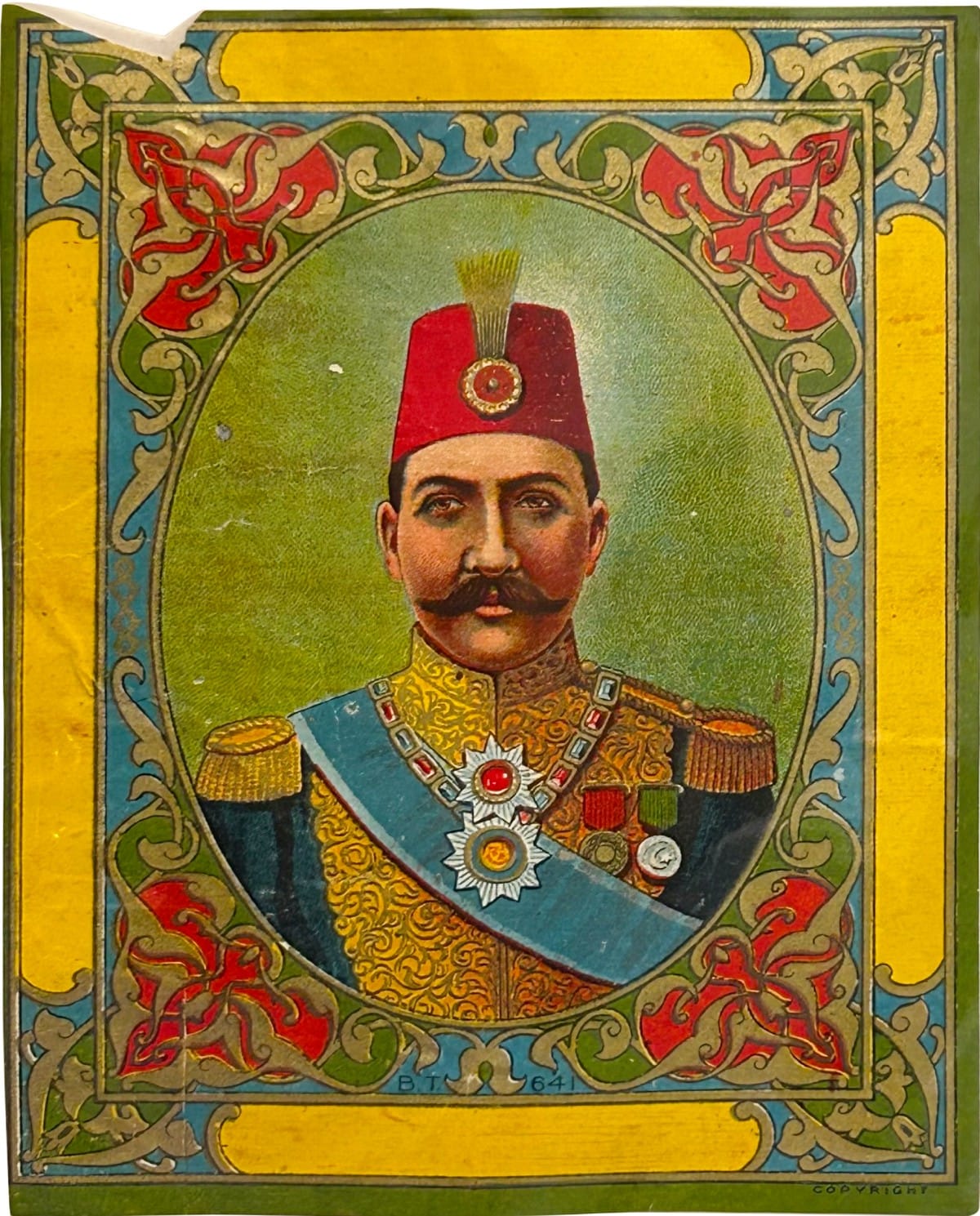
A shipper’s ticket bearing the motif of an Ottoman ruler. Collection of the National Library Singapore (Accession no. B35800823G). Acquired with the support of the Tun Tan Cheng Lock Trust.
In 19th-century Singapore, the Ottoman Empire was an alluring and exotic presence in the public imagination, even if it was rarely encountered in person. For the local Muslim community, awareness of the Turkish people was reinforced by prominent Arab merchant families such as the Aljunieds and the Alsagoffs. The former served as honorary representatives of the Ottoman Empire, while the latter acted as important intermediaries linking Singapore to Istanbul. Yet despite these connections, the Empire itself remained a distant and largely unseen entity merely known by locals through news reports, religious networks, correspondence, literary works and the accounts of travellers.
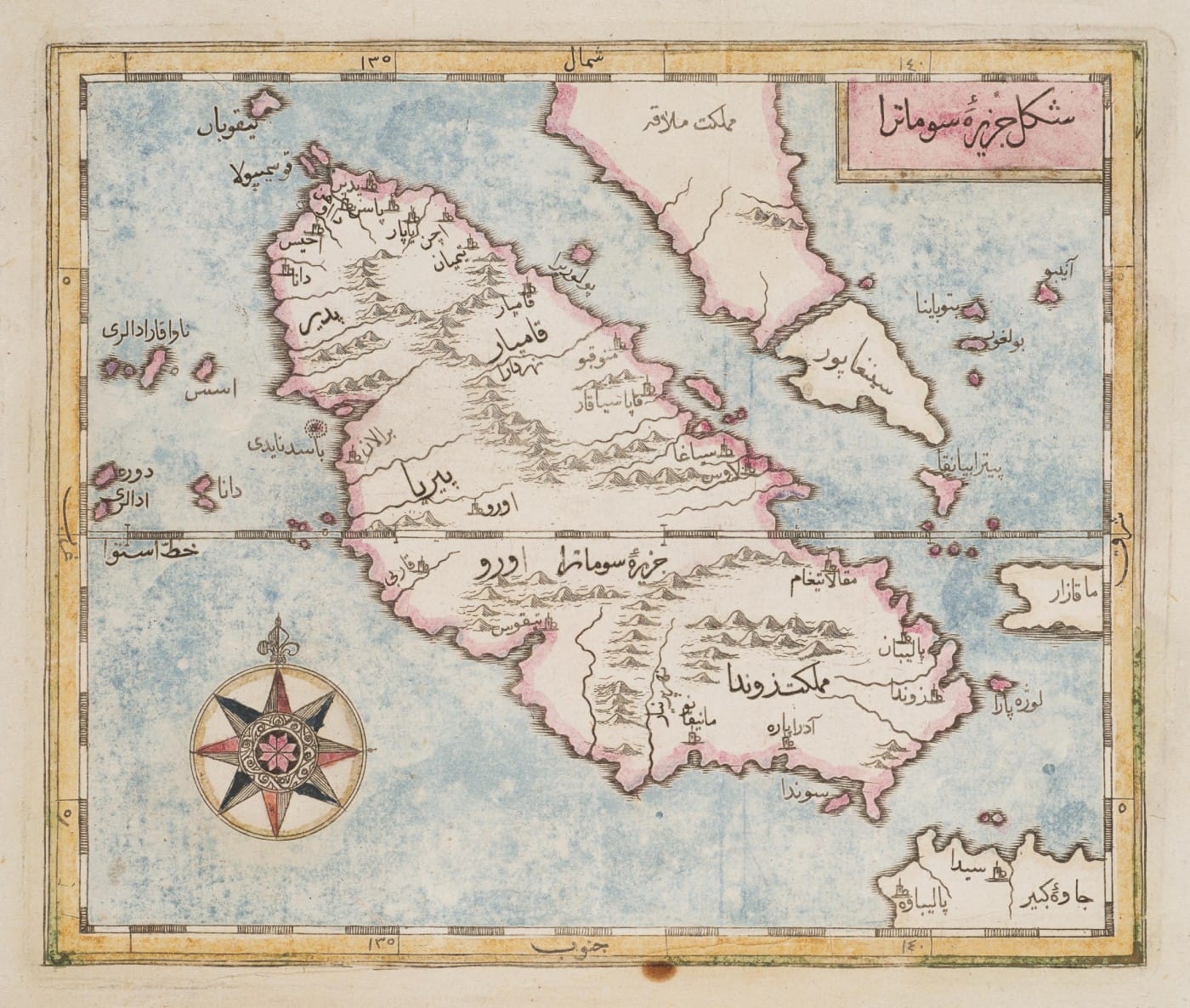
This map is from an Ottoman geographical work published in Istanbul in 1732. It depicts Singapore, Melaka and Indonesia. Collection of the National Museum of Singapore, National Heritage Board.
This enduring sense of connection would continue into the early 20th century when Ahmed Ataullah Efendi arrived in Singapore in 1901 as the Ottoman Empire’s first resident consul. Yet, the true turning point in how ordinary residents perceived the Ottomans had been a decade earlier when a physical piece of the Empire finally sailed into their waters with its crew. For the first time, Singapore encountered not merely the occasional Ottoman merchant or traveller, but an official and significant representation of the Empire itself.
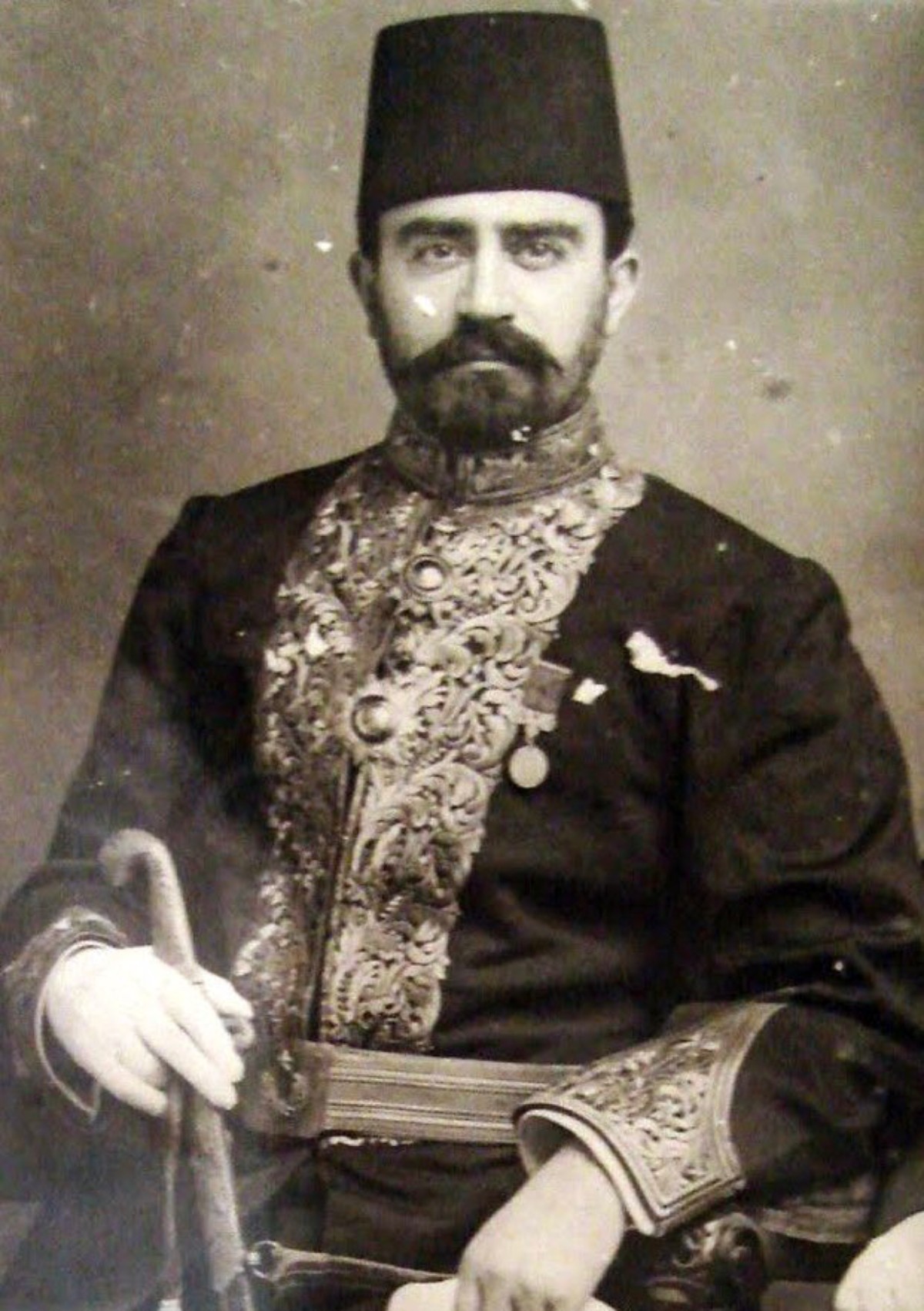
Ahmed Ataullah Efendi, the first Ottoman Consul General to Singapore, took office in 1901. Courtesy of the Embassy of the Republic of Türkiye in Singapore.
The Ottoman Warship that Fascinated Singapore
In June 1889, the Ottoman frigate Ertuğrul, named after Ertuğrul Gazi, the father of the empire’s founder – a name symbolising honesty and bravery – departed Istanbul on a historic goodwill mission to Japan. Commanded by Captain Osman Pasha (who was promoted to rear admiral during his stay in Singapore), the vessel carried a prestigious diplomatic charge: to present an imperial order to the Emperor of Japan on behalf of Sultan Abdülhamid II (r. 1876–1909).
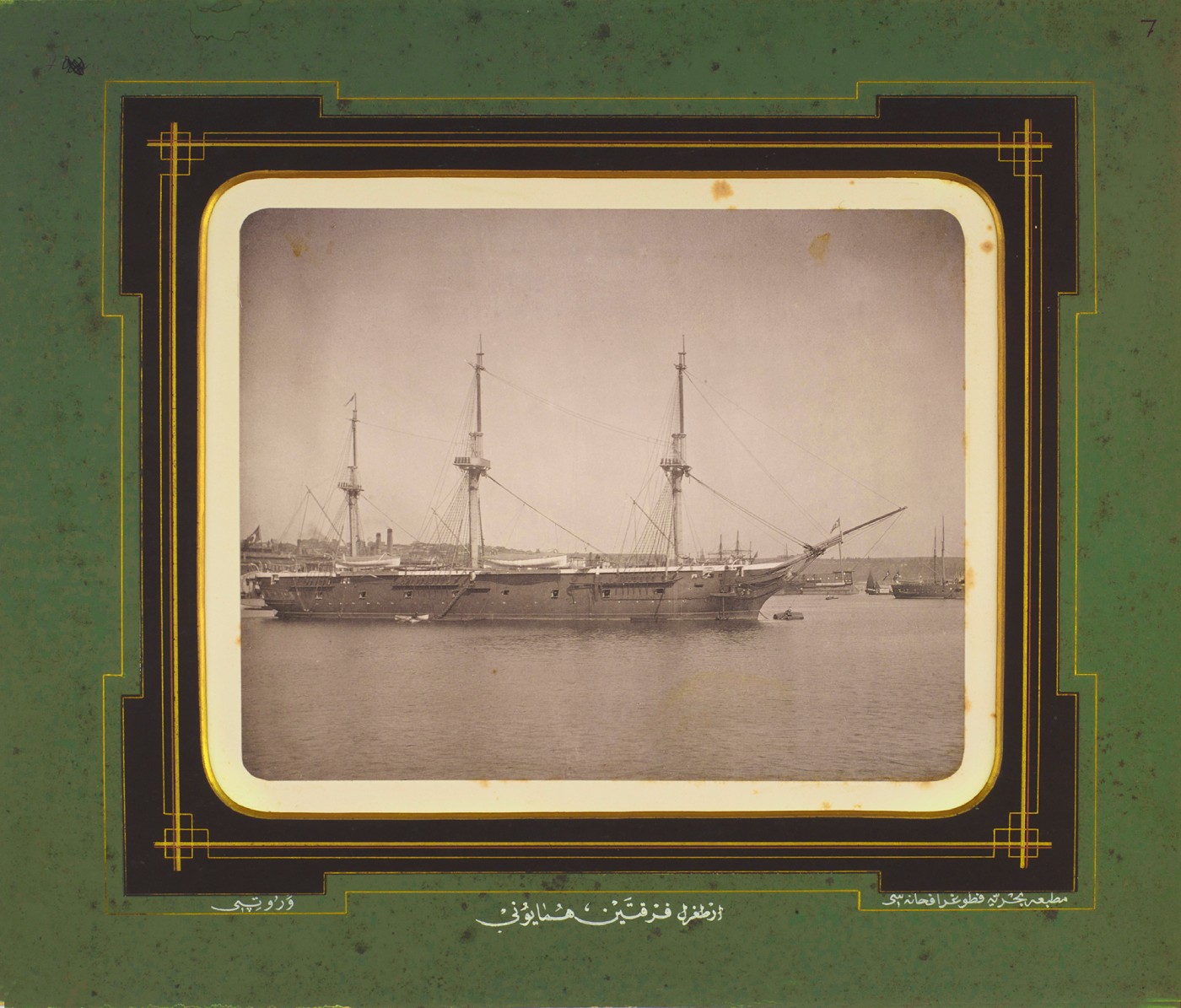
The imperial Ottoman frigate Ertuğrul. Courtesy of Istanbul University Rare Books Library, Sultan Abdülhamid II Photograph Albums (Accession no. NEKYA91242/7).
Although the outward journey successfully fulfilled its purpose, tragedy struck on the return voyage. In September 1890, the Ertuğrul was caught in a fierce typhoon off the coast of Wakayama, Japan, striking a reef and sinking into the Pacific. The disaster claimed the lives of more than 500 sailors, including the captain, leaving just 69 survivors.
While history largely remembers the Ertuğrul for its tragic end, the long voyage also wove a lesser-known connection with Singapore. In November 1889, after departing Colombo, Ceylon (present-day Sri Lanka), the Ertuğrul cast anchor two miles from the bustling Johnston’s Pier, marking the beginning of a remarkable visit. At the time, Johnston’s Pier was the beating heart of Singapore’s waterfront. Extending out from Collyer Quay, the pier acted as the main gateway to the city, serving as a lively gathering place where international merchants, visiting officials and ordinary travellers first set foot on land.
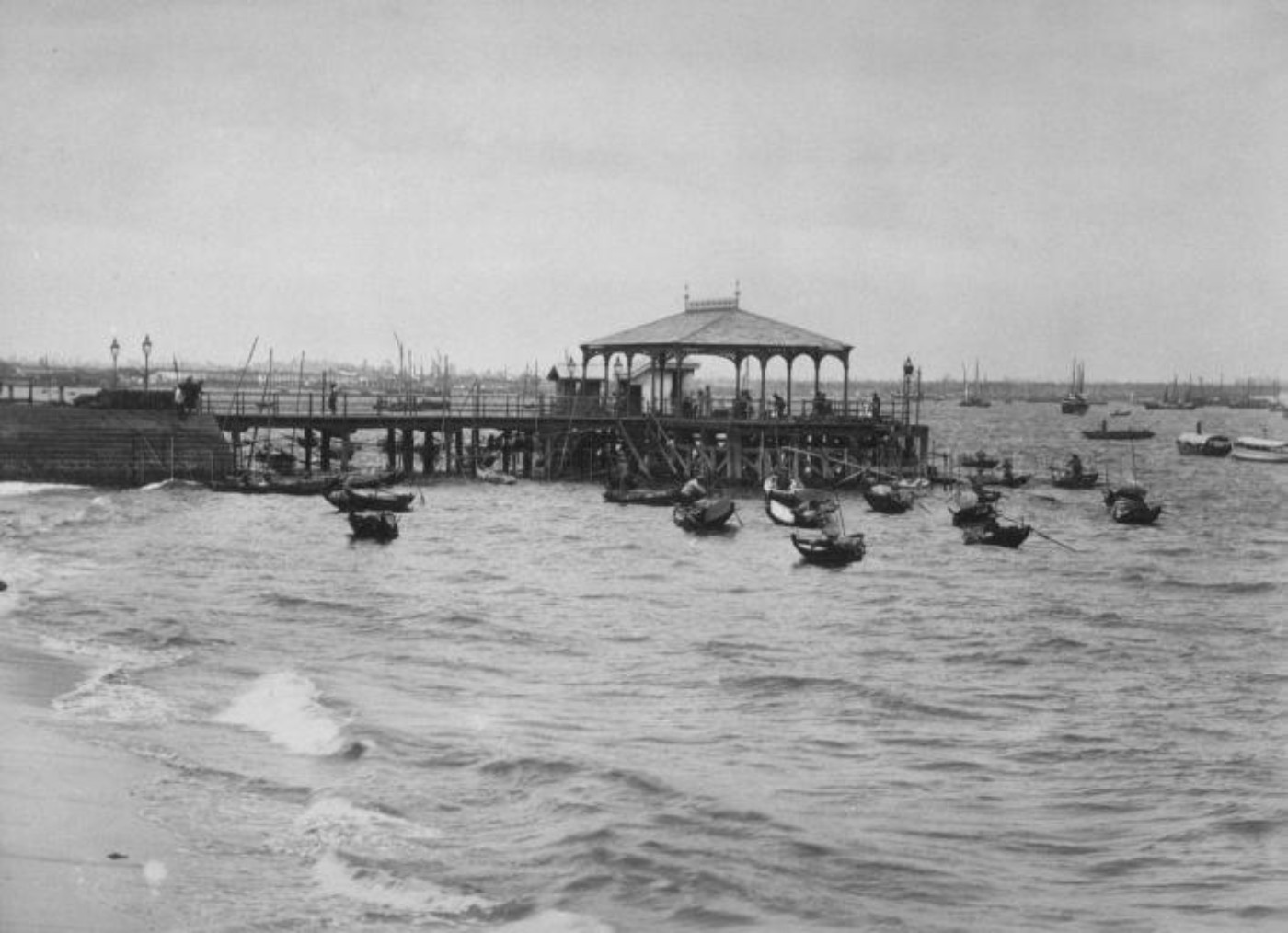
Johnston’s Pier, Singapore, where the frigate Ertuğrul docked, 1880s. Royal Tropical Institute Collection, courtesy of National Archives of Singapore (Media-Image No. 20060000347 - 0104).
The Ottoman frigate was neither the largest nor the most imposing vessel in this busy port. Yet for Singapore’s Muslim community, it held a significance that far exceeded its size – offering a tangible connection to a world they had previously known only through reports, newspapers, and their own imaginations fed by numerous tales and accounts. All of a sudden, the faraway and venerated Ottoman Empire had arrived on their shore.
During the five months that the ship remained in port, until 15 March 1890, the abstract geography of empires became immediate and perceptible. Upon its arrival, anchored two miles off Johnston’s Pier, the 24-year-old, 1,800-ton vessel was described by the local press as a “wooden ship of somewhat antiquated style”. It carried 590 men over the age of 20, including 20 officers, 15 cadets, 60 firemen, 24 marines and a 24-piece military band. For Singapore’s Muslim residents, the arrival of a warship crewed by fellow Muslims was a deeply emotional event. “[L]arge throngs of Malays have been continually crowding on and around Johnston’s Pier, off which the vessel is lying, expressing their admiration and pleasure at beholding a war-ship of the great Caliph,” reported the Straits Times.1
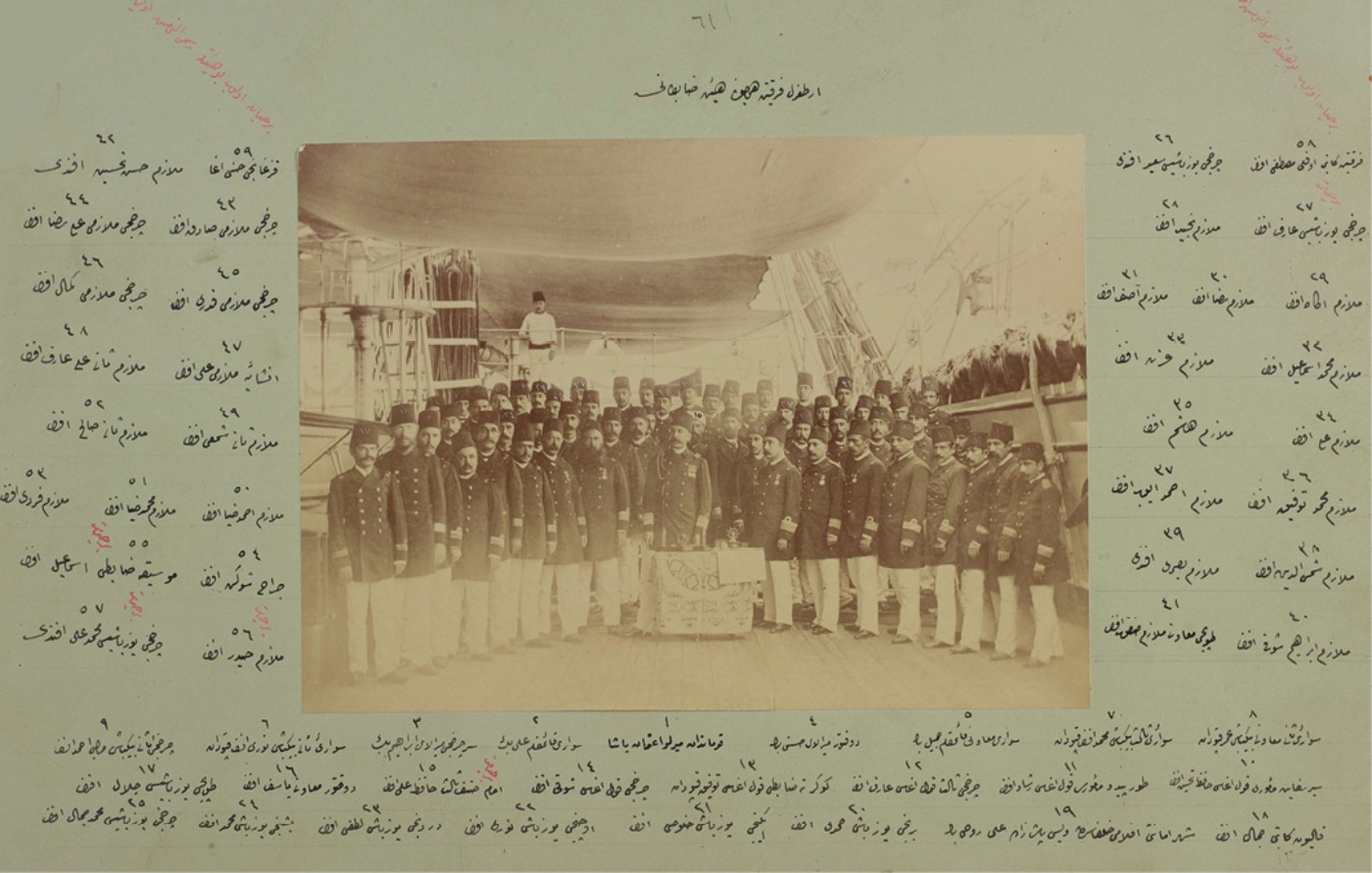
The officer corps of the imperial Ottoman frigate Ertuğrul in Japan. Courtesy of Istanbul University Rare Books Library, Sultan Abdülhamid II Photograph Albums (Accession no. NEKYA91222/61).
The crew also encountered numerous expressions of profound affection. According to the memoirs of Engineer Captain Mehmed Ali Bey, one of the few sailors who survived the disaster, local Muslims regularly visited the ship to offer gifts and extend their hospitality.2
The community was thrown into a state of “feverish excitement”. The vessel’s reputation grew rapidly, with claims circulating around the port that it could “vanquish all comers”. When Ottoman officers walked the streets, they were “looked upon as demi-gods” and “followed about by a horde of the faithful”. Eager locals constantly sought to “shake or touch the hands of the curious naval warriors”, viewing the simple physical contact as a “special blessing conferred upon them from the founder of the religion”, according to the Straits Times.3 For many residents in Singapore, the distant figure of the Turk had suddenly become a real person encountered amid the hustle and bustle of daily life.
The enthusiasm reached its peak on 22 November 1889 when news that the Ertuğrul’s band would perform at the Esplanade sent a wave of excitement through Singapore. By three o’clock that day, the Singapore Cricket Club’s grounds were already packed with horse-drawn carriages and an excited crowd. The sheer flow of the crowd instantly demolished the makeshift roped barricades before a single note could even be played, and the resulting gridlock was so intense that the police commissioner himself had to step in to direct the chaos.4
When the band finally began to play, nearly two hours later, the roar of the crowd created a “babel which simply drowned the music”, leaving onlookers to guess they were playing chiefly by “the distended cheeks of the bandsmen” and the visual cues of a “fine Ethiopian” musician, wrote the Straits Times. Yet, even without actually hearing the tunes, the enthralled crowd pressed forward in absolute admiration, with “evident satisfaction depicted upon their open-mouthed countenances”.5
While some of these newspaper reports have been recently translated and utilised in various Turkish sources – highlighting a continuing interest in the Ertuğrul’s Southeast Asian sojourn – a deeper study into the archival materials unveils previously overlooked details regarding the ship’s cultural imprint.
The concert on the Esplanade was only one encounter, and the frenzy easily crossed the strait into Johor. Although Captain Osman Pasha could not bring the warship to Johor without special permission from his superiors after receiving an invitation, he accepted a personal invitation to visit Johor in late November 1889. The Straits Times reported that he “came round in Syed Mahomed’s [Alsagoff] s.s. Lingie, accompanied by the reporter who [was] making the voyage with the ship for the purpose of writing a journal”. The paper also observed “some little excitement amongst the Mahomedan population, who crowded on the pier to see the Turkish Captain land, and a large crowd awaited his departure”. Dressed in the distinguished uniform of a naval aide-de-camp to the Ottoman sultan, Osman Pasha was hosted at a special “tiffin” to meet top European and Malay officials, before eventually being given a driving tour of the town and departing on the sultan’s yacht.6
Even after the frigate raised its anchor in March 1890, the cultural imprint of the Ertuğrul lingered. The adoration was so enduring that during a large picnic in Johor a month later, which included 200 Malays, some people were spotted playfully bringing the crew back to life. A correspondent with the Straits Times noted that the person “who represented the Captain had on white shoes and ‘spurs,’ and nearly all were wearing false beards, whiskers and moustaches”, delightedly playing the parts of the “Turkish men-of-war’s men” who had memorably captured their imaginations.7 The distant Ottoman had finally stepped off the pages of books and newspapers, and into the lives of ordinary people.
Visualising the Turk in Shipper’s Tickets
In the late 19th and early 20th centuries, representations of the Turk also entered everyday consumer culture. The glamour and prestige of the Ottoman Empire became a powerful medium in Singapore’s dynamic marketplace, firmly attached to a variety of imported goods. The image of the Turk was a common motif on shipper’s tickets, also known as bale labels and bolt labels, which were “attached to the ends of cotton bolts exported from British mills around the world”.8
According to Adrian Wilson, artist, interior designer and collector of shipper’s tickets,9 these labels were used “on the ‘faceplate’ (front) of fabric pieces... in conjunction with water soluble ink trademarks to identify the brand, type and length of fabric in the piece”. Since these labels were the primary way buyers identified quality cloth, each ticket was meticulously designed specifically for its target market to attract the attention of the purchaser. “Colour coding and recognisable symbols” were of particular importance, and “the florid and often exuberant and exaggerated designs [were] frequently responsible for the sale of the fabrics”, especially in Asian bazaars.10
By placing Turkish imagery on these bolts, British mills were intentionally appealing to the deep-rooted local respect for the Ottoman Empire. As Wilson further observed regarding these merchant strategies, “respecting and celebrating the culture of your customer was obviously good business”.11
Beyond these vibrant textile labels, the Ottoman and Turkish presence in the commercial imagination extended into many other facets of daily life. The residents of Singapore could buy Turkish cigarettes, savour Turkish delight and dried figs, and use famously plush Turkish towels manufactured by British companies.12 These items kept the allure of the Ottoman Empire constantly present on local store shelves and in homes. Yet, within this steady flow of imported charm, one particular local commercial enterprise attracted the attention of both the public and the courts in a more apparent and contentious manner.
Tea, Trademarks and Turkish Imagery
During the 1920s in Singapore, the use of Ottoman and Turkish historical figures on the packaging of various commodities, including tea, became an effective marketing strategy. As symbols of quality, authority and prestige, these distinctive motifs were adopted by merchants to appeal to consumers in the region.
T.G. Kiat and Co. and Haroon bin Ali and Co., two highly respected trading firms, were prominent players in this branding trend. Their subsequent legal dispute is significant not merely as a commercial dispute, but as a testament to the market value and widespread public visibility of Turkish imagery.
In July 1934, the need to establish clear trademark boundaries regarding these images brought the two companies before the Supreme Court of Singapore and Chief Justice of the Straits Settlements Walter Huggard. The plaintiff, T.G. Kiat and Co., requested a ban against the defendant, Haroon bin Ali and Co., over allegations of trademark violation. At the heart of the dispute was the former’s well-known product, widely recognised among consumers in the Straits Settlements and Malaya as “Raja Stambul” tea or “Tea Stambul”. This popular tea had been sold since 1927, and featured a distinctive red-and-white wrapper with “a picture of a Mohammedan ruler at the top left hand corner” and “a seascape showing a ship, a lighthouse and a locomotive with the words ‘Best and Selected’.”13
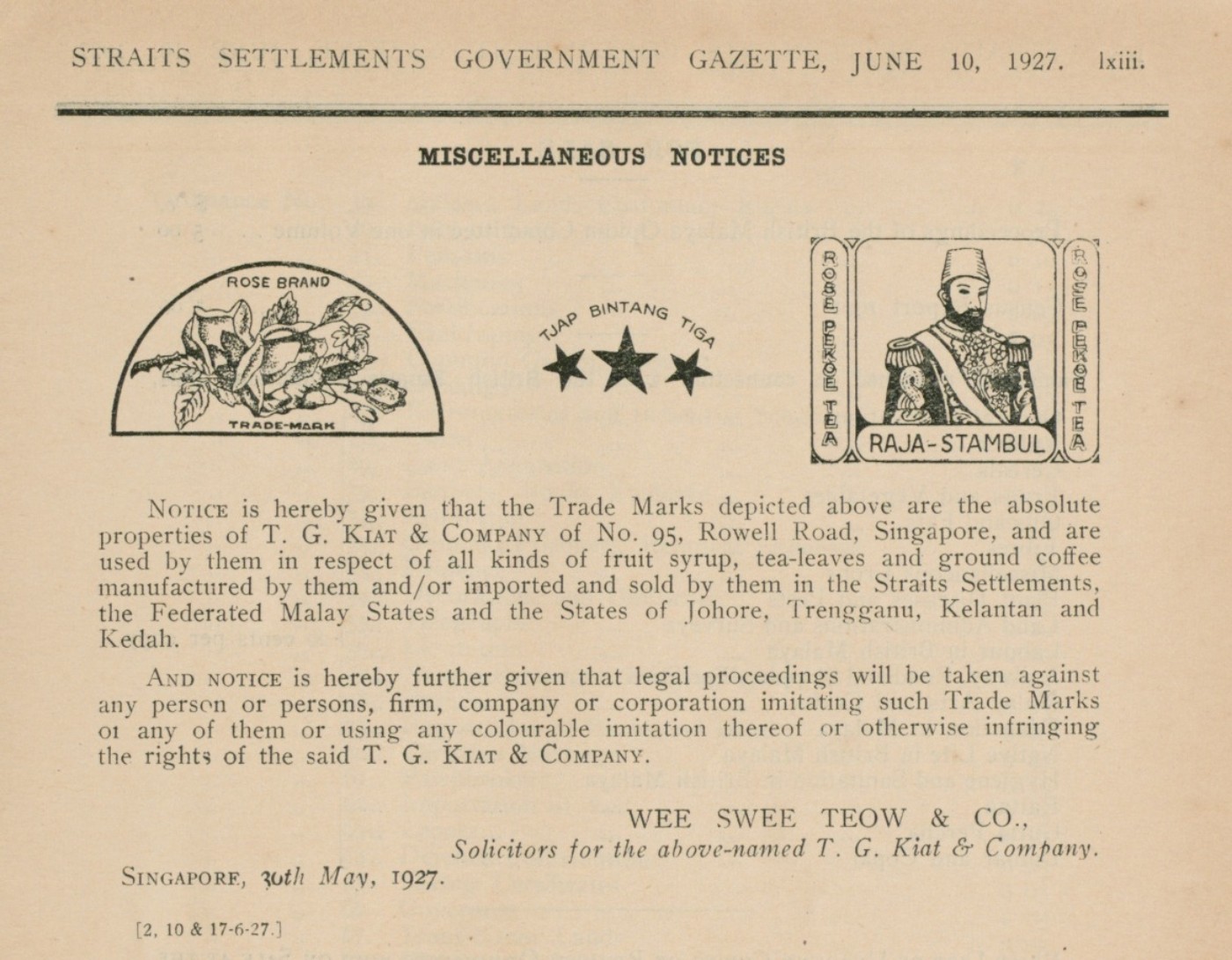
The registered trademark of T.G. Kiat’s Raja Stambul tea (right). Image reproduced from the Straits Settlements Government Gazette 62, no. 35–36 (10 June 1927). Collection of the National Library Singapore (Accession no. B02969106K).
Also printed on the plaintiff’s tea wrapper were the words “Best and Selected”, and beneath the image of “Raja Stambul” and on each side of the packet were the words “Rose Pekoe Tea”.14 The purpose of these images was to emphasise that “both by sea and rail, the tea is distributed all over the world”.15 T.G. Kiat and Co. had originally sold this tea in tins, but in May 1930, the owner Tjoa Guan Kiat “decided that it would be more profitable to sell his tea in packets instead of tins”.16
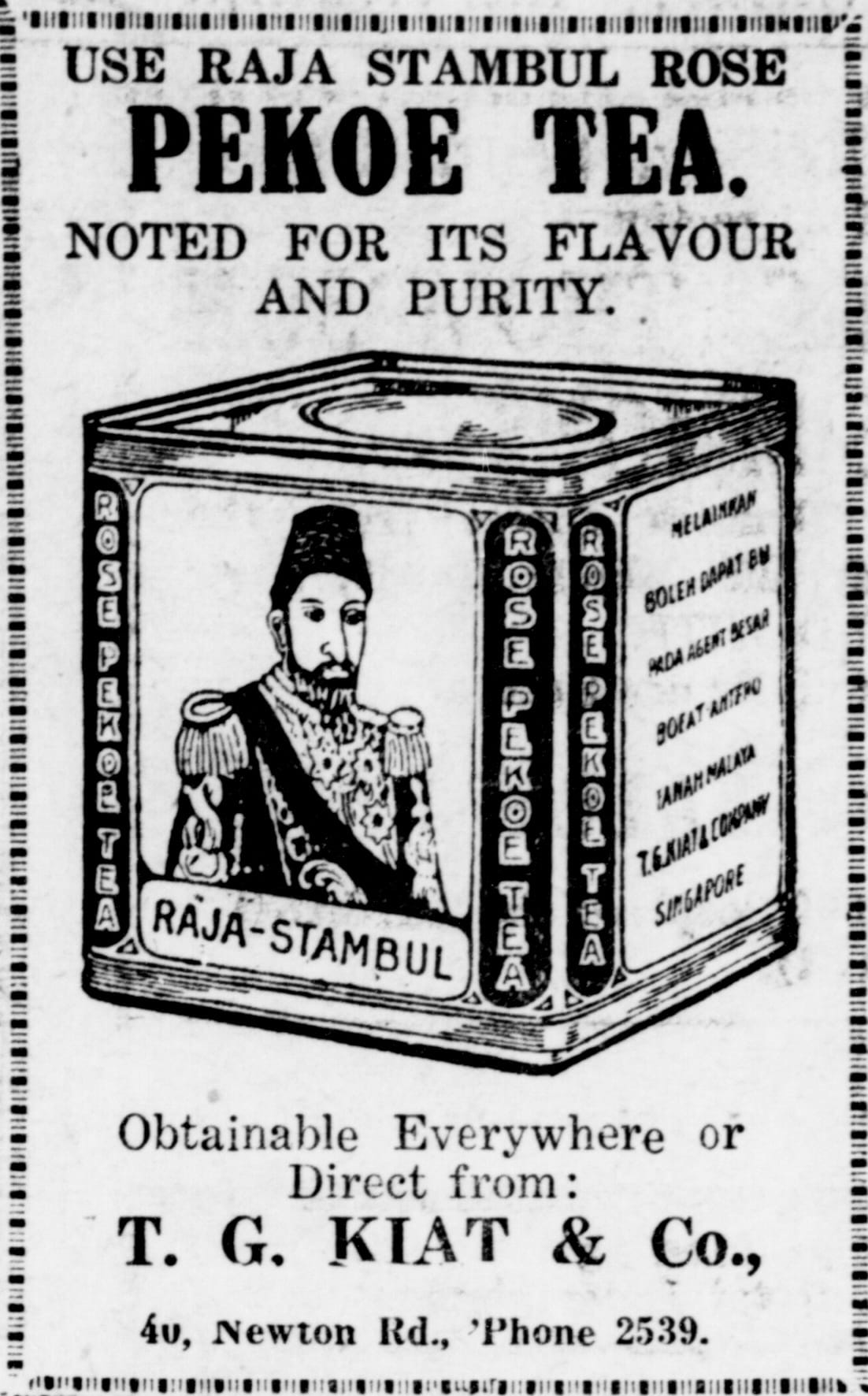
T.G. Kiat & Co.’s advertisement for their Raja Stambul tea bears the image of an Ottoman ruler. Image reproduced from Malaya Tribune, 15 September 1934, 7. (From NewspapeSG).
T.G. Kiat and Co. claimed that the packaging used by Haroon bin Ali and Co. was “almost identical” to his own product and “calculated to deceive intending purchasers and cause the tea to be sold and passed off as tea sold by the plaintiffs”.17
The wrappers of Haroon bin Ali’s rose pekoe tea, which had also been manufactured since 1927, featured portraits of two historical Turkish military figures based on contemporary studio photographs,18 with the court text noting that “the names ‘Anver [sic] Pasha’, and ‘Mustafa Kemal Pasha’ were shown”.19 [Ismail Enver Pasha was the minister for war who played a central role in aligning the Ottoman Empire with Germany during World War I, while Mustafa Kemal Atatürk founded the Republic of Türkiye in 1923. “Pasha” was a high-ranking administrative and military title in the Ottoman Empire.]
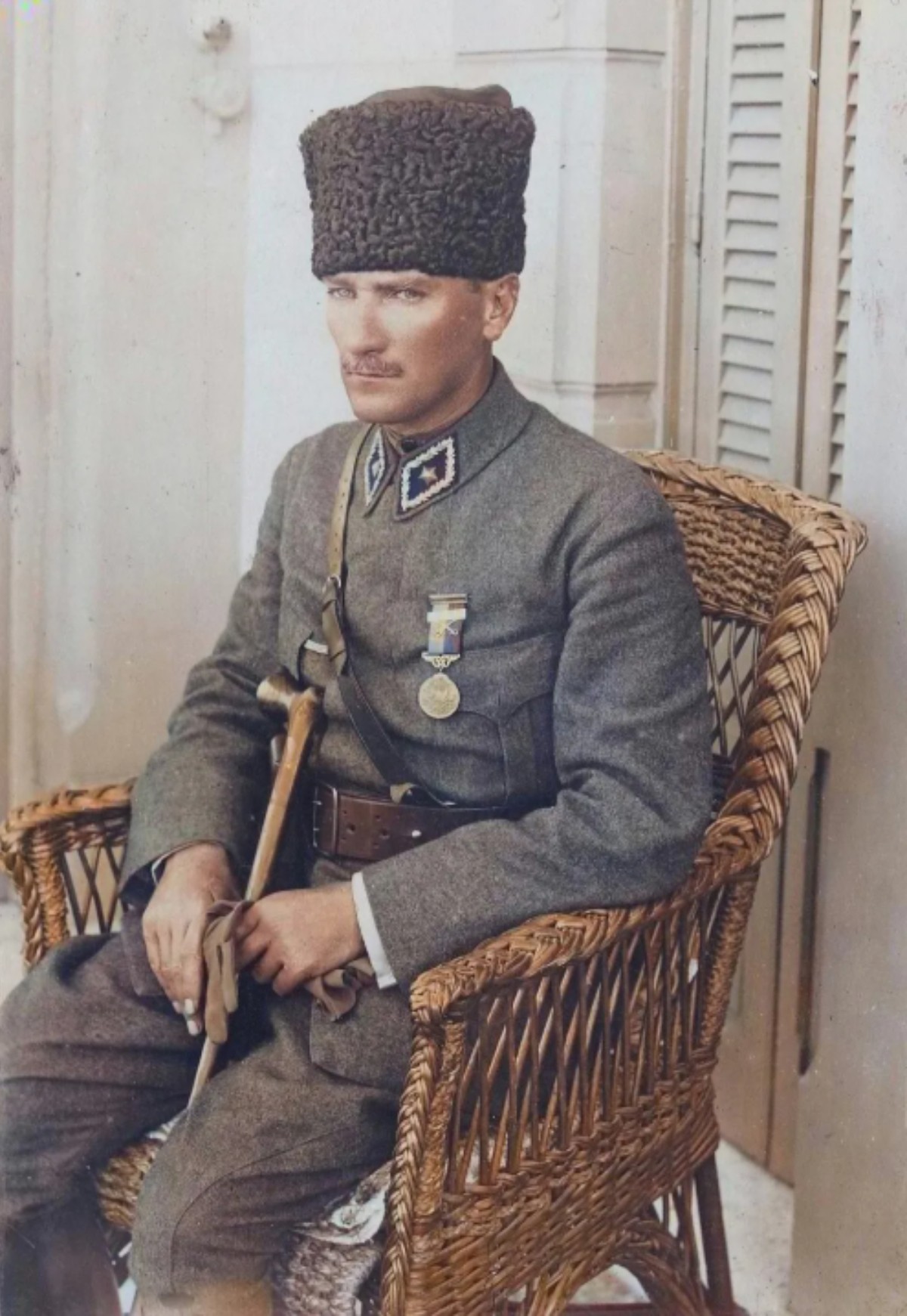
Mustafa Kemal Pasha in Izmir, Türkiye, 1922. Image reproduced from Wikimedia Commons.
Haroon bin Ali and Co. was a well-established merchant who had published a notice in the Straits Settlements Government Gazette as early as November 1927 claiming these marks,20 and from 1927 until 1932 had similarly sold his tea in tins. However, conflict erupted in October 1932 when Haroon bin Ali began “to sell his tea in packets instead of tins,” creating large packets “of apparently the same size and weight as the plaintiff’s packet”.21
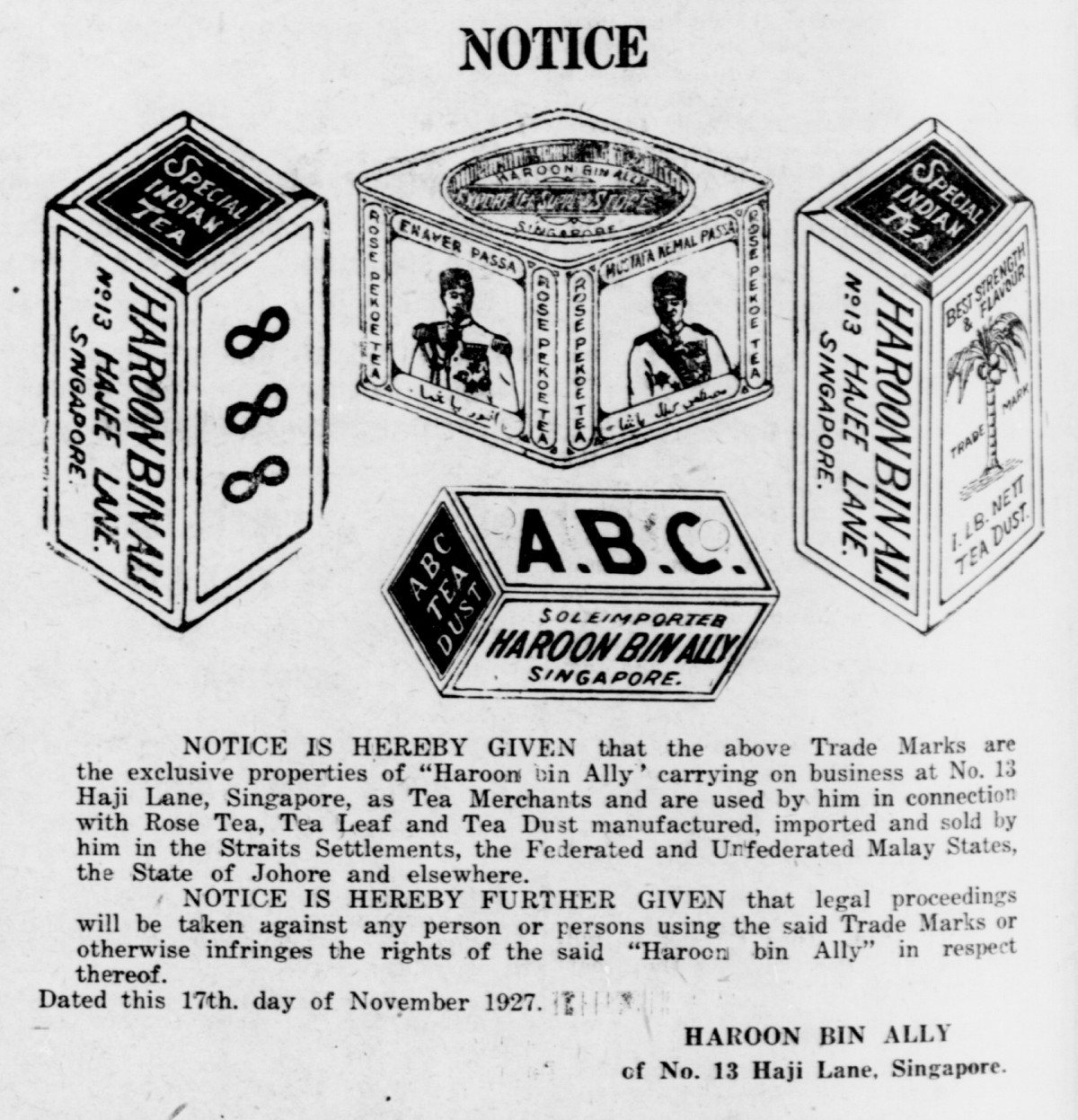
This advertisement by Haroon bin Ali and Co. features a tea tin depicting Enver Pasha (left) and Mustafa Kemal Pasha (right). Image reproduced from Malaya Tribune, 30 November 1927, 6. (From NewspapeSG).
Haroon bin Ali and Co. also utilised a seascape on the wrapper which featured “a ship, a lighthouse, a motor van instead of a locomotive and they had brought in an aeroplane”, while still using the same “The Best and Selected” slogan as the plaintiff.22 Both companies also printed “Rose Pekoe Tea” on the sides of their packaging, further blurring the visual distinctions between the two brands.
The resemblance between the two designs formed the basis of T.G. Kiat’s claim that the wrappers “had given rise to confusion” in the marketplace. His main objection was to the defendant’s use of a “picture of the seascape and the medallion of a Mohammedan ruler”. Advertising agent Choo Tay Beng testified that upon visiting a shop on Beach Road to purchase “Raja Stambul” tea, he was instead handed “two packages of the defendant’s tea”, despite the shopkeeper writing “Raja Stambul tea” on the bill.23 Upon discovering this parallel packet marketing, the plaintiff rushed to protect his consumer base, causing “the writ in the present action to be filed on the 27th of that month” in January 1934.
The defence, led by Roland Braddell,24 pushed back against the accusations, criticising the plaintiff for resorting to a lawsuit without prior warning and argued that the defendant was “quite willing to change the make up of his packages and to do anything that the plaintiff wanted him to do” had he simply been asked.25 Furthermore, Braddell stated that the defendant had actually been “selling tea in the packages [then] complained of since 1932” and that “no damage had been done to [the] plaintiff’s business”, which had in fact increased considerably.26
Eventually, on 5 September 1934, Chief Justice Huggard “held in favour of the plaintiff in a voluminous judgment covering fourteen folios and granted the injunction”, preventing the defendant from continuing to use wrappers that could be mistaken for those of the plaintiff.27
This trademark war revealed how the imagery of the Ottoman Empire and the nascent Turkish Republic had become woven into the fabric of life in colonial Singapore. For consumers purchasing daily provisions, the appeal of a Turkish “raja” or a wartime “pasha” transcended geopolitics, serving as a powerful symbol of quality and prestige.
The Long Echo of the Turk
This Turkish imagery enjoyed remarkable longevity in Singapore’s collective memory. Even as late as 1954, a Singapore Standard quick quiz cited “Raja Stambul Tea” as the answer to the clue, “This is indeed a Turkish delight,” demonstrating how deeply the brand had become embedded in local popular consciousness.28
This interest found one of its most vibrant expressions on the local stage through Kairo Dean (Khairudin), the renowned performer who rose from being “a handbill boy for the Wayang Kassim at 15 cents per day” to becoming “the talk of the town during the glorious era of bangsawan (Malay opera) in the early twenties”. Dean went on to establish his own theatre company, Dean’s Star Opera. Together with his leading lady and wife, Miss Tijah, he was one of the “Big Four” of Malay bangsawan theatre in its heyday.29
Among the ambitious productions staged by his company in the 1930s was Mustapha Kemal in Siberia (1930). Announced as having been “under preparation for many months”, the production invited audiences with the promise of a spectacular stage novelty, an “Aeroplane”. Advertisements promoting the show used the tagline, “Remember. Mustapha Kemal is the Saviour of Turkey”.30
In reality, the play was entirely fictional as Mustafa Kemal Atatürk had never stepped foot in Siberia. Since the exact script has not survived, it is impossible to determine the sources that inspired the story. Kairo Dean staged another play, Anwar Pasha in the Balkans, in 1931 and again in 1935.31 As the title suggests, the play is likely related to Enver Pasha, who had fought in the Balkan Wars (1912–13) and was killed in 1922 during an attack by Bolshevik forces near Baldzhuan, Turkestan (present-day Tajikistan). In April 1934, Dean was featured in the Sunday Tribune wearing a uniform reminiscent of a Turkish pasha, presumably in connection with one of these productions.32
What had begun decades earlier with the arrival of the Ottoman frigate Ertuğrul at Johnston’s Pier continued to evolve in unexpected ways. The Turk was no longer a distant foreign figure but a familiar presence in Singapore’s popular imagination, appearing in advertisements, consumer products, newspaper quizzes and theatre announcements. From tea labels to shipper’s tickets, Turkish imagery was repeatedly reimagined and repurposed, becoming part of the cultural fabric of colonial Singapore.
This research was supported by the Middle East Technical University Scientific Research Projects Coordination Unit (METU-BAP) under Project No. ADEP-107-2023-11263 and Project No. Hızlı Destek-107-2026-11837. The author gratefully acknowledges the Embassy of the Republic of Türkiye in Singapore, H.E. Ambassador Sadık Arslan, Third Secretary Furkan Usta, and the entire embassy staff for their invaluable support throughout this research and during the presentation of the project’s findings in Singapore.
About the Author
Dr Bahar Gürsel is an associate professor with the Department of History at Middle East Technical University in Ankara, Türkiye, and a former Isaac Manasseh Meyer Fellow at the National University of Singapore. Her main areas of research include representation of the East in the West; visual culture and history; diplomatic, social and cultural history of the United States; ephemera studies; and 19th-century children’s literature.
Endnotes
1 “The Turkish Man-of-War in Port (opens in new tab),” Straits Times, 16 November 1889, 2. (From NewspaperSG)
2 Serpil Sürmeli, “The Memoirs of Engineer Captain Mehmed Ali (Balkır) Who Survived the Tragedy of Ertuğrul,” History Studies: International Journal of History 15, no. 2 (May 2023): 171–96, https://www.historystudies.net/eng/the-memoirs-of-engineer-captain-mehmed-ali-balkir-who-survived-the-tragedy-of-ertugrul_2098 (opens in new tab).
3 “The Turkish Band on the Esplanade (opens in new tab),” Straits Times Weekly Issue, 26 November 1889, 9. (From NewspaperSG)
4 “The Turkish Band on the Esplanade (opens in new tab).”
5 “The Turkish Band on the Esplanade (opens in new tab).”
6 “Johore News (opens in new tab),” Straits Times Weekly Issue, 3 December 1889, 6. (From NewspaperSG)
7 “Johore News (opens in new tab),” Straits Times Weekly Issue, 15 April 1890, 2. (From NewspaperSG)
8 Ashley Jackson and David Tomkins, “Ephemera and the British Empire,” in Exhibiting the Empire: Cultures of Display and the British Empire, ed. John McAleer and John M. MacKenzie (Manchester: Manchester University Press, 2015), 153, https://manchesteruniversitypress.co.uk/9780719091094/ (opens in new tab).
9 “Tan Cheng Lock Trust Donation to Enlarge Nation’s Showcase of Rare Materials,” National Library Board, 27 January 2025, https://www.nlb.gov.sg/main/about-us/press-room-and-publications/media-releases/2025/Tan-Cheng-Lock-Trust (opens in new tab). For details see “Annex A: Highlights of the Adrian Wilson Collection of Shipper’s Tickets (opens in new tab)”.
10 Jackson and Tomkins, “Ephemera and the British Empire,” 153.
11 Adrian Wilson, “Shipper’s Ticket Book Review: Labels of Empire by Susan Miller,” Textile Trademarks, 14 August 2023, http://www.textiletrademarks.com/?cat=6&_sv_p_id=ipVb-_23hVa9i4SX (opens in new tab).
12 Among numerous examples, see for Turkish delight, “Page 1 Advertisements Column 2 (opens in new tab),” Straits Times, 25 January 1912, 1; for Turkish towels, “Page 2 Advertisements Column 1 (opens in new tab),” Straits Echo, 5 January 1917, 2; for Turkish figs, “Page 6 Advertisements Column 1 (opens in new tab),” Straits Times, 21 November 1910, 6; and for Turkish cigarettes, “Page 1 Advertisements Column 3 (opens in new tab),” Straits Times, 8 July 1937, 1. (From NewspaperSG)
13 “Tea Traders at Variance (opens in new tab),” Pinang Gazette and Straits Chronicle, 19 July 1934, 12. (From NewspaperSG)
14 “Tea Traders at Variance (opens in new tab)”; “Tea Trade Mark Injunction (opens in new tab),” Straits Budget, 13 September 1934, 16. (From NewspaperSG)
15 “Local Traders’ Dispute (opens in new tab),” Malaya Tribune, 18 July 1934, 13. (From NewspaperSG)
16 “Tea Trade Mark Injunction (opens in new tab).”
17 “Local Traders’ Dispute (opens in new tab).”
18 “Page 6 Advertisements Column 3 (opens in new tab),” Malaya Tribune, 30 November 1927, 6. (From NewspaperSG)
19 “Local Traders’ Dispute (opens in new tab)”; “Tea Traders at Variance (opens in new tab)”; “Tea Trade Mark Injunction (opens in new tab).”
20 The same notice was also published in newspapers during the same period. See “Page 6 Advertisements Column 3 (opens in new tab).”
21 “Local Traders’ Dispute (opens in new tab)”; “Tea Traders at Variance (opens in new tab)”; “Tea Trade Mark Injunction (opens in new tab).”
22 “Tea Traders at Variance (opens in new tab).”
23 “Tea Traders at Variance (opens in new tab).”
24 Sir Roland St. John Braddell (1880–1966) was a prominent Singapore-born lawyer, colonial public figure and historian known for his influential writings on Malaya, including the popular 1934 work, The Lights of Singapore. For a detailed overview of his life and career, see Gracie Lee, “A Glimpse of 1930s Singapore (opens in new tab),” BiblioAsia 11, no. 4 (January–March 2016): 79–81.
25 “Tea Traders at Variance (opens in new tab).”
26 “Tea Wrappers Bring Merchants to Court (opens in new tab),” Singapore Free Press, 18 July 1934, 7. (From NewspaperSG)
27 “Tea Trade Mark Injunction (opens in new tab).”
28 “Page 11 Advertisements Column 2 (opens in new tab),” Singapore Standard, 14 August 1954, 11. (From NewspaperSG)
29 “Malay Opera Star (70) Still ‘Young to Think of Retiring (opens in new tab)’,” Singapore Free Press, 28 May 1960, 3. (From NewspaperSG)
30 The advertisement was republished several times. See, for example, “Page 11 Advertisements Column 2 (opens in new tab),” Malaya Tribune, 8 November 1930, 11. (From NewspaperSG)
31 “Page 11 Advertisements Column 3 (opens in new tab),” Malaya Tribune, 13 June 1931, 11; “Page 9 Advertisements Column 2 (opens in new tab),” Malaya Tribune, 30 October 1935, 9. (From NewspaperSG)
32 “Malay Songs and Pantuns on the Gramaphone (opens in new tab),” Sunday Tribune, 22 April 1934, 10. (From NewspaperSG)