
Article
Jefri Zain Is Singapore's James Bond
18 August 2026
Topics
Arts
Culture
A 1966 Malay spy thriller becomes a cinematic portrait of a newly independent nation.
By Raphaël Millet

Illustration by Oxygen Studio Designs.
When Sean Connery first uttered the iconic line, “Bond. James Bond,” in Dr. No (1962), the first James Bond film, it marked the beginning of a film series based on the fictional spy created by the British novelist Ian Fleming in 1952.1 The film, which starred the late Scottish actor as an agent of the British Secret Intelligence Service (commonly known as MI6) with the code 007 (pronounced “double-oh seven”), premiered in Singapore in 1963.2
By the mid-1960s, following the release of three more films3 and the popularisation of the secret agent’s trademark martini order – “shaken, not stirred” – the James Bond phenomenon had become a global cultural force, inspiring a wave of European espionage thrillers that increasingly turned to Asia for exotic locations. Newly independent Singapore soon found itself as the setting for Ferdinando Baldi’s Operation Singapore (originally titled Goldsnake: Anonima Killers, 1966) and Gianfranco Parolini’s So Darling, So Deadly (Kommissar X – In den Klauen des goldenen Drachen, 1966), both filmed on the island in late 1965 and early 1966 respectively.4
Rather than leaving this emerging genre to foreign filmmakers, Shaw Brothers’ Malay Film Productions (MFP) sought to produce its own locally made spy thriller. When Jefri Zain dalam Gerak Kilat (Jefri Zain in Operation Lightning) was screened on 3 September 1966, it was touted as “Singapore’s Own Bond” and marketed as a “Western-style Malay film modelled after James Bond” that would “put Singapore on the international entertainment map”.5 Conceived as a studio project to revitalise Malay cinema through narrative and stylistic innovations, producer Shaw Vee Meng entrusted the original story to publicity officer Jaafar Abdullah before it was developed into a screenplay by Jamil Sulong (1926–2014), one of MFP’s most accomplished filmmakers.

An advertisement for "Jefri Zain dalam Gerak Kilat". Image reproduced from Berita Harian, 29 August 1966, 8. (From NewspaperSG).
Born in Parit Sulong, Johor, Jamil joined the studio in the late 1940s, rising from translator to assistant director before making his full directorial debut in 1959. Jamil was by then ideally placed to bring the studio’s most ambitious spy film to the screen.6 He was not alone in this though as he was assisted by the Singapore-born Kemat Hassan (1929–2004), who had served as his assistant director on several productions since 1959 and had himself been one of the familiar faces of the Jalan Ampas studios.
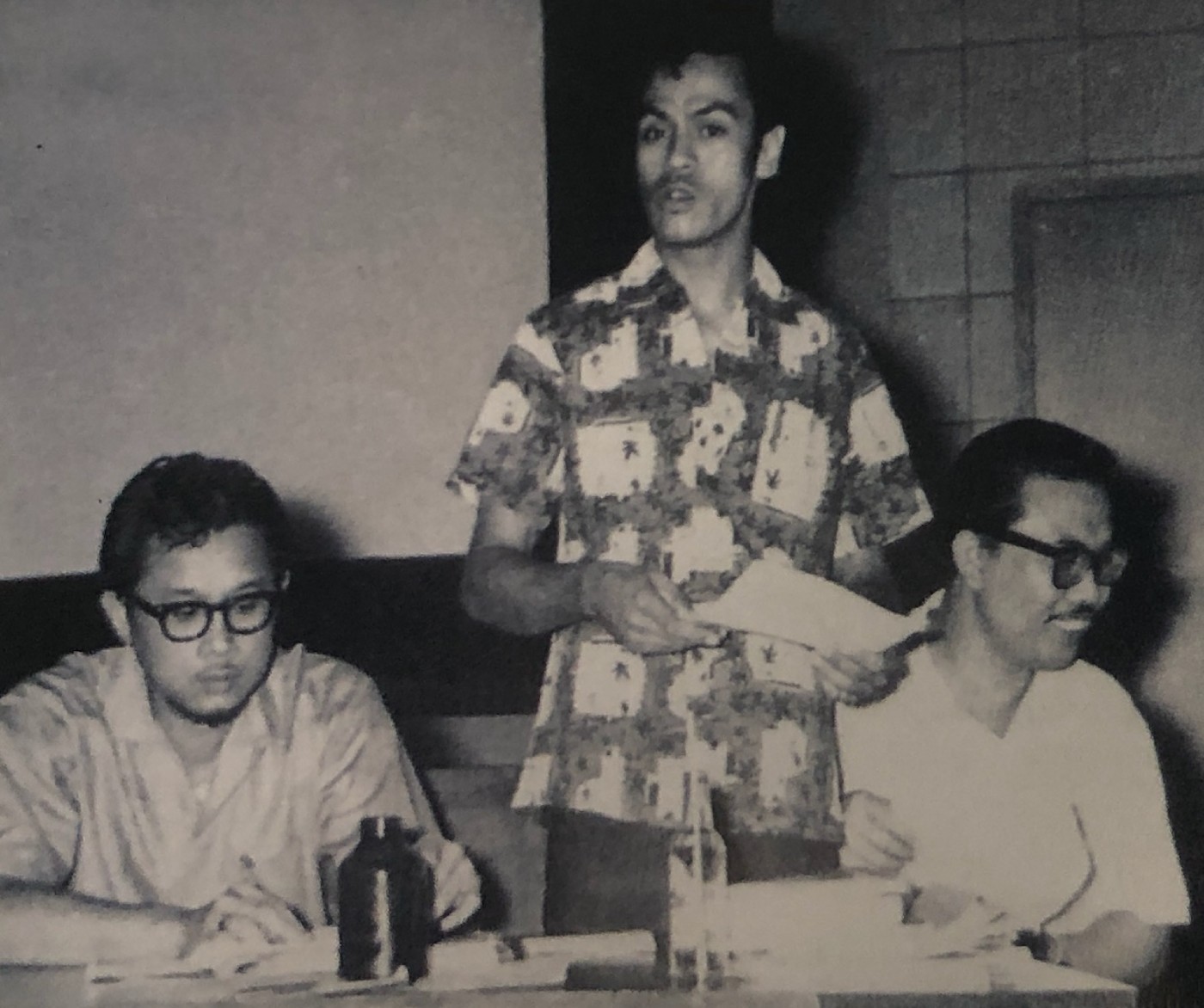
(From left) Director Jamil Sulong, actor Jins Shamsuddin and assistant director Kemat Hassan, 1966. Courtesy of Raphaël Millet.
Once the screenplay for the spy thriller was completed, MFP moved swiftly. Even before filming commenced, several key personnel were reassigned from Omar Rojik’s Dahaga despite the fact that it was still in production. Abu Bakar Ali (later known as Pak Bakar) became the cinematographer for Jefri Zain dalam Gerak Kilat, with Chua Chang Kok replacing him on Dahaga. Similarly, A.V. Bapat was transferred to the new film as set designer, while Mustafa Yassin succeeded him on Dahaga. There was true urgency due to the increasing number of European spy films using Singapore as a backdrop as well as competition from longtime rival Cathay-Keris, which was preparing to announce production of its own espionage feature, Mat Bond.7
Jins Bond
With the director and crew in place, attention turned to finding an actor capable of portraying Singapore’s answer to James Bond. The role fell naturally to Jins Shamsuddin, real name Mohamed Zain Shamsuddin (1935–2017), who was born in Taiping, Perak, but had moved to Singapore in the mid-1950s. Jamil had known him even before he became an actor, when the young Jins frequently visited MFP’s Jalan Ampas studio to repair tape recorders and became fascinated by filmmaking.8
. Courtesy of Shaw Organisat.jpg)
Jins Shamsuddin as Jefri Zain in "Jefri Zain dalam Gerak Kilat" (1966). Courtesy of Shaw Organisation Pte Ltd.
After making his screen debut in Keluarga Tolol (1956), Jins came under the mentorship of actor and filmmaker P. Ramlee, whose Pancha Delima (1957) established him as one of Malay cinema’s rising stars.9 By the mid-1960s, Jins had appeared in 27 films and become one of MFP’s leading actors. When Jefri Zain dalam Gerak Kilat entered production in 1966, Jins was fresh from starring in Jamil’s Kacha Permata (literally Glass Gems, or Shattered Glass, 1966), released only weeks earlier, in February of that year.
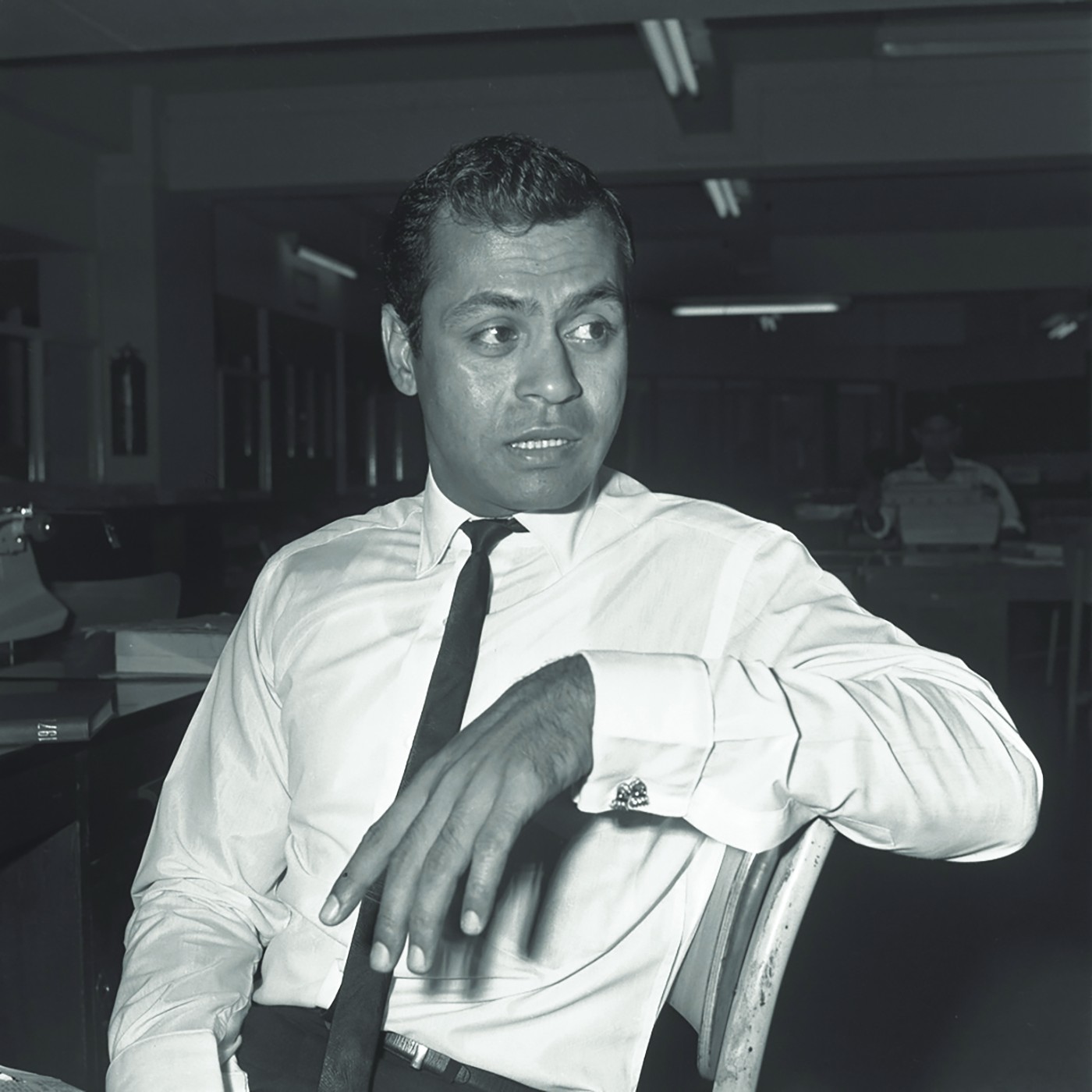
Jins Shamsuddin was 35 years old in this photo taken in 1970. Source: The Straits Times © SPH Media Limited. Permission required for reproduction.
Jamil regarded Jins as the ideal choice for the titular role, not least because he was widely seen in the local film industry as the only Malay actor whose height and features resembled those of Sean Connery.10 When I interviewed Jamil in 2004, he remarked that “without Jins there could have been no ‘Singapore’s Own Bond’”.
The choice of Jins Shamsuddin also helped shape the character’s very identity. Jaafar Abdullah coined the name “Jefri Zain” by combining Jefri, the name of Jins’ young son, with Zain, the actor’s own given name, Mohamed Zain, thereby blurring the boundary between actor and character. The connection became even more personal with the casting of Jins’ former wife and mother of his son, Rahmah Rahmat, who appeared alongside him in the film, making the production even more of a family affair. Rahmah, described by the press as the “naughty girl” of Malay films, was given the role of Ratna, the “seductive, pistol-packing gangster girl” in the film.11
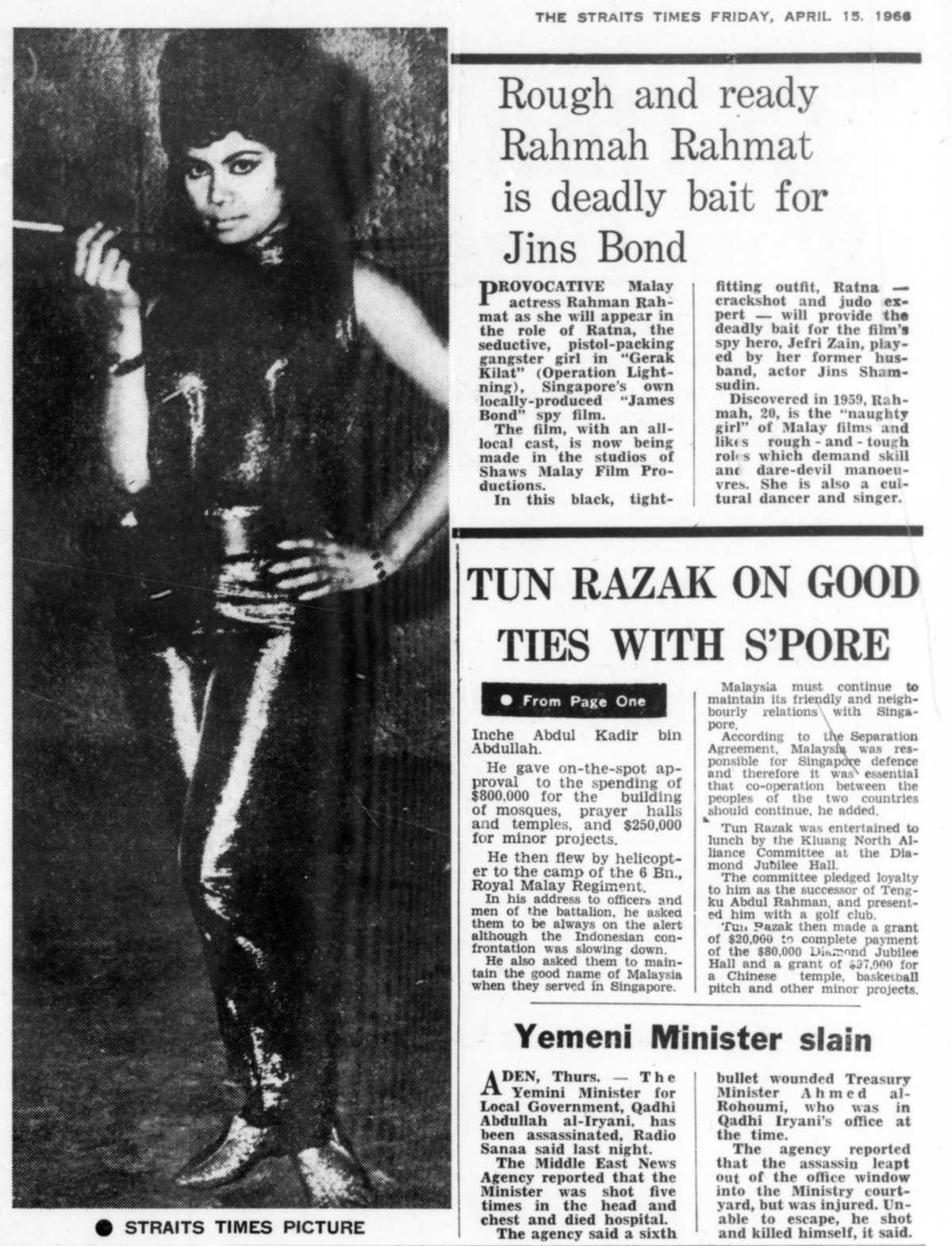
Rahmah Rahmat as gangster girl Ratna in "Jefri Zain dalam Gerak Kilat". Source: The Straits Times, 15 April 1966, 18 © SPH Media Limited. Permission required for reproduction.
Newspapers quickly dubbed Jins Shamsuddin “Jins Bond”, while also describing him as “James Bond Melayu” (Malay James Bond) and “Singapore’s Own Bond”.12 Far from being contradictory, these epithets reflected the transnational character of the Malay-language film industry at the time. The former situated Jefri Zain within Malay cinema, while the latter asserted Singapore’s place in a global spy phenomenon. That Jins himself was not born in Singapore mattered little in an industry that drew talent from across the region.
A Cosmopolitan Cast
The film also featured established Malay stars such as Sarimah who played the female lead Tina, and Salleh Kamil, who was cast as the supervillain Commander Jeeman. They were joined by Chinese Singapore actresses Sylvia Koh, making her screen debut, and Rita Cheong, who had briefly appeared in Ferdinando Baldi’s Operation Singapore only months earlier.13
Publicity materials enthusiastically promoted these actresses as Singapore’s own Bond girls. “Our own Bond girls are very much like the curvy creatures the late Ian Fleming created. They are as desirable, as delectable and as deadly as Sean Connery’s girl friends on the screen,” reported the Straits Times.14 The cast also included Margaret Clougher, who played Agent No. 4, and the British couple Tony Richardson, an army signalman, and his wife, Rene Richardson.15
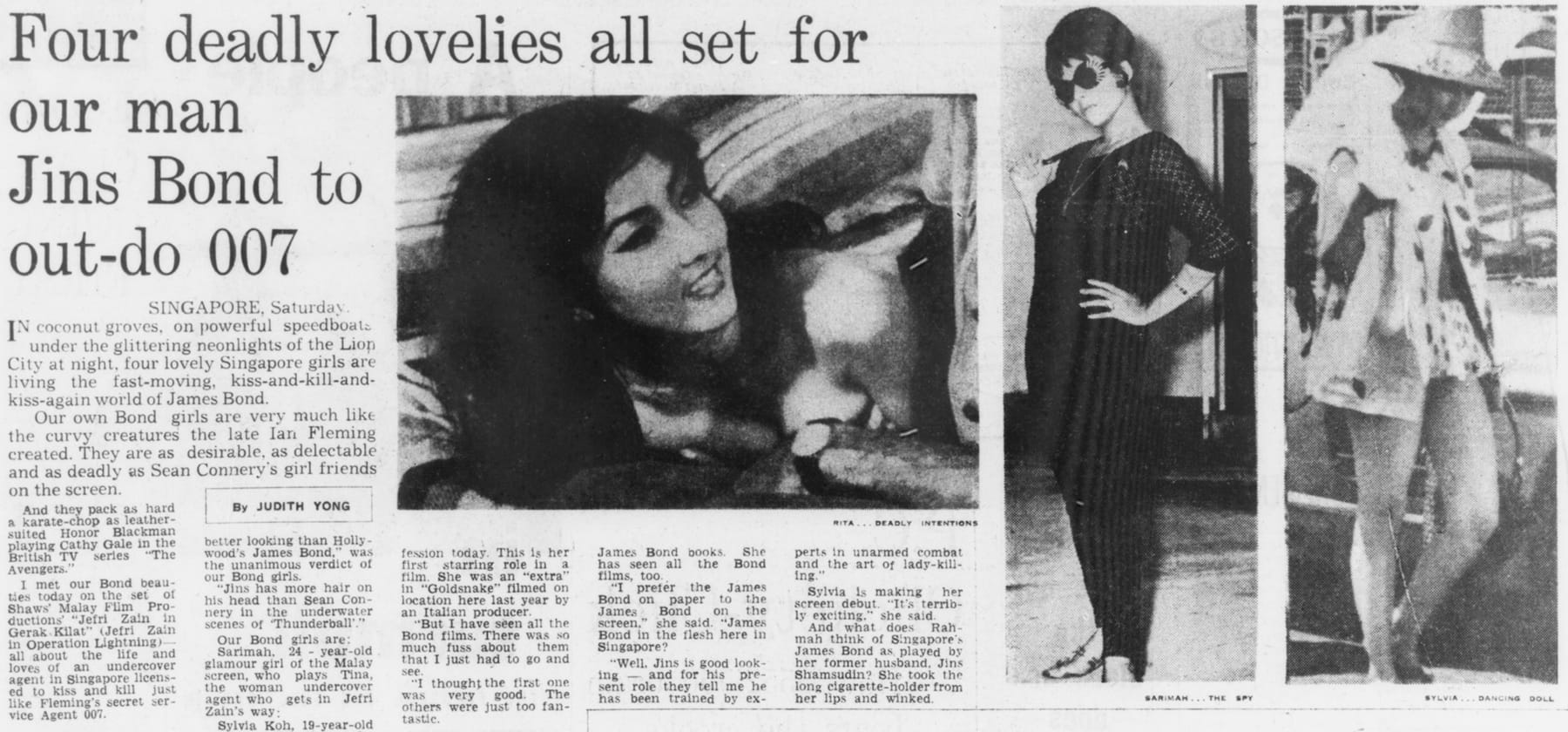
(From left) Rita Cheong as Mei Ling, Sylvia Koh as Mona and Sarimah as Tina. Source: The Straits Times, 17 April 1966, 7 © SPH Media Limited. Permission required for reproduction.
This diversity was more than a marketing ploy. The screenplay required the presence of British military officers, their wives and airline personnel associated with RAF Changi, making the European cast essential rather than ornamental. Together with Malay and Chinese local actors, they reflected the ethnic diversity and international character of mid-1960s Singapore, reinforcing the city’s cosmopolitan image.
The dialogue, likewise, contributed to the atmosphere. Although spoken predominantly in Malay, the film was peppered with English words and expressions – even by Jefri Zain himself – with lines such as “Please, don’t come too close!”, “Get me something to cover the body” and “I’ll send you home”. While English had long appeared occasionally in Malay-language films, Jefri Zain dalam Gerak Kilat employed it more extensively than most of its contemporaries, giving its dialogue a distinctly modern, multilingual flavour in line with the ambitious production.
Borrowing from James Bond Films
Jefri Zain dalam Gerak Kilat consciously adopted many of the characteristics audiences had come to associate with the British secret agent. By day, Jefri Zain worked as an insurance agent, but beneath the bathroom of his modest home lay a concealed operations centre from which he undertook covert missions. Investigating the murder of a fellow operative, Jefri found himself confronting the elusive Commander Jeeman, whose technologically sophisticated criminal organisation relied on hidden headquarters, advanced communications equipment, sophisticated electronic surveillance devices and concealed weaponry.
Jefri was assisted by Eddie, played by Salim Bachik, who designed and supplied him with specialised gadgets. Eddie fulfilled much the same role as Q, the head of the fictional Q Branch (later Q Division) of the British Secret Service. Q’s ingenious inventions are a defining feature of James Bond films.
Among the film’s highlights was Jefri’s sleek Mercedes-Benz 300 SL Gullwing coupé, the equivalent to James Bond’s Aston Martin DB5, which was first introduced in Goldfinger (1964). The Benz was valued at $32,000 and was described by the press as the only example of its kind in Malaysia.16 It became an instant attraction, sporting Jefri’s personalised “JZ1” licence plate and distinctive gullwing doors. Although it lacked the concealed gadgetry of Bond’s Aston Martin, the car served the same symbolic purpose, projecting speed, sophistication and technological modernity while signalling that Singapore’s own secret agent deserved a machine every bit as impressive as his British counterpart.
..jpg)
Jefri’s Mercedes-Benz 300 SL Gullwing coupé as seen in "Jefri Zain dalam Gerak Kilat" (1966). Courtesy of Shaw Organisation Pte Ltd.
The Mercedes-Benz 300 SL was not the only authentic feature of the production. Many of the firearms seen on screen, including the Sterling sub-machine guns carried by Jefri and his adversaries, were genuine weapons that required not only the authorisation but also the assistance of the Singapore Police Force. Many of the film’s fight sequences were personally supervised by Assistant Superintendent Shaari, then chief armourer of the police force.17 He was responsible for the management, maintenance and distribution of police firearms, making him the natural choice to oversee the production’s use of weapons and ensure their safe handling on set.
Jins also underwent training with the police in the handling of firearms and explosives before filming commenced. The involvement of the Singapore Police Force lent Jefri Zain dalam Gerak Kilat a level of realism and technical credibility rarely seen in Malay cinema of the period.
Jins’ commitment to the role went beyond mastering firearms. In the James Bond film Thunderball (1965), which premiered in Singapore on 16 March 1966 – only three days before the announcement of the new Malay spy thriller – Sean Connery had personally carried out many of the film’s underwater stunts, thereby raising expectations for the genre.18
In response, Jins insisted on performing all of his own stunts. Without using a double, he leapt from a moving car and a motorboat, and most spectacularly across the rooftop of the Capitol Theatre, clearing an eight-foot (2.4 m) gap between two buildings before astonished crowds. During another chase, Jins injured his leg after leaping from a bridge but completed the sequence regardless. His willingness to undertake such risks gave Jefri Zain dalam Gerak Kilat an authenticity worthy of Singapore’s own Bond.
The Kissing Scene
Yet more than its gadgets, luxury cars or spectacular stunts, the film generated a lot of buzz through a controversy largely fuelled by studio publicity officer Jaafar Abdullah, who encouraged speculation that the film would contain the first genuine kiss in a Malay-language production. Jamil Sulong, however, diplomatically refused to either confirm or deny this.19
The press eagerly picked up on the story and amplified the rumours, even claiming that Jins and Sarimah would perform the kisses. According to Jamil, Jins reportedly posed for publicity photographs embracing the film’s actresses, including Margaret Clougher, although no such photographs appear to have surfaced.20
With news reports escalating to claims of six kissing scenes, supposedly filmed in a specially constructed bilik khayalan (“fantasy room”) reserved for unusually intimate sequences,21 the situation soon escaped MFP’s control. Objections even came from the Malaysian Parliament, with one member of parliament declaring that he would get the film banned from being screened in Malaysia if it “contained kissing and other sizzling love scenes”. “I object to it not merely on religious grounds but also from the cultural point of view… kissing in public is not only against our national religion but also against Malaysian concepts of culture and tradition,” said Ismail Idris, Alliance Member of Parliament for Penang South.22
The press that had previously celebrated the production as “James Bond Melayu” or “Singapore’s Own Bond” now dubbed it “Singapore’s Kissing Bond”.23 The shift was telling: once the debate centred on morality rather than modernity, the film came to symbolise Singapore’s increasingly cosmopolitan image rather than merely its cinematic ambitions, and Jefri Zain became less closely identified with the Malay community across the Malay Peninsula.
In the end, the controversy proved largely manufactured. Shortly before the film’s release, the studio clarified that the kisses would involve neither Jins, Sarimah nor any other Malay actors, but only a British couple. Audiences ultimately saw just a single kiss between European honeymooners embracing on a beach at the beginning of the film.
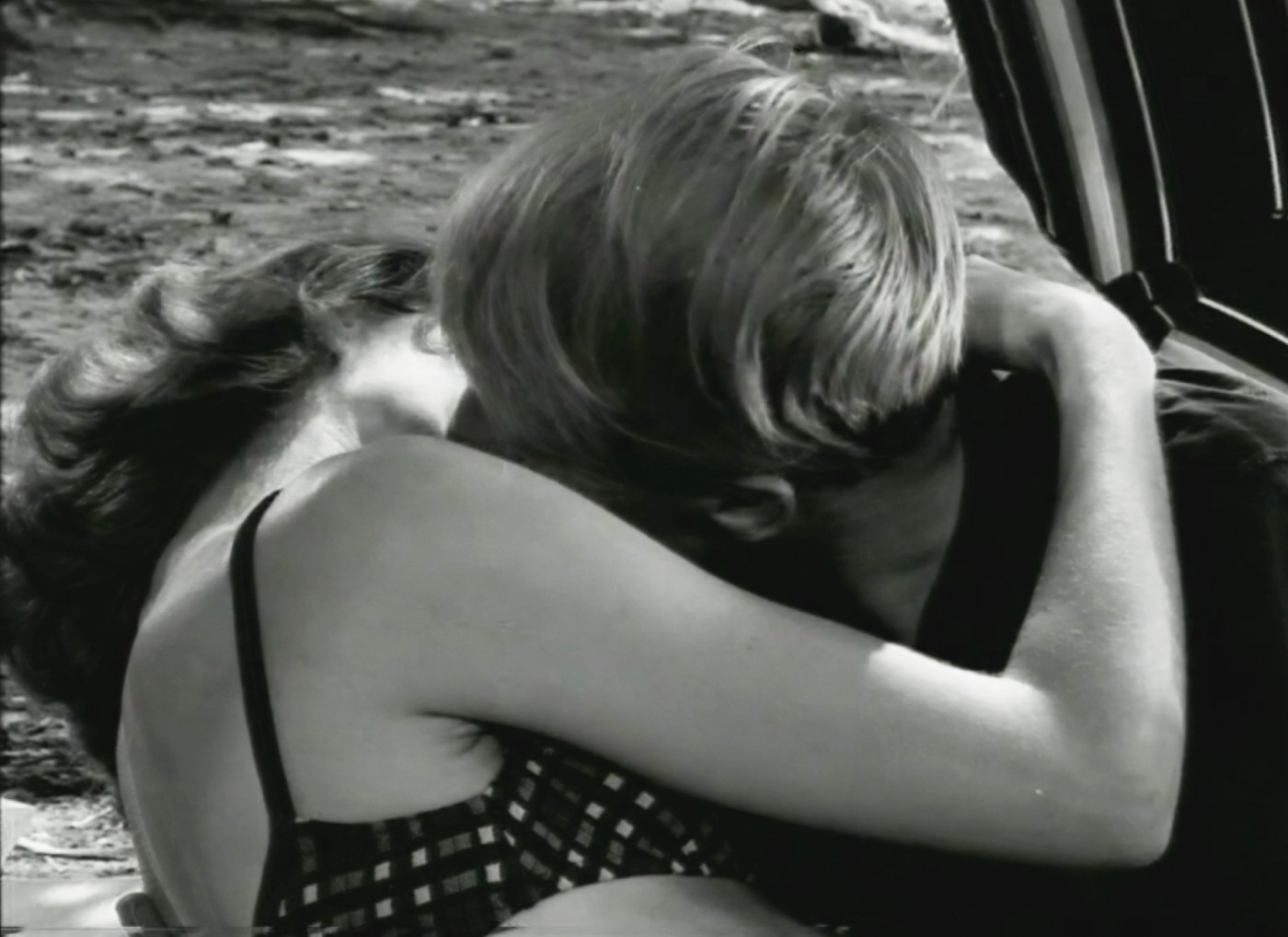
The kiss scene between two European honeymooners on Changi Beach in "Jefri Zain dalam Gerak Kilat" (1966). Courtesy of Shaw Organisation Pte Ltd.
As Jamil Sulong later explained, such behaviour seemed perfectly normal for Westerners holidaying or living in Singapore, and therefore suited the story’s cosmopolitan setting. The episode, nevertheless, reflected broader social changes within Singapore and even more so in the Malay-language film industry. As filmmaker Amir Muhammad later observed, Jefri Zain dalam Gerak Kilat was clearly meant to be “set in a socially liberal, cosmopolitan Singapore”.24
Documenting a Singapore That Once Was
Today, the greatest significance of Jefri Zain dalam Gerak Kilat lies less in its espionage plot or much-publicised kissing scene than in the Singapore it inadvertently preserved. Unlike studio-bound melodramas, spy films thrive on movement, transforming streets, rooftops and public spaces into arenas of pursuit. The very conventions that once made the film appear strikingly modern have since turned it into an invaluable visual record of Singapore’s early years of independence. This is apparent in the opening sequence which portrays Changi Beach as a vibrant seaside playground where Singaporeans and Westerners swim, sunbathe, water-ski and socialise along an open coastline that had not yet been transformed by reclamation and redevelopment works.
..jpg)
..jpg)
The action then moves across a succession of recognisable landmarks that embodied Singapore’s emerging modernity. One scene takes place at the Adelphi Hotel on Coleman Street, which shows the characters attending a floor show titled Mahaligai Lautan Selatan (The Palace of the Southern Sea). It was most likely performed by the Lion City Revue whose repertoire of Malay songs and dances entertained audiences at the hotel throughout the late 1960s,25 unless the performance was staged by MFP’s own dance troupe. Within only a few years, however, the performances were no more: the Adelphi closed in 1973 and was subsequently demolished and replaced by the Adelphi Complex.
Later in the film, a rooftop chase across the Capitol Theatre transforms one of the city’s best-known Art Deco landmarks into a spectacular cinematic arena before spilling into the surrounding streets. The camera then casually lingers on places such as City Book Store, a familiar landmark at Winchester House in Collyer Quay since the end of the Second World War, as the pursuit across town continues.
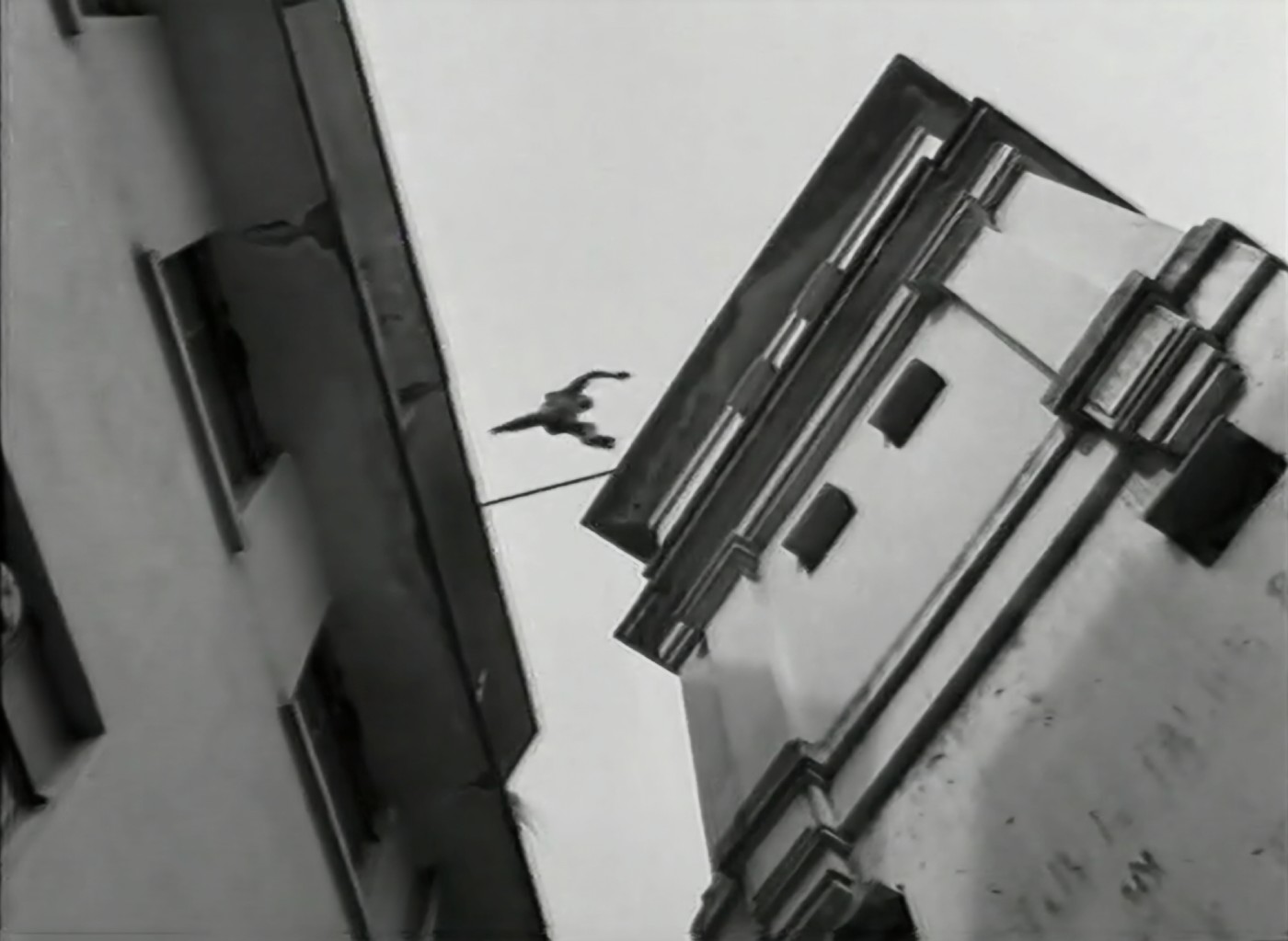
Jefri Zain leaping from one building to another during a rooftop chase in "Jefri Zain dalam Gerak Kilat" (1966). Courtesy of Shaw Organisation Pte Ltd.
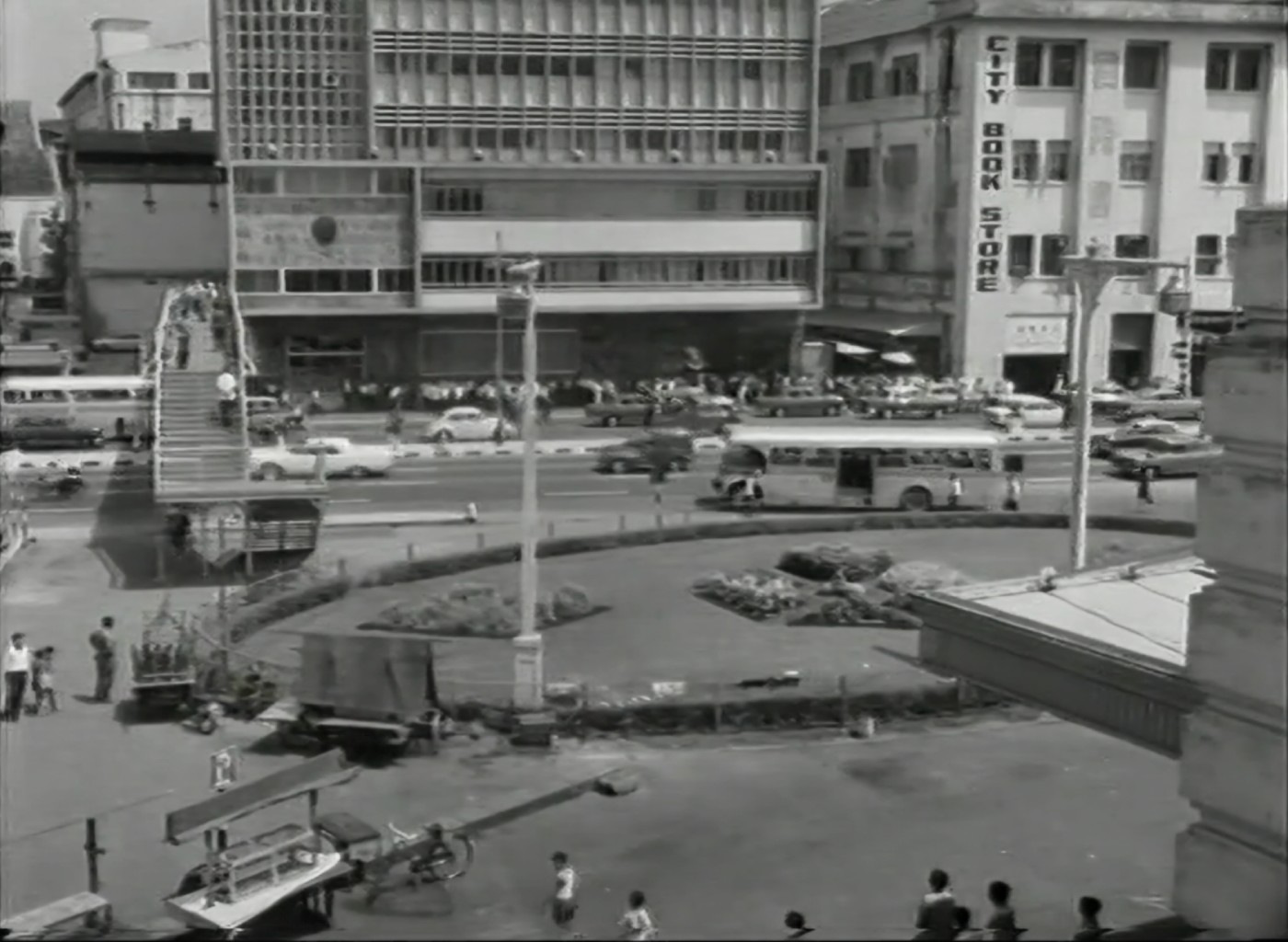
City Book Store at Winchester House, Collyer Quay, as seen in "Jefri Zain dalam Gerak Kilat" (1966). Courtesy of Shaw Organisation Pte Ltd.
Other scenes showcase neighbourhoods such as Serangoon Gardens, whose orderly residential landscape symbolised the aspirations of a rapidly modernising society. Even incidental details – the passing traffic, shopfronts, street furniture, fashions and patterns of everyday pedestrian life – have acquired documentary value, preserving aspects of Singapore that have long since disappeared.
 showcases everyday landscapes of Singapore..jpg)
"Jefri Zain dalam Gerak Kilat" (1966) showcases everyday landscapes of Singapore. Courtesy of Shaw Organisation Pte Ltd.
The Only True “Singapore’s Own Bond”
The film’s documentary value becomes even clearer when viewed alongside the Zain series it launched, which occupies a notable place in Malay film history. Following the successful release of Jefri Zain dalam Gerak Kilat in Malaysia and Singapore in late 1966, Shaw Brothers expanded the franchise with the female-led Nora Zain: Ajen Wanita 001 (Nora Zain: Female Agent 001, 1967), followed by two Jefri Zain adventures filmed back-to-back and which also starred Jins Shamsuddin in the titular role: Jefri Zain dalam Bayangan Ajal (Shadow of Death, 1968) and Jefri Zain dalam Jurang Bahaya (Danger Valley, 1968). Shot in Hong Kong, all three films were directed by Lo Wei and produced at Shaw Brothers’ Clearwater Studio in the territory.26 (Lo Wei was a Hong Kong film director, screenwriter and producer who helped launch the international careers of Bruce Lee and Jackie Chan.)
Yet in leaving Singapore behind for Hong Kong, the three subsequent films lost what makes the original unique today. They retained the Zain character (whether in its male or female form), the action and the espionage, but no longer captured the city of Singapore itself. Only Jefri Zain dalam Gerak Kilat remains inseparable from Singapore, preserving its streets, beaches, hotels and public spaces at a pivotal moment before redevelopment transformed much of the urban landscape. In that sense, it remains the only true “Singapore’s Own Bond” film, not merely because it was made in Singapore, but because Singapore itself became one of its principal protagonists. In fact, the first film in the Jefri Zain trilogy was the only one to be marketed as “Singapore’s Own Bond”.
..jpg)
A bookmark promoting "Jefri Zain dalam Gerak Kilat" (1966). Courtesy of Wong Han Min.
Jamil Sulong was not involved in the latter three Zain films. Instead, he went on to direct something very different: the epic Raja Bersiong (King of the Fanged Wings, 1968), based on a story by Tunku Abdul Rahman, Malaysia’s prime minister from 1957 to 1970.27 This was the last feature produced by MFP at Jalan Ampas before the studio’s closure. Yet when I interviewed Jamil in 2004, he described Jefri Zain dalam Gerak Kilat as, in many respects, his last studio film truly about Singapore, a city where he had spent his formative years and established himself as a filmmaker. He also recalled it as perhaps the most enjoyable film of his career, not only due to its action and gadgets but also the opportunity to film extensively on location across the island-city.
Jins, whom I interviewed separately in 2004, expressed similar affection for the production, asserting that Jefri Zain was inseparable from Singapore before his own career took him to Hong Kong and then elsewhere. “Those Jefri Zain movies captured the non-Malay audience,” Jins told the New Paper in 2000.28
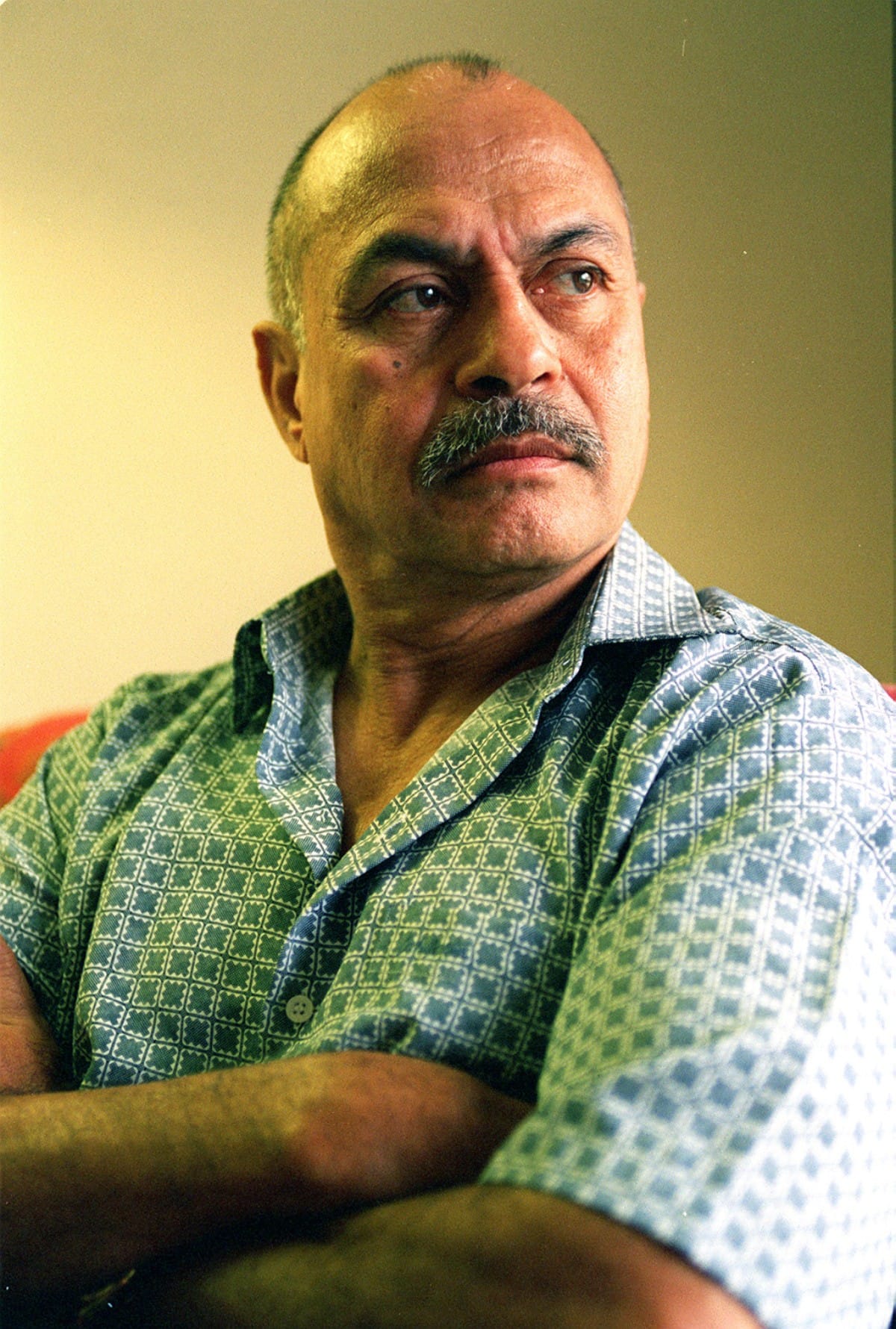
Jins Shamsuddin, aged 64, 2000. Source: The New Paper © SPH Media Limited. Permission required for reproduction.
The recollections of the two main creators of “Singapore’s Own Bond” are revealing. Conceived as Singapore’s answer to James Bond, Jefri Zain dalam Gerak Kilat ultimately became something far more enduring: an accidental visual archive of a newly independent nation and, perhaps, a true cinematic farewell to the city that had shaped the careers of several iconic and influential talents during what is usually described as the “Golden Age” of Malay cinema.
This article draws upon multiple primary and secondary sources. Chief among them are separate interviews conducted by the author with director Jamil Sulong at his home in Pahang and with lead actor Jins Shamsuddin in Kuala Lumpur in 2004. These interviews are complemented by close analysis of Jefri Zain dalam Gerak Kilat, contemporary newspaper coverage, archival records and published biographies of both Jamil Sulong and Jins Shamsuddin. Wherever possible, information derived from oral testimonies has been corroborated against contemporary documentary sources. Gerak Kilat is currently available for viewing for subscribers of Malaysia’s pay TV provider Astro.
About the Author
Raphaël Millet is a film director, producer and critic with a long-standing interest in Singapore’s film history. His publications include Le Cinéma de Singapour (2004), Singapore Cinema (2006) and Singapore: A Cinematic Portrait (2026). He also directed the documentaries, Gaston Méliès and His Wandering Star Film Company (2015), Chaplin in Bali (2017) and The Capitol of Singapore (2020), all preserved by the Asian Film Archive.
Endnotes
1 “Dr. No,” IMDb, accessed 23 July 2026, https://www.imdb.com/title/tt0055928/ (opens in new tab); “Inspirations,” Ian Fleming, accessed 12 August 2026, https://ianfleming.com/james-bond/universe/inspiration/ (opens in new tab).
2 Joanne Soh, “Spy Classic Dr. No Returns to Shaw Lido, Kicking off the Cinema’s James Bond Marathon,” Straits Times, 5 March 2026, https://www.straitstimes.com/life/entertainment/spy-classic-dr-no-returns-to-shaw-lido-kicking-off-the-cinemas-james-bond-marathon (opens in new tab).
3 The three films were From Russia with Love (1963), Gold Finger (1964) and Thunderball (1965), all starring Sean Connery.
4 Raphaël Millet, Singapore: A Cinematic Portrait (opens in new tab) (Singapore: Asian Film Archive, 2026), 210–11. (From PublicationSG)
5 “Kissing to Stay in S’pore’s First James Bond Film (opens in new tab),” Straits Times, 27 April 1966, 20; “Halaman 8 Iklan Ruangan 1 (opens in new tab),” Berita Harian, 29 August 1966, 8. (From NewspaperSG)
6 Jamil Sulong, Kaca Permata: Memoir Seorang Pengarah (opens in new tab) [Gemstone: A director’s memoir] (Kuala Lumpur: Dewan Bahasa dan Pustaka, 1990), 195. (From National Library Singapore, call no. Malay RSING 791.4309595 JAM)
7 “Pekerja2 ‘Dahaga’ Banyak Yg Letak Jawatan (opens in new tab)” [Many ‘thirsty’ employees resigned], Berita Harian, 19 March 1966, 7; “Enter Mat Bond the Magician (opens in new tab),” Straits Times, 27 April 1966, 11. (From NewspaperSG)
8 Jamil Sulong, Warisan dan Wawasan (opens in new tab) [Legacy and vision] (Kuala Lumpur: Dewan Bahasa dan Pustaka, 2007), 164. (From National Library Singapore, call no. Malay RART 791.430233092 JAM)
9 Raphaël Millet, “P. Ramlee: The Singapore Years (opens in new tab),” BiblioAsia 22, no. 1 (April–June 2026): 52–57.
10 Mohd. Zamberi A. Malek, Suria Kencana: Biografi Jins Shamsudin (opens in new tab) [Suria Kencana: Biography of Jins Shamsudin] (Bangi: Penerbit Universiti Kebangsaan Malaysia, 1998), 62. (From National Library Singapore, call no. Malay RSING 791.437092 MOH)
11 “Rough and Ready Rahmah Rahmat Is Deadly Bait for Jins Bond (opens in new tab),” Straits Times, 15 April 1966, 18. (From NewspaperSG)
12 “Halaman 8 Iklan Ruangan 1 (opens in new tab)”; Judith Yong, “Four Deadly Lovelies All Set for Our Man Jins Bond to Out-do 007 (opens in new tab),” Straits Times, 17 April 1966, 7; “Kemalangan dalam Masa Penggambaran Akhir ‘James Bond’ Melayu (opens in new tab),” Berita Harian, 24 July 1966, 5. (From NewspaperSG)
13 “Sylvia Koh – Satu Chabaran Kapada Seniwati Melayu (opens in new tab)” [Sylvia Koh – a challenge to Malay artists], Berita Harian, 14 May 1966, 7; “Suspense at Airport – All in the Act (opens in new tab),” Straits Times, 14 November 1965, 10 (From NewspaperSG). Contemporary sources are inconsistent in the spelling of Rita’s surname, which appears as both “Cheong” and “Chong” in newspaper reports and the film’s screen credits.
14 Yong, “Four Deadly Lovelies All Set for Our Man Jins Bond to Out-do 007 (opens in new tab).”
15 “Gerak Kilat,” IMDb, accessed 19 July 2026, https://www.imdb.com/title/tt0277718/ (opens in new tab).
16 “Jins Dapat Mempermainkan Adegan2 Yang Chemas (opens in new tab)” [Jins was able to portray tense scenes], Berita Harian, 2 April 1966, 7. (From NewspaperSG)
17 Mohd. Zamberi A. Malek, Suria Kencana: Biografi Jins Shamsudin (opens in new tab), 62.
18 “New Y’s Men Lead Tells of Film Premiere (opens in new tab),” Straits Times, 15 February 1966, 16. (From NewspaperSG); “Pekerja2 ‘Dahaga’ Banyak Yg Letak Jawatan (opens in new tab).”
19 Jamil Sulong, Kaca Permata (opens in new tab), 197.
20 Jamil Sulong, Kaca Permata (opens in new tab), 198.
21 “Filem James Bond Melayu Mengandongi Babak Chium (opens in new tab)” [Malay James Bond film contains kissing scenes], Berita Harian, 19 March 1966, 7. (From NewspaperSG)
22 “MP’s Bid to Ban S’pore’s Kissing Bond (opens in new tab),” Straits Times, 26 April 1966, 10. (From NewspaperSG)
23 “MP’s Bid to Ban S’pore’s Kissing Bond (opens in new tab).”
24 Amir Muhammad, 120 Malay Movies (opens in new tab) (Petaling Jaya: Matahari Books, 2010), 348. (From National Library Singapore, call no. RSEA 791.430899923 AMI)
25 “The Last Dinner and Dance at the Adelphi (opens in new tab),” Straits Times, 25 June 1973, 10. (From NewspaperSG)
26 “Nora Zain: Ajen Wanita 001,” IMDb, accessed 21 July 2026, https://www.imdb.com/title/tt1729213/ (opens in new tab); “Bayangan Ajal,” IMDb, accessed 21 July 2026, https://www.imdb.com/title/tt1729173/ (opens in new tab); “Jurang Bahaya,” IMDb, accessed 21 July 2026, https://www.imdb.com/title/tt1729203/ (opens in new tab).
27 “Raja Bersiong,” IMDb, accessed 21 July 2026, https://www.imdb.com/title/tt0277982/ (opens in new tab); Tan Zi Hao, “Raja Bersiong or the Fanged King: The Abject of Kedah’s Geopolitical Insecurity,” Indonesia and the Malay World 48, no. 142 (August 2020): 263, https://www.researchgate.net/publication/343469799_Raja_Bersiong_or_the_Fanged_King_The_abject_of_Kedah’s_geopolitical_insecurity (opens in new tab).
28 “He’s the James Bond of Malaysia (opens in new tab),” New Paper, 9 July 2000, 5. (From NewspaperSG)