
Article
Marching Through History: 100 Years of the Singapore Police Force Band
20 August 2026
Topics
Arts
History
The desire of the municipal authorities to have a band perform at publicly funded outreach events was the original impetus for what would become the Singapore Police Force Band.
By Eugene Dairianathan
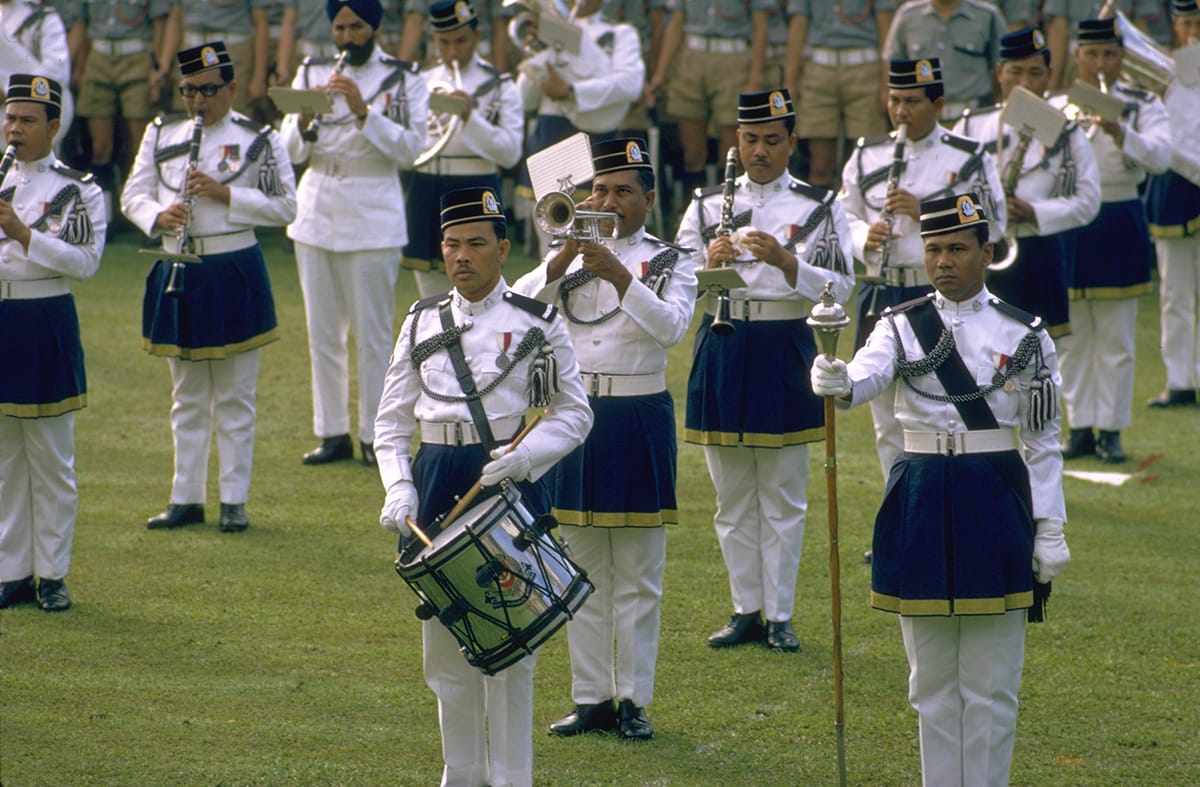
The 1970 National Day Parade at the Padang. Ministry of Information and the Arts Collection, courtesy of National Archives of Singapore (Media – Image No. 19980006944 - 0012).
On 25 March 1927, the Second Straits Settlement Police Band gave its inaugural performance to a large crowd. The Singapore Free Press and Mercantile Advertiser reported that a crowd “numbering between three and four thousand greeted the new S.S. Police Band which gave its first performance at the band stand in Waterloo Street last night… [with] several members of the Singapore Municipal Commission present”. E.A. Brown, a member of the Municipal Commission, introduced bandmaster F.E. Minns – formerly bandmaster of the Second Royal Sussex Regiment – who was “going to make the band one which would be known throughout the East” and a “band for the populace of Singapore”.1
Subsidised by the Municipality, this presence of a band performing in public outreach concerts under a law-and-order organisation was interesting because the police force at the time already had an existing full military band. Why then was there the need for a second one?
Early Bands in Singapore
During the 19th century, itinerant Indian army regiments stationed in Singapore provided music for concerts and events, most notably commemorating the birthday of King George IV on Government Hill in 1827.2 The musical contribution could have been provided either by the 35th Madras Native Infantry Band or the 3rd Battalion Madras Artillery Band stationed in Singapore.3
Another Indian army band performed in 1831: “[T]he Officers of the 29th Madras Native Infantry, who had just come, allowed their band to play once a week on the plain, which is now called the Esplanade… the [itinerant] band used to play… twice a week… opposite Coleman Street and the carriages were driven in, and stood in a circle around the bandstand.”4
These itinerant Indian regimental bands of the Madras Army continued to provide public concerts at the Botanic Gardens and Esplanade until the British annexation of the Maratha kingdom into the Presidency of Madras in 1856, and the Madras Army was reorganised.5 A letter to the editor of the Singapore Free Press in December 1865 expressed concern that there would be no more Indian bands performing in Singapore and appealed for the formation of a local town band.6
In November 1869, the Straits Times Overland Journal reported the first appearance of a local Volunteer Band accompanying the Singapore Volunteer Rifle Corps. The paper described how this ensemble “marched through some of the principal streets of the town last evening”, with music “furnished by the Volunteer Band, who give promise of becoming very efficient”.7 In December 1878, the same paper reported: “The Band of the Volunteers afforded much delectation to the town residents by playing on the Esplanade by moonlight… a selection of popular airs.”8 (“Airs” are simple, song-like melodies or musical pieces that are often lyrical and expressive in nature.)
The cost of sustaining a Municipal Band was raised at the meeting of the Municipal Commission on 7 September 1888 when member W.C. Brown asked “if enquiries [had] been made about [its] probable cost”. The president of the Municipal Commission, W.E. Maxwell, replied that he had done so and was “awaiting further information from Manila [the Philippines]”.9
At a special meeting of the Municipal Commission on 3 May 1889, the cost of forming a town band was brought up once again, with the suggestion to appoint a committee to study its feasibility.10
Santa Cecilia Band
By 1895, Singapore still did not have a town band. On 20 December that year, Alex Gentle, president of the Municipal Commission, wrote to the manager of the Santa Cecilia Band based in Singapore to confirm that the Municipality was prepared to “contribute a sum of $15 a week for a weekly performance of the band in one or other of the public grounds of this town”. It would be partly funded by the Municipal Commission and partly by the band’s own advertisements for public subscriptions.11
In January 1896, Gentle informed the Municipal Commission that thanks to the large music-loving community of Singapore, “there should be no difficulty in raising the necessary funds” and a “sufficient amount could be easily subscribed to enable the band to give two performances every week instead of one”. With the “many Chinese subscribers to the fund”, Gentle hoped that performances would be held in People’s Park, Hong Lim Green and the Esplanade and that “many [would] eagerly look forward to the commencement of the Band performances”.12
The Santa Cecilia Band comprised 20 trained musicians from Manila who would perform at “Soirees, Balls, Theatres, Funerals, Baptisms, Weddings, Picnics” to name a few.13 In June 1895, the band had the opportunity to accompany an orchestral ensemble during a Pontifical High Mass at the Cathedral of the Good Shepherd. They also provided music for a quadrille party organised for the warders of the criminal prison at Boustead Institute.14
After its commission by the Municipality, the Santa Cecilia Band often played at Government House (the Istana today) with Governor Charles Mitchell and Lady Mitchell in attendance. Following a reception there in March 1896, the band received a note from the governor’s aide-de-camp which read: “H.E. Sir C. Mitchel was much pleased with the way the band played and his Excellency thinks the Band shows considerable improvement.”15
In September 1896, however, band members addressed a petition to the governor that they were not sufficiently paid and received no remuneration for playing on Sundays.16 Apparently, these grievances were resolved because the band continued to perform at various locations across the island over the next few years, including the Esplanade and Noordin Lane.17
Town and Volunteer Band
In 1900, there was some progress made towards having a town band when the Straits Times reported that “a sub-committee [had] been appointed for the purpose of organising a band for the Singapore Volunteer Rifles”.18 This was the proposed “Singapore Volunteer and Town Band” whose committee appealed for public funds in January 1901 for its support and maintenance. The band was expected to “play in public twice a week, and would be available for public and private engagements”.19
The Town and Volunteer Band was eventually formed in June 1901 with 25 members as well as instruments loaned by the Sultan of Johor. According to the Straits Times, “the direction of the interests of the band was entrusted into the hands of the Municipal Commission, which subscribed $6,000 annually”. The band was initially popular with the people and became “quite an institution in the town” with two weekly performances. But as time went by, its novelty wore off and public donations dwindled.20
In February 1906, F.J. Benjafield, the secretary of the band, made an appeal for subscriptions as the Municipal Commission had reduced its annual funding support to $3,000 from $6,000 in previous years. For every $25 subscribed, the subscriber may engage the band twice a year at half the price.21 Eventually, with the lack of support and funding, the band was reduced to 17 men and had no bandstand to play on. Its last performance was reported to be on 31 December 1906 at the Police Ball.22
Police Force Fife, Drum and Bugle Band
A new band, the Singapore Volunteer Corps Bugle, Drum and Fife Band, emerged in 1911 and maintained a weekly programme of drills and performances until 1926.23 It also played at Government House on Tuesday afternoons.
Meanwhile, the Singapore Police Force Fife, Drum and Bugle Band made its debut in 1923 with reports of the appointment of W.P. Barsby as European Drill Instructor.24 A Police Parade featured “the newly formed bugle and fife band under Inspector Barsby” in November that year.25 In March 1924, the band played at a Police Sports event held on the Esplanade in Penang.26 Those who performed were recruits who had only eight months of service, and they carried out “Police duty, practising in their spare time”.27 Their performance in Penang also served as a recruitment campaign for local bandsmen.
The press reported that when the band returned to Singapore, they “took with them about 50 recruits of smart and keen men”.28 The band later performed opposite the Town Hall in June 1924, marking its first public appearance in Singapore.29 This Singapore Police Force Fife, Drum and Bugle Band was considered the First Straits Settlement Police Band.
Even as the First Straits Settlement Police Band gained public recognition through its performances, the Municipal Commission had argued earlier in a special meeting in February 1922 that the “Town Band” be reorganised and be an “entirely Municipal Band and entirely under their own control”, believing that it would “not only be useful to Europeans but to other classes as well, such as for Chinese funerals, etc.”. (This was presumably the Town and Volunteer Band that was supposed to wind up after its last performance on 31 December 1906 but was likely resurrected subsequently.) As the municipal commissioners were unable to decide whether to disband the present band or form a new one, the meeting agreed to form a sub-committee to look into the matter.30
Second Straits Settlement Police Band
It took two years before the Municipal Commission appointed a special committee on 25 July 1924 to “inquire into and report upon the practical possibilities of the formation of a Municipal Orchestra for the town of Singapore”. The committee proposed either a band of Goanese or Filipino performers, or a police band subsidised by the Municipal Commission. Its recommendation was a police band, which would cost considerably less than an imported band.31 The Municipal Commission agreed to the proposal. “After much discussion, the project now holding the field is that which provides for the Commissioners to subsidise a good Police band, and from several points of view that seems to be the best solution of the problem,” was the committee’s recommendation.32
Given the challenges with the Santa Cecilia Band, the optimal solution was to approach the police authorities to form a band. There was also consideration to include a philharmonic ensemble to give concerts to children and adults, but the costs were too high.33
The deliberations resulted in the establishment of the Second Straits Settlement Police Band in May 1925, comprising ex-Indian army bandsmen led by F.E. Minns who retired from the Second Battalion of the Royal Sussex Regiment. Appointed on 1 June 1925, Minns personally went to India to recruit band members. The band was expected to give public performances and supply the needs of the police force.34
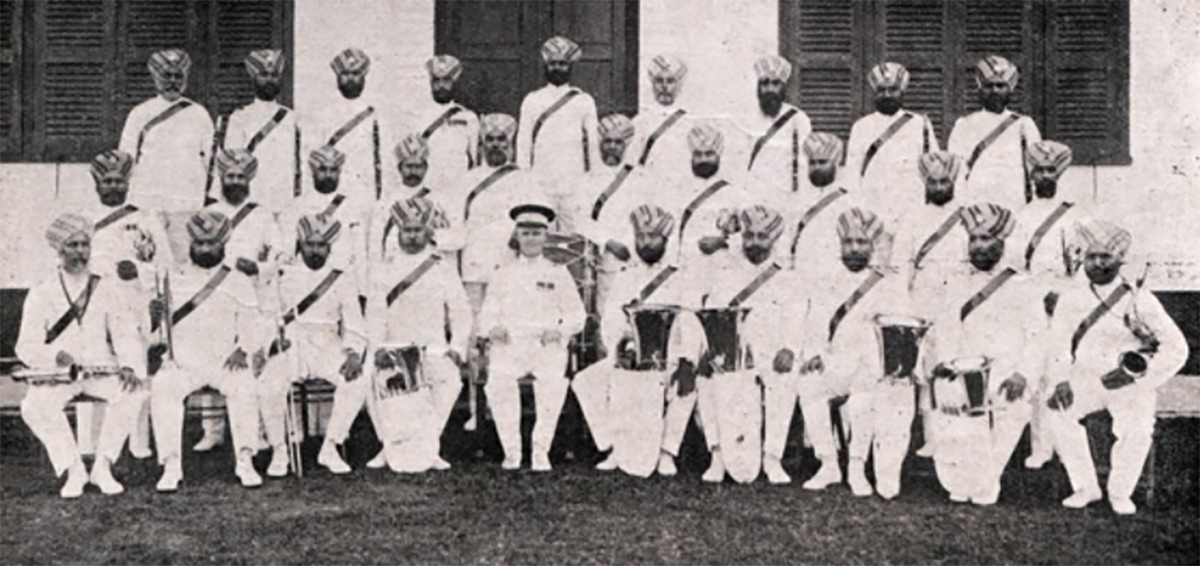
The Second Straits Settlement Police Band, c. 1927. Courtesy of the Singapore Police Force Band.
But there was still the existence of the First Straits Settlement Police Band under Barsby. He was subsequently transferred to the Police Depot in Kuala Lumpur in July 1925 to form a drum and fife band there.35 In the meantime, the bandsmen in the newly formed Second Straits Settlement Police Band underwent training and rehearsals,36 and gave their inaugural public performance on 25 March 1927.37
In an interview with the Straits Times upon his retirement in May 1935, Minns noted, among other things, the “marked interest taken by the younger generation of Asiatics in the performances of the Police Band”. He was also pleased with the “number of school children who had been conveyed to Katong Park or to the Telok Ayer Bandstand in lorries, listening intently to the strains of classical, light opera and regimental march music”.38
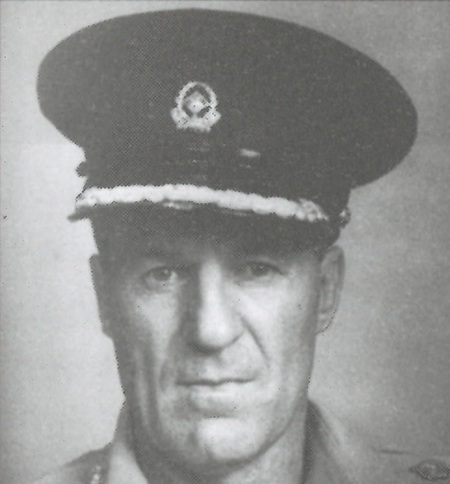
F.E. Minns led the Straits Settlement Police Band from June 1925 to May 1935. Courtesy of the Singapore Police Force Band.
Minns was succeeded by John Cawdor Hitch in 1936, who was previously with the First Battalion of the Cheshire in India and was conversant in Hindustani. “I am all for lively airs, something with a zip in it, and hope to stock our music library here with the best music that can be obtained from all countries,” Hitch told the Straits Times. He was “looking forward to giving Singapore some of the best band music yet heard here”.39
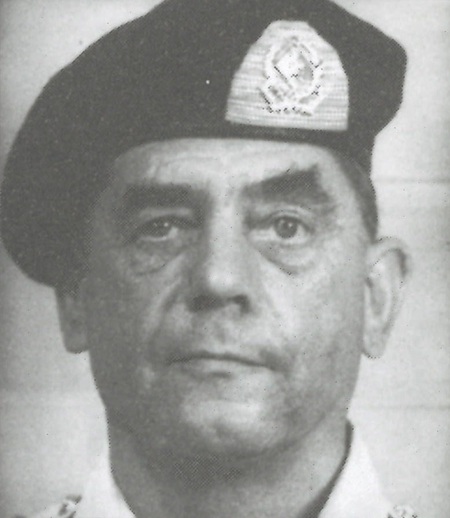
John Cawdor Hitch served as bandmaster of the Second Straits Settlement Police Band from 1936 to 1942, and later of the renamed Singapore Police Force Band from 1945 to 1950. Courtesy of the Singapore Police Force Band.
Unfortunately, Hitch’s tenure was interrupted by the Japanese Occupation of Singapore from 1942 to 1945. During those years, the Second Straits Settlement Police Band was renamed Syonan Police Band (Singapore was called Syonan-to, or “Light of the South”), and Ganda Singh was assigned band conductor during that period. The band played arrangements of classical pieces at locations such as Farrer Park, Jalan Besar, Waterloo Street, the Police Club and the Botanic Gardens. The national anthem of Japan, “Kimigayo” (“His Imperial Majesty’s Reign”), was included in the band’s repertoire.40
Singapore Police Force Band
When the Japanese Occupation ended, Hitch returned as bandmaster of the renamed Singapore Police Force (SPF) band. His retirement in June 1950 was marked by a farewell concert by the band under his direction, which was recorded at Radio Malaya, Singapore. The programme included “a selection of memories from the Shaftesbury Theatre, London, Charles Ancliffe’s waltz ‘Nights of Gladness’ and a cornet duet by Kenneth Alford”.41
Upon Hitch’s departure, band sergeant Ujagar Singh conducted the SPF Band in the interim. In November 1950, Robert Edward House of the Devonshire Regiment took over permanently as bandmaster.42 The SPF Band continued its public concert commitments in an arrangement with the City Council, which succeeded the Municipal Commission in September 1951 when Singapore attained city status. The band played at public parks such as Farrer Park, Botanic Gardens, King George V Park and Katong Park.43
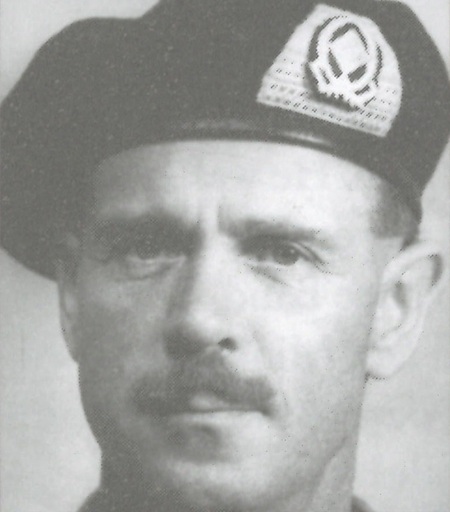
Robert Edward House, bandmaster of the Singapore Police Force Band between 1950 and 1957. Courtesy of the Singapore Police Force Band.
James E. Boyle succeeded House in 1957. During his tenure, performances by the Police Band were broadcast on Radio Singapore in four weekly radio concerts starting from March 1960.44 In August 1959, Boyle directed performances of German composer Engelbert Humperdinck’s opera Hansel and Gretel, and Mozart’s opera Bastien und Bastienne (inspired by Jean Jacques Rousseau’s Le Devin du Village), both staged by the children of Marymount Convent.45
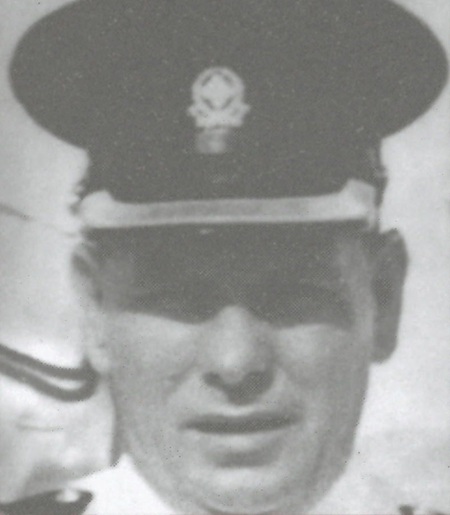
James E. Boyle, bandmaster of the Singapore Police Force Band between 1957 and 1960. Courtesy of the Singapore Police Force Band.
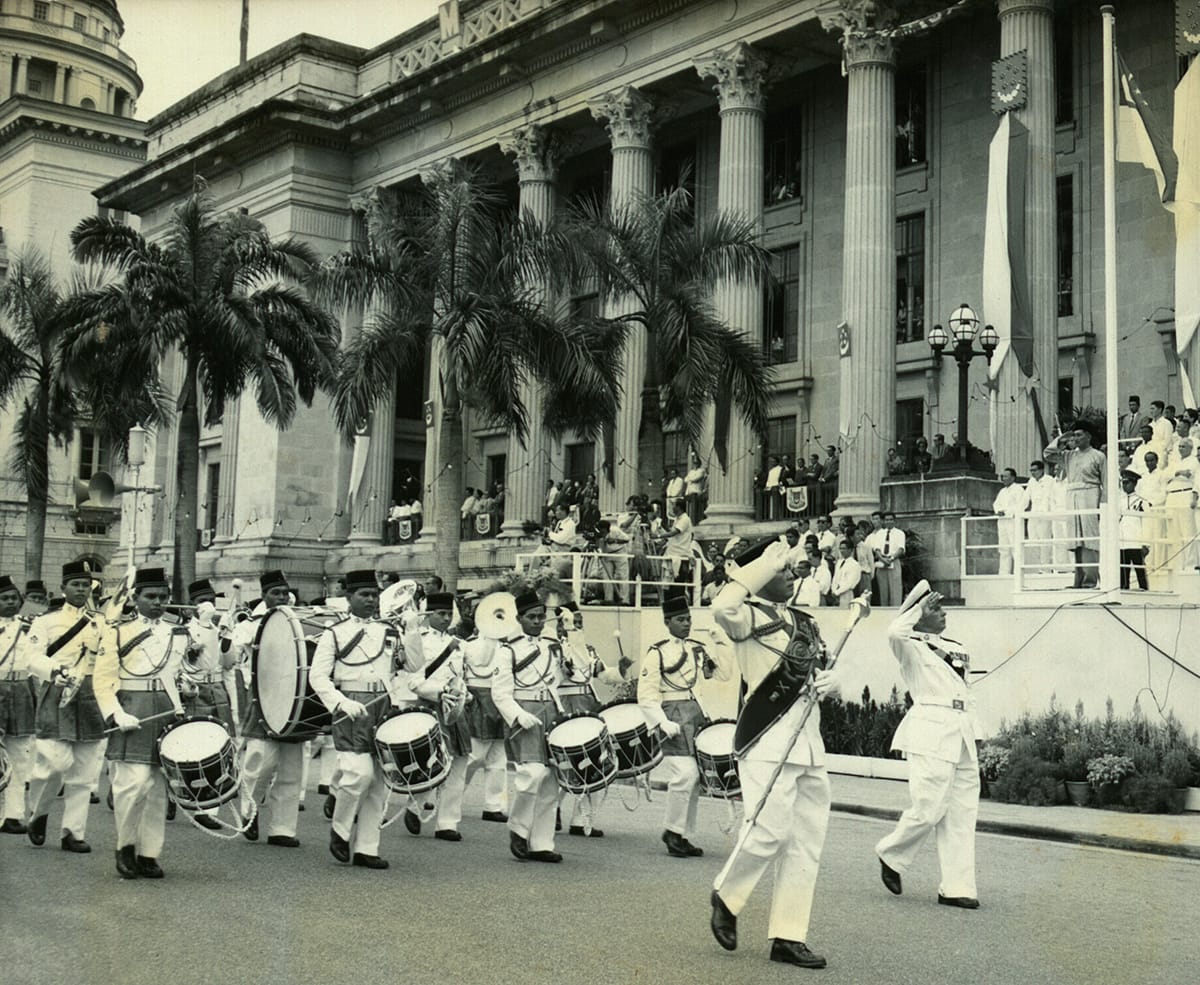
March-past by the Singapore Police Force Band in front of City Hall at the installation of Yusof Ishak as Yang Di-Pertuan Negara on 3 December 1959. Yusof Ishak Collection, courtesy of National Archives of Singapore (Media - Image No. 20090000506 - 0020).
History was made on 28 December 1960 when Boyle handed leadership of the SPF Band to his successor, Ridzwan Salmy Mulok, the first local bandmaster and Director of Music, at a ceremony at the Police Training School. “The drums rolled out the introduction to the state’s National Anthem last night and, for the last time, the Singapore Police Force played under the baton of Mr. J.E. Boyle, their retiring Director of Music,” the Singapore Free Press reported. Boyle became emotional as he handed over the baton to Ridzwan. “Again the band struck, and to the strains of ‘Auld Lang Syne’ Mr. Boyle, who was responsible for bringing the band up to its present high standard, marched off the parade ground.”46
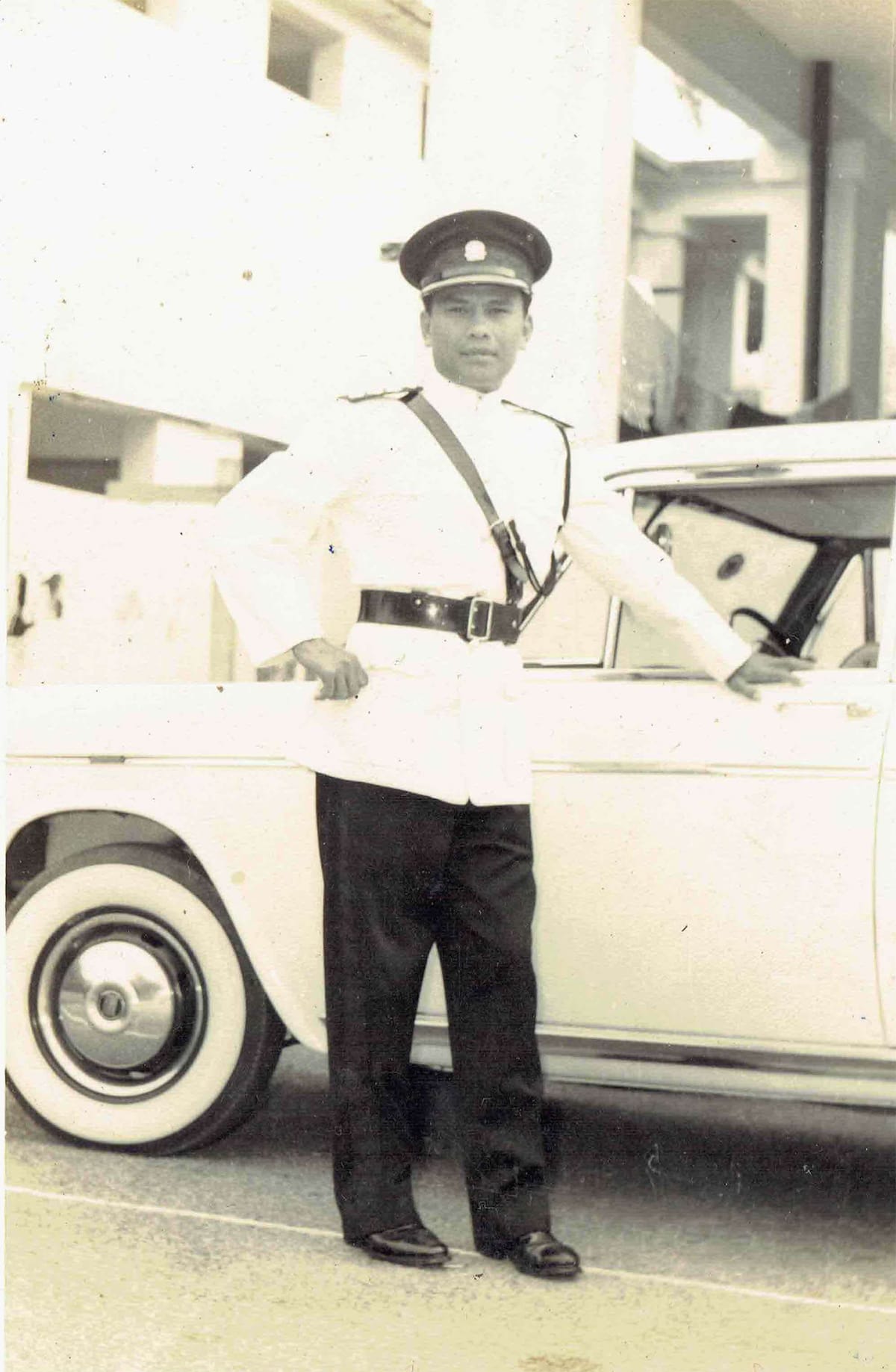
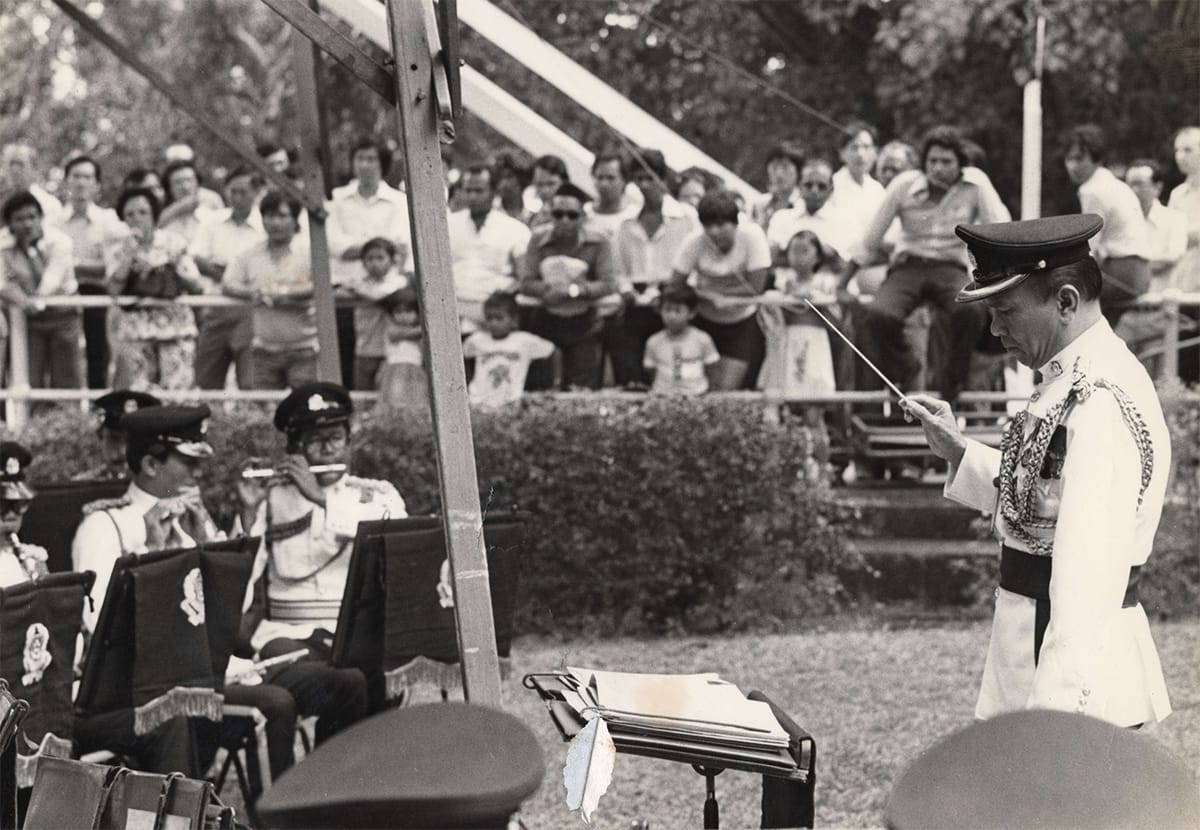
In 1965, following Singapore’s independence, Ridzwan composed the Singapore Police Force March, which is played as the last piece during any major police event or parade, before the National Anthem. It remains the official police march to this day.47 Under Ridzwan, the SPF Band expanded its repertoire to include more contemporary pieces. In December 1978, as part of the month-long Festival of the Arts, the band performed Christmas carols, music from the Swedish pop group ABBA, medleys from the Herb Alpert & The Tijuana Brass band, and movie theme songs from Exodus, Lawrence of Arabia and Star Wars as part of a series of outdoor performances.48
In the 1980s, the SPF Band played a part in “paving the way to a good relationship between the police and the public”, as the force “switch[ed] from traditional to community-oriented policing”. One of the band’s objectives then was to project a softer image of the police force.49 Today, the band continues to tour and perform overseas.50
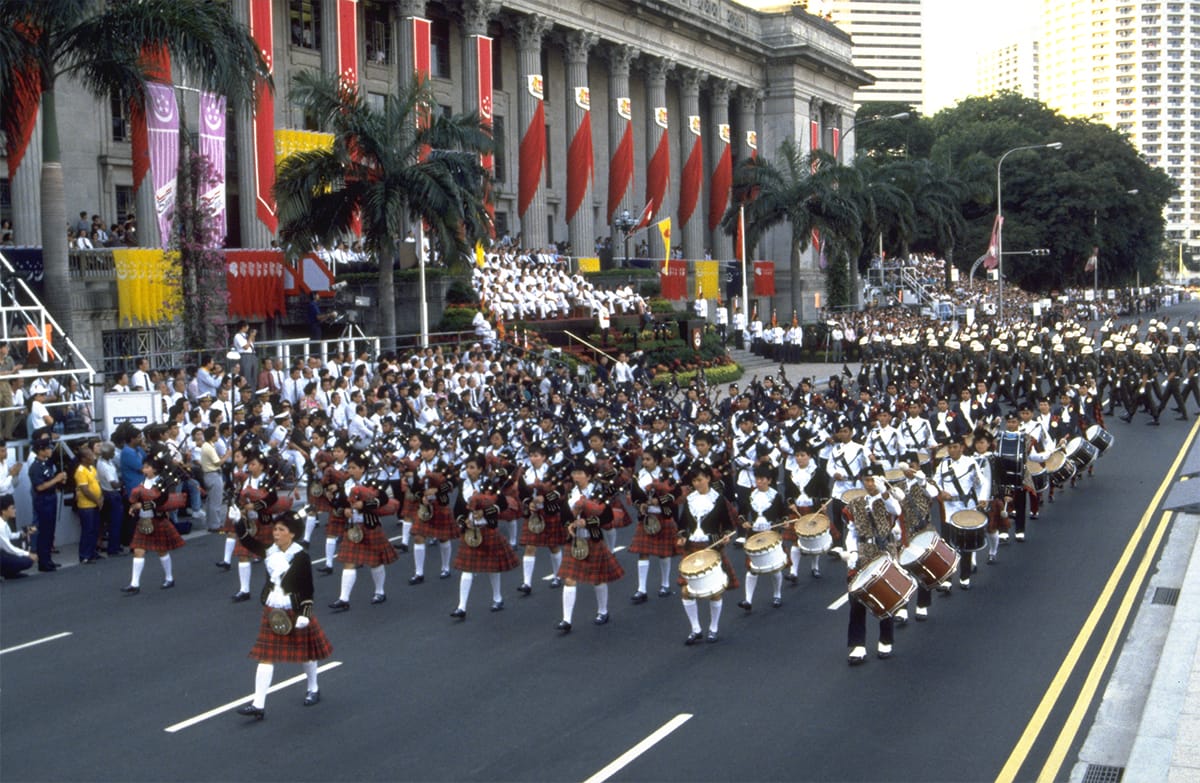
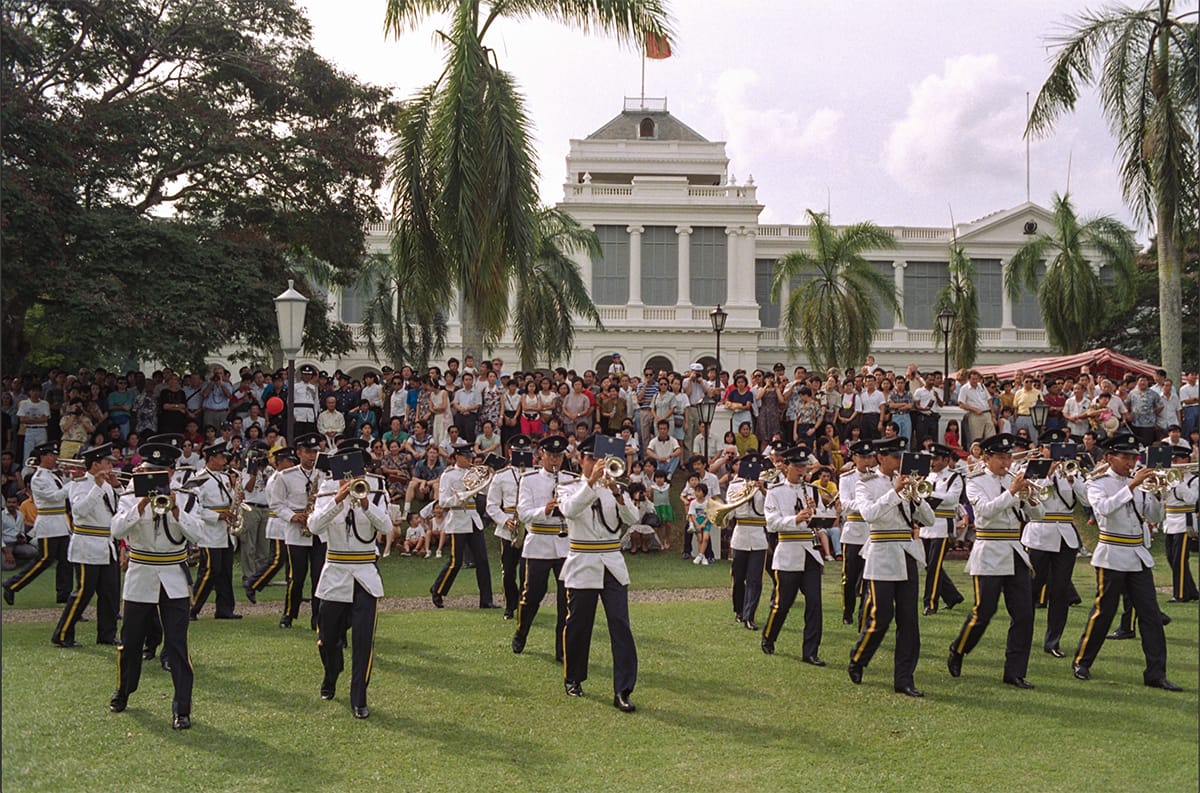
In 1986, Idris Mohamed Yusof succeeded Ridzwan as Director of Music and later led the band at the prestigious Edinburgh Military Tattoo in 1991.51 Amri Amin took over in 2004 as the third Director of Music. Under his leadership, the band was transformed from a military unit into a modern performance band, and was featured in various local and global events.52
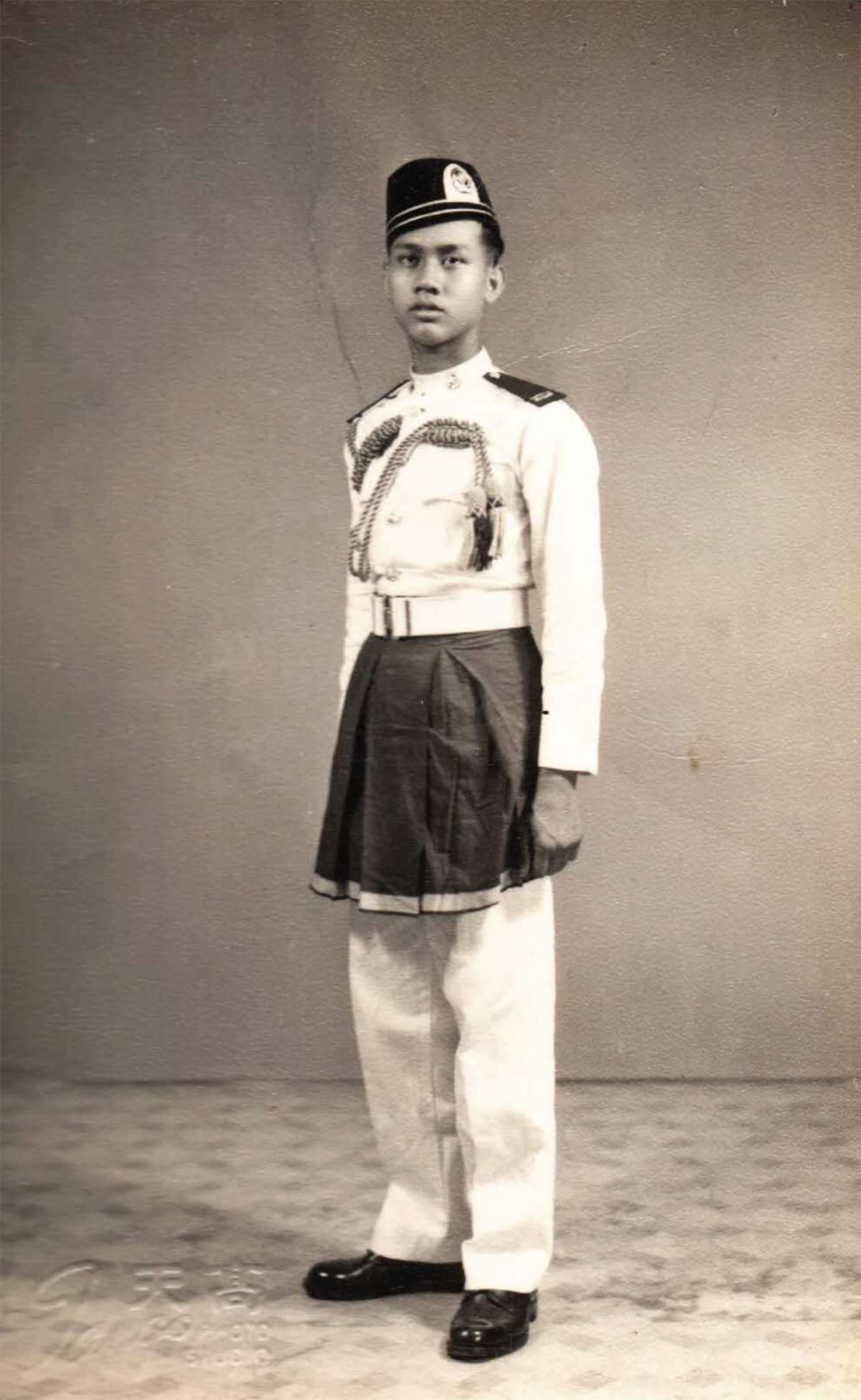
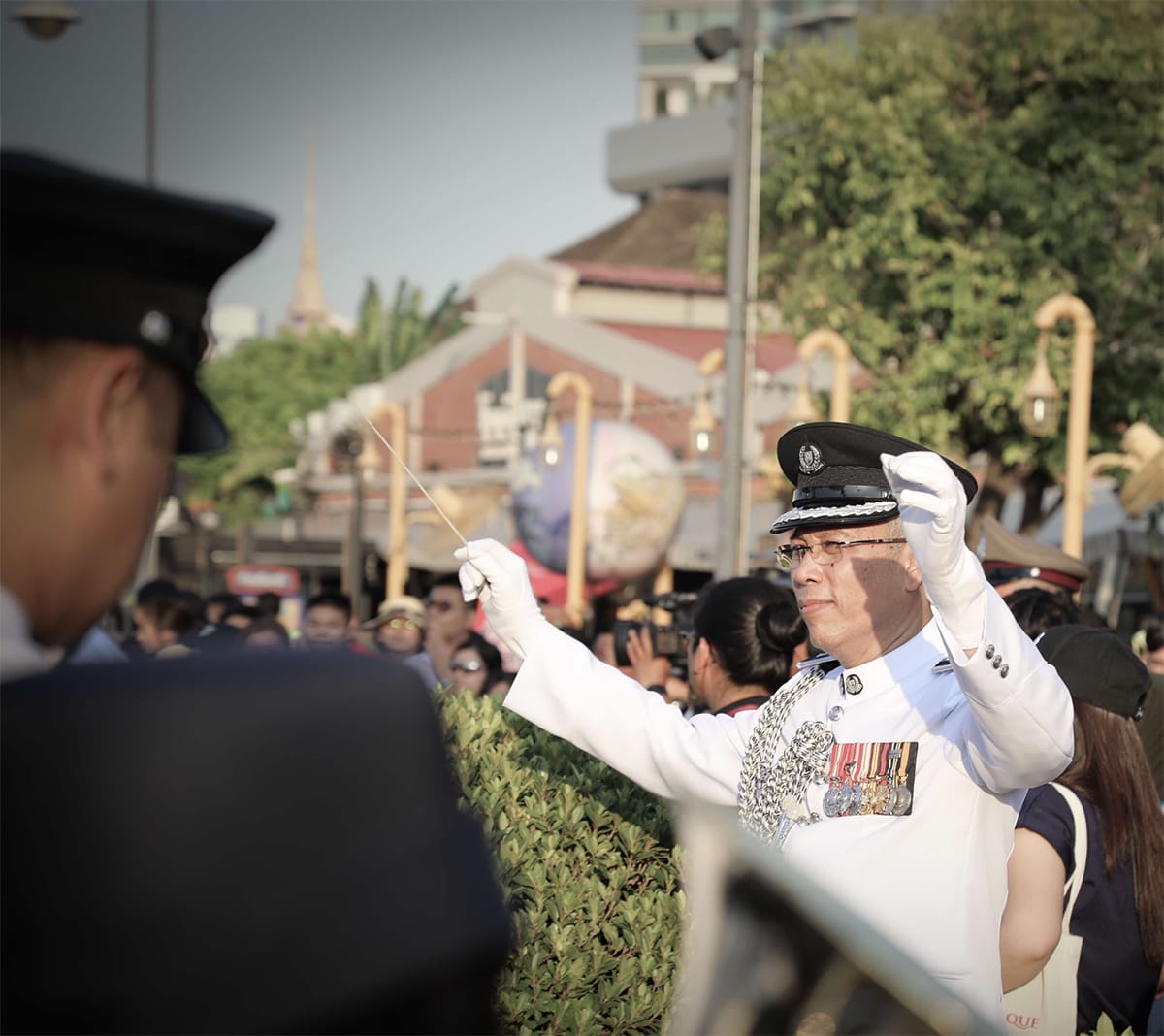
The SPF Band’s repertoire has since grown to encompass more local, global and popular music, with original compositions and arrangements by band members. Since 2019, the 64-member band has been led by Director of Music Sulaiman Abdul Wahab.53 The band continues to engage the community through music and public performances at events such as National Day Parades and police community roadshows. Besides the main band, there are also the Military Band, the Women Police Pipes and Drums band, the Gurkha Contingent Pipes and Drums Platoon, and smaller ensembles including the Fusion Quintet, the Combo Band and the Showband.
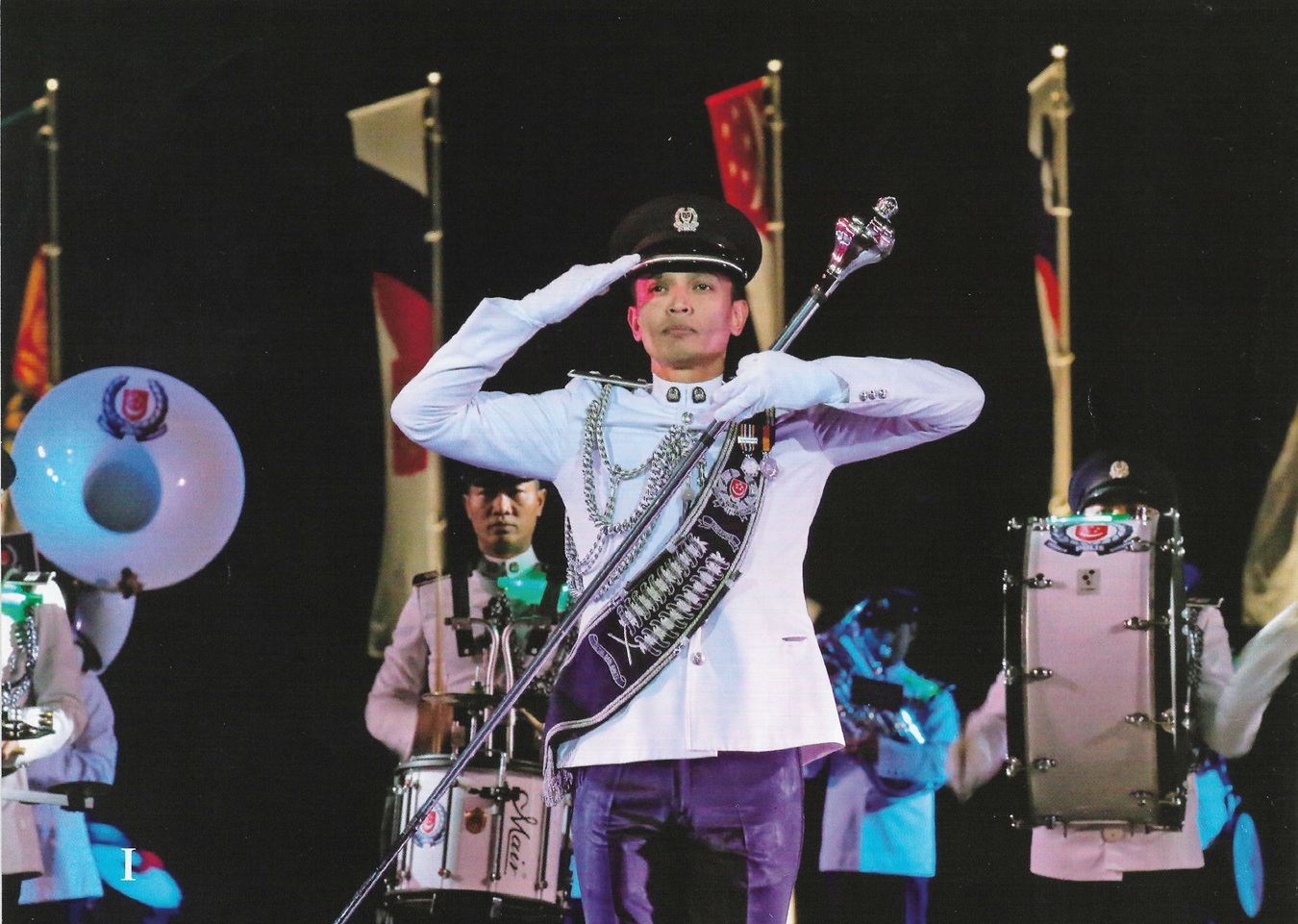
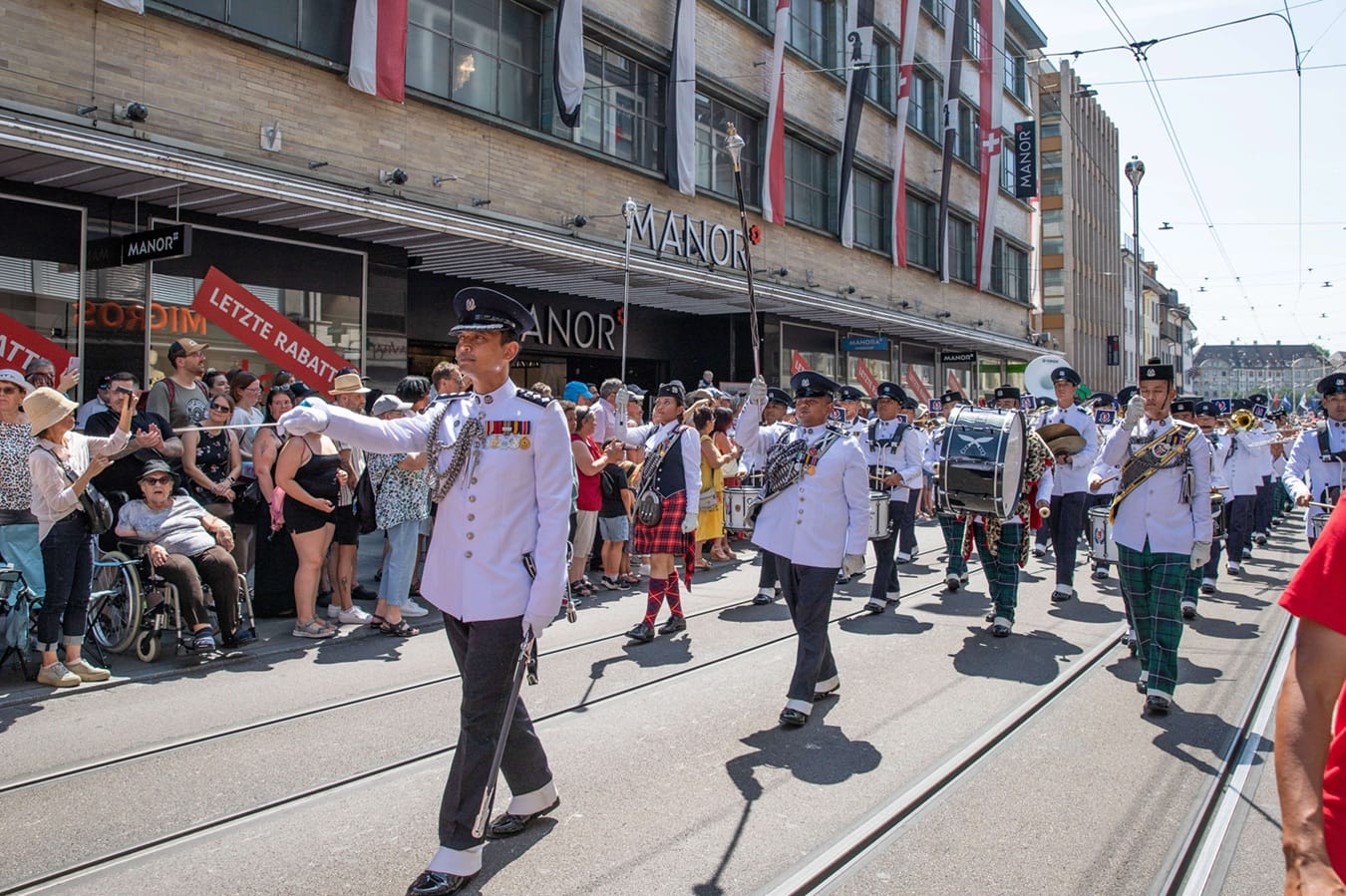
To cap its year-long celebration commemorating its centennial in 2025, the SPF Band entertained more than 1,000 guests at a gala concert at the Esplanade Concert Hall on 30 December with iconic favourites, classical works as well as original pieces by former and present band members. “It is a tremendous honour to mark 100 years of the SPF Band. This concert celebrates not only our history and growth, but also the passion, artistry, and devotion of every officer – past and present – whose contributions have woven the rich tapestry of our enduring legacy,” said Sulaiman.54
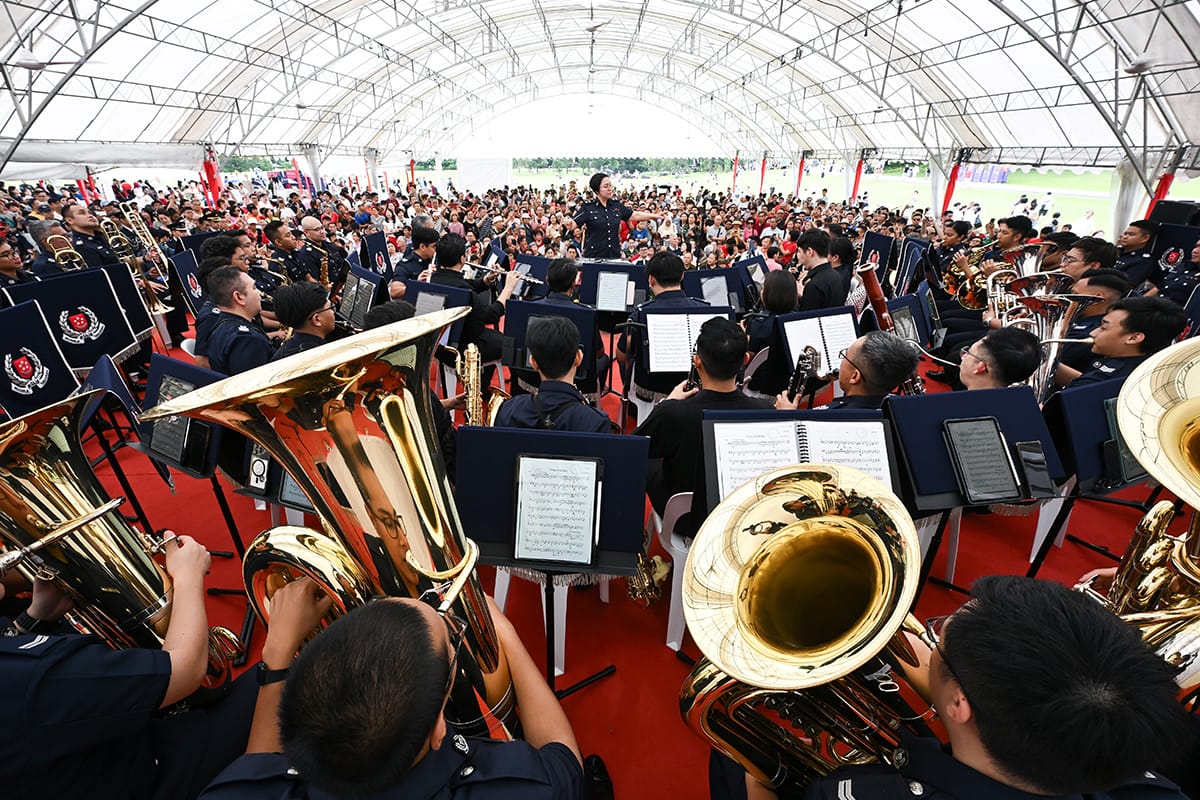
Deputy Superintendent of Police Lau Lifeng conducting the Singapore Police Force Band during the Lunar New Year Istana Open House on 2 February 2025. This performance marked the start of the band’s 100th anniversary series of performances in 2025. Source: The Straits Times © SPH Media Limited. Permission required for reproduction.
About the Author
Dr Eugene Dairianathan is the co-author of First Steps to Music (3rd edition) for primary schools in Singapore. He is currently an independent researcher, whose research interests include interdisciplinary perspectives on music and education, and local musical practices in Singapore.
This article acknowledges funding from an academic research grant by the National Institute of Education, Singapore (NIE-AcRF Grant RI 5-20 ED), assistance from the National Archives of Singapore as custodians of the scores in a private collection, the Singapore Police Force Band as legal owners of the private collection and the National Institute of Education Library, NTU, Singapore, as custodians of the reconstructed scores and digital audio realisations from the research project.
Endnotes
1 “The Police Band (opens in new tab),” Singapore Free Press and Mercantile Advertiser, 26 March 1927, 11; “The New Public Band (opens in new tab),” Singapore Free Press and Mercantile Advertiser, 18 May 1925, 8. (From NewspaperSG)
2 “The King’s Birth Day (opens in new tab),” Singapore Chronicle and the Commercial Register, 26 April 1827. (From NewspaperSG); Eugene Dairianathan and Phan Ming Yen, A Narrative History of Music in Singapore 1819 to the Present (Singapore: National Arts Council, 2005), 261, https://repository.nie.edu.sg/entities/publication/f2fd3ddb-a04f-468a-8257-11f0842527d5 (opens in new tab).
3 Dairianathan and Phan, A Narrative History of Music in Singapore 1819 to the Present, 260–61.
4 Charles Burton Buckley, An Anecdotal History of Old Times Singapore (opens in new tab), Vol. 1 (Singapore: Fraser & Neave, Limited, 1902), 216. (From National Library Online)
5 Gregory, D. Booth, “The Madras Corporation Band: A Story of Social Change and Indigenization,” Asian Music 28, no. 1 (1996–1997): 61–86. (From JSTOR via NLB’s eResources (opens in new tab) website); Dairianathan and Phan, A Narrative History of Music in Singapore 1819 to the Present, 262.
6 “The Singapore Free Press (opens in new tab),” Singapore Free Press and Mercantile Advertiser, 7 December 1865, 2. (From NewspaperSG)
7 “Untitled (opens in new tab),” Straits Times Overland Journal, 23 November 1869, 7. (From NewspaperSG); Alec Soong and Goh Lee Kim, “Singapore Volunteer Corps (opens in new tab),” Singapore Infopedia. National Library Singapore. Article published October 2021.
8 “Summary of the Week (opens in new tab),” Straits Times Overland Journal, 12 December 1878, 1. (From NewspaperSG)
9 “Minutes of a Meeting of the Municipal Commissioners Held on the 7th of September 1888 (opens in new tab),” Pinang Gazette and Straits Chronicle, 25 September 1888, 6. (From NewspaperSG). The Singapore Volunteer Rifle Corps was disbanded on 16 December 1887 coinciding with the enactment of the Municipal Ordinance of 1887 to create a separate authority, the Municipal Commission, that would oversee local urban affairs in Singapore. See “Municipal Commission Is Created (opens in new tab),” National Library Online. Article published 2013. The Singapore Volunteer Rifle Corps was revived and succeeded by the Singapore Volunteer Artillery on 22 February 1888. See Soong and Goh, “Singapore Volunteer Corps (opens in new tab).”
10 “The Municipality (opens in new tab),” Straits Independent and Penang Chronicle, 22 May 1889, 5. (From NewspaperSG)
11 “Public Band Performances (opens in new tab),” Singapore Free Press and Mercantile Advertiser, 7 January 1896, 7. (From NewspaperSG)
12 “The Santa Cecilia Band (opens in new tab),” Mid-day Herald, 9 January 1896, 2. (From NewspaperSG)
13 “Page 18 Advertisements Column 2 (opens in new tab),” Singapore Free Press and Mercantile Advertiser, 14 May 1895, 18; “The Santa Cecilia Band (opens in new tab),” Mid-day Herald, 29 August 1896, 3. (From NewspaperSG)
14 “Page 2 Miscellaneous Column 1 (opens in new tab),” Singapore Free Press and Mercantile Advertiser, 15 June 1895, 2; “Page 2 Miscellaneous Column 1 (opens in new tab),” Singapore Free Press and Mercantile Advertiser, 20 June 1895, 2. (From NewspaperSG)
15 “Saturday, March 21, 1896 (opens in new tab),” Singapore Free Press and Mercantile Advertiser, 24 March 1896, 8; ““Lady Mitchell’s Reception (opens in new tab),” Singapore Free Press and Mercantile Advertiser, 17 April 1896, 2. (From NewspaperSG)
16 “The Bandsmen (opens in new tab),” Mid-day Herald, 28 August 1896, 2. (From NewspaperSG); “The Santa Cecilia Band (opens in new tab).”
17 “Santa Cecilia Band (opens in new tab),” Straits Times, 24 February 1897, 3; “Thursday, 27th April (opens in new tab),” Straits Budget, 28 April 1899, 15; “Untitled (opens in new tab),” Singapore Free Press and Mercantile Advertiser, 29 April 1899, 2. (From NewspaperSG)
18 “Untitled (opens in new tab),” Straits Times, 7 September 1900, 2. (From NewspaperSG). On 12 December 1901, the Singapore Volunteer Artillery, Singapore Volunteer Rifles, Singapore Volunteer Infantry and Singapore Volunteer Engineers were officially reorganised as the Singapore Volunteer Corps. See Soong and Goh, “Singapore Volunteer Corps (opens in new tab).”
19 “A Suggested ‘Singapore Volunteer and Public Band’ (opens in new tab),” Singapore Free Press and Mercantile Advertiser, 31 January 1901, 13. (From NewspaperSG)
20 “Town and Volunteer Band. Lapsed Through Lack of Support (opens in new tab),” Straits Budget, 10 January 1907, 19; “Town and Volunteer Band (opens in new tab),” Straits Times, 4 January 1907, 6. (From NewspaperSG)
21 “The Town and Volunteer Band (opens in new tab),” Eastern Daily Mail and Straits Morning Advertiser, 7 February 1906, 3. (From NewspaperSG)
22 “Town and Volunteer Band (opens in new tab).”
23 “S.V.C Orders (opens in new tab),” Straits Times, 19 October 1911, 3. (From NewspaperSG)
24 “Police Parade (opens in new tab),” Singapore Free Press and Mercantile Advertiser, 27 November 1923, 6. (From NewspaperSG)
25 “Police Parade (opens in new tab).”
26 “The Mails (opens in new tab),” Pinang Gazette and Straits Chronicle, 28 March 1924, 6. (From NewspaperSG)
27 “Straits Police Band. Return from Recruitung Campaign at Penang (opens in new tab),” Straits Budget, 4 April 1924, 21. (From NewspaperSG)
28 “Police Recruiting (opens in new tab),” Pinang Gazette and Straits Chronicle, 2 April 1924, 7; “Police Recruiting (opens in new tab),” Straits Times, 5 April 1924, 11. (From NewspaperSG)
29 “Untitled (opens in new tab),” Straits Times, 6 June 1924, 8. (From NewspaperSG)
30 “Municipal Commission (opens in new tab),” Straits Echo, 21 February 1922, 186. (From NewspaperSG)
31 “Municipal Music (opens in new tab),” Straits Times, 28 August 1924, 9. (From NewspaperSG)
32 “A Municipal Band (opens in new tab),” Malayan Saturday Post Illustrated, 6 September 1924, 12. (From NewspaperSG)
33 “Municipal Music (opens in new tab).”
34 “The New Public Band (opens in new tab).”
35 “Untitled (opens in new tab),” Straits Times, 31 July 1925, 8. (From NewspaperSG)
36 “Occasional Notes (opens in new tab),” Straits Budget, 7 October 1926, 5. (From NewspaperSG)
37 “The Police Band (opens in new tab).”
38 “Inspector Minns Leaving (opens in new tab),” Straits Times, 23 May 1935, 12. (From NewspaperSG)
39 “New Bandmaster Likes to Give Public 'Zip.' (opens in new tab),” Straits Times, 3 January 1936, 12. (From NewspaperSG)
40 “Police Band in Syonan-to (opens in new tab),” Syonan Shimbun, 15 May 1942, 4; “Police Band (opens in new tab),” Syonan Shimbun, 13 August 1942, 2; “Page 2 Advertisements Column 5 (opens in new tab),” Syonan Shimbun, 2 June 1943, 2; “Police Band Program (opens in new tab),” Syonan Shimbun, 10 August 1943, 2; “Band at Farrer Park (opens in new tab),” Syonan Shimbun, 15 March 1944, 2. (From NewspaperSG)
41 “Police Band to Lose Conductor (opens in new tab),” Straits Times, 18 June 1950, 5. (From NewspaperSG)
42 “Only One Man Wants This Job (opens in new tab),” Straits Times, 15 August 1950, 7; “Colony’s New Bandmaster (opens in new tab),” Straits Times, 9 November 1950, 7. (From NewspaperSG)
43 “Municipal Commission is Created (opens in new tab),” National Library Online. Article published 2013; “Band Programme (opens in new tab),” Straits Times, 1 November 1952, 6; “Band Music to Continue (opens in new tab),” Straits Times, 26 January 1953, 7. (From NewspaperSG)
44 “Band on the Air (opens in new tab),” Straits Times, 6 March 1960, 11. (From NewspaperSG)
45 “The Boy Mozart Ably Portrayed by Convent Girls (opens in new tab)” Singapore Free Press, 5 August 1960, 7; “Fairy Opera Starts Tomorrow (opens in new tab),” Singapore Free Press, 12 August 1959, 10. (From NewspaperSG)
46 “A Moment of Police History (opens in new tab),” Singapore Free Press, 29 December 1960, 1. (From NewspaperSG)
47 Azfer Ali Khan, “The Police March,” Police Life 40, no. 10 (October 2014): 10, https://www.police.gov.sg/~/media/spf/files/publications/pdf/plm/plm201410.pdf (opens in new tab).
48 “Police Band Delights (opens in new tab),” Straits Times, 14 December 1978, 30. (From NewspaperSG)
49 “Music to Help Police Image (opens in new tab),” Straits Times, 15 April 1983, 11. (From NewspaperSG)
50 “Police Band to Play Military, Pop Tunes on Tour (opens in new tab),” Straits Times, 20 April 1972, 5; “Police Band in Perth (opens in new tab),” Straits Times, 18 September 1978, 10. (From NewspaperSG)
51 “The Singapore Police Force Band (opens in new tab),” New Paper, 10 June 1995, 5. (From NewspaperSG)
52 Amanda Wong, “Honouring Past Generations of the SPF Band and Carrying on Their Tradition of Musical Excellence!” Singapore Police Force, 31 October 2023, https://www.police.gov.sg/media-hub/police-life/2023/10/the-beat-goes-on (opens in new tab).
53 Wong, “Honouring Past Generations of the SPF Band and Carrying on Their Tradition of Musical Excellence!”
54 “Singapore Police Force Band Commemorates 100th Anniversary with Gala Concert,” Singapore Police Force, 31 December 2025, https://www.police.gov.sg/media-hub/news/2025/12/20251231_singapore_police_force_band_commemorates_100th_anniversary_with_gala_concert (opens in new tab); Al Cheng, “A Legacy in Music: The SPF Band Marks 100 Years with a Centennial Gala,” Singapore Police Force, 31 December 2025, https://www.police.gov.sg/Media-Hub/Police-Life/2025/12/A-Legacy-in-Music-The-SPF-Band-Marks-100-Years-With-a-Centennial-Gala (opens in new tab).