
Article
Saving Traditional Chinese Pastries
9 September 2026
Topics
Food
In a BiblioAsia Podcast episode, pastry chef Yeo Min talks about how she became interested in Chinese pastries and why she wrote the book Chinese Pastry School.
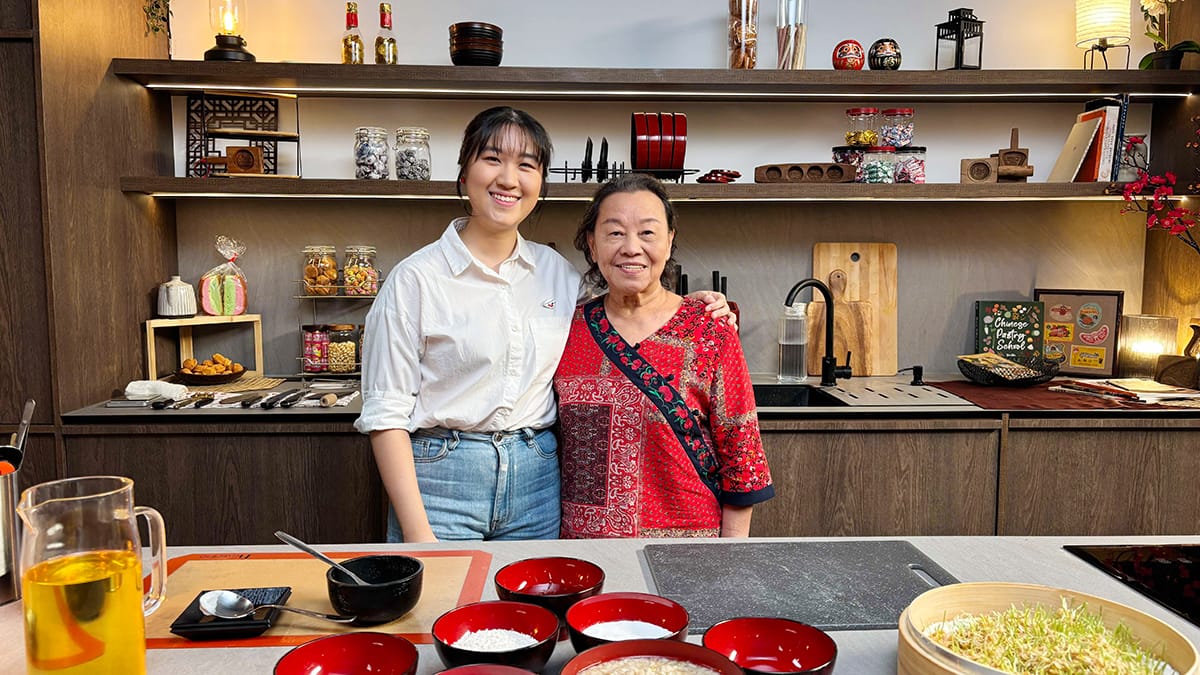
Yeo Min and her mentor Chef Pang Nyuk Yoon, 2025. Photo by Woo Pei Qi.
Yeo Min is the author of Chinese Pastry School (Marshall Cavendish Cuisine, 2024), founder of Pastories Bakery (https://www.thepastories.com/ (opens in new tab)) and co-founder of the Museum of Food (https://www.foodmuseumsg.com/ (opens in new tab)), a nonprofit for heritage food education.
Jimmy
Tell us about the book Chinese Pastry School. It has more than 200 pages, and you didn’t just write and do the research. You also took the photographs, and the photographs are amazing. You’re very talented. Why did you put the book together?
![Published by Marshall Cavendish Cuisine, 2024. Collection of the National Library Singapore (Call no. 641.865 YEO-[COO]).](https://isomer-user-content.by.gov.sg/339/51d63cf0-378c-4123-9c86-58064c73ec28/Published-by-Marshall-Cavendish-Cuisine,-2024.jpg)
Published by Marshall Cavendish Cuisine, 2024. Collection of the National Library Singapore (Call no. 641.865 YEO-[COO]).
Yeo Min
So I was in pastry school at the time [in the early 2020s]. I quit my job. I want[ed] to be a pastry chef because then I [could] do creative work, maybe earn more money. I was wrong about the second part. So I was there for the Western French skills. Then I met my teacher, my mentor, Chef Pang [Nyuk Yoon]. She’s in her 70s. She’s this amazing chef, and she had so much to share. She taught one or two classes on traditional pastry. But she also shared that they had been cutting back on the curriculum quite a bit, and it’s always the traditional stuff that gets cut.
Jimmy
Because there’s no market for it?
Yeo Min
Yeah. You graduate with a diploma in pastry, you [will] most likely go work in a five-star hotel or a Michelin-star kitchen. Very few graduates would go to traditional bakeries.
Jimmy
Kueh also?
Yeo Min
We didn’t learn ang ku kueh [a pastry made from glutinous rice flour typically filled with mung bean paste]. We learned how to make mooncakes. And I asked, “Why are we not learning how to cook the paste from scratch?” And she said, “You can just buy it outside.” It pained her to say that too. So she talked me through the steps, and I was very inspired. Then many traditional pastry shops closed down. So that was around the time that the Hokkien bakery Tan Hock Seng announced their closure.
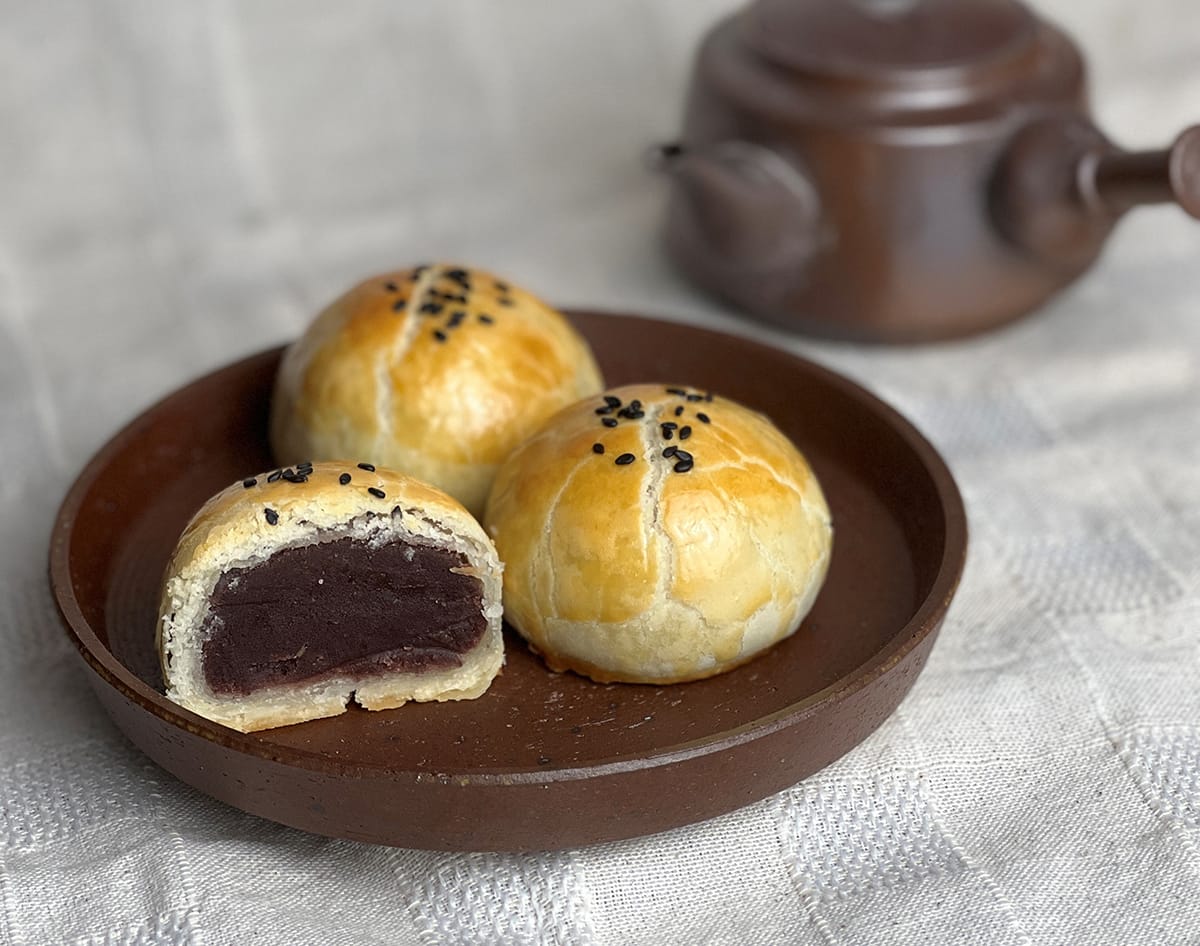
Suzhou-style mooncakes shaped into domes by hand instead of being pressed into mooncake moulds, 2024. Photo by Yeo Min.
Jimmy
Where were they located? And what were they known for?
Yeo Min
Somewhere in Chinatown. They were known for their beh teh saw [a flaky pastry filled with maltose], made fresh. I was quite shocked. I thought, “Why am I not doing anything about this? And why is nothing being done about this?” So, as always, I took matters into my own hands because what am I supposed to do, right? I see a problem; I can’t just wait around. That’s not really my style. So I was like, “What actually is failing here? Why is this happening?”
And I realised that the French are so successful because they are so open with sharing their recipes. They have schools all over the world. They share their techniques everywhere. But at the same time, Chinese people being Chinese people, or Asian people being Asian people, we are like, “Aiya, paiseh, paiseh lah” [“Oh dear, I’m so embarassed.”]. This is a very humble technique. I’m not going to force my children to take on this business.
Jimmy
I think you can’t force them because they don’t want to learn.
Yeo Min
Yeah. And there’s this idea of the hardworking Asian. If you want to learn my craft, you commit your whole life to me. There’s no such thing as a six-month internship.
Jimmy
You have to come in and scrub the dishes.
Yeo Min
Yes. You have to start by throwing the trash, and you work your way up. I respect that these chefs spend their entire lives building an empire, their business, all these recipes. So I respect that, but that is a sure way for our practices to die, for these techniques to just disappear. And I was like, “Okay, if I can learn all these basic French techniques in 18 months, including a six-month internship... so actually 12 months was all it took to cover all the basic techniques, everything from sugar to chocolate sculpting, to plated desserts, gelato, croissants.” So I was like, “Can I do the same for Chinese pastries? Is there a way that I can maybe consolidate all these techniques, translate it to an accessible language?”
.jpg)
Yeo Min’s recreation of bee pung or bee pang (mi chang), made using puffed rice, maltose and black sesame seeds, 2025. According to Chef Pang Nyuk Yoon, this rice cracker snack was often served at weddings back in the day, although white sesame seeds were used then instead of black. Photo by Woo Pei Qi.
Jimmy
Is there a place out there that teaches all these things?
Yeo Min
There isn’t a single place because Chinese pastry is very diverse. Everything is divided by region.
Jimmy
It’s very complicated.
Yeo Min
It’s very complicated. But if you think about it, the French went through the same thing. Certain pastries belong to certain regions, and then they became a huge thing, and then everyone now eats them. I guess there’s a bit of knowledge lost, like which part of France this came from. But at the same time, there are so many people making these now, and we are forced to study a bit of the history in pastry school. So I thought maybe I can do the same, but I can’t set up a school ’cause I have no funding.
Jimmy
Hence the name of the book.
This is an edited extract of the full interview. Listen to the full episode on BiblioAsia Podcast, “A Woman’s Mission to Revive Traditional Chinese Candy (opens in new tab)”.
Check out the book, Chinese Pastry School (opens in new tab) (Call no. 641.865 YEO-[COO]).