
Article
Singapore’s Experience of the Great Depression
29 June 2026
Topics
History
When the Great Depression struck, Singapore’s trade-dependent economy faltered, tin and rubber prices plummeted, businesses closed and people faced immense hardship.
By Darren Seow
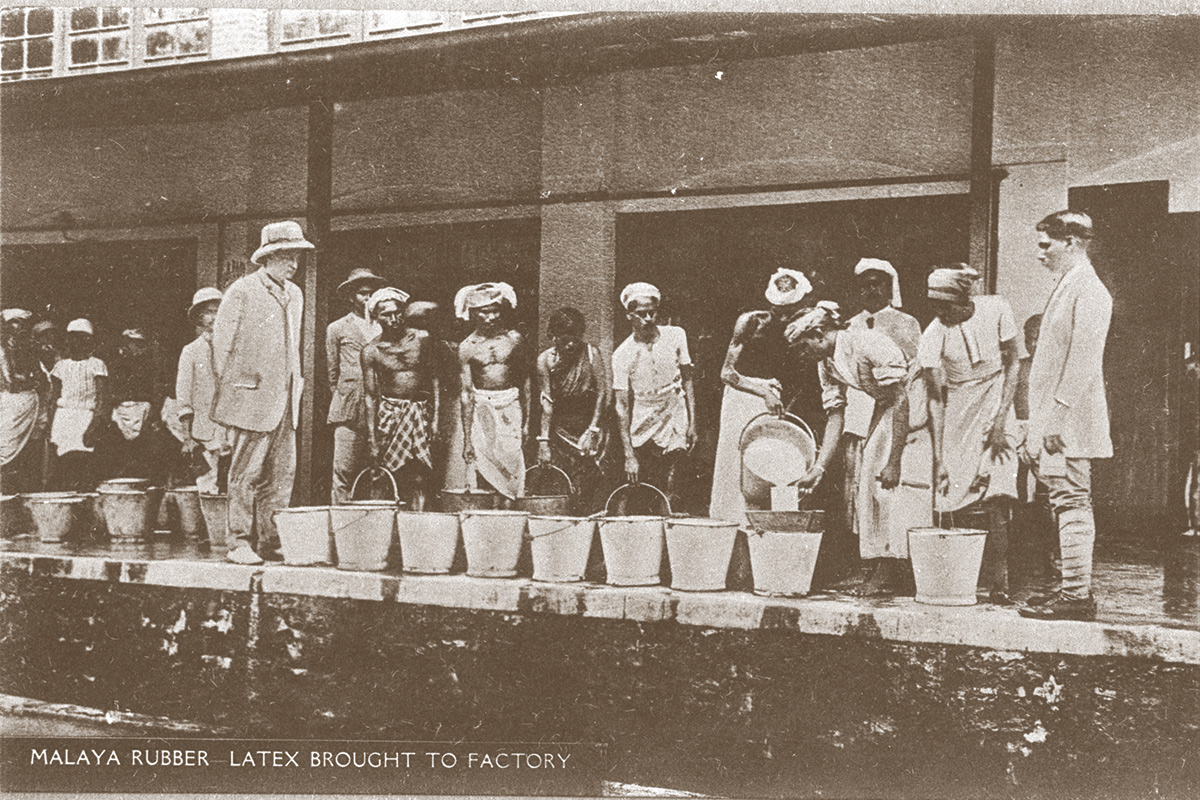
Latex brought to a factory to make rubber, c. 1920. Rubber was Malaya’s chief staple export, and the value of Singapore’s rubber exports declined by 84 percent between 1929 and 1932 during the Great Depression. Lim Kheng Chye Collection, courtesy of National Archives of Singapore (Media - Image No. 19980005883 - 0001).
In February 1933, a correspondent with the Malaya Tribune cast a doleful eye over the streets of Singapore. “Oh! [H]ow sad it is to see so many shops which, before the slump, used to be full of all sorts of valuable goods, are now closed,” wrote the correspondent using the pseudonym “Lucky Star”. “I wonder whether you will be moved with pity and sympathy, when you see these rows and rows of vacant shops.” She lamented that many people were suffering from starvation and even the educated could not find a job. “Oh, what a sad place Singapore is!”1
“Lucky Star” was describing a scenario common during the Great Depression, which lasted from 1929 to 1939. As it swept across the globe, Singapore – dependent on international trade and the export of Malayan rubber and tin to the American market – was badly hit.2 The collapse of the US automotive industry caused rubber demand and prices to plummet, falling from an average of 34 cents per pound in 1929 to an all-time low of 4.95 cents in June 1932. Tin prices also fell from an average of $104.27 per picul in 1929 to $60 in 1931. Between 1929 and 1932, the value of Singapore’s rubber exports declined by 84 percent and tin by 68 percent. This contrasted with the period 1921 to 1925, when rubber exports rose by 384 percent and tin by 74 percent.3
The Depression affected all segments of the community: rubber planters and tin miners, labourers, hawkers, businessmen, shopkeepers, clerks, school leavers, office workers, Europeans, locals, the wealthy, the poor, the educated, the uneducated – nobody was spared.4
Collapse of Trade
In 1929, business in Singapore weakened. The building boom subsided, land prices fell and further private development largely ceased. Speaking at the annual meeting of the Singapore Chamber of Commerce on 25 March 1930, chairman J. Bagnall said: “All the surrounding territories from which Singapore draws its trade became financially embarrassed as rubber and other produce declined in value, and the resulting contraction of business and credit led to many failures among various classes of dealers and shopkeepers in Singapore, some very heavy and almost all having liabilities out of all proportion to assets.”5
Six months later, the situation deteriorated further. Around 500 shops had closed since 1 June 1930, and the value of imports in the first half of that year fell by 11.5 percent to $37.5m compared with the same period in 1929, while exports plunged nearly 15 percent to $39m. The new Chamber of Commerce chairman, J. Robertson, noted that while “[i]t is almost a truism to say that trade recovery may confidently be expected in course of time, but an examination of all the circumstances, can only lead to the conclusion that the time is not yet”. He called upon merchants to “exercise a further measure of patience and courage before the end of this slump is sighted”.6
High Cost of Living
While businesses struggled, ordinary residents faced financial strain from high living costs and rents. In May 1930, the Malaya Tribune observed that although the prices of necessities in Singapore had generally fallen by a negligible margin, some items actually became more expensive, with imported foods remaining costly. This was contrary to expectations that the widespread depression would bring about a “welcome deflation”. It was difficult to persuade the ordinary individual that he was not being “stung” by high costs.7
Rents were a particular concern. Despite poor financial conditions, house rents saw a general increase of 4 percent in 1930. Many landlords preferred to leave their houses vacant rather than rent them out.8
People wrote to the press to voice their displeasure. In a letter published in the Malaya Tribune on 21 June 1930, a reader stated: “In Singapore here and there a few concerns and individuals have made slight reductions, but the majority have so far turned a deaf ear to the woes of their tenants.” The writer added that it was “high time they realised that it would pay them better to reduce rents and keep all their houses occupied than to retain high rents and have most of the houses unoccupied for months”. The writer also pointed out that the Municipality “have not seen fit to reduce their boom-time rates” for electricity and gas.9
Living costs remained high by mid-1932. “Singapore is rightly ranked among the most expensive cities in the world,” the Malaya Tribune reported. Rents stayed above prewar levels, causing many people to share houses with relatives or friends. Although food prices had fallen to some extent in line with the general price decline and clothing was relatively cheap, “the sum total of living costs is considerably above what might be recognised as a reasonable level”.10
To provide shelter for those in need, the Malaya Tribune reported in April 1933 that cheaper municipal houses off Balestier Road were available for rent at $7 per month and included free water supply, while three- to four-room houses in Geylang were leased for $18 to $20 per month. These working-class dwellings were “a boon to the poorer classes in these days of depression”.11
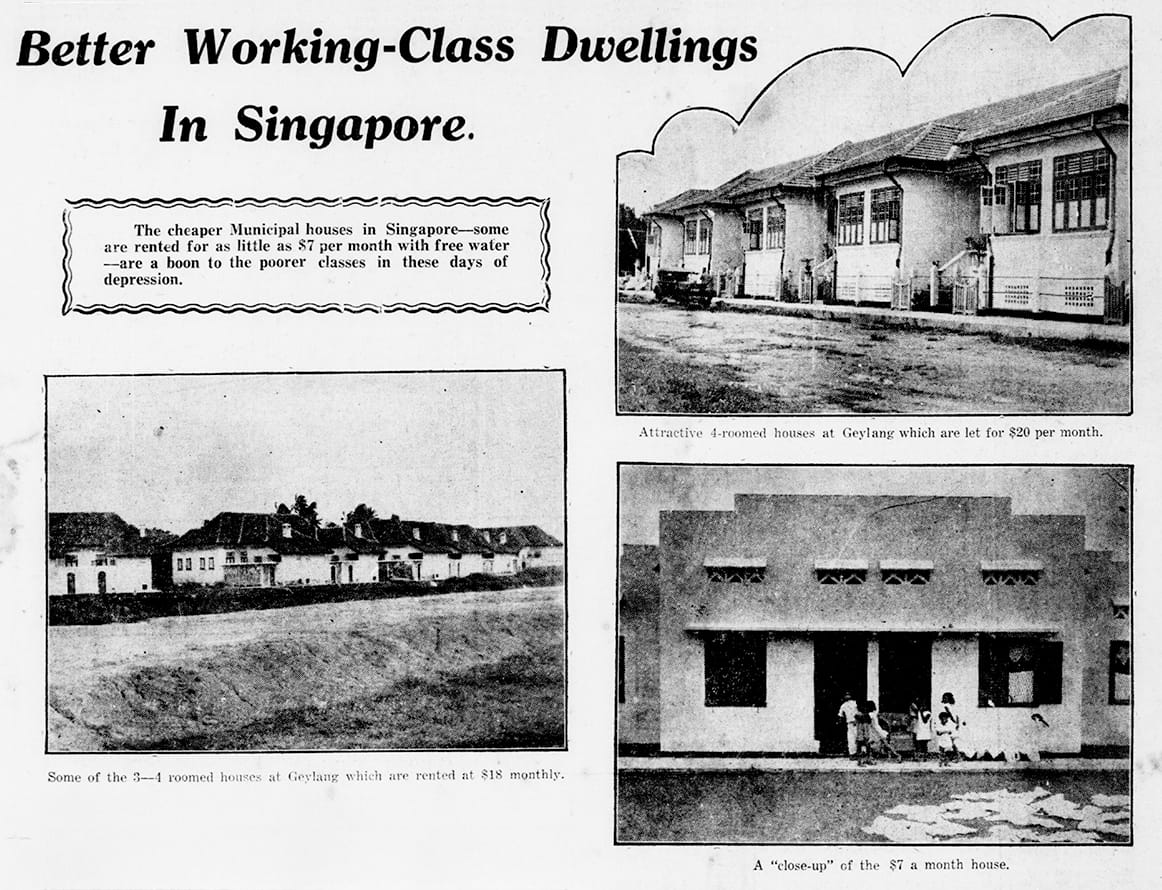
During the Great Depression, the Municipality provided affordable housing for the people. Image reproduced from “Better Working-Class Dwellings in Singapore,” Malaya Tribune, 1 April 1933, 20. (From NewspaperSG).
Many people turned to pawning their valuables to raise funds. Pawnbrokers not only used their own capital but also accepted deposits, paying about 8 percent interest per annum. By charging over 20 percent interest on pledged articles, they made considerable profits. Despite these margins, pawnbroking was not a sure win. As the Malaya Tribune noted, “there are more people pledging articles than redeeming them”. The paper added that “[t]here is no market for expired pledges, so that they have to be sold at sacrifice prices in order that they might be turned into money”.12
To make things worse, some pawnbrokers used deposits from customers to invest in rubber plantations, tin mines and other businesses, which were badly hit by the Depression. “They place these deposits in the pawn-shops to earn a little interest and for safe-keeping,” reported the Malaya Tribune, “Imagine the plight and disappointment of these poor people!” According to the newspaper, the “liabilities in these failures amount to hundreds of thousands of dollars”.13
In November 1930, the Straits Times reported that the proprietor of a pawnshop on Havelock Road had received deposits ranging from $500 to $1,000 from hundreds of poor people. They earned an interest of 90 cents to $1 on $100 per month during the slump; in normal times, the rate was 70 to 80 cents. The pawnbroker admitted he “had acted as banker for hundreds of poor people, and that from their deposits he had lost as much as $200,000”. The money was used to speculate in the proprietor’s jewellery business, which had failed when gold prices fell.14
Hard Times
The Depression brought widespread unemployment and hardship. Many able-bodied people, along with the aged and infirm, were begging on the streets by May 1930. “One of the biggest blots on the fair name of Malaya is the almost resolute lack of provision for the destitute,” wrote the Malaya Tribune. “These – able-bodied people who cannot find work, and the decrepit and the aged poor – are many in number, and are to be seen any day in the principal streets of all our towns, begging of all who pass, and often exposing vile diseases as an incentive to the charitable,” the paper noted.15
A letter to the Malaya Tribune describing “Singapore’s destitute people” highlighted the growing problem of starving beggars, particularly able-bodied individuals willing to work. At eating stalls, beggars asked diners for leftovers and “sometimes a man putting down his chopsticks for a moment finds his food grabbed from his plate”.16
Coolies were hit particularly hard. The Straits Times reported on 6 June 1930 that unemployment had led to “terrible consequences” among the “coolie class”, reaching the “proportions of a menace”. Applications for repatriation at the Chinese Protectorate had surged. In normal times, about 50 coolies unable to support themselves were sent back to China yearly. That week, 170 left within two days, while 250 to 300 applied for free passage on each of two other days. Many were able-bodied men thrown out of work; others had been nearly starving for months. The Straits Times suggested suspending immigration “since every new arrival serves to complicate further a problem which may have far-reaching effects on the future of Malaya”.17
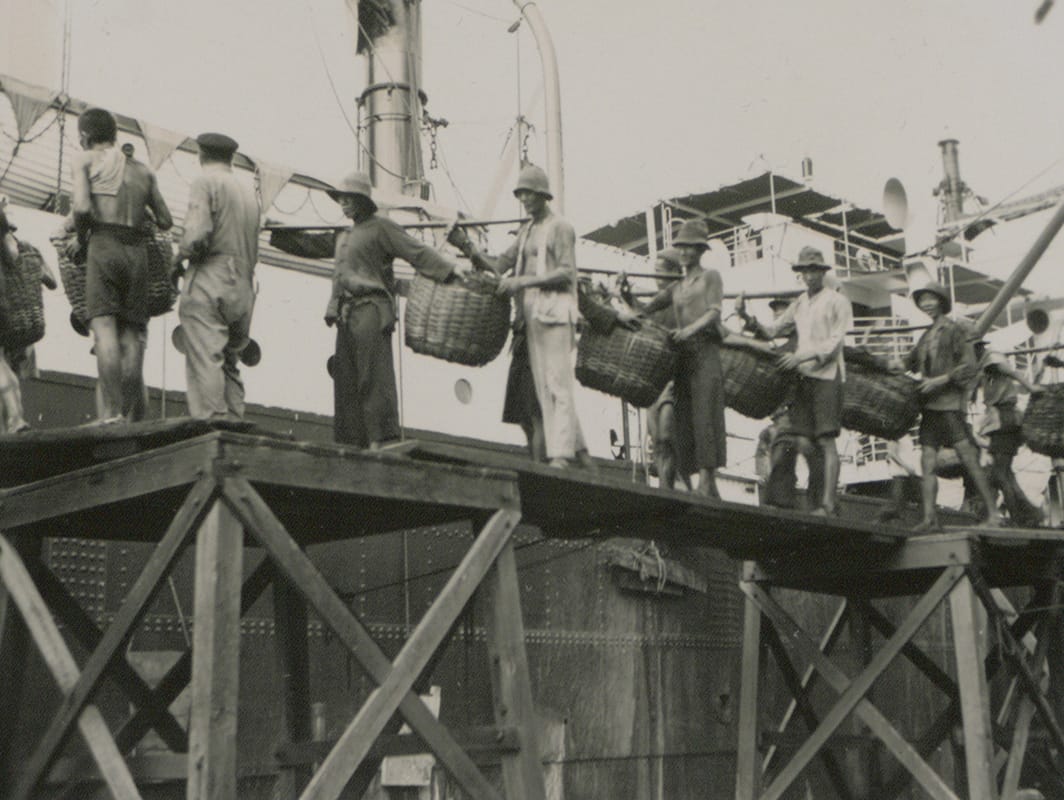
Coolies unloading goods from a ship at the Singapore River, 1930s. Many labourers and other workers were unemployed during the Great Depression. Allen Goh Collection, courtesy of National Archives of Singapore (Media - Image No. 20060000783 - 0089).
Since June 1930, the government had begun repatriating “decrepit and destitute Chinese” from Singapore. It also introduced quotas on Chinese male arrivals from August that year. As Secretary for Chinese Affairs A.M. Goodman reported at the Legislative Council: “There was a great deal of unemployment among able-bodied labourers… it was apparent that it was still on the increase.” He was of the view that restriction of new arrivals was imperative. This quota system worked as Chinese immigration fell sharply from 242,139 to 27,796 between 1930 and 1933.18
Additionally, between 1931 and 1933, there were around 443,000 more Chinese who left Singapore than those who arrived. As W.G. Huff, an economic and social history professor noted, mass emigration was a “safety valve” that prevented “the depression from turning into a disaster in the city”.19
Domestic servants were similarly affected by the Depression as European families cut back on household staff to reduce expenses. On 7 August 1930, the Straits Times had written about the “excessive rate” of servants’ wages which ranged from $35 to $45 a month. By 1933, amahs (female domestic servants) were “anxious to receive a good post for as little as $10 a month or even less”, down from $30 a few years earlier, to “ensure that they have at least a home and somewhere to sleep”.20
 with a child in her care 1930.jpg)
A Cantonese amah (female domestic servant) with a child in her care, 1930. By 1933, many amahs were willing to be paid $10 a month or less, down from $30 before the Great Depression. Mrs J. A. Bennett Collection, courtesy of National Archives of Singapore (Media - Image No. 19980005147 – 0009).
Hapless Hawkers
As the slump deepened, many unemployed individuals took to hawking as their sole means of “earning even a small pittance”. However, this caused problems within the Municipality and by December 1929, it had enforced reforms that prohibited itinerant hawkers “not only in the area bounded by New Bridge Road, Anson Road, Cecil Street, Cross Street and Upper Cross Street, but also in practically all the streets of Singapore,” the Straits Times reported.21
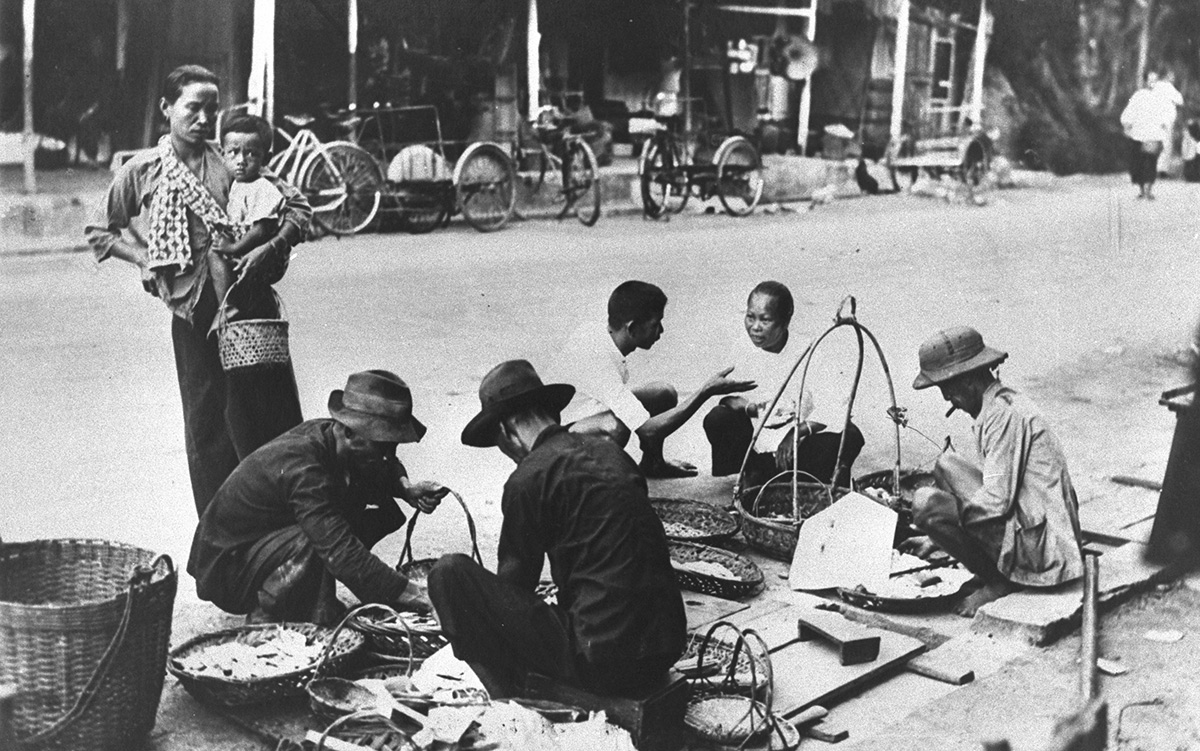
Street hawkers with their customers, 1920s. Hawkers were among the most vulnerable during the Great Depression. Courtesy of National Archives of Singapore (Media - Image No. 19980005092 - 0034).
Numerous hawkers were arrested for obstruction or for hawking without a licence. The Straits Times estimated some 4,000 unlicensed hawkers on the streets. With unemployment rising and the “vigilant trekking of the police from every conceivable angle”, the newspaper described their situation as “precarious and unenviable”. Yet they “cannot simply sit down and starve” – one might become “a beggar tomorrow, and a thief the next day”.22
Each morning, the court’s holding areas were filled with the “flotsam and jetsam of Singapore streets”: people who had tried to earn a living by hawking, only to breach municipal bylaws. One Chinese woman arrested for selling ice water explained: “I thought I would at least eke out an honest living by becoming a hawker... I was fined $2, but I have not the means to pay the fine, so I have to spend the day behind these bars until this afternoon.”23
People voiced their support for hawkers through letters to the press. In November 1930, a Malaya Tribune reader described the “deplorable” situation of these hawkers: “The struggle for existence, particularly among the hawker class, is by no means easy. They are confronted not only with the difficulty of disposing of their goods, which seem to yield no very great return, especially during the slump period, but also with the need to battle against the law.”24
Public figures also expressed sympathy. On 26 March 1931, Municipal Commissioner Seow Poh Leng wrote to the Straits Times and the Malaya Tribune that “the law should be administered with leniency and tolerance, and a means of obtaining food and other necessities of life at a cheap rate which these hawkers provide should not be denied to the poor citizens who form by far the larger proportion of the population”.25 In desperation, some hawkers decided to end their lives. On 23 January 1931, 25-year-old hawker Ng Cheu killed himself, leaving behind his parents. “He committed suicide because he was deprived of his means of livelihood,” Seow later recounted.26
Relief came only in late 1931. The Municipal Town Cleansing Department reported a relaxation in enforcement: “[T]he revenue from licensing of hawkers decreased by $6,168, as compared with 1930. This was partly due to stall-holders in specified streets giving up their licences and the cancellation of many others… Relaxation of measures against unlicensed hawkers was undoubtedly the cause of this, as it was more profitable to hawk without a licence.” Fines collected from hawkers in arrest and summons cases also decreased by $12,687, reflecting the reduced enforcement pressure.27
The Educated Unemployed
By May 1930, distress among the middle class was evident. As the Malaya Tribune reported, “[v]ery many people of a good social class, Europeans and Asiatics, are unemployed and dependent on relations or friends, or upon the debasing art known as ‘scrounging’ or ‘cadging’”.28
The Straits Times described one unemployed European as “tramping miles and having scores of abortive interviews, and developing a pronounced inferiority complex”. In response, the paper offered free advertising space for “victims of the slump” – Europeans and Asiatics who had lost their jobs due to the Depression – to advertise their skills. The first advertisement, featuring five individuals, appeared on 10 July 1930.29
The unemployment situation worsened towards the end of that year. A Malaya Tribune reader described the extent of the problem: “[E]nergetic, educated Europeans and Eurasians, shabbily dressed, can be seen hanging round eating-houses and coffee-shops, and walking about the streets looking for employment and unable to find it.” The writer proposed that the government establish a “Labour Bureau to keep men of good character until they find employment instead of letting them be disgraced by deporting them from the country, and wasting public funds”.30
The crisis also extended to clerks and other middle-class workers residing permanently in Singapore. “The sad and depressed faces of out-of-work clerks who are to be met with in Change Alley and Raffles Square are reminders that something must be done quickly to relieve the victims of the slump,” said H.C. Chan, honorary secretary of the Clerical Union, at a meeting in October 1930. Several hundred clerks were unemployed by November, with their dependents likely numbering over a thousand. The Malaya Tribune called on those still in employment to contribute to the Asiatic Unemployment Fund set up by the Clerical Union. “[E]very dollar given brings a handsome repayment in the heartfelt gratitude of unhappy people whose only fault is that Fortune has frowned upon them.”31
Women Seeking Work
As husbands or fathers lost their jobs, women often became breadwinners. Many women without training and work experience as well as qualified stenographers sought assistance at the Young Women’s Christian Association (YWCA). In July 1932, the YWCA at Raffles Quay established the Goodwill Service Depot to assist women without any means of support. Under experienced supervision, women fulfilled service orders by sewing, knitting, mending and cooking.32
At the YWCA's annual general meeting on 14 February 1933, Mrs A. Eklund, president of the Singapore branch, said that the association “had given help to a large number of women and children during the past year” and even some men. The president of the Malayan branch, Mrs B.C. Roberts, noted that the YWCA was doing “very valuable work in Singapore… especially in these times when things were very distressed”. “I think there is absolutely no indication that this Association is giving way to the natural depression in this country,” she added.33
In April 1933, more than 70 women had registered for work at the depot, and those whose work had proved satisfactory were employed. Over time, their output improved. “The women receiving orders appreciate this opportunity of self-help (no charity is given) and endeavour to please customers. Any orders, however small, may be of value to women who are without any means of support,” the Malaya Tribune reported. Services included sewing and mending men’s and women’s pyjamas and shirts (prices ranging from $1 to $2.50), as well as hand hemstitching and simple embroidery.34
On 2 December 1933, the YWCA put up a stall selling goods made by the women at the Christmas Bazaar held at the Victoria Memorial Hall. Lady Clementi, wife of Governor Cecil Clementi, awarded the cup for the most decorative stall to the YWCA. “I have decided to give the cup to this stall because it is the most original, inasmuch as the work on display has been done by the women themselves and shows good industry,” she said.35
Hope and Recovery
Singapore’s economy began to recover in late 1933 – though only partially – alleviating some of the earlier hardships.36 On 25 July 1933, speaking at the Durbar (meeting of Malay rulers and British administrators) at Kuala Kangsar, Governor Cecil Clementi welcomed the recent rise in tin and rubber prices. “[T]he worst of the slump is over,” he said. “We may… look forward into the years ahead with full confidence that before long prosperity will return to Malaya.”37
On 2 October that year, at a meeting of the Legislative Council, Clementi noted that the “Colony had made headway against the ‘economic blizzard’ and Malaya as a whole had weathered the storm better than most other countries”. He felt the worst was over and hoped that “we might soon be once more in smooth waters”.38
Three weeks later, Acting Treasurer L. Rayman told the council that the colony’s financial situation was “fortunate and enviable”, with a higher than expected surplus. “We must be careful of this surplus and guard against being moonstruck by ‘beams from larger economic lunacy’,” he cautioned. “[W]ith prudent management of our surplus, [we can] win through to smoother waters safely and unimpaired.”39
By the mid-1930s, rising rubber prices – still well below 1929 levels – led to higher wages and renewed immigration. As Huff observed, “the built-in shock-absorption capacity of emigration allowed a relatively speedy recovery from the worst effects of economic downturn”. Singapore ended the 1930s “shaken but not fundamentally changed, nor pressing for change”.
Singapore’s recovery revealed how closely its fortunes were tied to global trade. Its commitment to an open economic system and free trade held firm throughout the depression – a foundation that underpinned the rapid industrialisation from the mid-1960s, after independence. Today, Singapore’s prosperity continues to rest on an open economy driven by trade in goods and services, and facilitated by an extensive network of free trade agreements.40
About the Author
Darren Seow is a Senior Librarian with the National Library Singapore. His responsibilities include content development, research, and the provision of reference and information services.
Endnotes
1 “Lucky Star”, “Slump Time (opens in new tab),” Malaya Tribune, 25 February 1933, 2. (From NewspaperSG)
2 C.M. Turnbull, A History of Modern Singapore, 1819–2005 (opens in new tab) (Singapore: NUS Press, 2009), 146. (From National Library Singapore, call no. RSING 959.57 TUR)
3 W.G. Huff, “Entitlements, Destitution, and Emigration in the 1930s Singapore Great Depression,” The Economic History Review 54, no. 2 (2001): 290–323. (From JSTOR via NLB’s eResources (opens in new tab) website); Turnbull, A History of Modern Singapore, 1819–2005 (opens in new tab), 146; “Chamber of Commerce Review (opens in new tab),” Straits Times, 26 March 1930, 17. (From NewspaperSG); W.G. Huff, The Economic Growth of Singapore: Trade and Development in the Twentieth Century (opens in new tab) (Cambridge: Cambridge University Press, 1994), 374. (From National Library Singapore, call no. RSING 338.959570094 HUF)
4 Turnbull, A History of Modern Singapore, 1819–2005 (opens in new tab), 147.
5 “Chamber of Commerce Review (opens in new tab),” Straits Times, 26 March 1930, 17. (From NewspaperSG)
6 “Chamber of Commerce Review (opens in new tab),” Straits Times, 1 October 1930, 14. (From NewspaperSG)
7 “The Cost of Living (opens in new tab),” Malaya Tribune, 16 May 1930, 8; ““The Economic Crisis (opens in new tab),” Malaya Tribune, 12 April 1930, 8. (From NewspaperSG)
8 ““The Cost of Living (opens in new tab).”
9 “Wayfarer”, “The Cost of Living (opens in new tab),” Malaya Tribune, 21 June 1930, 11. (From NewspaperSG)
10 “That ‘H.’ in H.C.L.! (opens in new tab)” Malaya Tribune, 16 June 1932, 4. (From NewspaperSG)
11 “Better Working-Class Dwellings in Singapore (opens in new tab),” Malaya Tribune, 1 April 1933, 20. (From NewspaperSG)
12 “Chinese Topics (opens in new tab),” Malaya Tribune, 2 May 1930, 3. (From NewspaperSG)
13 “Chinese Topics (opens in new tab).”
14 “Savings of the Poor (opens in new tab),” Straits Times, 3 November 1930, 6. (From NewspaperSG)
15 “The Halt and the Lame (opens in new tab),” Malaya Tribune, 6 May 1930, 8. (From NewspaperSG)
16 “Observer”, “Singapore’s Destitute People (opens in new tab),” Malaya Tribune, 6 May 1930, 11. (From NewspaperSG)
17 “Unemployment Menace in Malaya (opens in new tab),” Straits Times, 6 June 1930, 12. (From NewspaperSG)
18 “Restriction of Chinese Immigration (opens in new tab),” Singapore Free Press and Mercantile Advertiser, 27 August 1930, 141. (From NewspaperSG); Joyce Ee, “Chinese Migration to Singapore, 1896–1941,” Journal of Southeast Asian History 2, no. 1 (March 1961): 33–51. (From JSTOR via NLB’s eResources (opens in new tab) website)
19 Huff, “Entitlements, Destitution, and Emigration in the 1930s Singapore Great Depression,” 290–323.
20 “Notes of the Day (opens in new tab),” Straits Times, 7 August 1930, 10; “Servants’ Wages (opens in new tab),” Malaya Tribune, 12 July 1933, 10. (From NewspaperSG)
21 “The Hawker Problem in Singapore (opens in new tab),” Straits Times, 31 December 1929, 20. (From NewspaperSG)
22 “The Hawker Problem in Singapore (opens in new tab)”; “Control of Hawkers in Singapore (opens in new tab),” Straits Times, 4 April 1932, 6. (From NewspaperSG)
23 “Notes of the Day (opens in new tab),” Straits Times, 5 December 1929, 10. (From NewspaperSG)
24 T.C.K., “The Hawker Problem (opens in new tab),” Malaya Tribune, 17 November 1930, 12. (From NewspaperSG)
25 “The Hawkers (opens in new tab),” Straits Times, 28 March 1931, 5; “The Hapless Hawkers (opens in new tab),” Malaya Tribune, 26 March 1931, 8. (From NewspaperSG)
26 “A Hawker’s Lament (opens in new tab),” Malayan Saturday Post, 16 May 1931, 18. (From NewspaperSG)
27 “Keeping Singapore Clean (opens in new tab),” Malaya Tribune, 12 August 1932, 3. (From NewspaperSG)
28 “The Halt and the Lame (opens in new tab).”
29 “Notes of the Day (opens in new tab),” Straits Times, 8 July 1930, 12; “Page 12 Advertisements Column 1: Victims of the Slump (opens in new tab),” Straits Times, 10 July 1930, 12. (From NewspaperSG)
30 “The Unemployment Problem (opens in new tab),” Malaya Tribune, 2 October 1930, 11. (From NewspaperSG)
31 “Unemployment (opens in new tab),” Malaya Tribune, 28 November 1930, 8; “Unemployment in Singapore (opens in new tab),” Malaya Tribune, 11 October 1930, 9. (From NewspaperSG)
32 “Unemployed Women in Singapore (opens in new tab),” Malaya Tribune, 29 June 1932, 7; “The Y.W.C.A. and Unemployment (opens in new tab),” Singapore Free Press and Mercantile Advertiser, 2 July 1932, 10. (From NewspaperSG)
33 “Y.W.C.A. Work in Malaya (opens in new tab),” Malaya Tribune, 15 February 1933, 8. (From NewspaperSG)
34 “Unemployed Women (opens in new tab),” Malaya Tribune, 8 April 1933, 10. (From NewspaperSG)
35 “Local Christmas Bazaar (opens in new tab),” Malaya Tribune, 4 December 1933, 10. (From NewspaperSG)
36 Huff, “Entitlements, Destitution, and Emigration in the 1930s Singapore Great Depression,” 290–323.
37 “Prosperity on the Way (opens in new tab),” Straits Budget, 27 July 1933, 6. (From NewspaperSG)
38 “Ultimate Solution of Rubber Problem (opens in new tab),” Straits Budget, 5 October 1933, 13. (From NewspaperSG)
39 “A Deficit of Five Millions. Colonial Treasurer Explains 1934 Estimates (opens in new tab),” Malaya Tribune, 26 October 1933, 2. (From NewspaperSG). In Clementi’s and Rayman’s statements to the Legislative Council, the Colony of the Straits Settlements consisted of Singapore, Penang and Melaka.
40 Huff, “Entitlements, Destitution, and Emigration in the 1930s Singapore Great Depression,” 290–323; “Free Trade Agreements (FTAs),” Ministry of Trade and Industry Singapore, last updated 2 June 2026, https://www.mti.gov.sg/Trade/Free-Trade-Agreements (opens in new tab).