Article
The Singapore River (Re)Imagined
25 June 2026
Topics
Arts
Places and Buildings
Across changing eras and artistic movements, artists have returned to the banks of the Singapore River to reflect on what the river means to them and what it means to be an artist.
By Luke Chua
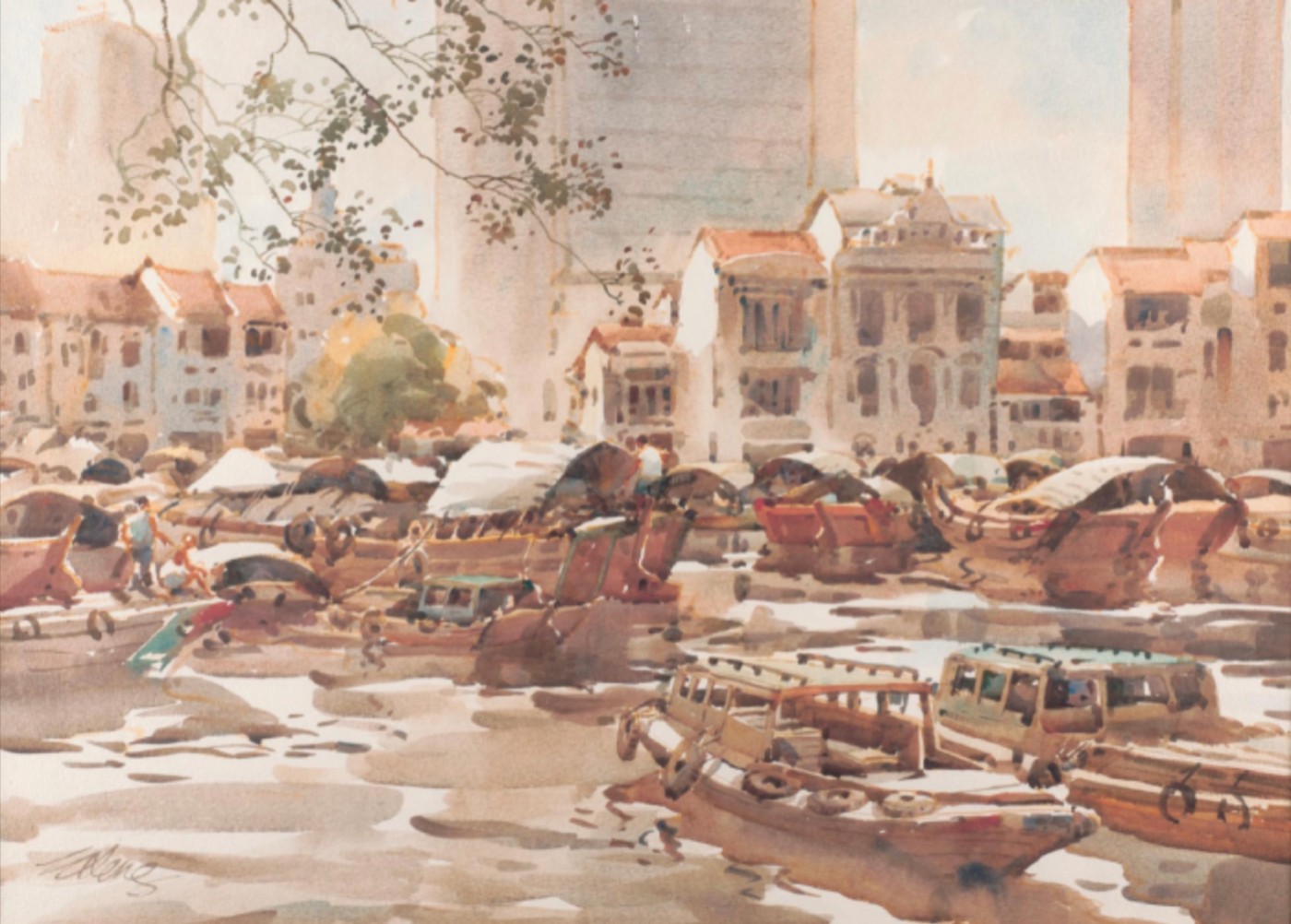
Ong Kim Seng, "S’pore River – From Raffles Landing Site", 1989. Watercolour on paper, 51.5 × 72 cm. Collection of the National Gallery Singapore, courtesy of National Heritage Board.
Throughout human history, rivers have been more than mere water bodies and geographical features. Rivers provide fresh water, support aquatic life, and facilitate transportation and trade. Rivers also form part of a community’s collective memory and history, embodying the stories of people who live along their banks and depend on them for their livelihoods.
Like the Seine in Paris and the Thames in London, the eponymous river of Singapore has inspired storytellers, artists and poets. It was the commercial lifeline of a thriving British colony in the 19th and early 20th centuries, the birthplace of the Singapore Watercolour Society in the 1960s and, in the 1980s, found itself at the centre of a debate on artistic expression.
A survey of artworks about the Singapore River uncovers not just stories of how the river evolved, but also a narrative of Singapore art itself, painted by artists who have been inspired by the historical waterway over the years.
Commerce
Early visual representations of Singapore date from the 19th century, coinciding with increased European presence in the region. During this time, images of the local landscape were often produced in Western artistic styles by Europeans for Europeans, offering a glimpse of life on the tropical island from a Western worldview.
It comes as no surprise that the Singapore River was the subject of many prints and drawings since it was the centre of commercial activity in the 19th century, supporting an entrepôt port where goods were unloaded, stored in godowns along the river and then reloaded onto vessels for export. “Images of the entrance into Singapore through the river dominate from [the] 1830s to the end of the 19th century, reflecting how the river remained the focal point of Singapore for most of the century,” wrote curator Wong Hong Suen.1
For instance, commercial activity along its banks fills the pictorial space in the watercolour and ink painting The River from Monkey Bridge (1842–43) by Charles Dyce (1816–53), dwarfing the settlement of the Orang Laut (“sea people”) on the left. The now-demolished Monkey Bridge once stood at the site of present-day Elgin Bridge and likely served as the centre of commercial activity along the Singapore River.2
![Charles Dyce, The River from Monkey Bridge, 1842–43. Watercolour and ink on paper, 35.8 × 51.5 cm. Image reproduced from Irene Lim, "Sketches in the Straits: Nineteenth-Century Watercolours and Manuscript of Singapore, Malacca, Penang and Batavia by Charles Dyce" (Singapore: NUS Museums, National University of Singapore, 2003), 52. (From National Library Singapore, call no. RCLOS 759.2911 LIM-[JSB]).](https://isomer-user-content.by.gov.sg/339/97e89c54-39f1-4c4c-883a-9c597d0662a6/Charles-Dyce-The-River-from-Monkey-Bridge-1842–43.jpg)
Charles Dyce, "The River from Monkey Bridge", 1842–43. Watercolour and ink on paper, 35.8 × 51.5 cm. Collection of NUS Museum, National University of Singapore.
Dyce was a merchant and amateur painter who stayed briefly in Singapore between 1842 and 1847, serving as the sheriff of the Straits Settlements towards the end of his stay. His paintings reflect his fascination with and documentation of the sights of tropical lands. “Dyce sought to affirm Singapore and the Straits Settlements as sites of order and mastery where colonial interests for commerce and industry may be sustained and advanced, and at the same time, to evoke the very poetics that promote emotional engagement with these lands,” observed Ahmad Mashadi, head of NUS Museum at the National University of Singapore.3
It would have been difficult to separate the Singapore River from the commercial activities that took place along its banks, as the river housed the primary port for shipping activity in Singapore until the late 1800s when it was replaced by New Harbour (later renamed Keppel Harbour), which served ships that required deep-water berths. Despite this development, the Singapore River did not lose its importance as a commercial centre in the early 20th century – merchants, trading houses and businesses continued to proliferate along the river, which developed into a logistics hub.
It was also during this time that artistic activity began to flourish in Singapore, with the establishment of groups such as the Singapore Amateur Drawing Society (1909). There are few surviving examples of paintings from this period, but the Singapore River was likely a subject of artistic interest. In 1912, the Singapore Free Press reported that an artwork titled Singapore River by Mrs L.G. Felkin clinched the first prize in the watercolours category in an exhibition organised by the Singapore Art Club – an informal club established in the 1880s whose members were mostly European ladies accompanying their husbands on postings to Malaya.4
As one of the main waterways on the island, the Singapore River also caught the attention of artists who travelled to or made Singapore their home from the early to the mid-20th century.5 For instance, artist Georgette Chen, who moved to Singapore in 1953, painted the river in works such as Singapore Waterfront (c. 1958), attesting to the importance of the site as a source of artistic inspiration. This painting shows Chen’s keen interest in bumboats as the key pictorial element giving life and vitality to the river, with shophouses receding into the background.
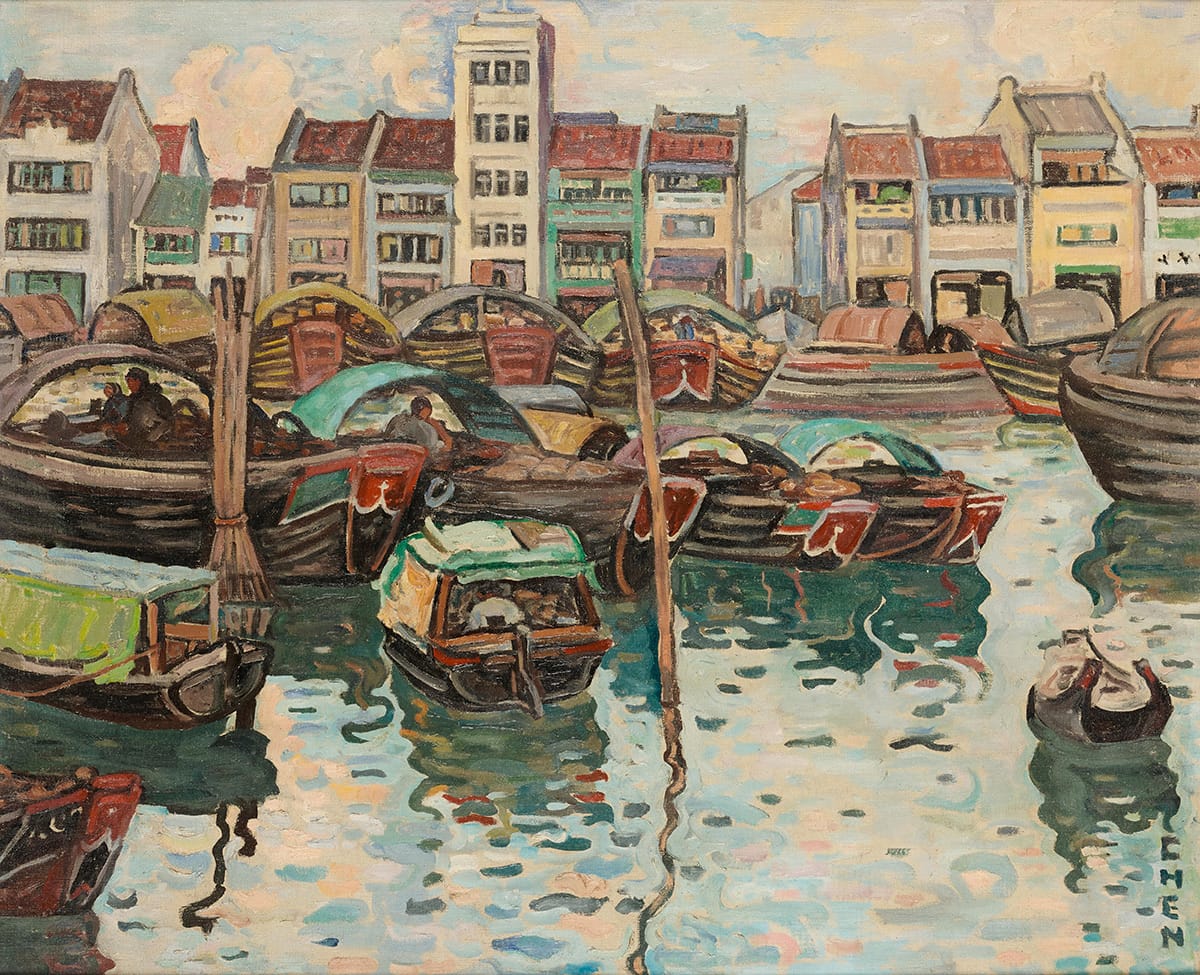
Georgette Chen, "Singapore Waterfront", c. 1958. Oil on canvas, 59 × 72 cm. Collection of the National Museum of Singapore, National Heritage Board. © Estate of Georgette Chen.
Connection
The connection these artists felt to the Singapore River took on deeper significance in the 1960s as it became a popular site for an informal group of artists who gathered on weekends to paint together. Visiting different parts of Singapore, they practised the artistic tradition of plein air (French for “open air”) where scenes were painted onsite from direct observation.6
Many artists, working across different mediums, favoured the Singapore River as the place to practise their craft. “Long before the advent of the younger generation of watercolourists, the Singapore River had cast its spell on the pioneers namely: Chen Chong Swee, Cheong Soo Pieng, Chen Wen Hsi, Georgette Chen, Liu Kang and of course Lim Cheng Hoe,” wrote artist, educator and art critic Chia Wai Hon.7
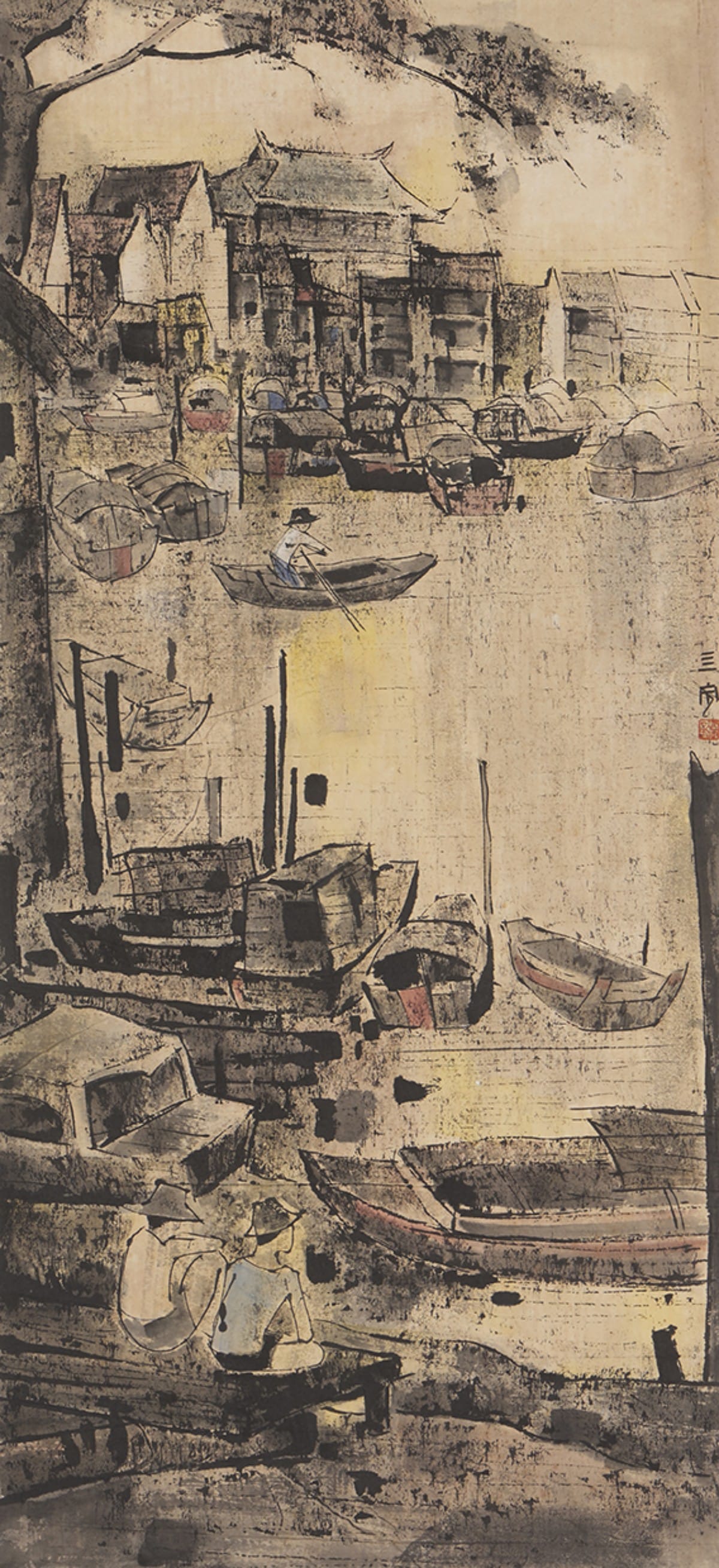
Cheong Soo Pieng, "Singapore River", c. 1961. Chinese ink and colour on paper, 60 × 111 cm. Gift of Ministry of Culture. Collection of the National Gallery Singapore, courtesy of National Heritage Board.
Lim Cheng Hoe, in particular, led other watercolourists such as Ong Chye Cho, Gog Sing Hooi and Ong Kim Seng. “They unobtrusively observed and learned from him [Lim Cheng Hoe], and painted with him on the spot. As they matured as painters in their own right, they in turn became mentors to a new generation of painters now in their early thirties,” Chia added.8
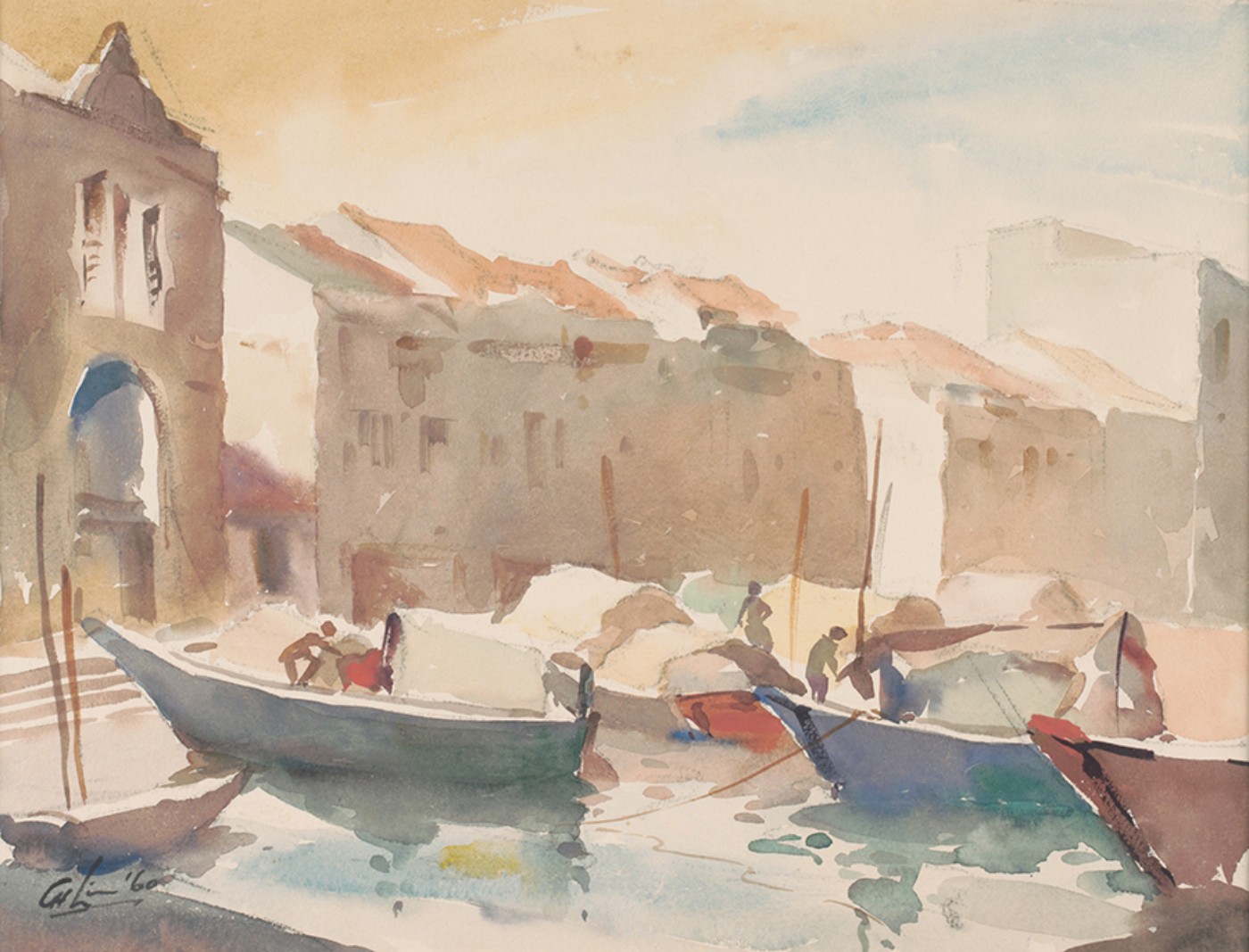
Lim Cheng Hoe, "Untitled (Singapore River)", 1960. Watercolour on paper, 34.8 × 45.5 cm. Gift of Lim Hock Ann. Collection of the National Gallery Singapore, courtesy of National Heritage Board.
It was along the riverbank that discussions on starting the Singapore Watercolour Society began.9 The society was eventually founded in 1969 by 13 individuals, many of whom were participants of the informal weekend artistic activities.10 Among the founders were Lim Cheng Hoe, Gog Sing Hooi and Chen Chong Swee, who went on to mentor and inspire many younger artists.
During this time, the river was not just a site for art practice; it was a home for artistic connections between senior artists and younger beginners, some of whom could not afford the time or money for a full-time art education. “This was a self-generating process, spontaneous and unplanned, that involved the older artists sharing their expertise and skill, not through formal lessons or organised activities, but by simply allowing the youngsters to look over their shoulders as they painted,” Chia wrote. “For the young artists this was more than just free tuition and demonstration; it was a strong motivating force which urged them to emulate their ‘master’, and to learn from one another.”11
Sculptor Ng Eng Teng was one of those who remembered the Singapore River as an informal art school. During lunchtime, Ng and a few classmates would drive out and set up their easels in front of kampongs or along the Singapore River. “Back then, there was no proper syllabus,” Ng told the Straits Times in 1998. “One week, all the students would crowd round Cheong [Soo Pieng], who would demonstrate. Then you would produce your own work. The next week, he would look at your painting and give his comments, adding a stroke here and a dash there.”12
Artist Andrew Yeo Kian Hwee also looked back fondly on the time he spent painting by the Singapore River. “I used to ponteng (cut classes) Chinese painting lessons and go to the Singapore River to sketch,” said the artist. “There used to be so many artists there and it was very common to see them squatting by the river side and drawing.”13
Between 1977 and 1987, there was a massive cleanup of the river, and artists painting along its banks would have witnessed the epochal transformation of the river from a heavily polluted waterway to a tourist attraction. Painting the river thus became a way to capture and memorialise that period in history.
Despite the filth, stench and industrial waste that characterised the river before and during the cleanup, art critic Chin Oi Tow believed that artists preferred to paint here rather than at newer and more modern sites. He wrote in the Straits Times in 1981: “The Singapore River, one of the last strongholds of the fast-vanishing old-world Singapore, has always been the hub of much artistic activity, frequented both by mature and vastly-experienced artists as well as by younger aspirants, all of whom gather here primarily to paint and also to hold discussions on all matters relating to art.”14 Against a rapidly changing Singapore, perhaps the grime represented a connection to a past that was disappearing, and this was what attracted the artists to the river.15
In 1980, Gog Sing Hooi acknowledged the need for art to reflect such changes, and that “a new art [had] to evolve to reflect the fiercely progressive nation that is Singapore”. “But right now,” he added, “the duty of the artist is to capture on canvas all that will soon disappear.”16 The Singapore River features prominently in his oeuvre, among other sites such as temples and kampongs, many of which no longer exist today.
Cliché?
At the same time, other artists were beginning to question this approach to painting the Singapore River. Cheo Chai Hiang was studying in England in 1972 when he submitted a proposal for a work titled 5' × 5' (Singapore River) to be shown at the Modern Art Society’s (MAS) annual exhibition that year. The work consisted of a set of instructions to create a blank square measuring 5 ft by 5 ft, half to be marked out by lines on the floor and half on its adjacent wall. According to art writer and independent curator Teo Han Wue, the work “challenged the dominant status accorded to painting in Singapore, especially with the Singapore River as a ubiquitous subject matter for landscape works”.17
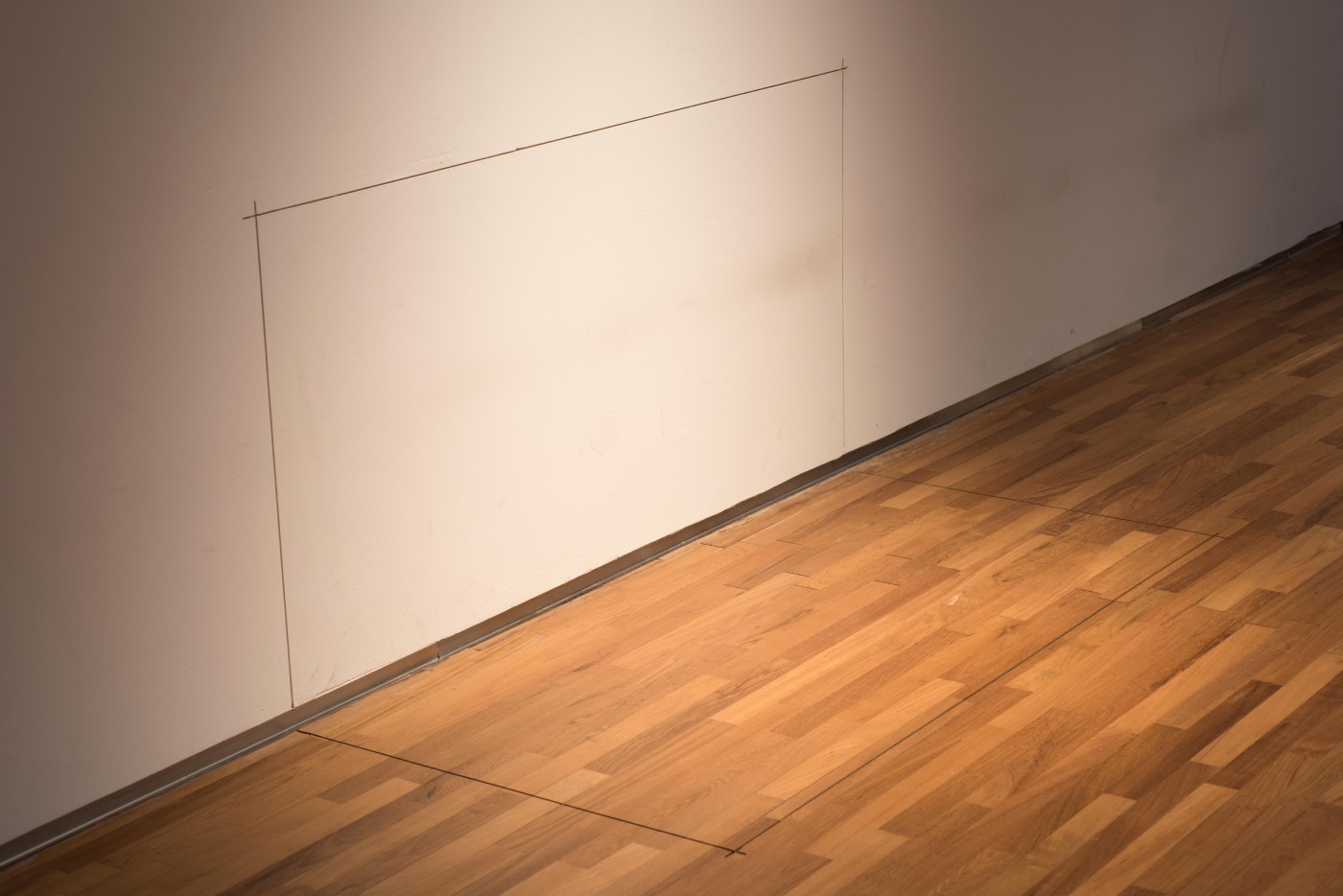
Cheo Chai Hiang, "5' × 5' (Inched Deep)", 1972, remade for display in 2015. Mixed media, 150 x 150 cm. Collection of the National Gallery Singapore, courtesy of National Heritage Board.
Rejecting the proposal, MAS’ co-founder Ho Ho Ying explained in a letter to Cheo: “In terms of the work’s intention, the way the two rectangular frames are connected is unconvincing. Viewers will not get any satisfaction even if they look at it for a whole day… Art, besides being new, also has to possess intentionality and particularity in order to strike a sympathetic chord in the viewer’s heart. Imagine an artist installing nothing other than a bare cube in a big public square, and declaring, ‘This is real art’. The viewer can also place a dead tree in the middle of a park and say this is art too. It is very confusing when an artist mixes art with non-art.”18
According to art historian Isabel Ching, Cheo’s work should be “placed in the context of the numerous formulaic representations of the Singapore River paintings exhibited in the annual shows of major art societies… and the dominance of a discourse that values the lyrical and the beautiful maintained by the Modern Art Society which saw itself as being at the forefront of artistic practices. Cheo’s proposal precisely targets this, emptying out Singapore art – characterised as being a world of painting then – of representational content as well as the values of beauty and skill”.19 In other words, in stripping his work of the beautiful Singapore River images that have come to dominate the art scene, Cheo is radically reformulating what it means to create art.
His proposal was not realised until 2005 when it appeared as 5' × 5' (Ao Tou, Another Source) in Tong An, Fujian, China, and 5' × 5' (Source of the Singapore River – Uncovered/Covered) in Singapore.20 In 2015, a recreation of the work, titled 5' × 5' (Inched Deep), was installed in the National Gallery Singapore.
Another instance of the river becoming a flashpoint in public discourse of what defined Singapore art was the 1986 exhibition titled Not the Singapore River at Arbour Fine Art. With its provocative title, the exhibition questioned prevalent artistic trends by foregrounding works from five young artists – Goh Ee Choo, Oh Chai Hoo, Yeo Siak Goon, Peter Tow and Katherine Ho – whose works departed from the mainstream, lyrical paintings of the Singapore River that were commonly seen at many exhibitions.
Older artists such as Ong Kim Seng reacted to the framing and title of the exhibition. In a letter to the Straits Times, Ong wrote: “It is an effective title, but I am very concerned if it indicates that we are getting tired of our source of nationhood, the Singapore River, and that artists, especially the younger ones, are discouraged or refrain from painting it.” He added: “[I]f the clever title is there because the artists need a change in expression, a change in their publicity – then I ask, why at the expense of the Singapore River?”21
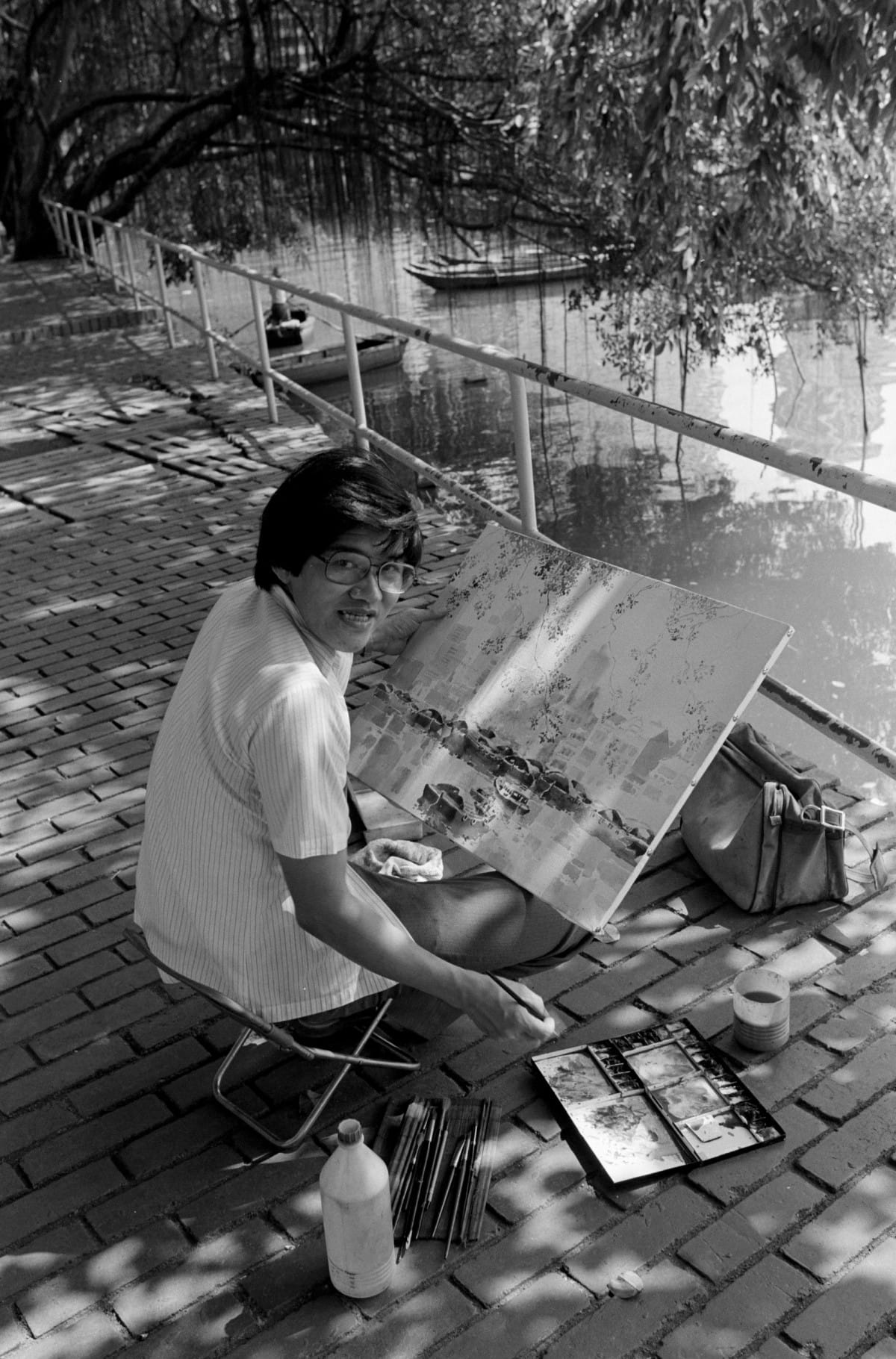
Ong Kim Seng painting by the Singapore River, 1982. Family of Kouo Shang-Wei and National Library Board Singapore.
Arbour Fine Art’s Lim Jen Howe replied that its motivation was “neither negative nor anti-Singapore River… it is a declaration that this is an exhibition to show that we have in Singapore young artists who are expressing their artistic ideas and talents in ways that are different from what we normally come across, for example, paintings of the Singapore River or Chinatown (Not Chinatown, however, does not have the same ring)”. He added: “There is no intention on our part to imply that the Singapore River as a ‘national emblem’ of our history is to be rejected.”22
The Singapore River had become a victim of its own artistic fame, and such episodes could be seen as the disavowal of prevailing pictorial conventions rather than outright rejections of the river as a subject for artistic creation. By provocatively using “Singapore River” as a title, a younger generation of artists wanted to embrace new artistic expressions appearing on the horizon.
Concept
In the 1970s and 1980s, these new languages shifted artmaking from the visual towards the conceptual, where the idea behind a work became more important than visual realism. More artists started to experiment with modes of creating art beyond traditional canvases and paints.
Artist Teo Eng Seng’s work The Net (Most Definitely Singapore River) (1986) showcases his signature “paperdyesculp”, a medium he pioneered that involves shaping dyed papier-mâché and other materials into sculptural artworks. This installation features a fishing net entangled with paperdyesculp debris, capturing the pollution that defined the river before the massive cleanup. According to the National Gallery Singapore, the work is “Teo’s wry response to the overuse of the Singapore River as a subject by local artists”, “emphasising rawness and spontaneity in his re-creation of the river’s debris”.23
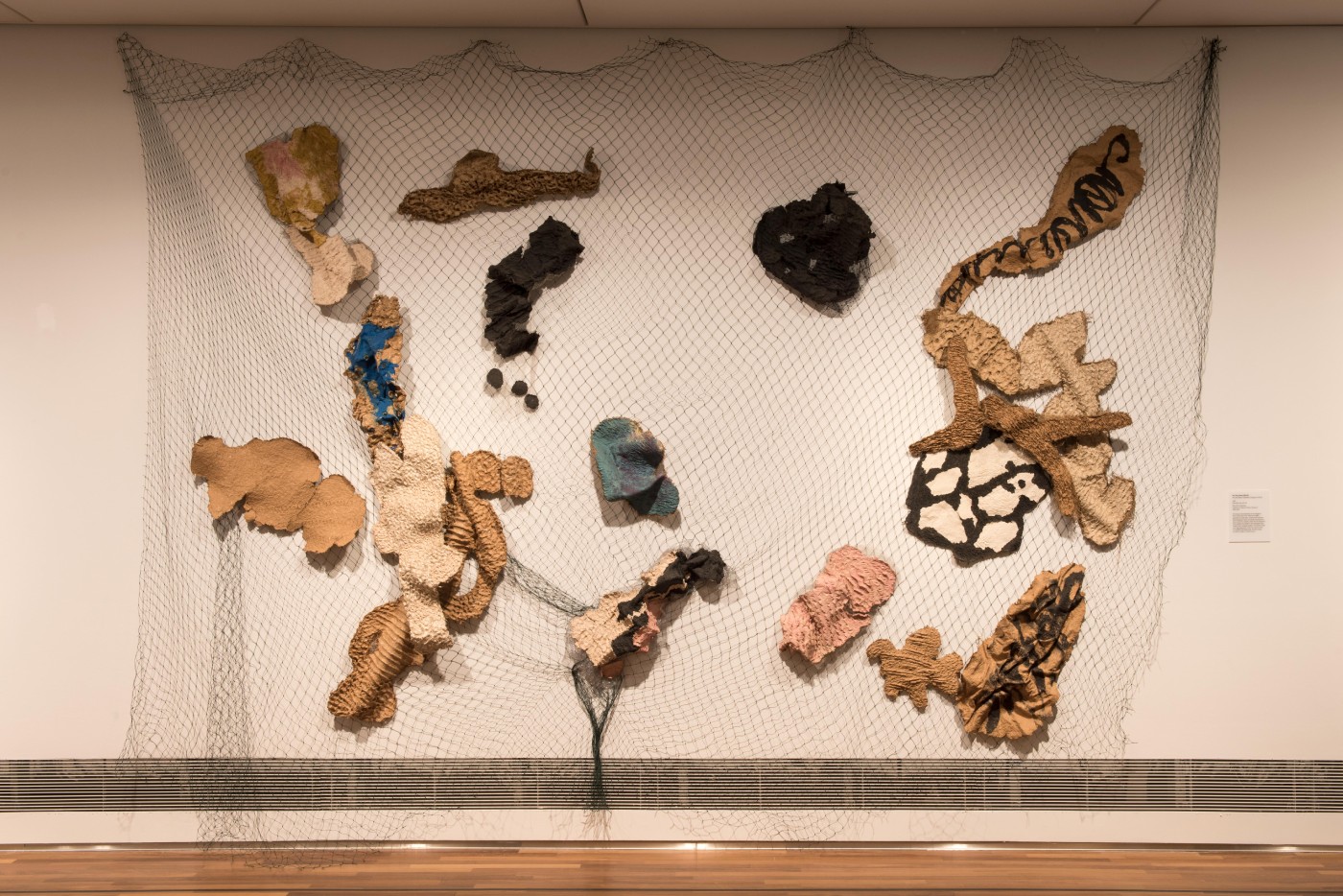
Teo Eng Seng, "The Net (Most Definitely the Singapore River)", 1986. Paperdyesculp on net, 350 × 350 cm. Gift of the artist. Collection of the National Gallery Singapore, courtesy of National Heritage Board.
This is a sharp departure from idyllic scenes of the river, with the artwork looking nothing like the watercolour paintings of the 1970s. Visual realism is not the objective here, and experimentation takes centre stage, where an unfamiliar presentation of the Singapore River demands a different type of audience engagement.
Such audience participation is a defining feature of contemporary art. Artist-scholar Debbie Ding’s Here the River Lies, first exhibited in 2010 at the Substation, is an interactive map installation that invites participants to contribute their stories and memories to a large hand-drawn map of the Singapore River, regardless of whether these are real, partially real, or imaginary. “The river is a site of significant historical, economic, and social importance – yet despite its centrality, it seems that many Singaporeans do not know its history, its exact location or even its appearance,” Ding noted.
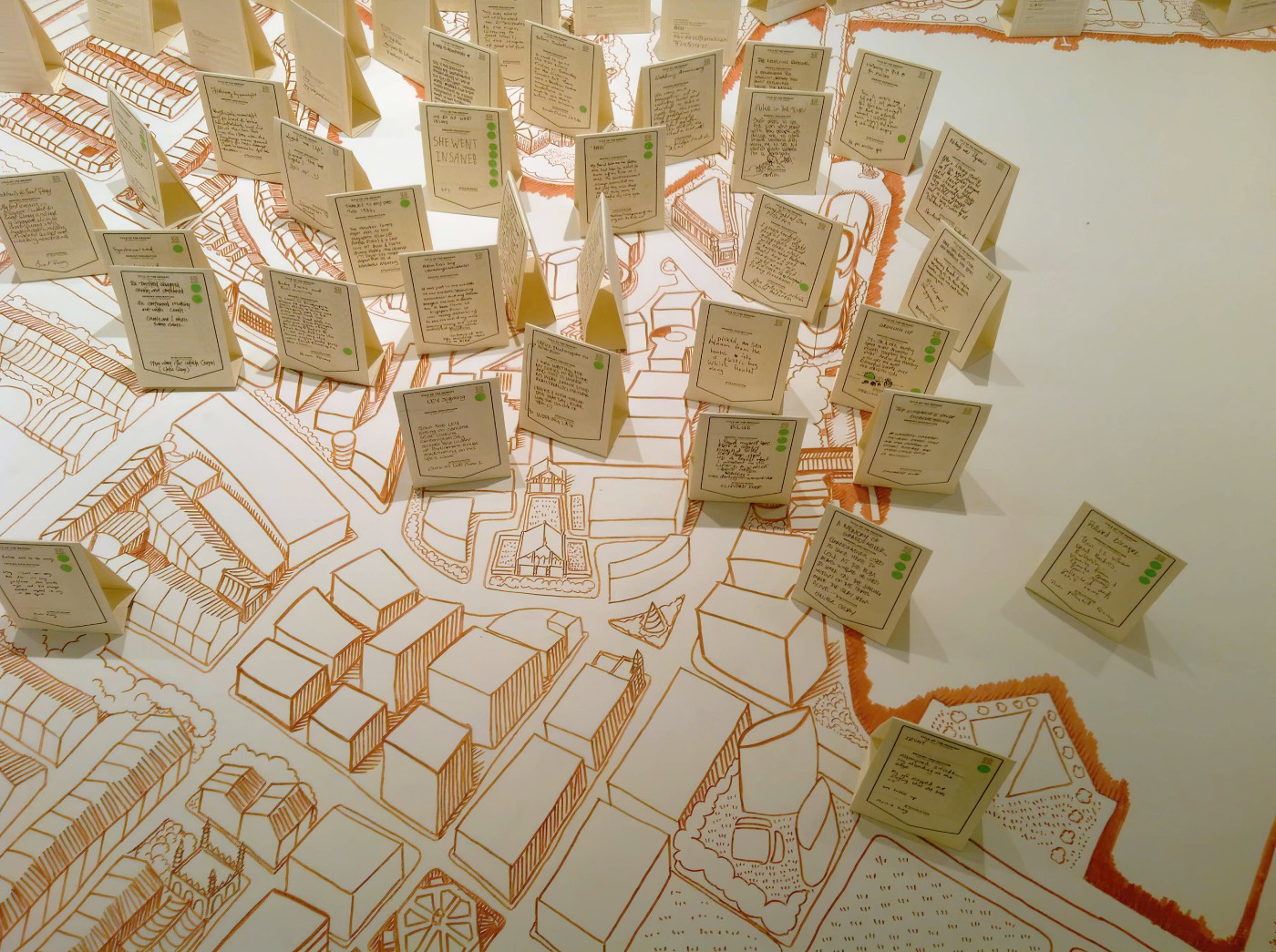
Debbie Ding, "Here the River Lies", 2022. Installation. Collection of the Singapore Art Museum, courtesy of Debbie Ding.
The resulting map does not aspire towards stable representations or visual realism since it is meant to show that our mental and emotional impressions of places are fluid. In fact, we think that we know what the Singapore River looks like, but we may struggle when asked to chart the exact shape of the waterway. What informs our relationship with the river is not just an image, but also the memories and emotions evoked by it.
In 2022, as part of Curiocity: Places & Perspectives, an initiative of the National Library Board and in partnership with the Light to Night Festival, artist Ong Kian Peng unveiled his immersive media installation, The River Connects, at the Asian Civilisations Museum. The work showed how human connection could be represented by the bridges along the Singapore River. Sights, sounds and memories were reawakened as audiences encountered archival images of the river and its bridges, experiencing the connections and social interactions that they have represented throughout history.25 Similarly, in this work, visual representations were dissolved as participants “experienced” the river through sounds, images and movement.
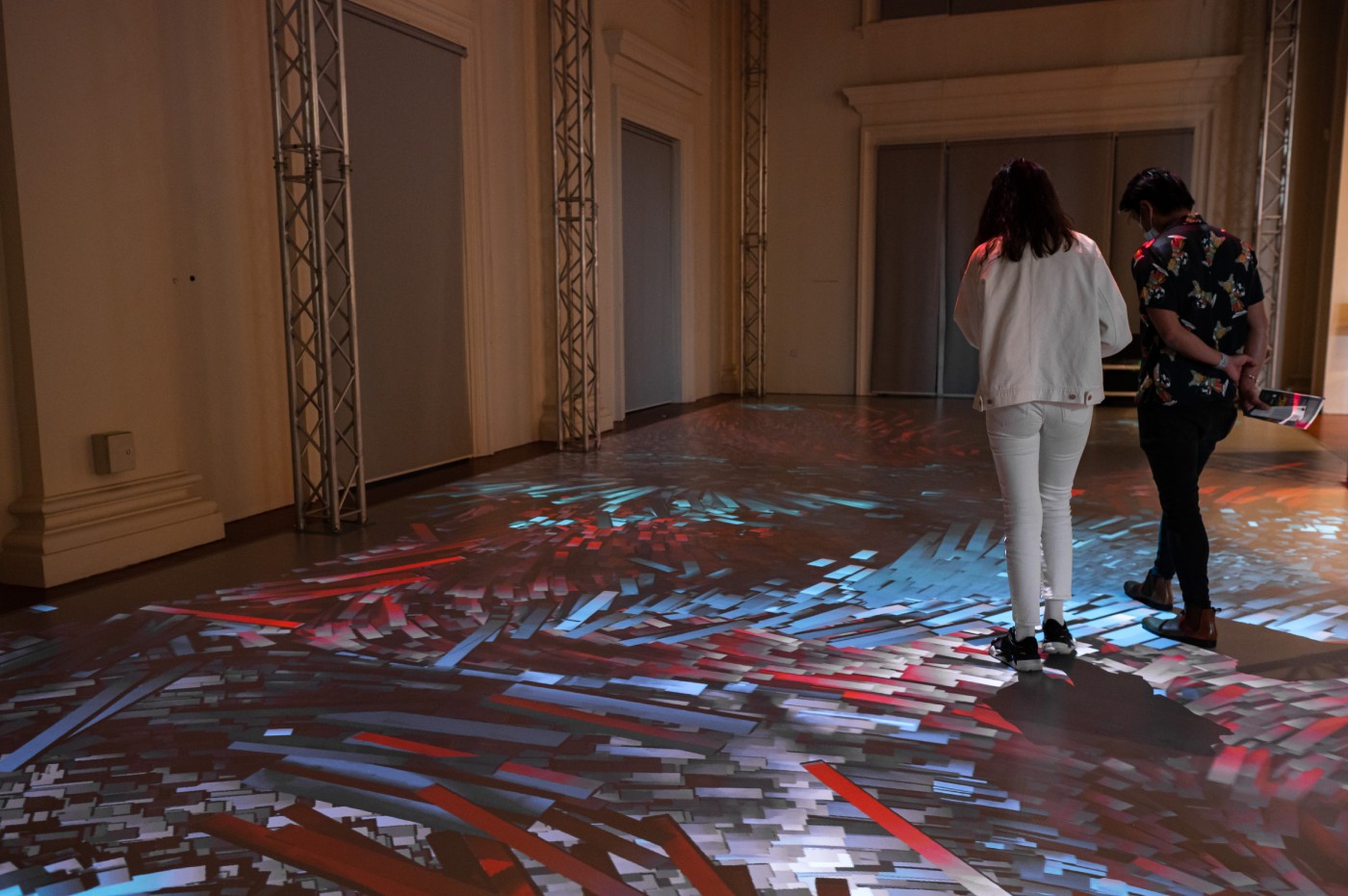
Ong Kian Peng, "The River Connects", 2022. Installation. Digital copy (c) National Library Board Singapore.
Confluence
Despite a shift towards conceptual art, contemporary artistic practices never completely replaced traditional modes of creation. Similar to the earlier years of the Singapore Watercolour Society, students and artists today still sit along the riverbanks painting their favourite scene,26 and artworks inspired by the Singapore River continue to be produced using a wide variety of artistic languages.
Rather than viewing these approaches as belonging to separate eras or opposing camps, it is more fruitful to see them as part of an evolving conversation about how Singapore’s art history is not a linear progression from tradition to innovation, but a layered confluence of artistic expressions. Embracing this diversity allows us to recognise how different artistic practices can collectively shape the visual memory and cultural imagination of a nation.
About the Author
Luke Chua is a Senior Librarian with the National Library Singapore, where he works on the visual arts collection.
Endnotes
1 Wong Hong Suen, Singapore Through 19th Century Prints & Drawings (opens in new tab) (Singapore: National Museum of Singapore and Editions Didier Millet, 2010), 35. (From National Library Singapore, call no. RSING 769.499595703 WON)
2 Colin Cheong, Framework and Foundation: A History of the Public Works Department (opens in new tab) (Singapore: Times Editions, 1992), 50–51. (From National Library Singapore, call no. RSING 354.5957008609 CHE)
3 Capturing the Straits: Painting and Postcard Views from the 19th and Early 20th Centuries (opens in new tab) (Singapore: NUS Museum, 2012), 2. (From National Library Singapore, call no. RSING 704.94995951 CAP); Victor R. Savage, “Aesthetics and the Western Sojourners’ Experiences in Southeast Asia,” in Sketching the Straits: A Compilation of the Lecture Series of Charles Dyce Collection (opens in new tab), ed. Irene Lim (Singapore: NUS Museums, 2004), 10–11. (From National Library Singapore, call no. RSING 759.2911 SKE)
4 “Singapore Art Club (opens in new tab),” Singapore Free Press and Mercantile Advertiser, 13 March 1912, 7. (From NewspaperSG)
5 For an account of the artistic activities during this time, see Melissa Susanto, “Tropical Tapestry,” in Siapa Nama Kamu? (opens in new tab), ed. Low Sze Wee (Singapore: National Gallery Singapore, 2015). (From National Library Singapore, call no. RSING 709.5957074 SIA); and Kwok Kian Chow, Channels & Confluences: A History of Singapore Art (opens in new tab) (Singapore: Singapore Art Museum, 1996). (From National Library Singapore, call no. RSING 709.5957 KWO)
6 Low Sze Wee, “Lim Cheng Hoe: What It Means to Be a Self-taught Artist,” in Lim Cheng Hoe: Painting Singapore (opens in new tab), ed. Low Sze Wee (Singapore: National Gallery Singapore, 2018), 33. (From National Library Singapore, call no. RSING 759.95957 LIN)
7 Chia Wai Hon, Bits and Pieces: Writings on Art (opens in new tab) (Singapore: Contemporary Asian Arts Centre, 2002), 169. (From National Library Singapore, call no. RSING 709.5957 CHI)
8 Chia, Bits and Pieces (opens in new tab), 169.
9 Lee Yoke Meng, “By the Banks of Singapore River (opens in new tab),” Business Times, 31 August 1981, 8. (From NewspaperSG)
10 Other than a shared interest in the medium, the formation of the Singapore Watercolour Society can also be attributed to other factors. Artist and writer Chia Wai Hon suggests that the society was set up partly in reaction to the Modern Art Society’s push for new forms of artistic expression. See Chia, Bits and Pieces (opens in new tab), 131.
11 Chia, Bits and Pieces (opens in new tab), 169.
12 Clarissa Oon, “New Growth from One Seed (opens in new tab),” Straits Times, 3 September 1998, 5. (From NewspaperSG)
13 Angela Wu, “I’ll Drink to the Old Mohd Sultan (opens in new tab),” Straits Times, 24 March 2001, 3. (From NewspaperSG)
14 Chin Oi Tow, “A Past Captured (opens in new tab),” Straits Times, 7 September 1981, 4. (From NewspaperSG)
15 Daniel Tham, ed., A Changed World: Singapore Art 1950s–1970s, Dialogues (opens in new tab) (Singapore: National Museum of Singapore), 29. (From National Library Singapore, call no. RSING 709.225957 CHA)
16 Richard Lim, “Country’s Progress in Art, Too (opens in new tab),” New Nation, 29 July 1980, 23. (From NewspaperSG)
17 Teo Han Wue, “Some New Trends in the Post-war Singapore Art Scene,” Culturepaedia, accessed 28 May 2026, https://culturepaedia.singaporeccc.org.sg/art/some-new-trends-in-the-post-war-singapore-art-scene/ (opens in new tab).
18 Ho Ho Ying, “Art, Besides Being New, Has to Possess an Intrinsic Quality in Order to Strike a Sympathetic Chord in the Hearts of the Viewers,” in Histories, Practices, Interventions: A Reader in Singapore Contemporary Art (opens in new tab), eds. Jeffrey Say and Seng Yu Jin (Singapore: Institute of Contemporary Arts Singapore, 2016), 44–45. (From National Library Singapore, call no. RSING 709.5957 HIS)
19 Isabel Ching, “Tracing (Un)certain Legacies: Conceptualism in Singapore and the Philippines,” Asia Art Archive, 1 July 2011, https://aaa.org.hk/en/like-a-fever/like-a-fever/tracing-uncertain-legacies-conceptualism-in-singapore-and-the-philippines (opens in new tab).
20 Louis Ho, “Voids, Riverine and Otherwise,” in A Void: Returning to the River (opens in new tab) (Singapore: Sculpture Square Limited, 2013), 6–7. (From PublicationSG); Cheo Chai-Hiang, Erased, Mislaid, Rejected, Revisited: Cheo Chai-Hiang's Works 1972–2005 (opens in new tab) (Singapore: Sculpture Square, 2005), 17. (From National Library Singapore, call no. RSING 709.5957 CHE-[LK])
21 Ong Kim Seng, “Why Not the Singapore River? (opens in new tab)” Straits Times, 30 May 1986, 2. (From NewspaperSG)
22 Lim Jen Howe, “Why It Is Not the Singapore River (opens in new tab),” Straits Times, 6 June 1986, 2. (From NewspaperSG)
23 “Uncover Teo Eng Seng’s Witty Negotiations Between the Self and Society at National Gallery Singapore’s Latest Exhibition, Teo Eng Seng: We’re Happy. Are You Happy?” National Gallery Singapore, 27 August 2024, https://www.nationalgallery.sg/sg/en/about/media-centre/uncover-teo-eng-sengs-witty-negotiations-between-the-self-and-society.html (opens in new tab); Teo Eng Seng, “The Net: Most Definitely the Singapore River (opens in new tab),” 1986, photograph. (From National Library Online)
24 Debbie Ding, “Here the River Lies,” Debbie Ding, last updated 4 March 2024, https://dbbd.sg/works/here-the-river-lies.php (opens in new tab).
25 “Satellite Installations: The River Connects,” Curiocity, last updated 28 May 2026, https://curiocity.nlb.gov.sg/events/curiocity-showcase-2022/satellite/ (opens in new tab); Ong Kian Peng, “The River Connects,” Light to Night Festival, accessed 28 May 2026, https://www.nationalgallery.sg/content/dam/microsites/lighttonight2022/programmes/the-river-connects/index.html (opens in new tab).
26 “Painting River Scenes Awash with Beauty, History (opens in new tab),” Straits Times, 1 September 2019, 16. (From NewspaperSG)