
Article
Trends in Malay Wedding Photography: 1950s to the Early 1980s
10 July 2026
Topics
Arts
Culture
The evolution of Malay wedding photography since the 1950s has been shaped by several factors, including the changing needs of newlyweds, professionalisation of the craft and services provided by the mak andam.
By Zhuang Wubin
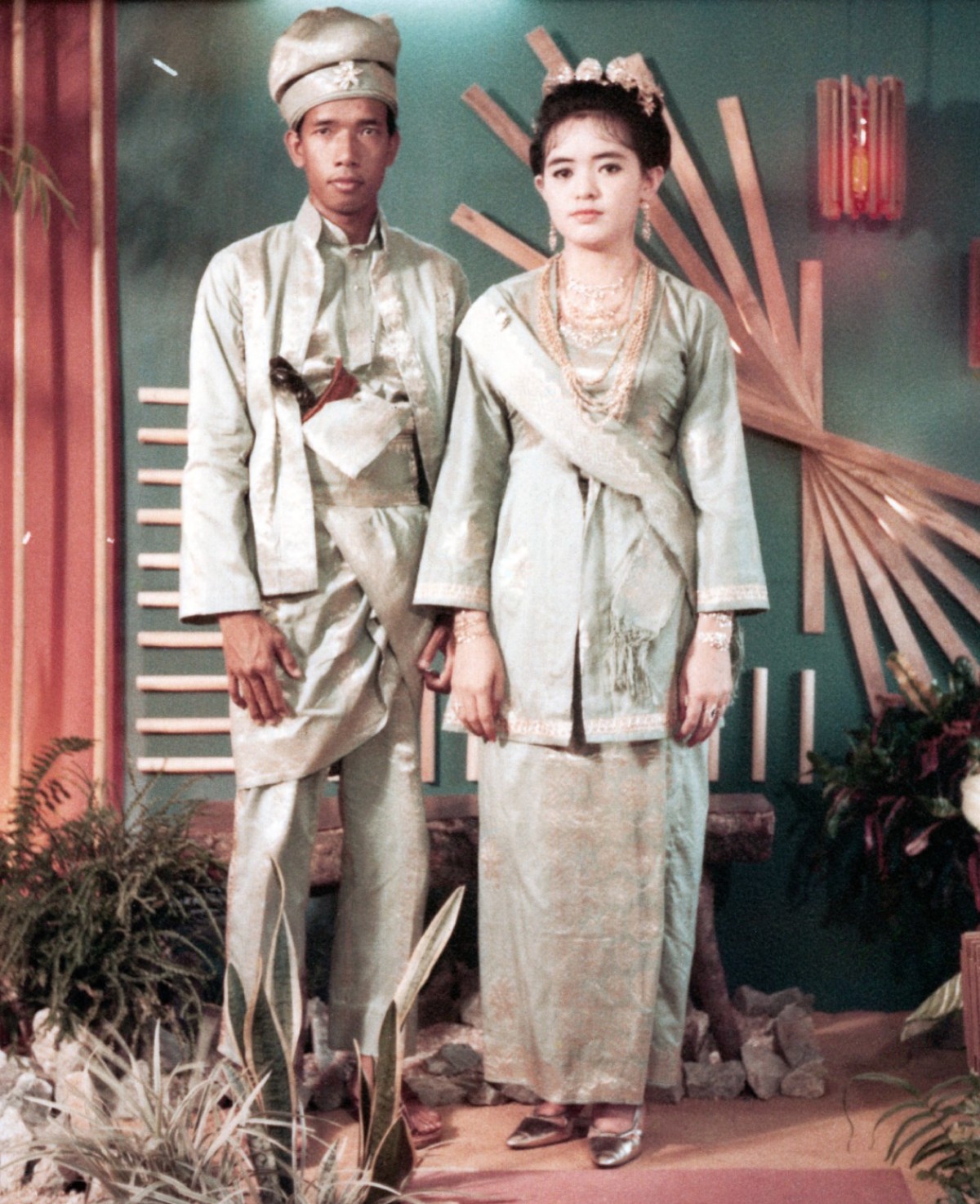
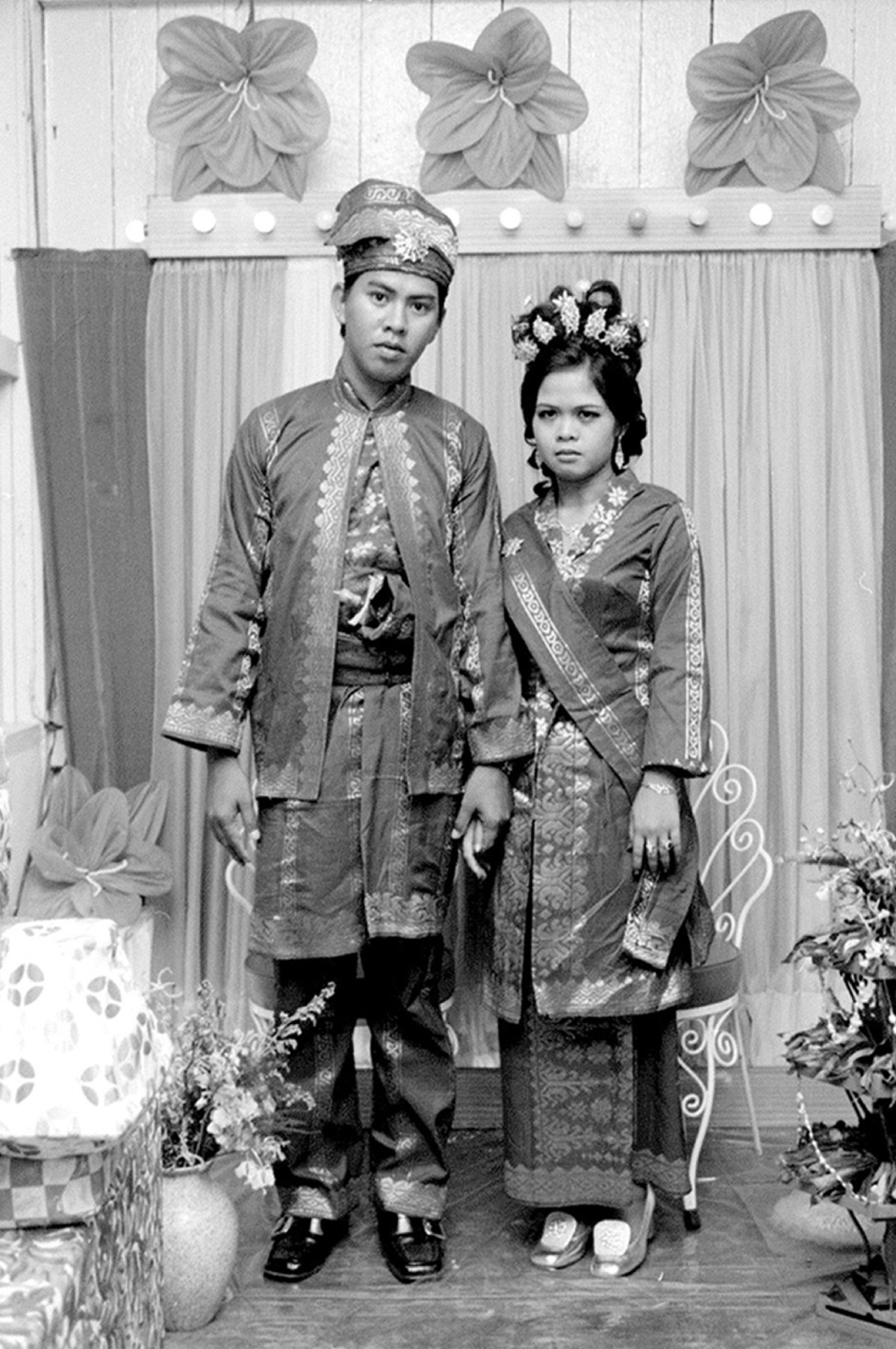
At the bertandang of Salleh Sariman and Noribah M. Serat, the couple wore the traditional Baju Melayu Pengantin, tailor-made from luxurious songket material, 31 August 1969. Courtesy of Salleh Sariman.
In the 1950s and ’60s making a stop at the photo studio was an important part of Chinese marriages. On auspicious days, couples queued outside popular photo studios waiting for their turn to capture a memento of their special day.
During the same period, photography for Malay weddings tended to take a different form. Instead of visiting a photo studio, family members, neighbours and friends were roped in to take photographs at Malay weddings in a display of gotong-royong, the communal spirit of helping one another. Around the 1960s, a small group of pioneering Malay photographers began to offer their services at Malay weddings on a part-time basis, existing alongside non-professionals in a burgeoning market.
The informal nature of Malay wedding photography at the time allowed the photographers to shape the scope of their practice in collaboration with the mak andam (wedding attendant), while also responding to the wishes and preferences of their customers. The mak andam played a central role in the wedding by managing the couple’s attire, applying the bride’s makeup, and overseeing the rituals and ceremonies.
Photography of Malay Weddings in the 1950s
When literary pioneer and Cultural Medallion recipient Suratman Markasan married educator and activist Saerah Taris at her home village on Pulau Blakang Mati (present-day Sentosa) in June 1958, her family engaged a part-time Malay photographer to photograph the bersanding (sitting-in-state ceremony).1
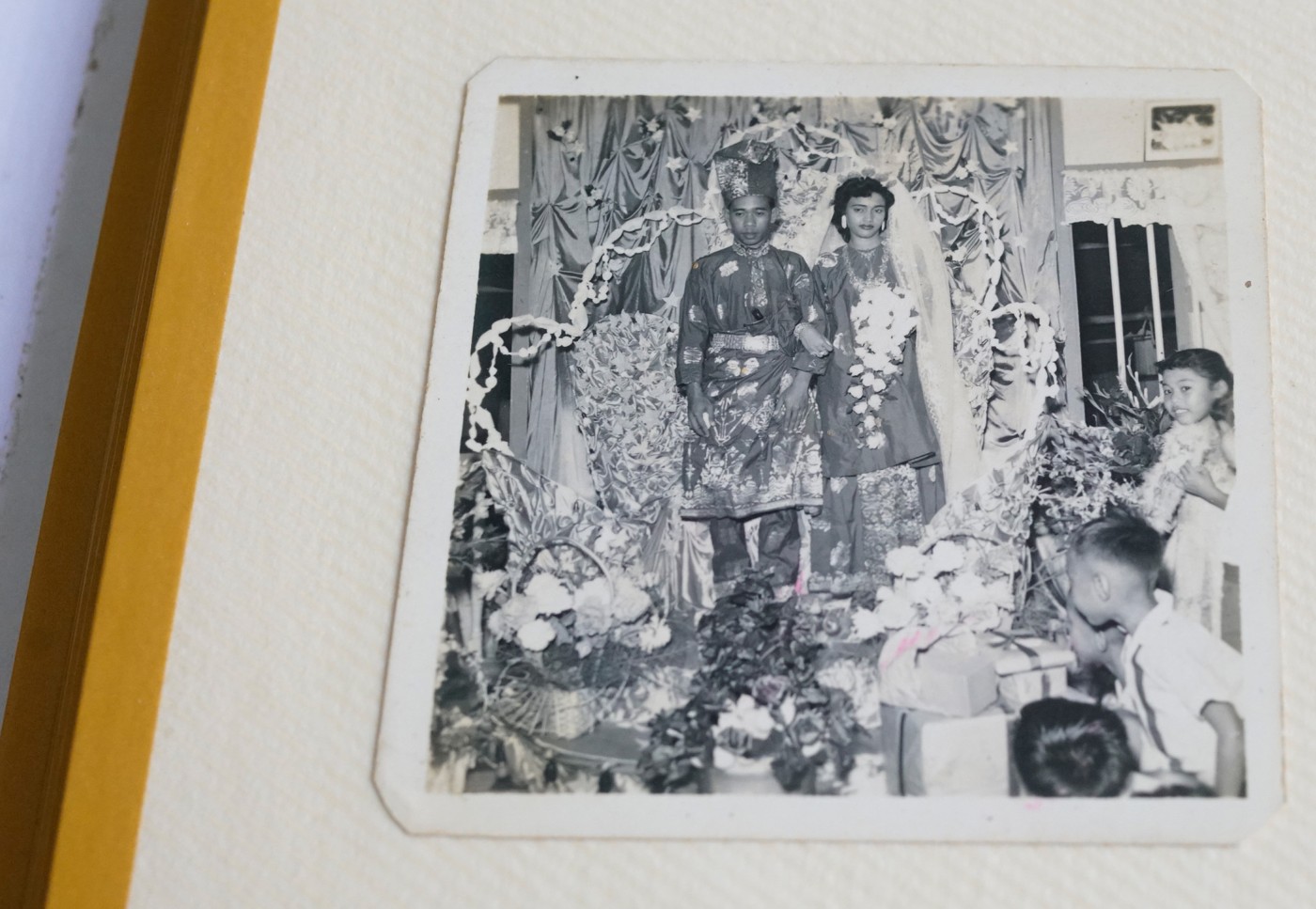
When literary pioneer and Cultural Medallion recipient Suratman Markasan married Saerah Taris in June 1958, her family asked a part-time Malay photographer to photograph the bersanding. The photograph is kept in Suratman’s photo album. Courtesy of Suratman Markasan.
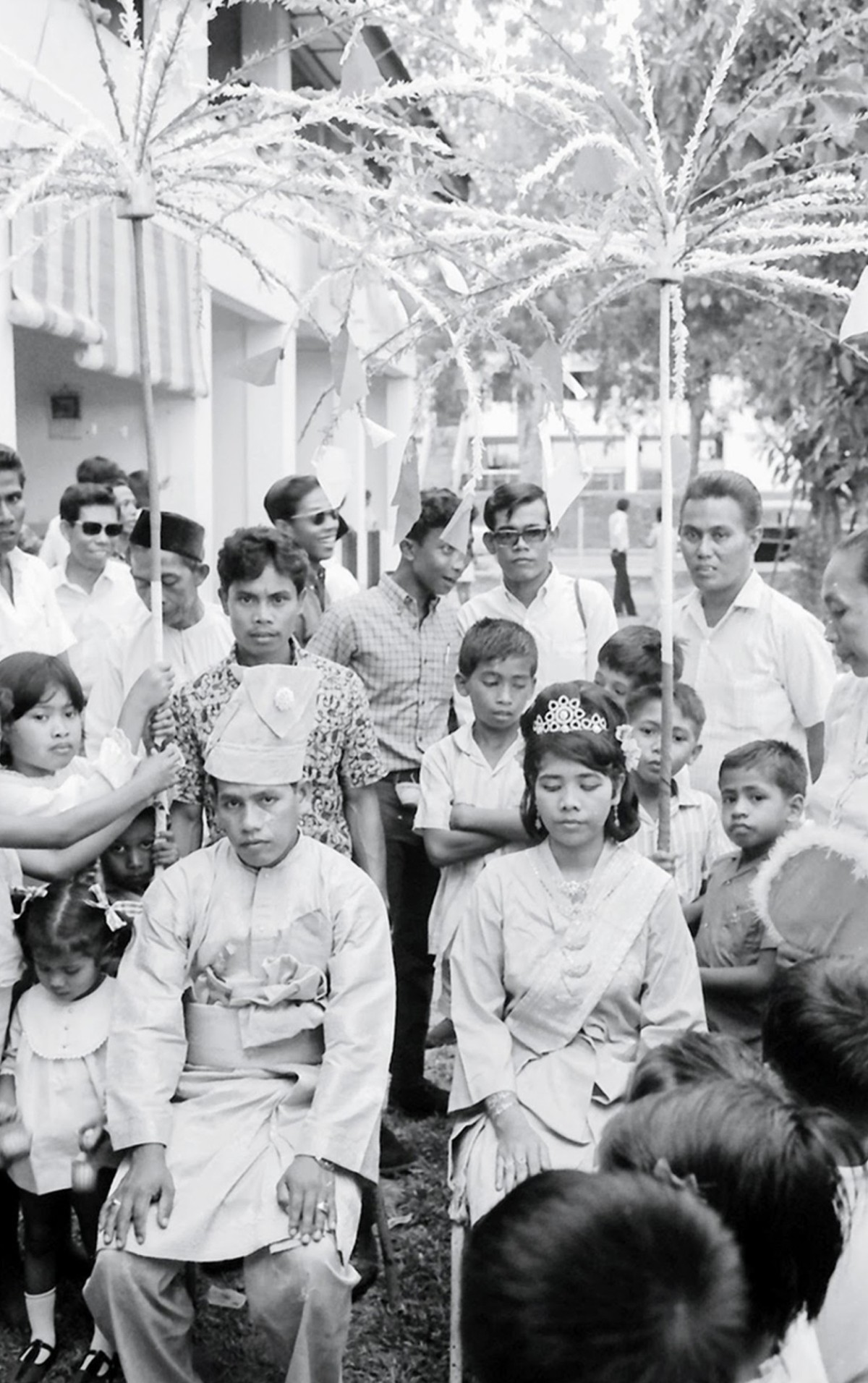
The bersanding marks the wedding finale when the couple sit on a pelamin (throne-like wedding dais) as king and queen of the day during the walimah (communal wedding feast). Today, the walimah and bersanding continue to be the core ceremonies of Malay weddings in Singapore, preceded by the nikah (solemnisation) and followed by the bertandang (welcoming the bride/in-laws). The berinai (applying henna on the hands and feet of the couple) used to be an important ceremony, but has been rarely observed since the early 2000s.2
According to Suratman, around half of Malay weddings in the late 1950s involved some form of photographic documentation. He said that it was uncommon for Malay couples to visit photo studios, which were mostly Chinese-owned, for wedding photographs.3 Instead, those who could afford professional photography might commission a Chinese studio photographer to take their photos at the wedding dais during bersanding. Even so, only a few photographs would be taken to save cost.4
In most cases, if the bride and groom wanted photographs of their wedding, they would ask someone – a family member, a relative, a neighbour or a friend – who knew photography and had access to camera equipment to help them out, with the mak andam directing the couple’s poses.5 Their main constraint was cost as the photographers shot on medium-format cameras using what was called 120 film. This format had fewer exposures than the 36 shots per standard roll of 35 mm film.6
Learning Photography
Salleh Sariman, who was born in Singapore in 1945, was among the earliest Malay photographers who contributed to the gradual professionalisation of Malay wedding photography. He was a television cameraman at Mediacorp who began his career at Radio and Television Singapura (RTS) in 1964 before retiring from Mediacorp in 2007. His most active years as a freelance wedding photographer was from 1962, when he joined Cathay-Keris Film Productions as an apprentice, until 1967 when he was promoted from an assistant to a full-fledged cameraman at RTS. Salleh subsequently stopped accepting part-time wedding photography assignments since his full-time job required him to work on weekends. However, he did shoot a few more weddings until 1970 due to his close relationship with the couples.7
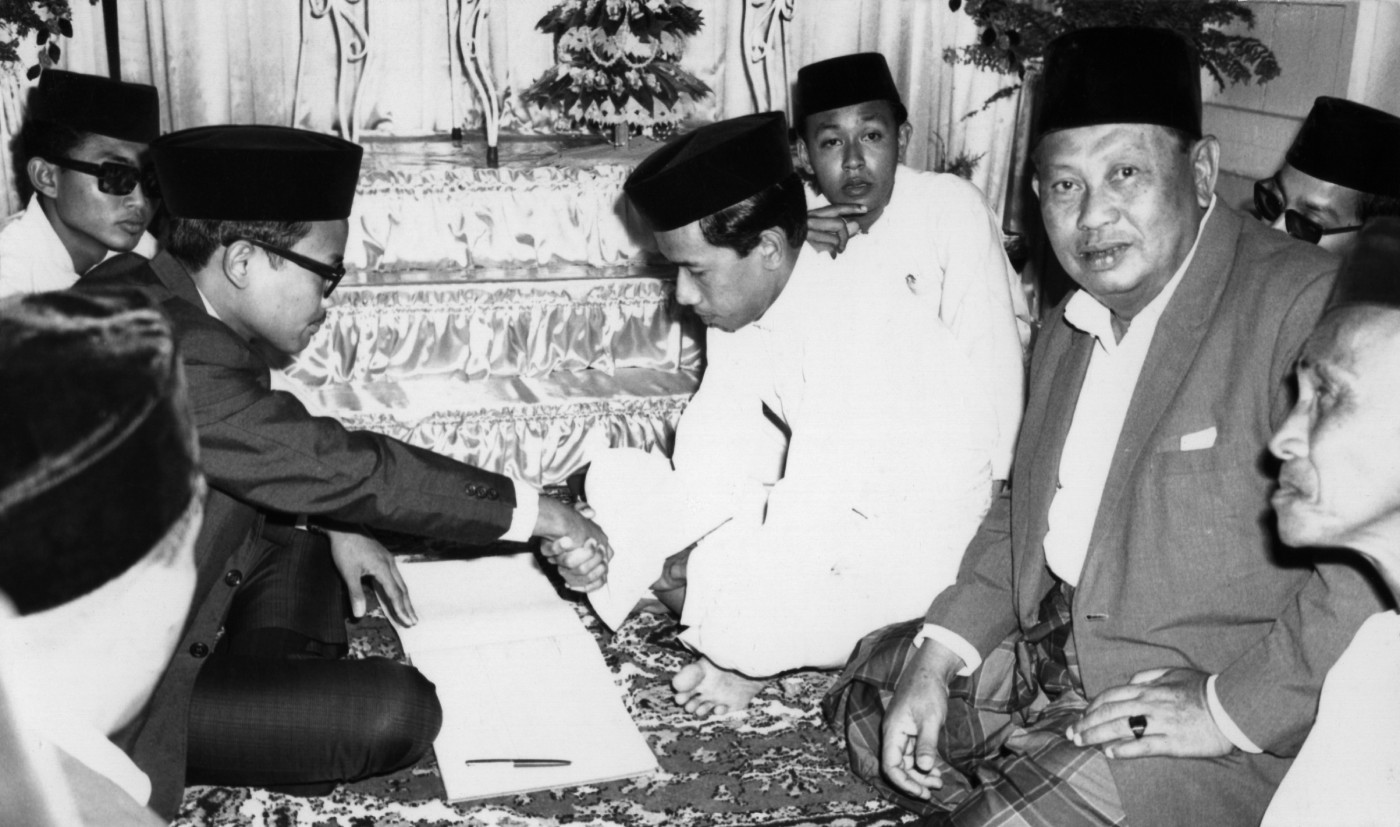
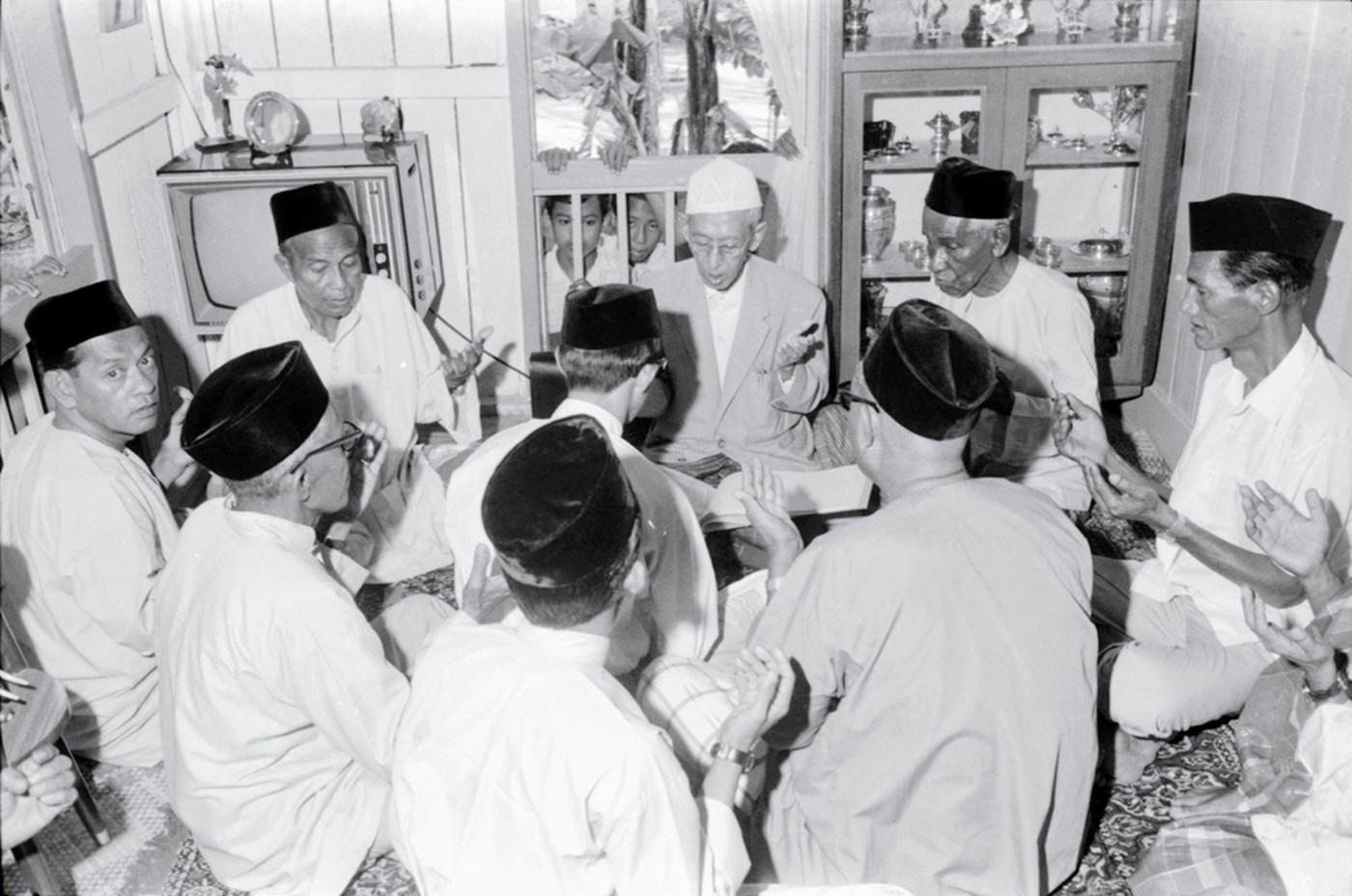
The kadi (wearing dark suit and glasses), or religious officer, officiating the nikah at Salleh Sariman’s wedding. The ceremony was held on 30 August 1969 at the bride’s family home. Courtesy of Salleh Sariman.
Salleh’s first encounter with the camera was in 1958 when he was 13. His friend had brought along a Zeiss Ikon camera for their Hari Raya Aidilfitri outing to the Botanic Gardens. Salleh was hooked the moment he pressed the camera shutter. Two years later, he used his savings to purchase a Japanese-made Pax M4 camera, although his grandfather had to top up the shortfall.8
After he had taken some family photographs, Salleh’s neighbour asked him to help shoot her wedding even though he was only 15 at the time. “I was in jitters,” Salleh recalled. “My 35 mm camera was not good enough for enlargements, so I borrowed a Yashica medium-format camera as the main camera.”9 At Siglap Secondary School, Salleh was the school magazine’s photographer and his works were featured in the 1961 issue of the Siglap Clarion.10
After Salleh joined RTS, he befriended Woon Kee Fee, a Cantonese cameraman from Malaysia and they worked together for three years. Outside of work, Woon became his mentor in photography, loaning him books and teaching him the artistic aspects of the medium. Woon stressed the importance of lighting and composition in the medium.11 “When I first picked up photography, I was fascinated by its look of precision and the joy it gave me and my subjects when we saw the photographs,” Salleh recalled. “Later, I came to value its ability to capture a beautiful scene and make it better by selective framing and composition.”12
Professionalising Malay Wedding Photography
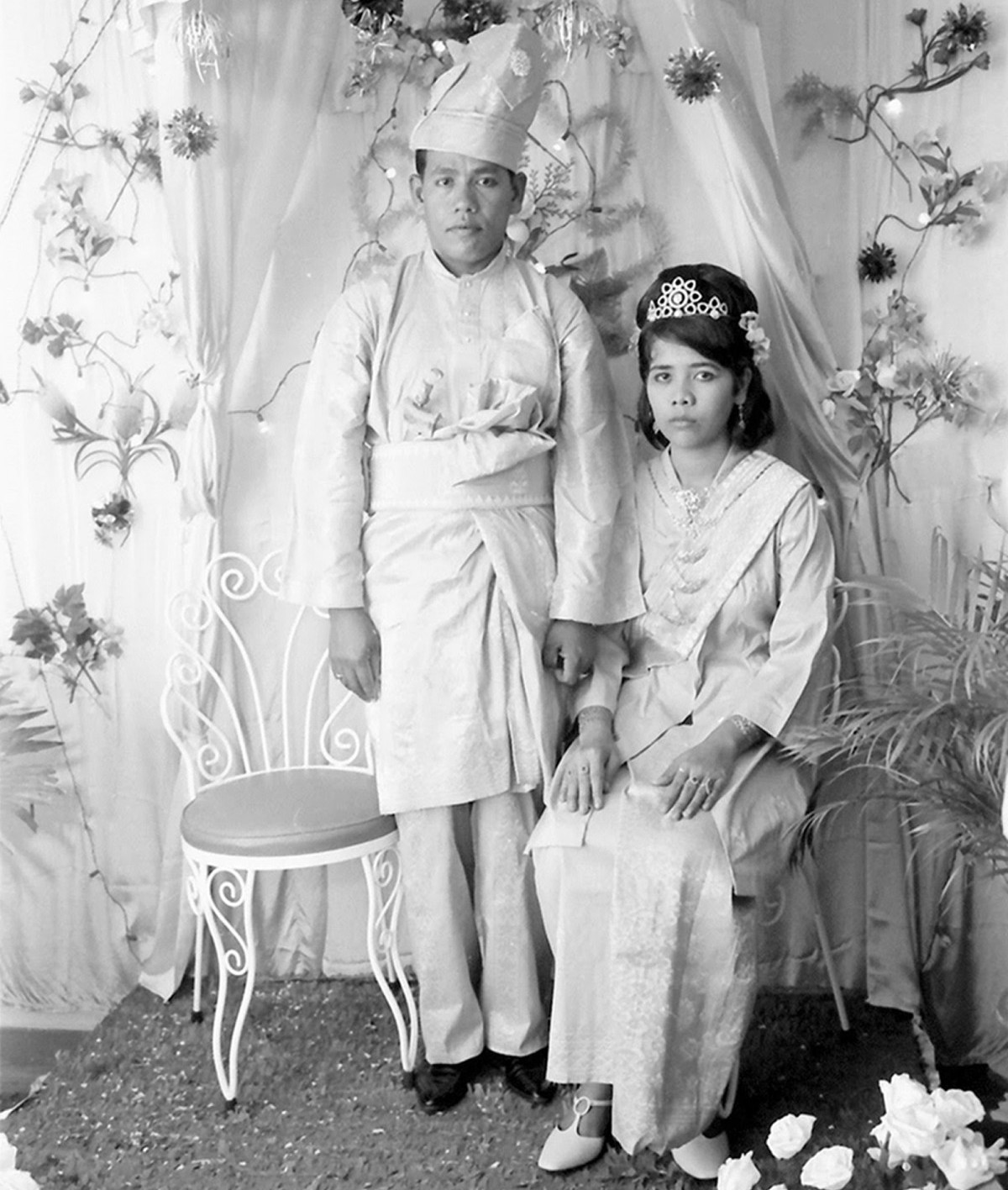
Salleh and his contemporaries introduced pricing and payment models that aligned with market practices, while also expanding and standardising the scope of Malay wedding photography. This was not a conscious and collective attempt at professionalising the craft. Instead, the changes occurred in an organic fashion. In Salleh’s case, he responded to the requests of his clients and subjects while balancing the authority of the mak andam, and at the same time learning from other practitioners how to enhance his skills and range of services.
When Salleh started out in 1962, he would visit New City Photo Studio at 467 Changi Road to develop his film and print his photographs. The studio was opened in 1958 by Kuet Gin Bok, a Hainanese who began his apprenticeship in studio photography in Malaya towards the end of the 1940s.13 There were two other studios in the vicinity, but Salleh preferred the print quality from New City. As a rookie, Salleh often sought Kuet’s expertise on the right type of film for his wedding shoots. On a few occasions, he even asked Kuet to comment on his photographs. Speaking in Malay, Kuet told Salleh: “Select your subject and go closer in order to avoid the unnecessary surroundings.” His advice has stuck with Salleh since then.14 (Salleh subsequently set up a darkroom in his home in 1964.)
Salleh’s first clients were his neighbours and relatives who asked him to photograph their weddings. He charged a small token fee initially, but later asked Kuet for advice on pricing his photography service. He also checked with other newlyweds on the rates charged by fellow Malay photographers.15 Soon after, Salleh charged $1.50 per photo, with a minimum order of 50 photographs for a three-day shoot. He carefully kept the negatives of the photographs he took as Kuet had told him that the request for reprints would be lucrative. Salleh did receive many requests for reprints, and he charged 30 cents for a postcard-size reprint.16
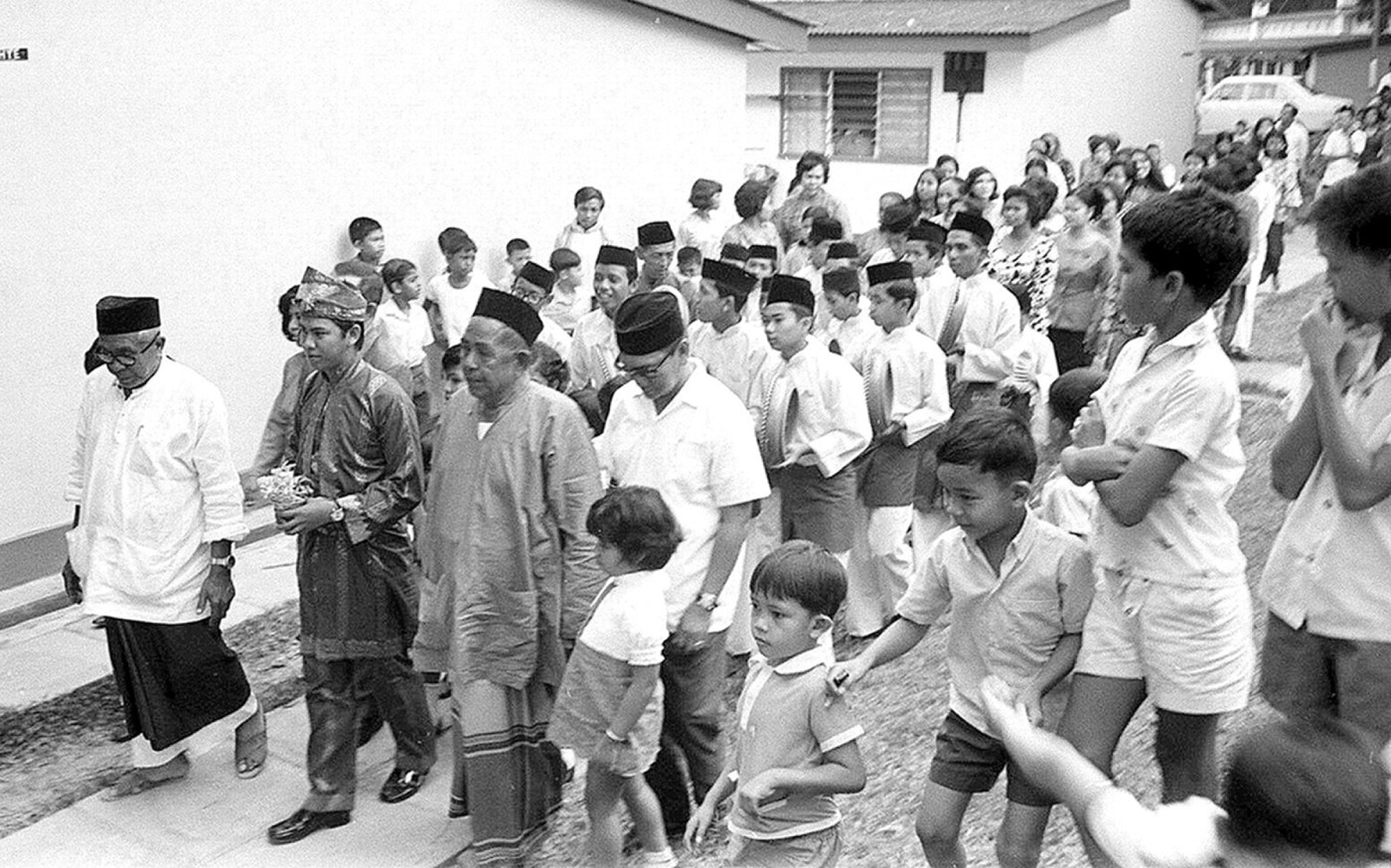
In the past, the entire kampong was expected to contribute to Malay weddings in the spirit of gotong-royong. Villagers were mobilised to put up tents for the reception, construct the pavilion for the band, decorate the bridal chamber, set up the temporary kitchen, cook for hundreds of guests and clean up the dishes, among other tasks. “When I covered [the] weddings of my relatives and neighbours, they would shout at me to snap their photographs, which I obliged,” Salleh recalled. “When the newlyweds saw my photographs, they realised I had done more than just photographing them. All the newlyweds whom I had photographed ended up approving my coverage. They could see so much merriment in the photographs.”17
Encouraged by the positive response, Salleh sought to capture the often-overlooked moments such as parents receiving guests, kitchen helpers hard at work and relatives serving food. He also fastidiously documented the key ceremonies: the berinai, nikah, bersanding, walimah and bertandang. The newlyweds and their guests were happy with his work, and he received additional orders for his photographs.18
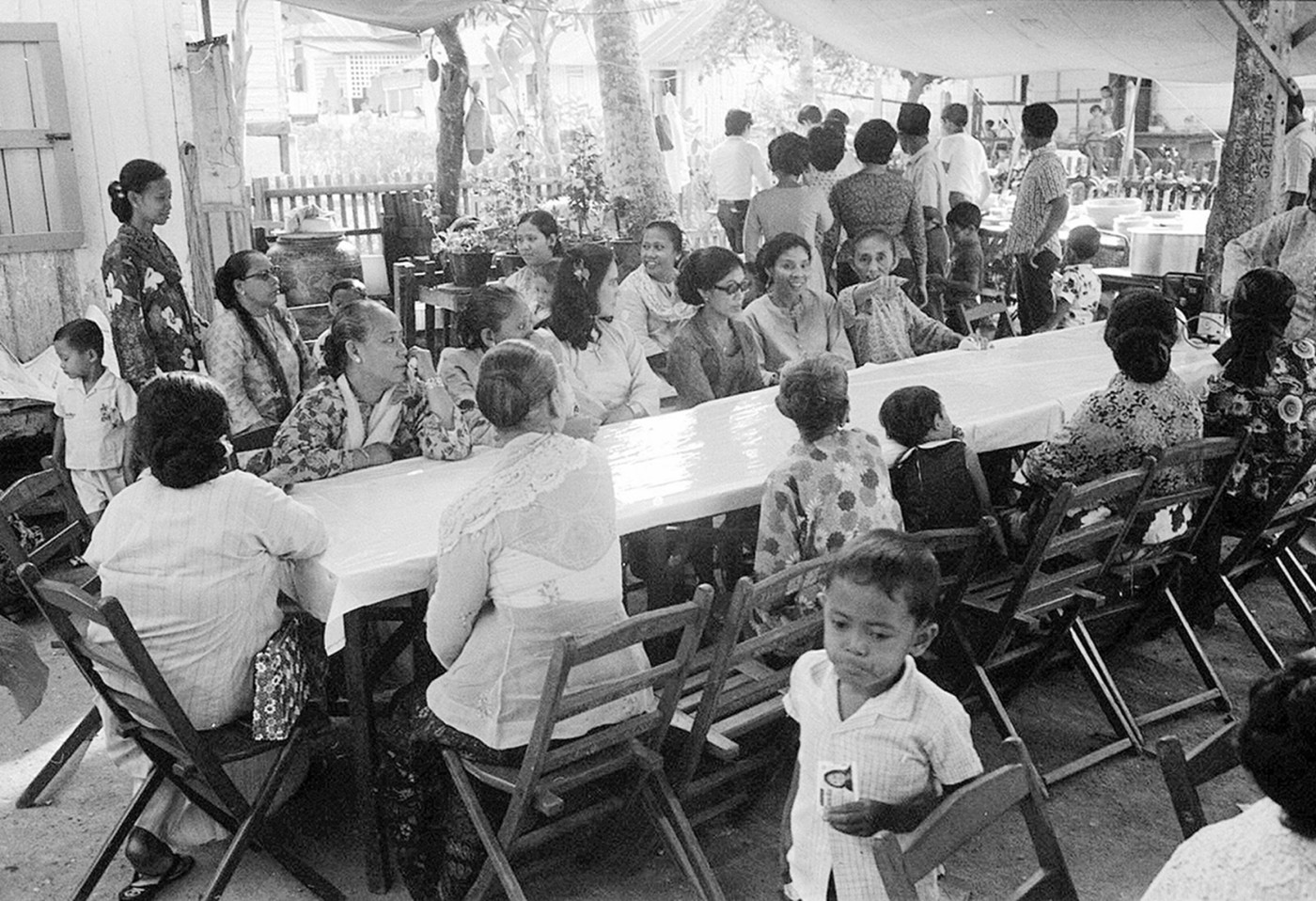
As photography was still a luxury then, there were couples who wanted Salleh to save his film for the most crucial parts of the wedding. However, all of them regarded the three berinai sessions (berinai curi [to steal], berinai kecil [small] and berinai besar [big]) as very important.19 For each berinai, the bride was expected to wear a different outfit while reserving another attire for the bersanding.20
The colourful berinai ceremonies were ideal subjects for the camera. In fact, Salleh noted that as photography became more commonplace in Malay weddings, the berinai became more elaborate and the number of attire changes multiplied. He recalled photographing Malay weddings in the 1960s with two nights of berinai ceremonies in which the brides made three costume changes each night.21 “The satisfaction for the bride was to hear others say how beautiful she was in this or that costume,” added Salleh.22
Not everyone could afford multiple changes of outfits though. Because of their modest means, when Salleh married Noribah M. Serat (born Wilhelmina Ema Palar) in 1969, she only had two different attires for berinai kecil and one for berinai besar.23 Even though it would make things more expensive, by the 1970s, some couples were making 10 to 15 costume changes for the berinai ceremony.24 Over time, the symbolism of giving and receiving blessings between the elders and the newlyweds became sidelined in favour of taking beautiful photographs during berinai.25 Today, however, the berinai ceremonies are no longer widely performed in Malay weddings in Singapore.
Role of the Mak Andam
Couples rented their outfits from the mak andam who would have an attractive and wide selection of costumes. For Salleh’s wedding, Noribah’s uncle used his connections in the world of bangsawan (Malay opera) and the Malay film industry to hire Zainab Simen as their mak andam.26 A bangsawan veteran with access to an extensive wardrobe, Zainab brought a touch of glamour to the wedding. Noribah picked for her berinai two costumes that she had seen in Panji Semerang (Outlaw of Semerang; released by Shaw Brothers in 1961) and Jula Juli Bintang Tujoh (Jula Juli Seven Stars; released by Cathay-Keris in 1962), two movies that Zainab had provided outfits for.27 This was how the fashion trends of popular cinema intersected with the practice of Malay wedding photography.
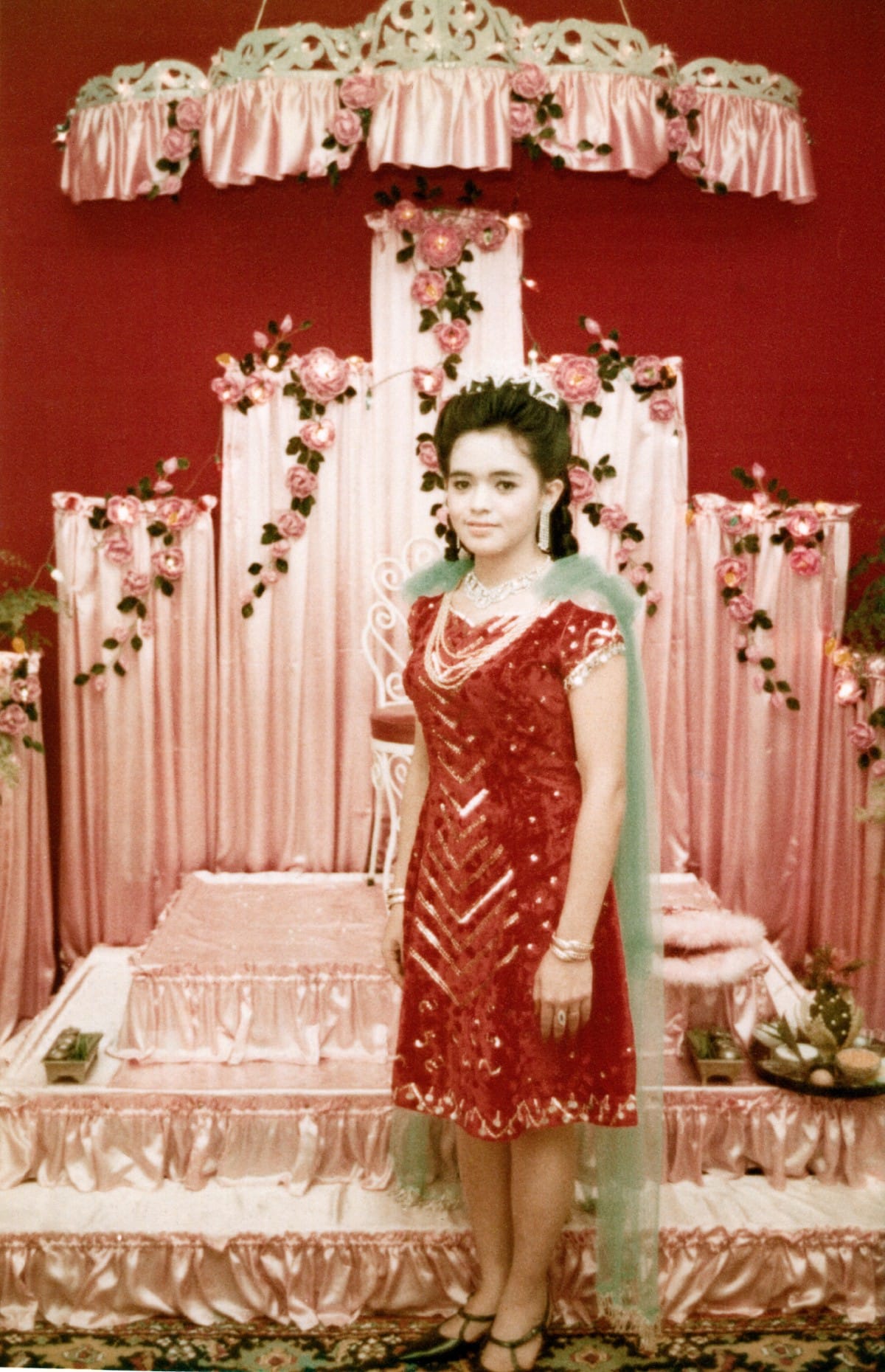
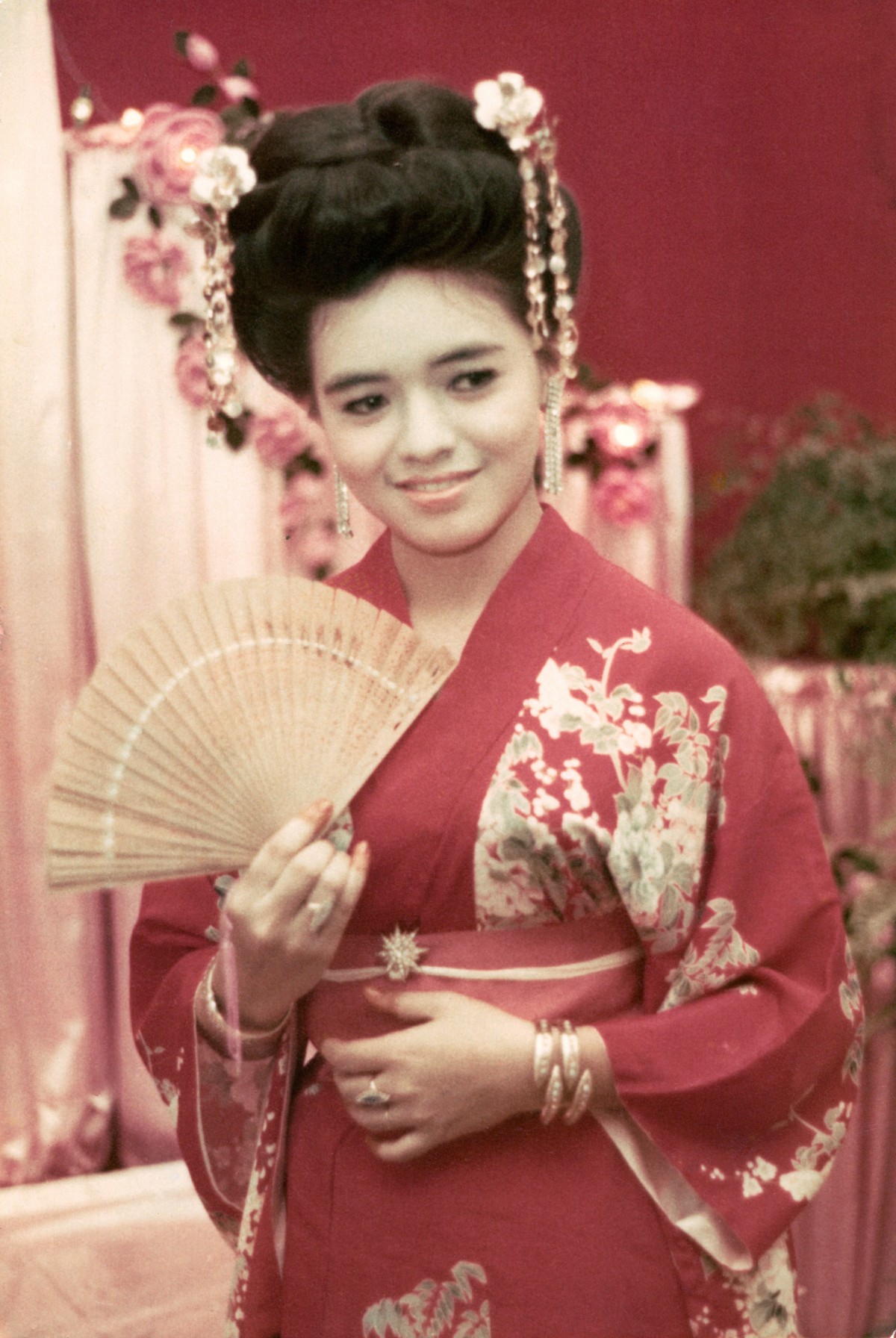
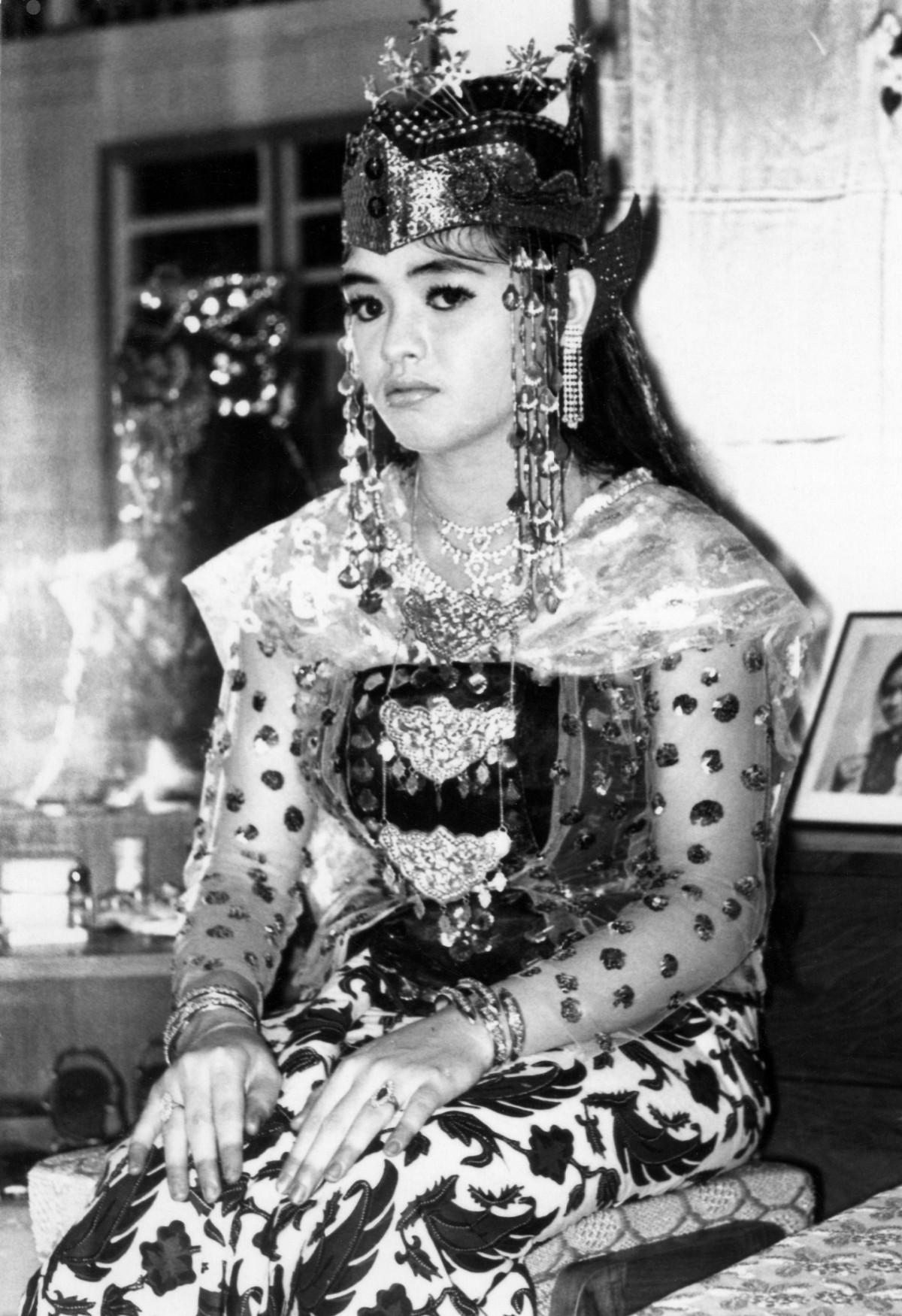
The involvement of the mak andam in Malay wedding photography went beyond the mere provision of bridal costumes. She was also responsible for directing the photo-taking sessions, especially during the berinai and bersanding.28
The working dynamic between the mak andam and the wedding photographer was recorded – albeit briefly – in Shaik Kadir’s autobiography about growing up in Geylang Serai. Invited to help at the wedding of his friend’s sister in the 1960s, Shaik observed that the photographer, a relative of the bride, had already taken many pictures during berinai kecil. At the bersanding the following day, the mak andam urged the photographer to take more photographs as she instructed the newlyweds to pose in different positions, such as “seated on the pelamin chairs, standing on the pelamin and holding hands, sitting on the dais without the chairs”. The photographer seemed bemused by her desire for more photographs, and he nearly ran out of flash bulbs for the shoot.29
Salleh had always deferred to the experience of the mak andam when it came to posing the couple.30 There were typically three standard poses for the bride and groom at the pelamin: both standing, both sitting and the groom standing with the bride sitting down.31 Salleh could also request other poses, but he had to relay the instructions to the couple through the mak andam.32
Developments in the 1970s
From the 1970s, Malay photographers began to collaborate more closely with the mak andam so that she could refer business to her preferred photographers.33 In 1973, Malay dance pioneer and Cultural Medallion recipient Som Said began offering her service as a mak andam on a part-time basis. She set aside space in her home for newlyweds to take photographs after the nikah. The pelamin setup featured two chairs and a simple backdrop. “The pelamin at my home catered to couples who did not want to organise the walimah and bersanding for their wedding because they were trying to follow the Islamic way,” Som explained. “Only the nikah, the Islamic part of the rituals, is a must.” However, the couples still wanted to commemorate the occasion by wearing different attires for the camera in the privacy of Som’s house.34
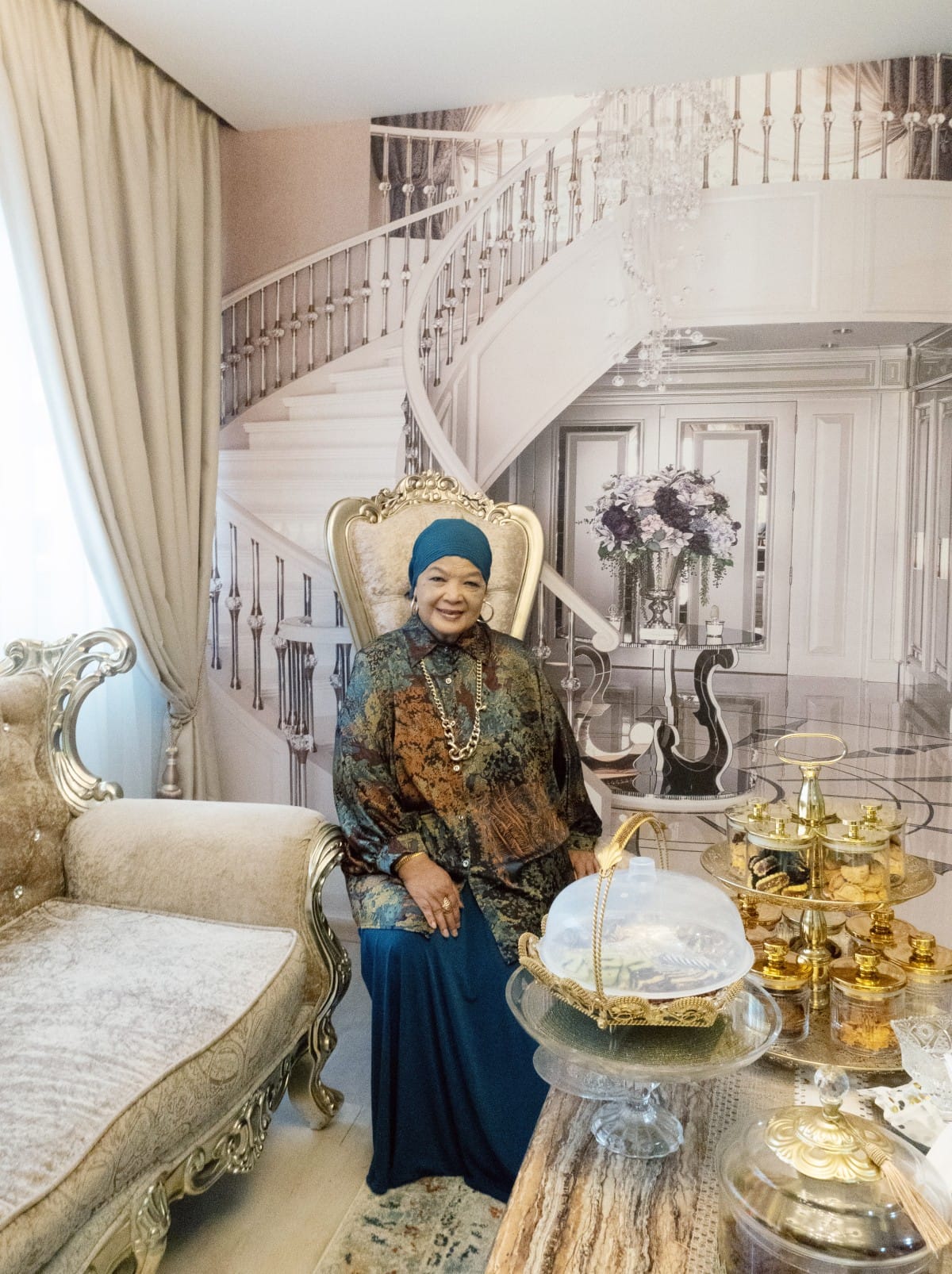
Som Said in her home, 31 March 2026. Photo by Zhuang Wubin.
By 1983, Som had gained enough experience to establish Ratu Sari Bridal House & Photo Studio – which is widely believed to be the first Malay bridal boutique in Singapore – in Tanjong Katong Complex. Starting in the 1970s, Som worked closely with two photographers: her husband Ahmad Sawal, and Sazali, a dancer who had some photography skills. The couples who engaged Som were free to hire their preferred photographers. But if they needed referrals, Som would recommend either Sazali or her husband.35
To supplement their income, some contributors to the Berita Harian newspaper began photographing Malay weddings on weekends. When Som married Ahmad in 1973, their wedding was photographed by Ahmad Samuri from the newspaper. She also recalled the late veteran journalist Karim Iskandar – who covered the arts and entertainment beat – shooting Malay weddings from around the late 1970s.36
There were also a few Malay women photographers who photographed Malay weddings on a part-time basis during the period. One of them, Che Fatimah, picked up photography in around 1956 or 1958, encouraged by her husband and driven by her interest in the medium. In 1967, she worked as a photographer for a local magazine but resigned for personal reasons. She later pursued freelance photography, offering her services for different events, including Malay weddings. She built a darkroom at home and did her own developing and printing work. It also helped that her husband was interested in photography and that his younger brother was Junid Juani, a veteran photographer with the Straits Times group.37
Wedding Photography in the 1980s
Even though Salleh had stopped photographing Malay weddings by the end of the 1960s, he continued to maintain a keen interest in the craft. By the 1970s and the ’80s, most, if not all, Malay wedding photographers had transitioned from medium-format cameras to 35 mm photography because the latter provided more exposures per roll. Meanwhile, as more Singaporeans were relocated into public housing, Malay weddings increasingly took place in the flat unit and in void decks rather than in kampongs.38 These factors most likely helped to standardise the iconography of Malay wedding photography.
Malay photographers also found new ways to attract more customers. In the 1980s, beyond the pelamin, some photographers began setting up temporary paper backdrops at the bride’s house, providing couples with an additional background to pose for the camera.39 There were also some who introduced video recording services at Malay weddings.40 In Som Said’s case, the decision to set up Ratu Sari was partly influenced by the Chinese bridal industry. She hoped to pioneer the trend of offering complete wedding packages to prospective Malay clients, which included photo shoots at her studio.41 Malay bridal boutiques became more common from then on.
Since the 1950s, Malay photographers have negotiated the needs and expectations of newlyweds and the mak andam in defining the scope and practice of Malay wedding photography.Its evolution was also shaped by advances in photographic technology, changing cultural and religious norms, the impact of popular culture, and the commercialisation of photography and bridal services.
The writer would like to thank Zakaria Zainal, Chong Chin Xin and Shio Soon Yi for their assistance with this article.
About the Author
Zhuang Wubin is a writer, curator and artist, and has a PhD from the University of Westminster (London). He is interested in photography’s entanglements with modernity, colonialism, nationalism, the Cold War and “Chineseness”.
Endnotes
1 Suratman Markasan, interview by author, Singapore, 12 October 2023. Unfortunately, Suratman passed away in 2024. I did not have the chance to confirm with him on whether the Malay photographer was someone who offered his service on a part-time basis, or whether he was someone who knew photography and was known to the wife’s family as a family member, relative, friend or neighbour.
2 For an overview of Malay wedding rituals, see Hidayah Amin, Malay Weddings Don’t Cost $50 and Other Facts About Malay Culture (opens in new tab) (Singapore: Helang Books, 2014), 89–108. (From National Library Singapore, call no. RSING 305.8992805957 HID); and Asrina Tanuri and Nadya Suradi, “Malay-Muslim Weddings: Keeping up with the Times (opens in new tab),” BiblioAsia 17, no. 2 (July–September 2021): 16–21.
3 Suratman Markasan, interview by author, Singapore, 12 October 2023.
4 Salleh Sariman, email to author, 5 January 2024.
5 Salleh Sariman, email to author, 22 November 2023. See also Som Said, oral history interview by Zarina bte Yusof, 20 February 2003, MP3 audio, Reel/Disc 4 of 5, 28:07, National Archives of Singapore (accession no. 002733 (opens in new tab)), 7:30.
6 Salleh Sariman, interview by author, Singapore, 23 March 2026.
7 Salleh Sariman, interview by author, Singapore, 23 March 2026.
8 Salleh Sariman, email to author, 27 August 2022.
9 Salleh Sariman, email to author, 2 March 2026.
10 Salleh Sariman, email to author, 27 August 2022.
11 Salleh Sariman, email to author, 27 August 2022.
12 Salleh Sariman, email to author, 30 August 2022.
13 For a brief history of New City Photo Studio and its founder Guet Gin Bok, see Tan Wei Keong, “New City Photo Studio 1958–1987,” SG Snaps, 8 June 2015, https://sgsnaps.tanweikeong.com/new-city-photo-studio-1958-1987/ (opens in new tab). See also Pingfan zhi ren bu pingfan: Yige zaoqi Hainan yimin de gushi 平凡之人不平凡:一个早期海南移民的故事 (opens in new tab) [An ordinary person with an extraordinary life: The story of an early Hainanese immigrant] (Singapore: n.p., 2012), unpaginated. (From National Library Singapore, call no. Chinese RSING 770.92 PFZ)
14 Salleh Sariman, email to author, 10 January 2024.
15 Salleh Sariman, email to author, 8 January 2024.
16 Salleh Sariman, interview by author, Singapore, 23 March 2026.
17 Salleh Sariman, email to author, 6 January 2024.
18 Salleh Sariman, email to author, 3 March 2026.
19 Salleh Sariman, email to author, 3 March 2026.
20 Muhammad Ariff Ahmad, Bicara Tentang Adat dan Tradisi (opens in new tab) [A discussion about customs and traditions] (Singapore: Pustaka Nasional, 1993), 40. (From National Library Singapore, call no. RSING 306.08999205957 MUH); HJ Muhd Ariff Ahmad, “When the Bride’s Fingers Are Stained with Henna (opens in new tab),” Straits Times, 24 March 1988, sec. 2, 5. (From NewspaperSG)
21 Salleh Sariman, email to author, 24 November 2023.
22 Salleh Sariman, email to author, 4 January 2024.
23 Salleh Sariman, email to author, 10 December 2023.
24 Som Said, interview by author, Singapore, 21 November 2023.
25 Som Said (opens in new tab), oral history interview, 20 February 2003, Reel/Disc 4 of 5, 21:01.
26 For a brief history of bangsawan in Singapore and the venues that hosted the performances, see Tan Chui Hua, “The Theatres of Bangsawan (opens in new tab),” BiblioAsia 15, no. 4 (January–March 2020): 8–13.
27 Salleh Sariman, interview by author, Singapore, 23 March 2026.
28 Faezah Ismail, “Maker of Brides (opens in new tab),” New Nation, 3 October 1982, 30. (From NewspaperSG); Som Said, interview by author, Singapore, 31 March 2026.
29 Shaik Kadir, A Kite in the Evening Sky: Tales of Kampung Life in Geylang Serai (opens in new tab) (Singapore: Marshall Cavendish Editions, 2018), 115–16. (From National Library Singapore call no. RSING 959.57 SHA-[HIS])
30 Salleh Sariman, email to author, 8 January 2024.
31 Salleh Sariman, email to author, 9 January 2024.
32 Salleh Sariman, email to author, 7 January 2024.
33 Salleh Sariman, email to author, 18 September 2022.
34 Som Said, interview by author, Singapore, 31 March 2026.
35 Som Said, interview by author, Singapore, 21 November 2023.
36 Som Said, interview by author, Singapore, 21 November 2023; Natasha Mustafa, “Mantan Wartawan Hiburan Veteran Meninggal (opens in new tab)” [Former veteran entertainment journalist passes away], Berita Harian, 5 October 2021, 12. (From NewspaperSG)
37 Zubaidah Ismail, “Che Fatimah, Dengan Kamera Di-hadapan Raja Sa-hari (opens in new tab)” [Che Fatimah, with a camera in front of the king for a day], Berita Harian, 24 February 1968, 4; Zawiyah Salleh, “Seni Fotografi Hobi dan Sumber Mata Pencharian Bagi Che Fatimah (opens in new tab)” [Photography is a hobby and source of livelihood for Che Fatimah], Berita Harian, 30 April 1972, 9. (From NewspaperSG)
38 Salleh Sariman, email to author, 3 March 2026.
39 Salleh Sariman, email to author, 18 September 2022; Som Said, interview by author, Singapore, 31 March 2026.
40 “Jururakam Video Jadi Kebiasaan di Majlis2 Kahwin (opens in new tab)” [Video recording has become common at wedding ceremonies], Berita Harian, 26 September 1985, 3. (From NewspaperSG)
41 Som Said, oral history interview by Sharifah Maznah Syed Omar, 3 March 1997, transcript (opens in new tab) and MP3 audio, Reel/Disc 8 of 9, National Archives of Singapore (accession no. 001812 (opens in new tab)), 141–42.