
Article
Singapore at the Smithsonian: Ethnological Encounters at the National Museum of Natural History
13 October 2026
Topics
Arts
Organisations
Tucked away in the cabinets of the Smithsonian National Museum of Natural History is a curious collection of objects associated with Singapore. The stories behind them reveal visions of Singapore in the American imagination.
By Chia Jie Lin
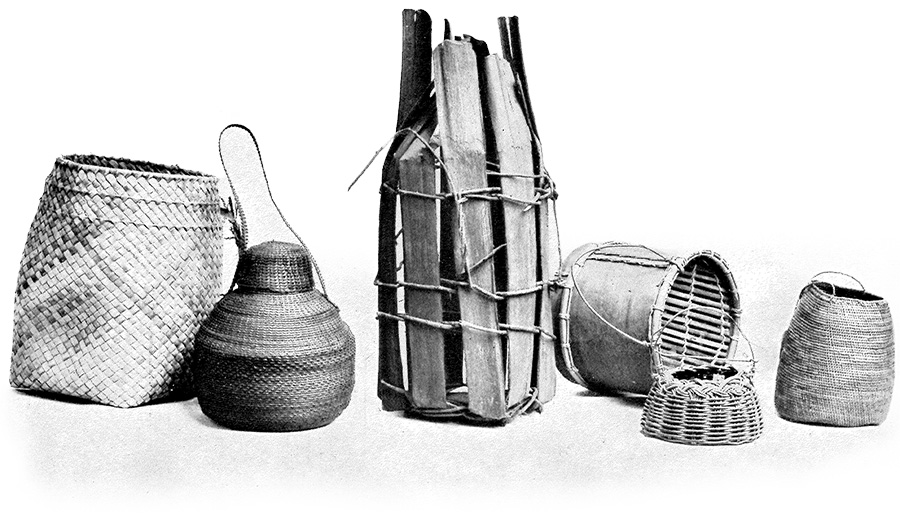
Different types of Malaysian basketwork. Shown lying on its side is a rice steamer collected from Singapore, which has a cylindrical body made of a strip of hard, tough bark with the ends sewn together, and handles made of rattan. Image reproduced from Otis T. Mason, "Vocabulary of Malaysian Basketwork: A Study in the W. L. Abbott Collections" (Washington: Government Printing Office, 1908), Plate I. (From National Library of Singapore, call no. RSEA 746.41 MAS).
"I don’t like Singapore, it is a rotten place as is indeed every other town. I am simply crazy to get away again,” wrote the American naturalist-collector William Louis Abbott in a 1903 letter to his sister.1 Wrapped up in this complaint seemed to be his general ambivalence towards cities. Abbott also had little love for his native United States, finding “the masses of its people vile”.2
Despite his feelings, Singapore, then a British colonial trading port, served as Abbott’s base for his collecting expeditions across maritime Southeast Asia. Between 1900 and 1909, Abbott’s schooner – the Terrapin, which he built and outfitted in Singapore – took him on collecting trips along the Malayan and Sumatran coasts, up the rivers of Borneo to the islands of the South China Sea, and further eastward to western New Guinea. A prolific collector of mammal and bird specimens as well as ethnological items, Abbott became the single largest contributor – of over 6,000 objects – to the Smithsonian.3 His impressions of Singapore were peculiar to him. Other American collectors who landed on our shores left behind a more varied and, in some cases, warmer record of the island.
![William Louis Abbott’s schooner, Terrapin, in the Kwangtung (Guangdong) Strait. Image reproduced from C. Boden Kloss, “In the Andamans and Nicobars: The Narrative of a Cruise in the Schooner “Terrapin”, with Notices of the Islands, Their Fauna, Ethnology, Etc.” (London: John Murray, 1903), frontispiece. (From National Library of Singapore, call no. RCLOS 954.88 KLO-[RFL]).](https://isomer-user-content.by.gov.sg/339/40205328-7eff-43b4-a98f-42fff3bc9bb9/William Louis Abbott’s schooner, Terrapin, in the Kwangtung (Guangdong) Strait. Image reproduced.jpg)
It was during my time at the Summer Institute in Museum Anthropology at the Smithsonian National Museum of Natural History in 2025 that I chanced upon Abbott’s collection and an assemblage of 83 items from “Singapore” within its ethnology collections. Thus began my journey of studying this assemblage and the circumstances of its formation. What factors informed the collecting practices of American explorers and public servants in Singapore from the 19th to 20th centuries? What visions of Singapore and Southeast Asia did American collectors have?
The “Wilkes Ex. Ex.”
“Singapore?” reads the catalogue card of a “fly-brush” donated to the former US National Museum (now the National Museum of Natural History) by the United States Exploring Expedition (1838–42). Listed as its collector is the “Wilkes Ex. Ex.” (Wilkes Exploring Expedition), referencing the expedition’s commander – Lt Charles Wilkes, who was a naval officer and scientist by training.4
, labelled as a “fly-brush.jpg)
Measuring 70 cm long with a diameter of 5.5 cm, this sapu lidi (broom), labelled as a “fly-brush”, was likely collected from Singapore by the United States Exploring Expedition before being accessioned into the US National Museum in 1858. (From E14259-0, Department of Anthropology, Smithsonian Institution).
The expedition was funded by Congress with the goals of exploring and mapping the Pacific, Antarctica and the northwest coast of the United States, promoting American commerce and industry as well as “to extend the bounds of science, and to promote the acquisition of knowledge”.5 While the expedition established American scientific and intellectual efforts as equal to that of Europe, its primary purposes were commercial and militaristic, with the goal of projecting American soft power across the globe.6
This “fly-brush” is the earliest item associated with Singapore to have been accessioned into the US National Museum. It is among nearly 4,000 ethnographic objects collected by the “scientifics” – a civilian group of nine scientists with the expedition – and deposited at the then newly established Smithsonian Institution and the US National Museum in the 1850s.7 Yet the question mark with the geographical attribution for the “fly-brush” raises, well, a question: one of provenance.
The USS Vincennes, under the command of Lt Wilkes, made a stopover in Singapore in February 1842 before returning to the United States.8 Some collecting was conducted here, particularly of natural specimens. Wilkes wrote: “The neighbouring seas afford a great variety of shells and corals; among the latter I may mention the cup of Neptune (Alcyonium), which grows to a very large size, and is not found elsewhere. Our collections, by the industry of the naturalists and officers, were much increased here.”9 Could the “fly-brush” have been collected at the time?
.jpg)
Charles Wilkes, commander of the United States Exploring Expedition (1838–42). Image reproduced from Charles Wilkes, “Narrative of the United States Exploring Expedition: During the Year 1838, 1839, 1840, 1841, 1842”, vol. 1. (Philadelphia: Lea & Blanchard, 1845), frontispiece. (From Biodiversity Heritage Library).
The vast swathes of natural specimens and ethnological objects gathered by the expedition steadily made their way back to Washington as cargo on other ships. However, accurate identification data on collection records for many specimens were subsequently lost or removed when passing through various institutions before arriving at the US National Museum.10
A description of the “fly-brush” can be found in artist and museologist Titian Peale’s handwritten catalogue titled “Collections of the United States South Sea Surveying and Exploring Expedition, 1838, 9, 40, 41, & 42”.11 Peale, who served as one of the expedition’s principal scientific collectors, listed it as an “ornamented brush from the island of Negros, one of the Phillipine [sic] group”, thus revealing the uncertainties surrounding its true origins. Given its role as a waypoint to East Asia and maritime Southeast Asia, first as an indigenous port before 1819, and then as a colonial port-city and gateway to the Malayan hinterland, many items attributed to Singapore likely did not have Singapore as their true provenance.12
Two other early items linked to Singapore are a sheathed keris and a sheath without its keris, both collected by William Rich. It is likely that he obtained the items during his time as a botanist on the Wilkes Expedition and passed these on to Spencer F. Baird, assistant secretary of the Smithsonian Institution, who then donated the items to the Smithsonian in 1874. We do not know exactly when these items were collected, nor do we know where the missing keris is. The lack of information offers insight into the challenges Smithsonian staff faced while organising their rapidly expanding global collections in the 19th century.
Consular Collectors
Another group of collectors, the American consuls, contributed the majority – 49 items – to the Singapore assemblage. According to academic Pamela Sodhy in her 1983 essay, “United States Consuls in Singapore”, this “special breed of men – adventurous, daring, and willing to take risks”, was also “overworked, underpaid, and understaffed”.13 From 1833 onwards, American consuls to Singapore produced handwritten reports, known as Singapore Despatches, for the United States Department of State, and sometimes included clippings and other materials relevant to US interests.14
Beyond dealing with foreign diplomatic representatives, the work of the consuls was heavily commercial in nature due to Singapore’s prosperity as a free port and a desire by the US “to share in that trade, to make Singapore a potential market for American goods”.15 Among other duties, American consuls sent quarterly and annual reports to the State Department about shipping and trade activity in Singapore; managed the aftermath of shipwrecks and deserters; and monitored regional piracy and political developments.16
American consuls worldwide were also collectors of material culture. Between 1898 and 1920, consuls donated approximately 1,000 textile samples to the US National Museum. These samples eventually became part of the “consular collections” now housed at the National Museum of American History.17
One of the artefacts in the Singapore assemblage at the National Museum of Natural History is a betel chewing set described as a “Siri Quid Chewer’s Outfit”, with “siri” referring to sirih (betel leaf). It was collected by Adolphus G. Studer, the American consul in Singapore from 1871 to 1889.
Studer came to prominence in the American Civil War, serving in the Union Army under General Ulysses S. Grant. Grant, who later became the 18th president of the United States, appointed Studer as consul in Singapore.18 As Singapore was then part of the Straits Settlements, US-Singapore relations were mediated by the British colonial authorities. Consular appointments required the approval of the British monarch. Queen Victoria approved Studer’s appointment, which was published in the London Gazette in August 1871.19
A highlight of Studer’s 19-year tenure was the “happy occasion” of Grant’s visit to Singapore in April 1879.20 Accompanying Grant on this post-presidential world tour was journalist John Russell Young, who observed that “there was nothing lacking in the hospitality of Singapore… There were dinners at the Government House and a reception. There was a band which made a heroic attempt at various American national airs, succeeding only in Yankee Doodle”.21
The catalogue card for the betel chewing set bears the annotation “N.O. Exp.” (New Orleans Exposition), which referred to the World’s Industrial and Cotton Centennial held in New Orleans from December 1884 to June 1885.22 Also known as the 1884 New Orleans World’s Fair, the exposition showcased “the ethnological, animal, and mineral resources of the United States”. Like other world’s fairs, it provided an opportunity for the Smithsonian to enhance its collection of international items by acquiring them from exhibitors at low cost.23
Studer’s other Singapore finds, also showcased at the exposition, included three pairs of wooden clogs – described as “wooden sandals” – used for everyday wear and household work in the kitchen. One pair has low block heels bound by leather straps, while another contains protruding toe knobs, which would have been clamped between the first and second toes. These two pairs of clogs were likely displayed at the exposition’s ethnological exhibit, for which ethnology curator Otis T. Mason wrote a circular.24 In October 1885, the State Department donated the items to the US National Museum, reflecting how consular involvement in the world’s fairs allowed them to serve as conduits for ethnological representations of Singapore in the museum.
The world’s fairs were hotbeds of colonial ideology, with exhibits reinforcing hierarchical views of human societies and cultures. This was exemplified by the deception that the Johor contingent found themselves embroiled in at the 1893 Chicago World’s Fair, as writer and researcher Faris Joraimi revealed.25 Rounsevelle Wildman, then the American consul to Singapore and the World’s Fair Commissioner for the Straits Settlements, had arranged for the Johor exhibit to be shown at “the showman’s quarter and not the main part of the Fair”.26
To make things worse, Wildman had assigned the rights to the Johor exhibit to the Ocean Trading Company without Johor’s knowledge. The contingent’s eventual exhibition in the Agricultural Building alongside other independent nations was only possible due to the efforts of Johor statesman Abdul Rahman Andak and Harry Lake, an engineer and secretary to Sultan Abu Bakar of Johor. Such fraught encounters may be more indicative of the desultory attitudes of collectors towards local communities than the objects collected themselves.
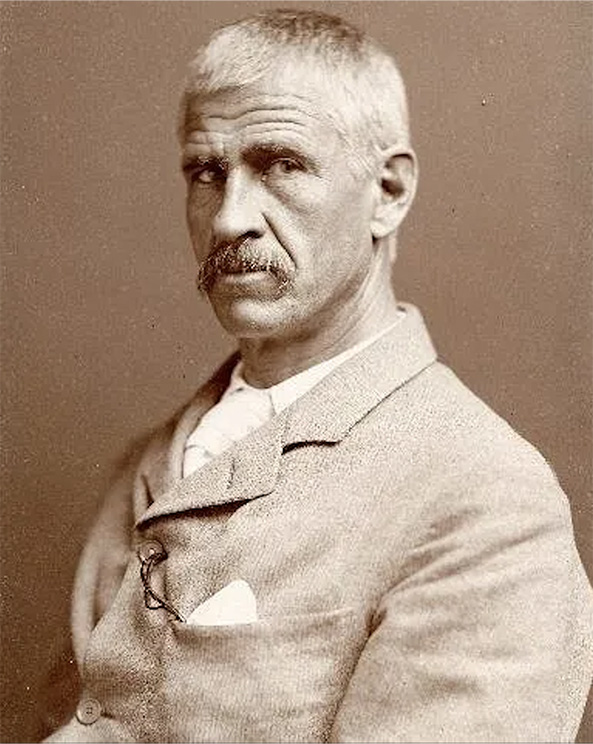
It was this same Wildman whose collecting efforts were no doubt encouraged by his additional role as Special Commissioner for the Smithsonian Institution of the Straits Settlements and Siam. While he was consul, Wildman contributed 45 items to the Singapore assemblage, including 34 musical instruments, five kerises, four games, a basket and a turtle carapace, the last dubiously listed as a “war shield”. Among the musical instruments were single-sided drums (ketebung, spelt “cattaban” on the museum’s catalogue cards) and two-sided drums (gendang, spelt “ghendan”).27
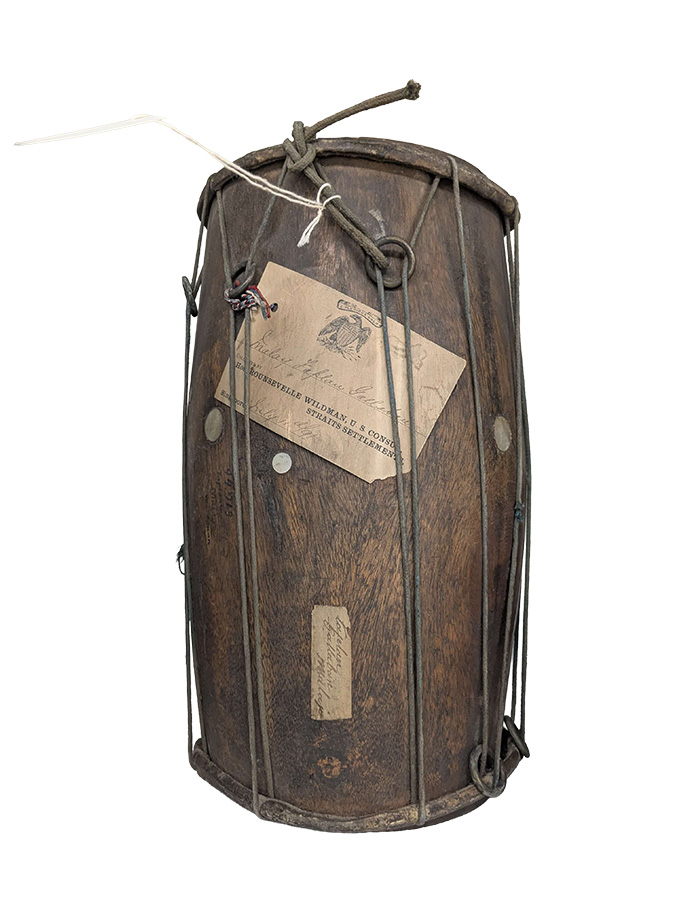
Measuring 34 cm in height with a diameter of 20.3 cm, this drum was collected by Rounsevelle Wildman, 1891. Wildman’s contributions are easily identifiable. Each item is affixed with a paper label containing his printed name, title and location (Singapore), alongside handwritten notes about the item and the month and year in which it was collected. Handwritten on the label for this drum are “Malay Taplan Gallabau” and “July 1891”. Photo by Chia Jie Lin. (From E94913-0, Department of Anthropology, Smithsonian Institution).
Wildman’s acquisitions must be read against his literary visions of Singapore. “Were it not for the great black python, that lies sleeping in the road in front of you, or the green iguana that hangs in a green timboso tree over your head, or a naked runner pulling a rickshaw, you might think you were travelling the wide asphaltum streets of Washington,” he described in Tales of the Malayan Coast (1899), a collection of fictional and semi-autobiographical stories based on his time living and travelling in Southeast Asia.28 Wildman’s impressions are rife with images of “a Malay in sarong and kris by his side, singing… the glorious promises of the Koran”, “the Chinese ‘boy’… always the ‘boy’ until he dies”, and “the genie of the cart… a tall, wiry, bronze-colored Hindu”, among others.29
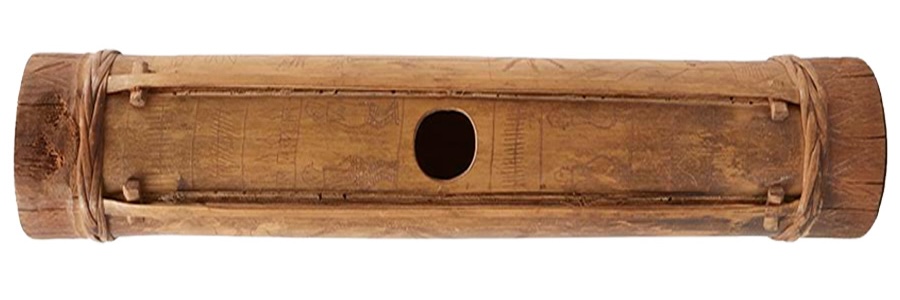
This Malay stringed instrument, which is 31.1 cm long and has a diameter of 6.67 cm, was collected by Rounsevelle Wildman, 1892. According to its accompanying catalogue card, the instrument appears to have been purchased in Singapore. (From E95067-0, Department of Anthropology, Smithsonian Institution).
Viewed through a colonial lens, the objects Wildman collected have been reduced to curiosities plucked from a rotating cast of exotic stereotypes. This raises new questions: What stories did these artefacts carry, and how much of these were lost in the transactions, and in translation?
Abbott’s Adventures
Wildman was not the only American who collected items from Singapore at the turn of the 20th century. Enter Abbott, a naturalist, zoologist and ethnologist of means. In October 1900, Abbott and a crew of Malay sailors departed Singapore aboard the Terrapin, as zoologist Cecil Boden Kloss wrote in his travelogue, In the Andamans and Nicobars (1903).30
Abbott’s donations, amassed from his travels to virtually all Southeast Asian island groups within 1,000 km of Singapore, eventually formed the majority of the Smithsonian’s ethnology collections.31 Between 1903 and 1907, Abbott contributed 23 items from Singapore to the ethnology collection at the National Museum of Natural History: seven baskets, four rice storage and cooking implements, four spears, three hats, a knife, a sleeping hat, a “chopper”, a sword and a “fish scoop, ‘penango’”, described as a “pocket at the end of the fish fyke, (kelong)”.
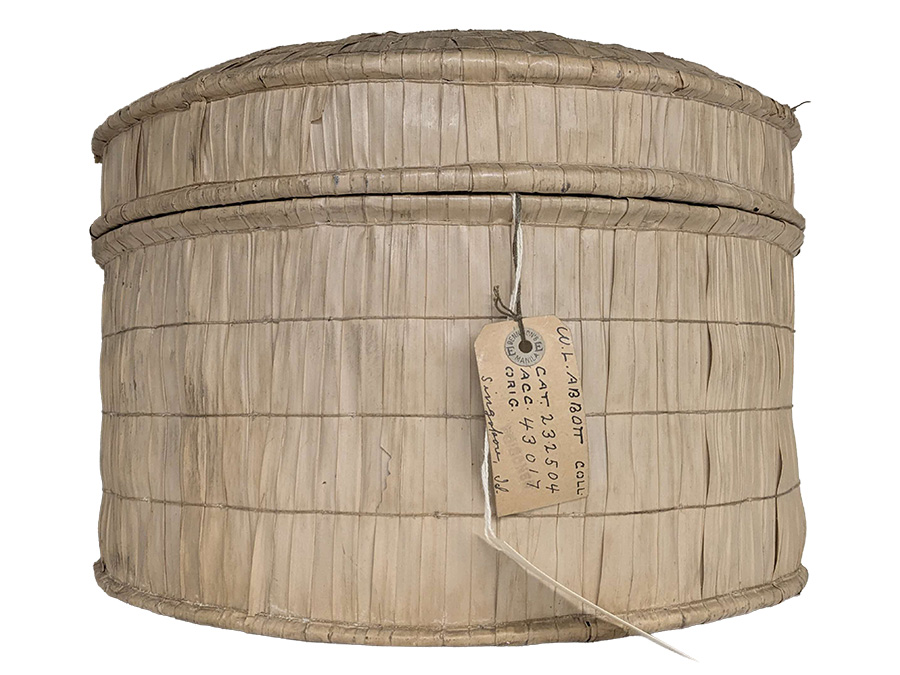
Collected in 1904 in Singapore by William Louis Abbott, this lidded basket has a height of 25.4 cm and a diameter of 35.6 cm. Photo by Chia Jie Lin. (From E232504-0, Department of Anthropology, Smithsonian Institution).
Abbott also donated a selection of material culture and ethnographic photographs from Borneo to the ethnology collection of the Raffles Library and Museum between 1903 and 1909.32 These items were later inherited by the Asian Civilisations Museum.33
The breadth and variety of these items reflect the then prevailing ethos to systematically collect “representative samples” of every culture that marked ethnological collecting. In his publication, Vocabulary of Malaysian Basketwork, Otis T. Mason examined the forms, structures and techniques of Malaysian basketwork represented in Abbott’s Smithsonian collections.34 Yet, the voices of their actual makers have largely been absent from the historical record.
Interpreting Ethnological Collections Today
It would be remiss to examine the Singapore assemblage in isolation. These objects discussed are best understood within this context of a broader Malay world: a sea of islands with interconnected histories, trade networks and cultural exchanges that shaped life in the region long before the arrival of Western naturalists and collectors.
From everyday household items to kerises, the Singapore collection at the National Museum of Natural History is but a small portion of all the objects that bore witness to the negotiated encounters between American collectors and Southeast Asian communities. These objects reveal not only American conceptions of what was deemed worthy of collecting from Singapore, but also the agency of local communities and traders who actively shaped what made its way westward, presenting goods they believed would resonate with Western buyers. However, the perspectives of those who made, used and ultimately parted with these objects remain largely absent from historical records. To study these items today is to acknowledge these silences, and to invite more Southeast Asian researchers and communities to encounter them and reinterpret their material heritage on their own terms.
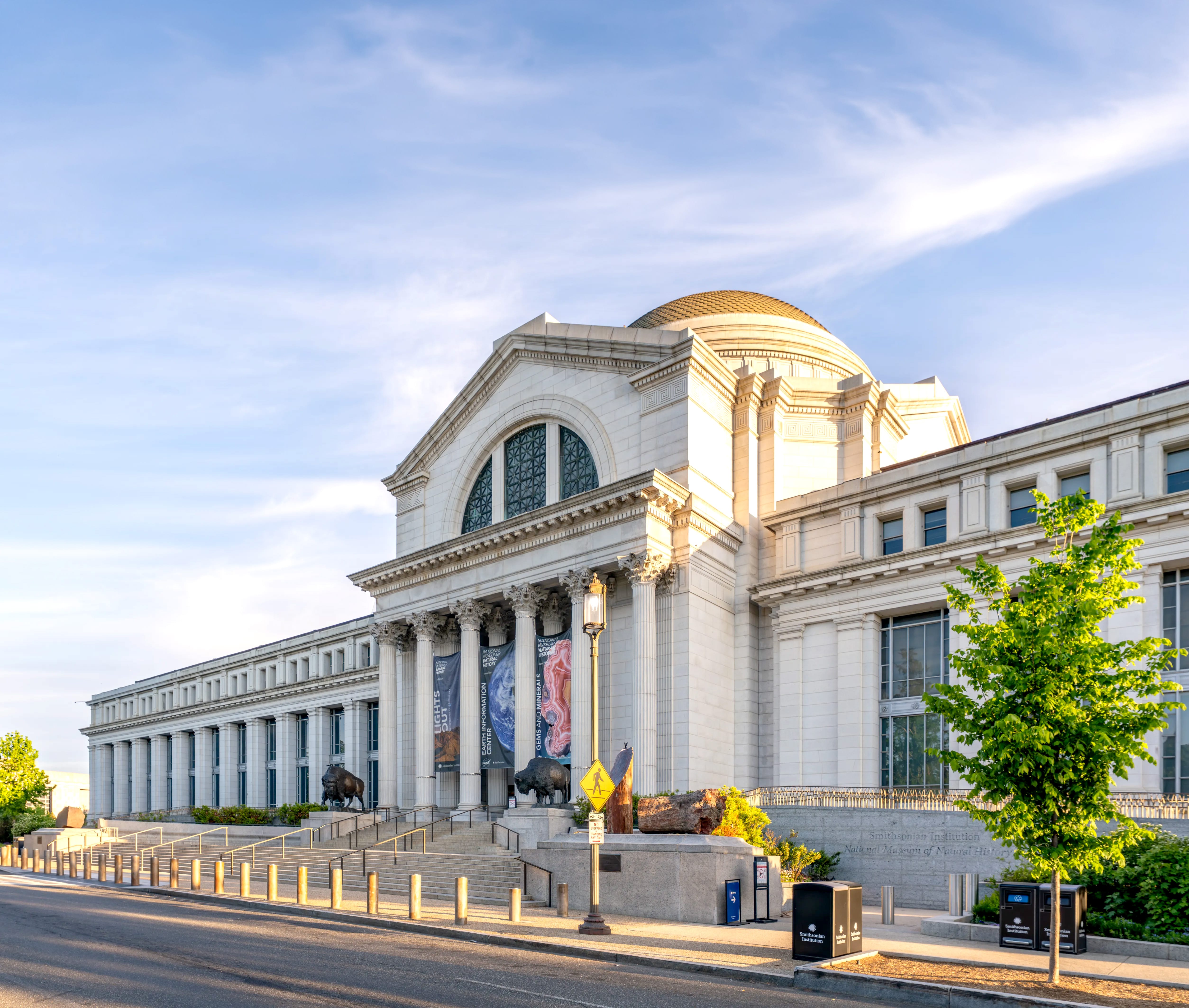
The National Museum of Natural History in Washington, D.C., 2026. Photo by Ajay Suresh. (From Wikimedia Commons).
The writer gives special thanks to the Summer Institute in Museum Anthropology at the Smithsonian National Museum of Natural History for the opportunity to explore the Singapore ethnological assemblage, and to Dr Joshua Bell, Alex Foo and Caleb Leow for their inputs in the writing of this article.
About the Author
Chia Jie Lin is a former Librarian with the National Library of Singapore and is currently on secondment to the National Heritage Board. She is passionate about engaging fellow Singaporeans with stories from Singapore’s past. Her favourite animals include the Malayan tapir and banded leaf monkey.
End Notes
1 William Louis Abbott, quoted in Clement Oon, Nicola Kuok and Gauri Parimoo Krishnan, eds., Hunters & Collectors: The Origins of the Southeast Asia Collection at the Asian Civilisations Museum (opens in new tab) (Singapore: Asian Civilisations Museum, 2009), 27. (From National Library of Singapore, call no. RSING 069.50959 HUN)
2 Paul Michael Taylor, “A Collector and His Museum: William Louis Abbott (1860–1936) and the Smithsonian,” in Treasure Hunting? The Collectors and the Collecting of Indonesian Artefacts (opens in new tab), eds. Reimar Schefold and Han Vermeulen (Leiden: Research School of Asian, African, and Amerindian Studies, University of Leiden, 2002), 221. (From National Library of Singapore, call no. RSEA 306.09598 TRE)
3 Taylor, “A Collector and His Museum (opens in new tab),” 221–39.
4 Vidya Schalk, “US Ex Ex: An Expedition for the Ages (opens in new tab),” BiblioAsia 15, no. 2 (July–September 2019): 16–22.
5 Charles Wilkes, Synopsis of the Cruise of the U.S. Exploring Expedition During the Years 1838, ’39, ’40, ’41 & ’42 Delivered Before the National Institute by Its Commander Charles Wilkes on the Twentieth of June 1842 to Which Is Added a List of Officers and Scientific Corps Attached to the Expedition (Washington, DC: Peter Force, 1842), 6, Internet Archive, https://archive.org/details/SynopsiscruiseU00Wilk (opens in new tab).
6 As Wilkes wrote in 1844, “I have reason to rejoice that I have been enabled to carry the moral influence of our county to every quarter of the globe where our flag has waved.” Wilkes was also writing in defence of the Expedition. At the point of writing, he was embroiled in controversies, including brutal violence that the expeditioners exerted on Fiji Islanders. See Charles Wilkes, “Introduction,” in Narrative of the United States' Exploring Expedition, During the Years 1838, 1839, 1840, 1841, 1842. Condensed and Abridged (opens in new tab) (London: Whittaker and Co., 1845). (From National Library of Singapore, call no. RRARE 910.4 WIL)
7 Ilana Newman and Steven Chen, “In the Name of Science? A Tale of Exploration, Conquest, and Collecting Aboard the Wilkes Expedition,” Wesleyan University, 24 July 2018, https://archaeologycollections.site.wesleyan.edu/2018/07/24/in-the-name-of-science-a-tale-of-exploration-conquest-and-collecting-aboard-the-wilkes-expedition/ (opens in new tab).
8 Schalk, “US Ex Ex: An Expedition for the Ages (opens in new tab).”
9 Charles Wilkes, Narrative of the United States Exploring Expedition: During the Year 1838, 1839, 1840, 1841, 1842, vol. 5. (Philadelphia: Lea & Blanchard, 1845), 432, Biodiversity Heritage Library, https://www.biodiversitylibrary.org/page/41010499 (opens in new tab).
10 Leslie K. Overstreet, “The Publications of The U.S. Exploring Expedition, 1844–1874,” Smithsonian Libraries, accessed 7 September 2026, https://www.sil.si.edu/DigitalCollections/usexex/learn/Overstreet-01.htm (opens in new tab).
11 For information on Titian Peale, see Jane Walsh, “From the Ends of the Earth: The United States Exploring Expedition Collections,” Smithsonian Libraries, 29 March 2004, https://www.sil.si.edu/DigitalCollections/usexex/learn/Walsh-01.htm (opens in new tab).
12 Derek Heng, “Continuities and Changes: Singapore as a Port City Over 700 Years (opens in new tab),” BiblioAsia 1, no. 1 (November 2005): 12–16.
13 To better afford Singapore’s high cost of living, American consuls were initially allowed to carry out trade outside of their consular duties, but this privilege was rescinded after 1857. Pamela Sodhy, “United States Consuls in Singapore 1859–1880,” Journal of the Malaysian Branch of the Royal Asiatic Society 56, no. 1 (1983): 16. (From JSTOR via NLB’s eResources (opens in new tab) website)
14 Sodhy, “United States Consuls in Singapore 1859–1880,” 12. For digitised copies of the Singapore Despatches, see United States National Archives and Records Administration, “Despatches from United States Consuls in Singapore, Straits Settlements (opens in new tab),” 2 May 1878–1 July 1880, private records. (From National Archives of Singapore, accession no. 464–6)
15 However, Singapore’s exports to the US outnumbered that of U.S. imports. Sodhy, “United States Consuls in Singapore 1859–1880,” 32.
16 Consuls also addressed disputes between Americans, especially sailors, and settled the estates of Americans who died at sea or in Singapore. Sodhy, “United States Consuls in Singapore 1859–1880,” 20–23.
17 Madelyn Shaw and Amy J. Anderson, “‘The Consular Collections at the National Museum of American History’ Opening Plenary Session: Crosscurrents: The Transnational Flow of Textiles,” October 2016, https://digitalcommons.unl.edu/tsaconf/1000 (opens in new tab).
18 Joseph Eiboeck, “Chapter 8 (Translation): German Iowans in the Union Army,” German Iowa and the Global Midwest, accessed 24 April 2026, https://germansiniowa.lib.uiowa.edu/exhibits/show/eiboeck/chapter8-translation (opens in new tab).
19 Straits Settlements, Straits Settlements Government Gazette (opens in new tab) (G.N. No. 209), 6 October 1871, 465. (From National Library of Singapore, call no. RRARE 959.51 SGG)
20 Sodhy, “United States Consuls in Singapore 1859–1880,” 31.
21 John Russell Young, “Chapter XXXI: The Straits of Malacca,” in Around the World with General Grant: A Narrative of the Visit of General U.S. Grant, Ex-President of the United States, to Various Countries in Europe, Asia, and Africa, in 1877, 1878, 1879. To Which Are Added Certain Conversations with General Grant on Questions Connected with American Politics and History (opens in new tab), vol. 2. (New York: The American News Co.,1879), 107. (From National Library of Singapore, call no. RRARE 910.41 YOU)
22 The Cotton Centennial celebrated a century of US production, manufacture and sale of cotton. See Michael Shane Powers, “The Smithsonian Institution in the 1884 New Orleans World’s Fair,” Smithsonian Institution Archives, 3 October 2017, https://siarchives.si.edu/blog/smithsonian-insitution-1884-new-orleans-world’s-fair (opens in new tab).
23 “World’s Industrial and Cotton Centennial Exposition (New Orleans, 1884–1885), 1884–1888, 1893,” Smithsonian Institution Archives, accessed 7 September 2026, https://siarchives.si.edu/collections/siris_arc_216677 (opens in new tab).
24 “General Correspondence of George Brown Goode and Spencer F. Baird, 1884–1886,” Smithsonian Institution Archives, accessed 7 September 2026, https://siarchives.si.edu/collections/siris_arc_216677 (opens in new tab).
25 Faris Joraimi, “Johor at the 1893 Chicago World’s Fair (opens in new tab),” BiblioAsia 18, no. 3 (October–December 2022): 30–35.
26 “True Tale of Johore (opens in new tab),” Singapore Free Press, 19 September 1893, 190. (From NewspaperSG)
27 Also included were bamboo flutes (suling), with one described as a “native flaegeolet (sulin)”. They are part of a collection of almost 8,000 musical instruments within the Smithsonian Institution, with 35 percent of the holdings split across the National Museum of Natural History, the National Museum of the American Indian and the National Museum of African Art. The remaining 65 percent lies in the National Museum of American History. “The Collection,” Smithsonian Chamber Music society, accessed 7 September 2026, https://www.smithsonianchambermusic.org/collection (opens in new tab).
28 Rounsevelle Wildman, “In the Golden Chersonese: A Peep at the City of Singapore,” in Tales of the Malayan Coast: From Penang to the Philippines (opens in new tab) (Amsterdam: Fredonia Books, 2002, c.1899), 314–15. (From National Library of Singapore, call no. RSING 398.2 WIL)
29 Wildman, “In the Golden Chersonese (opens in new tab),” 298, 309, 317.
30 This is the only published account of Abbott’s collecting expeditions within this period. See C. Boden Kloss, In the Andamans and Nicobars: The Narrative of a Cruise in the Schooner “Terrapin”, with Notices of the Islands, Their Fauna, Ethnology, etc. (opens in new tab) (London: J. Murray, 1903), 2. (From National Library of Singapore, call no. RCLOS 954.88 KLO-[GBH])
31 Taylor, “A Collector and His Museum (opens in new tab),” 224.
32 Items include a bark beater, a basket, a hair ornament and a printing block.
33 Oon, Kuok and Krishnan, Hunters & Collectors (opens in new tab).
34 Otis T. Mason, Vocabulary of Malaysian Basketwork: A Study in the W.L. Abbot Collections (opens in new tab) (Washington: Government Printing Office, 1908). (From National Library of Singapore, call no. RUR 746.41 MAS)