
Article
Still Generating Interest: St James Power Station at 100
17 November 2026
Topics
History
Places and Buildings
From meeting Singapore’s growing demand for electricity to becoming a national monument, St James Power Station has undergone several transformations over the past century.
By Cheryl Chong
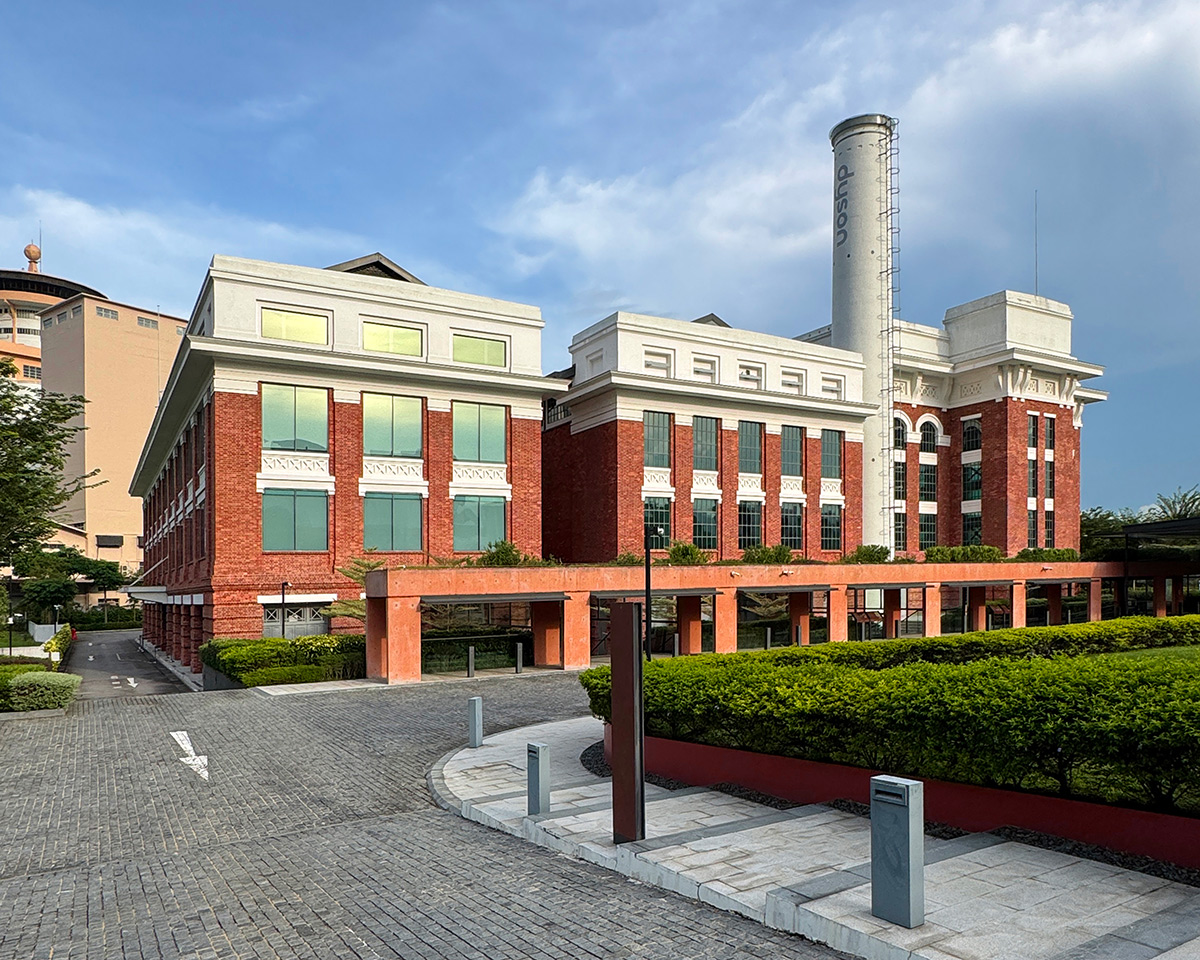
The building of the former St James Power Station currently serves as the global headquarters of Dyson, 2026. Photo by Jimmy Yap.
People these days take it for granted that when they flick on the light switch, turn on their televisions, or plug in their phones to be charged, that everything will simply work. Few, however, give any thought to all the infrastructure needed to make this happen. Scattered around Singapore are 31 power stations that mostly burn natural gas to generate the electricity needed to power all the homes, commercial buildings, trains, factories, data centres and petrochemical plants in the country.1 In 2025, the city-state generated 59,616 gigawatt-hours of electricity according to the Energy Market Authority.2
It would be unimaginable to live without electricity today. A century ago though, life was very different. Electricity was still a fairly recent innovation and not yet available everywhere on the island. However, even back then, it was abundantly clear that electricity, and lots of it, would be needed in a modern metropolis. Which is why the authorities decided to build St James Power Station, a coal-fired plant with an initial capacity of 7,000 kW. Built at a cost of $30 million in the Edwardian style, it was officially opened on 7 November 1927.3
At the time, electricity was still such a novelty that at the official opening of St James, Straits Settlements Governor Hugh Clifford could recount a story of people who had yet to encounter using an electrical appliance. Clifford recalled that when he was in Nigeria (where he had been governor between 1919 and 1925), a servant had come up to him to ask for permission to bring his wife into his office so she could see for herself how a kettle could boil water by plugging “a peg into the wall” instead of being heated over a fire.4
A Short History of Electricity
Although the opening of St James marked a significant milestone in the development of Singapore’s public electricity supply, electricity had, in fact, arrived in Singapore in 1878. A power station had been built outside the eastern entrance to the dock and the Tanjong Pagar Dock Company installed an electric arc lamp at the wharves that emitted light equivalent to about 2,000 candles “to facilitate work which had to be carried on all night” and also provided security and protection against crime.5
In 1906, the MacKenzie Road Power Station began operations. Located beside Bukit Timah waterworks, the station supplied electricity to power trams, wharves and streetlights. Anticipating that demand for electricity would rise in the near future, Municipal Engineer R. Peirce observed that “there is every prospect of a reasonable increase of consumers”.6
Between 1906 and 1907, the number of electricity accounts rose by more than 400 percent, and continued growing. By the early 1920s, MacKenzie Road Power Station had become overtaxed, with little downtime for maintenance. In 1921, the Municipality’s Engineer-in-Chief, H.L. Pearson, pessimistically concluded: “The backward state of the electrical situation is holding back the progress of the town not only in respect to public and private lighting, and power and road improvement on tram routes but the high price of current has also ruled out of consideration the adoption of electric vehicles which have many advantages for Municipal work of certain kinds.”7
The Municipality decided to plan for a larger power station. In October 1923, the Municipal Commissioners instructed British engineering firm Preece, Cardew and Rider to select a suitable site for the power station.8 Cape Saint James, a narrow strip of land formerly known as Telok Blangah Bay, was identified. It had once belonged to Temenggong Abdul Rahman, with whom Stamford Raffles negotiated to sign the 1819 Singapore Treaty that allowed the British to establish a trading post on the island.9
The site’s location beside Keppel Harbour provided direct access to seawater for the turbines, while its proximity to the wharves facilitated the delivery of coal by sea. Coal and other materials could also be transported quickly to St James by rail, as the Federated Malay States Railway Station was nearby.10
In 1924, after the Municipality purchased the 65,000 sq ft (6,039 sq m) site for $375,000, a “considerable amount of preliminary work” was conducted before the “actual work of laying the concrete foundations and erecting the huge steel skeleton of the building”.11 This included reclaiming sections of tidal swamp, levelling the ground and relocating squatters on an ideal site whose “only drawback was the necessity of driving piles in the filled-in portion on the west side”. Preece, Cardew and Rider had originally chosen a site on the east side of the peninsula, which comprised “practically solid rock”, but this was rejected by the government.12
Actual construction began only in late 1924. The most difficult part of the foundation work involved the construction of a twin culvert for the inlet and outlet of circulating water, which would run under the station between the turbine and switchgear house, with a trench 37 ft (11.3 m) wide and 24 ft (7.3 m) deep excavated for this purpose. The culvert had to be made “amply strong” as it was intended to bear the weight of rolled steel columns and the building. The underground laying of the inlet and outlet pipes also presented challenges, as these ranged from 195 to 280 ft (59 to 85 m) in length, weighing a hefty 6.25 tons per 10 ft (3 m) length. Foundations for the boiler house, turbine house and switchgear house were completed by Christmas 1925.13
Although St James had been planned for completion in March 1927, the first 2,000 kW generator in the power plant was installed and commissioned on 30 September 1926, and operated from 6 to 11 pm daily, to relieve the peak electrical loading on existing sources. As St James ramped up its operations, there was a gradual reduction in supply from the MacKenzie Road Power Station, which ceased its electrical supply on 29 October 1926. By June 1927, ahead of St James’s official opening in November the same year, it was supplying electricity for the whole existing system.14
A Grand Dame
St James was designed by Chief Municipal Architect Alexander Gordon, who was also responsible for the City Hall building, with recommendations from Preece, Cardew and Rider. Massive steel works formed the skeleton of the superstructure, with about 820 tons of steel used to construct the building.15
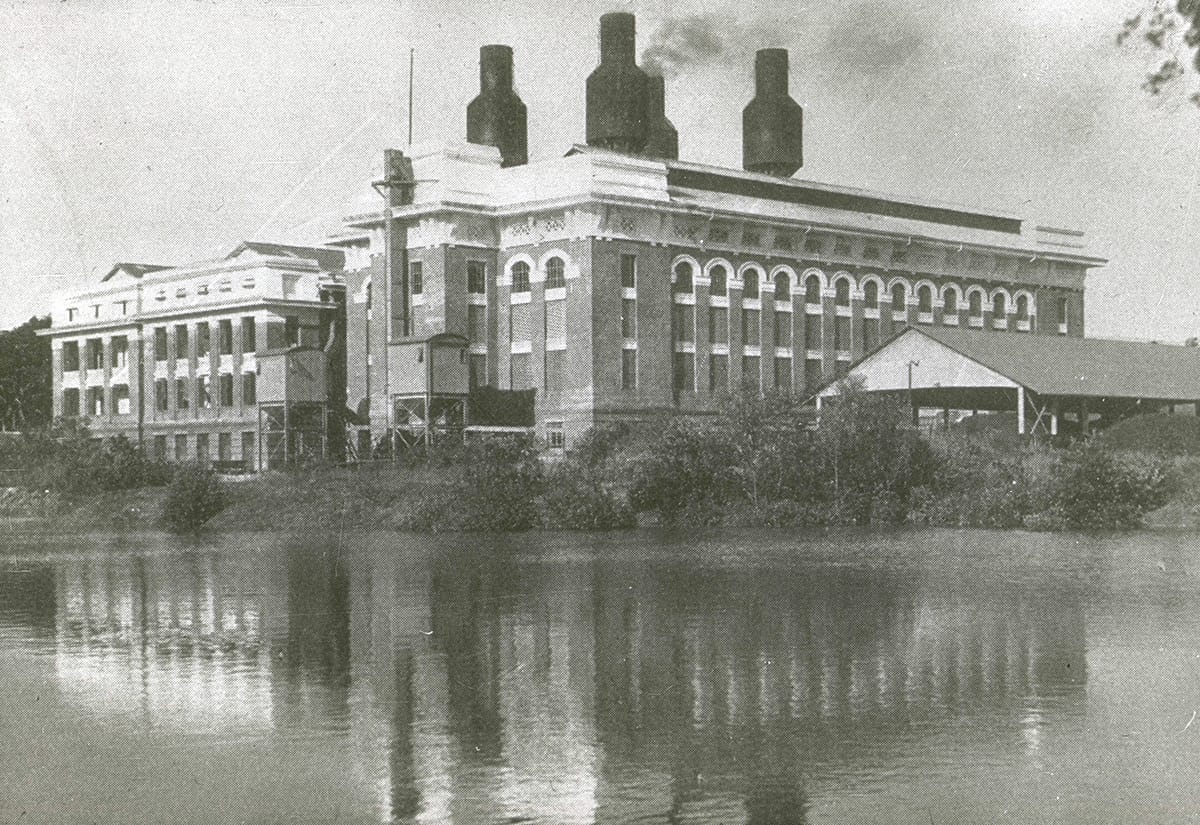
St James Power Station, 1930s. Lee Kip Lin Collection, courtesy of National Archives of Singapore (Media - Image No.19980005123 - 0097).
The facility’s distinctive features were its red-brick facade lined with rows of full-length windows and tinted-glass panels that let natural light into the cavernous interior spaces for industrial machinery, along with soaring chimneys. Similar to buildings of its time like the Central Fire Station, its neoclassical exterior retained an air of elegance and decorum despite the building’s utilitarian function.16 Victor Koh Dut Sye, who worked at St James as a storekeeper in the 1950s described it as grand, observing that “during those days, anything in red-brick gave a very ‘high- class’ kind of feeling”.17
The building housed a boiler house, turbine room, switchgear house, pumps and storage areas for coal. Six boilers were supplied by a British manufacturer, each capable of boiling 40,000 lb (18,144 L) of water per hour, with one steel chimney for every two boilers. Three turbines – one with a capacity of 2,000 kW and the other two with capacities of 5,000 kW each – would generate electricity for distribution to several substations. At its full capacity, the power station was designed to accommodate a maximum capacity of 40,000 kW, subject to extension of the building and additional equipment. With the increasing cost of coal in the late 1930s, the station switched from burning coal to fuel oil in 1940, with two boilers converted for oil-firing.18
“Keeping the Lights On”
St James provided an expanded electricity supply, and connected Singapore to the grid at a time when the port and commercial economy were booming. The electricity it generated would reach around 28,255 people across different neighbourhoods,19 in addition to powering street lighting, tramways, port and industrial purposes.
With St James up and running, the Municipality took on the role of stimulating electricity demand. In 1928, the Electricity Department opened an office on Orchard Road to provide the public with advice on using and acquiring electrical appliances like cookers, fans and water heaters, which could be leased to households for a fee.20
Its early years were beset by difficulties. As early as June 1927, the Municipal Commissioners anticipated a rise in demand and authorised the addition of a new 10,000-kW turbo-alternator, with the consulting engineers instructed to call for tenders immediately. Sure enough, demand among the public increased as tariffs were reduced and the unit cost of electricity declined from 14 cents in 1927 to 6.2 cents in 1932.21
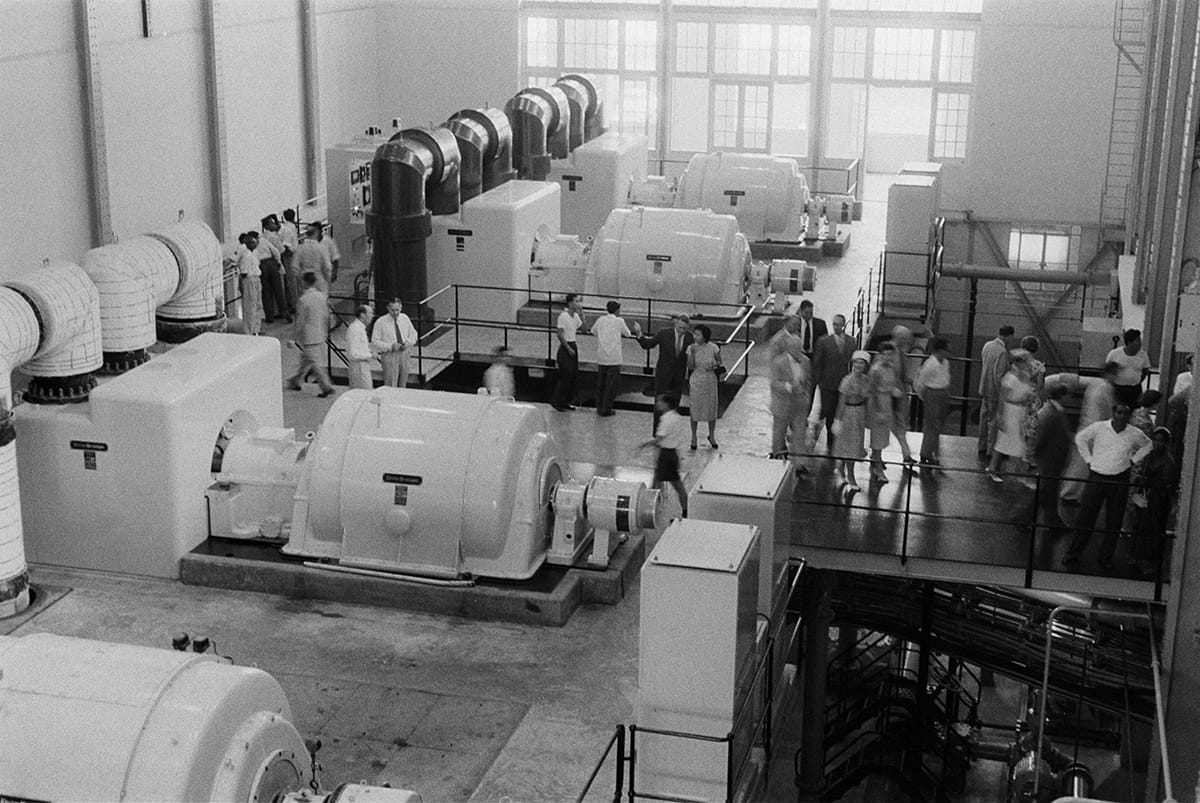
Steam turbines at St James Power Station, 1960. Ministry of Information and the Arts Collection, courtesy of National Archives of Singapore (Media - Image No. 20120000255 - 0015).
St James experienced blackouts and power failures as early as 1928, some of which were attributed to negligence on the part of the junior shift engineers who were subsequently dismissed. Following a shutdown of the power station on 12 November that year, the electrical engineer discovered three days later that “the steam kept in one of the boilers, which should have been at a pressure of from 190 lb. to 50 lb., had been let down to 30 lb”.22
Working at St James was often demanding and thankless. “While most people enjoy their weekend leisure, the power station staff will be hard at work, converting heat from coal into energy, striving to increase the amount of work obtained from each pound of coal and keeping on the alert in case an emergency should arise and a black-out result,” the Straits Times wrote in 1933. In the event of an electrical fault, staff were expected to react in “a matter of ten minutes or so”, with “many telephone bells ringing”. “The engineers would be awakened, the whole engineering staff would be summoned, and, as quickly as firefighters, the Superintendent, Assistant Superintendent, Boiler Superintendent and others would be on duty”.23
These incidents did not dampen the work ethic and diligence of staff like S.R. Urquhart, who served as superintendent of St James prior to the Second World War. His daughter, Muiriel MacLeod, recalled that her father reported for work at the power station every day. “He went there pretty early in the morning, came back for lunchtime, had a little rest, then went back in the afternoon. There were times when he had to go back in a hurry, and that might have been when there were blackouts, because the power station wasn’t able to handle the lights and everything in Singapore. But I think he was on top of his game there, and I know he loved his job.”24
The same rigour and resourcefulness were demanded of local staff who worked to “keep the lights on” during the Japanese Occupation of Singapore, when expatriate engineers like Urquhart were interned in Changi Prison.
“In the distribution section, there were just these two Japanese and we were running the whole section by ourselves,” recalled Lawrence Estrop, an engineering assistant. “We did not have much of a problem running the system… Sometimes we did not have the spares and we would look for them on the black market. All the expatriates were gone… There was nobody with experience left. There were only the foremen. When there was any breakdown, they had to call us. It was sink or swim. We had to do a lot of things that we had never done before.”25
Wireman Lim Loo Cheong was another local staff member who was called back to work. “When there was a cable fault that needed fixing, the Japanese would send someone to my house to pick me up to fix the fault,” he said. “And it was a good job because they gave me a lot of rice and vegetables for my work.”26
“A Second Act”
Wartime shortages and makeshift repairs took a heavy toll on the station’s machinery. By the end of the war, its turbines were “all very seriously damaged”, while “the boiler house was in deplorable condition, as were all auxiliary pumps”. There was also an urgent need to restore equipment and quickly expand electricity supply, as domestic demand for electricity had spiked by about 50 percent after the war.27
As a result, blackouts became common in the late 1940s and 1950s, caused by equipment failures at St James. On 7 February 1948, a generator at the power station broke down, causing a power failure lasting eight-and-a-half hours, which affected all non-city areas in Singapore. “It was estimated that thousands of dollars’ worth of ice-cream in private houses and restaurants melted and was made useless,” the Straits Times reported. The Acting Municipal Electrical Engineer R. Waddle appealed to the public to “cut electricity consumption to a minimum to lighten the load on generators operating on temporary repairs”.28
Two years later, on 19 September 1950, another generator failure at St James plunged the whole of Singapore into darkness for about one-and-a-half hours. “When the single generator broke down all other generators in operation failed, and after a few moments flickering all light and power throughout the city was cut off just before 10.30 pm,” reported the Straits Times. At Kandang Kerbau Hospital – one of the last places to have power restored – three babies were delivered safely by lamplight. Meanwhile at the General Hospital, the night medical officer examined patients using a hurricane lamp. Over at the Victoria Memorial Hall, the “show went on” after a car was driven into the auditorium and had its lights – reflected from a large mirror – directed on the stage.29
In anticipation of such blackouts, engineers brought forward their start-up times on Monday to better manage the sudden spikes in demand from offices and factories resuming a new work week – called “the Monday Syndrome”. Engineer Lau Gar Ning recalled: “To meet this spike, the power stations were asked to move their start-up time to the early hours of Monday morning. One would start at, say, 3 am, another at 4 am.”30
Working at St James continued to be challenging. Howard Higgins, who served as superintendent after the Japanese Occupation, recounted that the station’s restoration was a testament to “the grit and determination of the Municipal electricity staff”, despite crises like “the resignations at one time of two-thirds of senior staff, because the daily process of working the station became too drastic for their endurance”.31
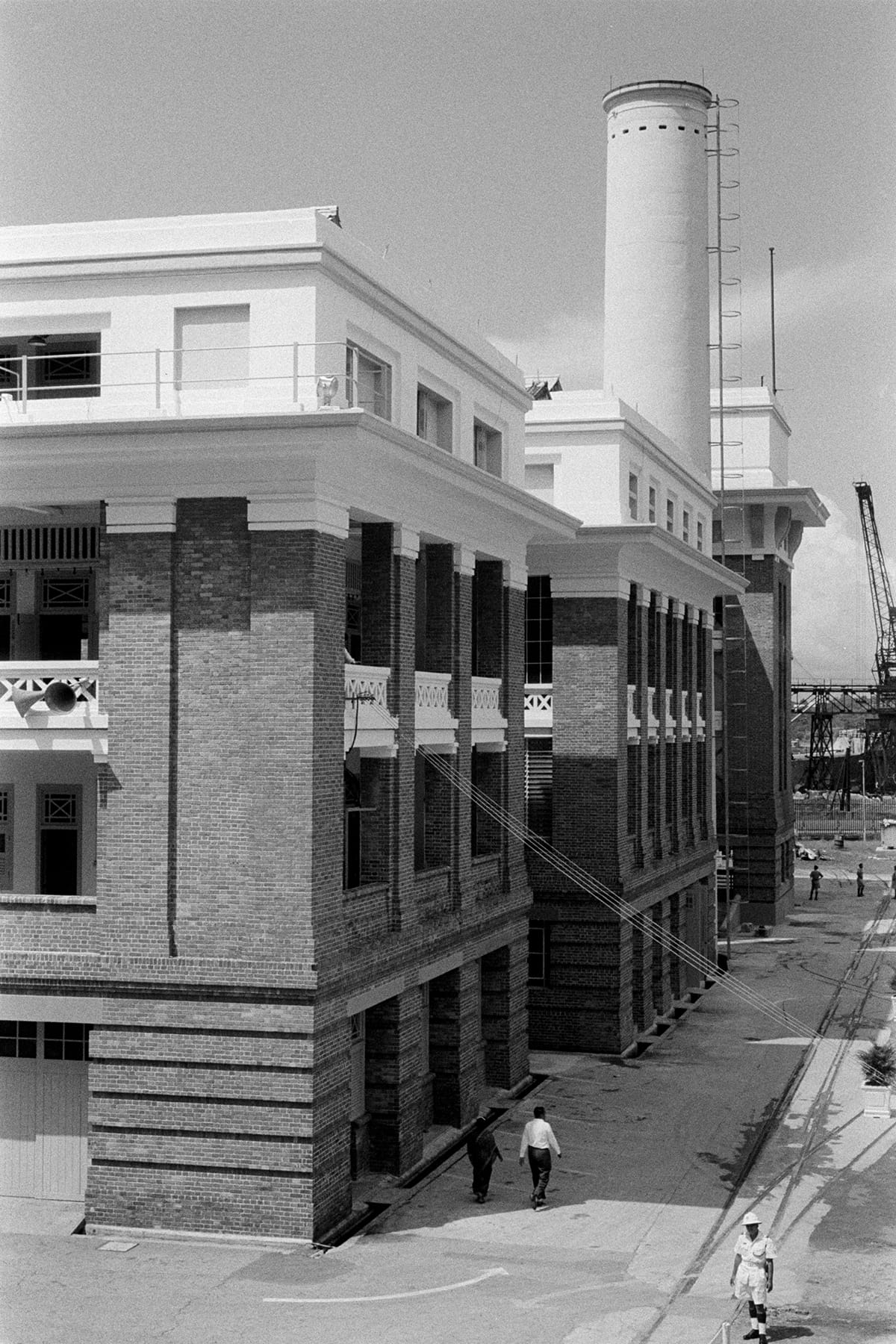
St James Power Station, 1960. Ministry of Information and the Arts Collection, courtesy of National Archives of Singapore (Media - Image No. 20120000254 - 0058).
A renovation in 1956 and reopening in July 1960 equipped St James with new generators to raise its power output by 18,000 kW and extended its useful life, but could not indefinitely delay the inevitable. The power station had grown inefficient, with its running costs exceeding that of Pasir Panjang Power Station. In 1955, the cost of electricity generation at St James was 3.57 cents per unit, compared to Pasir Panjang’s 1.4 cents per unit.32 With the full opening of Pasir Panjang Power Station in 1966, St James was gradually phased out and its last gas turbine was decommissioned in 1976.33
A New Lease of Life
The building was not demolished though. Since the 1980s, the building has been repurposed for a myriad of uses, ranging from an automated warehouse for the Port of Singapore Authority between 1983 and 1992, to an entertainment and leisure complex from 2006 to 2018.34 Since 2022, it has been home to the global headquarters of British technology company Dyson.35
While the building certainly reflects the Edwardian design of its time, it has undergone a number of makeovers. After an initial restoration of its facade in 2006, the building underwent further redevelopment in 2018. Mapletree, its developer, inserted new floating floor slabs to create additional space for modern office use, while atriums were introduced to bring natural light into the building’s cavernous interiors, facilitating communal mingling.36
These conservation efforts earned St James two Urban Redevelopment Authority (URA) Architectural Heritage Awards. In 2010, the building received the URA Architectural Heritage Award (Category A) following its earlier restoration and conversion into an entertainment complex. In 2022, it received the URA Architectural Heritage Award for Conservation & Innovation (Distinction) in recognition of its restoration and adaptive reuse as a modern office building.37 The power station had earlier been gazetted a national monument by the National Heritage Board in 2009.38
Disruptions to global energy markets caused by the war in Iran in 2026 have renewed awareness of energy-related vulnerabilities in Singapore. The city-state’s electrical system is almost entirely dependent on imported gas and liquefied natural gas, heightening anxiety. Nonetheless, for a city whose skyline is always in motion, with old buildings falling to make way for newer ones, the century-old St James Power Station stands as a symbol of Singapore’s history of adaptability, resilience and capacity to respond to uncertainty.
The writer would like to thank Mapletree Investments Pte Ltd for providing video footage of an interview with Muiriel MacLeod on her father S.R. Urquhart, former superintendent of St James Power Station.
About the Author
Cheryl Chong is a former public servant of 19 years who is currently on a career break. She writes freelance and spends much of her free time exploring Singapore's history and built heritage. Her writing can be found in Quarterly Literary Review Singapore, Cha: An Asian Literary Journal and Chautauqua Journal.
End Notes
1 Shabana Begum, “Singapore Plans to Build Up to 3 More Hydrogen-ready Natural Gas Power Plants by 2032,” Straits Times, 29 April 2026, https://www.straitstimes.com/singapore/environment/singapore-plans-to-build-up-to-3-more-hydrogen-ready-natural-gas-power-plants-by-2032 (opens in new tab); “How Singapore’s Energy Supply Affects You,” Energy Market Authority, last updated 10 April 2026, https://www.ema.gov.sg/consumer-information/energy-prices-in-singapore-what-you-need-to-know/how-singapores-energy-supply-affects-you (opens in new tab).
2 Energy Market Authority Annual & Sustainability Report FY2024/25 (Singapore: Energy Market Authority, 2025), 24, https://www.ema.gov.sg/resources/corporate-publications/annual-sustainability-report-2024-2025 (opens in new tab).
3 “Decision on St James Soon (opens in new tab),” Singapore Standard, 23 December 1955, 5; “St James Station (opens in new tab),” Straits Times, 8 November 1927, 10. (From NewspaperSG)
4 “St James Station (opens in new tab).”
5 “The Electric Light in the Straits Settlements (opens in new tab),” Straits Times Weekly Issue, 22 November 1886, 7. (From NewspaperSG); Koh Buck Song and Lee Geok Boi, Brighter – Electricity in Singapore: From Beginning to Beyond (opens in new tab) (Singapore: Energy Market Authority, 2011), 24. (From National Library of Singapore, call no. RSING 333.7932095957 KOH). Also available at https://www.ema.gov.sg/content/dam/corporate/resources/corporate-publications/10th-anniversary-book/EMA-Resources-Brighter-10th-Anniversary.pdf.coredownload.pdf (opens in new tab).
6 Koh and Lee, Brighter – Electricity in Singapore (opens in new tab), 24, 27.
7 Koh and Lee, Brighter – Electricity in Singapore (opens in new tab), 31, 33.
8 “The Electricity Supply (opens in new tab),” The Straits Budget, 27 October 1927, 14. (From NewspaperSG)
9 Jan Lee, “Goodbye, St James Power Station: 6 Things You Might Not Have Known About the Iconic Nightspot,” Straits Times, 7 September 2018, https://www.straitstimes.com/singapore/goodbye-st-james-power-station-6-things-you-might-not-have-known-about-the-iconic (opens in new tab).
10 “The Electricity Supply (opens in new tab)”; National Heritage Board, “Former St James Power Station,” Roots, last updated 15 October 2020, https://www.roots.gov.sg/places/places-landing/places/national-monuments/former-st-james-power-station (opens in new tab).
11 “Municipal Commission. Site for Singapore’s New Power Station (opens in new tab),” Straits Budget, 4 July 1924, 14; “Singapore’s New Power Station (opens in new tab),” Singapore Free Press and Mercantile Advertiser, 8 January 1926, 4. (From NewspaperSG); Energise, Electrify, Empower – 20 Years and Beyond (opens in new tab) (Singapore: Energy Market Authority, 2021), 20. (From National Library of Singapore, call no. RSING 333.79095957 ENE). Also available at https://www.ema.gov.sg/content/dam/corporate/resources/corporate-publications/20-anniversary-book/EMA-Resources-Energise-Electrify-Empower-20th-Anniversary.pdf.coredownload.pdf (opens in new tab).
12 Koh and Lee, Brighter – Electricity in Singapore (opens in new tab), 34; “The Electricity Supply (opens in new tab).”
13 “Singapore’s New Power Station (opens in new tab),” Singapore Free Press and Mercantile Advertiser, 8 January 1926, 4. (From NewspaperSG); Koh and Lee, Brighter – Electricity in Singapore (opens in new tab), 34.
14 “Singapore’s New Power Station (opens in new tab)”; Koh and Lee, Brighter – Electricity in Singapore (opens in new tab), 34.
15 “Decision on St James Soon (opens in new tab)”; “Loss to Singapore Municipality (opens in new tab),” Straits Times, 30 April 1931, 12; “Singapore’s New Power Station (opens in new tab),” Singapore Free Press and Mercantile Advertiser, 8 January 1926, 4. (From NewspaperSG); Jason Ng, “Industrial Heritage II – Power Stations and Jurong Industrial Estate,” Docomo Singapore, accessed 4 November 2026, https://docomomo-singapore.squarespace.com/about-docomomosg (opens in new tab).
16 Ng, “Industrial Heritage II – Power Stations and Jurong Industrial Estate.”
17 Victor Koh Dut Sye, oral history interview with Patricia Lee, 10 May 2001, MP3 audio, Reel/Disc 1 of 4, 0:30:45, National Archives of Singapore (accession no. 002529 (opens in new tab)), 00:11:30.
18 National Heritage Board, “Former St James Power Station (opens in new tab)”; “Singapore’s New Power Station (opens in new tab)”; Energise, Electrify, Empower – 20 Years and Beyond (opens in new tab), 10, 20.
19 Gretchen Liu, Singapore: A Pictorial History, 1819–2000 (opens in new tab) (Singapore: Archipelago Press in association with the National Heritage Board, 1999), 232. (From National Library of Singapore, call no. RSING 959.57 LIU)
20 Koh and Lee, Brighter – Electricity in Singapore (opens in new tab), 34.
21 “The Electricity Supply (opens in new tab)”; “The Men Who Lighten Our Darkness (opens in new tab),” Straits Times, 10 September 1933, 9. (From NewspaperSG)
22 “Power Station Failure (opens in new tab),” Straits Times, 1 December 1928, 11. (From NewspaperSG)
23 “The Men Who Lighten Our Darkness (opens in new tab).”
24 Mapletree Investments Pte Ltd. “St James Power Station, Video 3 - Electric Men.” Educational video, 0:05:25. This video can be viewed only at the St James Power Station Heritage Gallery.
25 Koh and Lee, Brighter – Electricity in Singapore (opens in new tab), 43.
26 Koh and Lee, Brighter – Electricity in Singapore (opens in new tab), 40, 43.
27 John G. Darbyshire, “St James Faces 2-Year Struggle (opens in new tab),” Singapore Standard, 26 May 1951, 2. (From NewspaperSG); Koh and Lee, Brighter – Electricity in Singapore (opens in new tab), 52.
28 “All-Day Power Failure (opens in new tab),” Straits Times, 8 April 1948, 1. (From NewspaperSG)
29 “Worst S’pore Power Cut Darkens City (opens in new tab),” Straits Times, 20 September 1950, 1. (From NewspaperSG)
30 Koh and Lee, Brighter – Electricity in Singapore (opens in new tab), 53.
31 Darbyshire, “St James Faces 2-Year Struggle (opens in new tab).”
32 “Decision on St James Soon (opens in new tab),”
33 National Heritage Board, “Former St James Power Station”; “Singapore’s Power Houses on the Main Island (opens in new tab),” Straits Times, 28 June 1988, 38. (From NewspaperSG)
34 “Automated Warehouse to Open Next Month (opens in new tab),” Business Times, 28 January 1983, 19. (From NewspaperSG); Tiffany Fumiko Tay, “Party's Over for St James Power Station,” Straits Times, 6 September 2018, https://www.straitstimes.com/singapore/partys-over-for-st-james-power-station (opens in new tab); National Heritage Board, “Former St James Power Station”; “Mapletree Creates Another Destination for Global Best in St James Power Station,” Mapletree, 28 November 2019, https://www.mapletree.com.sg/newsroom/mapletree-creates-another-destination-for-global-best-in-st-james-power-station/ (opens in new tab).
35 “His Excellency Lee Hsien Loong Officially Opens Dyson’s New Global Headquarters at the Historic St James Power Station,” EDB Singapore, 25 March 2022, https://www.edb.gov.sg/en/news-and-insights/his-excellency-lee-hsien-loong-officially-opens-dyson-new-global-headquarters-at-the-historic-st-james-power-station (opens in new tab).
36 Mapletree Property, “SJPS – St James Power Station (opens in new tab),” accessed 4 November 2026, https://stjamespowerstation.sg/ (opens in new tab).
37 “Former St James Power Station,” Urban Redevelopment Authority, last updated 4 November 2026, https://www.ura.gov.sg/conservation/find-a-building/conservation-portal/060-fsjps/ (opens in new tab).
38 National Heritage Board, “Former St James Power Station (opens in new tab)”.