
Article
The Mystery of the Missing Diplomat
12 October 2026
Topics
People
For 10 days in June 1966, the former Chief Minister of Singapore Lim Yew Hock remained completely incommunicado. The mystery of his whereabouts captured public fascination in Singapore, Malaysia and Australia.
By Felix Cheong
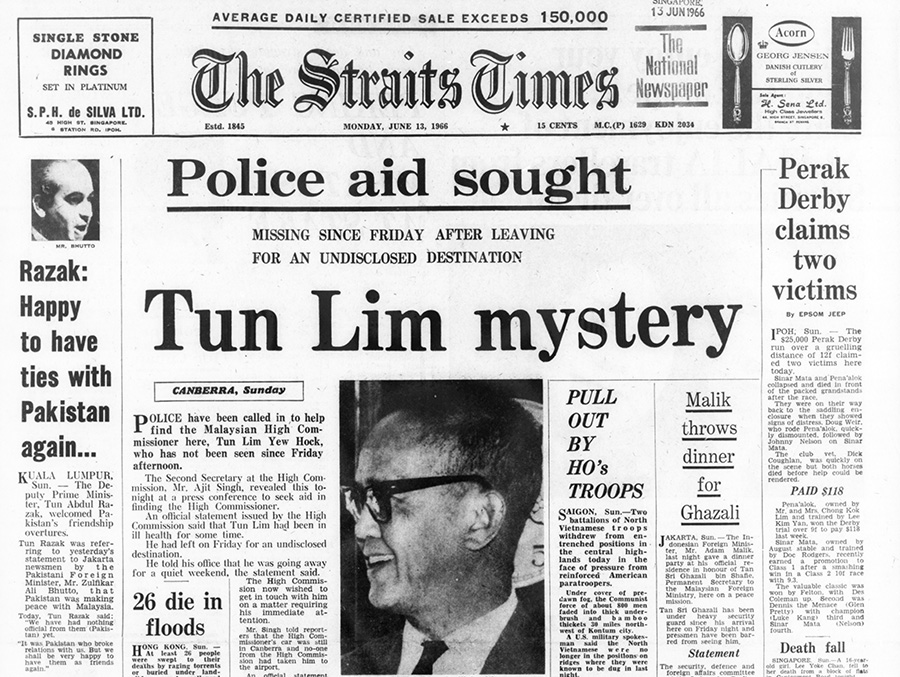
In June 1966, the mysterious disappearance of Lim Yew Hock in Australia made it to front-page news. Source: The Straits Times, 13 June 1966, 1 © SPH Media Limited. Permission required for reproduction.
Over 10 days in June 1966, Tun Lim Yew Hock,1 the Malaysian High Commissioner to Australia and New Zealand (1964–66) and Singapore’s former second Chief Minister (1956–59), vanished.
It was an incident that had all the elements of politics and intrigue. It hogged the headlines of newspapers in Singapore and Australia for weeks, and reportedly sent thousands of women weeping. To this day, 60 years later, it remains a mystery, with more questions than answers.
The Man Who Fell Out of Power
Born in Singapore in 1914, Lim rose through the labour movement before entering politics, first under the Singapore Progressive Party and, later, the Labour Front.2 When David Marshall resigned as Singapore’s first Chief Minister in June 1956 after failing to secure full internal self-government from the British, Lim, the Minister for Labour and Welfare, succeeded him.3
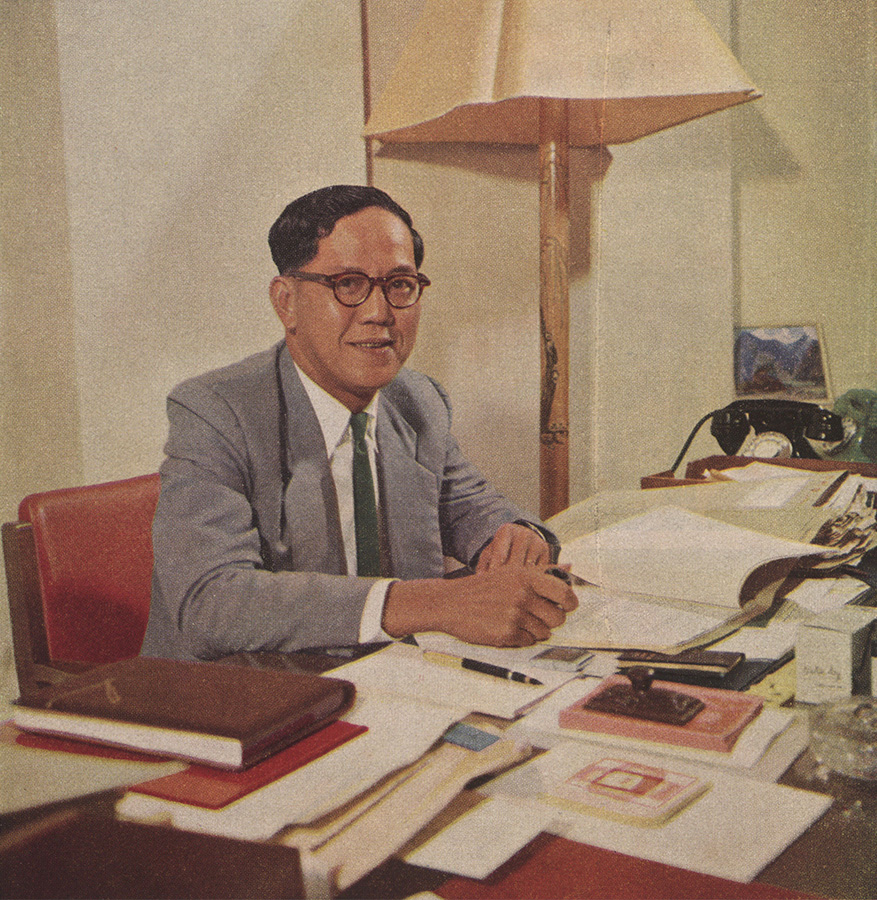
Lim Yew Hock was the second Chief Minister of Singapore from 1956 to 1959. Collection of the National Library of Singapore.
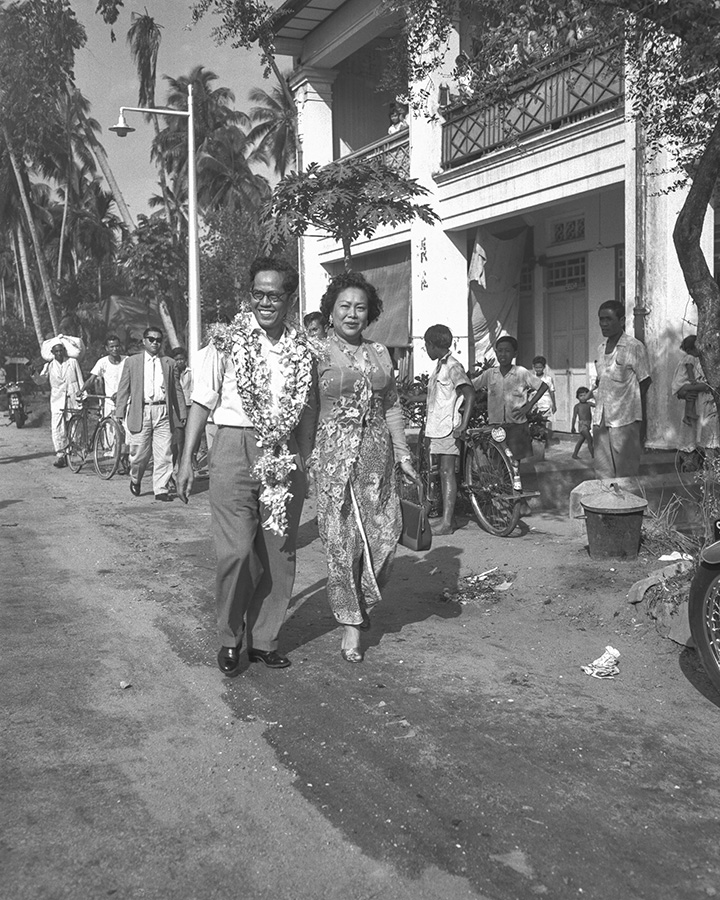
In March 1957 and May 1958 respectively, Lim led the second and third All-Party Mission to London for constitutional talks with the British government, resulting in Singapore’s full internal self-government in 1959.4
 on his return after leading the third All-Party.jpg)
But Lim’s years in office were often viewed as turbulent. To the British, he was instrumental in acting firmly against left-wing activists, trade unionists and Chinese middle-school students whom they feared were aligned with the communists.5 To the Chinese-speaking masses in Singapore, however, the same toughness looked like repression. The 1956 Chinese middle-school riots, and the hundreds of arrests that followed, stained his reputation among voters already leaning towards Lee Kuan Yew’s People’s Action Party (PAP).
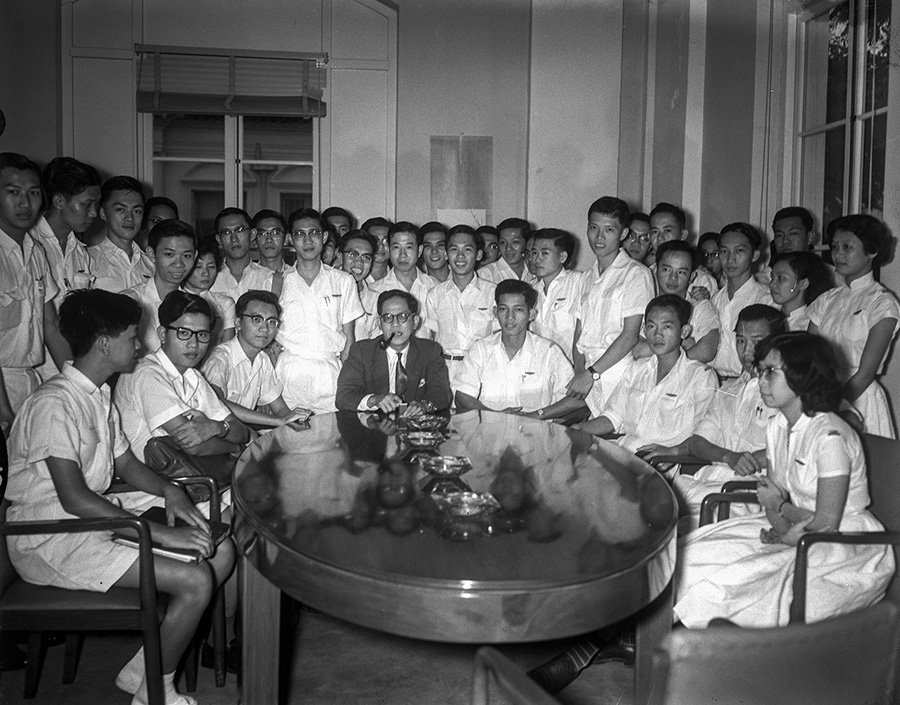
Chinese middle school students meet Chief Minister Lim Yew Hock at his office, 1957. Ministry of Information and the Arts Collection, courtesy of National Archives of Singapore (Media - Image No. 19980001324 - 0011).
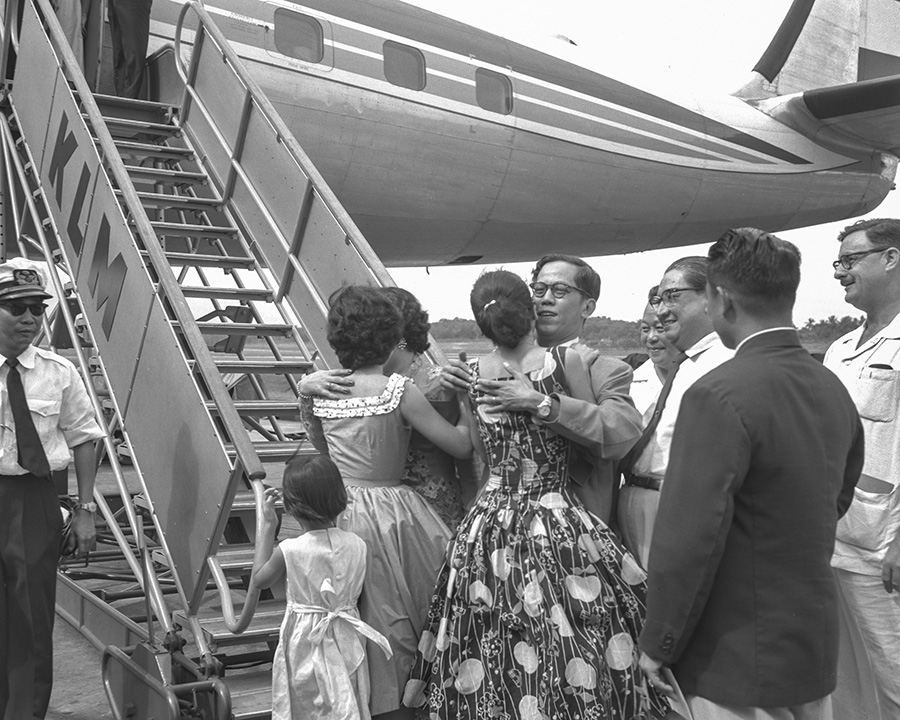
The upshot: the PAP swept into power in the 1959 Legislative Assembly General Election, with Lim’s Singapore People’s Alliance winning only four seats.6 The formation of the Federation of Malaysia in 1963 gave him another role. Taking up Malaysian citizenship, Lim was appointed Malaysia’s High Commissioner to Australia and New Zealand in 1964.7
Based in Canberra, Lim discharged his duties as Malaysia’s chief diplomatic representative Down Under. Then, in June 1966, he suddenly vanished.
Ten Days Missing
On Friday, 10 June 1966, Lim left Canberra. According to early reports, he had told staff at the Malaysian High Commission that he was going away for a quiet weekend. A Canberra journalist who knew Lim had seen him buying a ticket with cash, under another name, before flying to Sydney. The journalist also said that Lim was “carrying no baggage and was wearing an open neck shirt with a sports jacket”.8
When Lim failed to return on 13 June, concern turned into alarm. This was not a junior officer extending a holiday. This was a high commissioner, a former head of government, missing in a foreign country at the height of the Cold War. The Malaysian High Commission held a press conference that night to seek help finding Lim. An official statement by the High Commission revealed that he had been in ill health for some time and “had been under medical treatment for about two months”, but did not disclose the nature of his illness.9
The High Commission enlisted the help of the Australian police, involving even the Australian security and intelligence agencies. Police concentrated their search around Bondi Beach, and the Malaysian Chief Protocol Officer, Abdul Rahman Jalal, was sent to Canberra to help in the search.10
Lim’s elder daughter Shirley also went to Sydney personally to check the places where her father usually stayed.11 Even students from Malaysia and Singapore studying in Australia were roped in for the hunt. The New York Times reported that “student leaders issued an appeal by radio for the 700 students from the two countries to check every place where the envoy might be found”.12
The search for the missing diplomat was made even more poignant when Lim’s wife, Chia Kim Neo (“Toh Puan” is the title given to the wife of a “Tun”),13 appeared on Australian television with their two daughters on 15 June, pleading for him to come home. “I am sad at my husband’s absence from Canberra. It has upset me very much. I don’t know what to say because I am too distressed,” crying as she said this. Then it was Shirley’s turn: “We know that you are not very well. Please come back to us. Your absence is causing us much unhappiness and distress.”14
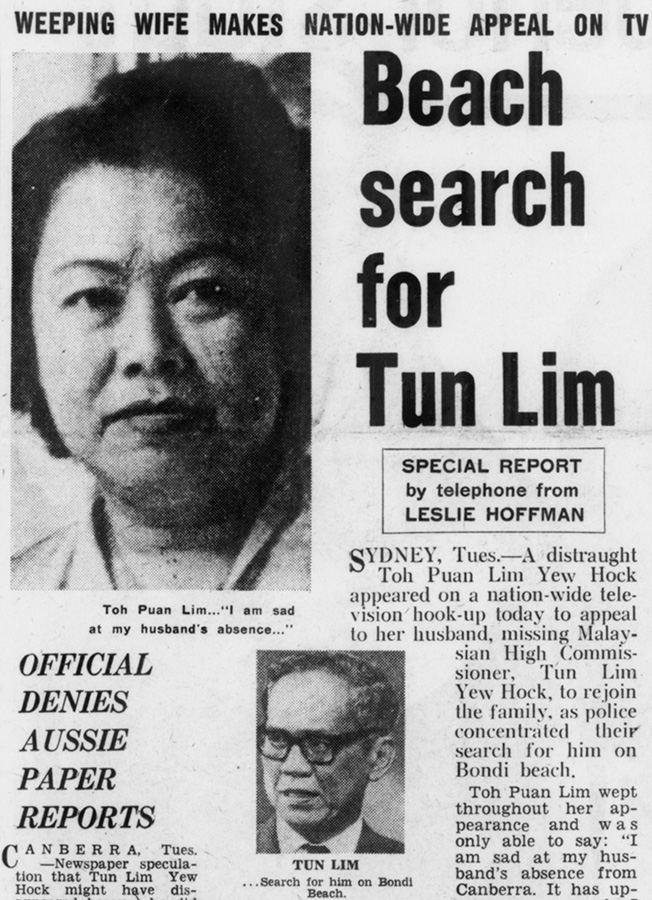
Lim Yew Hock’s wife made an emotional appeal on television for his return, while the police concentrated their search on Bondi Beach. Source: The Straits Times, 15 June 1966, 1 © SPH Media Limited. Permission required for reproduction.
The television appeal apparently struck a chord because the newspapers reported that thousands of women wept after watching the High Commissioner’s wife.15 According to Second Secretary of the High Commission Ajit Singh, Lim’s wife had been just as ill as her husband – if not more – and had also been receiving medical attention for some time.16
The story, however, took an unexpected turn when a report by Time magazine linked Lim to a 19-year-old stripper named Sandra Nelson, who often performed at Paradise Club in Sydney’s red-light district, Kings Cross.17 Nelson was not just another showgirl. She had already gained notoriety two years earlier for her publicity stunts, such as taking a popular ferry in a see-through top that left little to the imagination. Russian by birth, she had run away from a migrant camp in Wollongong and then resurfaced in the strip club circuit.18
Tunku Abdul Rahman, Malaysia’s Prime Minister, made a personal appeal from Kuala Lumpur. “Come back, my dear friend, and I will welcome you. I will be happy to let bygones be bygones,” he said.19
 exchanging greetings with Singapore’s Chief M.jpg)
Malaysian Prime Minister Tunku Abdul Rahman (left) exchanging greetings with Singapore’s Chief Minister Lim Yew Hock, 1958. Ministry of Information and the Arts Collection, courtesy of National Archives of Singapore (Media - Image No. 19980001343 - 0024).
Returning Home
After 10 days, Lim returned to his Canberra residence at 9.15 am on 20 June. His younger daughter Adeline was the only person at home as her mother and sister were still in Sydney. On opening the front door, she was shocked to find her father standing on the porch. “I was so surprised. I ran into his arms. I cried with joy,” she said. “I kissed him and said: ‘I’m glad you’re home daddy’,” she told the Straits Times. “Daddy just hugged me and said: ‘Alright dear, don’t cry’.”20
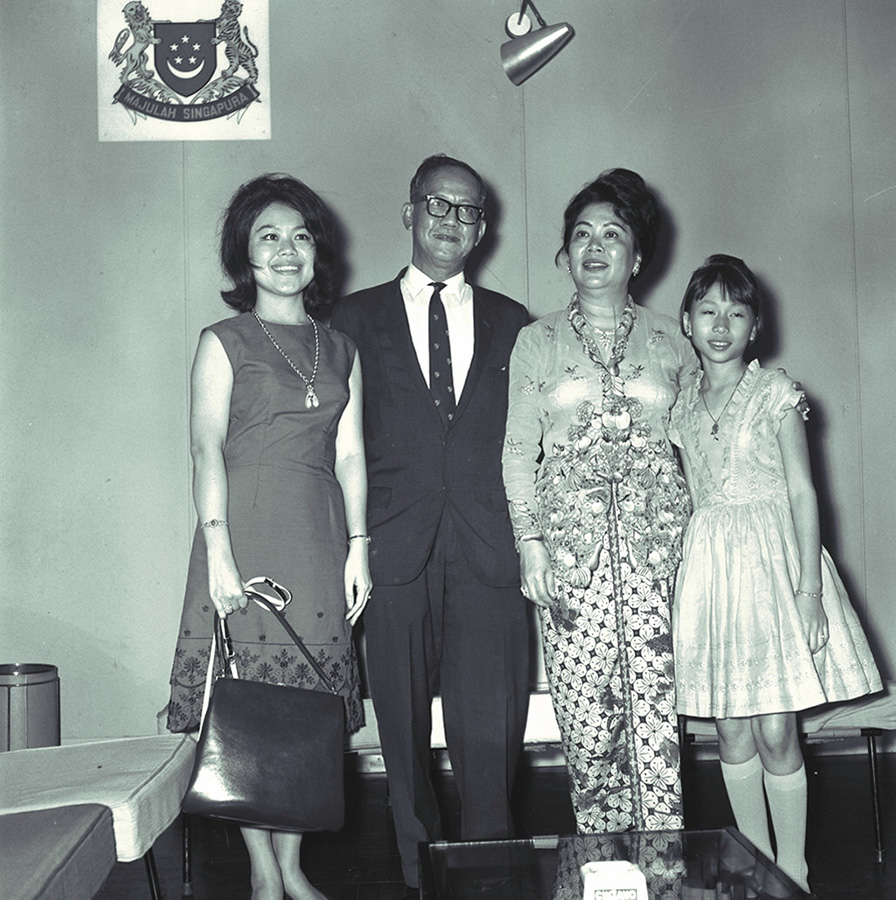
Lim Yew Hock with his first wife and two daughters at Paya Lebar Airport on 16 January 1964. He was bound for Canberra to take up his new appointment as the Malaysian High Commissioner to Australia and New Zealand. Source: The Straits Times © SPH Media Limited. Permission required for reproduction.
The official explanation by the High Commission at the press conference later that night was that Lim was “suffering from a physical and nervous illness” from overwork, and that a “good Samaritan” had found him ill in Sydney, cared for him and driven him back. “The High Commissioner is back in Canberra but he is sick and is resting at his home,” said Malaysian Chief Protocol Officer Abdul Rahman Jalal. “As you know, the High Commissioner took a plane to Sydney on Friday. While there he was in a state of collapse and a good Samaritan – that is the only phrase I could use – took him over. There he stayed with this kind soul.” Abdul Rahman Jalal added that when Lim was found by the man, he was “vomiting and was very ill”.21
The Malaysian Prime Minister was also informed of Lim’s return on 20 June and was reported to be “very happy”. In a message thanking Australian newspapers for their help, Tunku Abdul Rahman said: “He [Lim] will remain in Australia until I am satisfied that he is well enough to go to his new post in Rome.”22
 exchanging greetings with Singapore’s Chief M.jpg)
Malaysian Prime Minister Tunku Abdul Rahman (left) exchanging greetings with Singapore’s Chief Minister Lim Yew Hock, 1958. Ministry of Information and the Arts Collection, courtesy of National Archives of Singapore (Media - Image No. 19980001343 - 0024).
The media were dissatisfied with the responses from the High Commission about Lim’s disappearance. Canberra police were informed of Lim’s return only 12 hours after he had been driven home. “It is a pity that there was a 12-hour delay in telling the Australian people that the man about whose fate they have been perplexed and concerned for 10 days was safely home. One would have thought the news would have been sent out as soon as the good Samaritan had returned Tun Lim,” went a Sydney Sun editorial.23
On 23 June, Lim expressed his gratitude in various newspapers throughout Australia, thanking the government, police, press, radio, television, the Australian public, and Malaysian and Indonesian students for their assistance during his recent illness.24
Before leaving Australia for good on 1 July, Lim gave a press conference on 30 June, his first since his return. He told reporters that he “could not remember anything of his disappearance earlier this month” and did not know the police were looking for him. “You see, I wanted to take a holiday,” he said, “I had been working very hard, sometimes making three speeches in one day, and I was very tired.” He explained, “I was walking around quite nicely when pop – I stumbled on something and fell and hurt my head. For many days after that I was looked after by this good Samaritan whose identity I still cannot reveal.”25
Although Lim had “given his word not to divulge his helper’s name”, he was later identified in September 1966 as Vincent Laus, a 35-year-old guesthouse proprietor from the city of Gosford, near Sydney. According to Abdul Rahman Jalal in the press conference on 20 June, “The man who was with [Lim] came to know that it was Tun Lim Yew Hock only last evening [the evening before he returned home].” Laus rejected the “many dirty stories” connecting Lim with Kings Cross strippers, and said “Tun Lim did not do anything wrong and that he was sick and needed rest”.26
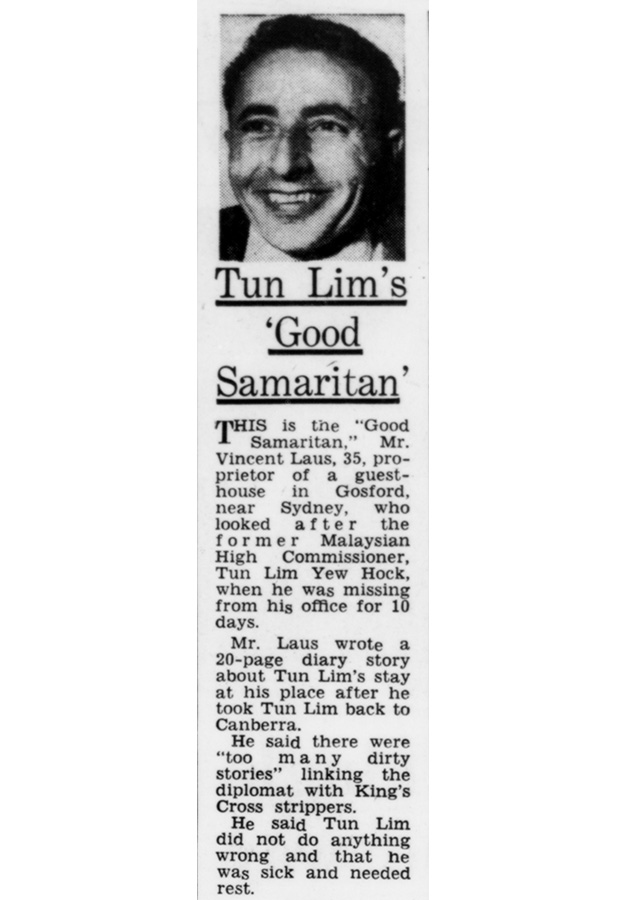
The person who found and looked after Lim Yew Hock was revealed to be Vincent Laus, a guesthouse proprietor from Gosford, near Sydney. Source: The Straits Times, 8 September 1966, 20 © SPH Media Limited. Permission required for reproduction.
Years later, in his memoir Reflections, which was published posthumously in 1986, Lim offered a different explanation for his disappearance. He wrote that his relationship with his wife had become “strained and unbearable”, but admitted that he was not free from blame. “I had been fickle and my wife was an unforgiving woman.” He had felt that “life was no longer worth living and [he] wanted to do away with [him]self.” Lim then hid in a boarding house, “planning to put an end to [his] misery”, but the thought of his children changed his mind. Lim also wrote that he had grown a moustache to disguise himself but the boarding house keeper eventually recognised him from his pictures shown on television and drove him home to Canberra.27
The Aftermath
In October 1966, it was reported that Lim would take on a desk job at the Malaysian Ministry of External Affairs. “I have asked him to take a complete rest for a few months. But he told me he wanted something to do,” said Malaysian Prime Minister Tunku Abdul Rahman.28
Two years later, news broke on 7 November 1968 that Lim had resigned in June from his post at the Foreign Ministry where he was the Deputy Secretary (Special Duties) because of the “strain” on him. “I am now no more a government servant. I just want to rest and relax and I’m out of politics for good,” he said. Lim then retired to Melaka.29
Later in the month, on 29 November, the Straits Times reported that the Yang di-Pertuan Agong (sultan) had “cancelled and annulled” the title of “Tun” that had been awarded to Lim in 1958. He was acting on the prime minister’s recommendation and no reason was given.30
In 1972, Lim embraced Islam, took the name Omar and immigrated to Jeddah, Saudi Arabia. Over there, he worked as Special Assistant to the president of the Islamic Development Bank. After his first marriage broke down, he married Chinese Muslim convert Hajjah Hasnah Abdullah and had two children with her.31
Unanswered Questions
The simplest question in this whole incident is still the hardest: where was Lim in those 10 days, and why did he not make contact? He should have known that a senior diplomat could not just disappear without consequences.
Another unresolved question is the role of the good Samaritan Vincent Laus. His silence during the nationwide search remains difficult to explain. The Australian media had extensively reported Lim’s disappearance. Why did Laus not alert local authorities to the man he had found?
Then there is the stripper Sandra Nelson. While she denied there was any serious relationship between them, the rumour travelled too widely to be ignored. Nelson maintained that her relationship with Lim was purely casual. “I knew him, but only just casually. I never met him. He just came to the club to see me,” she told the Straits Times in an interview on 23 August 1966.32
A fourth question is in Prime Minister Tunku Abdul Rahman’s interview appeal when he used the curious phrase, “let bygones be bygones”. Lim said at his press conference on 30 June 1966 that he did not know what the Prime Minister had meant by this.33 This seems to suggest that Lim must have incurred his wrath over something not publicly named. Whatever differences the two might have had, the Tunku buried the hatchet and he subsequently penned the introduction to Lim’s memoir. Lim also dedicated his memoir to his “very good friend YTM Tunku Abdul Rahman Putra Al-Haj First Prime Minister of Malaysia”.34
The final question lies in Lim’s account in his memoir in 1986. In Reflections, he claimed that he withdrew to a boarding house because of the breakdown of his marriage. Assuming the public story at the time about him falling, or having taken ill, was merely a cover-up for problems at home, what specifically were those problems? This question is particularly pertinent because by his own account in Reflections, he made another disappearance a year later “after the same domestic trouble erupted”.35
The disappearance of Lim Yew Hock can be read in many ways: a diplomatic embarrassment, a tabloid scandal, a marriage on the rocks, a medical episode, or the public unravelling of a man who had already lost one public life. None of these readings, however, cancel the others.
While he had led a very colourful life, his passing was quiet. Lim died on 30 November 1984, at the age of 70, in his home in Jeddah. The Straits Times reported that he had died peacefully and had been found lying on a sofa in the morning by his daughter. He was buried in Mecca.36
About the Author
Felix Cheong is the bestselling author of more than 30 books across different genres. His graphic novel, The Showgirl and the Minister (Random House SEA, 2023), was inspired by the 10-day disappearance of former Singapore Chief Minister Lim Yew Hock. Conferred the Young Artist Award in 2000, Felix has been invited to writers’ festivals all over the world. He holds a masters in creative writing and is currently a university adjunct lecturer.
Endnotes
1 The title of “Tun” was awarded to Lim Yew Hock in 1958. “Tun” is the top civilian title in Malaysia, similar to a “Lord” in the United Kingdom. See “Now He's No More Tun Lim... (opens in new tab),” Straits Times, 29 November 1968, 1. (From NewspaperSG)
2 Michael Mukunthan, “Lim Yew Hock (opens in new tab),” Singapore Infopedia. National Library of Singapore. Article published 2016.
3 “Marshall to Resign Today (opens in new tab),” Indian Daily Mail, 7 June 1956, 1; “Same Team – Game Goes On (opens in new tab),” Straits Times, 9 June 1956, 1. (From NewspaperSG)
4 “Colony Talks a Success – Triumph for Mr. Lim (opens in new tab),” Straits Times, 30 March 1957, 1; “Last Mission to London (opens in new tab),” Straits Times, 8 May 1958, 6. (From NewspaperSG)
5 Lulin Reuten, “Man Who Thumped the Reds (opens in new tab),” Straits Times, 1 December 1984, 14. (From NewspaperSG)
6 Lim Tin Seng, “1959 Legislative Assembly General Election (opens in new tab),” Singapore Infopedia. National Library of Singapore. Article published 2018.
7 K.K.H., “Tun Lim a Citizen of Malaysia (opens in new tab),” Straits Times, 11 December 1965, 15; “Farewell by Lim (opens in new tab),” Straits Times, 12 January 1964, 2. (From NewspaperSG)
8 “Tun Lim Mystery: Police Aid Sought (opens in new tab),” Straits Times, 13 June 1966, 1; “Tun Lim: Fears Grow for His Safety (opens in new tab),” Straits Times, 14 June 1966, 1. (From NewspaperSG)
9 “Tun Lim Mystery: Police Aid Sought (opens in new tab)."
10 “Intelligence Alerted (opens in new tab),” Straits Times, 14 June 1966, 1; Leslie Hoffman, “Beach Search for Tun Lim (opens in new tab),” Straits Times, 15 June 1966, 1; Jack Fingleton, “Tun Lim: Police Not Told Till 12 Hours Later (opens in new tab),” Straits Times, 21 June 1966, 1. (From NewspaperSG)
11 “Tun Lim: Fears Grow for His Safety (opens in new tab).”
12 “Malaysian Envoy Missing: Hunt Pressed in Australia,” New York Times, 14 June 1966, 11, https://www.nytimes.com/1966/06/14/archives/malaysian-envoy-missing-hunt-pressed-in-australia.html (opens in new tab).
13 “Marriage (opens in new tab),” Malaya Tribune, 12 January 1937, 9. (From NewspaperSG)
14 Hoffman, “Beach Search for Tun Lim (opens in new tab).”
15 “Thousands Wept with Her (opens in new tab),” Straits Times, 18 June 1966, 11. (From NewspaperSG)
16 “Tun Lim: Fears Grow for His Safety (opens in new tab).”
17 “Australia: The Diplomat & the Samaritan,” Time, 1 July 1966, https://content.time.com/time/subscriber/article/0,33009,835866,00.html (opens in new tab)
18 Martyn Jolly, “Girls Galore!: Photography in Australian Men’s Magazines in the 1960s,” Journal of Australian Studies 47, no. 1 (2023): 91–127, https://www.tandfonline.com/doi/full/10.1080/14443058.2022.2157036 (opens in new tab).
19 “Australia: The Diplomat & the Samaritan.”
20 “Tun Lim Found – He's Ill (opens in new tab),” Straits Times, 20 June 1966, 1. (From NewspaperSG)
21 “Tun Lim Found – He's Ill (opens in new tab)”; Fingleton, “Tun Lim: Police Not Told Till 12 Hours Later (opens in new tab).”
22 “Tun Lim Found – He's Ill (opens in new tab)”; Fingleton, “Tun Lim: Police Not Told Till 12 Hours Later (opens in new tab).”
23 Fingleton, “Tun Lim: Police Not Told Till 12 Hours Later (opens in new tab).”
24 Jack Fingleton, “Tun Lim to Say 'Thank You' in the Papers (opens in new tab),” Straits Times, 22 June 1966, 11. (From NewspaperSG)
25 “Tun Lim: I Was Walking Nicely When ‘Pop’ I Fell... (opens in new tab),” Straits Times, 1 July 1966, 1. (From NewspaperSG)
26 “Tun Lim Found – He's Ill (opens in new tab)”; Fingleton, “Tun Lim: Police Not Told Till 12 Hours Later (opens in new tab)”; “Tun Lim’s ‘Good Samaritan (opens in new tab)’,” Straits Times, 8 September 1966, 20.
27 Lim Yew Hock, Reflections (opens in new tab) (Kuala Lumpur: Pustaka Antara, 1986), 109–10. (From National Library of Singapore, call no. RSING 320.9595050924 LIM)
28 V.K. Chin, “Tun Lim – A Desk Job (opens in new tab),” Straits Budget, 12 October 1966, 7. (From NewspaperSG)
29 Philip Mathews, “Tun Lim: I Have Quit Foreign Ministry (opens in new tab),” Straits Times, 7 November 1968, 11; Alan John, ““Lim Yew Hock Dies in Jeddah (opens in new tab),” Straits Times, 1 December 1984, 1. (From NewspaperSG)
30 “Now He's No More Tun Lim... (opens in new tab).”
31 Lim, Reflections (opens in new tab), 115, 123, 128; John, “Lim Yew Hock Dies in Jeddah (opens in new tab)”; “Ex-Chief Minister Lim Yew Hock Dies in Jeddah (opens in new tab),” Business Times, 1 December 1984, 12. (From NewspaperSG)
32 Jack Fingleton, “Sandra: I’m Ready to Send a Bundle of Photos (opens in new tab),” Straits Times, 24 August 1966, 11. (From NewspaperSG)
33 “Tun Lim: I Was Walking Nicely When ‘Pop’ I Fell... (opens in new tab).”
34 Lim, Reflections (opens in new tab), 1–5.
35 Lim, Reflections (opens in new tab), 110.
36 John, “Lim Yew Hock Dies in Jeddah (opens in new tab)”; “Ex-Chief Minister Lim Yew Hock Dies in Jeddah (opens in new tab).”