
Article
“Mr Lee is playing golf still.” A family vacation in Cameron Highlands provided cover for LKY’s efforts to finalise Separation.
Topics
History
People
16 September 2026
As a lawyer, a wife and a mother, Kwa Geok Choo – the wife of founding Prime Minister Lee Kuan Yew – provides a unique insight into a critical moment in Singapore’s history.
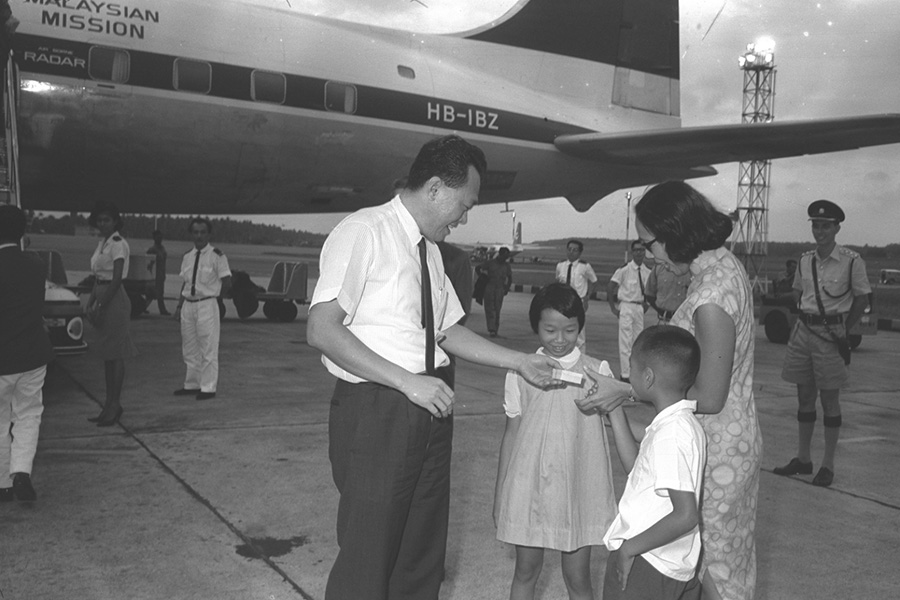
Kwa Geok Choo receiving Prime Minister Lee Kuan Yew at Paya Lebar Airport on his return from the Malaysian Mission to 17 African states from 21 January to 27 February 1964. Seen in the photo are their two children Wei Ling and Hsien Yang. Ministry of Information and the Arts Collection, courtesy of National Archives of Singapore (Media - Image No. 19980000357 - 0073).
This is an extract from the book, The Albatross File: Inside Separation (opens in new tab), edited by Susan Sim.1 It includes an excerpted transcript of an oral history interview that Tan Kay Chew conducted with Kwa Geok Choo, the wife of Prime Minister of Singapore Lee Kuan Yew, between 25 October 1981 and 21 June 1982 at their residence at 38 Oxley Road. Kwa was interviewed for the Political History of Singapore 1945–65 project. She was the legal draughtsman who helped draft the crucial constitutional provisions that guaranteed Singapore’s continued water supply after Separation from Malaysia.
By the end of July 1965, Singapore’s Finance Minister Goh Keng Swee had worked out the main terms of Singapore’s separation from the Federation of Malaysia to become an independent country. In early August, Goh and Law Minister E.W. [Eddie] Barker finalised the arrangements with their Malaysian counterparts. When almost all the details were ironed out, Lee made his way to Malaysia.
Lee’s presence in Kuala Lumpur was kept a secret because the architects of Separation from both Malaysia and Singapore did not want to alert the British to plans to carve out Singapore. Had the British known of these plans, they would have attempted to derail it. In addition, there were parties in Singapore and Malaysia who would have tried to stop Separation if they had gotten wind of it. Separation had to be presented as a fait accompli if it was to succeed.
To allay suspicions, Lee went to Cameron Highlands in early August with his family. The official story was that he was there to rest before a meeting of the Federal Parliament. In reality, Lee was only briefly in Cameron Highlands before he made his way to Kuala Lumpur on 6 August to await the final agreement and to then meet Malaysian Prime Minister Tunku Abdul Rahman.
While Lee was in Kuala Lumpur, his family remained in Cameron Highlands. Kwa had to maintain the story that Lee was playing golf when he was actually in Kuala Lumpur. In her oral history interview, she provides a glimpse into her relationship with Lee and offers a behind-the-scenes look at the days Lee spent in Kuala Lumpur, as well as the period immediately after 9 August 1965, when a despondent Lee had to come to terms with the aftermath of Separation.
Kwa and Lee first met in Raffles Institution (RI). As the top student in the whole of Malaya in the 1936 Senior Cambridge Examination, Kwa joined a special class at RI for students competing for the prestigious Queen’s Scholarship. Barker was also in that 1938–39 special class. Lee, who was younger than both, initially saw Kwa chiefly as his competitor. The academic rivalry gave way to romance when they met again during the war. Kwa won the Queen’s Scholarship to study at Cambridge University in 1947. Lee also began his studies at Cambridge University in the same year. Kwa married Lee in Stratford, England, in December 1947, and they graduated in 1949. Together with Lee’s brother, Lee Kim Yew, they co-founded the law firm, Lee & Lee, in 1955.
Kwa died on 2 October 2010. In his eulogy to his wife at her funeral service on 6 October, Lee said: “She was precise and meticulous in her choice of words. The amendment statute [that Kwa drafted] was annexed to the Separation Agreement, which we then registered with the United Nations. ... Each time Malaysian Malay leaders threatened to cut off our water supply, I was reassured that this clear and solemn international undertaking by the Malaysian government in its Constitution will get us a ruling by the UNSC [United Nations Security Council].”2
Kwa was given a state-assisted funeral “in recognition of her exceptional and unique contributions to Singapore for more than five decades, beginning before Singapore became independent,” the Prime Minister’s Office said.3
In this excerpt recorded on 21 June 1982, Kwa gives a behind-the-scenes perspective of key events leading up to Separation: the excitement of the Malaysian Solidarity Convention in June; her role in editing some of the transcripts of the prime minister’s speeches and press conferences; the weekend in Cameron Highlands when she and the children provided “camouflage” as her husband went secretly to Kuala Lumpur to finalise the Separation Agreement; Lee’s state of mind on 9 August itself, both before and after the press conference; and the anguish he felt on Separation.
Tan Kay Chew: On to June 1965, the Malaysian Solidarity Convention. You were there, Mrs Lee. Can you describe what it was like?
It was a Sunday morning. Wasn’t it? Yes, I think it must have been a Sunday morning. Any other day, you can’t get a crowd. On a working day, you can’t get a crowd to attend. So if you have a big party meeting, it has to be on a Sunday. And this was a Sunday morning, we had to make an effort to get up early and be there by nine or ten. I think we had to be there by ten. I remembered seeing them all up there on the platform. I was sitting in the front row, but to the side, not immediately in the centre. And I saw the Australian High Commissioner was there – [William] Pritchett. Somehow I noticed him particularly. He probably had been to Cameron Highlands to play golf. … And the New Zealand person, [Robert] Wade, I suppose, would have been there.
And the meeting was an exciting meeting. … It was one of the best speeches I thought my husband had made. I’ve heard quite a few of his speeches, but sometimes I have a feeling that whenever somebody says, “your husband made a marvellous speech …”, I said, “but I wasn’t there then.” This happened at Lagos.4 [Harold] Wilson said he made a very good speech, and I said: “No, I’m sorry, I wasn’t there.” Then it happened in Lusaka.5 They told me the same thing, and I wasn’t there.
He made that long four-hour speech in [the Malaysian] Parliament. I don’t go to Parliament every time, I wasn’t there. But this is one speech that he made [at the Malaysian Solidarity Conference] which was a good speech, and it was an off-the-cuff speech without a prepared text. He must have had a few notes. He got up and spoke probably after the others. As a rule, he would be the last speaker. I cannot remember whether this was so, on this occasion. And what I remember particularly was how he made the Malaysian Chinese Association leaders appear [like] absolute running dogs, without using the words, “running dogs”. What I remembered was his gestures with his hands. He’s got very expressive hands, which he uses sparingly. But when he does use them, you could almost picture a little dog running up and wagging its tail when it’s patted by its master.6
And it impressed me. I am not usually. I’m quite a critical person and will come back sometimes, and tell him that his speech is – sometimes I tell him where I think it’s gone a little bit too far, or ... I don’t quite think it should have been said in such and such a way. … But that one I thought was very well done. And it came over tremendously well, and was received well by the audience, I think.
The other speakers, I do remember this man, Michael Buma.7 But other than that, I can’t remember the speeches. The hall must have been full. It isn’t always full for our meetings there. Sometimes it is more full than others, but this time it was a crowded hall. It was a nice sunny day and we went home. I came away satisfied that the meeting had got off – this movement – well. I didn’t have a sense of history in realising that this was the beginning of something that would snowball. But I had a feeling this was a successful meeting. Sometimes we’d have meetings, I’d say, “Oh, that was a dull meeting.” And he’d say, “No, no, we have to do these things.” But this one was not a dull meeting. …
In May 1965, PM was not allowed to speak to reply in the Malaysian Parliament. And after that he held a press conference. Do you remember going up to KL?
Yes. Well, he went up for Parliament quite often in those days – I mean, whenever Parliament was in session, he would go. I’m working, I don’t always go with him. So that time he’d gone up, I’d stayed behind. I was in the office, I think, when I had a telephone call to say to take the plane up, that he … was going to make a speech, and that I was to help Sankaran8 after that, when Sankaran was transcribing, to help him to sort out, and edit.
But when I got there, … in the room set aside for use by the opposition … Sankaran was there, I was there, whoever was his Press Officer, Vas,9 I think, in those days, was also there. And suddenly my husband came and said no, he was not going to be allowed to make that speech. So it appeared as though I had gone up for nothing, but no, he was going to have a press conference. … So Vas was running around making arrangements for the press conference.
[…]
Looking through the letters, I found one amusing one which Kuan Yew wrote back from Accra.10 This was 1964 when he did the long trip around Africa to counter Sukarno’s [President of Indonesia] things about Konfrontasi.
He wrote: “Been to Lagos, have been to Guinea, Sékou Touré11 has not issued the communique he had earlier promised.” You see, after every country that he visited he hoped that the leader would come up with a communique supporting Malaysia. So he is disappointed Sékou Touré did not come up with a communique.
“Though he says – he said to me privately before I left to say how much he was convinced we had right on our side – he was impressed by my dispassionate and factual analysis and told me that I was known as an honest and progressive man. I have seen the local papers up to 3 February. I thought the Straits Times did not do me justice on bringing Ben Bella12 around. Hope the Tunku13 knows who put in the effort. But then there are things which may count more in the long than in the short run. He may realise through British and Australian sources what a good job I did for him and it may make quite a difference to the attitude of the African countries at future conferences and in the UN.”
That’s amusing because when Tunku gave him his book many, many years later, in 1977 – Tunku wrote the book called Looking Back, his memoirs14 … – inside he inscribed: “Mr Lee Kuan Yew, the friend who had worked so hard to found Malaysia, and even harder to break it up. Kindest regards, Abdul Rahman.”
So, oh, how many years? 1964 to 1977 – 13 years. Tunku did know that my husband worked very hard for Malaysia. But he also thought my husband worked harder to break up Malaysia.
On the break-up – you were in Cameron Highlands those few days when everything happened. Do you remember Dr Goh calling PM?
Yes. I am not sure that I knew it was Goh [Goh Keng Swee; Minister for Finance]. I knew before we went up to Cameron Highlands that things were coming to the boil. We couldn’t help but know that things were not going well. After the riots,15 … I remember Ko Teck Kin16 coming to see my husband, very worried. He, as Chairman of the Chinese Chamber of Commerce, had come out with a statement at the time of the Referendum to tell the Chinese people: “Vote for Malaysia. Let’s go into Malaysia.” And when these riots took place in 1964, Ko Teck Kin felt responsible, as my husband felt responsible, for letting the Singapore people in for this kind of trouble.
And Ko Teck Kin came around to Sri Temasek. I remembered him visiting my husband, seeing him and looking very worried. And that is why my husband had respect for the man. He was not just a selfish, money-making Chinese businessman. He felt a sense of responsibility. He’d brought Singapore into this thing by asking them to vote for the merger. And my husband felt the same way. …
Therefore, when we went up to Cameron Highlands, I knew things were coming to the boil. Before we left Singapore, my husband had shown me a draft. That was shown to me in Oxley Road,17 and not in Cameron Highlands. He had shown me a draft and asked me to run through it and said: “It is alright? Is there anything there that you think should be tightened up or is not clear?”
My main … what I feel is my duty in such a thing … is to see whether there are any ambiguities which can later lead to disagreement and conflict, which can be interpreted one way or another way. That, as a draughtsman, is how I look at the thing. Is there any sentence where the meaning is not clear? It is not for me to say whether the meaning is correct, [whether] it is right that you should do this, or it is wrong that you should do that. My whole attitude is, what is it you want to do? Has it been spelt out clearly in words which nobody can argue about?
And when he showed me that piece of paper, I ran my eye through it, and I remembered pointing out: “Here, this part here is open to argument. And this part perhaps you could say it this other way. Otherwise it might be interpreted another way.” And he was in a … we did not have much time ... I don’t think we spent more than 10 minutes on it. And he looked at it, and he listened to me, and he said, “Yes”, and “No”, and off he went.18 It was at home, at six, seven o’clock [in the evening] when he produced this piece of paper. I knew what it was all about. I knew that there had been talks about pulling apart, and getting some other arrangement. I am not sure that I would have known the details of the arrangement, what was actually planned. But when I saw this, of course I must have understood what it meant.
And therefore, when we went up to Cameron Highlands, I knew things were coming to the boil. My husband was there playing golf, [I was] walking around with my husband – we went down to the village sometimes together. Then he’d go off and play golf. My children and I, we amused ourselves. But one day in the evening, he had a phone call. He said: “Yes, I am going down to KL.” And we were expecting the phone call.
In the evening.
Well, whatever time the phone call, I think he left in the evening. He didn’t leave in the daytime. And he left and the children asked: “What’s happened?” I said: “No, Papa’s got some work.” And I stayed on in Cameron Highlands with the children. I knew that things were coming to a boil … meaning that it’s … well, the Separation was going to take place. How it was taking place? Who was doing it? I did not know the details, but we were coming to a crisis.
He must have gone down on a Thursday. On Friday, I was there alone with the children. We went down to the town as usual. We stayed up in Cluny Lodge.19 We had a car. We must have gone down to the village. The people in the shops are accustomed to seeing my children and me, going into the shops, we buy a few things. They asked me: “Where’s Mr Lee?” “Oh,” I said, “Mr Lee is playing golf still.” And if the children had heard me, they would have known I was telling a lie. But I don’t think they questioned me.
This would be Friday. On Saturday … Friday night I think he must have telephoned me to come down ... because Saturday morning, I drove down. … He telephoned and said, “Yes, you come down to KL too.” So I didn’t ask any questions. “Come down”, so I packed up, paid off the bill at Cluny Lodge, came down with the children and we arrived at Temasek House, sometime in the afternoon, I suppose on that Saturday, in Kuala Lumpur.20 …
So when we came down – as a rule, when we are in Temasek House KL, we have the run of the house. Or at the most, there would be one other person, his secretary would be there or the SO [security officer]. But my husband and I, my children, would occupy that house. This time, we found that the house was full of people. So that my husband, myself and three children were occupying one room; we usually spread out in three or four bedrooms.
And so I got the bedsheets, I remembered, and extra blankets and put them on the floor and made a bed on the floor, if you understand what I mean. And they slept on the floor with the bed made English-style with the bedsheet tucked under something, and the blankets over them. Because it’s air-conditioned. It’s air-conditioned, so there were the two of us and three children. We slept there on Saturday night. And I must have had to hush the children and tell them not to get underfoot, get in the way. We had our dinner in Temasek [House], must have had it earlier than the others. There were so many people there.
Who were there, do you remember?
Keng Swee, Raja, Pang Boon?21 I told my husband I remembered Othman being there. He said, “no”, he can’t remember Othman – Othman Wok.22 I said: “Who signed in Singapore?” Nyuk Lin23 didn’t come up. Nyuk Lin signed in Singapore. Eddie, I don’t remember seeing him. He may have left when I came or he may have just passed … but Pang Boon, Chin Chye,24 Raja … the place looked full of people, and grown-ups, that my children had to be kept out of the way, which had never happened in Temasek House.
My children were sort of told to not get in the way, not make a nuisance of themselves. So the next morning [8 August], we left and drove down. I knew my husband would be flying down, and we drove down leisurely in the car and came straight back, not to Oxley Road. We may have come [to Oxley Road] to collect our things, but we stayed in Sri Temasek that night.25
So the whole of Sunday, we were driving and arrived back in Singapore. … Usually we’d come back in the evening, I suppose get in five, six o’clock. And we slept that night at Sri Temasek. You see, we did not know what would happen when the break-up was announced at ten o’clock [on 9 August]. Ten o’clock on Monday morning, the break-up was announced over the radio.26
I think I may have telephoned the office in the morning, just to tell them: “Look, I am back in Singapore, but I am not coming to the office yet.” We stayed on at Sri Temasek, not knowing when this thing bursts and becomes public knowledge, will the Malays riot because they are left alone in Singapore? Or will the Chinese riot and try to take their own, get their own back and beat up the Malays? We didn’t know whether there would be riots and civil commotion.
So we were at Sri Temasek, I think for at least a week. And it was at Sri Temasek that he held a TV conference downstairs where he announced the break-up.27 And it was at Sri Temasek that he received [Antony] Head, and he said Head met Ling,28 and Ling asked him, “You want to see my father?” And Ling must have been – that was in 1965, she was 10 years old then.
The children liked to stay at Sri Temasek. There’s a big open field there, the Istana fields. So we stayed there for at least a week, I think, at least a week. And then we came back home29 – oh, that was when we had the greatest trauma, where we had all the change and the extra security, because they were jittery, not knowing what was going to happen. They, being the security, the police who were in charge, and responsible for my husband’s safety.
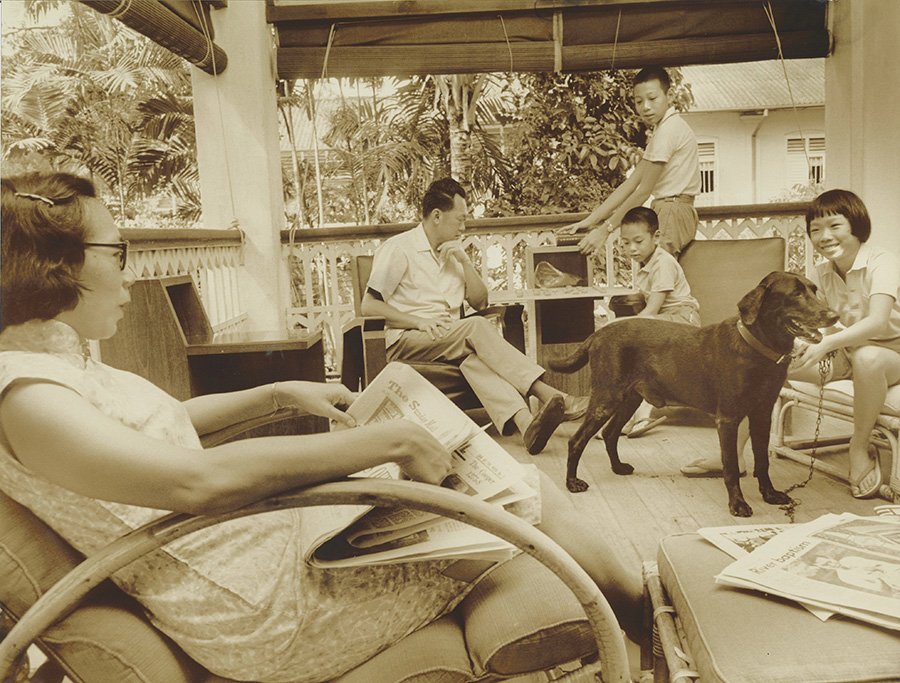
Mr and Mrs Lee Kuan Yew in their residence at 38 Oxley Road with their children Hsien Loong, Wei Ling and Hsien Yang. Lee Kuan Yew Collection, courtesy of National Archives of Singapore.
When you were in Cameron Highlands, was it agreed beforehand that you would say Mr Lee was playing golf?
No, I didn’t need to be told these things. He just said: “I am going off.” That’s that and I knew that when he goes off like this, you don’t tell the whole world that he’s gone down to Kuala Lumpur to negotiate these delicate things. So there are certain things he may have told me, “just don’t …”
No, I don’t think it was necessary. I knew what … this is a cloak and dagger thing. You don’t tell people. If my son had blurted out, “papa’s not here”, that would have been trouble. But my son would have known better, my big boy.30 My children wouldn’t have known, the younger ones wouldn’t have known. No, I don’t know whether we discussed – there’re certain things you don’t need to discuss. I mean, we knew this was Top Secret. He’s gone down, things are coming to the boil. It’s going to be pulled off. And so I just stayed back waiting for the phone call saying “come down”.
When he said, “come down,” then … I was there just as a camouflage. As far as the world knew, I mean, he was on holiday in Cameron Highlands. So when they asked me: “Where’s your husband?” “He’s playing, he’s on the golf course.” And when you are in Tanah Rata,31 in the village, in the town there, whether you are on the golf course or not, cannot be proved, because it’s a big rambling place.
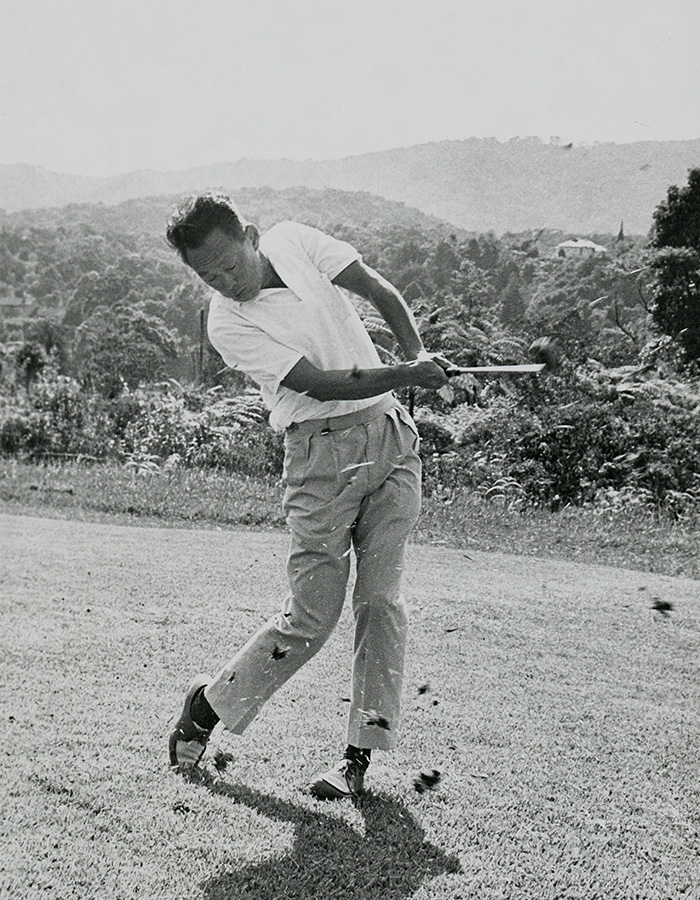
Prime Minister Lee Kuan Yew playing golf in the Cameron Highlands, 1967. Lee Kuan Yew Collection, courtesy of National Archives of Singapore.
That last night before the break-up, do you remember Mr Lee getting up in the middle of the night?32
No, no. He was upset after the thing was over. When the thing is on, there is no time to be upset. There is no time to be jittery and nervous while you are doing it. No, no. I think where he had the nearest to a nervous breakdown was after it was over, after the press conference [on the afternoon of 9 August] when we came back and slept in this room.33 Then he was very, very upset.
 at the press conference on the separation of Singapo.jpg)
Prime Minister Lee Kuan Yew (extreme right) at the press conference on the separation of Singapore from Malaysia on 12 August 1965. Beside him is Devan Nair, future president of Singapore. Ministry of Information and the Arts Collection, courtesy of National Archives of Singapore (Media - Image No. 19980000615 - 0031).
Devan34 was left up there in Kuala Lumpur. His [Lee’s] cause for concern was that he had abandoned our supporters in Malaya and that Devan was left our MP in Bangsar. And at that time the metaphor he used was: The spaceman has just gone up. They had sent something into space and a man had gone out [of the space capsule] and walked outside … and walked in space.35
And he said: “Devan is like that spaceman walking out in space.” And he was really upset at the idea of Devan being alone in Malaya to carry on, and that we had abandoned all these people.
And he had to make up for lost sleep, sleeping here in that room, and Devan came to see him. I remembered very clearly. Devan came down from KL, and my husband was sleeping and I took Devan to the little study at the back and said: “Look, you’ve got to convince Kuan Yew that you are staying on in Kuala Lumpur of your own volition. You are a grown up adult person. If you did not want to be left alone in Kuala Lumpur, you can come back to Singapore. And Kuan Yew is not responsible for your staying behind in Kuala Lumpur.” That was what upset him.
He was very distressed, distressed for the people and for Devan. And I told Devan: “Look, you are not a puppet, you are an independent person with your own mind. You’ve got to convince Kuan Yew not to be so upset about it because you are making up your mind yourself, not Kuan Yew making up your mind for you and leaving you behind.” So Devan agreed with me, but we let my husband sleep. He needed the sleep.
Then when he woke up, I think he saw Devan. I didn’t sit in with them when he saw Devan. But he was very, very upset. That is the nearest I have seen him to being near a nervous breakdown. After, not before. But it was very short, because he had to recover and then after that meet the press. Monday, after Separation was announced, I think he met the foreign correspondents that afternoon, and then some time later in the week, he may have met them again.36 Then we went up to Changi.37 And when we were in Changi, I remember Fred Emery38 of the London Timeswent up to meet us. So even then, he was working, he had to recover from this temporary … for a few days or for one day, he was very, very distressed, very distressed that we had let down the people who voted for us, and that he had left Devan there. I compared his reaction to Chua Sian Chin’s39 reaction. He [Chua] said: “Serve those people right. If more of them had voted for PAP [People’s Action Party], this wouldn’t have been necessary.” That was Chua Sian Chin’s reaction. But he was from Melaka, and he had fought in Melaka. So his reaction was: The people did not vote the PAP MPs in. And that’s why there was only Devan. But my husband felt that those people who had looked up and expected so much from the PAP had been let down.
He must have been very tense. That’s when you have real tension. Then relaxed after that. And this feeling … almost distraught and distressed for … it was only here within the four walls of my room … once at that press conference, when he broke down, but not after that. Not after that, but when he came back. And he had to sleep it off.
And when Devan came, I told Devan: “Look, you’ve got to convince my husband. It is not his fault.” And that took – I don’t know … took a little while I suppose. I can’t remember how long Devan stayed here … whether it was one hour or half an hour or two hours … I can’t remember that. But I remember taking Devan to the back room and saying: “Kuan Yew is sleeping. But this is the position. That’s why you must talk to him and convince him.”
ALBATROSS EXHIBITION AND BOOK
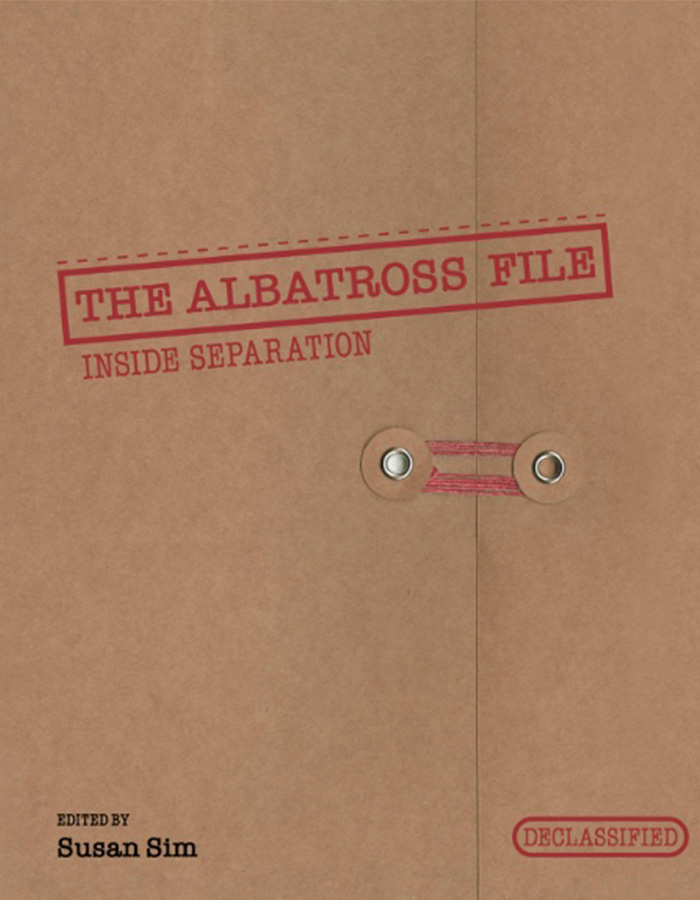
The Albatross File
The Albatross File is a secret file kept by Minister for Finance Goh Keng Swee, documenting the secret talks that led to Singapore’s separation from Malaysia. It contains Cabinet papers, memorandums as well as Goh’s handwritten notes of his discussions with Malaysian leaders in the tense days, weeks and months leading to Singapore’s independence on 9 August 1965. The original Albatross File has been in the custody of the National Archives of Singapore since 1996.
In conjunction with newly declassified documents and oral history accounts, a permanent exhibition, The Albatross File: Singapore’s Independence Declassified (opens in new tab), and a book, The Albatross File: Inside Separation (opens in new tab) (National Archives of Singapore and Straits Times Press, 2025), edited by Susan Sim, were launched in December 2025.
Jointly organised by the National Library Board and the Ministry of Digital Development and Information, the exhibition on Level 10 of the National Library Building aims to deepen visitors’ understanding of Singapore’s journey to independence through interactive storytelling, historical replays and first-person narratives of Singapore’s founding fathers.
The book contains essays on Merger and Separation, documents from the Albatross File and other key documents relating to Separation, as well as oral history interviews of key players involved. It is available for reference at the Lee Kong Chian Reference Library (call no. RSING 959.5705 ALB) and for loan at selected public libraries (call no. SING 959.5705 ALB). It is also available for sale at physical and online bookshops.
End Notes
1 Susan Sim, ed., The Albatross File: Inside Separation (opens in new tab)(Singapore: National Archives of Singapore and Straits Times Press, 2025), 473–82. (From National Library of Singapore, call no. RSING 959.5705 ALB)
2 “Eulogy by MM Lee Kuan Yew at the Funeral Service of Mrs Lee Kuan Yew,” Prime Minister’s Office Singapore, 6 October 2010, https://www.pmo.gov.sg/newsroom/eulogy-minister-mentor-lee-kuan-yew-funeral-service-mrs-lee-kuan-yew-mandai-crematorium/ (opens in new tab).
3 “According Honours to the Late Madam Kwa Geok Choo for Her Final Journey,” Prime Minister’s Office Singapore, 5 October 2010, https://www.pmo.gov.sg/newsroom/press-statement-prime-ministers-office-according-honours-late-madam-kwa-geok-choo-her/ (opens in new tab).
4 British Prime Minister Harold Wilson had called a special meeting of the Commonwealth leaders in Lagos, Nigeria, in January 1966 to discuss the unilateral declaration of independence by Ian Smith, then Prime Minister of Rhodesia. Lee attended the two-day meeting with Minister for Culture S. Rajaratnam.
5 Lee spoke at the Third Summit Conference of the Non-Aligned Countries in Lusaka, Zambia, on 9 September 1970.
6 Kwa was likely referring to the part of Lee’s speech where he described how Malaysian Chinese Association leaders like Lim Swee Aun, a Federal Cabinet Minister from Taiping, would occasionally stand up for minority rights: “Lim Swee Aun says, ‘We are all co-owners.’ I like to hear that. You know, his tail was up, wagging again. You know, in February, his tail was down. Umno branches in Perak were condemning him and calling him anti-Malay, anti-National Language. ‘Sack him!’ Passing resolutions in their special network in Jawi. We were reading it. We got alarmed. … I say there’s no need to be frightened. You see, the tails already are up. And now Lim Swee Aun says, ‘We are co-owners.’ This is important. We are fighting for Malaysia: agreed. Who owns Malaysia? This is very important because having fought for Malaysia, 10 years of Confrontation, suddenly we find only some are owners.” (The text of Lee’s speech is available from the National Archives of Singapore.)
7 Michael Buma was Chairman of the Machinda Party of Sarawak. In his memoirs, Lee described Buma as brilliant. “He spoke simply but with tremendous effect. His speech was so devastating that the English newspapers were afraid to publish his punchlines.” (Lee Kuan Yew, The Singapore Story: Memoirs of Lee Kuan Yew (opens in new tab) [Singapore: Times Editions: Singapore Press Holdings, 1998]. [From National Library Singapore, call no. RSING 959.5705092 LEE]).
8 Ayyavier Sankaran was the private secretary to Prime Minister Lee.
9 Vas was an officer with the Singapore Ministry of Culture.
10 Lee visited Accra, capital of Ghana, as the leader of a Malaysian delegation which undertook a 35-day mission to 17 African countries from January to February 1964.
11 Ahmed Sékou Touré was the first president of Guinea, formerly known as French Guinea, from 1958 until 1984.
12 Ahmed Ben Bella was the first president of Algeria who ruled from 1963 to 1965.
13 Tunku Abdul Rahman was the prime minister of Malaysia from 1957 to 1970.
14 Looking Back: Monday Musings and Memories is a compilation of articles by Tunku Abdul Rahman published in The Star, a Malaysian newspaper. It covers his life story and political career and the role he played in the formation of independent Malaya in 1957, and later, Malaysia in 1963. See Tunku Abdul Rahman Putra Al-Haj, Looking Back: Monday Musings and Memories (opens in new tab) (Kuala Lumpur: Pustaka Antara, 1977). (From National Library Singapore, call no. RSEA 959.5 ABD)
15 Race riots erupted twice in Singapore in 1964 – first, on 21 July during a procession marking the birth of the Prophet Muhammad; the second time, on 2 September.
16 Ko Teck Kin was a businessman, banker and president of the Singapore Chinese Chamber of Commerce from 1954 to 1955 and again from 1958 to 1965. After Separation, he was appointed Singapore’s first High Commissioner to Malaysia, serving from 1965 to 1966.
17 The Lee family residence.
18 In his memoirs, Lee said that he had asked his wife to write a clause guaranteeing the water agreements between Singapore and Johor. This was inserted as clause 14 in the Bill to amend the Malaysian Constitution and annexed to the Separation Agreement.
19 A cottage in Cameron Highlands that became part of the Aloha Resorts, a holiday facility owned by the Singapore government for civil servants.
20 Temasek House (Rumah Temasek) on Jalan Tun Razak in Kuala Lumpur was where Singapore officials used to stay. After Separation, it was, until 2014, the official residence of the Singapore High Commissioner to Malaysia.
21 S. Rajaratnam was the Minister for Culture of Singapore and Ong Pang Boon was the Minister for Education of Singapore.
22 According to Othman Wok, Minister for Social Affairs, he had driven Rajaratnam up to Temasek House on 7 August, and Lee had later that day asked him if he would sign the Separation Agreement if Lee himself did (see Othman Wok’s oral history excerpt on p. 293 of the Albatross book). Ong was also in Kuala Lumpur that weekend and was persuaded by Toh to sign the Separation Agreement at Temasek House.
23 Yong Nyuk Lin was the Minister for Health of Singapore.
24 Toh Chin Chye was Deputy Prime Minister of Singapore.
25 In his memoirs, Lee wrote that they decided to spend the night at Sri Temasek because they “would be safer there if any Umno Malays in Singapore should riot when the news broke the next morning” (Lee, The Singapore Story (opens in new tab), 1998).
26 Radio Singapore announced Singapore’s separation from Malaysia on 9 August 1965 at 10 am. The proclamation was broadcast in English, Malay and Mandarin and repeated every half an hour.
27 The TV conference was not held at Sri Temasek but at Caldecott Hill where Radio and Television Singapore, the predecessor of Mediacorp, was located. The telecast showed Lee breaking down and wiping his tears when he described Separation as “a moment of anguish”.
28 Lee Wei Ling, daughter of Lee Kuan Yew and Kwa Geok Choo.
29 Lee and his wife moved to Changi Cottage for a few weeks after they left Sri Temasek.
30 The older son, Lee Hsien Loong, was 13 years old in 1965.
31 Tanah Rata, which means “flat land”, is the largest town in Cameron Highlands.
32 Lee wrote in his memoirs that sleep was difficult that night because he “was fretting; had I overlooked any important [thing] that needed to be buttoned up?” (Lee, The Singapore Story (opens in new tab), 1998).
33 It is not clear which room Kwa was referring to. It would appear she thought Lee’s meeting with Devan Nair took place in Oxley Road, where this oral history interview was being conducted. But they were staying at Sri Temasek in the first days after Separation.
34 Devan Nair was the sole People’s Action Party member in the Malaysian Parliament representing the Bangsar constituency.
35 In June 1965, while the US spacecraft Gemini 4 was in orbit, astronaut Edward White emerged from the craft, floated in space for about 20 minutes, and became the first person to propel himself in space with a manoeuvring unit. Three months earlier, Soviet cosmonaut Alexei Leonov had been the first man to walk in space on 18 March 1965.
36 Lee did not meet only the foreign correspondents. There were local journalists present too.
37 Changi Cottage, a government holiday bungalow in Changi, was where Lee stayed to rest and recuperate after Separation. Sited on Netheravon Road, it is now part of the Singapore Civil Service Club.
38 Fred Emery was the Southeast Asia correspondent for The Times of London based in Singapore in the 1960s.
39 Chua Sian Chin had contested unsuccessfully as a PAP candidate in the 1964 Malaysian General Election. He joined the Singapore Cabinet in 1968 as Minister for Health.