
Conceptualising the Chinese World: Jinan University, Lee Kong Chian and the Nanyang Connection, 1900–1942
1 March 2014
Having been influenced by non-Chinese ideas and people, Jinan students and intellectuals provide a holistic, trans-regional perspective on the Chinese World.
By Leander Seah
Abstract
Historians of modern China and Chinese migration have inadequately conceptualised the Chinese world. Historically significant maritime activities have been incorrectly confined to the periphery of studies on modern China. Scholars of Chinese migration have adopted the contradictory approach of using a Sino-centric “Chinese diaspora” theory to examine local communities in destination countries. The under-explored area of education can help to address these issues. It can provide a more satisfactory understanding of the Chinese world.
This report uses Jinan University (Jinan Daxue) as a case study to do so. Founded in 1906, Jinan was the first school in China dedicated to the education of Nanyang (Southern Ocean or South Seas) Chinese migrants and their offspring. A region which is now equated with Southeast Asia, the Nanyang was the main destination for Chinese migration. Jinan thus served as the cornerstone of governmental efforts to reach out to such migrants. Education in modern Chinese history should not be contextualised only in terms of late Qing modernisation.
My selection of an educational institution also rectifies the overemphasis on business activities in Chinese migration studies. I am primarily interested in analysing the experiences of Jinan students and intellectuals. Many of them traversed the two regions of China and the Nanyang even as they were influenced by non-Chinese ideas and people. One prominent example was the famous rubber magnate, Lee Kong Chian (Li Guangqian). My trans-regional interpretation of the school’s history differs from the official narrative, which has focused on developments on the mainland. I examine in particular the Nanyang connection in this report. A trans-regional approach privileges neither China nor Chinese migrant communities, yet such balance has hitherto been absent from the historiographies of modern China and Chinese migration. My research ultimately calls for a holistic conceptualisation of the Chinese world, which would have considerable contemporary significance in light of recent debates on the global role of China and Chinese identity.
Preface
Through my academic training at the National University of Singapore (NUS) and the University of Pennsylvania (Penn) in Philadelphia, United States, I have gradually realised that historians of modern China and Chinese migration have inadequately conceptualised the Chinese world. Historically significant maritime activities have been incorrectly confined to the periphery of studies on modern China. Scholars of Chinese migration have adopted the contradictory approach of using a Sino-centric “Chinese diaspora” theory to examine local communities in destination countries. With these issues in mind, I selected a case study based on an educational institution for my Ph.D. dissertation topic at Penn.
I chose to study the history of Jinan University shortly after my arrival in the US in late August 2005. Jinan’s main claim to fame since its founding in 1906 has been its status as the first school in China dedicated to the education of Nanyang Chinese migrants and their offspring. Yet my focus differed from the perspective of the institution’s administration. I was interested in the experiences of Jinan students and researchers because they had traversed China and the Nanyang, even as they had been influenced by non-Chinese ideas and people. This focus would, I felt, help me to attain a more balanced understanding of the Chinese world, one which is neither China-centred nor Nanyang-centric.
The November 2005 launch of the Lee Kong Chian Research Fellowship (LKCRF) was fortuitous. I found out about the Fellowship from the websites of Singapore newspapers through which I have always been keeping track of developments in my home country despite my residence in the US. I thought that the Lee Kong Chian Reference Library’s (LKCRL) holdings would be ideal for my research due to the large collection of sources on Singapore and Southeast Asia. The Nanyang, which features prominently in my dissertation, was not only the main destination for Chinese migration, but was also a region that is now equated with Southeast Asia. Furthermore, I learnt from the grapevine that the National Library Board (NLB) would be organising an exhibition on Tan Kah Kee and Lee Kong Chian. I was thus very interested in applying for the LKCRF because Lee Kong Chian had been the epitome of the successful Jinan student and alumnus.
The financial terms of the LKCRF are generous for foreigners and overseas Singaporeans. I found the S$3,000 transportation package to be particularly helpful given the high cost of round-trip airfares between the US and Singapore. While I was satisfied with my package, perhaps the NLB could consider modifying the monthly stipend and monthly housing allowance amounts such that the former would comprise S$1,500 and the latter S$2,000. This adjustment would make the LKCRF monthly stipend as competitive as that offered by several universities in Singapore.1
As for other LKCRF terms, while the NLB was kind enough to allow me to hold the LKCRF for approximately three months, the brochure states that the Fellowship has to be held for six months. This may be an issue for Ph.D. candidates at North American universities because many of them may be fully funded during the academic year and are consequently free agents only during the three-month-long summer (June-August). This being so, the NLB might wish to consider advertising that there is some flexibility in terms of the time period for successful LKCRF applicants on a case-by-case basis, subject to a fixed total stipend package.
I was very grateful for the provision of other privileges. The laptop provided by the NLB was fantastic since it greatly facilitated my work, including the preparation of Microsoft Powerpoint slides for the public and internal lectures. I also appreciated the compactness of the laptop. Furthermore, I have nothing but praise for the work-station which was furnished. Fast internet access was very useful, and my work-station was conveniently located near LKCRL collections. The work-station layout was great: it was spacious and comfortable, and I appreciated the inclusion of drawers for storage of more sensitive items to be kept away from the public eye. The lighting and temperature were also ideal. I would also like to express my thanks for the extension of photocopying privileges to me, without which I would have been unable to complete my research. It was indeed very convenient to have photocopying facilities on almost every floor of the LKCRL. Finally, I enjoyed the LKCRL’s flexible opening hours, especially the fact that the library is open even on weekends. It was a wonderful experience to do research at such a library. I especially enjoyed the new NLB building and the LKCRL’s spacious shelving arrangement. The latter made it much easier to locate books.
Although the physical facilities at the LKCRL undoubtedly facilitated my research, I was most touched by the assistance rendered by the NLB administrators, staff and librarians. They made me feel very welcome after almost two years away from Singapore. I would especially like to thank Ms Ngian Lek Choh for her support and for attending my public lecture; Mrs Judy Ng for her support and advice; Mr Lai Yeen Pong for putting me in touch with an invaluable contact; Mr Johnson Paul, Dr Narinder Kaur, and Publishing & Research Services for their assistance, friendliness and patience; Ms Jane Wee for her suggestions and help; and Ms Ang Seow Leng, master of ceremonies for my internal talk and public lecture.
During the course of my stay at the NLB, Ms Wee Tong Bao served as my designated research assistant. She was simply first-class. She worked hard and was very helpful. She displayed much initiative in actively recommending (without my prior prompting) titles relevant to my research. Additionally, she served as liaison between Mr Lai and me in order that I would be placed in touch with Mr Xing Jizhong, a distinguished elderly writer in Singapore. This was absolutely crucial because Mr Xing was a very important figure in my research since he was possibly the most senior surviving Jinan alumnus in Singapore. Ms Wee also introduced me to the various facilities and collections at the LKCRL. She facilitated various logistics procedures (such as the setting up of the laptop), assisted in the efficient cataloguing and retrieval of books (e.g., RCLOS and RU/Repository), and helped to fulfil my inter-library loan request.
With regard to mentorship, I treated Ms Wee as a junior colleague given her previous research expertise. In fact, I had specifically requested that she be assigned as my research assistant in light of her excellent Master of Arts dissertation on Chinese education in pre-Second World War Singapore. I had found this thesis to be highly original, very well-written and thorough in terms of research. Due to my interest in her dissertation vis-à-vis my own research topic, I greatly enjoyed the opportunity to share ideas, bibliographical suggestions and so forth, with Ms Wee while I was based at the NLB. Besides, where academic mentorship is concerned, I personally believe in intellectual exchange rather than a hierarchical approach in order to ensure that both parties benefit the most from the relationship.
My research project entailed a holistic conceptualisation of the Chinese world. I thus adopted a transregional framework in order to highlight interactions between China and the Nanyang against the backdrop of Western and Japanese influences. My trans-regional perspective was inspired by recent debates on trans-nationalism, which have explored the fluid movements of people and organisations across geopolitical boundaries during the more recent global age. The term “trans-regional” was, however, more suitable for my research. This was because of my earlier chronological focus, 1900-42. Furthermore, China had not been a nation-state before 1911, and there had been hardly any nations in the Nanyang before post-World War II decolonisation. Instead, I considered both of them as “regions.”
I thought that the best way to illustrate the trans-regional approach would be to focus on the lives of Jinan students and intellectuals. This was because they had traversed regions, moving freely between China and the Nanyang while interacting with non-Chinese people and influences. Researchers who had worked at Jinan had founded the field of “Nanyang studies” (Nanyang Yanjiu). They had subsequently migrated to the Nanyang, which had become their new base of operations. As for the school’s students, they had contributed greatly to the historical fabric of both China and the Nanyang despite their relatively small numbers.
I was especially interested in personalities from Singapore, which meant that the LKCRL’s holdings would be most useful for my research. While the Nanyang had comprised such other places as the Dutch East Indies and Malaya, Singapore had been historically part of the Singapore-Malaya (Xinma) entity that had constituted the “heart of the Nanyang”.2 Statistics further supported my choice: in his study of global Chinese migration over a century from 1840 to 1940, Adam McKeown has estimated that out of the 19–22 million Chinese who migrated to destinations around the world, almost one-third migrated to the Straits Settlements (of which Singapore was a part) and Malaya.3 I thought that a stay at the NLB would enable me to corroborate material found in Singapore with documents to be located in China during further research forays in 2008 and 2009. This method is innovative because scholars of modern China have primarily used archives on the mainland due to the continental focus of their research. Furthermore, their counterparts for Chinese migration have consulted holdings in mainly destination countries.
My two-pronged research strategy combines both approaches. This reflects my dissertation’s holistic conceptualisation of the Chinese world, which avoids overemphasis on either China or Chinese migrant communities.
I found the NLB’s collection of publications to be fairly comprehensive in relation to my research topic. The LKCRL’s works were very useful, particularly the material in the RSING, RSEA, RCO, RCLOS, R (Chinese and English) and microfilm collections. The internet access at my work-station greatly facilitated my searches as I did not have to repeatedly stand at a terminal to look for call numbers and titles. As for the database access, I did not rely much on this. Regarding inter-library loans, I submitted only one request for a book from the University of Hong Kong. Everything else was available at the LKCRL.
I began my research by searching for Jinan publications since the school’s history from the spine of my study. The LKCRL owns some titles important for my research. These included: Nanyang huaqiao huiyi baogao (Shanghai: Guoli Jinan Daxue Nanyang Wenhua Shiyebu, 1930), although I already possessed a copy obtained via a loan from a North American library; Bainian Jinan shi 1906–2006 edited by Zhang Xiaohui (Guangzhou: Jinan Daxue Chubanshe, 2006), which was unavailable for loan at the time of my stay but which I later gained access to courtesy of a contact in Singapore; and Nanyang qingbao, a key periodical which had been published during the 1930s by Jinan and which had dealt with current affairs on the Nanyang (available on microfilm at the LKCRL). I also managed to obtain another crucial publication from the University of Hong Kong using the LKCRL’s inter-library loan facility: Jinan Daxue Tushuguan Huaqiao Huaren Wenxian Xinxi Zhongxin, ed., Jinan Daxue guanzang huaqiao huaren tushu ziliao mulu (Guangzhou: Jinan Daxue Tushuguan Huaqiao Huaren Wenxian Xinxi Zhongxin, 1995).
Yet, the NLB may wish to purchase additional Jinan titles (some of which contain biographical data on Lee Kong Chian and other Singapore Jinan alumni) which are unavailable in the LKCRL. I had borrowed them from North American libraries prior to my stay in Singapore. Examples include (see purchase list for full version) official Jinan histories such as Jinan Daxue Xiaoshi Bianxiezu, Jinan xiaoshi 1906–1996 (Guangzhou: Jinan Daxue Chubanshe, 1996); Zhou Xiaozhong’s Jinan yishi (Guangzhou: Jinan Daxue Chubanshe, 1996); and Jinan ren, vol. 1, ed. Zhong Yekun (Guangzhou: Jinan Daxue Chubanshe, 1996). Additionally, there exist primary sources such as Jinan Daxue Huaqiao Yanjiusuo (Institute of Overseas Chinese Studies, Jinan University), ed., Jinan xiaoshi, 1906-1949: Ziliao xuanji (Selected Source Material on History of Jinan University, 1906–1949), 2 vols. (Guangzhou: Jinan Daxue Huaqiao Yanjiusuo, 1983); and Jinan Xuetang xianxing zhangcheng (Nanjing: Jinan Xuetang, c. 1911). Also, several volumes in the Huaqiao jiaoyu series published by Jinan in the early 1980s may constitute useful resources for scholars working on education in China and among Chinese communities worldwide.
Regarding material specifically dealing with Lee Kong Chian, I found that the LKCRL possesses a formidable array of such works, including List of Lee Kong Chian Documents, compiled by Tadao Harada in 1979; Zheng Bingshan’s Li Guangqian zhuan (Beijing: Zhongguo Huaqiao Chubanshe, 1997); and Li Yuanrong’s Li Guangqian zhuan (Hong Kong: Mingliu Chubanshe, 1998). I consulted all these works.
However, I found a few noticeable gaps in the LKCRL collection. In particular, the LKCRL may wish to consider checking out these collections: the collection of newspaper articles on Lee Kong Chian available in the National University of Singapore Central Library Reference Office Personality Files Collection (NB: information in these articles is frequently unreliable; the best version of the facts is available from my BiblioAsia article and the full report below since I spent much time carefully corroborating biographical data); and Quek Soo Ngoh’s “Lee Kong Chian: Contributions to Education in Singapore, 1945–1965,” unpublished B.A. Hons. thesis, Department of History, National University of Singapore, 1986/87 (I think that this thesis would be absolutely crucial to any LKCRL exhibition on Lee Kong Chian).
My project emphasised the examination of Jinan’s history from the perspective of Singapore-based Jinan alumni. As such, locating sources pertaining to their experiences was a primary research agenda. Relevant material which I found at the LKCRL encompassed a very impressive collection of Singapore Jinan Alumni Association souvenir magazines. Even so, despite possessing the issues commemorating the 150th anniversary of Singapore’s founding as well as the 44th, 46th, 50th and 65th anniversaries of the Association, the LKCRL collection does not contain the issue celebrating the Association’s 60th anniversary. I have therefore included Xinjiapo Jinan Xiaoyouhui chengli liushi zhounian jinian tekan 1941–2001 (Singapore: Xinjiapo Jinan Xiaoyouhui, 2001) in the suggested purchase list.
Two other categories of sources helped me to better understand the experiences of the Jinan alumni. First, I looked for works containing biographical data at the LKCRL. These included several important publication series such as the three-volume Dongnanya renwuzhi (Who’s Who in Southeast Asia) edited by Xu Jiaozheng (Koh Kow Chiang) (Singapore: Xu Jiaozheng, 1965-1969) and the four-volume Xingma renwuzhi (Who’s Who in South East Asia) edited by Song Zhemei (Sung Chek Mei) (Hong Kong: Dongnanya Yanjiusuo, 1969-–990). Other avenues encompassed publications by Jinan alumni, like Tan Ee Leong (Chen Weilong)’s Dongnanya huayi wenren zhuanlue (Singapore: South Seas Society, 1977), and the LKCRL’s excellent newspaper collection. I regret that I did not have the time to consult the latter thoroughly since I was in Singapore for only about three months. Consequently, I had to resort to “surgical strikes” by selecting, for example, several articles on Jinan from the 1920s issues of the Nanyang Siang Pau (Nanyang shangbao).
I found another category of sources to be most useful in the compilation of information on the Jinan alumni. Such works helped me to understand the various networks connecting these people.4 The LKCRL collection is rather comprehensive in this respect.5 Useful sources comprised: 1) commemorative magazines of Singapore schools (since several Jinan alumni served on their boards or taught there) such as Tao Nan (Daonan or Toh Lam), Yeung Ching (Yangzheng), Chung Cheng (Zhongzheng) and Chung Hwa Girls’ (Zhonghua); 2) Singapore clan association publications, including those for the Hokien (this is the original spelling as opposed to the commonly used “Hokkien”) (Fujian), Hui Ann (Huian), Foochow (Fuzhou), Eng Choon (Yongchun), Eng Teng (Yongding) and Khek (Kejia) huiguan; and 3) the Singapore Chinese Chamber of Commerce and Industry’s commemorative publications.
Besides alumni who had studied at Jinan, my project also examined the contributions of various intellectuals to the founding and flowering of Nanyang studies at Jinan. The LKCRL in Singapore was an ideal location for my research on this field because of two reasons. First, Nanyang studies later became the Chinese-language track of Southeast Asian studies, and, second, after working at Jinan, these intellectuals had moved to Singapore, where they had pioneered a new approach in Nanyang studies by studying the Nanyang from the region itself rather than from the perspective of China.
I extracted a fair amount of information on these intellectuals’ experiences from my Master of Arts dissertation (two copies are available in the LKCRL). However, I used my stay at the LKCRL to search for sources that would shed further light on the influence of Japanese Nanyo studies (“Nanyo” being essentially the Japanese term for the Nanyang) on the emergence of Nanyang studies at Jinan. The LKCRL possesses good collection on this topic, including the works of Mark R. Peattie, a leading historian on the Nanyo. The Library even owns some interesting primary sources such as Nanyang yu Riben, originally written by Inoue Kiyoshi in 1913 but translated into Chinese by Huang Shuaizhen (Shanghai: Zhonghua Shuju, 1914).6 But one key work is missing: Shimizu Hajime’s Southeast Asia in Modern Japanese Thought: Essays on Japanese-Southeast Asian Relationship, 1880–1940 (Nagasaki: Nagasaki Prefectural University, 1997).7 This book is important because Shimizu remains one of the leading historians in Japan to have published on Japanese interest in the Nanyo.
Finally, while being based at the LKCRL, I looked for material related to the broader historical backdrop of my project, particularly in terms of education in Singapore and in China. The LKCRL has a fairly comprehensive collection of works, both in English and Chinese, pertaining to the former. Some titles which I consulted were: D.D. Chelliah’s “A History of the Educational Policy of the Straits Settlements with Recommendations for a New System Based on Vernaculars,” D.Phil. dissertation, University of London, 1940; and Xu Suwu’s Xinjiapo huaqiao jiaoyu quanmao (Singapore: Nanyang Shuju Zongjinghuo, 1950).
Education in China was very much a different story. I discovered that the LKCRL owns several gems, such as volumes from the Zhonghua Minguo shi dangan ziliao huibian series. This series consists of primary Republican-era documents reprinted by the Second Historical Archives of China in Nanjing. The LKCRL also has a very useful book by Ding Zhipin entitled Zhongguo jin qishinian lai jiaoyu jishi (Taipei: Guoli Bianyiguan, 1961). Yet there remain gaps in the NLB collection. For example, the LKCRL does not own several primary sources available in North American libraries. Such works include the periodical Jiaoyu zazhi, which had been published in Shanghai by the Shangwu Yinshuguan (Commercial Press) from 1909 onwards, and various China Ministry of Education gazette series for the late Qing and Republican periods (see purchase list). The LKCRL also does not own a number of works by well-known educators in China like He Bingsong (refer to the purchase list). I was aware of their significance because these men had played instrumental roles in Jinan’s history. The LKCRL may also wish to consider purchasing Who’s Who in China, 1918–1950 (Hong Kong: Chinese Materials Center, 1982) for further biographical data on such important historical figures.
Research Findings
Introduction
Historians of modern China and Chinese migration have inadequately conceptualised the Chinese world. Historically significant maritime activities have been incorrectly confined to the periphery of studies on modern China. Scholars of Chinese migration have adopted the contradictory approach of using a Sino-centric “Chinese diaspora” theory to examine local communities in destination countries. The under-explored area of education can help to address these issues. It can provide a more satisfactory understanding of the Chinese world. This report uses Jinan University 暨南大學 (Jinan Daxue) as a case study to do so.8 Founded in 1906, Jinan was the first school in China dedicated to the education of Nanyang南洋 (Southern Ocean or South Seas) Chinese migrants and their offspring. A region which is now equated with Southeast Asia, the Nanyang was the main destination for Chinese migration. Jinan thus served as the cornerstone of governmental efforts to reach out to such migrants. Education in modern Chinese history should not be contextualised only in terms of late Qing 清 modernisation.
My selection of an educational institution also rectifies the overemphasis on business activities in Chinese migration studies. I am primarily interested in analysing the experiences of Jinan students and intellectuals. Many of them traversed the two regions of China and the Nanyang even as they were influenced by non- Chinese ideas and people. One prominent example was the famous rubber magnate, Lee Kong Chian 李光前 (Li Guangqian). My trans-regional interpretation of the school’s history differs from the official narrative, which has focused on developments on the mainland. I examine in particular the Nanyang connection in this report. A trans-regional approach privileges neither China nor Chinese migrant communities, yet such balance has hitherto been absent from the historiographies of modern China and Chinese migration. My research ultimately calls for a holistic conceptualisation of the Chinese world, which would have considerable contemporary significance in light of recent debates on the global role of China and Chinese identity.
Trans-Regionalism and Education in the Chinese World
Few scholars of modern China have published analytical works on education.9 Studies on modern Chinese education have tended to contextualise educational developments against the limited backdrop of modernisation during the late nineteenth and early twentieth centuries. The pre-occupation with the late Qing period has in turn meant that there have been few monographs on education in Republican China with broader scopes beyond individual institutional histories.10 My research instead focuses on an educational case study which straddles both of these eras. Jinan was a school on the mainland for Chinese migrants that served as a cornerstone of state policies on Chinese migration during the late Qing and Republican periods.
At the same time, this report addresses the inaccurate conceptualisation of the Chinese world in the historiography on modern China. Historians have tended to examine continental events rather than the maritime sphere and migration. The post-1970s dominance of the approach favouring discussions of eighteenth-century China has only exacerbated this imbalance. Such works have privileged internal developments in response to the previous emphasis on the external Western impact during the nineteenth century.11 Established historians of maritime China and Chinese migration such as Wang Gungwu have been content to remain on the historiographical periphery even as they have argued for the need to study maritime activity.12 Since the maritime arena was hardly inconsequential in modern Chinese history, the next logical step would then be to re-evaluate the status of scholarship on the coastal regions and migration in the historiography on modern China.
Despite the peripheral status of maritime China in the field of modern Chinese history, works on Chinese migration have tended to subscribe to a Sino-centric concept called “Chinese diaspora.” Such a contradiction reflects the divide between the two historiographies, a gap which I aim to bridge. The diasporic framework which has been adopted in migration studies implicitly places primacy on the point of departure or homeland, China. This implication has been adequately discussed in much of the social sciences literature on “diaspora” and has, in fact, been examined by social scientists such as Ien Ang in relation to the Chinese case.13 Even so, promising scholarship on Chinese migration by historians like Adam McKeown has persisted in positing the existence of “diasporic networks,” thereby overemphasising the role of the mainland at the expense of migrants’ historical agency.14 Alternative conceptualisations remain unsatisfactory. Wang Gungwu has advocated the use of the phrase, “Chinese overseas” 海外華人 (haiwai huaren) while expressing reservations about “diaspora,”15 but this alternative contextualises those of Chinese ethnicity as being “overseas” relative to the mainland. His conceptualisation of Chinese migration has been appropriated in the Encyclopedia of the Chinese Overseas. The book scrupulously avoids any mention of “diaspora” yet portrays migration in terms of a concentric diagram with China as its core.16
Most of these works on Chinese migration have discussed business networks among migrant communities in destination countries. This approach has resulted in two problems. First, there has been tension between the Sino-centric character of the popular “Chinese diaspora” theory and the localised nature of such case studies.17 Second, their overemphasis on the economic dimension has indirectly perpetuated a form of Sino-centrism due to the pre-occupation with the presence of seemingly quintessential Chinese cultural values in business practices.18
My research instead adopts a more balanced approach towards understanding the Chinese world by examining linkages between the mainland and Nanyang migrant communities without overemphasising either connection. In choosing to examine the history of an educational institution, my report also diverges from the conventional path of examining Chinese business networks, thus demonstrating the importance of the educational sphere in Chinese migration.
This paper on the history of Jinan University calls for a holistic conceptualisation of the Chinese world. It adopts a trans-regional framework in order to highlight interaction between China and the Nanyang against the backdrop of Western and Japanese influences. My trans-regional perspective has been inspired by debates on trans-nationalism, which have explored the fluid movements of people and organisations across geopolitical boundaries during the more recent global age. The term “trans-regional” is, however, more suitable for my research. This is because of my earlier chronological focus: 1900-42. China was not a nation-state before 1911, and there were hardly any nations in the Nanyang before post-World War II decolonisation. Both should instead be considered as “regions.”
The trans-regional approach can be most clearly seen from my emphasis on the lives of Jinan students and intellectuals, who moved freely between China and the Nanyang while interacting with non-Chinese people and influences. It is indeed tempting to make much of Jinan’s location in China (first Nanjing 南京 and then Shanghai 上海 for my chronological scope) and its existence during the pre-Second World War era, when links between the Nanyang Chinese and the mainland were the strongest. I instead examine the experiences of researchers who worked at Jinan, where they founded the field of “Nanyang studies” 南洋研 究 (Nanyang Yanjiu). These intellectuals subsequently migrated to the Nanyang, which became their new base of operations. I also discuss the profiles of several of the school’s students. They contributed greatly to the historical fabric of both China and the Nanyang despite their relatively small numbers.19
I focus in particular on personalities from Singapore. The Nanyang comprised such other places as the Dutch East Indies and Malaya.20 Singapore is, however, a suitable choice to reflect the Nanyang connection in Jinan’s history and in the larger backdrop of the Chinese world. The island was historically part of the Singapore-Malaya 新馬 (Xinma) entity that constituted the “heart of the Nanyang”.21 The statistics further support my choice: in his study of global Chinese migration over a century from 1840 to 1940, Adam McKeown has estimated that out of the 19-22 million Chinese who migrated to destinations around the world, almost one-third migrated to the Straits Settlements (of which Singapore was a part) and Malaya.22 This report’s coverage consequently ends in early 1942, when Singapore was conquered by the Japanese during the Pacific War.
My emphasis on the Nanyang connection stands in contrast to the Jinan official narrative’s Sino-centric focus. There are no English monographs and articles on the institution. Chinese works have been limited to official or semi-official accounts, many being published by Jinan University Press. The dominant official narrative has deprived the Nanyang students of their historical agency by examining the school’s history from the administration’s perspective. The narrative has similarly failed to examine the activities of the Nanyang studies researchers after they moved to Singapore. The Jinan story has consequently privileged developments in China. It is no wonder that the narrative has highlighted the origins of the school’s name, which can be traced to the phrase “shuonanji” 朔南暨 (from north to south). It is telling that the phrase was extracted from an ancient Chinese text, the Shujing 書经 (Book of Documents or Classic of Documents).23 The implication then has been that Jinan has helped to spread Chinese culture southward to the Nanyang.
Lee Kong Chian, Pioneer Students, and the Early Years, 1900–11
Jinan’s official narrative has accorded much credit for the school’s establishment to its founder, Duanfang 端方. He was a high-ranking Qing official who was one of the most prominent reformists in China during the final decades of the nineteenth and the early years of the twentieth centuries.24 Yet the institution’s founding needs to be contextualised against the backdrop of Western and Japanese-inspired reforms which were implemented to address the vulnerability of imperial rule. The official narrative has also insufficiently examined the role of the Nanyang. The school was established by the Qing court to harness the financial resources of the Nanyang Chinese and cultivate political allegiance among younger generations of migrants in order to prop up its precarious rule.25 More tellingly, it was not Duanfang, but instead a low-ranking Qing official named Qian Xun 錢恂, who actually initiated the Jinan project. Qian Xun did so during a visit to the Nanyang in 1906 as part of a Qing Ministry of Education fact-finding mission.26 It is likely that given the rising number of new schools in the Nanyang for Chinese migrants by the turn of the twentieth century,27 he perceived the urgent need to seize the initiative and beat the competition by establishing Jinan in China.
The students who came from Singapore included Lee Kong Chian. This man was undoubtedly the epitome of the successful Jinan student. He has been better known for his business acumen and his rags-to-riches story. In 1916, he joined Tan Kah Kee’s 陳嘉庚 (Chen Jiageng) rubber company, and eleven years later at the age of 34, he started his own business in 1927. By 1942, Lee Kong Chian held leadership roles in organisations such as the Singapore Chinese Chamber of Commerce, the Rubber Trade Association of Singapore and the Oversea-Chinese Banking Corporation.28
As a rubber magnate and philanthropist, Lee Kong Chian certainly contributed immensely to the historical fabric of Singapore and the Nanyang. But it is equally noteworthy that the man had an eclectic background and that he traversed China and the Nanyang in his youth. Born on 18 October 1893 in Nan’an 南安, Fujian Province 福建, Lee Kong Chian migrated from China to Singapore in 1903. On the island, he enrolled in the Anglo-Tamil (or Anglo-Indian) School, and attended Chinese classes at Yeung Ching 養正 (Yangzheng) School on weekends. In 1907, he enrolled in Tao Nan 道南 (Toh Lam or Dao Nan) School, where he won a scholarship to study at Jinan Academy 暨南學堂 (Jinan Xuetang), the school’s earliest incarnation, in 1908.29 In early 1909, he arrived in Nanjing, where Jinan was located. He was part of the first group of students from Singapore to study at the Academy. These students had been selected by the General Chinese Trade Affairs Association in Singapore 中華商會 (Zhonghua Shanghui), the predecessor of the Singapore Chinese Chamber of Commerce and Industry. Jinan administrators had given responsibility for the selection of suitable students to the various academic societies and Chinese Chambers of Commerce in the Nanyang,30 and this reflected an acknowledgement of the importance of the Nanyang connection. At the school, Lee Kong Chian excelled academically, being placed in the better of the two middle-school classes, and performed well in Physics, Chemistry, and Mathematics. One of his Chinese essays was even used as a model essay. It was no surprise then that he graduated as the top student in his cohort in 1911.31
Upon graduating from middle school, Lee Kong Chian was one of only ten from Jinan to be admitted to Qinghua High School 清華高等學堂 (Qinghua Gaodeng Xuetang) in China. Yet he rejected the admission offer, having reached a consensus with the other nine that none would enrol at Qinghua. This was because Jinan administrators had previously promised to send successful students to Western countries for further studies. The promise was not honoured, possibly due to financial constraints since the Qing dynasty was on the verge of collapse. Hence, Lee Kong Chian attended the Tangshan Railway and Mining College 唐山路鑛專學堂 (Tangshan Lukuang Zhuan Xuetang) where he was taught by Englishmen and Scots. At Tangshan, Lee actually joined the Tongmenghui 同盟會 (Revolutionary Alliance), the predecessor of the Kuomintang 國民黨 (Guomindang), since the school was a hotbed of revolutionary sentiment. He arrived back in Singapore during 1912, having left China due to the turmoil of the 1911 Revolution. He spent several years working first for the Survey Department as a surveyor, and then as a translator for a Chinese newspaper and as a teacher at Tao Nan and Yeung Ching 養正 Schools. In 1915, he joined the business world and subsequently cemented his place in history.32
Lee Kong Chian was not, however, the only prominent Jinan student from Singapore. Others among the first batch of students from the island included Lim Pang Gan 林邦彦 (Lin Bangyan) and Ho Pao Jen 何葆仁 (He Baoren or Ho Pao Jin). These two men were on such intimate terms that they became sworn brothers at Jinan. They were both born in Fujian Province, Lim Pang Gan in Yongchun 永春 during 1894 and Ho Pao Jen in Xiamen 廈門 during 1895. They even arrived in Singapore during the same year, 1905. Both men enrolled at Tao Nan School in Singapore, and were subsequently selected to join Lee Kong Chian at Jinan. There was indeed a strong Tao Nan connection in the initial batch of Singapore students at Jinan – out of an intake of 38 from the island, 18 came from Tao Nan.33
At Jinan, Lim Pang Gan and Ho Pao Jen did not join Lee Kong Chian in the better of the two middle-school classes, but were instead placed in the other middle-school class. The sworn brothers’ paths split amidst the upheaval of the 1911 Revolution. Lim Pang Gan returned to Singapore, where he had a day-time job as a clerk and worked as a Chinese tutor at night. He also worked as a bill collector, and in the tobacco business. Ho Pao Jen pursued further studies at Fudan University 復旦大學 (Fudan Daxue) in Shanghai, representing Fudan in a patriotic movement of student organisations during the 1919 May Fourth Movement. Ho Pao Jen subsequently headed to the United States in 1920 to study commerce at the University of Washington. He then joined the University of Illinois to pursue Masters and Ph.D. studies on Governance and Economics, after which he returned to Fudan in 1924 as a professor of Political Science.
Yet both of them continued to keep in touch. For example, it was Ho Pao Jen who recommended Lim Pang Gan for a book-keeping job at a provision shop. Both of them also featured prominently among the Chinese community in Singapore. Lim Pang Gan held various appointments on the boards of organisations and schools, including Chung Hwa 中華 Girls’ School (which he assisted in establishing), Chung Cheng 中 正 High School, the Singapore Chinese Chamber of Commerce and clan associations. Ho Pao Jen moved to Singapore in 1925, being appointed as the principal of the Chinese High School 華僑中學 (Huaqiao Zhongxue). He stayed at the school for three years before becoming a banker in 1928. Ho then fled to Chongqing 重慶 in 1941 to escape the Japanese onslaught, and returned to Singapore in 1949 to pursue careers in business and banking.34
A second group of students from Singapore arrived at Jinan Academy in 1910. Two notable examples were Tan Ee Leong 陳維龍 (Chen Weilong) and Hu Tsai Kuen 胡載坤 (Hu Zaikun). Tan Ee Leong was born on 28 November 1897 in Yongchun, Fujian Province. He left China for the Nanyang in 1904 with his mother in order to join his father in Medan, Sumatra. There he studied Chinese, but then transferred to Jinan in 1910. At the Academy, Tan Ee Leong frequently consulted his senior, Lee Kong Chian, regarding Mathematics problems. Due to the 1911 Revolution, Tan Ee Leong moved to Penang, where he studied English at the Anglo-Chinese School and took supplementary lessons in Chinese. In 1914, he followed his father to Singapore, where he enrolled at the Anglo-Chinese School there for his middle-school education. Upon graduating in 1918, he worked for various banks and businesses. From May 1939 to February 1941, Tan Ee Leong served as the secretary of the Singapore Chinese Chamber of Commerce at Lee Kong Chian’s behest since Lee Kong Chian was then the head of the Chamber.35 Tan Ee Leong reprised this appointment from 1960 to 1964. He retired from banking and business in 1964.36
As for Hu Tsai Kuen, he is better known as the father of Richard Hu, the former Finance Minister of Singapore. But he was a prominent personality in his own right. Born during 1895 in Singapore, Hu Tsai Kuen was a Hakka. His schooling began with classes at the Anglo-Chinese School during the day and Chinese lessons at Eng Sing 应新 School at night. Hu Tsai Kuen then transferred to Tao Nan because he wished to attend Jinan, and thus arrived in Nanjing during 1910. He subsequently studied medicine at the University of Hong Kong from 1915 to 1921, after which he returned to Singapore in 1922. He set up the Nanyang Clinic on the island, where he practised Western medicine. Hu Tsai Kuen became well-known for his participation in the activities of the Overseas Chinese Association. This organisation was established in 1942 during the Japanese Occupation with the backing of Shinozaki Mamoru. The initial intention was to save Chinese lives, but the Association was forced to spearhead the campaign to raise the notorious $50 million demanded by the Japanese military authorities. Hu Tsai Kuen then took part in the Endau scheme to resettle Chinese in Johore in 1943, and was in charge of medical and health issues. He was an active member of the Hakka community in Singapore, and was also a patron of the arts during the 1950s.37
These students benefited from a modern education at Jinan. The Academy borrowed from the Japanese educational system, which featured nine years of elementary-standard schooling (divided into lower and upper levels) and five years of middle-school education.38 As such, there were two middle-school classes and four upper-elementary classes at Jinan. The medium of instruction was not Mandarin and instead depended upon the respective topolects of the teachers. More significantly, the syllabi were hardly Sinocentric. Jinan’s administrators placed heavy emphasis on comprehensive instruction in foreign languages, which encompassed not only reading but also translation work, conversational skills and writing. Students similarly benefited from History and Geography lessons which featured case studies beyond China’s shores (refer to the sample syllabi in tables A-C).39
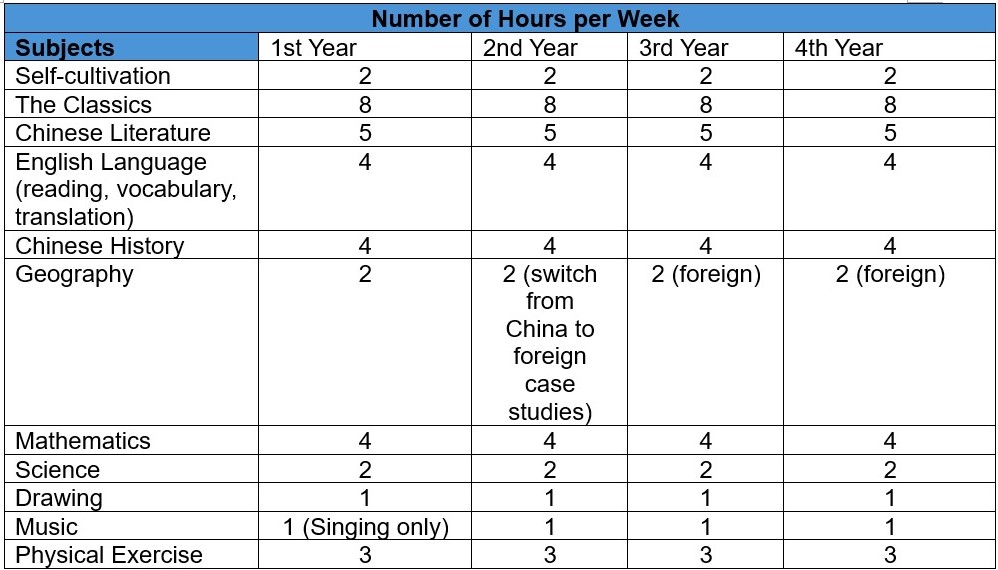
TABLE A: UPPER ELEMENTARY-SCHOOL SYLLABUS AT JINAN ACADEMY. Jinan Xuetang xianxing zhangcheng 暨南學堂現行章程 (Nanjing: Jinan Xuetang, c. 1911), 33-37.
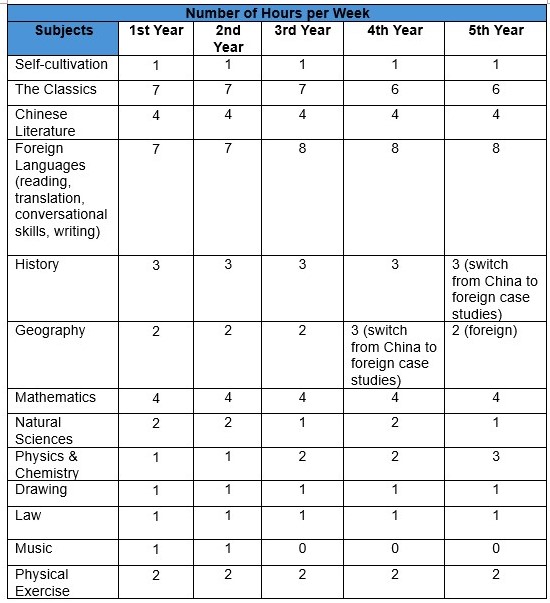
TABLE B: MAIN MIDDLE-SCHOOL SYLLABUS AT JINAN ACADEMY. Jinan Xuetang xianxing zhangcheng 暨南學堂現行章程 (Nanjing: Jinan Xuetang, c1911), pp. 33–37.
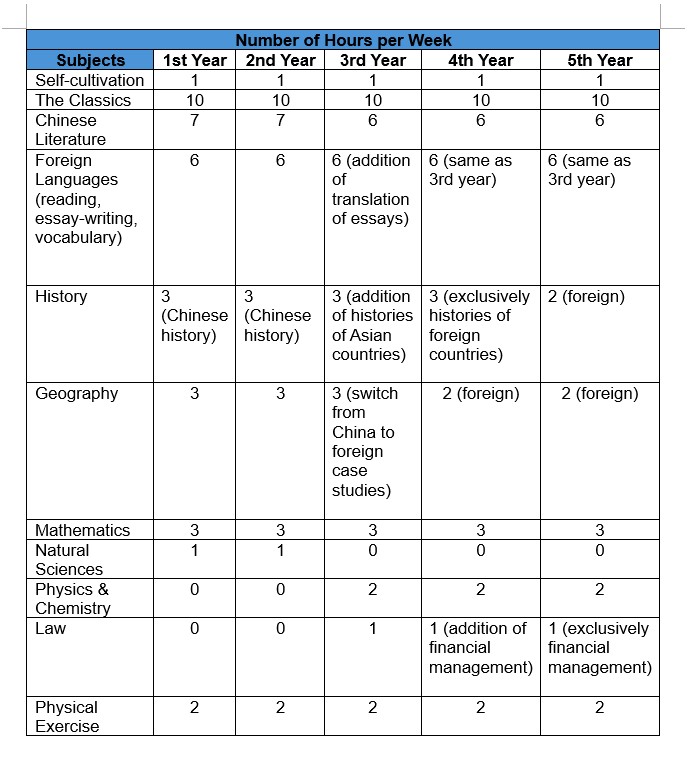
TABLE C: MIDDLE-SCHOOL SYLLABUS WITH HUMANITIES EMPHASIS AT JINAN ACADEMY. Jinan Xuetang xianxing zhangcheng 暨南學堂現行章程 (Nanjing: Jinan Xuetang, c. 1911), 22-27.
The closure of Jinan Academy took place amidst the turmoil of the 1911 Revolution which saw the end of Qing rule. The underlying cause was that the students cut their queues as early as fall 1910 after being exposed to revolutionary sentiment. The queue was a symbol of one’s loyalty to the Qing imperial court. This being so, during the fighting in 1911, the provincial governor gave the order that those without queues were to be treated as revolutionaries. Fearing for their lives, most of the students returned to the Nanyang, with a small group fleeing to Shanghai. Others made their way to Wuchang 武昌, wherethe Revolution had first broken out, participating in the fighting on the revolutionary side.40 It has been customary to highlight the financial contribution of Chinese migrant communities towards political movements in China.41 Yet many migrants actually sacrificed limb and life for the revolutionary cause.
Revival and Expansion, 1918–36
Classes at Jinan began again on 1 March 1918 after the renowned educator, Huang Yanpei 黄炎培, pushed for the institution’s revival. He did so upon returning to China from a fact-finding mission in the Nanyang. He was convinced that Chinese migrants and their descendants should be encouraged to study on the mainland. Nanjing was once more the location for the institution, which was named “Jinan School” 暨南學校 (Jinan Xuexiao).42
This period in Jinan’s history also featured a prominent Nanyang connection. One example was the school’s establishment of a research institute to study the Nanyang. By 1927, Jinan was based in Shanghai, having moved there in 1923–24. Zheng Hongnian 鄭洪年, who had been the first principal of Jinan Academy (1906–09), once again played an instrumental role. Having returned to head Jinan in 1927, Zheng Hongnian made the decision on 13 June that year to expand the institution’s activities. He added a research dimension to Jinan by founding the Nanyang Cultural and Educational Affairs Bureau 南洋文化教育事業部. This was officially inaugurated in September 1927, the same month that the school was upgraded to the status of a national university. Zheng Hongnian appointed himself as the Bureau’s first head, an indication that this research institute was a top priority.43 The establishment of the Bureau also constituted the institutional beginning of the Chinese-language track of Southeast Asian studies. The significance of this move was two-fold. First, there had been no prior systematic attempt by scholars in China to conduct research on the Nanyang. Second, the field of “Nanyang studies” at Jinan pre-dated by several decades the North American contribution towards research on Southeast Asia.44
The formation of the Bureau represented the culmination of Chinese intellectual interest in the Nanyang which had been partly influenced by Japanese research on the “Nanyo.” The latter concept was a Japanese equivalent of the Chinese “Nanyang.” Liu Hong has suggested that the advent of Nanyang studies at Jinan could therefore be traced back to the “South Seas Fever” in Japan as early as the first decade of the twentieth century.45 My research has convinced me otherwise. The pre-World War I notion of the “Nanyo” in fact referred to Micronesia in the South Pacific, the islands being seized by the Japanese from the Germans in 1914. The term did not at first refer to Southeast Asia. It was only during the aftermath of World War I that the concept of the “Nanyo” came to resemble more closely that of the “Nanyang.”
Shimizu Hajime has suggested that this was due to Japanese economic penetration into Southeast Asia during World War I.46 The Nanyo Kyokai 南洋协會 (South Seas Association), founded during the war years, played a significant role in equating the Nanyo with Southeast Asia. Its activities encompassed the systematic training of experts and accumulation of information. It was supported by eminent Japanese, including nobility and important businessmen, with governmental backing.47 Mark Peattie has also observed that during the 1920s, there emerged a division between the “Inner South Seas” (Uchi Nanyo), which referred to Micronesia, and the “Outer South Seas” (Soto Nanyo), which meant Southeast Asia. He has further noted that Japanese interest in the Nanyo gradually declined during the 1920s, when Nanyang studies began to emerge in China at Jinan. It was only during the 1930s that Japan began to rekindle its interest in the region due to the revival of Japanese commerce and the rise in its imperialist ambitions.48
Another instance of the importance of the Nanyang connection was the visit by the Jinan football (soccer) team to the region in 1928. The team was famous, winning the Kiangnan Inter-collegiate Athletic Association League nine times between 1927 and 1937. In spring 1928, Zheng Hongnian decided to send the Jinan football players to the Nanyang for a series of friendly matches. The objective of the trip was to raise the school’s profile in the Nanyang. This was a particularly apt goal in light of recent developments such as the achievement of university status and the founding of Nanyang studies at Jinan.
Singapore was a key destination on the tour, which took place from March to June 1928. Other destinations included Saigon (Vietnam), Bangkok (Siam/Thailand), and several locations on the Malay Peninsula (Kuala Lumpur, Ipoh, Penang, Kelantan, and Trengganu).49 The official Jinan narrative does not, however, mention that this tour provided the impetus for the beginnings of an alumni association based in Singapore. While the organisation was subsequently registered in 1941, the informal gathering of Jinan alumni on the island could be traced back to 1928.50 The Jinan football team’s visit rekindled interest among former students such as Lee Kong Chian in maintaining links with their alma mater.
Students from Singapore continued to arrive at Jinan throughout the 1920s and early 1930s. Many of them traversed China and the Nanyang. Born on the mainland, they migrated to the Nanyang. Upon graduating from Jinan, they eventually headed to Singapore and played important roles in the Chinese community on the island. Such personalities included Sheng Peck Choo 盛碧珠 and Liu Kang 劉抗. Both of them were born in Fujian Province, Sheng Peck Choo in Quanzhou 泉州 during 1912 and Liu Kang in Yongchun during 1911. Sheng Peck Choo underwent elementary and middle-school education in China. This included a stay at Jimei 集美 School, which had been established to train teachers by the famous philanthropist in Singapore, Tan Kah Kee. Sheng Peck Choo then worked as a teacher before pursuing a university education with Jinan’s Education Department from 1932 to 1935. Upon graduation, she taught at a village school in China before leaving for Singapore to join her husband in 1937. She worked as a teacher before joining Chung Hwa Girls’ School in 1939. She was subsequently promoted to be the school’s principal in 1955 and held the appointment till her retirement in 1977.51
Liu Kang spent a substantial portion of his childhood (1917–26) in Malaya because his father was a rubber merchant there. He then pursued a middle-school education at Jinan for a year (1926–27) before switching to art classes at the Shanghai College of Fine Arts 上海美專. This was followed by further studies in Paris from 1929 to 1933, after which Liu Kang worked as a professor at the Shanghai College of Fine Arts for the period 1933–37. He then moved to Singapore, teaching art at several schools, before going into hiding in Muar (Malaya) due to the Japanese conquest of the island. Liu Kang subsequently became a famous painter in Singapore as one of the pioneers of the Nanyang style of painting. This was a blend of both Western and Chinese methods, and paintings based on this style featured Nanyang subjects.52
War and the Move South, 1937–42
In August 1937, the Japanese invaded Shanghai. Jinan was thus forced to shift its campus to the International Settlement, where the school stayed until 1941. The official Jinan narrative describes these years as the “Isolated Region” 孤島 (gudao) period of the institution’s history to indicate that the school was isolated from the rest of “Free China”.53 However, the invasion of Shanghai also meant that Jinan was cut off from the Nanyang. The centre of gravity in the Nanyang connection therefore shifted to the region itself. Singapore constituted the heart of the Nanyang connection until the fall of the island to the Japanese in February 1942. There were two reasons for this. First, Singapore became the base of operations for Nanyang studies with the founding of the South Seas Society 南洋學會 (Nanyang Xuehui) in 1940. Second, a Jinan alumni association was officially registered on the island in 1941. The intellectual lineage of the South Seas Society could be traced back to China. Wang Gungwu has rightly stated that the organisation’s founders “wrote very much in the shadow of the Nanyang Research Institute of Chi-nan [Jinan] University in Shanghai,”54 and the full Chinese version of its name was “Zhongguo Nanyang Xuehui” 中國南洋學會 (China South Seas Society).55 Yet the “cradle for its initial development” was located in Singapore.56 Editors of the Sin Chew Jit Poh 星洲日報, a Chinese newspaper on the island, played a particularly important role in the Society’s birth. The organisation was founded by eight scholars on 17 March 1940 at the Southern Hotel 南天酒樓 in Eu Tong Sen Street. Five of the six who were actually present at this first meeting were linked to the Sin Chew Jit Poh. These five also constituted the majority in the seven-member inaugural council. They were: Guan Chupu 關楚璞 (Kwan Chu Poh), Yu Dafu 郁達夫 (Yue Daff ), Yao Nan 姚楠 (T.L. Yao/Yao Tse-liang/Yao Tsu Liang), Xu Yunqiao 許雲樵 (Hsu Yun Tsiao/Hsu Yun- Tsiao/Hsu Yun-ts’iao), and Zhang Liqian 張禮千 (Chang Lee Chien/Chang Li-chien).57
Two co-founders who did not attend the inaugural meeting were Liu Shimu 劉士木 (Lou Shih Mo/Liu Shih-Moh) and Li Changfu 李長傅 (Lee Chan Foo/Lee Chang-foo). Liu Shimu resided in Penang, having left China for the Nanyang in 1938 due to the upheaval of the Sino-Japanese War. Li Changfu was absent because he was then in Shanghai. The backgrounds of these two men shared a common denominator with Yao Nan’s profile: they all worked for the Nanyang Cultural and Educational Affairs Bureau at Jinan prior to establishing the South Seas Society.58 This reflected the Society’s ties with the China-based tradition of Nanyang studies. The backgrounds of Liu Shimu and Li Changfu further indicated a Japanese component as well. Liu Shimu was born during 1889 in Xingning 興寧, Guangdong 廣東 province, while Li Changfu was born during 1899 in Jiangsu 江蘇 province. Liu Shimu was partly educated in Japan because of the availability of economics courses in Japan on the Nanyang, evidence of the Nanyo-Nanyang link. He then joined the Nanyang Cultural and Educational Affairs Bureau in February 1928 as head of the cultural affairs section. He subsequently headed the Bureau from June 1928 to 1933. Similarly, Li Changfu joined the Bureau in 1927 as an editor before leaving for Japan in 1929, where he had stayed for two years. In Japan, Li Changfu learnt Japanese and English, after which he returned to work at the Jinan Bureau.59
As for Yao Nan, he was born in Shanghai during 1912. His interest in the Nanyang originated in his youth. He felt that Chinese scholars needed to pay more attention to the region because the Chinese contribution had been lagging behind the scholarship of European writers. He enrolled in the Nanyang Middle School 南洋中學 at the age of fifteen. Yao Nan then pursued his interest in Nanyang studies by working as an English translator with the Nanyang Cultural and Educational Affairs Bureau at Jinan from August 1929. Yao Nan later became the first head of the South Seas Society by virtue of his appointment as the Honorary Secretary, which was the highest-ranking position then. Amidst the Japanese onslaught on Malaya and Singapore, however, he fled to the Chinese war-time capital of Chongqing in 1941 and did not re-settle in Singapore following the end of World War II.60
The activities of the South Seas Society were halted by the Japanese invasion of Singapore. Despite its short war-time existence, the Society nevertheless fulfilled an instrumental role in the development of Nanyang studies. It was the first Nanyang-based organisation specialising in research on the region. This represented a new approach of understanding the Nanyang from the region’s perspective without repudiating the debt owed to the China-based intellectual tradition. The Society’s flagship periodical, the Journal of the South Seas Society 南洋學報 (Nanyang xuebao), broke new ground by being the first scholarly journal in the Nanyang to study the area. It was possibly also the oldest Chinese-language academic journal in the region.61 The publication of the Journal and other Society activities resumed during the post-Second World War period.62
There was overlapping membership between the South Seas Society and a second organisation with links to Jinan, the Singapore Jinan Alumni Association. Lee Kong Chian, for example, was a member of both bodies and a key sponsor of their activities.63 Although the move to found the Singapore Jinan Alumni Association began in 1940 with the submission of its registration application, the organisation officially came into being only on 23 April 1941. This was the date on which the organisation’s registration was approved. It was initially known as the “Chi-Nan Alumni Association (Singapore)”.64 There were ten or so founding members, one of whom was Lee Kong Chian. Hu Tsai Kuen was the founding chairman and Lim Pang Gan was the inaugural treasurer. The Association initially rented the third floor of 72 Robinson Road to serve as its headquarters.65
The choice of the Association’s initial Chinese name, “Luxing Jinan Xiaoyouhui” 旅星暨南校友會, was significant.66 The first character, “lu” 旅, implied that the organisation’s stay in Singapore was temporary and that there was thus no repudiation of the linkage with China. Yet the second character, “xing” 星, was an abbreviation for Singapore and an implicit acknowledgement of the Nanyang connection. The organisation was also known as the “Jinan Xiaoyouhui” and not “Jinan Daxue Xiaoyouhui” 暨南大學校友會 (Jinan University Alumni Association) because its membership comprised graduates of earlier non-university incarnations of Jinan like Jinan Academy (1906–11).67 The Association’s activities came to a standstill with the fall of Singapore in February 1942. When it was revived in 1947 by Lim Pang Gan, it became known as the “Singapore Jinan Alumni Association” 新加坡暨南校友會 (Xinjiapo Jinan Xiaoyouhui).68
While the inaugural version of the Singapore Jinan Alumni Association survived for only a short time prior to the Japanese conquest of Singapore in 1942, its existence was significant. This was because the organisation was one of the earliest of the Jinan alumni associations worldwide and possibly the oldest in the Nanyang.69 The official coordinating body at Jinan University was not established until 25 December 1992. Furthermore, the founding of the Singapore-based organisation represented the culmination of close links among the alumni on the island.70 Informal gatherings of these Jinan graduates had indeed begun as early as 1928, being prompted by the Jinan football team’s tour of the Nanyang. The reason for the delay in formalising the Association’s existence by submitting an application for registration has never been addressed by the organisation’s publications. The founding members have also passed away and are therefore not available for interviews.71 It may well have been the case that there were insufficient alumni in Singapore to make the founding of an organisation worthwhile, or that these alumni did not have the financial resources to support an alumni association until the 1940s.72 But another plausible explanation was that the Singapore alumni did not see the need to formally establish such a body until the isolation of Jinan following the Japanese invasion of Shanghai in 1937. The siege of the school meant that there was now a need to keep the memory of their alma mater alive south of China, in the heart of the Nanyang.
Concluding Remarks
This paper contributes to debates on such contemporary issues as Chinese identity and the global role of China. More recent approaches to these subjects have included the “Greater China” economic notion and the centre-periphery dichotomy in the “Cultural China” concept.73 Such perspectives have presented an imbalanced interpretation of the Chinese world. My research offers a different approach. I examine Jinan University’s history using a trans-regional framework. This report in particular has analysed the experiences of Jinan students and intellectuals. Such people as Lee Kong Chian traversed the two regions of China and the Nanyang while being influenced by non-Chinese people and ideas. My research thus demonstrates the usefulness of an educational case study in understanding the history of modern China and Chinese migration. The ultimate goal is to formulate a holistic historical conceptualisation of the Chinese world.
Endnotes
1 For the National University of Singapore and Nanyang Technological University stipend levels, refer to these websites: https://nus.edu.sg/ (opens in new tab); https://www.ntu.edu.sg/ (opens in new tab).
2 Wang Gungwu, Community and Nation: China, Southeast Asia and Australia (opens in new tab) (St Leonards: Asian Studies Association of Australia in association with Allen & Unwin Pty ltd, 1992), 29. (From National Library Singapore, call no. RSING 305.8951059 WAN)
3 See table 3 in Adam McKeown, “Global Chinese Migration, 1840–1940” (paper presented at ISSCO V: the 5th Conference for the International Society for the Study of the Chinese Overseas, Denmark, 10–14 May 2004), 5.
4 I have discussed some of these networks in my two NLB talks (public and internal), and my BiblioAsia article. I will further illuminate them in my Ph.D. dissertation, which will be completed in May 2010.
5 Titles missing from the LKCRL collection have been added to the purchase list.
6 I will examine the ramifications of such translations on the founding of Nanyang studies at Jinan during 1927 in my Ph.D. dissertation.
7 The LKCRL has a much earlier version of this work, which was published in 1980 under a different sub-title.
8 This paper is a fragment of a Ph.D. dissertation in progress with the Department of History at the University of Pennsylvania: Leander See, “Conceptualizing the Chinese World: Jinan University, Nanyang Migrants, and Trans-Regionalism, 1900–1942 (opens in new tab),” BiblioAsia 4, no. 1 (April 2008)
9 I have excluded Chinese works on education from this overview of the historiography on modern China because they have tended to lack analytical purchase: Marianne Bastid, Educational Reform in Early Twentieth-Century China, trans. Paul J. Bailey (Ann Arbor: Center for Chinese Studies, The University of Michigan, 1988), xvi.
10 Three notable exceptions have been: Yeh Wen-Hsin, The Alienated Academy: Culture and Politics in Republican China, 1919–1937 (opens in new tab) (Cambridge, Mass.: The Harvard University Asia Center, 1990) (From National Library Singapore, call no. RUR 378.51 YEH); Ruth Hayhoe, China’s Universities, 1895–1995: A Century of Cultural Conflict (opens in new tab) (New York: Garland Pub., 1996) (From National Library Singapore, call no. RUR 378.510904 HAY); Thomas D. Curran, Educational Reform in Republican China: The Failure of Educators to Create a Modern Nation (Lewiston, New York: The Edwin Mellen Press, 2005).
11 For further analysis of post-1970s scholarship on modern China, refer to: Hans van de Ven, “Recent Studies of Modern Chinese History,” Modern Asian Studies 30, no. 2 (May 1996): 226. (From JSTOR via NLB’s eResources (opens in new tab) website)
12 Wang Gungwu, “Maritime China in Transition,” in Maritime China in Transition 1750–1850, ed., Wang Gungwu and Ng Chin-Keong (Wiesbaden: Harrassowitz Verlag, 2004), 4.
13 Ien Ang, On Not Speaking Chinese: Living between Asia and the West (London: Routledge, 2001). For a discussion of the theoretical implications of the term, “diaspora,” see Kim D. Butler, “Defining Diaspora, Refining a Discourse,” Diaspora: A Journal of Transnational Studies 10, no. 2 (Fall 2001): 189–219.
14 Adam McKeown, Chinese Migrant Networks and Cultural Change: Peru, Chicago, Hawaii, 1900–1936 (Chicago: The University of Chicago Press, 2001), 84–85.
15 Wang Gungwu, China and the Chinese Overseas (Singapore: Times Academic Press, 1991; repr. Singapore: Times Academic Press, 1997); and Wang Gungwu, “A Single Chinese Diaspora?” in Diasporic Chinese Ventures: The Life and Work of Wang Gungwu (opens in new tab), ed. Gregor Benton and Hong Liu (London: RoutledgeCurzon, 2004), 157. (From National Library Singapore, call no. R 950.049510092 DIA)
16 Lynn Pan, ed., The Encyclopedia of the Chinese Overseas (opens in new tab) (Singapore: Archipelago Press, 1998; reprint ed., Singapore: Published for the Chinese Heritage Centre by Archipelago Press and Landmark Books, 2000), 14–15. (From National Library Singapore, call no. RSING 304.80951 ENC)
17 Zhu Guohong has rightly highlighted the localized focus of the extant scholarship, but his solution is still Sino-centric since it is based on understanding migrant activity as emigration from China. Refer to Zhu Guohong朱國宏, Zhongguo de haiwai yimin: yixiang guoji qianyi de lishi yanjiu 中國的海外移民: 一項國際遷移的歷史研究 [Chinese emigration: A historical study of the international migration) (上海: 复旦大学出版社, 1994), 5.
18 Wang Gungwu, Don’t Leave Home: Migration and the Chinese (opens in new tab) (Singapore: Times Academic Press, 2001; repr., Singapore: Eastern Universities Press, 2003 (opens in new tab)), 291, 293. (From National Library Singapore, call no. RSING 304.80951 WAN)
19 For example, enrolment at Jinan Academy 暨南學堂 (Jinan Xuetang), the school’s earliest incarnation, peaked at 240 in 1911: Jinan Daxue Xiaoshi Bianxiezu 暨南大學校史編寫組, Jinan xiaoshi 1906–1996 暨南校史 1906–1996 (Guangzhou: Jinan Daxue Chubanshe, 1996), 5–7.
20 I have previously examined the origins of the name, “Nanyang,” and the region’s geographical boundaries: Leander Seah, “Historicizing Hybridity and Globalization: The South Seas Society in Singapore, 1940–2000” (master’s thesis, Department of History, National University of Singapore, 2005). Refer also to Leander Seah, “Hybridity, Globalization, and the Creation of a Nanyang Identity: The South Seas Society in Singapore, 1940-1958,” Journal of the South Seas Society (opens in new tab) 南洋學報61 (December 2007):134–51. (From National Library Singapore, call no. RSING 959.005 JSSS)
21 Wang Gungwu, Community and Nation (opens in new tab), 29.
22 See table 3 in McKeown, “Global Chinese Migration, 1840–1940,” 5.
23 Jinan Daxue Xiaoshi Bianxiezu, 4; “Muxiao xiaoshi” “母校校史” “School history,” in Jinan xiaoshi, 1906–1949: Ziliao xuanji 1906–1949: 資料選輯 [Selected source material on history of Jinan University, 1906–1949), vol. 1, ed. Jinan Daxue Huaqiao Yanjiusuo 暨南大學華僑研究所 [Institute of Overseas Chinese Studies, Jinan University] (Guangzhou: Jinan Daxue Huaqiao Yanjiusuo, 1983), 3.
24 Bastid, Educational Reform in Early Twentieth-Century China, 241. See also Hiromu Momose’s biography in Arthur W. Hummel, ed., Eminent Chinese of the Ch’ing Period (1644–1912) (opens in new tab), vol. 2 (Washington, D.C.: United States Government Printing Office, 1943), 781 (From National Library Singapore, call no. RCLOS 920.051 EMI-[JSB]); and Wu Zixiu 吴子修, Xinhai xunnanji 辛亥殉难記 [The martyrs of the Xinhai revolution] (N.p., 1916; repr., Taibei: Taiwan Datong Shuju, 1968), 514–16.
25 The economic dimension has been thoroughly analyzed in Yen Ching-hwang’s book, Coolies and Mandarins: China’s Protection of Overseas Chinese during the Late Ch’ing Period (1851-1911) (Singapore: Singapore University Press, 1985).
26 Zhou Xiaozhong 周孝中, Jinan yishi 暨南逸史 [Unofficial history of Jinan University] (Guangzhou: Jinan Daxue Chubanshe, 1996), 2. Zhou’s book is possibly the only work published by Jinan University Press that has not downplayed this important fact.
27 For instance, Wee Tong Bao has examined the case of Singapore in her dissertation: “The Development of Modern Chinese Vernacular Education in Singapore – Society, Politics & Policies, 1905–1941” (master’s thesis, Department of History, National University of Singapore, 2001), 1, 14.
28 See, for example, “Reliving Lee Kong Chian,” AlumNUS 17 (March 1994), extracted from National University of Singapore Reference Office Personality Files Collection. Known as the “rubber king” during the 1950s, Lee was so respected that he even lectured on Southeast Asia at the Naval School of Military Government and Administration (based at Columbia University in New York City) on the invitation of law professor Philip C. Jessup. Lee had been stranded there while attending a rubber conference during the Pacific War: Tan Kok Kheng, oral history interview by Lim How Seng, 24 September 1983, transcript (opens in new tab) and MP3 audio, Reel/Disc of 54 of 81, National Archives of Singapore (accession no. 000232 (opens in new tab)), 491–500; Schuyler C. Wallace, “The Naval School of Military Government and Administration,” Annals of the American Academy of Political and Social Science (opens in new tab) 231 (January 1944): 29–33 (From National Library Singapore, call no. RUR 320.05 AAAP); and Chia Poteik, “Lee Kong Chian: Pay-off for Perseverance (opens in new tab),” Straits Times, 12 June 1962, 10 (From NewspaperSG) extracted from National University of Singapore Reference Office Personality Files Collection.
29 Lee retained fond memories of his brief stay at Tao Nan. Indeed, his wedding ceremony was held there.
30 Jinan Xuetang xianxing zhangcheng 暨南學堂現行章程 [Current regulations of Jinan Academy] (Nanjing: Jinan Xuetang, c. 1911), 13.
31 Selected sources on Lee Kong Chian: Zhou, Jinan yishi, 11–12; Tan Ee Leong, oral history interview by Lim How Seng, 28 May 1981, transcript (opens in new tab) and MP3 audio, Reel/Disc 14 of 21, National Archives of Singapore (accession no. 000003 (opens in new tab)), 117; Chia, “Lee Kong Chian: Pay-off for Perseverance (opens in new tab)”;
Anonymous, “Li Guangqian boshi” “李光前博士” [“Li Guangqian”] in Xingma renwuzhi 星馬人物誌 [Who’s Who in South East Asia], vol. 1, ed. Song Zhemei 宋哲美 (Hong Kong: Dongnanya Yanjiusuo, 1969), 23–50; Zheng Bingshan 鄭炳山, Li Guangqian zhuan 李光前傳 [Lee Guangqian] (Beijing: Zhongguo Huaqiao Chubanshe, 1996), 17–20, 223–224; Quek Soo Ngoh, “Lee Kong Chian: Contributions to Education in Singapore 1945-1965” (B.A. Hons. thesis, Department of History, National University of Singapore, 1986/87), 15–17; Chen Weilong 陳維龍, “Laotongxue jianjie” “老同學簡介” [“Introduction of old classmates”] in Jinan Xiaoyouhui xinhuisuo luocheng ji Xinjiapo kaibu yibai wushi zhounian jinian tekan, 暨南校友會新會所落成暨新加坡開埠一百五十週年紀念特刊 [Souvenir publication on inauguration of new premises of the Chi-nan Alumni Association and 150th anniversary of the founding of Singapore] (Singapore: Jinan Xiaoyouhui, 1970), 37. Some of these sources furnish incorrect details. For example, Lee studied and taught at Yeung Ching School, and not “Yeung Chia,” “Chung Cheng” 中正, or “Chongzheng” 崇正 Schools. The facts cited in my main text have been selected after careful corroboration of information.
32 Refer to the sources in the previous footnote.
33 The first intake from Singapore was part of the fifth overall cohort (54 students) from the Nanyang. Refer to: Interview with Lim Pang Gan, oral history interview by Tan Ban Huat, 10 May 1980, transcript (opens in new tab) and MP3 audio, Reel/Disc 2 of 6, National Archives of Singapore (accession no. 000036 (opens in new tab)), 19–29; “Jinan biannian dashiji” 暨南編年大事記, Jinan jiaoyu 暨南教育5 (December 1987): 82.
34 Zhou, Jinan yishi, 15–17; Lim Pang Gan, oral history interview by Tan Ban Huat, 10 May 1980, transcript and MP3 audio, Reels/Discs 2–3 of 6, National Archives of Singapore (accession no. 000036 (opens in new tab)); Lim Pang Gan, oral history interview by Tan Ban Huat, 20 October 1982, transcript and MP3 audio, Reels/Discs 1–2 of 3, National Archives of Singapore (accession no. 000227 (opens in new tab)); Xing Zhizhong 邢致中, “‘Gancao laoren’ lao shezhang Lin Bangyan xiansheng” “甘草老人]老社長林邦彦先生” [[“Licorice elder”] former president], Lin Bangyan in Tongde Shubaoshe jiushi zhounian jinian tekan 同德書報社九十週年紀念特刊 [Tongde book and newspaper 90th anniversary commemorative special issue], ed. Tongde Shubaoshe Jiushi Zhounian Jinian Tekan Weiyuanhui 同德書報社九十週年紀念特刊委員會 (Singapore: Tongde Shubaoshe, 2000), 60–62; Anonymous, “He Baoren boshi” “何葆仁博士” [“He Baoren”] in Xingma renwuzhi , vol. 2 (Hong Kong: Dongnanya Yanjiusuo, 1972), 113–14.
35 Tan Ee Leong was on such intimate terms with Lee Kong Chian that he was the best man at Lee’s wedding in 1928. Tan Ee Leong’s younger brother subsequently worked for Lee Kong Chian as late as 1979.
36 Tan Ee Leong, oral history interview by Lim How Seng, 28 May 1981, transcript and MP3 audio, Reels/Discs 1, 2, 7, 8, 10, 14 of 21, National Archives of Singapore (accession no. 000003 (opens in new tab)); Anonymous, “Chen Weilong xiansheng” 陳維龍先生 [“Chen Weilong”], in Xingma renwuzhi 星马任务之 [Mission to Seima], vol. 1 (Hong Kong: Dongnanya Yanjiusuo, 1969), 179–91; and Chen Weilong 陳維龍, Dongnanya huayi wenren zhuanlue 東南亞華裔聞人傳略 [Biographies of prominent Chinese in Southeast Asia] (Singapore: South Seas Society, 1977), vi. None of these sources, however, provide the correct dates for Tan’s second stint as the Secretary of the Chinese Chamber of Commerce, using the years “1958–1964” instead of “1960–1964.” I have therefore referred to the Chamber’s official record: Fangyan sihai: Xinjiapo Zhonghua Zongshanghui jiushi zhounian jinian tekan 放眼四海: 新加坡中華總商會九十週年紀念特刊 [Looking to the world: Singapore Chinese Chamber of Commerce and Industry's 90th anniversary commemorative publication] (Singapore: Singapore Chinese Chamber of Commerce & Industry, 1996), 99.
37 Chen Weilong 陳維龍, “Qingmo Jinan huiyi zhier” 清末暨南回憶之二 [Memories of Jinan University in the Late Qing Dynasty (part two)], in Jinan xiaoshi, 1906–1949: Ziliao xuanji, vol. 1, 98; Lim (opens in new tab), interview, 10 May 1980, Reel/Disc 2 of 6, 19–29; Koh Soh Goh, oral history interview by Tan Beng Luan, 24 October 1984, transcript (opens in new tab) and MP3 audio, Reel/Disc 2 of 5, National Archives of Singapore (accession no. 000497 (opens in new tab)), 11–19; Magdalene Lum, “The Doctor who had a Shot at Art (opens in new tab),” Straits Times, 30 October 1984, 1; “Hakka Leader Dies after Illness (opens in new tab),” Straits Times, 25 October 1984, 13 (From NewspaperSG); and Mamoru Shinozaki, My Wartime Experiences in Singapore (opens in new tab) (Singapore: Institute of Southeast Asian Studies, 1973), 32–33, 79–80. (From National Library Singapore, call no. RSING 959.57023 SHI-[HIS])
38 Chen, Qingmo Jinan huiyi zhier, 99.
39 Jinan Xuetang xianxing zhangcheng.
40 Chen, Qingmo Jinan huiyi zhier, 97, 102–03; Zheng Hongnian 鄭洪年, “Guoli Jinan Daxue zhi baogao” “國立暨南大學之報告” [“Report from National Chi Nan University”], in Huaqiao jiaoyu huiyi baogaoshu 華僑教育會議報告書 [Report of the Overseas Chinese Education Conference] ([n.p.]: May 1930), 19; “Jinan biannian dashiji,” 81–82; Jinan Gaojiaoshi Ziliaozu 暨南高教室資料組, “Jinan biannian dashiji” 暨南編年大事記, Jinan jiaoyu 暨南教育 5 (December 1987): 81–82; and “Jinan dili, Jinling] Yuan Shikai danu: ‘Jinan doushi xie gemingdang” [暨南地理、金陵]袁世凱大怒:暨南都是 些革命黨” [Jinan Geography, Nanjing] Yuan Shikai was furious: Jinan is full of revolutionaries], 30 May 2007.
41 See, for example, Yen Ching-Hwang, The Overseas Chinese and the 1911 Revolution: With Special Reference to Singapore and Malaya (opens in new tab) (Kuala Lumpur: Oxford University Press, 1976), xviii–xix, 90–91, 309. (From National Library Singapore, call no. RSING 301.451951095957 YEN)
42 “Jinan biannian dashiji,” 82.
43 Jinan nianjian 1929 暨南年鑒 1929 [Chinan annual 1929] (Shanghai: Guoli Jinan Daxue, 1929)
44 The Bureau was active, publishing various periodicals like Nanyang yanjiu 南洋研究 and a monograph series. It also spearheaded the organization of academic conferences. One example was the large-scale 1929 Nanyang Huaqiao Jiaoyu Huiyi 南洋華僑教育會議 at Jinan, which featured 78 participants of which 49 were from the Nanyang: “Jinan biannian dashiji,” 86.
45 Liu Hong, “Southeast Asian Studies in Greater China,” Kyoto Review of Southeast Asia 3 (March 2003), accessed 13 September 2005, https://kyotoreview.org/issue-3-nations-and-stories/liu-hong-on-southeast-asian-studies-in-greater-china/ (opens in new tab).
46 Shimizu Hajime, “Southeast Asia as a Regional Concept in Modern Japan,” in Locating Southeast Asia: Geographies of Knowledge and Politics of Space (opens in new tab), ed. Paul H. Kratoska, Remco Raben and Henk Schulte Nordholt (Singapore: Singapore University Press, 2005), 87–88. (From National Library of Singapore, call no. RSING 959 LOC)
47 Mark R. Peattie, “Nanshin: The ‘Southward Advance’ 1931–1941 as a Prelude to the Japanese Occupation of Southeast Asia,” in The Japanese Wartime Empire, 1931–1945 (opens in new tab), ed. Peter Duus, Ramon H. Myers and Mark R. Peattie (Princeton, New Jersey: Princeton University Press, 1996), 198–99 (From National Library Singapore, call no. RSING 950.41 JAP); Huei-ying Kuo, “Nationalism Against Its People? Chinese Business and Nationalist Activities in Inter-war Singapore, 1919–1941,” (Southeast Asia Research Centre Working Paper Series no. 48, City University of Hong Kong, July 2003); J. Charles Schencking, “The Imperial Japanese Navy and the Constructed Consciousness of a South Seas Destiny, 1872–1921,” Modern Asian Studies 33, no. 4 (October 1999), 792 (From JSTOR via NLB’s eResources (opens in new tab) website); Peattie indicates that the Nanyo Kyokai was founded in 1914, but Schencking states that this instead took place in January 1915. The precise date of establishment will be determined after further research in my Ph.D. dissertation.
48 Peattie, “Nanshin (opens in new tab),” 190, 195–96, 212–13.
49 Jinan nianjian 1929; and Ma Xingzhong 馬興中, “Jinan Daxue yu Xinjiapo” “暨南大學與新加坡” [“Jinan University and Singapore”], in Jinan Daxue bainian huadan, Xinjiapo Xiaoyouhui liushiwu zhounian 暨南大學百年華誕,新加坡校友會六十五週年紀念特刊 [Commemorative publication for the centennial celebration of Jinan University and the 65th anniversary of the Singapore Alumni Association] (Singapore: Xinjiapo Jinan Xiaoyouhui Chuban Weiyuanhui, 2006), 30.
50 Xing Jizhong 邢濟眾, “Fengxian manhuai aixin gongchuang meihao weilai” “奉獻滿懷愛心共創美好未來” [“Dedicate yourselves to creating a better future with love”] in Jinan Daxue bainian huadan, 1.
51 While Sheng Peck Choo has stated that she retired in 1978, the school’s records indicate instead that this took place in 1977: Sheng Peck Choo, oral history interview by Ang Siew Ghim, 9 March 1995, transcript and MP3 audio, Reel/Disc 1–4 of 17, National Archives of Singapore (accession no. 001608 (opens in new tab)); Zhonghua Zhongxue chuangxiao bashi zhounian jinian tekan 中華中學創校八十週年紀念特刊 [Zhonghua secondary school 80th anniversary souvenir magazine) (Singapore: Zhonghua Zhongxue, 1991), 41. For additional biodata, see: Jinan Xiaoyouhui xinhuisuo luocheng ji Xinjiapo kaibu yibai wushi zhounian jinian tekan, 147.
52 For a discussion of Liu Kang’s Nanyang style, refer for example to Alicia Yeo, “Singapore Art, Nanyang Style (opens in new tab),” BiblioAsia 2, no. 1 (April 2006). I have also referred to numerous sources, including: Liu Kang, oral history interview by Tan Beng Luan, 9 April 1982, transcript and MP3 audio, Reels/Discs 1, 5, 6, 37 of 74, National Archives of Singapore (accession no. 000171 (opens in new tab)); “Untitled (opens in new tab),” Straits Times, 3 February 1993, 3; and “Liu Kang: Milestones (opens in new tab),” Straits Times, 31 March 2000, 103 (From NewspaperSG). Many sources provide incorrect dates for Liu Kang’s stay at the Shanghai College of Fine Arts because they do not take into account his studies at Jinan. The dates for his enrolment at Jinan can be found in: Jinan Xiaoyouhui xinhuisuo luocheng ji Xinjiapo kaibu yibai wushi zhounian jinian tekan, 149.
53 Zhang Xiaohui 張曉輝, ed., Bainian Jinan shi 1906–2006 百年暨南史 1906–2006 [A century of history of Jinan University (1906–2006)] (Guangzhou: Jinan Daxue Chubanshe, 2006), 91.
54 Wang, China and the Chinese Overseas, 34.
55 See the inaugural annual report 會務報告, Journal of the South Seas Society (opens in new tab) 南洋學報 1, no. 1 (June 1940): 95 (From National Library Singapore, call no. RSING 959.005 JSSS) of the Chinese section.
56 Gwee Yee Hean, “South Seas Society: Past, Present and Future,” Journal of the South Seas Society (opens in new tab) 南洋學報 33 (1978): 32. (From National Library Singapore, call no. RSING 959.005 JSSS)
57 For further details, refer to Seah, “Hybridity, Globalization, and the Creation of a Nanyang Identity (opens in new tab).”
58 Jinan xiaoshi 1906–1996, 38 and table 7 on 325.
59 For Liu Shimu’s biographical details, see Journal of the South Seas Society (opens in new tab) 南洋學報 8, no. 2 (December 1952), especially 1-13 of the Chinese section; and Yao Nan 姚楠, Nantian yumo 南天余墨 (Shenyang: Liaoning Daxue Chubanshe, 1995), 39. Concerning Li’s hometown, sources differ: it was either Dantu 丹徒 or Zhenjiang 鎮江 – see “Bianji suoyu” 編輯瑣語, Journal of the South Seas Society (opens in new tab) 南洋學報 1, no. 2 (December 1940): 3 of the Chinese section; Yao Nan, Nantian yumo, 39; and Chen Daiguang 陳代光, “Li Changfu xiansheng zhuanlue” “李長傅先生傳略” [A brief biography of Mr. Li Changfu], in Li Changfu 李長傅, Nanyang shidi yu huaqiao huaren yanjiu 南洋史地與華僑華人研究 [Nanyang history and geography and overseas chinese studies] (Guangzhou: Jinan Daxue Chubanshe, 2001), 1–2.
60 “Yidai caizi Nantian Jiulou qi ‘hui’: Nanyang Xuehui 54 nian” “一代才子南天酒樓起‘會’: 南洋學會54年” [A talented scholar founded the Nanyang Society at the Nantian Restaurant: 54 years ago], Lianhe zaobao 聯合早報, 10 April 1994; Yao Nan, Nantian yumo, 39–40; and Yao Nan 姚楠, Xingyunyeyuji 星雲椰雨集 [ Nebula coconut rain collection] (Singapore: Singapore News & Publications Ltd., 1984), 2.
61 1940 annual report, Journal of the South Seas Society (opens in new tab) 南洋學報1, no. 1 (June 1940): 95 of the Chinese section; and the “Fakan zhiqu” “發刊旨趣” [“Foreword”] in the same Journal of the South Seas Society (opens in new tab) 南洋學報 1–2 of the Chinese section.
62 For post-war activities, refer to Seah, “Historicizing Hybridity and Globalization.”
63 Lee was a South Seas Society member from 1946 till his death in 1967, and was also a founding member of the Singapore Jinan Alumni Association. The overlapping membership will be further explored in my Ph.D. dissertation, “Conceptualizing the Chinese World.”
64 Straits Settlements Government Gazette (opens in new tab) 76, no. 55 (2 May 1941): 933. (From National Library Singapore, call no. RRARE 959.51 SGG)
65 He Baoren 何葆仁, and Lin Bangyan 林邦彦, “Jinan Xiaoyouhui chuangli shimoji” “暨南校友會創立始末記” [“A chronicle of the founding of the Jinan Alumni Association”] in Jinan Xiaoyouhui xinhuisuo luocheng ji Xinjiapo kaibu yibai wushi zhounian jinian tekan, 89; Xing, “Fengxian manhuai aixin gongchuang meihao weilai,” 1; and Ma, “Jinan Daxue yu Xinjiapo,” 30–32.
66 Straits Settlements Government Gazette (opens in new tab), 2 May 1941, 933.
67 Interviews conducted in Mandarin with Xing Jizhong 邢濟眾 on 25 June 2007 and 16 August 2007. Also known by his pen-name, “Xing Zhizhong” 邢致中, Xing is a famous writer in Singapore who was born in China and who studied at Jinan University from 1943 to 1947. At the time of my interviews, he had recently relinquished his position as the head of the Singapore Jinan Alumni Association after five years of leadership. He joined the organization in 1982 as its Assistant Secretary, was the Secretary from 1984 to 2002, and became the head in 2002. He is possibly the Association’s most senior surviving member.
68 Refer to the sources in footnote 65.
69 See footnote 67.
70 These networks will be further explored in my Ph.D. dissertation, “Conceptualizing the Chinese World.”
71 Oral interviews which were recorded prior to their demise do not contain information on this issue.
72 See footnote 67.
73 Wang, Don’t Leave Home: Migration and the Chinese (opens in new tab), 91; and Tu Wei-ming, “Cultural China: The Periphery as the Center,” in The Living Tree: The Changing Meaning of Being Chinese Today (opens in new tab) (Stanford: Stanford University Press, 1994), 1–34. (From National Library Singapore, call no. RSING 306 LIV)