
In Touch with My Routes: Becoming a Tourist in Singapore
1 March 2014
Singaporeans become tourists in their own country to rediscover their identity and the city they call home.
By Desmond Wee
To tourists around the world over, the Merlion is the tourism symbol of Singapore. To
the architects of independent Singapore, it is the story of a concept that worked. To
the travel industry, it is a souvenir spinner and an icon that helps to sell Singapore
overseas.
Pamelia Lee (2004, p. 99)
It struck me when the Merlion was struck, more by the discourses around it than by the stroke of lightning that bore a hole in its skull. Forty-five years after its creation, I wonder about the Merlion as an emblem for the Singapore Tourist Promotion Board (now Singapore Tourism Board), how Singaporean Fraser Brunner felt when he conceptualised the animal and if that mattered at all. According to the Report of the Tourism Task Force 1984 (as cited in Schoppert, 2005, p. 25), “what Singapore suffers from is an identity problem as there is no landmark or monument which a tourist can easily associate Singapore with”. In a paper for a course “Questioning Evolution and Progress” conducted at the National University of Singapore, Devan (2006, p. 4) related the issue — rather than being about “how tourists identify Singaporeans”, it was about the Singaporean “struggle for an identity”. However, the complexities of identity acquisition cannot elude how tourists identify Singaporeans. As described by Lanfant, Allcock & Bruner (1995, p. ix), it is tourism which “compels local societies to become aware and to question the identities they offer to foreigners as well as the prior images that are imposed upon them.” Representations in this sense are not only constituted by embodied practices, but they also constitute the ways in which identities are performed. By the same token, Singaporeans identify tourists as much as tourists identify Singaporeans, and in asking how Singaporeans identify themselves in the fostering of identity, I also ask if it is possible for Singaporeans to identify themselves as tourists. Who is the Singaporean under the Merlion?
Minister Mentor Lee Kuan Yew once remarked that economic progress must not undermine the “heartware of Singapore” referring to “our love for the country, our rootedness and our sense of community and nationhood” (The Straits Times, 20 October 1997). The cultivation of identity, as a need and means of survival, has evolved into a “substantial injection of self-definition and national pride” (Chua & Kuo, 1990, p. 6). However, given the rise of active citizenry, contestations across and in-between routes pertaining to the definition of self come to the fore. Kellner (1992) has suggested the emergence of identity as a “freely chosen game” in a “theatrical presentation of the self”. In this sense, our rootedness is also our “routedness”, a play in which identities are constituted within and not outside representation, and “relate to the invention of tradition as much as to tradition itself” (Hall, 1996, 4). Instead of the “so-called return to roots”, Hall (1996, p. 4) advocates a “coming-to-terms-with our ‘routes’” with which we can relate to cultural identities as fluid and emergent rather than being static. In the same way, Crouch, Aronsson & Wahlström (2001) maintain that the consideration of place and its represented culture “through encounter as ‘routes’ suggests a much less stable and fixed experienced geography”. This framing of text and place in terms of a becoming of identity repositions the performance of self as “the changing same” (Gilroy, 1994) and discusses the myriad ways in which knowledge and performances based on their representations are being (re)produced.
Performing Tourism
Tourism has traditionally been studied in a linear fashion between its consumption and its production, as well as how one affects, impacts and produces the other. Lanfant (1995, p. 32) maintains that tourism “has exposed, frantic forging of signs of identity with a view to their manufacture as tourist products where everybody is being exhorted to prepare representations of themselves.” However, it is in the recognition and engagement of the individual in a complexity of practices that we disrupt the familiar, more linear relationship between tourism semiotics and the knowledge and sense tourists make of touristic space in terms of their actions and their making of representations (McCabe, 2002). By traversing beyond “authenticity” (MacCannell, 1976) and the “gaze” (Urry, 1990) into the “performance” turn, we look at the constant negotiation within infrastructures of complex networks and mobilities, experiences, discourses, technologies and agencies framed within an ordering of spatialities in which embodied performances and practices are facilitated (Crouch, 2002; Franklin, 2003; Edensor, 2006; Haldrup & Larsen, 2006). In this sense, places emerge as tourist places when they are performed (Coleman & Crang 2002) and when they are appropriated, used and made part of memories, narratives and images of people engaged in embodied social practices (Urry, 2006). Spaces which are determined as tourist places, given both industry backing and the dynamic flux of tourist and local (among many others) practices, are not only packaged for touristic consumption, but are also constantly redefined in terms of “place”.
That constant refrain “where are you from?” that constantly follows tourists becomes variegated within the space of modernity evidenced through a measure of uncertainty as fluid productions of meanings manifest. With emergent hybridities evidenced in the blurring of traditional dichotomies like subject-object, production-consumption and tourist-local, it becomes increasingly difficult to ascertain a place called “home”. With the “organic binding of different cultural conventions and symbols”, there is no longer any “simple sense of the spatially and temporally distinct ‘home’ and ‘away’” (Rojek & Urry, 2000, p. 4). Perhaps the most lucid description is one by Zygmunt Bauman (1996, p. 30) in which he affirms the problem,
that as life itself turns into an extended tourist escapade, as tourist conduct becomes
the mode of life and the tourist stance grows into the character, it is less and less
clear which one of the visiting places is the home.
Following from this, one might also concur that the notion of being “home” could also be “visited”, “away” and prone to being an object of tourism. This is also the problem of modernity in which home is not only “fluid” (Bauman, 2000), it is also constantly being displaced, placed and replaced. Veijola (2006) writes,
How do you know and experience a place you knew as a child; and how does
that place know you? At which point do strangers turn into friends, tourists into
neighbours, locals into visitors, and places into tourist destinations? Can Heimat be
revisited? How is ontological security, guaranteed by being at home and having a
home, produced and managed in the modern world? How does one trust a place?
To clarify the notion of home and its proliferating mobilities is also to ask if the every day could be used as a premise for analysis in which “the every day becomes the setting for a dynamic process: for making the unfamiliar familiar; for getting accustomed to the disruption of custom; for struggling to incorporate the new; for adjusting to different ways of living” (Highmore, 2002). By looking at the everyday practices that formulate and reformulate personal nostalgia related to the sense of Heimat, I attempt to construe the ambiguities involved in constructing identities.
The setting of the every day is as modern as it is trying to separate images and experiences that shape tourism from the every day. McCabe (2002, p. 63) reiterates that “tourism is now so pervasive in postmodern society that, rather than conceiving tourism as a ‘departure’ from the routines and practices of everyday life, tourism has become an established part of everyday life culture and consumption.” The “touristification of everyday life” (Lengkeek, 2002) is evident in a “spectacular society bombarded by signs and mediatized spaces [where] tourism is increasingly part of everyday worlds” (Edensor, 2001). While “everyday sites of activity are redesigned in ‘tourist’ mode’” (Sheller & Urry 2004, p. 5), I ask how we deal with becoming tourist and who becomes the tourist. By contemplating the tourist, tourist place and tourist practice and their concomitant relationships, what are the kinds of dynamics that (re)produce these spaces and how do these relate to the acquisition of identity?
In an indispensable relationship between tourism and identity in which one informs the other, my research in Singapore induces the questioning of identity in terms of the spatial and embodied practices of tourism and the (re)production of representations and discourses which are performed every day. Identities rather than being rooted by place are re-emerging with new meanings and attributions. What is home? Who is a tourist? Can I be a tourist at home? When does that liminal transition happen and when it does, how do I perform tourism? This paper considers how tourist practice is assimilated in the context of the everyday through “local” consumption, its translation into tourist identities and vice versa. In contextualising the city and juxtaposing my three-faceted persona as researcher, tourist and local in Singapore, I explore through photography how Singaporeans perform tourism en route home through institutional attempts to “rediscover” and “love” the city and the local reiteration of place and identity.
Performing Place And Photography
Places are produced and reproduced on a daily basis through an embodied relationship with the world that is never finished and is always “becoming” (Seamon, 1979; de Certeau, 1984; Pred, 1984; Thrift, 1997). They are being performed on unstable stages as they are being reproduced and re-imagined. However, rather than performing social practices in a void, we are embodied in the materiality of places and their contingent meanings. Cresswell (2004, p. 39) asserts that place is the “raw material for the creative production of identity rather than an a priori label … [and] provides the conditions of possibility for creative social practice.” This creativity underlies a performance which ensues as part of an everyday experience of place in the construction of self in which “the performance offers cultural content for that identity”
(Kirshenblatt-Gimblett, 1998).
Places are reproduced through systems of tourist performances, made possible and contingently stabilised through networked relationships with other organisations, buildings, objects and machines (Baerenholdt et al., 2004). Tourist photography as embodied performance is likewise performed through heterogeneous actor-networks of photographers, actors and spectators, technologies, materials, scripts and practices (Larsen 2003; 2005). As “practice” in determining spatial stories (de Certeau, 1984), photography becomes an extension of walking and knowing the city through constitutive performances. It is a corporeality that “acts” (Haldrup & Larsen 2006) in ways in which the tourist photographer frames, as well as, is being framed. It is a performance in which the very blatant act of carrying a camera and taking a photograph of a tourist becomes a tourist script in itself.
Photography exists as a technology and practice which reproduces place rather than consumes it. In modernity, tourist photography not only reproduces the real, it recycles “in the form of photographic images [where] things and events are put to new uses, assigned new meanings …” (Sontag, 1999, 91; Bauman 1996). New agencies come into place: the urge to take photographs become an “experience seeking a crisis-proof form” (Sontag, 1999, p. 84), the camera positions the user and the camera “acts” in sync with the photographable object. The place object queries the gaze and coerces the photographer to look at it in a particular way. It defines and negotiates a meaning with the self the same moment as the click.
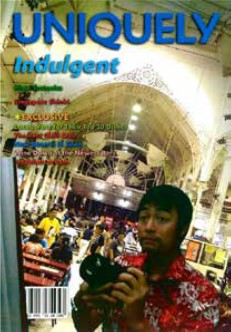
Souvenir photo taken at a fully automated photo booth at the Singapore Visitors Centre on Orchard Road. Before the photograph was taken, I was asked to describe my Singapore experience.
According to Chaney (1993, p. 64), we are “performers in our own dramas on stages the industry has provided”. By engaging place using photography and vice versa, I attempt to perform the tourist (while bearing the traits reflexively as a local and a researcher) and compare the kinds of performances in which Rae & Low (2003) depict the consumption of the Singaporean scent-scape,
To press on, you need to take a step back and look to your own place in the scheme
of things. Amidst these most pungent practices of the every day, it is you who are
the performer. Play it up. Hitch a ride on a more available identification: the tourist.
Perform a little journey of your own …
The following four segments attempt to leverage on the platform of performance, and discuss the becoming and commingling of tourism and identity representations of tourist performance, looking at how tourists are being identified, how they identify themselves through practice and the discourses on how tourism is being performed. Apart from “doing tourism” in Singapore during this phase of my field work as part of the Lee Kong Chian Research Fellowship, I also participated in the “Shooting Home” project which culminated in a photo exhibition of my series taken while en route entitled “Tourist from here”. Using photographs as methodology, as a performative of self and as a tool for analysis, we look at the meanings derived through place performance and their conjunctions with tourism.
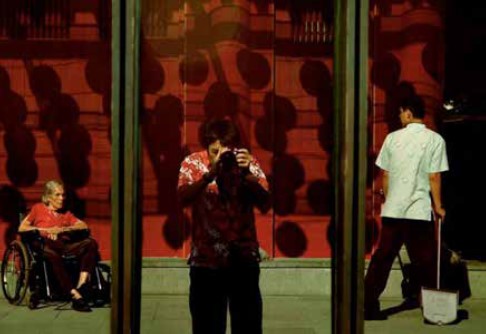
Signature image in a series entitled “Tourist from here” as part of “Shooting Home” Exhibition.
Becoming Identity
I believe it has come to the point where Singaporeans cannot imagine Christmas
without bright lights along Orchard Road. Likewise, they cannot imagine Deepavali
without lights in Little India, Chinese New Year without lights in Chinatown and Hari
Raya Puasa without lights in Geylang Serai.
Pamelia Lee (2004, p. 45)
The year 1819 marked Singapore’s founding by the British East India Company after acquiring the strategic port in the Strait of Malacca. Singapore’s independence and departure from the Malaysian federation in 1965 meant that its leaders were faced with the task of building a nation out of a racially diverse population and developing the nation’s economy without access to any natural resources (Wee, 2003). The island became an independent nation characterised by a post-colonial complex amidst ethnic diversity. In 2000, Lee Kuan Yew (2000, p. 19), then Senior Minister of Singapore, wrote that
(t)here are books to teach you how to build a house, how to repair engines, how to
write a book. But I have not seen a book on how to build a nation out of a disparate
collection of immigrants from China, British India and the Dutch East Indies.
The building of a common national identity became an important and complex state-led project (Yeoh & Willis, 1997) and a “multiracialism” (Benjamin, 1976) developed as a crucial means for the maintenance of racial harmony. The Chinese, Malay, Indian and Others (CMIO) quadratomy (Siddique, 1990, p. 36) which was established as a classification of multiracialism has held its ground until today.
Since its independence, the development of identity in Singapore was authored alongside tourism. The tagline created by the Singapore Tourist Promotion Board, Instant Asia, was an “exotic” blending of a “stateconceived model which is amenable to tourism promotion on one hand, while conveying an image of ethnic harmony on the other” (Teo & Chang, 2000, p. 125). According to Chang (1996, p. 205), “Tourism’s contribution to multiculturalism in the form of Instant Asia marketing image served equally as part of the nation building apparatus. Tourism provided an invaluable opportunity to advance the CMIO ideology …”. After Instant Asia was Surprising Singapore which added a splash of modernity and New Asia in the ’90s, and which promoted Singapore as the cultural hub of Asia and global city for the arts (Teo & Chang, 2000). The current ‘Beyond Words’, The Next Phase of Uniquely Singapore Brand Campaign, Breaks New Ground” (2006) bears “personal” traits, goes “beyond promoting the destination through product attributes and strives to bring out the depth of the Singapore experience.” However, the contexts for the experience in which “no two experiences are the same” (2006) continue to resonate with an already internalised CMIO complex, exemplified in the definition of four uniquely ethnic “places”. Chinatown, Kampong Glam, Little India and the colonial quarter are the places that epitomise representations for the making of identity and tourism.
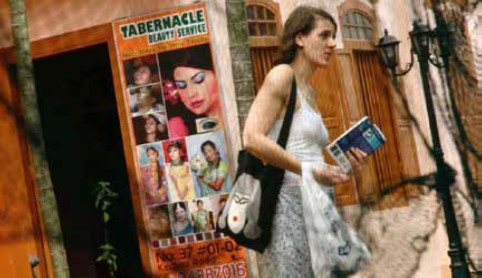
Image of an inconspicuous side street in Little India as part of “Shooting Home”.
While in Singapore in a guest lecture to a hundred polytechnic students I asked where this place was (Plate 3), and there was a roar of “Little India”. Most of the students (who were Singaporean) had not been to the place or Little India for that matter (why is another matter). If they looked carefully for leads, they would have found an address on the plaque which might have rewarded them with a clue, but instead, the place name was determined based on its relationship with the colourful images of Indian women. Admittedly, the question that I asked was loaded because there was no other “place” that could bring out these images in the Singaporean place knowledge. What seemed to unfold was a play of synecdoche in terms of image, Indianness and the ascription of place such as Little India as the beholder of all signification. Little India in its place(d) performance enacted the whole rather than its part of Indianness.
There is also the question of the tourist carrying that ubiquitous blue book. She is found in Little India through her dedication to the inscriptions of the guide, but it is also because of her presence in Little India where the place is performed and reinforced. Not only are tourist places produced places, but “tourists are co-producers of such places” (Larsen, 2005). Her recognition of Little India contributes to Little India being more recognisable, as a place and as a tourist place. But what if in her place was one of the other three “races” that constitute Singapore’s multiculturalism: Chinese, Malay or Indian? How do we make sense of these faces as tourists and tourism?
These images question what the woman is doing in these places. Her “race” is put at stake by being “Chinese” in the ethnic areas either through incorporated difference and the rhetoric of place. She is my model and also my grandmother who is experiencing Kampong Glam and Little India for the first time in her life. By using her as subject, the kinds of performances of the people in the backgrounds are also being questioned. These emergent ways of personal and subjective experience look at an already established CMIO and reveal seepages in terms of what is being experienced and who are involved in the experience. It is no longer possible to separate the branding of image and the construction of identity as they are fused in ways that reinforce each other. By looking at identity and tourism through performance, questions evolve as to who the tourist is and how this relates to the expression of self.
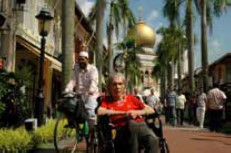
Lady in Kampong Glam in “Tourist from Here”.
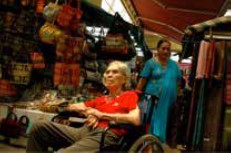
Lady in Little India in “Tourist from Here’”.
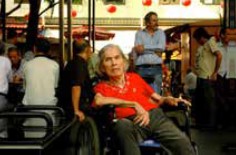
Lady in Chinatown in “Tourist from Here’”.
These images question what the woman is doing in these places. Her “race” is put at stake by being “Chinese” in the ethnic areas either through incorporated difference and the rhetoric of place. She is my model and also my grandmother who is experiencing Kampong Glam and Little India for the first time in her life. By using her as subject, the kinds of performances of the people in the backgrounds are also being questioned. These emergent ways of personal and subjective experience look at an already established CMIO and reveal seepages in terms of what is being experienced and who are involved in the experience. It is no longer possible to separate the branding of image and the construction of identity as they are fused in ways that reinforce each other. By looking at identity and tourism through performance, questions evolve as to who the tourist is and how this relates to the expression of self.
Representing Tourist
After a visit to the Singapore Visitors Centre, I was armed with things to do around Singapore. From the “topless” Hippo Bus tours which gave me an overview of the city, I ventured into the four ethnic quarters in the name of cultural tourism. I visited Chinatown, Little India, Kampong Glam and the colonial district, I took a bumboat ride along the Singapore River to marvel at the waterfall spouting out of the Merlion’s mouth. Since I was travelling alone and could not take photographs of myself and my experience on the boat, I sought postcards like any normal tourist would. I also consulted the National Library educational e-resource, OnAsia (onasia.com/nlb) which consisted of “high-quality copyrighted images created by some of Asia’s finest photojournalists and photographers” featuring “photographic essays, stock photographs and conceptual images that represent a unique visual description of Asia, offering online access to a comprehensive collection of historical, political, social and cultural images.” By using two search criteria: “tourism” and “tourist”, I extracted and sought an analysis of visual imagery and descriptions which determined place in tourist settings.
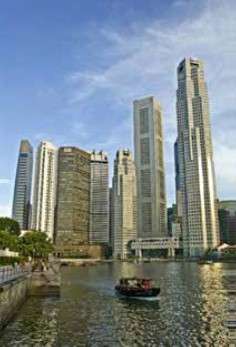
Singapore, 22 May 2007. A bumboat carrying tourists on a sight-seeing cruise along the mouth of the Singapore River. This area used to be the old port of Singapore where the city’s first settlements were. Back in the colonial days, the river mouth was the centre of entrepot trade, commerce and finance. To this day, it remains the most expensive and economically important district in Singapore. © Edgar Su/OnAsia.com.
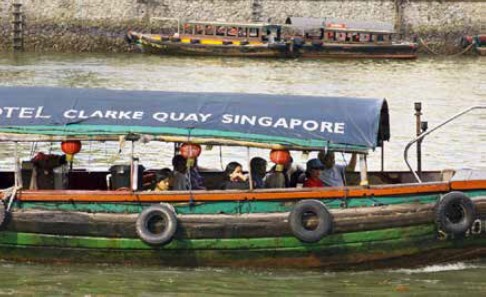
Singapore, 26 May 2006. A boat carrying tourists along the Singapore River near Clarke Quay. © Erick Danzer/OnAsia.com.
Upon viewing both images and the attached descriptions in plate 7 and 8, I realised that through an other perception, I became by default, a tourist the moment I was in the boat. My choice to engage in a tourist activity in a designated tourist area afforded a tourist practice that made anyone who sat in the boat a tourist. In plate 9 and within the same area, Duggleby likewise captured yet another tourist, this time taking a photograph. Without a priori knowledge, one would become a tourist while indulging in tourist practice within a tourist place. But at which point did I become a tourist? How do we determine the confines of what constitutes a tourist place and the reciprocity of practice in place?
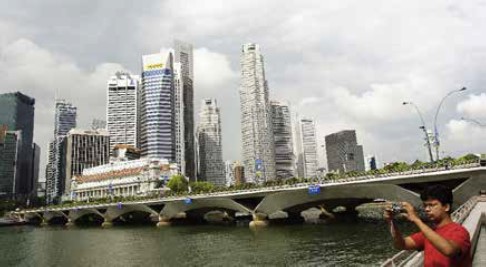
Marina Bay, Singapore, 16 April 2006. On a bridge crossing the Singapore River in the Marina Bay district, tourists walk along to view the skyline in the distance. © Luke Duggleby/OnAsia.com.
Still within sight of the Sıngapore River, plate 10 demonstrates what one might “mistake” for passers-by or pedestrians, tourists walking on the waterfront. In fact, I as a tourist even before I arrived at the ticketing booth. The sense of place and what constitutes an identifiable tourist space remains arbitrary depending on the kinds of performances delineated by embodied practice. In plate 11 is a total role reversal in which the Caucasian man carrying a camera in a place of worship frequented by tourists is suddenly acknowledged as a Buddhist devotee, rather than as a tourist. Perhaps the man was, or at least considered himself to be, a devotee or a local, rather than a tourist. If not, at least the photographer thought so. The issue is an epistemological one, delving into a typology of knowledge produced and reproduced in order to sustain performance, perhaps also incorporating other roles like tourist Buddhist devotee, expatriate Buddhist devotee or local Buddhist devotee.
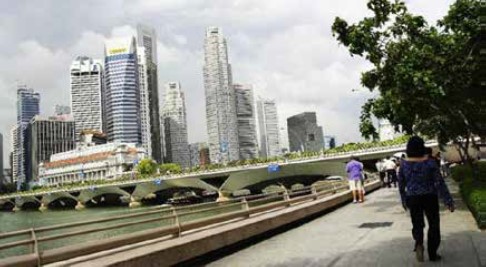
Marina Bay, Singapore, 16 April 2006. On the waterfront at Singapore’s Marina Bay district, tourists walk along its many paths to view the skyline across the Singapore River. © Luke Duggleby/ OnAsia.com.
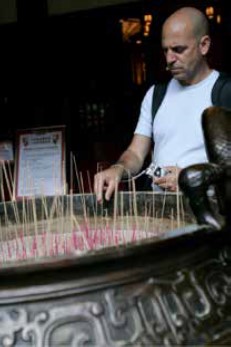
China Town, Singapore, 16 January 2009. A Buddhist devotee prepares to offer incense in the Buddha Tooth Relic Temple and Museum in Singapore. Buddhist devotees flock to the temple to offer their prayers for the upcoming Chinese New Year. © Joel Boh/ OnAsia.com.
Both tourist practice and the emphasis on place invite interpretations which seem to disclose the “increasing difficulty of drawing boundaries between the tourist and people who are not tourists” (Clifford, 1997) while distinguishing a tourist becomes “more difficult in circumstances of more complex tourist practices” (Crouch, Aronsson & Wahlström, 2001). The performance of place seems to elicit emerging definitions of tourist and how tourism is performed. In other words, all the photographers of the images reproduced above were also tourists doing tourism as they were indulging in taking photographs of tourists and tourism. They were framing the tourist text as much as they were being framed. It is within this context that creative spaces are developed in terms of social practice, with which the place determines performance as tourist.
Identifying Tourist
One definition of the tourist in cultural tourism is a “temporarily leisured person who voluntarily visits a place away from home for the purpose of experiencing a change” (Smith, 1977). Since then there have been definitions in terms of typology (Cohen, 1979), performance (Edensor, 2001) and even ambiguities (McCabe, 2002), and the writer advocates an investigation into the forms of touristic experience rather than the concept of the tourist as a stable category within tourism discourses. In an e-mail correspondence with a representative of the Singapore Tourism Board (STB) in my capacity as tourism researcher, I asked how the STB would define the tourist, and received this reply: “The STB looks at more than tourists. We welcome visitors (non-residents) who visit Singapore for all kinds of purposes, be it Leisure, Business, Healthcare or Education.”
How would residents fit into this broad, welcoming definition? The current “Beyond Words” concept which is part of the greater “Uniquely Singapore” campaign “moves beyond promoting the destination through product attributes and strives to bring out the depth of the Singapore experience” (STB, 18 July 2006) illustrated in the article entitled “Beyond Word”, The Next Phase Of Uniquely Singapore Brand Campaign, Breaks New Ground.
On-Ground Creative Approach
The new creative experience for the on-ground component of the new campaign “Beyond Words” strikes a deep chord with locals (and local families, businesses, retailers and hospitality agents) as well as generates multiple layers of local and international (e.g. ASEAN) publicity. It is designed to promote direct interaction between locals and tourists to enhance the “personal experience” element that is “Beyond Words”. Refreshing and vibrant bus wraps, taxi wraps, personalised bus hangers with information on various attractions, mobile display units, banners and standees all combine to make the brand personable and accessible to locals and visitors in Singapore.
The depiction of various modes of visual paraphernalia with the aim of personalising experience is perhaps less convincing and creative than the point that tourists and, especially, locals are targeted as part of this direct interaction. Indeed the STB welcomes more than “non-residents”, but how would residents or locals consume this new creative experience and would this consumption be any different from that experienced by tourists?
It was International Tourist Guide Day on 21 February 2009 and in commemoration of the event by the STB, free walking tours of three designated heritage areas were conducted by more than 80 Singaporean tour guides. Registration and assembling of the tours were coordinated on the grounds of the National Library where excited participants gathered. What was revealing was an interesting question posed on the registration sheet, “Tourists?”, of which all the participants answered in the negative, safe for “No. 12” who did not seem to be able to answer the question. In my subsequent hunt for “obvious” tourists, I found a German who would not consider himself a tourist as he was married to a Singaporean and lived in Singapore, and a Polish woman who asked the person at the registration desk to re-circle the “N” instead of the “Y” because she considered herself an expatriate in Singapore. At the end of the day, I finally found an American couple who said explicitly that they were tourists and were elated to have chanced on the occasion while walking by.

Public Registration Sheet for the International Tourist Guide Day 2009 free walking tour.
I wondered what kind of conclusion could be drawn from the curious question posed to the thousands of locals who thronged there. The event was conceived by the tourism board for locals, but the intrusion of touristic concepts in terms of the activity and the purveyors of tourism were not central to the discourse. In an ironic way, it was ostensibly a tour which did not constitute tourism, nor was it meant for tourists. Yet, it is also in this respect of ambiguity that challenges notions of tourism beyond the commonly agreed borders and the nuanced practices of the actors at play.
Performing Tourist
In an article in the Straits Times on 18 April 2009 entitled “Rediscover Singapore, says URA”, the Urban Redevelopment Authority (URA) as “Singapore’s master planning agency … is kicking off a string of initiatives to plan for the eventual recovery and to expand its own role locally and globally. It is also hoping to reacquaint Singaporeans with the city and renew their love for it, National Development Minister Mah Bow Tan said”, and added, “So let’s do what we would like to do overseas — let’s do our shopping, our eating, our sightseeing — let’s travel around Singapore, revisit the places we have not visited for a long time, maybe even discover some new surprises”.
“Rediscover Singapore” is also the name of a compact booklet highlighting places of interest for Singaporeans to experience. In the introduction of the publication, Jason Hahn (2003) writes,
[I]n our rush to explore the world, all too often, we overlook the fact that we are
strangers to our own backyards. In some ways, it’s almost trendy to trumpet the
fact that we don’t even know what’s beyond Orchard Road or our block of flats. As
phenomena go, this is nothing new. There are born and bred New Yorkers who’ve
never been to the Statue of Liberty, while millions of tourists travel around the
globe to visit her. But, if you ask us, that’s a shame. As the Chinese writer, Han Suyin,
once observed, the tree is known by its roots …. And while it may seem odd, at first
blush, to be producing a publication such as this, it became very clear right at the
beginning that Singaporeans are very unfamiliar with many of these places. In a
quixotic sense then, this magazine is about Singapore for Singaporeans.
The institutional attempt and discursive implements of identity building seem rather apparent. It is about a coordinated planting of human roots into spaces of familiarity and belonging. However, the kinds of identities that are being determined in terms of inclusionary and exclusionary space bring to fore the complexities of “love” for the city. Relph (1976, p. 49) in Place and Placelessness elaborates on “insideness” and “outsideness” in terms of human experience of place wherein “[t]o be inside a place is to belong to it and identify with it, and the more profoundly inside you are the stronger is the identity with the place.” Why is there pride in being putatively oblivious to the outskirts of downtown and cultivating an inside-outside confusion? And what is this quixotic sense: the ideal, the romantic or the delusional? The fluidity of tourist places and experiences and the meanings enmeshed in their constant negotiations and (re)productions are constructed through performance (Tucker, 2007; Chronis, 2005; Coleman & Crang, 2002). More than being about Singapore for Singaporeans, the discourse is laden with how to be “authentically” Singaporean and how to perform a Singaporean identity within compressible spaces. By looking at performance in terms of “symbolic interactions, discourses and signifying practices” (Mordue, 2005, p. 181), it is specifically the renewal of love and the rediscovery of the city which is becoming tourism and identity simultaneously.
Plate 13 is a walking tour map and guide of the “Malay ethnic” area known as Kampong Glam. It is one of the four prominent ethnic enclaves demarcated both in terms of national rhetoric to mark multiculturalism as a melange of CMIO, as well as, supporting tourism place designation. Unlike other guides similar to this one published by the STB, the URA version has a significantly Singaporean appeal. In the foreground is a young “Chinese” couple exploring the “traditional” Malay place exemplified by three “Malays” in the background flanked by two rows of shop houses, the women wearing baju kurung and donning tudung over their heads. The “races” in question are crucial to highlight the inherent representations of Chinese as Singaporeans performing tourism within a systematic, othered Malay space. But what if the Malays in the background were also performing tourist rather than performing local? Would there be a difference in comprehending the loci of a contextualised Singaporean space? I suppose the ideal place performance envisaged for the audience of this pamphlet would comprise the initial will to be there, the (re) discovery process of an exotic culture and a consequential knowledge fulfilment by way of experience which produces a greater place identity. The quest for identity is revealingly its acquisition at once, wherein the performance constitutes the thing it is performed for, when both locals and tourists engage in a coproduction (Bruner, 2005). In a “quixotic” sense, the Singaporean identity is seemingly about performing Singaporeanness through tourist practice.
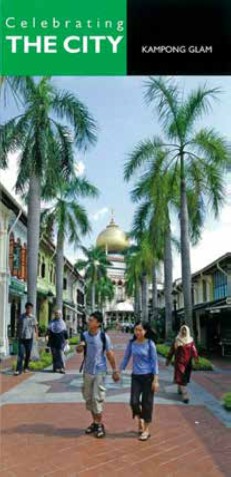
Image of a walking map produced by the Urban Redevelopment Authority (2005). © Urban Redevelopment Authority. All rights reserved.
Singaporean Under The Merlion
For a while I stood under the Merlion doing a vox pop, trying to understand what Singaporeans thought of the Merlion. I realised the answers were standardised depending on whether I was a tourist or a local. As a tourist, I was portrayed the way Ulysses would describe it, “This lion of the sea/This image of themselves” (Thumboo, 1979) in multicoloured splendour. As a local, I collected discourses of Sa’at’s (2005) Merlion, “how its own jaws clamp open in self-doubt”, “so eager to reinvent itself”. In answer to the “where are you from?” question, I would like to say after some contemplation, that I am a tourist from here. I have written elsewhere (Wee, 2009) that on the one hand it would seem that the determined national imperative to acquire a particular identity has seen ramifications that question its very construction, but on the other, the same national ideology that expends its energies in producing contrived identities is also capable of producing other forms of ironic and even affectionate identifications. The modern Merlion, albeit filled with conflicts and uncertainties and somewhat depressing, is also more real and aware of the incessant search for identity embedded as everyday discourse within itself. The Singaporean under the Merlion teases the reflexive self as person, concept, feeling and most crucially, the becoming of each or all given the locality.
It is also under the Merlion where “I” gaze and am being gazed at, in a “watching community … [where] it is in the audience watching shared events that identity is created” (Crang, 1998, p. 166). Local agencies are no longer simply producers of the product, but are an inherent part of the product in producing and projecting their bodies as performed selves in the construction of identity (Featherstone, 1983, p. 29). Rather than “who we are” or “where we came from”, Hall (1996) would assert that the more crucial questions would be what we might become, how we have been represented and how that bears on how we might represent ourselves. This paper explores the connections between representations of the tourist place through the branding, the ways in which they are consumed and experienced by the “local” and the kinds of identities that are constructed, questioned and reproduced. In an attempt to elucidate the tourist and how tourism is performed within a cityscape, questions are raised on how we identify tourists and how tourists identify themselves through the fusing of discourses, practices, materiality and technologies. The method employed is a doing of photography as tourist practice by analysing the production of images given by the tourist gaze and the reflexivities incorporating the self as photographer, researcher, tourist and local. More than sheer tourist snapshots exemplified by the Kodak moment, photography as practice incorporates photo taking as performance, agency of the photographable object and camera possession as tourist practice.
In the same way through performance, tourism and its actors are constantly in states or conditions of becoming, re-evaluating and repossessing particular jurisdictions of space and cultivating emergent forms of identity through meaningful contestations. If we look at everyday life as “the starting point of inquiry and the rationale for touristic behaviour”, (McCabe, 2002, p. 66–67), then the place performance of Singapore as a tourist city through its branding confounds identity in terms of how we identify tourists and how tourists identify themselves. Tourism is being incorporated into the every day and vice versa in ways whereby they are being reproduced through embodied practices. The positioning of “experience” in Singapore as creative space for local consumption through the Uniquely Singapore and the Rediscover Singapore campaigns provoke the collapsible nature (Simpson, 2001) of tourism and the everyday. This reproduction of space through the lens of the tourist and the local confuses the localities of consumption and acknowledges routes as performance.
In my second photograph (plate 14) taken at the Singapore Visitors Centre, I found next to the automated photo booth, a wardrobe containing different “ethnic” costumes one could don for the picture. I picked the outlandish Chinese outfit along with a skullcap with a Manchurian pigtail attached and expressed my absurdity wearing it. Just then, a lady with a fine British accent who worked there walked by and said to me, “You actually look quite good in it!” By looking at how tourist performance affords local performance, this paper seems to have produced a vague formula: local becoming tourist becoming local, which acknowledges a deeper enquiry into the agency of tourism rather than producing answers. It also investigates the bigger question, if the nomenclature of tourist-local is not already coalesced into a tourism-scape of buzzing practices. Baerenholdt et al. (2004) suggest the possibility “[t]o leave behind the tourist as such and to focus rather upon the contingent networked performances and production of places that are to be toured and get remade as they are so toured”. The allusion to the need of eschewing tourist practice instead of dealing with the fuzzy tourist is admittedly being overshadowed by the omnipresence and gregariousness of that same tourist. Rather than being a part of tourism, the tourist is indeed the bearer and embodiment of tourism, a synecdoche in which the tourist constitutes tourism.
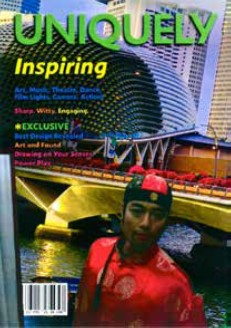
Souvenir Photo taken at a fully automated photo booth at the Singapore Visitors Centre on Orchard Road (on a separate occasion as the first in plate 1.) Naturally I described my Singapore experience another time.
The Sante Fe meeting on Creative Tourism posed a provocative question while introducing the agency of the local community, “Who are we as Creative Cities” and emphasised that “[i]n order for the tourist to feel a part of the city, the community must know and be proud of what they have, and be willing to cultivate local enterprises that share the experiences” (Towards Sustainable Strategies for Creative Tourism, 2006). Instead of looking at the construction of place as artificial or contrived by national imperative, the city of Singapore is nevertheless creative in that feeling part of the city is not only the desire of the tourist, but the local as well, who is also the tourist. The play of identities and the incessant adoption and rejection of places as part of an embodied pride to what constitutes Singaporean, is an attempt to negotiate a case of a relatively new sovereign-city state within the monuments of modernity.
The author wishes to acknowledge the contributions of Dr Philip Long, Principal Research Fellow, Centre for Tourism and Cultural Change, Faculty of Arts and Society, Leeds Metropolitan University, The Old School Board, in reviewing the paper.
References
Adrian Franklin, Tourism: An Introduction (London: Sage, 2003)
Alfian Sa'at, One Fierce Hour (opens in new tab) (Singapore: Landmark Books, 1998). (From National Library Singapore, call no. RSING S821 SAA)
Allan R. Pred, “Place As Historically Contingent Process: Structuration and the Time-Geography of Becoming Places,” Annals of the Association of American Geographers 74, no. 2 (June 1984): 279–97. (From JSTOR via NLB’s eResources (opens in new tab) website)
Athinodoros Chronis, “Coconstructing Heritage at the Gettysburg Storyscape,” Annals of Tourism Research 32, no. 2 (2005): 386–406.
Barbara Kirshenblatt-Gimblett, Destination Culture: Tourism, Museums and Heritage (Berkeley: University of California Press, 1998)
Ben Highmore, Everyday Life and Cultural Theory (London: Routledge, 2002)
“Beyond Words, The Next Phase of Uniquely Singapore Brand Campaign Breaks New Ground,” Singapore Tourism Board, accessed 15 July 2009.
Brenda Yeoh and Katie Willis, “Singapore Unlimited: Configuring Social Identity in the Regionalization Process” (Manuscript presented at the University of Nottingham, Department of Geography Seminar Series, January 1997)
Chris Rojek and John Urry, Touring Cultures: Transformations of Travel and Theory (London: Routledge, 2000)
Chua Beng Huat and Eddie C.Y. Kuo, The Making of a New Nation: Cultural Construction and National Identity in Singapore (opens in new tab), working paper no. 104. (Singapore: Department of Sociology, National University of Singapore, 1990). (From National Library Singapore, call no. RSING 959.57 CHU-[HIS])
David Chaney, Fictions of Collective Life: Public Drama in Late Modern Culture. (London: Routledge, 1993)
David Crouch, “Surrounded by Place, Embodied Encounters,” in Tourism: Between Place and Performance, ed. Simon Coleman and Mike Crang. (Oxford: Berghahn Books, 2002), 207–18.
David Crouch, Lars Aronsson and Lage Wahlström, “The Tourist Encounter,” Tourist Studies 1, no. 3 (2001): 253–70.
David Seamon, A Geography of the Lifeworld: Movement, Rest, and Encounter (New York: St Martin’s Press, 1979)
Dean MacCannell, The Tourist: A New Theory of the Leisure Class (New York: Shocken Books, 1976). (From National Library Singapore, call no. RUR 301.57 MAC)
Desmond Wee, “Singapore Language Enhancer: Identity Included,” Language and Intercultural Communication 9, no. 1 (2009): 15–23.
Douglas Kellner, “Popular Culture and the Construction of Postmodern Identities,” in Modernity and Identity, ed. Scott Lash and Jonathan Friedman (Oxford: Blackwell, 1992), 141–77.
E.A. Devan, Questioning Evolution and Progress, 22 November 2006.
E. Su, A Bump Boat Carrying Tourists on a Sight-Seeing Trip Along the Mouth of the Singapore River, 2007, photograph, OnAsia, accessed 15 July 2009. (Image Number: esu00181)
Edward M. Bruner, Culture on Tour: Ethnographies of Travel (Chicago: University of Chicago Press, 2005)
Edward Relph, Place and Placelessness (London: Pion, 1976)
Edwin Thumboo, Ulysses by the Merlion (opens in new tab) (Singapore: Heinemann Educational Books, 1979). (From National Library Singapore, call no. RSING 828.995957 THU)
Erik Cohen, “A Phenomenology of Tourist Experiences,” Sociology 13, no. 2 (1979): 179–202.
Erick Danzer, A Boat Carries Tourists Along the Singapore River Near Clarke Quay, 2006, photograph, OnAsia, accessed 13 July 2009. (Image Number: eda00484)
Fiona Chan, “Rediscover Singapore, Says URA (opens in new tab),” Straits Times, 18 April 2009, 64. (From NewspaperSG)
Geoffrey Benjamin, “The Cultural Logic of Singapore’s ‘Multiracialism’,” in Singapore: Society in Transition (opens in new tab), ed. Riaz Hassan (Kuala Lumpur: Oxford University Press, 1976). (From National Library Singapore, call no. RSING 309.15957 SIN)
Hazel Tucker, “Performing a Young People’s Package Tour of New Zealand: Negotiating Appropriate Performances of Place,” Tourism Geographies 9, no. 2 (2007): 139–59.
J. Boh, A Buddhist Devotee Prepares To Offer Incense in the Buddha Tooth Relic Temple and Museum in Singapore. Buddhist Devotees Flock to the Temple To Offer Their Prayers for the Upcoming Chinese New Year, 2009, photograph. From OnAsia. (Image Number: jbo00131)
J. Lengkeek, “A Love Affair With Elsewhere: Love as a Metaphor and Paradigm for Tourist Longing,” in The Tourist as a Metaphor for the Social World, ed. G. Dann (Wallingford: CABI Publishing, 2002), 189–208.
James Clifford, Routes: Travel and Translation in the Late Twentieth Century (Cambridge, MA: Harvard University Press, 1997)
John Urry, “Preface: Places and Performances,” in Travels in Paradox: Remapping Tourism (opens in new tab), ed. Claudio Minca and Tim Oakes (Lanham: Rowman and Littlefield, 2006), 1–3. (From National Library Singapore, call no. RBUS 338.4791 TRA)
Jonas Larsen, “Performing Tourist Photography” (PhD thesis, Roskilde University, Department of Geography, 2003)
Jonas Larsen, “Families See Photographing: The Performativity of Tourist Photography,” Space and Culture 8, no. 4 (2005): 416–34.
Jorgen Ole Baerenholdt et al., Performing Tourist Places (opens in new tab) (Aldershot: Ashgate, 2004). (From National Library Singapore, call no. RBUS 338.4791 PER)
Ken Simpson, “Strategic Planning and Community Involvement As Contributors to Sustainable Tourism Development,” Current Issues in Tourism 1, no. 4 (2001): 3–41.
L. Duggleby, On a Bridge Crossing the Singapore River in the Marina Bay District, Tourists Walk Along To View the Skyline in the Distance, 2006, photograph, OnAsia, 15 July 2009. (Image Number: ldu03821)
Lee Kuan Yew, From Third World to First: The Singapore Story, 1965–2000 (opens in new tab) (Singapore: Times Private Media, 2000). (From National Library Singapore, call no. RSING 959.57092 LEE-[HIS])
Lionel Wee, “Linguistic Instrumentalism in Singapore,” Journal of Multilingual and Multicultural Development 24, no. 3 (2003): 211–24.
M. Featherstone, “The Body in Consumer Culture,” Theory Culture and Society 1, no. 2 (1983): 18–33.
Marie-Franðcoise Lanfant, “International Tourism, Internationalization and the Challenge to Identity,” in International Tourism: Identity and Change (opens in new tab), ed. Marie-Franðcoise Lanfant, John B. Allcock and Edward M. Bruner (London: Sage, 1995), 24–43. (From National Library Singapore, call no. RBUS 338.4791 INT)
Marie-Franðcoise Lanfant, John B. Allcock and Edward M. Bruner, eds., International Tourism: Identity and Change (opens in new tab) (London: Sage, 1995). (From National Library Singapore, call no. RBUS 338.4791 INT)
Michael Haldrup and Jonas Larsen, “Material Cultures of Tourism,” Leisure Studies 25, no. 3 (2006): 275–89.
Michel de Certeau, The Practice of Everyday Life (opens in new tab) (Berkeley, CA: University of California Press, 1984). (From National Library Singapore, call no. 909 CER)
Mike Crang, Cultural Geography. (London: Routledge, 1998)
Mimi Sheller and John Urry, eds., Tourism Mobilities: Places to Play, Places in Play (opens in new tab) (London: Routledge, 2004). (From National Library Singapore, call no. RBUS 338.4791 TOU)
Nigel Thrift, “The Still Point: Resistance, Expressiveness Embodiment and Dance,” in Geographies of Resistance, ed. Michael Keith, Steven Pile (London: Routledge, 1997), 124–54.
Pamelia Lee, Singapore, Tourism and Me (opens in new tab) (Singapore: Pamelia Lee Pte Ltd., 2004). (Call no. RSING 338.47915957 LEE)
Paul Gilroy, Black Music, Ethnicity, and the Challenge of a Changing Same (London: Verso, 1994)
Paul Rae and Low Kee Hong, “Nosing Around: A Singapore Scent Trail,” Performance Research 8, no. 3 (2003): 44–54.
Peggy Teo and T.C. Chang, “Singapore: Tourism Development in a Planned Context,” in Tourism in South and South East Asia: Issues and Cases, ed. Colin Michael Hall, Stephen Page (Oxford: Butterworth-Heinemann, 2000)
Peter Schoppert, “The Merlion & Other Monsters: Some Notes on Singapore’s Moving Monuments,” in Lim Tzay Chuen, Mike (opens in new tab) (Singapore: National Arts Council & Singapore Art Museum, 2005). (From National Library Singapore, call no. RSING q731.86 LIM)
Rediscover Singapore: An Explorer’s Guide to Funky Finds, Fah Fun and Fantastic Food (opens in new tab) (Singapore: published for the Urban Redevelopment Authority by Media Corp Publishing Pte Ltd., 2003). (From National Library Singapore, call no. RSING 959.57 RED-[HIS])
S. McCabe, “The Tourist Experience and Everyday Life,” in The Tourist as a Metaphor for the Social World, ed. G. Dann (Wallingford: CABI Publishing, 2002), 1–18.
Sharon Siddique, “The Phenomenology of Ethnicity: A Singapore Case Study,” Sojourn: Social issues in Southeast Asia 5, no. 1 (February 1990): 35–62. (From JSTOR via NLB’s eResources (opens in new tab) website)
Simon Coleman and Mike Crang, eds., Tourism: Between Place and Performance. (Oxford: Berghahn Books, 2002)
Soile Veijola, “Heimat Tourism in the Countryside: Paradoxical Sojourns to Self and Place,” in Travels in Paradox: Remapping Tourism (opens in new tab), ed. Claudio Minca and Tim Oakes (Lanham: Rowman and Littlefield, 2006), 77–96. (From National Library Singapore, call no. RBUS 338.4791 TRA)
Stuart Hall, “Who Needs Identity?” in Questions of Cultural Identity, ed. Stuart Hall and and Peter Du Gay (London: Sage, 1996)
Susan Sontag, “The Image-World,” in Visual Culture: The Reader, ed. Jessica Evans and Stuart Hall (London: Sage, 1999), 80–94.
T. C. Chang, “Local Uniqueness in the Global Village: Heritage Tourism in Singapore (opens in new tab),” (PhD thesis, McGill University, 1996), manuscript. (From National Library Singapore, call no. RSING 338.47915957 CHA)
Tim Cresswell, Place: A Short Introduction. (Oxford: Blackwell, 2004)
Tim Edensor, “Performing Tourism, Staging Tourism: (Re)producing Tourist Space and Practice,” Tourist Studies 1, no. 1 (2001), 59–81.
Tim Edensor, “Sensing Tourist Spaces,” in Travels in Paradox: Remapping Tourism (opens in new tab), ed. Claudio Minca and Tim Oakes (Lanham: Rowman and Littlefield, 2006). (From National Library Singapore, call no. RBUS 338.4791 TRA)
Tom Mordue, “Tourism, Performance and Social Exclusion in ‘Olde York’,” Annals of Tourism Research 32, no. 1 (2005): 179–98.
United Nations Educational, Scientific and Cultural Organization, “Towards Sustainable Strategies for Creative Tourism. Discussion Report for 2008 International Conference on Creative Tourism Santa Fe, New Mexico, U.S.A. October 25–27, 2006,” UNESCO, accessed 10 July 2009.
Urban Redevelopment Authority, Celebrating the City: Kampong Glam (opens in new tab) (Singapore: Urban Redevelopment Authority, 2005). (From National Library Singapore, call no. RCLOS 915.95704 CEL)
Valene L. Smith, ed., Hosts and Guests: The Anthropology of Tourism (Philadelphia: University of Philadelphia Press, 1977).
Zygmunt Bauman, “From Pilgrim to Tourist – or a Short History of Identity,” in Questions of Cultural Identity, ed. Stuart Hall and Paul du Gay. (London: Sage., 1996), 18–36.
Zygmunt Bauman, Liquid Modernity (Wiley: Blackwell, 2000)